The dynasty of the Sukkalmaḫs in Susa rests on a disputed chronological basis and the way in which it took over from the Šimaškian rulers is still a matter for debate.
New evidence, based on the study of Chantier B from Susa's Royal City published in MDP 55, has recently led to a new chronology for the beginning of the Sukkalmaḫat. The basic argument for this is the early dating of the rule of Atta-ḫušu which, based on my study of Chantier B, can be dated at least eighty years earlier than the generally accepted chronology as stated most recently in Steve et al. Reference Steve, Vallat and Gasche2002.
Since then, responses in defence of the generally accepted chronology have been offered by Vallat (Reference Vallat2007, Reference Vallat2009), a new inscription of the Šimaškian ruler Idattu has been published (Steinkeller Reference Steinkeller2007), and new insights on the chronology and history of this period have been formulated by Glassner and Steinkeller and presented at the International Congress on Susa and Elam, Ghent University, December 2009. At the same time I have been working on additional material from the same early period in Susa,Footnote 2 putting things in a wider perspective in order to develop a chronological and historical perspective on the transitional period between the loss of control by the Ur III empire and the institutionalization of the Sukkalmaḫ regime, in order to come to a chronologically solidly grounded and coherent socio-economic history of the early Sukkalmaḫat.
In light of all the new material and insights, the time has come to reconsider the chronology I proposed and to investigate whether and to what extent it can be adjusted, corrected and specified.
How it all started
The idea for the new chronology originated in the study of the tablets found in Chantier B of Susa's Royal City by Ghirshman in the 1960s, and more particularly in the study of the archaeological and archival context of these tablets (MDP 54: 1–16 and MDP 55: 1–12 and 21–3). It must be remembered that Ghirshman was the first to undertake stratigraphical excavations in the Royal City of Susa. Over the course of twenty archaeological campaigns (1946–66) he uncovered fifteen stratigraphical levels in his large Chantier A situated at the northern edge of the Royal City. He then decided to open a new stratigraphic Chantier to bridge the gap of more than 250 years in the occupation of Susa between the most recent levels found earlier on the Acropolis, some wells from the Ur III period, and the earliest level of his Chantier A, which could be dated to within the Sukkalmaḫ period, about 1700 bce.
This new Chantier (Chantier B)Footnote 3 was located in a small area (c. 700 square metres) on the southern edge of the Royal City, on one of the terraces of the ancient second sounding of de Mecquenem, which was excavated in the 1920s (MDP 25: 218–21). Within this Chantier B, five different levels were uncovered: VII, dating from the late Ur III period,Footnote 4 VI ancien, dating from the Šimaškian dynasty, V ancien, dating from the beginning of the Sukkalmaḫat,Footnote 5 and VI and V récent, both dating from the late Sukkalmaḫat.Footnote 6
The two levels of interest here are VI ancien and especially V ancien. From an archaeological point of view, there is no interruption in the occupation of this part of Susa between these two levels (MDP 47: 13). In VI ancien, seventeen administrative tablets and fragments were found (MDP 55: 2–3). In V ancien, sixty-eight administrative tablets and fragments were unearthed, of which some could be joined, which left me with sixty-two administrative tablets and fragments (MDP 55: 5–7). Unfortunately, none of these tablets have a date. In consequence, only relative dates could be assigned to these two levels, based on indications from the texts, palaeography (Steve et al. Reference Steve, Gasche and De Meyer1980: 87–8) and the occurrence of known and datable historical figures. In VI ancien, the impression of the seal of Me-Kūbi, daughter of Bilalama the king of Ešnunna and wife of Tan-Ruhurater,Footnote 7 one of the Šimaškian rulers, was found, which led Steve et al. to date VI ancien to within the so-called Šimaškian dynasty. The occurrence of Šilhaha (MDP 55, 26) and Atta-ḫušu (MDP 55, 20 and 23) within the texts of V ancien made it possible to date this level to the beginning of the Sukkalmaḫat. This relative dating is supported by the results of Gasche's study on the tombs of Susa (unpublished PhD). On this basis Gasche dates Level VI ancien to c. 1910–1850 bce and Level V ancien c. 1850–1775 bce.
However, as I will argue later, we need to ask whether the Šimaškian dynasty really existed as a period in the history of Susa between the Ur III occupation and the institutionalization of the Sukkalmaḫat, and consequently whether Levels VI and V ancien of Chantier B are really to be interpreted as belonging to two different chronological periods (the Šimaškian dynasty and the Sukkalmaḫat), especially in view of the fact that there is no interruption in the occupation between both levels. I will return to this subject later.
The Ašiši dossier (B V ancien)
Among the tablets found in V ancien, there is one coherent group of twelve, found in locus 33. It consists of economic and accounting documents, mostly receipts and lists of expenditures or deliveries. Some of these texts show that this group of texts belonged to the (remnant) archive of a certain Ašiši (MDP 55: 7–8). Three of these Ašiši texts were not only very important in dating Level V ancien, but they turned out to be crucial in the development of a new chronology of the transitional period: MDP 55, 20, an atypically written receipt of silver in Akkadian containing an oath by Atta-ḫušu, to which I will return in greater detail below; MDP 55, 23, a zi-ga record mentioning Atta-ḫušu as the official responsible; and MDP 55, 26, a list mentioning a servant of Šilhaha.
Although Šilhaha's title is not given in this last text, there is no doubt that we are dealing with the rulerFootnote 8 of that name, since he is mentioned among other very important persons such as the teppirFootnote 9 and the vice sukkal (egir sukkal). The mention of Šilhaha and Atta-ḫušu in texts of one and the same archive can only lead to the conclusion that both Atta-ḫušu and Šilhaha ruled in Susa during Ašiši's life, or in other words, that Šilhaha and Atta-ḫušu were (at least partly) contemporaries.
Moreover, we know from a Susa text published by De Meyer (Reference De Meyer, Beek and de Liagre Böhl1973) that the so-called founder of the Sukkalmaḫat, Ebarat II and Šilhaha ruled at least in part at the same time. We can thus conclude that Ebarat II, Šilhaha and Atta-ḫušu were at least partly contemporaries.
However, Vallat (Reference Vallat and Durand1996a; Reference Vallat2007; and 2009, cf. also Steve et al. Reference Steve, Vallat and Gasche2002) dates Atta-ḫušu to the time of Gungunum of Larsa's reign (1837–1811 bce) and that of Sumu-abum “of Babylon”Footnote 10 (1798–1785 bce). Between the reigns of Ebarat II and Šilhaha on the one hand, and Atta-ḫušu on the other, Vallat (Reference Vallat2007: 84) situates five Sukkalmaḫs: Temti-Agun I, Pala-iššan, Kuk-Kirmaš, Kuk-Naḫhunte and Kuk-Našur I. In other words, there was almost a century between the reigns of Ebarat II and Šilhaha, which he dates to c. 1880 bce, and that of Atta-ḫušu, who, he argues, still ruled in 1798 bce, the first year of the reign of Sumu-abum “of Babylon”.
Evidently the information gained from the Ašiši texts does not fit with this chronology. It is impossible that Atta-ḫušu, who was a contemporary of Ebarat II and Šilhaha and reigned c. 1880 bce, would still have been in power eighty-two years later in 1798 bce.
Let us therefore reconsider the main arguments for the chronology proposed by Vallat.
Reconsidering Vallat's chronology
Sumu-abum “of Babylon” (1798–1785 bce) and Atta-ḫušu
The first and probably most important argument is the contemporaneity between Sumu-abum “of Babylon” and Atta-ḫušu (Vallat Reference Vallat and Durand1996a: 310–11; Steve et al. Reference Steve, Vallat and Gasche2002: 383–4 and 446–7). This contemporaneity is argued on the basis of MDP 10, 2. In MDP 10 Scheil published a group of twenty-eight texts which mention a person named Kûyâ.Footnote 11 In these texts, all but one of which are zi-ga records, sheep are being expended for several purposes (for gūšum and ḫatāpi offerings, for banquets, to temples … ) by several people. In almost all cases, the sheep are being expended at Kûyâ's place (ki Kûyâ):Footnote 12 in other words, this is a coherent group of texts that can be dated to within the time span of the life of Kûyâ. The seal of Adad-rabi, son of Rīm-Adad, servant of Atta-ḫušu is impressed on six of these Kûyâ texts (MDP 10: 2, 11, 17, 21, 22 and 32), leading to the conclusion that Atta-ḫušu ruled in Susa during Kûyâ's life. On one of these Kûyâ texts (MDP 10, 2) we read on the left edge: mu šà šu-mu-a-bi. Vallat (Reference Vallat and Durand1996a: 310–11, cf. also Steve et al. Reference Steve, Vallat and Gasche2002: 383–4 and 446–7) considers this line to be a variant of Sumu-abum “of Babylon”'s first year formula, hence the contemporaneity between Atta-ḫušu and Sumu-abum.
Grillot and Glassner (Reference Grillot and Glassner1993) have argued that the Šumu-abi from MDP 10, 2 could not have been the first king of Babylon, and I concur with these authors.
First, the lack of the word lugal on MDP 10, 2 – a word that is incontestably part of the typical expression used in year formulae of the type mu RN lugal “Year RN became king” – rules out that the expression on MDP 10, 2's left edge could be a proper year formula.
Moreover, Charpin (Reference Charpin, Charpin and Stol2004: 85–6) has convincingly proposed that Sumu-abum never reigned in Babylon and consequently never had any year names – the ones extant in date lists being an artificial construct of later scribes. This is not to say that Sumu-abum was not an important person in his time: he would have been a kind of Amorite “overlord” whose authority was recognized in several cities under the rule of local Amorite kings, mainly in northern Babylonia. This was expressed in oaths taken by him and the local king.
Furthermore, there are no historical sources suggesting that Susa was ever under any form of control of Sumu-abum.
But how should we then interpret mu šà šu-mu-a-bi? First, as I mentioned earlier, there is no lugal at the end, which is odd if this should be a year name. Further, the Sumerian mu is used to express both “year” (Akk. šattu) and “name” (Akk. šumu) and šà is commonly used in Susa to express the Akkadian determinative and relative pronouns ša (De Meyer Reference De Meyer1962: 43–6 and Salonen Reference Salonen1962: 11). Furthermore, the same Šumu-abum appears in another Kûyâ text, MDP 10, 21, where he is the official responsible (gìr) for the transaction. As Grillot and Glassner (Reference Grillot and Glassner1993) noted, the signs gìr and mu seem to be interchangeable in the Kûyâ texts, as can be seen from MDP 10, 16, 25 and 35 where mu lú kin.gi4.a is used, vs. MDP 10, 19, 33 and 36 where gìr lú kin.gi4.a is used in the same context. We can therefore conclude that mu šà šu-mu-a-bi (MDP 10, 2: 16) is simply a variant of gìr šu-mu-a-bu-um (MDP 10, 21: 7) meaning “In the name of / under the responsibility of Šumu-abum”.Footnote 13 Hence, there is no synchronism between Atta-ḫušu and Sumu-abum “of Babylon”.
Gungunum of Larsa (1837–1811 bce) and Atta-ḫušu
The second argument is the contemporaneity between Gungunum of Larsa and Atta-ḫušu. Indeed, Vallat states that Gungunum installed Atta-ḫušu on the throne in Susa during his second campaign against Elam in the fifth year of his reign,Footnote 14 viz. 1834 bce (Vallat Reference Vallat and Durand1996a: 310–11; Steve et al. Reference Steve, Vallat and Gasche2002: 446–7). He deduces this from the year name mentioned on MDP 10, 124: mu é ᵈinana larsaki ba.dù!?Footnote 15 “Year the temple of Inana in Larsa was built”, which is Gungunum's sixteenth year name. The fact that a tablet from SusaFootnote 16 should bear a year name of a king of Larsa is remarkable and, moreover, unique. Stolper (Reference Stolper1982: 56, cf. also Carter and Stolper Reference Carter and Stolper1984: 23), interprets this as evidence of a short period of Larsa domination in the Susiana region and rules out the possibility of longer Mesopotamian control of the region at this time.
However, as Gungunum only campaigned against the East (Bašime and Anšan) in the second and fourth years of his reign,Footnote 17 it is impossible that a short Larsa interlude in Susa would have lasted until his sixteenth year – all the more since MDP 10, 124 is the only Susa tablet bearing a Larsa year name. In other words, this tablet cannot be adduced as proof of longstanding Larsa rule in Susa, since it requires that Gungunum would never have had the power to put Atta-ḫušu on the throne there.
A more fundamental problem is that whereas the link with Gungunum is clear, however we interpret it, nothing in this tablet refers to Atta-ḫušu. Why was such a reference ever supposed to exist? Most probably, the 126 administrative tablets published in 1908 by Father Vincent Scheil in MDP 10 were found during the 1898–99 excavation season headed by J. de Morgan on the Acropolis of Susa.Footnote 18 Scheil (MDP 10: 14) presumed that they all dated from the same period, i.e. the period of Atta-ḫušu. However, he noted two exceptions, texts bearing Ur III year names,Footnote 19 and collation revealed a third one from the same period. My study of the MDP 10 texts showed that certain groups, such as the Kûyâ dossier, indeed date from Atta-ḫušu's time, for others this cannot be determined. This same Kûyâ dossier allows us to conclude, as I will demonstrate in this article, that Atta-ḫušu was contemporaneous with Šilḫaḫa and Ebarat II, who are dated to c. 1880 bce by Vallat and others. The Susa tablet with the Gungunum year name is to be dated to 1822 bce, some fifty-eight years later. Since he was in power fifty-eight years before, Atta-ḫušu cannot have been promoted by Gungunum and they could hardly even have been contemporaries. In all probability, the MDP 10 volume contains some coherent groups but also some loose tablets, such as the much earlier Ur III texts and the later Gungunum document.Footnote 20
The argument for a synchrony between Gungunum and Atta-ḫušu cannot really be upheld on this basis.
The Pala-iššan group and Atta-ḫušu
The third argument is the fact that Atta-ḫušu is to be dated after the Pala-iššan group, consisting of the Sukkalmaḫ Pala-iššan and his immediate successors Kuk-kirmaš, Kuk-Naḫundi and Kuk-Našur (Vallat Reference Vallat1989a; Reference Vallat and Durand1996a: 304 and 309–311; 2007: 84 and Steve et al. Reference Steve, Vallat and Gasche2002: 445–6). In his most recent reconstruction of the genealogy and chronology of the early Sukkalmaḫs, Vallat (Reference Vallat2007) places Temti-Agun I between Šilhaha and Pala-iššan, thus creating a group of five Sukkalmaḫs (Temti-Agun I, Pala-iššan, Kuk-kirmaš, Kuk-Nahundi and Kuk-Našur) who reigned after Ebarat II and Šilhaha.
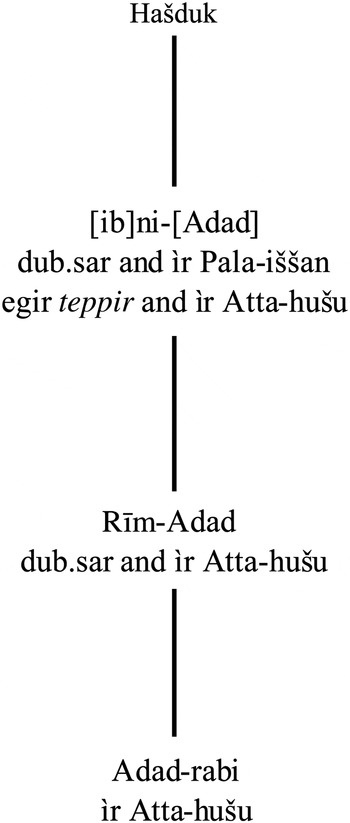
He situates Atta-ḫušu after this Pala-iššan group on the basis of his reconstruction of the family tree of Adad-rabi, a servant of Atta-ḫušu (Vallat Reference Vallat1989a). As mentioned above, the seal of Adad-rabi, son of Rīm-Adad, servant of Atta-ḫušu, is rolled on six tablets belonging to the Kûyâ dossier (MDP 10, 2, 11, 17, 21, 22 and 32). The seal of Adad-rabi's father is also known (MDP 43: n 1682 and 1683). Its legend reads: Rīm-Adad, scribe (dub.sar), son of Ibni-Adad, servant of Atta-ḫušu. Note that both father and son were servants of Atta-ḫušu, which not only means that Atta-ḫušu's rule must have been rather long, but that the Kûyâ texts date from the later part of Atta-ḫušu's reign as the son was already in service. The crucial point of this argument is that, according to Vallat (Reference Vallat1989a), the seal of Ibni-Adad, father of Rīm-Adad and thus grandfather of Adad-rabi is to be found in an early publication of Scheil (Reference Scheil1926) where he reads [Ib]ni-[Adad], dub.sar, son of Hašduk, servant of Pala-iššan. Although, in reality, the first line of this seal legend only has the signs ni and dingir, Vallat completes it to [ib]-ni-ᵈ[iškur] and identifies this dub.sar with the assistant or vice teppir (egir teppir) Ibni-Adad, who served under Atta-ḫušu according to the inscription on a bronze gunaggu vessel, published by Sollberger (Reference Sollberger1968). On the basis of this seal legend and inscription, Vallat (1989a) reconstructs the family tree shown in Figure 1, from which it is clear that Ibni-Adad served first under Pala-iššan and later under Atta-ḫušu.
Vallat's reconstruction of the family tree

As the five successors of Pala-iššan are known. Atta-ḫušu must have reigned after this group of six rulers according to Vallat.
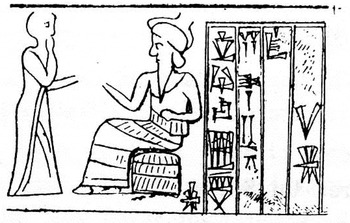
However, in my opinion, it is impossible to complete the first line of the seal legend as [ib]-ni-ᵈ[Iškur]. It is obvious that the first part of the name was Ibni-, but there is not enough space left after the dingir to write an iškur, as can be seen on the drawing in Scheil Reference Scheil1926 (Figure 2). Most probably, there was either a small sign such as utu (Ibni-Šamaš), or no sign at all after the dingir (Ibni-ilum). Unfortunately, this seal legend cannot be collated, as nobody knows where the seal impression in question is to be found.Footnote 21
Drawing from Scheil Reference Scheil1926. Reproduced with permission.

Furthermore, even if the seal belonged to an Ibni-Adad, the grounds for identifying him with the grandfather of Adad-rabi are inadequate: the similarity in name would not be enough and neither would the difference in title add anything to the argument.
In conclusion, the supposed family relations between Adad-rabi and Ibni-Adad cannot be upheld and so the assumption that Pala-iššan (and his five successors)Footnote 22 reigned before Atta-ḫušu loses all ground.
Arguments to date Atta-ḫušu at the beginning of the Sukkalmaḫat
Now that the arguments for a later date have been examined and proved unconvincing, I will present my arguments for dating Atta-ḫušu earlier, viz. to the time of Ebarat II and Šilhaha.
As we saw above, the texts of the Ašiši dossier (MDP 55, 20 and 26) mention Atta-ḫušu and Šilhaha, the Susa document published by De Meyer (1973) mentions Ebarat II and Šilhaha. These three rulers must thus have been (at least partially) contemporaneous, which means that Atta-ḫušu must be situated at the beginning of the Sukkalmaḫat. We will now see that texts belonging to the Kûyâ dossier confirm this.
The Kûyâ dossier (MDP 10)
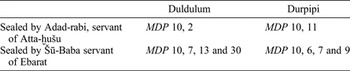
All 27 zi-ga records in the Kûyâ dossier are sealed. As we have seen, six of these tablets are sealed by Adad-rabi, son of Rīm-Adad, servant of Atta-ḫušu (MDP 10, 2, 11, 17, 21, 22 and 32). Eight others are sealed by Šū-Baba, son of Rīb-Narte, servant of EbaratFootnote 23 (MDP 10, 4, 6, 7, 9, 13, 30, 40 and 44). Apart from Kûyâ, who is mentioned in all of the texts, two suppliers of small cattle, Duldulum and Durpipi, are mentioned on tablets sealed by Adad-rabi or Šū-Baba, as seen in Table 1.
Duldulum and Durpipi as mentioned on tablets sealed by Adad-rabi or Šū-Baba

This means that at least three people, Kûyâ, Duldulum and Durpipi, were active during the reigns of both Ebarat and Atta-ḫušu, or in other words, that both Ebarat and Atta-ḫušu reigned during the professionally active part of the lives of Kûyâ, Duldulum and Durpipi, and were therefore no doubt at least partly contemporary.
Other sources
There is a Šimaškian king list and a so-called genealogy of Šilhak-Inšušinak which have been variously interpreted in the past. We are now better placed to establish whether their comparison with information culled from administrative, legal and economic documents allows us to understand them better.
The Šimaškian king list
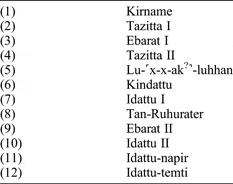
Only one of our three leading figures, Ebarat, is mentioned in the Šimaškian king list (Scheil Reference Scheil1931 and MDP 23: IV): he is the ninth ruler, preceded by Tan-Ruhurater (8) and followed by three more rulers: Idattu II (10), Idattu-napir (11) and Idattu-temti (12).
It is known that three Šimaškian kings, Kirname, Tazitta and Ebarat, were contemporariesFootnote 24 so here again, rulers listed as sequential were in fact simultaneous and doubt was cast on the chronological reliability of this document. However, Steinkeller (Reference Steinkeller2007: 221–2) has published a new inscription of Idattu I, who described himself as the grandson of Ebarat I and the son of Kindattu. Hence, Steinkeller concluded that at least for the line of Ebarat I, the Šimaškian king list is to be considered a genuine chronological source. However, since this is not true for other early Šimaškian rulers, the question arises as to whether this is true for the later Šimaškian rulers – the list is, after all, a copy from Hammurabi's time (Scheil Reference Scheil1931: 2).
An important question is why Ebarat II is included in this list, while his contemporaries Šilhaha and Atta-ḫušu are not. Does this imply that Šilhaha or Atta-ḫušu were not of Šimaškian descent? I do not think soFootnote 25 and will propose another reason for their “exclusion” below.
The king list and the Kûyâ archive
The Kûyâ archive sheds further light on the chronology of the names mentioned in the list:
• The Kûyâ archive: Idattu-napir ~ Atta-ḫušu. Tablets from this archive indicate that at least one of Ebarat II's successors in the Šimaškian kinglist, Idattu-napir, was a contemporary of Atta-ḫušu (and thus also of Šilhaha and Ebarat II). MDP 10, 21, a tablet sealed by Adad-rabi, servant of Atta-ḫušu, records the expenditure of seven fattened male sheep by Idattu-napir at Kûyâ's place, indicating that Idattu-napir ruled (a part of) the Šimaškian land(s) while Atta-ḫušu ruled in Susa.
• The Kûyâ archive: Idattu I ~ end Šimaški, beginning Sukkalmaḫ ~ Atta-ḫušu. Two other Kûyâ texts, MDP 10, 16 and 27, record the expenditure of sheep at Kûyâ's place by Šū-Rimku, who is also mentioned in the tablets from B VI ancien (MDP 55, 4) and B V ancien (MDP 55, 48, 49 and 58) – as well as in other Susa textsFootnote 26 – and whose seal legend reads Šū-Rimku, physician, son of Puzur-Ištar, servant of Idattu who in all probability is Idattu IFootnote 27 (MDP 43, nr 2325).Footnote 28 In other words, Šū-Rimku, who served under Idattu I, is attested in administrative Susa texts that can be dated with certainty to the end of the so-called Šimaškian dynasty (B VI ancien) and the beginning of the Sukkalmaḫat (B V ancien and Kûyâ dossier). The three seals of the scribe Sir-ahu-pitir, who calls himself a servant of Idattu (I or II)Footnote 29 in two of them and a servant of Atta-ḫušu in the thirdFootnote 30, point in the same direction.
The Cylindroid of Atta-ḫušu: the exclusion of Šilḫaḫa and Atta-ḫušu explained?
Recently, GlassnerFootnote 31 proposed, after collation, a new interpretation of the so-called Cylindroid of Atta-ḫušu (MDP 28, 4), an inscription ordered by Atta-ḫušu to commemorate his (re)building of a temple for Nanna, in which he mentions both Ebarat II and Šilhaha.Footnote 32 Based on his new reading of the inscription, Glassner puts forward the theory that Ebarat II ruled as king over Anšan and Susa while Šilhaha, being his Sukkalmaḫ, exercised authority in his name over Elam and/or Šimaški. He refers to an inscription published by Steinkeller (Reference Steinkeller2007) in which Kiten-rakittapi, Sukkalmaḫ of Elam and teppir, calls himself a servant of Idadu, king of Anšan, Šimaški and Elam.Footnote 33 Steinkeller (Reference Steinkeller2007: 222 n. 29) concluded from this inscription that the Sukkalmaḫ of Elam was a deputy of the king of Anšan and that the later (Old-Babylonian) Sukkalmaḫs of Susa were also dependent on the rulers of Anšan. This is certainly true for the Šimaškian and transitional periods and the early Sukkalmaḫat.Footnote 34 Adding Atta-ḫušu to the equation we can conclude that Ebarat II, Šilhaha and Atta-ḫušu exercised their power each on a different level and/or in a different area but, as we saw above, at the same time. While Ebarat II ruled as king over Anšan and Susa, Šilhaha was his Sukkalmaḫ in Elam (or Šimaški and Elam) and Atta-ḫušu was his sukkal and teppir in Susa. This could explain why only Ebarat II was mentioned in the Šimaškian king list: the other two were not kings in their own right.
Šimaškian kinglist (Scheil Reference Scheil1931 and MDP 23: IV)

The so-called genealogy of Šilhak-Inšušinak
This is a Middle Elamite royal inscription (König Reference König1965: nos 48/a/b), not giving the ancestors of Šilḫak-Inšušinak as its (erroneous) modern name might suggest, but listing the earlier kings who built and/or restored temples in Susa. The text mentions our three key figures: Ebarat, Šilhaha and Atta-ḫušu. It goes without saying that this list is incomplete as it only mentions the rulers who built and/or restored temples, but it can be demonstrated that a number of the rulers are not given in chronological order. Of interest to us is that between Ebarat II and Šilhaha on the one hand, and Atta-ḫušu on the other, three rulers are mentioned: Širuktuh, Ṣiwe-palar-huppak and Kuk-kirwaš.Footnote 35 With certainty all of them can be dated later than the reigns of Ebarat II, Šilhaha and Atta-ḫušu: Širuktuh is mentioned in a letter of Shemshara, dated during the reign of Samsî-Addu (1710–1679 bce);Footnote 36 Ṣiwe-palar-huppak is mentioned on several occasions in the Mari archive, showing that he ruled at the same time as Zimri-Lim of Mari (c. 1671–1659 bce) and Hammurabi of Babylon (1696–1654 bce);Footnote 37 and Kuk-kirwaš ruled (at least partly) at the same time as Pala-iššan, as they are mentioned together in the oaths of MDP 24: 348 and 349.
The chronological mix-up has everything to do with the fact that this list was compiled some 300 years after the Sukkalmaḫ period. This must have been done on the basis of earlier inscriptions that the scribe of the “genealogy” tried to integrate into his document. The sequence Šilḫaḫa – Širuktuḫ and Ṣiwe-palar-huppak could stem from a single inscription because the names are linked: Širuktuḫ is called the ruḫu šak of Šilḫaḫa and Ṣiwe-palar-huppak is the ruḫu šak of Širuktuḫ. It could well be that the scribe did not want to interrupt this sequence and placed Kuk-Kirwaš and Atta-ḫušu, who should have come between them, after them.
Other factors may have played a role, such as the wrong ordering of the rulers to be included, as Steinkeller (Reference Steinkeller2007) showed for the very beginning of the list, where the Šimaškian kings are placed in the wrong order.
In other words, the “genealogy” cannot be used as such for chronological purposes.
A new element in the debate: a very odd receipt of silver
I recently published a receipt of silver (MDP 55, 20) and examined its orthographical peculiarities and its important chronological implications. Since there has been some debate about itFootnote 38 I will summarize my arguments and the debate about them. My original interpretation of this textFootnote 39 will be supplemented with some new ideas, as well as a discussion of recent proposals by Vallat (Reference Vallat2009) and Glassner (forthcoming). Finally I will interpret it within its archaeological and archival context as well as within the knowledge and understanding we have so far of the so-called Šimaškian and Sukkalmaḫ periods.
For the present chronological discussion, the interesting part of this text is the oath formula.
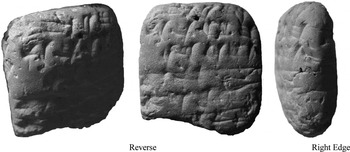
The oath formula of MDP 55, 20 (Rev. 6–9). Courtesy of the National Museum of Iran.

The oath formula of MDP 55, 20 (Rev. 6–9)
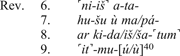
This oath formula is phrased in an unusual way. The scribe chose to use the Akkadian nīš instead of the commonly used Sumerian mu to start with, which is only rarely seen in Old-Babylonian Susa texts. The part between the nīš “by the life of” on line 6 and the itmû “they swore” on line 9, or in other words, by whose life or lives the oath was taken, is even more enigmatic. The only clear and indubitable thing is the first name after the nīš: although the scribe used an atypical spelling and, moreover split up the name, writing the first part on the second half of the sixth line and the second part on the beginning of the seventh line – a practice inconceivable in the Mesopotamian scribal tradition – this clearly is Atta-ḫušu (a-ta- / -hu-šu). The key question, however, is who or what is mentioned after Atta-ḫušu. Due to the severe wear of the reverse of the tablet as well as the clumsiness with which this clearly inexperienced scribe wrote the cuneiform signs, this particular passage can be read and interpreted in different ways.
Depending (a) on how one interprets the ù after Atta-ḫušu's name – is it the conjunction “and” or is it the lengthening of the final vowel of the preceding personal name? – and (b) on how one reads the last sign on line 7 – ma or ba – three interpretations are possible:
(1) nīš Atta-ḫušu ù PN itmû “By the life of Atta-ḫušu and PN they swore”
(2) nīš Atta-ḫušu ù mar PN itmû “By the life of Atta-ḫušu and the son of PN they swore”
(3) nīš Atta-ḫušu mar PN itmû “By the life of Atta-ḫušu, son of PN, they swore”
In se, option (1) seems to be most likely: it is perfectly logical that an oath would be taken by the lives of Atta-ḫušu and a co-ruler or subordinate, or by Atta-ḫušu and a divinity. However, the lack of a /dingir/ determinative preceding the second personal name rules out the latter. The following readings are possible for the co-ruler or subordinate: (1) Marq/kištum: ma- / -ar- ki-iš-˹tum˺ (MDP 55: 23–4 and 104–5), (2) Marq/kidatum: ma- / -ar- ki-da-˹tum˺ (MDP 55: 23–4 and 104–5), (3) Par-Kištum: pá- / ar-ki-iš-˹tum˺ (Vallat Reference Vallat2009) and (4) Par-Kišatum: pá- / ar-ki-ša-˹tum˺ (Glassner, forthcoming).
None of these personal names is ever attested elsewhere, either in Elam or in Mesopotamia. It is strange, but of course possible, that a co-ruler or subordinate of Atta-ḫušu was not yet mentioned in one of the hundreds of administrative texts or royal inscriptions from Susa that came to us. However, we would expect Atta-ḫušu's colleague to have a proper Elamite name, as all rulers, Šimaškian or Epartid, had, and this seems, apart from the possible first part being Par-, not to be the case here.
Options (2) and (3) are less likely at first sight: taking an oath before somebody and the son of somebody else, without actually naming this son, or adding the patronym in an oath formula is quite remarkable and to my knowledge unseen. Combining the last sign on line 7, ma, with the first one on line 8, ar, yields the Akkadian construct state mār “son of”, which produces the following possible readings: (1) ma-ar qí-iš-˹tum˺ “son of Qīštum” and (2) ma-ar ki-da-˹tum˺ “son of Kidatum”. In other words, the oath was taken before Atta-ḫušu and a son of either Qīštum or Kidatum, or, if the ù is part of his name, Atta-ḫušu was the son of either Qīštum or Kidatum. No Qīštum or son of Qīštum can be linked to Atta-ḫušu or Susa. Moreover, we would expect Atta-ḫušu's or his co-ruler's father to have an Elamite name and certainly not an Akkadian one like Qīštum. This leaves us with Kidatum, which makes indeed much more sense, as it can be interpreted as a variant or atypical spelling of the name of the Šimaškian king Kindattu – as this text contains several atypical spellings (cf. my discussion of these in MDP 55) this is not at all improbable. So, this means that Atta-ḫušu either ruled together with a son of Kindattu or was a son of Kindattu himself. Chronologically speaking, the implications are the same.
Two sons of Kindattu are known to us by name: Imazu, king of AnšanFootnote 41 and Idattu I, king of Anšan, Šimaški and Elam.Footnote 42 We saw earlier that a servant of Idattu I, Šū-Rimku, is attested in administrative Susa texts that can be dated with certainty to the period in which Atta-ḫušu ruled (B V ancien and Kûyâ dossier). Did Atta-ḫušu's rule begin under (or shortly after?) the reign of king Idattu I, and did he continue under his successor king Ebarat II? This seems indeed very plausible. However, the fact that a scribe would write “son of Kindattu” instead of giving his name Idattu (who was after all king) and, moreover, mention Atta-ḫušu, who was no doubt lower in rank, before him, does not make sense.
Was the oath taken before just one person, Atta-ḫušu, son of Kindattu? Why then would the author or scribe of a contract want or consider it necessary to mention the descent of the ruler by whose life the oath was taken? The only reason I can see is that it was to legitimize the authority of a newly installed (but perhaps relatively unknown) ruler. Was this contract written shortly after Atta-ḫušu took power in Susa? Did the author or scribe want to legitimate Atta-ḫušu's rights to the throne by mentioning that he was a son of the famous Šimaškian ruler Kindattu?
I think it is fair to say that none of the proposed readings of the part of the oath after the name of Atta-ḫušu is completely compelling. One thing is certain though: either the oath was taken by the life of Atta-ḫušu and another person, which implies Atta-ḫušu ruled (at least partly) together with another person; or the oath was taken by Atta-ḫušu who was the son of the second person – be it Qīštum, Kidatum or Kišatum.
Since only two personal names are attested elsewhere: Atta-ḫušu and Ki(n)datum, it seems most likely (for now) that this enigmatic passage should be interpreted as an oath taken by either the lives of Atta-ḫušu and the son of Kindattu, or the life of Atta-ḫušu, son of Kindattu.
Chronologically both options have the same implication: that Atta-ḫušu belonged to the generation of Kindattu's children or was himself a son of this king. The key question therefore is: is it chronologically possible, in the light of what is known with certainty about Atta-ḫušu (that he reigned contemporaneously with Ebarat II and Šilhaha), that he was a son of Kindattu or a contemporary of Kindattu's sons?
Atta-ḫušu (contemporary of a) son of Kindattu?
Kindattu played a part in the final collapse of the Ur III empire in Mesopotamia in 1911 bce. Since he is mentioned in BIN 9, 382 (ki-in-da-du lú elamki), dating from the nineteenth year of reign of Išbi-Erra, we know he was still alive in 1903 bce. It is even possible that he was still alive eight or nine years later, since the formulae of the 27th and 28th year of reign of Išbi-ErraFootnote 43 mention that he rolled back “the Elamite who was dwelling in Ur”, who might have been Kindattu. Steve et al. (Reference Steve, Vallat and Gasche2002: 383–4) date the reigns of Ebarat II and Šilhaha to around 1880 bce. As he ruled at the same time, Atta-ḫušu's reign is also to be situated around this date. In other words, it is, purely chronologically, possible that Atta-ḫušu was a son of Kindattu or a contemporary of his sons.
This is also shown by the fact that Šū-Rimku, a physician and servant of Idattu I, who claims to be a son of Kindattu (Steinkeller Reference Steinkeller2007: 221–2), is attested in texts that can be dated with certainty to the period during which Atta-ḫušu ruled in Susa (B V ancien and Kûyâ dossier). It seems therefore quite plausible that Atta-ḫušu began his rule under or shortly after the reign of king Idattu I. He continued to rule under Idattu I's successor Ebarat II and most probably even later under the latter's successor Šilhaha when he rose from Sukkalmaḫ under Ebarat II to be king. If Atta-ḫušu served under two or three kings, it would seem that he ruled, albeit on a local Susean level, for a long time.
However, in his inscriptions, Atta-ḫušu calls himself “legitimate descendant” (dumu nin9) of Šilhaha,Footnote 44 and never son of Kindattu. The expression “dumu nin9 / ruhu šak Šilhaha”, which means literally “son of the sister of Šilhaha”, does not necessarily imply a biological relationship, as it is used by various Sukkalmaḫs, some of them ruling several centuries after the reign of Šilhaha. It was an honorary title used to legitimate their authority and power, hence the translation “legitimate descendant of Šilhaha” (Steve et al. Reference Steve, Vallat and Gasche2002, 444–5). As far as we know, Atta-ḫušu is the first one to call himself “legitimate descendant of Šilhaha”. It is therefore possible that he really was the son of the sister of Šilhaha – who must have been the wife of Kindattu if we assume Atta-ḫušu was his son – and that the expression became an honorary title after Atta-ḫušu's reign, but this is far from certain.
Why would Atta-ḫušu be called “son of Kindattu” in one text but “legitimate descendant of Šilhaha” in all other inscriptions? Two points of difference are to be considered here: (1) he is called “son of Kindattu” in an administrative text, in a local, viz. Susean, context, while he is called “descendant of Šilhaha” in his royal inscriptions, in a broader, i.e. “Elamite empire” context; and (2) Kindattu was a Šimaškian ruler, whereas we have no idea to what lineage Šilhaha belonged.Footnote 45 Was being the son of the Šimaškian ruler Kindattu not considered enough to legitimize one's authority at a certain point in time? Does this possible change in filiation hint at a regime switch in Susa at that particular time? After all, it was Šilhaha, who is not mentioned in the Šimaškian king list, who succeeded to Ebarat II as a king, and not one of Ebarat II's three successors in this king list. The fact that “legitimate descendant of Šilhaha” was used as an honorary title by various Sukkalmaḫs later on clearly shows that Šilhaha was, or at least became at a certain point in time, a very important person in the early stage of the Sukkalmaḫat.
Dating Ebarat II, Šilhaha, Atta-ḫušu and the beginning of the Sukkalmaḫat
As we saw above, since the reigns of king Ebarat II and the Sukkalmaḫ Šilhaha can be dated to around 1880 bce, so too can the reign of Atta-ḫušu.
An additional chronological element is Gasche's dating of Level V ancien of Chantier B in Susa's Ville Royale to c. 1850–1775 bce. As tablets mentioning both Atta-ḫušu and Šilhaha were found on this level, this would suggest that both Atta-ḫušu and Šilhaha reigned for more than thirty years assuming that the tablets mentioning them date from the very beginning of this archaeological level.
The contemporaneity of Ebarat II, Šilhaha and Atta-ḫušu can be explained by the fact that they all ruled on different levels: king, Sukkalmaḫ, sukkal and teppir, as is shown by the Cylindroid of Atta-ḫušu (MDP 28, 4, see above). The same division of power, on different levels, is found in other royal inscriptions. During the Susa and Elam Congress in Ghent in December 2009, Glassner revealed a new inscription from which we learn that Šilhaha was not the only Sukkalmaḫ under Ebarat II's kingship. Whereas we know from the Cylindroid of Atta-ḫušu that Šilhaha was Sukkalmaḫ (and “adda kalam”Footnote 46) of Anšan and Susa under Ebarat II, this new inscription reveals that Temti-Agun was Sukkalmaḫ of Elam and Šimaški under Ebarat II (cf. Glassner, forthcoming). Yet another inscription (Mahboubian Reference Mahboubian2004: 7ab and Vallat Reference Vallat2007) shows that Temti-agun had been sukkal and teppir of Susa during the rule of his brother Pala-iššan – which would suggest that Temti-agun started out as a sukkal and teppir of Susa when his brother Pala-iššan was Sukkalmaḫ, but later on became Sukkalmaḫ himself. The fact that several of these rulers, whose reigns were thought up to now to have been sequential, actually reigned contemporaneously in this state structure with a king as highest authority, at least two Sukkalmaḫs supervising rather large territories and probably many sukkals and teppirs supervising smaller territories and/or cities, also solves the problem of the abundance of rulers at the beginning of the Sukkalmaḫat.
The inscription published by Steinkeller (Reference Steinkeller2007: 221–2) shows that this state structure, with rulers on different levels, was already in use during the reign of king Idattu I, son of Kindattu and a contemporary of Atta-ḫušu. This implies that the Sukkalmaḫat was implemented not too long after the end of the Sumerian occupation, to be situated in the first half of Ibbi-Sîn's reign, somewhere between I-S 3 – the last Ur III year name found on a Susa tabletFootnote 47 – and I-S 14, Ibbi-Sîn's last fruitless attempt to reconquer Susa and Adamdun in the land of Awan,Footnote 48 after which the eastern lands are definitively lost to the Mesopotamians.
During the Ur III period, the Sumerians controlled Susa and, albeit with varying success, large parts of the Šimaškian territories. From the beginning of Ibbi-Sîn's reign, they gradually lost their control in the east and eventually in Susa. This breaking point must have occurred during the lives and careers of Idattu I and his son Tan-Ruhurater.Footnote 49 Tan-Ruhurater's house is mentioned in a Susa tablet sealed by a servant of Ibbi-Sîn (MDP 28, 505Footnote 50), but as this tablet bears a year name that is certainly not Ur III – probably one of a Šimaškian kingFootnote 51 – it is certain that Ibbi-Sîn was no longer in power in Susa, which means this tablet dates from the latter part of Ibbi-Sîn's reign or even from after Ibbi-Sîn's reign, as it could be the son of Ibbi-Sîn's servant who used his father's seal.
It seems that Ebarat I conquered Susa quite early during Ibbi-Sîn's reign (between I-S 3 and I-S 14), thus initiating a conflict that was soon settled in favour of the Šimaškian forces. After the Šimaškians expelled the Sumerians definitively, regained control in their territories and annexed Susa, the state structure with a king, Sukkalmaḫs and Sukkals came into being.
Exit the Šimaškian period
We can conclude that the end of the Ur III occupation and the institutionalization of what we have called up to now the Sukkalmaḫ regime, must have been chronologically close. This can be explained by the fact that soon after the Šimaškians expelled the Sumerians and took control, Susa became part of their vast and well organized empire. This empire – as far as the early Sukkalmaḫ period is concerned – was led by a king as the central and highest authority, by at least two Sukkalmaḫs who supervised a part of the territory under his authority, and by sukkals who supervised smaller territories or cities under the authority of their Sukkalmaḫ and the king.
I therefore suggest removing what has up to now been called the Šimaškian dynasty as a period between the Ur III occupation and the Sukkalmaḫ period in Susa, for the simple reason that it never existed as a separate period. The Šimaškian kings ruled both during and after the Ur III occupation. During the Ur III period they reigned over their territories under the authority or in alliance with the Sumerian kings. After they expelled the Sumerians, they expanded their territory and installed the Sukkalmaḫ system.
Consequently, it seems logical to interpret Levels VI and V ancien of Chantier B of Susa's Ville Royale as belonging to one and the same period, which is supported by the fact that there is no interruption in the occupation between both levels.