Recurrent pericarditis complicates up to 30% of acute pericarditis cases.Reference Imazio, Brucato and Pluymaekers 1 The initial therapy for recurrences is based on non-steroid anti-inflammatory drugs and colchicine as the first choice in children.Reference Imazio, Brucato and Pluymaekers 1 Corticosteroids should be considered for recurrent, refractory, or specific forms, but its use may increase the risk of recurrences in viral or idiopathic aetiologies.Reference Imazio, Brucato and Pluymaekers 1 In approximately 5% of patients, the disease usually follows a chronic relapsing course.Reference Imazio, Brucato and Pluymaekers 1 Although long-term prognosis is good, without mortality and low risk of constrictive pericarditis, quality of life may be severely affected, and children can develop dependence and side effects of prolonged high-dose corticosteroid regimens.Reference Imazio, Brucato and Pluymaekers 1
Anakinra, azathioprine, and intravenous immunoglobulin might be considered in this setting.Reference Lazaros, Antonatou and Vassilopoulos 2 Of these options, anakinra, a recombinant human interleukin-1 competitive receptor antagonist, appears to be one of the most promising strategies in paediatrics.Reference Lazaros, Antonatou and Vassilopoulos 2
Case report
A 13-year-old previously healthy boy was admitted in our Pediatric Cardiology Department in July 2014. He complained of 2 days of fever followed by acute onset of typical pericardial chest pain. Physical examination showed paleness, tachycardia of 131 beats/minute, and normal blood pressure of 100/70 mmHg without pulsus paradoxus. Laboratory tests showed an increased white blood cell count of 24.856/mm3, 83% neutrophils, elevated C-reactive protein (108.1 mg/L), and an erythrocyte sedimentation rate of 86 mm/hour. Chest X-ray was normal. Electrocardiography showed sinus tachycardia and global ST-segment elevation. At transthoracic echocardiography, a diffuse mild pericardial effusion without signs of cardiac tamponade was noted. Microbiologic study result confirmed positive for Coxsackie virus acute infection. Treatment with ibuprofen 40 mg/kg/day and colchicine 1 mg/day was initiated with control of symptoms within 3 days, but colchicine was stopped because of gastrointestinal intolerance after 1 week of treatment.
In September 2014, after discontinuing ibuprofen, a similar episode of acute pericarditis occurred, but without control with ibuprofen. Then prednisone 2 mg/kg/day was started, followed by a prompt resolution of inflammatory signs and symptoms within 3 days. The patient was discharged home receiving treatment with ibuprofen and a slow prednisone-tapering regimen.
In November 2014, a new pericardial relapse occurred on discontinuing prednisone 0.25 mg/kg/day. Treatment with increased prednisone dosage of 1 mg/kg/day and ibuprofen 40 mg/kg/day was initiated with a good response in 2 days.
Pericarditis relapsed with a similar presentation on three further occasions over the following months, always when prednisone was tapered under 0.5 mg/kg/day, with immediate improvement after increasing the prednisone dosage of 1 mg/kg/day. In all the episodes, microbiologic study was negative for acute infection. Also, he had no features of a rheumatic disease, and mutation analysis of MEFV and TNFRSF1A was negative. Concomitant autoimmune diseases, metabolic conditions, and all other possible causes of recurrent pericarditis were ruled out. No family history of recurrent pericarditis or recurrent fever episodes was reported.
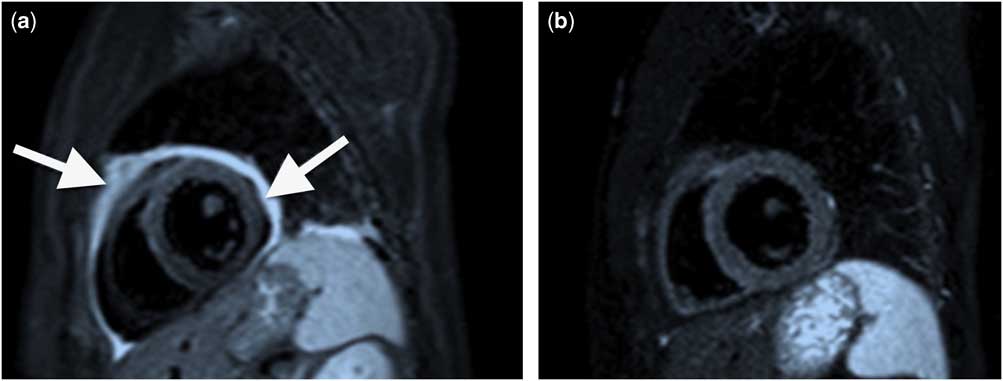
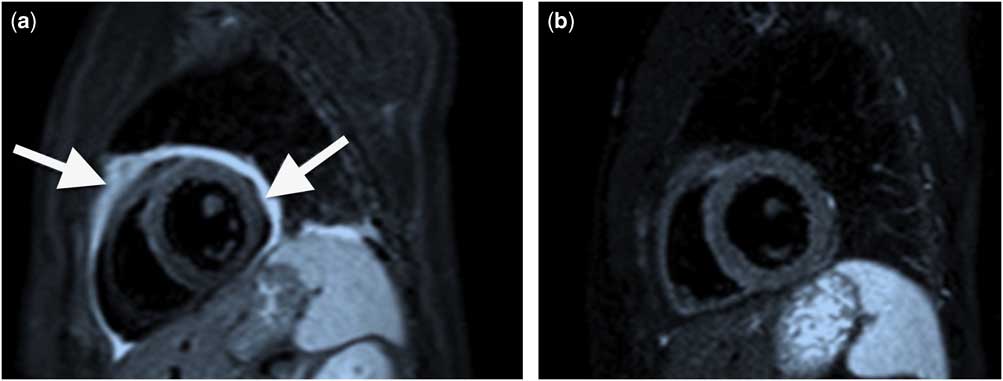
Cardiac MRI was performed during the last relapse, in March 2015, and documented active pericardial inflammation (Fig 1). Anakinra 1 mg/kg/day was added for the treatment of recurrent and steroid-dependent pericarditis. Given the excellent clinical and laboratory response in 3 days, the prednisone dosage was slowly tapered until discontinued entirely in July 2015 without disease recurrence. In July 2015, cardiac MRI revealed neither active pericardial inflammation nor constrictive physiology. In October 2015, a trial of anakinra withdrawal was followed within 1 month by a new pericardial flare that promptly resolved after restarting anakinra 1 mg/kg/day in monotherapy. This dosage was maintained until we documented the absence of active inflammation on cardiac MRI in January 2016. Then a progressive and slow dosage reduction was initiated, and after a follow-up period of 26 months until March 2018, he remained in remission and with normal cardiac MRI while receiving anakinra 1 mg/kg/day biweekly, without development of any side effect.
( a ) Cardiac MRI (short-axis view) performed on March 2015 under treatment with prednisone 1 mg/kg/day. The late gadolinium sequence showed a diffuse enhancement above the whole pericardium (white arrows), as a sign of active pericardial inflammation. ( b ) Cardiac MRI (short-axis view) performed on July 2015, 3 months after the initiation of anakinra 1 mg/kg/day. The late gadolinium sequence showed no enhancement; therefore the pericardial inflammation was then controlled.
Discussion
Several mechanisms have been hypothesised to explain the recurrence of pericarditis, including inadequate treatment during the first episode, augmented viral DNA/RNA replication in the pericardial tissue secondary to steroid therapy, reinfection, and an autoimmune reaction following the initial episode of pericarditis.Reference Imazio, Brucato and Pluymaekers 1 Remarkably, idiopathic recurrent pericarditis shares common features with auto-inflammatory diseases, which are characterised by increased production of interleukin-1β due to dysregulated activation of a cytosolic molecular structure: the inflammasome.Reference Cantarini, Lopalco and Selmi 3 Under these conditions, the suppression of interleukin-1β results in a prompt and persistent decrease in disease severity.Reference Lazaros, Antonatou and Vassilopoulos 2 – Reference Scott, Hajela, Hawkins and Lachmann 4 Of note, the excellent response to interleukin-1 blockade with anakinra observed in cases of idiopathic recurrent pericarditis supports the hypothesis that interleukin-1β may have a role in the pathogenesis of this disease; therefore idiopathic recurrent pericarditis might be considered as an unidentified auto-inflammatory disease.Reference Cantarini, Lopalco and Selmi 3
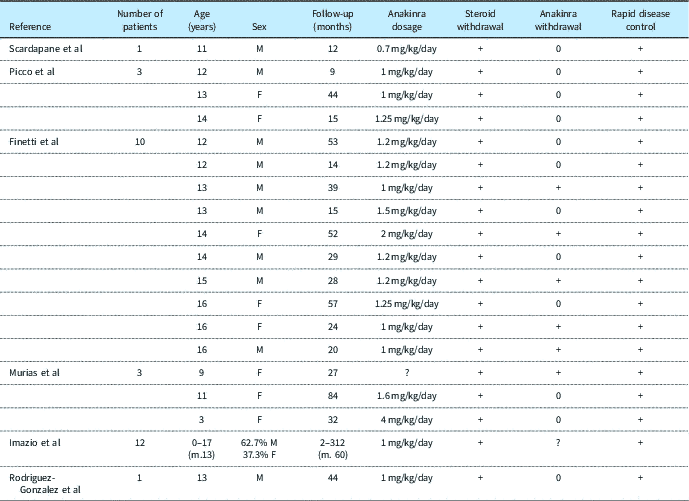
The available data about anakinra treatment for idiopathic recurrent pericarditis in children are derived from a small number of patients, with 30 cases reported until March 2018, including our case (Table 1).Reference Picco, Brisca, Traverso, Loy, Gattorno and Martini 5 – Reference Finetti, Insalaco and Cantarini 8 From this scarce evidence, anakinra seems to be an effective, rapidly acting, steroid-sparing, and relatively safe agent for the treatment of steroid-dependent courses in children. Of note, anakinra provides the best chance of remission compared with azathioprine and intravenous immunoglobulin.Reference Scott, Hajela, Hawkins and Lachmann 4
Cases reported of steroid-dependent idiopathic recurrent pericarditis treated with anakinra in children.

M=male; F=female; m=median; 0=no; +=yes; ?=individual data non-available
Recently, the results of the only randomised trial, the AIRTRIP study, regarding patients with idiopathic recurrent pericarditis have been reported.Reference Brucato, Imazio and Gattorno 9 Although the size was small with 21 cases and only one child, they described impressive results when comparing anakinra to placebo. All patients had a rapid and maintained response to anakinra. During a median follow-up period of 14 months, recurrence of pericarditis was recorded in 90% of patients on placebo compared with only 18% of patients on anakinra. All patients successfully discontinued corticosteroids within 6 weeks. Local skin reactions and herpes zoster reactivation observed during the first month of administration were the most common side effects. No side effects led to permanent drug discontinuation.
An important matter of concern is the high index of recurrences after anakinra discontinuation, leading to long-term treatments in most cases.Reference Picco, Brisca, Traverso, Loy, Gattorno and Martini 5 – Reference Finetti, Insalaco and Cantarini 8 In this setting, cardiac MRI might be a good guidance option to a successful withdrawal. This strategy has proved to reduce steroid usage and the rates of recurrences.Reference Alraies, AlJaroudi and Yarmohammadi 10
In summary, on the basis of the presented evidence, anakinra seems to be an effective and safe therapeutic alternative in cases of steroid-dependent idiopathic recurrent pericarditis in children.
Acknowledgements
None.
Financial Support
The authors have indicated that they have no financial relationships relevant to this article to disclose. This research received no specific grant from any funding agency, or from commercial or not-for-profit sectors.
Conflicts of Interest
The authors have no conflicts of interest relevant to this article to disclose.
Informed Consent
Informed consent of the legal tutors of the patient reported was obtained.