Introduction
Almond [Prunus dulcis (Mill.) D.A. Webb., Syn. Prunus amygdalus Batsch.] was introduced in La Palma by European settlers after colonization in the 15th century, and it has become one of the most important exports from the island (ADER, 2002). Past importance of almond production in La Palma is revealed by the numerous names of the local cultivars. In recent years, several attempts have been made to preserve these resources (ADER, 2002; Borja-González, Reference Borja-González2009). These studies dealt with differences in the state of the orchards and differences in their ecological conditions due to the abrupt orography of the island. Still, important results were obtained, e.g. the geographical location of individuals from most of the cultivars known in the island and their preliminary characterization. These studies also demonstrated that different names have been given to the same cultivar (synonymies) or that the same name has been used to refer to different cultivars (homonymies). The latter situation is apparent in soft-shell varieties, all known as ‘Mollar’, even though they exhibit morphological and phenological differences (Borja-González, Reference Borja-González2009).
Simple sequence repeat (SSR; microsatellites) markers are useful tools for characterizing agricultural crop diversity (Gupta et al., Reference Gupta, Balyan, Sharma and Ramesh1996; Agarwal et al., Reference Agarwal, Shrivastava and Padh2008). Within Prunus, SSRs have been broadly used for variability studies among cultivars of different species such as peach (Aranzana et al., Reference Aranzana, Garcia-Mas, Carbó and Arús2002, Reference Aranzana, Abbassi, Howad and Arús2010; Bouhadida et al., Reference Bouhadida, Moreno, Gonzalo, Alonso and Gogorcena2011), sweet cherry (Struss et al., Reference Struss, Ahmad, Southwick and Boritzk2003; Wünsch and Hormaza, Reference Wünsch and Hormaza2004; Stanys et al., Reference Stanys, Baniulis, Morkunaite-Haimi, Siksnianiene, Frercks, Gelvonauskiene, Stepulaitiene, Staniene and Siksnianas2012), apricot (Hormaza, Reference Hormaza2002; Romero et al., Reference Romero, Pedryc, Muñoz, Llácer and Badenes2003; Maghuly et al., Reference Maghuly, Fernandez, Ruthner, Pedryc and Laimer2005; Pedryc et al., Reference Pedryc, Ruthner, Herman, Krska, Hegedus and Halasz2009) and almond (Fernández i Martí et al., Reference Fernández i Martí, Alonso, Espiau, Rubio-Cabetas and Socias i Company2009; Kadkhodaei et al., Reference Kadkhodaei, Shahnazari, Nekouei, Ghasemi, Etminani, Imani and Ariff2011; Gouta et al., Reference Gouta, Ksia, Buhner-Zaharieva, Mliki and Gogorcena2012). All these studies have been enhanced by the transportability of SSRs across the Prunus species (Martínez-Gómez et al., Reference Martínez-Gómez, Arulsekar, Potter and Gradziel2003; Mnejja et al., Reference Mnejja, Garcia-Mas, Howad, Badenes and Arús2005, Reference Mnejja, Garcia-Mas, Audergon and Arús2010). In the study carried out by Mnejja et al. (Reference Mnejja, Garcia-Mas, Audergon and Arús2010), 12 specific microsatellites that are polymorphic in all Prunus species and that cover the whole genome have been proposed as the ‘universal Prunus set’. Fernández i Martí et al. (Reference Fernández i Martí, Alonso, Espiau, Rubio-Cabetas and Socias i Company2009) studied the genetic diversity in 93 Spanish and foreign almond accessions by SSRs, including seven accessions from La Palma Island prospected in 1982 (AJ Felipe, unpublished results) and maintained at the Spanish national almond germplasm collection in Zaragoza (Espiau et al., Reference Espiau, Ansón and Socias i Company2002). In this study, all accessions were placed in five groups. Five La Palma accessions were in a group practically of their own, while the other two accessions were in two different groups. This indicates that La Palma cultivars are genetically different enough to form an independent cluster due to geographical isolation, but, at the same time, exhibit high inter-cultivar variability.
The objectives of this study were (1) the genetic characterization of the almond cultivars in La Palma and the estimation of the genetic diversity among them and (2) the comparison of their genetic profile with that of the commercial cultivars gathered in local nurseries.
Materials and methods
Plant material
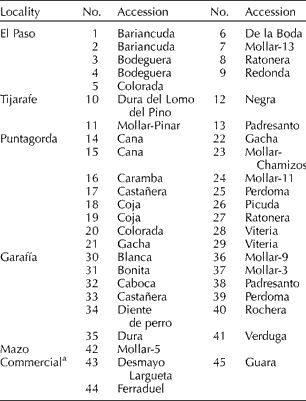
The 45 accessions studied are known by 28 different names (Table 1). ‘Mollar’ cultivars (soft-shell varieties) are represented by seven accessions, with five of them being preserved at the collection of the Cabildo Insular de La Palma in Garafía and the other two located in the orchards of two growers. The remaining local cultivars are hard-shell varieties. Sampling zones were mostly in the northwest of the island (Fig. 1), and the majority of the accessions were geographically located by Borja-González (Reference Borja-González2009). Those cultivars more commonly found during preliminary surveys were collected in two different orchards. Three commercial cultivars were included as references: ‘Desmayo Largueta’, ‘Ferraduel’ and ‘Guara’.
List of the 42 almond accessions from La Palma and the three commercial cultivars evaluated in this study

a Cultivars acquired at local nurseries.
Localities sampled in La Palma and zones where the orchards are found.

DNA extraction and SSR analysis
Young vegetative flushes were harvested, and DNA was isolated from 50 mg tissue samples using the GenElute™ Plant Genomic DNA Miniprep Kit (Sigma, St. Louis, MO, USA) following the manufacturer's recommendations. Fifteen SSRs (Table 2) were selected from those used by Fernández i Martí et al. (Reference Fernández i Martí, Alonso, Espiau, Rubio-Cabetas and Socias i Company2009) and Mnejja et al. (Reference Mnejja, Garcia-Mas, Audergon and Arús2010) based on their polymorphism, single-locus amplification and uniform distribution throughout the almond genome. Amplification reactions were carried out in a final volume of 10 μl containing 2 × QIAGEN® Multiplex PCR Master Mix (Qiagen, Hilden, Germany), 2 μM of each primer and 50 ng of genomic DNA. Multiplex reactions were carried out with three or four primer pairs that differed with respect to their fluorescence dye and/or their expected range size. PCR cycling conditions included 15 min at 95°C for heat activation of the HotStar Taq DNA polymerase, followed by 25 cycles of 30 s at 94°C, 90 s at 60°C and 60 s at 72°C, and a final step of 30 min at 60°C. Fluorescence dyes used were 6-Carboxyfluorescein (6-FAM™), 5′-Hexachloro-Fluorescein Phosphoramidite (HEX™) and 5-Carboxy-tetramethylrhodamine N-succinimidyl ester (TAMRA™), and amplicons were separated by capillary electrophoresis using the MegaBACE 1000 DNA Analysis System (GE Healthcare, Chalfont St. Giles, UK) and ET400-ROX as size standards (GE Healthcare). Each reaction was repeated twice.
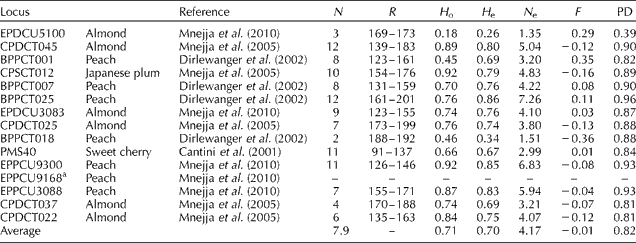
Number of alleles (N), allele size range (R), observed heterozygosity (H o), expected heterozygosity (H e), effective number of alleles (N e), Wright's fixation index (F), and power of discrimination (PD) for 15 SSR markers in 37 almond genotypes

a Amplification fragments with poor resolution in capillary electrophoresis separation.
Data analysis
Allele size in base pairs and the total number of alleles were determined for each SSR locus. Genetic diversity was estimated using the following statistics: number of alleles per locus (N), size range of alleles per locus (R), observed heterozygosity (H o= number of heterozygous individuals/total number of individuals), expected heterozygosity (H e= 1 − Σp i 2, where p i is the frequency of the ith allele) (Nei, Reference Nei1973), effective number of alleles per locus (N e= 1/1 − H e), Wright's fixation index (F= 1 − H o/H e) (Wright, Reference Wright1951), and power of discrimination (PD = 1 − ΣG ij 2, where G ij is the frequency of the jth genotype for the ith locus) (Kloosterman et al., Reference Kloosterman, Budowle and Daselaar1993).
A similarity matrix obtained from the proportion of shared amplification fragments (Nei and Li, Reference Nei and Li1979) was constructed, and a cluster analysis was carried out using the unweighted pair group method with arithmetic averages (UPGMA) with the program NTSYS-PC version 2.1 (Rohlf, Reference Rohlf1998). The cophenetic correlation coefficient was computed after the construction of a cophenetic matrix to test the goodness of fit between the original similarity matrix and the dendrogram (Sokal and Rohlf, Reference Sokal and Rohlf1962).
An analysis of molecular variance (AMOVA; Excoffier et al., Reference Excoffier, Smouse and Quattro1992), based on the number of different alleles, was carried out with the program ARLEQUIN version 3.5 (Excoffier et al., Reference Excoffier, Laval and Schneider2005) to assess the genetic structure of the almond collection of La Palma. Considering each locality as a population, this analysis partitioned the total SSR variation into among-localities and within-localities variation components. The significance level for the among-localities variance component was tested with a permutation test.
Results
SSR polymorphism and genetic diversity
All the SSRs, except EPPCU9168, amplified one or two fragments per accession, and they were confirmed as single-locus SSRs. The amplified product of EPPCU9168 failed to produce clear peaks by capillary electrophoresis after several attempts and was not included in the study. The remaining SSRs produced a total of 110 amplification fragments. The number of alleles per locus varied from 2 (BPPCT018) to 12 (CPDCT045 and BPPCT025), with an average of 7.9 alleles per locus (Table 2). The H o values ranged from 0.18 (EPDCU5100) to 0.92 (CPSCT012 and EPPCU9300), with an average value of 0.71. All the SSRs, except EPDCU5100 and EPPCT018, can be considered as highly informative, with H e≥ 0.5 and an average value of 0.70. With H o and H e of almost the same average value, the F mean value is practically 0 ( − 0.01) (Table 2). All the SSRs, except EPDCU5100, exhibited a PD ≥ 0.8 (Table 2).
Allele frequencies ranged between 0.86 and 0.013, with 42 alleles (38%) having a frequency < 0.05. Twenty genotype-specific fragments were detected: seven of them in the three commercial cultivars, five in four of the seven ‘Mollar’ accessions and eight in six of the 24 hard-shell cultivars.
Similarity relationships among accessions
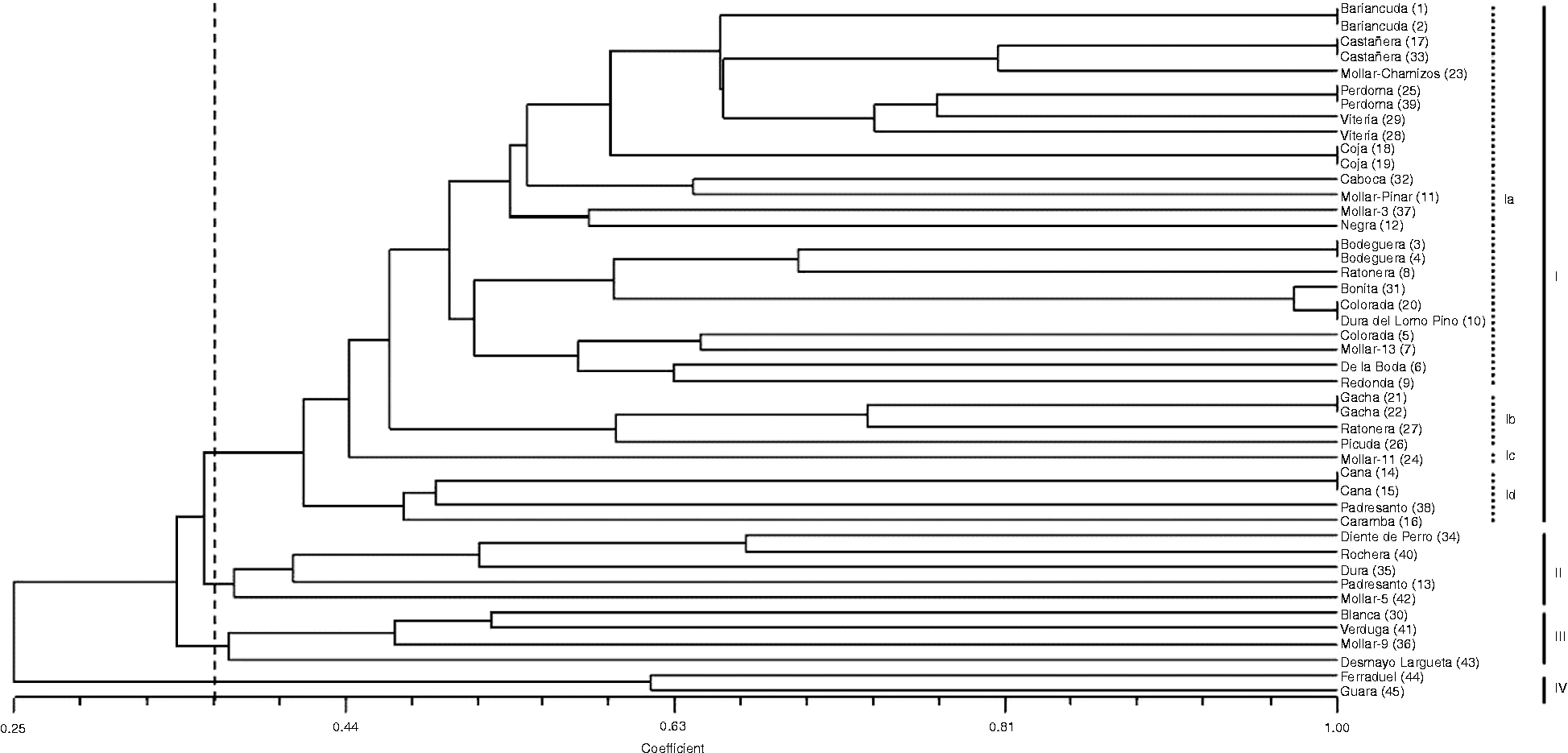
The 45 accessions included in the study fit into 28 a priori cultivars, including the seven ‘Mollar’ accessions and the three commercial cultivars. The dendrogram resulting from the UPGMA analysis illustrates the genetic differences among these accessions, each identified by its local name followed by the number given in this study (Fig. 2). These 45 accessions produced 37 different genotypes. The commercial cultivars ‘Ferraduel’ and ‘Guara’ clustered separately from the rest of the accessions, while ‘Desmayo Largueta’ clustered with the three local accessions ‘Blanca’, ‘Verduga’ and ‘Mollar-9’, all of which are from Garafía. All ‘Mollar’ accessions exhibited a different genetic profile and were distributed throughout the dendrogram. Among the hard-shell cultivars represented by two putative clones, ‘Ratonera’, ‘Colorada’, ‘Padresanto’ and ‘Viteria’ exhibited genetic differences between pairs. On the other hand, accessions whose pairs were clones were ‘Bariancuda’, ‘Bodeguera’, ‘Cana’, ‘Castañera’, ‘Coja’, ‘Gacha’ and ‘Perdoma’. Among these, ‘Castañera’ and ‘Perdoma’ are from different localities, so it can be assumed that they constitute two well-established cultivars. The cophenetic correlation coefficient between the similarity matrix based on the Nei and Li coefficient and the similarity matrix obtained from the cluster was 0.85.
Dendrogram of the 42 almond accessions from La Palma and three commercial cultivars based on the UPGMA analysis using the similarity matrix generated by the Nei and Li coefficient as determined by 14 SSR amplifications.

Accessions clustered into four different groups (I–IV, Fig. 2). Group I is the largest and can be divided into four subgroups (Ia–Id). Subgroup Ia includes all the accessions from El Paso and the most important accessions from the other three main growing areas, i.e. Tijarafe, Puntagorda and Garafía. All the accessions in subgroups Ib, Ic and Id, except ‘Padresanto (38)’, are from Puntagorda. Subgroup Ib comprises ‘Gacha’, ‘Picuda’ and one of the ‘Ratonera’ accessions, subgroup Ic comprises the ‘Mollar-11’ accession, and subgroup Id clusters ‘Cana’ with ‘Caramba’ and the ‘Padresanto’ accession from Garafía. Accessions included in group II have a heterogeneous geographical origin, with three accessions from Garafía (‘Dura’, ‘Rochero’ and ‘Diente de perro’), one from Tijarafe (‘Padresanto (13)’) and the only accession from Mazo (‘Mollar-5’). Group III is formed by three accessions from Garafía (‘Blanca’, ‘Verduga’ and ‘Mollar-9’) and the commercial cultivar ‘Desmayo Largueta’. Finally, group IV separates the other two commercial cultivars, i.e. ‘Guara’ and ‘Ferraduel’.
Genetic structure
As randomization of the data for the estimation of P values is limited by sample size (Fitzpatrick, Reference Fitzpatrick2009), the localities Tijarafe and Mazo were not included in the AMOVA because of their low number of accessions. Table 3 summarizes AMOVA partitioning genetic variability within and among the three remaining localities. The variation between the localities was significant (P< 0.001), but not meaningful (3.2%). The within-localities component accounted for most of the total variation (96.8%).
Analysis of molecular variance partitioning genetic variability among and within the three localities of 37 almond accessions using 14 simple sequence repeats

a Probability to obtain a random value that is equal to or greater than the observed value using 1023 permutations.
Discussion
Amplification was successful for all the markers, except for EPPCU9168. With the exception of this SSR, markers that were developed for other species yielded a high level of polymorphism in almond DNA. Nine SSRs that were also used by Fernández i Martí et al. (Reference Fernández i Martí, Alonso, Espiau, Rubio-Cabetas and Socias i Company2009) exhibited a similar performance. For example, the same SSRs had the highest and lowest numbers of alleles (CPDCT045 and BPPCT018, respectively), but with double values in the study carried out by Fernández i Martí et al. (Reference Fernández i Martí, Alonso, Espiau, Rubio-Cabetas and Socias i Company2009) due to the higher number of genotypes analysed. The H o average value was practically the same in both the studies: 0.72 in the study of Fernández i Martí et al. (Reference Fernández i Martí, Alonso, Espiau, Rubio-Cabetas and Socias i Company2009) and 0.71 in the present study. Considering that the sample used in the present study was from a single island, whereas that used in the study of Fernández i Martí et al. (Reference Fernández i Martí, Alonso, Espiau, Rubio-Cabetas and Socias i Company2009) included accessions from all over the world, these similarities reflect the wide genetic diversity of La Palma accessions. However, in the present study, only the most informative primers cited in the literature (Fernández i Martí et al., Reference Fernández i Martí, Alonso, Espiau, Rubio-Cabetas and Socias i Company2009; Mnejja et al., Reference Mnejja, Garcia-Mas, Audergon and Arús2010) were chosen. Therefore, a certain bias towards a higher level of variability has to be expected when comparing the results of the present study with those of other studies.
The mean F value obtained was close to 0 ( − 0.01), indicating that the collection of almond cultivars analysed behaved similarly to a random mating population. Outbreeding events would be enhanced by the species gametophytic self-incompatibility (Socias i Company, Reference Socias i Company and Janick1990). According to Socias i Company (Reference Socias i Company1998), open-pollinated seedlings were utilized primarily in traditional almond culture, and almond culture was probably established in La Palma by seedlings; later, outcrossing and selection in geographical isolation may have led to the different genotypes that can be found today.
The PD is related to the number of different genotypes and the ability of each SSR to discriminate among them. All the SSRs (except EPDCU5100) exhibited a high PD. Locus EPDCU5100 had three alleles, one of them with a frequency close to 0.9; consequently, this allele can be considered as fixed and the locus as homozygous. Overall, 42 alleles with a frequency < 0.05 can be considered as rare.
‘Mollar’ does not describe a clone and, therefore, this cultivar represents a clear case of homonymy. This term exclusively refers to the soft-shell characteristic, which is genetically determined and independent of other genetic regulations (Socias i Company et al., Reference Socias i Company, Kodad, Alonso and Gradziel2008). Homonymy could also be detected in ‘Ratonera’, ‘Colorada’, ‘Padresanto’ and ‘Viteria’ cultivars. ‘Dura del Lomo del Pino’ and ‘Colorada (20)’ were identified as synonyms, and both were genetically similar to ‘Bonita’.
The cophenetic correlation value obtained was >0.80, which, according to Sokal and Rohlf (Reference Sokal and Rohlf1962), indicates a good adjustment of the original distance matrix. The clustering proposed differentiates the most divergent genotypes, i.e. accessions from Garafía, the commercial cultivars, and the only accession from Mazo, from what could be considered the La Palma almond core collection in group I. Within this group, all the accessions in subgroups Ib, Ic, and Id, except one, are from Puntagorda. The fact that the accessions from Garafía and those from Puntagorda tend to cluster together could suggest an association between the clusters and the geographical origin of the accessions. However, as shown by the AMOVA, the among-localities component accounted for only 3.2% of the variability, suggesting that La Palma almond cultivars did not originate independently in different areas of the island. Only Garafía could be an area where particular cultivars may have emerged, as shown by group III; this group includes three cultivars from Garafía and the traditional Spanish cultivar ‘Desmayo Largueta’. Fernández i Martí et al. (Reference Fernández i Martí, Alonso, Espiau, Rubio-Cabetas and Socias i Company2009) found a case of genetic identity between an accession from the Canary Islands (Tenerife) and ‘Desmayo Largueta’ and concluded that this commercial cultivar was probably introduced in the Canary Islands because of its low chilling requirements (Alonso et al., Reference Alonso, Ansón, Espiau and Socias i Company2005). If introduced in the past, ‘Desmayo Largueta’ might have genetically contributed to the establishment of the group III accessions. Another consequence of the little effect of the inter-locality variation is that clones of the same cultivar should have kept their genetic identity no matter their geographical dispersion. This is only true in part, as ‘Ratonera’, ‘Colorada’, ‘Padresanto’ and ‘Viteria’ lost their genetic identity.
In conclusion, the genetic uniqueness of the La Palma almond cultivars and the genetic diversity among them were established. Genetic singularity is based on the low coefficients of similarity between most La Palma accessions and the commercial cultivars and confirms the results obtained by Fernández i Martí et al. (Reference Fernández i Martí, Alonso, Espiau, Rubio-Cabetas and Socias i Company2009). Cultivar traditional names reflect the genetic diversity, although some cases of synonymies and homonymies could be detected. This is particularly apparent in ‘Mollar’ accessions, where better germplasm characterization and management are needed. Despite the small contribution of the inter-locality diversity to the total diversity, Garafía has unique cultivars not found elsewhere in the island; three of them exhibited higher coefficients of similarity between the commercial cultivar ‘Desmayo Largueta’ than with the other local accessions from La Palma.
Acknowledgements
This study was supported by the Cabildo Insular de La Palma. The authors thank Neftalí Castro and Ana González for their invaluable help during material sampling and during SSR analysis, respectively.