Urban pollution and industrial production in early modern London
In 1752, the bluestocking Catherine Talbot wrote to her friend Elizabeth Carter from the deanery of St Paul's Cathedral to report that she found herself happy and healthy in the London air – or, rather, ‘the smoke, I should say, for there is a sugar baker just by that is candying us all over as fast as he can’.Footnote 1 For Talbot, the already notorious coal smoke of London was the product of one easily identified manufacturer in the heart of the city, an operator of one of the capital's several large sugar refineries. Talbot's suggestion that large-scale manufacturing caused smoky urban air – that industry caused pollution – was already long familiar by the 1750s. Almost half a century earlier, a bill was introduced into parliament that shared Talbot's view of the industrial nature of coal smoke. It would have prohibited any ‘glasshouse, brewhouse, meltinghouse, dying house, or other workhouse consuming a greater quantity of sea coalFootnote 2 than is usual for a dwelling house’ so as to preserve the air in Westminster ‘as clear, wholesome, and free from annoyances as is possible’.Footnote 3 Similarly, in 1661, John Evelyn had argued that urban smoke was emphatically an industrial problem. It was caused by ‘tunnels and issues belonging only to brewers, dyers, lime-burners, salt and soapboilers, and some other private trades, one of whose spiracles alone does manifestly infect the air more than all the chimneys of London put together besides’. If these tradesmen were banished from the city, Evelyn claimed, Londoners could continue burning coal in their fireplaces without causing any significant pollution.Footnote 4 For Evelyn, Talbot, the authors of the 1706 bill, and many other observers, London's manufacturers were directly culpable for its dirty air. In making this claim, some ignored or sidestepped the importance of domestic consumption, while others, notably Evelyn, explicitly denied that such small fires were an important contributor to urban dirtiness.
Economic historians interested in the coal industry, and environmental historians interested in urban smoke, have also considered the importance of industrial versus domestic coal consumption, but their findings have been much more divergent than contemporaries. Some have stressed the association between industrial coal burning and urban smoke, implying that manufacturers were the primary problem. Keith Thomas and Emily Cockayne both stressed the industrial origin of urban pollution, while David Ormrod demonstrated how British coal exports to Europe were put primarily to industrial purposes.Footnote 5 These broadly follow the approach of John Nef, who stressed coal's contribution to an early modern industrial revolution, yet also estimated that only one third of British coal was used for industrial production.Footnote 6 John Hatcher's authoritative 1993 study found that the most important cause in London's embrace of coal fuel must have been domestic, rather than industrial, demand, but he does not explain how this is known, nor does he suggest how much each sector required, nor whether this changed over time.Footnote 7 Peter Brimblecombe has written less assuredly that it is ‘hard to imagine’ that domestic fires did not contribute significantly to London smoke, but again with no more specific claims.Footnote 8
Beyond such cautious indications of the importance of domestic coal burning, Ken Hiltner has asserted confidently that early modern people knew that domestic fires caused air pollution and hence were deluding themselves into denying their own complicity with urban environmental problems. Evelyn, he judged, ‘like many modern environmentalists…realized that casting blame away from his readers to industry was a highly effective rhetorical device. However, we now know – and it is likely that Evelyn also knew – that far more than half of the sea coal burned in London prior to 1700 was for residential, not industrial use.’Footnote 9 While Hiltner may well be right about the psychological and rhetorical utility of Evelyn's deflection of blame onto ‘the sordid and accursed avarice of some few particular persons’, the use of the phrase ‘we know’ here is simply indefensible. We do not, in fact, know very much at all about the nature of coal burning in early modern London.Footnote 10 Despite detailed studies of the growth and scale of the British coal trade, of the economics and politics of its control, and of the political significance of resulting air pollution, no one has assessed whether it was Hiltner or Keith Thomas, Catharine Talbot and John Evelyn who more accurately described the relative importance of industrial and domestic coal consumption in the early modern metropolis.Footnote 11
To illuminate this is all the more desirable since recent work by leading economic historians have considered E.A. Wrigley's thesis that energy lay at the heart of England's economic transformation during the industrial revolution.Footnote 12 England's coal-fired economy has recently been found to have played a major role in facilitating industrialization, and yet we know very little about consumption practices in London, the early modern world's largest coal market. This article therefore investigates the relations between industrial production and coal consumption in London by asking basic questions, including how much coal was consumed by industry compared with households and how this changed over time. As we will see, the extant sources rarely allow for exact figures, but we can be a little more precise than the guesswork that exists so far. Ultimately, it will be argued, domestic coal consumption in London was much larger than industrial for almost the entire early modern period. However, there were industrial facilities which did, in fact, burn smoky coal fuel on large scales, meaning that contemporaries had good reasons to pay particular attention to manufacturers even though they collectively burned less fuel and emitted less smoke than London's thousands of fireplaces.
A coal-fired city
The chronology of early modern London's embrace of mineral coal that Nef advanced in 1932 has been largely confirmed in Hatcher's more recent and more complete study. London coal imports, Hatcher shows, were only about 10,000–15,000 tons during the mid-sixteenth century, but rose quickly thereafter to over 27,000 tons in 1580, almost 50,000 by the end of the 1580s and over 140,000 tons by 1605–06. Growth thereafter continued more gradually, doubling to about 284,000 tons in 1637–8 and reaching an average of about 425,000 tons annually during the final two decades of the seventeenth century. Flinn has described continued, but slower, growth during the eighteenth century, from over 500,000 tons annually during the 1710s, 630,000 during the 1720s, 630,000–640,000 during the 1730s and 1740s, over 700,000 by 1760 and exceeding one millions tons annually from the later 1780s.Footnote 13 Some of these imports were then transported out of the London metropolis, so to reach totals for London coal consumption these figures should be deflated by perhaps 5 per cent.Footnote 14
Coal was taxed at its arrival into the port of London, but no bureaucracy recorded how it was used afterwards. Nor can actual per capita consumption be estimated in a city where households varied enormously in size, composition and wealth. London's rapidly rising population is clearly the fundamental context for its buoyant coal market, as the capital never stopped growing from about 1550 throughout the early modern period (and indeed beyond, into the twentieth century) despite high urban mortality rates and occasional outbreaks of plague. From something like 65,000 people in 1550, metropolitan London increased by around 1,000 per cent over the following two centuries, reaching half a million late in the seventeenth century and exceeding two-thirds of a million people during the middle of the eighteenth.Footnote 15 Coal imports tracked this rise from around 1600, rising from just over to .5 to almost 1 ton per capita by the eighteenth century. This enormous population surely burned very large amounts of coal in its hearths – 250,000 of which were taxed in 1666 – but its widely varying standards of living make any more precise statements than this about domestic consumption impossible.Footnote 16
Measuring the fuel needs for manufacturing industry, however, is possible though the industrial history of London is surprisingly understudied. In general, it is quite clear that London was England's leading manufacturing centre during the early modern period.Footnote 17 But London's guilds, the Livery Companies, rarely exercised sufficient authority over its members’ levels of production, much less their use of raw materials, for company records to provide clear evidence of industrial fuel use. Despite source difficulties, however, arriving at meaningful numbers is possible. This article will therefore describe the key industrial consumers of coal in early modern London, in particular brewing, distilling, brick making, glass making and sugar refining. These manufacturers used their fires to heat, to boil, to melt and to bake – in other words, to effect changes in the chemical composition of matter – but not to convert energy into motion.Footnote 18 The mills, railroads and steam ships which were so crucial to nineteenth-century industrialization were absent during the seventeenth and eighteenth centuries, but if pre-industrial London had not yet achieved the greater efficiencies of the later period, it nevertheless used large amounts of fuel to produce large quantities of goods through a great deal of human work. It is reasonable, in this sense, to describe a kind of early modern industry, even if this is still distinguished from the fully industrial economy of the nineteenth century.
London's coal-burning industries
The most important industrial consumer of mineral coal in early modern London was beer brewing. It was brewing that attracted the attention of monarchs who disliked smoke clouds near their palaces and gardens, and it was the brewhouse that authors like Thomas Dekker, Ben Jonson and William Davenant turned to when they wished to evoke the fires of hell or of the dirty early modern city itself.Footnote 19 Such poetic usages were rhetorical, but also grounded in the material reality of an early modern industry that operated on an impressive scale and so burned a great deal of fuel. Already during the 1570s, London's brewers produced approximately 400,000 barrels, or 65 million litres, of strong beer per year. This made it Europe's leading brewing centre even before its output approximately doubled by 1620. By the decades around 1700, London brewing had stagnated at about 1,075,000 barrels of strong beer and 730,000 barrels of weak beer annually.Footnote 20
Using these figures to arrive at estimates of coal usage cannot be done with absolute precision, but the available data do agree sufficiently to produce reasonable assessments. First, there is an archival record of the coal used by a London brewery. The steward's accounts of Westminster Abbey record that from 1586 to 1635 brewing required an average of 12.22 chaldrons of coal to produce 498.2 barrels of ‘double beer’ and 24.7 barrels of strong beer annually, or about 43 total barrels per chaldron of coal.Footnote 21 This is almost identical to the ratio given in two budgets produced by the London Foundling Hospital during the 1750s, which each estimated about 45 barrels of beer per chaldron.Footnote 22
Higher levels of efficiency, however, were suggested by a series of budgets produced during the sixteenth and seventeenth centuries. Two budgets produced for the crown, one in 1574 and another in 1637, agreed at a figure of about 125 barrels per chaldron, while a 1699 pamphlet asserts that 80 was the proper figure.Footnote 23 It is quite possible that such budgets were imprecise with their estimates for fuel consumption, a relatively minor cost and one which was not of central importance for the purposes of those constructing the budgets. However, the first known archive of the raw material costs for a London commercial brewery is not so far off these figures. The Truman brewery in Spitalfields recorded an average of 109 barrels of beer per chaldron of coal during the period from 1791 to 1803. This is over twice as much beer per unit of fuel as was achieved at Westminster Abbey. But Truman, compared to the earlier practice, enjoyed the benefit of economies of scale derived from brewing 200 times more beer than Westminster, as well as 150 years of craft skill and technological innovation. It would make sense for small establishments like Westminster or the Foundling Hospital to be less efficient with their fuel than large commercial concerns. While London always contained a mix of both large and small beer producers, the larger were always responsible for most brewing.Footnote 24 Therefore, a figure of 70 barrels of beer per chaldron of coal – more efficient than is suggested by the records of small breweries, but less efficient than the huge operation of the 1790s – is used here as a plausible average for breweries in the early modern metropolis.Footnote 25
Applying this ratio to production data shows that breweries were not responsible for a large proportion of London's coal consumption once domestic fuel use began to expand during the 1580s and 1590s. Before that, however, brewing was uniquely prominent. In the mid-1570s, London's brewers probably used about 5,700 chaldrons of coal, or 8,000 tons, in order to brew their 400,000 barrels. Such a figure agrees well with the Brewers Company's claim in 1575 that their use of coal saved the realm 30,000–40,000 loads of wood. The heat of so much wood would have been provided by about 10,000 chaldrons of coal, suggesting (if we believe the Brewers) that a figure of 8,000 tons is reasonable or perhaps slightly low. Hatcher does not have any figures for the 1570s, but the evidence that he does offer suggests that 8,000 tons would have been from 30 to 40 per cent of London's total.Footnote 26 If the Brewers were not exaggerating their consumption, or if we allow for a significant amount of additional fuel for ale brewing, a total of even 50 per cent is not implausible for the 1570s.
By the 1590s, however, this percentage had shrunk dramatically and permanently. If total beer production in 1595 was about 650,000 barrels, this suggests almost 9,300 chaldrons, or 13,000 tons, of coal. By these years, however, London's overall coal consumption had more than tripled since 1575, from something like 22,000 tons to c. 80,000–100,000 tons.Footnote 27 Brewing would therefore have accounted for about 13–16 per cent of London's total. By 1620, this proportion declined still further, to 8–10 per cent, as Londoners completed their switch from wood fuel to coal for most purposes.Footnote 28 These figures assume that only strong beer was made, but assuming that brewers used one third more fuel in order to brew small beer (in other words, that they heated additional water to reuse the same, partially spent grain) raises these estimates proportionally, to c. 17 per cent in 1600 and 11–12 per cent in about 1620.Footnote 29 Using the same assumptions for the decades around 1700 gives brewing only 6–7 per cent of metropolitan fuel consumption, or just under 30,000 tons out of a total of 425,000. If this underestimates the amount of coal needed for brewing – if, for example, all of the small as well as the strong beer brewed in London by 1700 were made so inefficiently as to require 1 chaldron of coal for only 45 barrels of drink – London's brewing in 1700 would still have used only 11–14 per cent of the capital's coal supplies. This proportion diminished further as production of beer stagnated during the early decades of the eighteenth century while coal imports maintained a steady rise. Altogether, beer brewing probably used between one third and one half of London's coal during the 1570s, but only about 10–15 per cent by the early seventeenth century, and under 10 per cent by early eighteenth century.
The stagnation of brewing during the early eighteenth century has often been attributed to the increasing consumption of distilled liquors, above all gin. Gin drinking was widespread in the capital, as reformers frequently lamented, and distilleries arose to meet and drive demand. While beer production declined after about 1690, London's distilleries flourished.Footnote 30 From around half a million gallons in 1690, London gin production rose to 2 million gallons by 1713, 2.5 million by 1720 and over 4 million gallons by mid-century.Footnote 31 Distilling 4 million gallons required about 8,000 chaldrons, or 11,200 tons of coal.Footnote 32 Refining the capital's spirits, therefore, required only about a third of a per cent of London's coal in 1690 and under 2 per cent during the decades of the early eighteenth-century ‘Gin Craze’.Footnote 33
Sugar refining, as Catherine Talbot's reference to being ‘candied’ in the heart of the city in 1752 indicates, was widely seen as another leading industrial coal consumer. A 1666 proclamation by Charles II included it among the trades ‘carried on by smoke’, and lobbyists against coal duties included it among the trades that depended on cheap fuel supplies.Footnote 34 While it had long existed in London, refining only took off during the middle decades of the seventeenth century.Footnote 35 Its expanded contribution to metropolitan industry from 1660 was dependent upon – indeed was one intended result of – new plantations in the Caribbean and the slave labour working them. Large sugar refineries, employing English workers to perfect a raw material from the colonies, were thus among the most visible physical embodiments of increasing global trade and the mercantile division of labour which they made possible.
While London's refineries during the century after 1660 used large amounts of fuel, they still did not approach the consumption of urban brewing. During the 1660s, English sugar imports were around 5,000 tons of brown, or muscovado, sugar, rising to 12,000–15,000 tons of retained imports during the early eighteenth century. For London alone the figures were lower, not far from 12,000 tons around 1700, 23,000 tons in 1720 and 30,000 tons by 1750.Footnote 36 There is no way to know precisely, however, how much of the muscovado sugar imported into London was actually refined. For many consumers, this form of brown sugar was a perfectly acceptable sweetener and was therefore eaten or drunk without further treatment.Footnote 37 If a 1753 pamphlet, representing the refining interest, was accurate in its claim that 75 per cent of English muscovado imports were refined, then about 9,000 tons were refined in London around 1700, rising to about 22,500 by 1750.Footnote 38 A proposal in Robert Walpole's papers, however, suggests lower figures are more likely, closer to 5,000 tons refined in London c. 1723.Footnote 39 No data has been found indicating how much fuel London's refiners consumed, but a study of the French sugar industry has found that during the later eighteenth century about 1.1 tons of coal was required to make 1 ton of refined sugar.Footnote 40 Applied to London, this would indicate totals of 10,000–25,000 tons of coal over the first 50 years of the eighteenth century using the higher estimate, or only 5,500 tons around 1720 if Walpole's petitioner was correct.Footnote 41 If, therefore, the methods of London's refiners were similar to the French, it is likely that they used under 1 per cent of the capital's coal in 1700 and a little above 1 per cent in 1750.
Brick burning was another of the most visible and persistently cited sources of black smoke clouds, especially near the periphery of London where many of its richest and most vocal inhabitants lived. Brick kilns are a classic example of the kind of suburban industry that conflicted with other understandings of suburban land use, especially those based on agricultural production or pastoral retreat.Footnote 42 Bricks were dug around the edge of the built city where transport costs would be lowest but also exactly where people went in search of relief from urban crowds and dirtiness. Smoky kilns were therefore complained of across the early modern period, from a 1619 nuisance case before the Westminster sessions to Charles Jenner's 1772 complaint that suburban London's ‘long burning rows of fetid bricks’ hindered poetic inspiration.Footnote 43 Indeed, the natural and political philosopher William Petty credited bricks, alone among urban industries, with driving metropolitan coal consumption.Footnote 44 The city, or at least its more fashionable quarters, was increasingly brick-built from the early seventeenth century onwards.
Quantifying this expansion and estimating its fuel requirements, however, is difficult. Bricks were certainly made and used by the millions throughout the early modern period; searches by the Tylers and Bricklayers Company normally cited production levels by named members in the tens and hundreds of thousands. The company mentioned over six million deficient bricks produced over the winter of 1632–33 and another five million bricks and tiles in the summer of 1657, presumably implying many millions of acceptable bricks.Footnote 45 Beyond such anecdotes, an estimate of overall brick production might be based on Linda Clarke's finding that a typical three-storey ‘fourth-rate’ house, as defined by the 1667 Rebuilding Act, contained around 30,000 bricks during the later eighteenth century.Footnote 46 If it were assumed that each of c. 8,000 houses built during the five years spanning 1667–71 contained 50,000 bricks, and further that 100 million bricks were necessary for public structures, and further that there was no reuse or salvage of material after the fire, then about 500 million bricks would have been used to rebuild the city in the aftermath of the Great Fire. 100 million bricks annually is an enormous figure, more than any English city, even rapidly industrializing Manchester, produced during the early 1830s, and about twice what all of the Netherlands made annually during its seventeenth-century Golden Age.Footnote 47 One Henry Tindale, however, made 1.4, 1.4 and 2.7 million bricks, respectively, in the three years following autumn of 1667, and there must have been others like him anxious to exploit the clayish earth surrounding London.Footnote 48
Burning 100,000,000 bricks annually, according to the most persuasive estimates, would have required some 14,000 tons (10,000 chaldrons) of coal. John Haughton claimed in the early 1690s that ‘a famous brick maker’ from Hoxton, on the north-eastern London periphery, budgeted 10 chaldrons of coal per 100,000 bricks, and early eighteenth-century discussions reinforce the likelihood of this ratio.Footnote 49 During the years immediately following 1666, then, the brick makers of London and its surrounding periphery may have used as much as 14,000 tons of sea coal annually. If London used 300,000–350,000 tons of coal annually during this period, then this would have accounted for 4–5 per cent of its total.Footnote 50 These, however, were very unusual circumstances. Before the Great Fire, most of London's houses were not primarily constructed from brick.Footnote 51 Even the post-fire city, when elegant brick townhouses filled the new West End, contained entire districts built primarily of wood, as Peter Guillery's brilliant study of urban vernacular architecture has shown.Footnote 52 If we estimate, then, that one half of the 90,000 houses in the early eighteenth-century metropolis were built entirely in brick, and that one fiftieth of that number were built annually, with each house containing 30,000 bricks, then London's builders would have required 27,000,000 bricks per year.Footnote 53 This suggests 2,700 chaldrons or 3,780 tons of coal. Even after further bricks were allowed for public construction, building on such a scale would not have required much more than 1 per cent of London's annual coal imports. This estimate is very close to the figures offered by the opponents of a proposed tax on bricks in 1712. Pamphlets claimed variously that 20–30 million bricks had supplied London's builders in 1711, and that this required 7,000–9,000 chaldrons or 9,800 – 12,600 tons of coal, some 2.5 per cent of the capital's total.Footnote 54 If, as seems likely, these pamphlets exaggerated the amount of coal required, we are left again with London's brick industry contributing around 1 per cent of metropolitan coal consumption.
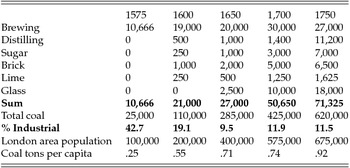
So many bricks were held together with vast amounts of lime mortar, which also used substantial quantities of coal. Combining Richard Neve's 1703 description of brick and mortar production with a late eighteenth-century study of rural lime burning yields a ratio of about 5 chaldrons of coal per 100,000 bricks.Footnote 55 This means adding 50 per cent to the figures for bricks, meaning that (if we assume that all lime was produced in metropolitan London, which is unlikely) lime burning would account for about 2 per cent of metropolitan coal use in the aftermath of the Great Fire, but about .5 per cent during the more normal years during the following decades. But even this modest proportion is too high. First, because a late seventeenth-century account suggests that lime was burned along the Kentish coast of the Thames about twice as efficiently as this, using only 2.7 chaldrons.Footnote 56 Second, because some significant proportion of London's lime was burned near its source, imported to the capital from Kent or elsewhere as lime rather than chalk.Footnote 57 It therefore seems generous to allow lime burning one quarter of the coal required for making bricks, which is reflected in Table 1. This suggests that lime burning accounted for only about 1 per cent of London's coal consumption around 1670, and less than half of this in other years.
London coal consumption (tons) by industry, 1575–50
See text for sources and assumptions behind data.

A final trade whose fuel consumption can be estimated with some confidence is London's glass industry. Scholarship on the history of glass making in London has been much less interested in social, economic or environmental change than in the development of English craft production and its aesthetic accomplishments. Much has been written, therefore, about the roles of Venetian immigrants in importing new skills, the spread of production around England and development of new styles and manufacturing techniques within the English industry.Footnote 58 Very little work, however, exists on the place of glass making in the London economy. Nevertheless, it is quite clear that, as in the case of brick making, the blame received by this trade for urban smoke pollution was disproportionate to the small numbers of glass houses working in the capital. Even at its height around 1700, London probably contained just over 20 glass houses, and these collectively used only a small fraction of London's coal.
The development of London's glass industry was closely tied to innovative use of coal fuel. Late sixteenth-century glass production, carried on by skilled immigrants, was said to waste scarce wood supplies, so conservation was an explicit justification for the development of a new technique of making glass with mineral coal.Footnote 59 Eleanor Godfrey's study shows that it was state policy rather than cost-effectiveness that drove glass making's transition from wood to mineral fuels. Before around 1620, therefore, the contribution of glass to London coal consumption was zero because all glass was made with wood. Thereafter, the monopolist Sir Robert Mansell operated London glass houses primarily in disused ecclesiastical spaces: in Southwark within the palace of the bishop of Winchester, within London's walls in Austin Friars Broadstreet, and downriver at St Katharine's and Woolwich.Footnote 60 These were substantial undertakings but there were no others like them in London; even Mansell's primary works were at Newcastle. Godfrey estimated that the substantial glass works of the Willoughby family in Wollaton, Nottinghamshire, required about 800 tons of coal per year to make its window and drinking glasses. If Mansell's works required three times this amount in London (where fuel was much more expensive than at Wollaton and therefore perhaps used more efficiently), the capital's glass industry would still have used under 1 per cent of the urban coal supply.Footnote 61
While its fuel needs were therefore modest before mid-century, after 1660 London glass production grew. At the Charterhouse, Vauxhall and Greenwich under the patronage of the duke of Buckingham, and most importantly at the Savoy where George Ravenscroft's new method for making lead crystal was employed, London glassmakers improved in sophistication and quality and expanded in scale.Footnote 62 By 1696, John Houghton claimed that there were 24 glass houses in the London area, a total that should probably be taken as an upper limit for substantial houses since not all were producing simultaneously.Footnote 63 On the other hand, there were probably also other unknown facilities producing on a small scale.Footnote 64 By around 1700, glass production had reached an important scale and was a significant component of the manufacturing sector of the London economy.Footnote 65 In 1750, total English production of bottle and white glass amounted to almost 15,000 tons, which (if Godfrey's proportions of 6 tons of coal per ton of glass still prevailed) suggests annual fuel inputs of around 90,000 tons of coal.Footnote 66 London's contribution to this total is not known but seems likely to have been small as substantial glass industries existed by this period throughout England, including Tyneside, Lancashire, South Yorkshire, Birmingham, Stourbridge and Bristol, and the general trajectory of the London industry during the eighteenth century was downward.Footnote 67 If London held one third of the English glass industry in 1750, it would have accounted for about 30,000 tons, or less than 5 per cent of the metropolitan total. If London's share was as small as one fifth of the English total, as would seem more likely given the advantages to a glass house of being located near to cheap fuel, then this industry would have consumed only 18,000 tons, a large figure but less than 3 per cent of London's fuel supply.
Altogether, the trajectories of these major consumers of sea coal can be combined into a general picture. During the opening decades of Elizabeth's reign, in particular during the 1570s, a high proportion – perhaps even half – of London's coal use was industrial, and this was almost entirely due to the capital's substantial brewers. As households began to burn coal from about 1590 this proportion declined towards about 10 per cent, a ratio that probably changed little throughout the early modern period. During the early seventeenth century, however, London's coal-fired industrial landscape gradually diversified. Glass making with coal began during the 1610s, brick making with coal steadily expanded and sugar refining existed on a modest scale. After the middle of the seventeenth century, all of these industries grew so that by about 1700 beer, gin, sugar, brick, lime and glass production consumed something likely to be near 12 per cent of greater London's mineral fuel. These were not, of course, London's only industries: dying, pipe making, tallow melting, soap melting and metal working were all said to burn substantial amounts of coal as well. Quantifying these industries’ fuel requirements has not been possible for this article, but there seem to be no grounds for suspecting that they would have exceeded the processes described above. The fuel required to melt London's dye and candles must have been dwarfed by that required to boil the water for its beer, to burn its millions of bricks or to refine most of England's white sugar. Intense heat was important to make tobacco pipes, ceramics, copperas and saltpetre, to work metals and to make armaments, but all of these were niche industries, each requiring either a small number of workshops or a small amount of fuel per shop.
Assigning numbers to these trades therefore remains educated guesswork, but it is nevertheless reasonable to suppose that these and other smaller coal consumers did not match the requirements of the larger industries.Footnote 68 Given that large industries like glass, brick and sugar making, which were generally cited as the leading consumers of coal after brewing, used only 1–2 per cent of the capital's coal each, it seems unlikely that smaller manufacturers would have added substantially to the proportion of fuel required by London industry. By 1700, then, London's leading fuel consumers consumed about 12 per cent of its coal, so even if all other industries doubled this amount total industrial fuel consumption would only have reached 25 per cent. A proportion higher than this is unlikely. After about 1700, London's industry continued to diversify and expanded in many sectors, but working against this growth was the decline of London's dominance in many of the trades that required large amounts of cheap fuel and therefore were hurt by competition from growing ports like Bristol and Liverpool or the gradually industrializing north. These two trends probably roughly cancelled each other out, with industry's contribution to London's fuel demand approximately the same proportion in 1750 as it had been in 1700. From about 1590, throughout the rest of the early modern period, then, London's furnaces, boilers and kilns were never responsible for anything close to a majority of its mineral coal demand.
London's coal-burning industrial facilities
It is therefore clear that writers like Petty who suggested that one industry drove urban coal consumption, were wildly off the mark, as was John Evelyn's claim that smoke from ‘culinary fires…was hardly at all discernable’.Footnote 69 Contemporaries were not, however, delusional in perceiving connections between smoke and industry. The general cloud that was often seen to hover over the entire metropolis was primarily the work of domestic fires, but large furnaces remained quite capable of leaving their mark on the air of a neighbourhood. For if industry in general consumed a minority of London's fuel, some industrial facilities nevertheless burned coal in quantities far exceeding what was needed within households. If a poor family of five might have used two or three tons of coal in a year, many manufacturing plants exceeded 100 times that total. While households, moreover, burned their fuel gradually and steadily, some industries devoured vast amounts of coal over concentrated periods. Brick burning, for example, came after weeks of digging, mixing and working clay into moulds, but the firing was then accomplished over only a few days. Glass making and beer brewing also involved a rhythm, as periods during which large amounts of coal were burned were followed by time to perform other tasks.
Such industries, according to both contemporary comment and to reconstructions of their manufacturing process, regularly required hundreds of tons of coal annually. A glass house in early seventeenth-century Nottingham consumed around 10 tons of coal per week, and a century later a budget for a new glass factory in Wales envisaged three times this amount.Footnote 70 It is reasonable to assume that the larger London concerns would have been on comparable scales. Whether they were closer to the lower or the upper end of that range is unknown, but one pamphleteer claimed even higher totals when he argued in 1699 that metropolitan glass houses, like brewhouses, distillers and dyers, each burned 700 and even up to 1,400 tons of coal per annum.Footnote 71 Individual brick kilns, too, used large amounts of coal over short periods. In December 1632, for example, a search by the Tylers and Bricklayers Company identified six yards with between 500,000 and 900,000 bricks each, plus many others of lesser scale. Such larger undertakings would have required, following Houghton's account, 50–90 chaldrons, or 70–126 tons of coal.Footnote 72 Henry Tindale's 2.8 million bricks in 1669/70 would have required almost 400 tons of coal if he used the same ratios.Footnote 73 Even if he skimped on fuel and under-fired his bricks, Tindale's fields and others like them would have consumed enormous piles of coal fuel very quickly. Similarly, the sorts of large sugar refineries that ‘candied’ Catharine Talbot also used large amounts of coal. Sir John Fellowes and Company were said in 1723 to do £150,000 worth of business annually, which would have required some 1,600 tons of sea coal. Fellowes’ own accounts show that in May of 1724 his 10 refineries, scattered throughout the metropolis, held about 1,350 tons of coal in stock. However long such a supply would have lasted and however much each of his houses used per year, it is quite clear that Fellowes’ sugar business consumed vast fuel supplies. Accordingly, he bought in bulk, as his accounts show debts of hundreds of pounds to George Oldner, one of London's leading coal wholesalers.Footnote 74 Fellowes was probably only unusual in the scale of his investment in multiple refineries, and each of London's other large refiners used amounts of coal probably ranging from 100–200 upwards towards c. 500 tons annually.
Brewers, however, were certainly the most important and visible individual users of coal, just as they collectively used more fuel than any other urban industry.Footnote 75 From as early as the mid-sixteenth century, London's leading commercial brewers operated on large scales for the burgeoning urban market. While Westminster Abbey's in-house brewery required 17 tons of sea coal to brew 146 quarters of malt annually during the 50 years after 1587, the large commercial brewhouses during this same period used around 100 quarters of malt per week, suggesting an annual fuel consumption of about 600 tons per year if they followed the same ratio, or 400 tons if they were more efficient, as suggested above. Two brewers in 1593 were assessed for using 150 and 200 quarters, respectively, of malt per week, over 50 times the scale of Westminster Abbey. Totals near to 500 tons of coal annually would have been common for London's largest brewers across the metropolis, from the large brewhouses in Westminster to those along Thames Street in London itself to those on Southwark's bankside to those in St Katharine east of the Tower. By 1750, London's largest breweries approached and exceeded 50,000 barrels of beer per year, an amount probably requiring close to 1,000 tons of coal fuel.Footnote 76 The Truman brewery's archive shows them purchasing about 1,400 tons of sea coal per year to produce around 100,000 barrels at its brewery in Spitalfields, just east of the City of London, at the end of the eighteenth century.Footnote 77 During the seventeenth century, large breweries would have produced about one quarter of this amount, and if they used their fuel less efficiently then we are again given totals not far from 500 tons annually. This is also the scale of a large Southwark distillery described in 1763, when it burned 700 tons of coal to produce a quarter-million gallons of spirits.Footnote 78 Pamphleteers made similar claims, as in 1699 when it was claimed that large brewers used up to 20 tons of coal per week, or that ‘many’ London glass makers and brewers used 1,100–1,400 tons of coal per year. Even half of such sums were enormous amounts of fuel whose plumes of black smoke would have been easily visible, and perhaps taste-able and smell-able too, throughout their immediate neighbourhood.Footnote 79
These brief sketches of the likely coal requirements of some of London's heat-intensive industries indicate that, while they did not drive the urban coal market and they alone did not cause London's urban smoke cloud, they nevertheless burned fuel in ways that would have struck contemporaries as remarkable. From a modern perspective, it is equally remarkable that they reached such scales with ‘pre-industrial’ technology, if by that term we mean the absence of steam engines and with them the ability to translate heat into motion. In this sense, the brewing, melting, firing and refining that took place within early modern London were qualitatively different from the mills and engines of the industrial period.
Yet this does not mean that they were necessarily smaller. Compare the fuel use described so far with early eighteenth-century London's famous steam engine used to raise water near the Strand. It was described in a highly polemical pamphlet in 1726 as ‘The York Buildings Dragon’, a beast that ‘lives upon’ mineral fuel, which ‘will produce a scarcity of coal, by reason of the great consumption’. It emitted ‘such vast dense and opaque columns of smoke, that those who live in the borough will hardly see the sun at noon-day…Now this smoke being ponderous, will descend again upon all the neighbouring inhabitants; being elastic, will spread and fall upon all the evergreens within ten miles of London.’ Coughs will become universal and ‘the cities of London and Westminster will lose sight of one another though in the clearest day, so that nobody can possibly receive any benefit by this contrivance, unless it be the link boys who will be absolutely necessary to conduct people through the smoke’.Footnote 80 The pamphlet's author suggests that the new technology of the Newcomen engine has introduced into London pollution on a new scale.Footnote 81 And yet the York Buildings pump consumed around 1,000 tons of coal annually, or 2 chaldrons per day, about the same as the capital's largest brewhouses.Footnote 82 The large heat-intensive industries of early modern London, in other words, burned coal on a scale similar to the engines of the early industrial revolution. There was only one York Buildings Dragon, moreover, but dozens such breweries, glass houses, sugar refiners and brick kilns. While the coming of industry may have dramatically transformed some parts of England, London already possessed a fossil-fuelled economy and a polluted environment before the transformative decades of the late eighteenth century.
Conclusion: industrial production and early modern urban pollution
Coal and its relationship to economic growth has been the subject of vigorous debate in recent years, but the findings described above suggest that this literature has missed out on some of the key implications of early modern coal consumption. Economic historians have focused on explaining British industrial precocity, arguing over the importance of energy endowments relative to other factors like mercantilism, colonial markets and raw materials, consumerism and the industrial enlightenment.Footnote 83 This is a crucial debate, but coal's role in it can give the impression that coal mattered primarily, or even only, as an industrial raw material. Coal does have an important place in the story of how northern English and Scottish manufacturing centres achieved such unprecedented levels of productivity during the nineteenth century. But that is not the only story to which it contributes. Before dark satanic mills changed the face of Britain, coal had long played a vital role in the daily lives of its people, especially those people dependent on markets rather than hedges or forests for fuel supplies. England had been a fossil-fuelled society almost two centuries before Watts’ steam engine, and during the seventeenth century the only place in the world famous for burning prodigious supplies of mineral coal was London. London was by far the world's largest coal market, its largest energy consumer and endured its most polluted air. None of this resulted from industrialization, but from dynamics already present in the early modern city.
London's coal burning, therefore, was indeed a harbinger of an industrial future, but in limited ways. Thousands of the capital's inhabitants knew that their livelihoods depended on reliable and affordable fuel, points they or their lobbyists repeated to parliament whenever it considered further coal taxes. Cheap fuel, they argued, was essential to industrial manufacturers, and if coal were overtaxed industries would shrivel in the face of competition, either from abroad or domestic regions where coal was cheap and untaxed. London's inhabitants and visitors could see the dark clouds emitted from industrial chimneys, each of which signalled a busy workshop dependent on affordable fires to compete, to employ, to supply markets and to pay taxes. The connection between cheap energy and metropolitan economic power thus became ever more evident. But this discussion has shown that, if the coal trade was widely considered to be crucial for urban industry, urban industry was not similarly crucial to the coal trade. It was London domestic consumption that accounted for about 75 per cent or more of the capital's coal demand. This fuel was burned in small fireplaces, a few pounds at a time, as individuals and families heated water, cooked food and kept warm. The vast urban market for cheap fuel, then, was driven by the mundane needs of all Londoners to supply basic needs. Surprisingly large industrial facilities existed in early modern London, and they consumed surprisingly large quantities of fuel. But it was millions of little fires that made London the largest consumer of fossil fuels, and the first city to endure permanently smoky air, which the world had ever seen.