Introduction
The recent United States (US) troop withdrawal out of Afghanistan under a February 2020 US-Taliban agreement and the rapid concurrent collapse of the Afghan military, followed by the ascendance of the Taliban and the capture of Kabul, has placed an international spotlight around the future of South Asian countries. Security threats, in particular, will likely escalate within the region and beyond, with significant concerns around the resurgence of the Taliban and Al-Qaeda. Reference Taneja and Siyech1,Reference Engel, Smith and Talmazan2 The interwoven relationship between terrorist organizations and South Asian countries remains complex and some counter-terrorism experts predict a surge in terrorism activities in the near future, with a high likelihood of an attack on the US and its allies as a result. Reference Erlanger3 This study aims to provide an epidemiological description of all terrorism-related attacks in South Asia sustained from 1970 – 2019. These data will be useful in the development of education programs in Counter-Terrorism Medicine and provide an insight into potential attacks in the future.
Methods
Data collection was performed using a retrospective database search through the Global Terrorism Database (GTD). 4 This database is open-access with publicly available data collection methodology utilizing artificial intelligence that identifies events from news media around the world and confirms them through human examination by the National Consortium for the Study of Terrorism and Responses to Terrorism (College Park, Maryland USA). The GTD defines terrorist attacks as “the threatened or actual use of illegal force and violence by a non-state actor to attain a political, economic, religious, or social goal through fear, coercion, or intimidation.” 5 The GTD does not include acts of state terrorism, contains no personal identifiers for victims, and links specific events to open-source news articles.
The GTD was searched using the internal database search functions for all events which occurred in Afghanistan, Bangladesh, Bhutan, India, Maldives, Mauritius, Nepal, Pakistan, and Sri Lanka (collectively referred to as South Asia) from January 1, 1970 - December 31, 2019. Years 2020 and 2021 were not yet available at the time of the study. Primary weapon type, primary target type, country where the incident occurred, and number of deaths and injuries were collated by two separate data extractors and compared to locate any conflicts in extraction.
Results were exported into an Excel spreadsheet (Microsoft Corp.; Redmond, Washington USA) for analysis. Ambiguous events (this field is only systematically available with incidents occurring after 1997) were excluded when there was uncertainty as to whether the incident met any of the criteria for GTD inclusion as a terrorist incident. Attacks met inclusion criteria if they fulfilled the following three terrorism-related criteria, as set by the GTD. These criteria are determined within the database and not by the authors:
-
– Criterion I: The act must be aimed at attaining a political, economic, religious, or social goal.
-
– Criterion II: There must be evidence of an intention to coerce, intimidate, or convey some other message to a larger audience (or audiences) than the immediate victims.
-
– Criterion III: The action must be outside the context of legitimate warfare activities (ie, the act must be outside the parameters permitted by international humanitarian law, particularly the admonition against deliberately targeting civilians or non-combatants).
Results
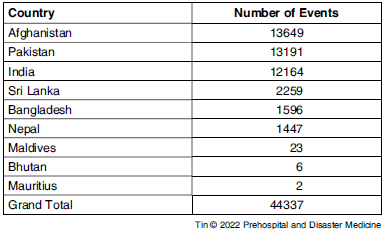
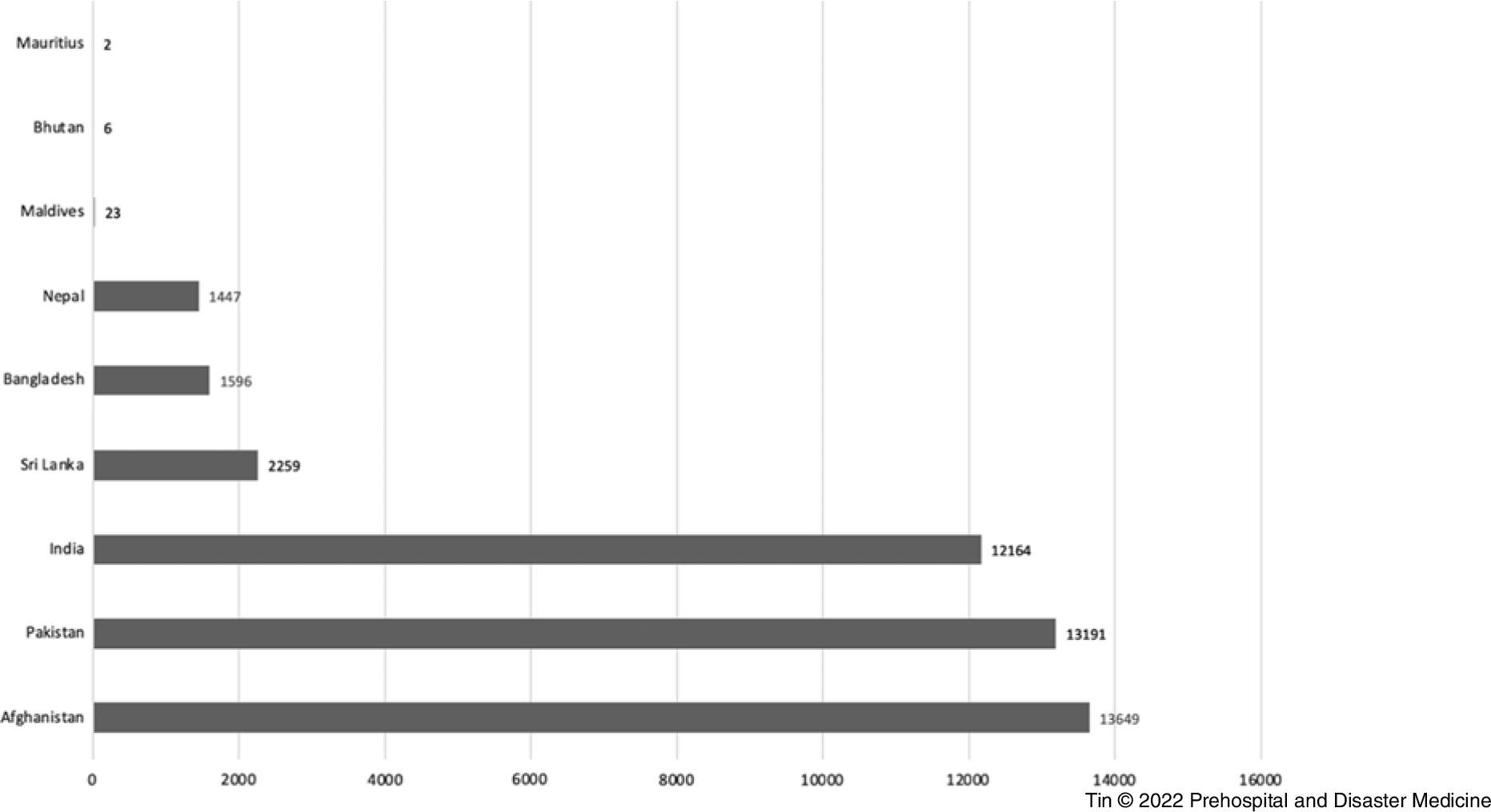
A total of 44,337 events occurred in South Asia, representing 26.39% of all terrorism events world-wide from 1970-2019. Reference Tin, Margus and Ciottone6 A total of 96,092 deaths and 141,333 non-fatal injuries were recorded in this region as a result of these attacks. Of those, 30.8% of attacks happened in Afghanistan, 29.8% in Pakistan, 27.4% in India, 5.1% in Sri Lanka, 3.6% in Bangladesh, 3.3% in Nepal, and <0.1% in Maldives, Bhutan, and Mauritius combined (Table 1 and Figure 1).
Number of Terrorist Events by Country

Terrorist Attacks in South Asia, by Country.

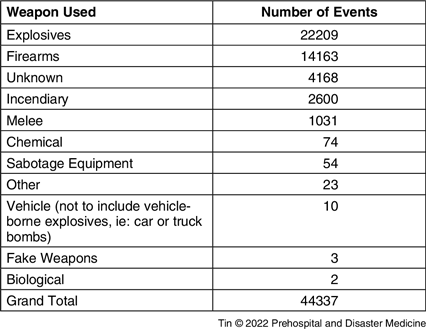
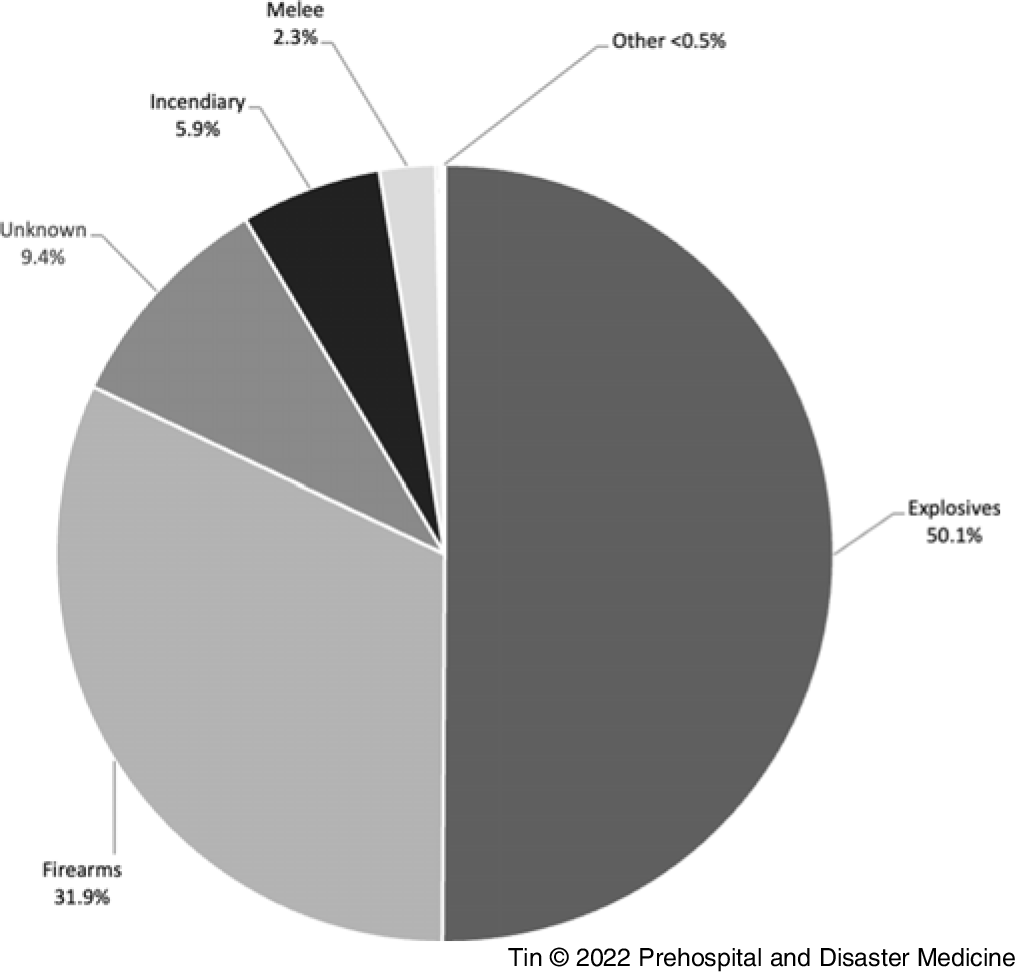
Overall, 50.1% of attacks used explosives, 31.9% used firearms, 9.4% used unknown weapons, 5.9% used incendiary attacks, 2.3% were melee attacks, and <0.5% used chemical, biological, and other weapon types (Table 2 and Figure 2).
Number of Terrorist Events by Weapon Type

Weapon Type Used in Terrorist Attacks in South Asia.

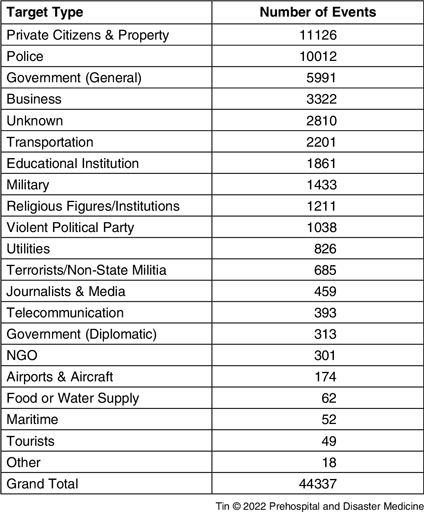
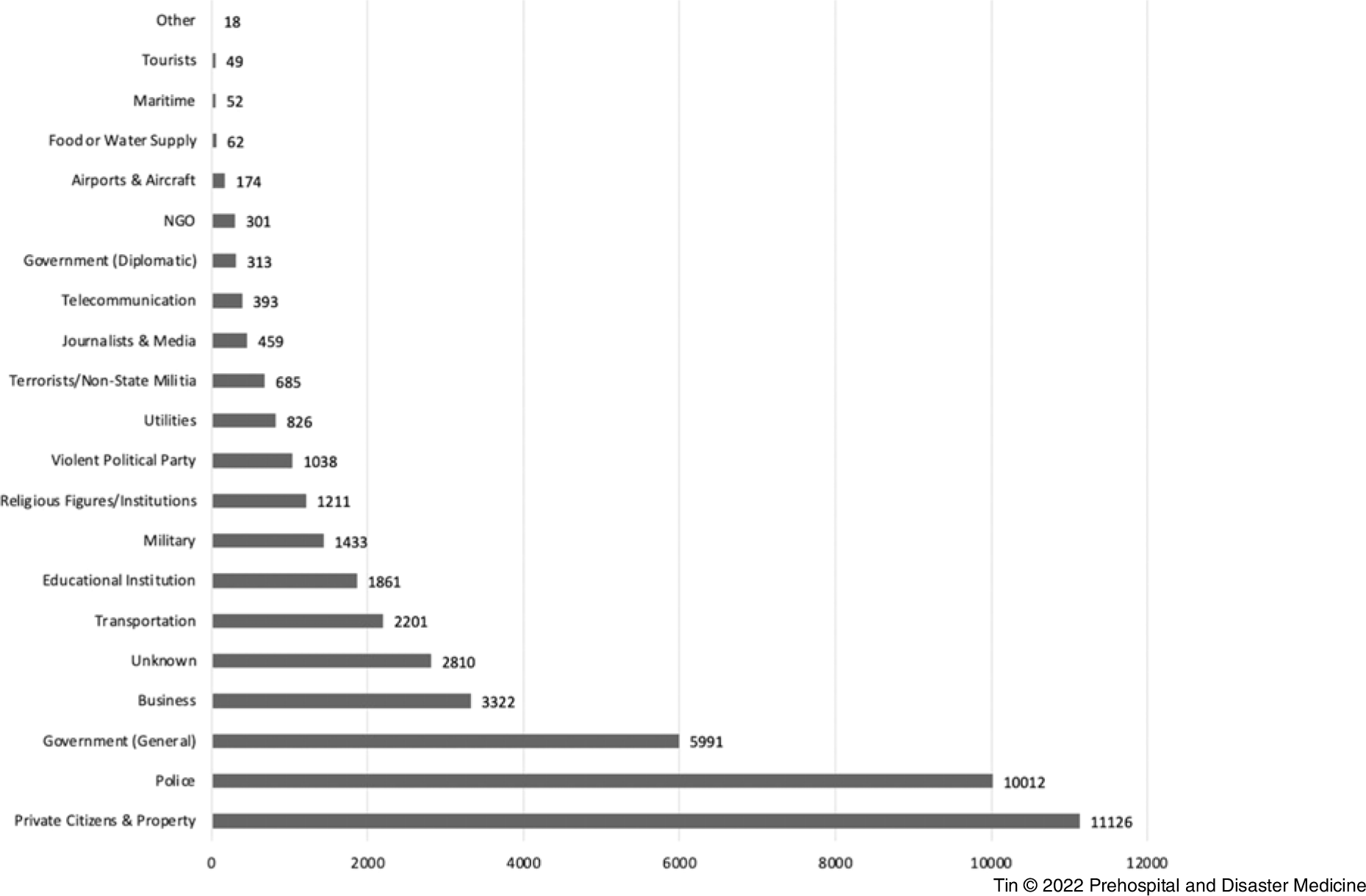
Overall, 25.1% of attacks targeted private citizens and property, 22.6% targeted police, 13.5% government (general), 7.5% businesses, 6.3% unknown, 5.0% transportation, 4.2% educational institution, 3.2% military, 2.7% religious figures/institutions, 2.3% violent political parties, 1.9% utilities, 1.5% terrorists/non state militia, 1.0% journalists and media, and 3.1% the rest (Table 3 and Figure 3).
Number of Terrorist Events by Target Type

Abbreviation: NGO, nongovernmental organization.
Terrorist Targets.
Abbreviation: NGO, nongovernmental organization.

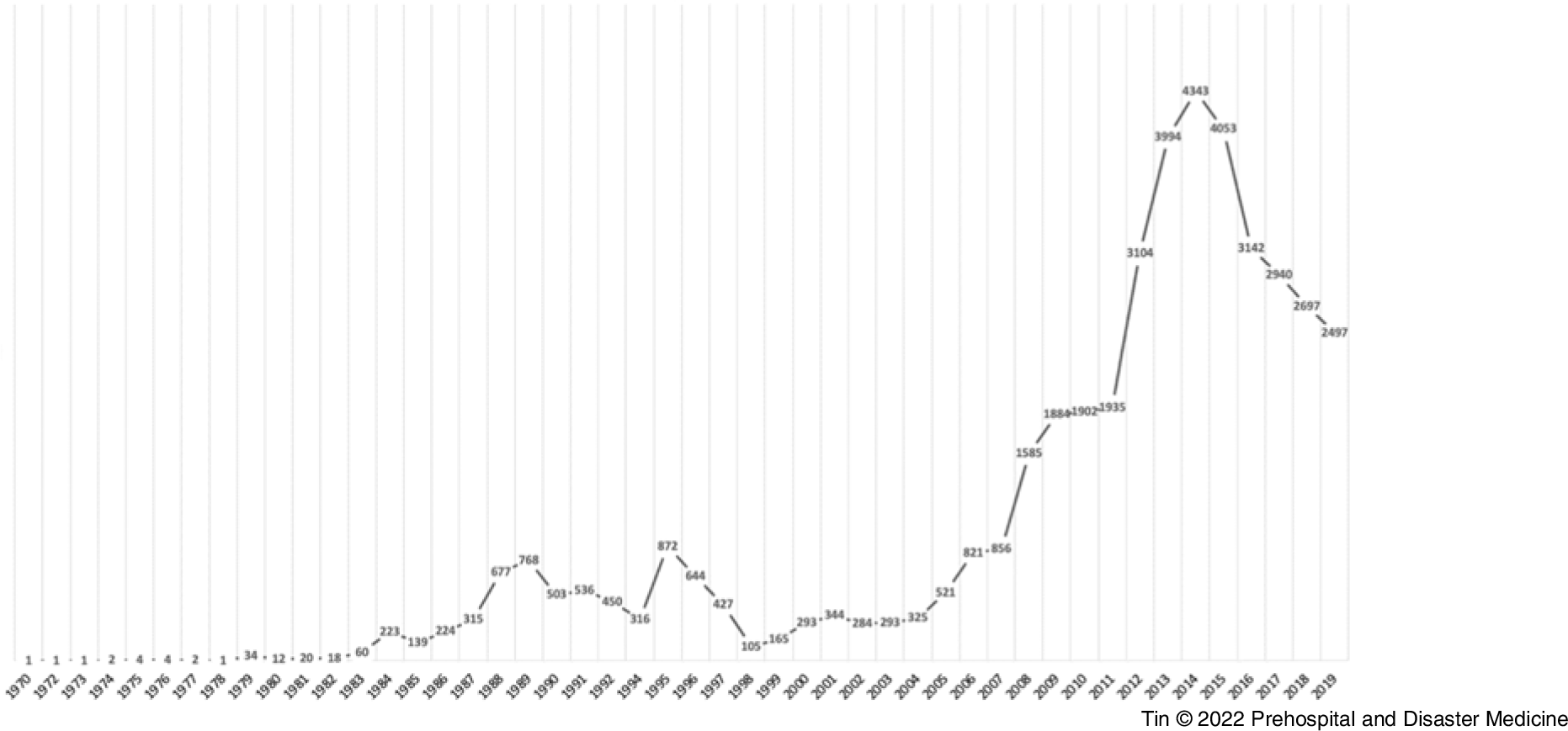
The year 2014 saw a peak of 4,343 terrorist events, with a gradual decline in activity since (Figure 4). The deadliest terrorist attack in the region occurred on April 21, 2019 in Sri Lanka, which caused 266 deaths and 500 injured.
Terrorist Attacks in South Asia.

Discussion
Based on data from The World Bank (Washington, DC USA), the life expectancy in South Asia is 69 in males and 71 in females, and the region ranks second globally in terms of terrorist attacks since the 1970s, after the Middle East and North Africa region. Reference Tin, Margus and Ciottone6–8 The years of life lost in the region are due to non-communicable diseases, infectious diseases, and trauma. Reference Naghavi, Abajobir and Abbafati9
The limited ability of the region to cope with various disasters is evident in their response to the current pandemic. Due to the poor health infrastructure in the region and the large segment of the population living below the poverty line, it would be difficult to address any additional crisis. Reference Saleem, Sidra, Rauf and Siddique10
In a report on terrorism from July 2021, the United Nations Security Council (New York USA) warned of increasing terrorist activities, including the recruitment and training of new members, throughout South Asia. 11 While there has been a downtrend in attacks since the 2014 peak, the rapid resurgence of the Taliban since the US withdrawal of troops in Afghanistan remains a concern, with likely short-term immediate impact and escalation of activity around the region. Reference Clarke12
Health care infrastructure in South Asia remains fragmented and under-funded with the workforce struggling to deliver optimal, time-sensitive care to victims of terrorism. Reference Sonawane, Garg, Chandanwale, Mathesul, Shinde and Singh13 The conflict in the area has also brought about displacement of persons leading to increased risks of infectious diseases, child malnutrition, gender-based violence, and increased mental health issues, along with on-going difficulties in accessing health care due to the lack of human and financial resources in the region. Reference David, Gazi, Mirzazada, Siriwardhana, Soofi and Roy14
Furthermore, health care facilities can be targets of attacks, as evidenced by the 2008 Ahmedabad incident where secondary blasts were carried out in civil hospitals leading to more harm and disruption to emergency care. The November 2008 Mumbai terror attacks also clearly demonstrated deficiencies in prehospital Emergency Medical Service responses, as well as a lack of incident command systems. The complex, coordinated Sri Lanka Easter suicide bombing attacks in 2019 demonstrated a level of sophistication and coordination by terrorist groups that should be a cause of concern for health and security professionals. Reference Sonawane, Garg, Chandanwale, Mathesul, Shinde and Singh13,Reference Arora15 In light of these attacks, Disaster Medicine, Counter-Terrorism Medicine, and local health care specialists have been advocating for improved preparedness measures to man-made, intentional events.
Health care professionals in the region have called for curriculum adaptation and continuous on-job training to be better prepared to handle terrorism-related disasters in the future. Reference Khilji Fur, Raziq and Shoaib16 On a global scale, Disaster Medicine and Counter-Terrorism Medicine specialists have similarly been advocating for education and training, in addition to reconsiderations in health care mitigation, preparedness, response, and recovery strategies for man-made, intentional events. Reference Tin, Hertelendy and Ciottone17–Reference Ciottone, Tin and Court19
Limitations
The GTD is a comprehensive record of global terrorist events. It is maintained by the National Consortium for the Study of Terrorism and Responses to Terrorism and is the basis for other terrorism-related measures, such as the Global Terrorism Index. Reliance wholly on the GTD is partially mitigated by confirmation with other lay sources and searches for other online searches, but if there are incidents not reported in the GTD, this could limit the veracity of the findings. Furthermore, the lack of a universally agreed-upon definition of the term terrorism can create inconsistencies between databases in the labelling of such events. Clear and detailed documentation of terrorist events is further hindered by restrictions on reporting, the lack of independent corroboration, and the lack of transparency within government sources. Finally, the use of pre-existing databases such as the GTD as a data source inherently introduces potential challenges such as miscoding or data entry errors and a reliance on the accuracy of open-source information.
Conclusion
Overall, 23.69% of all terrorist attacks from 1970-2019 occurred in the South Asia region, causing 96,092 deaths and 141,333 non-fatal injuries. Over 88% of the attacks occurred in Afghanistan, Pakistan, and India combined. While there has been a decline in attacks since 2014, there are concerns of a significant increase in terrorism activity in recent months, which could impact an already fragmented health care system. The use of explosives and firearms as attack modalities accounted for 82.0% of all weapon types used, but the impact of terrorism and conflict expands beyond simple death and casualty tolls.
Conflicts of interest/funding
The authors declare no conflicts of interest and no financial disclosures.