Introduction
Parkinson's disease is a degenerative disorder of the central nervous system. It is estimated to affect 2 per cent of the population aged over 60 years of age worldwide. In 2008, there were about seven million individuals with Parkinson's disease worldwide, of which about 89 per cent suffered from disease-related communication disorders.Reference Ramig, Fox and Sapir 1 The classic clinical picture of Parkinson's disease includes: bradykinesia, rigidity, rest tremor and asymmetric onset. Pathologically, the disease affects many structures in the central nervous system, with preferential involvement of dopaminergic neurons in the substantia nigra pars compacta. It is generally believed that the disease is a result of the disturbed balance between the antagonist neurotransmitters dopamine and acetylcholine, due to the depletion of dopaminergic neurones.Reference Ramig, Meyer, Fox, Blitzer and Tagliati 2
Some of the contributing factors to the limitation of communication in a vast majority of patients with Parkinson's disease are: soft voice, breathiness, hoarse quality of voice, monotone voice, imprecise articulation and reduced facial expressions (masked face).Reference Pitcairn, Clemie, Gray and Pentland 3 , Reference Pitcairn, Clemie, Gray and Pentland 4 This reduced ability to communicate is considered by many of the patients and their families as the most handicapping aspect of the disease. It can have a negative impact on individuals with Parkinson's disease and their family life, long before frank intelligibility impairment is evident.Reference Miller, Noble, Jones and Burn 5
Voice problems are typically the first to occur, followed by others such as prosody, articulation and fluency, which gradually appear as the speech impairment progresses.Reference Sapir, Ramig, Hoyt, Countryman, O'Brien and Hoehn 6 Perceptually, the voice of a Parkinson's disease individual is characterised by reduced loudness, reduced pitch variation, mono-loudness, mono-pitch and breathy hoarse quality of voice. Although the underlying neural mechanisms of these voice and speech changes remain unclear, these changes have been traditionally attributed to motor signs such as rigidity, bradykinesia, hypokinesia and tremors. Inadequate muscle activation is one pathophysiological mechanism underlying bradykinesia and hypokinesia, which is thought to be of particular importance to the voice and speech disorders in patients with Parkinson's disease.Reference Berardelli, Rothwell, Thompson and Hallett 7
The voice changes, especially intensity and speech audibility, are associated with a more systemic decline in respiratory and laryngeal control. They are typically the result of a decreased respiratory driving pressure to propel air through the larynx and the decreased closure of the vocal folds to effectively convert the aerodynamic energy into acoustic energy.Reference Ramig, Fox and Sapir 8 Yet, strangely enough, patients with Parkinson's disease are generally unaware of the voice disorder severity. In fact, they often report that they feel as if they are shouting or as if they are exerting a great deal of effort when they are asked to speak at a normal loudness level. This observation suggests that the voice disorder in Parkinson's disease is not purely motoric in nature, but may also be related to a somatosensory function.Reference Hammer and Barlow 9
Since the 1980s, many studies have investigated the laryngeal function of patients with Parkinson's disease. These have studied the correlations between laryngeal function and the general neurological motoric manifestation, the presence of tremors, gender differences and the effect of Parkinson's disease treatment on these laryngeal changes.Reference Hanson, Gerratt and Ward 10 – Reference Yücetürk, Yilmaz, Eğrilmez and Karaca 13 Most literature agrees that the characteristic laryngeal manifestations of Parkinson's disease include: vocal fold bowing (which relates to vocal fold atrophy), abnormal vocal fold abduction, the presence of tremors, abnormal phase closure and phase asymmetry. Men are reportedly more likely to develop vocal fold atrophy with bilateral hypertrophy of the ventricular folds, while women are more likely to develop phase closure incompetence.Reference Stelzig, Hochhaus, Gall and Henneberg 12 The vocal abnormality correlates with the general neurological symptoms and the laryngoscopic examination findings.Reference Hanson, Gerratt and Ward 10 The tremor location varies with the type of neurological disorder. In idiopathic Parkinson's disease, vertical laryngeal tremors have been reported as most prevalent, while in Parkinson's-plus patients the tremors mainly affected the arytenoid cartilages.Reference Perez, Ramig, Smith and Dromey 11
As most Parkinson's disease disordered functions have been attributed to the imbalance between acetylcholine and dopamine, dopamine agonists have been the treatment of choice given their marked effect on rigidity, bradykinesia, akinesia and tremors.Reference Radad, Gille and Rausch 14 However, the magnitude, consistency and long-term effects of dopamine agonist therapy on speech in Parkinson's disease have not been confirmed. Some studies have documented improvement in voice and speech motor functions, such as better laryngeal control of voice onset and vocal fold closure, a reduction in excessive laryngeal neuromuscular activity, better speech intelligibility, greater prosody, voice fundamental frequency inflection, fewer voice tremors and generally better voice quality.Reference Goberman, Coelho and Robb 15 – Reference Jiang, Lin, Wang and Hanson 17 Conversely, many others have failed to show systematic changes or clinically significant improvement with levodopa.Reference Larson, Ramig and Scherer 18 – Reference Trail, Fox, Ramig, Sapir, Howard and Lai 20 These findings have led some researches to suggest that voice and speech disorders in Parkinson's disease may be related to non-dopaminergic or special dopaminergic mechanisms. In line with this suggestion, Biary and colleagues found that clonazepam (a non-dopaminergic agent) can significantly improve some aspects of speech in Parkinson's disease when given daily.Reference Biary, Pimental and Langenberg 21
Other medications used in Parkinson's disease include apomorphine, glutamate antagonists, anticholinergics, COMT (catechol-O-methyl) inhibitors and MAO-B (monoamine oxidase B) inhibitors. In a randomised, double-blind, placebo-controlled crossover study, apomorphine was shown to not have any different effects on speech than a placebo.Reference Kompoliti, Wang, Goetz, Leurgans and Raman 22 Anticholinergics and MAO-B inhibitors may affect the voice negatively because of their well-documented drying effect, although no studies have investigated this directly. In addition, no studies have examined the effect of glutamate antagonists on the voice.
Neurosurgical procedures such as deep brain stimulation of the thalamus, pallidum or subthalamic nucleus, ablative surgical procedures (pallidotomy and thalamotomy), and fetal cell implantation have produced inconsistent effects on speech and voice, with some showing dramatic improvement and others showing no changes despite the significant improvements observed in limb motor functions.Reference Baker, Ramig, Johnson and Freed 23 – Reference Törnqvist, Schalén and Rehncrona 26
Given the inconsistencies in voice and speech improvement obtained using neuropharmacological or neurosurgical intervention, speech therapy has been recommended to improve voice and speech, even in patients who are medicated or have undergone a neurosurgical procedure. The UK National Institute for Health and Care Excellence guidelines have updated the national guidelines accordingly for the diagnosis and management of Parkinson's disease. Regarding clinical care, it is recommended that speech and language therapy be available to those with Parkinson's disease. Specific recommendations focus on improving vocal loudness and pitch range, as in programmes such as Lee Silverman Voice Treatment (‘LSVT’) Loud® therapy.Reference Ramig, Sapir, Countryman, Pawlas, O'Brien and Hoehn 27 , Reference Ramig, Sapir, Fox and Countryman 28
Lee Silverman Voice Treatment Loud is an intensive therapy programme of voice exercises for people with Parkinson's disease. Its exercises target the greatest voice problem areas: volume and clarity. It is based on training the single motor control parameter of amplitude (voice loudness) and the recalibration of self-perception of vocal loudness; these are considered the fundamental elements underlying treatment success. Training ideally involves four 1-hour sessions per week for 4 weeks. It requires intensive, high-effort exercise, combined with a single, functionally relevant target (loudness) taught across vocalisation tasks (from simple to complex). The therapy enables most individuals with Parkinson's disease to recognise and understand when their speech is too soft, and gives them the ability to self-correct by speaking louder and with greater clarity. However, it is generally recognised that the therapy has greater success in those with early or intermediate disease, stressing the need for early recognition of symptoms.
Vocal loudness training has been documented to improve not only the voice, but articulation, facial expression and swallowing.Reference Fox, Ramig, Ciucci, Sapir, McFarland and Farley 29 Examination of the laryngeal changes that occur following the administration of intensive vocal and respiratory efforts has revealed improvements in laryngostroboscopic variables, namely less glottal incompetence, without significant change in supraglottic hyperfunction.Reference Smith, Ramig, Dromey, Perez and Samandari 30 Patients with late-stage Parkinson's disease may not have as good an outcome with Lee Silverman Voice Treatment as those with early or intermediate Parkinson's disease, and the authors postulate that one reason may be advanced laryngeal changes.
This study aimed to investigate laryngeal changes in patients with Parkinson's disease, and to determine the stepwise changes seen in early-, mid- and late- Parkinson's disease using laryngostroboscopic imaging of the larynx.
Materials and methods
Sixteen patients diagnosed with Parkinson's disease were seen in University Hospital Lewisham voice services. They were examined and followed up in a multidisciplinary out-patient setting. They were seen between October 2013 and July 2015 as part of the multidisciplinary voice clinic caseload. The clinic includes a specialised laryngologist and a specialised voice therapist.
Examination included history taking, voice-specific self-assessment questionnaires for quality of life (Voice Handicap Index and Reflux Symptom Index), manual examination of the larynx and visualisation of the larynx using a laryngostroboscope. All examinations followed the local protocol for examining patients with voice disorders in the voice clinic.
Visualisation of the larynx was performed using a rigid laryngoscope with a high-definition Toshiba three-chip camera (Pentax™ 8 mm, rigid 70-degree laryngoscope, or Machida™ 10 mm, rigid 70-degree laryngoscope). Some patients in whom the larynx was difficult to visualise, or those who could not tolerate the rigid laryngoscope examination despite the use of local anaesthesia, or in cases when the diagnosis could not be confirmed with single use of the rigid laryngoscope, were examined using a Pentax nasolaryngoscope, the chipped-tip VNL-1190STK. All examinations were performed using videolaryngostroboscopy. The examinations were all recorded, edited and saved onto a secured hard drive. All recordings were played back on the same device using the same screen for all patients. All patients consented to the storing of their data for research purposes.
Those patients who were scheduled for medialisation injection of the vocal fold(s) consented to undergo surgical intervention either under local or general anaesthesia. All patients were given vocal hygiene advice, reflux management advice and post-operative voice care advice when appropriate.
Patients who were diagnosed with a hyperfunctioning larynx were given a course of conventional voice therapy, working mainly on breath support and reducing tension while optimising glottic closure. Others who were diagnosed with Parkinson's disease related laryngeal changes without superimposed hyperfunction or any other laryngeal disorders were given an intensive course of Lee Silverman Voice Treatment by a voice therapist trained in this treatment. Patients who were diagnosed with swallowing difficulties were referred for swallowing assessment and further management.
Results
The average age of the studied sample was 72.69 years, ranging from 48 to 88 years. Of the 16 patients, 7 were female (age range, 58–83 years; average age of 71.71 years) and 9 were male (age range, 48–88 years; average age of 73.42 years).
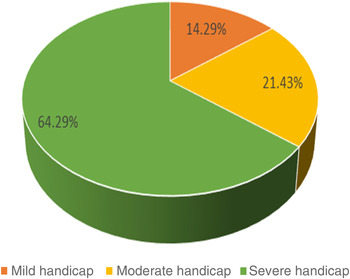
The Voice Handicap Index-10 scores ranged hugely, from 5 (mild handicap) to 33 (severe handicap), with a mean score of 20.5 (Figure 1). These scores indicate that 64.3 per cent of patients had severe handicap. Figure 2 shows the distribution of voice handicap severity according to Voice Handicap Index-10 scores.
Patient's Voice Handicap Index-10 (VHI-10) scores.

Distribution of voice handicap severity according to Voice Handicap Index-10 scores.

Reflux Symptom Index scores (total range, 0–45) also ranged widely, from 4 (not significant for laryngopharyngeal reflux) to 31 (strong significance suggesting laryngopharyngeal reflux) (Figure 3). The mean Reflux Symptom Index score was 18.36; 78.57 per cent of patients scored significantly on the Reflux Symptom Index questionnaire, as shown in Figure 4.
Patient's Reflux Symptom Index (RSI) scores.

Significant Reflux Symptom Index scores indicating laryngopharyngeal reflux.

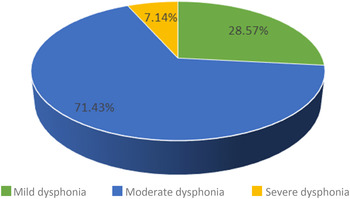
Dysphonia, evaluated by auditory perceptual assessment on the Grade, Roughness, Breathiness, Asthenia, Strain (‘GRBAS’) scale, ranged from mild to severe. None of the patients had normal voice quality. Figure 5 shows the distribution of various grades of dysphonia based on the auditory perceptual assessment scale.
Dysphonia grade based on auditory perceptual voice assessment (Grade, Roughness, Breathiness, Asthenia, Strain (‘GRBAS’) scale).

All patients were retired, with average vocal demands, and all were non-smokers. Two patients showed a normal laryngeal structure with no evident Parkinson's disease related changes. Seven patients (four males and three females) showed elements of associated muscle tension patterns and a hyperfunctional larynx (average age of 72 years). Three patients declined any further management and 13 patients were referred for voice therapy. Six patients received Lee Silverman Voice Treatment while four patients received conventional voice therapy to improve breath support and glottic closure and to reduce excessive muscle tension. One patient opted for medialisation injection of the left vocal fold to help overcome the phonatory gap. One patient was referred for swallowing assessment and further management of dysphagia.
Four male patients showed a degree of presbylarynx (average age of 78 years). One male patient and one female patient had unilateral vocal fold bowing (average age of 59 years). Figure 6 shows the male-to-female ratios for various laryngeal findings. All patients who developed what we considered as grade 3 ‘Parkinson's larynx’ were males.
Male-to-female ratio for various laryngeal changes. MTD = muscle tension dysphonia (hyperfunction)

Discussion
Parkinson's disease is one of the most common degenerative diseases of the central nervous system. Mild changes in articulation and voice quality are apparent in the early stages of Parkinson's disease. The voice changes stem from restrictions of frequency and intensity modulation, a reduction of intensity, and quality changes.Reference Luschei, Ramig, Baker and Smith 31 – Reference Baker, Ramig, Luschei and Smith 33 It has been suggested that the decisive factor in reduced intelligibility, and the consequent effects on communication, is the reduction of vocal intensity.Reference Smith, Ramig, Dromey, Perez and Samandari 30 , Reference Ramig, Countryman, Thompson and Horii 34
The reduction of vocal intensity has been attributed to two main factors: the reduction of breath support and limited vocal fold adduction.Reference Ramig and Dromey 35 This glottis inefficiency can be explained both by the structural laryngeal changes, in the form of vocal fold thinning and bowing, and hypokinesia.
One must consider the possible effects of Parkinson's disease medication on the voice. Some medications (anticholinergics and MAO-B inhibitors) have recognised side effects of dryness and may thus compound any physical laryngeal changes. However, dopamine agonists aim to improve the imbalance between acetylcholine and dopamine in Parkinson's disease, and so improvement of voice may run in parallel to the improvement of overall symptoms, with or without the proposed management plans described here. This study does not dispute this possibility, but rather seeks to add a possible adjunct to maximise the potential the patient has for voice, speech and protection of the lower respiratory tract. If the voice has improved with medication, then their voice examination grading may improve and less intervention will be needed. If the medication compounds the physical changes, then the patient's voice grading may increase, thus pushing the case for further treatment. This decision is of course down to the patient and consulting practitioners, and should be made on an individual basis.
Various laryngeal changes associated with Parkinson's disease have been described in the literature, focused mainly on vocal fold thinning and bowing, and the presence of tremors. More detailed laryngeal functions, such as phase closure incompetence and abnormalities of amplitude and mucosal waveform, have also been investigated. Some researchers have even suggested that gender differences could be the reason for the presence or absence of certain abnormalities.Reference Stelzig, Hochhaus, Gall and Henneberg 12 The current study took a different approach to interpreting the laryngeal changes in Parkinson's disease, by assuming that the disease duration would impact on the laryngeal structures and consequently the function.
This assumption is supported by the fact that we could divide our sample based on the laryngeal findings into three groups, representative of three stages of disease: group one patients had a normal larynx or minimal changes in the form of unilateral bowing of vocal folds; group two patients had changes in the form of presbylarynx with compensatory muscle tension; and group three patients had significant bilateral bowing, spindle-shaped glottic gap on adduction and loss of compensatory muscle tension. There were four patients in the first group, seven in the second and four in the third. The mean patient age was 56 years in group one, 72 years in group two and 78 years in group three. The groups were statistically significantly different in terms of age, supporting the hypothesis that older patients who had suffered Parkinson's disease for longer had developed more advanced laryngeal changes. All stages may have superimposed tremor and/or bradykinesia. Late-stage Parkinson's disease patients may have poor breath support as the chronic motor effects will have an impact on respiratory muscle function. These changes may also be affected by the presence of pre-existing laryngeal pathology.
These findings suggest that Lee Silverman Voice Treatment would be most beneficial at the early stage of Parkinson's disease, prior to the development of muscle tension patterns at the second stage. It will also be helpful at the third stage, when the muscle tension disappears. The compensatory muscle tension is probably the result of inefficient glottic closure, which suggests that treating these patients at stages two and three with medialisation injection would help improve glottic closure, and consequently the breathy, weak quality of voice in Parkinson's disease. Moreover, it gives another window to apply Lee Silverman Voice Treatment in the second stage, as improving glottic closure will help reduce the muscle tension pattern.
However, these stages of laryngeal changes could also be attributed to age changes, regardless of the disease itself. If that is the case, the hypothesis of gradual development of the laryngeal changes still has clinical implications in that it suggests optimum intervention for various stages and indicates that benefits can be achieved by medialisation injection. Medialisation injection can reduce the development of compensatory muscle pattern, and at later stages of the disease can help improve glottic closure. The earlier the administration of Lee Silverman Voice Treatment, the less communicative handicap the patient is likely to suffer. In the second stage of disease, when muscle tension develops, Lee Silverman Voice Treatment alone would be an inappropriate line of management, hence the trials of conventional voice therapy conducted to reduce the laryngeal hyperfunction.
-
• Parkinson's disease is a degenerative disorder of the central nervous system, mainly affecting motor functions including the voice
-
• Dysphonia aetiology changes throughout the course of disease progression
-
• Dysphonia aetiology may be affected by prior laryngeal pathology
-
• Moderate and severe dysphonia cases may benefit from injection medialisation thyroplasty
Larger, longitudinal studies must be performed to gauge whether the changes observed within this patient group can be extrapolated to the whole cohort of Parkinson's patients. The changes that occur with time and disease progression should be examined and correlated with the overall disease picture and prognosis. However, looking forward, it is encouraging to think that there may be a way to categorise the laryngeal changes and that simple phonosurgical procedures may help the voice in these patients. These would aid and run parallel to the current proven speech therapy methods.
Conclusion and recommendations
Laryngeal function in Parkinson's disease appears to go through a series of changes with progression of the disease and may be affected by pre-existing laryngeal pathology. The laryngeal changes may be helped by both therapeutic and surgical interventions, and these patients should be treated within the confines of a voice clinic multidisciplinary meeting setting.
Further studies on larger samples, using age-matching controls, would help to shed more light on the effect of Parkinson's disease progression on laryngeal structures, and to confirm the clinical implications.