Enterobacter spp. are the sixth most common cause of healthcare-associated infections,Reference Sievert, Ricks and JRMS 1 – Reference Marchaim, Navon-Venezia, Schwaber and Carmeli 4 and the emergence of resistance to carbapenems among this species represents a clear epidemiologic threat.Reference Peleg and Hooper 2 , Reference Marchaim, Navon-Venezia, Schwaber and Carmeli 4 – Reference Schwaber and Carmeli 6 The initial spread of carbapenem-resistant Enterobacteriaceae (CRE) was mediated primarily by bla KPC producing Klebsiella pneumoniae strains (ie, >90% of CRE isolations 5 , Reference Schwaber, Lev and Israeli 7 ). Therefore, the CRE cohorts that have been extensively analyzed consisted predominantly of bla KPC producing K. pneumoniae isolates.Reference Marchaim, Chopra and Bhargava 8 – Reference Schwaber, Klarfeld-Lidji, Navon-Venezia, Schwartz, Leavitt and Carmeli 10 Despite the established differences between carbapenem-resistant Enterobacter spp. (CREn) and K. pneumoniae,Reference Schwaber, Graham, Sands, Gold and Carmeli 3 , Reference Marchaim, Navon-Venezia, Schwaber and Carmeli 4 , Reference Marchaim, Chopra and Bhargava 8 , Reference Bogan, Kaye and Chopra 11 the epidemiology of CREn has not been thoroughly investigated, particularly in recent years.Reference Schwaber, Graham, Sands, Gold and Carmeli 3 , Reference Marchaim, Navon-Venezia, Schwaber and Carmeli 4 , Reference Qureshi, Paterson and Peleg 12 Moreover, the phenotypic method for carbapenemase detection, used routinely by many laboratories—that is, the Modified Hodge Test (MHT), is less reliable (has a low specificity) in Enterobacter. 13 Therefore, without additional molecular investigations, the interpretation of the scarce scientific epidemiologic data that do exist pertaining to these pathogens is theoretically subject to classification bias.Reference Schwaber, Graham, Sands, Gold and Carmeli 3 , Reference Marchaim, Navon-Venezia, Schwaber and Carmeli 4 , Reference Qureshi, Paterson and Peleg 12
The aim of this study was to conduct an epidemiologic investigation of CREn from 2 endemic and geographically distinct medical centers. Both clinical and molecular epidemiology analyses were conducted, in order to provide novel information pertaining to one of the lesser studied among the ESKAPE pathogens (ie, enterococci, Staphylococcus aureus, Klebsiella pneumoniae, Acinetobacter baumannii, Pseudomonas aeruginosa, Escherichia coli, and Enterobacter species).
METHODS
Study Settings
This was a multicenter multinational retrospective case series analysis conducted at 2 institutions during 2 different periods. The first study cohort was from the Detroit Medical Center (DMC) healthcare system (8 hospitals, ~2,200 inpatient beds, in Michigan); CRE had emerged and spread since 2008.Reference Marchaim, Chopra and Bhargava 8 , Reference Marchaim, Chopra and Perez 9 , Reference Marchaim, Bogan, Lazarovitch and Kaye 14 – Reference Marchaim, Perez and Lee 17 Patients at DMC were enrolled from September 2008 to September 2009. The second study group was from Assaf Harofeh Medical Center (AHMC; 813-bed tertiary facility, in Southern-Central Israel); CRE has been endemic since 2007, and patients were enrolled from January 2007 to July 2012.Reference Schwaber, Lev and Israeli 7 , Reference Marchaim, Zaidenstein, Lazarovitch, Karpuch, Ziv and Weinberger 18 Data at both DMC and AHMC were extracted from all available records. Other molecular investigations were executed at a research laboratory, located at the Veterans Affairs Medical Center, Cleveland, Ohio. The study was approved before its initiation by the institutional ethics committees at DMC, Wayne State University, AHMC, and the Cleveland Veterans Affairs Medical Center.
Case Finding and Definition
The study enrolled all patients who had a positive culture for CREn. CREn was defined as any Enterobacter spp. that were either (1) nonsusceptible to any group 2 carbapenem on the basis of Clinical and Laboratory Standards Institute criteria set in 2009 13 ; or (2) determined to be a carbapenemase-producer per phenotypic (MHT) or genotypic (bla KPC polymerase chain reaction [PCR]) tests. 13
Differentiation between colonization and infection was determined on the basis of established criteria.Reference Dellinger, Levy and Carlet 19 , Reference Horan, Andrus and Dudeck 20 For patients who had more than 1 CREn isolated during the study period, only the first episode was analyzed.
Microbiology and Molecular Analyses
Bacteria were identified to the species level, and susceptibilities were determined to predefined antimicrobials by means of automated systems at DMC (MicroScan; Siemens) and at AHMC (Vitek 2; bioMérieux), and in accordance with Clinical and Laboratory Standards Institute criteria. 13 Minimum inhibitory concentrations (MICs) to colistin and tigecycline were determined by using Etests strips (bioMérieux). In AHMC only, beginning in 2010, the colistin MICs were determined via specified panel of the Vitek 2 automated system. Breakpoints to define nonsusceptibility to colistin and to tigecycline were set to at least 4 µg/dL for both agents. 13 , 21 All Enterobacter spp. that were resistant to 1 or more third-generation cephalosporin and had an MIC greater than 1 mg/L to ertapenem were screened for carbapenemase production with the MHT. 13 A positive phenotypic extended-spectrum β-lactamase test was defined on the basis of the automated systems at each center, validated with a disc diffusion test. 13
CREn isolates were tested for the presence of bla KPC by PCR.Reference Endimiani, Depasquale and Forero 22 The DMC isolates were tested at the Cleveland Veterans Affairs Medical Center and the isolates from AHMC were tested locally. Previously characterized KPC-producing strains were used as controls.Reference Endimiani, Depasquale and Forero 22 – Reference Samra, Ofir, Lishtzinsky, Madar-Shapiro and Bishara 25
Repetitive extragenic palindromic PCR was used to determine genetic relatedness among CREn from DMC. Analyses were conducted at the Cleveland Veterans Affairs Medical Center using an automated system (DiversiLab; bioMérieux).Reference Marchaim, Chopra and Perez 9 A dendrogram was generated using the DiversiLab software. Isolates with band patterns similarity of at least 95% were considered genetically related.Reference Endimiani, Hujer and Perez 23 CREn from AHMC were genotyped by pulsed-field gel electrophoresis at the Central Laboratories of the Israeli Ministry of Health (Jerusalem, Israel). The XbaI restriction enzyme was used, and the electrophoresis was performed in the CHEF DR III system (Bio-Rad) using an established protocol (www.pulsenetinternational.org/protocols). Isolates with band patterns similarity of at least 95% were considered genetically related.Reference Tenover, Arbeit and Goering 26
Data Extraction
For persons meeting inclusion criteria, the following parameters were extracted: (1) demographic characteristics; (2) comorbidities and background conditionsReference Charlson, Pompei, Ales and MacKenzie 27 ; (3) healthcare exposures; (4) microbiology results (eg, culture source, MICs); (5) severity of acute illness at the time of isolation—for example, McCabe score,Reference Bion, Edlin, Ramsay, McCabe and Ledingham 28 level of Systemic Inflammatory Response Syndrome,Reference Dellinger, Levy and Carlet 19 and the type of the infectious clinical syndromeReference Horan, Andrus and Dudeck 20 (determined by infectious diseases experts at the 2 centers); (6) factors related to antimicrobial therapy such as recent (3 months) exposure history, empirical therapy (from 2 days before to 3 days following the culture date), consolidative regimens (from 3 to 14 days following the culture date), and time to initiation of appropriate therapy (defined as the time frame from obtaining the CREn culture to administration of the first dose of an antimicrobial agent that possessed in vitro activity against the CREn); and (7) outcomes including mortality parameters (extracted from the Israeli Ministry of Interior for AHMC patients, and the Social Security Death Index for DMC patients), length of hospital stay (LOS) from CREn isolation to discharge among those who survived the hospitalization, functional status deterioration,Reference Katz, Ford, Moskowitz, Jackson and Jaffe 29 discharge to long-term care facility after being admitted from home, and direct costs (for AHMC patients only).
Statistical Analysis
All analyses were performed by SPSS, version 21.0 (IBM). Bivariate analyses were performed using the Fisher exact or the χ2 test for categorical variables and the independent samples t test or the Mann-Whitney test for continuous variables. Multivariable models for outcomes were constructed using logistic regression, including only infected patients (vs “colonized only”). A stepwise selection procedure was used to select variables for inclusion in the final models. The final selected model was tested for confounding. If a covariate affected the ß-coefficient of a variable in the model by more than 10%, then the confounding variable was maintained in the model. All P values were 2-sided. A Kaplan-Meier survival analysis was performed as well.
RESULTS
Cohort Descriptive Analysis: Demographic Characteristics and Comorbid Conditions
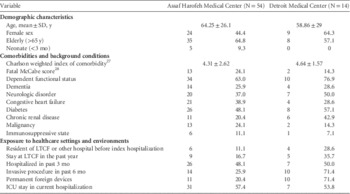
During the study period, there were 68 patients with CREn who met inclusion criteria: 54 from AHMC and 14 from DMC. The overall mean (SD) age of the entire cohort (including pediatric patients) was 63.1 (26) years and 43 patients (63%) were older than 65 years (Table 1). Adult patients (>18 years) were chronically ill, as reflected by the high mean (SD) Charlson weighted index score of 4.4 (2.5).Reference Charlson, Pompei, Ales and MacKenzie 27
Characteristics of Patients With Carbapenem-Resistant Enterobacter Species

NOTE. Data are no. (%) of patients unless otherwise specified. The percents provided are the valid percents—that is, excluding the missing cases from the denominator. ICU, intensive care unit; LTCF, long-term care facility.
There were 5 neonates (<3 months of age) and 1 child (1 year of age) with CREn diagnosed at AHMC. All pediatric CREn isolations were among patients with prolonged LOS (median, 58 days [interquartile range, 40–85 days]). All acquisitions were nosocomial (ie, >72 hours after hospital admissionReference Horan, Andrus and Dudeck 20 ). None of the neonatal cultures were determined to be vertically transmitted. The median (interquartile range) time at risk—that is, days from admission (or birth) to culture, was 11 (3–27) days.
Previous Healthcare Exposures
In general, adult patients from both centers had extensive exposures to healthcare procedures and/or environments (Table 1). Nonetheless, patients from DMC had increased frequency of recent healthcare encounters and exposures, as reflected by higher proportion of patients with recent intensive care unit (ICU) stay (36% at DMC vs none at AHMC, P<.001), regular (ie, at least weekly) outpatient clinic visits (36% vs 6%, P =.008), invasive procedures (of any sort) in the previous 6 months (71% vs 26%, P =.004), and presence of a chronic or a permanent invasive device prior to CREn isolation (71% vs 20%, odds ratio, 9.5, P =.001).
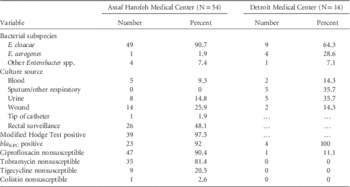
Microbiology
Forty-nine isolates (91%) from AHMC were E. cloacae, 1 (1.9%) was E. aerogenes, and 4 (7.4%) were other Enterobacter species, compared with 9 (64.3%), 4 (28.6%), and 1 (7.1%) from DMC, respectively (Table 2). The portion of E. aerogenes was significantly higher at DMC than at AHMC (odds ratio, 21, P =.006).
Microbiologic Characteristics of Carbapenem-Resistant Enterobacter Species Strains

NOTE. The percents provided are the valid percents—that is, excluding the missing cases from the denominator.
There were more isolations of CREn from rectal surveillance cultures at AHMC (26 [48%]), compared with DMC (none). Twenty-three cases (42.6%) from AHMC represented “true” clinical infection, compared with 10 patients (76.9%) from DMC (odds ratio, 4.3, P =.06). These differences are due in part to screening practices at the study hospitals: at AHMC rectal surveillance was routinely conducted for CREn, whereas at DMC, rectal surveillance was not conducted routinely.
The MHT and the extended-spectrum β-lactamase test results were positive in most cases (ie, 98% for both tests). The presence of bla KPC was confirmed by PCR among all 4 isolates tested from DMC and among 23 (92%) of 25 isolates tested at AHMC.
In general, CREn isolates from AHMC exhibited broader resistance compared with isolates from DMC. Significant variations between institutions in terms of MIC values were noted for colistin, tobramycin, ciprofloxacin, all carbapenems, and trimethoprim/sulfamethoxazole. Significant variations with regards to the proportions of nonsusceptible isolates were noted for amikacin (83% of the isolates from AHMC were nonsusceptible vs 0 at DMC, P<.001), ciprofloxacin (90% from AHMC vs 11% from DMC, P<.001), and trimethoprim/sulfamethoxazole (84% from AHMC vs 0 from DMC, P<.001).
CREn Genetic Relatedness
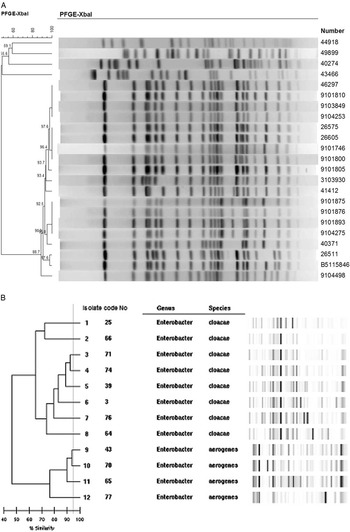
Overall, 23 strains from AHMC were available for genotyping by using pulsed-field gel electrophoresis (Figure 1A). There were 4 pulsotypes diagnosed.Reference Tenover, Arbeit and Goering 26 The results of the repetitive extragenic palindromic PCR conducted on 12 strains from DMC are depicted in Figure 1B. Only E. cloacae and E. aerogenes isolates from DMC were investigated. There were 4 distinct clones among the isolates tested: 2 clones of E. cloacae and 2 clones of E. aerogenes (Figure 1B).
A, Genotypic characterization per pulsed-field gel electrophoresis from patients with carbapenem-resistant Enterobacter species, Assaf Harofeh Medical Center, Israel, 2007–2012. B, Genotypic characterization per repetitive extragenic palindromic polymerase chain reaction from patients with carbapenem-resistant Enterobacter species, Detroit Medical Center, Michigan, September 2008–September 2009.

Severity of Acute Illness at the Time of CREn Isolation
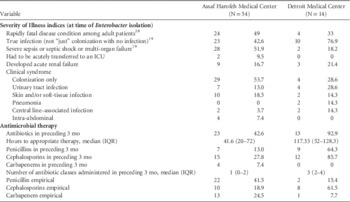
At the time of CREn isolation, 28 (46%) of the adults had a rapidly fatal condition (Table 3).Reference Bion, Edlin, Ramsay, McCabe and Ledingham 28 The proportion of patients with severe sepsis, septic shock, or multi-organ failureReference Dellinger, Levy and Carlet 19 was significantly higher among AHMC than DMC patients (52% vs 18%, P =.05).
Acute Illness Indices and Antimicrobial Therapy Parameters Among Patients With Carbapenem-Resistant Enterobacter Species

NOTE. Data are no. (%) of patients unless otherwise indicated. The percents provided are the valid percents—that is, excluding the missing cases from the denominator. ICU, intensive care unit; IQR, interquartile range.
Antimicrobial Therapy
Compared with patients from AHMC, patients from DMC had more often received antibiotics in the previous 3 months (43% vs 93%, odds ratio, 17.0; P =.001) (Table 3). The mean number of antimicrobial classes that patients from DMC had received in the preceding 3 months was 2.8, compared with 0.6 among AHMC patients (P =.02). Time from receipt of last prior antibiotic was significantly shorter at DMC (3.9 days), compared with AHMC (14.2 days, P<.001 between groups). None of the patients from DMC, and only 4 (7%) of the patients from AHMC, were exposed to carbapenems in the 3 months preceding the isolation of CREn.
The median (interquartile range) time to appropriate antimicrobial therapy among the entire cohort of patients was 50 (25–115) hours, and it did not significantly differ between institutions (P =.2). Overall, only 39% from AHMC and only 50% from DMC received appropriate consolidative regimens. Main appropriate consolidative regimens consisted of colistin (1 patient [8%] from DMC and 10 [19%] from AHMC), tigecycline (1 patient [8%] from DMC and none from AHMC), and aminoglycosides (5 patients [39%] from DMC and 10 [19%] from AHMC), sometimes given in combination with a carbapenem (1 patient [8%] from DMC and 2 [4%] from AHMC) (Table 3).
OUTCOMES
Descriptive Analysis
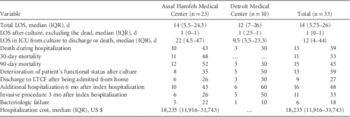
Clinical outcomes of patients infected with CREn (not including “colonized only” individuals) were similar between the 2 institutions (Table 4). The median (range) total LOS for the entire cohort was 14 (0–239) days, and the LOS from culture to discharge, after excluding patients who died, was 1 (0–151) days. The median cost from culture date to discharge (after excluding the dead) from AHMC was more than US $18,000 per affected patient.
Clinical Outcomes of Patients With Carbapenem-Resistant Enterobacter Species

NOTE. Data are no. (%) of patients unless otherwise specified. The percents provided are the valid percents—that is, excluding the missing cases from the denominator. ICU, intensive care unit; IQR, interquartile range; LOS, length of stay; LTCF, long-term care facility.
The in-hospital mortality rate for the entire cohort was approximately 40%. Carriage was also associated with other devastating outcomes—for example, 39% of patients experienced a decrease in functional status, 27% were discharged to a long-term care facility after being admitted from home, and 48% were readmitted to the hospital in the following 6 months (Table 4). The rate of microbiologic failure was nearly 18%.
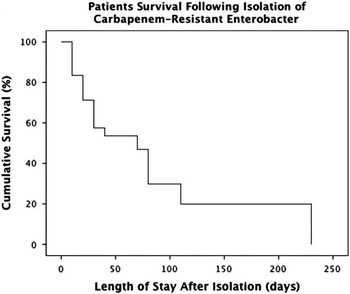
The median (interquartile range) survival time for CREn carriers was 65 (14–75) days and was similar between institutions (Figure 2).
Kaplan-Meir survival analysis following the isolation of carbapenem-resistant Enterobacter during the hospital stay.

Bivariable and Multivariable Analyses of Outcome Parameters
Twelve separate bivariable and multivariable analyses were executed, for all outcomes as listed in Table 4, in order to isolate specific predictors or features associated with each outcome. There were 3 outcomes for which multivariable analyses are presented. Older age and ICU stay were independent predictors for being discharged to a long-term care facility following CREn isolation. Only female sex was an independent predictor for functional status deterioration following the CREn isolation. Acute illness indices parameters and cognitive impairment at baseline were independently associated with in-hospital mortality.
DISCUSSION
This study is one of the largest CREn cohorts ever reported and several notable findings were described. CREn was isolated from 6 pediatric patients at AHMC, all bla KPC-producing strains: 5 neonates and 1 child (a 1-year-old who was chronically ill with severe congenital defects and prolonged LOS). In 2010, there was a reported cluster of cases of CREn in the neonatal ICU (NICU) of one of the DMC facilities as well.Reference McGrath, Chopra and Abdel-Haq 30 Invasive Enterobacter spp. infections are relatively common in NICUs and are usually associated with device-related infections.Reference Marchaim, Navon-Venezia, Schwaber and Carmeli 4 , Reference Macharashvili, Kourbatova, Butsashvili, Tsertsvadze, McNutt and Leonard 31 – Reference Carmeli, Grisaru-Soen, Leavitt, Schwaber, Dolberg and Navon-Venezia 33 Per surveillance criteria,Reference Horan, Andrus and Dudeck 20 all acquisitions were nosocomial, with no vertical transmissions. Two of the affected neonates were twins. One twin harbored the pathogen in his fourth day of life, and his sister became infected with CREn in her 29th day of life. This suggests that patient-to-patient transmission is a mode of CREn acquisition in NICUs.Reference Marchaim, Navon-Venezia, Schwaber and Carmeli 4 , Reference Carmeli, Grisaru-Soen, Leavitt, Schwaber, Dolberg and Navon-Venezia 33 Although in Enterobacter, the chromosomally encoded resistance mechanism may lead to “emergence of resistance” to a wide range of antibiotics, including carbapenems,Reference Jacoby 34 at least in NICUs, horizontal transmission seems to be a mode for acquisition as well.
As previously published in other cohorts of CRE, CREn adult carriers had extensive exposures to healthcare procedures and/or environments (Table 1).Reference Marchaim, Chopra and Bhargava 8 , Reference Schwaber, Klarfeld-Lidji, Navon-Venezia, Schwartz, Leavitt and Carmeli 10 Interestingly the exposures of patients from DMC were significantly more frequent compared with carriers from AHMC. Although 54 patients from AHMC had CREn recovered less than 72 hours into their hospitalization, 53 (98%) of 54 patients were “healthcare-associated” cases per established definitions, suggesting the importance of nonhospital healthcare reservoirs of CREn.Reference Friedman, Kaye and Stout 35 This finding supports targeted screening of patients who have prior healthcare exposure for CREn at the time of hospital admission.Reference Schwaber, Lev and Israeli 7 , Reference Marchaim, Chopra and Bogan 15 , Reference Schechner, Kotlovsky and Tarabeia 36
The molecular descriptive characteristics of this cohort merit attention (Table 2). DMC isolates were all obtained from patients during the time when a dominant transposon (Tn4401) containing bla KPC had disseminated among Enterobacteriaceae in this region (2008–2009)Reference Marchaim, Chopra and Bhargava 8 , Reference Marchaim, Chopra and Perez 9 , Reference Marchaim, Bogan, Lazarovitch and Kaye 14 – Reference Marchaim, Perez and Lee 17 in similar fashion as in other parts of the world.Reference Cuzon, Naas and Truong 37 , Reference Kitchel, Rasheed and Patel 38 Some of the strains analyzed from AHMC were bla KPC-negative and were resistant to carbapenems owing to other mechanisms.Reference Doumith, Ellington, Livermore and Woodford 39 There were 2 CREn from AHMC, both obtained from patients in 2012 (last study year), that were non-bla KPC-producers and not genetically related (Figure 1a). Phenotypic tests like the MHT, which is performed by many laboratories as the only screening method to detect CRE, have low specificity in Enterobacter spp. 13 , Reference Jacoby 34 As this analysis demonstrates, genotypic tests such as the PCR bla KPC might not detect all CREn. Therefore, close attention and active surveillance programs should be instituted, at institutional,Reference Adler, Navon-Venezia, Moran-Gilad, Marcos, Schwartz and Carmeli 40 regional,Reference Brennan, Coyle and Marchaim 41 and nationalReference Schwaber, Lev and Israeli 7 levels, in order to monitor the evolution of circulating CREn strains. An additional worrisome trend was that strains from AHMC (from later years) were significantly more resistant to other classes of antibiotics (eg, aminoglycosides, fluoroquinolones, trimethoprim/sulfamethoxazole), compared with strains from DMC (earlier years).
CREn infection was associated with devastating outcomes (Table 4), as has been demonstrated with other CRE cohorts from all over the world.Reference Bogan, Kaye and Chopra 11 , Reference Borer, Saidel-Odes and Riesenberg 42 This was not a matched case-control investigation. Therefore, the independent association of CREn infection with the various outcomes could not have been measured.
Since nearly 50% of the AHMC cases were diagnosed through rectal surveillance cultures, the importance of screening high-risk populations for CRE upon admission, coupled with implementation of infection control processes and measures, is stressed.Reference Schwaber, Lev and Israeli 7 , Reference Schechner, Kotlovsky and Tarabeia 36 , Reference Adler, Navon-Venezia, Moran-Gilad, Marcos, Schwartz and Carmeli 40
Antimicrobial use is a predictor for many multidrug-resistant organisms including CREReference Marchaim, Chopra and Bhargava 8 and, not surprisingly, previous antimicrobial use was common among patients in this study. Any policy to prevent and control CREn infections should include antimicrobial stewardship at its core.
Our study’s strengths are its large sample size, the detailed clinical and molecular data that were extracted, and the potential generalizability of the results since it included 2 institutions located at the opposite sides of the world (both are CRE endemic). In addition, our study included both inpatients and outpatients, both pediatric and adult patients, and both asymptomatic carriers and truly infected patients. The study, however, has several limitations. In order to isolate independent epidemiologic predictors for CREn, a matched case-case-case-control study design would be appropriate.Reference Marchaim, Chopra and Bhargava 8 , Reference Bogan, Kaye and Chopra 11 , Reference Harris 43 An additional limitation is that isolates were genotyped and MIC testing was conducted at both centers using different methods, which limits the ability to explore genetic relatedness between the US and the Israeli strains. Our case definition in this specific study might have limited us in diagnosing CREn that harbored other carbapenemases (eg, metallo-β-lactamases, oxacillinases), though these types of carbapenemases have never been reported from these facilities.
This study depicts a comprehensive analysis of one of the largest CREn cohorts studied to date. Patients with CREn tended to be at the extremes of age. Many patients were elderly and had poor baseline health. Of particular interest was the inclusion of several NICU patients in the study. The devastating outcomes among infected patients of this cohort demonstrate the clinical significance of CREn. Laboratories routinely conducting MHT or PCR bla KPC as the only screening method for CRE detection might not be identifying all CREn. Developing novel methodologic strategies to improve diagnostics would aid in shortening the time to initiating appropriate therapy for infected patients and in improving the management and outcomes of patients with CREn infections.
ACKNOWLEDGMENTS
Financial support. National Institute of Allergy and Infectious Diseases, Division of Microbiology and Infectious Diseases (protocol number 10-0065, to K.S.K.); Cleveland Department of Veteran Affairs, the Veterans Affairs Merit Review Program (grant 1I01BX001974 to R.A.B.); National Institute of Allergy and Infectious Diseases of the National Institutes of Health (grants R01AI100560, R01AI063517, and R01AI072219 to R.A.B.); and the Geriatric Research Education and Clinical Center VISN 10 (R.A.B.).
Potential conflicts of interest. All authors report no conflicts of interest relevant to this article.