INTRODUCTION
The traditional roles of agricultural extension, namely transferring and disseminating agricultural technologies, are proving insufficient in today's global context (Cho and Boland, Reference Cho and Boland2002, p.1). The capacity of rural people to innovate has to be strengthened (Hall et al., Reference Hall, Sivamohan, Clark, Taylor and Bockett2001), calling for changes in the inefficient traditional public extension systems (Rivera and Zijp, Reference Rivera and Zijp2002). Currently, new methods for interacting with smallholder farmers, such as participatory learning and action research (PLAR), farmer field schools (FFS) and local agricultural research committees (CIALs; Spanish acronym that stands for local agricultural research committees, Comités de Investigación Agrícola Local), focus on learning among farmers, testing and modifying technologies and building social cohesion (Bentley et al., Reference Bentley, Priou, Aley, Correa, Torres, Equise, Quiruchi and Barea2006; Braun et al., Reference Braun, Thiele and Fernandez2000). Nevertheless, triggering such changes beyond pilot phase projects remains a key challenge (Bentley, Reference Bentley, Peshin and Dhawan2009; Van Mele et al., Reference Van Mele, Salahuddin, Magor, Van Mele, Salahuddin and Magor2005).
A novel way of achieving this is to work in a carefully planned way with graduates from PLAR or FFS who share their learning and innovations with their peers through video. This approach, called zooming-in zooming-out (ZIZO), merges participatory innovation development with video and results in quality farmer-to-farmer training videos that are locally appropriate and regionally relevant (Van Mele, Reference Van Mele2006). The ZIZO approach builds on the technical and social outcomes of participatory learning and action research.
To strengthen rural learning and linkages in the rice sector, the Africa Rice Center (AfricaRice) has developed a series of farmer-to-farmer videos following the ZIZO approach. In this paper, we assess the video ‘Cashing in with parboiled rice’, which was developed in collaboration with rice processors in Benin who had earlier been involved in developing and testing the improved rice parboiling technology. Rice parboiling is an optional step of pre-cooking raw paddy with steam to enhance the nutritional value of rice and reduce the grain-breakage rate at milling. Cooked parboiled rice grains are significantly more intact and retain their natural shape as compared with non-parboiled rice grains (FAO, 1998). In Benin, rice parboiling is an income generating activity exclusively for women and girls in rice producing villages. However, the prevailing traditional rice parboiling method does not lead to quality rice (Diop et al., Reference Diop, Hounhouigan and Kossou1997). The higher presence of cracks and burnt paddy, sand and/or stones in the final product lowers its quality (Houssou and Amonsou, Reference Houssou and Amonsou2004) and negatively affects the nutritional values of rice (Diop et al., Reference Diop, Hounhouigan and Kossou1997). Relative to traditionally parboiled rice, consumers were willing to pay price premiums of 25–34% for rice parboiled through the improved parboiler (Demont et al., Reference Demont, Zossou, Rutsaert, Ndour, Van Mele and Verbeke2012). The improved parboiling equipment consists of a large, metal pot with a perforated bottom that is placed on top of a large aluminium pot containing water. The principle behind this improved technology is to precook the paddy with steam, without it touching the water. The improved rice parboiling video shows how and why to precook paddy with steam using the improved technology, as well as why and how to wash the paddy, how to soak it in the hot water and how to dry it (AfricaRice, 2005).
Various methods have been tested and described for evaluating farmer-to-farmer videos, such as for technological, organisational and institutional innovations (Van Mele et al., Reference Van Mele, Zakaria, Begum, Rashid and Magor2007; Zossou et al., Reference Zossou, Van Mele, Vodouhe and Wanvoeke2009a, Reference Zossou, Mele, Vodouhe and Wanvoekeb, Reference Zossou, Mele, Vodouhe and Wanvoeke2010), for enhancing rural learning and linkages and triggering institutional changes (Van Mele et al., Reference Van Mele, Wanvoeke and Zossou2010), and for capital assets building (Chowdhury et al., Reference Chowdhury, Van Mele and Hauser2011). This study addresses the impact of farmer-to-farmer video using the sustainable livelihoods (SL) framework. According to Chambers and Conway (Reference Chambers and Conway1992), a sustainable livelihood comprises the capabilities, assets and activities required for a means of living that can cope with and recover from stresses and shocks, maintain or enhance its capabilities and assets while not undermining the natural resource base. The sustainable livelihoods framework is a participatory method that involves farmers as participants in the research and focuses on a process of sequential reflections and actions carried out with and by target people rather than on them (Cornwall and Jewkes, Reference Cornwall and Jewkes1995). This framework guides farmers in conceptualizing changes over time in their overall livelihood as used by Mancini et al. (Reference Mancini, Van Bruggen and Jiggins2007) in evaluating outcomes of a cotton integrated pest management FFS. Livelihood approaches work with people, supporting them to build upon their own strengths and realise their potential, while at the same time acknowledging the effects of policies and institutions, and external shocks and trends (Carney, Reference Carney1999). These approaches have also been adapted for outcomes and impact evaluation (Haan et al., Reference Haan de, Drinkwater, Rakodi and Westley2002). The main objective of this study is to test the sustainable livelihoods framework as a participatory impact assessment tool and to analyse to what extent farmer-to-farmer training videos can influence livelihoods.
MATERIAL AND METHODS
Data collection
Our study was conducted in 2010 in five municipalities in Collines, central Benin, where rice parboiling is a tradition. The surveys covered eight video villages, where the rice parboiling video had been shown in late 2006 and where conventional training was done once from 2005 to 2007 by four local NGOs, and four control villages (at least 12 km away from video villages) within similar socio-economic situations. In video villages, the rice parboiling video was publicly screened in ‘Fon’ or ‘Yoruba’, local languages of the region. The conventional training was a two-day community workshop during which experts from four local NGOs showed to only a few selected women how to parboil rice with the improved equipment. The impact of these training workshops was limited (Zossou et al., Reference Zossou, Van Mele, Vodouhe and Wanvoeke2009a). In control villages, no video or other interventions on rice parboiling had taken place. Villages were randomly selected from four municipalities (Dassa, Glazoué, Ouessè and Savalou). A total of 144 women rice processors, divided into three groups (48 video watchers, 48 non-watchers of video and 48 control processors), were randomly selected to participate in the assessment without providing them any incentive. Women in video villages who did not watch the video were included because of possible information exchange within the village.
The sustainable livelihood approach, which is people-centered, designed to be participatory and has an emphasis on sustainability, was used to appreciate the different capital assets of participants. This general analytical framework shows how, in different contexts, sustainable livelihoods are achieved by accessing a range of livelihood resources: financial, social, human, natural and physical capitals (Scoones, Reference Scoones1998). We started by collecting qualitative data through focus group discussions in each village to get an idea of the overall description of the five capitals. The main questions of the focus group (adapted from Mancini et al., Reference Mancini, Van Bruggen and Jiggins2007) were framed in terms of ‘what do you value the most, and in which form, in your livelihood in terms of natural, human, social, physical and financial capitals?’ and ‘which are the entities of the capitals where farmer-to-farmer parboiling video had a direct impact?’ Based on insights from the qualitative research phase, we formulated a structured questionnaire and individually interviewed 144 women rice processors (48 per group) to get capital stocks recorded in the baseline year (2006) before the parboiling video show and in the impact year (2009). We used a recall method exercise, during which people were asked to try to remember their past capital assets to estimate capital stocks in the baseline year. The respondents rated the capital stocks identified for the baseline year (2006) and the impact year (2009) on a 0–5 scale. A spider diagram was then drawn to visualise the five capitals with value 0 (no stock) at the centre of the diagram and the value 5 at the other extreme of the axes, corresponding to a full asset stock. The causes of changes made visible in the diagram were listed and ranked.
Data analysis
One-way ANOVA was used with SPSS 16.0 to determine differences between the three groups of women in their description and assessment of the five capitals.
Table and graphs were made with the median capital rating values to make changes visible over time for each of the three sample populations. The Wilcoxon test (alternative to the Student t-test for ordinal data and applies to two-sample designs) was then used to determine significant differences between the baseline and impact years. Stepwise and canonical discriminant analyses were used to determine whether the three samples could be separated based on changes in all capitals simultaneously. This analysis also established which of the changes in capitals contributed most to the distinction between sampled groups (Mancini et al., Reference Mancini, Van Bruggen and Jiggins2007). The analysis was done with SPSS 16.0 and the ranking values were log-transformed to obtain normality.
RESULTS AND DISCUSSION
The majority of the surveyed rice processors were young women aged between 20 and 39 years (60%), married (98%) and mostly illiterate (79%). The predominant ethnic group is Mahi (56%). In video villages, about 10% of the surveyed women who watched the video and 15% of those who had not watched the video have attended conventional training (two-day community workshops) on the improved rice parboiling process previously to video shows. Earlier research showed that the rice parboiling video had reached three times more women (74%) than conventional training and contributed to more equitable knowledge-sharing within communities. Most women who participated in the training workshops were mainly interested in receiving a per diem (81%) and nearly two-thirds of the women surveyed did not even know that conventional training workshops had taken place. Public video screenings helped to overcome participant selection bias through local power structures and gave an equal chance to women and men to learn (Zossou et al., Reference Zossou, Mele, Vodouhe and Wanvoeke2009b). The interest of women in the rice parboiling video triggered local NGOs to improve their training methodology and strengthen their relations with the women rice processors. Women discovered in the video an improved stove that consumes less wood, and addressed requests to local NGOs to be trained to make and use the stoves. About 188 women were trained (Zossou et al., Reference Zossou, Mele, Vodouhe and Wanvoeke2010).
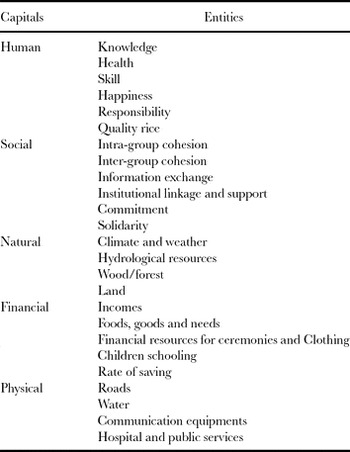
We used a free listing method during the focus groups to identify the entities of the five capitals on which the farmer-to-farmer parboiling video had a direct impact (Table 1). Knowledge, health and good quality rice were important in human capital. Solidarity, institutional linkages and support, information exchange and cohesion among groups were commonly rated under social capital. Forest (firewood) and water access were seen as central in natural capital. Level of saving, children schooling, income and financial resources for ceremonies and clothing were highly rated in financial capital. Hospital and public services, communication devices and water access were central in physical capital.
Main components of the five capitals where farmer-to-farmer parboiling video could have a direct impact according to rice processors’ description.

Livelihood changes over time for each category of rice processors
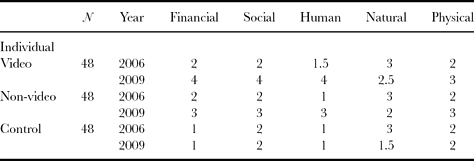
Table 2 shows the median values of capital stocks in the baseline year (before video shows) and in the impact assessment year (2009).
Median values of capitals in 2006 and 2009 for the three population samples for individual survey.
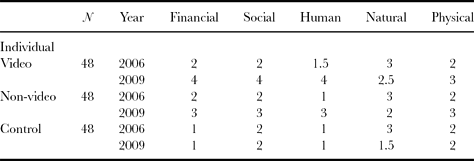
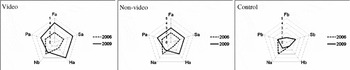
Figure 1 shows changes in individual evaluation of capital stocks recorded between the baseline (2006) and the impact year (2009) for the three sample populations.
Changes in capital stocks for rice processors in central Benin between the baseline year (2006) and impact year (2009) by the three sample populations. F = financial capital, S = social capital, H = human capital, N = natural capital, P = physical capital; a = significant Wilcoxon test (p ≤ 0.05), b = non-significant Wilcoxon test.

Human, social, financial and physical capitals. Rice parboilers who watched the video perceived an important improvement in their human, social, financial and physical capitals (p ≤ 0.01 for Wilcoxon test). Rice processors in villages where the video was shown but who did not attend the video screening also perceived changes in these human, social, financial and physical capital assets (p ≤ 0.01 for Wilcoxon test), but to a lesser extent than those who had watched the video. Unlike the first two sample populations, the rice processors who lived in control villages did not perceive any change in their human, social, financial and physical capitals.
Natural capital. Rice processors who watched the rice parboiling video did not perceive a significant change in their natural capital, while those living in the same villages, who did not watch the video, and those living in the control villages perceived a significant decrease of the natural capital stock between 2006 and 2009. This decrease in the natural capital stock reflected an increasing difficulty to access firewood. Rice parboiling requires heat and 100% of the surveyed women used firewood for it. Before the video show, women used a traditional stove that consumes a lot of wood to parboil rice. By watching the video, women saw an improved stove that consumes less wood. They requested the facilitators of local NGOs to be trained to make and use the stoves. About 188 women were trained and the improved stoves were built in 11 villages with the technical and financial support of some international NGOs (Zossou et al., Reference Zossou, Mele, Vodouhe and Wanvoeke2010). The use of the improved stove made those rice processors less dependent on firewood and consequently they had less of an impact on their natural wood resources.
Drivers of change
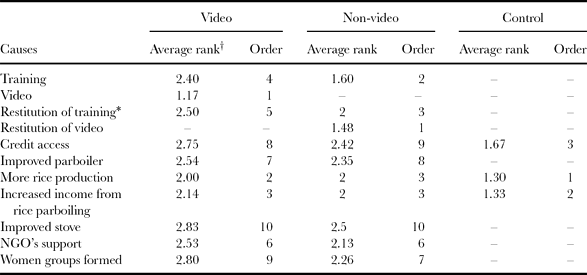
When women were asked about the reasons for the change in capital assets, they listed and ranked causes (Table 3). In video villages, the main cause of changes according to women was the video screening. They also said that they learnt through video about good practices before and after the rice was parboiled and applying this had helped them to obtain good quality rice, which they could sell for a better price. They also organised themselves in groups and started to interact more with other rice value chain actors (NGOs, producers, sellers, micro-finance institutions and consumers). These improvements in human, social, financial and physical capitals perceived by women who watched the rice parboiling video were consistent with our earlier studies. In villages where video was shown, women positively appreciated this farmer-to-farmer video as a ‘mass training tool’ that stimulated active communication (vision, hearing and practical application) and ‘self-learning’ about the new technology and helped to overcome participant selection bias through local power structures and reduced conflict at the community level (Zossou et al., Reference Zossou, Van Mele, Vodouhe and Wanvoeke2009a). Most women who had watched the video but did not have access to the equipment, innovated creatively with local resources and paid attention to reducing the loss of steam and using local resources innovatively to conserve energy. Apart from enhancing women's creativity, the parboiling video influenced women's behaviour to deliver good quality rice by improving rice-handling practices (Zossou et al., Reference Zossou, Mele, Vodouhe and Wanvoeke2009b). Consequently, larger quantities of parboiled rice can be found in local markets, of better nutritional quality and fetching 42% higher price than the traditionally parboiled rice (Zossou et al., Reference Zossou, Mele, Vodouhe and Wanvoeke2010). Watching the rice parboiling video helped women to enhance parboiled rice quality. That was confirmed by laboratory grain analysis (Fofana et al., Reference Fofana, Wanvoeke, Manful, Futakuchi, Mele, Zossou and Bléoussi2011). Asked how the rice parboiling video influenced their physical capital, rice parboilers said that increase in their incomes contributed to getting mobile phones, and indirectly to the installation of telecommunication base stations in their villages. Also, being aware of the importance of clean water to parboil rice, as highlighted by the video, contributed to considering drinking water infrastructures as priority in community development plans.
Individual ranking of drivers for livelihood changes.
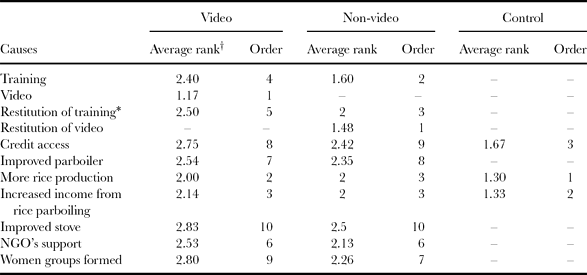
* Restitution of training or video means that women who have attended training or who watched the video have informed their colleagues on their new knowledge.
† Rank 1 is the most important and 10 the least important.
The changes perceived by women in the video villages but who had not watched the video were mainly attributed to information exchanges within the village. About 87% of women in the video villages but who had not watched the video reported that their colleagues had informed them about the key points of the video. They also interacted with their colleagues who watched the video by joining the parboiling women groups formed and consequently equally improved their collaboration with intermediaries, micro-finance institutions and other actors in rice post-harvest sector.
At the same time, in control villages, we noted a lack of cohesion and less collaboration among rice processors, and among rice processors, local NGOs working in the rice sector, formal and informal micro-finance institutions and other actors in the rice value chain.
The little changes perceived by women in control villages were mainly attributed to more rice production.
Overall effect of the five capitals
The use of the stepwise and canonical discriminant analyses showed a significant difference among the three sample populations in their capital stocks between 2006 and 2009 (Wilks’ λ = 0.445; Canonical correlation = 0.725 and p < 0.01).
The most discriminatory variables were changes perceived in financial capital (p < 0.01); social capital (p < 0.01), human capital (p < 0.01) and natural capital (p = 0.01). This confirms that there was an impact of the rice parboiling video on the livelihood of rice processors who watched the video. There was also a significant positive correlation between financial capital and social capital (0.37) suggesting that variations in the stock of one capital are linked to changes in the other one. This result is consistent with Zossou et al. (Reference Zossou, Van Mele, Vodouhe and Wanvoeke2009), who discussed how video strengthened linkages between service providers and women groups and how this in turn led to multiple spin-offs. Chowdhury et al. (Reference Chowdhury, Van Mele and Hauser2011) showed that farmer-to-farmer video strengthened sharing of knowledge and skills between farmers who watched the video, other farmers and service providers. Improved social capital in turn led to better human capital. During our field research, women declared that just after watching the video, they discussed with NGO staff the possibility to organise themselves in groups. With advice and support from NGO facilitators, they began working in groups to parboil rice for others against payment, solicit funds from micro-finance institutions, package the parboiled rice and label their products. Working in groups also helped them to build and strengthen their relations with informal credit actors who accepted to sell paddy rice to them on credit. They could now buy, store and process great quantities of paddy. As the quality of the parboiled rice had improved, this attracted more consumers and created more demand. A study on consumers’ valuation of improved rice parboiling technologies in the study area shows that relative to traditionally parboiled rice, consumers were willing to pay price premiums of 25–34% for rice parboiled with the improved method (Demont et al., Reference Demont, Zossou, Rutsaert, Ndour, Van Mele and Verbeke2012).
CONCLUSION
The improvement of their livelihoods as perceived by rice processors who watched the rice parboiling video and those who did not watch the video but lived in the same villages suggests that farmer-to-farmer rice video has been quite effective in terms of its impact on farmer-learning. The participatory process embedded in the technology development and video production, as well as the local NGO interventions triggered by public screenings of the rice parboiling video, has likely contributed to the impact of this farmer-to-farmer video. The main limit of this study is some possible biases, which can be introduced by the recall process concerning estimation of stocks in the baseline year. Another limitation to these results is that villages where video was shown were not randomly selected by the local NGO who publicly screened the video. Therefore, there may have been a bias due to a possible difference in the importance of rice processing in video villages and non-video villages. Further research using experimental methods of impact assessment with the baseline data will need to address this main limit.
Various approaches to evaluate video-mediated rural learning can be used and are complementary. Studies on technological, organisational and institutional innovations help to analyse local dynamics and endogenous development processes that follow video screenings. The sustainable livelihood approach described in this paper is a participatory evaluation tool that helps women to assess the effect of learning on their livelihood using their own indicators. The sustainable livelihoods approach has proven valuable, reliable and complementary to other methods for evaluating the effect of information technologies in rural areas.
Acknowledgements
This study has been financed by the Belgian Technical Cooperation (BTC) and the Government of Japan who kindly supported AfricaRice's post-harvest research and integrated rural learning approach. We are grateful to Mahussi Houetohossou (extension agent, NGO Castor Appuis-Conseils) and Hyacinthe Assogba (extension agent, NGO Un Monde) for their support during the field research.