INTRODUCTION
I hope in this paper to promote slingshots as artefacts loaded with research potential pertaining to a range of social issues. Slingshots bearing text are illuminating artefacts as not only can they reflect military action, leadership, civic affiliation and ethnicity, but they can also occasionally offer an insight into the psyche of their associated military personnel.
Slingers (sphendonetai), archers (toxotai) and javelineers (akontistai) constituted the three divisions of the light-armed infantry (psiloi) of the armies of Late Classical and Hellenistic Greece. By the fourth century bc warfare strategies, specifically those relating to siege warfare, were radically overhauled with greater emphasis placed on the light-armed soldiers, thereby contributing to a series of transformations known as ‘The Military Revolution’. The resulting approaches to siege warfare, consisting of traditional siege tactics complemented by light infantry offensives, facilitated the most effective breaches of fortified cities (Robinson Reference Robinson1941b; Lawrence Reference Lawrence1979, 39). The effectiveness of light infantry per se was both lauded by Arrian (Ars Tactica 15) and acknowledged during the Persian Wars, when Gelon of Syracuse provided light-armed troops, consisting of 2000 archers and 2000 slingers, to the Greek envoys (Herodotus 7.158).
The current investigation mainly focuses on archaeological evidence for slinging as undertaken by the civic armies of Cretan city-states, thereby specifically relating to postings in civic forces pertaining to Cretan poleis, as opposed to mercenary activity which has been amply reviewed elsewhere.Footnote 1 Much of our knowledge of the Late Classical and Hellenistic Cretan soldier is scriptive (both epigraphic and literary) and reflects mercenary activity, as opposed to battalions of civic troops.Footnote 2 This complementary artefactual appraisal provides a fresh perspective on this engagement, bringing us closer to the ‘face of battle’ (Keegan Reference Keegan1976), and offers a vantage point which yields new sets of social data.
It is logical to deduce that conflict on the island of Crete in the Hellenistic period was born of territorial pressure due to the presence of some 50 or 60 independent city-states concentrated in a limited space (Chaniotis Reference Chaniotis2005, 21 and 131; Kelly Reference Kelly and Wiplinger2006, 303). In the Hellenistic period Crete was home to a high density of small city-states which were generally located on hills in response to the almost incessant warfare on the island. The concentration of nucleated Hellenistic settlement provided a legacy for urban distribution in the Roman period when many of these centres continued (although some changes in site location, or at least site aspect, are apparent, with the centres abandoning their hillside perches in favour of lower ground). The abundance of numerous small-scale Roman cities on the island was a product of both pre-Roman settlement patterns and topographical conditions, factors which are both regionally and historically specific to Crete (Kelly Reference Kelly and Wiplinger2006, 309).
An inscription discovered on the hill of Vasiliki, overlooking the Bay of Mirabello (on the northern coast of the eastern isthmus) presents a list of names accompanied by an epigram (Supplementum Epigraphicum Graecum 39 [1989], 967). The inscription, which, in part, constitutes a list of names, is thought to represent civic soldiers from Hierapytna, who were possibly stationed at this northern outpost c.100 bc, in view of the common onomastica appearing throughout the city's epigraphic corpus (van Effenterre 1989, 99–107). Chaniotis informs us that elsewhere in Greece such outposts were manned by paid patrol soldiers (i.e. paid soldiers from the citizen body, as opposed to mercenaries, who are always foreigners), which may have constituted a considerable expense for civic communities (Chaniotis Reference Chaniotis2005, 28–9, 116; 2008, 103–53). The discovery of such a list at Vasiliki may reflect Hierapytna's expansion, and ultimate dominance, over the full extent of the isthmus, as connectivity with the northern station would facilitate the city's administrative control over the land bridge from its strategic location on the southern shore. Strongholds at either end of the isthmus would clinch Hierapytnian authority over demographic and commercial movement into the eastern extent of the island – a monopoly it retained throughout the Roman period.
In view of the expansionary pressure exerted by the various poleis of Hellenistic Crete (as attested through the epigraphic record and further manifested in the fortified nature and strategic placement of cities within the rocky landscape of Crete), the lack of artefactual evidence for soldiering on the island is striking.Footnote 3 Physical weaponry and armour remain relatively obscure in the published archaeological record, despite the wealth of epigraphic evidence pertaining to Late Classical and Hellenistic warfare on Crete, indicating ubiquitous conflict on the island.Footnote 4 Javelins and arrowheads were retrieved from the battlefield for refire (the activity is mentioned by Xenophon, Anabasis 3.4.17, Polybius, Histories 6.22, Livy, History of Rome 10.29 and Sallust, Jugurthine War 58), and the practice could reasonably be applied to slingshots. It should be cautioned, however, that low material representation, while perhaps exaggerated by the propensity to recycle metallic objects, is also reliant on the published record of material from Classical and Hellenistic Crete (which, although growing, still remains relatively sparse), rather than being directly indicative of any decline in military engagement per se.Footnote 5 This paper aims to partially redress this disparity between the epigraphic record and the published material accoutrements of war through an analysis of lead slingshots found on Crete.
THE IMPACT OF THE CRETAN LANDSCAPE ON THE RISE OF THE LIGHT INFANTRY
While Cretans became almost synonymous with archery in the broader literature, it now seems that they were also adept with the sling and, although not as famous as the Rhodians and the Balearic islanders in this field, they may still be cited alongside them in the ancient sources. A reference to the Cretan slinger may feature in Livy, who possibly points to their presence alongside Cretan archers (Cretenses sagittarios funditoresque et iaculatores – Livy, History of Rome 37.41.9 and 11). There is also a possible reference to slingers from Crete in Thucydides' account of the events of 415 bc when Nikias advises the Athenians to include Cretan archers, and slingmen, for the expedition to Syracuse (… καὶ τοξοτῶν τῶν αὐτόθεν καὶ ἐκ Κρήτης καὶ σφενδονητῶν … Thucydides 6.25.2) – admittedly 700 Rhodian slingers were subsequently deployed, which serves to undermine an absolute Cretan affiliation.
Polybius observes that the Cretans ‘both by land and sea are irresistible in ambuscades, forays, tricks played on the enemy, night attacks, and all petty operations which require fraud, but they are cowardly and down-hearted in the massed face-to-face charge of an open battle’ (Polybius, Histories 4.8.11, translation by W.R. Paton, Loeb 1954). While these comments serve to expose Polybius' jaundiced opinion of the Cretans, they also act as an unintentional nod to the adeptness of the Cretan light infantry. Certainly, unorthodox military tactics were praised elsewhere and Josephus, in his review of an ambush of Roman forces during the Jewish War, even recommended irregular enterprising tactics, noting that they can unhinge the most highly trained and disciplined battalions who adhere to orders and procedure (Josephus, The Jewish War 5.71–9).
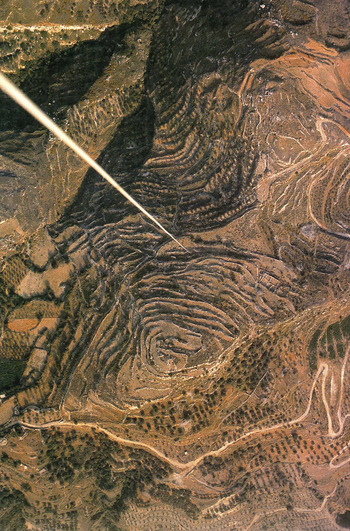
It can also be argued that civic armies in Late Classical and Hellenistic Crete mainly consisted of a light-armed infantry by virtue of the terrain alone. That fighting styles could be influenced by terrain is noted in Plato's Laws (625d) where the Cretan, Kleinias, explains that, due to the rugged nature of the terrain of the island – a geographical determinant which is immediately evident in the island's mountainous interior (Fig. 1) – the Cretans developed a preference for archers and light-armed soldiers over cavalry and hoplites (cited in Vertoudakis Reference Vertoudakis2000, 27; Baldwin Clark Reference Baldwin Clark2004, 5–6; Morrow Reference Morrow1960).Footnote 6 Onorio Belli, writing of Lyttos c.1596, observed that the hill ridge had a small amount of level space and altogether the worst topography of any site he had ever seen (cited in The Builder, 7 December 1901, 499). The rugged nature of much of the Cretan landscape is graphically portrayed in Rackham and Moody's 1996 study, which presents a topography over which only goats, their herders, and light-armed infantrymen might traverse with any degree of agility. The direct impact of terrain on military approaches was not specific to Crete and is implicit in Mardonius' claims, just prior to the Persian invasion, that the Greeks sought out smooth, level ground once warfare was declared (Herodotus 7.9; for further implications of terrain for military strategy see Hanson Reference Hanson1991, 5; 1998, 86–7 and 97). The lack of flat terrain on Crete (beyond the Omalos and Lasithi plateaux) would certainly preclude the orderly formation associated with hoplite warfare.
Aerial view of the acropoleis of Praisos in Eastern Crete (courtesy of J.W. Myers, E.E. Myers and G. Cadogan, and University of California Press; Myers, Myers and Cadogan Reference Myers, Myers and Cadogan1992, 258, fig. 37.2).

DISTRIBUTIONS OF SLINGSHOT DISCOVERIES ON CRETE
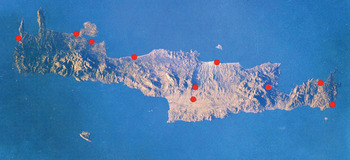
Cretan slingshots have never been addressed as a group and only appear decontextualised in museum catalogues and sporadically in excavation reports. On Crete, inscribed lead sling bullets have been reported from Knossos, Gortyna, Lato (although issued by Gortyna), Aptera, Prinias Patela (possibly ancient Rhizenia – the slingshot was again issued by Gortyna), Rethymnon (ancient Rhithymna), Khania (ancient Kydonia), Trypetos and Xerokambos (often identified as ancient Ambelos), while an inscribed slingshot from the Cretan city of Phalasarna has also been discovered on the neighbouring island of Antikythera (cat. nos. 1–40) (Fig. 2). This discovery of lead slingshots in the Cretan landscape is highly significant in view of the dearth of tangible Late Classical and Hellenistic weaponry throughout the archaeological record of Crete.
Map of Crete, with distribution of slingshots (satellite image courtesy of J.W. Myers, E.E. Myers and G. Cadogan, and University of California Press; Myers, Myers and Cadogan 1992, frontispiece).

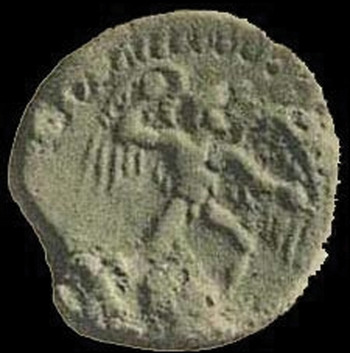
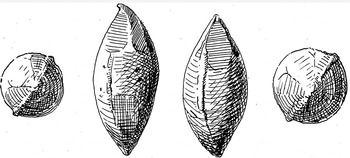
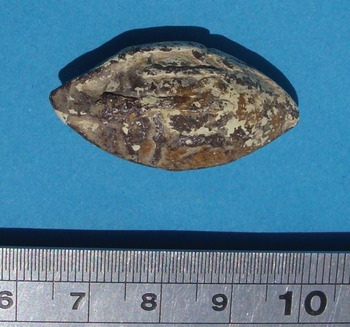
The slingshot, like the arrowhead, has a long association with Crete. The mythical giant Talos, said to have roamed the island, is depicted hurling hand-held spherical weapons on third century bc staters from Phaestos (Grose Reference Grose1926, 243 Phaestos no. 4) (Fig. 3). The lead slingshot makes an early appearance on the island and Sir Arthur Evans discovered the potentially Cretan prototype in an undisturbed context associated with the shrine of the Double Axes in the Palace at Knossos (cat. no. 39) (Fig. 4). Evans noted that ‘they are not of the same late fabric [although they are lead] as the specimens that are not infrequently found on the site of the Greco-Roman city’ (Evans Reference Evans1928, 344). He observed that, unlike the later examples, these had a round midsection and a prominent ridge resulting from their crude casting; but perhaps their most distinctive feature was that they were pared to a sharp point at the ‘action end’ (Evans Reference Evans1928, 344). Another problematic slingshot context was recorded by Hutchinson in 1935 in a mixed Middle Minoan stratum at Knossos (Laura Preston and Don Evely, personal communication) (cat. no. 38).Footnote 7 The typology of this lead slingshot fits comfortably into a Late Classical or Hellenistic date range in terms of manufacture and emblem and I can only deduce that it is a later intrusion (Fig. 5).
Phaestos coin depicting Talos hurling stones on obverse (after Grose Reference Grose1926, 243 Phaestos no. 4).

Early slingshot from Knossos (after Evans Reference Evans1928, 345, fig. 196).

Slingshot with possible ‘trident’ from mixed deposit at Knossos (photograph courtesy of Laura Preston).

THE CHRONOLOGICAL RANGE FOR SLINGSHOTS
The slingshot (manufactured in a variety of materials including clay, stone and lead) has a lengthy utility. The lithic variety was presumably used for hunting as early as the Early Neolithic, as attested on Malta (dating to the Grey Skorba Phase 4500–4100 bc) (Trump and Cilia Reference Trump and Cilia2002, 52). Its application in early siege warfare is attested by the depiction of slingers on the silver siege rhyton from Mycenae (Korfmann Reference Korfmann1986, 133, pl. 3; Vutiropulos Reference Vutiropulos1991, 284), while they also appear in a depiction of mixed troops in a combat scene on a Geometric vase from Paros of c.700 bc (Wheeler Reference Wheeler, Sabin, van Wees and Whitby2007, 194, fig. 7.1). Similarly, they proved effective in the siege of Lachish (c.700–691 bc), as evidenced both in the relief friezes from the palace of Nimrud and from the vast quantity of spherical stone slingshots discovered during excavations (Fagan Reference Fagan, Fagan and Trundle2010, 93–5, fig. 8). The iconography of the slinger in the Aegean is presented in a paper by Buchholz, who listed nine different representations from reliefs, vases and coins (Buchholz Reference Buchholz1965, 133–59).
The utility of the lead sling bullet is attested by its survival into the Roman period. Vegetius' omission of the lead slingshot, in his discussion of slingers (Concerning Military Matters 1.15–16; 2.23), is problematic and while, in attempting to explain this oversight, it has been suggested that their use pre-dates his source material, the inscriptions on lead slingshots would clearly refute such a terminus ante quem. It is clear that the weapon was deployed throughout the Roman period from its inscribed content denoting various Roman generals (for its use under Octavian at the siege of Perusia see Hallett Reference Hallett1977, 151–71). An inscription on a lead slingshot from Vindonissa pertains to the Legion XIII who were stationed there until ad 45, thereby representing one of the latest inscribed ‘glandes’ to be recorded (Simonetti Reference Simonetti1947, 18, abb. 5).Footnote 8 The lead variety is purportedly used as late as the close of the second century ad, according to the anonymous biographer of the Emperor Septimius Severus in his report on the battle in ad 197 with Clodius Albinus, near Lugdunum, when the emperor suffered a direct hit from a lead slingshot (ictu plumbeae) (Scriptores Historiae Augustae, Severus 11.3).
The stone and clay varieties also enjoyed lengthy services as plain ballistics, and auxiliary slingers are famously represented in scenes 167 and 177 on Trajan's Column in Rome (Gilliver Reference Gilliver1996, 61 n. 42), where these forces carry large spherical missiles (both held directly in the hand and also suspended in loose textile slings), a shape which intimates that they represent the stone variety.Footnote 9 The majority of the Greek inscriptions on slingshots, however, seem to relate to the Late Classical and Hellenistic periods and are a characteristic of the lead variety.
LEAD SLINGSHOT MANUFACTURE
The transition from stone to lead was integral to the effectiveness of these missiles, as lead is easy to cast and provides maximum weight in a small volume.Footnote 10 Lawrence estimates that weights of c.40 g could achieve distances of 400 m (perhaps at speeds of up to 100 km/h) (Lawrence Reference Lawrence1979, 39).Footnote 11 There is a trade-off between force of impact and optimum range, since heavier bullets, while not commanding the same reach (at least if the launching technique remains constant), achieve a more violent impact. In tactical terms, advantages in range are key contributors to a successful assault since the troops with the longest range hold strategic immunity, once that distance can be maintained, by virtue of their freedom to attack without fear of reprisal. That the initial volley could be a determinant in securing a ‘tearless battle’, that being when one line fled beyond any range of attack, has been outlined by Sabin (Reference Sabin2000, 13). Mithridates' slingers outreached the opposing javelineers at the Battle of Cunaxa, forcing the rearguard into a futile charge (Xenophon, Anabasis 3.3.7–11).Footnote 12 Xenophon, however, also informs us that, among the Greeks, the Rhodians understood the use of the lead sling and preferred the relatively light lead shots which travelled twice the distance of the Persians' heavier stone missiles (Xenophon, Anabasis 3.3.16–17).Footnote 13
Any text on slingshots was conceived of, and cast, as an integral component of the weapon, thereby representing a fundamental aspect of the weapon's design. Lead slingshots, along with any script they might carry, were cast in clay or stone moulds, only a few of which have survived.Footnote 14 The cavities in the mould are connected by a channel, much in the same manner as coin manufacture, as illustrated by a mould from the Canellopoulos Collection bearing the name TIMONOΣ/Τίμωνος (Empereur Reference Empereur1981, 555–61, fig. 29; Supplementum Epigraphicum Graecum 31 [1981], 1603; Pritchett Reference Pritchett1991, 45, fn. 80) and another in the National Museum in Athens (personal observation). Nine missiles found at the rustic sanctuary at Mines in Cyprus still preserve their connecting joints, effectively representing a tree of bullets (Nicolaou Reference Nicolaou1977, 213, fig. 2). We can deduce from their condition that they have never seen action, and their articulated state attests their manufacture rather than their application (Nicolaou Reference Nicolaou1977, 213; Michaelidou-Nicolaou Reference Michaelidou-Nicolaou1969–70, 361).Footnote 15 Six of the nine lead slingshots discovered in the 1988 excavations of House IV in the West Quarter in Eretria form a cluster representing their conjoined condition during the casting process (Brélaz and Ducrey Reference Brélaz and Ducrey2003, pl. 23, 1–2; Ma Reference Ma2010, 163). Similarly, at Caerhun (Gwynedd), in Britain, between thirty and forty clayshots (dating to the Flavian–Trajanic period) were found in an ashy deposit in a small circular hearth, with the context representing their manufacture by firing (Baillie Reynolds Reference Baillie Reynolds1930, 78). Biconical clay slingshots seem to be favoured in Britain, where they far outnumber their lead counterparts, being found in hoards (presumably as stockpiles awaiting use) at Ardoch (Tayside), Strageath (Tayside), Caerhun (Gwynedd) and Abergavenny (Gwent) (Greep Reference Greep1987, 16). Similarly, in Cyprus, at Idalion, a munitions dump of lead slingshot bullets, copper projectile points, and a catapult stone was also recovered from the wall surrounding the West Acropolis (Stager Reference Stager1972, 221).
Due to their portable nature and ease of manufacture, it is entirely plausible that slingshots could be made to order at the battle site as demand dictated. Caesar established smithies within his camp to cast lead bullets in preparation for battle in Africa (On the War in Africa 20). Evidence for impromptu slingshot casting was discovered at the fort of Velsen in Holland, where the Romans resorted to pressing their fingers into the soft ground to create cavities into which they poured molten lead to create crude, yet effective, slingshots (Thorne Reference Thorne and Erdkamp2007, 222; Pritchett Reference Pritchett1991, 45, fn. 80).Footnote 16 This desperate measure was presumably carried out during a battle associated with the Frisian Revolt of ad 28 (Bosman Reference Bosman and van Driel-Murray1995, 99–103).
THE USE OF TEXT ON SLINGSHOTS
Personal names on slingshots and their significance – Cretan examples and their conformity with the broader milieu
Slingshot inscriptions frequently denote a personal name, usually that of a squadron commander.Footnote 17 Ma (Reference Ma2010, 171) maintains that the inscription and accompanying symbol serve to advertise an allegiance with that particular troop, and an affinity within its wider military structure. This role is explicit in an example from Sestrino, in the region of Petrich in southwestern Thrace, which bears the script IIII CR, possibly referring to the fourth cohort, c(oho)r(tis) IV, thereby representing that particular military unit (Paunov and Dimitrov Reference Paunov and Dimitrov2000, no. 3). In a Greek context, military divisions are more commonly represented through reference to their commanding personnel; at Olynthus over 500 slingshots were found, 100 of which were inscribed, many with the name of Philip II, while ethnic divisions were also denoted and are discussed below (Robinson Reference Robinson1941a, 419; see footnote 25). The presence of these titles encourages group identity within a corps and presents the group as a united front to the enemy.Footnote 18
The deployment of foreign forces by Cretan cities constitutes an integral aspect of Hellenistic warfare on the island, with cities often inviting allied troops and their generals (as distinct from mercenaries) to conduct campaigns on their behalf (Chaniotis Reference Chaniotis2005, 21). Strabo, writing at the turn of the millennium, informs us that his ancestor, Dorylaus (surnamed Tacticus, or ‘The General’), visited Knossos at the outbreak of a war between Knossos and Gortyna (Strabo, Geography 10.4.10; Launey Reference Launey1949, 274). Chaniotis classifies Dorylaus as a xenologos, effectively a recruiting officer, whom Mithridates Euergetes often sent to Greece and Thrace to enlist mercenary troops for the royal forces (Chaniotis Reference Chaniotis2005, 83). His prestige, as officer and friend of Mithridates Euergetes, and his arguably serendipitous presence at Knossos ensured that he was entrusted with the command of the Knossian army, an appointment which led to a sweeping victory and ensuing accolades (Strabo, Geography 10.4.10).
From Cretan treaties, we also know that the Cretan poleis did organise joint military enterprises – usually targeting war booty and captives – under the command of either civic officials or private individuals (Chaniotis Reference Chaniotis1996, 93 – also see footnote 22). In cases such as these, clear distinctions between allied forces become economically significant and we might therefore expect to find the names of the commanders of military units inscribed on slingshots.Footnote 19
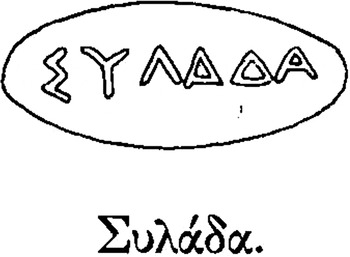
On Crete an onomastic reference may be represented by a slingshot from the west of the island bearing the text ΣYΛAΔA (cat. no. 26) (Fig. 6). The traditional reading Sylada, the genitive of the personal name Syladas, one of the numerous Cretan names deriving from sylon (τὸ σῦλον/τὰ σῦλα), concurs with the Cretan tradition of choosing names which allude to the gaining of booty, i.e. names related to the word syle (‘spoils’) such as Syladas, Sylichos, Solos Sotosylos and Damaisylos (Chaniotis Reference Chaniotis2005, 137; see also Pritchett Reference Pritchett1991, 116–24). In the war between Perseus and Rome (ad 174) 3000 Cretans were under the command of Sosos of Phalasarna and Syllos of Knossos (Livy, History of Rome 42.51).
Slingshot bearing the name ΣYΛAΔA (after Guarducci Reference Guarducci1939, xxx no. 16).

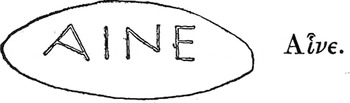
The text AINE (cat no. 32) on a slingshot from the fortified remains at modern Xerokampos (often flagged as the ancient city of Ambelos) possibly constitutes an abbreviated personal name, despite the fact that Halbherr interpreted the inscription as a verb (Halbherr Reference Halbherr1898, 93–4 no. 34). The text could relate to the common proper noun Ainesidemos (ΑΙΝΗΣΙΔΗΜΟΣ/ΑΙΝΕΣΙΔΑΜΟΣ) which would then represent the name of a commander (Chaniotis, personal communication) (Fig. 7). John Ma (Reference Ma2010, 169) adroitly highlights the dangers of misinterpreting proper nouns, relating to commanders, as directives or taunts.Footnote 20
Slingshot from Xerokampos area (possibly ancient Ambelos) bearing the text AINE (after Halbherr Reference Halbherr1898, 93–4, no. 34).

A slingshot from the west of Crete, bearing the monogram ΠΑ, possibly refers to Panares (Guarducci Reference Guarducci1939, xxx no. 17), the commander at Kydonia (modern Khania) in 69 bc when the Romans attacked (Velleius Paterculus 2.34.1) (cat. no. 27). A possible Roman example, from north central Crete, may be identified in the slingshot from ancient Rhithymna bearing the monogram ME (cat no. 28). Guarducci ascribed the monogram to Quintus Metellus, who besieged the Cretan cities of Lappa and Eleutherna which had, in turn, absorbed the port city of Rhithymna. Cassius Dio, an admittedly later source, informs us that Quintus Metellus could only secure Eleutherna through treachery, when he fired and destroyed a brick tower which had previously been weakened through applications of vinegar (Cassius Dio 36.18).Footnote 21 The alleged aggression of Metellus is arguably conveyed through his treatment of the opposing Cilician troops stationed at Lappa in 68 bc (under Pompey's legate Octavius), all of whom he had executed on the fall of the city (Cassius Dio 36.18; Sanders Reference Sanders1982, 4), which represents a possible deviation from the regular protocol for the treatment of prisoners of war, as outlined in the epigraphic record of Crete.Footnote 22 After such a brutal response, panic might be incited in the inhabitants of any Cretan cities subsequently under attack, through the mere advertisement of his generalship (Fig. 8).Footnote 23 The inscribed onomastica on the slingshots serve to both promote a sense of group identity, among the firing troops, and instil a corresponding fear in their targets.
Lead slingshot from ancient Rhithymna (after Guarducci Reference Guarducci1939, xxiv no. 24).

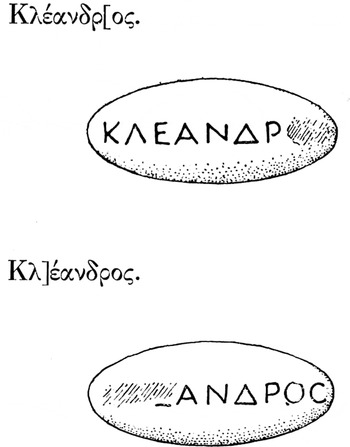
Group identity might also be reinforced through an emblem on a slingshot: a bovine head is depicted on three examples reported from the area of Gortyna in Crete (cat. nos. 23–5), three further examples from Megalopolis and another example from the Boeotia region (Everson Reference Everson2004, 168, fig. 63, museum no. 719; Foss Reference Foss1975b, 40). The examples found on Crete, like the examples from the Greek mainland, bear the name Kleandros on one side and a bovine head on the other (cat. nos. 23–5) (Fig. 9). The possibility of associating the name with that of the commander Kleandros, son of Polemokrates, who famously supplied Alexander with 4000 mercenaries, is tempting (Arrian, Anabasis of Alexander 1.24.2 and 2.20.5) and would imply that the Gortyna slingshots represent mercenary troops returning to that Cretan city. Following this model, the spread of identical slingshots, bearing the name of a squadron commander, over such a wide range of locales affords insight into the disparate nature of auxiliary troops and their consequent need for self-cohesion (see Chaniotis Reference Chaniotis2005, 95).
Slingshots bearing the name Kleandros (after Guarducci Reference Guarducci1935, viii 79, nos. 46–7).

Civic allegiance and ethnicity as inscripted on slingshots – Cretan examples and their conformity with the broader milieu
In Crete the traditional correlation between citizenship and military service ensured that every Cretan city in the Hellenistic period, regardless of scale, had its own army (Chaniotis Reference Chaniotis2005, 21). In Hellenistic Crete civic soldiering was regarded as a defining civic duty, as arguably overplayed at Lyttos, where military service constituted the predominant prerequisite for securing citizenship (Chaniotis Reference Chaniotis1996, 124–6; 2005, 21). Warfare could be profitable, enabling soldiers to contribute to the civic treasury and to actively partake in the common meals in the andreia of Hellenistic cities (Gorlin Reference Gorlin1988, 161). This high-profile engagement in a daily public ritual visibly elevated civic status, a social endorsement which, in turn, promoted soldiering as an attractive career prospect among young men (Chaniotis Reference Chaniotis2005, 135–6).Footnote 24
While the preceding examples of slingshots discovered on Crete may be representative of either mercenary troops returning to the island or corps of civic soldiers, the presence of civic identifiers on slingshots, although relatively rare, constitutes an indisputable representation of civic forces. Such Cretan examples advertise affiliations with Knossos, Gortyna, Phalasarna and possibly Aptera.Footnote 25
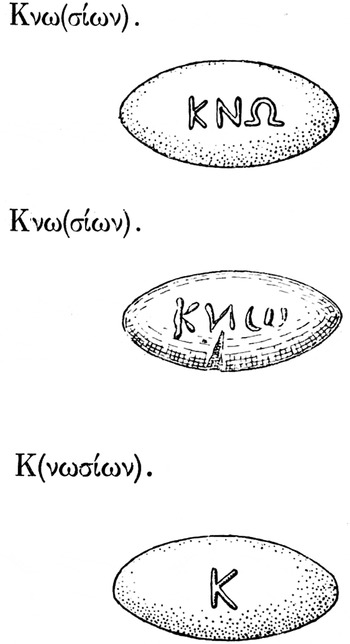
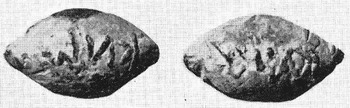
At Knossos Guarducci reports three examples, bearing the monograms KNΩ or K, in the Herakleion Museum (cat. nos. 1–3) (Fig. 10), while two similar examples from Knossos are reported by Boardman (cat. nos. 4–5) (Fig. 11). The monogram ‘Kappa Nu Omega’ clearly refers to the actual ethnic (Κνωσίων), as opposed to the more commonly evidenced proper noun referring to a commander or some military personage.
Slingshots bearing the monograms KNΩ or K, in the Herakleion Museum (after Guarducci Reference Guarducci1935, viii 79, nos 43–45).

Slingshots from Knossos in the Ashmolean in Oxford (after Boardman Reference Boardman1961, 124, 127, pl. XLVIII; AN 1941.186 and 186a).

Also in Crete, at the Hellenistic fort at Prinias Patela two lead slingshots were found with the letters ΓOP (cat. nos. 6–7). It is tempting to view these slinghots as representative of the action which prompted a subsequent negotiated alliance between ancient Rhizenia (although the identification of Prinias Patela as the ancient city is admittedly problematic) and Gortyna. The relationship between the ancient cities is illuminated by a fifth century bc inscription which establishes the subservient partnership that Rhizenia held with Gortyna, since this city was obliged, as stipulated by Gortyna, to contribute 350 staters' worth of sacrificial victims for Zeus Idaios (Chaniotis Reference Chaniotis and Chaniotis1999, 196–7). Demargne also notes a slingshot with the name of Gortyna at Lato, which he sees as evidence of Gortynian forces in the area (Demargne Reference Demargne1903, 232; Ma Reference Ma2010, 172) (cat. no. 8).
The potential for the discovery of vast quantities of projectile weaponry along city defences has been recently realised at Aptera, in west Crete, where catapult stones, slingshots and arrowheads were found in considerable numbers along stretches of the fortification walls which were originally constructed around 350 bc (Niniou-Kinteli Reference Niniou-Kinteli2008, 26 and 53). Many of the lead slingshots found in these ‘battle layers’ carry the monogram ‘A’ (Niniou-Kinteli Reference Niniou-Kinteli2008, 27), which at least suggests an Apteran affiliation.Footnote 26 The excavator has tentatively suggested that the battle contexts could relate to a siege of the city led by Gortyna's allies following the destruction of Lyttos by the Knossians (c.222–218 bc) (Niniou-Kinteli Reference Niniou-Kinteli2008, 27).Footnote 27 The Knossian victory prompted a series of reprisals on Aptera, Kydonia and Eleutherna, meted out by Polyrrhenia and Lappa and aided by Philip V and the Achaeans (Niniou-Kinteli Reference Niniou-Kinteli2008, 27).
Moreover, at Gortyna continuing work on the defensive walls by Nunzio Allegro and Maria Ricciardi (Allegro and Ricciardi Reference Allegro and Ricciardi1999) could also yield similar artefactual evidence associated with the siege of Gortyna in c.220 bc. This siege, conducted during the Lyttian War (c.222–218 bc), allegedly involved blockades aimed at starving the besieged into capitulation (Chaniotis Reference Chaniotis2005, 79) – a tactic which is generally characteristic of earlier siege strategy.
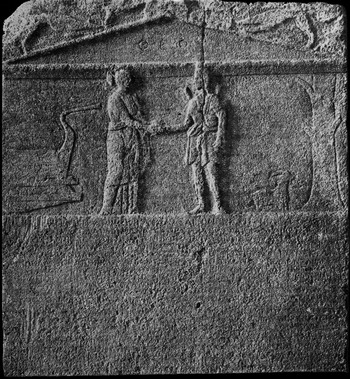
On Antikythera a slingshot was discovered at the fortified site of Kastro inscribed ΠΑΡΑ ΦΑ[ΛΑΣ]ΑΡΝΙΩΝ, implying that the slingshot was thrown, or was issued, by the Phalasarnians of western Crete (cat. no. 22). The quantity of third century bc bronze coinage of Phalasarna discovered at Kastro on the islet would suggest that at this stage the acropolis settlement was under their control (Martiş et al. Reference Martiş, Zoitopoulos, Tsaravopoulos, Luca and Sîrbu2006, 125). Moreover, the presence of the stylised image of a warship prow accompanying the nymph Phalasarne on an inscription outlining the peace treaty between Phalasarna and Polyrrhenia strongly suggests that Phalasarna had consolidated its naval strength by the early third century bc (Fig. 12).
Peace treaty between Phalasarna and Polyrrhenia (after Guarducci Reference Guarducci1939, xi no. 1).

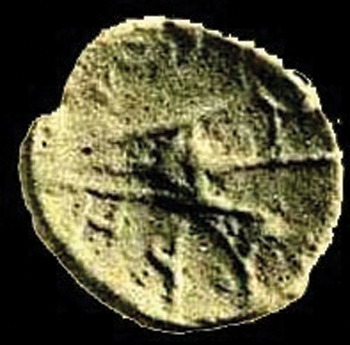
The pictorial scene accompanying this peace treaty depicts the goddess Dictynna, Polyrrhenia's patroness, armed with quivers, shaking hands with the nymph, Phalasarne. Hunting dogs confront each other on the incised pediment framing the main scene, perhaps representative of the opposing powers (Guarducci Reference Guarducci1939, xi no. 1) (Fig. 12). The two deities stand before contrasting contexts: Dictynna emerges from a rustic agricultural scene, denoted by a tree and a goat, while Phalasarne advances from the prow of a warship. The vignettes convey the cities' contrasting spheres of governance, physical setting and military strengths. These aspects are also expressed numismatically, with Polyrrhenian coinage employing the emblem of an arrowhead (Grose Reference Grose1926, 243 Polyrrhenia no. 13; Svoronos 1890, 38) (Fig. 13), while Phalasarna incorporates maritime symbols, such as the trident and the dolphin (Grose Reference Grose1926, 243 nos. 5–8). Furthermore, the copy of this treaty found at Kalyviani, where it was thought to mark a sanctuary of Tyliphos (Supplementum Epigraphicum Graecum 50 [2000], 936), is decorated with a trident flanked by two dolphins in the pediment, perhaps signalling the more prominent position held by the associated signatory, i.e. Phalasarna.
Coin of Polyrhennia (after Grose Reference Grose1926, 243, Polyrrhenia 13; arrowhead on coin).

The harbour at Phalasarna, in west Crete, was heavily fortified, and catapult stones were discovered at the base of its towers. The excavator, Hadjidaki, noted two examples (each c.20 cm in diameter), found together with a pair of statuettes of the late fourth/early third century bc (Hadjidaki Reference Hadjidaki1988, 472, 474, fig. 15). The physical evidence, including the scale and sophistication of the harbour defences, points to a prowess in naval affairs which, in turn, bestows a militaristic character on the maritime vignette accompanying the treaty and, by inference, intimates a corresponding prominence in bowmanship within the civic forces of Polyrrhenia. Moreover, the date of the inscription outlining the peace treaty between the powers of Polyrrhenia and Phalasarna in western Crete (complete with the stylised image of a warship prow) suggests that Phalasarna had consolidated its naval strength by the early third century bc (Guarducci Reference Guarducci1939, xi no. 1; Hadjidaki Reference Hadjidaki1988, 467–8) – a strength attested by the city's inscribed slingshots discovered on the islet of Antikythera (cat. no. 22).
I also should add that this combined evidence demands the presence of a shipshed at the site at Phalasarna in order to facilitate the swift launch of light warships (as demonstrated at other Cretan shipshed facilities such as Trypetos and Matala; see Baika Reference Baika2011). In the case of Phalasarna these ships would clearly have been equipped with forces of slingers. Slingers were not exclusively confined to land manoeuvres, and were deployed on landing ships due to their agility, as demonstrated by their efficacious role in the landing of Julius Caesar's troops in Britain (Caesar, Gallic War 4.25; Pritchett Reference Pritchett1991, 61) and in the siege of Motya in Sicily (Diodorus Siculus 14.50.4; Livy, History of Rome 24.34).Footnote 28 We should envisage a similar strategy in the attacks on the fort of Kastro on the islet of Antikythera, with the Phalasarnian slingers being initially used on board to facilitate a successful docking, only to swiftly disembark and infiltrate the terrain.
Slingshots in psychological warfare – Cretan conformity to the broader milieu?
As already demonstrated, inscriptions on lead slingshots usually denote a personal name, generally that of the squadron commander, or some civic allegiance, but they can also touch on a range of surprising topics. Perhaps the most intriguing, if not the most surprising, attribute of the slingshot is its element of humour. Sling bullets are an unexpected source of military humour, albeit black, in which their text occasionally addresses the target of the projectile or even the weapon itself (Pritchett Reference Pritchett1991, 43).Footnote 29
The authenticity of several of the decontextualised examples (specifically those that survive in collections) has been brought into question. Zangemeister highlights numerous forgeries in the Latin corpus in both of his related works (1883, 35–48, nos. 664–759; 1885, 88–142). Robert too refers ‘to the fantasy of François Lenormant who he claims forged sling bullet inscriptions, specifically τρῶγε (“eat it”) and τραγάλιον (“a sugar coated pill”)’ (1969, 39, fn. 5; Pritchett Reference Pritchett1991, 44, fn. 79). It should be noted, however, that Ross cited identical examples in the field in the 1840s (1841, 39). Nonetheless, we must also guard against reading ironic or insulting intent into these cursory inscriptions where none exists; the traditional reading of aischron doron (αἶσχρο(ν) δῶρο(ν), ‘unpleasant gift’) applied to one slingshot inscription (Robinson Reference Robinson1931, 56) can now be appreciated as the proper noun Aischrodoros (Ma Reference Ma2010, 170). But even if these precautions reduce the number of secure examples in the Greek corpus of slingshot inscriptions, there still remains a sufficient body of provenanced Greek slingshots which fall into this category, i.e. where the intent is evident and purposeful (Ma Reference Ma2010, 168). Moreover, no such ambiguity exists in the Latin messages, which can be much more explicit: the slingshot inscription ‘Pet[o] Octavia[ni] culum’, fired during the siege of Perusia, clearly instructs the bullet to seek out Octavian's backside (Mommsen Reference Mommsen1863, no. 682 = Zangemeister Reference Zangemeister1885, no. 58; Rosen Reference Rosen1976, 124).
A scriptive dimension to provocation is a surprisingly potent addition to this kind of repertoire, and the effective delivery of such taunts is facilitated by the slingshot (Chaniotis Reference Chaniotis2005, 95). Secure examples of this nature include dexai (δέξαι – ‘receive this’), with a thunderbolt on the reverse (Dodwell 1819, 160; Parsons Reference Parsons1943, 242, fig. 26), which may be paralleled by labe (λάβε – ‘take this’), both reported from Athens (Supplementum Epigraphicum Graecum 32 [1982], 1691), while sou (σε-ῦ = σοῦ – ‘all yours’) may feature at Kition in Cyprus (Nicolaou Reference Nicolaou1977, 215 no. 3; Supplementum Epigraphicum Graecum 27 [1977], 966 no. 30).
Trogalion (τρωγ(ε)/άλιον) (a dessert or sweetmeat – replacing the older reading troge halion; Curtius and Kirchhoff Reference Curtius and Kirchhoff1877, no. 8530.c) is reported from the area of Corinth (Fraenkel Reference Fraenkel1902, no. 384; although do note Robert's comment above – 1969, 44, fn. 79), while ῥοῦ γεῦσαι, ‘have a taste of sumac’, is attested at Dora in Palestina (Supplementum Epigraphicum Graecum 35 [1985], 1535). This reference to Syrian rhus, a genus of shrubs which produce fruit used both as a spice and in medical concoctions, is perhaps fittingly ironic, while also being geographically appropriate. A slingshot reported to bear the inscription hyse (ὗσε – aorist of ὕει, ‘it rains [bullets]’) was discovered at Kition in Larnaka and has been dated to the late fourth century bc (Nicolaou Reference Nicolaou1977, 215 no. 3; Supplementum Epigraphicum Graecum 27 [1977], 966 no. 30). If interpreted correctly, the inscription would recall Dienekes' meteorological quip at Thermopylae, when, on being informed that even the sunlight was obscured by the dense volley of enemy arrows, he affirmed that they would then fight in the shade (Herodotus 7.226).
A directive to the bullet might be read into a fourth century bc example in the Cyprus Museum carrying the text αἰσίως (‘hopefully’), which might encourage the bullet to hit its target (Supplementum Epigraphicum Graecum 35 [1985], 1472). An example, albeit a highly tentative one, from the islet of Antikythera (also known as Aegialeia), between Crete and Kythera, reads either ΑΙΝΙΣ/αἴνις or ΑΦΝΙΣ/ἄφνις, the latter of which may represent an address to the bullet itself (Ashmolean Museum, Sir John Evans' Collection, AM 1927.544; Martiş et al. Reference Martiş, Zoitopoulos, Tsaravopoulos, Luca and Sîrbu2006, 125).Footnote 30
In modern contexts the humour clearly has a morale-boosting effect at source, as is evident from photographs of World War II soldiers who pose smiling for the cameramen. The repetition of the Easter egg analogy conveyed on incendiary devices used in World War II and in the Korean War proves that the joke is considered ‘an oldie but a goodie’.Footnote 31 In ancient contexts, such humour is dispatched in the same field as communications which seem to embody unadulterated violent intent, as purportedly expressed in the use of haima (αἷμα, ‘blood’), pyri (πυρί, ‘fire’ or perhaps a reference to a funerary pyre) and papai (παπαι) (Guarducci Reference Guarducci1969, 516–24; Tuck Reference Tuck2005, 45–62). The latter as a repeated exclamation, appearing in the literature, can clearly mean ‘ouch’, as demonstrated by the exclamations of the chronically ill eponymous soldier in Sophocles' Philoctetes (746; Easterling Reference Easterling2004, 122–3, n. 746; see also Perdicoyianni-Paléologou Reference Perdicoyianni-Paléologou2002, 60–2).Footnote 32 But again, there are problems with this reading as Παπᾶς is also a well-known name, commonly attested in the epigraphic record of Asia Minor, an association which renders it likely to represent an onomastic reference (Empereur Reference Empereur1981, 560; Ma Reference Ma2010, 169; Supplementum Epigraphicum Graecum 31 [1981], 1620). Nonetheless, a lead slingshot from Ilindentsi, Blagoevgrad, in southwestern Thrace bears the word ὀδύνη which, while it can relate to the pangs of childbirth, can also refer to physical pain in general, specifically that from a blow (Paunov and Dimitrov Reference Paunov and Dimitrov2000, no. 6).
Pyri would also constitute a particularly apt label as it was widely believed that the speedy propulsion of the ballistic melted its lead (Aristotle, On the Heavens 2.7). This phenomenon is celebrated by Lucretius (On the Nature of Things 6.177–9, 306–7), Ovid (where Mercury blazed, exarsit, like a lead sling bullet in flight: Metamorphoses 2.727–9; 14.825), Virgil (Aeneid 9.588) and Lucan (Pharsalia 7.513).Footnote 33
These inscribed ‘salutationes’ must have had profound psychological impact, if we imagine the physical pain in trying to remove an embedded slingshot which also tells you that you are of questionable Intelligence Quotient (if de Visscher's perhaps rightly debunked reading of βαβύρτα holds, see footnote 20) – and this is a best-case scenario, as, if you are humiliated and in pain, then you are, at the very least, still alive. In the first century ad the medical writer Cornelius Celsus communicates the difficulty of extracting slingshots from bone and soft tissue (On Medicine 7.5.4), a difficulty which Vischer believed is conveyed textually by a slingshot discovered in Corfu, carrying the inscription ΕYΣΚΑΝΟY accompanied by a scorpion on the reverse (Vischer 1878, 8 no. 4, tab. I, 3; Dittenberger Reference Dittenberger1897, no. 836; British Museum 1868. 0110.61.a). Vischer translated the inscriptions as ‘be lodged well’, an interpretation which would explicitly add insult to injury (Vischer 1878, 8 no. 4, tab. I, 3; Curtius and Kirchhoff Reference Curtius and Kirchhoff1877, no. 8530.b.d; Dittenberger Reference Dittenberger1897, no. 836).
Recorded on Cyprus, kye, κύε, a single word meaning ‘impregnate yourself on this’ (awkwardly avoiding the obvious vernacular) (Pritchett Reference Pritchett1991, 46), perhaps reflects a common metaphor of abuse, while the black humour would also serve to reinforce the dispatcher's sense of superiority (Chaniotis Reference Chaniotis2005, 95; Ma Reference Ma2010, 168 fn. 66).Footnote 34 That this sexual metaphor operates on a political level well beyond the battlefield is graphically spelled out by the Triptolemos Painter on the Eurymedon Vase (Museum für Kunst und Gewerbe, Hamburg) where the text between two figures (one actively pursuing and the other sexually submissive) announces εύρυμέδον ειμ[í] κυβά[δε] ἒστεκα, ‘I am Eurymedon. I stand bent over’ (for the traditional reading see Schauenburg Reference Schauenburg1975, as championed by Dover Reference Dover1978, 105; also cited in Davidson Reference Davidson and Osborne2004, 86). Pinney offers an astute rereading; ‘I am Eurymedon’ (Eὐρυμέδον εἰμ[í]) attributed to the Greek hunter/pursuer) and ‘I am the bendover’ (κυβάδας ἒστεκα) to his Oriental target (Pinney Reference Pinney1984). Εmbracing all prior interpretations, Smith offers a comprehensive analysis of the pictorial complement as an illustrative metonym for Greek triumph over a foreign army (specifically in terms of the victory over the Persians at the Eurymedon River in the early 460s bc) (Smith Reference Smith1999, 139).Footnote 35
Such messages embody a genderisation (or, at least, an implied emasculation in the defeated), more explicitly projected elsewhere in the phallic silhouette of the mobile siege machine, the helepolis, ramming open the city gates (Chaniotis Reference Chaniotis2005, 102–3). Chaniotis develops the analogy further with regard to the number of Greek cities bearing female names, an implication that complements the sexual metaphor of Demetrios the Besieger, whose sexual verve is celebrated in Plutarch, attempting to breach the city walls (Chaniotis Reference Chaniotis2005, 102–103; see Plutarch, Demetrius Poliorcetes 27; for this parallel see also Ovid, Amores 2.12).Footnote 36
Elsewhere, the sexual metaphor is explicit in a Roman context, by the slinger's penetrative and aptly-termed glandes, and could be reported textually by slingshots advertising Octavi laxe (Zangemeister Reference Zangemeister1885, nos. 61–2; Hallett Reference Hallett1977, 152 no. 4). The Roman slingshots bearing text with sexual references associate military success with sexual prowess, a correlation which enjoys lengthy celebrity in the Latin literary tradition, featuring as exempla of militia amoris in Terence, Propertius, Tibullus and Ovid (cited in Murgatroyd Reference Murgatroyd1975, 59–79; Gale Reference Gale1997, 78–80). The soldier-amator embodied an armoury of disparate talents befitting a victor, as typified by the mercenary soldier and poet, Archilochos, who secured multiple favours from the divinities governing both war and the fine arts due to his excellence in all fields (see Ovid, Amores 1.9; Davenport Reference Davenport1975, 352–6). Harper identifies the persona as resurfacing in the fifteenth century, in the condottiere Sigismondo Malatesta of Rimini, who simultaneously waged war, penned love letters to his wife and juggled various mistresses while committing rape and incest (Harper Reference Harper1981, 88–9). The duality complements Foucault's statement that ‘pleasure and power do not cancel or turn back against one another; they seek out, overlap, and reinforce one another. They are linked together by complex mechanisms and devices of excitation and incitement’ (Foucault Reference Foucault and Hurley1978, 48).
On Crete it is possible that messages on slingshots may conform to the psychologically damaging intent of the broader milieu outlined above, but only two examples have been proffered, and these are rather unconvincing, and a broader compliance has yet to be confirmed. Five lead slingshots were reported from the surrounds of the small fortified coastal site at modern Xerokampos (often referred to as ancient Ambelos) (Papadakis Reference Papadakis1984, 138–9). Four of these examples (three almond shaped and a questionable spherical specimen) were discovered in the field in 1984 (Papadakis Reference Papadakis1984, 139). One example carried the inscription MOPA, presented by Papadakis as a Doric form of μοίρα, and so thought to pertain to ill-fatedness (Papadakis Reference Papadakis1984, 139) (cat no. 31). Another example, discovered in this area in the 1890s, bore the text AINE, which Halbherr thought to be a possible derivative of the imperative of the verb haino (αἵνω) and roughly translatable as ‘dread’ or ‘horror’, with κόπτω (kopto) or τύπτω (tupto) as possible synonyms (Halbherr Reference Halbherr1898, 93–4, no. 34) (cat no. 32). It should again be cautioned that it is equally possible that this constitutes an abbreviated personal name, e.g. the common Ainesidemos (ΑΙΝΗΣΙΔΗΜΟΣ/ΑΙΝΕΣΙΔΑΜΟΣ), thus representing the name of a commander (Fig. 7).
Were taunts in battle effective?
In the field of inscribed slingshots the malign intent of some of the Latin communications is irrefutable, whereas the Greek counterparts are often contentious in terms of intent and implication. But even if taunts only appeared occasionally on slingshots, they abound in the war literature: the Iliad is riddled with examples (e.g. Iliad 11.394; Iliad 16.745). Taunting seems to be a timeless aspect of war, yet the fact that it features in wars down through the ages is not reflective of influence or progression, and its repeated application is a testimony to the raw emotions which are left exposed in battlefields, on both a physiological and psychological plane. That taunting might be considered comedic by the dispatchers, affords them a necessary release of tension and a sense of supremacy, and, most importantly, instils the opposite emotions in their targets (Keith Reference Keith1924, 556–7).
That taunts in battle could be audibly and visibly communicated is attested throughout the ancient sources. In 407 bc, when the Peloponnesian fleet lay at anchor in the mouth of the harbour at Ephesus, the Athenian general Antiochos entered the harbour and sailed past shouting insults and making contemptuous gestures (Plutarch, Alcibiades 35.5; Diodorus Siculus 13.71 and Xenophon, Hellenica 1.5.12). Eventually Antiochos received the reaction he sought, affirming the effectiveness of such behaviour.Footnote 37 That taunting often involved sexual reference, crudely targeting social mores of delicate vulnerability, is demonstrated by the Teutones, hoards of whom, on passing Marius' Roman camp, asked for messages they could deliver to the wives of the Roman soldiers, as they would soon be with them (Plutarch, Gaius Marius 18).Footnote 38
Comedy, however distasteful, dissipates mental anguish and deters psychological disintegration among the troops, and is as much an exercise in maintaining calm and morale as military dance and drill is in improving group strategy and manoeuvre.
In view of the emotional and physical trauma associated with warfare, camaraderie and unity were essential ingredients for survival. Bonding the corps was of paramount importance, in terms both of victory and of surviving the battle experience with mind and body intact – a cohesion which can be graphically communicated through slingshot inscriptions.
THE REALITY OF WAR IN THE CLASSICAL AND HELLENISTIC PERIODS – A SNAPSHOT
That ancient warfare was equally as horrific as its modern counterpart is amply conveyed by Thucydides in describing the dying and wounded beseeching retreating comrades on being left to die on the battlefields of Syracuse (Thucydides 7.75.2–5). Horrendous injuries and disfigurements feature in the Epidaurean Miracle Lists, where wounded men survive for years with arrowheads embedded in chest cavities and spearheads wedged in jaws (Hiller von Gaertringen 1929, no. 121; Chaniotis Reference Chaniotis2005, 96; Tritle Reference Tritle and Raaflaub2007, 181; LiDonnici Reference LiDonnici Lynn1995, 109, 95l; Salazar Reference Salazar2000, 212–15; Plutarch, Moralia 217C, 241F).Footnote 39 The high praise heaped on the Koan physician Hermias, son of Emmenidas, operating on Crete, is not surprising in the light of such testimonies. This physician was sent to Gortyna from Kos, upon request, where he fulfilled a five-year contract, presumably during the Lyttian War of c.221–219 bc (Polybius, Histories 4. 53. 7; 55. 6; Massar Reference Massar2005; Samama Reference Samama2003; Salazar Reference Salazar2000, 69). He was duly praised for having saved many of those wounded in the civil war in an inscription discovered at the shrine of Asclepius on Kos (Guarducci Reference Guarducci1935, viii no. 7; 1950, no. 168). He served not only the Gortynians, but also the Knossians, and attended to the wounded from a later battle near Phaestos and, again, at Halicarnassos. Similarly, the praise bestowed upon another physician from Kos (Kallippos, son of Aristokritos) by the citizens of Aptera, in west Crete, is understandable in view of the recent discoveries of archaeological strata lining the fortifications which yielded a dense mix of catapult stones, slingshots and arrowheads, attesting ferocious attacks on the city walls (Niniou-Kinteli Reference Niniou-Kinteli2008, 26–27, 53, 55; Guarducci Reference Guarducci1939, iii no. 3; Samama Reference Samama2003, 247 no. 136).
That injuries sustained were not always purely physical is attested by accounts of mania and conversion disorder (more commonly referred to as hysterical blindness) in soldiers. Herodotus tells us of the Athenian Epizelus, who lost his sight at Marathon on witnessing a man being killed at close quarters (Herodotus 6.117.2–3; Tritle Reference Tritle and Raaflaub2007, 181), while mercenary soldiers rendered silent regain their power of speech in a fragmentary epigram of Posidippus of Pella (cited by Voutiras Reference Voutiras1994, 31). Tritle references the ‘Encomium of Helen’, attributed to the sophist Gorgias, who describes the full effects of witnessing the violence of the battlefield, which reduces survivors to ‘useless labour and dread diseases and hardly curable madnesses’ (Gorgias, B. Fragment 11, 16–17 [Diels and Kranz 1952, no. 82]; Kennedy's [1972, 53–4] translation cited in Tritle Reference Tritle and Raaflaub2007, 181).
Hunt draws our attention to laws catering for instances of deilia (δειλία, cowardice), lipotaxia (λιποταξία, desertion) and astrateia (ἀστρατεία, failure to show up for duty) which point to associated traumas (Hunt Reference Hunt, Sabin, van Wees and Whitby2007, 131–2). Battle survivors encountered varying receptions on their return and Tritle outlines the fate of the two notorious survivors of Thermopylae (Tritle Reference Tritle2009, 190). Pantites was driven to suicide through guilt and/or public shame (Herodotus 7.232), which Tritle parallels with the suicide of Major C. Whittlesey in 1918, a recipient of the Medal of Honour for his command of the ‘Lost Battalion’, yet who committed suicide through the guilt of surviving when others had perished (Tritle Reference Tritle2009, 190). The other survivor, Aristodemus, however, subsequently joined the forces at Plataea, thereby refuting the extent to which he was shunned (Herodotus 7.231), as his inclusion among the ranks affirms that he was deemed fit for battle. Moreover, Herodotus disagrees with the verdict of the ensuing Spartan debate concerning his lack of valour at Plataea, where, although he fights to the death, he is denied any honour due to his reckless disregard for his own life (Herodotus 9.71; Garrison Reference Garrison1991, 13). The account provides an illuminating insight into the question of what constituted military bravery, a question which seems much debated in antiquity: Aristodemus was considered for a medal, the ensuing debate settled against him, yet Herodotus voices dissent sixty years later.
READING SLINGSHOTS – DEGREES OF LITERACY IN THE MILITARY
Beyond any possible psychological implications, messages on slingshots have interesting implications for general levels of literacy among the troops, as the personal names, civic reference, insulting imperatives and scriptive irony all demand a degree of scriptive comprehension in order to achieve an effective delivery, even though intent can hardly be realised by every common soldier due to the unavoidable disparity in erudition. Nonetheless, Bryan Ward-Perkins believed that the slingshots fired during the siege of Perusia carrying the Latin message ‘Lucius Antonius the bald, and Fulvia, show us your ass’ (‘L.[uci] A[ntoni] calve, Fulvia, culum pan[dite]’) were intended to be understood by someone at the receiving end (Ward-Perkins Reference Ward-Perkins2005, 157–8; Mommsen Reference Mommsen1863, no. 684; Zangemeister Reference Zangemeister1885, 59–60, no. 65). It could, however, be argued, using modern comparative material, that the slingshot dispatcher's perspective is predominantly egocentric. After all, in a modern setting the choice of language on bombs does not address the enemy; the Germans wrote in German to the British (World War II), the Argentinians in Spanish to the British (Falklands War) and the Americans in English to the Japanese (Pacific War) – intimating that the assailant's gratification was weighted more on the ritual of delivering the abuse than on its effective delivery.
Clearly, modern warring sides do not often share a common language, rendering the dispatcher's disregard for the language of the recipient, or any appropriate lingua franca, painfully evident. Furthermore, in a modern context, these messages are never intended to be understood by the targets, as the script (and the human targets) would not survive the explosion following a direct hit. Therefore, in the modern world, the act of writing on the incendiary device can serve only to boost morale at source (however distasteful this might seem when appraising far removed from a warring context).Footnote 40
While it is tempting to apply this interpretation to the ancient model, it should be cautioned that there are fundamental distinctions between the ancient and modern examples: the spontaneity of the act finds no parallel in the ancient world when the messages were cast in moulds as part of the manufacturing process, and the mode of conveyance was not destroyed through the very act of firing in an ancient context where the messages were delivered in multiple. Appian relates how two Athenian slaves in Piraeus wrote down everything that occurred inside the city and delivered their messages using lead balls (πεσσοῖς ἐκ μολύβδου) discharged from slings, and, by their doing so repeatedly, these messages came to Sulla's attention (Appian, The Mithridatic Wars 5.31).Footnote 41
The monopoly of Greek script in lead slingshot inscriptions during the Hellenistic period is symptomatic of the widespread use of the language across multiple enemy lines.Footnote 42 In Herodotus, Mardonius wonders why the Greeks, who all share the same language, could not find a way of settling their differences through negotiation and diplomacy or by any other means than waging war on open battlefields (Herodotus 7.9). Perhaps the lack of slingshots bearing Aramaic inscriptions is a moot point here (for language barriers see Miller Reference Miller2004, 130–3). The Persians certainly used slingers according to Xenophon but reportedly preferred stone missiles, a medium which does not facilitate haste in scriptive duplication (Xenophon, Anabasis 3.3.16–17; but see footnote 13).
In the light of the combined evidence, we might suggest that any comprehension on the part of the ancient recipient, although a secondary consideration (and not a necessary precondition), would certainly constitute a bonus, and might also be linked to the incorporation of malign emblems on slingshots. Despite fluctuating levels of erudition and any language barriers, the illiterate on the battlefield were not immune to the taunts of the enemy which could also be conveyed on slingshots using evidently malign symbolism of thunderbolts, coiled snakes, bees, and scorpions, among a range of motifs (Niniou-Kinteli Reference Niniou-Kinteli2008, 55; Paunov and Dimitrov Reference Paunov and Dimitrov2000; Michaelidou-Nicolaou Reference Michaelidou-Nicolaou1969–70, 364, fig. 2; Guarducci Reference Guarducci1969, 520, fig. 154; Parsons Reference Parsons1943, 242 fig. 26).
Emblems on Cretan slingshots conform to the broader Greek assemblage. In west Crete several examples of lead slingshots depicting thunderbolts were discovered in besiegement strata lining the massive fortification walls of Aptera (cat. nos 34–7), while a separate example was discovered in east Crete at the Hellenistic port of Trypetos (cat. no. 33). Similar representations are found on examples from Cyprus (specifically from Vigla, at Dhekeleia), where over 70 late fourth century bc slingshots have been found in association with bronze arrowheads and scrap lead (Nicolaou Reference Nicolaou1977, 216, no. 5, fig. 6; 1980, 261).
Through their reliance on visual metaphor slingshots dispense with the need for mass literacy and a common tongue. These physical objects can therefore represent either the group as a whole or some trait or historical episode pertaining to the group or its collective identity (a significance which is also applicable to the bovine emblem on the Kleandros examples cat. no. 23–5). Such motifs could also be used to emphasise text, lest there be any doubt as to the harmful intent of the slinger. The commander's name βαβύρτα (a reading which most scholars now favour over the potentially abusive term; see footnote 20 in favour of an onomastic reading) is accompanied, rather than reinforced, by the image of a socketed spearhead on the reverse, an emblem which could be physically complemented by volleys from this associated branch of the light-armed forces (Empereur Reference Empereur1981, 557, fig. 34; Supplementum Epigraphicum Graecum 32 [1982], 1691 – originally from Rhodes).
Recognition devices implemented in battle were highly visual and ubiquitous, and Russell cites emblems on shields, whitened helmets or flags on ships, presenting a corpus to which slingshots might be added (Russell Reference Russell1999, 182). That the emblems on slingshots promote cohesion within a particular unit or civic force is evident; however, the malign aspect inherent in the choice of these symbols is purposeful in terms of the aggressive intention that they advertise to the enemy.
CONCLUSION
Irrespective of scriptive intent, or varying levels of understanding at the receiving end or, indeed, any perceived cleverness in the ancient communications, one thing is certain: in order for psychological warfare to be effective, the projectiles of the light infantry had to pack a physical punch. The situation at Aptera, in west Crete, where slingshots have been found in strata lining the walls, demonstrates the ferocity of the slingshot bombardment. Here battle layers flanking the fortifications yielded a density of arrowheads, slingshots and catapult stones, attesting a violent and sustained attack, thereby heralding the potential for future discoveries of projectile weaponry on the island (Niniou-Kinteli Reference Niniou-Kinteli2008, 26–7, 53, 55). In this case, at least, the archaeological evidence lends credence to a meteorological analogy implied in the slingshot inscription hyse (ὗσε – aorist of ὓει, ‘it rains’, with ‘bullets’ being implicit) whereby the inscription evokes the magnitude of the barrage of these projectiles in battle.Footnote 43
Yet, despite their successful adoption of the sling, as the discovery of the inscribed slingshots on the island would attest, the Cretans still remain synonymous with archery. References to Cretan archery are legion in Latin poetry, where they serve as a literary trope for amorous afflictions (Weiden Boyd Reference Weiden Boyd1983; most famously featuring in Virgil, Aeneid 4.68–73), yet it might be argued that any metaphorical effect presupposes a widespread recognition of such Cretan expertise.Footnote 44 Nonetheless, despite the myriad of literary references, actual arrowheads (namely the archaeological artefacts) are relatively scarce in the published record pertaining to Late Classical and Hellenistic Crete; the Esperitai cannot have them all.Footnote 45 This seeming paucity of artefactual evidence (at least in terms of their survival and/or publication) jars with the Latin hyperbole, even allowing for their reuse on the battlefield (see Xenophon, Anabasis 3.4.17 for accounts of Cretan archers reusing Persian arrowheads), and thereafter for their metallic content, which undeniably contributes to this artefactual shortfall.Footnote 46
I contend that the unforeseen discovery of slingshots in the Cretan field offers a more visceral dimension to Cretan light infantry engagement and presents a far more credible complement to the archer of Latin love poetry fame. The relatively limited archaeological evidence pertaining to the Cretan civic soldier now points to a highly trained citizen body of light infantry troops (a supply of manpower which spilled over into mercenary auxiliary troops in foreign armies depending on civic circumstance and profit margins).
Clearly, the epigraphic record and defensive architecture of Late Classical and Hellenistic Crete conveys a period when territoriality became a major concern.Footnote 47 The epigraphic corpus, as analysed by Chaniotis (Reference Chaniotis1996; Reference Chaniotis2005), elucidates a drive towards regulated military engagement, consolidated through oaths and binding intercity treaties, thereby generating an extensive epigraphic portfolio, yet the voice of the individual soldier is rarely heard.Footnote 48
The historic accounts of sieges on the island, too, are limited and can lapse into familiar literary topoi and signature vignettes. Diodorus Siculus, writing in the first century bc, informs us that when Phalaecus of Phokis besieged Kydonia, c.343 bc, he constructed wooden siege engines, but, on his approaching the city walls, lightning struck, burning them to the ground, resulting in the deaths of numerous mercenaries who attempted to save them (Diodorus Siculus 16.63). The motif resurfaces in Cassius Dio's accounts of the Marcomannic Wars, which perhaps serves to expose both passages as rhetorical topoi.Footnote 49
The Cretan capacity for light infantry tactics can be seen as a direct response to the island's challenging physical terrain, which necessitated composite military responses and flexible tactical strategies. But if Cretan military tactics were landscape-responsive, and therefore specific to Crete, they also evolved within wider Greek trends which involved collective strengths, targeted mass firing and synchronised strategies bolstered and underpinned by a proactively reinforced psychology which served to unite the corps and deflect panic in the face of enemy fire. The Cretan slingshots are a testimony to a little-known area of Cretan expertise, while their inscriptions both establish a degree of literacy among the forces and point to the widescale adoption of psychological warfare in the face of battle.
CATALOGUE OF PUBLISHED INSCRIBED SLINGSHOTS DISCOVERED IN CRETE WHICH ARE INCLUDED IN DISCUSSION
(i) Published slingshots discovered on Crete carrying texts denoting Cretan cities
Cat. nos. 1–3. Inscription – ΚΝΩ/K
Provenance: Unknown (Knossos?).
Current location: Herakleion Museum.
References: Guarducci Reference Guarducci1935, viii 79, nos 43–45.
FIG: 10
Description: Three lead slingshots bearing the monograms ΚΝΩ or K.
Comment: The monogram/initial clearly refers to the actual ethnic Κνωσίων, as opposed to the more commonly evidenced proper noun referring to a commander or some military personage.
Cat. nos. 4–5. Inscription – ΚΝΩ
Provenance: Knossos.
Current location: Ashmolean Museum in Oxford (inv. no.: AN 1941.186 and 186a).
References: Boardman Reference Boardman1961, 124, 127, pl. XLVIII; Foss Reference Foss1975b, 40; Evans Reference Evans1928, 345, fig. 197.
FIG: 11
Description: Two lead slingshots bearing the monogram ‘Kappa Nu Omega’, ΚΝΩ.
Comment: see cat. nos. 1–3.
Cat. nos. 6–7. Inscription – ΓOP
Provenance: Hellenistic fort at Prinias Patela (ancient Rhizenia?).
References: Guarducci Reference Guarducci1935, xxviii no. 28; Faure Reference Faure1963, 17; Sanders Reference Sanders1982, 155.
Description: Two lead slingshots were found inscribed with the letters ΓOP.
Cat. no. 8. Inscription – ΓOP
Provenance: Lato.
References: Demargne Reference Demargne1903, 232, cited in Ma Reference Ma2010, 172.
Description: Demargne noted a slingshot, scuffed through use, carrying the letters ΓOP, to which he adds [τυνίων], discovered in a room in the prytaneion of Lato. He interprets the find as evidence of Gortynian forces in the area.
Cat. nos. 9–21. Inscription – A
Provenance: Aptera, found in strata lining the Hellenistic fortifications (essentially the city walls).
References: Niniou-Kinteli Reference Niniou-Kinteli2008, 27.
Description: Representative group of lead slingshots inscribed with the letter A.
Cat no. 22. Inscription – ΠΑΡΑ ΦΑ[ΛΑΣ]ΑΡΝΙΩΝ (Phalasarna)
Provenance: Antikythera – at the fortified site of Kastro.
References: Martiş et al. Reference Martiş, Zoitopoulos, Tsaravopoulos, Luca and Sîrbu2006, 125.
Description: A slingshot inscribed ΠΑΡΑ ΦΑ[ΛΑΣ]ΑΡΝΙΩΝ.
Comment: The text implies that the slingshot was thrown, or was issued, by the Phalasarnians of western Crete.
Date: Possibly early third century bc, based on the quantity of third century bc bronze coinage of Phalasarna discovered at Kastro.
(ii) Slingshots discovered on Crete carrying inscribed texts referring to individuals (commanders)
Cat. nos. 23–4. Inscription – ΚΛΕΑΝΔΡ[ΟΣ]
Provenance: Unknown provenance (Gortyna?).
Current location: Herakleion Museum.
References: Guarducci Reference Guarducci1935, viii 79, nos. 46–47.
Description: As cat. no. 25, but with surviving letters KLEANDR[OS] and [KLE]ANDROS. Bovine head in relief on reverse.
FIG: 9
Comment: An identical example from Boeotia is currently housed in the Shefton Museum of Greek Art and Archaeology in the University of Newcastle-upon-Tyne (museum no. 719).
Foss contends that the Kleandros mentioned on these slingshots was a general in Phalaecus' forces (Foss Reference Foss1975b, 41). Phalaecus was formerly a general of the Phokians and Foss associates the Kleandros slingshots with Phokis on the basis that the coinage of the Phokians shares the same bovine emblem (Foss Reference Foss1975b, 41). He proceeds to associate the slingshots with the attack on Megalopolis by the Spartans in 351 bc when Phalaecus served as a mercenary captain (Foss Reference Foss1975b, 41). Subsequently, in 346/5 bc, Phalaecus and his Phokian force were hired by Knossos and captured Lyttos. Repelled from there by the Spartans (under Archidamus III), they attacked Kydonia where Phalaecus was killed (Diodorus Siculus 16.62–4) – thereby explaining the Cretan distribution.
Although Foss presents an interesting interpretation, bovine motifs are common numismatic emblems and are attested on the coinage from a variety of Cretan cities, such as Praisos, Polyrrhenia and Phaestos, and elsewhere, which contests any exclusive correlation with Phokis. Examples of iconography evidently serve as both codifiers and visual insignia on coins and slingshots, but comparable (and even identical) imagery between the two artefact types may reflect different allegiances. On Greek coinage the city is the prime identifier (although civic insignia do not monopolise currencies), while with the slingshot, the corps and its general constitute the prime group identifier (although civic affiliations do feature and, moreover, the city and corps may connote the same thing if the members of an entire corps all hail from the same city – which is clearly not the case with the KLEANDROS examples).
Cat. no. 25. Inscription – ΚΛΕΑΝΔΡΟ
Provenance: Gortyna.
References: Boardman Reference Boardman1961, 124, 127.
Description: Slingshot with the text KLEANDRO in retrograde/sinistrorsum. See cat. nos. 23–4. Bovine head in relief on reverse.
Comment: See cat. nos. 23–4.
Cat. no. 26. Inscription – ΣYΛAΔA
Provenance: Unknown provenance (possibly ancient Kydonia as it is now in the Khania Museum).
Current Location: Khania Museum inv. 95.
References: Guarducci Reference Guarducci1939, xxx no. 16.
FIG: 6
Description: Lead slingshot bearing the text ΣYΛAΔA.
Comment: The traditional reading is Sylada, the genitive of the personal name Syladas (Chaniotis Reference Chaniotis2005, 137).
(iii) Slingshots carrying monograms relating to a possible commander
(See also Cat. no. 31 for possible example)
Cat. no. 27. Inscription – ΠΑ
Provenance: Unknown provenance (possibly ancient Kydonia as it is now in the Khania Museum).
Current location: Khania Museum inv. 95.
References: Guarducci Reference Guarducci1939, xxx no. 17.
Description: The slingshot bears the monogram ΠΑ.
Comment: It is at least plausible that the monogram refers to Panares, the general at Kydonia when the Romans attacked in 69 bc (Velleius Paterculus 2.34.1).
Cat. no. 28. Inscription – ME
Provenance: Ancient Rhithymna in north central Crete.
Current location: Rethymnon Museum inv. 59.
References: Guarducci Reference Guarducci1939, xxiv no. 24.
FIG: 8
Description: Slingshot with the monogram ME.
Comment: The monogram may refer to Quintus Metellus, who besieged the Cretan cities of Lappa and Eleutherna which had, in turn, absorbed the port city of Rhithymna.
Cat. nos. 29–30. Inscription – ΔY
Provenance: Aptera, in ‘battle layers’ outside of the fortification walls.
References: Niniou-Kinteli Reference Niniou-Kinteli2008, 27.
Description: The two representative illustrated examples from Aptera carry the inscription ΔY.
(iv) Cretan slingshots conveying taunts
Cat. no. 31. Inscription – MOPA
Provenance: The wider area of the small fortified coastal city at Xerokampos in eastern Crete (ancient Ambelos?).
Current location: Sitia Museum, inv. 4633.
References: Papadakis Reference Papadakis1984, 138–9; Supplementum Epigraphicum Graecum 35 (1985), 994.
Description: Of four lead slingshots discovered in the area of Xerokampos, one example bears the text MOPA. It is one of three almond-shaped shots discovered in this locale in the 1980s, while the fourth example is spherical and its identification as a slingshot is questionable.
Length 0.025 m; weight 29.20 g.
Comment: Papadakis (Reference Papadakis1984, 139) notes that it remains uncertain whether this inscription relates to a military unit or whether it carries some ironic humour addressing the target.
Cat. no. 32. Inscription – AINE
Provenance: The wider area of the small fortified coastal city at Xerokampos in eastern Crete (ancient Ambelos?).
Current location: Herakleion Museum inv. 9 (formerly Sitia Museum, inv. 4637).
References: Halbherr Reference Halbherr1898, 93–4, no. 34; Guarducci Reference Guarducci1942, i no. 6; Papadakis Reference Papadakis1984, 138–9; Supplementum Epigraphicum Graecum 35 (1985), 994.
FIG: 7
Description: This example represents the fifth lead slingshot to be discovered at Xerokampos. It bears the text AINE, reportedly in letters of the 4th or 3rd century bc. The cross-bar of the alpha runs at a diagonal, downwards from left to right, which may represent a chronological indicator.
Date: Papadakis (Reference Papadakis1984, 139) attributes the style of lettering to the 4th or 3rd century bc.
(v) Slingshots carrying emblems
Cat. no. 33. Thunderbolt
Provenance: Trypetos – at the site of a Hellenistic harbour town, with a rock-cut boat slipway, located on the north coast in eastern Crete.
Reference: Papadakis Reference Papadakis1989–90, 291–2.
Description: A lead slingshot depicting a thunderbolt.
Comment: Similar representations of thunderbolts have been found at Aptera (see cat. nos. 34–7) while other examples were found in association with scrap lead and bronze arrowheads on Cyprus (specifically from Vigla, at Dhekeleia) (Nicolaou Reference Nicolaou1977, 216 no. 5, fig. 6; 1980, 261).
Date: The comparable material from Cyprus dates from the late 4th century bc.
Cat. no. 34–7. Thunderbolt
Provenance: Aptera, in ‘battle layers’ lining the exterior of the fortification walls.
Reference: Niniou-Kinteli Reference Niniou-Kinteli2008, 55.
Description: Two lead slingshots (constituting a representative sample) depicting thunderbolts.
Comment: For slingshots discovered on Crete carrying bovine emblems see cat. nos. 23–5 above.
Cat. no. 38. Trident?
Provenance: Knossos. Found on the Acropolis Hill (to the west of the valley), in a Bronze Age burial cave context. Said to be from ‘Taphos B1’, in mixed Middle Minoan stratum (Don Evely, personal communications, with permission to include here, courtesy of Laura Preston).
Current location: Stratigraphical Museum, Knossos. Box with label: Knossos Area SF. Inscriptions Amphora Stamps; within small cigarette box with date 31.3.35.
References: Unpublished. Mentioned by Hutchinson in a list compiled in 1941, from a trial he made in 1935.
FIG: 5
Description: Slingshot, ovoid. Complete. Lead, one side slightly corroded. Moulded, seam along sides visible. Low-relief trident (?) takes up most of one side; very angular form. If there was any inscription on the reverse, it is now no longer visible.
Measurements: Length 3.4 cm; width (long axis) 1.7 cm; width (short axis) 1.2 cm; weight 31 g.
(vi) Early Cretan slingshot
Cat. no. 39. Early Slingshot from Knossos
Provenance: Knossos – discovered in an undisturbed context associated with the Shrine of the Double Axes in the Minoan palace.
References: Evans Reference Evans1928, 344, 345, fig. 196.
FIG: 4
Description: A lead slingshot was reported by Sir Arthur Evans, who noted that ‘they are not of the same late fabric [although they are lead] as the specimens that are not infrequently found on the site of the Greco-Roman city’. Evans observed that, unlike the later examples, these had a round midsection and a prominent ridge resulting from their crude casting; but perhaps their most distinctive feature is that they were pared to a sharp point at the ‘action end’.
(vii) Plain slingshots
Cat. no. 40. Slingshots on display in the Sitia Museum
Provenance: Unknown (Xerokambos?).
Current location: Sitia Museum.
Description: There are eight uninscribed slingshots in a display case in the Sitia Museum (presumably three of which are from Xerokampos where five were reported, only two of which carry script).
ACKNOWLEDGEMENTS
This discussion draws on research originally conducted for my Master's thesis entitled ‘Territorial Landscapes of Hellenistic City-States; The District of Sitia, Eastern Crete’ (Kelly Reference Kelly1997), when I noted lead sling bullets reported from a range of Cretan poleis. I am particularly grateful to Angelos Chaniotis for reading an early draft of this paper and encouraging me to pursue the topic further. I must extend this gratitude to Nadia Coutsinas of the Université Paris I (Panthéon-Sorbonne) for sharing her expertise regarding the fortifications of Gortyna and highly relevant material from her forthcoming book, Défenses crétoises. Fortifications urbaines et défense du territoire en Crète aux époques classique et hellénistique, Publications de la Sorbonne (a work based on her 2008 doctoral thesis). I am also pleased to include a slingshot from Knossos and must warmly thank Don Evely, Knossos Curator (British School at Athens), and Laura Preston, Faculty of Classics, Cambridge, for notifying me of its existence and for permission to publish. I was delighted to learn of the Apteran examples from Vanna Niniou-Kindeli and Angel Martínez-Fernández and owe them a debt of gratitude for their communications. I would also like to thank Donncha O'Rourke of National University of Ireland Maynooth, Ioannis Georganas of The Foundation of the Hellenic World, Catherine Parnell of University College Dublin, Conor Trainor and Hazel Dodge of Trinity College Dublin, and Jon Coulston of the University of St Andrews for their insightful contributions. I should also thank John Winterton, the Copy-Editor of the Annual, for his assistance at the final stages. Thanks are also due to University of California Press, who granted permission to reproduce James Wilson Myers' and Eleanor Myers' aerial photograph of Praisos, and the satellite image of Crete (both originally published in Myers, Myers and Cadogan Reference Myers, Myers and Cadogan1992). As always, any errors are mine alone.