


David Cameron's efforts to feminize the British Conservative Party since he became its leader at the end of 2005 have involved measures designed to increase the number of women that the party returns to Parliament (which, following Hannah Pitkin, we call the ‘descriptive’ representation of women) and the adaptation of party rhetoric and policy to integrate women's concerns and perspectives (the ‘substantive’ representation of women).Footnote 2 In this article, we explore the extent to which these initiatives resonate in the wider body of the Conservative Party. We do this through an analysis of a recent survey of party members. Our major findings are that there is significant support within the party grassroots for what might be considered liberal feminist positions on questions of gender: younger members, women and those with relatively leftist predispositions are somewhat more likely to embrace progressive positions on gender roles and relations and approve of liberal feminist reforms on matters of the substantive representation of women. Neither sex nor age are significant influences on support for gender-related reforms designed to enhance the descriptive representation of women, once underlying ideological stances are taken into account. In respect of general attitudes towards gender roles and relations, and towards the substantive representation of women, however, age and sex do count for something: younger members and women generally are significantly more favourable towards liberal feminist positions on such matters.
THE CONTEXT: FEMINIZING THE CONSERVATIVE PARTY UNDER DAVID CAMERON
As we have recounted elsewhere at greater length,Footnote 3 after 2005 the new Conservative Party leadership built on the earlier work of gender equality activists to introduce several reforms to the party's parliamentary selection procedures in an effort to rectify what Cameron called the ‘scandalous under-representation of women’ in the parliamentary party, not all of which proved uncontroversial with the membership. Our earlier research reveals that, although most members applauded the principle of a more socially representative parliamentary party, they had little appetite for engineering such an outcome through what they regarded as ‘politically correct’ measures. Moreover, a substantial proportion of the membership expressed disquiet about the level of national party intervention in local candidate selection processes. This impression was reinforced in the run-up to the 2010 general election by media reports of outbreaks of conflict between the national party headquarters and local constituency associations unhappy at the interference of the former in what has traditionally been a haven of local autonomy from the central organization.Footnote 4
In addition to candidate selection reforms, the party has also addressed matters of substantive representation through various statements, press notices and speeches: most significantly, in February 2008, the Women's Policy Group (WPG) published Women in the World Today–‘a fresh base upon which future Conservative Policy will be built’, according to Theresa May in the Foreword. This focused on issues of the gender pay gap and the work/life balance; childcare and caring for dependants; homelessness, women prisoners, domestic violence, rape and human trafficking; forced marriage, female genital mutilation and ‘honour’ killings; and poverty and aid.
It might be tempting to date feminization of the Conservative Party from the commencement of Cameron's leadership and to see it as a top-down leadership effort. Indeed, Cameron opened the door to such reform when others might perhaps not have done, and he is widely considered to be ‘onside’ by the party's gender equality activists and felt to be personally committed to gender equality. It looks, too, as if Cameron recognized the opportunities that feminization offered him following the party's third general election defeat. Feminization, or at least the rhetoric of feminization, symbolizes that his is a new and not a ‘nasty’ Conservative Party – one that can attract those voters who have supported New Labour since 1997. Yet to see everything as stemming from Cameron would be both to overlook the way in which he himself benefited from a gendering of the party leadership election in 2005 and to deny the role of gender equality activists in the party before his leadership. For them, the 2005 general election was a watershed.Footnote 5 The Conservative Women's Organization (CWO) fringe meeting at Conservative Conference that year heard calls for positive discrimination to increase the number of Conservative women selected for Parliament. The then chairman of the CWO, Pamela Parker, produced a highly critical report of the party's election manifesto, and her conclusions were reported in the mainstream media. Moreover, parliamentarians such as Theresa May, who had spoken out previously, became even more vocal.Footnote 6 Finally, the establishment of the ginger group, women2win, following the general election defeat, created a new organization to push for feminized party change.
Since the 2010 general election the Conservative parliamentary party can claim to be more feminized, given that it has its highest ever number of women MPs, at 49, thus more than doubling the 17 who sat in the 2005 Parliament. Even so, this is less than a fifth of the parliamentary party, and while its 2010 election manifesto was more electorally competitive than before, addressing concerns that it had hitherto left mostly to Labour and the Liberal Democrats,Footnote 7 questions remain about the nature and extent of the party's feminist transformation.
Despite obvious points of difference between the two ideologies of conservatism and feminism, conservative thought has sometimes overlapped with some second-wave Western feminist concerns and perspectives – for example, on pornography – even if such overlaps come from very different starting points and seek very different ends.Footnote 8 Accordingly, it is possible to contend that conservatism, or rather aspects of conservative thought and practice, might be compatible with some forms of feminist analysis. This is most obvious in respect of traditional conservatism and conservative feminism, which both privilege women's traditional gender roles. Conservative feminism rejects those feminist arguments that adopt a ‘male’ model of careerism and public achievement as female goals, thereby denying women's needs for intimacy, family and children.Footnote 9 Nevertheless, complete compatibility between some forms of conservative thought and some variants of feminism is unlikely to be achieved as significant points of dissonance remain between the two ideologies.Footnote 10 Of course, feminism is a heterogeneous body of thought, but the most high-profile second-wave Western feminist demands – for sexual liberation, an end to patriarchy and criticisms of the patriarchal family and the traditional sexual division of labour – appear particularly challenging to conservatism. Bryson and Heppell contend that an ideology or policy is compatible with feminism ‘if it recognizes the collective, structural and socially produced nature of men's domination and women's disadvantage and treats the promotion of greater gender equality and justice as a political priority’.Footnote 11 For some feminists, free-market variants of conservatism leave unproblematized women's and men's resources, and are therefore unable to support a role for the state to provide or fund childcare, for example, in order to equalize these resources. At the more conceptual level, the individual is so important to this form of conservatism that it is unmasked as ‘male’, for he relies on women's labour in the traditional family.Footnote 12 It is, however, worth stating that certain feminist positions – not least radical feminist views of the family – are themselves open to contestation by other feminist perspectives. Hence, accepting uncritically particular feminist analyses and contending that these are compatible or incompatible with particular conservative principles may, itself, be reliant on a partial and uncritical reading of feminism.Footnote 13
In light of these observations, therefore, it is useful for us to draw a distinction between a type of conservative feminism that draws on elements of liberal feminism, and conservative representation claims that by definition cannot be feminist. Conservatives of the first type might not identify themselves as feminists but they will support some definition of ‘gender equality’; seek to undermine rather than promote gender hierarchies; or denounce a situation that is disadvantageous for women, advocate a policy to improve the situation for women or claim a right for women.Footnote 14 This position accepts some of the observations and tenets of liberal feminism. In this way, such conservatives will probably advocate slow and cautious societal reform; recognize that perfect justice and equality cannot be achieved because of human nature; and address issues of gendered crime, women's ‘cultural degradation’, the problem of ‘sex without commitment’ and the feminization of poverty.Footnote 15
Overall, it seems to us that the policy initiatives that the Conservative Party has engaged with on matters of the descriptive and substantive representation of women might best be understood as deriving in this way from liberal feminist interpretations of feminism.Footnote 16 Liberal feminism is characterized by an individualistic emphasis on equality and tends to see legislative reform as the key means by which opportunities have to be opened up to allow women to become equals in society. The primary focus is on individual autonomy, rights and opportunities, and the concern is to remove the barriers to self-actualization that women face because of their gender. Thus, issues important to liberal feminists include reproductive rights and access to abortion, sexual harassment, voting, education, fair compensation for work, affordable childcare, affordable health care and bringing to light the frequency of sexual and domestic violence against women. The liberal feminist also looks for evidence of progress in the numbers of women in positions previously occupied by men, especially powerful positions in state and economy. Throughout the Western world, liberal feminism is the most mainstream form of feminism and is consistent with the British Conservatives' newfound emphasis on individual equality and its acceptance of some legislative reforms as the key means by which opportunities have to be opened up to allow women to become equals in society. The question, then, is where do the party grassroots stand in respect of such issues?
BASIC SOCIAL AND POLITICAL PROFILE OF THE SAMPLE
The central purpose of this article is to address the foregoing question through an analysis of a survey of Conservative Party members that was conducted in July 2009. The survey was conducted by YouGov using an internet panel that generated a sample of 1,690 respondents (considerably larger than the 1,000 or so that was deemed necessary for a representative random sample).Footnote 17 The main demographic characteristics of the sample show some differences from previous surveys of the party's membership; Seyd et al.'s well-known study of the party in the early 1990s revealed a membership that was evenly divided between men and women (51/49),Footnote 18 whereas in our sample the split is 60/40 in favour of men; the membership has become even more middle class now, with exactly 83 per cent coming from the ABC1 social grades compared to 73 per cent then, but it has also become a little younger, with an average age of 55 now compared to 62 in the 1990s. Three-fifths are from the south, while nearly three-quarters regard themselves as middle class (although only half thought their parents had been), and just one-fifth regularly attended religious ceremonies (i.e. at least once a month).
In terms of political profile, the average Conservative member has been a party member for 26 years; 31 per cent consider themselves either very or fairly active, with 17 per cent feeling they are more active than five years earlier and 30 per cent feeling less active. Ideologically, the membership regards itself as right of centre, as might be expected, with the mean location of 5.32 on a seven-point scale, where 1 represents ‘very left wing’ and 7 ‘very right wing’ (valid n = 1601, sd = 1.1). There is a slight difference between men and women, in that the latter are somewhat more likely to identify themselves as centrists, and hence return a mean score of 5.22 on the scale compared to 5.38 for men. Note that the survey also registers the location of Conservative members in multiple dimensions of attitudinal space – not only standard left/right ideology, but also social liberalism/authoritarianism, materialism/post-materialism, and pro/anti-Europeanism. For reasons of space we will not attempt to present the evidence on these orientations in any detail here, but can summarize it in these terms: our sample is not only predominantly middle class, middle aged, southern and centre-right, but also socially authoritarian, materialist and Eurosceptic – none of which is really very surprising. There are no major differences between men and women in the party, although the latter tend to be a little less right wing, slightly more authoritarian and more materialist than the former.Footnote 19
Having established the broader context, we can now turn to the key question of attitudes towards gender.
CONSERVATIVE PARTY MEMBERS' ATTITUDES TOWARDS GENDER ISSUES: THE EVIDENCE
In respect of gender relations and politics, our survey focuses on three broad types of issue: basic orientations towards gender roles and relations; specific policy measures on the current agenda of British politics that are relevant to the substantive representation of women; and the descriptive representation of women. We will examine each of these areas in turn.
Basic Orientations Towards Gender
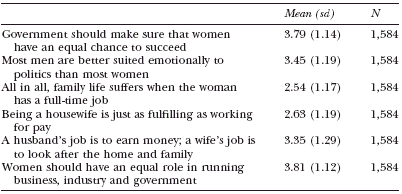
First, in order to get a general sense of party members' views about gender roles and relations, the survey asked respondents a group of six Likert scale questions. These were coded similarly so that 1 represented an anti-feminist position and 5 a liberal feminist position. Together, these five items constitute a very reliable summary attitudinal scale through which we can measure respondents' overall orientation towards liberal feminism (Cronbach's alpha = 0.741). The individual item statistics are reported in Table 1 and the locations of men and women on the overall feminism scale are shown in Table 2. These show a statistically significant difference between men and women, with the latter being somewhat closer to the feminist pole of this attitudinal spectrum (though we should note that men are also closer to this pole than to the opposite one). This difference is illustrated by a few of the individual scale item details. Thus, whereas 42 per cent of women strongly agree that ‘government should make sure that women have an equal chance to succeed’, only 25 per cent of men do; and while 33 per cent of women strongly disagree with the statement that ‘men are better suited to politics emotionally than most women’, only 17 per cent of men do; or again, nearly half of men tend to agree that ‘family life suffers when women have a full-time job’, compared to just a third of women. Finally, while 43 per cent of women strongly agree that ‘women should have an equal role in running business, industry and government’, only 27 per cent of men do so. Even among Conservative members, then, there is clear scope for distinct gendered responses to relevant issues.
General Feminism Scale Item Statistics
Positions on Feminism Scale, by Sex

Note: An independent sample t-test produces a two-tailed significance level of 0.000 for the differences between men's and women's mean scores on this scale.
Issues of Substantive Representation
The feminism scale is derived from responses to a rather general set of questions designed to elicit people's underlying attitudes towards gender relations, but what of the more specific issues on the agenda of current British politics? Do such issues reveal similar differences of opinion between the men and women that constitute the Conservative Party's grassroots? To judge from responses to a battery of questions on these issues, the answer generally would appear to be yes – at least, to a significant extent. Each of these indicators is designed to measure attitudes towards actual or potential reforms that are consistent with liberal feminist objectives on such matters as equal pay, tax status, parental leave rights, flexible working and state provision for childcare. Overall, cross-tabulations reveal statistically significant differences between men and women in the party over 11 out of 12 questions about which they were asked (see Tables 3 and 4), although these differences are not especially notable in most cases. A ‘percentage difference index’ (see note to Table 3 for an explanation of how this is constructed) serves as a simple measure of the extent to which sex differences exist on these questions. With a theoretical range running from 0 (no difference between men and women) to 200 (no overlap whatsoever between the views of men and women), we can see that this confirms both the existence of, and the limits to, sex differences. Table 3, however, also clearly reveals that the issue that most polarizes opinion is equal pay: women are much more likely than men (by 44 per cent to 18.5 per cent) to agree strongly that compulsory pay audits should be conducted on companies previously found guilty of unequal pay to see if they are paying men and women the same amount for the same work. Further, they are much more likely (by 38 per cent to 14 per cent) to feel that pay audits should take place in all companies, irrespective of whether they have a previous record of transgression. The implications of childcare also produce notable differences in the overall distribution of opinion between men and women (e.g. rights to flexible working arrangements, maternity leave and state financial support). Responses to these 12 questions on the substantive representation of women can be combined into a summary additive scale (alpha = 0.716), and this confirms that overall differences between Conservative men and women are significant, with the mean score of men being 2.85 (sd = 0.58), while that of women is 2.52 (sd = 0.59), where 1 represents high support for reform and 5 represents low support.Footnote 20 These figures suggest that, on balance, both men and women in the Conservative Party are more opposed to than supportive of such reforms.
Sex Differences on Current Gendered Political Issues

Note: Each cell is a percentage difference index (PDI) score, calculated as the percentage of males opting for a given response minus the percentage of females opting for the same response. The larger the figure, the greater difference between men and women; positive scores indicate that men prefer a given position more than women do, while a negative score indicates the opposite. The total PDI sums all PDIs for each row, without taking direction of sign (+ or −) into account. n.s. = not significant. Significance statistics are derived from cross-tabulation chi square tests.
Sex Differences on Abortion Law, PDI Scores
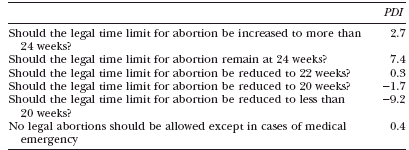
Note: PDI calculated as explained in note to Table 3. Cramer's v = 0.134 (sig. = 0.000), n = 1,506.
One other issue that revealed an interesting sex difference among party members was abortion. This is a classic issue of concern to liberal feminists, who generally seek the legalization and extension of abortion rights, and aim to have reproductive rights recognized as human rights. In 2008, a series of amendments to the Human Embryology and Fertility Act were tabled as it proceeded through Parliament, each of which proposed changes to the current legal deadline of 24 weeks at which abortions can be conducted. Echoing these amendments, we asked our respondents whether they felt the current 24-week limit should be increased, left where it currently stands, reduced to 22 weeks, to 20 weeks, to less than 20 weeks, or outlawed altogether except in cases of medical emergency. The difference between men and women was either insignificant or modest with respect to most of these options, but women were notably more inclined (by 23.5 per cent to 14.3 per cent) to argue that the limit should be reduced to less than 20 weeks (see Table 4). To this extent, women in the Conservative Party might be regarded as more morally ‘conservative’ than men.
Attitudes Towards the Descriptive Representation of Women
How does the Conservative rank and file regard the descriptive representation of women in politics? In particular, how supportive is it of the reforms that David Cameron introduced in order to achieve a greater number of Conservative women MPs? It has long been of major concern to liberal feminists that more women should achieve positions that have traditionally been dominated by men, including elective political offices. Thus, the descriptive representation of women in Parliament is critical to the liberal feminist perspective and is perhaps the most obvious area in which Cameron has sought to take his party into liberal feminist territory.
It is important to note that our survey constitutes a second phase of data-gathering that followed a series of focus groups conducted with party members in 2008. This earlier phase of qualitative research was important in its own right and also helped to shape the survey questionnaire. The major findings of this stage of our work are reported elsewhere,Footnote 21 but can be briefly summarized as follows. While Conservative Party members are generally willing to concede the principle of a more socially representative parliamentary party, they do not regard this as a high priority for the party, and they do not welcome all of the candidate selection reforms that have been introduced in recent years. This is partly because of an instinctive aversion to anything that smacks of political correctness or positive discrimination (even if Cameron's measures fall short of equality guarantees), and they are insistent on the need for strictly ‘meritocratic’ recruitment of prospective parliamentary candidates (PPCs). They specifically dislike the priority list and quotas for women on shortlists, but they are open to the promotion of women candidates through training and awareness-raising initiatives.Footnote 22 This is broadly consistent with their feeling that the low number of women MPs in the party is mainly a result of the poor supply of women putting themselves forward to become candidates, although there is some perception of discrimination by selectorates, particularly by older women on the selection boards.
It seems likely that the process of debate about the reforms may even have served to strengthen antipathy towards them, at least in respect of the stronger forms of equality promotion. Although this summarizes the overall picture, a closer examination of the focus group discussion suggested a number of interesting nuances of opinion between the sexes and generations, which is consistent with the working hypothesis that the attempt to change the social and substantive representation of women in the party may generate tensions among different Conservative actors. These, then, were the key findings that we wished to confirm through a systematic quantitative analysis of survey data.
The first thing to note is that the majority of Conservative members agree that there are too few women in Parliament, a finding that mirrors an opinion that was frequently expressed in the focus groups.Footnote 23 As Table 5 reveals, moreover, there is no significant difference of opinion between men and women on this point. Nearly 60 per cent of men and 65 per cent of women think Parliament should have more women MPs.
Should Parliament Have More or Fewer Women MPs?

Note: Cramer's v = 0.084 (sig. = 0.239), n = 786.
Notwithstanding this, only a minority of party members (approximately one-fifth) regard the dearth of Conservative women in Parliament as something that actually discourages female voters from supporting the party, and there is no significant gap between men and women on this point (Table 6). Still, given that a clear majority do think there should be more women MPs, it would seem logical to suppose that they would approve of action directed towards the achievement of this end. Do they in fact do so?
The Low Number of Conservative Female MPs Deters Women from Voting for the Party – Do You Agree or Disagree?
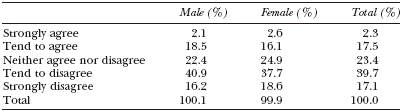
Note: Cramer's v = 0.056 (sig. = 0.304), n = 1,528.
In order to investigate this, we asked the party members a number of relevant questions, some of them directly pertinent to the candidate selection reforms that Cameron introduced after 2005. Specifically, respondents were asked Likert-style questions to gauge how far they approved of the following measures: the creation of the party's ‘priority list’ of candidates; primaries in which candidates go through a series of public votes to win nomination; compulsory minimum numbers of women at the shortlisting stage; party training programmes for female, black and ethnic minority candidates; a compulsory minimum number of women selected as PPCs in winnable seats; the introduction of a Conservative Party ‘women's manifesto’ for the next election; and greater use of women MPs and candidates in prominent roles in election campaigns. Responses to these questions were coded from 1 to 5, with 1 representing strong support for these measures designed to enhance the presence of women in Parliament and election campaigns, and 5 representing opposition to them. When responses to the question about whether or not the low number of Conservative female MPs deters women from voting for the party were combined with data on these other seven questions, a reliable attitudinal scale (alpha = 0.783) was created, on which the overall sample mean was 3.28 (sd = 0.71) – a position slightly more opposed to than supportive of such measures. There is a modest but significant difference between men and women on the scale (which we call ‘selectreform’), with the latter more supportive of measures designed to give women greater prominence in Parliament and election campaigns – better descriptive representation, as it were. The mean position of women on the scale is 3.17 (sd = 0.70), while it is 3.35 for men (sd = 0.70), giving a two-tailed t-test significance level of 0.000 between the two means. A little more of the detail, including these sex differences, can be illustrated by closer examination of the individual scale items. Table 7 reports the overall percentages of men and women approving and disapproving of the various measures, and the relevant percentage difference index scores.
Support for Individual Measures Designed to Enhance the Descriptive Representation of Women in the Conservative Party, by Sex

Note: ‘% approving’ = total of % ‘strongly approve’+ % ‘tends to approve’; ‘% disapproving’ = total of % ‘strongly disapprove’+ % ‘tends to disapprove’.
The first point to note here is that there is generally only limited support for the idea of institutional reform designed to result in the selection of more female candidates. Table 7 shows that the introduction of primary elections and a priority list of candidates (on which women are more heavily represented than in previous years) – both measures that the party leadership has actually introduced – have the support of both men and women members, overall. No other measure has this support. This is not especially surprising in respect of any sort of quota of women on selection shortlists or selected for winnable seats at Westminster, given that our focus group participants (and, indeed, party elite interviewees) repeatedly told us that they were opposed to these measures on the grounds that they smacked of positive discrimination. It is more surprising to see a preponderance of disapproval rather than approval for the idea of training programmes designed to help women, minority ethnicity and disabled people win candidacies, however, since the focus groups had seemed to generate a consensus in favour of this proposal. The second feature of note with regard to Table 7 is that it shows where sex differences exist: these are most evident in respect of quotas of women on shortlists and in winnable seats. This finding is consistent with our focus group findings, for – notwithstanding the general opposition that Conservative members evinced towards these measures – some women participants did voice limited support for them. Overall, we can conclude that support within the party membership for a liberal feminist position on action to achieve better descriptive representation is at best limited, and more likely to emanate from women than men.
There are two further points worthy of note in terms of candidate selection processes before we move on with our analysis. First, the rather lukewarm support for any idea of reforming the process may not only be about attitudes towards the descriptive representation of women; it is almost certainly also a reflection of a widespread resentment on the part of party members against anything perceived to constitute central party interference in the independence of local constituency associations. Selection of candidates for elective public office has always been one of the core functions of the local parties, and local autonomy tends to be jealously guarded in these matters, as we have already noted. A clear sense of this attitude emerged from the focus groups and receives some confirmation in our survey, as Table 8 reveals. More than a quarter of the sample felt that the leadership generally wielded too much influence over the candidate selection process, and men were significantly more likely to take this viewpoint.
Do You Think that the Leadership Has Too Much, Not Enough or About the Right Amount of Influence in the Candidate Selection Process?
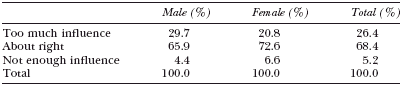
Note: Cramer's v = 0.104 (sig. = 0.000), n = 1,473.
Finally, we felt that we had to broach one particular issue that had come to the surface with remarkable frequency both in our focus groups of party members and in our interviews with party elites: that of selectorate discrimination against women. The outcome of particular political parties' selection processes is often understood in terms of the interaction between the supply of applicants wishing to pursue a political career and the demands of selectors who choose candidates on the basis of their preferences and perceptions of abilities, qualifications and electoral appeal.Footnote 24 Supply-side factors likely to limit the overall level of women seeking selection include gendered socialization and the sexual division of labour. Women are, on average, likely to have fewer resources than men, whether that is the necessary free time to engage in politics, money to fund selection and election campaigns, and/or lower levels of political ambition, confidence and experience. On the demand side, women have been found to suffer from selectorate discrimination, that is, a lack of party demand for women candidates.Footnote 25 This can take different forms. Direct discrimination refers to the positive or negative judgement of people on the basis of characteristics seen as common to their group, rather than as individuals; it reflects the attitudes of the selectors, and can be seen where gender discriminatory questions are posed during the selection process. Indirect discrimination refers to instances where the idea of what constitutes a ‘good MP’ counts against women – where, for example, party selectorates prefer candidates with resources primarily associated with men and masculinity. Imputed discrimination is where party members may be unwilling to choose a woman candidate because they are concerned that by so doing they would lose votes. In the UK there is increasing consensus – at least among gender and politics scholars – that the problem of women's descriptive representation at Westminster is one of party demand. This is not to say that efforts to increase both the overall numbers and diversity of women seeking parliamentary selection should not be undertaken (discrimination in the selection process is more of a problem at the local level). For Westminster, however, all the main parties have sufficient numbers of women seeking selection; it is just that too many are selected in parties' unwinnable seats.Footnote 26
While the feedback we received from Conservative Party actors at all levels gave primary emphasis to the problem of short supply (i.e. too few women coming forward to apply for candidacies) rather than active bias on the part of party selectorates, many of our interlocutors nevertheless voiced concerns about the latter. We have, for instance, noted elsewhere the claims of an aspiring female PPC from Bristol who recounted having been asked ‘completely different questions’ to men, including how she would manage her childcare. She saw such discrimination as specific to the Conservative Party, which ‘does not accommodate’ women. She noted, too, that the ‘majority of the room is filled with older people…and older women don't like to see a woman in politics’.Footnote 27 This latter claim has continually been repeated to us in our research: the problem for younger women aspiring to become PPCs is said to be the role played by older women activists in constituency associations who are, presumably, uncomfortable with the implications for the traditional model of family life of a woman having a demanding and public job such as being a member of Parliament. How widely is this view really shared across the membership? The answer provided by Table 9 is that a significant minority of both men and women hold to the view in roughly equal proportions. Of course, the mere perception of selectorate bias of this kind does not necessarily mean that it actually happens, but the relative prevalence of such a perception across all levels of the party certainly helps us to understand why a leadership determined to get more women into the parliamentary party would have taken the measures that David Cameron introduced after 2005.
Conservative Women Members Are More Likely to Discriminate Against Women Seeking Selection as Parliamentary Candidates than Conservative Men Members
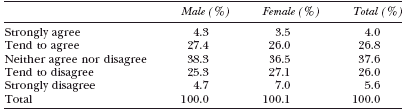
Note: Cramer's v = 0.058 (sig. = 0.340), n = 1,331.
We tried a simple experiment in order to gauge if there was hidden grassroots bias against women candidates in our sample, the results of which are reported in Table 10. The sample was split in half, and each half was a given a description of three hypothetical would-be PPCs. Each respondent was asked to place the three in order of preference. The only thing that distinguished the candidate descriptions was their names, which implied that the candidates were of different sexes: thus, split-sample A was told that ‘Peter King is a barrister with a 10-year long record of party office as a local councillor and as an adviser to a shadow minister. He is seeking selection in a Greater London seat. He currently works and lives in central London but grew up in Yorkshire’, while split-sample B was given exactly the same profile – except that the candidate's name was changed to ‘Patricia King’. Similarly, split sample A was told that ‘John Harrison has extensive experience as a human resources professional; he has been a Conservative member for 15 years, a local councillor for 10 years and fought an unwinnable Conservative seat at the previous election, achieving a greater than average swing’, while split-sample B was told that this candidate was called ‘Jane Harrison’. Finally, a control was applied in that each split-sample was also told of a third candidate with a ‘gender-neutral’ name: ‘Leslie Green is 40 years old and has been a party member for two years, and was born and raised in the constituency. Educated to degree level and a small-business owner, Leslie has extensive links with the local community, especially with Black and Asian groups’. If there is latent bias against women we would expect that candidates with female names would garner less support than their male counterparts, while the two split-samples should be indistinguishable in terms of their support for ‘Leslie Green’. In fact, Table 10 reveals little or no overall difference between the two split samples, so that one cannot infer there is any bias against the selection of female candidates among Conservative members.Footnote 28 In passing, it is interesting to note, however, that there may be some evidence of bias against BME candidates given the relative unpopularity of ‘Leslie Green’ (who has links with Black and Asian groups).
Split-Sample Evidence of Latent Bias Against Women Candidates
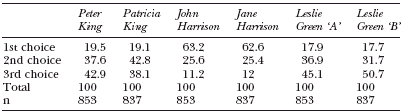
Note: Columns headed ‘Peter King’, ‘John Harrison’ and ‘Leslie Green A’ = split-sample A. Columns headed ‘Patricia King’, ‘Jane Harrison’ and ‘Leslie Green B’ = split-sample B. All figures except the bottom row are percentages.
MULTIVARIATE MODELS OF ATTITUDES TOWARDS GENDER POLITICS IN THE CONSERVATIVE PARTY
Having examined the descriptive and bivariate relationships between sex and the Conservative Party membership's attitudes towards gender politics, it is time to develop multivariate models of these attitudes. Such models need to take into account the demographic and ideological backgrounds of members so that we can gain a sense of what factors might be conducive to more or less liberal feminist orientations among Conservatives (and conservatives) at the individual level.
There are three attitudinal scales that we have encountered that constitute the dependent variables we wish to model: ‘feminism’ (measuring underlying orientation towards gender roles and relations), ‘genderscale’ (tapping the substantive representation of women) and ‘selectreform’ (the descriptive representation of women). What independent variables should we take into account? We have certainly seen enough evidence in our bivariate analysis to suggest that sex is likely to be a factor that makes a significant difference to respondents' outlooks, but there are also several other potentially important standard demographic factors to take into account: social class, educational experience, age and, given the preceding discussion of the possible biases of older women (and indeed, an established literature about the impact of the ‘gender-generation gap’ in British politics),Footnote 29 a possible interaction between sex and age.
In addition, it is important to consider the extent and nature of the impact of the fundamental ideological orientations referred to earlier in the article – left/right ideology, social libertarianism/authoritarianism, and post-materialism/materialism. Our expectations of the relationships between the dependent variables and the predictors in this model are as follows: ideological leftism, social liberalism and post-materialism are all likely to be positive correlates of support for progressive liberal feminist positions on the gender politics scales, as is female gender, higher social status, higher educational attainment and youth rather than age. The interaction effect for the relationship between sex and age should show that older women are hostile to progressive positions while younger women are not – an effect that requires a multiplicative rather than a simple additive term in the equation. Finally, we regard general orientation towards gender roles and relations as logically prior to attitudes to the more specific questions of substantive and descriptive representation; for this reason, the general feminism scale will be added as an independent variable to the models of genderscale and selectreform.
We start with the feminism scale, as this is designed to give a sense of underlying attitude towards gender roles and relations. The key results of our ordinary least squares analysis are reported in Table 11. We used the backward stepwise method to enter the independent variables in order to maximise the parsimony in our model; Table 11 only reports the data for those independent variables that are significantly related to the dependent variable after non-significant predictors have been eliminated. Analysis of residual diagnostics confirms that none of the key assumptions of OLS (linearity, homoscedasticity, no multicollinearity or autcorrelation) is violated in our data.Footnote 30 As can be seen, only four of the predictor variables emerge as having a significant influence on the dependent variable: respondent's sex, libertarian/authoritarian predisposition, age and left/right ideology, in that order of impact. The interaction effect between sex and age is not significant. Overall, this model only explains 8.4 per cent of the variance in the dependent variable, which is not particularly high. Nevertheless, our expectations are confirmed in that the significant coefficients are all signed as we had expected: relatively left-wing and socially liberal attitudes tend to increase an individual's likelihood of holding a liberal feminist conception of gender roles and relations, as do youth and female gender.
OLS Regression Model of General Feminism Scale (‘Feminism’)
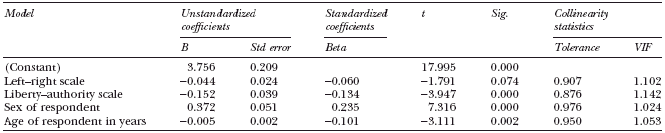
Note:-dependent variable: feminism. Backward stepwise elimination of non-significant factors in six steps. Adjusted R-squared = 0.084; Durbin-Watson statistic = 2.041; n = 912.
OLS Regression Model of Substantive Representation Scale (‘Genderscale’)

Note: dependent variable: genderscale. Backward stepwise elimination of non-significant factors in six steps. Adjusted R-squared = 0.297; Durbin-Watson statistic = 1.986; n = 874.
Moving on to our model of attitudes towards the substantive representation of women, we see remarkably similar results: the same four independent variables are once again significant, with the addition of underlying orientation towards gender (the feminism scale). Overall, this model is somewhat stronger, explaining nearly 30 per cent of the variance in the dependent variable. The significant coefficients are once again nearly all signed as we had expected, with the exception of the respondent's location on the liberty–authority scale: somewhat counter-intuitively, social liberals seem slightly less likely to support these objectives than social authoritarians. While this is theoretically unexpected, a possible empirical explanation is that women are both more socially authoritarian than men in our sample, and also more supportive of reforms designed to enhance the substantive representation of women (see Table 3), so it may not be surprising that authoritarianism correlates negatively with genderscale.
Finally, Table 13 reports the results for our model of attitude towards the descriptive representation of women. This shows that no demographic factors play a significant role in shaping attitudes towards reforms designed to enhance the presence of Conservative women in Parliament and national election campaigns; only the underlying ideological predispositions toward leftism, social conservatism (again) and liberal feminist conception of gender roles and relations play a significant part, it seems.
OLS Regression Model of Descriptive Representation Scale (‘Selectreform’)

Note: dependent variable: selectreform. Backward stepwise elimination of non-significant factors in seven steps. Adjusted R-squared = 0.174; Durbin-Watson statistic = 2.010; n = 785.
DISCUSSION AND CONCLUSIONS
This article shows that, to judge from the case of British Conservative Party members, it is certainly possible for conservatives to hold views consistent with liberal feminist objectives. In respect of broad outlook on gender roles and relations, the members are moderate on the whole, but women show a significantly greater sympathy than men for progressive liberal feminist positions. In terms of current issues of women's substantive representation, persistent differences of outlook between men and women reveal themselves on gendered questions, especially on issues of equal pay, childcare rights and abortion. Where matters of descriptive representation are concerned, there is a shared sense among both men and women that there should be more women in Parliament. On the whole, however, the membership is somewhat reluctant to embrace radical measures such as gender equality guarantees that could be introduced in order to achieve this end, although it does not object to certain reforms that the leadership has implemented in candidate selection processes in recent years (such as the ‘priority list’ on which women were more heavily represented than in previous years, or the occasional use of local primary elections). Even so, while the notion of using sex quotas for shortlists or safe seats is widely unpopular among members, there is some evidence that a significant minority – especially of women – are prepared to countenance such measures. Multivariate analysis reveals that neither sex nor age are significant influences on support for gender-related selection reforms, once underlying values and attitudes are taken into account; among Conservative members (as among outsiders, we suspect), the more left wing or feminist an individual is, the more inclined he or she will be to support reforms, regardless of age or sex. However, in respect of general attitudes towards gender roles and relations, and towards the substantive representation of women, age and sex do count for something: younger members and women generally are significantly more favourable to liberal feminist positions on such matters.
It should be said that few Conservatives regard gender-related issues as political priority areas for the party; the economy, asylum and immigration, and law and order are the three most frequently mentioned key issues for our respondents. From the perspective of party competition strategy, this is most probably beside the point, however, for gender issues have rarely been electorally salient in the UK since the time of the suffragette struggles, even if there has been a feminization of the terrain over which parties compete in the last decade or so. Feminization of Cameron's Conservative Party is unlikely to be a direct strategy to garner votes, then. Rather, it is more plausible to regard it as part of the strategy of ‘decontaminating’ the general party image, which had come to seem so disconnected from the mainstream of society and politics in the country that the majority of voters refused to take it seriously. In seeking to achieve this, Cameron has been able to draw on and work with the varieties of Conservative actor that exist in his party; the pursuit of a comparatively progressive agenda on matters of gender has, in effect, depended on the support of parts of the liberal and traditional Conservative streams within his party, and on the women in the party.Footnote 31 It is the nature of British conservatism that the specific outlooks that define these groups, and their relative sizes, will change over time, but in any case our findings suggest that conservatism is by no means universally resistant to liberal feminist reforms.



