Introduction
Digit ratio (2D:4D) is defined as the relative length of the second (2D, index finger) to fourth (4D, ring finger) digits of the human hand. The ratio varies according to sex and is sexually dimorphic: 2D:4D <1 is characteristic for men and 2D:4D ≥1 for women (Manning et al., Reference Manning, Scutt, Wilson and Lewis-Jones1998; Manning, Reference Manning2011). On the basis of experimental studies, it has been found that 2D:4D is determined during early prenatal development by a balance of testosterone and oestrogens (Zheng & Cohn, Reference Zheng and Cohn2011). It is claimed to be a biomarker of prenatal sex steroids acting in a narrow window of early ontogeny (Galis et al., 2010; Breedlove, Reference Breedlove2010). A low ratio indicates high prenatal testosterone and low oestrogens (the male pattern), whereas a high ratio indicates low fetal testosterone and high oestrogens (the female pattern) (Manning et al., Reference Manning, Scutt, Wilson and Lewis-Jones1998; McIntyre et al., Reference McIntyre, Ellison, Lieberman, Demerath and Towne2005). Dimorphism of 2D:4D results from the fact that, during the fetal period, the phalanges are rich in testosterone and oestrogen receptors, with their highest concentration in the fourth finger (Zheng & Cohn, Reference Zheng and Cohn2011). Moreover, after being determined in early fetal period (the first trimester), this ratio is claimed to remain constant in postnatal development (McIntyre et al., Reference McIntyre, Ellison, Lieberman, Demerath and Towne2005; Malas et al., Reference Malas, Dogan, Evcil and Desdicioglu2006).
On the basis of these theoretical considerations, researchers have determined correlations between 2D:4D and the incidence of different illnesses and disorders. It has been found that the ratio correlates with: left-handedness, fertility, sex orientation, migraine, tension-type headaches, autism, coronary heart disease, prostate and breast cancers and many others (Manning & Bundred, Reference Manning and Bundred2000; Manning & Leinster, Reference Manning and Leinster2001; Manning et al., Reference Manning, Baron-Cohen, Wheelwright and Sanders2001; Rahman et al., Reference Rahman, Lophatananon, Stewart-Brown, Harriss, Anderson and Parker2011; Auger & Eustache, Reference Auger and Eustache2011; Muller et al., Reference Muller, Baglietto, Manning, McLean, Hopper, English, Giles and Severi2012; Lu et al., Reference Lu, Ma, Zhao and Huo2015; Wei et al. , Reference Wie, He, Liu, Dong, Xie, Wang and Yu2015). Also, there have been studies of the correlation between 2D:4D and different aspects of physical body build: for example, on the basis of 2D:4D studies it was found that an idiopathic form of gynaecomastia may be related to prenatal sex hormone levels (Kasielska-Trojan & Antoszewski, Reference Kasielska-Trojan and Antoszewski2015). High 2D:4D appears to be related to female facial features in women, but not in men. This observation has led to the conclusion that certain aspects of facial development are ruled by factors that are established prenatally (Burriss et al., Reference Burriss, Little and Nelson2007).
The relations between 2D:4D and different types of personalities and social behavioural traits have also been examined. Such studies are helpful in explaining the role of prenatal sex hormones in creating personality and behavioural patterns. The hormonal environment in which the human fetal brain evolves may influence adult social behaviour (Swaab, Reference Swaab2007). However, it has not yet been explained how these hormonal effects influence adult traits. Some specific patterns of behaviour (e.g. aggressive or risky behaviours) may be reflected as, for example, susceptibility to trauma, risky sexual activities and criminal conduct. Also, studies have examined the relationships between 2D:4D and financial risk-taking. It has been demonstrated that men, regardless of 2D:4D ratio, have a greater tendency to engage in risky behaviours than women in many different contexts and that there is a correlation between sex hormones and a tendency for risk-taking (Stenstrom et al., Reference Stenstrom, Saad, Nepomuceno and Mendenhall2011). At the same time, it is known that testosterone plays a role in risky, asocial and criminal behaviours in adolescent boys (Ellis & Hoskin, Reference Ellis and Hoskin2015). Also, correlations between 2D:4D in men and agreeableness to women, as well as sexual orientation, have been examined. Men with lower 2D:4D appear to be more conciliatory to women than to men. On the basis of this research it can be concluded that fetal androgen exposure affects context-specific aspects of men’s social behaviour (Moskowitz et al., Reference Moskowitz, Sutton, Zuroff and Young2015).
The 2D:4D ratio also appears to be predictive for performance in sports. The 2D:4D has been correlated with risk preferences through participation in sports such as football, rugby, basketball and skiing (Manning & Taylor, Reference Manning and Taylor2001; Manning, Reference Manning2002; Tester & Campbell, Reference Tester and Campbell2007). It has also been shown that success and prowess in competitive sports are associated with lower 2D:4D in comparison with the general population (Manning & Taylor, Reference Manning and Taylor2001).
Thus there is a fairly large literature on the links between 2D:4D and aggressive/risky/dominant behaviours. This link has been found in a number of studies but often the effect sizes are small or only found in one sex. This pattern may result from the methods used to measure such behaviours, such as questionnaires. However, there have been a few studies that have used ‘real world’ measures for behaviours such as impulsive behaviour in offenders (Hanoch et al., Reference Hanoch, Gummerum and Rolison2012), boxers’ injuries to the hands (Joyce et al., Reference Joyce, Kelly, Chan, Colgan, O’Briain, McCabe and Curtin2013) or fouls committed during football matches (Perciavalle et al., Reference Perciavalle, Di Corrado, Petralia, Gurrisi, Massimino and Coco2013; Mailhos Reference Mailhos, Buunk, del Arca and Tutte et al. , in press). These studies tend to give higher effect sizes than studies based on questionnaire measures of such behaviours. Thus, the present study aimed to add to this literature by using a ‘real world’ measure of risky behaviour.
In this report, 2D:4D and WHR were compared in men and women with nose deformity caused by injuries suggesting risky behaviour and unaffected male and female controls from the general population. This kind of facial trauma was considered an indicator of risk-taking behaviour. It was predicted that patterns of 2D:4D in women who suffered such an injury would be more masculinized. Similarly, in the case of affected men, it was hypothesized that their 2D:4D would be lower than those of control men.
Methods
Participants
The study involved 100 patients who underwent rhinoplasty in the Department of Plastic, Reconstructive and Aesthetic Surgery in Łódź, Poland, due to nose trauma in a one-year period (2015). The examined group consisted of 50 women (mean age 30.74±8.09 years) and 50 men (mean age 30.98±10.86 years). The inclusion criteria were: (1) nose trauma due to a fight or car/bike accident (and the person was the driver), sport activities or any accident under the influence of alcohol or drugs (fall, accidental hit); (2) no congenital malformations and/or hormonal disorders in medical history; (3) no history of hand injuries. Patients were qualified for nose correction after detailed medical examination and CT imaging at least 6 months post-trauma. For comparison purposes, measurements were taken in a control sample of 70 healthy women (mean age 23.03±3.36 years) and 70 healthy men (the mean age 22.87±3.46) recruited among students and clinic patients without facial trauma, congenital abnormalities or hormonal disturbances.
Measurements and questionnaire
In both groups of participants (patients with post-traumatic nose deformity and the controls) the following measurements were taken: body height (the maximum distance from the base to the vertex of the head; B-v), waist and hip circumferences, right (R) and left hand (L) II and IV digit lengths (2DR, 2DL, 4DR and 4DL) and body weight. The following parameters were calculated from these measurements: BMI (body weight [kg]/height [m2]), WHR (waist circumference [cm]/hip circumference [cm]) and 2D:4D for the right (R) and left (L) hand (finger II length [cm]/finger IV [cm]): 2D:4DR and 2D:4DL. Measurements were made using GPM anthropological instruments, i.e. a sliding caliper, anthropometry and measuring tape. Finger lengths were measured directly on the palmar side of the hand using anthropometric points lying on the digit axis: pseudophalangion (pph) – a point in the proximal finger crease – and dactylion (da) – the most distal point on the fingertip. Body height was measured in a standing position with the head positioned in the Frankfurt plane. Waist circumference was measured at the level of the umbilicus, and hip circumference was measured at the level of the greater trochanters.
Patients filled in a questionnaire with questions about their age, date and circumstances of nose injury and eventual comorbidities. In a randomly selected group of 40 subjects (20 women and 20 men) all measurements were done twice to calculate the Technical Error of Measurement (TEM) and the coefficient of reliability (R). For 2D:4D, correlation coefficients were also computed. All measurements were done by one person educated in the Anthropology Department, University of Łódź. The protocol for the study was approved by the local ethics committee (No: RNN/280/15KE).
Statistical analysis
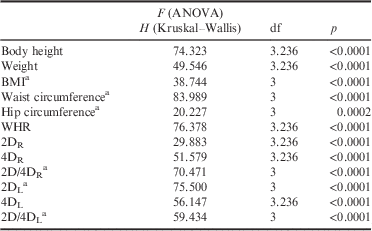
Differences in the measured anthropometric features between the women and men with post-traumatic nose deformity and controls were analysed. Prior to a statistical analysis of the metric data, the normality of distribution of the tested variables was examined using the Kolmogorov–Smirnov test and the homogeneity of variances was checked using the Levene test. With both assumptions met (normality of distribution and homogeneity of variances), single-factor analysis of variance (ANOVA) was applied to identify individual features discriminating the groups. If none of these assumptions was met, non-parametric Kruskal–Wallis tests were used (Table 1). When the results were significant (p<0.05), post-hoc tests (Bonferroni procedure corrected for multiple comparisons) were applied to detect differences between pairs of groups. In order to check which of the analysed features would be most effective in discriminating subjects with post-traumatic nose deformity, a multifactorial classification model was designed. To verify the model’s accuracy, leave-out-one cross-validation was performed.
Differences in anthropometric measurements and indices in the examined group (ANOVA and Kruskal–Wallis tests)
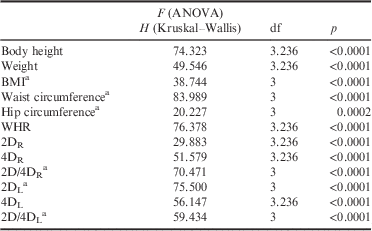
a Kruskal–Wallis H tests.
Results
Reliability of measurements
The coefficient of reliability of the measurements (R) ranged from 0.994 to >0.999. The highest reliabilities were observed for body height (TEM=0.001, R>0.999) and waist and hip circumferences (waist: TEM=0.102, R>0.999; hips: TEM=0.112, R>0.999). Also, high coefficients for finger length measurements were calculated (2DR: TEM=0.028, R=0.994; 2DL: TEM=0.021, R=0.997; 4DR: TEM=0.023 R=0.997; 4DL: TEM=0.02, R=0.998). The coefficients of reliability for the 2D:4D ratios were 0.975 for the right 2D:4D and 0.99 for the left 2D:4D.
Body measurements: post-traumatic nose deformity vs control groups by sex
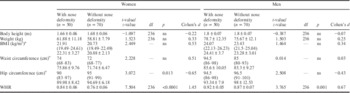
Body height, body weight, waist circumference and both indices differed between female and male controls, i.e. presented sexual dimorphism (p<0.0001). Comparisons of body height, body weight, BMI and waist circumference did not reveal any differences between subjects who had facial trauma and controls, regardless of their sex. Women and men who suffered a nose injury were characterized by significantly higher values of WHR (p<0.05) (Table 2).
Comparison of body measurements and ratios between women and men with post-traumatic nose injury and controls

Results shown as the means and ±standard deviations; Bonferroni post-hoc tests: t-values, df, p-values.
a Medians and I–III quartile, multiple comparisons (z-values, p-values).
ns, not significant.
Digit lengths and 2D:4D: post-traumatic nose deformity vs control groups by sex
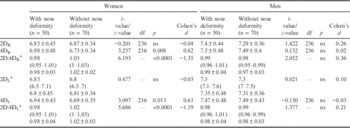
Comparison of II and IV finger lengths, and 2D:4D, for both hands between control women and men showed significant differences for all variables (p<0.05). Males had longer II and IV fingers, and the median 2D:4D for both hands was <1, while in women it was ≥1 (p<0.0001). The 2D:4D in women with post-traumatic nose deformity was significantly different from the ratio in control women (p<0.0001 for left and right hand ratios). The 2D:4D in this group presented a male pattern, as the median for both hands was <1 and did not differ from the 2D:4D (right and left hands) of control men. The differences were connected with IV finger lengths as, in comparison with control women, women who suffered trauma appeared to have longer IV fingers in the right (4DR) (p=0.008) and left (4DL) hands (p=0.013), while the II finger lengths (right and left) were similar to the values observed in the controls. No differences were found in the men: those with post-traumatic nose deformity and controls had similar finger lengths and 2D:4D ratios (Table 3).
Comparison of digits measurements and ratios between women and men with post-traumatic nose deformity and controls

Results shown as the means ±standard deviations; Bonferroni post-hoc tests (t-values, df, p).
a Medians and I–III quartile, multiple comparisons (z-values, p-values).
ns, not significant.
Multifactorial classification model
Statistical analysis showed significant differences between women with post-traumatic nose deformity and control women for the following variables: hip circumference, WHR, 2DL, 2DR, 4DR, 4DL and 2D:4DR and 2D:4DL. These variables were included in multifactorial logistic regression analysis and backward stepwise elimination was conducted. Finally, the model indicated hip circumference, WHR and right and left 2D:4D as independent risk factors for this trauma (Table 4). The model correctly classified 80% of women with nose injury and 88.6% of control women. Leave-out-one cross-validation showed that the model’s accuracy was 83.33%.
Independent risk factors for nose trauma in women

a Odds Ratio for a 1 unit increase in hip circumference and 0.01 increase for the indices WHR and 2D:4D.
χ 2=91.801, df=4, p<0.0001.
Discussion
The purpose of this study was to examine the association between the 2D:4D ratio and risk-taking behaviours resulting in nose trauma, in men and women. The most interesting finding was for women, as the 2D:4D in women with post-traumatic nose deformity was significantly different from that of control women. For both hands it reflected a male pattern (did not differ from the ratios in control men). Due to the fact that 2D:4D is established as a prenatal sex hormone marker, it can be speculated that women who engage in risky behaviour are subjected to prenatal androgenization. Moreover, a recent experimental study showed that androgen and oestrogen receptors have increased activity in the fourth finger and the length of the fourth finger, not that of the second one, determines the 2D:4D ratio (Zheng & Cohn, Reference Zheng and Cohn2011). This finding seems to be in accordance with the present study’s results, as it was found that the observed differences in 2D:4D were related to longer left- and right-hand fourth fingers in women after nose trauma.
Some studies have demonstrated that 2D:4D may be reflective of aggressive behaviours. It has been found that the male pattern (2D:4D<1) and lower 2D:4D may be associated with increased level of aggression in adulthood (Benderlioglu & Nelson, Reference Benderlioglu and Nelson2004; Bailey & Hurd, Reference Bailey and Hurd2005). It has also been found that boxers’ fractures, being a result of an aggressive tendency, are related to a low 2D:4D ratio (Joyce et al., Reference Joyce, Kelly, Chan, Colgan, O’Briain, McCabe and Curtin2013). Similarly, in this study, nose trauma caused by aggressive acts such as fights and car or bike accidents (if the person was the driver), during sport activities or any accident under the influence of alcohol or drugs (fall, accidental hit) was accepted as an indicator of risk-taking behaviour.
This research has demonstrated that some aspects of human morphology are correlated with a particular pattern of behaviour. Firstly, men and women who suffered nose trauma appeared to have waist–hip ratios (WHR) significantly higher (more ‘male’) than the controls. Due to the fact that WHR is considered a tertiary sex feature, which is established not earlier than during adolescence, it may reflect pubertal and/or adult hormonal activity. It has also been found that WHR correlates with oestrogen and testosterone concentrations in women and men (Singh, Reference Singh1993; Mondragón-Ceballos et al., Reference Mondragón-Ceballos, García Granados, Cerda-Molina, Chavira-Ramírez and Hernández-López2015). In the examined male group the only difference between those who engaged in risky behaviour and the controls was a higher WHR. This observation confirms that men with a higher WHR (higher testosterone) may be more aggressive and more prone to risky behaviours.
A similar correlation was found in the female group, and this may also be related to postnatal sex hormone influence. However, the multifactorial classification model of risk-taking behaviour in women, presenting a satisfactory 83% accuracy, in addition to WHR included also 2D:4D of both hands. This indicates that in women some patterns of behaviour may be determined in prenatally by sex hormones and modified by pubertal and adult hormones. A similar observation was presented by Benderlioglu and Nelson (Reference Benderlioglu and Nelson2004), who concluded that 2D:4D may be associated with female reactive aggression when sufficient provocation was present. However, they did not find such a correlation in the examined men (Swaab, Reference Swaab2007). During the fetal period, the central nervous system is exposed to sex hormones such as testosterone, oestrogens and progesterone, as there are an increasing amount of receptors for these hormones in the brain from the initial periods of prenatal life (Swaab, Reference Swaab2007). The human brain forms in the male trend via the direct effect of testosterone, and in the female direction through a lack of this hormone (Swaab, Reference Swaab2007). It has been demonstrated that girls who were exposed to testosterone in the prenatal period (due to congenital adrenal hyperplasia) more often prefer playing with boys, tend to play with boys’ toys and are generally ruder than their peers (Nordenström et al., Reference Nordenström, Servin, Bohlin, Larsson and Wedell2002). Moreover, Iijima et al. (Reference Iijima, Arisaka and Minamoto2001) found that androgen exposure during fetal life may contribute to shaping masculine characteristics in children’s free drawings. Many authors have claimed that during prenatal life gender identity, sexual orientation and other behaviours are programmed (Swaab, Reference Swaab2007). However, on the basis of the present results, it seems that the tendency for risky behaviours in men is related to postnatal hormonal factors rather than prenatal factors, while in women prenatal sex hormones may have a significant influence on their behaviour.
This study has several limitations. First, patients were examined from one population (Polish). Second, different causes of nose injury were accepted as a risky behaviour indicator. It would be worth comparing the anthropometric features of participants with different causes of injury, but for such analysis the studied groups would need to be more numerous. Another limitation of the study is that the experimental and control subjects differed in age. However, the mean age of nose trauma was 20.1±6.3 years in women and 21.2±10.7 years in men, so it was similar to the control group’s age during examination.
In conclusion, women’s risky behaviours seem to be associated with the influence of prenatal sex hormones, while differences in WHR suggest that this tendency is also related to postnatal hormonal factors. Risky behaviours, stereotypically connoted with the male sex, seem, in men, to be linked to postnatal hormonal factors rather than increased prenatal androgen exposure. However, these findings should be interpreted with caution and require replication, preferably in different ethnic groups.
Acknowledgments
The authors are grateful to Associate Professor Aneta Sitek from the Department of Anthropology, University of Łódź, for helpful technical tips. They also thank the study participants. The authors have nothing to disclose and there are no conflicts of interest.