Introduction
Several studies in older adults have shown more frequent participation in cognitive activities to be related to better cognitive function (Christensen & Mackinnon, Reference Christensen and Mackinnon1993; Hultsch, Hammer, & Small, Reference Hultsch, Hammer and Small1993; Lachman, Agrigoroaei, Murphy, & Tun, Reference Lachman, Agrigoroaei, Murphy and Tun2010; Wilson et al., Reference Wilson, Bennett, Beckett, Morris, Gilley, Bienias and Evans1999), reduced cognitive decline (Hultsch, Hertzog, Small, & Dixon, Reference Hultsch, Hertzog, Small and Dixon1999; Wilson et al., Reference Wilson, Bennett, Bienias, Mendes de Leon, Morris and Evans2003), and reduced risk of dementia (Stern & Munn, Reference Stern and Munn2010; Verghese et al., Reference Verghese, Lipton, Katz, Hall, Derby, Kuslansky and Buschke2003; Wang, Karp, Winblad, & Fratiglioni, Reference Wang, Karp, Winblad and Fratiglioni2002; Wilson, Mendes de Leon, et al., Reference Wilson, Mendes de Leon, Barnes, Schneider, Bienias, Evans and Bennett2002). Although the mechanisms underlying these associations are not well understood, cognitive stimulating activity has been posited to contribute to cognitive reserve. The concept of cognitive reserve proposes that individual differences in the efficiency and flexibility of cognitive systems might explain individual differences in the effect of brain pathology on functioning. Participation in cognitive and other leisure activities, along with education, and occupational attainment, are at least some of the variables that might contribute to cognitive reserve (Stern, Reference Stern2002, Reference Stern2006).
Most studies on the association between cognitive activity and cognitive function in non-demented older adults have been in predominantly non-Hispanic Whites (e.g., Hultsch et al., Reference Hultsch, Hertzog, Small and Dixon1999; Verghese et al., Reference Verghese, Lipton, Katz, Hall, Derby, Kuslansky and Buschke2003; Wang et al., Reference Wang, Karp, Winblad and Fratiglioni2002; Wilson et al., Reference Wilson, Barnes, Krueger, Hoganson, Bienias and Bennett2005), and a small number in primarily non-Hispanic Blacks (Barnes, Wilson, Mendes de Leon, & Bennett, Reference Barnes, Wilson, Mendes de Leon and Bennett2006; Dotson, Schinka, Brown, Mortimer, & Borenstein, Reference Dotson, Schinka, Brown, Mortimer and Borenstein2008). Studies in geographically defined biracial samples have found less frequent engagement in cognitive activity in Blacks than Whites (Wilson et al., Reference Wilson, Bennett, Beckett, Morris, Gilley, Bienias and Evans1999; Wilson, Bennett, et al., Reference Wilson, Bennett, Bienias, Aggarwal, Mendes de Leon, Morris and Evans2002), but similar associations of cognitive activity to cognitive decline (Wilson et al., Reference Wilson, Bennett, Bienias, Mendes de Leon, Morris and Evans2003) and incident dementia (Wilson, Bennett, et al., Reference Wilson, Bennett, Bienias, Aggarwal, Mendes de Leon, Morris and Evans2002). Very few studies have examined the association between cognitive activity and cognition in older Hispanics (Herrera et al., Reference Herrera, Meeks, Dawes, Hernandez, Thompson, Sommerfeld and Jeste2011; Scarmeas, Levy, Tang, Manly, & Stern, Reference Scarmeas, Levy, Tang, Manly and Stern2001). In a multiethnic cohort (Scarmeas et al., Reference Scarmeas, Levy, Tang, Manly and Stern2001), Hispanics reported less frequent engagement in leisure activity as compared to non-Hispanic Blacks and Whites in a measure that included cognitive, physical and social activities, with no significant differences between Blacks and Whites. After adjusting for ethnicity and other demographic variables, higher frequency of engagement in cognitive activity in late life was associated with reduced risk of incident dementia. Another study explored frequency of engagement in leisure activities, some of which were cognitive activities, in a demographically matched sample of Hispanic and non-Hispanic White older women (Herrera et al., Reference Herrera, Meeks, Dawes, Hernandez, Thompson, Sommerfeld and Jeste2011). Participants in both groups reported similar frequency of engagement in most cognitive activities, except use of computers, which was lower in Hispanics. Leisure activities were differentially associated with better cognition in Hispanic and non-Hispanic White women and the findings were interpreted as evidence that Hispanic ethnicity might impact the relationship between cognitive activity and cognitive function (Herrera et al., Reference Herrera, Meeks, Dawes, Hernandez, Thompson, Sommerfeld and Jeste2011). Overall, the scant data on older Hispanics indicates that frequency of engagement in cognitive activity, at least in some cases, might be lower in Hispanics than other ethnic groups. However, whether there might still be a significant association between cognitive activity and cognitive function despite lower activity levels remains an unanswered question.
According to data from the U.S. Census Bureau, Hispanics represent the ethnic group with the highest growth within the older adult population of the United States. They are expected to become the largest minority group by 2050, representing 20% of older adults (U.S. Census Bureau, 2008). Despite these statistics, research on cognitive aging in Hispanics has been limited. The few available studies on a geographically defined population showed that although Hispanics might be at higher risk for mild cognitive impairment (Manly et al., Reference Manly, Tang, Schupf, Stern, Vonsattel and Mayeux2008) and dementia (Gurland et al., Reference Gurland, Wilder, Lantigua, Stern, Chen, Killeffer and Mayeux1999; Tang et al., Reference Tang, Cross, Andrews, Jacobs, Small, Bell and Mayeux2001), this might not be the case for all subgroups of Hispanics (Haan et al., Reference Haan, Mungas, Gonzalez, Ortiz, Acharya and Jagust2003). Projected increases in the numbers of elderly Hispanics, and the higher risk for cognitive problems in this group, highlight the importance of understanding factors that might impact age-related cognitive impairment in this segment of the population. Cognitive activity might prove to be an important one.
There were two main purposes to the present study. First, we were interested in exploring whether frequency of cognitive activity and its association with cognitive function in Hispanics was comparable to that of other ethnic groups, that is, non-Hispanic Whites and Blacks. Based on prior findings (Herrera et al., Reference Herrera, Meeks, Dawes, Hernandez, Thompson, Sommerfeld and Jeste2011; Scarmeas et al., Reference Scarmeas, Levy, Tang, Manly and Stern2001), we hypothesized that while Hispanics might engage in cognitive activity less often, the association between more frequent engagement in cognitive activity and better cognition would be comparable to that of other ethnic groups. Understanding the association between cognitive activity and cognitive function in older Hispanics requires appropriate measures of the constructs in this group. The cognitive battery used in this study has been previously validated for a Hispanic population (Krueger, Wilson, Bennett, & Aggarwal, Reference Krueger, Wilson, Bennett and Aggarwal2009). Thus, the second purpose of the current study was to examine the psychometric properties of a previously developed cognitive activity scale (Wilson et al., Reference Wilson, Barnes, Krueger, Hoganson, Bienias and Bennett2005).
Method
Participants
Participants were subjects from the Memory and Aging Project (MAP) or the Minority Aging Research Study (MARS) who were free of dementia, identified themselves as being Hispanic, non-Hispanic White, or non-Hispanic Black, and had valid measures of global cognitive function and lifetime cognitive activity. Details of these studies have been described elsewhere (Arvanitakis, Bennett, Wilson, & Barnes, Reference Arvanitakis, Bennett, Wilson and Barnes2010; Bennett et al., Reference Bennett, Schneider, Buchman, Mendes de Leon, Bienias and Wilson2005). Briefly, these are ongoing longitudinal studies of older adults with similar study designs, recruitment techniques and data collection procedures (Boyle, Barnes, Buchman, & Bennett, Reference Boyle, Barnes, Buchman and Bennett2009; James, Boyle, Buchman, Barnes, & Bennett, Reference James, Boyle, Buchman, Barnes and Bennett2011). Participants undergo assessment of risk factors and annual clinical evaluations. Clinical evaluations include a medical history, neurological examination, and cognitive and motor function testing. The diagnosis of dementia is done by a physician on the basis of the results of the clinical evaluation, and following the criteria set forth by the National Institute of Neurological and Communicative Disorders and Stroke and the Alzheimer's Disease and Related Disorders Association (McKhann et al., Reference McKhann, Drachman, Folstein, Katzman, Price and Stadlan1984).
Of the 1856 people enrolled in MAP and MARS, eight identified their ethnicity as something other than Hispanic or non-Hispanic White or Black, 86 had dementia, three did not have valid measures of global cognition and 162 were missing the lifetime cognitive activity measure, which was not collected in MAP until 4 years after study onset, so these participants were excluded from further analyses. This left 1571 older adults (73.45% female). Participants had a mean age of 78.36 years (SD = 7.23) and a mean education of 14.48 years (SD = 3.33). Study procedures were approved by an Internal Review Board.
Materials and Procedures
Participants completed all measures in their primary language (English or Spanish), as assessed by self-report.
Assessment of cognitive activity frequency
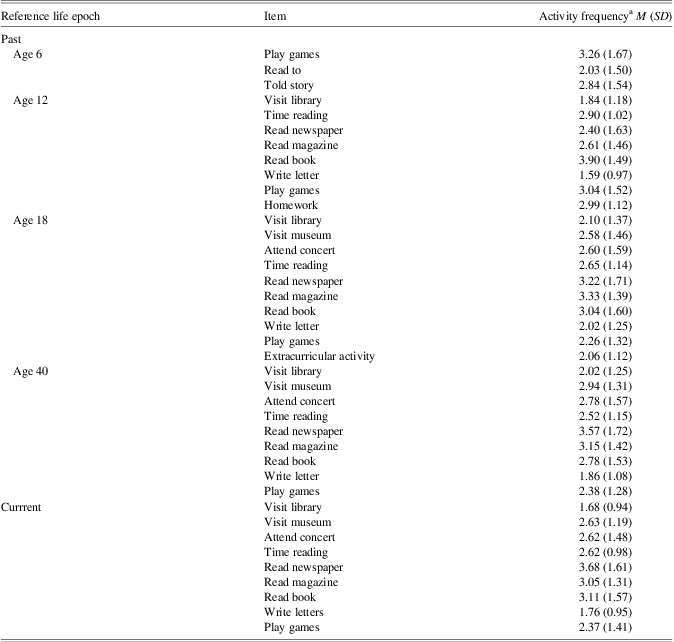
Participants completed a scale assessing frequency of cognitive activity in four life epochs: childhood (ages 6 and 12), transition to adulthood (18 years), middle of adulthood (40 years), and current age. Details about the scale have been published previously (Wilson et al., Reference Wilson, Barnes, Krueger, Hoganson, Bienias and Bennett2005). Briefly, items included activities such as reading newspapers, magazines, or books; visiting a museum or library; attending a concert, play or musical; writing letters; and playing games (see Appendix A for specific items). We computed an overall measure of past cognitive activity by averaging scores from the 30 items for childhood, age 18 and age 40. Current cognitive activity frequency scores represented the average of nine items. Both past and current activity scores ranged from 1 to 5, with higher scores indicating more frequent cognitive activity. This scale has been shown to have appropriate psychometric characteristics in a smaller sample drawn from MAP (Wilson et al., Reference Wilson, Barnes, Krueger, Hoganson, Bienias and Bennett2005). A similar scale, but which included a couple of additional items, was also found to have sound psychometric properties in a separate non-Hispanic Black cohort (Barnes et al., Reference Barnes, Wilson, Mendes de Leon and Bennett2006).
Assessment of cognitive resources
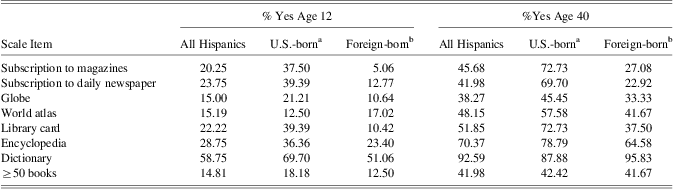
Participants completed measures of cognitive resources present in the home at age 12 and 40 thought to support a cognitively active lifestyle. Details of the measures have been published previously (Barnes et al., Reference Barnes, Wilson, Mendes de Leon and Bennett2006; Wilson et al., Reference Wilson, Barnes, Krueger, Hoganson, Bienias and Bennett2005). Participants were asked to indicate whether they had each of seven items available (newspaper subscription, magazine subscription, dictionary, encyclopedia, atlas, globe, and library card) and to estimate the number of books in the home. Scores on each of the measures ranged from zero to eight, with higher scores indicating more resources.
Assessment of cognitive function
Participants were administered a battery of tests measuring five cognitive domains: episodic memory, semantic memory, working memory, perceptual speed, and visuospatial ability (Wilson, Beckett, et al., Reference Wilson, Beckett, Barnes, Schneider, Bach, Evans and Bennett2002). The Mini-Mental State Examination (Folstein, Folstein, & McHugh, Reference Folstein, Folstein and McHugh1975) was used to describe the cohort but not in analyses.
Episodic memory measures included: immediate and delayed recall scores of story A from Logical Memory (Wechsler, Reference Wechsler1987) and of the East Boston Story (Albert et al., Reference Albert, Smith, Scherr, Taylor, Evans and Funkenstein1991; Wilson, Beckett, et al., Reference Wilson, Beckett, Barnes, Schneider, Bach, Evans and Bennett2002), and Word List Memory, Recall, and Recognition (Morris et al., Reference Morris, Heyman, Mohs, Hughes, van Belle, Fillenbaum and Clark1989). The semantic memory measures were: a 15-item version (Morris et al., Reference Morris, Heyman, Mohs, Hughes, van Belle, Fillenbaum and Clark1989) of the Boston Naming Test (Kaplan, Goodglass, & Weintraub, Reference Kaplan, Goodglass and Weintraub1983), and verbal fluency (Morris et al., Reference Morris, Heyman, Mohs, Hughes, van Belle, Fillenbaum and Clark1989; Wilson, Beckett, et al., Reference Wilson, Beckett, Barnes, Schneider, Bach, Evans and Bennett2002). Working memory measures included: Digit Span Forward and Backward (Wechsler, Reference Wechsler1987), and Digit Ordering (Cooper & Sager, Reference Cooper and Sager1993; Wilson, Beckett, et al., Reference Wilson, Beckett, Barnes, Schneider, Bach, Evans and Bennett2002). Perceptual speed tests included: the oral Symbol Digit Modalities Test (Smith, Reference Smith1982), Number Comparison (Ekstrom, French, Harman, & Kermen, Reference Ekstrom, French, Harman and Kermen1976; Wilson, Beckett, et al., Reference Wilson, Beckett, Barnes, Schneider, Bach, Evans and Bennett2002), and the number of words and colors correctly named in a modified version of the Stroop Neuropsychological Screening Test (Trenerry, Crosson, DeBoe, & Leber, Reference Trenerry, Crosson, DeBoe and Leber1989). Visuospatial ability was measured with a 15-item form of the Judgment of Line Orientation (Benton, Sivan, Hamsher, Varney, & Spreen, Reference Benton, Sivan, Hamsher, Varney and Spreen1994), and a 16-item form of Standard Progressive Matrices (Raven, Court, & Raven, Reference Raven, Court and Raven1992).
As described in prior studies (Wilson, Beckett, et al., Reference Wilson, Beckett, Barnes, Schneider, Bach, Evans and Bennett2002), composite scores for the five cognitive domains were created by converting raw scores of the measures comprising each cognitive domain into z scores, and averaging the z scores to obtain the cognitive domain score. A global cognition score was computed in similar manner using all the measures comprising the five cognitive domains. This battery was found to provide conceptually similar measures of cognition in Spanish-speakers (Krueger et al., Reference Krueger, Wilson, Bennett and Aggarwal2009).
Demographic variables
Demographic information, including age, self and parental education, race, and ethnicity, was gathered by participants’ self report. Race was ascertained by asking the following question as worded in the US Census: “With which group do you most closely identify yourself?” and giving the following options: White; Black, Negro, African-American; Native American, Indian; Eskimo; Aleut; and, Asian or Pacific Island. Hispanic ethnicity was determined by asking “Are you of Spanish/Hispanic/Latino origin?”
Adaptation of measures into Spanish
The adaptation of the cognitive function battery into Spanish has been described elsewhere (Krueger et al., Reference Krueger, Wilson, Bennett and Aggarwal2009). Briefly, a combination of the back translation method and group consensus was used in an effort to achieve a neutral Spanish language and culturally appropriate version of the tests, while maintaining their similarity to the English version. Cognitive activity frequency and cognitive resources scales were translated to Spanish and reviewed by a committee comprised of bilingual consultants who were familiar with neuropsychology and research on aging. In an effort to make these measures easily understood by groups of Hispanics of various origins, the committee members were of several regions in Latin America including Mexico, the Caribbean, Central America, and South America.
Statistical Analyses
We examined group differences in demographics, cognitive activity frequency, availability of cognitive resources, and cognitive function across ethnic groups using analyses of variance (ANOVAs). We also performed analyses of covariance (ANCOVAs) on these measures adjusting for demographics (age, sex, and education). Follow-up independent samples t-tests were performed in those cases where analyses indicated significant group differences, and Tukey's honestly significant difference was applied in all post hoc tests. We examined the relation of past and current cognitive activity and cognitive resources at age 12 and 40 with overall cognition and five cognitive domains in a series of linear regression models adjusting for age, sex, education, and ethnicity in our overall sample. To examine whether there were racial/ethnic differences in the association between cognitive activity and cognitive function we repeated the regression model for global cognition with terms for the interaction between ethnicity and cognitive activity (past and current) in addition to demographics (age, sex, education, ethnicity), with Hispanics serving as the reference group. Comparable analyses were run on cognitive resources scores (at age 12 and 40). Given demographic differences between groups, we matched a subgroup of non-Hispanic Whites and Blacks on age and sex to the 81 Hispanics, using two to one matching procedures. The much lower level of education in Hispanics prevented us from matching groups on this variable. We then repeated the previous analyses exploring the interaction with ethnicity on this smaller subsample.
In our sample of Hispanics, we investigated the relation of demographics with cognitive activity and cognitive resources scores using Pearson product moment correlation coefficients for continuous variables and independent sample t tests for categorical ones. To explore whether the association between education and cognitive activity was comparable in Hispanics and non-Hispanics, we ran a linear regression model in our overall sample on current cognitive activity scores adjusting for demographics and with added terms for the interactions between ethnicity and education. To examine the relation between cognitive activity and cognitive resources, and the relation of these variables with cognition in Hispanics we computed Pearson product moment correlation coefficients in our sample of Hispanics.
Models were validated graphically and analytically. Programming was done in SAS (SAS Institute Inc., 2000).
Results
Demographic Variables
Table 1 shows demographic characteristics of the sample by ethnic group. There were significant differences on demographic characteristics by ethnicity, with Hispanics being younger than non-Hispanic Whites, and reporting fewer years of self and parental education than both non-Hispanic Whites and Blacks.
Group comparisons (Hispanic [n=81], non-Hispanic White [n=1102], non-Hispanic Black [n=388]) on demographic variables

Note. aResults from Analyses of Variance (ANOVAs), F (p), and Chi Square test, χ 2 (p) on demographic characteristics by ethnic group (Hispanic [H], non-Hispanic White [W] and non-Hispanic Black [B]).
bResults from follow-up independent samples t-tests with Tukey's correction.
In a crude analysis of the Hispanic participants, 33 (40.74%) were born in the continental United States. Within foreign-born Hispanics, 39.58% were born in Mexico, 31.26% in the Caribbean islands, 14.58% in South America, and 14.58% in Central America. Those who were born outside the United States had been living in the US for a mean of 36.38 years (SD = 18.81; range, 2–76). Forty-eight participants (59.26%) identified themselves as primarily Spanish-speaking. Most Hispanics identified their primary race as White (89.87%), six as Black (7.59%), and two as Indian (2.53%).
Level of Cognitive Activity Frequency and Availability of Cognitive Resources Across Ethnic Groups
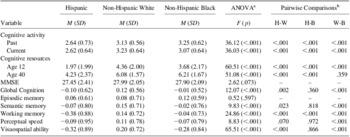
As shown in Table 2 Hispanics reported lower frequency of engagement in past and current cognitive activity and less availability of cognitive resources than both non-Hispanic groups. After adjusting for demographics, results for cognitive resources were unchanged. Analyses accounting for demographics showed that Hispanics’ frequency of past cognitive activity was similar to that of non-Hispanic Whites (p = .431) but less than non-Hispanics Blacks (p < .001), while engagement in current cognitive activity was comparable in Hispanics and non-Hispanic Blacks (p = .328), but less frequent than in non-Hispanic Whites (p < .001). Hispanics scored lower than one or both of our non-Hispanic groups across all cognitive domains except episodic memory and perceptual speed (Table 2).
Cognitive activity, cognitive resources, and cognitive function in Hispanics (n=81), non-Hispanic Whites (n=1102), and non-Hispanic Blacks (n=388)

Note. aResults from analysis of variance (ANOVA) on cognitive activity, cognitive resources, and cognitive function scores by ethnic group (Hispanic [H], non-Hispanic White [W] and non-Hispanic Black [B]).
bResults from follow-up independent samples t-tests with Tukey's correction.
Relation Between Cognitive Activity Frequency, Cognitive Resources, and Cognitive Function Across Ethnic Groups
Consistent with previous reports (Wilson et al., Reference Wilson, Barnes, Krueger, Hoganson, Bienias and Bennett2005), results of a series of linear regression models adjusting for demographics showed that higher frequency of cognitive activity (past and current) was associated with better global cognition in old age (Estimates = 0.15 and 0.21, respectively, both ps < .001), and each of our five cognitive domains (Estimates ranged from 0.11 to 0.39, ps from .010 to<.001) in our overall sample.
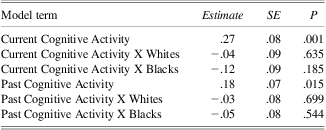
Findings from similar analyses on global cognition scores with added terms for the interaction between ethnicity and cognitive activity, showed no significant interactions, indicating comparable associations between cognitive activity and cognitive function across ethnic groups (Table 3). We repeated the previous analyses in a subgroup of non-Hispanic Whites and Blacks matched on age and sex to the 81 Hispanics (non-Hispanic Whites [n = 162; Age M = 72.29, SD = 7.53]; and Blacks [n = 162, Age M = 72.01, SD = 7.85]; sex [69% female in all groups]), and results were substantially similar.
Relation of ethnicity and cognitive activity to late life cognitive function
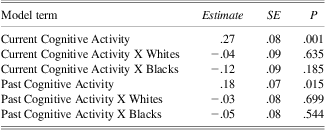
Note. Results were based on linear regression models on global cognition scores that controlled for demographics (age, sex, education, and ethnicity) and had Hispanics as the reference group.
Although estimates were relatively small, having more cognitive resources in the home both at age 12 and 40 was significantly associated with better cognitive function in late life (Estimates = 0.02 to 0.06, all ps < .04), with one exception: resources at age 12 was not significantly associated with episodic memory (Estimate = 0.01; SE = 0.00; p = .159). Similar models on global cognition with added terms for the interaction between ethnicity and cognitive resources, showed no significant interactions between ethnicity and cognitive resources at either age 12 or 40 (ps = .092 to .808). Analyses on the matched subgroup of Hispanics and non-Hispanics resulted in substantially similar findings.
Psychometric Information About Cognitive Activity and Cognitive Resources Measures in Hispanics
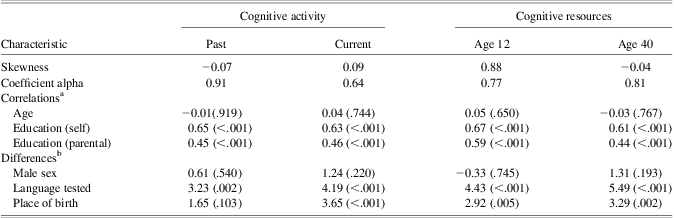
Table 4 shows psychometric data on the cognitive activity and cognitive resources measures in Hispanic participants alone. There were few item responses missing in our scales (range: 0–5 for cognitive activity, and 0–2 for cognitive resources). As can be seen in Table 4, scores for past and current cognitive activity, and cognitive resources at age 40 were approximately normally distributed. However, Hispanic participants reported having a relatively small number of cognitive resources in the home at age 12, and scores for this scale were positively skewed, Median = 1.38, range = 0 to 7.50. Internal consistency was adequate, but lower for current cognitive activity. Appendix A lists descriptive statistics for Hispanics on individual items comprising the cognitive activity scale.
Psychometric information on cognitive activity and cognitive resources scales in Hispanics (N=81)
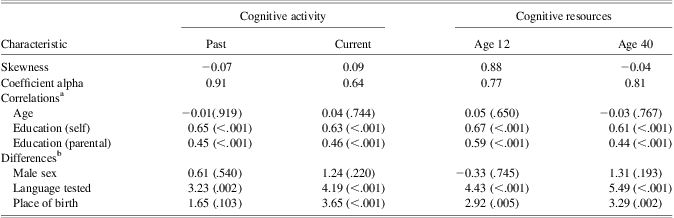
Note. aResults from Pearson product moment correlation coefficients, r (p). bResults from independent samples t-tests, t (p).
In our subgroup of Hispanics, cognitive activity and cognitive resources were not related to age, and there were no significant sex differences. However, they were significantly correlated with level of own and parental education (Table 4). Results of analyses exploring whether the association between own education and cognitive activity (past and current) was comparable in Hispanics and non-Hispanics, showed that the terms for the interaction between ethnicity and education were not significant (Estimates = both 0.02; ps = .296 and .345), suggesting similar associations between education and cognitive activity across ethnic groups.
Within our sample of Hispanics, those tested in Spanish reported significantly less frequent past (M = 2.44; SD = 0.68) and current cognitive activity (M = 2.41; SD = 0.57), as well as cognitive resources at age 12 (M = 1.25; SD = 1.61) and age 40 (M = 3.21; SD = 2.03) as compared to those tested in English (cognitive activity: past M = 2.94, SD = 0.70; current M = 2.98, SD = 0.61; cognitive resources: Age 12: M = 3.05, SD = 2.03; Age 40: M = 5.73, SD = 2.02). However, there were also significant differences by place of birth, with those born outside the United States reporting lower frequency of engagement in cognitive activity in late life (M = 2.43; SD = 0.59) and less cognitive resources at both age 12 (M = 1.45; SD = 1.65) and age 40 (M = 3.56; SD = 2.93) than those born in the United States (current cognitive activity: M = 2.95, SD = 0.60; cognitive resources: Age 12: M = 2.71, SD = 2.20; Age 40: M = 5.22, SD = 2.33). There were no group differences for past cognitive activity. Most of the participants tested in Spanish reported being foreign-born and having lower levels of own and parental education than those tested in English (ps < .001).
Appendix B shows the percentage of Hispanics that reported having each of the items comprising the cognitive resources scale at ages 12 and 40. Data are presented on the entire group of Hispanics and on Hispanics by place of birth (United States-born or foreign-born). Of note, certain items, such as having a magazine subscription or a library card were hardly ever present in the home of foreign-born Hispanic participants at age 12.
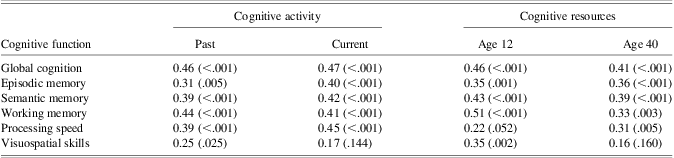
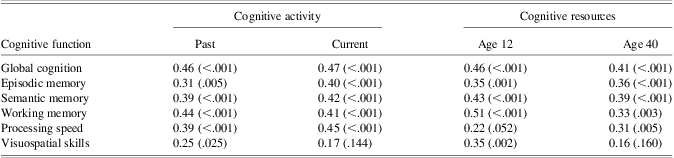
Table 5 shows significant correlations between the measures of cognitive activity frequency and cognitive resources, with global cognition and most domains of cognitive function in our Hispanic sample. Scores on the cognitive resources scales at age 12 and 40 were also significantly correlated with both past (rs = 0.66 and 0.61, respectively) and current (rs = 0.63 and 0.65, respectively) cognitive activity frequency (ps < .001).
Relation of cognitive activity and cognitive resources to cognitive function in HispanicsFootnote a (N=81)
a Note. Results from Pearson product moment correlation coefficients, r (p).
Discussion
In this analysis of two cohort studies of older Hispanics, non-Hispanic Whites, and non-Hispanic Blacks without dementia, we found that Hispanics had lower levels of education, reported engaging in cognitive activity less frequently and reported having less cognitive resources available to them as compared to non-Hispanic Whites and Blacks. Despite these group differences, the association of cognitive activity and cognitive resources to cognitive function in Hispanics was comparable to that of non-Hispanic Whites and Blacks.
Our findings are in line with results from a population based study from a geographically defined area in non-Hispanic Blacks and Whites showing that the association between participating in cognitively stimulating activities and cognitive function was comparable across these two racial groups (Wilson, Bennett, et al., Reference Wilson, Bennett, Bienias, Aggarwal, Mendes de Leon, Morris and Evans2002; Wilson et al., Reference Wilson, Bennett, Bienias, Mendes de Leon, Morris and Evans2003). However, current findings are somewhat inconsistent with those of a prior study in Hispanics, which suggested that Hispanic ethnicity might affect this association (Herrera et al., Reference Herrera, Meeks, Dawes, Hernandez, Thompson, Sommerfeld and Jeste2011). There were significant differences between that study and ours in both the measures of cognitive activity and the outcome of cognitive function. For example, the Herrera et al. study used a self-administered cognitive test which was designed to be used for screening of dementia (i.e., Cognitive Assessment Screening Test), and thus might be less sensitive to detect differences in cognition than our cognitive composite measures. Furthermore, they were interested in measuring leisure activity, instead of cognitive activity specifically. Their measure of leisure activity had only a few items involving cognitive activity (e.g., reading and doing puzzles, writing, using a computer); and analyses were performed on individual items. Finally, their sample was limited to only women. Thus, differences between their study and ours may be difficult to interpret.
The findings of a similar association between cognitive activity and cognition across ethnic groups despite lower cognitive activity in Hispanics potentially have important implications. They suggest that increasing cognitive activity might benefit late life cognition in Hispanics more than non-Hispanics because Hispanics start with a lower activity level and have more room for improvement. However, this assumes that the dynamic range of the cognitive activity scale used in this study is similar for Hispanics and non-Hispanics. Thus, although speculative, this hypothesis might be worth exploring in studies aimed at increasing frequency of cognitive activity in Hispanics and measuring the subsequent impact on cognition.
But, why might Hispanics report less frequent engagement in cognitive activity than other ethnic groups? One explanation might be related to the demographics associated with Hispanic ethnicity. Hispanics had lower levels of own and parental education than both of our non-Hispanic groups, and these variables were associated with frequency of cognitive activity. However, after adjusting for demographic variables (age, sex, and education) some of the group differences in cognitive activity and cognitive resources remained significant, indicating that other factors might be playing a role. It might also be the case that our measures of cognitive activity do not fully capture the cognitive experience of Hispanics. For example, activities that might have an important cognitive component and that might be common in a Hispanic culture such as cooking, listening to music, and fixing things around the house, might be items worth adding to cognitive activity scales for Hispanics. Alternatively, at least part of what might be driving the low frequency of cognitive activity in Hispanics might be the scarcity of cognitive resources available to them. Consistent with his hypothesis, availability of cognitive resources was also significantly lower in Hispanics than both of our non-Hispanic groups, even after adjusting for demographics. Furthermore, availability of cognitive resources in childhood and adulthood was associated with past and current cognitive activity in Hispanics after adjusting for demographics. However, caution is warranted in inferring causality in the associations from our study.
Hispanics’ limited cognitive resources were particularly notable in childhood and in those who were primarily Spanish-speaking and born outside the United States. For instance, only 5 to 10% of Hispanics born outside the United States reported having a library card, subscription to magazines or a globe in their home at age 12. Given that place of birth was confounded with language tested and level of own and parental education in our Hispanic sample, it is difficult to provide clear explanations for these findings. They do raise the possibility that there might be features of the environment, particularly of foreign-born Hispanics that might support cognitive activity but are not captured in our measures. For example, it might be more appropriate to ask about having access to magazines rather than having a magazine subscription in Hispanics. Alternatively, Hispanics might be at a true disadvantage in terms of availability of cognitive resources compared to other groups.
Despite the fact that our measures of cognitive activity and cognitive resources can certainly be improved upon to be used for Hispanics, particularly those from more disadvantaged backgrounds, we found our measures to have sound psychometric properties in Hispanics. This is consistent with a prior analysis in MAP that did not focus on race (Wilson et al., Reference Wilson, Barnes, Krueger, Hoganson, Bienias and Bennett2005) and a prior study in non-Hispanic Blacks (Barnes et al., Reference Barnes, Wilson, Mendes de Leon and Bennett2006). In Hispanics, there were only a small number of item responses missing in our cognitive activity and cognitive resources scales, indicating that items might be acceptable for this segment of the population. Furthermore, our measures had adequate internal consistency and were positively related to own and parental education, as well as various cognitive domains, supporting their construct validity in Hispanics. Hispanics who were tested with the Spanish version of our scales achieved lower scores than those who completed the corresponding English versions. Language use was confounded with level of education and place of birth, which highlights the importance of examining variables that might differ within subgroups of Hispanics (e.g., place of birth or testing language). Overall, results provide initial evidence of adequate reliability and validity of our cognitive resources measures in Hispanics.
The present study has important limitations. First, our findings on Hispanics are based on a small sample of volunteers. Hispanics represent a heterogenous group, which is highlighted in our sample by the diversity of our Hispanic participants in variables such as country of origin, time living in the United States, race, and language use. Thus, our findings might not necessarily apply to all subgroups of Hispanics, or to Hispanics living outside the United States. It will be important to explore in greater detail the effects of variables that differentiate subgroups of Hispanics, particularly in light of results from the present study indicating that language tested and country of origin might impact frequency of cognitive activity and availably of cognitive resources. Second, our group of Hispanics was not matched on level of education to our non-Hispanic groups, primarily because of the much lower level of education in Hispanics. We attempted to control for these differences in our statistical analyses since we did not want to restrict our Hispanic sample to those with higher levels of education. Future studies might help better understand the extent to which group differences in cognitive activity and cognitive resources are driven by ethnicity and other associated demographic variables. Third, because of large differences in sample sizes between ethnic groups in this study, our power for detecting a difference in the relation of cognitive activity to cognitive function between Hispanics and Blacks was substantially lower than the analogous power for the difference between Hispanics and Whites. Fourth, we used self-report measures for cognitive activity and resources, which might have introduced differential reporting bias across ethnic groups. The fact that the relationship between education and cognitive activity was similar across ethnic groups provides some evidence against this. Lastly, we used a retrospective design in our assessment of cognitive activity and cognitive resources, which might introduce recall bias and distortion. However, we excluded persons with dementia, and cognitive activity has been found to be associated with cognitive decline and dementia in longitudinal studies of non-Hispanics using a similar design (e.g., Hultsch et al., Reference Hultsch, Hertzog, Small and Dixon1999; Verghese et al., Reference Verghese, Lipton, Katz, Hall, Derby, Kuslansky and Buschke2003; Wang et al., Reference Wang, Karp, Winblad and Fratiglioni2002; Wilson, Bennett, et al., Reference Wilson, Bennett, Bienias, Aggarwal, Mendes de Leon, Morris and Evans2002; Wilson et al., Reference Wilson, Scherr, Schneider, Tang and Bennett2007).
There are also important strengths of the present study. First, the study included the use of previously established, psychometrically sound measures of both past and present cognitive activity and cognitive resources (Wilson et al., Reference Wilson, Barnes, Krueger, Hoganson, Bienias and Bennett2005). Second, data are derived from two well-characterized epidemiologic cohorts with an essentially identical study design and methods. Third, detailed neuropsychological data were available and summarized to yield previously established composite measures of five cognitive domains and global cognition. Furthermore, these measures were found to be psychometrically valid in Hispanics in prior research (Krueger et al., Reference Krueger, Wilson, Bennett and Aggarwal2009).
In conclusion, we found that despite Hispanics having lower levels of education, cognitive resources, and cognitive activity compared to non-Hispanics, the association between cognitive activity and cognition was similar across ethnic groups. Because Hispanics engage less frequently in cognitive activity than other groups, the potential for increasing the frequency of cognitive activity might be greater in Hispanics, resulting in a potentially a larger impact on cognition in this group. Our findings also indicate that although our cognitive activity frequency scale can certainly be improved upon, it is a psychometrically sound measure that might prove to be useful in research aimed at understanding individual differences in late-life cognitive function in Hispanics. Future studies could look into expanding our measures to fully capture the experience of cognitive activity in Hispanics, and determine whether interventions aimed at increasing the level of cognitive activity in older Hispanics without dementia might help reduce the risk for cognitive impairment and cognitive decline in this group.
Descriptive Information on Items in Cognitive Activity Scale for Hispanics
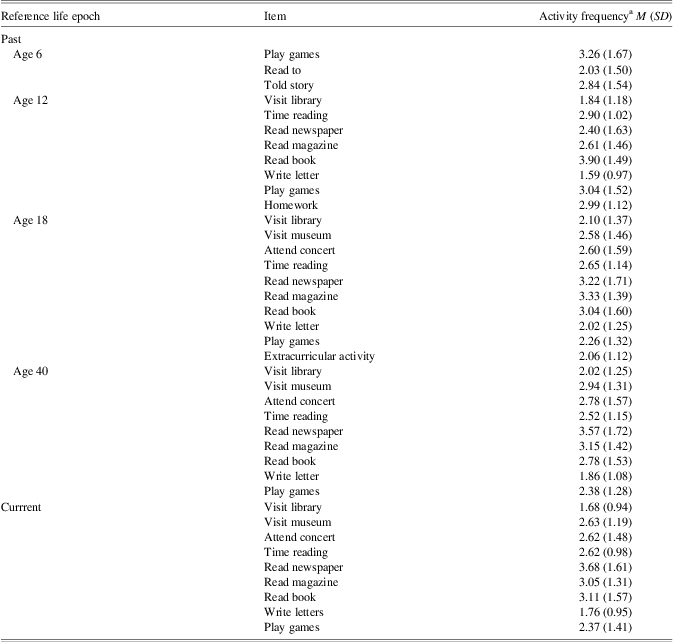
Note. aActivity frequency ranged from 1 (least frequent) to 5 (most frequent).
Cognitive Resources Scale Items Present in the Home at Ages 12 and 40 for Hispanics (n = 81)
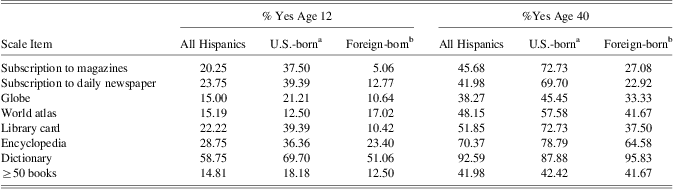
aPercentage of Hispanics born in the United States (n=33) that reported having specific cognitive resources available.
bPercentage of foreign-born Hispanics (n=48) that reported having specific cognitive resources available
Acknowledgments
The authors thank the participants of the Minority Aging Research Study and the Rush Memory and Aging Project for their invaluable contributions. We thank Charlene Gamboa, MPH; Traci Colvin, MPH; Tracey Nowakowski, Barbara Eubeler, Karen Lowe-Graham, MS and Mary Futrell for study recruitment and coordination, and John Gibbons, MS, and Greg Klein for data management, and the staff of the Rush Alzheimer's Disease Center. This research was supported by National Institute on Aging Grants R01AG22018, R01AG17917, and the Illinois Department of Public Health. The authors have no conflicts of interest to disclose.