1. Introduction
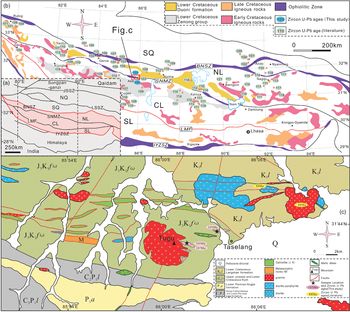
The study of the Tibet Plateau has always been a major focus in the field of geology. It consists of a series of terranes and sutures, including the Songpan Ganzi terrane, Jinsha River suture zone, Northern Qiangtang terrane, Longmucuo–Shuanghu–Lancangjiang suture zone, Southern Qiangtang terrane, Bangong–Nujiang suture zone (BNSZ), Lhasa terrane, Indian–Yarlung Zangbo suture zone and Himalayan terrane (from north to south) (Fig. 1a; Dewey et al. Reference Dewey, Shackleton, Chengfa and Yiyin1988; Yin & Harrison, Reference Yin and Harrison2000). Among them, the Lhasa terrane in the south is further divided by the Shiquanhe–Nam Tso mélange zone (SNMZ) and the Loubadui–Milashan fault zone into the Northern, Central and Southern Lhasa terranes (Zhu et al. Reference Zhu, Zhao, Niu, Mo, Chung, Hou, Wang and Wu2011) (Fig. 1b).
(a, b) The distribution of Early Cretaceous magmatism in the Lhasa terrane. (c) Geological map of the Asa area. SQ – Southern Qiangtang terrane; NL – Northern Lhasa terrane; CL – Central Lhasa terrane; SL – Southern Lhasa terrane; JSSZ – Jinsha River suture zone; LSSZ – Longmucuo–Shuanghu–Lancangjiang suture zone; BNSZ – Bangong–Nujiang suture zone; SNMZ – Shiquanhe–Nam Tso mélange zone; LMF – Luobadui–Milashan fault zone; IYZSZ – Indian–Yarlung Zangbo suture zone. Age data from Qu et al. (Reference Qu, Wang, Xin, Jiang and Chen2012), Chen et al. (Reference Chen, Zhu, Zhao, Meng, Wang, Santosh, Wang, Dong and Mo2014), Zhu et al. (Reference Zhu, Mo, Niu, Zhao, Wang, Liu and Wu2009, Reference Zhu, Zhao, Niu, Mo, Chung, Hou, Wang and Wu2011), Zhang et al. (Reference Zhang, Zhu, Zhao, Wang, Hang and Mo2010), Wu et al. (Reference Wu, Li, Hu, Zhang and Li2014, Reference Wu, Li, Hu and Li2015a,b), Sui et al. (Reference Sui, Wang, Zhu, Zhao, Chen, Santosh, Hu, Yuan and Mo2013), Kang et al. (Reference Kang, Xu, Dong and Wang2008), Zhang et al. (Reference Zhang, Zhu, Zhao, Liao, Wang and Mo2011), Liu et al. (Reference Liu, Huang, Fan, Zhang, Shi and Ding2014), Xie et al. (Reference Xie, Dun, Zhu, Nima, Yang, Tao, Li, He and He2015), Li et al. (Reference Li, He, Wang, Wei, Chen, He, Ning and Zhou2016), Yang et al. (Reference Yang, Wang, Zhang, Dan, Zhang, Qi, Xia and Zhao2018), Liu, Y. M. et al. (Reference Liu, Wang, Li, Li, Xie, Zeng, Dong and Liu2018).

As the boundary between the Northern Lhasa terrane and the Southern Qiangtang terrane, the BNSZ extends 1700 km E–W in the central Tibet Plateau, and is a remnant of the subduction and extinction of the Meso-Tethyan Ocean (Allègre et al. Reference Allègre, Courtillot, Tapponnier, Hirn, Mattauer, Coulon, Jaeger, Achache, Schärer, Marcoux and Burg1984; Dewey et al. Reference Dewey, Shackleton, Chengfa and Yiyin1988; Yin & Harrison, Reference Yin and Harrison2000; Metcalfe, Reference Metcalfe2013). On the southern side of this suture zone, the SNMZ separates the Northern and the Central Lhasa terranes. It is also a remnant of the Meso-Tethyan Ocean (Xu et al. Reference Xu, Li, Zhang and Wu2014; Zeng et al. Reference Zeng, Wang, Fan, Li, Xie, Liu and Zhang2018). The study of the geodynamic background of these two oceanic basins provides an important window for us to explore the evolutionary history of the Meso-Tethyan oceanic basin.
Previous studies on igneous rocks in the Northern and Central Lhasa terranes indicate that there was a major magma flare-up around 125–100 Ma (Kang et al. Reference Kang, Xu, Dong and Wang2008; Zhu et al. Reference Zhu, Mo, Niu, Zhao, Wang, Liu and Wu2009, Reference Zhu, Zhao, Niu, Mo, Chung, Hou, Wang and Wu2011; Zhang et al. Reference Zhang, Zhu, Zhao, Wang, Hang and Mo2010, Reference Zhang, Zhu, Zhao, Liao, Wang and Mo2011; Qu et al. Reference Qu, Wang, Xin, Jiang and Chen2012; Sui et al. Reference Sui, Wang, Zhu, Zhao, Chen, Santosh, Hu, Yuan and Mo2013; Chen et al. Reference Chen, Zhu, Zhao, Meng, Wang, Santosh, Wang, Dong and Mo2014; Liu et al. Reference Liu, Huang, Fan, Zhang, Shi and Ding2014; Wu et al. Reference Wu, Li, Hu, Zhang and Li2014, Reference Wu, Li, Xu and Li2015b, Reference Wu, Sun, Liu, Chu and Ding2019; Xie et al. Reference Xie, Dun, Zhu, Nima, Yang, Tao, Li, He and He2015; Li et al. Reference Li, He, Wang, Wei, Chen, He, Ning and Zhou2016; Liu, Y. M. et al. Reference Liu, Wang, Li, Li, Xie, Zeng, Dong and Liu2018; Yang et al. Reference Yang, Wang, Zhang, Dan, Zhang, Qi, Xia and Zhao2018). The study of this magmatic event provides a new perspective for the exploration of the evolutionary history of the Meso-Tethyan Ocean. However, there are many debates about the geodynamic background of this magmatism. Some scholars believe that it is related to the northward subduction of the Neo-Tethyan Ocean (Coulon et al. Reference Coulon, Maluski, Bollinger and Wang1986; Pearce & Houjun, Reference Pearce and Houjun1988; Matte, Reference Matte1996; Zhang et al. Reference Zhang, Xia, Wang, Li and Ye2004; Kapp et al. Reference Kapp, Decelles, Gehrels, Heizler and Ding2007; Dai et al. Reference Dai, Wang, Zhu, Li, Zhong and Ge2015); some other scholars think that the occurrence of slab break-off events during the southward subduction of the Bangong–Nujiang Ocean (BNO) is a more reasonable scenario (Zhu et al. Reference Zhu, Mo, Niu, Zhao, Wang, Liu and Wu2009, Reference Zhu, Zhao, Niu, Mo, Chung, Hou, Wang and Wu2011, Reference Zhu, Zhao, Niu, Dilek, Hou and Mo2013; Qu et al. Reference Qu, Wang, Xin, Jiang and Chen2012; Sui et al. Reference Sui, Wang, Zhu, Zhao, Chen, Santosh, Hu, Yuan and Mo2013; Chen et al. Reference Chen, Zhu, Zhao, Meng, Wang, Santosh, Wang, Dong and Mo2014; Wu et al. Reference Wu, Li, Xu and Li2015b). To solve these disputes, more detailed research on magma petrogenesis is necessary.
The study of the source region, formation process and rock assemblage of magmatic rocks provides important and effective information for exploring the tectonic environment at the time the magmatic rocks were formed, especially regarding special rock types, such as A-type granites, adakites and within-plate basalts, which can provide important evidence for understanding the evolutionary history of the ocean (Huppert & Sparks, Reference Huppert and Sparks1988; Wilson, Reference Wilson1989; Eby, Reference Eby1992; Martin, Reference Martin1999).
In this study we provide new geochronological, whole-rock geochemical and zircon Lu–Hf isotope analyses of the newly discovered Asa porphyritic granites. Zircon U–Pb dating results show that they formed in late Early Cretaceous time. Whole-rock geochemical test results show that they are A2-type granites and originated from interaction between mantle-derived and crustal-derived melts with an obvious influence of oceanic sediments. In combination with coeval magmatic rocks in the Northern and Central Lhasa terranes, which contain A2-type granites from partial melting of lower crust basalt (Xainza, Bangoin, Gar, etc.) (Qu et al. Reference Qu, Wang, Xin, Jiang and Chen2012; Chen et al. Reference Chen, Zhu, Zhao, Meng, Wang, Santosh, Wang, Dong and Mo2014; Xie et al. Reference Xie, Dun, Zhu, Nima, Yang, Tao, Li, He and He2015), adakites from partial melting of oceanic slab melts (Rutog, Dachagou, etc.) (Liu et al. Reference Liu, Huang, Fan, Zhang, Shi and Ding2014; Wu et al. Reference Wu, Li, Hu and Li2015a,b) and bimodal volcanic rocks (Yanhu, Xainza, etc.) (Sui et al. Reference Sui, Wang, Zhu, Zhao, Chen, Santosh, Hu, Yuan and Mo2013; Chen et al. Reference Chen, Zhu, Zhao, Meng, Wang, Santosh, Wang, Dong and Mo2014), the Asa A2-type granite porphyries provide insights into the ocean closure processes and magmatic evolutionary history during collisional orogenesis, and help us understand the Cretaceous evolutionary history of the Meso-Tethyan Ocean.
2. Geological background
The Asa area is located in the middle part of the SNMZ and at the junction of the Northern and Central Lhasa terranes. Its geological condition is complex. There are two stages of NE–SW and E–W faults in the study area. The exposed stratigraphic units in this area include the Laga Formation, Angjie Formation, Langshan Formation, Jingzhushan Formation and flysch, as well as a large area of Mesozoic intrusive rocks and ophiolites (Fig. 1c). The Upper Carboniferous – Lower Permian Laga Formation consists of quartz sandstone and composite conglomerate. It is a typical littoral and neritic facies deposit, representing the largest late Palaeozoic ice age deposit of the Palaeo-Tethyan stage (Li et al. Reference Li, Xie, Yuan, Xiao and Huang2002). The Lower Permian Angjie Formation is mainly composed of alternating limestone and sandstone, continuing the sedimentary environment characteristics of the Laga Formation. The Lower Cretaceous Langshan Formation is mainly a set of thick limestone deposits. It is the product of a large-scale transgression in the Cretaceous Period of the Lhasa terrane. The formation environment is relatively stable (Wang et al. Reference Wang, Frank, Werner, Liu, Tian and Li2003). In the nearby region, Lower Cretaceous volcanic sedimentary strata, the Qushenla Formation, unconformably covers the ophiolitic mélange (Fan et al. Reference Fan, Li, Wang and Xie2017; Liu, Y. M. et al. 2018 and references therein), and there are reports of red beds within it (Chen et al. Reference Chen, Zhang, Ding, Zhang, Zhao, Zhu, Yang, Yang, Li and Wu2017). The Upper Jurassic – Lower Cretaceous flysch mainly consists of a set of thin interbedded sand–shale sediments, a medium–thick-bedded mudstone and a thin-bedded shale with slight metamorphism occurring at its base (Wang et al. Reference Wang, Li and Xie2019). The appearance of flysch shows that the evolution of the ocean had entered the stage of subduction and accretion at this time (Stow & Shanmugam, Reference Stow and Shanmugam1980). The main lithology of the Upper Cretaceous Jingzhushan Formation is a red sandy conglomerate, in which there are typical reports of molasse formation, indicating that the evolution of the orogenic belts had entered the final collision stage (Liu, Y. M. et al. Reference Liu, Wang, Li, Li, Xie, Zeng, Dong and Liu2018; Luo et al. Reference Luo, Wang, Li, Xie, Fan, Zhang, Liu and Wang2019).
The ophiolite in the study area is well formed, and an Early Cretaceous age was obtained from a gabbro (Zeng et al. Reference Zeng, Wang, Fan, Li, Xie, Liu and Zhang2018). Most of these ophiolites appear in the form of fault blocks in the flysch, and some of them are intruded by acidic dykes. Previously, 90 Ma acid rocks and 103 Ma basic magma events have been reported in the study area (Liu, Y. M. et al. Reference Liu, Wang, Li, Li, Xie, Zeng, Dong and Liu2018; Zeng et al. Reference Zeng, Wang, Fan, Yu, Luo and Hao2019; Luo et al. Reference Luo, Wang, Li, Xie, Fan, Zhang, Liu and Wang2019).
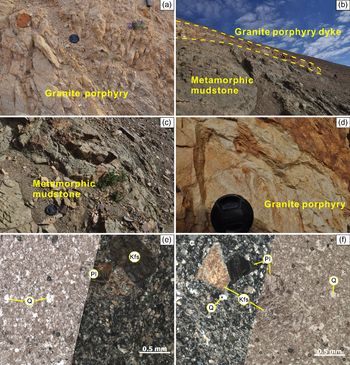
Here we report newly discovered porphyritic granites in the Asa area. Samples from the Taselang region in the east and the Tugu region in the middle of the study area (Fig. 1c) were collected for research. The porphyritic granites intruded into metamorphic mudstone and shale as pale yellow intrusive veins. They are ~2–5 m in width, with a distribution area of 200–300 m2. A chilled margin is visible at the edge of the granite bodies, indicating an intrusive contact connection (Fig. 2a, b, c, d). The timing of intrusion of the samples lacks an accurate age; regional geological survey results show that they may be rock units at the bottom of the Asa flysch (Wang et al. Reference Wang, Li and Xie2019). The porphyritic granites show light yellow weathering surfaces, a massive structure and a porphyritic texture, which comprises 75~80 % felsic fine-grained matrix and 20~25 % phenocrysts. The matrix is mainly composed of plagioclase (Pl, 20 %), K-feldspar (Kfs, 55 %) and quartz (Q, 25%). The phenocrysts mainly include Pl (20~30 %), Kfs (55~65 %) and Q (10~15 %). The Pl grains are ~0.5–1 mm, and show obvious polycrystalline twinning. The Kfs grains are ~1–2 mm. Both the Pl and Kfs have obvious alteration phenomena, including kaolinization and sericitization.
(a) Photograph of the Taselang porphyritic granite veins. (b) Photograph of the Tugu porphyritic veins that intruded into metamorphic mudstone. (c) Photograph of intruded metamorphic mudstone. (d) Photograph of the surface of the Tugu porphyritic granite. (e, f) Microphotographs of the Taselang and the Tugu porphyritic granites. Q – quartz; Pl – plagioclase; Kfs – K-rich feldspar. Lens cap for scale is 58 mm diameter.

Here, whole-rock geological analysis, zircon U–Pb dating and Lu–Hf isotope analysis are used to investigate the petrogenesis of the Asa porphyritic granites.
3. Analytical methods
3.a. Zircon U–Pb dating
We selected one sample (N17T13) from the Taselang area and two samples (N17T14a, N17T14b) from the Tugu area for zircon U–Pb dating (Fig. 1c). The zircons used for dating were separated using heavy liquid techniques at the Regional Geological Survey of Hebei province, China. The cathodoluminescence (CL) images were taken at the Institute of Geology, Chinese Academy of Sciences. The zircons selected for dating were complete in shape and homogeneous in texture without inclusions. Zircon U–Pb dating of N17T13 and N17T14a was performed at the Geological Laboratory Centre, China University of Geosciences, Beijing, China. Dating of N17T14b was performed at the Key Laboratory of Mineral Resources Evaluation in Northeast Asia, Jilin University, both using a 193 nm laser sampling system (UP193SS) and Agilent 7500a laser ablation inductively coupled plasma mass spectrometer (LA-ICP-MS) instrument. The diameter of the laser beam spot was 36 mm and the standard zircon used was 91500. International reference material NIST610 was used as the external standard and 29Si as the internal standard for zircon trace-element calculations. The resulting data were corrected for common Pb following the method described by Andersen (Reference Andersen2002). Glitter (version 4.4) software and Isoplot/Ex (version 4.15) (Ludwig, Reference Ludwig2003) were used to process the isotope data. Detailed analytical methods and test procedures followed Yuan et al. (Reference Yuan, Gao, Liu, Li, Günther and Wu2004) and Hao et al. (Reference Hao, Ren, Zhao, Lai, Zhao and Ma2018).
3.b. Whole-rock major- and trace-element analyses
Eight porphyritic granite samples were collected for element analysis (four from the Tugu and four from the Taselang area, all collected from the veins near the dating samples). The samples were taken from unaltered portions and rinsed with deionized water. After cleaning, the samples were ground to 200 mesh or less in an agate mortar at Lang Fang Regional Geological Survey of Hebei province for the whole-rock analysis. The loss-on-ignition (LOI) of the sample was measured by heating it to 1000 degrees Celsius and weighing it again after several hours. Major-element contents were tested using an inductively coupled plasma optical emission spectroscope (ICP-OES, Leeman Prodigy) at the ICP-OES laboratory of the China University of Geosciences, Beijing, China. Trace-element contents were analysed using an Agilent-7500a ICP-MS at the Geological Laboratory Centre, China University of Geosciences, Beijing, China. USGS standard sample AGV2 and China Geological Test Centre rock standard GSR-3 were used as the reference materials during the analyses. The analysis uncertainties for most elements are less than 5 %. For specific analysis steps and instrument parameters, see Yu (Reference Yu2011).
3.c. Zircon Hf isotope analyses
We selected 16 dated zircon grains from the Asa granite porphyry for zircon Hf isotope analysis. The zircon Hf isotope analysis points were selected in situ or near to the age test points and were selected based on the CL images. The zircon Hf isotope analyses were performed using a Nu Plasma multi-collector (MC) ICP-MS with a UP213 (New Wave Research, USA) laser-ablation microprobe at the State Key Laboratory of Endogenous Metal Deposits Mineralization Mechanism of Nanjing University. During the analyses, helium was used as a carrier gas. The laser beam diameter was 50 μm, and the 91500 and Mud Tank zircons were used as reference materials. For analytical details see Yuan et al. (Reference Yuan, Gao, Dai, Zong, Günther, Fontaine, Liu and Diwu2008). For the calculations, the decay constant of 176Lu was 1.865 × 10⁻¹¹a−1 (Scherer et al. Reference Scherer, Münker and Mezger2001), and the calculation of εHf(t) was performed using the recommended Hf isotope value of chondrite (Bouvier et al. Reference Bouvier, Vervoort and Patchett2008). Average crustal (176Lu/177Hf)C = 0.015 was used to calculate the Hf two-stage model age (Griffin et al. Reference Griffin, Wang, Jackson, Pearson and O’Reilly2002). The relevant calculation formula refers to Bouvier et al. (Reference Bouvier, Vervoort and Patchett2008) and Griffin et al. (Reference Griffin, Wang, Jackson, Pearson and O’Reilly2002). The analysed 176Hf/177Hf ratio for zircon standard 91500 was 0.282313 ± 22 (2σ), similar to the commonly accepted mean 176Hf/177Hf ratios of 0.282302 ± 8 and 0.282306 ± 8 (2σ) tested by Goolaerts et al. (Reference Goolaerts, Mattielli, De Jong, Weis and Scoates2004) and Woodhead et al. (Reference Woodhead, Hergt, Shelley, Eggins and Kemp2004).
4. Results
4.a. Zircon U–Pb geochronology
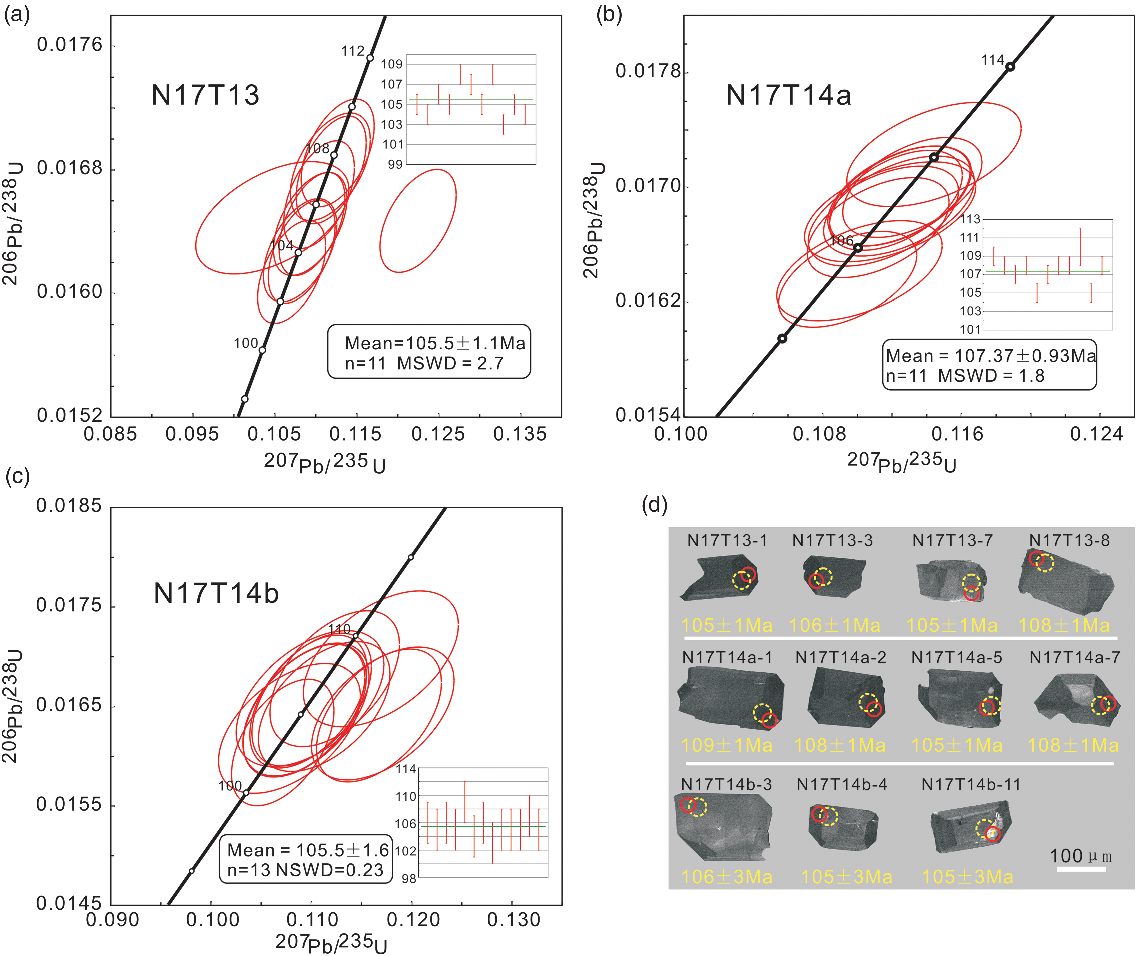
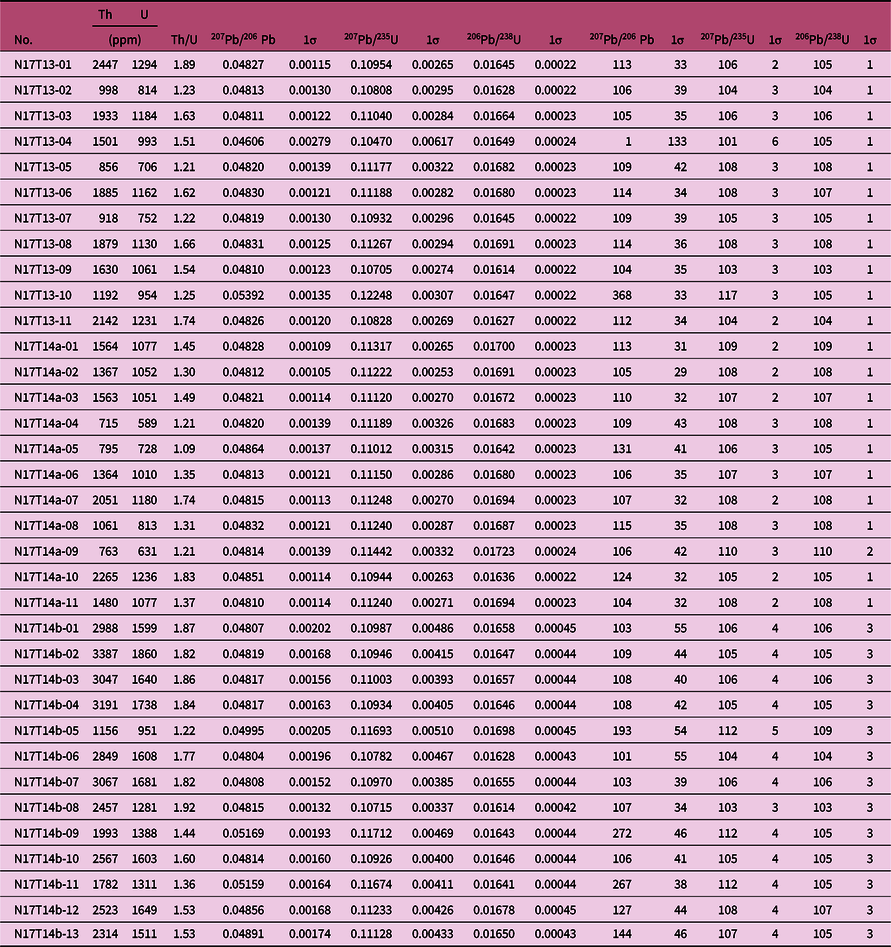
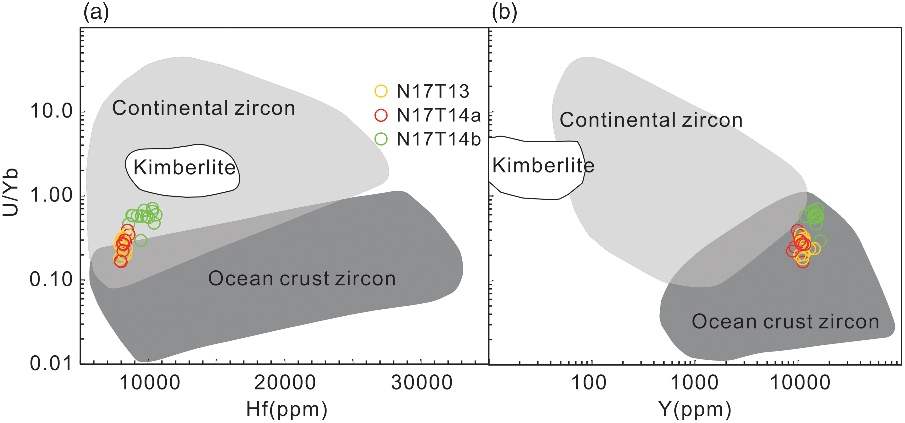
The zircons from the collected Asa granite porphyry samples have similar characteristics, having mostly short columnar crystal forms of 100–230 μm in length. Their CL images are darker in colour, and the oscillatory zoning is faintly visible (Fig. 3d), which may be related to their low Th and U contents. Their uniform texture, complete crystal shape and relatively high Th/U ratios of 1.09–1.92 are similar to magmatic zircons (Hoskin & Black, Reference Hoskin and Black2000). Data on the U–Pb dating are given in Table 1. Weighted-mean ages of samples N17T13, N17T14a and N17T14b are 105.5 ± 1.1 Ma (MSWD = 2.7; Fig. 3a), 107.37 ± 0.93 Ma (MSWD = 1.8; Fig. 3b) and 105.5 ± 1.6 Ma (MSWD = 0.23; Fig. 3c), respectively; moreover, the zircons show low Hf contents, high Y contents and moderate U/Yb ratios, and their data points fall between the continental and oceanic areas on the U/Yb versus Hf (Fig. 4a) and U/Yb versus Y (Fig. 4b) diagrams.
(a, b, c) Concordia plots and (d) cathodoluminescence images for representative zircon grains from the granite porphyry of the Asa area. The solid and dashed circles indicate the sites of LA-ICP-MS U–Pb and Hf isotopic analyses, respectively.

LA-ICP-MS zircon U–Pb dating results of granite porphyry from the Asa area of Tibet

Plots of (a) U/Yb versus Hf; (b) U/Yb versus Y (both after Grimes et al. Reference Grimes, John, Kelemen, Mazdab, Wooden, Cheadle, Hanghøj and Schwartz2007) for zircons from the granite porphyry from the Asa area.

4.b. Geochemical data
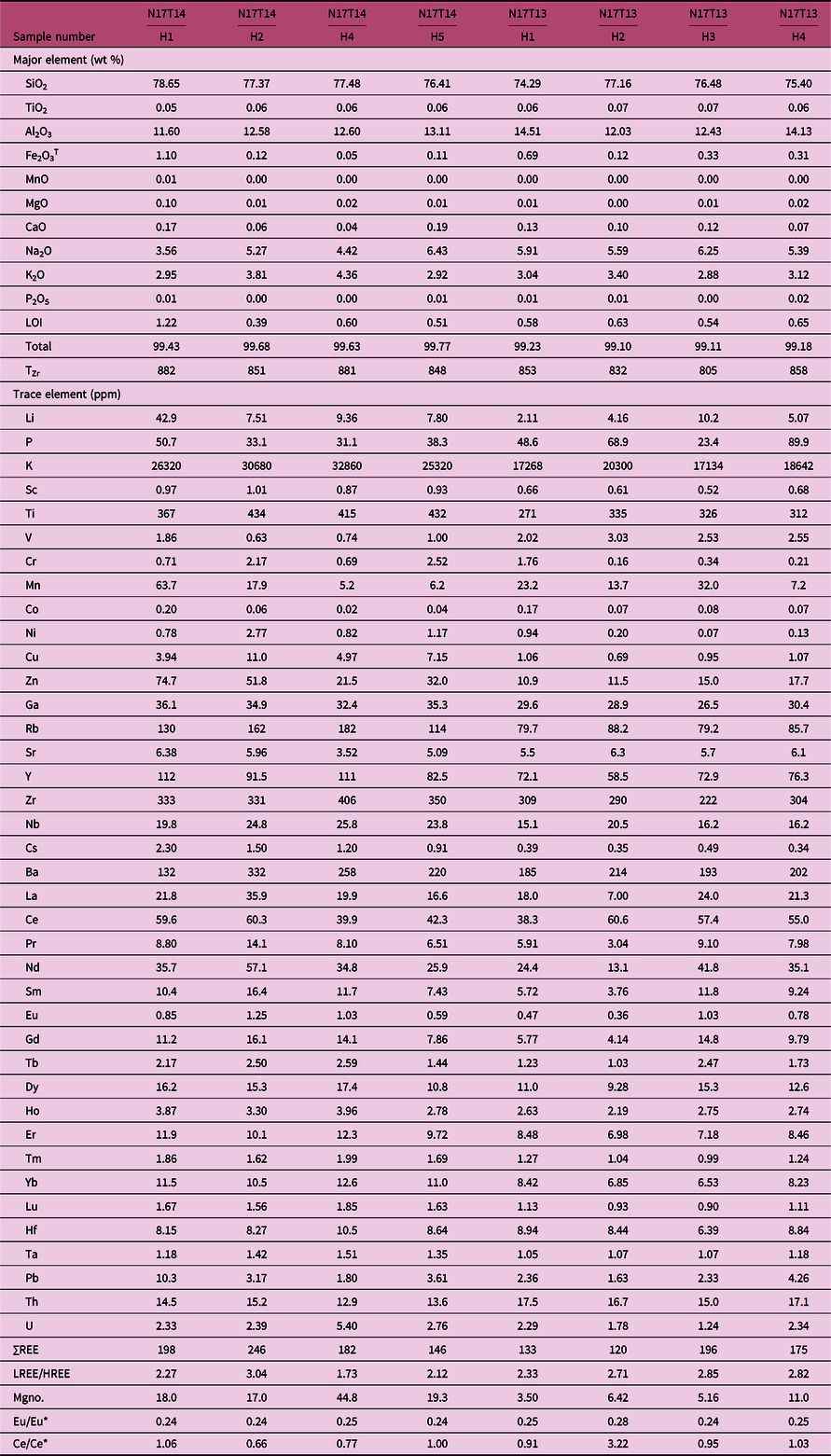
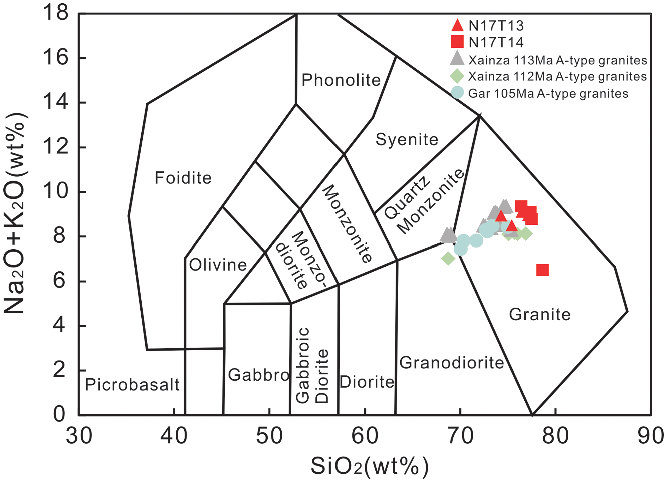
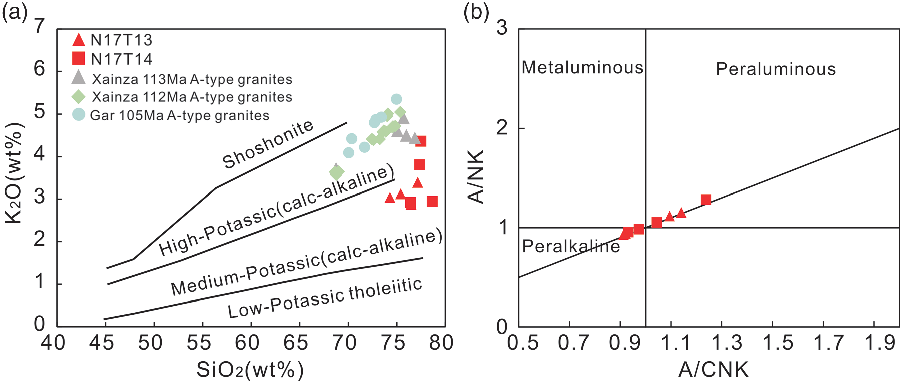
The geochemical data results for the Asa granite porphyry dykes are given in Table 2. The Early Cretaceous Asa granite porphyry has high SiO2 (74.29–78.65 wt %), Na2O + K2O (6.51–9.35 wt %), Y (58.46–112.04 ppm) and Yb (6.53–12.60 ppm) contents, and low CaO (0.04–0.19 wt %), MgO (0.01–0.10 wt %), Al2O3 (11.60–14.51 wt %), P2O5 (0.001–0.02 wt %) and TiO2 (0.05–0.07 wt %) contents. Data for the samples plot in the granite series area in the (Na2O + K2O) versus SiO2 diagram (Fig. 5), and mostly in the calc-alkaline series area in the K2O versus SiO2 diagram (Fig. 6a). On an A/CNK versus A/NK diagram, half of the samples plot in each of the peralkaline and peraluminous series areas (Fig. 6b). This may be owing to the alteration of the alkaline feldspar and K-rich feldspar in the samples, which affected their Na, K and Al element contents. The co-occurrence of such A-type granites, ranging from alkaline to aluminous, also occurs in SW China and northern Argentina, and their formation was related to crust–mantle interaction and sediment melting (Shellnutt & Zhou, Reference Shellnutt and Zhou2007; Morales et al. Reference Morales Cámera, Dahlquist, Basei, Galindo, Da Costa Campos Neto and Facetti2017).
Whole-rock major- and trace-element compositions of porphyritic granites from the Asa area of Tibet

Plots of (Na2O + K2O) versus SiO2 (after Middlemost, Reference Middlemost1994) for Early Cretaceous A-type granitoids of the Northern–Central Lhasa terranes. Gar A-type granites from Xie et al. (Reference Xie, Dun, Zhu, Nima, Yang, Tao, Li, He and He2015); Xainza A-type granites from Qu et al. (Reference Qu, Wang, Xin, Jiang and Chen2012) and Chen et al. (Reference Chen, Zhu, Zhao, Meng, Wang, Santosh, Wang, Dong and Mo2014).

Plots of (a) K2O versus SiO2 (after Peccerillo & Taylor, Reference Peccerillo and Taylor1976; Middlemost, Reference Middlemost1986) and (b) A/NK versus A/CNK (after Maniar & Piccoli, Reference Maniar and Piccoli1989) showing sample compositional variations. A – Al2O3; N – Na2O; K – K2O; C – CaO. For data sources see Figure 5.

In the primitive-mantle-normalized trace-element diagrams (Fig. 7a), the Asa granite porphyries are enriched in Rb, Th, U, Pb, Zr and Hf and relatively depleted in Nb, Ta, Ti, P, Ba and Sr, almost the same as the features of A-type granites (Whalen et al. Reference Whalen, Currie and Chappell1987; Eby, Reference Eby1990). The chondrite-normalized rare earth element (REE) patterns of the granite porphyry (Fig. 7b) indicate relative enrichment of light rare earth elements (LREE), with LREE/HREE ratios of 1.73–3.04, flat heavy rare element (HREE) patterns, with (Ga/Yb)N of 0.57–1.87, high total REEs (120.26–245.90 ppm) and pronounced negative Eu anomalies (Eu/Eu* = 0.24–0.28; average = 0.25) and varied Ce anomalies.
Chondrite-normalized REE and primitive-mantle-normalized trace-element patterns for Early Cretaceous A-type granitoids of the Northern–Central Lhasa terranes. Gar A-type granites from Xie et al. (Reference Xie, Dun, Zhu, Nima, Yang, Tao, Li, He and He2015); Xainza A-type granites from Qu et al. (Reference Qu, Wang, Xin, Jiang and Chen2012) and Chen et al. (Reference Chen, Zhu, Zhao, Meng, Wang, Santosh, Wang, Dong and Mo2014) The data for normalization and plotting are from Sun & McDonough (Reference Sun, McDonough, Saunders and Norry1989).

4.c. Zircon Lu–Hf isotopes
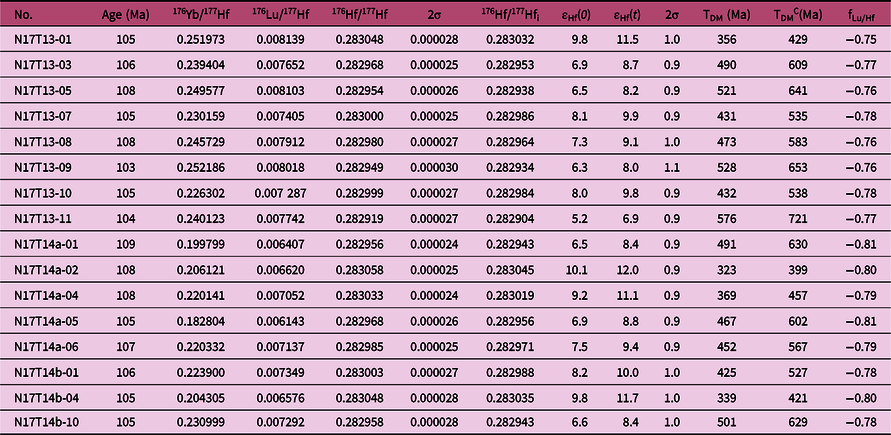
The zircon Hf isotope data are shown in Table 3. Sixteen zircons were selected from samples N17T13, N17T14a and N17T14b for Lu–Hf isotopic analysis. Analyses were performed at or adjacent to sites used for U–Pb dating. The zircons’ initial 176Hf /177Hf ratios are 0.282919–0.283058, with positive εHf(t) values of 6.9–12.0. The two-stage Hf model ages range from 721 Ma to 399 Ma.
Zircon Lu–Hf isotopic data for Early Cretaceous granite porphyry from the Asa area of Tibet

εHf(t) = 10000 × (((176Hf/177Hf)S − (176Lu/177Hf)S × (eλt − 1))/((176Hf/177Hf)CHUR,0 − (176Lu/177Hf)CHUR × (eλt − 1)) − 1)
TDM = 1/λ × ln(1 + ((176Hf/177Hf)S − (176Hf/177Hf)DM)/((176Lu/177Hf)S − (176Lu/177Hf)DM))
TDMC = TDM − (TDM − t) × ((fcc − fs)/(fcc − fDM))
fLu/Hf = (176Lu/177Hf)S/(176Lu/177Hf)CHUR − 1
λ = 1.867 × 10⁻¹¹ year−1 (Söderlund et al. Reference Söderlund, Patchett, Vervoort and Isachsen2004); (176Lu/177Hf)S and (176Hf/177Hf)S are the measured values of the samples;
(176Lu/177Hf)CHUR = 0.0336 and (176Hf/177Hf)CHUR,0 = 0.282785 (Bouvier et al. Reference Bouvier, Vervoort and Patchett2008);
(176Lu/177Hf)DM = 0.0384 and (176Hf/177Hf)DM = 0.28325 (Griffin et al. Reference Griffin, Pearson, Belousova, Jackson, Van Achterbergh, O’Reilly and Shee2000); (176Lu/177Hf)mean crust = 0.015 (Griffin et al. Reference Griffin, Wang, Jackson, Pearson and O’Reilly2002); fcc = ((176Lu/177Hf)mean crust/(176Lu/177Hf)CHUR) − 1;
fs = fLu/Hf; fDM = ((176Lu/177Hf)DM/(176Lu/177Hf)CHUR) − 1; t = crystallization time of zircon.
5. Discussion
5.a. Geochemical affinity and tectonic setting
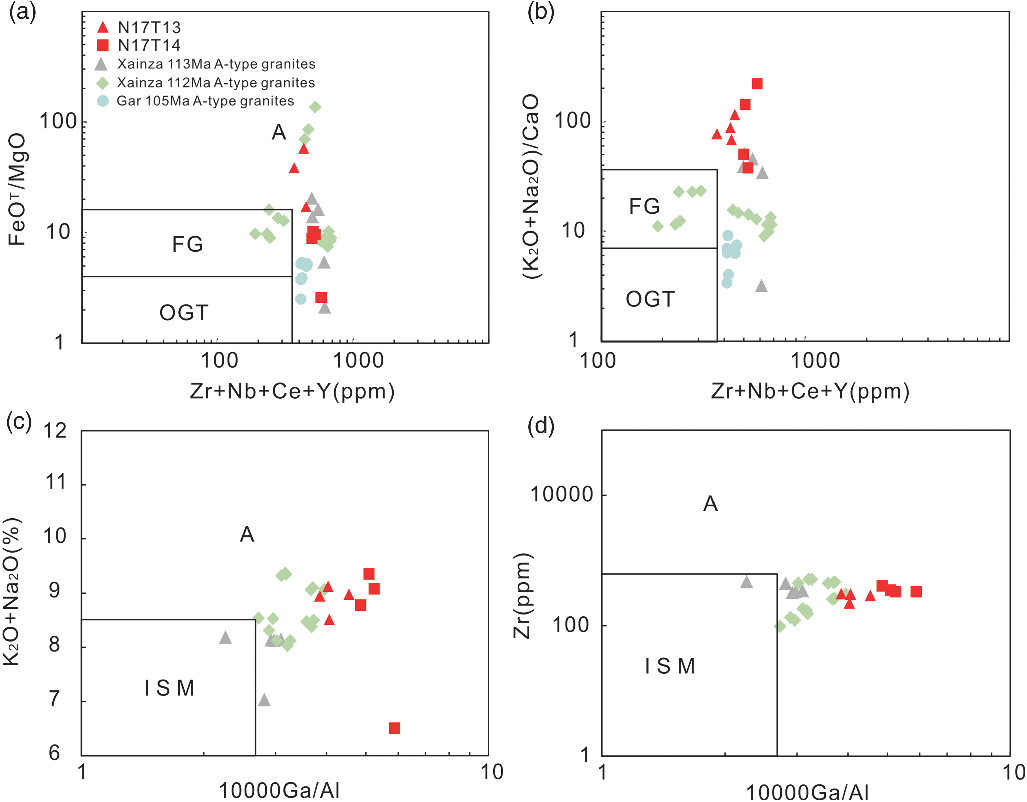
The Asa porphyritic granites are enriched in the high-field-strength elements (HFSE; e.g. Zr, Nb and Hf), have elevated total alkali contents (K2O + Na2O = 6.51–9.35 wt %) and have high FeOt/MgO (8.78–57.86, except for one sample with a value of 2.59); A-type granites usually have FeOt/MgO = 8–80 at SiO2 = 70 wt % (after Eby, Reference Eby1990) and Ga/Al ratios of 3.85–5.88 × 10⁻⁴. They also contain relatively low concentrations of CaO, MgO, Ba and Sr, all of which are indicative of an A-type granite affinity (Loiselle & Wones, Reference Loiselle and Wones1979; Whalen et al. Reference Whalen, Currie and Chappell1987) and are consistent with their data plotting in the A-type fields of granite discrimination diagrams (Fig. 8a, b, c, d). However, these samples also have high concentrations of SiO2 (74.29–78.65 wt %, as compared with >75 wt % for typical A-type granites), indicating they formed from evolved magmas. The geochemistry and mineralogy of granitoids tends to converge with increasing SiO2 concentrations, leading to an increase in the geochemical and mineralogical similarities of I- and A-type granites with differentiation, meaning that further confirmation of the A-type affinity of the granites in the study area is required. The Asa A-type porphyritic granites have zircon saturation temperatures of 805–882 °C, significantly higher than those expected for I-type granites, but consistent with the temperatures expected for A-type granites (King et al. Reference King, Chappell, Allen and White2001). In addition, the statistical analysis of highly differentiated I- and A-type granites undertaken by King et al. (Reference King, Chappell, Allen and White2001) indicated that A-type granites can be identified by their relatively high (TiO2 + FeOt)/MgO ratios. The Asa A-type granites have higher (TiO2 + FeOt)/MgO ratios (5.9–63.2) than those expected for highly differentiated I-type granites (King et al. Reference King, Chappell, Allen and White2001). All of these data indicate that the Early Cretaceous Asa porphyritic granites have A-type affinities.
Plots of (a) (FeOt/MgO) versus (Zr + Nb + Ce + Y); (b) (K2O + NaO)/CaO versus (Zr + Nb + Ce + Y); (c) (K2O + Na2O) versus (10000Ga/Al); and (d) Zr versus (10000Ga/Al) for the Early Cretaceous granite porphyry of the Northern–Central Lhasa terranes. FG – fractionated granites; OGT – unfractionated granites. (a), (b), (c) and (d) after Whalen et al. (Reference Whalen, Currie and Chappell1987). For data sources see Figure 5.

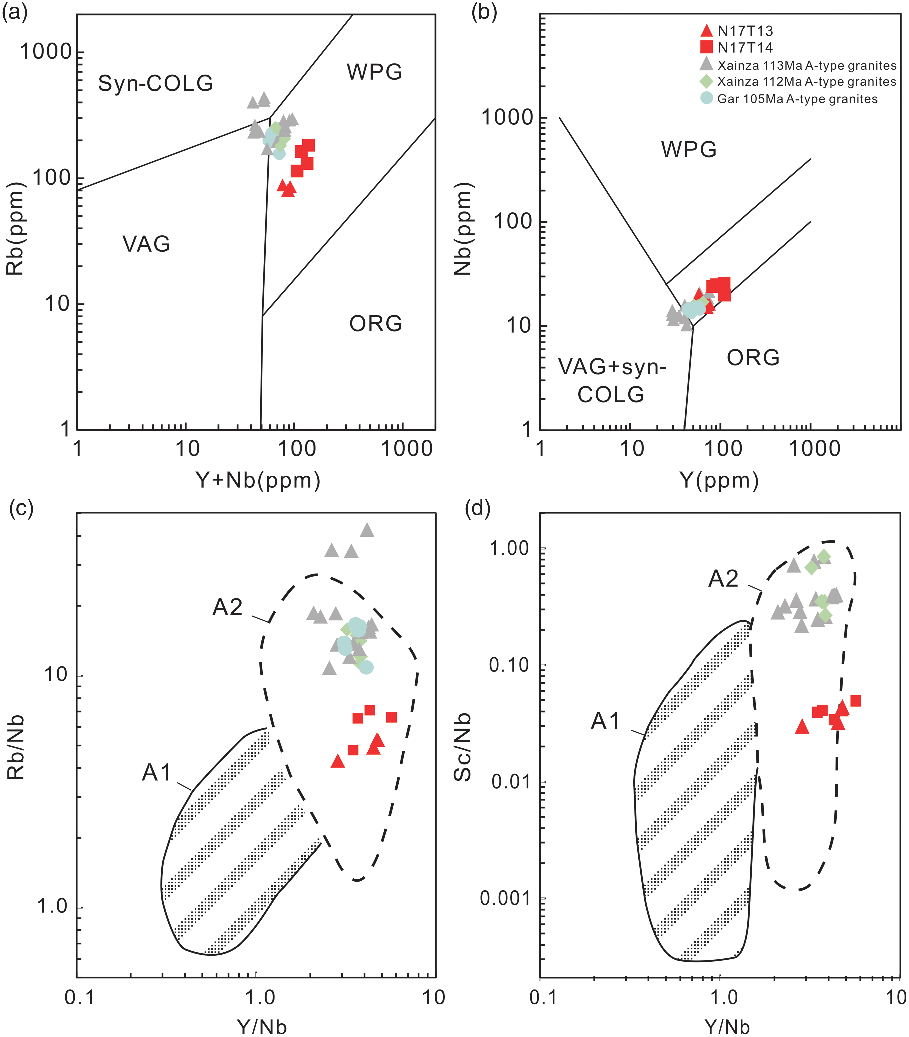
The initial alkaline, anhydrous and anorogenic-based classification of A-type granites by Loiselle & Wones (Reference Loiselle and Wones1979) was followed by the linking of these types of granites with specific tectonic settings. However, with the further development of research, scholars found that A-type granites not only form in mantle plume- or hot spot-type settings, but can also form in post-orogenic tectonic environments (Eby, Reference Eby1990, Reference Eby1992 and references therein). This led Eby (Reference Eby1992) to geochemically divide the A-type granites into A1- and A2-types, reflecting formation in different tectonic settings. A1-type granites have trace-element ratios that are similar to ocean island basalts (OIB) and form in non-orogenic, within-plate tectonic settings, whereas A2-type granites have trace-element ratios that are similar to continental crustal material and island arc basalts (IAB) and form in post-orogenic tectonic settings. It was pointed out by Grebennikov (Reference Grebennikov2014) that the diagram proposed by Eby (Reference Eby1992) could be used only for rocks falling in the fields of within-plate granites (WPG) on the diagrams of Pearce et al. (Reference Pearce, Harris and Tindle1984) and in the fields of A-type granites on the diagrams of Whalen et al. (Reference Whalen, Currie and Chappell1987). The Asa A-type porphyritic granites meet these conditions (Figs 8a, c, d, 9a, b) and plot within the A2-type field of the discrimination diagrams of Eby (Reference Eby1992) combined with other coeval A-type granites from the Xainza and Rutog areas (Qu et al. Reference Qu, Wang, Xin, Jiang and Chen2012; Chen et al. Reference Chen, Zhu, Zhao, Meng, Wang, Santosh, Wang, Dong and Mo2014; Xie et al. Reference Xie, Dun, Zhu, Nima, Yang, Tao, Li, He and He2015), indicating that the Late Cretaceous granitic magmatism occurred in an extensional environment after an earlier collisional tectonic event (Figs 9c, d, 10a).
Plots of (a) Rb versus (Y + Nb); (b) Nb versus Y; (c) Rb/Nb versus Y/Nb; (d) Sc/Nb versus Y/Nb for Early Cretaceous A-type granitoids of the Northern–Central Lhasa terranes. (a) and (b) after Pearce et al. (Reference Pearce, Harris and Tindle1984); (c) and (d) after Eby (Reference Eby1992). Syn-COLG – syn-collisional granite; WPG – within-plate granite; VAG – volcanic arc granite; ORG – ocean ridge granite. For data sources see Figure 5.

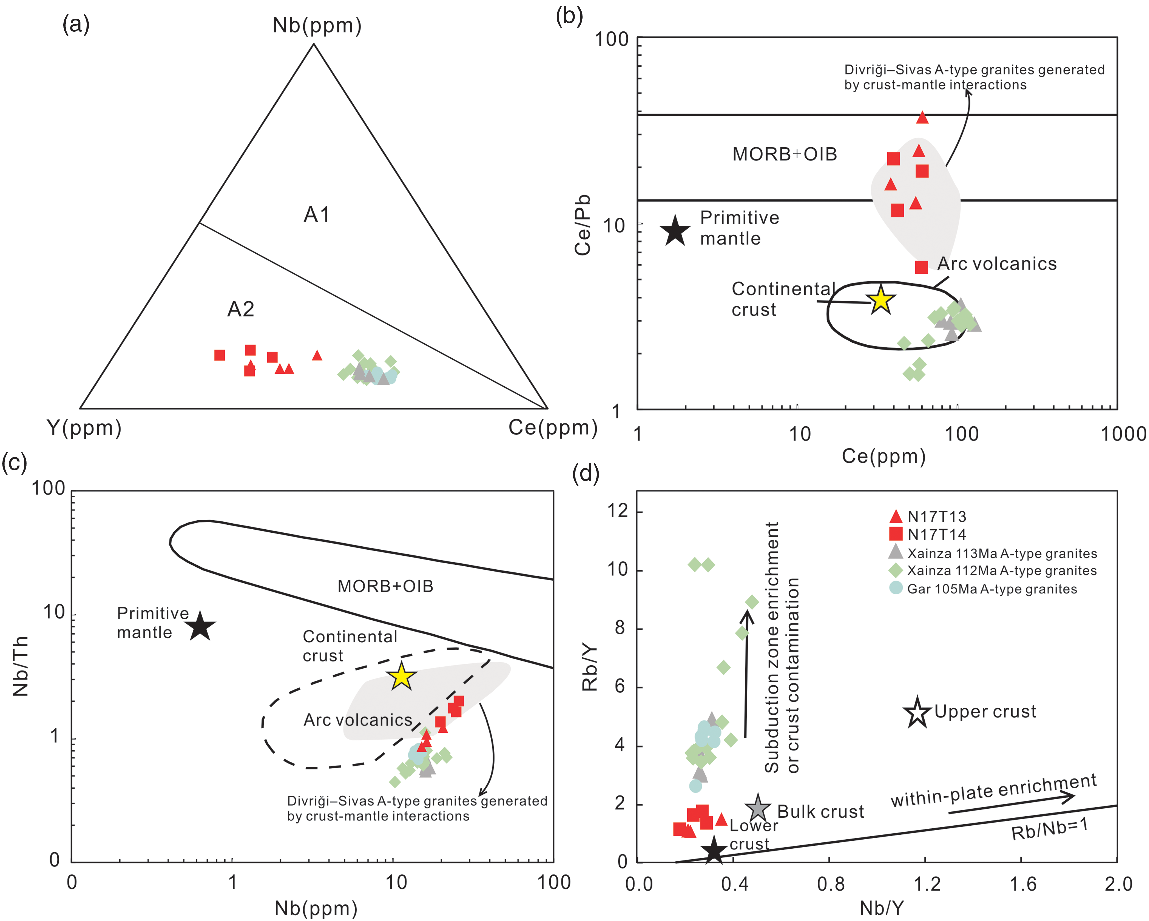
(a) Y–Nb–Ce diagram (after Eby, Reference Eby1992); (b) Ce/Pb versus Ce plot; (c) Nb/Th versus Nb; and (d) Rb/Y versus Nb/Y diagrams for A-type granitoids of the Northern–Central Lhasa terranes. (b), (c), (d) and Divriği–Sivas A-type granites after Boztuğ et al. (Reference Boztuğ, Harlavan, Arehart, Satir and Avci2007). MORB – mid-ocean ridge basalt; OIB – ocean island basalt.

5.b. Magma sources
A-type granites can form from magmas derived from a variety of sources, including (1) partial melting of residual F- or Cl-rich lower crustal granulites that previously melted to generate I-type granitic melts (Collins et al. Reference Collins, Beams, White and Chappell1982; Whalen et al. Reference Whalen, Currie and Chappell1987; Patiño Douce & Beard, Reference Patiño Douce and Beard1995; King et al. Reference King, White, Chappell and Allen1997; Yang et al. Reference Yang, Wu, Chung, Wilde and Chu2006); (2) low-pressure dehydration melting of tonalite or granodiorite material within the shallow crust (depths <15 km) (Skjerlie & Johnston, Reference Skjerlie and Johnston1992; Patiño Douce, Reference Patiño Douce1997); (3) partial melting of juvenile or ancient basaltic material (Wu et al. Reference Wu, Sun, Li, Jahn and Wilde2002, Reference Wu, Qiangba, Li, Wang, Gesang, Ciren and Basang2018; Qu et al. Reference Qu, Wang, Xin, Jiang and Chen2012); (4) direct formation by the assimilation and fractional crystallization (AFC)-dominated evolution of mantle-derived mafic magmas (Loiselle & Wones, Reference Loiselle and Wones1979; Sparks & Marshall, Reference Sparks and Marshall1986; Foland & Allen, Reference Foland and Allen1991; Turner et al. Reference Turner, Sandiford and Foden1992); and (5) interaction between mantle- and crust-derived magmas (Kerr & Fryer, Reference Kerr and Fryer1993; Boztuğ et al. Reference Boztuğ, Harlavan, Arehart, Satir and Avci2007). Experimental petrology indicates that melts derived from residual F-richsources are usually enriched in Al2O3 and are strongly peraluminous (Dooley & Patiño Douce, Reference Dooley and Patiño Douce1996; Patiño Douce & Beard, Reference Patiño Douce and Beard1996) and usually preferentially lose alkalis relative to Al2O3, and MgO relative to TiO2 (Creaser et al. Reference Creaser, Price and Wormald1991; Patiño Douce & Beard, Reference Patiño Douce and Beard1995, Reference Patiño Douce and Beard1996; Patiño Douce, Reference Patiño Douce1997), contrasting with the relatively high (Na2O + K2O)/Al2O3 (0.56–0.75) and TiO2/MgO (0.49–18.13) values, relatively low Al2O3 contents and the partially peralkaline nature of the Asa porphyritic granites (Fig. 6b). As such, these granites were not derived from the partial melting of residual F- or Cl-rich lower crustal granulite material (i.e. (1) above).
The zircons within the Asa A-type porphyritic granites have relatively low concentrations of Hf, low Y/Yb ratios and relatively high concentrations of Y. They plot between the continental and oceanic fields on zircon tectonic discrimination diagrams (Fig. 4a, b), indicating derivation from a source containing mantle-derived material. These granites have elevated but variable Ce/Pb ratios that are similar to values expected for mid-ocean ridge basalts (MORB) and OIB, but are significantly higher than granites derived from entirely crustal sources (Fig. 10b). All of these data indicate that the Asa A-type porphyritic granites cannot have formed from purely crustal sources (including the shallow and lower crust), ruling out (2) and (3) above.
A-type granites with characteristics indicative of a mantle-derived origin may reflect genesis from mantle-derived mafic magmas that have undergone AFC-type processes (Turner et al. Reference Turner, Sandiford and Foden1992). However, the Asa A-type porphyritic granites contain elevated concentrations of SiO2 (74.29–78.65 wt %), indicating that any petrogenetic model for these granites involving derivation from mantle-derived mafic magmas must involve significant amounts of fractional crystallization (Wilson, Reference Wilson1993). This would require much larger volumes of Late Cretaceous mafic magma than are present within the study area (Zeng et al. Reference Zeng, Wang, Fan, Yu, Luo and Hao2019) relative to the volumes of silicic igneous rocks, negating a model for the formation of the Asa A-type porphyritic granites based on (4) above.
A-type granitoids can also be generated by the interaction of mantle-derived and crustal melts (Kerr & Fryer, Reference Kerr and Fryer1993; Boztuğ et al. Reference Boztuğ, Harlavan, Arehart, Satir and Avci2007). We prefer this model as a reasonable explanation for the Asa porphyritic granites for the following reasons: (1) the Asa porphyritic granites show various Mg nos. (3.5–44.8) and εHf(t) (6.9–12.0); (2) their plots on the U/Yb versus Hf and U/Yb versus Y diagrams both fall into the transitional region between oceanic crust and continental crust and show a linear trend; (3) their plots on the Ce/Pb versus Ce and Nb/Th versus Nb diagrams both fall into a similar region with hybrid-sourced A-type granites (Boztuğ et al. Reference Boztuğ, Harlavan, Arehart, Satir and Avci2007) and show a transitional trend from MORB and OIB to continental crust; (4) in addition, this model can explain well some characteristics of the samples in this paper. The melting of high-HFSE accessory minerals within the crust can generate magmas containing elevated concentrations of Zr, Nb, Ce, Y and Ga (Kerr & Fryer, Reference Kerr and Fryer1993). The fractionation of forsteritic olivine and magnesian pyroxene within the mantle-derived magma prior to the interaction of this magma with the crust and/or crustal melts can generate magmas with high FeOt/MgO ratios (Barker et al. Reference Barker, Wones, Sharp and Desborough1975; Kerr & Fryer, Reference Kerr and Fryer1993). The above evidence suggests that the Asa A-type porphyritic granites have a hybrid source including mantle and crustal components.
The Asa A-type porphyritic granites have positive εHf(t) values (6.9–12.0) and relatively low Rb/Y and Nb/Y ratios (Fig. 10d) that indicate they were derived from magmas sourced from a region free of ancient crustal material, but instead formed from the re-melting of juvenile basaltic lower crustal material. In addition, three of the samples from the study area have clear negative Ce anomalies (Ce* = 0.66–0.91; samples N17T14H2, N17T14H4 and N17T13H1), whereas another sample has a positive Ce anomaly (Ce* = 3.22; sample N17T13H3). These anomalies are typically generated by post-magmatic chemical weathering, contamination by near-surface pelagic sediments or recycling of marine sediment components in the source (Hole et al. Reference Hole, Saunders, Marriner and Tarney1984; Neal & Taylor, Reference Neal and Taylor1989; Patino et al. Reference Patino, Velbel, Price and Wade2003; Ma et al. Reference Ma, Wei, Xu, Long and Sun2007; Class & Leroex, Reference Class and Leroex2008; Bao & Zhao, Reference Bao and Zhao2008; Shao et al. Reference Shao, Niu, Regelous and Zhu2015; Yang et al. Reference Yang, Wang, Zhang, Dan, Zhang, Qi, Xia and Zhao2018). For the following reasons, we believe that the Ce anomalies of our samples are inherited from the source region rather than caused by later weathering or near-surface contamination: (1) Ce anomalies caused by weathering are usually accompanied by an increase in Y element content (Price et al. Reference Price, Gray, Wilson, Frey and Taylor1991; Cotten et al. Reference Cotten, Ledez, Bau, Caroff, Maury, Dulski, Fourcade, Bohn and Brousse1995), but there is no trend of increasing Y element content in our samples. (2) Negative Ce anomalies in convergent continental margin magmatism are usually good evidence for the addition of subduction sediment components, while Ce anomalies in intraplate basalts are usually considered to be related to the weathering environment (Hole et al. Reference Hole, Saunders, Marriner and Tarney1984). According to previous research, the study area experienced a collisional orogenic event caused by the closure of the BNO during late Early Cretaceous time, which means that our samples were located in the continental margin area (107–105 Ma). (3) Ce anomalies caused by weathering are usually accompanied by an increase in LOI and enrichment of Gd contents (Yang et al. Reference Yang, Wang, Zhang, Dan, Zhang, Qi, Xia and Zhao2018 and references therein). These characteristics are inconsistent with the samples in this paper. (4) The pelagic sediments that have negative Ce anomalies are also characterized by a strong enrichment in Pb relative to Ce resulting in low Ce/Pb ratios in the range of 1–5 (Plank & Langmuir, Reference Plank and Langmuir1998; Class & Leroex, Reference Class and Leroex2008) while the Asa granites have high Ce/Pb ratios (5.81–37.1) similar to OIB, indicating their Ce anomalies cannot come from near-surface sediments. (5) What is more, positive Ce anomalies and negative Ce anomalies have been reported simultaneously in seawater (De Baar et al. Reference De Baar, Bacon and Brewer1983). All the evidence above indicates that the Ce anomalies in our samples may be related to recycling of marine sediments in the source.
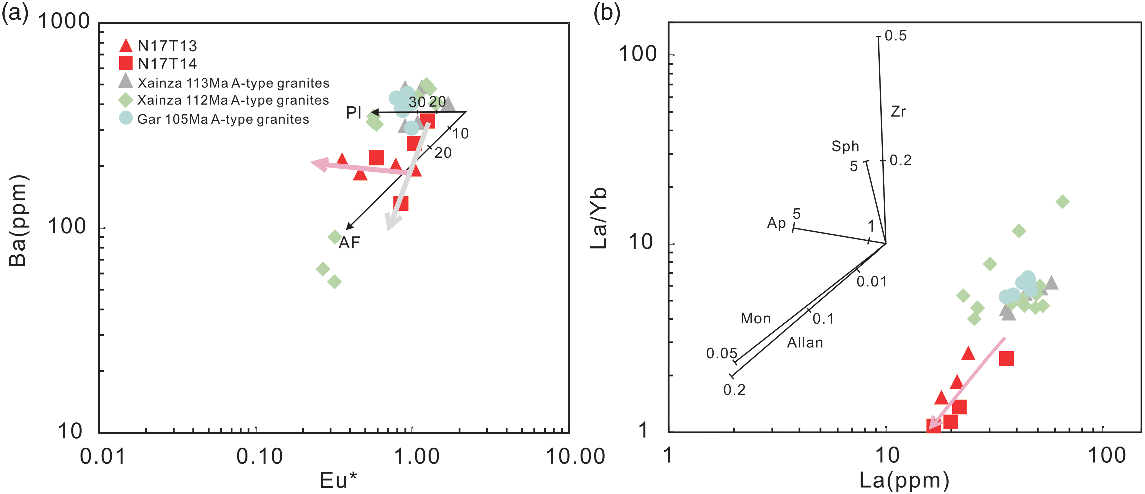
The Early Cretaceous Asa A-type porphyritic granites formed from magmas that have undergone fractional crystallization. They have low concentrations of Ba and Sr and negative Eu anomalies, both of which are indicative of the fractional crystallization of plagioclase. Plotting samples from the study area on a Ba versus Eu* diagram (Fig. 11a) indicates that sample N17T13 records plagioclase fractional crystallization, whereas sample N17T14 records the fractional crystallization of alkali feldspar. The Ti- and Ta-depleted nature of the samples from the study area is also indicative of the fractional crystallization of Ti-rich minerals, such as ilmenite and rutile. The REE contents of these samples are controlled by the fractional crystallization of accessory minerals, such as apatite, titanite, zircon, allanite and monazite, and plotting the granites on a (La/Yb)N versus La diagram (Fig. 11b) indicates that the magmas that formed these granites underwent fractional crystallization of allanite prior to their emplacement.
Plots of (a) Ba versus Eu* (after Whalen et al. Reference Whalen, Jenner, Longstaffe, Robert and Gariepy1996) and (b) (La/Yb) versus La for Early Cretaceous A-type granitoids of the Northern–Central Lhasa terranes. Pl – plagioclase; AF – alkali feldspar; Zr – zircon; Sph – sphene; Ap – apatite; Mon – monazite; Allan – allanite.

In conclusion, the Asa Early Cretaceous A-type porphyritic granites (107–105 Ma) most likely formed from magmas generated by the interaction between mantle-derived mafic magmas and melts derived from the re-melting of juvenile lower crustal basaltic material. These hybrid magmas interacted with oceanic slab-derived sediment melts and underwent significant fractional crystallization prior to their emplacement.
5.c. Tectonic implications
5.c.1. The late Early Cretaceous Bangong–Nujiang oceanic slab break-off
The late Early Cretaceous (~105 Ma) A-type porphyritic granites around Asa show high Rb, Y and Sc element contents and relatively low Nb element contents. In some discriminant diagrams, they fall into the within-plate granite field (Fig. 9a, b) or the collision-related A2-type granite areas (Fig. 9c, d), indicating a post-collision/syn-collision setting. At the same time, their positive εHf(t) (6.9–12.0), various Mg nos. (3.5–44.8) and high Ce/Pb ratios indicate the participation of mantle material in the source. The main ways for mantle material to participate in diagenesis in the post-collision process include slab break-off and lower crust detachment, etc. (Davies & Von Blanckenburg, Reference Davies and Von Blanckenburg1995; Wu et al. Reference Wu, Sun, Li, Jahn and Wilde2002; Hou et al. Reference Hou, Gao, Qu, Rui and Mo2004).
The geodynamic background of this series of Early Cretaceous magmatism, which is widely developed in the Northern and Central Lhasa terranes, has long been considered to be related to either northward subduction of the Neo-Tethyan Ocean (Coulon et al. Reference Coulon, Maluski, Bollinger and Wang1986; Pearce & Houjun, Reference Pearce and Houjun1988; Matte, Reference Matte1996; Ding & Lai, Reference Ding and Lai2003; Zhang et al. Reference Zhang, Xia, Wang, Li and Ye2004, Reference Zhang, Zhang, Tang and Xia2012; Kapp et al. Reference Kapp, Yin, Harrison and Ding2005; Leier et al. Reference Leier, Kapp, Gehrels and DeCelles2007) or the southward subduction and slab break-off of the BNO (Zhu et al. Reference Zhu, Mo, Niu, Zhao, Wang, Liu and Wu2009, Reference Zhu, Zhao, Niu, Mo, Chung, Hou, Wang and Wu2011, Reference Zhu, Li, Cawood, Wang, Zhao, Liu and Wang2016). For the Asa A-type porphyritic granites we report in this paper, located in the SNMZ, the subduction of the Shiquanhe Nam Tso Ocean could be another possibility.
Most scholars believe that the northward subduction of the Neo-Tethyan Ocean involved low-angle subduction (Zhang et al. Reference Zhang, Xia, Wang, Li and Ye2004, Reference Zhang, Zhang, Tang and Xia2012; Kapp et al. Reference Kapp, Decelles, Gehrels, Heizler and Ding2007) and the increase in subduction angle combined with slab roll-back events triggered the Cretaceous magma eruption in central Tibet (Zhang et al. Reference Zhang, Xia, Wang, Li and Ye2004, Reference Zhang, Zhang, Tang and Xia2012). In the low-angle subduction model, the early subduction angle is small and the corresponding magmatism is scarce. However, extensive Jurassic–Cretaceous magmatism has been reported in the Southern Lhasa terrane in recent years (Wen et al. Reference Wen, Chung, Song, Iizuka, Yang, Ji, Liu and Gallet2008; Zhu et al. Reference Zhu, Mo, Wang, Zhao and Liao2008a, Reference Zhu, Mo, Niu, Zhao, Wang, Liu and Wu2009, Reference Zhu, Zhao, Niu, Mo, Chung, Hou, Wang and Wu2011), which is contrary to the low-angle subduction model.
Some other scholars believe that the northward subduction of the Neo-Tethyan Ocean was a normal deep subduction, and slab break-off events triggered the Early Cretaceous magma eruption (Dai et al. Reference Dai, Wang, Zhu, Li, Zhong and Ge2015). Considering that the Lhasa terrane suffered significant crustal shortening after Cretaceous time, the distance between the northern magmatic arc and the southern Neo-Tethyan subduction zone was more than 600 km (Murphy et al. Reference Murphy, Yin, Harrison, Dürr, Chen, Ryerson, Kidd, Wang and Zhou1997; Kapp et al. Reference Kapp, Yin, Harrison and Ding2005, Reference Kapp, Decelles, Gehrels, Heizler and Ding2007), which could not be explained by the normal subduction model.
The Asa area is located within the central SNMZ, which is an area that may represent a former ocean that underwent subduction and caused the magmatism within the Northern and Central Lhasa terranes (Kang et al. Reference Kang, Xu, Dong and Wang2008). However, recent research on the SNMZ suggests that this zone represents a southern nappe within the BNSZ (Kapp et al. Reference Kapp, Yin, Harrison and Ding2005) or a back-arc ocean basin that developed during the southward subduction of the BNO (Zhu et al. Reference Zhu, Zhao, Niu, Mo, Chung, Hou, Wang and Wu2011; Xu et al. Reference Xu, Li, Zhang and Wu2014; Zeng et al. Reference Zeng, Wang, Fan, Li, Xie, Liu and Zhang2018). Even if this area is a back-arc basin, its small scale and rapid evolution means that the subduction in this basin could not be responsible for the large-scale magmatism within the Northern and Central Lhasa terranes (Zhu et al. Reference Zhu, Pan, Wang, Mo, Zhao, Zhou, Liao, Dong and Yuan2008b).
Southward subduction and slab break-off of the BNO have been proposed several times in recent years to try to explain the cause of these magma effects (Zhu et al. Reference Zhu, Mo, Niu, Zhao, Wang, Liu and Wu2009; Qu et al. Reference Qu, Wang, Xin, Jiang and Chen2012; Sui et al. Reference Sui, Wang, Zhu, Zhao, Chen, Santosh, Hu, Yuan and Mo2013; Chen et al. Reference Chen, Zhu, Zhao, Meng, Wang, Santosh, Wang, Dong and Mo2014; Wu et al. Reference Wu, Li, Xu and Li2015b). The main evidence for the southward subduction is: (1) large-scale Early Cretaceous magmatism exposed on both sides of the BNSZ (Kapp et al. Reference Kapp, Yin, Harrison and Ding2005; Liu et al. Reference Liu, Hu, Gao, Feng, Coulson, Feng, Qi, Yang, Yang and Tang2012; Haider et al. Reference Haider, Dunkl, Von Eynatten, Ding, Frei and Zhang2013; Fan et al. Reference Fan, Li, Xie, Wang and Chen2015; Zhu et al. Reference Zhu, Li, Cawood, Wang, Zhao, Liu and Wang2016; Wu et al. Reference Wu, Qiangba, Li, Wang, Gesang, Ciren and Basang2018); (2) the εHf(t) values of the Mesozoic–early Tertiary acidic magmatism on the Lhasa terrane show a decreasing trend from north to south (Zhu et al. Reference Zhu, Zhao, Niu, Mo, Chung, Hou, Wang and Wu2011, Reference Zhu, Li, Cawood, Wang, Zhao, Liu and Wang2016).
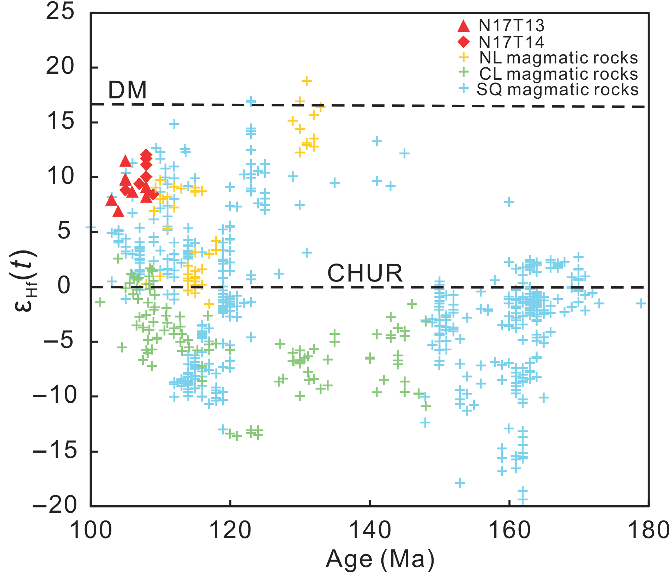
Owing to the absence of pre-Cretaceous magmatism in the Northern Lhasa terrane, the southward subduction model has been controversial. However, we believe that some recent research advances have provided a reasonable explanation for this problem. In the BNSZ and SNMZ on the south side, there are several reports of Jurassic magmatic events related to intra-oceanic subduction, including high-Mg andesite in the Darutso, Shiquanhe and Asa areas (Zeng et al. Reference Zeng, Chen, Xu, Wang and Huang2016; Liu, W. L. et al. Reference Liu, Huang, Gu, Zhong, Zhou, Gu, Zheng, Liu, Lu and Xia2018), and plagioclase granite intruded into ophiolite in the Lhaguo Tso area (Li et al. Reference Li, Guilmette, Yin, Ding, Zhang, Wang and Baral2019). The discovery of the residual magmatism of Jurassic intra-oceanic arcs indicates that the BNO may have experienced multi-stage intra-oceanic subduction events during the Jurassic Period. The intra-oceanic arcs are less preserved on the Earth’s surface today, and most of their magmatism remains in trenches, which explains the absence of Jurassic magmatic arcs in the Northern Lhasa terrane. Moreover, the intra-oceanic subduction model can well explain the characteristics of the enriched εHf(t) composition of the Northern Lhasa terrane (Fig. 12), and the growth and collage of the juvenile arc crust led to the formation of the Northern Lhasa terrane.
Plots of εHf(t) values versus ages of the late Mesozoic igneous rocks from the Northern (NL) and Central (CL) Lhasa terranes. Reference data from Zhu et al. (Reference Zhu, Mo, Niu, Zhao, Wang, Liu and Wu2009, Reference Zhu, Zhao, Niu, Mo, Chung, Hou, Wang and Wu2011), Chang et al. (Reference Chang, Zhu, Zhao, Dong, Mo, Liu and Hu2011), Li, S. M. et al. (Reference Li, Zhu, Wang, Zhao, Sui, Liu, Liu and Mo2014), Li, J. X. et al. (Reference Li, Qin, Li, Richards, Zhao and Cao2014), Hao et al. (Reference Hao, Wang, Wyman, Ou, Dan, Jiang, Wu, Yang, Long and Li2016), Wu et al. (Reference Wu, Xie, Li, Wang, Fan and Xu2016), Liu et al. (Reference Liu, Shi, Ding, Huang, Zhang, Yue and Zhang2017), Li et al. (Reference Li, Chen, Wang and Li2018), Yang et al. (Reference Yang, Wang, Zhang, Dan, Zhang, Qi, Xia and Zhao2018). SQ – Southern Qiangtang terrane; DM – depleted mantle; CHUR – chondritic uniform reservoir.

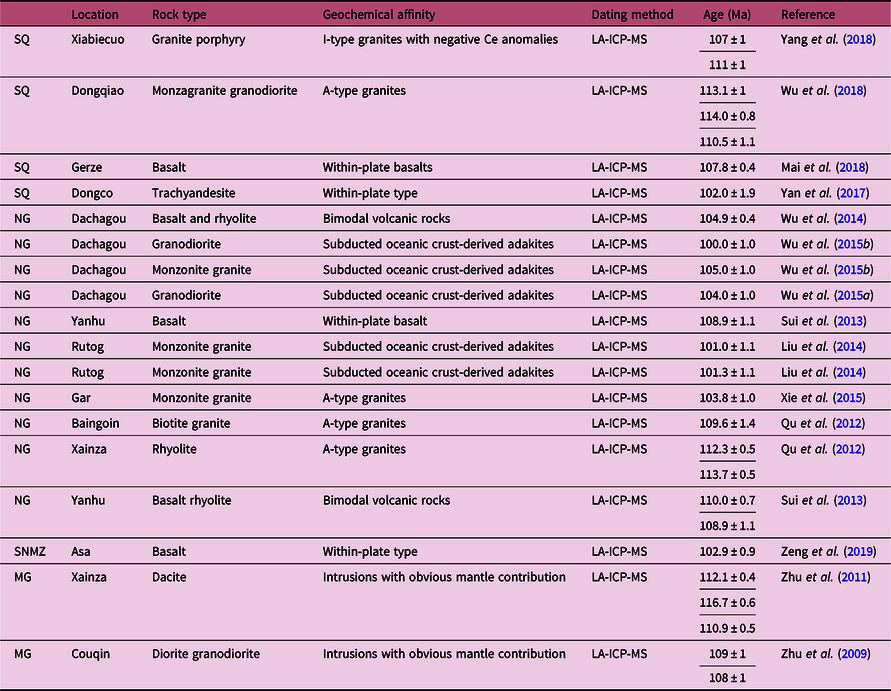
In addition, the Mesozoic intermediate-acid magmatism widely developed in central Tibet showed obvious Hf isotopic changes in late Early Cretaceous time. On the Southern Qiangtang and Central Lhasa terranes with Precambrian crystalline basement (Zhu et al. Reference Zhu, Mo, Niu, Zhao, Wang, Liu and Wu2009, Reference Zhu, Zhao, Niu, Mo, Chung, Hou, Wang and Wu2011, Reference Zhu, Zhao, Niu, Dilek, Hou and Mo2013), rocks with enriched Hf isotopic compositions suddenly appeared (Fig. 12), indicating that mantle material was added to the source, which may be closely related to the opening of the slab window, and when the slab window exists below the crust, a corresponding series of special extensional rock assemblages will be produced, including bimodal volcanic rocks, A-type granites, within-plate basalts and slab-derived adakites. Similar syn- and post-collisional magmatism associated with extension has been reported within the central and western BNSZ (Table 4), including in the Baingoin and Xainza County parts of the eastern central BNSZ, both of which contain late Early Cretaceous (c. 116–110 Ma) A-type granites (Qu et al. Reference Qu, Wang, Xin, Jiang and Chen2012; Chen et al. Reference Chen, Zhu, Zhao, Meng, Wang, Santosh, Wang, Dong and Mo2014) and c. 116 Ma within-plate basalts (Chen et al. Reference Chen, Zhu, Zhao, Meng, Wang, Santosh, Wang, Dong and Mo2014). The Asa area of the central BNSZ also contains late Early Cretaceous (c. 107–105 Ma; this study) A-type porphyritic granites and c. 103 Ma within-plate basalts (Zeng et al. Reference Zeng, Wang, Fan, Yu, Luo and Hao2019), and the Dachagou area of the western central BNSZ contains late Early Cretaceous (c. 105–100 Ma) adakites (Wu et al. Reference Wu, Li, Hu and Li2015a,b) and c. 105–104 Ma bimodal volcanic rocks (Wu et al. Reference Wu, Li, Hu, Zhang and Li2014). Finally, the Gar and Rutog areas of the western BNSZ contain late Early Cretaceous (c. 104 Ma) A-type porphyritic granites (Xie et al. Reference Xie, Dun, Zhu, Nima, Yang, Tao, Li, He and He2015) and c. 101 Ma adakites (Liu et al. Reference Liu, Huang, Fan, Zhang, Shi and Ding2014). The Asa A-type porphyritic granites in the study area formed contemporaneously with this extensional magmatism, and the high Ce/Pb ratios, positive εHf(t) values and Ce anomalies of some of these granites provide evidence of derivation from a source incorporating mantle-derived melts, juvenile crustal melts and oceanic slab-derived sediments. This is consistent with the contemporaneous extension-related magmatism in this area (Qu et al. Reference Qu, Wang, Xin, Jiang and Chen2012; Chen et al. Reference Chen, Zhu, Zhao, Meng, Wang, Santosh, Wang, Dong and Mo2014; Liu et al. Reference Liu, Huang, Fan, Zhang, Shi and Ding2014; Wu et al. Reference Wu, Li, Hu and Li2015a,b) and provides further evidence for the presence of a slab window. In summary, the southward subduction and slab break-off of the BNO was most likely the driving process behind the late Early Cretaceous magmatism in the Northern and Central Lhasa terranes, including the Asa A-type porphyritic granites.
Late Early Cretaceous extensional magmatism in central Tibet

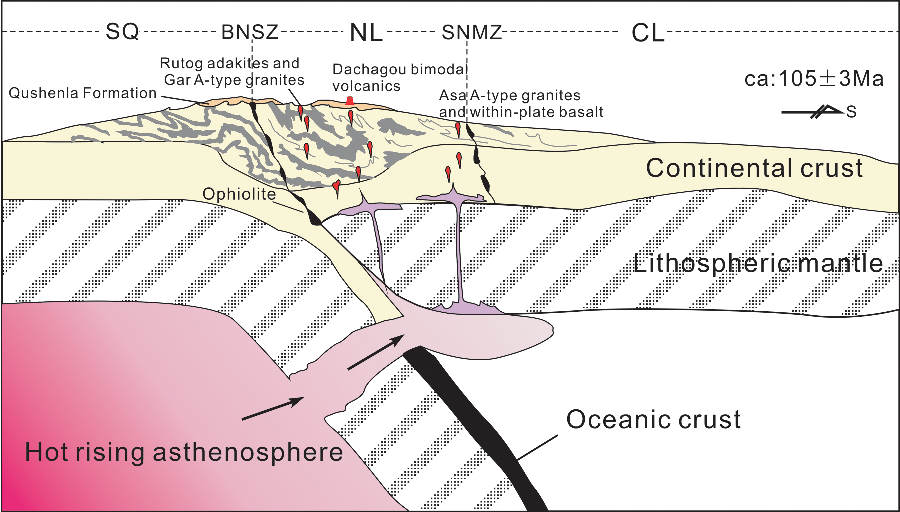
Slab break-off leads to the formation of a plate window, allowing the upwelling of hot asthenospheric mantle that undergoes decompression, causing melting and the formation of within-plate basaltic magmas (Ferrari, Reference Ferrari2004). This also causes extension within the overlying lithosphere (Duretz et al. Reference Duretz, Gerya and May2011), enabling the formation of bimodal volcanic rocks, A-type granites and adakites (Sui et al. Reference Sui, Wang, Zhu, Zhao, Chen, Santosh, Hu, Yuan and Mo2013; Chen et al. Reference Chen, Zhu, Zhao, Meng, Wang, Santosh, Wang, Dong and Mo2014; Wu et al. Reference Wu, Li, Xu and Li2015b). This is consistent with the derivation of the Asa A-type porphyritic granites from magmas generated by the interaction between mantle- and juvenile crust-derived melts that incorporated oceanic sedimentary material. This slab break-off model can also explain the contemporaneous magmatism in this region, indicating that the late Early Cretaceous extension-related magmatism was caused by the break-off of the southward subducting Banggong Lake–Nujiang oceanic slab (Fig. 13).
Geodynamic model illustrating the tectonic setting of the magmatism in the study area. SQ – Southern Qiangtang terrane; NL – Northern Lhasa terrane; CL – Central Lhasa terrane; BNSZ – Bangong–Nujiang suture zone; SNMZ – Shiquanhe–Nam Tso mélange zone.

6. Conclusions
Based on the whole-rock geochemistry, zircon U–Pb dating and zircon Lu–Hf isotope data for porphyritic granites newly reported in the Asa area, and combined with the work done by predecessors in the region, we draw the following conclusions.
(1) The Asa porphyritic granites intruded into the matrix flysch of the SNMZ at c. 107–105 Ma, and are typical A2-type granites.
(2) The Asa A2-type porphyritic granites were formed in a slab break-off event of the southward subducting Banggong–Nujiang oceanic crust. The mantle-derived melts interacted with juvenile lower crust-derived melts, accompanied by the addition of oceanic slab-derived sediments, and then suffered significant fractional crystallization, forming the Asa porphyritic granites.
Acknowledgements
This research was funded by the National Science Foundation of China (Grant No.41402190 and 41602230) and the Program of China Geological Survey (Grant No.121201010000150014 and DD20160026). We also thank Professor Deming Yang for drafting the figure. In addition, we thank the editors and reviewers for their valuable suggestions on the revision of this paper.