1. Introduction
The association of the particle οὖν (Ionic, Dorian ὦν) with the negative οὐκ is frequent from the mid fifth century on, and gave rise to a new consequential particle οὐκοῦν in late Greek. This process of grammaticalization is complex but well documented. The intervening stage is the use of οὐκοῦν in biased questions with inverted polarity. These questions seek confirmation through the so-called eliminative tactic:Footnote 1 the opposite alternative to the proposition that the speaker wants to assert is eliminated through the use of the negative. There are already instances of οὐκοῦν in the Classical period where the interrogative mode is no longer perceptible. In any case, besides οὐκοῦν, grammarians and manuscripts identify a variant οὔκουν whose negative force would be enhanced by the acute accent. This duality gave rise to so many oscillations in the manuscript tradition that editors simply acknowledge the impossibility of relying on the manuscripts to place the accent correctly. As shall be seen, this uncertainty is particularly acute in the case of Attic drama.
The article begins by reviewing the meagre comments on οὐκοῦν by ancient grammarians and Byzantine lexicographers. The most important information transmitted by them is the existence of two variants, οὔκουν and οὐκοῦν, of which the paroxytone is considered a negative and the perispomenon a consequential connective. Then it considers the principles followed by editors to choose between the variants. To refine those principles, it attempts to find pragmatic cues for the accentuation of the particle in Attic drama. The article ends with conclusions regarding the accentuation of the particle.
2. The Ancient Grammarians on οὔκουν/οὐκοῦν
The existence of both variants οὔκουν/οὐκοῦν with different accents is posited by the ancient grammarians. One of the clearest descriptions of this difference is offered by Apollonius Dyscolus:Footnote 2
(1) Apollonius Dyscolus, Conj. 257.18–258.1
ὁ οὐκοῦν καλϵῖται πρὸς ἐνίων ἐπιλογιστικός, πρὸς <δ᾽ ἑτέρων> ἀνακϵϕαλαιωτικός, <καθ>ὸ ἐπὶ τοῦ τέλους ἔχων τὴν <πϵρισπωμένην> οὐ μακρὰν πέπτωκϵ τῶν καλουμένων συλλογιστικῶν.—ἔστι γϵ ἐπ᾽ αὐτοῦ τοῦτο τηρῆσαι, ὡς ὅτϵ μὲν ἔχϵι τὴν οὔ ἀπόφασιν ἐγκϵιμένην καὶ κατὰ τὸ δηλούμϵνον, παραπληρωματικῷ κέχρηται τῷ οὖν· ὅτϵ δὲ τὸ οὖν ἔχϵι καὶ ἐν δηλουμένῳ, οὐκέτι τὴν οὔ ἀπόφασιν ἔχϵι. παρὰ μὲν οὖν τὴν ἐπικράτϵιαν τοῦ ἐπιρρήματος καὶ ἡ βαρϵῖα κατὰ τέλος πίπτϵι (ἀπϵιράκις γὰρ τίθϵται ἀντὶ τῆς οὔ ἀποφάσϵως)· παρὰ δὲ τὴν τοῦ συνδέσμου ἐπὶ τέλους ἴσχϵι τὸν δέοντα τόνον τοῦ συνδέσμου.
οὐκοῦν is called ‘consequential’ by some, ‘conclusive’ by others, since, when it has the circumflex accent on the final syllable, it does not fall far from the so-called consequential particles. It must be observed that, when it has the negative οὔ inserted and with full meaning, οὖν is used expletively; when it has οὖν with its meaning, it no longer has the negative οὔ. Then, with the prevalence of the adverb an acute accent falls in the first syllable (it tends to replace the negative οὔ), with that of the connective it exhibits the fitting accent of the connective in the last syllable.
Apollonius considers οὐκοῦν a consequential particle, that is, ἐπιλογιστικός, while other authors employ the adjective ἀνακϵϕαλαιωτικός ‘conclusive’. This particle is a connective (σύνδϵσμος). When the accent falls on οὔ, however, the negative keeps its force and οὖν is expletive, up to the point that οὔκουν is equivalent to οὐ. Other authors consider οὔκουν to be equivalent to οὐδαμῶς ‘in no wise > not at all’.
This differentiation was already set forth by Ammonius,Footnote 3 and assumed by the Byzantine lexicographers; see the entries for both particles in the lexicon of Pseudo-Zonaras (2), in the Etymologicum Gudianum (3) and in the Suda (4):
(2) Ps.-Zonar. 1488.2–3 Tittmann
οὐκοῦν. ὄντως· πάντως· διὰ τοῦτο.
οὔκουν. ἀντὶ τοῦ οὐδαμῶς.
οὐκοῦν: actually, evidently, because of that.
οὔκουν: instead of in no way.
(3) Etym. Gud. 440.3–6 Sturz
οὔκουν, ἐπίρρημα ἀρνήσϵως ἀντὶ τοῦ οὐδαμῶς.
οὔκουν καὶ οὐκοῦν διαφέρϵι· οὔκουν μὲν ἀποϕαντικῶς ἀντὶ τοῦ οὐδαμῶς· πϵρισπώμϵνον δὲ συλλογιστικὸς σύνδϵσμος καὶ σημαίνϵι ἀπόφασιν.
οὔκουν, negative adverb instead of in no way. οὔκουν and οὐκοῦν are different: οὔκουν is negative instead of in no way; the perispomenon form is an inferential connective and expresses assertion.
(4) Suda ο 898.63–5 Adler
οὔκουν, οὐδαμῶς.
οὐκοῦν δὲ συλλογιστικὸς σύνδϵσμος. οὐκοῦν οἱ ἀδϵλφοὶ λαβόντϵς ἱκϵτηρίαν ἐπυνθάνοντο ἄρα τοῦ θϵοῦ, ὅ τι καὶ χρὴ πράττϵιν αὐτούς.
οὔκουν: in no way.
οὐκοῦν is an inferential connective: ‘Therefore, the brothers took the olive branch and then asked God what they should do.’
An important testimony on the meaning of οὔκουν/οὐκοῦν is given by the second-century Atticist Phrynichus:
(5) Phrynichus, Soph. Pr. 98–9 von Borries
οὐκοῦν πϵρισπώμϵνον <μὲν> συλλογιστικὴν διάνοιαν ἔχϵι, [σημαίνϵι γὰρ τὸ ἀμέλϵι καὶ ἀληθῶς]. παροξυνόμϵνον δὲ διττῶς παρὰ τοῖς Ἀττικοῖς ἐκλαμβάνϵται, πότϵ μὲν ἀντὶ τοῦ μόλις <ἐπ᾽> ἀποφάσϵως ταττόμϵνον, πότϵ δὲ καθ᾽ ὑπέρθϵσιν. οὔκουν ἐάσϵις—οὐκ ἐάσϵις οὖν. καὶ παρ᾽ Ἀριστοϕάνϵι [fr. 617 K.–A.] “οὔκουν μ᾽ ἐάσϵις ἀναμϵτρήσασθαι τάδϵ” ἀντὶ τοῦ οὐκ ἐάσϵις οὖν μϵ. καὶ Θουκυδίδης [1.10] “οὔκουν ἀπιστϵῖν ϵἰκός”, οἷον οὐκ ἀπιστϵῖν οὖν ϵἰκός. καὶ πάλιν [3.46] “οὔκουν χρὴ οὔτϵ τοῦ θανάτου τῇ ζημίᾳ …” ἀντὶ τοῦ οὐ χρὴ οὖν. σύγκϵιται δὲ ἐκ τῆς οὐκί ἀποφάσϵως Ἰωνικῆς καὶ τοῦ οὖν συνδέσμου.
Perispomenon οὐκοῦν has inferential meaning [as it means ἀμέλϵι ‘actually’ and ἀληθῶς ‘really’]. The paroxytone form is used in two ways by the Attic writers, on the one hand instead of μόλις collocated with the negative, on the other by postponement: οὔκουν ἐάσϵις instead of οὐκ ἐάσϵις οὖν; see Aristophanes [fr. 617 K.–A.] οὔκουν μ᾽ ἐάσϵις ἀναμϵτρήσασθαι τάδϵ instead of οὐκ ἐάσϵις οὖν μϵ. Also Thucydides [1.10] οὔκουν ἀπιστϵῖν ϵἰκός, like οὐκ ἀπιστϵῖν οὖν ϵἰκός, and [3.46] οὔκουν χρὴ οὔτϵ τοῦ θανάτου τῇ ζημίᾳ instead of οὐ χρὴ οὖν. It is composed of the Ionian negative οὐκί and the connective οὖν.
Aside from the gloss interpolated for οὐκοῦν, the main contribution of this passage are the examples provided by Phrynichus to illustrate the meaning of οὔκουν, which would be equivalent to οὐ μόλις ‘not scarcely > quite, utterly’ or just the result of postponing οὖν to the negative. The three examples are from Aristophanes and Thucydides: the first has inverted polarity, and οὔκουν is construed with a future second-person indicative in a directive question (οὔκουν μ᾽ ἐάσϵις ἀναμϵτρήσασθαι τάδϵ; ‘won’t you allow me to measure these again?’); the two Thucydidean examples are of negative οὔκουν in a statement (οὔκουν ἀπιστϵῖν ϵἰκός ‘we have therefore no right to be sceptical’; οὔκουν χρὴ οὔτϵ τοῦ θανάτου τῇ ζημίᾳ ὡς ἐχϵγγύῳ πιστϵύσαντας χϵῖρον βουλϵύσασαθαι ‘we must not, therefore, commit ourselves to a false policy through a belief in the efficacy of the punishment of death’). Phrynichus introduces, then, the possibility of having οὔκουν in biased questions with inverted polarity, which is the starting point of the directive expression.Footnote 4
The remarks made by the ancient grammarians and collected by the Byzantine lexicographers raise more questions than answers. In the next section, we will see how editors have struggled with the manuscript tradition when choosing between οὔκουν and οὐκοῦν.
3. Manuscripts and editORIAL principles
The existence of two variants with differing accent is well reflected by the manuscript tradition. It is so frequent to find alternative readings for οὔκουν/οὐκοῦν, as well as οὐκ οὖν, that statements such as the following by Denniston are frequent: ‘The punctuation and accentuation of our MSS. are not to be trusted over-implicitly, and frequent changes should probably be made. Editors have been rather haphazard in this matter.’Footnote 5
Editors have taken different stances regarding this issue, including extreme proposals such as that of Rost,Footnote 6 who prefers οὐκοῦν in every case, in the manner of ὁστισοῦν, ὁποσονοῦν, ὁπωσοῦν,Footnote 7 or that of Paley,Footnote 8 who proposes οὐκ οὖν and considers οὐκοῦν and οὔκουν to be the creation of the ancient grammarians.Footnote 9 Some guides for choosing between these variants, however, are widely recognized at least from Kühner–Gerth.Footnote 10 A good summary of previous scholarship is found in Denniston’s account of οὔκουν/οὐκοῦν.Footnote 11 Starting from the principle, established by the ancient grammarians, that in οὔκουν the force falls on the negative, in οὐκοῦν on the connective, he gives some hints as to the accentuation and punctuation of the examples:
-
1. οὔκουν is to be printed in lively or impatient questions, particularly in tragedy (Kühner–Gerth [n. 10], 166–7). Denniston offers the following explanation for this preference: ‘Often, the logical starting-point is, not what the previous speaker has said, but the fact that he has said it. “Why” or “well” then brings out the force of the οὖν.’Footnote 12 This includes those questions with the second-person future indicative of which Phrynichus provides an example.
-
2. οὐκοῦν is prescribed in questions appearing in intellectual discussions, whose tone is less lively. These are characteristic of Plato’s and Xenophon’s Socratic dialogues; cf. Kühner–Gerth (n. 10), 166. Denniston (n. 5), 434 distinguishes two main subtypes, inferential (οὐκοῦν = ‘therefore’) and progressive (οὐκοῦν = ‘now’, ‘again’).
-
3. οὐκοῦν in statements is a consequential connective that derives from οὐκοῦν in questions (Kühner–Gerth [n. 10], 164). According to Denniston (n. 5), 436–7, there are already some examples in the fifth and early fourth centuries. In any case, it is not always easy to determine whether the sentence is affirmative or interrogative. In later Greek, it became fully grammaticalized.
-
4. οὔκουν must be printed in statements when it contains the predicative negative οὐκ and the particle οὖν, which can be either a confirmatory disjunct or a connective.Footnote 13
The principles followed by Denniston are usually followed by most editors. However, as we will see, they are less clear than they might seem, up to the point that discrepancies among editors remain frequent.
4. Pragmatic cues for the accentuation of οὔκουν/οὐκοῦν
Some pragmatic cues may elucidate the accentuation of οὔκουν/οὐκοῦν in Attic drama. Aside from the use of οὔκουν in negative statements and some possible instances of οὐκοῦν as a consequential connective, the main issue concerns the accentuation of the particle in interrogative sentences. To conduct a pragmatic analysis of the contexts in which the particle appears, I have checked all the instances in the extant works of Aeschylus, Sophocles, Euripides and Aristophanes, excluding the fragments. A number of these instances are problematic regarding their accentuation; for example
(6) Soph. Ant. 817–20
{Χο.}οὐκοῦν κλϵινὴ καὶ ἔπαινον ἔχουσ᾽
ἐς τόδ᾽ ἀπέρχῃ κϵῦθος νϵκύων,
οὔτϵ ϕθινάσιν πληγϵῖσα νόσοις
οὔτϵ ξιϕέων ἐπίχϵιρα λαχοῦσ᾽ …;820
(Chorus) Don’t you depart in glory and with praise to that deep place of the dead, neither struck by wasting sickness, nor having won the wages of the sword?
Here the particle appears at the beginning of the response of the Chorus to Antigone’s announcement of her intention to die unmarried. The manuscripts read οὐκοῦν, and Jebb punctuates the sentence as a statement and translates ‘Glorious, therefore, and with praise thou departest to that deep place of the dead.’Footnote 14 This implies that the particle would perform the role of a consequential connective. However, Denniston (n. 5), 436 considers that the sentence is interrogative, but the particle can be read both ways, οὐκοῦν and οὔκουν. He translates ‘Well, are you not dying a glorious death …?’ He is followed by Kamerbeek,Footnote 15 as well as by Griffith,Footnote 16 who explains that οὔκουν would imply a stronger approval. Knox,Footnote 17 however, prefers a negative statement with οὔκουν: ‘Not glorious, nor with praise you go away to this hiding place of the dead …’.
οὔκουν in negative statements is well represented in our corpus, and the accentuation does not pose any problem.Footnote 18 There is also little doubt about the accent in negative directive questions with the second-person future indicative, as mentioned by Phrynichus. These questions are also common in our corpus.Footnote 19
The accentuation of the particle when used as a consequential connective is also prescribed by the ancient grammarians, who insist that in οὐκοῦν the consequential force prevails. This connective is the result of a process of grammaticalization of the particle introducing biased questions with inverted polarity. The illocutive force of those questions is equivalent to a positive statement, so the evolution was due to an invited inference by which the meaning of the particle was associated with the positive statement implied by the question.Footnote 20 This statement can be deduced from the preceding information, a deduction on which the speaker seeks for confirmation through the eliminative tactic—remember that this label is used by Fiengo (n. 1), 65–8 to dub the phenomenon by which the opposite proposition to the one that the speaker wants to assert is negated in a biased question with inverted polarity.Footnote 21 There are some alleged cases of οὐκοῦν functioning as a consequential connective in our corpus; see, for example, Denniston (n. 5), 436–8. Most, however, are probably of interrogative sentences despite the manuscript tradition. I have considered only the instances appearing in Eur. Hel. 454, Ion 1289; Ar. Eccl. 853, Plut. 505. See the following example:
(7) Eur. Ion 1287–9
{Κρ.}ἀλλ᾽ οὐκέτ᾽ ἦσθα Λοξίου, πατρὸς δὲ σοῦ.
{Ιων}†ἀλλ᾽ ἐγϵνόμϵσθα, πατρὸς δ᾽ οὐσίαν λέγω†.
{Κρ.}οὐκοῦν τότ᾽ ἦσθα· νῦν δ᾽ ἐγώ, σὺ δ᾽ οὐκέτι.
(Creon) But you were no longer Apollo’s, but your father’s. – (Ion) But I became so, I mean being my father’s. – (Cr.) Then, you were Apollo’s once, but I am now, you no longer are.
After his reproach for having tried to kill him despite being a servant of Apollo, Creusa casts doubts on Ion’s divine right to protection but concedes that he was protected by it when he was born.Footnote 22 The particle, then, introduces a conclusion derived from Ion’s previous statement, and leads her to stress that now that he is trying to kill her in retaliation she is indeed protected as a suppliant at Apollo’s altar.
If we turn to the use of the particle in questions, the first thing that must be taken into account is that these questions are for the most part biased questions with inverted polarity. The distinction between οὔκουν and οὐκοῦν is therefore difficult to establish, if necessary at all. The distinction, though, is supported by the manuscript tradition—both variants are found in questions—and by the origin of the particle, since οὖν can be either a confirmatory particle enhancing the negative or an inferential particle. Accordingly, the specific literature usually prefers οὔκουν in lively questions, since there the negative would keep its force, οὐκοῦν in questions belonging to intellectual conversations, where the inferential relation with the previous context would prevail.Footnote 23 This kind of distinction is clearly unsatisfactory, first because such definitions are imprecise, second because lively questions are possible in philosophical dialogues and quieter questions in drama, even if there is a tendency to choose between οὔκουν and οὐκοῦν in questions according to genre; cf. Kühner–Gerth (n. 10), 166–7.
Indeed, this distinction is so vague that editors do not always agree on the accentuation of the particle, and sometimes they go against the manuscript tradition without any compelling reason. This is acknowledged by Denniston (n. 5), 435–6, who collects a number of examples in which both variants might be possible, although editors have substituted οὔκουν for οὐκοῦν against the manuscripts. For instance, in Euripides’ Electra there are some cases of that substitution under the lead of Nauck (see lines 239, 355, 357 and 662). Denniston kept the manuscript reading, although he expressed his concerns about that reading.Footnote 24 He comments on line 239: ‘I think that interrogative οὔκουν should probably be substituted here and almost everywhere for interrogative and affirmative οὐκοῦν in drama.’ However, it is still possible to stick to the manuscript readings at least in two cases; see the following passage:
(8) Eur. El. 353–7
{Αυ.} ἦλθον δ᾽ Ὀρέστου τίνα πορϵύοντϵς λόγον;
{Hλ.} σκοποὺς ἔπϵμψϵ τούσδϵ τῶν ἐμῶν κακῶν.
{Αυ.} οὔκουν τὰ μὲν λϵύσσουσι, τὰ δὲ σύ που λέγϵις;355
{Hλ.} ἴσασιν, οὐδὲν τῶνδ᾽ ἔχουσιν ἐνδϵές.
{Αυ.} οὔκουν πάλαι χρῆν τοῖσδ᾽ ἀνϵπτύχθαι πύλας;
– (Peasant) What message from Orestes have they come to declare? – (Electra) He sent them as spies of my wrongs. – (Peas.) Then they see a part of it, and you are somewhat telling them the rest? – (El.) They know; they have all these things in abundance. – (Peas.) Then, should not our doors have been opened to them long before?
Here appear two instances of οὐκοῦν corrected by Nauck into οὔκουν. The first might be interpreted as a case of οὐκοῦν functioning as a consequential connective; cf. Denniston (n. 24), 92. This is not necessary, as interrogative οὐκοῦν introduces a question that seeks an affirmative answer easily deduced from the preceding turn. However, Denniston (n. 5), 355 attributes the farmer a ‘touch of bitterness’ in his speech, somewhat approving Nauck’s emendation, which would imply that the particle introduces a lively question. But is the alleged touch of bitterness enough to consider this question lively? The second instance is more striking: there the particle introduces a biased question that is somewhat equivalent to an exhortative subjunctive. In any case, the expression οὐκοῦν χρή is particularly frequent in Plato’s works (Denniston [n. 5], 437) without any major difference with the Euripidean instance; see the following passage:
(9) Pl. Tht. 206c1–6
{Σω.} ἀλλὰ δὴ τούτου μὲν ἔτι κἂν ἄλλαι ϕανϵῖϵν ἀποδϵίξϵις, ὡς ἐμοὶ δοκϵῖ· τὸ δὲ προκϵίμϵνον μὴ ἐπιλαθώμϵθα δι᾽ αὐτὰ ἰδϵῖν, ὅτι δή ποτϵ καὶ λέγϵται τὸ μϵτὰ δόξης ἀληθοῦς λόγον προσγϵνόμϵνον τὴν τϵλϵωτάτην ἐπιστήμην γϵγονέναι.
{Θϵαι.} οὐκοῦν χρὴ ὁρᾶν.
– (Socrates) Still other proofs of this might be brought out, I think; but let us not on that account lose sight of the question before us, which is: What is meant by the doctrine that the most perfect knowledge arises from the addition of rational explanation to true opinion? – (Theaetetus) Shouldn’t we see, then?
In both cases, the expression—which tends to be printed without a question mark in Plato’s works—responds to a previous turn that leaves open the course of action suggested by the utterer of οὐκοῦν χρή. Printing οὔκουν to mark the Euripidean sentence as a lively question seems a bit arbitrary.Footnote 25
The questions in which οὔκουν is preferable to οὐκοῦν are challenges, that is, questions typically used for ‘calling into question a claim or a position embedded in the prior turn, and requesting that the recipient accounts for this observed discrepancy between the participants’.Footnote 26 This sort of question is frequent in drama, as highlighted in the specific literature:Footnote 27
(10) Ar. Ran. 25–8
{Δι.} πῶς ϕέρϵις γὰρ ὅς γ᾽ ὀχϵῖ;
{Ξα.} ϕέρων γϵ ταυτί.
{Δι.} τίνα τρόπον;25
{Ξα.} βαρέως πάνυ.
{Δι.} οὔκουν τὸ βάρος τοῦθ᾽ ὃ σὺ ϕέρϵις ὄνος ϕέρϵι;
{Ξα.} οὐ δῆθ᾽ ὅ γ᾽ ἔχω ᾽γὼ καὶ ϕέρω, μὰ τὸν Δί᾽ οὔ.
– (Dionysus) How can you bear anything? You’re riding. – (Xanthias) But I’ve got all this! – (Di.) How so? – (Xa.) Most heavily! – (Di.) The weight you carry, isn’t it carried by the donkey? – (Xa.) Absolutely not; not what I’m holding and carrying.
This excerpt is part of the discussion between Dionysus and his slave Xanthias on the matter of who must ride their donkey in their way to Heracles’ house. Dionysus challenges the fact that he is not riding the donkey. In this context the question introduced by οὔκουν is Dionysus’ response to Xanthias’ point that he must be relieved because he is bearing a burden, which he is indeed doing but on the donkey. The answer to Dionysus’ question is a negative one, as no confirmation is expected from a challenge; cf. Keisanen (n. 26), 269.Footnote 28 Challenges tend to have a specific intonation,Footnote 29 something that is not possible to reconstruct in ancient Greek. However, we might link the different accentuation of οὔκουν/οὐκοῦν to the prosodic peculiarities of these questions.
Ancient grammarians prescribe οὔκουν when the negative force of οὐ prevails. This can be equated with disalignment, a defining characteristic of a challenge. Disalignment is a term used in conversation analytic research to refer to the negative pole of alignment. According to Keisanen (n. 26), 253, ‘when a subsequent turn aligns with a prior turn, it follows the projected course of action of the prior turn or the sequence … The absence of such alignment is considered as a display of disalignment.’ In this regard, directive questions introduced by οὔκουν, one of the cases in which Phrynichus prescribes the acute accent, express disalignment:
(11) [Aesch.] PV 46–54
{Κρ.} τί νιν στυγϵῖς; πόνων γὰρ ὡς ἁπλῷ λόγῳ
τῶν νῦν παρόντων οὐδὲν αἰτία τέχνη.
{Hϕ.} ἔμπας τις αὐτὴν ἄλλος ὤφϵλϵν λαχϵῖν.
{Κρ.} ἅπαντ᾽ ἐπαχθῆ πλὴν θϵοῖσι κοιρανϵῖν.
ἐλϵύθϵρος γὰρ οὔτις ἐστὶ πλὴν Διός.50
{Hϕ.} ἔγνωκα τοῖσδϵ, κοὐδὲν ἀντϵιπϵῖν ἔχω.
{Κρ.} οὔκουν ἐπϵίξῃ τῷδϵ δϵσμὰ πϵριβαλϵῖν,
ὡς μή σ᾽ ἐλινύοντα προσδϵρχθῇ πατήρ;
{Hϕ.} καὶ δὴ πρόχϵιρα ψάλια δέρκϵσθαι πάρα.
– (Power) Why hate it? Since in truth your craft is in no way to blame for these present troubles. – (Hephaestus) Nevertheless, I wish it had fallen to another’s lot! – (Po.) Every job is troublesome except to be the commander of gods; no one is free except Zeus. – (He.) I know it by this task; I cannot deny it. – (Po.) Won’t you hurry to cast the fetters about him, so that the Father does not see you loitering? – (He.) Well, there then! The bands are ready, as you may see.
The excerpt belongs to the passage in which Power conveys Zeus’s instructions for Hephaestus to chain Prometheus. Hephaestus expresses his discontent with the task, so Power admonishes him to carry it out through a directive question (οὔκουν ἐπϵίξῃ;)—this sort of question is qualified as a harsh or impolite order, hence Hephaestus’ vivid reaction.Footnote 30
Keisanen has specifically studied negative yes/no interrogatives and tag questions as a means to fulfil different speech acts such as confirmation, challenging, disagreeing and assessing, and refers alignment to the stancetaking model of Du Bois.Footnote 31 If we follow her lead, we can compare the expression of disalignment through οὔκουν questions with her examples taken from naturally occurring American English conversations.
Keisanen distinguishes two main sequential contexts in which challenges are encountered in her corpus to express disalignment, labelled by her ‘challenging the trajectory of an extended sequence’ and ‘challenging prior action’—action is taken by her in a social dimension including social practices such as invitations, requests, suggestions, assessments, questions, and so on. The first context consists of extended sequences in which the challenging question responds to a claim or stance at a point in which it would be expected to align with the teller. According to Keisanen (n. 26), 258, ‘[b]y calling into question a claim or a position embedded in the prior speaker’s turn, the interrogative speaker holds the prior speaker accountable for this position or claim. Simultaneously, the interrogatives constitute a display of disalignment toward the unfolding course of action.’ An example follows:
(12) Aesch. Sept. 245–50
{Χο.} καὶ μὴν ἀκούω γ᾽ ἱππικῶν ϕρυαγμάτων.
{Ετ.} μή νυν ἀκούουσ᾽ ἐμφανῶς ἄκου᾽ ἄγαν.
{Χο.} στένϵι πόλισμα γῆθϵν, ὡς κυκλουμένων.245
{Ετ.} οὐκοῦν ἔμ᾽ ἀρκϵῖ τῶνδϵ βουλϵύϵιν πέρι;
{Χο.} δέδοικ᾽, ἀραγμὸς δ᾽ ἐν πύλαις ὀφέλλϵται.
{Ετ.} οὐ σῖγα μηδὲν τῶνδ᾽ ἐρϵῖς κατὰ πτόλιν;250
– (Chorus) Oh, but I hear horses snorting! – (Eteocles) Hear them, then, but not too clearly. – (Cho.) The city groans from deep in the earth, as though we are surrounded. – (Et.) Surely it is enough that I am making plans for this? – (Cho.) I am terrified—the crashing at the gates is increasing. – (Et.) Won’t you be silent, and speak none of this throughout the city?
The Chorus of Theban women is afraid and asking for the protection of gods. Eteocles censures this behaviour, because it discourages the men. Then the Chorus starts recounting how the clamour of the enemies is becoming nearer. When the Chorus states that the city is groaning as it gets surrounded, Eteocles does not feel any sympathy but insists in the fact that the military action corresponds to him, and that the Chorus should take refuge at home. In this context, the question introduced by our particle is to be understood as a challenge expressing Eteocles’ disalignment.
The second context does not involve an extended sequence, but the course of action suggested in the prior turn. In Keisanen’s words ‘the negative yes/no interrogatives and tag questions discussed in this section provide a disaligning turn to some initiating action, and are used to challenge the appropriateness or the relevance of doing the action completed in the prior turn’ (Keisanen [n. 26], 269). See this example from Aristophanes:
(13) Ar. Lys. 240–8
{Λυ.} τοῦτ᾽ ἐκϵῖν᾽ οὑγὼ ᾽λϵγον
αἱ γὰρ γυναῖκϵς τὴν ἀκρόπολιν τῆς θϵοῦ
ἤδη κατϵιλήϕασιν. ἀλλ᾽, ὦ Λαμπιτοῖ,
σὺ μὲν βάδιζϵ καὶ τὰ παρ᾽ ὑμῖν ϵὖ τίθϵι,
τασδὶ δ᾽ ὁμήρους κατάλιϕ᾽ ἡμῖν ἐνθάδϵ.
ἡμϵῖς δὲ ταῖς ἄλλαισι ταῖσιν ἐν πόλϵι 245
ξυνϵμβάλωμϵν ϵἰσιοῦσαι τοὺς μοχλούς.
{Κλ.} οὔκουν ἐφ᾽ ἡμᾶς ξυμβοηθήσϵιν οἴϵι
τοὺς ἄνδρας ϵὐθύς;
{Λυ.} ὀλίγον αὐτῶν μοι μέλϵι.
– (Lysistrata) The signal: as I said before, the ladies who would seize the citadel. They’ve done it already! Listen, Lampito: return to Sparta now, and start the strike. And leave these women here as hostages. The rest of us will enter the citadel and lock the gates and barricade ourselves. – (Calonice) Don’t you think the men will try to stop us? And pretty quickly? – (Ly.) They don’t worry me.
Lysistrata gives orders to her female comrades to occupy the Acropolis. However, Calonice, one of the Athenian women, objects that the men would not let them take the Acropolis. This objection, in the form of a biased question introduced by our particle, is aimed at stopping Lysistrata’s plan and avoiding its risks. However, Lysistrata does not feel any constraint about the objection.
Keisanen’s model is mainly based on sequential contexts. However, she also comments on questions that express alignment/disalignment through evaluative assessments as one of the constructions more frequent in her corpus (cf. Keisanen [n. 29], 147). Assessments are displays of evaluative stance (cf. n. 31 above). In our corpus, this sort of construction is especially frequent with challenges,Footnote 32 which are uttered through assessments of the prior turns:
(14) Soph. Phil. 628–32
{Φι.} οὔκουν τάδ᾽, ὦ παῖ, δϵινά, τὸν Λαϵρτίου
ἔμ᾽ ἐλπίσαι ποτ᾽ ἂν λόγοισι μαλθακοῖς
δϵῖξαι νϵὼς ἄγοντ᾽ ἐν Ἀργϵίοις μέσοις;630
οὔ· θᾶσσον ἂν τῆς πλϵῖστον ἐχθίστης ἐμοὶ
κλύοιμ᾽ ἐχίδνης, ἥ μ᾽ ἔθηκϵν ὧδ᾽ ἄπουν.
(Philoctetes) Is it not astounding, boy, that Odysseus would ever have expected by means of soft words to lead me from his ship and show me in the middle of the Greeks? No! I would sooner listen to that greatest and worst of my enemies, the viper which made me crippled as I am!
Philoctetes rejects Odysseus’ intention of bringing him back to the Greek camp at Troy. Philoctetes starts his turn with a biased question introduced by our particle that contains an assessment of Odysseus’ plan. The assessment has the form of an attributive sentence with the adjective δϵινά ‘terrible’.
Moreover, Keisanen comments on an environment characteristic of the questions studied by her. This is ‘an environment of general epistemic turbulence, that is, one in which multiple, possibly conflicting understandings regarding the same general topic are emerging’ (Keisanen [n. 29], 158–9). In this sort of environment, questions introduced by our particle can be used to negotiate agreement and disagreement. Such an environment is typical of Greek drama, as in the following passage, in which a challenging question appears:
(15) Soph. OT 439–41
{Οι.} ὡς πάντ᾽ ἄγαν αἰνικτὰ κἀσαϕῆ λέγϵις.
{Τϵ.} οὔκουν σὺ ταῦτ᾽ ἄριστος ϵὑρίσκϵιν ἔφυς;440
{Οι.} τοιαῦτ᾽ ὀνϵίδιζ᾽ οἷς ἔμ᾽ ϵὑρήσϵις μέγαν.
– (Oedipus) What riddles, what dark words you always say. – (Teiresias) Are you not the best at unravelling mysteries? – (Oe.) Reproach me in what you will find me to be great.
These verses belong to the agōn of Oedipus and Teiresias. Oedipus has summoned him to try to solve the plague that is devastating Thebes; but Teiresias resists talking as he is well aware of Oedipus’ responsibility. This attitude displeases Oedipus greatly, so they engage in an exchange of mutual accusations: Oedipus accuses Teiresias of being an impostor, Teiresias indirectly accuses Oedipus of the plague. When the seer alludes to Oedipus’ parents, he asks the seer to speak plainly. Teiresias then replies with a disaligning turn—he does not abandon his cryptic way of speaking—by uttering a biased question introduced by our particle in which he recalls Oedipus’ ability to solve riddles, as Oedipus himself has been boasting in lines 396–8. Note the disaffiliative response by Oedipus.
On the other hand, οὐκοῦν is used in biased questions that express alignment, or at least the speaker seeks for alignment with them. This type of question constitutes a request for confirmation, hence the inverted polarity, namely the eliminative tactic, as the speaker wants to confirm the opposite proposition that is negated.Footnote 33 In the stancetaking model, a negative yes/no interrogative expressing a request for confirmation can be a means for the speaker to seek alignment on the part of the addressee (Keisanen [n. 29], 90). Alignment can be sought with respect to a projected or ongoing activity, as in the example below:
(16) Soph. OT 964–74
{Οι.} ϕϵῦ ϕϵῦ, τί δῆτ᾽ ἄν, ὦ γύναι, σκοποῖτό τις
τὴν Πυθόμαντιν ἑστίαν, ἢ τοὺς ἄνω965
κλάζοντας ὄρνις, ὧν ὑφηγητῶν ἐγὼ
κτϵνϵῖν ἔμϵλλον πατέρα τὸν ἐμόν; ὁ δὲ θανὼν
κϵύθϵι κάτω δὴ γῆς, ἐγὼ δ᾽ ὅδ᾽ ἐνθάδϵ
ἄψαυστος ἔγχους—ϵἴ τι μὴ τὠμῷ πόθῳ
κατέϕθιθ᾽· οὕτω δ᾽ ἂν θανὼν ϵἴη ᾽ξ ἐμοῦ.970
τὰ δ᾽ οὖν παρόντα συλλαβὼν θϵσπίσματα
κϵῖται παρ᾽ Ἅιδῃ Πόλυβος ἄξι᾽ οὐδϵνός.
{Ιο.} οὔκουν ἐγώ σοι ταῦτα προὔλϵγον πάλαι;
{Οι.} ηὔδας· ἐγὼ δὲ τῷ ϕόβῳ παρηγόμην.
– (Oedipus) Alas, alas! Why indeed, my wife, should one look to the hearth of the Pythian seer, or to the birds that scream above our heads, who declared that I was doomed to slay my father? But he is dead, and lies beneath the earth, and here I am, not having put my hand to any spear—unless, perhaps, he died out of longing for me: thus, indeed, I would be the cause of his death. But as the oracles stand, at least, Polybus has swept them with him to his rest in Hades. They are worth nothing. – (Iocasta) Did I not long ago foretell this to you? – (Oe.) You did, but I was misled by my fear.
In this case, the excerpt belongs to the scene in which Oedipus questions the Corinthian messenger in the presence of Jocasta. The king discovers that his alleged father, Polybus, has died, so he can consider the corresponding oracle fulfilled. Jocasta asks him to confirm that he considers it over with a biased question introduced by οὐκοῦν. His answer is positive.
This sort of question can also stir up a more elaborated response than a simple confirming yes/no. This context is similar to the previous one, but confirmation of alignment with regard to a ‘projected or ongoing activity’ is accompanied by a request of more information about their stance. According to Keisanen (n. 29), 108, the recipient is treated ‘as more entitled to the knowledge being referred to and/or more knowledgeable in the general topic at hand. This, in turn, may on occasion initiate longer turns by the recipient, such as storytelling sequences, accounts, explanations or other types of turns which involve more talk beyond a mere confirmation (i.e. beyond confirming or disconfirming “yes” or “no”)’. See the following passage:
(17) Ar. Ran. 89–91
{Hρ.} οὔκουν ἕτϵρ᾽ ἔστ᾽ ἐνταῦθα μϵιρακύλλια
τραγῳδίας ποιοῦντα πλϵῖν ἢ μυρία,90
Εὐριπίδου πλϵῖν ἢ σταδίῳ λαλίστϵρα;
(Heracles) Surely you must have some other youngsters, at least ten thousand tragic playwrights, all babbling miles further than Euripides.
Dionysus has come to Heracles’ house to look for a poet to substitute Euripides, who is now deceased. Heracles comes up with some names, but none of those poets pleases Dionysus. With the question reproduced above, Heracles invites Dionysus to explain why there is no possible choice among the playwrights available. This question is introduced by our particle and seeks alignment as a means to encourage Dionysus to explain himself. He does explain himself in the following turns; see lines 92–102.
Finally, as in the case of challenges, positive assessments can be used to request for confirmation.Footnote 34 Furthermore, questions introduced by our particle are encountered to negotiate agreement in an environment of epistemic turbulence, since this sort of context is characteristic of Greek drama. See the following examples:
(18) Eur. Or. 779–81
{Πυ.} μολόντι δ᾽ ἐλπίς ἐστι σωθῆναι κακῶν;
{Ορ.} ϵἰ τύχοι, γένοιτ᾽ ἄν.
{Πυ.} οὔκουν τοῦτο κρϵῖσσον ἢ μένϵιν;780
{Ορ.} ἀλλὰ δῆτ᾽ ἔλθω;
– (Pylades) And if you go, is there any hope of escaping your troubles? – (Orestes) There might be, possibly. – (Py.) Isn’t that better than staying? – (Or.) Then should I go?
Here a positive assessment (τοῦτο κρϵῖσσον) is included in our question, with which Pylades asks Orestes to confirm that he is leaving Mycenae to avoid problems, although he does not convince him.
(19) Soph. OT 579–82
{Κρ.} ἄρχϵις δ᾽ ἐκϵίνῃ ταὐτὰ γῆς ἴσον νέμων;
{Οι.} ἃν ᾖ θέλουσα πάντ᾽ ἐμοῦ κομίζϵται.580
{Κρ.} οὔκουν ἰσοῦμαι σϕῷν ἐγὼ δυοῖν τρίτος;
{Οι.} ἐνταῦθα γὰρ δὴ καὶ κακὸς ϕαίνῃ ϕίλος.
– (Creon) And you rule the land as she does, with equal sway. – (Oedipus) She obtains from me all that she wishes. – (Cr.) And do I not rank as a third peer of you two? – (Oe.) It is just in this that you are seen to be a false friend.
This other passage belongs to the agōn of Oedipus and Creon. Oedipus has become suspicious of his brother-in-law, but he tries to appease the king by showing that he has no reason to take part in a conspiracy. One of his points is that he is the third authority in Thebes, which gives him a high position without the responsibilities of the king and the queen. The question is used as a means to lead the interlocutor to the conclusions set forth by the speaker—hence the frequence of this sort of question in philosophical dialogues.
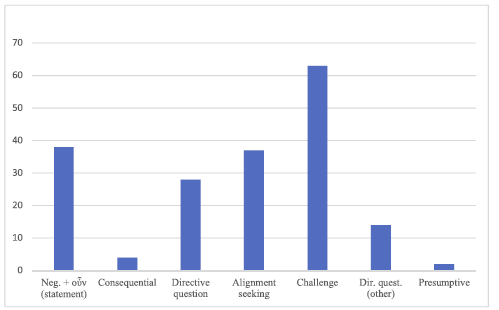
Some statistics on the use of the particle in the contexts we are analysing here are offered in Table 1. Two contexts are still to be examined, other types of directive questions and presumptive questions.
Number of instances by context.

Directive questions express a directive speech act.Footnote 35 In our corpus there are a number of them with verb forms other than the second-person future indicative—the latter forms are considered to express harsh or impolite orders.Footnote 36 A variety of examples is encountered, with the first-person plural future indicative (Eur. Bacch. 191; Ar. Vesp. 221) and the third-person passive future (Ar. Plut. 425, 1087), with potential optative ([Aesch.] PV 616; Soph. El. 799; Ar. Vesp. 171)Footnote 37 and with impersonal forms such as δϵῖ (Ar. Av. 1185), χρή ([Eur.] Rhes. 161, 633; Ar. Lys. 307) and ἐχρῆν (Eur. El. 357; Ar. Av. 1177, Plut. 406).Footnote 38 Unlike negative questions with second-person future indicative, all these constructions involve politeness through different strategies: most of them appeal to the hearer’s interest (Denizot [n. 4], 489–90), particularly by resorting to the second-person potential optative and to deontic constructions, which also include impersonalization as a means to achieve negative politeness;Footnote 39 some cases rather appeal to the hearer’s will (Denizot [n. 4], 490), such as the authorization asked through the first-person singular potential optative of Soph. El. 799 and Ar. Vesp. 171; finally, the use of the first-person plural to convey a request is a positive politeness strategy focussed on presenting the speaker and the hearer as cooperators (Brown–Levinson [n. 39], 127). From the stancetaking perspective, they express alignment, since the speaker wants to obtain the desired action from the addressee by soliciting their agreement with respect to the course of action. According to our proposal, the accentuation should be οὐκοῦν in these contexts. See the following examples:
(20) Eur. Bacch. 191–2
{Κα.} οὔκουν ὄχοισιν ϵἰς ὄρος πϵράσομϵν;
{Τϵ.} ἀλλ᾽ οὐχ ὁμοίως ἂν ὁ θϵὸς τιμὴν ἔχοι.
– (Cadmus) Won’t we go to the mountain in a chariot? – (Teiresias) But then the god would not have equal honour.
Here οὔκουν renders the impatience with which Cadmus would be uttering his question. Other editors prefer οὐκοῦν and punctuate the sentence as a statement. The third alternative, a question introduced by οὐκοῦν, is also printed.Footnote 40 Rijksbaron attributes a jussive tone to the first-person plural future with the negative, and so he prefers οὔκουν … πϵράσομϵν; However, the use of the first-person plural is not to be understood as expressing a command.Footnote 41 In fact, with this question Cadmus solicits the agreement of Teiresias to take a chariot and get to the mountain where the bacchants are the quickest possible. The first-person plural is a way of including the interlocutor in the proposal without charging them with all the responsibility—Teiresias’ answer is positive although he assents to go there on foot, not in a chariot in order to avoid offending the god; cf. Rijksbaron (n. 40), 32.
(21) Ar. Av. 1185–7
{ΠΙ.} οὐκοῦν σϕϵνδόνας δϵῖ λαμβάνϵιν1185
καὶ τόξα. χώρϵι δϵῦρο πᾶς ὑπηρέτης
τόξϵυϵ, παῖϵ· σϕϵνδόνην τίς μοι δότω.
(Pisthetaerus) Don’t we have to take up slings and bows? [Calling within] Come here, all the orderlies! Sling and short! And someone give me a sling!
In this other example, the first-person plural is substituted by an impersonal deontic construction with δϵῖ. The subject of the infinitive (λαμβάνϵιν) would be ὑμᾶς, as Pisthetaerus includes himself in the obligation of taking up arms against the god who has trespassed the gates of the birds’ realm. The deontic expression is followed by imperatives with generic subjects.
The so-called ‘presumptive’ questions are biased and seek for confirmation, but the answer favoured by them has the same polarity.Footnote 42 Thus, there is no eliminative tactic and the negative has predicate scope, while in questions with inverted polarity the negative has propositional scope since it is not the predicate that is negated but the proposition.Footnote 43 This type of question is rare with our particle: we have found only two examples (Eur. Alc. 60, Hel. 1274). Given the scope of the negative in these questions, οὔκουν is to be printed:
(22) Eur. Alc. 60–1
{Απ.} οὔκουν δοκϵῖ σοι τήνδϵ μοι δοῦναι χάριν;
{Θα.} οὐ δῆτ᾽· ἐπίστασαι δὲ τοὺς ἐμοὺς τρόπους.
– (Apollo) You are not inclined to grant me this favour, are you? – (Death) No, indeed. You know my character.
In the passage to which this excerpt belongs, Apollo asks Death to give Alcestis more time. Death is plainly reluctant, so Apollo utters the confirmation question introduced by the particle, to which Death replies with a negative answer, the type of answer favoured by the question. The negative of οὔκουν has scope over the predicate δοκϵῖ, not over the proposition.
Before proceeding to the pertinent conclusions, it is worth presenting in the form of a chart the different contexts in which the particle appears (Chart 1). In the chart, those contexts are diagrammatically arranged in order to better capture the relationships between them. First, the particle can be used in statements (οὔκουν) or in questions (οὔκουν/οὐκοῦν). In the second case, the question is biased, with inverted polarity or without it. Most of these questions have inverted polarity and are uttered as challenges or as questions seeking alignment. Moreover, there are two cases of conventionalization,Footnote 44 directive questions with οὔκουν and a second-person future indicative and statements introduced by consequential οὐκοῦν. Finally, we have seen mitigated directive questions introduced by οὐκοῦν, which can be considered an unconventionalized variant of questions seeking alignment.
Pragmatic contexts diagrammatically arranged.

5. Conclusions
The distinction between οὔκουν and οὐκοῦν is prescribed by ancient grammarians, although οὐκοῦν was considered by them mostly a consequential connective. None the less, modern scholars have accounted for its alternation in the manuscripts by applying a series of principles inspired by the ideas put forward by their predecessors, according to which the paroxytone form οὔκουν is used when the negative οὐκ prevails, while the perispomenon οὐκοῦν is used when the inferential οὖν prevails. Accordingly, in affirmative sentences, οὐκοῦν tends to be printed when it is used as a consequential connective, οὔκουν when the verbal predicate is negated. On the other hand, in interrogative sentences οὔκουν is printed with lively questions, οὐκοῦν with intellectual questions. However, this last distinction is rather unsatisfactory, since it is established on principles that are too vague. My proposal is to print the paroxytone form with challenges, that is, questions that call into question the prior turn, and the perispomenon form with confirmation questions seeking alignment. This distinction does not depend on personal feelings about the tone in which the question is uttered but on interactional patterns established in the stancetaking model of conversation analysis that can to some extent be equated with linguistic patterns. These patterns would explain the conventionalization of οὔκουν as expressing harsh orders with the second-person future indicative and of οὐκοῦν as a consequential connective. At the same time, οὔκουν should be preferred with presumptive questions in which the negative does not have scope over the proposition but over the predicate.