“A country that does not take care of its domestic problems is not going to have an effective position abroad,” Daniel Patrick Moynihan, then a presidential assistant, noted in August 1969. The Nixon administration just had introduced a sweeping and ultimately unsuccessful plan to overhaul Aid to Families with Dependent Children (AFDC), the thirty-four-year-old program of public assistance for poor single mothers and their children commonly referred to in the United States as “welfare.”Footnote 1 Richard Nixon, the foreign-policy President, had turned to welfare dependency, attacking its corrosive impact as harshly as he responded to any hint of “American” dependency abroad. AFDC “deepened dependency by all too often making it more attractive to go on welfare than to go to work,” the President charged.Footnote 2
Tropes of independence and dependence pervaded the official discourse of the Nixon administration in foreign as well as domestic policy: continued independence at home would depend on independence abroad. At the time of the Yom Kippur War waged between US ally Israel and its Arab neighbors in 1973, reliance on Middle Eastern petroleum would lead to the oil embargo, gas lines, and an energy crisis – that is, to oil dependence.Footnote 3 The oil crisis came amid Watergate and US defeat in Vietnam.Footnote 4 Nixon responded with “Project Independence,” declaring that the
United States of America as the greatest industrial power of the world with 7 per cent of the world's people and using 30 per cent of the world's energy shouldn't have to depend on any other country for energy that provides our jobs and our transportations and our light and our heat. We can become self-sufficient.Footnote 5
In displaying these core hegemonic terms, Nixon drew upon a pervasive national discourse. Over the course of the twentieth century, as the United States became an urban, industrial society and moved from its earlier imperialist ventures through an internationalist foreign policy toward post-Cold War empire, the terms independence and dependence captured the national ideal and its disdained opposite. These relations we find most tellingly embodied in the gendered and racialized icons of the cowboy and the welfare queen, symbols of the nation and the anti-nation. Nixon himself was no cowboy – unlike Theodore Roosevelt, Lyndon Baines Johnson, and Ronald Reagan – he didn't ride horses and his claim to real masculinity always remained suspect. After all, he was the vice presidential candidate who cried during the 1956 Checkers Speech when pleading to retain his slot on the ticket even though he took inappropriate campaign contributions.Footnote 6 But Nixon captured the spirit of the cowboy in tying domestic as well as foreign policy to the quest for independence.
Too often scholars of the United States consider domestic policy (at home) apart from foreign policy (abroad).Footnote 7 This essay breaks with that scholarly division of labor by suggesting one set of connections based on two cultural/political archetypes, the cowboy and the welfare queen, which were or are simultaneously gendered and racialized. Political leaders both deployed cowboy iconography and were recognized for good or ill as displaying characteristics associated with a mythic American West in which this heroic figure tames the wilderness and crusades against evil, violent outlaws. The myth largely ignores that the cowboy acted to wipe out the indigenous, rightful inhabitants of the land.Footnote 8 The welfare queen, in contrast, was a label that detractors gave to poor women, undeservedly growing fat on government largesse. It has existed as a verbal tag or a name printed or implied under a photograph that with another caption would merely serve as a picture of a black woman.Footnote 9 Drawing upon newspaper accounts, blogs, speeches, and iconographic representations, this essay traces the ways that modern Presidents deployed these icons to push independence as a national virtue in spite of their apparently different political positions. Indeed, the languages of independence and dependence have provided an easy vocabulary for policymaking that aspires to moral heights, leading to a performativity that traps those who utter the tropes of their predecessors into policy grooves not necessarily of their own choosing.Footnote 10
These types, of course, represent constructions. Actual cowboys, those who herded cattle on the ranching frontier, composed a multi-cultural workforce, whose position as wage-earners dependent on their employers hardly appears salient in the national imagery, never mind media representations.Footnote 11 Until recently, the majority of women on welfare were white; most of these poor single mothers spent less than two years receiving public aid before returning to employment.Footnote 12 But just as the cowboy as a symbol of white male individualism has represented worthy American manhood, so the welfare queen has denoted a despised black womanhood.Footnote 13 Behind the image of the cowboy stands the workings of empire; behind the portrait of the welfare queen lies the punishment of poor women, often African American or Latina, for their motherhood, sexuality, and lack of dependence on husbands. The problem with the welfare queen is that she parlayed her dependence on the state into independence from men and employment (that is, work as commonly understood).Footnote 14 Like the enemies without, who would make the nation dependent through withholding a vital resource – oil – and require disciplining through “cowboy diplomacy,” welfare dependents have become the primitive other, politically assaulted, responsible for national decline, who need taming through cowboy social policy.
IMPERIAL COWBOYS, DOMESTIC REFORMERS: TR AND LBJ
The presidential cowboy rode onto the national stage during the imperialistic extension of the nation's boundaries across the West to the Pacific. He temporarily became discredited with the morass of the Vietnam War.Footnote 15 Both Theodore Roosevelt and Lyndon Baines Johnson combined expansionist foreign policy with domestic reform to improve the lives of the less fortunate. Nonetheless, the dependency of mothers and children taken for granted in 1900 no longer held by the 1960s. Not only did a growing women's movement demand the end to workplace discrimination and equal pay for equal work, but the face of welfare in the political imagination had undergone a racial transformation from the white widow to the black “matriarch,” as Moynihan named these female heads of families, no matter the persistence of unequal treatment of women of color who applied for public assistance.Footnote 16 It no longer was clear that mothers with small children belonged with the frail elderly and the permanently and totally disabled among the unemployables or that they were deserving of public assistance. The meaning of dependency changed, and so did government support when the color of dependency became black.Footnote 17
The first presidential cowboy undoubtedly was Theodore Roosevelt. TR shed his aristocratic and effete Ivy-League upbringing to construct, as biographer Sarah Watts has argued, “the cowboy-soldier hero model” as a new ideal of manliness. Purchasing a Dakota ranch in 1883, over the next years he hardened his body by busting broncos and shooting buffalos, running for New York mayor as the “Cowboy of the Dakotas” shortly thereafter. He remade himself into the Rough Rider, a term synonymous in the popular culture with “Western horsemen,” charging up Cuba's San Juan Hill during “the splendid little war” against Spain, and made sure that the United States “took” the Philippines.Footnote 18 Though as President he would broker peace between Russia and Japan, TR advocated the use of force. In conducting the nation's foreign adventures through a modernized navy and army, he would “speak softly and carry a big stick.” He interpreted this “old proverb” to mean, “If a man continually blusters, if he lacks civility, a big stick will not save him from trouble; and neither will speaking softly avail, if back of the softness there does not lie strength, power.”Footnote 19
As historian Gail Bederman has argued, this conception of national might was racialized. Just as his multi-volume saga The Winning of the West celebrated “the American race” forged from English, German, and other Northern European “blood” in its conquest of indigenous peoples, and the Spanish-American War marked the triumph of “Anglo-Saxonism,” so America's rise to world power would be a racial, as well as a manly, victory. The “white frontiersman,” like the soldier against Philippine guerillas, fought not “a civilized foe” but rather a brutal and brown savage. Cowboyhood may have elided race, but the independence it evoked became associated with whiteness and manhood, and both of these attributes with democracy and civilization.Footnote 20
The imperialist was a domestic reformer, especially when it came to confronting the ills generated by immigration, urbanization, and industrialization. TR sought to reinforce the existing gender order of male breadwinner and female homemaker in ways that a century later a generation of religious conservatives could only dream of achieving. His understanding of dependency grew from a progressive, albeit masculinist, perspective that certainly rejected the fatalistic conservatism of his day. The dependency that stood for weakness among men, who were to be strong and independent, was a natural condition for women and children. Women's dependency, then, justified use of the police powers of the state to protect them. Since the strong had the responsibility to come to the aid of the needy, the purpose of government under the vigorous leadership of worthy men should be to relieve the helpless. TR would enhance the power of the state to regulate the economy, clean up the cities, and maintain the family.Footnote 21 Thus he embraced public assistance for poor children. As he told the White House Conference on Children in 1909,
Parents of good character suffering from temporary misfortune, and above all, deserving mothers fairly well able to work but deprived of the support of the normal breadwinner, should be given such aid as may be necessary to enable them to maintain suitable homes for the rearing of their children.Footnote 22
Along with prominent “maternalist” reformers in the social settlement houses and women's organizations, such as the General Federation of Women's Clubs, Roosevelt pushed for mothers' pensions, public allotments to poor mothers that would become Aid to Dependent Children (ADC) during the New Deal and AFDC in the 1960s. In the 1910s mothers' pensions represented the other side of the paycheck. Fashioned from the same gender ideology that criminalized male desertion and non-support of families, they represented a form of state provision for social reproduction. Mothers without male supporters due to death (and sometimes incapacity, divorce, or desertion) would need no longer to enter the wage-labor force full time, which previously necessitated breakup of the family, with children sent to orphanages or left to roam the streets. In practice, without an allotment for the mother herself, these pensions provided inadequate income. Mothers had to enter the labor force anyhow, crowding low-waged and flexible employments like public cleaning and industrial homework. Because states, indeed counties, controlled the pensions, they determined eligibility, imposing restrictions by marital status, residency, race, citizenship, and moral or maternal fitness. Fearing long-term dependency, some required employment outside the home. Geography would determine the extent of assistance obtainable by children and their caregivers when no national standard existed.Footnote 23
When justifying federalization of mothers' pensions as Title IV of the 1935 Social Security Act, the US Children's Bureau retained the association of children with acceptable dependency. New Dealers instituted work relief to curb demoralization among adult men, but, as former bureau chief Grace Abbott explained, “children are always dependent, and they are ‘demoralized’ by inadequate not by adequate care.”Footnote 24 Prior to the 1960s, when AFDC became stigmatized in the public mind because of increased numbers, reports of fraud, and a shift in recipient population from white widows to African Americans and the never married, it represented assistance given to worthy dependents.Footnote 25
But from the start, even before the full-blown image of the welfare queen, local governments vigilantly looked for ways to eliminate recipients from receiving benefits. When the referent for mother became non-white, states beginning with Louisiana in 1943 adopted “employable-mother” regulations to compel entrance into the labor market. Additional “man-in-the-house” rules reinforced male breadwinning and responsibility for the family by requiring stepfathers or any cohabiting man to support children and mothers to request courts to enforce payments from absent fathers. Further suitable-home and employable-mother rules halted the equitable coverage of African Americans that had developed during the 1940s. From 1956, amendments to Social Security encouraged wage-earning for mothers on ADC, a shift in philosophy that would undermine a mother's “right to assistance even if she refused to go to work,” one administrator feared.Footnote 26
To the problem of poverty, Lyndon Baines Johnson brought martial metaphors. Riding a horse on his Texas ranch, LBJ embodied a cowboy image, even though the former teacher had been a politician since the 1930s and his persona was much more one of a Washington insider.Footnote 27 “When he first came into office, he seemed to be proud of that cowboy image,” one Johnson press secretary recalled. “He wanted to have pictures taken riding a horse. The Westerner image was something that he cultivated. He built it up; he didn't try to hide it.” But later on he felt that the Eastern establishment dismissed him because of his cowboy persona.Footnote 28 Certainly the image has stuck. Millinery websites continue to offer broad Stetsons as LBJ cowboy hats.Footnote 29 In his conduct of the Vietnam War, commentators still remember cowboy characteristics, such as “shoot first” and go it alone. In advising George W. Bush to follow Johnson's lead, USA Today founder Al Neuharth reinforced both men's association with the cowboy:
LBJ, after mismanaging the Vietnam War that so bitterly divided the nation and the world, decided he owed it to his political party and to his country not to run for re-election. So, he turned tail and rode off into the sunset of his Texas ranch.
George W. Bush, he implied, should follow suit.Footnote 30
Johnson justified foreign policy in terms of national independence; stopping communism was necessary to maintain freedom. In the 1964 State of the Union Address he declared that “we must strengthen the ability of free nations everywhere to develop their independence and raise their standard of living, and thereby frustrate those who prey on poverty and chaos. To do this, the rich must help the poor – and we must do our part.”Footnote 31 This goal paralleled that of domestic policy to enhance the independence of the most impoverished within the nation. But with Vietnam the cowboy's self-reliance had morphed into an “arrogance of power.”Footnote 32
When it came to welfare and dependency, Johnson's Great Society modernized the New Deal. Thirty years before, FDR, a polio survivor dependent on others for mobility, had equated independence with employment. “Continued dependence upon relief induces a spiritual and moral disintegration fundamentally destructive to the national fiber,” Roosevelt proclaimed in 1935. “To dole out relief in this way is to administer a narcotic, a subtle destroyer of the human spirit.”Footnote 33 LBJ remained true to the New Deal's preference for work over relief when designing the War on Poverty to offer “a hand-up, not a hand out,” which would assist “taxeaters” to become “taxpayers.”Footnote 34 Training and education programs proliferated. But in encouraging maximum participation of the poor through community action and in promoting civil rights, the War on Poverty helped to spark a nationwide welfare rights movement that demanded a decent standard of living, reproductive freedom, and fair treatment by the state itself. These poor single, predominantly African American, mothers rejected the equation of welfare with dependency and instead sought welfare as a right of citizenship.Footnote 35
Nixon relied on similar rhetoric in promoting work over welfare. As part of a political scheme to capture southern white voters for the Republican Party, he sought to direct government funds to poor white male-headed families over black single mothers. Nixon promised that the poor would gain “the opportunity to guide their own destinies” and “a way of independence through the dignity of work.”Footnote 36 His Family Assistance Plan (FAP) would institute a guaranteed basic annual income. But, in doing so, the government would require employment or work from adult recipients, exempting only mothers of small children, still seen as worthy of government aid. Following the Work Incentive Program of 1967, states were able to require recipients to work for their payments – what came to be called workfare. Welfare rights activists charged that such forced work was slavery, the ultimate dependence, and that Nixon's proposed annual income was too low to support an urban northern family. Along with trade unions, they helped to “zap FAP,” a program that the President himself had abandoned to defeat after 1972.Footnote 37 Nixon, however, may never have believed in his own program. As he commented to White House aides the previous May in the characteristically crude language captured by his secret tapes, “We're going to [place] more of these little Negro bastards on the welfare rolls at $2,400 a family ... let people like Pat Moynihan and Leonard Garment [his attorney] and others believe in all that crap. But I don't believe in it … work, work, throw 'em off the rolls. That's the key.”Footnote 38
Nixon's foreign policy introduced questions of interdependence, which were subject to political debate in a more robust way than they would be after the ending of the Cold War had presumably left the US as a lone superpower. Talk of oil dependence, independence, and interdependence pervaded the press, including the nation's foremost newspaper the New York Times. Some proposed increased interdependence. News articles declared, “Self-Sufficiency May Be only a Mirage,” and columnists questioned, “A Fortress America?” and asked, “Alone or Together?”Footnote 39 Letters to the editor suggested internationalizing oil resources. One correspondent emphasized the need for US–European interdependence, lest a Soviet–Arab stranglehold suffocate European growth. Another writer even invited Europe to join “Project Independence” as an equal partner, paying its share of the cost, of course.Footnote 40 Early in 1974, however, the Times editorialized that “‘Project Independence’ – to make this country independent of unreliable foreign sources for its essential energy needs – should begin with an overhaul of the tax laws that have resulted in Condition Overdependence”; that is, inducements to US companies, like the oil depletion allowance, that encouraged expanded foreign production over domestic development. Domestic and foreign policy depended on each other.Footnote 41
Meanwhile, Secretary of State Henry Kissinger engaged in “shuttle diplomacy.” Kissinger saw the US as generating cooperation among allies; he proposed that Europeans, North Americans, and Japan work together to develop “an initial action program for collaboration in all areas of the energy problem.”Footnote 42 At the “World Energy Conference” in Washington in early February 1974 the US secretary of state pointed to “the energy crisis” as “indicat[ing] the birth pangs of global interdependence.” But French foreign minister Michel Jobert questioned this assumption, seeing in Kissinger's vision regional independence rather than global interdependence: “We must not appear before the entire world as seeking to define alone a ‘new course’ which would inevitably lead to a confrontation or a conflict with the producing countries and maybe with all the developing countries,” Jobert urged. “Let us not seek to establish or to impose a new world energy order.”Footnote 43 Kissinger would implore Europe “to work with the United States for a new world order,” Times writer James Reston argued. France, however, suggested a sinister plot on the part of the US to regain its dominance over other industrial nations and “would go it alone,” only highlighting in Reston's analysis the ridiculousness of “selfish nationalistic interests.”Footnote 44 In essence, as Reston had earlier explained, “Kissinger … switch[ed] the emphasis from Project Independence to Project Interdependence.”Footnote 45
The notion of ‘interdependence’ within a Cold War alliance system that recognized US supremacy existed within its diplomatic repertoire, even if the concept of “interdependence” remained absent from promotion of “workfare” over welfare. But as historian Natasha Zaretsky convincingly argues, the oil crisis symbolically linked the national appetite for oil, including the over-consumption of middle-class families and wage-earning women of “convenience” foods and appliances, with lack of restraint exhibited by poor mothers and “the Arab oil sheik,” two “racialized notions of dependency.”Footnote 46 Independence through homes, thus, replaced notions of interdependence within them.
REAGAN'S LEGACIES
But Ronald Reagan, not Richard Nixon, crafted “a new world order.” Historians have argued that Reagan “lived in a world of myths and symbols, rather than facts and programs.”Footnote 47 He gained a reputation “as a rigid ideologue with an underdeveloped social conscience, a rawhide foreign policy and a dangerously simplistic world view.” During the presidential campaign of 1980, advisers toned down the impression that he would “put on a six-shooter and take Iran” or that “he's flinty-hearted and would kick all the blacks off welfare.”Footnote 48 In foreign policy he actually gave great latitude to advisers, which undoubtedly helped usher in the Iran–Contra scandal. Despite Central American misadventures, he did negotiate arms reduction, setting the basis for, first, détente with Mikhail Gorbachev and, then, the end of the Cold War with the collapse of the Soviet Union back into Russia.Footnote 49
As an actor, Reagan actually had played few cowboys, although his favorite Hollywood films were “adventure and action,” involving “escape and rescue.” The public associated him with the small screen's “Death Valley Days”; as the Old Ranger selling 20-Mule Team Borax, his representation as a Western outsider barely camouflaged his salesmanship of corporate goods. Reagan left television to run for governor, a post he won after promising toughness against civil rights, anti-war, student, and other outbursts against “law and order.” After two terms in Sacramento, he bought a ranch in Santa Barbara County, where photographers could picture him in the saddle and cutting brush.Footnote 50 As President he drew upon that past in fashioning an imaginary as the sheriff who would bring the bad guys – the Soviet Evil Empire – to justice.Footnote 51 Voters described him as “a man who, when he says something, sticks to his guns.” He recalled “a John Wayne type of thing … the Cavalry.” One 1984 poll had respondents describing him with “terms like ‘bravado,’ ‘swagger,’ ‘swashbuckle,’ ‘tough guy’,” in contrast to effete Democrats.Footnote 52 No less than the general public, scholars and journalists have delighted in painting him as “tall in the saddle”Footnote 53 He became known for “cowboy capitalism,” or what one “free-market” proponent defined as “policies of low tax rates, deregulation, free trade, price stability, and massive entrepreneurship ...” Reaganomics, the name given to his combination of tax cuts and reductions in domestic spending, then, would encourage individual action without government presence, behavior associated with the freedom of the range, with the cowboy's West.Footnote 54
Reagan rode to political prominence by fanning resentment against the “welfare queen.” As California's governor, he linked together big government, high taxes, and welfare fraud. “Public assistance should go to the truly needy not the truly greedy,” he claimed, as he pledged to end cheating by undeserving poor black and brown single mothers – by replacing social workers, who, he charged, coddled the poor, with eligibility clerks and by forcing recipients to work for their benefits.Footnote 55 Their crime was manipulating the system, deliberately having children for a higher relief check, in contrast to the disabled, ill, and elderly, whose dependency came from no fault of their own. These other clients of public assistance remained, like children, naturally dependent. In contrast, the poor mother on welfare became, as historian Rickie Solinger has shown, “the symbol of the dependent woman who makes bad choices.”Footnote 56 During Reagan's two terms, California tightened welfare eligibility rules, instituted workfare and “birth control training,” and refused to implement federal directives, including those promulgated by the Nixon administration, that required more generous benefits – until unfavorable court decisions forced compliance.Footnote 57
The story of the “welfare queen” became a staple of the presidential campaign trail. During the New Hampshire primary in 1976 Reagan incorporated into his stump speech the tale of a Chicago woman charged with welfare fraud by an “Illinois investigation.” This woman “has 80 names, 30 addresses, 12 Social Security cards and is collecting veterans' benefits on four nonexisiting deceased husbands,” he proclaimed. She received “welfare under each of her names,” overall obtaining $150,000 in “tax-free cash income.” But like many lines recited by the former actor, this one turned out to be an exaggeration. The woman in question, Linda Taylor, indeed seemed to have collected a disproportionate amount from the government, but not nearly to the extent portrayed by Reagan. She apparently used four aliases to receive $8,000. The police later confiscated “her Cadillac limousine,” which they believed “was used to transport a fur coat, television set, diamond ring,” and other consumer goods that signaled her “bad choices” as a consumer as well as waste of taxpayer dollars.Footnote 58 But, thanks to Reagan, this forty-seven-year-old woman became the prototypical woman on welfare, who treated herself as royally as a “pig at the trough.”Footnote 59 Later, Reagan would parlay voter resentment of welfare to increase the number of investigations for fraud and thus the policing of poor families. Meanwhile, he enacted deep cuts in social programs, including food stamps and aid to the disabled, transforming even the deserving poor into the undeserving.Footnote 60 Reagan promoted work requirements to end dependence, believing, “We can only measure our success by the number of people we have removed from the welfare rolls and made self-sustaining citizens – not the number we have added.”Footnote 61 But the wages available to those leaving welfare rarely lifted their families out of poverty.Footnote 62
From a liberal strategy to increase women's independence, employment had become a conservative weapon to punish female sexuality and reinforce the low-wage labor force. Republicans had portrayed Bill Clinton as “soft” on foreign policy, but he certainly took a hard line when it came to welfare dependency. Though he asked for increases in child- and healthcare, his rhetoric appropriated Republican themes, encouraging opponents who would punish the autonomy of women under the guise of “family values” and who never accepted aid to poor solo mothers in the first place.Footnote 63 During the 1992 campaign he promised to “end welfare as we know it,” and in his first address as President called to “end welfare as a way of life and make it a path to independence and dignity.” As the 1996 election loomed he continued to deploy the old tropes. “We can break the vicious cycle of welfare dependency,” Clinton urged. “It should be pro-work, pro-family, pro-independence, responsible. Welfare should be a second chance, not a way of life.”Footnote 64
The resulting legislation replaced AFDC with TANF (Temporary Assistance for Needy Families). It forced recipients to take any job, even one below minimum wage, eliminating credit for higher education as a work activity as well as making such poor mothers leave the home for other labor. It also limited social assistance to no more than five years in a lifetime, established a family cap restricting poor women's reproductive freedom, and continued the attempt to garner the wages of poor men to reimburse the state for assisting the mothers of their children. Reacting to fears that pregnant women crossed the border to deliver in the United States, thus automatically making their children citizens, Congress further excluded immigrants from benefits. Some states used their own monies to cushion these provisions, which became more restrictive under the next Bush administration.Footnote 65 TANF reauthorization a decade later curtailed state flexibility by increasing the number of work hours, shrinking what counts as work, and cutting childcare and other family supports. To further reduce welfare dependency, George W. Bush proposed a massive $1·5 billion pro-marriage initiative and pushed prevention of motherhood. Marrying off poor single mothers to men, or at least forcing men to take fatherhood support seriously, would make women independent of public support.Footnote 66 His policies would reverse what welfare rights activist Johnnie Tillmon over thirty years before had described as “trad[ing] a man for the man.”Footnote 67
Clinton, the anti-war protestor, could not escape the cowboy designation any more than his predecessor, the well-mannered George H. W. Bush, who, in his first year of office, had appeared as a “modest, sober, selfless steward” rather than a cowboy. But Bush Senior certainly proved that he was “no policy wimp,” and, after Iraq's invasion of Kuwait, became a real “Rambo,” the Cold War update of the gunslinger, even as he built a multi-national consensus for troop deployment to the Persian Gulf.Footnote 68 Though some charged Clinton with dependency on the European allies, he too was castigated for going at it alone when it came to Bosnia and accused of being “trigger-happy.”Footnote 69 A political opponent of Hussein, who lived in Seattle, complained following Clinton's continued bombing of Iraq, “The whole … administration is a bunch of machos with cowboy mentality.”Footnote 70 The persistence of oil dependency – “an energy policy which basically has given up the goal of energy independence,” as one former energy secretary explained – led Clinton's secretary of sate to speak in terms of outlaw regimes as much as would the administration of George W. Bush.Footnote 71
REAGAN REDUX?
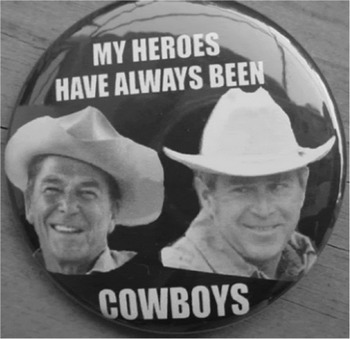
During his presidential campaign George W. Bush declared, “I started as a cowboy. Now I'm a statesman.”Footnote 72 Two images of Bush II suggest his appropriation of the cowboy that both hail and mock the past. The first comes from a website selling Republican Party memorabilia and places Bush in a white Stetson next to Ronald Reagan in a similar iconic hat (Figure 1). With the words “My Heroes Have Always Been Cowboys,” this button seeks to transfer the enthusiasm and affection of party faithful from Reagan to G. W. Bush, a son who aspires to be more like the “Gipper” than his own father.Footnote 73 Bush Junior apparently shares Reagan's proclivity for make-believe, as well as his economic conservatism and New Right social positions. Like Reagan, this Bush purchased his ranch in anticipation of running for higher office and the ranch has functioned as a stage set for image-making. But this Bush, unlike Reagan, is no horserider. In Crawford he drives a good ol' boy pickup truck.
“My Heroes Have Always Been Cowboys,” from RepublicanMarket, 2004.

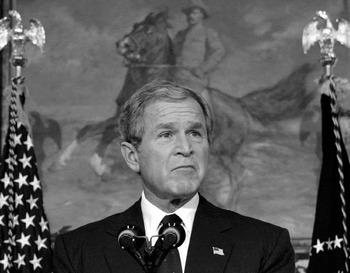
Bush II's connection to TR is more complicated, as the second image suggests. Whereas TR truly transformed his body into a cowboy, G. W. Bush, however fit, only looks the part. Standing below a photograph of the Rough Rider during a White House news briefing on 2 July 2003, Bush challenged Iraqi militants to “bring them on”. In the same room, he earlier declared, “the game is over” (Figure 2).Footnote 74 Historians William Marina and David T. Beito have argued that “Teddy Roosevelt Fathered the ‘Bush Doctrine’” of preemptive war.Footnote 75 Or, as another commentator has explained, the Bush doctrine of preemption is just another name for a “cowboy ethics” that justifies US interventionism abroad on the basis of “a sense of moral providence,” “the world in terms of a good/evil dichotomy,” “the right to anticipatory self-defense,” “a willingness to act alone,” and “a sense of duty to defend the weak”Footnote 76 – characteristics applied to TR as well. But the lip-biting Bush undermines his own identification with Roosevelt's muscular imperialism. His face suggests that this time interventionism would lead to farce if the Iraq War did not have all the elements for becoming a national nightmare, draining both material and human resources.
US President George W. Bush pauses while talking about Iraq and President Saddam Hussein in front of a portrait of Teddy Roosevelt in the Roosevelt Room of the White House in Washington, 6 February 2003. © Reuters/CORBIS

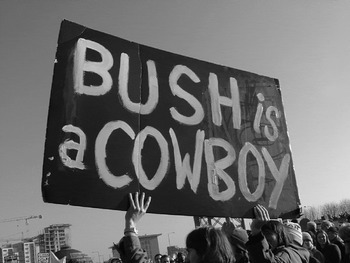
The cowboy moniker has stuck with Bush II. Where Republican partisans during the contested 2000 election in Florida proclaimed, “This Country Needs Cowboys, Not Smarty Pants,” a few years later anti-war protestors at home and abroad held signs, as one in Glasgow, Scotland, far less favorably declaring that “Bush Is A Cowboy” (Figure 3).Footnote 77 The Los Angeles Times likened his March 2003 ultimatum to Saddam Hussein to “a Wild West sheriff warning the bad guys to get out of town.” It was “giving Saddam and his boys 48 hours to get out of Dodge.”Footnote 78 But Cartoonist Charles Pugsley Fincher scorned “Cowboy Bush's Cowboy Plan for Terrorists” as a bad replay of the movies.Footnote 79 “Old West Cowboy Ethic” may have remained “the American Way to Fight Evil,” but, for Europeans, the cowboy has become the “symbol of reckless irresponsibility.”Footnote 80 Hans Ulrich Klose of the German parliament complained, “the way he talks, this provocative manner, the jagging of his finger at you … It's Texas, a culture that is unfamiliar to Germans. And it's the religious tenor of his arguments.”Footnote 81 As the war began the Ventura Country Star (California) described his lack of European support: “If Bush is the cowboy sheriff, he's riding without a posse.”Footnote 82 Democratic opponents lamented his go-it-alone behavior, with Connecticut Senator Chris Dodd insisting that we must not “act like a unilateral cowboy.”Footnote 83 The libertarian Santa Barbara News Press concluded, “George W. Bush's brand of cowboy justice hasn't served the country well”; his going it alone had undermined the US position in the world.Footnote 84
Anti-war demonstration, Glasgow, March 2003. Photographer: Leon McDermott

PERSISTENT ICONS
George W. Bush may have distorted “the Cowboy Code,” as a Village Voice columnist claimed, by failing to protect the little guy and the weak or stick by his word and be truthful or work hard while maintaining dignity.Footnote 85 But his foreign policy has come to stand for “cowboy diplomacy,” so that when it appeared that he was consulting with allies, Time magazine announced “The End of Cowboy Diplomacy” with a cover featuring a big Stetson with the presidential seal and a pair of boots sticking down from it. Bush II apparently floated notions of interdependence only when, as realpolitik Washington Post columnist Charles Krauthammer explains, “there is something the allies will actually help accomplish, or … There is nothing to be done anyway, so multilateralism gives you the cover of appearing to do something.”Footnote 86 Still other commentators countered that “Cowboy Diplomacy Is not Dead yet,”Footnote 87 continuing to defend “a cowboy over a ‘Kum-ba-yah’ type any day”Footnote 88 The cowboy remained an icon of masculinity, independence, and action.
The welfare queen has not only persisted as a descriptor of poor single mothers but migrated to additional referents, others who illegitimately get rich from public funds. Thus, in receiving foreign aid, the Republic of Korea goes to the top of the US State Department's “foreign policy welfare queens.” As the state with the most federal assistance per capita, Alaska has become “a welfare queen.”Footnote 89 Meanwhile, the political left hurls “welfare queen” as an epithet at corporations for undeservingly dipping into public coffers. Thus, in paying workers so little that they have to rely on food stamps, Medicaid, and the earned income tax credit, Wal-Mart has transferred costs of doing business onto taxpayers, while other companies, like Boeing, live off federal contracts. An Arizona Green Party chapter compared support of “the welfare mother” with that of the “corporate welfare mother,” who costs the government billions of dollars more.Footnote 90 Such designations reinforce the negativity of welfare and thus legitimate the term in its original signification of the dependency of poor black mothers.
These tropes of independence and dependence are powerful precisely because they tap into historical memories and lend themselves to multiple readings or manipulations. But we need not construct a new world order on the basis of old myths. Feminist theorists of care, and other advocates for social justice, offer an alternative to such binary oppositions; we have emphasized interdependence over the dyad of dependence/independence.Footnote 91 Globalization has connected people more tightly than ever before as producers, consumers, and even reproducers. We are dependent on each other for the air we breathe and the water we drink, as much as for goods and services. Nuclear or biological terrorism, bird flu, or other pandemics will wipe out people who seem distant but have become close. A truly new world order will put cowboys and welfare queens to rest.