


Why do states accommodate some self-determination (SD) movements but not others? Recent accounts have looked at some features of groups that affect their ability to bargain with the state and at the larger strategic environment in which they do so.Footnote 1 Yet, these works, as well as most cross-national studies of separatism, have largely ignored the role of these movements’ internal structures, despite the fact that most SD movements are internally divided.Footnote 2 Since the 1960s, only about 37% of SD movements could be considered unitary actors, with one clear leader, during the majority of their interactions with their host state.Footnote 3 In reality, groups such as the “Kurds” or “Kashmiris” comprise a variety of different organizations, sometimes with different preferences and different relationships to the state.
The internal structures of movements should have a profound effect on whether they receive concessions from states. In fact, qualitative analysis of particular cases often focuses on the complexity born of internal division.Footnote 4 However, because the effect of internal divisions has not been explored generally, there are multiple potential arguments that could be made about the impact of internal divisions on concessions.
The conventional wisdom on the role of internal divisions follows a divide and conquer logic focusing on the weakness of actors. Internally divided SD movements have difficultly presenting a coherent, strong challenge to the state, and are, in fact, often rife with internecine conflict. FactionsFootnote 5 in these movements make differing demands on the state and compete with one another, and, in many cases, each faction claims to have widespread support from its population.Footnote 6 Often neither the state nor the SD factions know what kind of concessions would resolve the dispute.Footnote 7 Moreover, these divided movements frequently appear unable to make credible commitments that would facilitate settlement because they cannot rein in more extreme factions. Due to these challenges, states will forgo attempting to “settle” disputes with these movements in favor of trying to divide (or capitalize on existing divisions) and conquer the SD movement by fighting factions individually, fostering conflict between factions, or coopting factions through side payments unrelated to their collective demands.
However, this divide and conquer logic is based on the idea that a concession, or a bargained outcome generally, is the end point of a dispute, and that settlement and fighting are two sides of a coin. Here, I introduce the possibility that concessions are not only an outcome, but also part of the strategic bargaining process. If this is true, then states have incentives to grant concessions to divided movements even if these do not fully resolve the underlying conflict. Internal divisions not only are a sign of an SD movement's weakness, but also provide an opportunity for states to bargain with different partners and pursue concessions without satisfying everyone in the group. States may do this for a number of reasons. Concessions can reveal information about what most of the SD movement wants and flush out strategic separatists. States can also try to use concessions to bolster their preferred SD faction and strengthen moderates.
Do states follow a divide and conquer or divide and concede logic when faced with divided SD movements? Properly addressing this question requires comprehensive data on the internal characteristics of SD movements and on the concessions they receive, and, prior to this study, these data have not existed. Here, I present new data on both internal divisions and concessions. I evaluate whether concessions go to relatively unitary or relatively divided SD movements, and I find that internally divided movements are more likely to get concessions from their host states. I also find that concessions have different effects based on whether they are granted to unified or divided movements. When concessions are granted, if the movement is unified, then it is longer until the outbreak of violence and subsequent concessions than if the movement is divided. Despite these different effects, we know from the analysis presented here that states give concessions to divided movements more frequently. These results suggest that states use concessions to achieve different ends when facing unified or divided movements.
This article proceeds in three parts. In the first, I present in more detail the logic of the divide and conquer and the divide and concede approaches. These competing logics suggest different predictions about the frequency and effects of concessions that should be made to divided and unitary SD movements, as well as a shared prediction about the size of concessions. Then, I describe the new data that I use to evaluate the impact of internal divisions on concessions and report the results of several empirical analyses. I conclude by discussing the implications of these findings for the two approaches and avenues for further research.
THE LOGIC OF DIVIDE AND CONQUER
We can think of states as deciding whether to make concessions to internally divided SD movements and assume that states want (1) to minimize the costs put on them by ongoing disputes,Footnote 8 and (2) to concede as little as possible because they are generally reluctant to lose power.Footnote 9 Moreover, they are uncertain about what the SD movement would settle for and whether the SD movement can credibly commit to a new deal—both of which are compounded by internal divisions.
Internal divisions in SD movements affect both the costs the movement can impose on the state and the extent of concessions they can expect. We typically believe that success in conflict and bargaining is the result of how strong actors are, relative to each other. All else held constant, the stronger party in a dispute should end up with more, whether this occurs through negotiation or battle.Footnote 10 In this context, internal divisions weaken an actor if the actor can no longer bring the totality of its strength to bear on the dispute. For example, divisions in the Sri Lankan Tamil Movement undermined the potential challenge that this movement could present to Sri Lanka. Factions in SD movements, even when they have the same goals, prefer to maintain their autonomy from one another; they differ markedly in the strategies they employ and how they engage with the state. For example, the Alliance of Palestinian Forces and Fatah both sought an independent state of Palestine, but the Alliance of Palestinian Forces explicitly rejected the diplomatic peace process in the 1990s. Thus, the aggregate strength, or power, of internally divided movements is diminished because factions within them often do not work together to achieve their aims.
In some cases, internal factions further decrease the strength of the movement's challenge to the state by fighting one another. Internecine conflicts between factions that represent the same people occur frequently in divided SD movements. In Chechnya, for example, factions seeking independence from Russia have devoted significant resources to fighting each other. Fighting between factions decreases the strength of the movement as a whole, diverting attention and effort away from challenging the state.
Unified movements, then, generally present stronger challenges to the state and thus should get larger concessions.Footnote 11 The divide and conquer logic also suggests that states may see an opportunity to defeat more divided movements without making any concessions to them.
In addition to decreasing the strength and coherence of separatist challengers, internal divisions can hinder bargained settlement with the state because movements with internal divisions will have difficulty making credible commitments to abide by a settlement. This means that states may fear that granting concessions will not resolve the dispute because some SD factions will continue challenging the state. In that case, the state will have both given concessions and may not have decreased the costs it bears in the dispute. Perhaps the most well-known example of this is Yasser Arafat's failure to “deliver” the Palestinians after negotiating a compromise between his group and the Israeli government. Whatever the good intentions of Arafat, he and his organization could not rein in more extreme Palestinian factions that pursued violence in the wake of the agreement. Concerns about the ability of SD leaders and factions to deliver their constituent population can make bargained settlement with divided SD movements unattractive for states if they believe that concessions to these movements cannot settle the dispute.
Because divided movements are often weaker and have difficulty making credible commitments, the divide and conquer approach expects that states will forgo concessions to divided movements in favor of marginalizing or eliminating the threat they pose. This means that concessions should be more likely when states are facing unitary, rather than divided, challengers. In addition, when concessions are made to more unitary movements, they should reflect this greater strength of the movement and therefore be relatively large compared to any concessions that are made to divided movements. Finally, because unified movements can make credible commitments and receive more dramatic concessions, once these concessions are granted they should be more likely to resolve the underlying dispute.
THE LOGIC OF DIVIDE AND CONCEDE
The divide and conquer logic suggests that divided SD movements will not be accommodated by states because they are weak and unable to make credible commitments. Yet, if we see accommodation not only as an outcome, but also as a strategic act by states, then divided movements appear to be an attractive target for concessions.
The divide and conquer logic focuses on the weakness and commitment problems that arise from internal divisions; however, these divisions also create information problems by making it unclear what concessions would satisfy most of the SD movement. States can use concessions to address these information problems by making the preferences of the movement clearer and flushing out strategic separatists.Footnote 12 In addition, concessions can be used to strengthen factions with more moderate positions in the movement. By negotiating concessions with specific factions of a SD movement, the state can observe the response of other factions to the concessions, which reveals information about what kind of accommodation would satisfy “key factions” in the movement.Footnote 13 States, then, can use concessions to reveal information about the movement's reversion point (i.e., the state can “screen” the movement).Footnote 14 For example, the Algerian government made minimal concessions over language policy to the Berber people in 1995, but followed with more substantial concessions as the Berbers engaged in mass protests over the insufficiency of the initial concessions.Footnote 15 Concessions, then, when used strategically, can reveal information about preferences and the resolve of the SD movement, which we have typically thought of as occurring through fighting.
Concessions to divided SD movements can also flush out strategic separatists.Footnote 16 Those factions that support independence as a bargaining posture may be satisfied by more limited concessions; however, actually agreeing to them can be untenable to the leaders of the most extreme factions.Footnote 17 States offering concessions that meet limited demands of the movement can flush out strategic separatists in divided SD movements because these factions respond positively to the concession. For example, Shanti Bahini demanded independence for the Chittagong Hill Peoples from Bangladesh, but demobilized in response to the 1997 autonomy deal that devolved economic and political power to the group through the creation of a regional council.
Moreover, if states employ concessions as part of the bargaining process, then they can use accommodation strategically to try to strengthen the position of moderates in the movement. Instead of working to fully settle the dispute, concessions can be designed to benefit moderate factions and integrate the self-governance demands of SD movements into the larger political system. In particular, resources passed to these factions through accommodation can bolster factions that participate in the settlement, influencing the intramovement competition between factions. The creation of the Bodoland Autonomous Council (BAC) in India illustrates this. The BAC agreement created a local governing body with an executive council and dealt with a range of policy issues. The negotiations that led to the BAC were conducted with a number of more moderate Bodo factions.Footnote 18 After the agreement, the BAC became the primary forum for competition among Bodo factions, deflecting their attention from challenging the state for more power (Cunningham Reference Cunningham2007).
If making concessions is part of the bargaining process, rather than just a potential end point, then divided movements provide opportunities for states to use concessions to reveal information, flush out strategic separatists, and strengthen moderates. In such cases, the credibility problems of divided movements are obviated because the state is not using concessions to establish a final settlement. Moreover, we should not expect these concessions to be fully accepted by the movement, or even lead to lasting peace. Empirically, we see instances of governments pursuing concessions when it is clear that one or more of the SD factions plans to violently resist.Footnote 19 That is not to say that states are not seeking peaceful settlement, but that concessions to SD movements are not used only to achieve that settlement.
If states follow the divide and conquer logic, then concessions should go to unified movements that pose a clear challenge to the state and that can make credible commitments more readily. Thus, concessions should generally resolve disputes. If states follow a divide and concede logic, however, then concessions should going to divided movements, and multiple concessions being made to the same movement. Thus, we should expect continued contestation after concessions (particularly after early concessions). Both logics would predict that concessions to divided movements will be smaller in scope, all else being equal. In this article, I use new data to determine whether states respond differently to divided SD movements and whether the patterns of who gets concessions and the effects these have follow the expectations of either approach.
EMPIRICAL ANALYSIS
Whether states follow a divide and conquer or divide and concede logic in their response to divided SD movements is an empirical question that requires detailed data on the structure of SD movements and concessions to them. Moreover, to evaluate whether states use concessions with divide and concede objectives, we need to look at more than comprehensive settlements that occur after armed conflicts. If concessions are used to manage SD demands through strengthening moderate factions and flushing out strategic separatists, then we should observe these in times of peace and lower-level militancy, as well as full-blown conflict situations. In this section, I present new data that allow for analyzing these questions on a range of cases spanning peaceful to violent SD disputes.
The Population of Self-determination Disputes
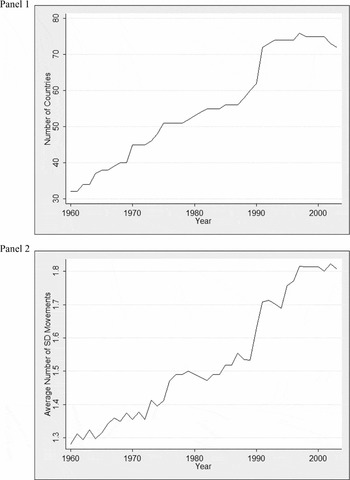
Self-determination movements—where an ethnonationalist group claims a right to greater self-rule based on its identity—occur in many countries throughout the world. The Center for International Development and Conflict Management (CIDCM) identifies the occurrence of 148 SD movements since the late 1940s (Marshall and Gurr Reference Marshall and Gurr2003). Although these disputes have occurred throughout the past 60 years, they have become increasingly common. Figure 1 shows the temporal trends in SD movements from two perspectives. In the first panel, the graph shows the number of countries facing SD movements over time. The second panel shows the average number of SD movements that these countries face over time.Footnote 20 This global picture indicates a general trend of an increase in SD movements since 1960, with a sharp jump at the end of the Cold War. A number of scholars have examined the impact of the Cold War—and its end—on nationalism and conflict processes, and the findings of these studies have been mixed, with contrasting arguments that it dampened or enflamed civil conflict.Footnote 21 If, as some suggest, the end of the Cold War has decreased resources to states to suppress domestic threats, then this may explain the increase we see in SD movements.Footnote 22 Moreover, the international system appears to be less supportive of the emergence of new states post–Cold War, although not necessarily unsupportive of SD claims, which can be cast as questions about basic rights.Footnote 23 In either case, the challenges of self-determination have increased markedly in the past several decades.
Temporal Trends in SD Challenges (Panel 1: Number of Countries with SD Movements; Panel 2: Average Number of SD Movements per Country)

The Study Sample
To evaluate the competing logics presented previously, I use a simple random sample of SD movement/state dyads selected from this population of SD movements.Footnote 24 I use a random sample because of the large number of movements and the time intensiveness of coding internal structure over time. The sample includes approximately 50% of SD movements from the CIDCM list. The unit of analysis is state/movement dyad year, and the data set spans from 1960 to 2003.Footnote 25 The data set includes 73 SD movements operating within 45 countries. The sample includes violent, militant, and nonviolent SD movements (based on the CIDCM designation) in a variety of different types of states.Footnote 26 Within the sample, 48% of cases (35 movements) are violent (i.e., they experienced civil war at some point). In 22% of cases (16 movements), the SD movement engaged in militant politics, whereas in 30% of cases (22 movements), only conventional political strategies were used. By including a diverse set of cases, as opposed to restricting the sample, for example, to just civil wars or just democracies or nondemocracies, I can evaluate the role of internal divisions controlling for other factors.Footnote 27 A list of cases is provided in the supplementary online Appendix (available at http://www.journals.cambridge.org/psr2011006).
Using a random sample ensures probabilistic equivalence between the sample and the population. In this case, it means that any differences between the sample and the population are unlikely to be related to how internally divided the SD movements are. Randomization does not guarantee that the sample will be representative; however, this sample is similar to the population on a number of dimensions. The distribution of cases in the sample is roughly equivalent to the full CIDCM list with respect to geographic region. In the sample, the bulk of cases are found in Asia (36%), Eastern Europe (19%), and sub-Saharan Africa (20%), with 15% of cases in the West, 6% in Latin America, and 4% in the Middle East/North Africa. These proportions are similar to the distribution in the population, which is Asia (30%), Eastern Europe (21%), sub-Saharan Africa (23%), the West (15%), Latin America (5.5%), and the Middle East/North Africa (5.5%). The spread of wealth across cases in the sample is also fairly representative of the full list,Footnote 28 as are the percent of observations in democratic countries (with 47% of observations in the CICDM list being democratic and 46% in the sample).
Variation in Self-determination Movement Structure
Because existing cross-national studies have generally ignored variation in the internal structure of SD movements, there is little systematic data on this across cases. This article presents a major advancement on that front. For an organization to be identified as an “SD faction,” two primary criteria had to be met: (1) it had to represent the SD group, and (2) it had to make demands related to self-determination. Self-determination demands include those related to the group's autonomy (cultural, economic, or political), independence, or inclusion in another state.Footnote 29 Examples of SD factions include the Kurdish People's Democracy Party in Turkey, who demand cultural autonomy; the National Movement of Kosovo, who demand a greater Albanian state; and the Republican Movement of Crimea in Ukraine, who demand independence for Crimean Tatars. A detailed account of the coding procedure and sources are found in the supplementary online Appendix.
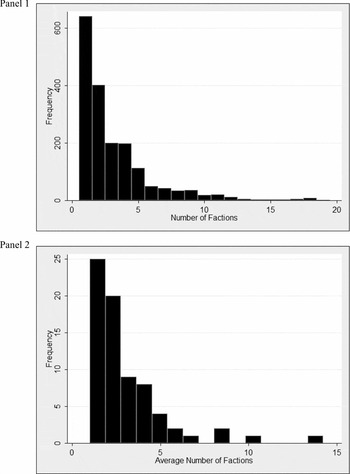
My exploration of the inner workings of SD movements has uncovered a number of interesting patterns. An examination of all SD movements in the sample shows that these movements can be considered unitary (with only 1 SD faction making demands on the state) in only about 35% of movement/state dyad years. Empirically, we see that SD movements alternate between periods of unity and internal division. Although about 84% of the movements in the sample can be considered unitary at some point in time, only 37% remain unified during most of their interaction with the state. Among divided movements, there is great heterogeneity in the degree of internal divisions. The average number of internal factions within SD movements across the time period ranges from 1 faction (e.g., the Hmong in Laos) to about 13 factions (e.g., the Kashmiri Muslims in India). Figure 2 shows the frequencies of each number of factions across all cases and years (panel 1) and the averages for SD movements spanning the time period (panel 2).
Frequency Distributions of the Number of Internal Factions (Panel 1: Number of Factions; Panel 2: Average Number of Factions)

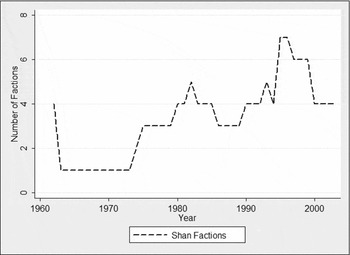
The number of factions in SD movements also varies over time in almost all movements in the sample. More than 90% of movements experienced a change in the number of factions since 1960. To illustrate, Figure 3 shows the trends for the Shan in Myanmar over time. The dashed line indicates the number of Shan factions making demands about self-determination. The movement experienced upward and downward shifts in the number of internal factions over time, with a brief period in which they could be considered unitary in the late 1960s/early 1970s. Looking at temporal trends more generally, I find that there is a trend toward more internal divisions within SD movements over time, particularly after the Cold War. A difference of means test indicates a statistically significant difference between the number of factions in SD movements during and after the Cold War.Footnote 30 The emergence of a greater number of SD factions may be the product of the dual processes of democratizing formerly communist states and decreased capacity of states previously bolstered by the superpowers.
Trends in the Number of Factions in Shan of Myanmar over Time

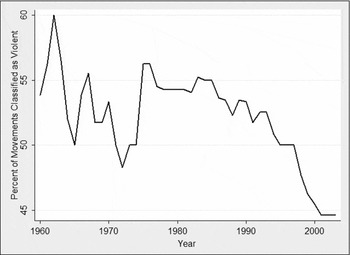
Identifying SD factions on a yearly basis is a substantial contribution to existing data on civil conflicts and nonviolent disputes over self-determination. At present, much of the data on this type of actor are constrained to armed conflicts and are available for only a limited number of years.Footnote 31 Including violent and nonviolent cases captures a much greater range of SD disputes, and nonviolent cases constitute an increasing proportion of SD challenges. Figure 4 shows the percentage of cases classified as violent by CIDCM over time.
Trends in the Percent of Violent Movements over Time

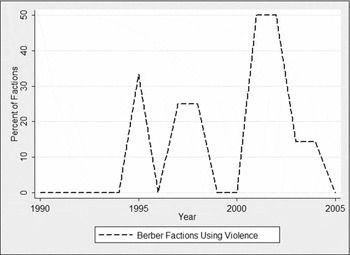
The graph shows a number of ups and downs in the percent of violent cases in the 1960s and 1970s. After about 1980, it shows a fairly steady decline in violent movements as a percent of all SD movements (which Figure 1 shows increases steadily throughout the period). Moreover, by identifying SD factions in a set of both violent and nonviolent cases for all years in which they pressed demands on the state since 1960, I include cases where contestation shifts between violence and nonviolence, or where factions use different strategies within the same movement. A closer look at a single case shows how the use of violence varies over time within one movement. Figure 5 shows the percent of factions using violence by year in the Berber movement in Algeria.Footnote 32
Trends in the Percent of Berber Factions Using Violence in Algeria

The Berber movement began in the early 1960s. Figure 5 shows the recent trends in the use of violence, which began in the mid-1990s. Between 1995 and 2005, seven factions were active in the dispute, and six of these factions alternated between violent and nonviolent strategies to press Berber demands on the state. Including violent, nonviolent, and militant SD movements in the same study allows me to assess the effects of internal structure on the likelihood that these movements will get concessions controlling for open conflict, but not assuming that violent or peaceful methods will be more successful.
I construct two variables measuring internal structure of movements to test the competing logics described previously. First, I create a dummy variable indicating whether the movement is unitary (i.e., it was represented by only one faction in a specific year). Second, I construct a logged count variable of the number of active SD factions each year of the dyad.Footnote 33 I log the number of factions because I do not expect the addition of a faction to a very divided movement to have the same effect as it would to a unitary movement.
These variables capture the number of divisions in an SD movement, which should affect concessions based on either the divide and conquer or divide and concede approaches. What these variables do not tell us, however, is the degree to which one or more of these factions are stronger than the rest, or perhaps seen as a more legitimate representative of the SD group. If a divided movement has a dominant and strong faction, then it would present a greater challenge to the state than an otherwise similar movement comprised of evenly matched factions. Yet, even if this were the case, the logics of both divide and conquer and divide and concede would still apply. Because these divisions still create credibility problems for states, and even small factions can impose large costs on the state, we should expect the disincentive for concessions to hold based on the divide and conquer logic. Moreover, states can take advantage of these divisions whether there is one stronger faction or many evenly matched ones if states use concessions to reveal information, flush out strategic separatists, or bolster moderates. So, for the purposes of evaluating whether concessions go to unitary or divided movements, knowing how many factions exist is sufficient. An interesting extension would be to explore how the balance of power between factions in SD movements might affect concessions to them or other conflict processes.Footnote 34
Concessions to Self-determination Movements
The dependent variable is concessions over self-determination made to SD movements. The data set includes 108 concessions, which include a variety of different types of accommodation, as well as diverse means though which the concessions are made.Footnote 35 The concessions measure is coded as accommodation related to the group's identity and status.Footnote 36 Empirically, concessions are made over a large range of issues related to self-determination, such as language policy, control over taxation, policing, the structure and competencies of local government, and independence. Many concessions entail the transfer of powers over multiple issues, such as cultural protection, economic autonomy, resource control, and political powers.
Exploring these concessions, several patterns emerge related to process, form, and content. The processes through which concessions are made vary in a number of ways. In some cases, talks between the state and the SD movement go on for many years, as in the Chittagong Hill Peoples case in Bangladesh, where negotiations began in 1985 and continued on and off for 12 years. In contrast, talks between the Tuaregs and the Niger government led to a signed agreement within six months of the initial ceasefire. At times, concessions do not follow from either formal or informal talks (e.g., the easing of restrictions on Kurdish culture in Turkey).
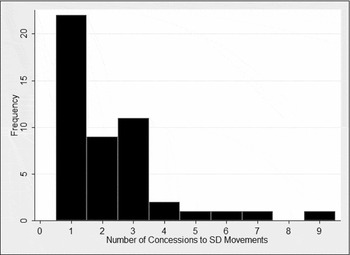
More than half of the concessions were made through legislation or codification though the court system (e.g., legal precedents). About 17% of concessions were enacted through changes in the constitution (e.g, increases in Walloon autonomy leading up to federalism in Belgium, and the creation of a local government with its own president on Anjouan in Comoros). Only about 11% of concessions appear directly related to military victories, and 4% can be considered de facto because they were obtained entirely by movements without explicit consent on the part of the state.Footnote 37 Exclusively cultural concessions (those that are neither political nor economic in nature) comprise about 21% of the concessions and relate primarily to the use of native languages. Just more than half of the concessions are subsequent concessions in the data set, preceded by at least one concession. Figure 6 shows the frequency distribution of the number of concessions to SD movements. About 34% of movements in the sample get no concessions, 22% get one concession, and 26% get more than one.Footnote 38
Distribution of Concessions to SD Movements

Given the range of types of accommodation, my dichotomous measure of whether the movement got a concession in a year may seem blunt. Indeed, the difference between language protection and a new autonomous local government is substantial. However, treating different types of concessions as if they were a continuum of “less” to “more” is problematic. There is a great diversity of demands made over self-determination, and a large diversity of demands that give rise to violence.Footnote 39 The value of the concessions depends on what the SD movements wants. Moreover, specific demands can have multiple implications because the connection between issues such as language policy, identity, and resource control can be closely related in these disputes. Indeed, many concessions are multifaceted—addressing a number of policy areas—which makes categorizing them difficult and potentially misleading.
Instead of subjectively assessing the magnitude of the concessions, I code another, stricter version of the concessions measure. The strict measure includes only concessions that devolve power (over economic policy, administration, or political process for the group generally) or increase the group's power at the center. For example, the devolution of greater control of local political processes and economic decisions to the Buryat in Russia in 1996 is included in the strict measure; however, increase in language rights to the group in 1993 is not included because this does not directly devolve any power to the group. The strict measure of concessions includes 77% of those included in the primary measure. The pattern of iterated strict concessions is similar to the primary measure, although fewer movements receive these types of concessions. About 41% of movements get no concession, 32% get one concession, and 27% get more than one strict concession. A description of each concession, whether it is included in the strict measure, and the coding procedure are provided in the supplementary online Appendix.
The degree to which concessions are “granted” by the state and “accepted” by the movement is an interesting, but difficult question to address in a cross-national study. When SD movements are internally divided, some factions may accept (and be satisfied by) the concessions, whereas others do not. This was the case for the Chittagong Hill Peoples in Bangladesh after both the 1989 and 1997 concessions. What constitutes “acceptance” of a concession can also be difficult to assess. Concessions can be largely accepted, but not lead to the end of SD demands (e.g., the Quebecois acceptance of language protection from the Canadian government in 1969). If we think of making concessions as strategic behavior on the part of governments, then it is not clear that concessions need, or would be designed to need, formal acceptance in many cases. Instead of trying to determine whether concessions have been accepted, we can assess the degree to which concessions satisfy the SD movement, which I do in an analysis on the effects of concessions in the next section.
Do Concessions Go to Divided or Unitary Self-determination Movements?
The primary difference between the predictions of the divide and conquer and divide and concede logics is that the former predicts that concessions will occur more frequently to unified movements, and the latter predicts that they will occur more frequently to divided movements. I use these data on factions in SD movements and concessions to evaluate whether structure appears to matter, and in what way.
I employ a logit model because the concessions variable is dichotomous and cluster the standard errors on country because some SD movements in the sample are in the same country. One difficulty of this kind of analysis is that government concessions to an SD movement are not necessarily independent of previous concessions to the same movement. To deal with temporal dependence of iterated concessions, I account for the number of years since a concession was made to the movement using the Beck, Katz, and Tucker (Reference Beck, Katz and Tucker1998) binary time-series–cross-section method.
I use two sets of models. The first set of “core models” includes only additional variables that are likely to influence both the number of movement factions and the occurrence of concessions.Footnote 40 Although there are other factors that likely influence the dependent variable (concessions), the inclusion of a large set of controls not believed to be related to both the dependent and independent variables can introduce bias into the model (Achen Reference Achen2005; Clark Reference Clarke2005; Ray Reference Ray2003). A second set of “controlled” models includes additional factors related to bargaining success or failure from the conflict literature. These models allow me to determine the robustness of the findings in the core models and compare those findings with the effects of factors typically associated with bargaining and conflict.
In the core models, I include three characteristics of the group: the size of the group's population (logged), whether it has kin in an adjoining state, and the heterogeneity of demands made by the movement. Larger groups may hold more sway with the government relative to smaller groups and may generate more factions through a diversity of preferences. Groups with kin in neighboring states are likely to have more factions as kin seek to influence the group's politics, and the existence of a neighboring state with ethnic kin may also affect the government's decision to make concessions (Jenne Reference Jenne2006). A greater diversity of demands may lead to more factions and affect the willingness of states to concede by increasing uncertainty.
I also control for two characteristics of the state: whether the state is federal and whether it is democratic. The extent to which groups already have local control may affect the willingness of the state to make concessions and influence the number of factions in the SD movement.Footnote 41 Open competition in democratic states and the norm of respecting citizen demands should also lead to both more factions and more concessions in democratic cases. Moreover, democratic governments tend to be more constrained in making and changing policy, which can increase their credibility with SD movements if both making and reneging on concessions are difficult (Spruyt Reference Spruyt2005; Tsebelis Reference Tsebelis1995).Footnote 42 State credibility should affect the incentives of SD factions to respond positively to any particular deal, especially if concessions require factions to reduce their mobilization,Footnote 43 and this will affect when we observe concessions. Finally, I control for two factors related to the strategic interaction of the movement and the state: whether the movement received concessions previously and whether the movement and state were in conflict in the previous year. Groups that have already been accommodated may be more likely to get concessions if the state is using them to reveal information, but less likely to do so if the concession is an attempt to settle the dispute fully. Concessions could lead to more factions if parts of the group contest the change. Similarly, open conflict can create new factions if some factions are opposed to war. It is unclear what effect violence should have on the likelihood of concessions, but bargaining theories argue that violence is a way of imposing costs to gain concessions.Footnote 44
In addition to the core models, I run a controlled model for each movement structure variable. These include factors likely to be associated with whether concessions are made and the degree to which movements can and are likely to challenge the state. They fall into three categories: (1) variables that capture the relative power of the movement vis-à-vis the state, (2) factors that make insurgency more likely or easier for movements, and (3) state characteristics associated with willingness to give concessions or use violence.
Relative Power. The relative power of the movement vis-à-vis the state should be a key determinant of whether the state wants to accommodate the movement because this should determine the size of concessions that the state needs to make. I use two proxies to account for relative power: a measure of the relative size of the SD group's population compared to the state and whether the group has a territorial base. Relatively larger groups and those that can use their home territory as a base for conflict (and to draw supporters from) should be more powerful than otherwise comparable groups without these features.Footnote 45
Likelihood and Ease of Insurgency. Previous studies have identified several structural factors that are consistently associated with an increased risk of civil war in countries. To control for these, I have calculated the predicted probability of civil war onset for each country (following Fearon and Laitin Reference Fearon and Laitin2003, Reference Fearon, Laitin, Box-Steffensmeier, Brady and Collier2008). I include this as a measure of country-level propensity for civil war onset. The model used to generate this variable includes a one-year lag of logged state population, one-year lag of gross domestic product (GDP) per capita, logged mountainous terrain, oil exporter dummy, new state dummy, political instability, and a one-year lag anocracy dummy.Footnote 46 Each is argued to make insurgency easier or more profitable in some way, which may negatively influence the willingness of SD factions to negotiate for concessions and thus make states less likely to use concessions to manage SD claims. In addition to the country-level civil war onset propensity, I control for the level of grievance of the group (based on the MAR economic discrimination score) because more disadvantaged movements may be more likely to challenge the state.
State Characteristics. This article focuses on the effect of internal divisions of SD movements on their bargains with the state, but conceptually puts the state in a black box. However, the process of bargaining over self-determination is interactive and states bargaining with SD factions are themselves neither identical nor unitary. The civil war propensity variable captures some of these differences. To account for further differences among states, I include two other variables. First, I include military expenditure per capita to account for differential strength of states. Second, I control for the number of SD movements in a state, which may influence its willingness to make concessions if it fears encouraging future challenges (Toft Reference Toft2003; Walter Reference Walter2006). Although many states face an internally divided SD group [e.g., the East Timorese were represented by the Democratic Union of Timorese, the Revolutionary Front of Independent East Timor (FRETILIN), and the Socialist Association of Timor among others], many states also face multiple, different challenges over self-determination. In addition to the East Timorese (who gained independence), Indonesia faces three other challenges over self-determination: the Aceh, the Dayaks, and the Papuans.
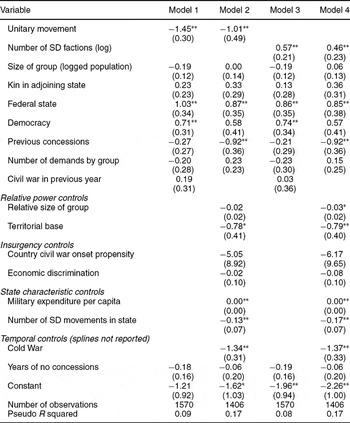
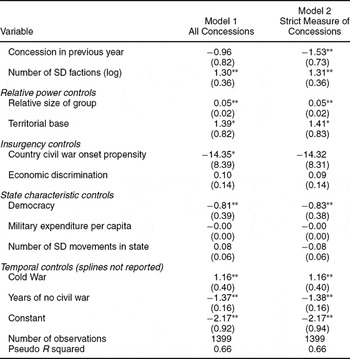
Table 1 reports the results of four logit models on the concessions variable using the two measures of movement structure: unitary movement dummy and the logged number of SD factions. Models 1 and 3 are the core models, including only variables related to the independent and dependent variables. Models 2 and 4 include the additional controls for relative power, likelihood and ease of insurgency, and additional state characteristics.
Effect of Movement Structure on Likelihood of Concessions

*Statistically significant at the 0.10 level; ** statistically significant at the 0.05 level in two-tailed tests.
The coefficient on the unitary movement dummy is negative and statistically significant in models 1 and 2. Unitary SD movements are less likely to get concessions from the state than divided ones; yet, there is also a lot of variation in structure for nonunitary movements for which this does not account. Models 3 and 4 explore this variation using the logged number of factions as the independent variable. The positive and significant coefficients in these models (at the 0.05 level) suggest that not only are divided SD movements more likely to get concessions, but also the likelihood of concessions goes up as the extent of division increases. That is, as the number of factions increases, the probability of getting a concession in a specific year also increases. This result holds when controlling for a number of other factors likely to affect both the number of factions and the likelihood of concessions, as well as factors believed to influence the utility or ease of fighting the state, levels of grievance, and different state contexts.Footnote 47
Several other variables in the core models are significant predictors of concessions. SD movements in federal states and democratic states are more likely to get concessions. These institutional arrangements appear to create a favorable environment for making concessions to SD movements. In the models with more controls, the results suggest that movements that had previous concessions are less likely to receive them in any given year.
Both relative power variables are negative, suggesting that relatively stronger movements are less likely to get concessions. All else being equal, these movements should be able to present the state with a stronger challenge; however, if concessions are not made primarily in response to relative power and to resolve disputes (as the divided and concede logic suggests they are not), then stronger movements may be seen as potentially more difficult to satisfy, decreasing the use of concessions to them.
SD movements in countries with greater military spending are more likely to get concessions. Although military spending per capita is not a perfect measure of state strength, the finding that SD groups are more likely to get concessions in stronger states suggests that concessions are not made because states are weak and unable to counter the SD movement's challenge. Movements in countries with a greater number of SD movements are less likely to see concessions, supporting the argument that states care about reputation (Toft Reference Toft2003; Walter Reference Walter2006). Finally, SD movements are also less likely to get concessions during the Cold War. The suppression of nationalism in communist regimes, additional resources to states in the East's and West's spheres of influence, and growing attention to human rights in the post–Cold War period are all likely to contribute to this relationship.
These results are largely supportive of the divide and concede logic for understanding how and when states use concessions in response to SD challengers. States accommodate divided movements more often than unitary ones, and the more divided the movement is, the more likely accommodation is in any given year. This is true when controlling for the relative power of the group, ease of insurgency, and a host of state-level characteristics. A potential limitation of my concessions measure is that I include a wide range of accommodation, including cultural and linguistic concessions that might be considered less costly, if not less important, for states to make. I reproduce the analyses using the strict measure of concessions to ensure that this relationship between internal structure and concessions exists when, potentially, the stakes are higher (e.g., cases where political and economic powers are transferred). The results were largely the same.Footnote 48 More divided movements are getting not only potentially less substantial concessions such as language protection, but also concessions that devolve power to them with greater frequency than unitary or less divided movements.
The correlation between divided movements and concessions is strong and robust to the inclusion of many other factors. But because bargaining over self-determination is a strategic and ongoing process, endogeneity is a potential problem. There are two major potential endogeneity issues. First, it could be that concessions create new factions, either by establishing new organizations to represent group interests or because new factions emerge to resist the accommodation. Empirically, both of these things occur. The Australian government set up several organizations and institutions to transfer power to the aboriginal population, but these concessions simultaneously create new factions that channel aboriginal demands on the state.Footnote 49 In Bangladesh, the Woman's Hill Federation was formed to protest the 1997 deal between the Chittagong Hill Peoples and the state. The second endogeneity issue is that states may be making new bargaining partners (and thus increasing the number of factions) when they want to make concessions for other reasons. For example, the Indian government helped create the Naga People's Convention to negotiate the creation of a Naga state in India. If either occurs with frequency, then the correlation between factions and concessions may just be an artifice of how concessions are made.
Although endogeneity is a difficult problem, I have done several things to address it. First, I ran the models with lagged measures of the key independent variables (the unitary dummy and the logged number of factions) to exclude factions that emerged at the time concessions occur. The size, direction, and significance of the coefficients were similar to the initial models.Footnote 50 Second, using accounts of how and when factions became active, I recoded the number of factions to exclude any faction that emerged in the year a concession was made and could plausibly have been created by the concession or emerged directly in response to it. Using these adjusted measures, the coefficients on the unitary dummy and the logged factions variables are the same sign, but slightly smaller in size. The results remain statistically significant in all but model 4.Footnote 51
These tests do not eliminate the possibility that the process through which concessions are made influences the number of divisions in the movement. However, we can be reasonably confident that the correlation between internal divisions and concessions in a given year is not driven primarily by concessions causing these divisions in that year.
What Is the Role of Violence?
The analyses in Table 1 examine a random sample of violent and nonviolent SD movements. It includes both extremely violent cases, such as the Palestinians in Israel, and totally nonviolent cases, such as the South Tyrolians in Italy. However, there may be systematic differences in the way states respond to SD movements when there is or is not violence (or the threat of it). Both competing logics of divide and conquer and divide and concede are based on the assumption that states want to minimize the costs that SD disputes create. No disputes are completely costlessFootnote 52; however, the costs to states are much greater when high levels of violence are employed and the physical integrity of the state is threatened.
We can think about the effect of violence in two ways. First, states may act differently when violence is used in specific disputes than when it is not. Many SD disputes alternate between periods of violence and nonviolence. In Table 1, I controlled for whether conflict had occurred the previous year and found that this was not a significant predictor of concessions. Alternatively, I can examine the effects of having ever had violent conflict on the likelihood of settlement because this better captures the lingering effects of violence. I reran models 1 through 4, including previous civil war (25 battle deaths per year threshold), civil war in that year, and civil war onset. The finding that divided movements are more likely to get concessions was robust in these specifications. In these unreported tests, only civil war onset was a statistically significant predictor of concessions, indicating that concessions are more likely in years in which conflict has broken out.
Second, states may act differently in disputes when they perceive the potential for violence. If the host state never fears an armed challenge from the movement, then should we expect the same bargaining dynamics as in cases where this is a real possibility? Perhaps the logic of divide and conquer is dominant in cases where violence is a possibility, but the logic of divide and concede when violence is unlikely.
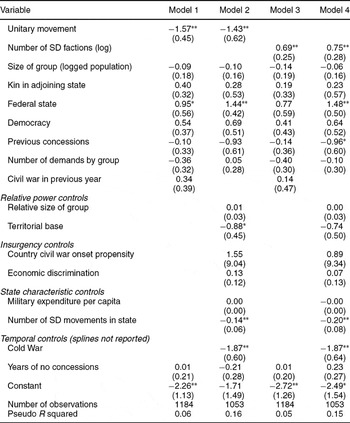
To shed light on this, Table 2 presents the results of models 1 through 4 on a restricted sample of cases. These are cases where CIDCM indicates that there has been open conflict between the movement and the state, or the use of militant politics at some point. In these cases, we can assume that the state will be concerned about the use of violence; the restricted sample includes about 75% of observations from the larger sample.Footnote 53
Effect of Movement Structure on Likelihood of Concessions (Violent/Militant Cases)

*Statistically significant at the 0.10 level; ** statistically significant at the 0.05 level in two-tailed tests.
The coefficients on the SD movement structure variables are still statistically significant and, in fact, larger in the subsample of violent or militant cases. Divided movements are more likely to get concessions, even when we examine only cases where violence seems like a plausible strategy for groups seeking self-determination. This is robust to the inclusion of many control variables. Table 2 shows, then, that the correlation between concessions and divisions within SD movements is not an artifice of including peaceful movements for self-determination that largely occur in politically open societies. Indeed, divided SD movements get concessions more often, even when violence is a real concern for states.
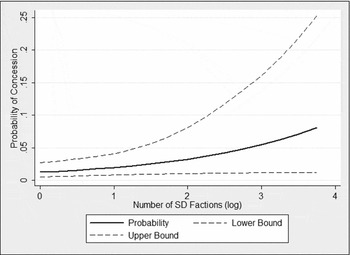
The other statistically significant predictors of concessions are whether the state is federal (positive effect), previous concessions, territorial base, the number of SD movements in the state, and the Cold War dummy, all of which decrease the likelihood of a concession in a given year. These findings are similar to the larger sample, although democracy is no longer significant. Tables 1 and 2 show a strong, consistent, statistically significant effect of internal division that is supportive of the divide and concede logic. In addition, further analysis reveals that increasing divisions have a large substantive effect as well. I use the Clarify program to generate predicted probabilities of concessions in a given year based on changes in the independent variables (King, Tomz, and Wittenberg Reference King, Tomz and Wittenberg2000). When we look at the difference between unitary and divided SD movements in the full sample, divided movements are almost three times more likely to get a concession in any given year than unitary movements (based on model 4). Moving beyond the unitary/divided distinction, Figure 7 graphs the predicted probability of concessions at different values of the logged factions variable holding all other variables at their mean or mode (based on Table 1, model 4). This is the probability of concessions in each dyad year.
Predicted Probability of Concessions by Logged Number of Factions

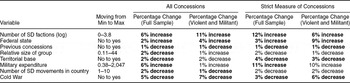
An increasing number of SD factions leads to a steady increase in the probability of concessions. SD movements with the greatest number of factions are about six times as likely to get a concession in a given year as those with only one faction. To compare the effect of increasing factions to that of changes in the other variables, I report the substantive effects of the other significant predictors from model 4. For each variable, Table 3 shows the predicted change in probability moving across the range of values the variable takes and holding all other variables at their mean or mode for both the lenient and strict measures of the concessions variables, and for both the full sample and the sample of just violent and militant cases.
Predicted Change in Probability of Getting a Concession

Compared to other factors, the logged number of factions has an equal or greater effect on the likelihood that an SD movement will get concessions in a given year in most specifications. Going from the minimum to the maximum value increases the probability of concessions by 6%. Military expenditure per capita has a similar effect, with a 6% increase in the probability of concessions when going from the minimum to the maximum value. Dyads in the Cold War period are 5% less likely to get concession in any given year. SD movements in federal states are 2% more likely to get concessions compared to those that are not. Relative group size, whether the movement has a territorial base, and the number of SD movements in the country each lead to a 2% decrease in the chance of a concession in a year when going from the minimum to maximum values. This comparably large effect of logged factions remains when I limit the sample to violent and militant cases and when I use the strict measure of concessions (see columns 4 and 5).Footnote 54 Indeed, the effect of logged factions is stronger in the violent and militant cases, where a change from the minimum to maximum results in an 11% increase in the likelihood of concessions in a year.
What Are the Effects of Concessions?
These analyses of the frequency of concessions support the divide and concede logic—that states use concessions more often when facing internally divided movements than when facing unitary movements—because they show a positive, statistically significant, and substantively important correlation between internal divisions and the frequency of concessions. In explaining the logic of divide and conquer and divide and concede, I argue that these logics are based on different motivations driving state behavior with regard to accommodation. Divide and conquer assumes that states use concessions primarily to resolve disputes, whereas divide and concede assumes that states also make concessions to reveal information or strengthen moderates. Although testing the motivation of states directly is impossible, examining the effects of concessions to divided and unitary movements can shed some light on this question. If states follow the divide and conquer logic, then we should expect the concessions they give to resolve disputes and lead to less violence. If they are following a divide and concede logic, then we would not expect concessions necessarily to end or prevent violence when given to divided movements.
Do Concessions Reduce or Prevent Violence? To determine this, I use a logit model (clustered on country) that examines violence in the immediate wake of concessions. Table 4 presents the results of this analysis. The dependent variable is the occurrence of civil conflict in a year with a 25 battle-death threshold. The independent variable is a concession in the previous year (using both measures of concessions in different models). I also include my measure of SD movement divisions (logged number of factions) and controls (described previously) for relative power of the SD movement and state, ease of insurgency, and several state characteristics associated with conflict (e.g., democracy and the number of other challengers in the state). Each factor is likely to influence the probability of conflict in any given year. As with concessions, the occurrence of conflict is likely to be related to the past, so I use a binary time-series–cross-section with a measure of time since previous conflict and cubic splines.
Effect of Concessions on Conflict

*Statistically significant at the 0.10 level; ** statistically significant at the 0.05 level in two-tailed tests.
The coefficient on concessions in the previous year is negative in both models, although it is only statistically significant in the model using the strict measure of concessions. In the short term, more substantial concessions—those that increase the power of the group—appear to reduce the chance of conflict. The coefficient on the logged number of SD factions is significant and positive in both models, meaning that years with more divided movements are associated with a higher incidence of civil conflict. This suggests a complex relationship between internal divisions in movements, concessions, and violence (discussed more later). The other significant predictors in these models are the relative size of the group (larger groups being more likely to see conflict) and territorial base (positive effect on conflict). Relatively strong groups are more likely to see conflict with the state. Country-level propensity for civil war onset and democracy are both significant and reduce the chance of conflict, whereas movements operating during the Cold War have a greater chance of conflict. The negative effect of the probability of civil war onset in model 1 is somewhat puzzling if we believe that the factors likely to influence onset and occurrence of conflict are similar. Recall, this is a predicted probability of civil war onset based on the Fearon and Laitin model. This finding suggests perhaps that the structural factors that we believe make countries more vulnerable to the start of insurgency are not having the same effect on the occurrence of civil war between SD groups and states.Footnote 55 The positive effect of the Cold War dummy is consistent with studies that suggest aid to insurgents and states in this period increased their capacity for conflict (see Kalyvas and Balcells Reference Kalyvas and Balcells2010). The years since last observation of civil war is also significant and negative; that is, the longer a dyad is at peace, the less likely is conflict.
Understanding the immediate impact of concessions is one way to assess how well they work, but we are typically interested in the more long-term consequences of accommodating SD movements. In addition, the divide and conquer and divide and concede logics both predict that concessions will have different effects depending on whether the movement is divided or unitary. Under divide and conquer, concessions will be made when they are likely to resolve the underlying dispute and avoid conflict. Under divide and concede, concessions will be made without the expectation of fully resolving the underlying dispute and continued (potentially violent) contestation by some factions is expected.
To assess the longer-term, and potentially differing, effects between unitary and divided movements, I look at the time from concessions (in years) to two possible outcomes—the outbreak of violence, defined as active civil war in that year, and a new concession. Examining Kaplan-Meier failure plots for unitary and divided SD movements,Footnote 56 I find that just more than 25% of concessions to unitary movements are followed by new concessions within 10 years, whereas about 65% of concessions to divided movements have seen new concessions within that time. Moreover, in about 10% of cases of concessions to unitary movements, violence occurs with 10 years. When the movement was divided at the time concessions were made, violence occurs within 10 years in nearly 25% of cases.
This suggests that concessions work better for unitary movements in the longer term but does not control for any other factors. To do this, I use a competing risks analysis of these two outcomes (violence and new concessions). Competing risks analysis is a type of duration analysis that allows for multiple failures.Footnote 57 This analysis examines how multiple factors affect the time to conflict or renegotiation of the group's status though new concessions, as well as whether concessions have different effects when made to unitary or divided movements.
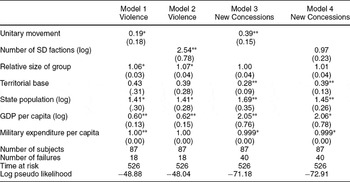
I have estimated two sets of Cox regressions. The first measures the time from concessions to violence, treating all other outcomes, including granting new concessions, as censored. The second measures the time from a concession to a new concession, treating all other outcomes as censored. Because earlier concessions may have a different effect than subsequent concessions, I stratify the analysis on the sequential number of concessions in the time period for each state/SD movement dyad. Using a stratified Cox model allows the underlying hazard to vary across the sequence of concessions (i.e., first, second, third concessions, etc.). Table 5 presents the hazard ratios for these analyses. Each model also includes several variables that measure relative strength of the movement (relative size and territorial base) and the state (logged population, GDP per capita, and military expenditure per capita). All else being equal, stronger movements should get more substantial concessions, and this may affect the degree to which concessions succeed.Footnote 58
Hazard Ratiosa

Note: GDP, gross domestic product.
a A hazard ratio less than 1 indicates that failure is less likely at any given point in time; greater than 1 indicates failure is more likely to happen.
* Statistically significant at the 0.10 level; ** statistically significant at the 0.05 level in two-tailed tests.
When a variable has a hazard ratio less than 1 this means that, at any given point in time, a failure is less likely to happen. The results in Table 5 are consistent with the Kaplan-Meier failure plots described previously. In model 1, the coefficient on the unitary dummy is significant and less than 1. Violence is less likely after concessions when movements are unitary than when they are divided. Moreover, the coefficient on logged number of SD factions in model 2 is significant and greater than 1. The greater the extent of internal divisions at the time concessions are made, the sooner violence is likely to occur after the concession. The coefficient on the unitary movement dummy in model 3 is also significant and less than 1—when concessions are made to unitary movements, it is longer until new concessions are made. The insignificant result on logged number of factions suggests that concessions made in increasingly divided movements are not necessarily more likely to see new concessions at any given point in time.Footnote 59 Models 1 through 3 support divide and concede as the logic guiding state responses to divided SD movements—concessions made to these groups are followed by more concessions and continued contestation.
The control variables also show some interesting results. Models 1 and 2 indicate that when concessions go to relatively large groups, violence is more likely to occur at any point in time after the concession. Concessions made to movements with a territorial base are less likely to see concessions again at any point in time. These two factors—relative size of the group and whether they have a territorial base—are both proxies for the relative strength of the movement. The finding that stronger movements are more likely to see conflict, but less likely to see more concessions when a concession is made to them, suggests that perhaps these movements have difficulty reining in violence, even if many are satisfied with the concession. Movements in larger and wealthier states are more likely to see new concessions after a concession is made. These variables proxy state strength and suggest that movements facing stronger states are more likely to get further concessions. Conflict after concessions is more likely in larger states and less likely in wealthier states. Wealthier states are less likely to face internal conflict, whereas large populations tend to attract conflict (Hegre Reference Hegre2008). Military expenditure has a statistically significant, but marginal effect on both violence and new concessions, which is positive and negative, respectively.
Taken together, the results indicate that the effects of concessions are, to some degree, conditional on whether they are made to unitary or divided movements. Concessions to unitary movements appear to “work” better in that they last longer—concessions to unitary movements are less likely to fail through violence or a renegotiation of new concessions. Concessions to divided movements see both the outbreak or return to violence and the renegotiation of new concessions more quickly. These results, then, suggest that states have different motivations when granting concessions to unitary and divided movements. In the former case, concessions seem to be a form of conflict or dispute management; however, when faced with divided SD movements, concessions appear to be guided by the divide and concede logic.
One common prediction from both the divide and conquer and divide and concede approaches is that unitary movements should get larger concessions, all else being equal. Measuring the size of concessions directly is problematic because the size of concessions needs to be assessed in relation to what groups want. Moreover, to understand how big a concession is relative to what the movement demands, we would need a way to determine the relative importance of different demands made by SD factions. If only a scarce minority of a SD movement supports an extreme demand such as independence, and the movement is granted extensive autonomy, then this could constitute essentially full accommodation of the movement. Yet, the same degree of concession for a movement where the majority supported independence would not be equivalent in size. Confounding this, all movements have incentives to overstate their demands as a bargaining posture, which makes assessing the size of concessions difficult.Footnote 60 Determining size based on how much power is taken from the state is also difficult because some states appear to value particular issue areas more than others.Footnote 61
Although we cannot easily measure the size of concessions to determine whether unitary movements get more, the preceding analysis gives us some reason to think so. Because concessions to unitary movements are longer lasting in the sense that the time to both the outbreak of violence and subsequent concessions is lengthened, it is reasonable to assume that these movements are more satisfied with what they get. If so, this suggests that concessions to these movements are “larger” in that they satisfy more of the demands of the movement.
IMPLICATIONS AND CONCLUSIONS
Although most cross-national studies of relations between states and ethnic groups or SD movements treat these actors as unitary, the internal structure of SD movements clearly matters. SD movements with more internal factions speaking on their behalf receive concessions much more frequently than do unitary and less divided movements. When concessions are granted to unitary movements, they “work” better in that both conflict and renegotiation of the group's status are less likely in the wake of concessions. Ignoring internal structure by treating these actors as unitary severely limits our understanding of the politics of self-determination.
Returning to the two logics that frame this article, the analyses here allow us to determine whether states generally follow the logic of divide and conquer or divide and concede when facing divided movements. The frequency with which states give concessions to divided SD movements and the effects of these concessions supports the idea that states follow a divide and concede logic—using concessions strategically without attempting to settle underlying disputes. Moreover, the analysis of the differential effect of concessions made to unitary versus divided movements suggested that states are following a different logic when responding to divided movements. When faced with unitary groups, states are unlikely to make concessions, but when they do, these appear to resolve the dispute. Divided SD groups present states with opportunities to use concessions strategically; in fact, they make myriad concessions, including at times iterated concessions, that do not resolve the underlying dispute.
Although they differ in their expectations about whether divided or unitary groups will get more concessions and what the effect of these concessions will be, both the divide and conquer and divide and concede logics lead to the same prediction about the expected size of concessions—that concessions made to more divided SD movements should be smaller. Indeed, they appear to be so. Moreover, the two logics share a prediction about conflict, although it derives from separate mechanisms. The divide and conquer logic predicts that states will be more likely to fight internally divided SD movements because there are significant barriers to negotiated settlement with them. The divide and concede logic expects concessions to divided movements to be associated with continued, potentially violent contestation because concessions will not be designed to satisfy the entire group. The empirical analysis supported this expectation (although could not differentiate between which mechanism was at work)—concessions to unitary movements are followed by longer periods of nonviolence than those to divided movements.
These empirical findings are important because they inform our understanding about which SD movements get greater local control. Taken together, they also have substantial implications for our understandings of how bargaining works. Conventionally, conflict studies treats violence and accommodation as two opposing outcomes. But the frequency with which states appear to use concessions in situations where they are unlikely to resolve disputes calls this into question. If states follow a divide and concede logic with internally divided SD movements, then they are not treating concessions as an end point, but rather as a strategic tool.
The finding here that divided SD movements engage in more violence with the state following a concession than unitary movements highlights this point. This is not primarily a study about the determinants of violence; however, the findings that divided movements not only get more concessions, but are also more likely to be involved in violence after concessions suggests a complex relationship between the internal structure of movements, the use of violence, and state responses to SD movements. Studies of civil conflict generally treat states and ethnic groups as unitary actors wherein violence is the result of bargaining failure. Yet, our understanding of the occurrence of violence is limited by this assumption if some factions in SD movements achieve bargaining success while other do not and if this process directly influences the use of violence.
These findings also beg an important question related to this interplay of concessions, relative power, and the structure of SD movements. In establishing the relationship between internal divisions and concessions, I treat these divisions within the movements as equivalent across cases (i.e., three divisions in one movement will have the same effect as three divisions in another, all else being equal). Indeed, I argue that the logic of both divide and conquer and divide and concede would apply regardless of the configuration of power among factions with respect to the frequency of concessions. Yet, the logic of divide and concede suggests that changing the relative power among factions with differing demands is a possible goal for states in using concessions. An examination of the distribution of power among factions could evaluate this claim more clearly. Moreover, additional information about the size and power of these factions could test the assumption made here that factions can be thought of as equivalent.
Similarly, in establishing the relationship between internal divisions and concessions to SD movements, I have ignored some interesting variation across factions. Some of these factions are military organizations, whereas others are social pressure groups or political parties. Although I have controlled for a number of different strategic and contextual factors here, I have not delved into what roles these different types of factions may play. Do states respond similarly when faced with more or less armed factions rather than conventional factions? How do the connections between factions—such as political wings or temporary cooperation as a “front”—matter for concessions or violence? This is an area ripe for further inquiry.
Moving beyond relations between states and SD movements, the unitary actor assumption remains a dominant one in many studies that consider strategic interaction between actors. States, rebel groups, political parties, economic classes, and religious groups have all been treated as unitary—with unified preferences and strategies. Yet, there is no reason to believe that internal divisions should be less important among these actors than they are in SD movements. Understanding politics generally requires looking within and understanding how the structure of actors affects their relations with each other.




Comments
No Comments have been published for this article.