Different personal and environmental elements involved in the teaching/learning process have been researched as influential in student achievement (Braithwaite, Spray, & Warburton, Reference Braithwaite, Spray and Warburton2011). There is an increasing body of evidence that connects motivation and learning in educational settings (Ryan & Deci, Reference Ryan and Deci2000). The achievement goal theory (AGT) has been the driving force to study achievement motivation in education. The central idea is that individuals participate in any type of activity to show competence (Nicholls, Reference Nicholls1989). There are many different personal and situational elements that can exert some weight on students’ motivation to learn, and the perceived motivational class climate is one of them (Wang, Liu, Chatzisarantis, & Lim, Reference Wang, Liu, Chatzisarantis and Lim2010).
Theoretical base
Motivational climate can be defined as a group of implicit and/or explicit environmental signals that determines individuals’ success or failure (Ames, Reference Ames and Roberts1992). Two motivational climates have been identified in the physical domain: performance or ego-involving, and mastery or task-involving (Ames, Reference Ames and Roberts1992). Performance climates emphasize interpersonal opposition, errors are penalized, and highly normative ability is rewarded, while mastery climates emphasize improvement and effort (Braithwhite et al., Reference Braithwaite, Spray and Warburton2011). Research has linked performance environments to maladaptive conducts such as negative attitudes towards learning activities, cheating, disruptive behaviors, or the belief that success is mainly the result of ability (Cervelló, Jiménez, del Villar, Ramos, & Santos-Rosa, Reference Cervelló, Jiménez, del Villar, Ramos and Santos-Rosa2004). In contrast, mastery contexts have been related to adaptive conducts such as positive attitude towards the different tasks, active participation, and the belief that success is a matter of effort (Wang et al., Reference Wang, Lim, Aplin, Chia, McNeill and Tan2008).
Therefore, the existing literature connects students’ perceptions of a mastery-oriented class climate with adaptive psychological and motivational outcomes, while it ties maladaptive outcomes to performance-oriented class climates. From this perspective, classroom environments are viewed as bipolar with one kind of class orientation linked to positive and the other one to negative results. However, other researchers believe that students can perceive several combinations of climate orientations in the classroom, which can be related to many different motivational and achievement outcomes (Meece, Anderman, & Anderman, Reference Meece, Anderman and Anderman2006). According to Ciani, Middleton, Summers, and Sheldon (Reference Ciani, Middleton, Summers and Sheldon2010), adaptive classroom goal structures can protect against the negative effects of performance-oriented class climates. This has been denominated the “buffering hypothesis” of the AGT (Cianni et al., Reference Ciani, Middleton, Summers and Sheldon2010), and it derives from previous researchers who believed that adaptive climate structures can operate in an additive way compensating the negative effects of performance-oriented climates (Duda, Reference Duda and Roberts2001).
Motivation has also been researched as one of the key elements related to learning outcomes. A major theoretical framework that is being used to study motivation in physical education settings is the self-determination theory (SDT). It identifies three basic types of behavioral regulations: intrinsic motivation, extrinsic motivation, and amotivation. Intrinsic motivation has been defined as doing an activity for its inherent satisfaction, which represents the highest degree of self-determined motivation. Extrinsic motivation is evident when individuals perform an activity because they value its associated outcomes. Three types of extrinsic motivation have been researched: identified regulation, introjected regulation and external regulation (Goudas, Biddle, & Fox, Reference Goudas, Biddle and Fox1994). Finally, amotivation can be described as lack of motivation. It evolves from thoughts of personal incompetence, absence of activity value, and the conviction that one’s acts cannot affect one’s outcomes (Ryan & Deci, Reference Ryan and Deci2000). Regarding the relationship between perceived class climates and motivation, Vallerand, Deci, and Ryan (1985) considered that performance-oriented climates are motivationally negative, because they tend to damage subject’s self-determination, whereas mastery-oriented environments have been linked to higher levels of intrinsic motivation (Papaioannou, Marsh, & Theodorakis, Reference Papaioannou, Marsh and Theodorakis2004).
Motivation can be affected by three essential psychological needs that are directly linked to the students’ social environment: autonomy, competence and relatedness (Deci & Ryan, Reference Deci and Ryan2000). Autonomy is the desire to be the source of one’s own behavior (Deci & Ryan, Reference Deci and Ryan2000). Competence is the student’s perception of being able to show effectiveness within a particular context (Deci & Ryan, Reference Deci and Ryan2000). Relatedness refers to the feeling that one belongs in a particular social setting (Vlachopoulos & Michailidou, Reference Vlachopoulos and Michailidou2006). Any factor which could fulfill students’ needs for autonomy, competence, and relatedness will facilitate the development of intrinsic motivation (Vallerand, Reference Vallerand and Zanna1997).
A recent meta-analysis (Braithwaite et al., Reference Braithwaite, Spray and Warburton2011, pp: 632–633) has connected students’ perceived motivational climate to several variables: “maladaptive outcomes such as anxiety, boredom, competitive strategies.... were largest for.... groups exposed to performance climate. Adaptive outcomes that were positive for groups experiencing a mastery treatment included attitude, commitment, enjoyment, competence...”. Certainly, the learning environment can be affected by variables such as students’ feelings of boredom, effort or pressure/tension. Student engagement in physical education seem to decline as students progress through secondary education, but Treasure and Roberts (Reference Treasure and Roberts2001) found that mastery-oriented motivational climates were related to students’ beliefs that effort caused success and satisfaction. Anxiety involves feelings of tension, uncertainty or nervousness, and Papaioannou (Reference Papaioannou1995) found that students who perceived a high learning environment had low levels of anxiety.
Previous research has showed that peers’ influence can have an impact on students’ perceptions of the class climate, especially during adolescence (Vazou, Ntoumanis, & Duda, Reference Vazou, Ntoumanis and Duda2006). This is particularly true in physical education where students interact constantly through active practice. Two main social goals have been researched in educational contexts. Social relationship refers to an individual’s desire to form and maintain positive peer relationships in school (Patrick, Hicks, & Ryan, Reference Patrick, Hicks and Ryan1997). Social responsibility represents the desire to adhere to social rules and role expectations (Wentzel, Reference Wentzel1991). There is evidence of the positive correlation between students’ social goals and task-involving class climates in physical education (González-Cutre, Sicilia, Moreno, & Fernandez-Balboa, Reference González-Cutre, Sicilia, Moreno and Fernandez-Balboa2009). Similarly, there has also been observed a positive connection between responsibility goals and desirable consequences such as effort or persistence (Guan, Xiang, McBride, & Bruene, Reference Guan, McBride and Xiang2006) and between relationship goals and interest, enjoyment, intrinsic motivation, and satisfaction (Papaioannou et al., Reference Papaioannou, Tsigilis, Kosmidou and Milosis2007).
In the XXI century, physical education teachers face one major educational goal: motivate their students to learn and develop lifelong physical activity habits. Understanding what types of class climates teachers create would help them reach this important target. This study proposes the identification of clusters in the perceptions of class climate of a group of Spanish adolescents, and how these perceptions shape several students’ psychological, motivational, and social variables.
Based on the aforementioned, the main purpose of this study was to uncover the different motivational climate profiles in a large sample of physical education students in Spain. A second goal was to examine the relationship between different motivational climate profiles and students’ basic psychological needs, motivation, social and behavioral outcomes. Our hypothesis was that task-learning class climates will be correlated to high levels of self-regulated motivation, effort, enjoyment, responsibility and relationship, and low levels of pressure/tension and boredom.
Method
Participants and procedure
A total of 507 secondary education students from a high school in the northern part of Spain agreed to participate (267 = 52.6% males, 240 = 47.4% females). The age of the students ranged from 12–17 years (M = 14.37, SD = 1.69). Participants’ socioeconomic and ethnic background was normal for Spanish’ standards (white, middle-class students). Our aim was to analyze students’ perceptions of an average high school in Spain. The implementation of this project involved three steps: first, permission from the Ethics Committee of the Universidad de Oviedo and the participating school were obtained. Second, an informed consent was also obtained from the parents of all students who participated. Third, all questionnaires were administered by two of the researchers during a regularly scheduled physical education class, who monitored the students during data collection, and answered all questions.
Research instruments
Class climate
The Perceived Motivational Climate in Sport Questionnaire-2 (PMCSQ-2; Newton, Duda, & Ying, Reference Newton, Duda and Ying2000) was validated for Spanish physical education settings by González-Cutre, Sicilia, and Moreno (Reference González-Cutre, Sicilia and Moreno2008). It consists of two high order scales, each one including three subscales: Task Climate: Cooperative Learning, Effort/Improvement, and Important Role; Ego Climate: Punishment for Mistakes, Unequal Recognition, and Intra-Team Member Rivalry.
Psychological Needs
The Basic Psychological Needs in Exercise (BPNES; Vlachopoulos & Michailidou, Reference Vlachopoulos and Michailidou2006) was validated to Spanish physical education contexts by Moreno, González-Cutre, Chillón, and Parra (Reference Moreno, González-Cutre, Chillón and Parra2008). It contains three subscales: Autonomy, Competence, and Relatedness.
Motivation
The Perceived Locus of Causality questionnaire (PLOC; Ryan & Connell, Reference Ryan and Connell1989) contains four subscales to measure motivation in the classroom: Intrinsic Motivation, Identified Regulation, Introjected Regulation, and External Regulation. It was adapted for physical education contexts by Goudas et al. (Reference Goudas, Biddle and Fox1994). The same authors also adapted the Amotivation subscale of the Academic Motivation Scale (Vallerand et al., Reference Vallerand, Pelletier, Blais, Briere, Senecal and Vallieres1993). The complete instrument was validated for Spanish physical education settings by Moreno, González-Cutre, and Chillon (Reference Moreno, González-Cutre and Chillón2009).
Consequences
Three subscales of the Intrinsic Motivation Inventory (IMI; McAuley, Duncan, & Tammen, 1989) were used: Effort, Enjoyment, and Pressure/Tension. They represent significant consequences of the different types of motivation (Ntoumanis, Reference Ntoumanis2002). Following Hambleton, Merenda, and Spielberger (Reference Hambleton, Merenda and Spielberger2005), the three subscales were translated into Spanish by a specialist, and then again into English to test their similarity with the original ones. Two experts assessed all the items, and they approved their adequacy in Spanish education contexts.
Social factors
The Social Goal Scale (SGS; Patrick et al., Reference Patrick, Hicks and Ryan1997) includes two subscales: Responsibility and Relationship. It was adapted by Guan, McBride, and Xiang (Reference Guan, McBride and Xiang2006) for physical education settings (SGS-PE), while Moreno, González-Cutre, and Sicilia (Reference Moreno, González-Cutre and Sicilia2007) validated it for Spanish contexts.
Boredom
A subscale developed by Duda, Fox, Biddle, and Armstrong (Reference Duda, Fox, Biddle and Armstrong1992) to measure students’ affective responses while performing physical activity was used. Again, we followed Hambleton et al.’s (Reference Hambleton, Merenda and Spielberger2005) procedure to probe its adequacy in Spanish education contexts.
The item response format of all questionnaires was a 5-point Likert-type scale, ranging from 1 = “totally disagree” to 5 = “totally agree”.
Results
All data was analyzed using the statistical program SPSS 19.0 (IBM, Chicago, IL).
Psychometric properties of the instruments
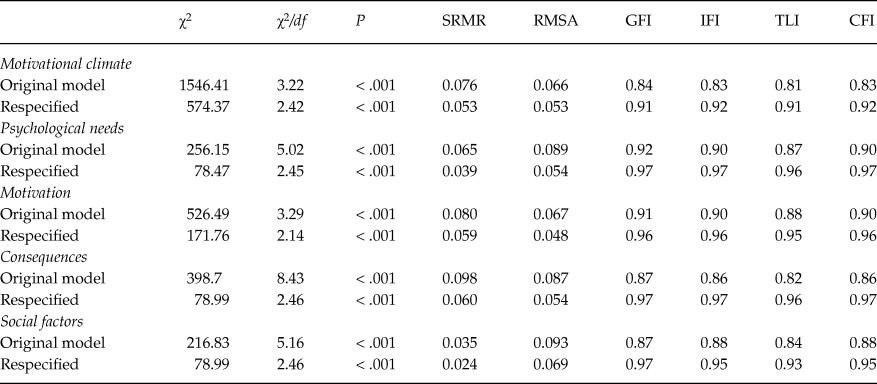
The first goal was to test whether the factor structure of the scales matched the dimensions described above and confirm that they were valid for our sample. We carried a Confirmatory Factor Analysis of the different subscales using the robust maximum likelihood method. Several indices were considered: χ 2 , ratio between Chi-Square and Degrees of Freedom (χ2/D.F.), Goodness of Fit Index (GFI), Comparative Fit Index (CFI), Incremental Fit Index (IFI), Tucker-Lewis Index (TLI), Root Mean Square Error of Approximation (RMSEA), and Standardized Root Mean Square Residual (SRMR). According to Jöreskog and Sörbom (Reference Jöreskog and Sörbom1989), χ 2 can be influenced by the sample size (p is usually significant with large samples). Therefore, it is better to consider χ2/D.F., which it is satisfactory when values are below 5 (Bentler, 1999). Following Schumacker and Lomax (Reference Schumacher and Lomax1996), indices such as GFI, CFI, IFI, and TLI are adequate when their values are .90 or above. RMSEA values of .06 or below and SRMR values of .08 or below are also acceptable (Hu & Bentler, Reference Hu and Bentler1999). Table 1 presents all Confirmatory Factor Analysis’ fit indices values.
Confirmatory Factor Analysis’ fit indices values

The limited global fit of the original model, coupled with the presence of several measurement errors linked to some items (along with some undesirable cross-loadings suggested by modification indexes provided by the statistical program) prompted some changes in the initial model. Deleting items to improve the factor structure of an instrument is considered a legitimate process, since it keeps the overall structure of the model originally formulated using the right indices (Hofman, Reference Hofman1995). Therefore, several items had to be disregarded to improve the original model: PMCSQ-2: one of the cooperative learning, effort/improvement and important role subscales; BPNES: one of the competence and relatedness subscales; PLOC: one of the identified regulation, introjected and external regulation subscales; IMI: one of the enjoyment and pressure/tension subscales; SGS-PE: one of the responsibility and relationship subscales. All these changes produced a better fit of the original model (table 1), which allowed us to use the selected instruments with our sample and analyze the results.
Descriptive analysis and bivariate correlations
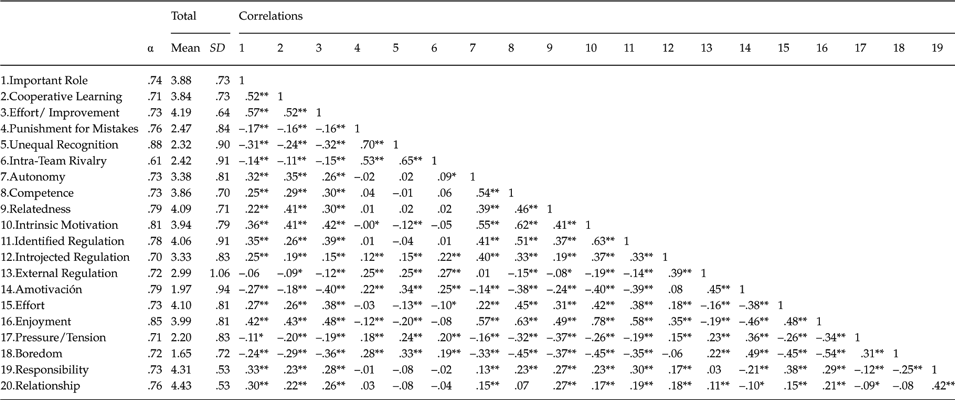
Table 2 shows Cronbach’s alpha coefficients of all the subscales, means and standard deviations of all variables, as well as bivariate correlations among them after deleting the mentioned items. Cronbach’s alphas were above .70 in all subscales, except intra-team rivalry (.61). However, this result could also be considered acceptable considering the small number of items of this subscale (Nunnally & Bernstein, Reference Nunnally and Bernstein1994). In the PMCSQ-2, the highest score appeared in the effort/improvement subscale and the lowest in the intra-team member rivalry one. In the BPNES, the highest score emerged in relatedness, followed by competence and autonomy. In the PLOC, the lowest score appeared in Amotivation, being the highest identified regulation. In the IMI, the highest value emerged in effort and the lowest in pressure/tension. In the SGS-PE, both variables obtained very similar high values. Finally, boredom achieved the lowest score of all. The subsequent correlation analysis revealed significant connections among most variables, which allowed us to perform the cluster analysis to see how these different correlations grouped showing different student profiles.
Cronbach’s alphas of the different subscales; means, standard deviations, and correlations among all variables

*p < .05; **p < .01.
Cluster analysis
It was developed to identify groups of students that responded similarly within the different motivational climates. The six factors that shape this construct were used as predictive variables. All different variables were standardized using Z scores (mean = 0, standard deviation = 1).
Following Hair, Anderson, Tatham, and Black’s procedure (1998), the sample was randomly divided in two subsamples (n = 253, n = 254). A hierarchical cluster analysis was conducted on the first subsample to identify the clusters emerging from it. Ward’s method was used to minimize the within-clusters differences, and to avoid long chains of observations (Aldenderfer & Blashfield, Reference Aldenderfer and Blashfield1984). Since we seek a solution where clusters are different from each other and, at the same time, the elements are close within each cluster, the best solution would be one where the corresponding lines will take time before coming to a close. In our case, the solution was four clusters, the one that created a major shift in the coefficients (9.8). This indicated that, from this point, different clusters were merging. Consequently, it was determined that the solution of four clusters or groups was more appropriate. This decision was also supported by the corresponding dendrogram.
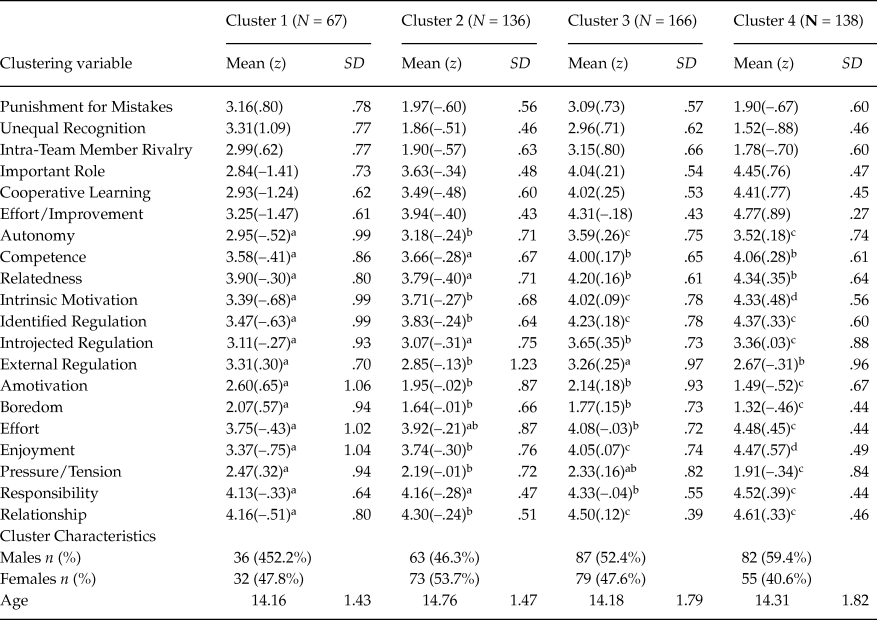
This hierarchical cluster analysis can be considered highly explorative. Therefore, in order to verify the results obtained, a K-mean cluster analysis was performed on the other subsample. According to Aldenderfer and Bashfield (Reference Aldenderfer and Blashfield1984), this cross-validation procedure is very important. If the same cluster groups are found in different samples of the same population, it is conceivable to assume that the solution has a certain degree of generality. In this K-mean cluster analysis, 4 groups were also identified and means, standard deviations and standardized scores were very similar to the 4 clusters identified in the first subsample (table 3). Therefore, a final K-mean cluster analysis using the whole sample was performed.
Profiles of the four-cluster solution from the K-Means cluster analysis

Note: Means in the same row that do not share superscripts differ at p < .01 in the Newman-Keuls post hoc test.
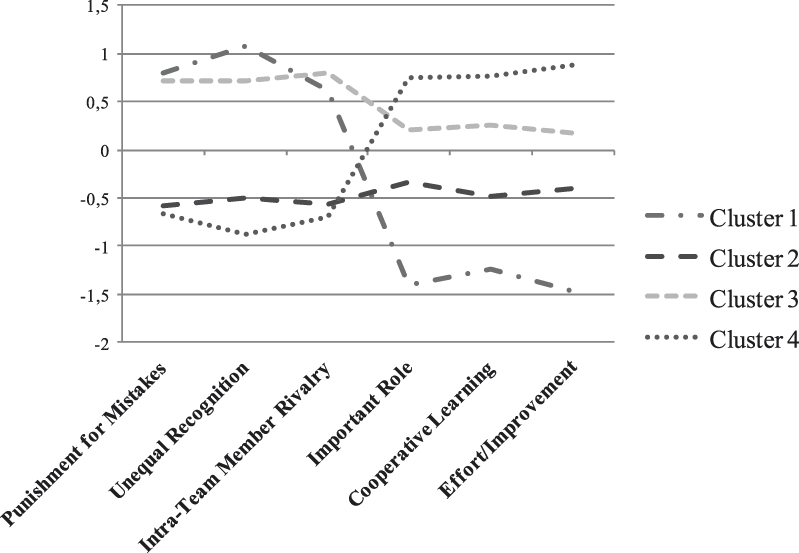
Figure 1 shows the four profiles identified through the cluster analysis. Cluster 1, labeled “high ego”, was characterized by a high ego climate profile in which all scores (punishment for mistakes, unequal recognition, and intra-member rivalry) were around Z = 1.00, and a very low task climate profile with all the scores (cooperative learning, effort/improvement, and important role) around Z = –1.50. It was composed of 67 students (52.2% males, 47.8% females). Cluster 2, labeled “low ego-task”, consisted of 136 students (46.3% males, 53.7% females) with a medium-low ego and task profiles with all the scores around Z = –0.50. Students in cluster 3, labeled “high ego-medium task”, showed a high ego profile in which all scores were around Z = 1.00, but also a medium task profile with all scores above Z = 0.00. This group had 166 subjects (52.4% males, 47.6% females). Finally, cluster 4, labeled “high task”, included 138 students (59.4% males, 40.6% females) and it showed a very low ego profile with all scores around Z = –0.50, and a very high task profile with all scores above Z = .0.5.
Perceived motivational climate of the four clusters.

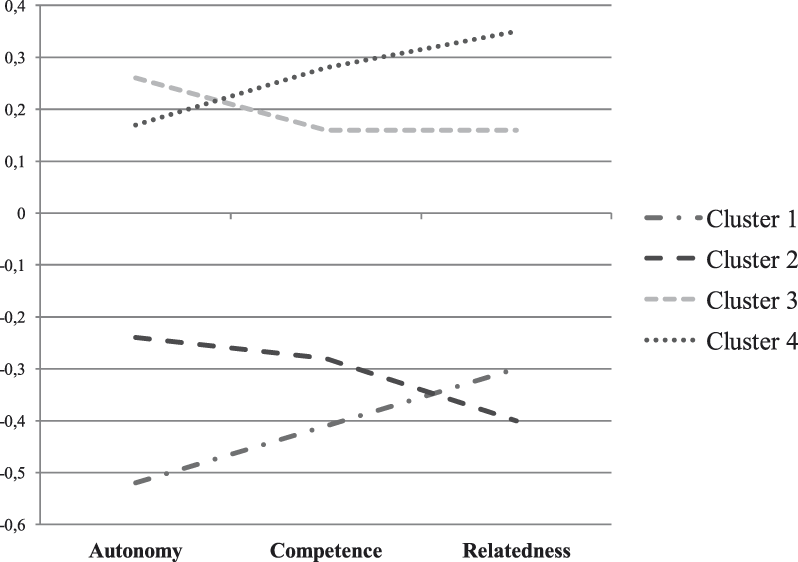
A one-way MANOVA was carried out using the basic psychological needs as dependent variables and the different clusters as independent variables (figure 2). It yielded a multivariate significant effect, Wilks’ Lambda = .851, F(9, 497) = 9.36, p < .001, η2 = .05. The following univariate analysis showed significant differences in all variables: Relatedness: F(3, 503) = 18.01, p < .001, η2 = .01, Competence: F(3, 503) = 13.66, p < .001, η2 = .07, and Autonomy: F(3, 503) = 15.36, p < .001, η2 = .08 (Fig. 2). Post hoc comparisons within groups were conducted using Newman-Keuls’ procedure (Table 2). Clusters 3 and 4 showed higher levels of basic psychological needs, but there were no significant differences between them on any of the variables. Nevertheless, there were significant differences between cluster 1 and 2 (p < .001) and between these and clusters 3–4 (p < .001) in autonomy. Finally, there were also significant differences between clusters 1–2 and clusters 3–4 in competence and relatedness (p < .001).
Basic psychological needs of the four clusters.

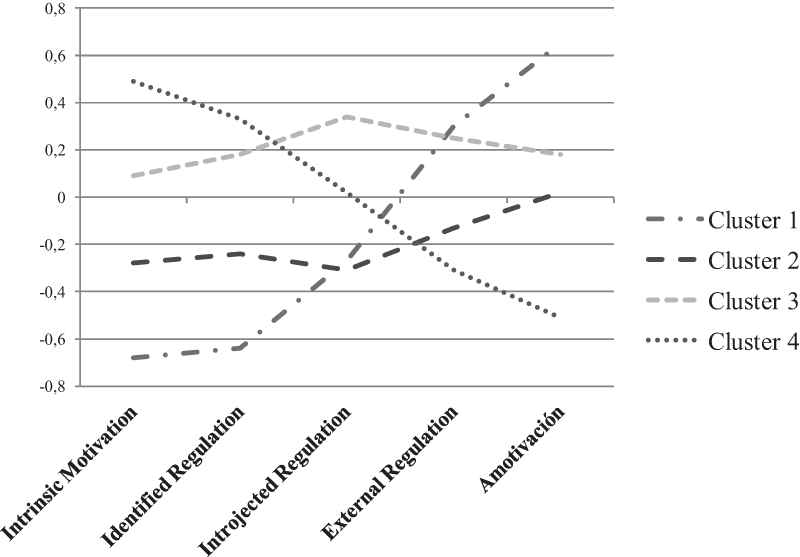
In the next step, we performed a second one-way MANOVA using the different types of motivation (intrinsic motivation, identified regulation, introjected regulation, external regulation, and amotivation) as dependent variables, and the different clusters as independent variables (figure 3). It yielded a multivariate significant effect, Wilks’ Lambda = .729, F(15, 491) = 11.12, p < .001, η2 = .10. The following univariate analysis showed significant differences in all variables: Intrinsic Motivation: F(3, 503) = 29.82, p < .001, η2 = .15, Identified Regulation: F(3, 503) = 21.12, p < .001, η2 = .11, Introjected Regulation: F(3, 503) = 13.78, p < .001, η2 = .08, External Regulation: F(3, 503) = 11.22 p < .001, η2 = .06, and Amotivation: F(3, 503) = 27.55, p < .001, η2 = .14 (Fig. 3). Post hoc comparisons within groups were conducted using Newman-Keuls’ procedure (Table 2). Cluster 4 showed the highest levels of intrinsic motivation and identified regulation, and the lowest level of amotivation. On the contrary, cluster 1 showed the lowest levels of intrinsic motivation and identified regulation, and the highest level of amotivation. Finally, cluster 3 showed intermediate levels of intrinsic motivation, while cluster 2 scored low in all variables except amotivation (intermediate level).
Motivational profiles of the four clusters.

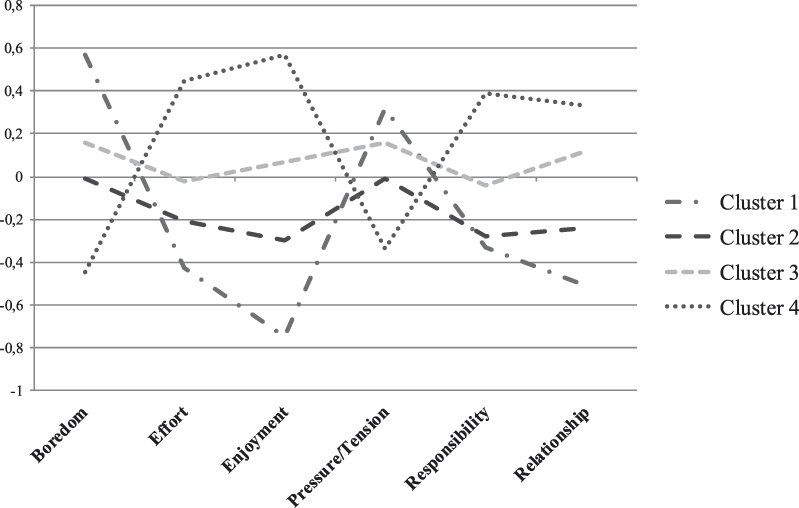
Finally, a third one-way MANOVA was carried out using social goals (responsibility and relationship), boredom and the different outcomes measured (enjoyment, effort, pressure/tension) as dependent variables, and the different clusters as independent variables (figure 4). It yielded a multivariate significant effect, Wilks’ Lambda = .701, F(18, 488) = 10.36, p < .001, η2 = .11. The following univariate analysis showed significant differences in all variables: Effort: F(3, 503) = 17.47, p < . 001, η2 = .11, Boredom: F(3, 503) = 20.40, p < .001, η2 = .11, Responsibility: F(3, 503) = 14.30, p < .001, η2 = .08, Relationship: F(3, 503) = 15.86, p < .001, η2 = .09, Pressure/Tension: F(3, 503) = 9.78, p < .001, η2 = .06, and Enjoyment: F(3, 503) = 39.93, p < .001, η2 = .19. Post hoc comparisons within groups were conducted using Newman-Keuls’ procedure (Table 2). Cluster 4 showed the highest scores in effort, responsibility, relationship, and enjoyment, and the lowest scores in boredom and pressure/tension. All these scores were significantly different from the other clusters’ scores. Cluster 1 showed the lowest scores in effort, responsibility, relationship, and enjoyment, and the highest scores in boredom and pressure/tension. Cluster 3 showed moderately high scores in all variables. Finally, cluster 2 showed intermediate scores in boredom and pressure/tension, and moderately low scores in the other variables.
Consequences measured on the four clusters.

Discussion
The purpose of the present study was to examine the structure of perceived motivational climate clusters detected in a large sample of Spanish high school students enrolled in physical education classes, and assesses their relations to several psychological and motivational outcomes. Four clusters were finally identified.
Cluster 4 was a very high task climate group with a low ego profile, and it was linked to the most positive set of outcomes: high levels of autonomy, competence, relatedness, intrinsic motivation, identified regulation, effort, enjoyment, responsibility, and relationship. Scores turned negative with the least self-determined types of motivation (introjected and external regulation), amotivation, pressure/tension and boredom. This cluster is similar to one named “self-determined”, identified in a sample of British physical education students (Ntoumanis, Reference Ntoumanis2002). Previous studies have also shown that a task-involving environment is the most desirable class climate in educational settings, since it has been associated to higher levels of students’ intrinsic motivation, persistence, effort, interest and participation (Morgan & Carpenter, Reference Morgan and Carpenter2002). Certainly, highly self-determined students are intrinsically motivated to participate in class (Vallerand, Fortier, & Guay, Reference Vallerand, Fortier and Guay1997). This idea was also reinforced by the students’ low levels of amotivation. They seem to feel that it is important to participate and try hard in class for the intrinsic pleasure of performing the different tasks designed by the teacher, for the activity’s sake, to learn new things, to develop their competence and to have fun.
According to Vallerand and Losier (Reference Vallerand and Losier1999), self-determined motivation is enhanced when cooperation is promoted. In our study, students in cluster 4 showed high levels of intrinsic motivation and cooperative learning. Furthermore, Ames (1992) believed that motivational climates that encourage students to help each other learn will increase their feelings of competence, which, in turn, will guide them to higher levels of self-determination (Vallerand, Reference Vallerand and Zanna1997). Our results support all these different connections, since students in cluster 4 also reported high levels of competence. According to Goudas and Biddle (Reference Goudas and Biddle1994), students who perceive their physical education class climate as task-oriented show higher levels of intrinsic motivation and perceived competence. Therefore, this cluster’s results tie task climates with high levels of self-determined motivation and high feelings of personal competence and autonomy. Furthermore, our findings in cluster 4 bond these ideas with high levels of enjoyment, and low levels of boredom, too. Certainly, students tend to have fun when they find themselves competent or skilled, when they can help other classmates learn, when they participate because they feel it is important. When all these happen, feelings of boredom disappear, because students have a good time in class. They also feel more autonomous, because they see themselves capable of doing things without the direct supervision of the teacher.
According to Ntoumanis (Reference Ntoumanis2002), physical education students become more interested in the class when its climate is task oriented. Students in cluster 4 rated significantly higher the effort they felt they displayed in class, and they also reported significantly lower levels of amotivation, pressure/tension, and boredom. This could mean that this group of students had fun, felt lower levels of pressure/tension, and felt competent while participating in class, so they tried hard. In a previous study, Papaioannou (Reference Papaioannou1995) found that students who perceived a high learning environment had low levels of anxiety, which means low feelings of tension. Our results reinforce the idea that mastery climates tend to produce less pressure/tension in the students.
Results from cluster 4 also showed a link between high levels of cooperative learning, relatedness, relationship, and responsibility. Previous works have reported that cooperative learning facilitates the quality and quantity of students’ interactions, encouraging the development of interpersonal skills (Dyson, Reference Dyson2002). When teachers use cooperative learning strategies, students work together in groups, interacting with other students. These processes seem to lead to feelings of connectedness among them, and to the development of social skills. Cooperative learning also seems to develop feelings of responsibility among group members, because each one of them feels responsible for, at least, one part of the group task (Dyson, Reference Dyson2002).
On the other end, cluster 1 represented the perfect example of a high ego, low task student profile. Subjects in this cluster showed the lowest scores of the whole sample in autonomy, competence and relatedness, intrinsic motivation, identified regulation, introjected regulation, effort, enjoyment, responsibility and relationship, and the highest scores on external regulation, amotivation, boredom, and pressure/tension. This is the most undesirable class climate and motivational profile in educational settings. This type of students with low levels of self-referenced motivation and high levels of external regulation and amotivation are negative predictors of future participation in education (Vallerand et al., Reference Vallerand, Fortier and Guay1997). Wang and Biddle (Reference Wang and Biddle2001) found a similar motivational cluster, and they also had the lowest rates of physical activity and the lowest scores of physical self-worth. According to Ntoumanis (Reference Ntoumanis2002), this type of students can be considered motivationally at risk, because high levels of the least self-referenced types of motivation can lead those youngsters out of the school system (Vallerand et al., Reference Vallerand, Fortier and Guay1997). As described earlier, these profiles are also related to negative affective and behavioral outcomes. Results from cluster 1 indicate that this group of students had low confidence on being able to improve and succeed in school. It is very possible that these students did not try hard because they felt incompetent to perform the different tasks proposed by the teacher. Consequently, they did not have fun, and they were bored. When an individual is not able to achieve success, he/she tends to dislike the activity and, eventually, stops doing it. Moreover, these results also relate this students’ profile to low levels of social outcomes such as relationship or relatedness. This finding was also reinforced by the low scores in cooperative learning and other variables related to a task class climate found in this cluster. Certainly, these students did not seem to believe in the group. Maybe they thought that their classmates could not help them improve. Therefore, their connection with other students was damaged, loosing that important aid in a person global development. Fortunately, this group of students was the smallest in the sample.
Cluster 2 represented those students who perceived a low task-ego motivational climate in their classes. They showed low or very low levels in almost all variables. Surprisingly, these results were very similar to those obtained by students in cluster 1 (very high ego and very low climate profiles). However, the distinctive elements between both groups were: significantly higher levels of autonomy, identified regulation, and enjoyment, and significantly lower levels of external regulation, amotivation, and boredom in cluster 2. These outcomes could be explained by the fact that this group of students perceived a significantly higher task climate in their classes. This perception could have positively affected the mentioned variables, and make this group of students more self-referenced, which is connected to more desirable behavioral and affective outcomes (Ntoumanis, Reference Ntoumanis2002).
Regarding this idea, cluster 3 depicted the most interesting student profile of all: high ego, but also medium-high task. Previous research has showed that students can hold multiple combinations of goals in classroom situations (e.g., high mastery and high performance) which, in turn, may be connected to different motivational and achievement outcomes (Meece et al., Reference Meece, Anderman and Anderman2006). Bearing in mind cluster 4 (high task), students in cluster 3 showed similar levels of autonomy, competence, relatedness, identified regulation and relationship. However, the distinguishing elements between both groups were: significantly higher levels of introjected and external motivation, amotivation, boredom, and pressure/tension, as well as significantly lower levels of intrinsic motivation, effort, enjoyment and responsibility in cluster 3. Undoubtedly, this is a remarkable finding that deserves additional consideration. This group of subjects perceived a high performance class climate and, consequently, many variables’ outcomes reflected that perception. Recent reviews overwhelmingly links students’ perceptions of a performance-oriented classroom context to maladaptive outcomes (Meece et al., Reference Meece, Anderman and Anderman2006). However, our students’ scores in autonomy, competence, relatedness, amotivation, boredom, effort, enjoyment, pressure/tension, responsibility, and relationship were significantly better/higher than the ones obtained by the other group of students who perceived a high ego classroom environment (cluster 1). These results showed that students in cluster 3 reflected many of the adaptive psychological and motivational outcomes expected from task-involving environments. A possible explanation for this shift can be found in the buffering hypothesis of the AGT. It suggests that an adaptive classroom goal structure can weaken the undesirable effect of a maladaptive classroom goal structure (Ciani et al., Reference Ciani, Middleton, Summers and Sheldon2010). In our case, students’ perception of a medium-high task class climate could have mitigated the effects of a high ego class climate to produce significantly better psychological and motivational outcomes. These findings are very important, because the largest number of students of the total sample belonged to this group. Students’ perceptions of both class climates could have produced an additive effect on the different outcomes measured (Linnenbrink, Reference Linnenbrink2005). That is, the perceptions of a medium-high task class environment seemed to have buffered the negative effects of the high ego class climate perceptions.
Although we believe that our findings can be of help to understand educational environments in physical education, the present study also holds some limitations. The first one concerns its representativity for the entire population of secondary education students. The sample used in this study was limited because all subjects came from just one high school. Consequently, the results obtained cannot be generalized. A second limitation refers to the age-range of the sample (12–17). It could be considered very large, since it covers 6 years. Smaller age-ranges could have yielded different results, and a better picture of how the different variables change across adolescence. Finally, another limitation is that the results were not evaluated based on gender. A differentiated analysis could have helped us find if girls and boys have different perceptions of the class climate and the related variables studied.
Future investigations should try to establish links between students’ perceived class climate and students’ achievement goals. How they interact to produce more or less adaptive responses in adolescents. Moreover, how this interaction might affect high task and performance class structures within the buffering hypothesis of the AGT. Another important shift for researchers would be to move away from subjective perceptions of the goal context to more objective measures such as observations or experimental designs.
In conclusion, in the search for a better understanding of the different elements that shape educational contexts, students’ perceptions of the class climate that teachers help create should be very carefully considered. High mastery class climates have been tied to positive psychological and motivational outcomes, while performance oriented class climate have been related to less motivationally self-determined and bored individuals. However, a third group of students emerged from our sample. It represented those subjects that perceived a high ego class climate, but also a medium-high task oriented class environment. The buffering hypothesis of the AGT indicates that the most adaptive classroom structure weakens the effects of the less adaptive one (additive effect). This group of students had similar autonomy, competence, relatedness, identified regulation, and relationship values to students in cluster 4 (high task), significantly higher scores than students in cluster 1 (high ego) in intrinsic motivation, introjected regulation, effort, enjoyment, and responsibility, and significantly lower in amotivation, boredom, and effort/tension. Therefore, teachers should try to develop class environments where students could make choices while performing a task, where they have to work in close contact with their peers and help them improve. Educators must try to create learning contexts where all the students could feel that they have a significant role to play, that their performance is valued by the teacher. Similarly, teachers ought to generate physical education settings where trying hard is rewarded, where students could feel successful when they improve their skills, not when they outperform others. Task-involving class climates posses all these positive traits, but the additive effect of an ego class climate should not be neglected, either.
To sum-up, physical educators should try to create task-involving learning classes where trying hard and working and helping peers is rewarded, where all students feel that they have an important role to play, that they can make choices, and that their performance is appreciated by the teacher. These learning contexts have been connected with self-regulated motivation and high levels of autonomy, competence, relatedness, enjoyment, effort, responsibility and relationship. Task class climates also seem to exert less pressure/tension on students. However, ego class climates hold an additive, positive effect to task climates.