Introduction
As life expectancy improves, men (and women) are seeking to preserve their sexuality into old age. This has led in recent years to increasing attention to sex-related behaviour and sexual dysfunctions in the ageing male. In addition to sexual dysfunctions, older adults experience the influence of physical limitations such as arthritis, back pain and cardiovascular disease on their sexual functioning.Reference DeLamater and Moorman1–Reference Laumann and Waite7
The principle sexual health issues in older men include erectile dysfunction (ED) and late onset hypogonadism (LOH). This review will address erectile and androgen biology in older men, the prevalence of sexual dysfunction and its aetiological factors in this population, and contemporary treatments for sexual problems. Although premature ejaculation (PE) is prevalent in older men, the bother from this disorder is generally lower in older men; therefore premature ejaculation will be discussed only briefly in this review.Reference Laumann and Waite7
Sexual behaviour patterns in the older man
Sexual desire and activity are present throughout the lifespan and remain important into old age for many individuals. However, a decline in sexual activity is typical with increasing age. In a large US study, the proportion of males who were sexually active declined from 83.7% in the age group 57–64 years to 38.5% in the age group 75–85 years.Reference Lindau, Schumm, Laumann, Levinson, O'Muircheartaigh and Waite3 This decline represented a decrease in the frequency of vaginal intercourse as well as oral sex and masturbation.Reference Lindau, Schumm, Laumann, Levinson, O'Muircheartaigh and Waite3 In a study among 50 people with a mean age of 81 years, Smith et al. reported that the main reasons for being sexually inactive were ‘ED’ and/or ‘no partner’. Interestingly, the vast majority of sexually inactive individuals (85%) reported a desire to resume sexual activity.Reference Smith, Mulhall, Deveci, Monaghan and Reid4 In another global survey, 82% of men over the age of 40 indicated that satisfactory sex is essential in maintaining a relationship, and 68% of men were in favour of the use of medical treatment to help older people to enjoy sexual activity.Reference Nicolosi, Laumann, Glasser, Moreira, Paik and Gingell5 While many men may sanction the use of medical therapy for enhancement of sexual activity, it is apparent that a relatively small proportion (14% of men in one sample) actually use medication or supplements to improve sexual function.Reference Lindau, Schumm, Laumann, Levinson, O'Muircheartaigh and Waite3
Risk factors and prevalence of sexual dysfunction
Age is strongly associated with risk of sexual dysfunction in both men and women. For many years it was assumed that such a loss of sexuality was natural and inevitable and therefore little attention was given to sexual behaviour and treatment in this population. However, more recent data have suggested that sexuality remains important into later life for many individuals.Reference Nicolosi, Laumann, Glasser, Moreira, Paik and Gingell5
Ageing is associated with a decline in functional status and general physical condition, which may compromise an individual's ability to enjoy sexual activity. Cardiovascular risk factors such as smoking, obesity, hyperlipidaemia and arterial hypertension also contribute to the development of ED through mechanisms that will be detailed later. Chronic diseases, obesity and the metabolic syndrome have also been associated with development of LOH.Reference Araujo, Mohr and McKinlay6 Ageing is also associated with an increase in medication usage; medications are a common cause of iatrogenic ED, particularly thiazides, some beta-blockers, and psychiatric medications.Reference Araujo, Mohr and McKinlay6 Finally, mental health problems, particularly depression, are frequent issues in elderly populations and contribute to sexual dysfunction.Reference Laumann and Waite7
The National Social Life, Health, and Aging Project (NSHAP), a nationally representative US probability sample of 1550 women and 1455 men aged 57–85 years, provided information on the prevalence of sexual problems in both sexes. There was an increase in the prevalence of erectile dysfunction from 30.7% in men aged 57–64 years, to 43.3% in men aged 75–85 years. A slight decrease in the prevalence of PE between age groups was seen; 29.9% in men aged 57–64 years, to 21.5% in men aged 75–85 years, implying that advancing age does not appear to be a risk factor for premature ejaculation. Other frequently reported sexual dysfunctions include lack of sexual interest and difficulty reaching orgasm, with an overall prevalence of 27.7% and 20.4%, respectively.Reference Laumann and Waite7
The Massachusetts Male Aging Study (MMAS) provided excellent longitudinal data of 1085 primarily Caucasian men of generally high socioeconomic status. The aim of the study was to provide information on the evolution of health conditions (including sexual dysfunctions) in the ageing male population over a 9-year period of follow-up. MMAS investigated effects of ageing on sexual intercourse, erection frequency, sexual desire, ejaculation with masturbation, satisfaction with sex, and difficulty with orgasm. This study revealed a significant increase in sexual problems during follow-up in all domains of sexual function except frequency of ejaculation with masturbation, which showed no change between baseline and follow-up.Reference Araujo, Mohr and McKinlay6 The relatively select nature of the study population may limit the generalizability of these data.
The NSHAP concluded that difficulty achieving penile erection and orgasm were both positively correlated with age. Mental health also had a significant influence on male sexual functioning; men with a lack of interest in sex, inability to achieve orgasm, lack of sexual pleasure, anxiety about performance and ED were more likely to endorse poor health on at least one of four mental health measures (anxiety, stress, depression, or poor self-rated mental health).Reference Laumann and Waite7 As this was a cross-sectional study, causality cannot be definitively determined.
The European Male Ageing Study group developed and validated a self-administered questionnaire, and correlated the effects of age and blood sex hormone levels to questionnaire outcome. Sixteen hundred men aged 40–79 years were enrolled. Lower levels of sexual functioning were found in men with the lowest levels of total, free and bioavailable testosterone compared with men with the highest testosterone levels. Similar to the results of the NSHAP study, men with worse sexual function tended to report higher levels of psychological stress.Reference O'Connor, Corona and Forti8
Testosterone in the ageing man
Age-related variations in serum testosterone levels
Testosterone (T) is a lipophilic molecule; its solubility in blood is limited. This is important because only 1–3% of serum T is unbound and available to tissues, with the larger portion being bound tightly to sex hormone binding globulin (SHBG) or loosely to albumin. Albumin-bound T is at least partially available to tissues but it is free testosterone (FT) that is most relevant for the biological actions of T.Reference Camacho and Reyes-Ortiz11
Men do not experience a physiological sudden cessation of gonadal function comparable to menopause in women. With advancing age, serum T levels gradually decline at a rate of approximately 0.5–2 % a year.Reference Wang, Nieschlag and Swerdloff9–Reference Camacho and Reyes-Ortiz11 This decline in serum T levels is caused by a decrease in the number of Leydig cells in the testes, as well as a decline in responsiveness to stimulation with luteinizing hormone (LH).Reference Buvat, Shabsigh, Guay, Gooren, Otavio-Torres, Meuleman, Porst and Buvat12, Reference Morley13 In addition to a decline in the production of T in older men, the level of bioavailable T (BT) declines due to increases in SHBG concentration at an average of 1.2% annually.Reference Seftel10, Reference Mohr, Guay, O'Donnell and McKinlay14 In the MMAS, serum T values below 251, 216, 196 and 156 ng/dl were representative of the lowest 2.5th percentile for men in their 40s, 50s, 60s and 70s, respectively.Reference Mohr, Guay, O'Donnell and McKinlay14 This is in contrast to reference ranges of greater than 300 ng/dl in healthy young men.
Physiology/pathophysiology of testosterone and sexual function
In the context of this review we will limit our discussion of T physiology to its effects on sexual function. The influence of T on sexual functioning is most pronounced in the case of young men with serum T levels below or near the lower limit of the normal young adult range.Reference Buvat, Shabsigh, Guay, Gooren, Otavio-Torres, Meuleman, Porst and Buvat12 T exerts effects on libido at the level of the central nervous system, more specifically in the hypothalamic preoptic area and the arcuate nucleus. Peripherally, T plays a critical role in erectile function by maintaining penile tissue integrity, structure and function of pelvic ganglion neurons, and in the expression of nitric oxide synthase (NOS) isoforms. A castrated rat model of hypogonadism has shown a decreased fibre density and thinner myelin sheaths of the penile cavernosal nerve structure.Reference Baba, Yajima and Carrier15 Furthermore, expression of NOS isoforms and PDE5 has been shown to decline in the absence of T.Reference Traish, Goldstein and Kim16–Reference Zhang, Morelli and Luconi19 However, PDE5 may not be directly regulated by androgen levels; the decline in PDE5 expression after castration in a rat model has been shown to be the result of decreased penile smooth muscle content rather than by an isolated decline in PDE5 expression.Reference Yang, Huang and Lin20
It has been established that supplementation of androgens in castrated animals restored erectile response and expression of NOS in the penis.Reference Park, Kim, Kim and Paick17, Reference Traish, Park, Dhir, Kim, Moreland and Goldstein18 These results have been corroborated in humans subjected to androgen deprivation by surgical or medical castration; corporal tissues in these men manifest a significant reduction in trabecular smooth muscle content and marked increase in fibrosis along with a decrease in the elastic fibre content of the tunica albuginea. These tissue structure alterations are associated with loss of erectile function by impairing trabecular and vascular smooth muscle relaxation.Reference Traish, Goldstein and Kim16
Late onset hypogonadism (LOH)
LOH is defined as a clinical and biochemical syndrome associated with advancing age that is characterized by at least one sign or symptom combined with serum T levels below the reference range.Reference Wang, Nieschlag and Swerdloff9
Clinical signs and symptoms of LOH
Low levels of serum T have been linked to a number of bothersome symptoms including abdominal obesity, depression, loss of vitality, difficulty in concentration, impaired memory, and hot flushes in cases of acute onset hypogonadism. Clinical signs of LOH include anaemia, osteoporosis/osteopenia, sacropenia, regression of secondary sex characteristics, and oligospermia.Reference Wang, Nieschlag and Swerdloff9, Reference Seftel10 Although none of these signs and symptoms is highly specific for LOH, they may raise clinical suspicion and are indications for a physical and biochemical work-up.Reference Wang, Nieschlag and Swerdloff9 Sexual dysfunction is the problem that is most commonly associated with hypogonadism. Sexual dysfunction in LOH includes not only low libido and ED, but also decreased penile sensation and difficulty attaining orgasm.Reference Wang, Nieschlag and Swerdloff9, Reference Seftel10, Reference Seftel21, Reference Emmelot-Vonk, Verhaar, Nakhai-Pour, Grobbee and Van Der Schouw22
Biochemical diagnosis of LOH
Men with symptoms suspicious for LOH should undergo assessment of serum T levels. A serum sample for total T should be obtained between 07.00 and 11.00 h, to exclude falsely low T levels due to diurnal variations. While morning assessment of T is the standard even in older men, diurnal variations in T are often attenuated in the aged male. Transient decreases in serum T, such as caused by acute illness, can be ruled out by repeated hormone measurements.Reference Buvat, Shabsigh, Guay, Gooren, Otavio-Torres, Meuleman, Porst and Buvat12
Measurement of SHBG, FT and oestradiol are currently not indicated for screening but can be helpful when suspicion of LOH persists despite borderline or normal serum total T. A FT level below 65 pg/ml can be construed as indication for T treatment. Measurement of LH and prolactin may assist in differentiating between primary and secondary hypogonadism; these tests are recommended when secondary hypogonadism is suspected or when T is lower than 150 ng/dl. Determination of other hormones, like growth hormone, thyroid hormone, cortisol or dehydroepiandrosterone are not routinely indicated unless clinical signs and symptoms point in the direction of other endocrine disorders.Reference Wang, Nieschlag and Swerdloff9 Salivary T has been shown to be a reliable substitute for FT measurement, but is currently not recommended for general use as most laboratories do not have a reliable salivary T assay.Reference Wang, Nieschlag and Swerdloff9
Treatment of LOH
Initiation of treatment. Current recommendations advocate a trial therapy with a short-acting preparation of T when at least one symptom of hypogonadism is present in the setting of documented T deficiency. Regardless of the method of supplementation chosen, close follow-up (at least every three months) during the first year of treatment is mandatory to evaluate clinical and biochemical response and to monitor for adverse effects. Once treatment is established, less frequent follow-up is necessary though patients should stay in specialized follow-up at least annually. A reasonable term for evaluation of clinical benefits on sexual function, libido, muscle function and abdominal obesity changes is 3–6 months. In absence of clinical response, therapy should be discontinued and further investigations should be carried out to identify other potential causes of symptoms.Reference Wang, Nieschlag and Swerdloff9, Reference Emmelot-Vonk, Verhaar, Nakhai-Pour, Grobbee and Van Der Schouw22–Reference Gruenewald and Matsumoto24
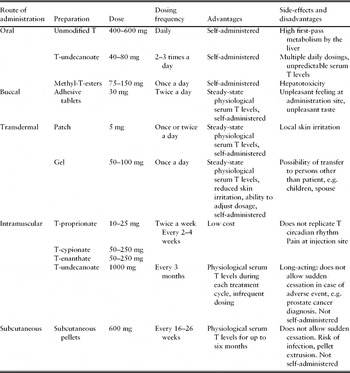
Testosterone supplementation. T should preferably be administered in its natural form. This enables activation of the androgen receptor, but also the many beneficial non-androgen receptor actions of T such as vasodilatation and cardiomyocyte recovery after MI.Reference Er, Michels, Gassanov, Rivero and Hoppe25 Administration of T also permits metabolism via the enzymes aromatase and 5α-reductase, potentiating effects mediated by oestrogen and dihydrotestosterone, respectively. Examples of metabolite effects include oestrogen-mediated maintenance of bone health.Reference Stanworth and Jones23 Currently available routes of administration of T include transdermal (gel and patch), subcutaneous (depot), intramuscular injection, and buccal tablets. Oral T supplementation, except testosterone undeconoate, is not widely used due to extensive first-pass metabolism in the liver. Furthermore, orally available methyl-T esters have been associated with hepatotoxicity.Reference Stanworth and Jones23
All routes for T supplementation have their own specific pharmacokinetics, side effects, advantages and disadvantages (Table 1). The choice of the preparation should therefore be a joint decision between patient and physician.Reference Wang, Nieschlag and Swerdloff9, Reference Stanworth and Jones23 During initiation of therapy, a short-acting preparation is advisable since it allows prompt cessation of therapy if an adverse event occurs. Short-acting T preparations may also be preferred in older patients given the relatively high incidence of prostate carcinoma in this population and persistent concerns regarding the role of T in prostate cancer progression.Reference Wang, Nieschlag and Swerdloff9 While recent evidence has suggested that the role of T in prostate cancer occurrence and progression has been overstated in the past, lingering uncertainties dictate judicious use of T in the elderly population.Reference Dobs and Morgentaler26, Reference Morgentaler27
Pharmacotherapy of late-onset hypogonadism

Contraindications and adverse events. T treatment is currently contraindicated in patients suffering from untreated locally advanced and metastatic prostate cancer. However, there is currently no evidence that exogenous T increases the risk of developing prostate cancer or converts subclinical prostate cancer into clinically detectable prostate cancer.Reference Dobs and Morgentaler26 Furthermore, many authors are now advising that T therapy may be offered to carefully selected and counselled men who have been successfully treated for prostate carcinoma.Reference Morgentaler27 Before starting exogenous T, prostate cancer screening is warranted. During therapy, patients should be monitored for prostate disease every three months in the first year, and at least annually thereafter. Other tumours that may be androgen responsive include cancer of the breast and primary liver tumours; therefore these are both contraindications to T treatment.Reference Wang, Nieschlag and Swerdloff9, Reference Stanworth and Jones23 Moderate lower urinary tract symptoms (LUTS) are a rather theoretical contraindication for T therapy although studies have reported neither an increase of LUTS, nor increased risk of urinary retention during treatment.Reference Gruenewald and Matsumoto24 Untreated obstructive sleep apnoea syndrome and untreated severe congestive heart failure are currently contraindications for T therapy, although supplementation can be considered after management of these disorders has been initiated. Patients with erythrocytosis and a haematocrit value above 52% should not receive T. When erythrocytosis develops during treatment, discontinuation or periodic phlebotomy is recommended.Reference Wang, Nieschlag and Swerdloff9
Erectile dysfunction (ED)
ED was defined at the NIH Consensus Development Panel on Impotence in 1992 as ‘the inability to attain or maintain erections firm enough for sexual intercourse’.28
Physiology of penile erection
The anatomy and physiology of the penile erection have previously been described in detail.Reference Lue29 In brief, upon sexual stimulation pro-erectile impulses are generated in the parasympathetic erection centres of the limbic system and the hypothalamus. These sexual impulses are transmitted and integrated in the sacral spinal cord. An erectogenic stimulus may also be obtained via direct tactile stimulation of the penis via sensory neurons that synapse in the sacral spinal cord; this tactile stimulation may play a relatively greater role in producing erections in the aged man.
The cavernous nerves are responsible for generating penile erection. These nerves run alongside the posterolateral side of the prostatic capsule and perforate the urogenital diaphragm to enter the cavernous bodies at the level of the crura. A neural stimulus leads to a release of nitric oxide (NO) from the non-adrenergic, non-cholinergic (NANC) nerve terminals in the corpus cavernosum and the endothelium. NO is made available by NOS in the nerve terminals (nNOS) and in the endothelium (eNOS) by catalysing the production of NO from L-arginine and oxygen. NO diffuses into the cavernous smooth muscle cells where it activates guanylate cyclase, which catalyses the breakdown of guanosine triphosphate into 3'5'cyclic guanosine monophosphate (cGMP). cGMP acts as a second messenger and initiates a chain of reactions ultimately resulting in a decrease of intracellular calcium and relaxation of the smooth muscle. This allows rapid blood flow into the cavernosal sinusoids and the development of an erection. cGMP is hydrolysed by a class of hydrolysing enzymes called phosphodiesterases (PDE), of which subtype 5 appears to be the dominant active isoform in penile tissue.
These pro-erectogenic parasympathetic mechanisms are counterbalanced by sympathetic input from fibres that also run in the cavernous nerves. The sympathetic nervous system influences erectile state of the penis by release of norepinephrine from the nerve terminals that stimulates the α1-adrenergic receptor on the cavernosal smooth muscle cells. This activates phospholipase C, enhancing influx of calcium and an increased smooth muscle tone, resulting in detumescence and cavernosal flaccidity. This contraction induced by norepinephrine is potentiated by endothelin-1, which is released from the endothelial cells lining the sinusoidal spaces in response to adrenergic stimulation.Reference Lue29–Reference Porst, Sharlip, Porst and Buvat31
Age-related changes in erectile function
While ageing is commonly associated with ED, it is co-morbid conditions associated with age (diabetes, hypertension, atherosclerosis, neurological disorders, LOH, BPH and prostate cancer, including prostate cancer treatment) that principally contribute to the development of ED in the older male. At the molecular and cellular level, four main causes for development of ED have been identified.
Impaired release of the erectile neurotransmitter NO from the cavernous parasympathetic nerve terminals prevents initiation of corporal relaxation. This can be due to either a defect in neuronal connections to and from the penis (as is the case in neurological disorders, diabetes mellitus, and after radical pelvic surgery) or due to a decline in nNOS expression related to androgen insufficiency (as detailed above).Reference Traish, Goldstein and Kim16, Reference Sampson, Untergasser, Plas and Berger33, Reference Gonzalez-Cadavid and Rajfer34
Atherosclerosis and other vascular diseases disrupt the functional integrity of the endothelium. This impairs its ability to respond to signals, a condition known as endothelial dysfunction. This process results in a down-regulation of eNOS and is accompanied by a decreased endothelium-dependent smooth muscle relaxation.Reference Gonzalez-Cadavid and Rajfer34
Increases in corporal smooth muscle tone oppose cavernosal relaxation. This may be driven by a putative excessive release of adrenergic compounds, activation of the endothelin-1 pathway, or increased sensitivity of smooth muscle to ionic calcium via activation of Rho-kinase.Reference Dean and Lue30, Reference Gonzalez-Cadavid and Rajfer34, Reference Rajasekaran, White, Baquir and Wilkes36
Impairment of cavernosal trabecular and vascular smooth muscle relaxation may reduce the capacity for corporal engorgement. Wespes and colleagues evaluated the percentage of smooth muscle cells in patients of different ages. At ages younger than 40 years, the percentage was 46%, between 41 and 60 years it was 40%, and at older than 60 years it was 35%.Reference Wespes37 With a decline in smooth muscle content and replacement by connective tissue (a process called penile fibrosis), there is an increased likelihood of diffuse venous leak that may contribute to ED.Reference Wespes38 The process is induced by the release of profibrotic cytokines, which are released in response to ischaemia, denervation and other factors.Reference Albersen, Joniau, Claes and Van Poppel39
It is readily apparent that there are numerous organic causes for ED in ageing men. While the role of disease states cannot be overlooked, it is important to recall that psychogenic, situational and relational factors play a major role in the pathogenesis of ED in men of all ages and deserve consideration.Reference Corona, Mannucci and Mansani32 Even in cases where a primary organic aetiology is identified, contextual and psychological factors will contribute to the overall disease state of ED in virtually every case.
Assessment
ED in the ageing male is often of multifactorial origin and therefore in need of a multimodal treatment approach that includes counselling and relationship assessment. Furthermore, a thorough medical assessment is necessary in the evaluation of erectile complaints in the older male. The initial evaluation of ED should include a complete medical, psychosocial and sexual history. The primary goal should be not only to understand the specific erectile problem, but also to identify possible underlying and reversible or treatable disorders.
The use of questionnaires, such as the Sexual Health Inventory for Men (SHIM) may be helpful in initiating a conversation about ED.Reference Rajasekaran, White, Baquir and Wilkes36 The onset of the problem and the situations in which ED is present should be determined. Presence of nocturnal erections can give clues about the aetiology of ED. Sexual problems other than ED, such as lack of sexual interest and difficulty reaching orgasm, could point to underlying hypogonadism or relationship factors. Influence on quality of life and satisfaction should be discussed, as well as partner issues and partner-satisfaction. Treatment goals and viable alternative means for intimacy and sexual expression (such as petting, mutual masturbation, oral sex) should be discussed.Reference Sefteld, Porst and Buvat40
Medical and psychosocial history should be taken for the evaluation of possible chronic diseases that contribute to ED or can complicate treatment, such as depression, diabetes, cardiovascular disease and iatrogenic causes of ED. Furthermore, the use of medication by the patient should be thoroughly reviewed since certain medications (e.g. β-blockers) can exacerbate ED, and others (e.g. nitrates) are contraindications for oral treatment with PDE5 inhibitors.Reference Sefteld, Porst and Buvat40, Reference Lue, Giuliano and Montorsi41
Physical examination should include a general screening for risk factors and co-morbidities that are associated with ED such as cardiovascular disease, neurological disease and obesity. Special consideration should be given to a physical examination of the genitalia, a digital rectal examination, and evaluation of secondary sexual characteristics.Reference Sefteld, Porst and Buvat40
Recommended laboratory tests include urinalysis, a complete blood count and measurements of serum glucose, creatinine, cholesterol, triglycerides and T, particularly in patients with decreased libido or regression of secondary sexual characteristics. PSA measurement is advised when ED is accompanied by voiding problems.Reference Sefteld, Porst and Buvat40–Reference Wespes, Amar and Hatzichristou42 Radiological testing, nocturnal penile rigidity testing or penile Doppler ultrasound are not routinely indicated in primary care settings but may be performed by a sexual medicine specialist in specific cases.Reference Wespes, Amar and Hatzichristou42
Treatment
The treatment of ED in older patients should be holistic and is best started with patient and partner education and counselling. An effort should be made to translate the results of the assessment and further investigation into an understandable and clear management strategy with consideration for the preferences of the patient and his partner. Realistic outcome goals for therapy should be discussed; very few older men will be able to regain the potency of their youth but most should be able to experience restoration of satisfying sexuality of some sort.Reference Lue, Giuliano and Montorsi41 Reversible causes of ED and its contributing factors such as hypogonadism should be identified and treated accordingly. Table 2 summarizes currently available pharmacological treatment options for ED.
Pharmacotherapy of erectile dysfunction (ED)

*Doses need to be adjusted for combination therapy.
Oral treatment. Oral therapy should be considered as first line treatment for the majority of older patients since these agents demonstrate a good risk to benefit ratio and are easy to administer.
PDE5 inhibitors PDE5 inhibitors (PDE5I) are the oral pharmacotherapy of choice for ED. Over 400 substances are currently under investigation for their inhibitory capacity of PDE5, but only three are available for clinical use in the United States: vardenafil, sildenafil and tadalafil.Reference Eros, Szántai-Kis and Kiss43 The three currently available drugs differ from each other in time to onset of action and duration of action (sildenafil and vardenafil up to 5 h and tadalafil up to 24–36 h).Reference Lue, Giuliano and Montorsi41 PDE5I possess the broadest efficacy and tolerability of all currently available oral ED treatment options, and all three PDE5I have been shown to be safe and effective in treating ED in older men.Reference Shindel44 Because of its prolonged half-life, tadalafil was recently approved for use as a daily medication for the treatment of ED, signifying a paradigm shift in the concept of ED as a chronic condition rather than a condition in need of only acute management.Reference Shindel44, Reference Wrishko, Sorsaburu, Wong, Strawbridge and McGill45
While some men report that PDE5I are not efficacious with first dose, results generally improve with repeated dosing. Patient education should cover this topic, address proper dosing intervals, and stress the fact that sexual stimulation is necessary for the drug to be effective. Current recommendations advise starting treatment with a dose of 50 mg for sildenafil and 10 mg for vardenafil and tadalafil.Reference Wespes, Amar and Hatzichristou42 This dose should be adapted according to effectiveness and adverse effects; furthermore, men with liver or kidney problems should start at lower doses (25 mg for sildenafil and 5 mg for the other drugs). A recent prospective, randomized, multicentre crossover study demonstrated an overall equivalence in the subjective perception of treatment benefits between all PDE5I, although patients and their partners may have individual preferences.Reference Jannini, Isidori and Gravina47
Adverse events from PDE5I include headache, facial flushing, nasal congestion, myalgia, back pain and blurred or disturbed vision; these effects are generally attributed to cross-reactivity with other PDE isoforms. The nature and frequency of adverse events are similar in patients older than 65 years compared with their younger counterparts. Patients who are treated with nitrates or nitrate-donors should not take PDE5I, since PDE5I can potentiate vasodilator effects of nitrates, resulting in precipitous declines in blood pressure.Reference Sefteld, Porst and Buvat40, Reference Wespes, Amar and Hatzichristou42 PDE5I may also interact with α-blockers and result in postural hypotension. PDE5I are further relatively contraindicated or to be used with caution in patients with unstable angina pectoris, recent myocardial infarction, certain arrhythmias and poorly controlled hypertension.Reference Sefteld, Porst and Buvat40–Reference Wespes, Amar and Hatzichristou42
A synergistic effect between T and PDE5I treatment has been demonstrated based on the finding that T plays a major role in the homeostasis of erectile mechanisms by altering corporal smooth muscle content and expression of PDE5.Reference Er, Michels, Gassanov, Rivero and Hoppe25, Reference Greco, Spera and Aversa46 Adjunctive T therapy may be considered in hypogonadal men who fail a proper trial of PDE5I.
Apomorphine SL (sublingual) Apomorphine is a centrally acting non-selective dopamine agonist with lower efficacy and satisfaction rates compared with PDE5I. It is rapidly absorbed due to the route of administration and erections are achieved in 20 minutes in more than two-thirds of the patients. The most common adverse events include nausea, headache and dizziness. Apomorphine is not contraindicated in patients taking nitrates and may therefore represent first-line oral treatment in this class of patients, although efficacy and tolerability is generally much lower than PDE5I.Reference Lue, Giuliano and Montorsi41, Reference Wespes, Amar and Hatzichristou42
Yohimbine Yohimbine is a peripherally and centrally acting alpha-blocker. There is little evidence on its efficacy and it is therefore not generally recommended for management of ED.Reference Lue, Giuliano and Montorsi41
Local therapy
Intracavernous injection therapy. For patients who fail to respond to oral therapy, intracavernous injections with vasoactive substances provide an alternative with broad efficacy, good safety profile and a rapid onset of action. The most commonly utilized substances include prostaglandin E1 (the only substance with formal US FDA approval), phentolamine and papaverine. These substances can be injected alone or in combination (so called bimix or trimix). Vasoactive intestinal peptide (VIP) is available for intracavernous injection therapy in some countries, although its efficacy is low and it is therefore typically used as part of a combination therapy.
The major risks of injection therapy include priapism, painful erections and (theoretically) penile fibrosis after long-term use.Reference Lue, Giuliano and Montorsi41 A training programme is required for the patient and his partner to learn the correct injection process.Reference Wespes, Amar and Hatzichristou42 The effectiveness of injection therapy declines with age, being less effective in older patients than in younger, although dose may be escalated to preserve efficacy.Reference Richter, Vardi, Ringel, Shalev and Nissenkorn48
Intraurethral therapy. Prostaglandin E1 is available for intraurethral administration in the form of a semi-solid pellet called MUSE (Medicated Urethral Suppository for Erections; Vivus, Mountain View, CA). MUSE may have some side-effects in common with intracavernous injection, and may also be associated with hypotension, syncope, urethral burning or pain in the patient, and vaginal irritation in the partner.Reference Lue, Giuliano and Montorsi41, Reference Wespes, Amar and Hatzichristou42
Topical therapy. Several topical substances have been investigated for the treatment of ED including nitroglycerin, papaverine gel and minoxidil solution or gel. None of these drugs has currently been formally approved outside of an investigational setting. Recently, a multicentre study of the safety and efficacy of topical prostaglandin E1 cream in male patients with ED demonstrated that topical prostaglandin E1 was safe, and improved erectile function in 73% of patients after individual dose adjustment. Adverse events were local irritation and prolonged erection. Priapism was noted in 0.4% of patients. Vaginal itching or burning was also reported by partners of patients treated with topical aldoprostil.Reference Rooney, Pfister, Mahoney, Nelson, Yeager and Steidle49
Vacuum constriction device. The vacuum constriction device (VCD) creates negative pressure around the penis, thereby initiating passive engorgement of the sinusoidal spaces and creating an erection. Maintenance of erection is facilitated by application of a rubber cuff around the base of the penis. VCD is a low-cost alternative for men who dislike pharmacological therapy, although some men find it cumbersome to use. Its use is accompanied by relatively minor local side-effects such as bruising, some discomfort and ejaculatory obstruction.
Surgical therapy. Surgical therapy is indicated for men in whom pharmacological therapy is not effective and consists almost exclusively of implantation of a malleable or inflatable penile prosthesis. This option should be reserved for select cases failing other treatment modalities. Penile prosthetic surgery has relatively high patient satisfaction rates but is invasive, irreversible and mechanical failure is reported in up to 50% of implants within 10 years. Other serious adverse events include erosion and infection, for which (temporary) removal of the prosthesis is indicated. Other surgical options such as microvascular arterial bypass and venous ligation are reserved for young patients and have generally very low success rates except in very carefully selected young patients.Reference Lue, Giuliano and Montorsi41
Premature ejaculation (PE)
Premature ejaculation is defined as ejaculation that nearly always or always occurs before the man wishes it (typically within one minute of penetration) and over which he feels no sense of control, leading to patient and/or partner distress.Reference McMahon, Althof and Waldinger50 The incidence of PE appears to be relatively stable over the lifespan; the relative importance of PE in older men tends to be overshadowed by co-morbid problems with ED and LOH.Reference Nicolosi, Laumann, Glasser, Moreira, Paik and Gingell5
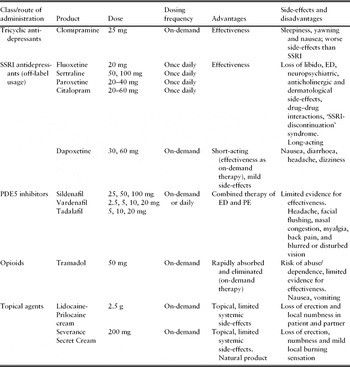
It is typically recommended that in cases of co-morbid PE and ED that ED be managed first. Therapy for PE may include education and counselling to address relationship issues, setting realistic goals for satisfactory sexual interactions, and learning physical techniques that may be used to delay ejaculation. Pharmacotherapy for PE includes use of selective serotonin reuptake inhibitors, opioids and topical anaesthetics; both have been reported to be effective although proper use and counselling are required prior to initiation of therapy (Table 3).Reference McMahon, Althof and Waldinger50
Pharmacotherapy of premature ejaculation (PE)

Conclusions
Although there is generally a decline in the frequency of sexual activity with advancing age, the desire to remain sexually active persists in many men. Androgen insufficiency and ED are highly prevalent in the older male and are both associated with chronic diseases and risk factors. When treating sexual dysfunction in older men, providers should strive to optimize the patients' satisfaction with sexual life via a holistic approach to sexual health. Patients and partners should be extensively counselled before starting a treatment and realistic outcome goals should be chosen. Currently available treatment methods are generally safe and effective in the older male. Future research will improve our ability to provide for the sexual health needs of older men.
Conflicts of interest
Dr Tom F. Lue is a consultant of Pfizer, Lilly, Bayer, Medtronic and Auxillium, and is a board member of Genix. He has received a research grant from American Medical Systems. Dr Alan W. Shindel received a research grant from American Medical Systems, and is a consultant for Boehringer Ingelheim. Dr Maarten Albersen has received research grants from the European Society of Surgical Oncology, Belgische Vereniging voor Urologie and the Frederico Foundation.