Healthcare-associated infections (HAIs) result in prolonged hospital stays and incur healthcare costs. Prevention of HAIs can lead to savings due to the release of beds for alternate uses. Reference Graves1 Whether these savings compensate for the added expenses of additional infection control programs is an important question for economic evaluation. Reference Graves1,Reference Graves, Halton and Lairson2 Accurate cost estimates of HAIs are needed for the conduct of economic evaluations. The cost burden of HAIs to Singapore hospitals is currently unknown, apart from limited estimates in single centers. Reference Vasudevan, Memon, Mukhopadhyay, Li and Tambyah3 The aims of this study were to model the excess cost associated with a single HAI infection in acute-care public hospitals in Singapore and to estimate the annual burden and economic impact of HAIs.
Methods
Estimates were conducted for all 10 Singapore public general and specialty acute-care hospitals in 2019 using the hospital perspective. To determine the cost of an HAI, we considered patients with and without HAIs and estimated prolongation on hospital stay (Supplementary Fig. 1 online). Data on the excess bed days and HAI costs were combined with the predicted number of HAIs annually to provide estimates of the annual burden and economic impact.
The input variables are shown in Supplementary Table 1 (online). We used the Rhame and Sudderth method to derive HAI incidence estimates from prevalence data. Reference Cai, Venkatachalam and Tee4,Reference Rhame and Sudderth5 Estimates of the prolongation of stay due to HAIs were obtained from a prospective cohort study, which adjusted for the time-dependent and competing risk nature of HAIs. Reference Cai, Lo and Venkatachalam6 Bed cost was estimated using the ‘cost accountant’ approach, which considers historical expenditures against some measure of activity. Uncertainties around the input variables were modeled using Monte Carlo simulations consisting of 1,000 iterations (TreeAge Pro 2020, TreeAge Software, Willianstown, MA). Length of stay and cost per bed day were assigned γ distribution; the probability of infection and death was assigned β distribution. We performed 5 scenario analyses in which HAI incidences were varied: (1) 10% reduction in overall HAIs, (2) 40% reduction in overall HAIs, (3) 53% reduction in surgical site infections (SSIs), (4) 54% reduction in bloodstream infections (BSIs), and (5) 44% reduction in pneumonia. Scenarios 1 and 2 simulated broad infection prevention efforts in which overall HAI rates were reduced, whereas scenarios 3–5 were based on proportion of preventable HAIs reported by Schreiber et al. Reference Schreiber, Sax, Wolfensberger, Clack and Kuster7 All data are reported as mean ± standard deviation (SD). Medians with interquartile ranges are additionally provided in Supplementary Table 2 (online) to illustrate data skewness. All costs were adjusted to 2019 Singapore dollars (SGD) (1 SGD = 0.75 USD) using a 3% inflation rate. Discounting was not applicable.
Results
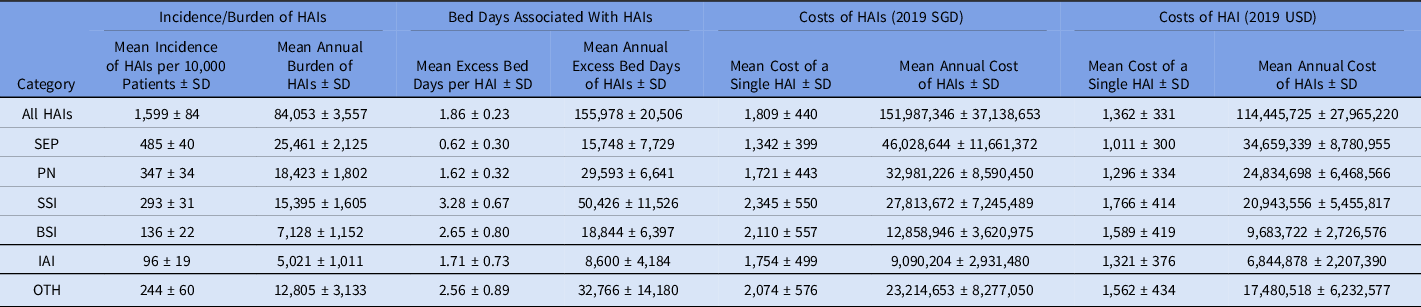
In 2019, the bed occupancy rates in the Singapore hospitals ranged from 70.6% to 91.5%. 8 Excluding patients <16 years old, there were 525,416 adult inpatient admissions. Using the Rhame and Sudderth equation, we estimated that 84,053 ± 3,557 adult inpatients in the hospitals had HAIs in 2019 (Table 1). Reference Rhame and Sudderth5
Mean Burden, Bed Days Lost, and Costs Associated With Healthcare-Associated Infections (HAIs) in Singapore Public Acute-Care Hospitals in 2019

Note. BSI, catheter-related bloodstream infection and bloodstream infection of unknown source; IAIs, gastrointestinal and intraabdominal infections; PN, pneumonia and other lower respiratory tract infections; SEP, unspecified sepsis; SGD, Singapore dollars; SSI, surgical site infections; OTH, other HAIs
The additional length of a single HAI when all infections were collectively analysed was 1.86 ± 0.23 days (Table 1). The excess cost of a single HAI was SGD1,809 ± 440 (US$1,362 ± 331). SSIs and BSIs were the costliest HAIs. In HAI patients who died during their stay, the excess cost of HAI was SGD1,469 ± 403 (US$1106 ± 303); in those who did not die, the excess cost was SGD1,931 ± 462 (US$1,462 ± 348).
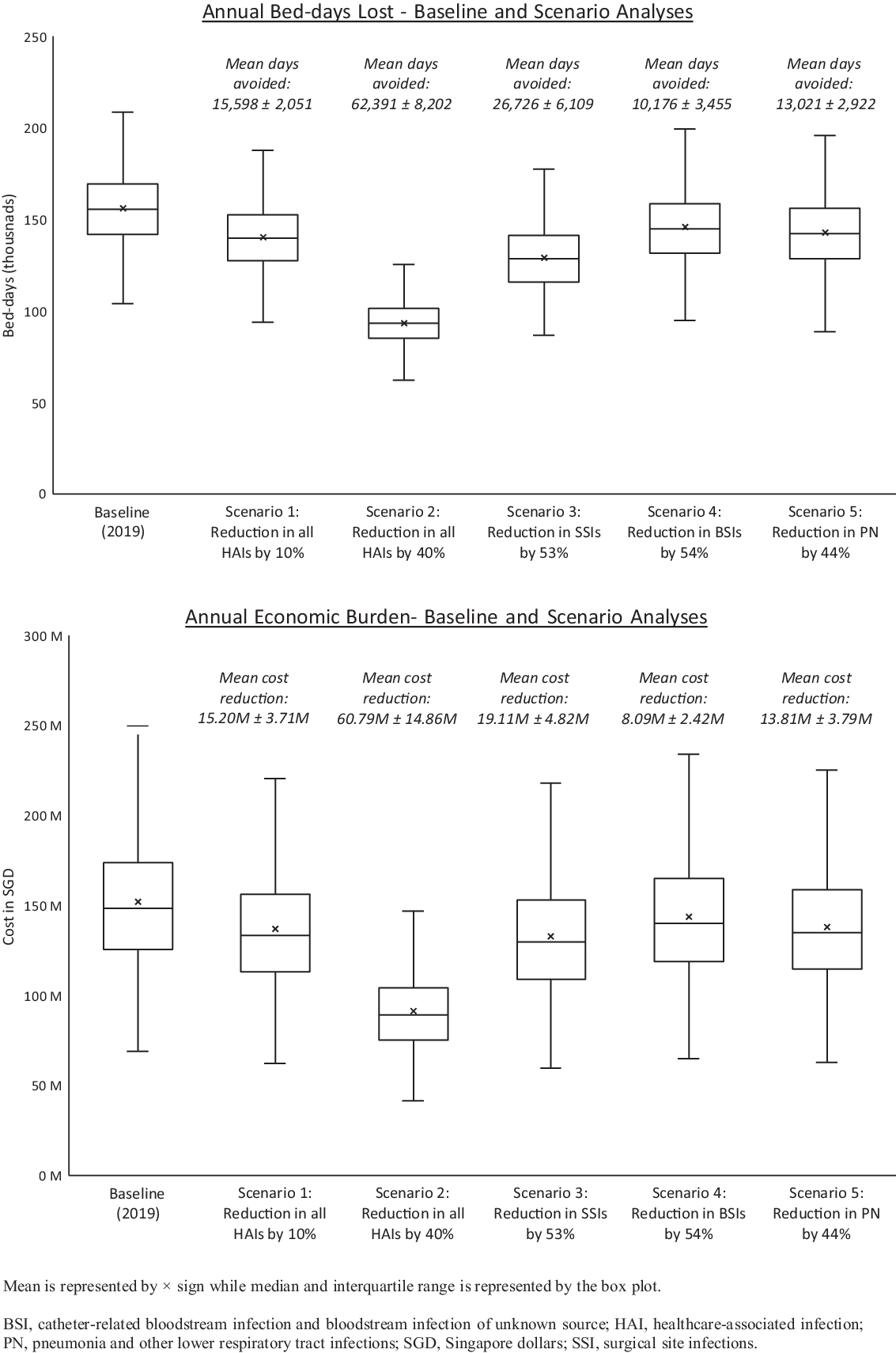
The annual extra bed days lost due to HAIs were 155,798 ± 20,506 days, which amounted to an annual excess cost of SGD151,987,346 ± 37,138,653 (US$ 114,445,725 ± 27,965,220) (Table 1). SSIs had the greatest economic impact, accounting for 32.3% of annual HAI costs. A reduction in overall HAIs by 10% would release 15,598 ± 2,051 and a reduction of 40% would release 62,391 ± 8,202 bed days for alternate use (Fig. 1). This would translate to an annual reduction in costs of SGD15,198,735 ± 3,713,865 (US$ 11,444,571 ± 2,796,522) for a 10% reduction and a reduction of SGD60,794,938 ± 14,855,461 (US$45,778,284 ± 11,186,088) for a 40% reduction. A reduction in SSIs of 53% would release 26,726 ± 6,109 bed days annually for alternate uses, which would yield associated cost savings of SGD 19,106,119 ± $4,823,739 (US$14,386,812 ± 3,632,251).
Scenario analyses in which HAI rates varied. Five scenario analyses were performed in which HAI incidences varied: (1) 10% reduction in overall HAIs, (2) 40% reduction in overall HAIs, (3) 53% reduction in surgical site infections, (4) 54% reduction in bloodstream infections, and (5) 44% reduction in pneumonia.

Discussion
We found that HAIs used 155,978 bed days in public hospitals annually, with a cost of SGD151 million (US$114 million) annually if accounting methods are used to value resources. Our scenario analyses revealed that the cost savings from the proportion of preventable HAIs is substantial. Our results are useful in informing future economic analyses of hospital-based infection control programs.
Monetary valuations of HAIs vary by healthcare setting and funding structures. In Singapore, >80% of the acute inpatient care is provided by 10 public hospitals in 3 healthcare clusters. Within these hospitals, the majority of the annual budget is provided by the government through block-based and activity-based funding, which allocates a fixed amount for each average admission. Because we can assume that the fixed amount will consider potential adverse events during admission, the additional bed days used by patients with HAIs may not incur a direct cost to the hospital. However, important opportunity costs can be avoided by controlling HAIs, in addition to reputational gains. Each bed day can be used in other health-producing activities and can potentially result in monetary gains. This factor is particularly relevant in our local context, given that bed occupancy rates in most Singapore public hospitals often exceed 85%–90%. 8
In contrast to previous studies directed at specific patient groups or organisms, we considered the cost of HAIs across all infection types, which allowed for comparison across different infections. SSIs were the greatest contributor to HAI costs, which highlights the importance of SSIs as a key target for future interventions. To estimate the cost of a hospital bed day in our study, we used historical accounting conventions. We acknowledge that our costs may not represent the opportunity costs that can be recovered if the bed days released, because our costs were produced with the aim of recovering hospital expenditure. Reference Graves, Harbarth, Beyersmann, Barnett, Halton and Cooper9 In future studies, we will consider alternate methods to accurately conceive the opportunity costs of HAI, such as tabulating the cost of each bed day in their alternate uses, or conducting contingent valuation to assess decision makers’ willingness to pay for bed days. Reference Page, Barnett and Graves10
Our study has several limitations. First, we do not consider bed days lost in the private sector, productivity losses due to absenteeism, caregiver time, or morbidity sequelae and death. Reference Graves, Harbarth, Beyersmann, Barnett, Halton and Cooper9 Hence, our findings may be less useful to private hospital administrators or to national policy makers. Second, infection control policy changes have been implemented due to the coronavirus disease 2019 (COVID-19) pandemic. This pandemic may have led to a reduction or a paradoxical increase in HAI incidences, and prevalence data from newer HAI surveys may more accurately reflect the current burden of HAIs in Singapore.
In summary, we described the annual bed days lost and economic burden of HAIs to Singapore hospitals. Future studies to elicit the opportunity cost of a bed day and to describe the economic impact of HAIs from patient and societal perspectives will be desirable.
Acknowledgments
Financial support
This study was supported by funding from Ministry of Health, Singapore (grant no. CDPHRG-CS/0002/2014) and the National Centre for Infectious Diseases short-term fellowship award. The funders had no role in design, data collection and interpretation of the work for publication.
Conflicts of interest
All authors report no conflicts of interest relevant to this article.
Supplementary material
To view supplementary material for this article, please visit https://doi.org/10.1017/ice.2021.165