Introduction
It is well known that expression of developmental and pluripotency-associated genes is an important feature to determine the embryo quality and normal development of growing embryos during the in vitro culture period. Culture conditions after the post-fertilization period may also play a major role in determining blastocyst quality with regards to relative abundance (RA) of many developmental and pluripotency-associated genes responsible for correct embryonic development. During embryonic development, the embryo experiences several morphogenetic developmental events such as oocyte maturation, fertilization, minor and major forms of embryonic genome activation, morula compaction, and blastocyst formation (Wrenzycki et al., Reference Wrenzycki, Herrmann and Niemann2007). Minor and major embryonic genome activation includes transition from the maternal to the embryonic genome. Preimplantation embryos undergo embryonic genome activation (EGA) and lineage specification resulting in three distinct cell types in the late blastocyst. These lineages are the trophectoderm, primitive endoderm, and epiblast, which can be differentiated in expanded blastocysts based on the expression patterns of lineage-specific genes in cattle (Wei et al., Reference Wei, Zhong, Mu, Xiang, Yue, Dai and Han2017). Therefore, normal embryonic development is characterized by a minor and a major form of genome activation, during which several developmentally important genes are expressed in a stage-specific manner (Niemann and Wrenzycki, Reference Niemann and Wrenzycki2000). It has been found that the mRNA expression profile of several developmental genes in developing embryos may differ with regards to various in vitro maturation (IVM) media and chemical supplementation (Wrenzycki et al., Reference Wrenzycki, Herrmann, Keskintepe, Martins, Sirisathien, Brackett and Niemann2001). Therefore, proper regulation of gene expression during developmental events is crucial for obtaining good quality blastocysts and further maintenance of the pregnancy (Watson et al., Reference Watson, Natale and Barcroft2004). Hundreds of genes have been identified related to embryo quality, viability, and pre- and post-implantation periods between in vitro and in vivo systems (Wrenzycki et al., Reference Wrenzycki, Herrmann, Lucas-Hahn, Lemme, Korsawe and Niemann2004). Another study revealed about 870 differentially expressed genes found between the inner cell mass (ICM) and trophectoderm (TE) of bovine blastocysts (Ozawa et al., Reference Ozawa, Sakatani, Yao, Shanker, Yu, Yamashita, Wakabayashi, Nakai, Dobbs, Sudano, Farmerie and Hansen2012). The subsequent study suggested that about 7400 developmental and pluripotency genes were associated with the onset of embryonic transcription in bovine as a species (Graf et al., Reference Graf, Krebs, Heininen-Brown, Zakhartchenko, Blum and Wolf2014).
Several pluripotency-associated transcription factors such as NANOG, OCT4, SOX2, c-MYC, and FOXD3 are exclusively expressed in the ICM and embryonic stem (ES) cells of mammalian species. NANOG, OCT4, and SOX2 are considered core pluripotency-associated transcription factors, which are expressed in embryos, blastocysts, and other tissues in mice and humans, as reviewed elsewhere (Welstead et al., Reference Welstead, Schorderet and Boyer2008). Expression of pluripotency-associated genes (OCT4, NANOG, SOX2) have been analyzed in bovine embryos (Gendelman and Roth Reference Gendelman and Roth2012; Madeja et al., Reference Madeja, Sosnowski, Hryniewicz, Warzych, Pawlak, Rozwadowska, Plusa and Lechniak2013; Silva et al., Reference Silva, Moura, Silva, Nascimento, Silva, Ferreira-Silva, Cantanhede, Chaves, Benko-Iseppon and Oliveira2018; Velásquez et al., Reference Velásquez, Veraguas, Cabezas, Manríquez, Castro and Rodríguez-Alvarez2019). The expression of these pluripotency-related transcription factors in bovine embryos may be linked with correct embryonic development (Herrmann et al., Reference Herrmann, Dahl, Lucas-Hahn, Collas and Niemann2013). It has been reported that OCT4, NANOG, and SOX2 interact and form a transcription regulatory machinery that specifies ES cell pluripotency (Zhao and Jin, Reference Zhao and Jin2017). Therefore, these core pluripotency transcription factors, along with other factors, may play a central role in the maintenance of the pluripotent state of ES cells in domestic animals. It has been found that the OCT4 binds to SOX2 and interacts with NANOG; this complex inhibits the expression of Stk40 (a putative serine/threonine kinase) and maintains the pluripotency of mouse ES cells (Li et al., Reference Li, Sun, Gao, Jiang, Yang, Li, Gu, Wei, Yang, Lu, Ma, Tang, Kwon, Zhao, Li and Jin2010). Nanog also increases pSTAT3 (phospho-signal transducer and activator of transcription 3) expression levels to enhance LIF (leukaemia inhibitory factor) signalling, which is partially mediated through inhibition of SOCS3 expression (Suppressor of cytokine signalling 3), a negative regulator of the LIF/STAT3 signalling pathway of ES cells (Stuart et al., Reference Stuart, van Oosten, Radzisheuskaya, Martello, Miller, Dietmann, Nichols and Silva2014).
The proto-oncogene MYC (c-MYC) is a transcription factor as well as a potent oncogene, and is implicated in many aspects of cellular biology including cell proliferation, DNA replication, inhibition of cellular differentiation, cell growth, and metastasis (Knoepfler, Reference Knoepfler2007). c-MYC has been used as a reprogramming factor to generate induced pluripotent stem cells (iPSC) in mouse, human, pig, cattle, sheep, goat, and other mammalian species. FOXD3, a pluripotency-associated transcription factor, is an activator of the Nanog gene in mouse ES cells. FoxD3 is also indispensable for the maintenance of pluripotency of mouse ES cells (Plank et al., Reference Plank, Suflita, Galindo and Labosky2014). FOXD3 factor binds and interacts with NFATc3 (Nuclear factor of activated T cells 3), and represses its transcriptional activity and therefore blocks the differentiation of ES cells (Zhu et al., Reference Zhu, Zhang and Jin2014). Some of these transcription factors have also been used to generate iPS cells in mouse (Takahashi and Yamanaka, Reference Takahashi and Yamanaka2006), human (Takahashi et al., Reference Takahashi, Tenabe, Ohnuki, Narita, Ichisaka, Tomoda and Yamanaka2007), pig (West et al., Reference West, Terlouw, Kwon, Mumaw, Dhara, Hasneen, Dobrinsky and Stice2010; Gu et al., Reference Gu, Hao, Hai, Wang, Jia, Kong, Wang, Feng, Xue, Xie, Liu, Li, He, Sun, Liu, Wang, Liu and Zhou2014), sheep (Li et al., Reference Li, Cang, Lee, Zhang and Liu2011), cattle (Sumer et al., Reference Sumer, Liu, Malaver-Ortega, Lim, Khodadadi and Verma2011; Zhao et al., Reference Zhao, Wang, Zhang, Yang, Gao, Wu, Zhao, Bao, Hu, Liu and Li2017), and buffalo (Deng et al., Reference Deng, Liu, Luo, Chen, Li, Wang, Liu, Lei, Zhang, Sun, Lu, Jiang and Shi2012; Kumar et al., Reference Kumar, Anand, Vijayalakshmy, Sharma, Rajendran, Selokar, Yadav and Kumar2019). Furthermore, considerable effort has been made to obtain and characterize iPS cells from domestic animals (Koh and Piedrahita, Reference Koh and Piedrahita2014; Pessôa et al., Reference Pessôa, Bressan and Freude2019).
The expression of pluripotency-associated genes has been examined in oocytes and embryos of cattle, pigs, sheep, and goats and described elsewhere. Expression of pluripotency-associated genes (OCT4, NANOG, SOX2, c-Myc, FOXD3) has been examined previously in ES cells of buffalo in our laboratory (Kumar, Reference Kumar2012; Shah et al., Reference Shah, Saini, Ashraf, Singh, Manik, Singla, Palta and Chauhan2015). However, very limited work has been carried out on the expression of the few pluripotency-associated genes in nuclear transfer-derived buffalo embryos. Similarly, a systematic study on the expression of pluripotency-associated genes in different grades of immature oocytes (A, B, C and D grades) with regards to their developmental quality is lacking in buffalo. Therefore, the present study was undertaken to study the RA of major pluripotency-associated candidate mRNA transcripts (OCT4, NANOG, SOX2, c-Myc, FOXD3) in different grades of immature oocytes and in vitro fertilized (IVF)-produced preimplantation embryos of buffalo.
Materials and methods
Collection, aspiration, and classification of buffalo oocytes
Buffalo ovaries were collected from the Delhi abattoir. These ovaries were washed three or four times with antibiotic fortified (400 IU/ml penicillin and 500 μg/ml streptomycin) isotonic normal saline (32–37°C). The washed ovaries were transported to the laboratory within 6 h of slaughter. The oocytes were aspirated from surface follicles (2–8 mm diameter) (Madan et al., Reference Madan, Das and Palta1996; Shahid et al., Reference Shahid, Jalalib, Khanc and Shamid2014) with the help of an 18–19-gauge needle attached to a 10 ml syringe containing the aspiration medium (TCM-199 + 0.3% BSA + 0.0001 g/ml l-glutamine + 50 μg/ml gentamicin sulfate). The purpose of the follicles, 2–8 mm in diameter, was to retrieve numerous, and good quality oocytes for IVF experiments. The content of the syringe was collected in a 15-ml centrifuge tube to settle out the collected cells. The sediment at the bottom contained the oocytes, granulosa cells, and other cellular debris, which was poured into a 100 mm × 100 mm Petri dish. The oocytes were screened and washed with washing medium [TCM-199 + 10% fetal bovine serum (FBS) + 0.81 mM sodium pyruvate + 0.0001 g/ml l-glutamine + 50 μg/ml gentamicin sulfate]. The aspirated oocytes were graded according to the following criteria:
-
Grade A: Compact cumulus–oocyte complexes (COCs) with an unexpanded cumulus mass having ≥5 layers of cumulus cells with homogenous evenly granular ooplasm.
-
Grade B: COCs with 2 to 4 layers of cumulus cells and homogeneous evenly granular ooplasm.
-
Grade C: Oocytes partially or wholly denuded or with expanded or scattered cumulus cells or with an irregular and dark ooplasm.
-
Grade D: Oocytes with deformed or irregular ooplasm without cumulus cells.
These different grades of immature oocytes were used to analyze the expression of the pluripotency-associated genes in the study.
Preparation of buffalo follicular fluid
Buffalo ovaries were collected from Delhi abattoir and transported to the laboratory under cool conditions (∼4°C) within 6 h post collection. Follicular fluid was aspirated from all visible surface follicles (4–8 mm in diameter) using a 23-gauge needle. The follicles of about 4–8 mm diameter were chosen to aspirate the follicular fluid. Small-sized follicles of 2–3 mm diameter would have very less amounts of follicular fluid, therefore these small follicles were ignored, whereas large-sized follicles only (4–8 mm diameter) were targeted to aspirate the follicular fluid for IVF experiments. The cellular debris was removed by centrifugation at 12,000 rpm for 30 min at 4°C at least two times. The supernatant was collected and sterilized by passing through a 0.22-μm Millipore filter. The follicular fluid was distributed in 1 ml aliquots in microcentrifuge tubes and stored at −20°C until further use. This follicular fluid was used for the whole study to minimize the variation in gene expression data.
In vitro maturation of oocytes
Different grades of immature oocytes, i.e. A, B, C and D types, were used for expression of the pluripotency-associated gene transcripts. Buffalo immature oocytes were washed five or six times with washing medium and then twice with IVM medium (TCM-199 + 10% FBS + 5 μg/ml porcine FSH + 1 µg/ml estradiol-17β + 0.81 mM sodium pyruvate + 0.0001 g/ml l-glutamine + 5% buffalo follicular fluid + 50 μg/ml gentamicin sulfate). Approximately 20 A and B grades of immature oocytes were cultured in 100-μl droplets of IVM medium overlaid with sterile mineral oil in 35-mm Petri dishes and cultured for 24 h in a humidified CO2 incubator (5% CO2 in air) at 38.5°C. These matured oocytes were in vitro fertilized and then cultured until day 7 of post IVF. Petri dishes carrying IVM droplets (containing few cumulus/granulosa cells to the surface of the droplet) were kept at 38.5°C in a humidified CO2 incubator. These IVM droplets were used for in vitro culture of the presumptive zygotes/embryos. Several trials were conducted to obtain the different stages of embryos, i.e. 2-cell, 4-cell, 8–16 cell, morula, and blastocyst to analyze the expression of the pluripotency-associated gene transcripts under the study.
Sperm preparation and in vitro fertilization (IVF)
Spermatozoa preparation for fertilization has been described by earlier workers (Chauhan et al., Reference Chauhan, Singla, Palta, Manik and Madan1998). Briefly, two French mini straws of frozen–thawed buffalo semen (Bull No. MU-5596) were washed twice with Brackett and Oliphant (BO) medium (medium containing 10 µg/ml heparin, 137.0 µg/ml sodium pyruvate, and 1.94 mg/ml caffeine sodium benzoate). The pellet was resuspended in ~0.5 ml capacitation and fertilization BO medium (washing BO medium containing 10 mg/ml fatty acid-free BSA). In vitro matured oocytes were washed twice with fertilization BO medium and transferred to 50-μl droplets of BO medium (~20 oocytes/droplet). For IVF, the spermatozoa suspended in 50 μl of BO medium (~3 million spermatozoa/ml) were added to the droplets containing the mature oocytes. IVF was conducted in 50-µl droplets of BO medium for which 50 µl of processed semen was added in each droplet (each droplet containing approximately 150,000 sperm). These droplets were covered with sterile mineral oil and placed in a CO2 incubator (5% CO2 in air) at 38.5°C for 18 h.
In vitro culture (IVC) of embryos
At the end of sperm–oocyte incubation period, cumulus cells were washed off from the oocytes by gentle pipetting/vortexing. Oocytes were then washed in a modified Charles Rosenkrans medium with amino acids (mCR2aa) containing 0.6% BSA fraction V and cultured for 48 h post-fertilization. After that, the embryos were moved to IVC medium (mCR2aa + 0.6% BSA fraction V + 10% FBS) and cultured in 100 µl IVC medium on the original beds (IVM droplets in which maturation of the cumulus–oocyte complexes (COCS) was performed) of granulosa cells for 9 days in a humidified CO2 incubator (5% CO2 in air) at 38.5°C.
During maturation, the COCs were removed from the droplets, however some cumulus/granulosa cells were shed and sloughed off from the matured COCs and became attached to the surface of the droplets. These granulosa cells may grow further and create bedding for the growing embryos. The presumptive zygotes/embryos were cultured in these droplets after IVF. The medium was replaced with 50% fresh IVC medium at 48 h intervals.
RNA isolation and cDNA preparation
Total RNA was isolated from different grades of immature oocytes separately and different stages of in vitro fertilized (IVF)-produced buffalo embryos using the TRIzol method (Invitrogen). Ten immature oocytes of each grade (A, B, C and D grades) were taken for RNA isolation. IVF-produced embryos from different trials were pooled and the RNA was isolated from each stage using TRIzol reagent. Similarly, different stages of embryos, namely 2-cell (n = 90), 4-cell (n = 340), 8–16 cell (n = 205), morula (n = 135), and blastocyst (n = 129) collected from different trails, were used for RNA isolation. About 200 µl TRIzol reagent was added for each grade of immature oocytes and mixed thoroughly by vortexing for 4–5 min, then kept at room temperature for 10 min. Total RNA was isolated from immature oocytes as per the manufacturer’s protocol (Invitrogen). Here, 500 µl TRIzol was added for each grade of embryo, and other reagents were added according to the manufacturer’s recommendations. The dried RNA pellet was dissolved in 10 µl (for immature oocytes) and 20 µl (for embryos) diethylpyrocarbonate (DEPC)-treated water. RNA was treated with 1 µl DNase I (Fermentas) at 37°C for 30 min to remove any DNA contamination. DNase I was inactivated using DNase inactivation reagent (Ambion) as per the manufacturer’s recommendations. RNA was quantified using a NanoQuant reader (Tecan).
cDNA was prepared from total RNA of different grades of immature oocytes and various stages of embryos using a single-stranded cDNA synthesis kit (RevertAID, Fermentas). About 5 µl (10–50 ng/µl) of total RNA of oocytes and embryos were used for cDNA preparation; 1 µl oligo(dT) (supplied with the kit) and 6 µl of DEPC water were added and mixed. The samples were incubated at 65°C for 5 min followed by 4 µl of 5× RT buffer, 1 µl of Ribolock (RNase inhibitor, 20 U/µl), 2 µl of 10 mM dNTPs mix, and 1 µl of Moloney murine leukemia virus reverse transcriptase (M-MLV RT, 200 U/µl) was added in each tube. A negative RT control (all components except reverse transcriptase) was include to negate DNA contamination in cDNA synthesis. Samples were incubated at 42°C for 1 h followed by 70°C for 5 min. The quality of cDNA was checked by measuring the A260/A280 OD ratio and the quantity was calculated by NanoQuant reader (Tecan).
Amplification of cDNA by GAPDH and pluripotency-associated genes
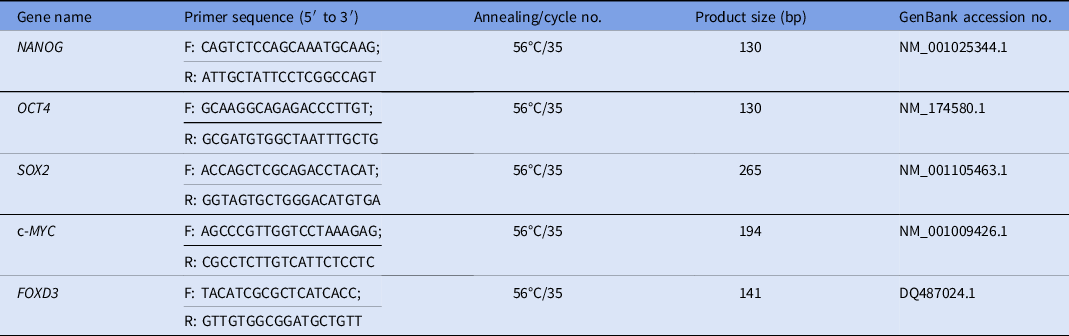
For expression of the individual genes under the study, primers were designed using Primer3 software based on published nucleotide sequences and on the sequence homology (ClustalW software) between mouse, human, sheep, goat, pig, and cattle. After synthesizing the cDNA from oocytes and embryos, cDNA were confirmed by presence of the GAPDH (glyceraldehyde-3-phosphate dehydrogenase) gene. For this purpose, initially, a reverse transcription-PCR (RT-PCR) assay was performed on cDNA of different grades of immature oocytes and various stages of embryos to detect the presence of GAPDH as a housekeeping marker gene. The GAPDH gene was amplified using forward primer (5´-CTCCCAACGTGTCTGTTGTG-3´) and reverse primer (5´-TGAGCTTGACAAAGTGGTCG-3´) (Coussens and Nobis, Reference Coussens and Nobis2002). Expression levels of the pluripotency-associated genes (NANOG, OCT4, SOX2, c-MYC and FOXD3) were analyzed in immature oocytes and various stages of buffalo embryos using RT-PCR. The PCR reaction components were: 1× PCR buffer with NH4(SO4)2, 1.5 U Taq DNA polymerase, recombinant (Fermentas), 200 μM dNTPs mixture, 1.5 mM MgCl2 and 10 pM of each primer, and 3 µl (~600 ng) of template cDNA. RT-PCR amplification reaction conditions for pluripotency genes were as follows: initial denaturation at 95°C for 3 min, followed by 35 cycles of denaturation at 95°C for the 30 s, annealing at 56°C/57°C for 30 s, and extension at 72°C for 30 s. The final extension was carried out at 72°C for 10 min for all genes. Negative RT and negative PCR controls were included to check DNA contamination and ascertain the authenticity of PCR amplification. PCR primer sequences, annealing temperature, and their product sizes are given in Table 1.
Primer sequences for the pluripotency-associated genes

Relative abundance of pluripotency-associated genes in buffalo oocytes and embryos using RT-qPCR
Reverse transcription qPCR (RT-qPCR) was performed on a CFX 96 system (Bio-Rad) using SYBR green (double-stranded DNA specific fluorescent dye), i.e. Light Cycler 480 SYBR Green I Master (2×) (Roche Diagnostics, GmbH, Germany) and Maxima SYBR green/fluorescein qPCR Master Mix (2×) (Fermentas). Here, 2.0 µl of cDNA (200 ng/µl) from each grade of oocytes and each stage of embryos were added to the 5.0 µl of 10× SYBR green master mixture (containing dNTPs, Taq DNA polymerase, MgCl2, and buffer) in triplicate along with two no template controls (NTC). About 0.2 µl of each gene-specific forward and reverse primer was mixed with the above sample and then the reaction was adjusted to 10 µl with nuclease-free water. The reaction was prepared in 96-well plates in triplicate with two NTC for each gene. Amplification conditions for all pluripotency genes were as follows: initial denaturation at 95°C for 5 min, followed by 45 cycles of denaturation at 95°C for 10 s, annealing X°C (respective temperature for each gene listed in Table 1) for 25 s, and extension at 72°C for 25 s. A melting curve was given from 65 to 95°C with 0.5°C increments for 0.05 min.
The specificity of RT-qPCR was confirmed by analysis of the melting curve through CFX manager software. Amplification results were analyzed by considering the Ct value for the target gene in the oocytes and embryos as a calibrator, and the housekeeping GAPDH gene was used as the control (Normalizer). After each reaction, a dissociation curve (melting curve) was run to check the specificity of the PCR product. During analysis, the Ct value for the housekeeping gene was subtracted from the Ct value of the target gene to obtain the change in Ct (ΔCt). The ΔCt value of the calibrator was subtracted from the ΔCt of the target sample to get the ΔΔCt values (Livak and Schmittgen, Reference Livak and Schmittgen2001). The ΔΔCt method was used to calculate the expression fold difference in mRNA transcript for the target genes using the equation 2-∆∆Ct, by assuming that the PCR amplification efficiency was two (Livak and Schmittgen, Reference Livak and Schmittgen2001).
Statistical analysis
Data were analyzed using SYSTAT v.7.0 software (SPSS Inc. Chicago, IL, USA). Data were grouped and presented as means ± SE and subjected to analysis of variance. Pairwise comparison of means was carried out using the least significance difference test and SYSTAT v.7.0. Differences were considered significant at P < 0.05.
Results
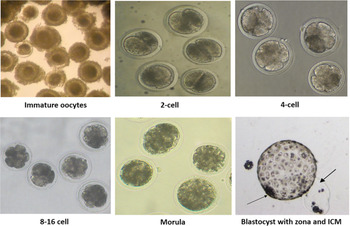
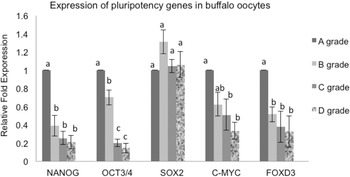
In the present study, different grades of immature oocytes and various stages of IVF produced 2-cell, 4-cell, 8–16 cell, morula, and blastocyst were assessed (Fig. 1). The RA of the pluripotency-associated transcription factor genes (NANOG, OCT4, SOX2, c-MYC, and FOXD3) were analyzed in different grades of immature oocytes and various stages of IVF-produced buffalo embryos using RT-qPCR. Glyceraldehyde-3-phosphate dehydrogenase (GAPDH), a housekeeping gene was used as an internal control to compare the target genes. In the current study, pluripotency-associated genes were expressed in all grades of immature oocytes and all stages of IVF-produced buffalo embryos (i.e. 2-cell, 4-cell, 8–16 cell, morula, and blastocyst) (Tables 1 and 2). Interestingly, the RA of NANOG, OCT4, and FOXD3 transcripts were significantly higher (P < 0.05) in A grade immature oocytes compared with the B, C and D grades of oocytes (Fig. 2). Similarly, expression of c-MYC was significantly higher (P < 0.05) in the A grade immature oocytes compared with the C and D grades of oocytes, but was not significantly different from B grade immature oocytes. Conversely, the SOX2 transcript expression was almost similar and no significant differences were recorded among all grades of immature oocytes.
Collection of the different grades of immature oocytes and in vitro-produced 2-cell, 4-cell, 8–16-cell, morula, and blastocyst stages of buffalo embryos.

Relative abundance of pluripotency-associated genes in different grades of immature oocytes of buffalo (with GAPDH used as reference gene, relative fold mean ± SE)

a,b,c: values with different superscripts within a column differ significantly (P < 0.05).
Relative abundance of pluripotency-associated genes in different stages of buffalo embryos (with GAPDH used as reference gene, relative fold mean ± SE)

a,b,c: values with different superscripts within a column differ significantly (P < 0.05).
Expression of pluripotency genes (NANOG, OCT4, SOX2, c-MYC, and FOXD3) in immature oocytes of buffalo. a, b, c: values with different superscripts on a bar differ significantly (P < 0.05), no significant difference (P > 0.05).

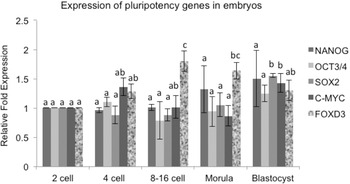
The RA of NANOG, OCT4, SOX2, c-MYC, and FOXD3 transcripts were analyzed in 2-cell, 4-cell, 8–16-cell, morula, and blastocyst stages of embryos (Fig. 3 and Table 3). RA of the NANOG transcript was higher in the blastocyst compared with the 2-cell, 4-cell, 8–16-cell, and morula stages of embryos. Similarly, the RA of OCT4 (P > 0.05) and SOX2 (P < 0.05) transcripts were higher in the blastocyst compared with other embryo stages. The RA of c-MYC was also higher in the blastocyst compared with other stages of IVF-produced embryos, but its expression was somewhat irregular from the embryo 2-cell stage to the morula stage. Surprisingly, the FOXD3 expression was lowest in 2-cell stage embryos compared with other stages of embryos. FOXD3 expression was significantly higher (P < 0.05) at the 8–16-cell stage compared with embryo 2-cell, 4-cell, and blastocyst stages, but did not differ significantly (P > 0.05) from the morula stage.
Expression of pluripotency genes (NANOG, OCT4, SOX2, c-MYC, and FOXD3) in different stages of buffalo embryos. a, b, c: values with different superscripts on a bar differ significantly (P < 0.05), no significant difference (P > 0.05).

Discussion
In the present study, the RA of pluripotency-associated transcription factor genes were analyzed using RT-qPCR in different grades of immature oocytes and various stages of IVF-produced buffalo embryos.
Relative abundance of pluripotency genes in immature oocytes and embryos
RA of the NANOG, OCT4, SOX2, c-MYC, and FOXD3 were analyzed in different grades of immature oocytes and various stages of buffalo embryos. These pluripotency-associated genes were expressed in all grades of immature oocytes and all preimplantation stages of embryos. RA of NANOG, OCT4, c-MYC, and FOXD3 transcripts were higher in A grade oocytes, but their expression gradually decreased in B, C and D grades of immature oocytes. Previously, it was assumed that expression of these pluripotency-associated genes was confined to ES cells only. Subsequently it was shown that these genes were not only expressed in the ES cells but also expressed in immature oocytes, which may be a good indicator to determine developmental competence of immature oocytes. Interestingly, SOX2 transcript expression was not significantly different in various grades of immature oocytes, therefore SOX2 expression was almost similar in all grades of immature oocytes. Expression of NANOG, OCT4, SOX2, c-MYC, and FOXD3 transcripts was detected in 2-cell, 4-cell, 8–16-cell, morula, and blastocyst stage of embryos (Fig. 3), but in this study expression of major pluripotency-associated genes was higher in the blastocyst except for the FOXD3 gene.
It is well known that the NANOG is expressed in the morula, ICM, ES cells, epiblast, and the germ cells, but is downregulated in extraembryonic lineages of the mouse (as reviewed by Welstead et al., Reference Welstead, Schorderet and Boyer2008). The results of the present study were similar to those of previous studies in that the NANOG transcript was expressed in oocytes and preimplantation embryos of pig, cattle, and goat, as reported by several workers (Brevini et al., Reference Brevini, Cillo, Antonini and Gandolfi2005; He et al., Reference He, Pant, Schiffmacher, Bischoff, Melican, Gavin and Keefer2006). Similarly, the NANOG transcript was expressed in IVF-derived bovine embryos (Madeja et al., Reference Madeja, Sosnowski, Hryniewicz, Warzych, Pawlak, Rozwadowska, Plusa and Lechniak2013), cloned bovine embryos (Rodríguez-Alvarez et al., Reference Rodríguez-Alvarez, Cox, Tovar, Einspanier and Castro2010), IVF, and parthenogenetic derived sheep embryos (Bebbere et al., Reference Bebbere, Bogliolo, Ariu, Fois, Leoni, Succu, Berlinguer and Ledda2010). Furthermore, the NANOG transcript was also expressed in the ICM of bovine blastocysts (Ozawa et al., Reference Ozawa, Sakatani, Yao, Shanker, Yu, Yamashita, Wakabayashi, Nakai, Dobbs, Sudano, Farmerie and Hansen2012). NANOG was expressed in immature oocytes and all stages of buffalo embryos, however NANOG expression was lower compared with that of the blastocysts in the study.
The results of the present study were in line with previous studies in that the OCT4 protein was expressed in the immature oocytes and in in vitro-produced cattle embryos (Kirchhof et al., Reference Kirchhof, Carnath, Lemme, Anastassiadis, Scholar and Neimann2000; Gendelman and Roth, Reference Gendelman and Roth2012). Similarly, the expression of OCT4 was detected in eggs, embryos, morulae, and blastocysts of sheep and cattle (Silva et al., Reference Silva, Moura, Silva, Nascimento, Silva, Ferreira-Silva, Cantanhede, Chaves, Benko-Iseppon and Oliveira2018). The earlier studies also showed that the OCT4 transcript was highly expressed in the ICM of the blastocyst, but it was rapidly downregulated in the trophectoderm (TE) of mice (Pesce et al., Reference Pesce, Gross and Scholer1998). Our results are in agreement with previous studies that the expression of OCT4 transcript was found in the ICM of the bovine blastocysts (Yadav et al., Reference Yadav, Kues, Herrmann, Carnath and Niemann2005), pig blastocysts (Vejlsted et al., Reference Vejlsted, Offenberg, Thorup and Maddox-Hyttel2006), goat embryos (He et al., Reference He, Pant, Schiffmacher, Bischoff, Melican, Gavin and Keefer2006), and sheep embryos (Sanna et al., Reference Sanna, Sanna, Mara, Pilichi, Mastinu, Chessa, Pani and Dattena2009). Other workers also showed that the OCT4 protein was not only confined to the ICM but also ubiquitously expressed in all cells of the morula of bovine (Kurosaka et al., Reference Kurosaka, Eckardt and McLaughlin2004). A study by Magnani and Cabot (Reference Magnani and Cabot2008) suggested that OCT4 was transiently activated at the 2-cell stage, while NANOG and SOX2 were activated at the 4-cell stage in pig cleaved embryos. Another study also showed that OCT4 expression was reduced in mature oocytes, 2-cell, 4-cell, 8–16-cell, morula, and the blastocyst stage of buffalo embryos during the hot period compared with the cold period (Sadeesh et al., Reference Sadeesh, Sikka, Balhara and Balhara2016), which suggests that high temperature may adversely affect the normal OCT4 expression in developing embryos.
SOX2 is expressed in oocytes, ICM, epiblast, early primitive ectoderm, germ cells, and multipotent cells of extraembryonic endoderm, neural lineage cells, brachial arches, and gut endoderm cells of the mouse (reviewed by Welstead et al., Reference Welstead, Schorderet and Boyer2008). In the present study, SOX2 expression was detected in all grades of immature oocytes and different stages of buffalo embryos. These results are in support of previous studies that SOX2 is expressed in bovine ICM explants (Pant and Keefer, Reference Pant and Keefer2009) and bovine cloned embryos (Rodríguez-Alvarez et al., Reference Rodríguez-Alvarez, Cox, Navarrete, Valdés, Zamorano, Einspanier and Castro2009). Similarly, SOX2 expression was found in the ICM and epiblast cells of porcine embryos (du Puy et al., Reference du Puy, Lopes, Haagsman and Roelen2011), goat embryos (He et al., Reference He, Pant, Schiffmacher, Bischoff, Melican, Gavin and Keefer2006), and sheep embryos (Sanna et al., Reference Sanna, Sanna, Mara, Pilichi, Mastinu, Chessa, Pani and Dattena2009). Similarly, the SOX2 transcript was also expressed in the ICM of bovine blastocysts (Ozawa et al., Reference Ozawa, Sakatani, Yao, Shanker, Yu, Yamashita, Wakabayashi, Nakai, Dobbs, Sudano, Farmerie and Hansen2012). As very few reports are available on SOX2 expression in oocytes of farm animals, it is difficult to discuss current results of the other species.
NANOG, OCT4, and SOX2, therefore, are core pluripotency-associated transcription factors that are mainly expressed in ES cells. NANOG, OCT4, and SOX2 transcripts were not only expressed in ES cells but also expressed in germ cells and other somatic cells/tissues. In the present study, NANOG, OCT4, and SOX2 transcripts were expressed in different grades of immature oocytes and various stages of buffalo embryos, although their expression was lower in immature oocytes and higher in blastocysts. Conversely, expression levels of NANOG, OCT4 and SOX2 transcripts were reduced from day 9 to day 13 of cattle blastocysts (Velásquez et al., Reference Velásquez, Veraguas, Cabezas, Manríquez, Castro and Rodríguez-Alvarez2019). This indicated that expression of pluripotency genes decreased as the embryo developed to more differentiation stages after gastrulation. However, in contrast, the RA of NANOG and SOX2 mRNA transcripts for day 3 (8–16-cell) embryos were significantly higher compared with day 7 blastocysts and mature oocytes. OCT4 expression was significantly higher at day 3 (8–16-cell) compared with day 7 in goats blastocysts (HosseinNia et al., Reference HosseinNia, Hajian, Jafarpour, Hosseini, Tahmoorespur and Nasr-Esfahani2019). Furthermore, OCT4 and NANOG transcript expression was found in in vitro-produced bovine blastocysts (Herrmann et al., Reference Herrmann, Dahl, Lucas-Hahn, Collas and Niemann2013) and OCT4 and SOX2 transcript expression was found in cloned bovine embryos (Cui et al., Reference Cui, Xu, Shen, Zhang, Zhang and Kim2011). Therefore, these results indicate that expression of the NANOG, OCT4, and SOX2 was higher in the blastocyst and that expression were further reduced at more advanced stages of buffalo development. Continued expression of these transcription factors may vary depending on timing of lineage differentiation after implantation in particular species.
Relative abundance of c-MYC transcript in immature oocytes and embryos
c-MYC was expressed in the morula stage and in mouse throughout the stage for embryo, heart, liver, intestine, spleen, kidney, lung, and mammary gland development (Welstead et al., Reference Welstead, Schorderet and Boyer2008). In our study, c-MYC expression was found in all grades of immature oocytes and all embryo stages. The results of the present study supported the study of Suzuki et al. (Reference Suzuki, Abe, Inoue and Aoki2009) in which c-MYC expression was found in the oocytes and preimplantation embryos, but in the mouse was reduced at the morula stage. No expression of the c-MYC transcript was detected in mouse blastocysts by other workers (Suzuki et al., Reference Suzuki, Abe, Inoue and Aoki2009). In contrast with our study, c-MYC expression was found to be higher in the blastocyst compared with other embryo stages (Mahesh et al., Reference Mahesh, Gibence, Shivaji and Rao2017). These results are similar to those of previous researchers in that c-MYC was expressed in bovine blastocysts (Titens et al., Reference Titens, Kliem, Tscheudschilsuren, Navarrete Santos and Fischer2000) and pig embryos (Tan et al., Reference Tan, Ren, Huang, Tang, Zhou, Zhou, Li, Song, Ouyang and Pang2011). Wang et al. (Reference Wang, Beyhan, Rodriguez, Ross, Iager, Kaiser, Chen and Cibelli2009) found the expression of the c-MYC transcript in iSCNT chimpanzee/bovine embryos. Overall, c-MYC is expressed in different cell types and tissues, however its expression may vary in different species, environmental conditions, and cell types used in the experiment.
Relative abundance of FOXD3 transcript in immature oocytes and embryos
FOXD3 expression was analyzed in different grades of immature oocytes and various embryo stages. Hanna et al. (Reference Hanna, Foreman, Tarasenko, Kessler and Labosky2002) found that FOXD3 was required for maintenance of pluripotent stem cells at the preimplantation and peri-implantation stages of mouse embryos. Although FOXD3 was not expressed in unfertilized oocytes or 1-cell stage embryos, it was expressed in the mouse blastocysts. Similarly, in our study, the FOXD3 transcript was expressed in all stages of buffalo embryos including blastocysts. However, in contrast, FOXD3 expression was higher in A grade immature oocytes compared with other grades of the oocytes. Higher expression, therefore, of the FOXD3 is indicated in good quality immature oocytes compared with poor quality oocytes. Other workers also found that FOXD3 expression was reduced in immature and mature oocytes compared with parthenogenetic developed morula and blastocysts (Singh et al., Reference Singh, Kaushik, Mohapatra, Garg, Rameshbabu, Singh, Palta, Manik, Singla and Chauhan2014). In buffalo, FOXD3 transcript expression was enhanced from the 2-cell stage to the 8–16-cell stage and subsequently gradually reduced in the morula and blastocyst embryo stages. FOXD3 expression was therefore present in immature oocytes and different buffalo embryo stages, however expression may vary between species, cell type and procedure used for embryo production.
In summary, the majority of pluripotency-associated genes were expressed in all grades of immature oocytes and various stages of IVF-produced buffalo embryos. The RA of NANOG, OCT4, and FOXD3 transcripts were significantly higher (P < 0.05) in A grade immature oocytes compared with B-, C-, and D grade oocytes. Although SOX2 transcript expression was not significantly different among the immature oocytes, c-MYC expression was higher in A grade oocytes compared with B-, C-, and D grade oocytes. The RA of NANOG, OCT4, SOX2, and c-MYC were higher in blastocysts, while FOXD3 expression was higher in 8–16-cell stage embryos compared with other stages.
In the present study, major pluripotency-associated genes were analyzed in immature oocytes and different stages of buffalo embryos (2-cell, 4-cell, 8–16-cell, morula and blastocyst). Poly-A tail shortening of certain transcripts has been detected in germinal vesicle stage oocytes and metaphase II stage oocytes in bovine (Brevini-Gandolfi et al., Reference Brevini-Gandolfi, Favetta, Mauri, Luciano, Cillo and Gandolfi1999). The poly-A tails of some physiologically and developmentally associated genes (Connexin-43, glucose transporter type 1, heat shock protein 70, poly A polymerase, Oct4, plakophilin gene) were shortened, however poly-A tails of β-actin and pyruvate dehydrogenase phosphatase (PDP) did not differ in both types of oocytes. Brevini et al. (Reference Brevini, Lonergan, Cillo, Francisci, Favetta, Fair and Gandolfi2002) analyzed the poly-A tail of several transcripts following resumption of meiosis stage of oocytes and the first cleavage of oocytes in bovine. They found no change in expression of β-actin and PDP, but gradual reduction and elongation of the other genes were observed between oocytes and cleaved embryos. If poly-A tail shortening occurred in matured oocytes, gene expression in mature oocytes would compare with that in germinal vesicle stage oocytes or cleaved embryos. Possibly, poly-A tail shortening of pluripotency-associated genes in buffalo may occur before EGA. However, in the present study, mRNA transcripts of pluripotency genes were analyzed in immature oocytes and IVF-produced embryos separately, therefore the issue of poly-A tail shortening of pluripotency genes in buffalo oocytes and embryos was uncertain. Poly-A tail shortening of pluripotency-associated gene transcripts in buffalo may be different from that found in cattle, and needs to be investigated further.
Finally, high expression level of pluripotency-associated genes in A grade oocytes suggested that these markers may be good indicators for determining developmental competence of buffalo oocytes for cloning and in stem cell research in buffalo as a species.
Acknowledgements
The authors are highly grateful to the Director, ICAR-NDRI, Karnal for providing the necessary facilities for carrying out this study.
Conflict of interest
No potential conflict of interest was reported by the authors.
Funding
This work was supported by the Department of Biotechnology, Govt. of India, and National Agricultural Innovation Project (NAIP, ICAR) projects granted to M.S. Chauhan (project codes: C-2067 and C-2075).
Ethical standards
Not applicable as ovaries were obtained from the abattoir.