Introduction
Historically, delusions that first occur late in life have been poorly defined and categorized. The terms late-onset schizophrenia, very late onset schizophrenia-like-psychosis, paraphrenia, and delusional disorder occur interchangeably in the research to refer to presentations that resemble early-onset schizophrenia but have an onset in late life, i.e. after the age of 40 or 60 years (Riecher-Rossler et al., Reference Riecher-Rossler, Rossler, Forstl and Meise1995; Reference Riecher-Rossler, Loffler and Munk-Jorgensen1997). A minority of individuals present with elaborate and fixed delusional beliefs but without other psychotic phenomena (e.g. hallucinations; Roth and Kay, Reference Roth and Kay1998) suggesting that the term late-onset delusional disorder (LODD) may be a more accurate diagnosis.
Delusions are common across a range of late-onset clinical disorders (Korner et al., Reference Korner, Lopez, Lauritzen, Andersen and Kessing2008), in both patients with undocumented cognitive impairment (Freeman, Reference Freeman2006) and in those with known or suspected cognitive decline (Holt and Albert, Reference Holt and Albert2006). For example, approximately 30% of Alzheimer's disease (AD) patients report delusional symptoms during the course of their illness (Flynn et al., Reference Flynn, Cummings and Gornbein1991; Cohen et al., Reference Cohen1993; Rao and Lyketsos, Reference Rao and Lyketsos1998; Bassiony and Lyketsos, Reference Bassiony and Lyketsos2003; Fischer et al., Reference Fischer, Bozanovic-Sosic and Norris2004). Thus, it is presently unclear whether LODD characterizes the prodromal phase of a common condition, such as AD; advanced cognitive impairment in dementia obscured by delusional symptoms (Korner et al., Reference Korner, Lopez, Lauritzen, Andersen and Kessing2008); or whether LODD is a discrete neuropsychiatric diagnosis with its own distinct pattern of cognitive dysfunction and possible progression over time.
Previous longitudinal studies addressing cognitive deterioration in patients with late-onset schizophrenia have yielded variable findings. Palmer and colleagues (Reference Palmer, Bondi, Twamley, Thal, Golshan and Jeste2003) found no evidence of progressive cognitive decline in patients with late-onset schizophrenia over a one- to two-year follow-up period (Palmer et al., Reference Palmer, Bondi, Twamley, Thal, Golshan and Jeste2003). Conversely, a large retrospective Danish study of hospital records reported that elderly patients (i.e. aged over 60 years) diagnosed with schizophrenia were more than twice as likely than the general population to be diagnosed with dementia after a three- to four-year follow-up interval (Korner et al., Reference Korner, Lopez, Lauritzen, Andersen and Kessing2008). Similarly, Brodaty and associates (Reference Brodaty, Sachdev, Koschera, Monk and Cullen2003) were able to confirm a dementia after five years in nine out of 27 patients with late-onset schizophrenia.
Thus, while dementia conversion rates seem significantly higher in patients with late-onset schizophrenia if followed up for sufficient time, it is certainly not the case that first-episode development of psychotic symptoms in older age represents a harbinger of inevitable cognitive decline.
In most previous investigations examining cognitive functioning in patients with late-onset psychotic disorders, screening instruments such as the Mini-Mental State Examination (MMSE) and the Mattis Dementia Rating Scale were used instead of comprehensive neuropsychological assessment (Holroyd and Laurie, Reference Holroyd and Laurie1999; Brodaty et al., Reference Brodaty, Sachdev, Koschera, Monk and Cullen2003; Palmer et al., Reference Palmer, Bondi, Twamley, Thal, Golshan and Jeste2003). While such screening tools may be clinically relevant in obviously impaired patients, unlike detailed neuropsychological examination, they lack the sensitivity and specificity to detect subtle deficits across a variety of cognitive domains (Rajji and Mulsant, Reference Rajji and Mulsant2008). To date, elucidation of a cognitive phenotype associated with LODD has been unattainable due to poorly defined patient samples, heterogeneous research methods, small sample size, and limited cognitive assessment.
Compared with healthy elderly individuals, patients with late-onset psychosis perform more poorly on neuropsychological measures assessing frontal executive functioning (Sachdev et al., Reference Sachdev, Brodaty, Rose and Cathcart1999), auditory and visual attention (Rajji and Mulsant, Reference Rajji and Mulsant2008), logical reasoning and perceptual processing (i.e. matching of unfamiliar faces; Phillips et al., Reference Phillips, Howard and David1997), visuo-spatial skills, verbal fluency (Miller et al., Reference Miller, Lesser, Boone, Hill, Mehringer and Wong1991; Almeida et al., Reference Almeida, Howard, Levy and David1995), intellectual functioning (Almeida et al., Reference Almeida, Howard, Levy and David1995), speed of information processing (Sachdev et al., Reference Sachdev, Brodaty, Rose and Cathcart1999), and memory (Miller et al., Reference Miller, Lesser, Boone, Hill, Mehringer and Wong1991; Sachdev et al., Reference Sachdev, Brodaty, Rose and Cathcart1999). With specific regard to memory functioning, research has typically indicated only mild reduction to recall performance and that recognition memory is essentially intact (Heaton et al., Reference Heaton1994; Jeste et al., Reference Jeste, Harris, Krull, Kuck, McAdams and Heaton1995; Herlitz and Forsel, Reference Herlitz and Forsel1996).
With a reemergence of the cognitive neuropsychiatric approach to the study of delusions (Davies et al., Reference Davies, Coltheart, Langdon and Breen2001; Langdon et al., Reference Langdon, Ward and Coltheart2008; Coltheart, Reference Coltheart2010), Coltheart and colleagues (Reference Coltheart, Langdon and McKay2007, Reference Coltheart, Langdon and McKay2011) developed a two-factor theory outlining the cognitive dysfunction required to both prompt and maintain a delusional belief system (Davies et al., Reference Davies, Coltheart, Langdon and Breen2001; Langdon et al., Reference Langdon, Ward and Coltheart2008; Coltheart, Reference Coltheart2010). They proposed that a delusional belief requires the presence of (1) a neuropsychological impairment to initially prompt the delusion (e.g. abnormal perceptual input); and (2) a second neuropsychological impairment that interferes with the process of normal belief evaluation that would otherwise cause the belief to be rejected (i.e. an executive or frontal systems deficit). These two factors act in unison. Coltheart et al. (Reference Coltheart2010) suggested that the first factor (Factor 1) can result from a multitude of potential neuropsychological impairments, and because this factor determines belief content, its potential heterogeneity accounts for the wide variation of delusional content across people. Conversely, the second factor (Factor 2) is an executive impairment that impedes the ability to examine counter-evidence. It is consistent across delusions and accounts for their incorrigibility. This theory has been used to account for the onset and maintenance of visually based delusions, such as mirrored self-misidentification and reduplicative paramnesia (Breen et al., Reference Breen, Caine and Coltheart2000a; Reference Breen, Caine, Coltheart, Hendy and Roberts2000b; Reference Breen, Caine and Coltheart2001).
Although Factor 1 can relate to many potential neuropsychological deficits, in LODD there is a preponderance of partition delusions (i.e. the belief that people or objects can enter the home through the walls) and delusions based on the misidentification or theft of possessions (Howard et al., Reference Howard, Castle, O'Brien, Almedia and Levy1992; Ballard et al., Reference Ballard1995; Hassett et al., Reference Hassett, Ames and Chiu2005). Such themes suggest impairment to the cognitive processes underlying object identification or spatial localization. Neuroanatomically, object identification processes have been localized within a network involving the anterior occipital and inferior temporal cortices, whereas spatial localization processes have been attributed to a network involving the occipital and posterior parietal cortices (Kohler et al., Reference Kohler, Kapur, Moscovitch, Winocur and Houle1995; Malach et al., Reference Malach1995; Kanwisher et al., Reference Kanwisher, Chun, McDermott and Ledden1996; Logothetis, Reference Logothetis1998; Grill-Spector et al., Reference Grill-Spector, Kushnir, Hendler and Malach2000). The cognitive process of hypothesis evaluation (i.e. Factor 2) has been associated with the lateral prefrontal cortex in functional neuroimaging studies of normal participants (Fletcher et al., Reference Fletcher2001; Coltheart, Reference Coltheart2010) and in studies of patients with prefrontal cortical lesions (Bechara et al., Reference Bechara, Damasio, Damasio and Anderson1994; Reference Bechara, Damasio, Damasio and Lee1999; Reference Bechara, Tranel and Damasio2000).
The two-factor theory has the potential to explain a variety of monothematic delusional disorders (Coltheart et al., Reference Coltheart, Langdon and McKay2011), yet to date the cognitive underpinnings of LODD remains a neglected research subject. This is important as many LODD patients are described clinically as experiencing only a primary psychiatric illness or conflated with AD. Often an insufficient examination of cognitive deficits means these factors are overlooked when explaining clinical presentations of LODD, which potentially influences clinical treatment.
Controversy remains about (1) whether LODD represents a prodromal or established dementia, and (2) whether LODD could be conceptualized as a separate clinical entity with a distinct cognitive profile. Due to methodological shortcomings in previous research, important theoretical considerations remain inadequately investigated. For example, whether patients with LODD are significantly cognitively impaired, and if so, whether such impairment is consistent with a common age-related condition, such as AD.
To date, the current study is the largest published clinical case series of LODD. It aims to describe the neuropsychological presentation of a large sample of patients with LODD, i.e. fixed and elaborate delusions of onset after 65 years of age, with no other accompanying psychotic features. Based on the two-factor theory of delusions, it was predicted that LODD would be associated with a primary perceptual processing deficit (Factor 1), and an executive deficit (Factor 2) that serves to reinforce the primary deficit. This study also contrasts the profiles of the LODD group with a sample of non-psychotic patients with AD. It was predicted that the AD group would exhibit a predominant amnestic memory profile, whereas the LODD group would present with visuo-perceptual and executive deficits. If significant cognitive differences were found between the groups, this would strengthen the case against LODD representing a prodromal form of typical dementia.
Methods
Participants
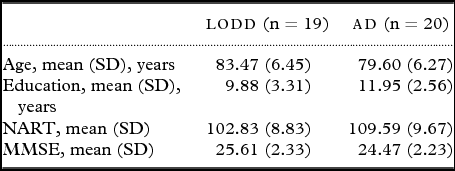
Nineteen community-dwelling patients met the Diagnostic and Statistical Manual of Mental Disorders-IV-Text Revision (DSM-IV-TR) criteria for delusional disorder with an onset age of more than 65 years (LODD), and 20 unmatched community-dwelling patients met the DSM-IV-TR criteria for dementia of the Alzheimer's type (AD). LODD patients were recruited from inpatient and outpatient services associated with the Kingston Aged Persons Mental Health Service within Monash Health. AD patients were recruited from an outpatient memory clinic. All study patients spoke English as a first language, and none demonstrated impairment in the comprehension of instructions or conversation. In addition, estimated premorbid level of intellectual function (as measured by National Adult Reading Test (NART) performance) was at least within the average range for both LODD and AD groups. Cognitive performance of patients in the LODD and AD groups was compared with published age and education-matched normative data. This allowed the comparison of the patient groups with a normal sample. This study was approved by the Research Directorate of Monash Health. Neuropsychological data were obtained during routine diagnostic work-up. Summary mean values and SD of patient variables are presented in Table 1.
Demographics of the sample groups

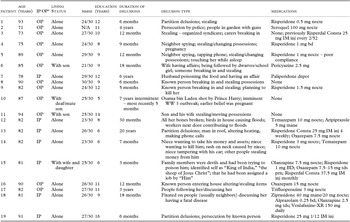
LODD patients were assessed to be experiencing non-bizarre delusions without accompanying auditory or visual hallucinations, and were not experiencing a primary mood disorder. This was to ensure a homogenous sample of patients exhibiting primary delusional symptomatology without the confounding influence of other psychotic phenomena. As such, LODD patients did not satisfy the diagnostic criteria for schizophrenia, schizophreniform disorder, or schizoaffective disorder. Of the 19 LODD patients, seven were seen as inpatients. Inpatients were assessed immediately prior to discharge to the community, so were considered stable in mental state and functional status. Table 2 provides detailed demographic and clinical information of the 19 individual LODD patients.
Demographic and clinical information for the LODD cohort

aIP: inpatient; OP: outpatient.
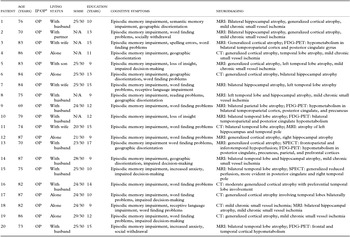
A consultant neurologist or psychiatrist diagnosed AD on the basis of clinical history, medical examination, neuropsychological profile, and neuroimaging. None of the AD patients had a history of psychotic illness. Table 3 provides detailed demographic and clinical information for the 20 individual AD patients.
Demographic and clinical information for the AD cohort

Of the LODD group, 15 of the 19 patients were females, and 15 lived alone. Of the AD group, 17 of the 20 patients were females; six lived alone. Patients were considered independent in activities of daily living (ADL) unless they were receiving assistance for five or more days per week from a family member or paid carer. On this basis 16 patients from each of the LODD and AD groups were independent in ADLs.
Neuropsychological assessment
All patients underwent comprehensive cognitive assessment with measures selected to examine the neuropsychological constructs of general intellectual function, executive function, attention and working memory, processing speed, new learning and delayed memory, expressive language, and visuo-perceptual processing. Putative measures of these constructs were taken from subtests of the Wechsler Adult Intelligence Scale – Fourth Edition (WAIS-IV; Wechsler, Reference Wechsler2008), subtests of the Wechsler Memory Scale – Fourth Edition (WMS-IV; Wechsler, Reference Wechsler2009), Hopkins Verbal Learning Test (HVLT; Brandt and Benedict, Reference Brandt and Benedict2001), Victoria version of the Stroop Test (Spreen and Strauss, Reference Spreen and Strauss1998), Trail Making Test (TMT; Army-Individual-Test-Battery, 1944), Controlled Oral Word Association Task (COWAT) and Animal Fluency Task (Spreen and Strauss, Reference Spreen and Strauss1998), NART (Nelson, Reference Nelson1982), Boston Naming Test (BNT; Kaplan et al., Reference Kaplan, Goodglass and Weintraub2001), and copy of the Rey Complex Figure (RCF; Meyers and Meyers, Reference Meyers and Meyers1995).
All patients received a common battery of standardized tests in the course of routine clinical management. As such, visuo-perceptual functions for all the patients were based on analyses of visually based errors on the BNT (e.g. naming a picture of a harp as a “staircase,” a harmonica as a “block of flats,” or a mask as a “teacup”) (Lukatela et al., Reference Lukatela, Malloy, Jenkins and Cohen1998; Williams et al., Reference Williams2007) and the patients’ copy of the RCF, which was scored according to standardized criteria (Meyers and Meyers, Reference Meyers and Meyers1995). Subsequent elucidation of visuo-perceptual errors was undertaken in patients manifesting visuo-perceptual dysfunction through the administration of the Visual Object and Space Perception Battery (VOSP; Warrington and James, Reference Warrington and James1991). The VOSP allows the delineation of the functionally and anatomically distinct processes of object and space perception (Lawrence et al., Reference Lawrence, Watkins, Sahakian, Hodges and Robbins2000; Pena-Cassanova et al., Reference Pena-Cassanova2009). Two subtests of the VOSP assessing object identification (i.e. Silhouettes and Object Decision) and two subtests assessing space perception (i.e. Position Discrimination and Number Location) were administered to 12 of the LODD patients.
Statistical analysis
Raw scores were converted to aged scaled scores using the published normative data for the WAIS-IV, WMS-IV, Verbal fluency, Victoria Stroop, TMT A and B, and BNT. The aged scaled scores were then converted to z-scores based on a mean score of 10 and SD of 3. For the HVLT, Animal Fluency Task, RCF, and VOSP, raw data were converted directly to z-scores based on the aged-matched normative data (Ivnik et al., Reference Ivnik, Malec, Smith, Tangalos and Petersen1996; Spreen and Strauss, Reference Spreen and Strauss1998; Hester et al., Reference Hester, Kinsella, Ong and Turner2004). Conversion of all raw data to z-scores allowed the direct comparison across all neuropsychological measures.
Premorbid level of functioning was estimated to have fallen within at least the average range for both LODD and AD groups. Deviation from expected performance by greater than 1 SD was used as the criterion for determining that a particular test performance was impaired (Lezak et al., Reference Lezak, Howieson and Loring2004).
As neuropsychological test z-scores were not normally distributed, non-parametric statistics (Mann–Whitney U) were employed to evaluate group differences across variables. T-tests were used for pairwise comparisons within groups, and Bonferroni adjustments were applied when variance was not homogenous. Effect sizes were measured using Person's correlation coefficient, r.
Results
There were no significant group differences in age, MMSE performance, years of education, and estimated premorbid ability as measured by the NART (p > 0.05; refer to Table 1).
General intellectual function
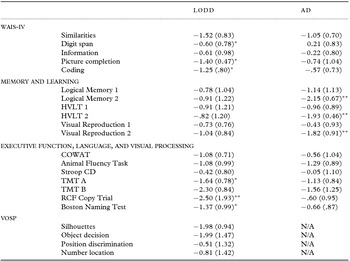
Compared with the aged-matched norms, the LODD group demonstrated impairments on the Similarities, Picture Completion, and Coding (a measure of processing speed) subtests of the WAIS-IV (z < –1.0; Table 4). No significant differences were observed on the Similarities and Information subtests of the WAIS-IV (p > 0.10) between the LODD and AD groups. However, significantly poorer performances were observed in the LODD group on the Picture Completion (U = 184.50, p < 0.05, r = 0.40) and Digit Span subtests (U = 254.00, p < 0.01, r = 0.42). These results suggested that the LODD group had reduced attention to visual detail and working memory when compared with the AD group. The Digit Span result, however, should be interpreted with caution as neither the LODD group nor the AD group performed below the specified cut-off (z < –1.0) for impairment on this measure. The LODD group was significantly worse than the AD group on the Coding subtest (U = 166.50, p < 0.05, r = 0.41).
Z-score mean values and standard deviations of neuropsychological tests for the sample groups

Significance of sample group differences: * p < 0.05; **p < 0.01.
Memory and learning
Against aged-matched norms, the LODD group demonstrated normal immediate and delayed recall (Table 4). The LODD and AD groups showed no significant group differences on immediate memory performances (Logical Memory 1, HVLT 1, and Visual Reproduction 1; p > 0.10). The LODD group was significantly superior to the AD group on all delayed memory tasks, i.e. Logical Memory 2 (U = 57.00, p < 0.01, r = 0.54), HVLT 2 (U = 33.50, p < 0.01, r = 0.60), and Visual Reproduction 2 (U = 83.50, p < 0.01, r = 0.42). Taken together, there was no significant difference between the AD group and the LODD group on immediate recall measures; however there was a significant difference on delayed recall measures.
Executive functioning
The LODD group demonstrated impairments on TMT A and B, RCF copy, and Animal Fluency Task when compared with age-matched norms (z < –1.0; Table 4). There were no significant differences between the LODD group and the AD group in COWAT, Animal Fluency Task, Stroop CD, or TMT B tests (p > 0.10). The LODD group did, however, perform more poorly than the AD group on the copy trial of the RCF (U = 273.50, p < 0.01 r = 0.51). Failure in copying the RCF suggested that the LODD group had greater difficulty in planning and organizing visual information.
Naming and misrecognitions
The LODD group had fewer correct responses than the AD group on the Boston Naming Test (U = 222.50, p < 0.05, r = 0.39; Table 4). An analysis of error type showed a qualitative difference between the LODD group and the AD group. Compared with the AD group (μ = 1.00, SD = 1.85), the LODD group (μ = 6.12, SD = 5.43) committed significantly more visuo-perceptual misidentification errors (U = 52.00, p < 0.01, r = 0.58).
Visual object and spatial perception
Pairwise comparisons of the four subtests of the VOSP indicated that the LODD patients were significantly poorer at Silhouette identification than both Position Discrimination (t(11) = –3.12, p < 0.05, r = 0.69) and Number Location (t(10) = –2.35, p < 0.05, r = 0.60). Similarly, the LODD group's performance on the Object Decision subtest was poorer than on the Position Discrimination subtest (t(10) = –2.70, p < 0.05, r = 0.65; Table 4). These results demonstrated that the LODD patients performed significantly more poorly on tasks requiring the visual identification of familiar objects compared with tasks requiring spatial localization abilities.
Discussion
The aim of the current study was two-fold. First, to determine whether LODD has a characteristic cognitive profile that underpins the presenting psychiatric features of the condition. Second, to determine whether LODD represents prodromal or established dementia.
This study provided clear evidence of LODD being associated with a significant and specific pattern of cognitive impairment on neuropsychological testing. Scores on measures of verbal and non-verbal conceptual reasoning, visual object recognition, processing speed, and naming fell between 1 and 1.5 SDs below the age- and education-matched mean scores. The LODD group's performance on tests of divided attention and visuo-perception with planning and organization components was approximately 2 SDs below the normative mean score.
In addition to the LODD group demonstrating cognitive abnormalities, significant differences were noted between the impairment profiles of the LODD and AD groups. While the AD group demonstrated the predicted severe limitations of episodic memory performance, the LODD group had deficits in visuo-perception, processing speed, working memory, and naming. The findings suggested an important double dissociation between the LODD group and the AD group. That is, in relation to delayed memory functioning (i.e. LM2, HVLT 2, and VR 2), the LODD group performed normally whereas performance by the AD group was abnormal. Conversely, on tests of visuo-perception (i.e. BNT misrecognition errors, RCF copy, picture completion), the AD group performed normally whereas performance by the LODD group was abnormal. Analysis of the VOSP performance in the LODD group also supported visual object recognition impairment. AD patients were not administered the VOSP for contrasting analysis, however were assumed to be intact within this domain based on their normal performances on more complex visuo-perceptual tasks. This double dissociation between memory and visuo-perceptual functions makes it unlikely that LODD simply represents a prodromal form of typical AD as suggested by previous research looking at the broader diagnostic category of late-onset schizophrenia (Brodaty et al., Reference Brodaty, Sachdev, Koschera, Monk and Cullen2003; Palmer et al., Reference Palmer, Bondi, Twamley, Thal, Golshan and Jeste2003; Korner et al., Reference Korner, Lopez, Lauritzen, Andersen and Kessing2008). Further support was evident in five of the 19 LODD patients who maintained their delusions beyond three years without any evidence of a progressive decline into dementia.
This study clearly links cognitive impairment to the delusional systems in the LODD group. This supports the primary tenet of the two-factor theory of delusional belief, i.e. delusions are prompted and maintained by neuropsychological impairment. Theoretically, the first factor can relate to myriad cognitive abnormalities capable of prompting an unusual belief. Visuo-perception was a suspected source of deficit because of the high prevalence of delusional content focusing on possessions having been altered or stolen. A primary visuo-perceptual deficit was also suggested by Breen and colleagues (Reference Breen, Caine, Coltheart, Hendy and Roberts2000b), who found right hemisphere cognitive impairments in a small sample of LODD patients. Analysis of the VOSP, object misidentification errors on the BNT, and the copying of the RCF supported visual misperception being the common factor prompting delusions in the current LODD group.
The second factor, proposed as responsible for the maintenance of delusions, was impairment to the evaluation processes that would normally result in the rejection of the belief (Coltheart, Reference Coltheart2010; Coltheart et al., Reference Coltheart, Langdon and McKay2011). Within a neuropsychological framework, putative measures of belief evaluation are tasks of abstract conceptual reasoning. Abstraction and problem-solving abilities were impaired in the verbal domain in the LODD group, supporting the existence of this second factor. It was not possible to reliably determine the presence or absence of a higher-level non-verbal abstraction deficit because of underlying deficits to lower-level perceptual processes.
Although not specified by the two-factor theory, absence of a memory consolidation deficit in the LODD group is likely imperative to the generation and maintenance of delusions. At interview, all such patients divulged the extended time spent during both prodromal and illness phases, gathering confirmatory evidence to support their delusional system. Such a process necessarily requires capacity to consolidate newly learned information (“evidence”) to facilitate the elaborate complexity common to the delusions of these patients.
The pattern of neuropsychological deficit within the LODD group is potentially informative regarding underlying regions of cerebral dysfunction. The detection of a primary visuo-perceptual impairment is strongly suggestive of dysfunction within the posterior association cortex. Specifically, performance on the VOSP indicated marked impairment to object identification processes, functions that have been associated with the “ventral” visual processing stream (Logothetis, Reference Logothetis1998). Studies employing both lesion and functional neuroimaging techniques have localized the cognitive processes associated with object recognition within a neuroanatomical network involving projections from the anterior occipital cortex into the inferior temporal cortex (Kohler et al., Reference Kohler, Kapur, Moscovitch, Winocur and Houle1995; Malach et al., Reference Malach1995; Kanwisher et al., Reference Kanwisher, Chun, McDermott and Ledden1996; Grill-Spector et al., Reference Grill-Spector, Kushnir, Hendler and Malach2000). Previous work has additionally proposed the locus of the belief evaluation system within the dorsolateral prefrontal cortex, particularly within the right hemisphere (Coltheart, Reference Coltheart2010; Coltheart et al., Reference Coltheart, Langdon and McKay2011). There is evidence that abstract reasoning processes are mediated by the frontal brain (Fletcher et al., Reference Fletcher2001), so finding impairment to such processes in the LODD group might be integral to its definition as a clinical syndrome.
A limitation of the current research was the lack of radiological investigation conducted on the LODD patients. Of the 19 patients included, only eight had undergone any neuroimaging, with only three having MRI. This presents a significant barrier to the investigation of the underlying neuropathology associated with the documented cognitive and psychiatric abnormalities. Specifically, it was neither possible to determine whether distinct neuroanatomical loci were damaged, nor whether there was likely to be a common underlying pathology. On the limited information available, there would seem to be a range of neuropathologies, with evidence of vascular lesions in both anterior (three patients) and posterior (four patients) regions, significant frontal cortical atrophy (three patients), and old bilateral frontal head injury (one patient). On this basis, the patient group appeared to represent a combination of static and progressive pathologies, possibly accounting for the variable findings regarding patient outcome in previous longitudinal studies (Brodaty, et al., Reference Brodaty, Sachdev, Koschera, Monk and Cullen2003; Palmer et al., Reference Palmer, Bondi, Twamley, Thal, Golshan and Jeste2003; Korner et al., Reference Korner, Lopez, Lauritzen, Andersen and Kessing2008). Future research should include detailed structural and functional neuroimaging investigation. The current research, plus predictions derived from the two-factor theory of delusional belief, indicates that focus should be placed on the inferior temporal lobes and the prefrontal cortex.
In this study, 13 of the 19 LODD patients were treated with low doses of antipsychotics. All these patients were trialed on such medication during contact with the mental health service, although medication was ceased in six of the patients secondary to inefficacy. A typical response to antipsychotic medication was the lessening of agitation and behavioral problems (e.g. calling authorities or confronting neighbors/family); however, all patients still endorsed the maintenance of their delusional beliefs post-treatment. This response may suggest that delusional symptoms in the LODD group are formed and maintained by structural neuropathology rather than dysfunction within the dopaminergic or serotonergic systems, with neuroleptics appearing to play a sedating role rather than producing any significant symptom amelioration.
This research would benefit from future controlled experimental study in which more focused cognitive assessments of reasoning, judgment, and visuo-perceptual impairment are administered. A comparison with the neuropsychological profiles of younger patients presenting with delusional disorder would also assist in informing our understanding of LODD as an age-related or age-independent clinical entity. Longitudinal follow-up of the current LODD group would also assist in determining the etiological driver for delusional beliefs, which would benefit future assessment and management of such patients.
The current study represents the largest detailed cognitive examination of LODD. Despite being generally functionally intact, patients with LODD presented with a marked cognitive impairment profile, which was distinct from that of patients with AD. Specifically, the existence of visuo-perceptual impairment, in concert with specific executive dysfunction (i.e. verbal abstract reasoning and disorganization) and intact memory retention, can explain the onset and maintenance of delusional beliefs in this population.
Conflict of interest
None.
Description of authors’ roles
All the authors were involved in the designing of this study. Drs Harris and Kotsopoulos collected neuropsychological assessment information for the participants included, and Dr Yamin completed statistical analysis of the data. All the authors were involved in the manuscript drafting process.
Acknowledgments
We sincerely thank Dr Carmel Lum for her invaluable critiques during the revision of drafts of this paper. Dr Lum is associated with Eastern Health, Melbourne, Australia.