Introduction
The study of the archaeology of the Eastern Eurasian Steppe is dominated by the region's rich monumental landscapes. Among these are the iconic deer stone and khirgisuur (DSK) monumental complexes that form the main components of a ceremonial mortuary landscape dating to the Late Bronze Age (c. 1200–700 BC). Part of the larger ‘kurgan’ tradition of the Eurasian Steppe, these monuments are found mostly in central and northern Mongolia, but also in north-western China and southern Siberia (Erdenebaatar Reference Erdenebaatar and Linduff2004; Allard & Erdenebaatar Reference Allard and Erdenebaatar2005; Amartuvshin Reference Amartuvshin2007).
Khirgisuurs are comprised of a central stone mound covering a stone burial chamber, which usually contains the remains of a single human individual. The central mound, which can reach an average diameter of approximately 10m, is surrounded by a circular or quadrangular fence formed by an alignment of stones. Most khirgisuurs are also associated with external structures in the form of stone mounds and circles. The stone circles are made up of between seven and twelve stones. Burnt bone from domesticated animals (mostly caprines, but sometimes also bovines) is often found within the circles. The stone mounds consist of locally sourced rocks heaped together (1–5m in diameter), covering a horse's head (positioned to face east) and associated with elements from the horse's neck and hooves. Taylor (Reference Taylor2017) has demonstrated that these were domesticated horses, used for chariotry or riding, emphasising the importance of the horse in the development of Late Bronze Age mobile pastoralism. These features suggest that the deposition of horse remains was linked to ritual practices, although it is currently difficult to determine whether these animals were sacrificed for the occasion, or used as an offering after slaughtering and/or death by natural causes.
The size of khirgisuur monuments varies widely, from 0.1–20ha, depending upon the number of associated peripheral structures, which can be in the thousands. The vast majority of khirgisuurs, however, are of moderate size, and very large monuments are rare. Deer stones are anthropomorphic stelae often covered with carvings depicting deer (Jacobson-Tepfer Reference Jacobson-Tepfer2001; Volkov Reference Volkov2002; Fitzhugh Reference Fitzhugh, Bemmann, Parzinger, Pohl and Tseveendorzh2009a). As with khirgisuurs, they are often accompanied by peripheral stone mounds and stone circles; indeed, these often include the same deposits of domestic animals as found at the khirgisuurs.
The wide distribution of these elaborate burial mounds and stone monuments suggests a shared knowledge between individuals and mobile communities across the Eastern Steppe and indicates a level of socio-political intensification and complexity previously unknown in this region. Despite the fact that khirgisuurs have been the recent focus of scholarly attention, many questions regarding their ritual and funerary role, as well as their social and political function, remain unanswered. Based on the analysis of form and architecture, some scholars have suggested that their construction was planned and executed over a short period of time (Fitzhugh Reference Fitzhugh, Hanks and Linduff2009b; Houle Reference Houle, Weber, Hite, Khatchadourian and Smith2017). Honeychurch et al. (Reference Honeychurch, Wright, Amartuvshin, Hanks and Linduff2009) regard these monuments as evidence for the beginning of social inequality on the Mongolian plateau. Indeed, a significant amount of collective labour was required to build them, and variations in their number and size have been interpreted as reflecting differences in wealth between communities and/or in the social status of individuals (Frohlich et al. Reference Frohlich, Amgalantugs, Littleton, Hunt, Frohlich and Goler2008; Wright Reference Wright2014). Wright (Reference Wright2014) has also identified khirgisuurs that appear to have ‘accreted’ with continual reuse and with the addition of peripheral structures over time; khirgisuurs, he argues, were living monuments that were built to be repeatedly visited and modified, thus highlighting their role in materialising communal cohesion through social interactions in an egalitarian society. The size of the communities involved in the construction of these large monuments is unknown. If we assume that large khirgisuurs were constructed very quickly, then the animals slaughtered—in some cases representing more than 1000 horses—must have drawn on an area much larger than that of a single local community. This would suggest social networks active over great distances (Houle Reference Houle, Weber, Hite, Khatchadourian and Smith2017). In contrast, if the large khirgisuurs were used over several decades, slowly growing in size, they could have been created without the need for the involvement of larger populations drawn from more distant areas.
Addressing the question of how quickly or otherwise the large khirgisuurs were constructed is therefore essential if we are to understand the socio-political structure of these Late Bronze Age societies. Houle (Reference Houle, Weber, Hite, Khatchadourian and Smith2017) has pointed out that some of the structural elements, such as the position of the surrounding stone fence and the mounds placed immediately adjacent to it, imply planning and subsequent execution. But whether ritual features such as stone mounds and circles were built during a single ceremony, or over a prolonged period of time, remains a matter of speculation; there are currently too few radiocarbon dates available to address this question (Allard & Erdenebaatar Reference Allard and Erdenebaatar2005; Fitzhugh & Bayarsaikhan Reference Fitzhugh and Bayarsaikhan2009). For the same reason, the construction history of complexes in which deer stones and khirgisuurs appear together is also unclear. Some scholars view these features as contemporaneous, while others consider deer stones to be later additions to areas already ritually sanctified (e.g. Jacobson-Tepfer Reference Jacobson-Tepfer2001; Fitzhugh Reference Fitzhugh, Bemmann, Parzinger, Pohl and Tseveendorzh2009a).
To our knowledge, only two large khirgisuurs have provided more than two AMS dates: Urt Bulagyn and the B10 complex of Tsatsyn Ereg, both of which are located in central Mongolia (Arkhangaï province). Urt Bulagyn is located in the Khanuy Valley. It covers approximately 15ha and contains around 2700 peripheral structures, of which four have been excavated and dated (Allard & Erdenebaatar Reference Allard and Erdenebaatar2005; Fitzhugh & Bayarsaikhan Reference Fitzhugh and Bayarsaikhan2009). The calibrated dates suggest a possible outward expansion of the satellite mounds over a period of a few hundred years between the eleventh and the seventh centuries BC (Table S1 & Figure S1 in the online supplementary material (OSM)). The B10 complex of Tsatsyn Ereg is located 50km south-east of Urt Bulagyn, in the Khoid Tamir Valley (Magail Reference Magail2008). This large khirgisuur covers approximately 22ha and contains 2361 peripheral structures (Figure 1). Radiocarbon dating of six ritual structures associated to the B10 complex suggests an extensive period of use from around the eleventh to tenth to the fourth to second centuries BC (Gantulga Reference Gantulga2015). If confirmed, the persistence of the ceremonial deposition of horse remains over several centuries would be unprecedented archaeologically and raise questions regarding the significance and function of this particular site. For reasons detailed in the OSM, however, we consider it probable that contamination of bone collagen with modern carbon has adversely affected the results.
Location map of Tsatsyn Ereg and of the three dated monuments (figure by A. Zazzo & S. Lepetz).

As khirgisuurs were key features of the social and physical landscape of the Late Bronze Age, their date and construction histories have significant implications for the wider understanding of demography, mobility and regional networks. Was each complex, for example, constructed in a single event, drawing on large regional networks for people and animals? Or built across a human lifetime, with lower requirements for extended regional resources? Or, did construction extend over a century or longer, with elements gradually added in sequence, and the overall complex therefore requiring only local resource capacity?
To answer these questions, tight chronology is of the utmost importance. Bayesian modelling can be used to test these hypotheses, but this requires large numbers of AMS dates on well-preserved samples. This can be challenging in the case of khirgisuurs, as bones are often buried in shallow contexts and exposed to weathering. This article aims to provide the first high-precision dating of ceremonial activity that ties deer stone complexes together with one large and one small khirgisuur. This is achieved by dating a large quantity of horse and caprine remains deposited at the site of Tsatsyn Ereg, and by the application of Bayesian modelling. We also address the issue of bone contamination and its impact upon radiocarbon dates, and discuss the broader significance of our results for understanding of the Mongolian Bronze Age.
The Late Bronze Age monuments of the Khoid Tamir Valley
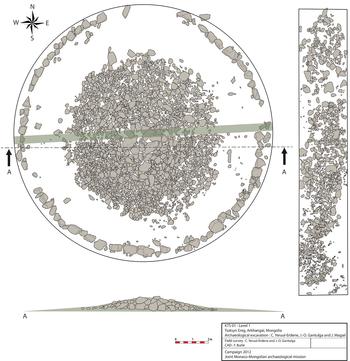
Since 2006, the joint Monaco-Mongolia archaeological mission has carried out research at the Late Bronze Age to Early Iron Age site of Tsatsyn Ereg (Figure 1) (Magail Reference Magail2008, Reference Magail, Rodriguez and Marchesi2015). To date, more than 2100 graves, over 110 deer stones and 3000 petroglyphs have been documented within the surveyed area (approximately 150km2) (Figure 2). The material analysed in this study derives from the excavation of three archaeological complexes located in the Khoid Tamir Valley: a small khirgisuur (KTS-01), a large khirgisuur (B10) and structures in close association with a deer stone (PAC38). A detailed description and analysis of each distinct ritual feature and its possible function in funerary or mortuary practice is beyond the scope of this article, and will form the focus of a separate contribution. Briefly, KTS-01 comprises seven peripheral structures, all of which were excavated in 2012 (Figure 3). Six out of the seven mounds contained the remains of horses, which were sampled for radiocarbon dating. The deer stone PAC38 is associated with 144 mounds, of which three were excavated in 2011 (Figure 4). Each excavated mound contained horse remains, which were sampled for radiocarbon dating. The large khirgisuur B10 covers an area of approximately 22ha with 2361 peripheral structures, including 1116 mounds and 1245 circles (Figures 5–6). The size and architectural plan of this khirgisuur is very similar to that of Urt Bulagyn (Allard & Erdenebaatar Reference Allard and Erdenebaatar2005).
The large khirgisuur B10 at Tsatsyn Ereg, Mongolia (figure by J. Wilczek).

Plan of the khirgisuur KTS01 and the excavated peripheral structures (figure by C. Yeruul-Erdene, J.-O. Gantulaga & M.-F. Burle).

Plan of the deer stone PAC 38 and the excavated peripheral structures (figure by J. Magail).

Plan of the khirgisuur B10 and the excavated peripheral structures (figure by S. Lepetz, A. Zazzo & J. Magail).

Ritual features at the B10 khirgisuur: top) mound ST 1 containing the heads of two horses at its centre; bottom) circle ST 107 containing calcined caprine bones (figure by S. Lepetz & A. Zazzo).

A total of 60 structures were excavated between 2009 and 2016, comprising 22 circles and 38 mounds. These structures were selected for excavation in order to cover a wide topographical range. Twenty out of the 22 circles contained datable material—either calcined bone or charcoal, or both—which were sampled for radiocarbon dating. While some mounds were empty (8 of 38), most provided one or sometimes two horse heads, together with skeletal elements from the neck and hooves. When two individual animals were found in the same mound, both were sampled. Collagen was extracted from the horse bones, and teeth from the three excavated complexes (KTS-01, B10 and PAC38). Two different collagen-extraction methods were used: our in-house protocol (method 1, after Bocherens et al. Reference Bocherens, Fizet, Mariotti, Lange-Badre, Vandermeersch, Borel and Bellon1991) and a protocol involving ultrafiltration (method 2, after Higham et al. Reference Higham, Jacobi and Ramsey2006). The results are described and summarised in the OSM (Table S2 & Figures S7–11). The discussion below examines the impact of diagenetic alteration on the radiocarbon dates, before integrating the samples into a high precision Bayesian model in order to refine the chronology of the Late Bronze Age monuments.
Result and discussion
Assessing the effect of diagenesis on radiocarbon ages
The dates obtained for calcined bones and charcoal from the B10 complex cluster tightly between 2770±20 and 2910±25 BP. Pairs of calcined bone and charcoal dates were either very close or identical in date (Figure S2), indicating good preservation of the bone apatite, in keeping with previous results obtained for this type of material (Lanting et al. Reference Lanting, Aerts-Bijma and Van Der Plicht2001; Chatters et al. Reference Chatters, Brown, Hackenberger, McCutcheon and Adler2017). Conversely, the dates obtained for bone collagen samples from this khirgisuur appear more variable, ranging between 2630±25 and 2925±25 BP. The chemical integrity of the collagen was assessed independently of the measured age using collagen yield and C/N ratio as proxies (DeNiro Reference DeNiro1985; Ambrose Reference Ambrose1990; van Klinken Reference van Klinken1999). All the samples fulfilled the conditions for well-preserved bones, with collagen yields above 1 per cent and C/N ratios between 2.9 and 3.6 (DeNiro Reference DeNiro1985; Ambrose Reference Ambrose1990; van Klinken Reference van Klinken1999; Brock et al. Reference Brock, Higham and Ramsey2010). But the correlation between the collagen C/N ratios and the radiocarbon ages observed at KTS01 (Figure S3) and at the B10 complex (Figure S4), together with the age difference between the high molecular weight (HMW) and the low molecular weight (LMW) fractions of the ultrafiltered bone collagen samples (Figure S5), indicate that some of the bone collagen samples were contaminated by a young, radiocarbon-enriched source of carbon, probably originating from the soil.
As the horse skulls were placed directly on, or just below, the surface of the palaeosol some 3000 years ago, they were continuously exposed to weathering, and often had roots and fungi penetrating deep into them. This contamination by environmental carbon could not have been detected solely by the quality control (QC) criteria routinely applied. In order to investigate whether ultrafiltration successfully removed this contamination, we compared the dates measured on the same samples prepared using methods 1–2, using the better-preserved HMW fraction results only for method 2. The results (Figure S6) show that there is no systematic difference between the radiocarbon age of bones treated with or without ultrafiltration. Only four ultrafiltered bone samples (in ST15, ST17, SAT533 and SAT 803) returned dates that were significantly (>50 radiocarbon years) older than non-ultrafiltered bones, while the opposite was observed on two occasions (ST6 and ST8). On average, the radiocarbon dates measured on ultrafiltered collagen were slightly older and less variable than those without ultrafiltration (2806±58 BP vs 2785±87 BP, n = 15), but not significantly different (p = 0.41), thus suggesting that ultrafiltration is not the solution.
Our results strongly suggest that the QC criteria for collagen purity are not strict enough for accurately dating the B10 complex and associated structures and should be revised—at least for bones found in similar contexts (i.e. subsurface finds from mid-latitude sites). For this reason, only collagen samples with C/N ratios of 3.30 or below and extraction yields of 5 per cent or above were considered to be sufficiently uncontaminated. For ultrafiltered samples, we can only rely on the C/N ratio, as lower collagen yields are typically obtained from poorly preserved samples (Higham et al. Reference Higham, Jacobi and Ramsey2006). This approach led us to discard over half (34 of 65) of the samples from the B10 khirgisuur, four of the six samples from STE01 and none of the three samples for PAC38. It is notable that most of the contaminated samples were from petrous bones (part of the temporal bone in the skull), while most of the samples with well-preserved collagen were from tooth roots and dentine. We postulate that the physical protection of dentine provided by tooth enamel probably explains this differential preservation observed within a single horse skull. Using these revised QC criteria, the radiocarbon ages of the remaining collagen samples ranged from 2780±25 to 2915±25 BP and are indistinguishable from the circle dates from the B10 structure. We tested the accuracy of the new QC criteria by comparing the radiocarbon ages of samples that had been dated twice. This is the case for SAT 810 and ST 5, where collagen from the same individual bone was extracted using two different methods, and in SAT 354, where two different bones were dated. In each case, the radiocarbon ages did not differ significantly (t-test, p < .001). We also show that, once the revised QC criteria are applied, there is no more correlation between collagen age and either collagen yield (r2 = 0.15) or C/N ratio (r2 = 0.02). This gives us confidence that the samples that meet the new QC criteria are not significantly contaminated and that their radiocarbon ages are reliable.
Bayesian modelling
The radiocarbon dates of the selected samples (31 bone collagen, 20 calcined bones and six charcoal samples from the B10 complex, two bone collagen samples from the KTS01 khirgisuur and three bone collagen samples from the deer stone PAC38) were used to generate a high-resolution chronology with Bayesian modelling. The principle of this technique is to combine radiocarbon dates with prior information to produce a posterior density estimate, which combines both types of evidence. A high overall agreement (by convention, 60 per cent or above) indicates that the posterior distribution agrees well with the prior distribution, and that the prior information and the radiocarbon dates are consistent. Conversely, a low overall agreement indicates that both the standardised likelihood and prior belief have to be reassessed. In the case of a monument such as the B10 complex, adding prior information is not trivial, as the dated material comes from structures that are not linked by stratigraphic relationships. For this reason, we used only weak or non-informative prior information to estimate the onset, duration and end of use of the B10 complex. To assess the relationship of the B10 complex with the other two dated structures, we also modelled the onset, duration and end of use of PAC38 and KTSE01. We used the resulting sample of 62 dates, and produced a Bayesian model containing three phases corresponding to the three dated monuments with a uniform prior using the OxCal (v4.3.2) and the IntCal13 radiocarbon calibration curve (Bronk-Ramsey & Lee Reference Bronk Ramsey and Lee2013). We then used the OxCal ‘Order’ function to test the chronological ordering between the different monuments. We repeated this analysis with an outlier model that identifies and downweights anomalous measurements (Bronk Ramsey Reference Bronk Ramsey2009). Details of the models can be found in the OSM (S4.A). Both models produced similar results, but only results from the outlier model are reported here. The model was run five times to assess its reproducibility, and the data from one of the runs are shown in Table 1.
Results of the Tsatsyn-phase model using the IntCal13 calibration curve.

The results provide an age model that precisely date the onset, duration and end of use of the three monuments (Figure 7). The model suggested that the construction of the horse and caprine ritual structures in the B10 complex started during the second half of the eleventh century BC (1057–1007 cal BC, 95.4 per cent confidence) and ended during the first half of the tenth century BC (1014–948 cal BC, 95.4 per cent confidence); the overall use span of the B10 complex was between 0–93 years (95.4 per cent confidence), with a median value of 41 years (Figure 8). For PAC38, the results suggest that the construction of satellite features started at 1337–945 cal BC and ended at 1060–684 cal BC (95.4 per cent confidence); the overall span was 0–113 years, with a median value of 32 years. For KTS01, the results suggest that the construction of satellite features started at 1532–1017 cal BC (90.9 per cent confidence, median 1143 cal BC) and ended at 1122–619 cal BC (90.9 per cent confidence, median 998 cal BC); the overall span was 0–103 years, with a median value of 22 years. The test for the ordering of the three structures suggests that there is a high probability that the small khirgisuur KTS01 was constructed before both the B10 complex (98.2 per cent confidence) and the deer stone PAC38 (79.8 per cent confidence) (Table 2). Conversely, the start of the B10 complex and the PAC38 area cannot be differentiated chronologically. This highlights a probable connection between deer stones and large khirgisuurs, as previously proposed (Fitzhugh Reference Fitzhugh, Bemmann, Parzinger, Pohl and Tseveendorzh2009a; Taylor et al. Reference Taylor, Jargalan, Lowry, Clark, Tuvshinjargal and Bayarsaikhan2017). It is notable that the boundaries for the PAC38 and KTS01 are less precise than for the B10 complex, due to the limited number of radiocarbon dates available for modelling.
Modelled start and end dates for the large khirgisuur B10, the deer stone PAC38 and the small khirgisuur KTS01 from the site of Tsatsyn Ereg (figure by A. Zazzo).

Modelled span for the large khirgisuur B10 (figure by A. Zazzo).

Probability that the start of event 1 (left column) precedes event 2 (top row) using OxCal ‘Order’ function.

Our results show with a high degree of confidence that the 2361 peripheral structures of the B10 complex were constructed over a relatively short period of time—probably within a generation. What the model does not distinguish effectively, however, is whether the B10 complex was built in a single event, or over a longer period of time. Indeed, the 2-sigma confidence interval for the construction span (0–93 years) includes 0; additional simulation is required to address this question meaningfully, i.e. as the modelled time interval includes the time period ‘zero’ as well as longer time periods (up to 93 years), we cannot say whether the DSK was constructed at one particular point or over several decades. To decipher the different scenarios, we built three models that use fictitious bone and charcoal dates (after Bayliss Reference Bayliss2007). Details of the models can be found in the OSM (S4B-D). The three models show the calibrated dates integrated in a single phase to mimic the real dataset for the B10 complex. The dates have been simulated by a process of back calibration from samples whose real age is centred around 1000 cal BC, as suggested by the results of the previous model.
In the first model (model 0), we hypothesise that all the peripheral structures were built in a single event and date from 1000 cal BC; in the second model (model 50), we hypothesise that the peripheral structures were constructed over 50 years—between 1025 and 975 cal BC; in the third model (model 100), we hypothesise that the peripheral structures were constructed over 100 years—between 1050 and 950 cal BC. The results provide age models that precisely date the onset, duration and end of use of the B10 complex (Table 3). The comparison of the shape of the probability distribution for the real data (Figure 8) and the three simulations (Figure 9) allow us to discard the single-event model (model 0) because in this model, the highest probability is predicted for a span of 0 years (median 15 years). We can also exclude model 100, which does not include 0 in the modelled span. The best match, therefore, is found with the intermediate simulation (model 50), both in terms of model outputs (onset, duration and end of use) and the shape of the probability distribution of the span, suggesting that the B10 complex was built over a period of around 50 years.
Modelled spans for model 0 (a) model 50 (b) and model 100 (c). The calibrated dates have been simulated from 50 samples that either all date to 1000 cal BC (model 0), or range from 1025–975 cal BC (model 50), or range from 1050–950 cal BC (model 100) (figure by A. Zazzo).

Results of models 0, 50 and 100 using the IntCal13 calibration curve

Several functions have been attributed to large DSK complexes. While large monuments of the Mongolian Bronze Age are often considered to represent the earliest expression of elite power and inequality (e.g. Allard & Erdenebaatar Reference Allard and Erdenebaatar2005; Fitzhugh Reference Fitzhugh, Bemmann, Parzinger, Pohl and Tseveendorzh2009a; Houle Reference Houle, Hanks and Linduff2009), other scholars prefer to view them as instruments of trans-egalitarian interactions and invoke their importance as structuring elements of Bronze Age societies (e.g. Wright Reference Wright2014). While the data and analysis presented here do not challenge the underlying assumptions about the significance of large complexes mentioned above, they provide an essential anchor for these theoretical models. For the first time, it is possible to form inferences regarding the size of the populations that built large DSK complexes, such as Tsatsyn Ereg. In Mongolia today, households usually slaughter one horse per year, at the beginning of winter (Marchina et al. Reference Marchina, Lepetz, Magail and Salicis2017). Modern ethnographic observations also show that in central Mongolia, horse skulls are deposited annually on the top of small cairns known as ‘ovoos’ (Marchina et al. 2017). Assuming a similar practice in the Late Bronze Age, the 1116 and 144 mounds of B10 and PAC38 respectively would represent 25 family units or households slaughtering approximately 1260 horses over 50 years. The different polygonal or linear arrangements of mounds observed at khirgisuur B10 that include 10–15 mounds could therefore represent these (possibly annual) events. Given that the number of stone mounds and stone circles of the B10 are close, the deposition of calcined caprine bones could have occurred at the same rate—either together with the horse heads, or at another time of the year. It is notable that this figure of 25 family units or households is very similar to the palaeodemographic estimates proposed for contemporaneous Mongolian Bronze Age populations living in Arkhangaï (Houle Reference Houle2010, Reference Houle, Weber, Hite, Khatchadourian and Smith2017), or farther north in the Khövsgöl province (Frohlich et al. Reference Frohlich, Amgalantugs, Littleton, Hunt, Frohlich and Goler2008).
The Late Bronze Age is often perceived as a period marked by major increases in population size and animal mobility. Our work provides indirect insight into the size of regional networks at that time. As animal remains were deposited across approximately 50 years around the Tsatsyn Ereg khirgisuur, its construction did not require the local population to draw on large regional networks and involvement of resources from remote regions. Although this conclusion does not exclude the long-distance mobility of some individuals, it may suggest that the importance of local social and demographic organisation has sometimes been underestimated. This conclusion also somewhat disagrees with recent strontium isotope analysis suggesting that Bronze Age horses from khirgisuurs located in the Khanuy Valley came from geographically distant locales (Makarewicz et al. Reference Makarewicz, Winter-Schuh, Byerly and Houle2018), indicating social networks active over great distances. Research comparing the isotopic signature of horse teeth with the mapping of local bioavailable strontium is required to assess this more fully.
Conclusion and perspective
New radiocarbon dating of samples from a large number of structures, combined with Bayesian modelling, has produced, for the first time, a high-precision chronology for the construction of a DSK complex. Our results show that construction of the B10 complex began during the second half of the eleventh century BC. They do not support previous suggestions that these features were built as part of a single-phase ceremony (Fitzhugh & Bayarsaikhan Reference Fitzhugh and Bayarsaikhan2009; Fitzhugh Reference Fitzhugh2017). They do, however, strongly suggest that the time period required to construct the B10 complex was short—around 50 years at most. Bayesian modelling of the radiocarbon dates also demonstrates that ritual activities around the deer stones and the large Tsatsyn Ereg khirgisuur complex are contemporaneous, highlighting a probable functional connection between the two types of monuments (in agreement with Fitzhugh Reference Fitzhugh, Bemmann, Parzinger, Pohl and Tseveendorzh2009a; Taylor et al. Reference Taylor, Jargalan, Lowry, Clark, Tuvshinjargal and Bayarsaikhan2017; contra Jacobson-Tepfer Reference Jacobson-Tepfer2001). This work highlights the importance of large monuments as structuring elements of Bronze Age societies, at a time of significant socio-political transformations on a level not previously seen in this region of Eastern Eurasia.
These results also have broader implications, as they invite us to challenge the validity of previous chronologies proposed for the monumental cultures of Central Asia, based on the direct dating of bone collagen artefacts. Previous dates obtained at Tsatsyn Ereg have been shown to be unreliable due to contamination. To a lesser extent, some of the new bone collagen dates presented here were also affected by contamination with modern carbon from the soil. All the samples therefore required thorough screening. We cannot dismiss the possibility that the contamination issue highlighted here could also apply to other sites where dated artefacts are heavily exposed to weathering. This would preferentially affect finds from shallow burial contexts, such as the bones found in Bronze Age satellite features. In our study, contamination affected mostly bone, although some teeth were also affected. Only careful selection using microscopic analysis of the best-preserved dentine and root fragment samples has resulted in an improved collagen yield, C/N ratio and, ultimately, reliable radiocarbon results. As most of the published radiocarbon dates for the Mongolian Bronze Age lack QC information, their overall reliability should be reconsidered. We call for the widespread adoption of similar QC measures for samples taken from shallow burial contexts across Eurasia. As contamination adds modern carbon, making the dates appear too young, this may bring into question earlier conclusions regarding the duration of the khirgisuur phenomenon, and the possible overlap with the slab-burial and well-dated Arzhan culture in the Mongolian Altai around 800 BC (Taylor et al. Reference Taylor, Jargalan, Lowry, Clark, Tuvshinjargal and Bayarsaikhan2017). Fully addressing these questions will require further research both in the field—with more detailed excavation of key archaeological sites—and in the laboratory, by carefully selecting and directly dating the domesticated animal remains recovered from these ritual structures.
Acknowledgements
We wish to thank all the members of the Monaco-Mongolia Archaeological Mission. We are particularly thankful to the members of the 2016 mission, who excavated a large number of the dated structures. We thank D. Fiorillo (SSMIM, Paris), M. Massault (GEOPS, Orsay), C. Gauthier, N. Tisnérat and F. Thil (LSCE, Gif-sur-Yvette) for their help with isotopic analysis, graphitisation and radiocarbon dating, respectively. We also wish to thank J. Cucchi for editing the language of the article, as well as the two anonymous reviewers for their insightful comments. Fieldwork was supported by the Monaco-Mongolia Archaeological Mission (director: J. Magail) and the French archaeological mission in Mongolia (CNRS, MNHN, MAEDI, director: S. Lepetz). The analyses were supported by the LabEx BCDiv and the CNRS.
Supplementary material
To view supplementary material for this article, please visit https://doi.org/10.15184/aqy.2018.175