1. Introduction
[S]electing human capacities for dealing with unforeseeable situations involves paradox and apparent theoretical impossibility of solution. But like a host of impossible things in life, it is constantly being done (Knight, Reference Knight1921: 298).
Place yourself…at the centre of a man's philosophic vision and you understand at once all the different things it makes him write or say (James, Reference James1909/1977: 117).
Frank Knight's revised doctoral thesis published in 1921 under the title Risk, Uncertainty and Profit (RUP) is widely credited for having introduced the notion of radical uncertainty into economic theory.Footnote 1 Knight himself states that ‘[the] particular technical contribution … which this essay purports to make is a fuller and more careful examination of the rôle of the entrepreneur or enterpriser, the recognized ‘central figure’ of the system’ (Knight, Reference Knight1921: ix). In RUP, Knight refers to the entrepreneur and the firm as the central entities for reducing uncertainty in a modern, complex economy (Loasby, Reference Loasby2007). Influenced by the work of William James, Knight's argument rests on a partially developed or implicit ‘psychology of uncertainty’ in which intuitive inferential judgment and tacit knowledge are central ingredients of purposeful and intelligent entrepreneurial action under uncertainty (Rizzo and Dold, Reference Rizzo and Doldforthcoming).
Knight thought of himself as an institutional economist (Hodgson, Reference Hodgson, Biddle, Davis and Medema2001, Reference Hodgson2004: 344). His view of institutionalism was, however, different from some of his contemporary institutionalists who wanted to base economics on ‘instinct theory’ (like, e.g. Thorstein Veblen or Wesley Clair Mitchell) or ‘behaviorist psychology’ that supported the straightforward application of experimental and empirical methods (like, e.g. Morris Copeland or Clarence Ayres).Footnote 2 Knight was an adherent of ‘institutional individualism’ (Agassi, Reference Agassi1975). In brief, this is the series of claims that (i) only individuals (or groups of individuals) make decisions or have purposes; (ii) institutions are important products of either deliberate design or spontaneous development generated by individual decisions; (iii) institutions have only the purposes granted to them by individuals; (iv) individuals' preferences, beliefs, and decisions are deeply affected by institutions.Footnote 3 Thus Knight was an institutionalist (but not a proponent of ‘American institutionalism’) who could still put individual decisions at the center of his set of concerns while exhibiting a strong sense of the ‘social construction’ of preferences and beliefs.Footnote 4
In RUP, Knight shows an awareness of the institutional prerequisites of the ‘enterprise system’ both in its idealized perfectly competitive form and in its more realistic entrepreneurial manifestation. He believed that, despite their obvious flaws, liberal social institutions are the sine qua non of the enterprise system. This includes such economic institutions as free contract and private property (Knight, Reference Knight1921: 370; 319–320) as well as the corporate-hierarchical form of firm-organization (Knight, Reference Knight1921: 273). These constitute the bases of a competitive and free social order.
Our task in this paper, however, is to focus on the institutional implications of the psychology of uncertainty and entrepreneurship in the third part of RUP. Unfortunately, Knight does not fully or explicitly draw these implications from this analysis, but we believe we are on strong ground to at least sketch them, once we fully understand what he is saying, or, as indicated in the second epigraph above, once we place ourselves at the center of Knight's philosophic vision. We intend to examine Knight's ideas on true uncertainty and the role of the entrepreneur in the context of Knight's philosophical background of ‘radical empiricism’ and ‘pluralism’.Footnote 5 These represent a set of ideas of the philosopher-psychologist William James that were widely discussed during the time of Knight's philosophical studies.
The paper is organized as follows. After introducing the philosophical background (section 2), we show that for Knight imperfect methods of classification lead to only partial knowledge (section 3) of a phenomenon. The way in which the individual makes decisions under partial knowledge follows, in Knight's view, an inductive method characterized by William James as ‘association by similarity’ (section 4). This method – or conceptual scheme – is to a certain extent socially constructed and tested in a social context (section 5). We concentrate, as does Knight in RUP, on entrepreneurial judgment under true uncertainty and its cognitive processes (sections 6, 7, 8). In Knight's conception of the firm, the entrepreneur recognizes her limits in direct decision-making under uncertainty and, in a large enterprise at least, assigns others to decision-making roles. She therefore becomes a judger of judgment (section 6). In so doing, entrepreneurship is being distributed throughout the firm. Since at every stage or level within the firm knowledge of an individual is partial, additional perspectives can improve decision-making. We discuss two types of interrelated knowledge problems entrepreneurial judgments must address (section 7) and make clear that entrepreneurial judgment involves a process of social inference (section 8). Following the implications of Knight's framework, we conclude our paper with a discussion of epistemic organizational structures appropriate to address uncertainty within firms (section 9). We discuss the negative impact of monocultures (section 9.1) and the positive effect of team entrepreneurship (section 9.2). Finally, we discuss the associated market phenomenon of venture capitalist firms, which creates another institutional structure that improves decision-making under uncertainty (section 9.3).
2. Philosophical context
Although Knight professes adherence to both radical empiricism and pluralism (Knight, Reference Knight1921: 8, 201), he does not clearly define these terms. Therefore, we rely on the explanations of William James.
To be radical, an empiricism must neither admit into its constructions any element that is not directly experienced, nor exclude from them any element that is directly experienced. For such a philosophy, the relations that connect experiences must themselves be experienced relations, and any kind of relation experienced must be accounted as ‘real’ as anything else in the system (James, Reference James1912/2003: 22–23, italics suppressed).
…[E]mpiricism inclines to pluralistic views. No philosophy can ever be anything but a summary sketch, a picture of the world in abridgment, a foreshortened bird's eye view of the perspective of events. And the first thing to notice is this, that the only material we have at our disposal… is supplied by the various portions of that world of which we have already had experience (James, Reference James1909/1977: 9).
Knight makes use of ‘radical empiricism’ to argue that the world – for the purposes of social science at least – is inextricably linked to the world as human beings experience it.Footnote 6 Our ‘direct experience’ is not limited to what hits us in the face, so to speak, but includes intimations of connections and tendencies to further ideas or experiences. This suggests that we can have tacit knowledge (Rizzo and Dold, Reference Rizzo and Doldforthcoming).Footnote 7 Furthermore, since our experiences are always partial – we do not grasp the whole of a phenomenon – our knowledge of the world is always partial.Footnote 8 Much of this is determined by our existing stock of knowledge and by where and how we direct our interest.
3. Partial knowledge
The classification of concrete phenomena into types is important, not only for assessing probabilities, but for all forms of inference.Footnote 9 How do we know that a specific fire quite close to a specific cube of ice will melt it? Knight's answer would be that we know something about the class ‘fire’ and the class ‘ice’ and then we judge that the specific fire and ice are members of their respective classes. From the knowledge of the properties of the classes, we infer that this specific fire will melt this specific ice. From a broader perspective, it is possible to see that classification is part of the explicit or implicit framework of analysis within which we make predictions about the world. Thus, for Knight, classification is the foundation of inferential empirical reasoning. However, all knowledge is partial. No one can make the ‘exhaustive classification of things’ that would be necessary for a complete understanding; each of us must classify ‘according to the purpose or problem in view’ (Knight, Reference Knight1921: 206).Footnote 10 This is particularly clear when we realize that any event or experience has a multiplicity of characteristics. Different partial views are reflective of differences in what is thought to be important about it. It is also obvious that people have different backgrounds with different stocks of (partial) knowledge.
Suppose, for example, we see the failure of an advertising campaign for a new product. Why has it happened? What can be done in the future to avoid this or to repair the problem? Our classifications of an event (from which a mental model is constructed) will point us to certain characteristics. A particular individual may think of the event as a member of the class of ‘advertising-failures’ and hence he will look for a common element(s) in that class. On the other hand, another individual may think of the event as a member of the class ‘failure-to-promote-a-new-product’ and hence she will look for a common element(s) in that class. It is likely that each of these persons will focus on different factors in the failure and hence in the proposed solutions.
Under conditions of true uncertainty, however, the classification of phenomena and the derivative mental models will be inadequate or incomplete. It is not simply that an individual has a partial-take on the phenomenon but that the partial-take is itself a partial view. The mental model is not completely adequate to understand even the aspect of the phenomenon that is of interest. That does not preclude the possibility that some classifications are more nearly adequate than others. Even in the most ‘homogeneous’ classes, there is still ‘a range of variation in the accuracy of measurement of probability’ (Knight, Reference Knight1921: 247). People differ in their ability to make inferences and thus in the quality of their judgments about the future (ibid.: 241). These differences are extremely important as we shall see in the discussion of entrepreneurship below.
4. Association by similarity: the basic case
Referring to James (Reference James1890) Principles of Psychology, Knight (Reference Knight1921: 210, n.1) makes clear that our mind seeks common attributes even in situations where cases are not identical but similar.Footnote 11 In this sense, judgment is ‘transferring the idea of truth, by association, from one proposition [describing a case] to another that resembles it’ (James, Reference James1890, vol. 1: 599).Footnote 12
What does an individual mind do when it is ‘transferring the idea of truth, by association’? James (Reference James1890, vol. 2: 346) says that an individual ‘deliberately accumulates all the instances he can and which have any analogy to that phenomenon; and by simultaneously filling his mind with them all, he frequently succeeds in detaching from the collection the peculiarity which he was unable to formulate in one alone.’ An individual whose mind is accustomed to associations by similarity will spontaneously form classes of instances that resemble the phenomenon at hand and base his judgments, at least in part, on the result.Footnote 13
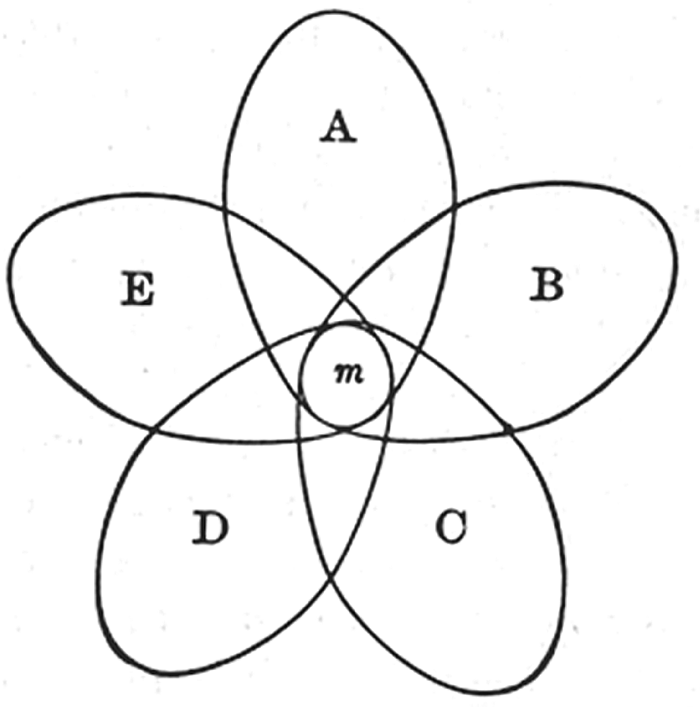
To illustrate this point, James gives us the example of a case A (which can be understood as a phenomenon in the real world, like an event, an action, a plan, or a project) that has many elements or characteristic attributes, among them is m. Let us suppose that m is the essential element in A responsible for the particular outcome that the individual desires (or wants to avoid). If the individual just looks at case A, he may fail to recognize the presence of m. Thus, he will not be in a position to predict the consequence of interest of A. Yet, if his mind calls up other cases B, C, D, and E which are different from A but resemble it, his mind may be able to identify the common element m in all of those cases (see Figure 1) and predict the effect with which m is associated.Footnote 14 James (Reference James1890, vol. 2: 347) emphasizes that this association by similarity works in ‘in highly gifted minds without any deliberation, spontaneously collecting analogous instances, uniting in a moment what in nature the whole breadth of space and time keeps separate.’
Association by similarity, from James (Reference James1890, vol. 2: 347).

If entrepreneurs are accustomed to making judgments based on those associative modes of thinking, a legitimate question is why don't they run their business alone? The answer is straightforward: ‘the greater the magnitude of operations which any single individual attempts to direct the less effective in general he will be’ (Knight, Reference Knight1921: 282). An entrepreneur is often confronted with incredibly complex decisions where one single mind can hardly construct similar cases B − E to the project A at hand.
To illustrate this point, let us take the example of an internationally operating company that is thinking of changing its marketing from mass distribution to an exclusive distribution system A in order to cut operating costs with intermediaries. The entrepreneur has to think carefully what the consequences of A would be for the company and its customers. Yet, he would not be able to do this forecasting alone; it is too complex for a single mind to deliberately accumulate all the cases which are analogous to A. Instead, applying the Jamesian logic, the entrepreneur needs to model the process of association by similarity on an interpersonal-organizational level. Each pedal or leaf in Figure 1 can now be understood as a different team within the firm putting their observation on the table for discussion by the whole group. Each team would cover the task of collecting information and together they are constructing cases B − E. We can think of those cases as companies of similar size that have changed their distribution systems in recent years. When coming together and discussing the consequences of project A, the entrepreneurial team will compare plan A with similar cases B − E and may be able to identify the common element m as one of the crucial elements in producing the consequences of A. This delegation of the process of association by similarity allows the company to yield better forecasts and reduce uncertainty by means of an admittedly imperfect classification, even though it could neither apply a priori or statistical probability judgments in a narrow sense.Footnote 15
5. Social aspects of knowledge and learning
Knight's institutionalism is partly manifested by his insistence on the social factors in the acquisition of knowledge: ‘[t]here can be no question that we build up our knowledge of an external world through the interchange of experience with our fellow human beings’ (Knight, Reference Knight1925: 397–398). In fact, ‘very little indeed of any person's actual knowledge of the world is derived in any way from his own observation and reflection, that an overwhelmingly preponderant portion comes from other persons by a process of communication’ (Knight, Reference Knight and H. Jones1924: 116). There are three aspects of this that are important for our purposes. First, our perceptions and concepts are largely inferences from more elemental sensations.Footnote 16 Second, these inferences are often based on classifications that are socially constructed.Footnote 17 For example, the so-called natural classes – like leaves, rocks, sand – are the products of a long history of human experience (ibid.: 112). Third, the whole process of ‘testing’ our inferences and hence our classifications is an interpersonal enterprise (Knight, Reference Knight1925: 398). The third aspect is the most important in conditions of uncertainty because of the incompleteness and inadequacy of classifications, inferences, and the derivative mental models.
Below we outline the logical steps in Knight's view of knowledge acquisition and its testing. Much of this was developed in the context of social or political discussion but they are abstract enough to apply in many different contexts, including the firm as we shall later endeavor to show.
1. All truths, including those about ‘simple’ facts, are partial. Absolute truth is a myth.
2. Rationality is social in nature, although individually expressed.
3. All putative truths must be socially tested.
4. Deliberation is for action.
5. True discussion or interchange of ideas cannot be directed to a preconceived or foreseeable outcome. The outcomes are spontaneous.Footnote 18
The value of an interchange of ideas will be greater as uncertainty and distributed knowledge are greater. Within a firm or within its separate departments, the exchange of ideas will be guided by a common purpose or a shared vision.Footnote 19 This shared vision provides a common understanding of what the goals of the firm are, but it does not predefine the way units within the firm are supposed to tackle complex problems. To the extent that decisions arising out of the discussion are decomposable from each other (i.e. their respective values for the overall success of a project are not correlated) the issues regarding coordination will be minimized. When this is not the case, a higher level decision-maker will have to sort things out.
6. Judgment of judgment
Due to the partial nature of knowledge and the complexity of problems in business, the delegation of decision responsibilities takes center stage in Knight's account of entrepreneurship. When she delegates, the entrepreneur replaces ‘knowledge of things by knowledge of men’ (Knight, Reference Knight1921: 297). For example, she decides which individuals would be best in determining how to market a product in order to increase sales rather than make that decision herself.Footnote 20 Some individuals are better at making decisions under uncertainty than others. Knight believes that the entrepreneur's knowledge about ‘men's capacities to know turns out to be more accurate than direct knowledge of things’ (298). Unfortunately, Knight does not explain why this might be the case or how exactly such a decision is made.Footnote 21
At one level it is quite plausible that the indirect knowledge of judgment capability is more accurate. For example, we choose doctors and other types of professionals to make decisions for us. We know that they know. Of course, we do not know with certitude that they know but at least we do know it will be better if they make the decisions rather than us. The reason for this is that they have technical knowledge that we do not possess ourselves.
At a somewhat deeper level, the entrepreneur's agent will often have local knowledge that is helpful in making decisions. The agent may be directly connected to a particular department in the firm such as warranty or marketing. If he has long experience, he may also possess tacit knowledge of what decisions to make and how to implement them in a particular context. And to the extent that his tacit knowledge has revealed itself in the past, the entrepreneur will have a sense of the agent's general judgment capability and can continue to entrust him with specific decision responsibilities in the future.
To a certain extent, those assigned to positions within the firm structure will be making routine decisions. However, there is no escaping the problem of making decisions under uncertainty by these ‘secondary’ decision-makers.Footnote 22 This means that those assigned to decision-making roles down the line make decisions under uncertainty. Thus, it is likely that entrepreneurial responsibility will also be diffused because the secondary decision-maker will rarely keep his job after a spate of bad decisions. In a limited sense, entrepreneurship and responsibility are distributed throughout the firm.Footnote 23 Foss and Klein (Reference Foss and Klein2012: 194) call these secondary decision-makers ‘proxy entrepreneurs’.
Although Knight writes about ‘cephalization’ (1921: 268) or a concentration of decision-making responsibility within the firm, the overall structure which he envisions is not centralized with respect to the actual decisions of what to do. The secondary decision-makers, the proxy entrepreneurs, deal with the fundamental uncertainty and the implied role of the ultimate entrepreneur is to select and coordinate them.Footnote 24 In a simple model, an entrepreneur might have a single proxy. This would be a solution to the partial knowledge problem but only in a limited way. The entrepreneur has the knowledge of judgment while the proxy has the knowledge of what to do. But rarely is there only one thing to do or has one person a complete view of all of the possible options and their consequences. Therefore, if the size of the firm and its cost structure permit, there are gains to having multiple views represented and discussed (Loasby, Reference Loasby1999: 66–67). The firm may have nested or parallel proxy entrepreneurs. At the same time, coordination problems may increase and so there is a rough balancing that is required. The balancing must be rough because the benefits of the interchange of partial viewpoints are uncertain.
Since the ultimate entrepreneur makes the delegation decisions under conditions of uncertainty, the decision-making process is essentially the same as that discussed above. It is an inferential process in which the entrepreneur imperfectly classifies cases in order to produce a conceptual scheme. For example, she may classify individuals on the basis of their record elsewhere in making decisions in uncertain conditions.Footnote 25 However, it may seem that the benefits of the interchange of ideas available to the proxy entrepreneurs are in principle unavailable to her since as the ultimate decision-maker, she may be conceived as ‘one’ decision-maker. There is truth to this. Nevertheless, a new enterprise need not be founded by a single person, especially in today's world. Pre-establishment discussion of opportunities is ubiquitous. Furthermore, as we see below, venture capitalists may also have a role in judging judgment.
7. Content of judgment: beyond Knight
We have discussed entrepreneurial judgment of judgment and the diffusion of entrepreneurship within the firm. But what are these judgments ultimately about? Knight provides little guidance. However, in one sense, the answer is trivial. They are about supply and demand conditions, both present and future. These are the ‘particular circumstances of time and place’ that feature so prominently in Hayek (Reference Hayek1945). Our knowledge, or perhaps, more accurately, our belief about these takes three forms (Sautet, Reference Sautet2000). First, knowledge may already be available to the appropriate optimizing agents. Thus, the main problem for the entrepreneur is to ensure proper incentive alignment, i.e. ensuring that individuals have incentives, like profit-sharing or other compensation schemes, to utilize the knowledge. This, itself, can be a decision under uncertainty for the entrepreneur. However, this is not our central concern. Second, knowledge may not be available to the entrepreneur but be dispersed throughout the firm. Here, the problem for the entrepreneur is to integrate the possession of it. Those who can use it most effectively need to possess it or, at least, be able to act upon it and communicate their plans to other agents in the firm.Footnote 26 Third, relevant knowledge may not have yet been discovered by anyone within the firm (or even outside of the firm). In this case, the primary entrepreneur (or her ‘proxies’) must be alert to new possibilities, including new products and technologies.Footnote 27 The second and third of these knowledge problems are the most important under Knightian uncertainty.
Our interest, as the discussion in section 9 will show, is the epistemic organization appropriate to the solution of the basic Hayekian knowledge problems of the firm. Each of them requires the discovery of things that at least some individuals do not realize that they ought to know. In each case, however, the ultimate stimulus is the same: the lure of profit. In each case, the institutional framework of the solution is the same. The general epistemic organization must enhance the capability of individuals to discover by removing obstacles and encouraging the diversity of opinions, judgments and information gathering (Loasby, Reference Loasby1999: 49ff.). The two fundamental knowledge problems are so intertwined that the learning which addresses the solution of one often redounds to the solution of the other.Footnote 28 Thus the epistemic structures discussed in section 9 are conducive to the solution of both types of problems. They can help in the integration of existing dispersed knowledge and the generation of new knowledge.
8. Process of judgment
Before we discuss the institutional implications, we want to highlight one more point. In the previous section, we addressed in a stylized manner the various knowledge problems entrepreneurs face when making judgments; here we want to emphasize that ‘entrepreneurial judgment’ in the Knightian framework really means a series of judgments. For instance, when Knight (Reference Knight1921: 273–275) discusses a seemingly ‘simple’ decision of the entrepreneur whether to hire an employee and at what wage rate, the entrepreneur has to make a series of judgments about the future (e.g. about the employee's productivity, her reservation price; the opportunity costs of alternative input factors; future market demand of labor and goods, etc.). In a nutshell, ‘[the] judgment in this case relates to the indirect significance derived from a twofold estimate of the future, involving both technological and price uncertainties … In such a case the decision depends upon an ‘estimate’ … of a series of … probabilities corresponding to various degrees of success or failure’ (ibid.: 274–275, emphasis added).
When one looks at the entrepreneurial decision as a single decision prior to the successful act, a false impression is given that the outcome was determinate (McMullen, Reference McMullen2015: 653). Yet, the mental operations along the way – the nature of the judgment process – are not mere noise but a series of ‘micro decisions’ that require ‘an opportunity belief and the need for judgment, often in the form of empathic accuracy’ (ibid.). The latter ‘is facilitated by good judgment which requires mental models that accurately assess, estimate, or infer others’ preferences well enough’ (ibid.: 652, emphasis added). Mental models do not exist in a social vacuum, but are informed by the entrepreneur's experience with others and shared organizational structures. Viewing entrepreneurial action as sequential opens the door to replacing the idea of judgment as the ability of a single entrepreneur to predict accurately the outcome of a complex event with ‘the capacity to form conclusions based on social inferences that are frequently tested and updated as one progresses through the decision making of entrepreneurial action’ (ibid.: 654). This process involves micro-judgments that range from ‘unconscious through automatic to deliberate’ (ibid.: 669). In the next section, we will flesh out the process of ‘social inference’ that is central to Knight's system but whose institutional implications he did not discuss in RUP.
9. Institutional implications
Knight does not thoroughly examine the institutional implications of the analytical framework he sketches beyond the idea that the ultimate entrepreneur will assign people of good judgment to various positions within the firm. Knight's firm is one of distributed entrepreneurial decision-making and responsibility.
The first knowledge problem is enhancing a firm's ability both to adapt to change and to initiate beneficial change through the coordination of dispersed knowledge already existing within the firm. Individuals need to share and discuss what they know with relevant others. This can occur in relatively specialized units. These operate as subsystems with fairly homogeneous purposes. The subsystems are isolated or decomposable from the rest of the firm. This ensures that changes in one area need not upend other areas of activity.Footnote 29 Within the unit, however, diversity of firm-relevant experience, awareness of different data points and interpretations potentially improve the integration of existing knowledge. Moreover, when the relevant knowledge is not specialized to a particular unit, cognitive diversity Footnote 30 will be important at the level of the top management team (TMT) to integrate existing knowledge from each of the separate units. These integration functions presuppose positive team dynamics as we discuss later.Footnote 31
The second knowledge problem is more important for our purposes. This is creating the capability to discover, to acquire new knowledge that enables the firm to innovate both incrementally and, when appropriate, more radically.Footnote 32 The fundamental requirements are cognitive diversity and a framework of TMT interaction that is flexible. We explore these and other requirements in the sections that follow. However, it is important to understand that the fundamental factors we identify do not directly produce innovative capability. They are both mediated and moderated. They are mediated in that there is some process operating between cognitive diversity and the innovative capability ultimately produced. They are moderated in that other factors may enhance or inhibit (even wipe out) the positive effect of diversity on innovative capability.
9.1 Institutional implications I: against cognitive monocultures
An important feature of association by similarity is that, ex ante, the parties involved do not yet know exactly what they are looking for. It is the ‘rapid alteration in consciousness [that] shakes out, as it were, the points of difference or agreement’ (James, Reference James1890, vol. 2: 346). The associated outcome of a case A is the result of a classificatory process, whose input is a variety of cases. It is essentially an open-ended, provisional, and potentially fallible process. It is also discursive at its core, especially when it is done in teams. For Knight, discursive processes do not ‘attempt to “sell” a solution already reached’, but they are ‘a co-operative quest of an impersonally, “objectively” right (or best) solution of an impersonal problem’ (Knight, Reference Knight1921/1933: xxxiii). In this sense, ‘discussion must be contrasted with persuasion, with any attempt to influence directly the acts, or beliefs, or sentiments, of others’ (ibid.).
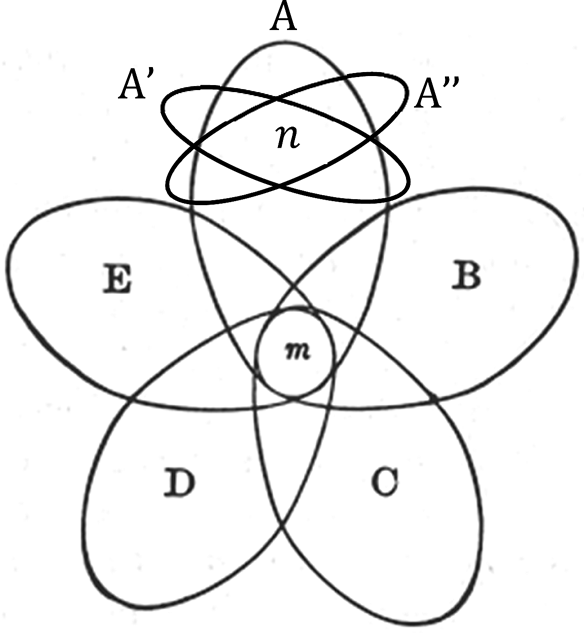
An implication of the open-endedness of the process is that there are no blue-print solutions to problems of uncertainty. Also, there is a danger of closing off the discussion too soon as this might lead to the domination of one or a few imperfect classifications. Think, for instance, of a team of entrepreneurs that bases its forecast on cases A, A ′, and A ′′, meaning the company compares the case at hand A only to narrowly related cases A ′ and A ′′. The consequence might be that the company identifies n as the pivotal element of project A (see Figure 2).
The danger of a too narrow process of association by similarity.

However, while n is part of A, a broader analysis would have revealed that m is actually the decisive element that the company would have identified had it based its forecasting process on a more diverse set of views. People do not have direct access to the ‘world-as-it-really-is’.Footnote 33 Instead their perception of the world is the product of conceptual frames built up inferentially from the variety of data (here, A to E). This means if an entrepreneur has only access to a single or a narrow set of classificatory schemes (conceptual frames), her ability to solve a problem or predict an outcome is very limited. It is helpful to think of the conceptual frames as different sources of light that make the entrepreneur see the world around her. If she has access only to one or similar sources of light, then her field of vision is likely to be narrow. The analysis might not be completely wrong, but it is likely to miss significant parts of reality. This ‘implies that we will keep stumbling on aspects of reality we earlier missed, simply because these aspects lie outside the area illuminated by the framework or model we used’ (Bronk and Jacoby, Reference Bronk and Jacoby2016: 13).Footnote 34 The ability to scan for crucial consequences of a plan of action is fostered by the use of different perspectives, or, as Bronk (2009: 2, 203) puts it, different ‘cognitive spectacles’. In this sense, a more precise classification is the product of the repeated juxtaposition of alternative ways of looking at the problem.
A consequence of this analysis is that there is an inherent danger of cognitive monocultures that constrain how agents classify – or, more broadly, think about – a project at hand. Bronk and Jacoby (Reference Bronk and Jacoby2016: 1) define monoculture as a system where its members ‘come to have their behavior and analysis structured by the same norms and conceptual grids’. Monocultures are restricting the capacity of a system to deal with uncertainty since they can lead to a ‘tunnel vision’, the correlation of forecasting errors, and shared analytical blind spots (ibid.: 25). Unless the institutional environment fosters decision-makers to switch between various conceptual frameworks, there is a high chance that they will not be able to see their own interpretive biases.Footnote 35
9.2 Institutional implications II: cognitively diverse teams
According to Knight (Reference Knight1921: 239),
we may call two fundamental methods of dealing with uncertainty, based respectively upon reduction by grouping and upon selection of men to ‘bear’ it, ‘consolidation,’ and ‘specialization,’ respectively. To these two methods we must add two others which are so obvious as hardly to call for discussion: (3) control of the future, and (4) increased power of prediction. These are closely interrelated.
In this section, we explore the empirical evidence regarding the effect of cognitively diverse teams on predictive capability and on the capability of firms to adapt to or initiate beneficial change (Knight's ‘control of the future’).
9.2.1 Prediction
How can entrepreneurs forecast the future more accurately? The first insight is that teams of entrepreneurs are better than individuals when it comes to forecasting accuracy. Tetlock and Gardner (Reference Tetlock and Gardner2015, Ch. 9) provide evidence from forecasting tournaments that ran for several years. In those tournaments, forecasters were asked to predict various geopolitical and economic events. Predictive challenges included single events (e.g. likelihood of a US recession in 2 years) and repeated events (e.g. likelihood of a recession in an array of countries each year). On average, teams of forecasters were 23% more accurate than individual forecasters. When forecasters who did well in year one of the competition were deliberately put together into a superforecaster team in year two, their individual prediction accuracy improved by 50%. The mere participation in a team of other high ability forecasters boosted the individual ability significantly. Moreover, those teams of superforcasters also beat prediction markets by 15–30%. In line with experimental economic evidence,Footnote 36 Schoemaker and Tetlock (Reference Schoemaker and Tetlock2016) hypothesize that one of the core reasons for the superiority of teams is that the contestation within teams helps individual members overcome simple judgmental biases (e.g. overconfidence) and distorted information processing (e.g. anchoring).Footnote 37
The second insight from prediction tournaments is the crucial role of discussion which is especially conducive to the solution of dispersed-knowledge problems. Tetlock and Gardner (Reference Tetlock and Gardner2015, Ch. 5) highlight the importance of a team's active open-mindednessFootnote 38 which is driving an internal culture of sharing information. Apparently, the communication pattern among group members, not just the cognitive processes inside each group member's mind, matters for a team's predictive success. In order to avoid tunnel visions where early (and possibly skewed) estimates define subsequent opinions, Schoemaker and Tetlock (Reference Schoemaker and Tetlock2016: 77) stress that successful predictive teams are especially good during two phases of team discussions: the diverging phase (in which the issue, assumptions, and approaches to finding a predictive model are explored) and the evaluating phase (in which productive disagreement is encouraged). Both of these phases coordinate and integrate knowledge and are essential before the team settles on a prediction.
While the combination of forecasters and an open internal culture are potent ways to improve team judgment, cognitive diversity is the key factor for the predictive power of a team (Page, Reference Page2007, Reference Page2017; Tetlock and Gardner, Reference Tetlock and Gardner2015: Ch. 9). Cognitive diversity consists, among other things, of individuals possessing different perspectives, i.e. ways of representing or categorizing a problem, and predictive models, i.e. ways of inferring cause and effect (Page, Reference Page2007: 7). Cognitive diversity does not produce bonuses on all tasks, e.g. manual, routine jobs like folding envelopes. Yet, in the context of cognitive, non-routine tasks like designing a product or predicting the future, cognitive diversity pays off. Here, facing a dispersed knowledge situation, cognitively diverse teams can effectively utilize and combine the differences in people's perspectives – what Knight (Reference Knight1921: 234) described as ‘the difference between individuals who have a mind for detail and those who confine their attention to the larger outlines of a situation’ (Knight, Reference Knight1921: 234).
There are two main reasons for the success of cognitively diverse teams when it comes to predictive accuracy (Page, Reference Page2014: 274). First, if we think of predictions as modeled as the truth plus an error term, members of cognitively diverse teams make independent predictions and their errors tend to cancel out so that the group error will be small. Second, individual members of a cognitively diverse group construct different categories to classify available data and rely on different models for their predictions. In other words, they make sense of the world in different ways and they make different kinds of mistakes.Footnote 39 Page (Reference Page2014: 275) concludes that ‘[if] people use different categories and therefore construct different models, they can collectively make accurate predictions not because their errors cancel … but because they are filtering the world differently and therefore each seeing different approximations.’ When combined, those different approximations can lead to a better overall model because they are each highlighting different explanatory variables of a phenomenon with many interacting causes.Footnote 40 They also create productive contestation and discussion which help prevent negative path dependencies and single narrative interpretations (Stark, Reference Stark2009). There is ample empirical evidence that cognitively diverse teams perform better in a variety of predictive tasks, such as academic research, financial forecasts, and business prognoses (for an overview, see Page, Reference Page2017: 161–183).
9.2.2 Firm performance and innovation
Firms must find low-cost ways of producing their products or services; they must understand what specific characteristics of their output are most highly valued by consumers; they must find effective ways to communicate the benefits to consumers; they must adapt to changing conditions; and, if they wish a long life, they must innovate both incrementally and radically. All this requires the efficient use of already-acquired knowledge and the production of new knowledge. We have been emphasizing the positive role of cognitive diversity for predictive accuracy. What does the empirical evidence on actual firm performance suggest?
There are many studies that show a positive impact of cognitive diversity or some intermediate factor on both firm performance, widely defined, and innovation capability. For example, cognitive diversity enhances information acquisition (‘scanning’) and seems to be correlated with information sharing (Miller et al., Reference Miller, Burke and Glick1998). It expands the firm's problem-solving capacity (Hambrick et al., Reference Hambrick, Cho and Chen1996). It has also been found to spur individual creativity for members of a cognitive diverse group (Shin et al., Reference Shin, Kim, Lee and Bian2012). Moreover, cognitive diversity enhances the ability of firms to innovate (Kanchanabha and Badir, Reference Kanchanabha and Badir2021; Nowak, Reference Nowak2020).
The relationship between cognitive diversity and firm performance or innovation is not direct. As we mentioned earlier, it is both mediated and moderated by other factors. The relationship is therefore complex. Nevertheless, careful examination will show that cognitive diversity plays an important role in the success of firms.
In some studies, the effect of cognitive diversity was seen to be mediated by task conflict. This refers to the ‘disagreements among group members about the content and outcomes of the task being performed…’ (de Wit et al., Reference De Wit, Greer and Jehn2012: 360). The positive aspect of this is the discussion and critical evaluation of various viewpoints and thus an ultimately more informed decision. And yet task conflict may produce relationship conflict. Members of the management team might feel attacked personally and may develop bad or uncooperative feelings toward each other. Process conflict may also develop if there is disagreement about who is competent to carry out decisions. These two latter forms of conflict are negatively related to firm performance whether measured by financial success or decision quality.Footnote 41 They operate to reduce and eliminate the positive effect of cognitive diversity on firm performance.
However, there are factors that moderate or counteract these negative tendencies. For example, Olson et al. (Reference Olson, Parayitam and Bao2007) argue that TMT with high levels of competence-based trust will display a stronger positive relationship between task conflict and proximal outcomes like decision understanding, decision commitment, and decision quality. In teams such as these, there will be greater respect for the opinions of each member, a greater sense of confidence in expressing opinions, constructive disagreement, and more productive discussion outcomes.
Nowak (Reference Nowak2020) stresses the moderating impact of strategic planning on what otherwise might be a negative relationship between cognitive diversity and firm performance.Footnote 42 Cognitive diversity can reduce the ‘cohesiveness’ of a firm by dividing individuals thus leading to unproductive conflicts, information withholding, and increased transactions costs among units of the firm. In this circumstance, there is a negative relationship between cognitive diversity and cohesiveness and consequently a negative relationship between cognitive diversity and performance. Strategic planning can create an interactive effect whereby it can enhance the positive effects of cognitive diversity on performance. Strategic planning defines the unit or firm's mission, its strategic goals, and implementation plans in a flexible way, i.e. it provides some guidance but not too much. Therefore, disagreement can be productive without causing excessive dissent and argumentation. Obviously, there is no precision possible in determining the balance, but it involves an exercise of judgment by the overall or ultimate entrepreneur.
The primary moderating factor in the process by which cognitive diversity improves firm performance and innovation capability is ambiguity.Footnote 43 March (Reference March1994: 178) says that ambiguity refers to features of decision-making in which alternative states are hazily defined or in which they have multiple meanings and simultaneously opposing interpretations. Ambiguity is a group or organization level concept. It refers to the different interpretations of data or situations among the members of a team arising, as we suggest, out of a more basic cognitive diversity. It is important to recognize that ambiguity is not the ultimate goal of a team. The ultimate goal is the resolution of ambiguity. However, consistent with our previous emphasis on the sequential nature of decision-making, it is an important stage especially in the early development of a new product or process.
Ambivalent interpretations can arise out of exposure to different observations or cases. If this were the only source it could be resolved simply by aggregating the cases with which individual members of the team are aware. The mobilization of things already known is the way to resolution. However, more basic forms of ambivalent interpretations arise out of different implicit or explicit theories held by the various team members. These differences can be resolved, if at all, by interpersonal testing. In other words, by discussion, conflict of ideas, as well as further empirical testing of hypotheses.
The value of ambiguity is essentially the value of tolerance. It can be created or destroyed by TMT and the attitudes of the primary entrepreneur. It is a social value consistent with Knight's emphasis on the social nature of testing putative ‘truths’. It also can be conceived as a flexible structure for the organization of the growth of knowledge (Loasby, Reference Loasby1991: 43–57). Its flexibility, however, should not be confused with a lack of structure entirely. As we have indicated, competence-based trust and cohesiveness moderate or affect the overall ‘productivity’ of cognitively diverse teams.
The research on the impact of ambivalent interpretations on innovation and firm performance is limited. However, Kilduff et al. (Reference Kilduff, Angelmar and Mehra2000: 24) found support for their hypothesis that ‘the higher the interpretative ambiguity within the top management team, the higher the firm's subsequent performance.’ Interpretative ambiguity is a state of equivocality in which both agreement and disagreement concerning the interpretation of and the solution to a problem are possible. This means that the same reality is perceived in different but complementary ways. Interpretative ambiguity needs to be distinguished from disorganization (i.e. explicit disagreement between all team members) and groupthink (i.e. unanimous agreement between all team members). In their empirical study of 35 simulated firms run by 159 actual managers, Kilduff et al (Reference Kilduff, Angelmar and Mehra2000: 31) find that interpretative ambiguity, particularly at earlier stages of the simulation, was the key cognitive diversity measure that differentiated successful versus unsuccessful teams. Holding multiple interpretations early in the team's life cycle prevented a team from closing off options that would lead to later success.
9.3 Institutional implications III: venture capitalists
Today diffusion of the entrepreneurial judgment function can take forms that Knight never imagined. Venture capital organizations play an important role in infusing capital into investment projects outside of traditional channels. We do not suggest that Knight should have anticipated this development. But venture capital organizations are an extension and implication of Knight's idea of distributed entrepreneurship and the ongoing specialization of a complex economy. These organizations are managed pools of financial capital which invest in projects initiated by others. Typically the investments are staged at various points in the development of the target firm rather than a once-and-for-all initial infusion. Venture capitalists are not simply a source of capital but they are also an additional source of information, opinion, and judgment for decision-making under uncertainty, particularly in situations where the discovery of opportunities is at stake: ‘The venture capitalist and the entrepreneur are…likely to have different information. Even with the same information, they are likely to disagree on certain issues…’ (Sahlman, Reference Sahlman1990: 506). Even before the venture capitalists become actively involved with the management of the firm, they play a role in selecting which firms to invest in. At this stage, the most important factor considered is the ‘management/founding team’ (Gompers et al., Reference Gompers, Gornall, Kaplan and Strebulaev2020: 170). Venture capitalists, as Knight's entrepreneur, must be able to judge the judgment of others. In effect, this is a second-level screening of judgment from an additional or alternative perspective. The partial nature of vision, especially under uncertainty, makes this a valuable supplement to the entrepreneur's judgment.
Beyond the initial function of selecting investments, venture capitalists add value to the target firms. They do this in the process of continuing involvement in the firms ‘typically becoming members of the board of directors and retaining important economic rights in addition to the ownership rights’ (Sahlman, Reference Sahlman1990: 473). They provide services to the firm such as ‘strategic guidance…connecting investors…connecting customers…operational guidance…hiring board members…and, hiring employees’ (Gompers et al., Reference Gompers, Gornall, Kaplan and Strebulaev2020: 171).Footnote 44 Thus the information input of the venture capitalists continues even after the initial selection is completed.
There is yet another level of information and judgment exchange: ‘One striking feature of venture-capitalist finance is that investments are often syndicated’ (Brander et al., Reference Brander, Amit and Antweiler2002: 424). This means that two or more venture capitalists either share a round of financing or invest in the project at two or more stages. Just as there is sharing of judgment between a single venture capitalist and the entrepreneur, there is an exchange among the venture capitalists in the syndicate.Footnote 45 Syndicated ventures appear to add value to the projects since they have higher rates of return than stand-alone investments (Brander et al., Reference Brander, Amit and Antweiler2002: 440–446).
10. Conclusion
Some economists (e.g. Foss et al., Reference Foss, Klein, Kor and Mahoney2008: 74) have characterized Knight's Risk, Uncertainty and Profit as a portrayal of entrepreneurial activity that is essentially an individual endeavor. We argued in this paper that Knight's argument is actually more nuanced. We stressed the way Knight situates entrepreneurial judgment within a discursive structure of the firm. Knight is aware that individual entrepreneurial judgment has its limitations and that discussion and contestation are important elements of decision-making under uncertainty. Knight only hints at those issues in RUP and largely sidesteps a clear discussion of institutional implications. However, considering his other writings in the 1920s and early 1930s, the implications we drew for distributed entrepreneurship and team judgements clearly follow the ‘Knightian spirit’. In broadening the perspective, we presented a modern interpretation of Knight's book that is in line with contemporary literature on organizational monocultures, cognitive diversity, and venture capitalism.
Our reading of RUP stresses an institutionalist view of entrepreneurship: it acknowledges that the organizational architecture of the firm affects the types and magnitude of errors individuals within the firm make (Sah and Stiglitz, Reference Sah and Stiglitz1986). We highlighted that effective entrepreneurial judgment is done in cognitively diverse teams whose composition and communicative dynamics are contributing to their predictive accuracy. Our interpretation does not negate the crucial role that Knight ascribes to the ‘original’ entrepreneur. It is she who is responsible for the shared vision of the firm, the initial set up of teams of proxy entrepreneurs, and the creation of the appropriate structures for productive cognitive diversity. This element of ‘top-down’ organizing is in line with the empirical success of deliberately designed teams (Page, Reference Page2017: 83).Footnote 46
When designing teams, entrepreneurs must not only take into account the cognitive types they hire but also be aware of the decision rules they foster within diverse teams. While discussion and contestation are important, diverse teams can also fall prey to dominant voices, group think, or false compromises (Harker, Reference Harker2015). It is a delicate balancing act on behalf of the (proxy) entrepreneurs: if they implement decision rules that prevent interdependence of individual judgments (e.g. by means of voting), they might suppress discussion and contestation. If they impose too little structure and encourage open-ended reasoning, teams might end up with interdependent individual judgments and extreme corner solutions. The right decision rule might involve multiple techniques and differ at various stages of a project. It is ultimately an empirical issue that can be addressed in organizational studies (for an overview, see Lunenburg, Reference Lunenburg2011).
It would be wrong to infer from our analysis that more cognitive diversity is always good for a firm. As Bronk and Jacoby (Reference Bronk and Jacoby2016: 25) rightly mention, ‘a cacophony of countless disparate ways of thinking may lead merely to confusion and serious coordination difficulties.’ As we have seen, there are moderating factors (such as strategic planning, competence-based trust, and productive ambiguity) whose presence or lack thereof can increase or decrease the advantages of cognitive diversity. These factors must be managed by the entrepreneur or TMT to avoid negative team conflicts. The fact that cognitively diverse teams often outperform their homogenous counterparts in complex, non-routine tasks should be seen as strong evidence for the advantages of cognitive diversity. In the situation of radical uncertainty, the costs of monocultures rise when cognitive diversity falls below a certain threshold (Bronk and Jacoby, Reference Bronk and Jacoby2016: 24f.). Hence, the implication of a Knightian analysis is not necessarily the support for a maximum amount of cognitive diversity. Instead, it is a call for the entrepreneur to implement a sufficient cognitive diversity among her proxy decision-makers using her judgment of judgment.