An event could be considered central if it has a great impact in a person’s life, such that it could be a reference point on which one anchors the meaning-making of other life experiences and future expectations. Moreover, it could be considered a core component of one’s identity and a significant turning point in one’s life story (Berntsen & Rubin, Reference Berntsen and Rubin2006). In this study, we look at how the centrality of a traumatizing event, such as exposure to a typhoon that caused severe flash floods and mudslides, could contribute to negative mental health outcomes in children and adolescents in its immediate aftermath. Furthermore, we also investigate the process that underlies this relationship.
Centrality of Events and Mental Health Outcomes
While generally, memories of negative events are less frequently remembered compared to positive ones (Schlagman, Schulz, & Kvavilashvili, Reference Schlagman, Schulz and Kvavilashvili2006), there is evidence that highly stressful and traumatic events may become central. Thus, memories of these events are more detailed, more frequently remembered, and are more easily recalled, suggesting the vividness and increased accessibility of these memories (Berntsen & Rubin, Reference Berntsen and Rubin2006). Berntsen and Rubin (Reference Berntsen and Rubin2006) have posited that when an individual experiences a traumatic event, it may become central to his or her life and serve as a reference point in making inferences, a landmark in one’s life story, and a core component of one’s personal identity.
A number of studies have shown that centrality of the traumatic event is related to negative mental health outcomes such as posttraumatic stress disorder (PTSD) (Berntsen & Rubin, Reference Berntsen and Rubin2006; Boals & Schuettler, Reference Boals and Schuettler2011; Groleau, Calhoun, Cann, & Tedeschi, Reference Groleau, Calhoun, Cann and Tedeschi2013) and depression (Berntsen & Rubin, Reference Berntsen and Rubin2006; Boals, Reference Boals2010). These associations have been well established in diverse samples, including university students (Berntsen & Rubin, Reference Berntsen and Rubin2006; Gauer et al., Reference Gauer, de Souza, da Silveira and Sediyama2013; Groleau et al., Reference Groleau, Calhoun, Cann and Tedeschi2013), older adults (Berntsen, Rubin, & Siegler, Reference Berntsen, Rubin and Siegler2011; Ogle et al., Reference Ogle, Rubin and Siegler2013), combat veterans (Brown, Antonius, Kramer, Root, & Hirst, Reference Brown, Antonius, Kramer, Root and Hirst2010), and adult survivors of childhood sexual abuse (Robinaugh & McNally, Reference Robinaugh and McNally2011). Whereas the link between centrality of event and trauma-related symptoms has been widely documented, the mechanism underlying this process is yet to be explored. A possible way that centrality of event could be related to trauma-related symptoms is through its association with enhanced sensory quality of trauma memory.
The Role of Sensory-Based Trauma Memory Quality
Trauma memories of individuals exposed to distressing events play a significant role in the development of trauma symptoms (Brewin, Reference Brewin2015; Ehlers & Clark, Reference Ehlers and Clark2000; Meiser-Stedman, Smith, Yule, & Dalgleish, Reference Meiser-Stedman, Smith, Yule and Dalgleish2007; Salmond et al., Reference Salmond, Meiser-Stedman, Glucksman, Thompson, Dalgleish and Smith2011). However, there are differences in how trauma memories are represented in various theoretical perspectives. Some cognitive theories view trauma memories as disorganized and poorly integrated in the person’s autobiographical memory (Clark & Ehlers, 2000; Halligan, Michael, Clark, & Ehlers, Reference Halligan, Michael, Clark and Ehlers2003). Furthermore, separate systems have been postulated to account for trauma memories: The verbally accessible memories (VAMs) that represent the narrative aspects of trauma that are recalled voluntarily, and the situationally accessible memories (SAMs) that represent the sensory, physiological, and motor aspects of the traumatic experience that are recalled involuntarily (Brewin, Dalgleish, & Joseph, Reference Brewin, Dalgleish and Joseph1996). In the context of stressful events, SAMs are posited to be more dominant than VAMs, resulting in sensory-based and poorly verbalized memories (Brewin et al., Reference Brewin, Dalgleish and Joseph1996; Meiser-Steadman et al., Reference Meiser-Stedman, Smith, Yule and Dalgleish2007).
On the other hand, Berntsen and Rubin (Reference Berntsen and Rubin2006) have countered the claim that trauma memory is poorly integrated in the person’s autobiographical memory; instead, they have argued that it is central to the individual’s cognitive organization and to one’s life story and identity when elevated PTSD symptoms are present. Indeed, Smeets and colleagues (2010) have found that the more integrated the trauma memory is to one’s autobiographical memory, the higher the level of posttraumatic stress symptoms observed. It has also been asserted that there is no need to indicate separate systems for voluntary and involuntary recall of trauma memories; rather, these memories are governed by the same system, as evidenced by the same frequency of voluntary and involuntary retrieval, and they are predicted by the same properties of autobiographical memory (i.e., emotional intensity and centrality to the life story) (Rubin & Berntsen, Reference Rubin and Berntsen2009).
Despite conflicting views regarding how trauma memories are represented, these theories have paralleled on the assumption that the enhancement of the sensory quality of trauma memory plays an important role in the course and development of trauma symptoms. We propose that for the trauma memories’ integration to and access from the individual’s autobiographical memory database to be better understood, it is important to consider certain factors, such as the lapse of time after the event, the situational realities of the immediate environment, and the developmental stage the survivors are in at the time of the event. In the case of child and adolescent survivors in the immediate aftermath of a typhoon who are currently staying in evacuation centers and are confronted with the reality that their survival heavily depends on adults, we postulate that the situation inevitably puts the distressing event at the center of their lives. Furthermore, the salience of the trauma memory due to its centrality could be associated with the enhanced vividness and sensory-laden quality of trauma memory, and in turn, could also be related to one’s vulnerability to psychological distress.
The Present Study
The present study intends to examine whether centrality of trauma event is related to negative mental health outcomes, i.e., acute stress disorder (ASD) symptoms and depression, through its relationship with enhanced sensory-based trauma memory quality in a sample of child and adolescent typhoon survivors who are currently living in evacuation centers. By testing this hypothesis, we intend to address certain gaps in the literature. Firstly, sensory-loaded trauma memory quality is often credited to poorly integrated autobiographical memory (Brewin & Holmes, Reference Brewin and Holmes2003; Ehlers & Clark, Reference Ehlers and Clark2000; Meiser-Stedman et al., Reference Meiser-Stedman, Smith, Yule and Dalgleish2007). However, the salience of trauma event considered central in one’s life and identity could increase the vividness and accessibility of the trauma memory (Berntsen & Rubin, Reference Berntsen and Rubin2006). This could also enhance the sensory characteristics of the trauma memory quality. Thus, we intend to examine whether sensory-based trauma memory quality mediates the relationship between centrality of event and mental health outcomes.
Secondly, there are very few studies that look into the relationship of centrality of event, sensory-based trauma memory quality, and psychological distress in the immediate aftermath of a traumatic event (i.e., less than a month). Most studies have examined this relationship long after the traumatic event has occurred, thus, focusing on PTSD instead of ASD (e.g., Boals & Ruggero, Reference Boals and Ruggero2015; Brewin, Reference Brewin2015; Groleau et al., Reference Groleau, Calhoun, Cann and Tedeschi2013; Halligan et al., Reference Halligan, Michael, Clark and Ehlers2003).
Thirdly, the majority of the studies regarding the psychological consequences in the aftermath of disaster involved adult respondents, and very few focused on children and adolescents (Alisic, Jongmans, van Wesel, & Kleber, Reference Alisic, Jongmans, van Wesel and Kleber2011; Alisic et al., Reference Alisic, Zalta, van Wesel, Larsen, Hafstad, Hassanpour and Smid2014). Although these individuals may not have fully established their sense of self and life stories, meaning-making and individuation—processes that are essential in the development of one’s identity, are already present at this stage (McLean, Breen, & Fournier, Reference McLean, Breen and Fournier2010). Moreover, the experience of an atypical life event (e.g., traumatic event), which may become central to one’s personal identity and life narrative, may pose challenges in the achievement of developmental tasks at this stage. These experiences may have implications for the development of their future identity and roles, and are thus, worth examining (Vagos, da Silva, Brazão, & Rijo, Reference Vagos, da Silva, Brazão and Rijo2016).
Lastly, children and adolescent survivors tend to be refractory to therapy once trauma symptoms set in. Thus, examining factors that are possibly related to trauma in the immediate aftermath of the traumatic event is important.
Method
Participants and Procedures
The participants of the study were child and adolescent survivors of typhoon Washi, a severe tropical storm that caused extreme flooding and mudslides in the southern part of the Philippines. All participants had direct exposure to the typhoon. Of the 225 typhoon survivors, 44.9% (n = 101) were males and 55.1% (n = 124) were females, with ages ranging between 9 and 17 years old (M = 14.17; SD = 1.90).
The data were gathered within a month after the typhoon. This timeframe was set based on the period stipulated by the Diagnostic and Statistical Manual of Mental Disorders (DSM; American Psychiatric Association, 2013) when initial stress reactions after a traumatic experience set in, which is highly predictive of the development of PTSD. Research assistants composed of ten pre-selected graduating psychology students who were trained in administering assessment procedures in children and adolescents with traumatic experience provided assistance in the data gathering. Permission to access the evacuation centers and its evacuees was sought from the camp administrators and community leaders. Informed consent from parents and assent from the participants were obtained prior to the testing sessions. Questions for clarification pertaining to the study were encouraged to ensure valid responses. Participants were informed about their rights regarding taking part in the study and were assured full confidentiality. All applicable ethical guidelines were strictly observed while the study was being conducted.
Measures
Centrality of event was measured using the Centrality of Event Scale (CES; Berntsen & Rubin, Reference Berntsen and Rubin2006). CES has 20 items that assess how central an event is to one’s identity and life story. The items are rated on a scale of 1 (totally disagree) to 5 (totally agree). CES is composed of items that address three conceptual themes on whether the event: (a) Has become a reference point for the generation of expectations and attribution of meaning to other events in the life story (event as reference point); (b) is perceived as a central component of one’s identity (event as central component of one’s identity); and (c) is regarded as a turning point in the life story (event as turning point). The test has demonstrated adequate reliability and construct validity (Berntsen & Rubin, Reference Berntsen and Rubin2006). Although usually, only the total score of CES is reported, Vagos and colleagues (2016) found that among adolescents, the 3-factor structure (i.e., event as reference point, event as central component of one’s identity, and event as turning point) is the best fitting model. Thus, we decided to use this model in the present study. The three factors have a Cronbach’s alpha of .82, .74, and .82, respectively, while the scale has an overall internal consistency of .91 based on the current data. Furthermore, confirmatory factor analysis indicated that the 3-factor model has good fit to the data from the sample of child and adolescent survivors of the typhoon in this study, χ2(171) = 1,367.75, p < .01; CFI = .91; TLI = .90; RMSEA = .06 (95% CI [.05, .07]).
The sensory-based memory quality of traumatic event was evaluated using the Trauma Memory Quality Questionnaire (TMQQ; Meiser-Stedman et al., Reference Meiser-Stedman, Smith, Yule and Dalgleish2007), an 11-item self-report questionnaire developed to be easily comprehended by children and adolescents. Items that reflect visual quality, non-visual sensory qualities, temporal context, and verbal accessibility of trauma memory based on the theories of Ehlers and Clark (Reference Ehlers and Clark2000) and Brewin et al. (Reference Brewin, Dalgleish and Joseph1996) are rated on a scale of 1 (disagree a lot) to 4 (agree a lot). Evidence of TMQQ’s internal consistency, criterion validity, and construct validity has been reported (Meiser-Stedman et al., Reference Meiser-Stedman, Smith, Yule and Dalgleish2007). For the purpose of the study, we included only the nine items that pertain to sensory quality of trauma and excluded the two items on verbal accessibility (i.e., “I can’t seem to put the frightening event into words” and “I can talk about what happened very easily”). The scale has adequate internal consistency based on the current data (α = .81).
Symptoms of acute stress disorder were assessed using the Acute Stress Disorder Interview (ASDI; Bryant, Harvey, Dang, & Sackville, Reference Bryant, Harvey, Dang and Sackville1998). ASDI is a 19-item structured interview based on the DSM–IV criteria for acute stress disorder. Each symptom is rated on a dichotomous scale of 0 (symptom absent) or 1 (symptom present). The instrument has demonstrated evidence of reliability and construct validity (Bryant et al., Reference Bryant, Harvey, Dang and Sackville1998; Mordeno, Cue, & Nalipay, Reference Mordeno, Cue and Nalipay2016). It has an internal consistency of Cronbach’s alpha = .85, based on the data from the present study.
Depression was measured using the Depression Self-Rating Scale for Children (Birleson, Reference Birleson1981). It is an 18-item self-report scale composed of statements related to major depressive syndromes in childhood, which are rated on a scale of 0 (never) to 2 (mostly). The scale has adequate internal consistency, factorial validity, and satisfactory stability (Birleson, Reference Birleson1981). The scale has an internal consistency of Cronbach’s alpha = .76, based on the current study’s data.
The participants were given the instruction to answer all questions based on their experience of the typhoon and its consequences. All the scales underwent forward-backward translation from English to Filipino-Bisaya language. Item to item comparison and analyses were conducted to ensure semantic equivalence of the scales. The translation was conducted by a team of psychologists, experts in both languages, and psychology students.
Data Analysis
Mediation analyses were conducted to examine whether sensory-based trauma memory quality mediates the relationship between centrality of trauma event (i.e., event as reference point, event as central component of one’s identity, event as turning point, and overall centrality of event) and mental health outcomes (i.e., ASD symptoms and depression). Hayes’ PROCESS macro for SPSS (2012) was used and the procedures documented by Hayes (Reference Hayes2013) were followed. The age and gender of the participants were controlled in all the mediation analyses.
Results
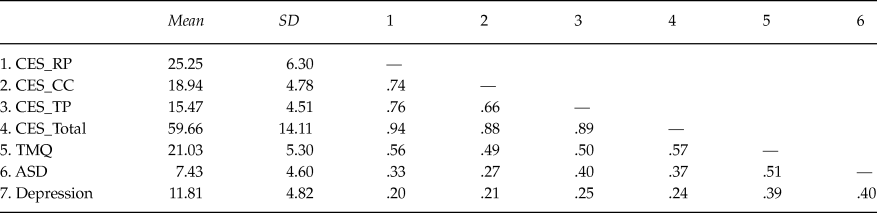
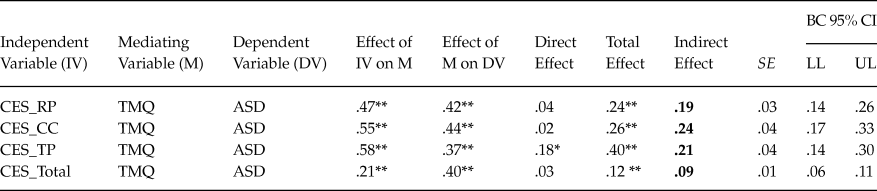
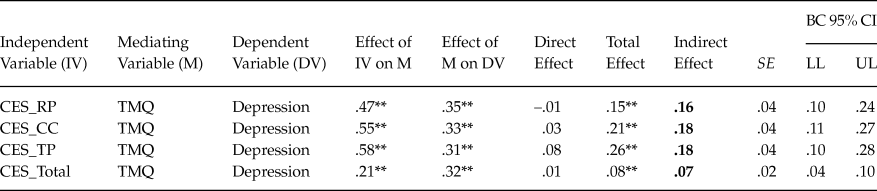
Table 1 shows the means, standard deviations, and correlations of the study’s variables. All the aspects of centrality of event and its overall score, sensory-based trauma memory quality, ASD symptoms, and depression significantly and positively correlated with each other. The results of mediation analyses are shown in Tables 2 and 3. Sensory-based trauma memory quality was found to mediate the relationships between all aspects of centrality of event, as well as its overall score, and ASD symptoms (see Table 2) and depression (see Table 3). This means that the more central the trauma event is to an individual (i.e., the event is viewed as a reference point for meaning-making of other life experiences and future expectations, as a central component of one’s identity, and as a turning point in one’s life story), the more likely it is for one to experience increased ASD and depression symptoms through heightened sensory-based trauma memory quality (i.e., more vivid, intense, and accessible visual, auditory, and other sensory-based memories). This confirms the hypothesis that centrality of event is associated with negative mental health outcomes in child and adolescent survivors of typhoon through enhanced sensory-based trauma memory quality.
Means, Standard Deviations, and Correlations

Note: CES_RP = event as reference point; CES_CC = event as central component of one’s identity; CES_TP = event as turning point; CES_Total = overall centrality of trauma event; TMQ = trauma memory quality; ASD = symptoms of acute stress disorder; all correlations are significant at .01 alpha level.
Results of Mediation Analyses for Symptoms of Acute Stress Disorder

Boldface indicates significant indirect effect.
Note: CES_RP = event as reference point; CES_CC = event as central component of one’s identity; CES_TP = event as turning point; CES_Total = overall centrality of trauma event; TMQ = trauma memory quality; ASD = symptoms of acute stress disorder; age and gender were controlled; bootstrap resamples = 5,000.
* p < .05. ** p < .01.
Results of Mediation Analyses for Depression

Boldface indicates significant indirect effect.
Note: CES_RP = event as reference point, CES_CC = event as central component of one’s identity, CES_TP = event as turning point, CES_Total = overall centrality of trauma event, TMQ = trauma memory quality; age and gender were controlled; bootstrap resamples = 5,000.
** p < 01.
Discussion
The study aimed to investigate whether centrality of event predicts mental health outcomes (i.e., ASD symptoms and depression) in a sample of child and adolescent survivors of typhoon, and whether sensory-based trauma memory quality mediates this relationship. Results indicated that the centrality of trauma event is associated with both ASD symptoms and depression through enhanced sensory quality of trauma memory.
Centrality of Event and Mental Health Outcomes
The finding that centrality of event predicted negative mental health outcomes in child and adolescent typhoon survivors suggests that as they become extremely affected by the traumatic event, they are likely to view this as a central component of their identity, life story, and understanding of the world, that is, it becomes a reference point for meaning-making of their life experiences and future expectations (event as reference point), it is viewed as a central component of one’s identity (event as a central component of one’s identity), and it is considered as a turning point in one’s life story (event as a turning point); and as such, their experience of psychological distress also increases. This is consistent with the existing literature stipulating that centrality of event is associated to the increase of traumatic stress symptoms (e.g., Berntsen & Rubin, Reference Berntsen and Rubin2006; Brown et al., Reference Brown, Antonius, Kramer, Root and Hirst2010; Robinaugh & McNally, Reference Robinaugh and McNally2011) and depression (e.g., Boals, Reference Boals2010; Robinaugh & McNally, Reference Robinaugh and McNally2011).
In the context of the present study, some conditions may have amplified the centrality of the typhoon disaster. Considering that the survivors were residing in the evacuation centers, the provision of their basic needs for survival (e.g., shelter, food, potable water, and clothing) was highly dependent on the agencies running the center. Furthermore, children and adolescents were expected to follow the course set by their parents and other adults in the family as they confront the difficulties of daily living and consequent recovery efforts (e.g., reestablishing livelihood, continuation of work and schooling, and rebuilding of dwellings). Whatever decisions that needed to be made at this time were referenced to the devastation and losses they experienced due to the typhoon. Thus, in the immediate aftermath of the distressing event, the survivors’ daily functioning preoccupied by disaster-related activities in the evacuation centers builds up to become a core component of their autobiographical memory. As studies have shown, the dominance of the traumatic event in survivors’ autobiographical memory is a significant precursor in the development and maintenance of psychological distress (Barton et al., Reference Barton, Boals and Knowles2013; Boals, Reference Boals2010; Newby & Moulds, Reference Newby and Moulds2011; Rubin, Dennis, & Beckham, Reference Rubin, Dennis and Beckham2011).
From a developmental perspective, significant early life experiences such as that of a traumatic event, which could be central to one’s personal identity and life story, may play an important role in the meaning-making of future life experiences. It may affect other processes (e.g., individuation, emotion regulation) that are crucial in establishing one’s future identity and roles (McLean et al., Reference McLean, Breen and Fournier2010; Vagos et al., Reference Vagos, da Silva, Brazão and Rijo2016). This could also set as a precursor to the development of future psychopathology. Indeed, exposure to early life trauma has been found to predict mental health problems such as depression, anxiety (Chu, Williams, Harris, Bryant, & Gatt, Reference Chu, Williams, Harris, Bryant and Gatt2013), PTSD, and psychosocial dysfunction (Ogle et al., Reference Ogle, Rubin and Siegler2013).
The Mediating Role of Sensory-Based Trauma Memory Quality
The finding that centrality of event and ASD symptoms and depression are related through sensory-laden trauma memory quality suggests that, as the trauma event becomes central and well-embedded in the survivors’ autobiographical memory, it is also likely that the clarity of sensory-based trauma memory becomes apparent, which is related to an increase in the symptoms of distress. This is consistent with Berntsen and Rubin’s (Reference Berntsen and Rubin2006) assertion that centrality of event makes sensory-loaded trauma memories more vivid, intense, and accessible. The enhanced quality of these memories heavily influences the increase of trauma-related symptoms (McKinnon, Brewer, Meiser-Stedman, & Nixon, Reference McKinnon, Brewer, Meiser-Stedman and Nixon2017; Meiser-Stedman et al., Reference Meiser-Stedman, Smith, Yule and Dalgleish2007; Salmond et al., Reference Salmond, Meiser-Stedman, Glucksman, Thompson, Dalgleish and Smith2011).
The mediating role of sensory-based trauma memory quality can be explained by the heightened accessibility and salience of personal memories that serve as reference points for the organization of survivors’ life narrative (Berntsen & Rubin, Reference Berntsen and Rubin2006; Rubin, Boals, & Berntsen, Reference Rubin, Boals and Berntsen2008; Fitzgerald, Berntsen, & Broadbridge, Reference Fitzgerald, Berntsen and Broadbridge2016). The notion that centrality of event is strongly associated with vividness, valence, and intensity of trauma has been supported by a number of studies (e.g., Rubin et al., Reference Rubin, Boals and Berntsen2008; Fitzgerald et al., Reference Fitzgerald, Berntsen and Broadbridge2016). Indeed, it has been found that high centrality of traumatic event is related with heightened sense of reliving the trauma event, especially the sensory-perceptual components (Fitzgerald et al., Reference Fitzgerald, Berntsen and Broadbridge2016).
While this mediation model is supported by the findings of the current study, it should be noted that these results could be context-specific. The recency of the disaster, the daily functional activities in the evacuations camps, the helplessness of child and adolescent survivors amidst the drastic change of life course, and the continuous and repetitive interaction and sharing of disaster-related experiences, may have contributed largely to the centrality of the typhoon disaster in the lives of the survivors. Consequently, these experiences build up the salience of trauma memories in their autobiographical memory database. The cogent integration and growing dominance of trauma information (i.e., centrality), and in addition, the survivors’ proximate conditions, may have made their sensory experiences to be integrated in the narrative of their trauma experience. These may have led to the enhancement of the quality and accessibility of sensory-charged memories, which is associated to the increase of negative mental health outcomes.
The study has some limitations. Firstly, the relationship between centrality of event, sensory-based trauma memory quality, and mental health outcomes were demonstrated in the context of the immediate aftermath of a typhoon disaster among child and adolescent survivors staying in evacuation camps. Considering the contextual specificity of how trauma memories function and evolve within the autobiographical memory database, the recency of the disaster and the environment of the evacuation camps may have contributed to the vivid visual, auditory, and other sensory-based memories, making it more easily accessible. Thus, further studies need to be conducted to see if this relationship will hold in the long run. Secondly, the use of self-report instruments increases the proneness to cognitive biases, poor memory, and social desirability. Other methods of data collection, such as interviews and behavioral observation, could be used in future research as these could provide additional information towards whether event centrality and mental health outcomes differ as a function of specific experiences such as exposure to life danger, separation from caregivers, loss of siblings and/or parents, among others. Thirdly, the cross-sectional nature of the study does not allow for causal inferences to be made; thus, longitudinal studies are suggested to clarify the temporal nature of the relationship among the variables (Pek & Hoyle, Reference Pek and Hoyle2016). Lastly, the findings of the study may be specific to survivors of a natural disaster and may not apply to survivors of other trauma types (e.g., domestic violence, armed conflict, and sexual abuse).
Nevertheless, the study provides a significant contribution to the existing trauma literature. Its findings on the mediating effect of sensory-based trauma memory quality may help clarify the mechanism of how centrality of trauma event is associated with mental health outcomes such as ASD symptoms and depression. It also adds to the limited literature on the role of cognition on psychological distress in the crucial period of the immediate aftermath of a disaster. Finally, the study addresses the underrepresentation of Asian, specifically Filipino, child and adolescent natural disaster survivors in trauma literature, where most studies include adult respondents from North America and Western Europe.
The study has demonstrated the mediating role of sensory-based trauma memory quality in the relationship between centrality of trauma event and mental health outcomes (i.e., ASD symptoms and depression) in a sample of child and adolescent survivors of a typhoon disaster. These findings support the contention that centrality of event is associated with heightened accessibility and vividness of sensory-laden trauma memory, which in turn, is related to an increase in symptoms of ASD and depression, especially in the immediate aftermath of a disaster, where the reminders of the trauma are particularly salient in the survivors’ environment and daily activities.