Introduction
Rising consumer attention to food–health issues and repeated meat scandals have added to the decline in per-capita demand for red meat in most developed country markets for the past two decades (Becker et al., Reference Becker, Benner and Glitsch2000). Between 2000 and 2014 pork demand declined by 9% in the USA and by 5% in Europe. Similar figures for beef amount to 19 and 11%, respectively (FAO, 2015).
As documented in Trienekens et al. (Reference Trienekens, Petersen, Wognum and Brinkmann2009), in recent decades the European pork industry has primarily focused on efficiency, food safety (e.g., Salmonella monitoring) and chain-wide traceability systems (e.g., QS Germany, IKB in The Netherlands). More recently, animal welfare schemes have been developed to respond to societal concerns as shown by the inventory of pork production systems in Europe (Bonneau et al., Reference Bonneau, Antoine-Ilari, Phatsara, Brinkmann, Hviid, Groes Christiansen, Fàbrega, Rodríguez, Rydhmer, Enting, de Greef, Edge, Dourmad and Edwards2011). Core factors defining the eating quality of meat—and especially sensory quality—appear to have been ignored by nearly all meat supply chains, namely the pork sectors in major producing countries across Europe, where specialty programs also focused on eating quality, remain niches.
At the same time, the Australian and New Zealand beef sectors have proven that sensory quality market segmentation and consumer labeling can be achieved and be successful (Polkinghorne et al., Reference Polkinghorne, Watson, Porter, Gee and Scott1999; Blanchard et al., Reference Blanchard, Willis, Warkup and Ellis2000; Bickerstaffe et al., Reference Bickerstaffe, Bekhit, Robertson, Roberts and Geesink2001; Morales et al., Reference Morales, Fleming, Wright, Griffith and Umberger2008; Griffith et al., Reference Griffith, Thompson, Polkinghorne and Gunner2010). To date, several studies have emphasized the importance of such initiatives for the pork sectors on both sides of the Atlantic (Schrader, Reference Schrader1998; Bickerstaffe et al., Reference Bickerstaffe, Bekhit, Robertson, Roberts and Geesink2001; Grunert et al., Reference Grunert, Bredahl and Brunsø2004; Perez et al., Reference Perez, de Castro and Font I Furnols2009). Ample empirical evidence also suggests that eating quality is important to consumers and that they are willing to pay for it (e.g., Grunert et al., Reference Grunert, Bredahl and Brunsø2004). Given this evidence the question arises as to why chain actors and particularly in the pork sector seem to be reluctant to use sensory differentiation strategies to add value to their products.
The objective of this paper is therefore to discuss possible reasons behind existing differences in the promotion of eating quality between the beef and the pork sector. To this end, we employ arguments from hedonic demand and transaction cost theory and combine discussions of consumer preferences, and supply-chain coordination to address the research questions guiding this paper:
Can consumer preferences, supply chain structure and transaction characteristics explain the lack of sensory marketing in the pork sector?
In particular, we are interested in the following two dimensions of this question:
-
• Are consumer preferences for higher eating quality less pronounced in pork than in beef?
-
• Is pork chain members’ willingness to supply sensory quality differentiated meat negatively impacted by hold-up problems related to the required specific investments?
The remainder of the paper is organized as follows. First, we present an overview of drivers of meat quality along the supply chain and review the literature on recent developments and issues pertaining to European pork supply chains. The example of Meat Standards Australia's (MSA) whole-of-chain value-based grading system for beef provides insights into a successful strategy toward consumer-driven meat marketing.
We then propose a conceptual model of quality provision in supply chains based on Rosen's (Reference Rosen1974) hedonic demand theory. We thereby specifically consider the impact non-linearities and thresholds in quality attributes may have on price formation along a supply chain as well as consumer decision making with regards to credence attributes. We then complement the consumer perspective by considering the role transaction costs and especially hold-up problems related to the development of differentiation strategies may play in explaining current differences between the pork and beef sectors. While consumer preferences as well as the supply chain organization of these sectors differ across the Atlantic (Martinez, Reference Martinez1999; Mulrony and Chaddad, Reference Mulrony and Chaddad2005; Schulze et al., Reference Schulze, Spiller and Theuvsen2007), we still assume that our findings are generally applicable to both Europe and the USA, though with varying market potential.
The paper concludes with a discussion of the organizational requirements for pork supply chains necessary to satisfy the identified pending demand for sensory pork attributes. We propose directions for future research centered on opportunities for the creation of differentiated supply chains that can deliver improved sensory meat quality, satisfied consumers and ultimately sustained economic viability of pork supply chains.
Status Quo and Recent Developments in Pork and Beef Marketing
Drivers of eating quality
Eating quality is determined as a combination of quality attribute cues, which are revealed during consumption, including color, leanness, texture, tenderness, odor, flavor and juiciness, all of which contribute to organoleptic quality perceptions by the consumer. Many of these quality attributes are inherently interdependent and thus cannot be readily altered without affecting others (Bernués et al., Reference Bernués, Olaizola and Corcoran2003; Bonneau et al., Reference Bonneau, Antoine-Ilari, Phatsara, Brinkmann, Hviid, Groes Christiansen, Fàbrega, Rodríguez, Rydhmer, Enting, de Greef, Edge, Dourmad and Edwards2011). Bonneau and Lebret (Reference Bonneau and Lebret2010) point at the fact that, while eating quality can be described using the above indicators, it can also be measured by physical and biochemical parameters.
Previous literature points at retailer's strong influence on consumer demand and their role as chain leaders in meat marketing (Anders, Reference Anders2008; Anders and Moeser, Reference Anders and Moeser2010). However, many of the value-added meat product and process credence attributes and related information essential to the retail-level quality assurance programs or producer-owned brands (e.g., certified Angus in the USA), including guarantees of superior eating experience, are determined by farm management and processing practices (Bonneau and Lebret, Reference Bonneau and Lebret2010; Bonneau et al., Reference Bonneau, Antoine-Ilari, Phatsara, Brinkmann, Hviid, Groes Christiansen, Fàbrega, Rodríguez, Rydhmer, Enting, de Greef, Edge, Dourmad and Edwards2011). At the farm level, the potential for improvements in sensory attributes is a function of the choice of breed, feed and the decision at which age or weight to slaughter an animal. Where younger, female or castrated animals generally deliver more tender meat, and older, heavier animals feature stronger flavor and marbling (Bonneau and Lebret, Reference Bonneau and Lebret2010). Last but not least, the downstream stages of transport, storage and preparation practices, even including the consumer, determine the eating quality of the end product. Fig. 1 emphasizes the team-production character (Alchian and Demsetz, Reference Alchian and Demsetz1972) of eating quality along the stages of a stylized meat supply chain. Moeller et al. (Reference Moeller, Miller, Aldredge, Logan, Edwards, Zerby, Boggess, Box-Steffensmeier and Stahl2010: 96) claim that there are ‘no standard procedures to assure consistency’ from farm to packer.
Contributions to eating quality throughout the supply chain.

Pork supply chains: focus on traceability, food safety and leanness
Pork supply chains in the major European pork producing countries, except Spain, can be understood to be rather loosely coupled systems (Fischer et al., Reference Fischer, Hartmann, Reynolds, Leat, Revoredo-Giha, Henchion, Albisu and Gracia2009). In Germany, for example, the majority of slaughter pigs is traded through cooperative as well as private intermediaries, who negotiate overall yearly quantities with slaughterhouses and establish enduring relationships with farmers, but usually not on a contractual basis (Schulze et al., Reference Schulze, Spiller and Theuvsen2007). The basic quality coordination in pork supply chains is performed based on grading schemes and respective price grids, which shall provide incentives to meet or exceed the basic quality. This is usually defined based on carcass traits, including slaughter weight, carcass weight and either Fat-o-Meter (FOM) results regarding estimated share of meat, or AutoFOM results for individual cuts, including ham, belly and fillet. Thresholds usually vary across slaughterhouses, and intermediaries might choose to apply own grids as well. Grading results obtained at the slaughterhouse are communicated to farmers, and actual prices paid to farmers are calculated and paid either by the slaughterhouse or by the intermediary. In Germany, the base price for meeting the base quality is negotiated between intermediaries and slaughterhouses on a weekly basis. There is an association of livestock trading cooperatives, which discusses and then publishes the expected price per kg slaughter weight for the following week each Friday as a guideline for the whole industry.
Political, societal and economic pressures have been named as the main drivers of activities to improve pork quality (Nijhoff-Savvaki et al., Reference Nijhoff-Savvaki, Trienekens, Omta, Trienekens, Petersen, Wognum and Brinkmann2008, p. 164). Increasing regulatory pressures for consumer health, animal welfare and environmental requirements have led to broad changes in animal husbandry, nutrition, transport and production technology [e.g., see Trienekens and Wognum (Reference Trienekens, Wognum, Trienekens, Petersen, Wognum and Brinkmann2009, p. 33) for an overview of societal concerns regarding pork production]. External shocks such as bovine spongiform encephalopathy (BSE) have acted as a catalyst to the establishment of industry-led quality assurance systems to manage food safety. For decades, the focus of the pork sectors in Europe and similarly in the USA has been the production of lean(er) pork, scale efficiencies and food safety, in responding to increasing consumer health concerns, while also remaining competitive against other proteins (Martinez and Zering, Reference Martinez and Zering2004, Tonsor and Schroeder, Reference Tonsor and Schroeder2013). In Denmark, with its strong export orientation and exceptional degree of self-sufficiency of 450% (Lorens Abando and Martinez Palou, Reference Lorens Abando and Martinez Palou2006) the main breeding objective has been on carcass homogeneity in terms of size and leanness as well as sow fertility (DeWitt et al., Reference DeWitt, Euken, McMullen, Stender, Storlie, Steinhart and Weiss2006). However, significant sector efforts have been made by European and the US producers to assure compliance with evolving rules. For example, the German QS system for quality and safety, established in 2001 in response to BSE, now covers 90% of German pig producers (QS, 2010). The same holds for The Netherlands, where the IKB (Integrale Keten Beheersing or Integrated Chain Management)-standard is equally widely adopted.
In addition to more stringent food safety requirements, labeling and certification of production systems and animal welfare attributes in livestock production (e.g., gestation stalls, Schulz and Tonsor, Reference Schulz and Tonsor2015) have added new compliance pressures over the past two decades.
Lueth and Spiller (Reference Lueth and Spiller2005) in an analysis for Germany estimated the market share of fresh premium meats to be only 5%, but judged this to be a supply and not a demand-driven phenomenon. The inventory of European pork chains by Bonneau et al. (Reference Bonneau, Antoine-Ilari, Phatsara, Brinkmann, Hviid, Groes Christiansen, Fàbrega, Rodríguez, Rydhmer, Enting, de Greef, Edge, Dourmad and Edwards2011) confirms this finding for other countries. Trienekens et al. (Reference Trienekens, Petersen, Wognum and Brinkmann2009) and Wever et al. (Reference Wever, Wognum, Trienekens and Omta2010) provide comprehensive overviews of conventional European pork chains. Both studies do not report any labeling programs that signal sensory quality to consumers. Among the quality differentiated systems analyzed by Bonneau et al. (Reference Bonneau, Antoine-Ilari, Phatsara, Brinkmann, Hviid, Groes Christiansen, Fàbrega, Rodríguez, Rydhmer, Enting, de Greef, Edge, Dourmad and Edwards2011), the share of programs that make eating quality claims is high; however, their respective market share remains very small. Moreover, evidence suggests that the pork sector's focus on leanness has come to the detriment of sensory quality, especially lower tenderness, juiciness and higher drip loss due to increasing incidence of PSE-meat (pale, soft and exudative) in the 1990s (Fisher et al., Reference Fisher, Mellett and Hoffman2000; Martinez and Zering, Reference Martinez and Zering2004). Tonsor and Schroeder (Reference Tonsor and Schroeder2013) however have pointed at considerable difficulties of measuring and predicting pork quality traits in the USA, especially with respect to intramuscular fat (marbling), which is key for sensory quality. At the same time, there seem to be divergent views regarding the severity of actual quality problems both at the processor and retail level in the USA. Moeller et al. (Reference Moeller, Miller, Aldredge, Logan, Edwards, Zerby, Boggess, Box-Steffensmeier and Stahl2010) claim that variation in fresh pork quality is a considerable problem at the retail level.
In this context, exemplary developments in the beef sectors in North America and Australia show how sensory quality labeling signals can be used for differentiation purposes even in otherwise conventional markets.
Sensory marketing in the beef sector: the case of MSA
Unlike the pork sector, major beef markets in North America and Australia have seen a number of branding initiatives in reaction to declining demand due to consumers’ dissatisfaction with the relative quality of beef throughout the 1980s and 1990s. As traditional commodity beef marketing systems were increasingly unable to signal changing consumer preferences regarding key quality attributes to producers, producer organizations in both regions attempted to distance themselves from the commodity meat market by introducing effective product development, branding and differentiation strategies through labeling of credence attributes related to genetics, production and process attributes applied in newly emerging chains. Examples of leading and well known initiatives are: Certified Angus Beef®, All Natural Tender Aged Beef ™, Coleman's Natural® , and Lasater Grasslands Beef ™. Consequently, quality grading systems and independent certification mechanisms that can assure overall more consistent and higher quality products from the consumer's perspective have co-evolved and been found to provide benefits to both consumers and to stakeholders within a value chain (McEachern and Schroeder, Reference McEachern and Schroeder2004).
A leading example of a whole-of-chain ‘consumer-response’ and value-based grading system is MSA in the Australian beef sector. (Watson et al., Reference Watson, Polkinghorne and Thompson2008). The uniqueness of MSA's approach is that system grades specific retail meat cuts (e.g., beef, lamb) rather than assigning scores to an entire carcass. The value-creating and value chain-coordinating approach taken by MSA is widely understood to present a major innovation, specifically to the traditional grading schemes employed in the USA, Canada and Korea, which assign quality grades to a carcass based on a limited number of traits available at the time of chilling (Watson et al., Reference Watson, Polkinghorne and Thompson2008). MSA information is then shared along the value chain and full traceability provides consumers with a guaranteed eating quality differentiated at three levels: MSA 3 assures ‘Tenderness Guaranteed’, MSA 4 is labeled as ‘Premium Tenderness’, and MSA 5 marks the premium segment regarding all quality attributes linked to sensory quality labeled and marketed as ‘Supreme Tenderness’ (Polkinghorne et al., Reference Polkinghorne, Thompson, Watson, Gee and Porter2008b).
Retail labeling and communication to final consumers is conducted in conjunction with suggested cooking method and recipe ideas. Full traceability and information on price premiums paid to value chain members, shared across all upstream levels including producers, can be linked back to individual grade levels. Griffith et al. (Reference Griffith, Heidi, Thompson and Dart2009) estimate the cumulative retail-level benefit to be US$300 million, with a current annual industry premium of about US$75 million. Market signals from price premiums with mandated shares for all chain members and sales shares are thought to encourage upstream chain members to invest into additional technology such as tender stretching of beef carcasses, extended aging or investment into improved genetics and new management practices in response to MSA grade yields and market returns (Polkinghorne et al., Reference Polkinghorne, Watson, Thompson and Pethick2008a). Polkinghorne and colleagues rate incentives through value creation along the chain as one reason behind the continuous growth in carcasses numbers that are MSA graded to 786,000 in 2007, from just 252,000 in 1999–2000. In the 2013–2014 period, a total of 3 million carcasses or roughly 35% of all slaughter in Australia were MSA graded (MLA, 2015).
MSA's total quality management grading approach through a focus on sensory quality and consumer satisfaction is widely viewed among experts as leading to overall higher meat quality and market differentiation in line with current consumer preferences and demand trends. This is seen as a significant value chain innovation over previous attempts at grading schemes, which professed to sort carcasses on eating quality, and that generally accounted for little variation in palatability when tested by consumers (Polkinghorne et al., Reference Polkinghorne, Watson, Thompson and Pethick2008a). The question, however, remains to why similar initiatives on sensory attributes and quality have been missing to date.
Theoretical Framework
Hedonic demand theory
A number of conceptual models proposed and discussed in the literature share the common objective of integrating consumer quality evaluation, scientific classifications of objective measures of food (meat) quality attributes with the complex process of consumer purchase decision making (e.g., Poulsen et al., Reference Poulsen, Juhl, Kristensen, Bech and Engelund1996; Acebrón and Dopico, Reference Acebrón and Dopico2000; Becker et al., Reference Becker, Benner and Glitsch2000; van den Heuvel et al., Reference Van den Heuvel, van Trijp, van Woerkum, Renes and Gremmen2007; Papanagiotou, et al., Reference Papanagiotou, Tzimitra-Kalogiann and Melfou2013). A more inclusive framework of analysis has been Grunert et al.’s (Reference Grunert, Larsen, Madsen and Baadsgaard1996) Total Food Quality Model (TFQM). The TFQM in the only approach to date attempting to integrate the economics of information in food attributes with Poulsen et al.’s (Reference Poulsen, Juhl, Kristensen, Bech and Engelund1996) multifactorial model of quality guidance and quality formation. However, the TFQM relies heavily on the role of consumers’ expected quality for health, convenience and process characteristics mediators between available extrinsic quality cues and individual's purchase motives. The integration of eating quality as a holistic consumption motive remains underdeveloped. Most studies, including Grunert et al., falsely treat sensory quality as the direct combination of observable color and fat content attributes (Brunso et al., Reference Brunso, Fjord and Grunert2002).
In order to foster a more structured approach of thinking about sensory quality, we borrow from Rosen's (Reference Rosen1974) well-established hedonic demand theory, which explicitly considers and distinguishes the supplier's decision to provide quality as well as the consumer's interest in and willingness to purchase a specific bundle of quality attributes. Moreover, we apply this concept to all stages of the meat (pork) supply chain. Not only does the hedonic model allow us to explain consumers’ valuation of diverse sets of product attributes, it can also be expanded to consider at which stage in the supply chain different quality attributes are (pre)-determined or altered before being evaluated by the end consumer. This application offers several benefits and allows for an explicit consideration of properties of meat quality that typically have been neglected in the literature cited above. The presence of non-linearities in the relationships between quality attributes and their implicit prices (e.g., increasing marginal cost of quality), and the existence of attribute thresholds (e.g., private or regulatory minimum requirements) that may result in disproportional price effects. Both topics, largely neglected in empirical hedonic studies in meat marketing (e.g., Hahn and Mathews, Reference Hahn and Mathews2007; Ahmad and Anders, Reference Ahmad and Anders2010; Vickner, Reference Vickner2015)
The hedonic approach to meat quality therefore appears to be best suited for an evaluation of the role of sensory attributes in meat marketing and provide insights into potential barriers to sensory quality-based differentiation of pork supply chains.
Hedonic demand theory defines product quality as the sum of a set of intrinsic and extrinsic quality attributes that comprise a product, which include all quality and sensory characteristics, value, function and information about how the product was produced (Caswell et al., Reference Caswell, Noelke, Mojduszka, Krissoff, Bohman and Caswell2002). Attributes can further be categorized into search, experience or credence attributes (Darby and Karni, Reference Darby and Karni1973), based on the point in time when a consumer is able to determine product quality. Or quality attributes can be distinguished according to the level at which they occur along the supply chain – the animal, meat processing, retail, and/or final consumer stage. The intuitive idea of hedonic pricing models is that the price of a unit of product varies with the set of characteristics it possesses. Hence, ceteris paribus, higher eating quality should yield a higher price, if and only if it is an attribute readily observable and usually understood by consumers. However, this process which is often thought to reveal linear relationships is further complicated by existing minimum standards and thresholds either dictated by regulatory requirements or chain-specific arrangements (e.g., private retailer standards or requirements).
In his seminal work Rosen (Reference Rosen1974) argues that in order for a market for attributes to function consumers and producers of products (e.g., pork) need to find an equilibrium in the supply and demand of a particular attribute—e.g., eating quality. Consumer demand for a given level of pork quality attributes (θ) is expressed in consumers’ bid function for individual (all) attribute(s) in question:
 $${\rm \theta} = {\rm \theta} (z_{ij} ;u({\rm \alpha} ),y),$$
with z ij being the quantity of characteristic j (j = 1,2,…,n) in pork product i. α is a taste parameter that characterizes differences in preferences across consumers, and y is consumer income that may pose a limit on how much of a quality attribute is demanded. The counterpart to consumers’ bid function is producers’ attribute supply function, in our case expressing pork producers’ willingness to provide levels of a specific quality attribute:
 $${\rm \theta} = {\rm \theta} (z_{ij} ;{\rm \pi} ({\rm \beta} )),$$
where β measures underlying production factors such as costs, and prevailing production technologies. π is the producer profit.
In market equilibrium, the consumers’ willingness to pay for an attribute must be equal to the producer's willingness to supply the wanted attribute, thus yielding a market price p ij , an indicator of the value both consumers and producers place on an attribute-eating quality.
For the case of quality differentiated pork products, we would typically assume that consumers purchase a bundle of attributes, those that in combination constitute a product. For instance, pork chops consist of various attributes ranging from cut, form, size, marbling and color and also presumably sensory attributes such as tenderness, taste and juiciness. When, however, marbling or tenderness are assumed to meet specific levels, as is the case in the MSA system, then the resulting implicit price of a set bundle of attributes that may constitute superior sensory quality is in not predetermined through the additive nature of individual implicit attribute prices. As Rosen, Reference Rosen1974, p. 53) shows the sheer presence of non-linearities and attribute thresholds can yield significant upward price pressures. In a similar fashion, pork producers’, processors’, and retailers’ choice of input factors and technologies along the pork supply chain may face additional thresholds resulting most directly from regulatory requirements and/or voluntary standards. For example, labeling and marketing tools applied to communicate that guaranteed marbling and tenderness levels are indeed met may results is additional unknown costs to consumers. Taking this into consideration consumers seek pleasure [utility u(α)] from eating pork chops and pay price p ij , pork producers and others along the pork supply chains receive p ij , which presumably maximizes their profits from sales to supply chain partners or final consumers. Optimality in the market for pork quality is achieved in the hedonic pricing function:
 $$P_i = \sum\limits_{\,j = 1}^m {(\,p_{ij} )}, $$
where P i is the market price of a product containing z ij amounts of attribute valued at price p ij .
To date numerous studies have explored the price impact of differential food quality levels (Huang and Lin, Reference Huang and Lin2007; Martin et al., Reference Martin, Brummer and Troncoso2007; Donnet et al., Reference Donnet, Weatherspoon and Hoehn2008). Research interest into the price-quality relationship in meat markets using hedonic methods only emerged in recent years. Existing empirical studies (Brester et al., Reference Brester, Lhermite, Goodwin and Hunt1993; Loureiro and McCluskey, Reference Loureiro and McCluskey2000; Dutton et al., Reference Dutton, Ward and Lusk2007; Hahn and Mathews, Reference Hahn and Mathews2007; Shongwe et al., Reference Shongwe, Jooste, Hugo, Alemu and Pelser2007; Ward et al., Reference Ward, Lusk and Dutton2008) are mainly motivated by the increasing market differentiation and attention to food safety and quality assurance programs in meat marketing. Melton et al. (Reference Melton, Huffman and Shogren1996) and Parcell and Schroeder (Reference Parcell and Schroeder2007) are examples of studies focused on different pork products. The authors find positive price coefficients for different objective and subjective meat quality indicators, convenience factors (e.g., packaging) and certain product forms (e.g., meat cuts), whereas processing and food-health-related indicators (e.g., sodium) have been found to negatively affect meat retail prices. However, unfortunately none of these studies has addresses the implications of non-linear attribute price relations or the attribute threshold effects on prices for products that fall under a quality assurance program with likely deviating attribute bundles from their conventional counterparts.
The hedonic models employed in the literature to date have had a clear focus on varying consumer preferences and their expression in P i . We argue that in order to analyze possible reasons behind the non-provision of specific sensory attributes, consumer knowledge and especially the economics of a necessary tighter coordination of the pork supply chain members has to be taken into account. This leads us to rest our subsequent argumentation on transaction cost economics and here especially on the role hold-up problems may play in explaining lack of sensory marketing in the pork sector.
Transaction cost economics
Transaction cost economics (Williamson, Reference Williamson1985) offers rich insights into the organization of economic transactions along the structures of supply chains. At the center of the theory the uncertainty and specificity of investments together with the bounded rationality and opportunistic behavior of the actors in business transactions, contractual hazards, lead to the occurrence of transaction costs associated with the exchange of any goods or services (Williamson, Reference Williamson1985). Bounded rationality recognizes that although actors intend to make rational decisions, they are limited in doing so by the market intelligence available to them. The level of resulting uncertainty generally can be assumed to be affected by the complexity and dynamics of environmental factors affecting the transaction. Moreover, the inability to evaluate all potential outcomes of a particular contractual decision opens the door to opportunistic behavior, defined by Williamson (Reference Williamson1979) as self-interest seeking with fraudulent intent. Vulnerability to opportunistic behavior increases in the presence of small numbers bargaining, where few alternative business partners or options exist. The inherent need to reduce such uncertainties and to safeguard specific investments then explains the existence of various governance structures, which lead to different levels of transaction costs at a given level of uncertainty and specificity (Williamson, Reference Williamson1991: 284). The concept's main postulate is thus to devise governance structures that minimize transaction costs, which arise from the uncertainty and specificity associated with the transaction (Williamson, Reference Williamson1985: xiii).
Transaction cost theory has been extensively used to analyze agribusiness supply chains. Hobbs and Young (Reference Hobbs and Young2000) provide a conceptual model for the relationship between regulatory, technological and socio-economic framework, product characteristics and transaction characteristics, which directly or indirectly affect vertical coordination. Their analysis of the US grain sector reveals technological changes as well as consumer preferences as major drivers toward closer vertical coordination in the sector. While this generally holds for many agribusiness supply chains, the European pork sector is still predominantly characterized by market-like coordination mechanisms (Schulze et al., Reference Schulze, Spiller and Theuvsen2007; Fischer et al., Reference Fischer, Hartmann, Reynolds, Leat, Revoredo-Giha, Henchion, Albisu and Gracia2009).
For the case of pre-determined quality traits, experts agree in that stricter contractual arrangements are necessary (Grunert et al., Reference Grunert, Bredahl and Brunsø2004; Schulze et al., Reference Schulze, Spiller and Theuvsen2007; Trienekens et al., Reference Trienekens, Petersen, Wognum and Brinkmann2009; Wever et al., Reference Wever, Wognum, Trienekens and Omta2010). This also applies to the niche market for organic pork, and smaller regional programs. Once a producer has committed to a specific form of exchange (e.g., supply of high-quality hogs), the producers is vulnerable to opportunistic behavior on the part of the processor and/or retailer (Morales de Queiroz and Zylberstaijn, Reference Morales de Queiroz and Zylbersztajn2011). The later may attempt to renegotiate contractual terms, for instance in case consumer demand stays behind expectations, and to appropriate rents from the transaction, which now presents a sunk cost to the producer. The threat of possible re-negotiation after a specific sunk investment is made may then prevent a contract or niche from emerging altogether. This threat of ‘hold-up’ consequently would require credible commitments from the business partners and result in stricter vertical coordination through contracts or even vertical integration.
In the following, we discuss how hedonic demand theory and transaction cost theory can be used to analyze the likely causes for the neglect of sensory attributes, which can be observed in pork production worldwide (Tonsor and Schroeder, Reference Tonsor and Schroeder2013).
In the next section, we first review studies on consumer preferences and knowledge regarding eating quality of pork and beef, before investigating the requirements for the provision of eating quality at the various levels of the supply chain in the two sectors.
Analysis of Differences Between Pork and Beef Sector
Differences in consumer preferences, expectations and perceptions of pork and beef quality
Expected quality is commonly thought of as the most important factor that influences consumer buying intention for pork (Papanagiotou et al., Reference Papanagiotou, Tzimitra-Kalogiann and Melfou2013). Consumers’ evaluation of meat quality, however, is not only multifactorial in nature, it also takes place at different stages, prior to and during the choice and buying process, and finally during consumption (Caswell et al., Reference Caswell, Noelke, Mojduszka, Krissoff, Bohman and Caswell2002). Much of the evaluation of quality prior to consumption takes places on the basis of consumers’ prior experience, perceptions and extrinsic quality cues, often summarized as functional and psychosocial attributes (e.g., Steenkamp, Reference Steenkamp1990). Important reasons for the differences between pork and beef may thus be consumer preferences, but also knowledge and expectations. Knowledge refers to the understanding of quality cues, which trigger certain expectations, while preferences represent the individual weights that consumers place on certain attributes.
A significant body of literature exists on consumer preferences for meat in general as well as for specific meat attributes (e.g., Anderson and Shugan, Reference Anderson and Shugan1991; Dransfield et al., Reference Dransfield, Zamora and Bayle1998; Becker et al., Reference Becker, Benner and Glitsch2000; Bickerstaffe et al., Reference Bickerstaffe, Bekhit, Robertson, Roberts and Geesink2001; Brewer et al., Reference Brewer, Zhu and McKeith2001; McEachern and Schroeder, Reference McEachern and Schroeder2001, Reference McEachern and Schroeder2004; Chen et al., Reference Chen, Ali, Veeman, Unterschultz and LeRelative2002; Enneking, Reference Enneking2004; Grunert et al., Reference Grunert, Bredahl and Brunsø2004). The literature generally attests the marketing of sensory attributes―taste, juiciness, texture―a high potential for added value (Grunert et al., Reference Grunert, Bredahl and Brunsø2004, p. 268). One important finding is that purchasing decisions differ strongly pre- and post-degustation (e.g., Brewer et al., Reference Brewer, Zhu and McKeith2001; Grunert et al., Reference Grunert, Bredahl and Brunsø2004), pointing at a certain lack of consumer skills to identify (eating) quality a priori. For example, on the one hand, certain halo-effects of organic or other ethical attributes were detected (Grunert et al., Reference Grunert, Bredahl and Brunsø2004). On the other hand, particularly organic meat has been rejected by consumers upon visual inspection because of its higher fat content (Bredahl et al., Reference Bredahl, Grunert and Fertin1998).
Following Steenkamp (Reference Steenkamp1990), meat attributes can be systemized first into intrinsic and extrinsic cues. While the latter are characterized in information economics (Darby and Karni, Reference Darby and Karni1973) as search attributes, intrinsic cues can be further divided into experience and credence attributes. Search attributes are immediately accessible to consumers, such as pricing, expiration date or packaging information. Experience attributes require consumers to at least purchase and consume a meat product once to determine, e.g. its’ taste or tenderness. A third category that has borne the brunt of attention of meat managers and policy makers are credence attributes of animal products. Neither visible nor tangible for consumers, the signaling of the presence and/or level of credence attributes in meat products heavily depends on safeguard mechanisms (e.g., labeling, certification or guarantees) (Caswell and Anders, Reference Caswell, Anders, Lusk, Roosen and Shogren2012).
The majority of these quality indicators are searchable and experience-based and thus familiar cues to meat consumers as part of retail purchase choice decisions. Eating quality—sensory quality—is rather more difficult. While sensory quality firmly belongs into the category of experience attributes, sensory experience is only a weak predictor of expected eating quality as its replicability is limited. Reliable cues for eating quality, or expected sensory quality ideally should provide consumers with an informational stimulus that can be processed prior to purchase and consumption (Steenkamp and Van Trijp, Reference Steenkamp and van Trijp1996).
While in beef, intramuscular fat is a ‘traditionally known’ quality parameter, the above described, decades-long focus on lean pork for health reasons might have trained consumers to avoid pork with a high share of intramuscular fat (Dransfield et al., Reference Dransfield, Ngapo, Nielsen, Bredahl, Sjödén, Magnusson, Campo and Nute2005). Bonneau et al. (Reference Bonneau, Antoine-Ilari, Phatsara, Brinkmann, Hviid, Groes Christiansen, Fàbrega, Rodríguez, Rydhmer, Enting, de Greef, Edge, Dourmad and Edwards2011) report such effects from their literature review, and also Albersmeier et al. (Reference Albersmeier, Schulze, Jahn and Spiller2009) found some evidence for German consumers being little informed about the association of pork marbling and eating quality, namely juiciness and taste. In the USA, the ‘Pork—The Other White Meat’ campaign (Pork Checkoff), which is widely known in the population, could have added to the explicit avoidance of meat cuts exhibiting intramuscular fat, as well.
Verbeke and Viaene (Reference Verbeke and Viaene1999) found the five most important attributes of meat in general to be ‘quality’, ‘taste’, ‘freshness’, ‘free of hormones’ and ‘healthiness’. Their comparison of ratings of beef and pork reveals that pork ranks specifically low on taste, quality and healthiness, and conclude that ‘Problems related to the pork image mainly pertain to the perception that pork is fat, has a bad taste and an overall low perceived quality’ (Verbeke and Viaene, Reference Verbeke and Viaene1999: 443). Dransfield et al. (Reference Dransfield, Ngapo, Nielsen, Bredahl, Sjödén, Magnusson, Campo and Nute2005) also found differences among British, Danish, French and Swedish consumers with regards to their quality inferences from visible traits such as color, fatness, marbling and drip. This contrasts with results from Greece and the USA:
Papanagiotou et al. (Reference Papanagiotou, Tzimitra-Kalogiann and Melfou2013) employ a conjoint approach and find a strong yet heterogeneous association between Greek consumers’ perceived quality and purchase intention for pork meat confirming results previously found for US consumers by Cardello et al. (Reference Cardello, Schutz and Lesher2007). The study identified marbling to be a relatively more important quality cue than country-of-origin or price. Interestingly, participating consumers showed great interest in intramuscular fat, typically hidden from pre-purchase quality evaluation, as an indicator of taste, tenderness and juiciness. The authors conclude that expected quality as a driver of pork demand is a least partially the result of consumers’ lack of confidence and proper information about what determines the eating quality of pork.
However, the most frequently asked question in the literature on meat attributes is whether consumers—the market—is willing to pay and if so, how much, for specific attributes and often certified credence attributes in meat products. Several studies addressed this topic and showed that consumers are indeed ready to pay more for higher sensory quality (Channon, Reference Channon2003; Grunert et al., Reference Grunert, Bredahl and Brunsø2004; Beriain et al., Reference Beriain, Sanchez and Carr2009). Other studies, as well as the success of MSA in Australia, have shown that customer bonding can be strongly increased through improvement of sensory qualities in the case of beef (Griffith et al., Reference Griffith, Thompson, Polkinghorne and Gunner2010). Sanders et al. (Reference Sanders, Moon and Todd2007), however, found only 6% of respondents to their survey in Illinois being willing to pay more for higher marbling of pork chops.
To sum up, there is some evidence of differences in consumer knowledge and preferences concerning beef and pork, respectively, which contribute to explaining the differences observed in the market. Additionally, consumers use various quality cues to infer eating quality of pork. Further research, however, is needed to understand how, if at all, these gaps can be closed. Given the fact that pork is the most consumed meat in many European countries already, it is questionable whether the market potential of a sensory labeling is big enough to justify necessary investments. Further supply chain related issues will be discussed in the following.
Hold-up problems associated with the provision and appraisal of pork of superior eating quality
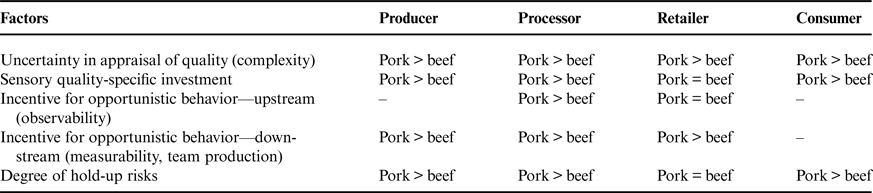
Following the framework of transaction cost theory, drivers of transaction costs are uncertainty and specificity of investment, which cause problems of adverse selection and hold up. Without being able to exactly observe and quantify differences in transaction costs arising along the supply chain we will first explore where hold-up problems are likely to occur and second how they may be mitigated to facilitate the provision of sensory attribute information to consumers. We do this by discussing the uncertainties and specificity of investments to be made by the respective actors along the chain and for the actors depicted in Fig. 1. Table 1 summarizes our findings regarding the comparison of beef and pork, which are discussed in more detail below.
Transaction characteristics and hold-up risk related to sensory quality in pork and beef.

Generally speaking, incentives for opportunistic behavior by individual firms arise from trade-offs between the attractiveness of non-compliance—likely associated with higher returns—and the risk and consequences of detection. The risks of detection and sanction are thought to increase in the extent to which exogenous factors affect final quality outcomes, in the number of business partners involved in the creation of an attribute and to decrease in the observability of the firm's actions.
As shown above, uncertainty for consumers occurs because the eating quality of a meat cut cannot be easily assessed in all its’ dimensions at the point of purchase (complexity). Consumer uncertainty is therefore assumed to be higher for pork than for beef due mainly to poorer consumer knowledge and understanding of visible eating quality cues (also requiring higher specific investments in understanding these); a point underlying the need for clear sensory labeling in the case of pork. Furthermore, Tonsor and Schroeder (Reference Tonsor and Schroeder2013) point at the possibility to manipulate color, which is one of the eating quality indicators. This would mislead consumers but also purchasers of retail chains in their quality judgments, with few chances to discover the manipulation.
Processors may be to a certain extent able to predict eating quality using a set of established parameters, including pH, shear force and others (Tonsor and Schroeder, Reference Tonsor and Schroeder2013). Upstream coordination of intrinsic attributes, however, remains subject to uncertainty due to the ‘team-production’ nature, since many factors in meat quality are the results of interactions between farming practices (genetics, feed choice and management) as well as live animal and carcass handling at slaughter (see Fig. 1). Further, meat is a food product subject to natural variation. Thus, failures in meat quality are often not directly attributable to a single party, a dilemma in mitigating hold-up problems due to opportunistic behavior up- and downstream.
The decisions to be taken at the farm level incur some uncertainties and also specificity. The animals are paid based on the grading results of the carcass as measured by the processor. The processor can thus have incentives to cheat on the farmer in declaring a lower quality than actually achieved, to pay lower prices. This incentive should be the higher the less a farmer is able to predict the quality of his animals. The grading of cuts rather than entire carcasses might lower this ability, thus increasing his uncertainty. From the pork sector, at least in Germany, there is some evidence about considerable doubts of farmers concerning the reliability of processors’ grading results, namely for pork (Schulze et al., Reference Schulze, Wocken and Spiller2006).
As show Bonneau and Lebret (Reference Bonneau and Lebret2010), most differentiated pork production programs claiming a higher eating quality base this claim in the use of a specific breed. This is a major point of distinction from beef. The often ancient local breeds are usually characterized by a lower performance in terms of feed conversion rate and slower growth, leading to longer finishing periods and thus longer cash-to-cash cycle times. It must be further assumed that the properties of a respective carcass will not be in line with the base quality of price grids in the standard market, meaning that farmers would suffer from price discounts when selling into the standard market. The decision to use such a breed therefore represents a specific investment, which has to be safeguarded against opportunistic behavior of the buyers. Potential safeguards can include long-term contracts assuring price premiums per animal or kg slaughter weight, which are to be paid irrespective of the actual carcass characteristics. Such coordination mechanisms are not in place in the standard pork market, yet.
From the buyer perspective, observable specific investments to be made by farmers can be controlled by downstream partners through supplier or third-party audits. This layer of monitoring, however, raises costs to a number of supply chain members. This scenario stands exemplary for the nature of hold-up problem faced in the context of supply-chain wide differentiation strategies. Pork producers, facing uncertainty over the sustainability of specific investments, are likely to not participate and risk of a hold-up situation the greater the ability of upstream buyers to successfully renegotiate contracts, to cheat on grading results, or to require additional upfront safeguards. Given the current structures of meat processing across Europe and the United States such behavior, we argue, is more likely to occur in the case of pork processors than in the beef cattle sector, where producers are better able to predict grading outcomes and face fewer specific investments:
In beef, pre-slaughter handling and rail hanging time play the most crucial role: MLA clearly states that it is mainly the last weeks before slaughter, including transport and waiting times at the point of slaughter, which influence carcass quality (MLA, 2015). Beef producers thus might face only minimum sunk costs when participating in such a sensory labeling program (Morales de Queiroz and Zylberstaijn, Reference Morales de Queiroz and Zylbersztajn2011). Morales de Queiroz and Zylbersztaijn (Reference Morales de Queiroz and Zylbersztajn2011) find that for the case of Brazilian beef supply chains aiming at the provision of higher eating quality, no stronger vertical coordination is required. This is due to the fact that in the described chains, the provision of sensory attributes is cost neutral or even associated with cost reductions, such that farmers have an incentive to pursue these measures even without being provided a bonus. Relevant measures here include the selection of young or female animals. These are at the same time easy-to-monitor requirements. The authors show that no bonus is paid in these chains, since the companies are able to identify eligible animals without the farmer providing additional information. However, concerns over and perceptions of required investments and change to management practices or commercial benefits are still among the main reasons also of cattle producers to not join the MSA grading scheme (Polkinghorne et al., Reference Polkinghorne, Watson, Thompson and Pethick2008a).
Coming back to the question of market potential for sensory labeling in pork, vis-a-vis beef and particularly in the USA, it is likely that only a small share of pork consumers can be expected to pay a premium for higher sensory quality. A collectively funded industry initiative such as MSA, which could ensure the necessary controls (Saenger et al., Reference Saenger, Torero and Qaim2014) may therefore neither be economically viable nor feasible.
The successful launch of sensory attribute differentiation and labeling is therefore more likely to take place under specialty programs, where sensory quality may just be one among several value-adding attribute (Bonneau and Lebret, Reference Bonneau and Lebret2010) and where vertical coordination mechanisms are already in place that minimize additional transactions costs (Trienekens et al., Reference Trienekens, Petersen, Wognum and Brinkmann2009).
At the same time, large slaughterhouses use automated sorting techniques and have, just by sheer numbers of slaughters per day, enough material at hand to cater to the needs of different markets. If these were to invest in consumer research to better understand the perceptions of eating quality as well as their association with objectively measurable meat traits, it is not unlikely that these large slaughterhouses set up their own sensory labeling without a need for further upstream coordination. (This holds as long as perceivable sensory differences can be achieved also with the conventional breeds.) At the moment, however, the market orientation (Slater and Narver, Reference Slater and Narver1995) of these companies has to be deemed low, and they will likely wait for more evidence about market potential before they make moves themselves and invest in own market research to follow a consumer-led process as proposed by Grunert et al. (Reference Grunert, Bredahl and Brunsø2004, p. 271).
Strong retail price competition and increasing consolidation in the pork sector taking hold well beyond Europe and North America firmly keep producers’ focus on productivity, genetic homogeneity, automation and improvements in slaughter technology. Much less attention is paid to satisfying eating quality expectations of a small albeit growing segment of premium quality consumers. Retail market power, high cost pressures and an industry ‘culture’ very much tilted toward a technical view of production and processing may further explain the sectors’ reluctance to innovate. Several studies further point to the adversarial nature of relationships within the meat industry and specifically pork supply chains (Enting and Zonderland, Reference Enting and Zonderland2006; Schulze et al., Reference Schulze, Wocken and Spiller2006), which complicates program collaboration based on credence attributes.
Conclusions and Future Research
Departing from the observation that pork and beef sectors around the world differ in their use of sensory quality differentiation, we studied demand and supply side arguments for systematic differences between the sectors within the frameworks of hedonic demand theory and transaction cost theory. We identify two main reasons for the observed differences between pork and beef, which relate to transaction costs incurred in assuring superior eating quality in pork supply chains, and a lack of knowledge on the side of the consumers.
From a supply chain coordination perspective, the provision of sensory quality in pork seems to provide a higher potential of hold-up problems. Currently relevant programs require the alignment of more activities involving specific investments along the supply chain than in beef, and namely the choice of appropriate genetics, which lead to lower productivity. Safeguarding these specific investments can be achieved, e.g. through contracts. European pork supply chains however up to now are rather loosely coupled systems and characterized by rather adversarial relationships and strong preferences for entrepreneurial freedom, with the prevailing coordination mechanisms being quantity-related framework contracts between slaughterhouses and livestock traders or marketing contracts. The use of quality signals based on sensory attributes represents a complex problem, since not only do all different stages of the chain considerably contribute to the final product quality, but also can the eating quality not fully be predicted before consumption; even the consumer himself with his or her cooking skills affects the final eating experience.
The system approach combining a hedonic assessment of meat attributes along several value chain stages emphasizes just how complex the relationship between the creation, communication and delivery of attribute information to final consumers is. A sustainable value added through sensory marketing can only be achieved if consumers at the point of purchase can sufficiently well predict the later eating quality of the cut and find the price to match their expectations.
In line with Saenger et al. (Reference Saenger, Torero and Qaim2014), we argue that the success of the Australian MSA grading system and approach to value chain creation and coordination, mainly relies on the collectively funded institution, which helps overcome the problems of uncertainty, and on the focus on process requirements, which are restricted to a small—and late—part of the production process, thus incurring no specific investments. In pork, however, it has to be assumed that only a smaller segment of consumers will be ready to pay more for higher sensory quality. A collectively funded third-party certification thus seems not to be justified in the pork sector, namely not in the USA, where beef is the preferred high-quality meat. We therefore assume that the promotion of sensory attributes in pork will be pursued primarily by specialty pig programs, where the sensory quality is only one among several attributes, which create a higher willingness-to-pay. Such programs usually rely on stricter vertical coordination, e.g. production contracts, and therefore face lower transaction costs to assure the compliance of all partners with the requirements to achieve superior eating quality. Once a clearer link between observable traits and actual eating quality could be established, large slaughterhouses could achieve sensory quality differentiation through simple sorting mechanisms and without upstream coordination. However, these companies are viewed as too few market-oriented to invest in the required consumer research.
Clearly, more research is necessary in this area to elicit the attitude of various value chain members toward more integrated and coordinated value chain initiatives aimed at delivering sensory labeling. Better knowledge of attitudes toward innovation and other market parameters will be essential to predict the likely adoption rates and market potentials of sensory quality programs in the pork industry, which are main drivers of overall value chain and market success.
Last but not least research focused on understanding the process by which consumers’ identify differences in meat quality before purchase and/or consumption (Bredahl et al., Reference Bredahl, Grunert and Fertin1998; Bickerstaffe et al., Reference Bickerstaffe, Bekhit, Robertson, Roberts and Geesink2001; Brewer et al., Reference Brewer, Zhu and McKeith2001) is still limited.