In October 1912, W. E. B. Du Bois introduced the first ever “Children's Number” of The Crisis, a special issue of the NAACP's magazine that would appear annually until the end of his editorship in 1934. From 1920 to 1921, the Children's Numbers took a brief hiatus and the NAACP published the Brownies’ Book, a monthly magazine aimed more singularly at children, and primarily at “Children of the Sun” aged between “Six and Sixteen.”Footnote 1 Like countless other campaigns of activism and reform before and since, the New Negro movement drew significantly on the image and idea of the child. The Crisis Children's Numbers include not only material for children but also features about them, such as advice for parents on child rearing and education.Footnote 2 Du Bois's famous editorials, some of which would be collected in the “Immortal Child” chapter of Darkwater (1920), often underscore the significance of childhood as a concept for his programme of racial “uplift” and his thinking about race more generally.Footnote 3 While The Brownies Book was aimed more firmly at the child reader, presenting stories and poems and features on young readers’ activities and successes, it too emphasized the conceptual and practical roles for children in forging a better future for African Americans.
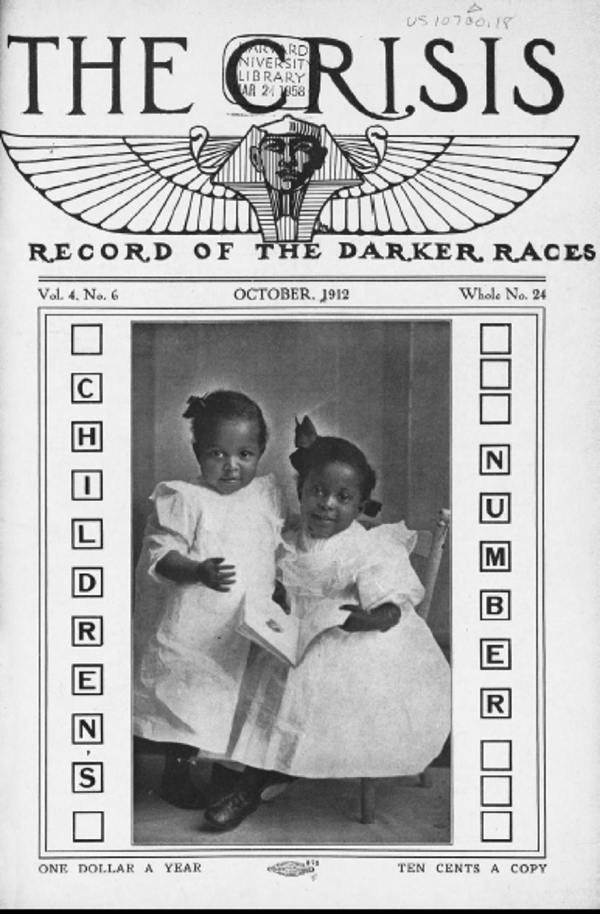
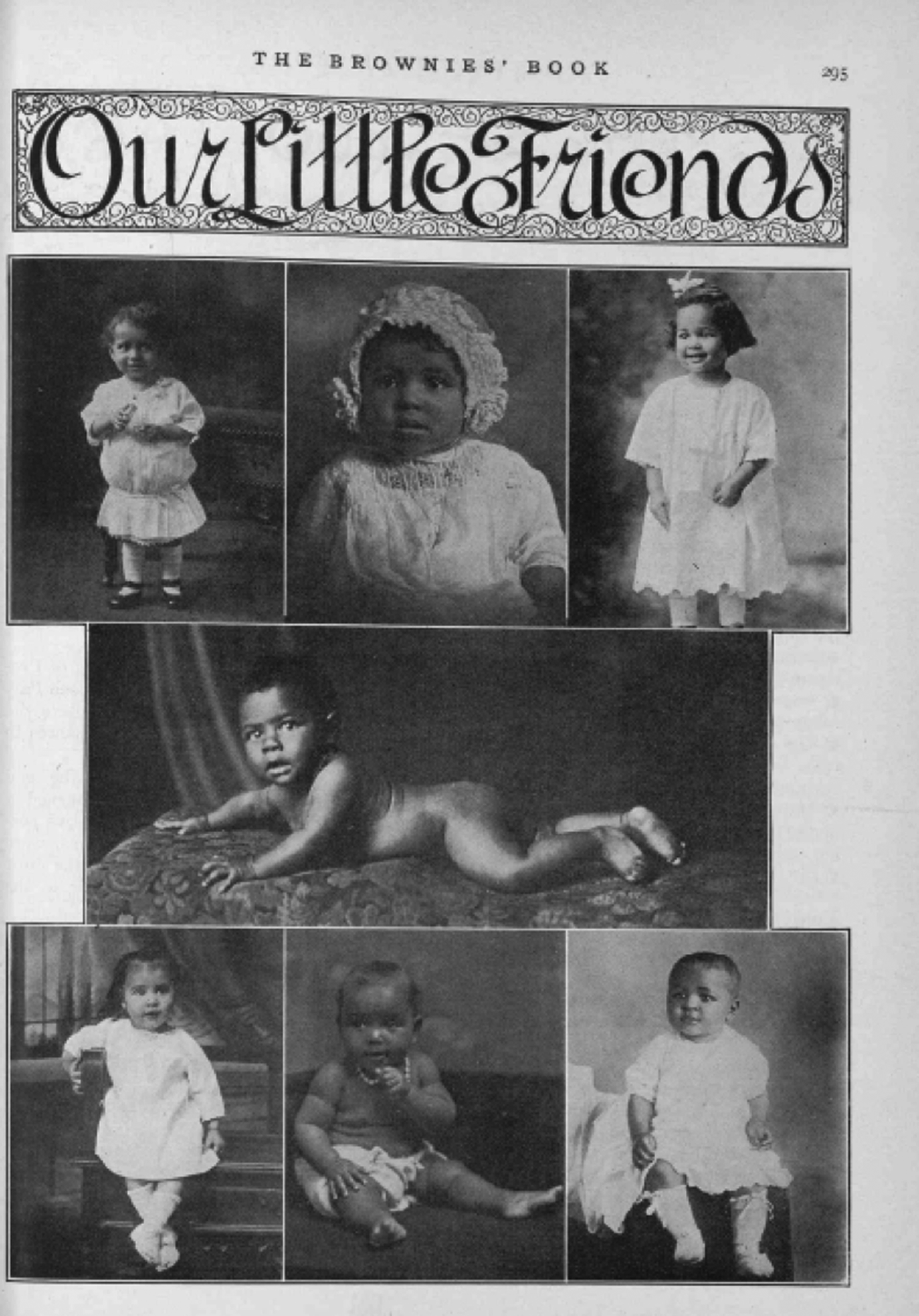
One particularly striking characteristic of both publications is the way they provide a visual representation of the important ideological and symbolic work performed by the child: through their extensive photographic content, they allow us to appreciate the New Negro engagement with the image of the child. Submitted by the magazines’ readers, the photographs are almost exclusively formal studio portraits: despite the availability of George Eastman's Kodak from 1888, there are very few informal snapshots in either The Crisis or the Brownies’ Book. The images that predominate across the magazines conform to middle-class images of idealized childhood: healthy, smiling babies and small children, often dressed exclusively in white, pose in the formal studio settings established during the nineteenth century (Figures 1, 2).
Front cover, The Crisis, Oct. 1912.

Brownies' Book, Oct. 1921, 295.

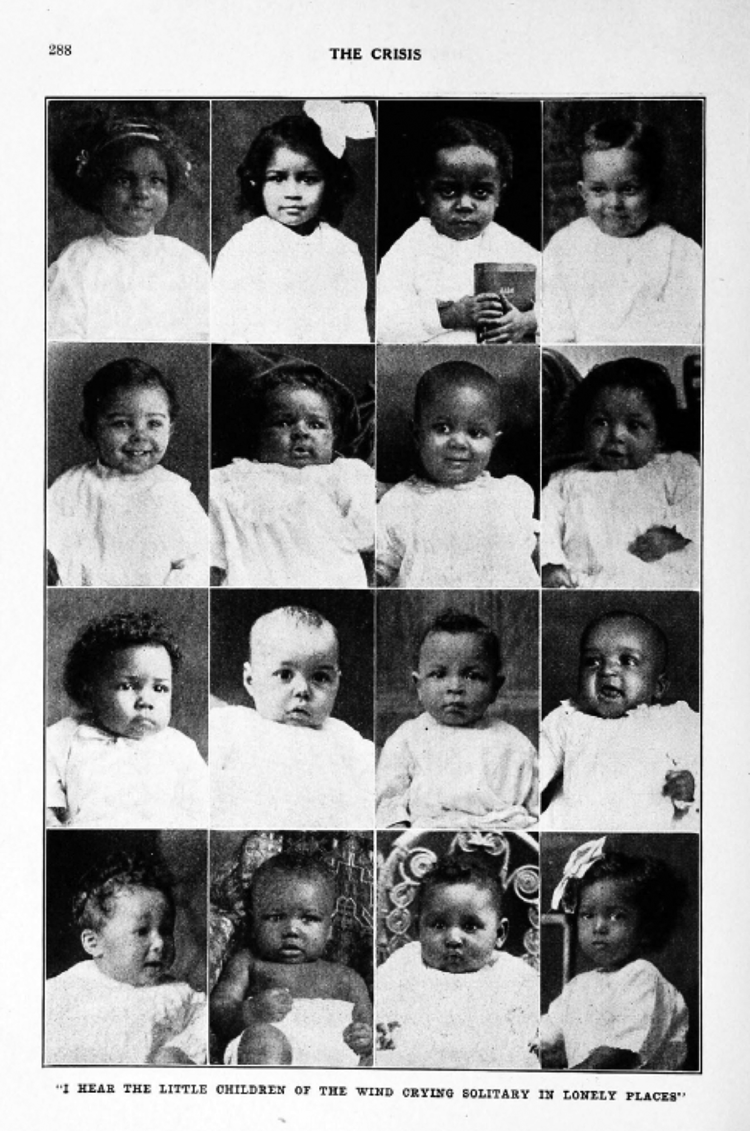
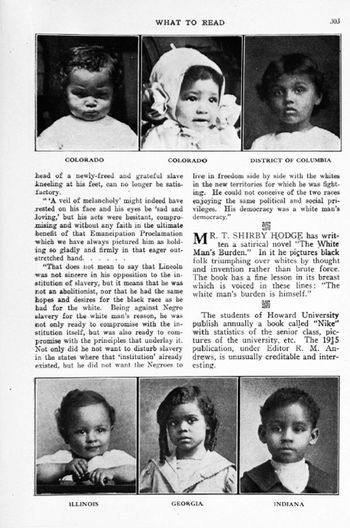
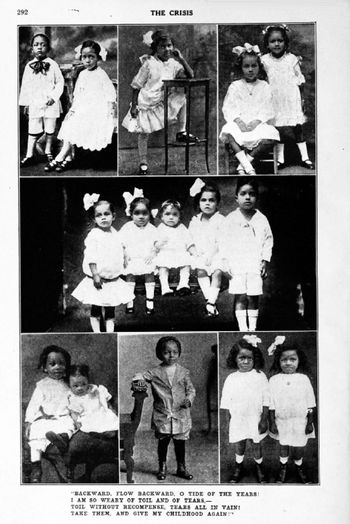
On the one hand, the repetitiveness of the photographs is in itself quite arresting: the reader is struck by the number and similarity of the images, both within individual issues, where they are sometimes printed in grid-like arrangements over several whole pages, and across the publications as a whole (Figure 3). Such similarity serves to document and cement the existence of a “family” of NAACP members, a national community of (respectable, middle-class) Crisis readers. More specifically, the set conventions of the studio portrait and the rather old-fashioned sartorial style of the sitters help to underscore a coherent image of childhood from which, as I shall discuss, the African American child had historically been excluded. But on the other hand, alongside this fairly consistent visual representation, the photographs also support the various, and sometimes contradictory, symbolic uses that the magazines find in the figure of the child. Often the photographs are invested with the power of speaking for themselves, receiving no labels at all, or simply bearing a caption of the child's name and/or their home state (Figure 4), but sometimes their meanings are more conspicuously shaped by the use of headings, captions and juxtapositions with the text (Figure 5). Across two decades of photographs, we can witness numerous constructions of the child, all of which have their own particular political value: the happy, healthy child, suggestive of the vitality of the race; the innocent, vulnerable, sentimental child, a counter to the racist image of the pickaninny; the child as a symbol of malleability and potentiality, signalling progress and a bright future for the race; the child as a figure for life itself, whose very existence is an affront to the inhumanity of the Jim Crow era.
The Crisis, Oct. 1916, 288.

The Crisis, Oct. 1915, 303.

The Crisis, Oct. 1916, 292.

As I hope to demonstrate in the course of this article, a consideration of these particular images offers a valuable perspective on some of the central insights of the rapidly expanding body of scholarship on the child within the humanities. The field of childhood studies was created in 1962 when Phillipe Ariès argued that childhood was a conceptual category forged by a particular history.Footnote 4 Since then, scholars of childhood have tended to focus on the child primarily as an idea and a complex site of social and cultural inscription, thus countering long-standing and Romantic notions about children's proximity to nature.Footnote 5 As I will argue, The Crisis and the Brownies’ Book’s sophisticated use of photography as a means of shaping and fixing images of the African American child supports this understanding of childhood as a cultural – rather than simply biological – category. A second key motif within childhood studies is the notion of the child as a “semiotically adhesive” figure, a carrier of an enormous range of social and cultural meanings and ideological investments.Footnote 6 In fact, scholars of childhood have argued that the child occupies a peculiar position as both a carrier of multifarious – and contradictory – meaning and a blank canvas. As Levander and Singley write, “The child is a compelling interpretative site precisely because it is so open and so vulnerable to competing, even opposing, claims.”Footnote 7 I have already hinted at the different kinds of symbolic work to which the magazines put the child, and, in what follows, I will consider the consequences of the child's semiotic availability in relation to the representative work of the photograph. The Crisis publications demonstrate that children – just like photographs – function as a blank screens for our own projections; both say at once too much and too little.
In considering children as a conceptual category, however, we must appreciate the fact that, as Kathryn Bond Stockton has argued, “children, as an idea, are likely to be both white and middle-class. It is a privilege to need to be protected – and to be sheltered – and thus to have a childhood.”Footnote 8 Stockton's insights have been supported by Robin Bernstein's important research on the historical exclusion of African American youth from the category of the child.Footnote 9 My discussion of the Crisis photographs addresses the way in which they respond to childhood as an idea shaped by questions of race and class. This article draws on a small but growing body of scholarship on African American children's literature which has expanded debates within the broader field of children's studies by retaining a careful focus on the relationship between two constructions: “race” and “childhood.” Any study of early twentieth-century African American children's culture must necessarily take its cue from Capshaw Smith's pathbreaking Children's Literature of the Harlem Renaissance, which was the first work to fully appreciate the complex interrelationships between racial politics, the idea of the child, and children's literature in this period.Footnote 10
This article contributes to this discussion, building particularly on Capshaw Smith's insights that Du Bois's publications overturned “the pickaninny stereotype of nineteenth-century minstrelsy” to reimagine the black child as a complex figure, but focussing specifically on the relationships between these constructions of the child and the magazines’ uses of and attitudes towards the photographic form.Footnote 11 The photographs are so much the distinguishing feature of the Crisis Children's Numbers that we might, I suggest, equally describe these special issues as photographic numbers: only in the Education Numbers, where youth is again at stake, do we see such a proliferation of photographic portraits. It is through the portraits that one can, in the October 1912 Crisis, first discern the magazine's interest in the child. An advertisement announcing the annual Children's Number in the September 1912 issue takes the form of a playful dialogue between the “Editor” and a “Little Girl,” in which the latter has to persuade the former that the number should indeed “have a children's story to go with the baby faces.”Footnote 12 And, by October 1934, the photographs are the final vestiges of the dying special number. Christina Schäffer in fact describes the origins of the Brownies’ Book in terms of providing “another outlet to publish the myriad of baby photographs,” but if this publication also engages with children more significantly beyond its photographic content, the specific link between the child and the photograph is maintained through the magazine's title: the Kodak Brownie, launched in 1900, was the first camera to be marketed at children.Footnote 13 Furthermore, in addition to reprinting, collectively, thousands of photographs, both magazines also feature editorial reflections on the processes and conventions of photographic practice and reproduction. In what follows, I will consider these theoretical discussions of the photographic medium alongside the use of particular photographs, thus exploring the magazines’ complex understanding of the photographic image. I will argue that these publications encourage us to think about the idea of the child and the concept of photography together; in the process they allow for a critical reflection on both.
While abstract concepts of childhood were certainly mobilized in the name of the New Negro movement and other antiracist political projects, they had also been used, as Bernstein has demonstrated, “to justify granting or withholding the rights of living adults and children.”Footnote 14 Equally, the child's association with nature and authenticity, coupled with its semiotic availability, has “enabled divergent political positions,” including racist ones, “to appear natural, inevitable, and therefore justified.”Footnote 15 The photographic form has similar claims to authenticity and similar abilities to make ideological effects appear natural and self-evident. Photography, or “light-writing,” is itself related to natural processes; photographs are uniquely “indexical” art objects which, according to Roland Barthes's famous claim, provide incontrovertible evidence that “the thing has been there.”Footnote 16 In recent years, scholars have demonstrated how the photograph has been used as powerful evidence of both racial oppression and African American humanity and citizenship in numerous contexts, from the Civil War to the civil rights movement and beyond.Footnote 17 Yet “scientific” racists and eugenicists such as Louis Agassiz and Francis Galton had also relied on photographic “evidence” to legitimize and naturalize their white supremacism: a faith in the truth and legibility of the photographic image was central to their claims of racial difference and evolutionary hierarchy. Photography, by virtue of its apparently indexical qualities, became “part of the master narratives that created and cemented cultural and political inequalities of race and class.”Footnote 18
I will argue that the NAACP magazines respond to these tensions in a sophisticated, multilayered fashion. Although they capitalize on both the child and the photograph's associations with the natural, authentic, and self-evident for their own political agenda, they also begin to trouble such associations. While the magazines suggest that the photographic image is poor evidence of racial identity, they also suggest that it might have a communitarian value for young African American readers which does not depend on indexicality. Furthermore, the magazines reveal that both the idea of the child and the photographic image are products of a particular set of conventions. While the publications draw on these conventions deftly for their own immediate ends, they also expose how they work. I will explore this through the example of the magazines’ nostalgic pairing of the sentimental literary discourse and portrait styles of the late nineteenth century, which provides African American children with access to a cult of childhood that would allow them to be recognized as precious and vulnerable. In the process, however, the publications also reveal the way that photography was not just a means of “reflecting” but also of “producing … and disseminating a Romantic ideal of children as innocent, vulnerable, emotionally priceless beings.”Footnote 19
The magazines, as I shall demonstrate, allow readers to appreciate two related claims: “the child” is not born but made; and “You don't take a photograph, you make it,” as Ansel Adams famously quipped. Thinking through the child and the photograph together allows the magazines to reveal how both phenomena, while often understood to speak for themselves, are also associated with an absence and excess of meaning. This absence or excess of meaning poses particular problems for scientific or documentary uses of the photographic image. Finally, I will argue that the magazines also allow us to appreciate how one particular understanding of the child – as a figure of potentiality and futurity, of what will or might be, rather than what has been – cuts against the grain of the photograph's “evidential force” as a faithful record of the past.Footnote 20 The future-facing image of the child is what allows the magazines, ultimately, to conceive of photography less as a documentary tool than as an imaginative art.Footnote 21
BODIES OF EVIDENCE
While the magazines ultimately articulate the value of their photography on grounds other than the straightforwardly documentary, I want to begin by briefly considering the ways in which the magazines do engage with these images of the child in terms of their evidentiary properties. Indeed, some of the photographs clearly participate in a popular version of eugenic discourse, documenting the winners of the NAACP's “Baby Contests.” More generally, the formal studio portraits of adults and children that Du Bois collected in The Crisis, like those he archived in social-science collections produced earlier in his career, rely on similar visual conventions to the frontal and profile “racial type” photographs used in nineteenth-century racial “science” and ethnography.Footnote 22 This resemblance can be understood in the context of Allan Sekula's influential concept of a “shadow archive,” the notion that, from the late nineteenth century, bourgeois studio portraiture must be conceived as part of a larger archive that also includes criminal and pathological photography.Footnote 23
Two of the most perceptive scholars of Du Bois's photographic archives have considered his work within the context of this “shadow archive”: both Daylanne English and Shawn Michelle Smith demonstrate, to cite Elizabeth Abel's claim about photography in the Jim Crow era, that “the same set of rhetorical tools might be marshalled towards different ends by subordinated cultures and their political allies.”Footnote 24 English emphasizes the similarities between Du Bois's portraits of his “Talented Tenth” in The Crisis and the family and baby photographs used by British eugenicist Francis Galton.Footnote 25 Drawing on Gaines's arguments about the eugenic aspects of the racial-uplift ideology that underpins The Crisis, English suggests that the photographs constitute part of an intraracial eugenicism evident elsewhere in Du Bois's writing: the photographs of model men, women, and children stand as objective evidence of the bright future that could be achieved through better breeding and education. Addressing the similarities between the photographs in his early Paris Exposition and Atlanta albums and those used in “scientific, eugenicist, and criminological archives” (including, again, those of Galton), Smith argues that Du Bois's photographs constitute a “counterarchive” to “turn-of-the-century ‘race science’ by offering competing visual evidence.”Footnote 26 Smith reconfigures Sekula's theory, arguing that, in the course of his albums, Du Bois replaces the racial “type” with the bourgeois individual: “seemingly scientific photographs blend and fade into middle-class portraits … Large feather hats, formal Victorian dresses, ornate chairs, lace curtains, plants, books, and statuettes come to fill the photographic frame. African American ‘types’ turn out to be middle-class gentlemen and ladies.”Footnote 27 Another crucial way in which Du Bois “signifies on” racist photography, Smith argues, is by demonstrating the sheer diversity of African Americans: through the albums as a whole, the “Negro type” is pluralized, and thus dismantled as a category.Footnote 28
On one level, the children's portraits in The Crisis and the Brownies’ Book cohere with Du Bois's other photographic archives, inasmuch as they provide visual evidence for the existence of a physically diverse community of respectable middle-class African Americans. Indeed, the naturalizing effects of the child and the photograph seem to join forces: the images are, in this sense, apparently self-evident – a single glance is, Du Bois suggests, sufficient to dispel racist stereotypes: “No sooner,” he asserts, has the viewer looked at these images, “than certainly the fiction of the physical degeneracy of American Negroes must disappear.”Footnote 29 The image of the child is able to function as a silent yet eloquent reproach when placed alongside articles about lynching: its mere presence is enough to condemn the inhumanity of such brutal acts. Some of the text that accompanies the children's portraits also stresses that the images speak (clearly) for themselves: “Look on these pages. Are not these little lives worth the saving?” “Does it show any superiority of mind or soul to believe or pretend to believe in the ‘inferiority’ of these little ones?”Footnote 30 However, this claim for the images’ self-evidence is rather undermined by the need for such accompanying captions. This adds to the already significant tension found in the very notion that the photographs provide “evidence” of the heterogeneity of the faces of the magazine's African American readers, which in itself suggests that racial difference cannot be captured visually. As Evelynn M. Hammonds says of The Health and Physique of the American Negro: “DuBois’ photographic evidence … was deployed to show that race mixing was a fact of American life and that the dependence on visual evidence to determine who was ‘black’ or ‘white’ was specious at best.”Footnote 31 In this respect, one might well conclude that the photographic “proof” offered by the magazines actually points to the limits of visual evidence: if this photographic archive counts as “evidence,” then it is evidence of a highly paradoxical nature.
PHOTOGRAPHIC TECHNOLOGY AND RACIAL IDENTIFICATION
We can begin to see how The Crisis and the Brownies’ Book provide the means of questioning the link between photography and evidence by considering the way they draw attention to the form and the process of photography, rather than allowing it to remain invisible or rendering it as simply a neutral or objective instrument. The photographs allow viewers to appreciate the limitations of the photograph as a tool for racial classification, while also appreciating the more imaginative and affective forms of identification that photographs can produce.
One way in which scholars have countered such assumptions about the strict neutrality of photographs is by pointing to the technical conventions that shape the photographic image. “Rather than the work of light alone, the camera image was,” Alan Trachtenberg notes, “the product of a lens designed in a certain way to produce a certain effect”: the photograph is shaped by the design of the camera itself, which is in turn shaped by particular conventions that govern our understanding of space.Footnote 32 And, as Pierre Bourdieu suggests, photographs are seen to reproduce reality with precision because photographers make their selections from already demarcated fields of possible usage, fields “structured according the categories that organize the ordinary vision of the world.”Footnote 33 Significantly, The Crisis – and the children's issues in particular – do not attempt to disguise the technical conventions that produce the photographic image, but rather include discussions of photography as a medium, discussions that in themselves cast doubt on its putative objectivity.
In 1918, Du Bois complained of the “endless editorial difficulties” caused by the baby photographs, requesting that his readers avoid sending “blurred snapshots or old photographs” or “‘art’ photographs in indistinct browns and grays; they are beautiful but they drive the engraver to despair.”Footnote 34 “For newsprint reproduction,” he explains, “a shiny black and white photograph, clear and sharp in outline and not too small in size, is needed.”Footnote 35 Far from imagining the photograph as an unmediated “portion of nature,” as the artist Samuel Morse famously put it in 1840, Du Bois emphasized the processes of mechanical reproduction.Footnote 36 Technical problems occurred so frequently for the magazines precisely because the conventions of photography were ill-suited to capturing the variety of skin tones belonging to their readers. Five years later, Du Bois used his editorial in the Children's Number to ask, “Why are there not more colored photographers?”Footnote 37 While celebrating African American studio photographers such as Scurlock, Battey, and Bedou (whose work featured in The Crisis), Du Bois complained that the
average white photographer does not know how to deal with colored skins and having neither sense of their delicate beauty of tone, nor will to learn, he makes a horrible botch of portraying them. From the South especially the pictures that come to us, with few exceptions, make the heart ache.Footnote 38
Photographic conventions follow social oppression, Du Bois suggests, and reflect hegemonic visual regimes. Citing the New York Institute of Photography's caution that there's nothing more confusing to novice photographers than “how to photograph people with black skin,” Jennifer González argues that this “confusion” arises “because neither the original design of the apparatus, nor common techniques for its use have taken blackness, or other nonwhite skin colors, as a standard.”Footnote 39 Not only do the conventions of photographic portraiture support racist conceptions of beauty, but, furthermore, since the production of these technologies has been informed by racial hegemony, racial discourse is “in turn … articulated and defined” by their use.Footnote 40
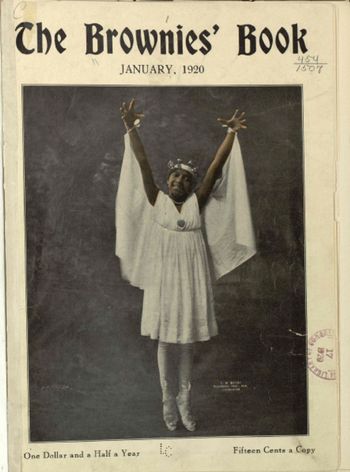
Not only do the magazines disrupt the technologies of race/photography through Du Bois's editorial framing, but also some of the particular techniques used in the images themselves point to the crudeness of any photographic approximation of blackness. For instance, while most photographs are black-and-white, the Children's Numbers and the Brownies’ Book sometimes use coloured tints, particularly on the front covers, and almost always for the sole purpose of representing skin colour. Such an image features on the front page of the Brownies’ Book’s inaugural issue (Figure 6). Here, a child dances in a white ballerina's costume, complete with fairy wings. Her skin colour, represented by a rich brown tint, is the only use of colour in the photograph. The portrait is attributed to Battey, one of Du Bois's favoured African American photographers, yet the technology available cannot capture the girl's skin colour, which is actually denaturalized by this photograph: like the fairy's wings, which capture the artificial otherness that helps us to recognize a child, it figures conspicuously as something that needs to be added, or superimposed onto the photographic image.
Front cover, Brownies' Book, Jan. 1920.

Within the pages of this first issue of the Brownies’ Book we find a story, “Over the Ocean Wave,” which takes as its very premise the photograph's unreliability as means of racial classification. Here we get a good indication of the magazine's ambivalent attitude towards photography: while the story demonstrates that the photograph should not be used to identify and fix racial difference, it also suggests the value of photographic images and captions as a means of promoting more fluid and imaginative forms of identification. The story centres on a discussion between two African American children and their uncle about a photograph of two young Filipino women. This photograph is printed on the second page of the story, and is in itself quite ambiguous: it features the women standing close together, arm in arm, and is simply captioned with their names – Princess Parharta Mirin and Carmen R. Aguinaldo. The princess's regal status is not evident from the photograph alone: notably, she looks quite ordinary in comparison with the bejewelled and enthroned child-empress of Ethiopia, Zaouditou, whose photograph is printed only pages before. The ages of the women/girls, their nationalities, their ethnicity, the nature of their relationship (and indeed Carmen's social class) are all unclear without the accompanying textual details. These details are not in fact captioned in the photograph's presentation in the Brownies’ Book but are provided by a caption within the story. In explaining the photograph, the children's uncle questions his niece's identification with the image (“there are some colored folks just like us”) and provides a taxonomy of racial groups – a taxonomy that the photograph cannot itself provide: “they are colored, – that is their skin is not white; but they belong to a different division of people from what we do. You see, we colored Americans are mostly of the black, or Negro race; whereas these girls belong to the brown, or Malay race.”Footnote 41 However, the uncle also speculates about the “influence of Aguinaldo” (Carmen's father) on the United States’ decision to “finally [promise] the Filipinos their independence.”Footnote 42 This reference (to the 1916 Philippine Autonomy Act), signals a broader anticolonialist sensibility that unites the photograph's viewers with its subjects.
“Over the Ocean Wave” articulates a value for photography that does not depend on its indexical or documentary qualities. While it underscores the photograph's failure to provide sufficient evidence for the categorization of racial difference, it demonstrates the kinds of cultural identifications made possible by reading both the photograph and the textual apparatus that surrounds it. The story allows readers to appreciate that captions and other framing text can do more than just support the photograph's indexical qualities: more productively, they can also open up new meanings and identifications. “Over the Ocean Wave” offers an indication of the complex political work performed by the Crisis children's photographs, work which cannot be captured entirely by Shawn Michelle Smith's otherwise helpful notion of a “counter-archive” of “competing visual evidence,” but which hinges on the commentary that the magazines provide on the photographic form itself.
MECHANICAL REPRODUCTION: MAKING PHOTOGRAPHS, MAKING THE SENTIMENTAL CHILD
I want to turn now to a consideration of how the magazines’ attentiveness towards photographic conventions relates to a similar attentiveness towards the conventions that create “the child.” The magazines manage to capitalize on these conventions and expose their workings: they draw on photographs to advocate the African American child's inclusion within the sentimental cult of childhood while also suggesting that such a child is not born but made, and that the photograph is one convention that aids its production.
In Europe and the United States, Carol Mavor observes, photography emerged “hand-in-hand with our modern conception of childhood. The child and the photograph were commodified, fetishized, developed alongside each other: they were laminated and framed as one.”Footnote 43 Just as the cult of the child served to maintain and develop middle-class culture, the photographic portrait, since the emergence of cartes de visite in the 1860s, had become associated with the performance of the consuming, upwardly mobile bourgeois self.Footnote 44 Such self-fashioning possibilities made portrait photography a powerful tool in The Crisis’s uplift agenda.Footnote 45 Furthermore, photography, as Anne Higonnet argues, “fossilized” the imagery of the Romantic child, adopting and making “nearly invisible” “all the visual signs of childhood innocence invented and refined by paintings, prints, and illustrations from the eighteenth to the early twentieth centuries.”Footnote 46 In this respect, just as the family photograph more generally didn't simply record or cement the modern bourgeois family, but helped to produce it, “naturalizing cultural practices” and acting as an “instrument of [the family's] togetherness,” photographs of children had similarly generative qualities.Footnote 47 Such qualities were supremely useful for the magazines’ editors at a time when black infants were denied the protection that white children received by virtue of their symbolic association with innocence, weakness, and vulnerability. Yet while the magazines draw on the portrait photograph as a means of producing the bourgeois, sentimental black child, they do not allow either the signs of childhood innocence or the conventions of portrait photography to remain “invisible” or even “nearly invisible.”
Robin Bernstein describes how, in the second half of the nineteenth century, sentimental culture constructed white children as “tender angels while black children were libeled as unfeeling, noninnocent nonchildren.”Footnote 48 Through the figure of the “insensate pickaninny,” a “de-childed juvenile,” infanthood was ultimately reserved for black adults.Footnote 49 The interdependent images of the juvenile “nonchild” and the childlike adult indeed coexist in representations of African Americans on the pages of St. Nicholas, a publication to which, critics have suggested, the Brownies’ Book responds. Schäffer discusses the paternalistic depiction of black adults in St. Nicholas, describing, for instance, a late nineteenth-century story in which two white children “adopt” an old black woman.Footnote 50 In a 1922 issue, the black child figures as “insensate pickaninny” in a racist cartoon called “A Is for Alligator”: written in the dialect of minstrelsy, the “humour” of the piece arises when the smiling black child puts his feet on a log which turns out to be an alligator.Footnote 51
The NAACP publications attempt to destroy the image of Topsy and extend the image of Little Eva to black children through their somewhat belated engagement with sentimental culture. While some of the writing in the Brownies’ Book reflects more modern aspects of children's literary culture – such as the work of Langston Hughes and Jessie Fauset, whose pared-down poetry engaged with contemporary urban themes – there is also a conspicuous reliance on the styles, motifs and vocabularies of the nineteenth century. Many of the stories adopt the common sentimental strategy of presenting a child's suffering: following the triangulated structure by which sentimental narratives instruct their readers how to feel, the reader is often positioned as a witness of a model child, who demonstrates their sympathy for another child. Schäffer in fact identifies several key sentimental tropes that recur in the Brownies’ Book: alongside the demonstrations of weeping and exclamations, and the repeated use of the adjective “poor,” the magazine promotes readerly identification through the use of the imperative; the pronouns “you,” “we,” and “our”; and salutations such as “Dear reader.”Footnote 52
I think that we can see such sentimental textual strategies working in tandem with the photographs in a story called “The Wish,” credited to an eleven-year-old reader named Alice Burnett. The child-author has successfully absorbed the key motifs of the sentimental children's narrative, replicating them masterfully in her story, which inserts a black child into the defining set piece reserved for blonde-haired little girls in nineteenth-century sentimental novels. The beautiful little girl in Burnett's story becomes “thin” and “pale” and her parents watch anxiously by her bedside as her life hangs “on a thread.”Footnote 53 Like many of the stories, “The Wish” is accompanied by a photograph that appears to be one of the readers’ studio portraits: a young girl in the standard white dress and bow is captioned “Jean,” after the name of the little girl in the story. In this respect, the photograph mirrors the address to readers made in sentimental fiction – it is a visual equivalent of the linguistic “you” or the “Dear Reader” salutation – and thus reinforces the connection between the sentimental narrative and the other, visually similar, readers’ photographs that appear throughout this issue and others.
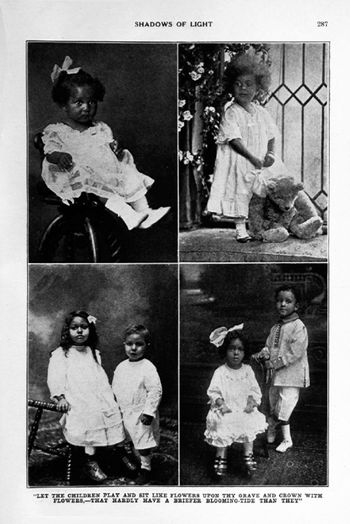
If word and image work together in the construction of the sentimental child, the magazines also interrogate the relationship between the visual and the linguistic. In a feature called “Shadows of Light,” portraits are gathered together above Romantic and sentimental quotations, such as Wordsworth's “A simple child that lightly draws its breath, and feels its life in every limb, what should it know of death?” (Figure 7).Footnote 54 Michelle Phillips argues that these “reminders of suffering and death” “encourage an ironic reading of the photographs on display”: the images of “smiling faces, white bows, and white dresses” emerge as “inadequate signs of a scarcely imagined subjectivity.”Footnote 55 While this may be the case, image and text seem quite congruent when one keeps in mind the model of Little Eva, with her “white dress … golden hair and glowing cheeks, her eyes unnaturally bright with the slow fever that burned in her veins.”Footnote 56 The “smiling faces, white bows, and white dresses” are the other side of the same sentimental coin through which the white child's suffering and death are fetishized, and which serves as a marker of innocence itself. Instead, we might consider this relationship between quotation and image in relation to Clive Scott's notion of the caption as a “rebus title,” where the function is not to confirm the picture's indexical status but to set up a “displaced commentary” where meaning resides “neither in the picture nor in the title, but in their point of convergence.”Footnote 57 In this context, therefore, I think a sense of disjunction is part of the point: the magazine gets to have it both ways, including the black child within the sentimental register while also suggesting the perversity of this category.
The Crisis, Oct. 1916, 287.

On several occasions the accompanying text reveals that the some of the children in the photographs – who, significantly, look exactly like the hundreds of others across each issue – have in fact died. The first issue of the Brownies’ Book includes a deceased child in its “Little People of the Month” photograph spread: the accompanying article informs us that Vivian Juanita Long “left her parents forever August 15, 1919. She is not really dead, though, – she is still living ‘In that great cloister's quiet and seclusion, / By guardian angels led’.”Footnote 58 In the same feature several months later, two similarly posed, aged, and dressed little girls mirror each other in the top left and bottom right corners of the page. The caption labels the child on the bottom left “the late Vivian Holland.”Footnote 59 As Bernstein argues, “Both romanticism and sentimentalism constructed the death of a child not as dispossessive but as preservative, as a freezing that paradoxically prevents the essential child-quality from ever dying through maturation.”Footnote 60 After Barthes in particular, the links between photography and death have been well explored but, as Bernstein's comments indicate, the form of the photograph has a particularly compelling parallel with the sentimental narrative. Given the similarity between these images and those published throughout the magazines, the revelation that the children they depict are now dead offers further indication of photography's power in bolstering and preserving the idea of the child. The images offer a suggestion of how, in sentimental culture, photography is like death because it allows us to think that we can “impound the child, hold it forever.”Footnote 61
The distinct Victorianism of the portraits of angelic all-in-white children, posed formally alongside the familiar stock backdrops of the photographer's studio, is even more conspicuous when one considers the Brownies’ Book alongside St. Nicholas, where indeed photography of human subjects plays a much less prominent role in general. When St. Nicholas does reproduce readers’ photographs in issues contemporary with the Brownies’ Book they are much more informal: instead of studio portraits that look back to the nineteenth century, St. Nicholas presents the modern, spontaneous child at play, as captured by amateur snapshot photography. Camping, boating, and riding photographs feature prominently, and the magazine also reprints holiday pictures taken by children; there is nothing comparable to the pages and pages of small, formally and sartorially near-identical, studio portraits of children that we find in The Crisis and the Brownies’ Book – pictures that insist, by sheer repetition, on the conformity of the black juvenile to the sentimental version of the child. If St. Nicholas did not present its white readers in this way it is because it did not need to – their status as feeling innocents in need of protection was taken for granted.
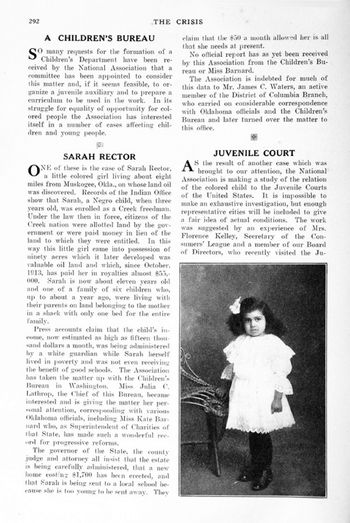
It is perhaps not surprising, therefore, that these images of the ideal, sentimental child were reprinted when the magazines examined particular instances of black juveniles’ exemption from categories of childhood innocence and vulnerability. In The Crisis in particular, where news items deal overtly with racial discrimination, it was politically urgent to situate the child into a discourse where he or she could actually become legible as such. For instance, a brief article on “Juvenile Court” in the 1913 Children's Number describes an ongoing “study of the relation of the colored child to the Juvenile Courts of the United States.”Footnote 62 As Geoff Ward has argued, Du Bois's articles in The Crisis, and the work of the NAACP more generally, played a part in campaigns for black children's access to the same juvenile justice programmes as white children in the juvenile-court era of the early twentieth century.Footnote 63 This article recounts a story about a court in Memphis, which held a four-and-a-half-year-old boy on a burglary and larceny charge:
Gainer was a little waif, without father or mother; he had so coveted a pair of new shoes, a luxury which he had probably never possessed in his life, that he smashed the glass in a show window, helped himself, and was making off with the shoes when he was arrested.Footnote 64
The harrowing story of the court's failure to recognize Gainer as a child is countered by the article's juxtaposition of images of adult criminality with those of sentimental childhood: he is described “hugging a Teddy bear while he waited for his sentence.”Footnote 65 The article refers to photographic evidence that appears elsewhere: the survey which had initially reported the case includes “pictures of the colored and white Juvenile Courts and a vivid account of their contrasting conditions.”Footnote 66 Crucially, however, the Crisis story does not reprint these pictures, or images of Gainer and his fellow defendants, rejecting a more literal form of photographic evidence for one of its standard portraits of children in white (Figure 8). The choice of such an image suggests the magazines’ appreciation that the most politically effective photograph in this instance was not necessarily one rooted in any claims to indexicality but one which might situate the African American juvenile within a particular discursive construction of childhood. The choice of the studio portrait demonstrates the editors’ awareness that the vulnerability and innocence of black children could be articulated more effectively through recourse to the visual language of (white, middle-class) sentimentalism than through more direct or documentary portrayals of black suffering.
The Crisis, Oct. 1913, 292.

In light of such uses of the studio portrait, it is surely significant that the first ever Crisis Children's Number uses a “before-and-after” photographic format which in fact dramatizes the shift from the documentary to the studio style, and reveals the different representations of the child that accompany such a change in formal register. The photographs accompany an article about a group of orphans who have been “rescued” and educated by a white woman in Chattanooga.Footnote 67 “Before-and-after” photographs were, of course, a familiar form of evidence about the interventions of charity and indeed colonization on childhood, but their truth-value had been publicly questioned in 1877 when Thomas John Barnardo was found guilty of dishonesty in a British court of arbitration, his comparative images of children deemed an “artistic fiction” to gain support for his children's homes.Footnote 68 In the context of The Crisis, the before-and-after format allows the reader to perceive the extent to which the sentimental bourgeois child is constructed by photographic convention – its production is the function of a shift in genre from the ethnographic or documentary to the studio portrait style. Specifically, the two photographs allow readers to witness the orphans’ transformation from an undifferentiated mass, huddled together on a stoop, to individuated bourgeois subjects with distinctive attire, carefully posed as a family in a formal studio setting complete with mock Grecian column. This “after” is, significantly, the image of the Crisis reader.
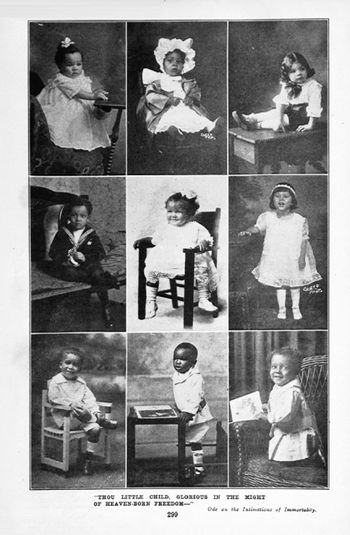
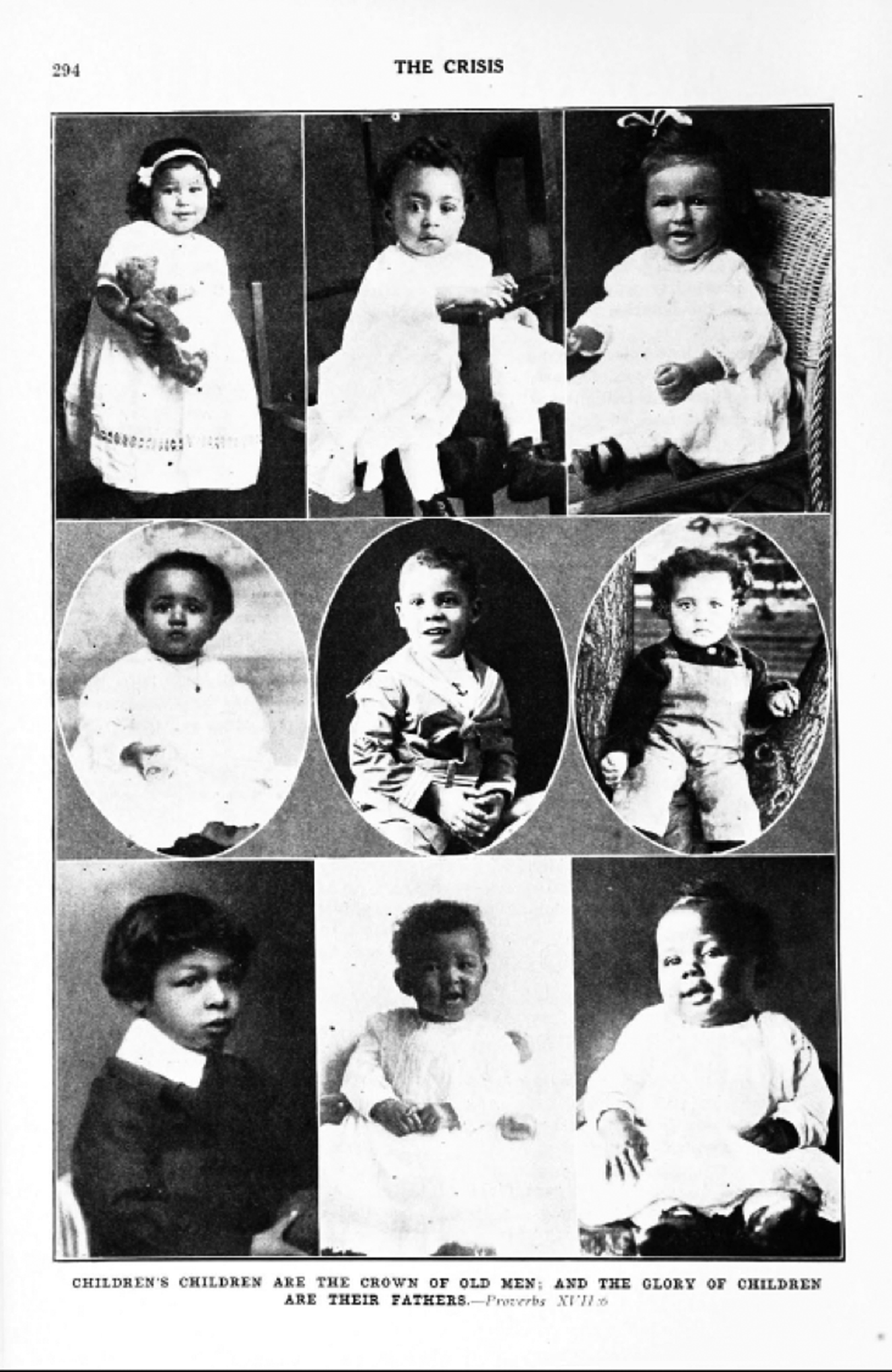
On a cumulative level too, the effect of viewing so many similar images across so many magazines also provides the reader with an insight into the relationship between studio photography and the sentimental construction of the cherished middle-class child. In essence, the photographs become decorative, functioning almost as a pattern, or a sort of wallpaper. Sometimes the photographs are grouped together simply because the children are posed to face in the same direction, or stand next to the same sort of studio prop (Figure 9). In such instances, the conventions, artifice, and aesthetic properties of the studio style are not hidden, but rather take centre stage. Other arrangements highlight the studio portrait's associations with the private, familiar realm, and are organized in a format designed to mimic a family album, complete with superimposed oval borders that mimic frames, and evoke a sense of the materiality of the personal album (Figure 10). This not only works to suggest that the pictures help transform the “imagined community” of periodical readers into a single, national family, but also preserves the sense that each photograph is precious, and maintains a personal, individual value alongside its apparently generic quality.
The Crisis, Oct. 1919, 299.

The Crisis, Oct. 1917, 294.

The magazines find different ways to demonstrate how photography bolsters the notion of the “priceless” child that, according to Viviana Zelizer, emerged at the beginning of the twentieth century and became essential to the modern concept of childhood. Zelizer describes a “cultural process of ‘sacralization’ of children's lives” at the turn of the century; excluded from the labour market and thus economically worthless, children instead became emotionally priceless.Footnote 69 If photography in general was one tool for shoring up the existence of the bourgeois family and the Romantic and sentimental ideals of childhood, then the NAACP's particular transformation of the children's photographs into a form of ornate, lovingly curated decoration seems to highlight Zelizer's account of the production of the child as expensive, non-instrumental, and “priceless.”
THE CHILD AND THE PHOTOGRAPH: TOO MUCH AND NOT ENOUGH
The magazines, I have suggested, function in a sophisticated way: they demonstrate an understanding of how photography doesn't simply capture the middle-class child deemed worthy of protection, but helps to produce this child. In this section, I want to address how thinking about the concepts of the photograph and the child together allows the magazines to suggest the photographic image's insufficiency as a form of scientific evidence. Just as the child is “an empty or loaded cipher,” the photograph speaks at once too quietly and too noisily to stand as evidence of racial difference.Footnote 70
Scholars of photography have frequently associated photography with semantic excess. Indeed, the same concept that underwrites the photograph's “evidential force” also complicates it, as Christopher Pinney observes: “Photography's exemplification of Peirce's index might be recast in terms of an inevitable randomness within the image … the inability of the lens to discriminate will ensure a substrate or margin of excess.”Footnote 71 Even mid-nineteenth-century anthropologists who attempted to use photographs as “evidence” of distinct racial “types” were, in practice, plagued by the problems of photographic excess, contingency and the “noise” of detail, as Deborah Poole has argued.Footnote 72 This excess, however, wasn't just a feature of the individual photograph, but an effect of the sheer proliferation of photographs witnessed within modernity. As Mary Ann Doane writes, citing Siegfried Kracauer's reference to a “blizzard” and “flood” of photographic images in his famous 1927 essay on photography, “The advent of mechanical reproduction inaugurated a discursive thematics of excess and oversaturation that is still with us today.”Footnote 73
And, as I have suggested, “the child” is subject to proliferations of its own. In the 1922 Children's Number Du Bois writes, “Of the meaning of a child there are many and singularly different ideas.”Footnote 74 Phillips argues that Du Bois presents “two polarized notions of childhood” that can be read in the context of his famous concept of “double consciousness.”Footnote 75 Discussing his editorial voice in the Brownies’ Book, she identifies a swing “between ‘hungry children’ and ‘happy children,’ between disturbing realities and idyllic visions of childhood … neither the romanticized child of America nor the impoverished child of Europe appears acceptable or sustainable.”Footnote 76 Equally, as Capshaw Smith indicates, the child of The Crisis and the Brownies’ Book is not Du Bois's alone but the product of a collaborative effort: “while Du Bois argues consistently for the black child's wisdom, Newsome yearns for a romantic ideal of child isolation and protection in nature.”Footnote 77
Not only do the magazines keep in play a variety of (sometimes contradictory) versions of the child, but they also suggest the problems of identifying the temporal boundaries of childhood. “Cross-written” texts like the Children's Numbers can be said to “activate a traffic between phases of life we persist in regarding as opposites”; in inviting us to question the clean boundaries between childhood and adulthood they draw attention to the ontological instability of “the child.”Footnote 78 Indeed, in 1929, as they announce the arrival of “The Junior Crisis” (which would be renamed “Youthport” when it appeared the following month), the editors admit “some confusion in our own minds as to whom we are addressing. We have talked rather promiscuously to babies, children, adolescents and young men and women, classed higgledy-piggledly [sic] as ‘Children’.”Footnote 79 The category of “Children” is too blunt an instrument to taxonomize the juvenile audience; it has, the editors suggest, simply been the best tool available. To complicate matters further, the child's conceptual mobility goes hand in hand with its semantic openness. As Kincaid writes, “What a child is … changes to fit different situations and different needs” since a child “is not, in itself, anything.”Footnote 80 Like the photograph, which is both mute and distractingly noisy, the child at once says too much and not enough.
One way in which the magazines can attempt to make the child signify in one particular direction, as I have suggested, is through the text that accompanies the photographs. It is therefore particular revealing when, rather than offering a single version of “the child,” the captions actually draw attention to other possible versions. One example of a suggestive divergence between text and image is from the 1916 Children's Number, where a picture of a reclining child is positioned next to an article about a lynching in Gainesville, Florida. In this context, the image's power resides in the child's apparent value as a symbol of innocence and the sanctity of human life, and its associations with transparency and authenticity cohere with similar claims about photography. However, these meanings risk becoming undone by the caption that accompanies the image, and attributes a different, and competing, characteristic to the child: “Who knows the thoughts of a child!”Footnote 81 By conjuring the child as a figure of inscrutability – and subtly suggesting that our claims about it are therefore interpretations, perhaps even impositions – the caption also invites us to challenge the apparent transparency of the photograph. In this sense, drawing attention to the multiplicity (and possible lack) of meanings held by the child also reveals an inherent instability in the photographic image.
Furthermore, the magazines draw our attention to the problem of photographic excess quite directly. The sheer volume of portraits is emphasized by the way small photographs are crammed onto grid arrangements on single pages, and hundreds of very similar portraits are reprinted in single issues. In 1923, Du Bois appears to be overwhelmed by the messiness of the archive, by the enormous number of photographs and the different meanings that might adhere to them. In the end, he claims, the choice is arbitrary:
At first we tried to make our selections with some system and according to certain rules of human interest, beauty and physical type. All this, however, was quickly given up and we frankly confess that there is no reason in the world why most of the pictures which we have not used should not have been printed instead of these.Footnote 82
If the choice of particular images from the “blizzard” of photographs becomes random, then this implies a degree of substitutability between them. The Brownies’ Book draws attention to this when one photograph's caption reads, “This might be ‘The Jury,’ [i.e. the child readership] but in fact it is a colored teacher's Music Class at Medford, Mass.”Footnote 83 A similar principle of substitutability is evident in the tendency to use reader's portraits to illustrate stories (as we have seen with “The Wish”). By captioning readers’ photographs with the names of fictional characters, the magazine complicates the photograph's referential status.
The November 1921 Brownies’ Book produces further confusion when a story follows a page devoted exclusively to readers’ portraits.Footnote 84 The first line reveals that the story is set at sea, and a photograph at the top of the page depicts little boys wearing matching outfits with oversized collars that look rather like sailor suits. As we read on, it turns out that these boys are not characters in the story, though the fact that they are pictured reading together suggests that they might have been chosen to illustrate the readers of the story. The magazine in fact suggests the proliferation of referential possibilities as we are encouraged to ask what relationship these photographs might bear to “the real”: do they represent fictional characters, are they simply a continuation of the readers’ photographs from the previous page, or are the “real” children in the photograph being fictionalized as the imagined readers of this particular story?
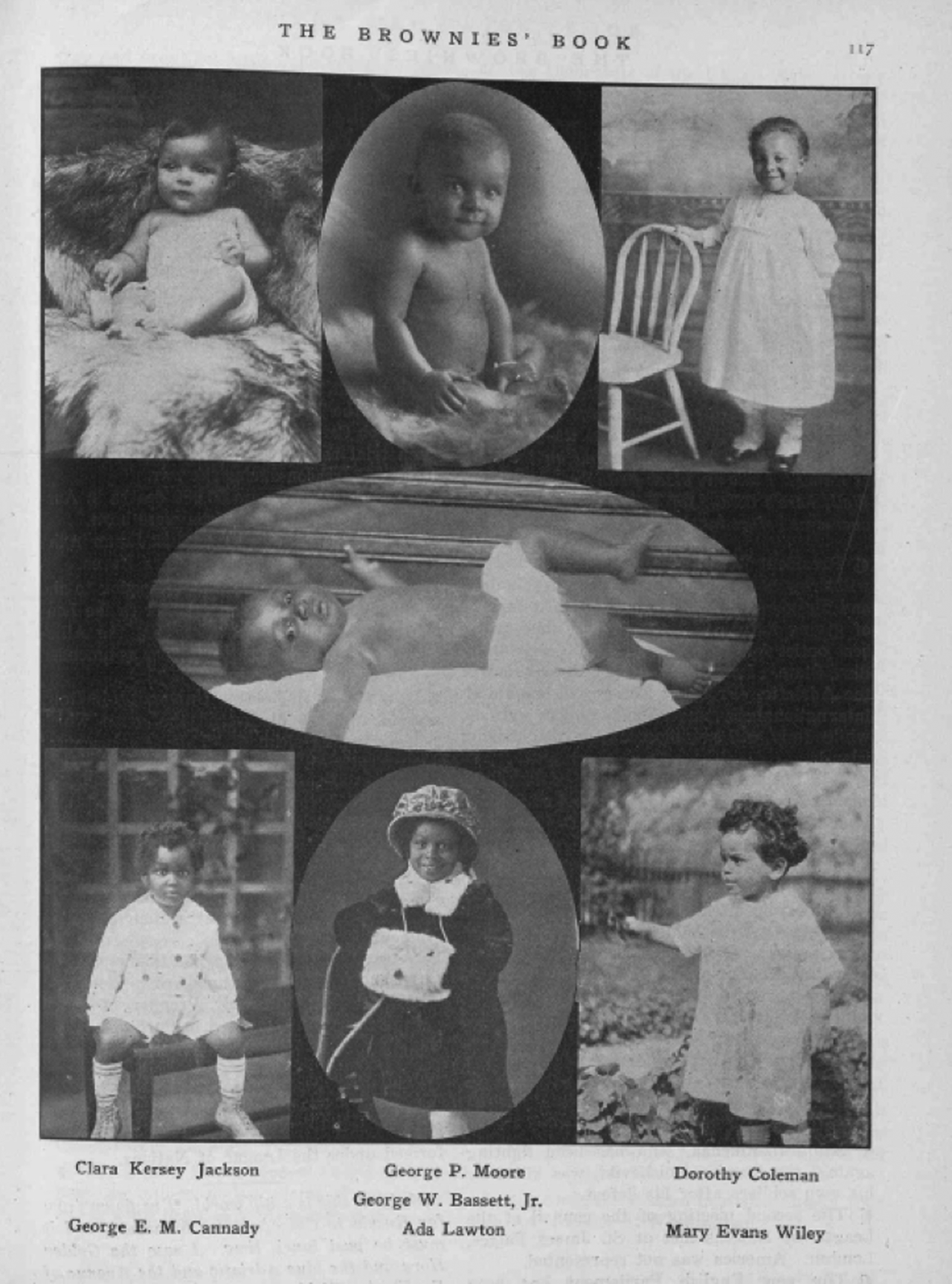
Just as photographic excess proved a problem for racial “scientists,” the volume of children's portraits in the magazines seems to come into conflict with the principles of selection and exclusion that are central to any ideas of intraracial eugenicism they may be promoting. A tension begins to emerge between the claims of perfection (the “Talented Tenth”) and proliferation. The April 1920 Brownies’ Book explains that four of the children photographed have attained scores of 99 per cent and 100 per cent on a eugenics test: their “little bodies are perfect.”Footnote 85 Yet the photos of these “perfect” babies are striking because they are so similar to the ones elsewhere in this magazine and in The Crisis – they are not, therefore, terribly compelling as “evidence” of perfection (Figure 11). The failure of the photograph to identify the “perfect” baby is indeed addressed directly in the August 1920 issue, which offers an explanation of its frontispiece photograph, “The Candy Contest.” The magazine reveals that the six children in the photograph are all siblings, and one of them, Audrey, is “the best pre-school baby in her district and in Manhattan, and … the third best in Greater New York.”Footnote 86 While her five siblings “may not be as perfect as Audrey … they certainly look it. That is why we have shown their pictures too, as our frontispiece.”Footnote 87 While medical apparatus can accurately judge Audrey's relative perfection – we are given weights and measurements, and reference to a “slightly imperfect left tonsil” – the photograph does not extend the work of the naked eye, or provide evidence of her special status.Footnote 88 In this case, the evidentiary properties of “the child” seem to clash with those demanded by the eugenic photograph: the photograph's utility as a piece of scientific evidence is neutralized by the tautological self-evidence of the child, which dictates that all children are beautiful precisely because they are children. The ubiquity of the child's value is emphasized by the sentimental family-album structure through which the pictures are presented, which of course works on the assumption that everybody's baby photographs are perfect. By drawing attention to the impossible tensions between the many features we have assigned to the child, the magazines draw attention the semiotic excess at the heart of the photographic form, and therefore discredit its claims to transparency.
Brownies' Book, April 1920, 117.

THE PAST TENSE OF THE PHOTOGRAPH VERSUS THE FUTURE TENSE OF THE CHILD
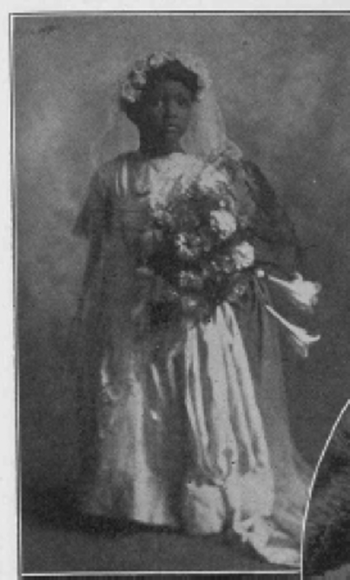
As Capshaw Smith has demonstrated, one version of the child that we find in Du Bois's writings is the mature, sophisticated child, the future race leader.Footnote 89 We can see this represented in photographic form in such features as The Crisis’s “Little Men and Women,” which groups together images of children dressed not in the typical all-white attire but in conspicuously adult costumes, particularly military or medical uniforms and even, in the October 1920 issue, bridal wear (Figure 12). Sometimes this sense of the child as a citizen in the making is emphasized by studio scenes where they perform adult tasks, such as answering the telephone, or by reference to the photographic subjects’ parents and grandparents, as in a “Distinguished Descendants” feature, and an image of the young Booker T. Washington III dressed as a tiny soldier.Footnote 90
Brownies' Book, Oct. 1920, 317.

These images visualize the gap between children and their future, potential selves and thus speak to the child's fundamental connections with concepts of change and development. Claudia Castañeda argues that the child's association with mutability relates to the “capacity for transformation” that is central to its definition:
This implies that the child is also never complete in itself. It is precisely this incompleteness and its accompanying instability that makes the child so apparently available: it is not yet fully formed, and so open to re-formation. The child is not only in the making but is also malleable—and so can be made.Footnote 91
Across her work on African American children's culture, Capshaw Smith has suggested the different political uses of the child as a figure of malleability and incompletion within distinct historical moments and political and artistic movements. In her study of African American children's conduct literature published during the second half of the 1910s, for instance, she identifies the books’ emphasis on the malleability and potentiality of the child's body as a means of imagining a performative racial identity in which binary categorizations are destabilized.Footnote 92 Such considerations of the child as a figure of change and becoming can be extended into a reading of the NAACP publications, where they fit quite clearly with Du Bois's uplift ideology. The Crisis articles promote the advancement of the African American community through improving children's diet, hygiene, and education and, in more eugenic terms, through early and productive middle-class marriage. The connection between the moulding of the child and the development of the race is particularly evident in articles such as “Little Mothers of Tomorrow,” which describes the activities of the “Little Mothers’ Movement,” where “the little colored mothers of tomorrow” are taught “what so many, many mothers of today do not know; – just what is best for the little babe; – just how to conserve the infant for the race!”Footnote 93
Furthermore, while photographic representations in particular can capture the child's associations with process and incompletion, and thus suggest the mutability of the subject, as Capshaw demonstrates in relation to both the conduct literature and photobooks of the black arts movement, I think that the focus on futurity and potentiality also contributes to the way these particular magazines problematize indexical and documentary conceptions of photography.Footnote 94 Crucially, the notion of the child as “a potentiality rather than an actuality, a becoming rather than a being: an entity in the making” poses a challenge to the concept of the photograph as a faithful, stable record of the past.Footnote 95 The attempt to capture the child's malleability, to present it as the adult it has not yet become, sits in tension with the aim to freeze and fix its meaning through photography.Footnote 96
Indeed, while Shawn Michelle Smith argues that Du Bois's 1900 photographs did not require explanation because their meaning was “apparently self-evident,” she points to the “much larger array of props and objects” in the archive's photographs of children.Footnote 97 The child, in its state of development and incompletion, in fact provides a limit case for the photograph's assumed transparency: “It is as if the narrative of their lives has not yet fully developed enough to stand on its own, or to be represented by their bodies, and needs some formal scripting in order to be communicated to the viewer.”Footnote 98 And, despite the centrality of the child in invocations of photographic “evidence” by eugenicists such as Galton, Sekula suggests that its malleability also worked against the notion of fixity demanded by racist uses of photography. In “the first sustained application of photography to the task of phrenological analysis” (conducted by Eliza Farnham), pictures of child subjects, unlike their adult equivalents, were not annotated with reference to race and ethnicity, and were also “presented as less weighted down by criminal biographies or by the habitual exercise of their worst faculties.”Footnote 99 The ever-changing child in fact presents a challenge to pathological uses of photography: its fundamental malleability is a foil to its naturalizing properties.
In the inaugural Children's Number, Du Bois imagines the child as a figure of pure potentiality: it assures the “immortality of black blood in order that the day may come in this dark world when poverty shall be abolished, privilege based on individual desert, and the color of a man's skin be no bar to the outlook of his soul.”Footnote 100 He uses similar language in his 1916 editorial “The Immortal Children”: “With the children, whether they are ours or others, our life goes on renewed in its splendid youth, uplifted by its quivering, ever-glorious dreams, like to all life and yet always different because it grasps new worlds and lives in a universe continually unfolding to new possibilities.”Footnote 101 Du Bois's child here sounds more like that of science fiction than that of sentimental fiction. Indeed, its role as an emblem of social progress threatens its visibility within sentimental discourse, as it risks becoming less a feeling, bourgeois individual than a sociological type: “After all, these are not individual children; they belong to no persons and no families; they belong to a great people and in their hands is that people's future.”Footnote 102 This child is imagined as atopic and indeed utopic. Nobody's child, existing nowhere in particular, it serves as the emblem of a yet-to-be-realized social and racial equality; its meaning is articulated in the conditional and subjunctive moods. Crucially, the child's status as a figure of becoming – the emblem of the “not yet” – points in the opposite direction from Barthes's indexical “that-has-been,” the perfect tense that underwrites the photograph's “evidential force.”Footnote 103
CONCLUSION
Anne Maxwell refers to Du Bois's Atlanta study as “the last time he would use photographs to challenge the precepts of scientific racism,” drawing a line between his work as an “academic and social scientist” who harboured a residual attachment to social Darwinism and his political role as editor of The Crisis.Footnote 104 As I have argued, the photographic images in The Crisis and the Brownies’ Book challenge racism in manifold ways, but the magazines also demonstrate a clear scepticism about any claims for the medium's special truth-telling abilities or its scientific objectivity. The power of these images does not depend on a faith in photographic indexicality, but on an understanding of the camera as an instrument for interpreting and shaping reality.
Crucially, this sophisticated presentation of photography is made possible in part by an equally sophisticated understanding of “the child.” By inviting the reader to find parallels between the photographic form and the idea of the child, and by exposing the conventions and manipulations that govern our understanding of both, the magazines challenge the photograph and the child's associations with authenticity, transparency and nature, associations which have been used to naturalize the structural oppression of black people.
We can perhaps better understand the magazines’ deft, flexible approach to the children's portraits by remembering Du Bois's famous claim that, upon assuming editorship of The Crisis in 1909, he became “master of propaganda.”Footnote 105 If, as Robert W. Williams argues, Du Bois used the word “propaganda” in “at least two senses,” then more than one is at stake in this context.Footnote 106 In their exposure of both “the child” and the photograph's naturalizing properties, the magazines prime readers to treat the evidence these constructions appear to provide with suspicion, and therefore to question the “distortions, lies, and the manipulation of truth” associated with the negative propaganda of racist photography.Footnote 107 But the photographs also participate in what Williams terms the “positive dimension” of Duboisian propaganda, the kind celebrated, most famously, as a property of “all art” in his “Criteria of Negro Art,” an essay first published in the 1926 Children's Number.Footnote 108 Here Du Bois differentiates an empirical, scientific “truth” from the “Truth” of the artist, the “highest handmaid of imagination” and “one great vehicle of universal understanding.”Footnote 109 As Williams suggests, the artist's “Truth” concerns “the yet-to-be or perhaps the yet-could-be,” an imagined, ideal future which corresponds, as we have seen, with the child's status as a figure for unlimited potentiality.Footnote 110 While the magazines ultimately cast doubt on the photograph's status as faithful record of the past, they draw on the photographic image of the child as a rich and mobile spur to the imagination, as a tool for changing the present and picturing a different future.