Management Implications
The invasive nature of Pyrus calleryana (Callery pear) has only become apparent within the past two decades, even though the first collections in the wild occurred in the 1960s. The current situation might be considered the result of a perfect storm comprising consumer desire for cultivated flowering pear trees, development of multiple cultivars capable of cross-fertilization, selection of traits that might favor invasion, and the weedy traits of this particular species. Various cultivars of P. calleryana continue to be sold in some states, although some progress has been made in increasing awareness of this plant’s invasive nature. Wild-type Pyrus calleryana can quickly dominate abandoned fields and rights-of-way, often forming dense thickets with sharp, rigid thorns that make foot travel through infested areas difficult at best and may pose a threat to equipment and livestock. In some areas it forms nearly pure stands, outcompeting native plants and threatening prairie and early-successional habitats. More recently it has been observed in the understory in pine plantations in the South, where it may hinder forest management operations.
We are unaware of any herbicides that currently list P. calleryana on the label, and few studies have evaluated the efficacy of various herbicide active ingredients against this invasive plant. Land managers, homeowners, farmers, municipalities, and other agricultural, municipal, and natural resource professionals need reliable tools to manage P. calleryana as it continues to spread and infest new areas. This study was undertaken to evaluate the efficacy of five herbicidal treatments consisting of four readily available active ingredients and one combination of two active ingredients. These data will add to our knowledge of P. calleryana control and support development of integrated pest management practices.
Introduction
Nonnative plant invasions in agricultural and natural ecosystems have a multibillion dollar annual impact (Pimentel et al. Reference Pimentel, Zuniga and Morrison2005) and can negatively affect ecosystem productivity and services, human well-being, and native flora and fauna (Fletcher et al. Reference Fletcher, Brooks, Lakoba, Sharma, Heminger, Dickinson and Barney2019; Pejchar and Mooney Reference Pejchar and Mooney2009; Pyšek et al. Reference Pyšek, Jarošík, Hulme, Pergl, Hejda, Schaffner and Vilà2012; Rai and Singh Reference Rai and Singh2020). Invasive plants are cosmopolitan across most of the forested regions in the United States (Oswalt et al. Reference Oswalt, Fei, Guo, Iannone, Oswalt, Pijanowski and Potter2015), and there is much work to do to educate landowners and managers to improve awareness of invasive plant problems (e.g., Clarke et al. Reference Clarke, Ma, Snyder and Floress2019; Fischer and Charnley Reference Fischer and Charnley2012).
The history of Callery pear (Pyrus calleryana Decne., Rosales: Rosaceae) in the United States spans more than a century; like many invasive plants, it was introduced for an agricultural purpose (Culley Reference Culley2017; Culley and Hardiman Reference Culley and Hardiman2007; Vincent Reference Vincent2005). Native to China, Taiwan, Korea, Vietnam, and Japan, but invasive in the United States (Swearingen et al. Reference Swearingen, Slattery, Reshetiloff and Zwicker2014; Vincent Reference Vincent2005), P. calleryana occurs in a wide variety of habitats and exhibits a variety of growth characteristics. In 1917, Frank N. Meyer (U.S. Department of Agriculture) collected P. calleryana seed in China in a search for fire blight–resistant germplasm for breeding programs with the European pear (Pyrus communis L.; Creech Reference Creech1973; Cunningham Reference Cunningham1984). After this initial collection, additional seed was purchased from Chinese collectors (Cunningham Reference Cunningham1984), and some cultivars (including ‘Bradford’, which is now the most common P. calleryana cultivar in the United States) were developed for the horticultural market. Pyrus calleryana has been used in breeding programs, as rootstock for other pears, and as a pollen donor for commercial pears. Pyrus calleryana is self-incompatible (Zielinski Reference Zielinski1965); however, as additional cultivars were developed and planted, they were able to cross-pollinate and produce fruit with viable seed. Resulting progeny form sexually reproducing populations (Swearingen et al. Reference Swearingen, Slattery, Reshetiloff and Zwicker2014). Grafting also results in invasive populations when the rootstock is allowed to sprout, flower, and cross-pollinate with the scion (Culley et al. Reference Culley, Hardiman and Hawks2011). In some instances, abandoned nurseries can serve as sources for new infestations (e.g., Taylor et al. Reference Taylor, MacGrath, Folley, Buck and Carpenter1996). Pyrus calleryana is widely distributed throughout the eastern half of the United States and in several western states (EDDMapS 2020).
The impacts of P. calleryana are not yet well known; however, this species has many characteristics typical of other woody invasives—for example, plants may begin flowering at just a few years of age (Bell and Zimmerman Reference Bell and Zimmerman1990; Warrix et al. Reference Warrix, Myers and Marshall2017), and their fruit is eaten and dispersed by birds (Reichard et al. Reference Reichard, Chalker-Scott, Buchanan, Marzluff, Bowman and Donnelly2001). Populations may form dense, thorny thickets, presenting issues for people and equipment. Pyrus calleryana is noted for its ability to thrive under a wide range of environmental conditions and not only invades disturbed areas and forest edges, but a variety of natural areas (Swearingen et al. Reference Swearingen, Slattery, Reshetiloff and Zwicker2014). It can be a problem in pine reforestation (Sundell et al. Reference Sundell, Thomas, Amason, Stuckey and Logan1999) but is not restricted to open areas. It can dominate a forest understory and is among the woody species of concern in site preparation for shortleaf pine (Pinus echinata Mill.) regeneration (Clabo and Clatterbuck Reference Clabo and Clatterbuck2019). Large thorns make removal difficult and may even pose a hazard to pneumatic tires on equipment (DR Coyle, B William, and D Hagan, personal communication). Seeds are long-lived and may remain dormant in seedbanks for at least 11 yr (Serota and Culley Reference Serota and Culley2019). In recent years, discussions among federal, state, and university Extension forest health personnel have focused increasingly on the widespread occurrence of P. calleryana, landowner concerns, and the need to develop a complete, effective integrated management program. As such, replicated studies to assess efficacy of readily available herbicides for control of P. calleryana are greatly needed.
To our knowledge, no herbicides specifically list P. calleryana on the label; however, some control recommendations are available in extension publications and other outreach literature. Foliar applications of glyphosate or triclopyr appear in most fact sheets, with foliar sprays recommended for smaller trees and cut stump treatment for larger trees (e.g., Elmore Reference Elmore2019; Templeton et al. Reference Templeton, Gover, Jackson and Wurzbacher2020). Hack-and-squirt or basal bark applications have also been recommended as an option for control, though these can be difficult due to the thorniness and thick branching structure of P. calleryana. Miller et al. (Reference Miller, Manning and Enloe2010) recommend cut stump treatment with glyphosate or triclopyr for larger trees; basal sprays for saplings; and foliar application with glyphosate, triclopyr, or imazapyr for seedlings. Swearingen et al. (Reference Swearingen, Slattery, Reshetiloff and Zwicker2014) recommend hand-pulling for smaller plants and cut stump application as previously described for larger trees. Pulling seedlings is difficult due to a relatively long, tough taproot, and thorns can hamper movement through stands for hand-pulling and other cultural or mechanical controls. Few published data are available on herbicide efficacy against P. calleryana. Page et al. (Reference Page, Flynn and Smeda2014) made basal and foliar applications of triclopyr and foliar applications of aminopyralid + metsulfuron, aminopyralid + triclopyr, and picloram + fluroxypyr on 1.5- to 2-m tall trees. At 1 yr after treatment, basal-applied triclopyr resulted in 100% control, while foliar treatments resulted in approximately 70% to 90% control. Regrowth was noted from the base of some plants receiving foliar treatments. Terry (Reference Terry2018) investigated control of P. calleryana in Missouri, with highly variable results likely due to season and application methods. Flynn et al. (Reference Flynn, Smeda and Page2015) achieved 100% control with basal bark application of 25% triclopyr in 75% basal bark oil. Picloram + fluroxypyr (13.24% and 10.64%, respectively, applied as a foliar spray provided 70% to 85% control when applied with surfactant (0.25%) and 93% control when applied with a methylated seed oil (1%). Triclopyr, aminopyralid + triclopyr, and potassium salt of 2-pyridine carboxylic acid, 4-amino-3,6-dichloro- + metsulfuron methyl provided partial control. Overall, results were variable and likely depended on existing environmental factors or tree size and/or health before treatment.
Our objective was to test four common, readily available active ingredients and one combination against an untreated control to determine efficacy against P. calleryana. We included a soil application for direct comparison with more commonly used foliar and basal bark applications. These data will contribute to a more complete integrated management plan for this species.
Materials and Methods
Trials were installed in central Georgia at Bartram Forest Wildlife Management Area (Baldwin County; 33.00028°N, 83.80333°W) and at two privately owned sites in South Carolina, near Liberty (Pickens County; 34.75541°N, 82.65831°W) and Fair Play (Oconee County; 34.54999°N, 82.97815°W). Climate data were obtained from National Oceanographic and Atmospheric Administration (NOAA), National Centers for Environmental Information (2020). Mean annual temperature and rainfall were 17.4 C and 118 cm for Baldwin County, warmer and drier than Pickens County (15.0 C, 149 cm) and Oconee County (15.3 C, 155 cm). The Bartram site consisted primarily of loblolly pine (Pinus taeda L.; average diameter at breast height [dbh] = 25 to 30 cm) thinned to approximately 24 to 28 trees ha−1. Understory was mostly P. calleryana with some scattered sweetgum (Liquidambar styraciflua L.), winged sumac (Rhus copallinum L.), black cherry (Prunus serotina Ehrh.), winged elm (Ulmus alata Michx.), and American beautyberry (Callicarpa americana L.). The site is on a 3-yr controlled-burn rotation. Soil was well-drained Norfolk loamy sand (fine-loamy, kaolinitic, thermic Typic Kandiudults). Both South Carolina sites were former agricultural land with Cecil sandy loam (fine, kaolinitic, thermic Typic Kanhapludults) soils in the Piedmont ecoregion of South Carolina. Vegetation at both sites consisted primarily of grasses (e.g., Andropogon spp., Paspalum spp.) and shrubs (e.g., Rubus spp., Chickasaw plum [Prunus angustifolia Marshall]) with occasional small trees (e.g., common persimmon [Diospyros virginiana L.]). Soils data were obtained from the U.S. Department of Agriculture–Natural Resources Conservation Service (2019). These sites had remained unmown for 3 to 5 yr before this study. All sites contained a mix of single-stem P. calleryana trees and multistemmed plants emanating from a single rootstock; the latter were considered single experimental units.
Treatments included two basal bark applications, a soil application, and two foliar applications. All treatments were applied with handheld sprayers at low pressure. Herbicide rates are given in acid equivalent, where applicable. Basal bark applications consisted of triclopyr (Forestry Garlon® XRT, Dow AgroSciences, Indianapolis, IN 46268) applied at 151 g L−1 (20% v/v) in basal oil (Hy-Grade 1™, CWC Chemical, Cloverdale, VA 24077) and triclopyr (as above, 20% v/v) plus triisopropanolammonium salt of aminopyralid (Milestone®, Dow AgroSciences) at 4.8 g L−1 (2% v/v) in basal oil (as above). Both basal bark treatments were applied to the bottom 45.7 cm of the main stem with an 80° fan tip, thoroughly wetting the stem, but not to the point of runoff. Soil applications were made using hexazinone (Velpar® L, E. I. du Pont de Nemours, Wilmington, DE 19898) applied at 239 g L−1 in a ready-to-use formulation. We applied 1 ml hexazinone 2.54 cm basal diameter−1 at the base of the main stem in a coarse stream with a standard circular nozzle. Foliar treatments included isopropylamine salt of imazapyr (Chopper® Gen2™, BASF, Research Triangle Park, NC 27709) at 4.8 g L−1 (2% v/v) with 1% basal oil (as above), applied on a spray-to-wet basis, and dimethylamine salt of glyphosate (Accord® XRT II, Dow AgroSciences) at 24 g L−1 (5% v/v) applied as a low-volume directed spray contacting at least 50% of the foliage on all sides. Foliar treatments were applied with an 80° fan tip.
Square plots (150 m2, N = 60) were established in 74-m-long linear blocks of six plots each at the Bartram site using tree rows as an approximate guide. Blocks were separated by approximately 12 m of untreated area; plots within blocks were laid out end to end. Plot corners were marked with PVC spikes, and the approximate plot center was marked with a metal stake. On each sampling date, a 2-m radius was established around the approximate plot center, recording the height of each P. calleryana encountered (for multiple-stemmed individuals, the tallest stem was measured), crown condition (simple visual estimate of green foliage present, 0% to 100%), and dbh for trees >5-cm dbh. Sampling a circular subplot near the plot center maintained a 5- to 6-m buffer between sampling units and adjacent plots.
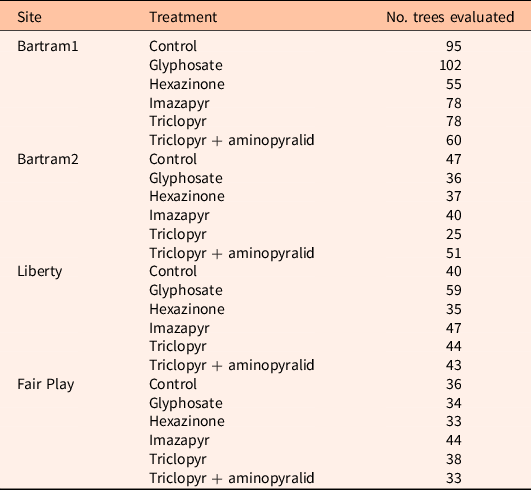
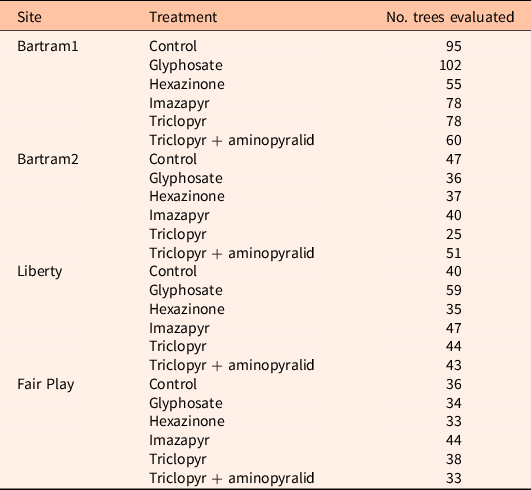
At the Liberty and Fair Play sites, plots (approx. 100 to 150 m2, N = 30 at Liberty and 24 at Fair Play) were established by mowing around groups of P. calleryana trees using a 1.5-m bush hog such that a minimum number of trees (5; range 5 to 20) were present in each plot and a minimum treatment buffer of 6 m was maintained between plots. Blocks of six plots each were established as groups of nearest neighboring plots. On each sampling date, the height of each P. calleryana within each plot was recorded (for multiple-stemmed individuals, the tallest stem was measured), crown condition was recorded as described earlier, and dbh was recorded for trees >5-cm dbh. Total number of experimental units (trees) in each site by treatment combination is given in Table 1.
Total number of trees evaluated in each treatment by site.
At each site, the five treatments (described earlier) and an untreated control were randomly assigned to the six plots in each block. Treatments were applied to every tree in a plot during the mid- to late-morning hours. All plots were evaluated before treatment. Bartram1 was treated on September 18, 2018 (28 C, 84% RH) and evaluated at 6, 13, and 19 mo after treatment (MAT); Bartram2 was treated on April 1, 2019 (11 C, 54% RH) and evaluated at 6 and 12 MAT; Liberty was treated on August 16, 2019 (28 C, 58% RH) and evaluated at 2 and 7 MAT, and Fair Play was treated on October 16, 2018 (25 C, 74% RH) and evaluated at 6 and 10 MAT. Trees were considered alive if they had any portion of green canopy remaining, new growth evident, or subapical sprouting and dead if they had no green canopy or sprouting. Trees counted as dead had twigs that easily snapped; several were checked on our final sampling dates to confirm mortality. Additionally, the Bartram1 and 2 sites were revisited at approximately 24 and 17 MAT to confirm mortality of trees counted as dead and to assess survivorship of trees with subapical sprouting.
We used historical STAR satellite rainfall estimates (https://www.star.nesdis.noaa.gov/smcd/emb/ff/CONUS.php; reprocessed data from what will become the new operational GOES-16/17 rainfall rate algorithm; R Kuligowski, personal communication) to estimate rainfall in the week before and 2 wk following treatment.
Statistical Analyses
Some trees that appeared dead in the first observation after treatment were tallied as alive during the subsequent observation. This was due to browning down and/or defoliation and our nondestructive sampling methods. For analysis, these individuals (n = 12, all at Bartram1 site) were changed to alive at the first observation after treatment.
Data were analyzed by using the general linear models (glm) function in the stats package in R (R Core Team 2019). Of interest were the main effects of treatment, site, days after treatment (DAT), and plant height, with the blocks treated as random replications. We analyzed the individual tree mortality data, with treatment, DAT, and height as factors, by invoking the glm function for the binomial family under the logit model (Equation 1):
 $$\eqalign{glm({\rm{formula = dead \sim treatment + site + DAT + height\comma\ family}}\cr {\rm\hskip -197pt {=binomial( link = logit)}$$
The logit is the natural logarithm of the odds ratio (Equation 2):
 $$a = {\rm{ logit}}\left( {p} \right){\rm{ = ln}}\left[ {{p/}\left( {{1 - p}} \right)} \right]$$
To obtain the probability (p) of mortality on each site for each treatment at each observation time we calculated the inverse of the solution from the logit regression (Equation 3):
 $${p = exp}\left( {{a}} \right)/\left\{ {\left[ {{\rm{exp}}\left( a \right)} \right] + 1} \right\}$$
Results were considered significant at P < 0.05.
Results and Discussion
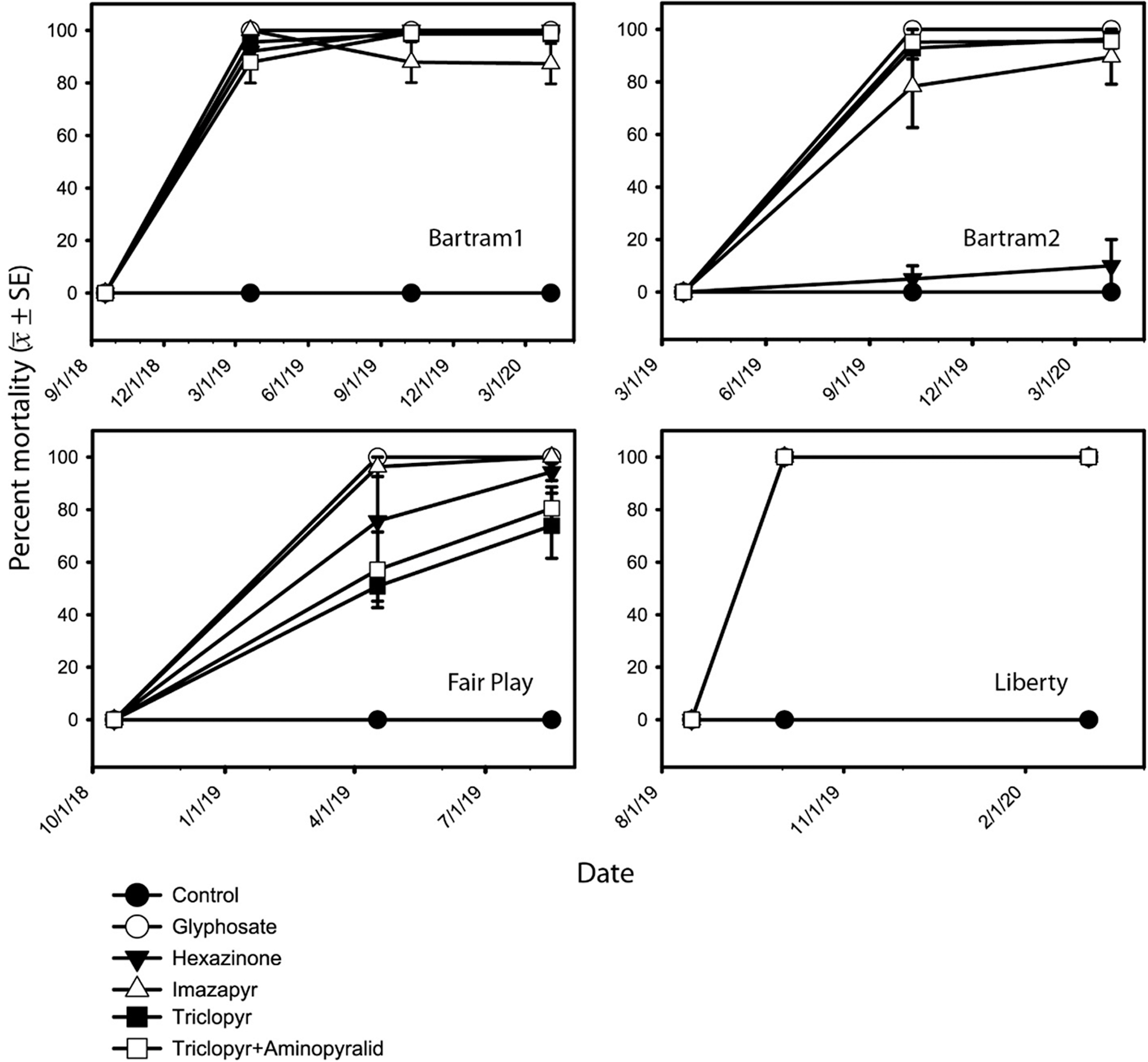
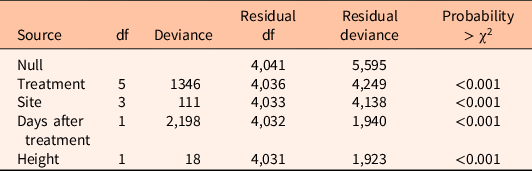
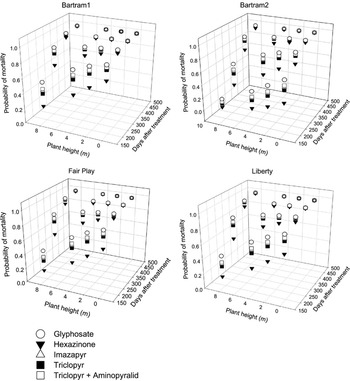
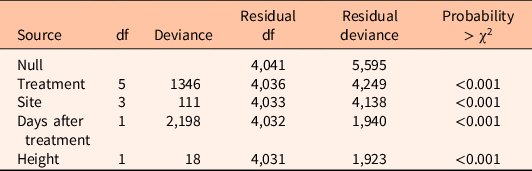
All treatments effectively killed trees, except the hexazinone treatment at the Bartram2 site (Figure 1). Mortality ranged from approximately 70% to 100% at the Fair Play site when the trial ended due to the site being cleared. Table 2 evaluates the glm solution for all sites combined under the logit model in an analysis of deviance table based on the χ2 test. Treatment, site, DAT, and plant height all explained a significant proportion of the deviance, with treatment and DAT accounting for 63% of the total deviance. The contribution of site and plant height to the model was relatively small, but significant. Figure 2 gives the predicted probability of mortality by site for 180, 270, 360, and 450 DAT and 0-, 2-, 4-, and 8-m plant height. The overall effect of increased plant height was to slow mortality.
Mortality of Pyrus calleryana given five herbicidal treatments and an untreated control at four study sites. Error bars represent standard errors of the means. Some symbols are obscured due to similarity in means.

Analysis of deviance for five Pyrus calleryana treatments and untreated controls.
Predicted mortality over time of Pyrus calleryana trees of different height given five herbicidal treatments at four study sites (control not shown). Some symbols are obscured due to similarity in predicted values.
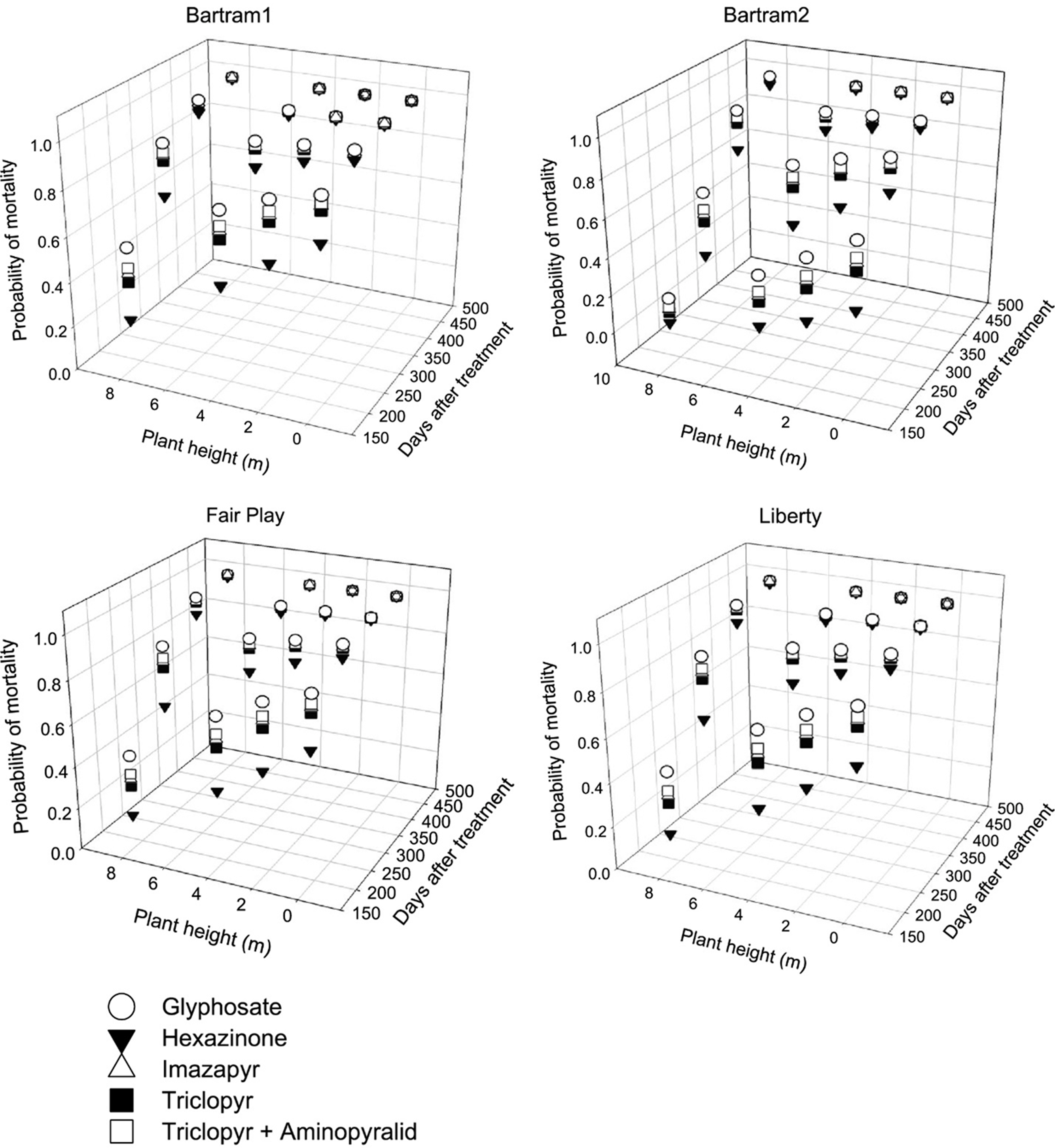
Low mortality in hexazinone-treated plots at the Bartram2 site is evident in Figure 1 but was obscured by the larger regression effects of treatment and time on predicted mortality in the overall model incorporating all sites (Figure 2). The hexazinone product label specifies that best results are obtained when soil is moist at the time of application, and the area received 0.64 to 1.27 cm of rainfall in the 2-wk period following application. Rainfall estimates for the week before application were highly variable at our sites (0.83, 3.7, 0.08, 0.1 cm for Fair Play, Liberty, Bartram1, and Bartram2, respectively). Likewise, rainfall estimates in the 2-wk period following application were variable (1.82, 0.36, 0.97, and 3.78 cm, ordered as above). According to these estimates the Bartram2 site, where hexazinone did not perform well, received little rain before application and more than twice the label specification for maximum results following application. Spatial resolution of STAR rainfall estimates is 4 km, so while it is likely that rainfall was low before application and high after application, we cannot say with certainty that rainfall affected performance of hexazinone.
Subapical sprouting was rarely seen during this study, as it was limited to seven trees treated with imazapyr; three at the Bartram1 site on April 20, 2020, and four at the Bartram2 site on April 20, 2020. We revisited these plots approximately 4 mo later (September 1, 2020) and confirmed survival and growth of trees that had sprouted; no additional sprouting or survival was noted among trees that were previously recorded as dead. Page et al. (Reference Page, Flynn and Smeda2014) noted regrowth at the base of all foliar-treated trees in their study, concluding that sequential treatments might be necessary for full control. Glyphosate was not among the foliar treatments in their study. We noted no subapical sprouting in our glyphosate treatments, and very few trees with subapical sprouting in our imazapyr treatments. As noted earlier, those trees that sprouted continued to survive and grow.
A multipronged approach including education of consumers and retailers, engagement with the green industry, investigation of cultural and mechanical control measures, and judicious application of herbicides will be needed to reduce the impacts of invasive P. calleryana. Given that naturalized P. calleryana is easily dispersed and can persist in the seedbank for years, herbicides will be a critical component of integrated pest management programs and may require repeated applications to achieve lasting control in infested areas. Our study demonstrated the effectiveness of four active ingredients and one combination of active ingredients against P. calleryana at three geographic locations in the Southeast, representing old-field conditions as well as understory infestation. Foliar and basal bark application methods provided consistent control; additional studies with careful measurement of local environmental conditions will be necessary to fully describe efficacy of soil-applied hexazinone, which failed to control P. calleryana at one of our sites. Other types of application (e.g., cut stump and hack-and-squirt) are effective against P. calleryana (Terry Reference Terry2018); however, the applicator must contend with thorny thickets and low-growing, thorny branches to use these methods. Future work will concentrate on control of larger (>10-cm dbh) trees, using products and application methods that do not require cutting or modification of the tree and integration of control methods for effective management programs.
Acknowledgments
We gratefully acknowledge personnel with the Georgia Forestry Commission and South Carolina Forestry Commission for expert assistance in herbicide application. Robert Kuligowski (NOAA) provided estimated rainfall data. We thank Webb Smathers and the Golden Grove Wesleyan Church for the use of their property. Two anonymous reviewers provided many helpful suggestions which greatly improved the article. Funding was provided by Clemson University, Georgia Forestry Commission, South Carolina Forestry Commission, and the USDA Forest Service, Southern Research Station. No conflicts of interest have been declared. Reference herein to any specific commercial products, process, or service by trade name, trademark, manufacturer, or otherwise, does not necessarily constitute or imply its endorsement, recommendation, or favoring by the U.S. government. The views and opinions of authors expressed herein do not necessarily state or reflect those of the U.S. government and shall not be used for advertising or product endorsement purposes.