Introduction
The family Chlopsidae Rafinesque (Reference Rafinesque1815) (false morays) is a small but distinct group of eels comprising 8 genera and 25 valid species (Fricke et al., Reference Fricke, Eschmeyer and D2025). Most chlopsids are very rarely found due to their small body size and cryptic habitat preferences (Smith, Reference Smith and Böhlke1989, Reference Smith, Carpenter and Niem1999). The genus Chlopsis Rafinesque (Reference Rafinesque1810) is the most diverse group among the family Chlopsidae, which currently comprises 11 valid species (Tighe et al., Reference Tighe, Pogonoski, Hibino, Ho and Van Nguyen2015; Table 1) and is easily distinguished by a round to oval patch of intermaxillary teeth, paired longitudinal vomerine tooth rows that are closely set anteriorly, diverge medially, and converge posteriorly, absence of a lower lip flange, presence of a single lateral-line pore, dorsal-fin origin positioned anterior to the mid-trunk, and the absence of pectoral fins (Smith, Reference Smith, Carpenter and Niem1999).
The genus Chlopsis was revised by Lavenberg (Reference Lavenberg1988), Smith (Reference Smith and Böhlke1989), Tighe and McCosker (Reference Tighe and McCosker2003), and, more recently, by Tighe et al. (Reference Tighe, Pogonoski, Hibino, Ho and Van Nguyen2015). Initially, the species Chlopsis slusserorum was described solely on the holotype and paratype, from the Somo-Somo Strait, Fiji (426−487 m depth) in February 1999 and from Malaita Island of the Solomon Islands (ca. 366 m depth) in 1973, respectively. To date, this species has been recorded only from its type localities. Despite this diversity and wide geographical coverage, no species of the genus Chlopsis has been previously recorded from Indian waters (Smith, Reference Smith, Carpenter and Niem1999; Tighe, Reference Tighe, Randall and Lim2000; Tighe and McCosker, Reference Tighe and McCosker2003; Tighe et al., Reference Tighe, Pogonoski, Hibino, Ho and Van Nguyen2015).
Here, we report the first record of Chlopsis slusserorum from off the Nagapattinam coast, Bay of Bengal, representing the first occurrence of the genus Chlopsis from the northeastern Indian Ocean. This finding further augments the known biogeographic range of the genus and adds to the documented diversity of deep-sea fishes and their habitats in the Bay of Bengal and adjacent regions. Furthermore, morphometric, meristic, and molecular analyses of the species are provided.
Materials and methods
A single Chlopsis specimen was collected on 14 April 2025 from the deep-sea trawl landings of Nagapattinam fishing Harbour (10° 45′ 36.9″ N, 79° 50′ 59.3″ E), east coast of India, Bay of Bengal. The specimen was caught as bycatch in commercial deep-sea shrimp trawlers operating at depths of 220–270 m. The fresh specimen photographs were taken with a Canon EOS R8 camera. The morphometric counts and measurements were documented following Böhlke (Reference Böhlke and Böhlke1989). Teeth counts and cephalic pore counts were taken using Nikon SMZ1270 stereomicroscopes. The morphometric measurements of the specimens were done using a digital Vernier Calliper (Mitutoyo) with an accuracy of 0.01 mm. Digital radiography was performed to determine the vertebral counts, following the methods described by Böhlke (Reference Böhlke1982). The collected specimen was identified following Tighe and McCosker (Reference Tighe and McCosker2003). The examined specimen was preserved in 10% formaldehyde and deposited in the national repository of the ICAR-National Bureau of Fish Genetic Resources (NBFGR), Lucknow, India, with the accession number CHLCSLU.1/NBFGR.
Global species checklist of the genus Chlopsis

Table 1 Long description
Rows list 11 species under columns for S.no, Species Name, Colour, Distribution, and Vertebrae. Vertebrae values are given as ranges for Chlopsis apterus, 134 to 140; Chlopsis bicollaris, 139 to 150; Chlopsis bicolor, 127 to 134; Chlopsis dentatus, 116 to 124; and Chlopsis olokun, 125 to 139. Three rows show three-part vertebrae entries: Chlopsis bidentatus, 11, 31, 128; Chlopsis Kazuko, 9, 39, 126; Chlopsis nanhaiensis, 12, 35, 120; Chlopsis orientalis, 11, 35, 135; Chlopsis sagmacollaris, 12, 42, 142; and Chlopsis slusserorum, 12, 41, 138. Colour descriptions are mostly bicoloured, with details such as prominent snout stripe for Chlopsis apterus, two half collar neck bands for Chlopsis bicollaris, and light brown above with distinct white ventrally for Chlopsis bidentatus. Other colour entries include yellow, banded or mottled for Chlopsis dentatus; tan, blotched ventrally for Chlopsis olokun; and light tan with 30 to 35 dark brown blotches for Chlopsis slusserorum. Distributions span multiple oceans and regions, including Eastern Pacific, Gulf of Mexico, West Atlantic and Mediterranean, South western Pacific, Western North Atlantic and Western Indian Ocean with Philippines, Eastern Central Pacific California, Southwest Taiwan, Eastern Atlantic Gulf of Guinea from Senegal to Angola, Western Pacific Vietnam, and Indian ocean between Ashmore Reef and Cartier Island in Northern Western Australia.
Molecular analysis
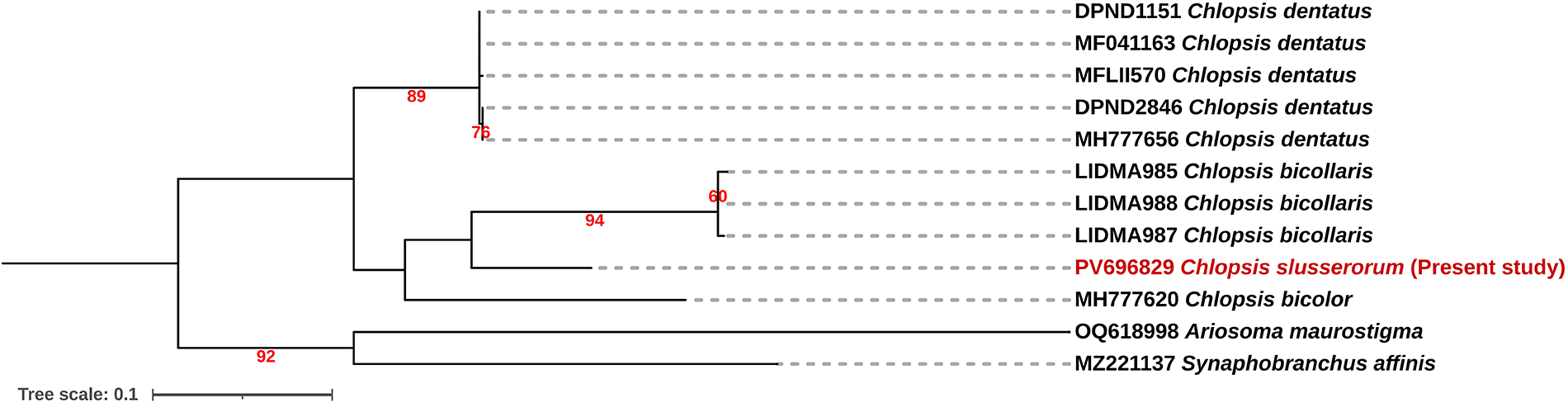
The tissue samples were collected and preserved in 95% molecular-grade ethanol, and isolation of the genomic DNA was done with the DNeasy Blood & Tissue Kit (Qiagen India Pvt. Ltd., New Delhi, India). Molecular analysis using the mitochondrial cytochrome c oxidase subunit 1 (COI) gene was carried out to confirm the species status of the collected specimen. A partial mitochondrial COI gene was amplified using a universal primer (Ward et al., Reference Ward, Zemlak, Innes, Last and Hebert2005), and the PCR product was sequenced using an ABI 3730XL sequencer at Gene Spec Pvt., Ltd., Kakkanad, Kerala, India. The sequences generated in the study were aligned using the Clustal W Multiple Alignment function in BioEdit software version 5.0.9 (Hall, Reference Hall1999). The gene sequences were submitted to the NCBI GenBank. The COI gene sequences were aligned with the sequences of other valid species of the genus Chlopsis retrieved from GenBank and BOLD systems. The phylogenetic tree was constructed using the maximum likelihood method, considering the best-fit model HKY+F+G4 with IQ-TREE V2.3.6 software (Minh et al., Reference Minh, Schmidt, Chernomor, Schrempf, Woodhams, Von Haeseler and Lanfear2020). The sequence of Ariosoma maurostigma and Synaphobranchus affinis was used as an outgroup for the phylogenetic tree generation.
Results
Table 2 shows the morphometric and meristic characteristics of the specimens from the present study and previous reports (Tighe and McCosker, Reference Tighe and McCosker2003).
Morphometric and meristic traits of Chlopsis slusserorum from the Bay of Bengal compared with the previous records

Table 2 Long description
Morphometric and meristic characters are listed for Chlopsis slusserorum across three columns: present study, CHLCSLU.1 slash NBFGR, and Tighe and McCosker 2003. Under Total Length in millimeters, values are 250 for the present study, 141 for CHLCSLU.1 slash NBFGR, and 86 for Tighe and McCosker 2003. Under In percent total length, predorsal length is 12.4, 13.2, and 13.8; pre anal length is 32.9, 33.5, and 34.2; head length is 10.7, 11.1, and 12.1; depth at anus is 3.3, 2.9, and 2.6. Under In percent of head length, eye diameter is 14.8, 13.4, and 13.5; interorbital width is 10.6, 12.1, and 10.6; snout length is 18.7, 22.9, and 22.1; tip of snout to rictus of jaw is 33.9, 35.0, and 33.6. Under Vertebrae, predorsal counts are 12 in all three columns, preanal counts are 41, 40, and 41, and total counts are 138 in all three columns. The row labeled Holotype and Paratype appears above the measurements without any values shown in the cells.
Systematic Position
Order: Anguilliformes Berg, 1943
Family: Chlopsidae Rafinesque, 1810
Genus: Chlopsis Rafinesque, 1810
Species: Chlopsis slusserorum Tighe and McCosker, 2003 (Figure 1; Table 2)
Type Locality
Holotype: MNHM2001-1079, 141 mm total length (TL), Fiji, Somo-Somo Strait, 16° 27′ S, 179º 35.4′ W, depth 426–487 m, captured with Waren dredge, Campagne Bordau 1, Station DW 1393, 23 February 1999.
Paratype: AMS I.17284-001, 86 mm TL, Solomon Islands, Malaita Island, S of Aoki, 8° 24′ S, 160° 35′ E, depth ca. 366 m, collector: P. Coleman, 27 August 1973.
Material examined
CHLCSLU.1/NBFGR, (250 mm TL) coll. by Ahamed Rasheeq. A & Kamalini S.N, 14 April 2025, Nagapattinam fishing harbour, Tamil Nadu, east coast of India, Bay of Bengal (10° 45′ 36.9″ N, 79° 50′ 59.3″ E).
Description
The general appearance of the eel is illustrated in Figures 1 and 2. Body slightly compressed and moderately elongate. Head moderately long and deep, its length 9.4 times in TL; snout broad. Gape short, with rictus situated below posterior margin of eye. Dorsal fin origin located slightly more than one eye diameter posterior to gill opening. Anterior nostril tubular, positioned just behind tip of snout, directed anterolaterally. Posterior nostril low, tubular opening without a flap, located on lip anterior to a vertical through mid-eye, directed posteroventrally (Figures 3). Predorsal and pre-anal lengths 8.1 and 3.0 in TL, respectively. Depth at anus is relatively small, 30.3 in TL. Eye diameter 6.8 in head length (HL), snout length 5.4 in HL, and distance from snout tip to rictus of jaw 2.9 times in HL. Total vertebrae 138, predorsal vertebrae 12, pre-anal vertebrae 41.
Lateral view of Chlopsis slusserorum CHLCSLU.1/NBFGR (250 mm TL), collected from Nagapattinam, Bay of Bengal (scale bar 5 mm).

Lateral (a); dorsal (b); ventral (c) view of anterior portion of head, Chlopsis slusserorum CHLCSLU.1/NBFGR.

Dentition of (a) upper jaw, (b) lower jaw of Chlopsis slusserorum CHLCSLU.1/NBFGR.

Left lateral (A) dorsal (B) and right lateral (c) views of the mid-body of Chlopsis slusserorum, CHLCSLU.1/NBFGR, showing distinctive lateral pigment blotches.

Single pore in branchial region parallel to upper eye orbit in dark saddle-shaped pigment patch (Figure 2a). Three supraorbital pores: the first in the anteroventral tip of snout, the second anteromedial to anterior nostrils base and the third behind anterior nostril; four infraorbital pores; five preoperculomandibular pores.
Intermaxillary teeth slightly recurved and conical, 22 teeth in a round patch. Maxillary teeth in two irregular rows, inner row larger than outer, with 28–30 teeth. Vomerine teeth paired in longitudinal series converging at the ends and diverging by mid row 21–22 teeth, and 2 small teeth in the median row. Mandibular teeth with two to three irregular rows anteriorly, reducing to two rows posteriorly, having nearly 28 teeth on either side of inner row (Figure 3a, b).
Colouration (fresh specimen)
Fresh specimen body light tan coloured with a series of 30–32 dark brown blotches in dorso-lateral surface of the body; no pairing of blotches on either side; dark saddle-shaped pigment patch before gill opening covering the dorso-lateral region in nape; ventral region pale white. Anal fin edges black pigmented in ventral tip of tail (Figure 1). In dorsal view, blotches are not distinctly visible, particularly at the dorsal fin origin and near the tail, and appear uniform brownish colour throughout the length. The blotches on one side of the body do not align symmetrically with those on the opposite side (Figure 4).
Distribution and habitat
Previously known only from the western Central Pacific: Somo-Somo Strait, Fiji, and Malaita Island of the Solomon Islands (Tighe and McCosker, Reference Tighe and McCosker2003). The present study documents the species from off the Nagapattinam coast, Bay of Bengal (Figure 5), at depths of 220–280 m.
Map depicting the global distribution of Chlopsis slusserorum: (Red) present study; (Yellow) previous reports.

Molecular analysis
The mitochondrial COI gene of Chlopsis slusserorum yielded 689 bp after further editing and alignment, and 612 bp obtained was used for the analysis. Molecular analysis for species confirmation has been conducted using publicly available sequences from databases such as GenBank and BOLD. The GenBank accession number obtained for the COI gene was PV696829. Based on the maximum likelihood phylogenetic tree (Figure 6), the sequence of Chlopsis slusserorum forms a single distinct clade with other sequences of the genus Chlopsis from different regions, validating the species identity. C. slusserorum shows maximum genetic divergence with C. bicolor (17.36%) followed by C. bicollaris (13.3–13.5%) and C. dentatus (12.6–12.8%).
Phylogenetic tree of Chlopsis slusserorum and related species based on the COI gene by maximum likelihood analysis.

Figure 6 Long description
The phylogenetic tree is oriented horizontally, depicting evolutionary relationships among fish species. The tree begins with a single branch that splits into multiple lineages. The topmost lineage includes several entries labeled as Chipoopsis dentatus, with identifiers such as DPND1151, MF941130, MFU1570, DPND2592 and MFU5720. Below this, another lineage labeled Chipoopsis bicoloraris includes identifiers LDM4885, LDM4886 and LDM4817. A separate branch labeled PVF84829, Chipoopsis slusserorum, marked as ′Present study′ in red, diverges from the Chipoopsis bicoloraris group. Further down, the tree includes Chipoopsis bicolor with identifier MH777682 and two other species, Ariosoma maurostigma labeled OQ311881 and Synaphobranchus affinis labeled MZ221127. The tree scale is indicated as 0.1 and numerical values such as 76, 94 and 82 are marked at various nodes, possibly representing bootstrap values or other statistical measures.
Discussion
The only known Indian Ocean congeners are Chlopsis dentatus from the western Indian Ocean and C. sagmacollaris of western Australia (Böhlke and Smith, Reference Böhlke and Smith1968; Tighe et al., Reference Tighe, Pogonoski, Hibino, Ho and Van Nguyen2015). C. slusserorum and C. dentatus are easily distinguished from other congeners by their banded colour patterns, whereas all other species are bicoloured. C. slusserorum is readily distinguished from C. dentatus by its pale to light tan body with approximately 30–35 discrete dark brown dorso-lateral blotches extending from the occipital region to the caudal base; these blotches do not extend to the dorsal surface or only weakly extend to the fin base. In contrast, C. dentatus is light yellowish brown, thickly banded with reddish-brown markings that extend onto the fins. Additionally, C. slusserorum possesses more total vertebrae (138 vs. 116–124 in C. dentatus) (Seale, Reference Seale1917; Tighe and McCosker, Reference Tighe and McCosker2003; Carvalho-filho and Paiva, Reference Carvalho-filho and Paiva2017).
Chlopsis slusserorum has a dark saddle-shaped pigment patch (Figure 2a) before the gill opening, covering the dorso-lateral region, similar to that of C. sagmacollaris, but C. slusserorum readily differs in dorsal fin origin (slightly more than one eye diameter behind the gill opening vs. two eye diameters in C. sagmacollaris), body colouration (dark brown blotches along the body vs. bicoloured), and fewer vertebral counts (12-41-138 vs. 12-42-142) (Tighe and McCosker, Reference Tighe and McCosker2003; Tighe et al., Reference Tighe, Pogonoski, Hibino, Ho and Van Nguyen2015).
The total vertebral count in C. slusserorum is 138, more than that of C. bidentatus (125–128), C. dentatus (116–124), C. kazuko (126), C. nahaiensis (120) and overlapping with C. apterus (134–140), C. orientalis (135), C. olokun (139) and fewer than in C. sagmacollaris (142) and C. bicollaris (134–150). These vertebral counts, along with other distinguishing morphological characters, support the identification of the specimen as C. slusserorum. Additionally, molecular identification using the mitochondrial COI gene further corroborates the species-level identification, and the present study generated the COI sequence for C. slusserorum for the first time.
These distinguishing features confirm the first record of Chlopsis slusserorum from the northeastern Indian Ocean, specifically off the southeastern coast of India, based on morphometric and meristic characters that are in complete concordance with the original species description. This significant range extension from the western Pacific to the Bay of Bengal highlights the potential for undocumented deep-sea biodiversity in Indian waters. As deep-sea ichthyofaunal diversity in the Bay of Bengal remains poorly explored, this finding emphasises the importance of continued deep-sea sampling and taxonomic research. Future studies incorporating integrative approaches, including molecular and osteological analyses, are warranted to further explore the deep-sea diversity and distribution patterns in this region.
Acknowledgements
The authors are grateful to the Director, ICAR_National Bureau of Fish Genetic Resources (NBFGR), for providing essential facilities. The authors are also thankful to the two anonymous reviewers for their valuable comments and suggestions, which helped improving the quality of the manuscript.
Author contributions
A.R.: Specimen collection, identification, molecular analysis, image preparation, writing – original draft. S.N.K.: Specimen collection, molecular analysis. P.K.: Taxonomic validation, review and editing of the manuscript. B.M.R.: Molecular analysis. A.K.: Conceptualisation, supervision, taxonomic corrections, review and editing of the manuscript. T.T.A.K.: Supervision of the study, review and editing of the manuscript. All authors read and approved the final version of the manuscript.
Declaration of interest
The authors declare no conflicts of interest.
Data availability statement
The datasets generated and/or analysed during the current study are included in this published article.
Ethics and approach
No research ethics committee approval was required to accomplish the study’s goals, as it was conducted on deceased specimens.
Funding statement
This work was supported by the Ministry of Earth Sciences, Government of India, under the Deep Ocean Mission programme (F. No. MoES/PAMC/DOM/71/2023(E-13084).