Introduction
Smoking prevalence among people with mental health problems is about twice as high as in the population as a whole and increases with severity of illness, in some instances reaching up to 80% (Royal College of Physicians & Royal College of Psychiatrists, 2013; McManus et al. Reference McManus, Bebbington, Jenkins and Brugha2016). Smoking prevalence in those with mental health problems has not seen the same decline as in the general population (Cook et al. Reference Cook, Wayne, Kafali, Liu, Shu and Flores2014; Szatkowski & McNeill, Reference Szatkowski and McNeill2015). Smoking is the main contributor to a gap in life expectancy of 8–22 years between those with and without mental health problems (Brown et al. Reference Brown, Kim, Mitchell and Inskip2010; Chang et al. Reference Chang, Hayes, Perera, Broadbent, Fernandes, Lee, Hotopf and Stewart2011; Wahlbeck et al. Reference Wahlbeck, Westman, Nordentoft, Gissler and Laursen2011; Lawrence et al. Reference Lawrence, Hancock and Kisely2013; Tam et al. Reference Tam, Warner and Meza2016). This affects a large number of people as it has been estimated that one-third of smokers have a mental health problem (Royal College of Physicians & Royal College of Psychiatrists, 2013). Prevalence of smoking and mental health problems is also higher among other disadvantaged groups, such as offenders and people with drug and alcohol dependence (Royal College of Physicians & Royal College of Psychiatrists, 2013) in prisons and substance use treatment settings, smoking prevalence in excess of 80% has been observed in some countries (Hickman et al. Reference Hickman, Delucchi and Prochaska2015). Evidence suggests that cessation benefits not only just physical, but also mental health (Taylor et al. Reference Taylor, McNeill, Girling, Farley, Lindson-Hawley and Aveyard2014).
Recently, some efforts to address this inequality have been made, including the introduction of comprehensive smoke-free policies in secondary care settings and prisons (National Institute for Health and Care Excellence, 2013; Working Group for Improving the Physical Health of People with SMI, 2016), ideally involving both smoke-free policies in buildings and grounds and integrated treatment for temporary abstinence and quitting (Kleber et al. Reference Kleber, Weiss, Anton, George, Greenfield, Kosten, O'Brien, Rounsaville, Strain, Ziedonis, Hennessy, Connery, McIntyre, Charles, Anzia, Cook, Finnerty, Johnson, Nininger, Summergrad, Woods, Yager, Pyles, Cross, Peele, Shemo, Lurie, Walker, Barnovitz, Gray, Saxena, Tonnu, Kunkle, Albert, Fochtmann, Hart and Regier2007; National Institute for Health and Care Excellence, 2013; Working Group for Improving the Physical Health of People with SMI, 2016). Staying in a smoke-free facility can provide a possibly rare period of abstinence from smoking and provides an opportunity to initiate long-term change to reduce morbidity and mortality. However, the risk of relapse after leaving is extremely high (Prochaska et al. Reference Prochaska, Fletcher, Hall and Hall2006; Clarke et al. Reference Clarke, Stein, Martin, Martin, Parker, Lopes, McGovern, Simon, Roberts, Friedman and Bock2013) and there appears to be little routine support to maintain abstinence and little evidence on interventions that may reduce the risk of reverting to smoking. An existing review of interventions to maintain abstinence in hospitalised patients (Rigotti et al. Reference Rigotti, Clair, Munafo and Stead2012) specifically excluded patients from facilities that predominantly treat psychiatric conditions or substance abuse, meaning there is a particular lack of information on the extant evidence in these disadvantaged populations. One previous review summarised the impact of smoke-free psychiatric hospitalisation on patients’ smoking (Stockings et al. Reference Stockings, Bowman, Prochaska, Baker, Clancy, Knight, Wye, Terry and Wiggers2014a ). Institutions with incomplete smoke-free policies that were not necessarily providing any behavioural or pharmacological support to achieve abstinence were included in the review and the authors concluded that adherence to the smoke-free policy and receipt of treatment are likely to be important factors for patients’ smoking.
We aimed to systematically review randomised controlled trials (RCTs) and cohort studies to identify pharmacological or behavioural interventions provided during the stay or post-discharge to maintain abstinence in smokers after a period of enforced abstinence in smoke-free facilities for mental health, substance misuse treatment centres or prisons. A secondary aim was to identify intervention components to guide development of future interventions.
Methods
The review is registered as PROSPERO 2016:CRD42016041840.
Inclusion criteria
The review included RCTs (including feasibility and pilot trials) and observational cohort studies with participants who were adult smokers (18 or older), abstinent because of a stay in a smoke-free prison, mental health or substance use treatment centre and followed up post-discharge. Institutions with partial smoke-free policies were included if participants had no access to smoking areas. In addition to a smoke-free setting, at least minimal support had to be offered. This could include any type of behavioural or pharmacological intervention aimed at maintaining abstinence from smoking following discharge, delivered during the stay and/or post-discharge. No limits were applied to control conditions where applicable.
Outcome measures
Primary outcome:
-
(i) Biochemically verified continuous smoking abstinence at longest follow-up (West et al. Reference West, Hajek, Stead and Stapleton2005).
Secondary outcomes:
-
(i) Biochemically verified continuous smoking abstinence at 6 months;
-
(ii) Biochemically verified point-prevalence (7-day) smoking abstinence at longest follow-up;
-
(iii) Biochemically verified point-prevalence smoking abstinence at 6 months;
-
(iv) Self-reported continuous abstinence at longest follow-up;
-
(v) Self-reported continuous smoking abstinence at 6 months;
-
(vi) Self-reported point-prevalence abstinence at longest follow-up;
-
(vii) Self-reported point-prevalence smoking abstinence at 6 months;
-
(viii) Other changes in smoking behaviour: (a) time to first cigarette post-discharge; (b) change in cigarette consumption at follow-up compared with the period prior to the enforced abstinence.
Search strategy and selection of studies
MEDLINE, EMBASE, PsycINFO, CINAHL and Web of Science were searched up to 25 May 2016. The search strategy included search terms relating to the population (smokers, mental health or substance use inpatients or prisoners), intervention (smoking cessation), outcome (relapse, maintenance) and study types (cohort studies, clinical trials). Searches were limited to studies in English and adults. A full search strategy is in the online supplement (A1). Endnote X7 was used to record publications at all stages of the selection process. One reviewer (ES) screened all titles and abstracts of studies. Full-text screening was undertaken by three authors; two reviewers (ES and LB) independently screened all papers and disagreements were settled by a third reviewer (AMcN); κ was calculated as a measure of agreement.
Data extraction
Using a pre-defined table, relevant data were extracted from all included studies by one reviewer and checked by a second reviewer.
Assessment of risk of bias
Risk of bias (study quality) was assessed independently by two reviewers using the Effective Public Health Practice Project tool (EPHPP). The tool has been designed to assess different study designs including RCTs and cohort studies. It consists of six sections: (a) selection bias, (b) study design, (c) confounders, (d) blinding, (e) data collection method, (f) withdrawals and dropouts; each section is rated as strong, moderate or weak. A study is rated as overall of strong quality if no section has been rated weak, moderate if one section is rated weak, and weak if two or more sections have been rated weak (Armijo-Olivo et al. Reference Armijo-Olivo, Stiles, Hagen, Biondo and Cummings2012). Differences in assessment were discussed to arrive at an agreed assessment.
Data synthesis
For trials, two pre-specified Mantel–Haenszel random effects meta-analyses were conducted using RevMan 5.3 (Higgins & Green, Reference Higgins and Green2011). The strongest available outcomes were used. For both analyses, those lost to follow-up were treated as non-abstinent with the exception of nine deceased participants (West et al. Reference West, Hajek, Stead and Stapleton2005). Subgroup analyses by setting (prison, substance abuse, mental health) were planned. Observational studies were summarised in a narrative synthesis. Intervention components were coded using the behaviour change technique (BCT) taxonomy (Michie et al. Reference Michie, Wood, Johnston, Abraham, Francis and Hardeman2015), which defines 93 BCTs organised into 16 clusters. Authors of eight studies were contacted for treatment manuals or treatment protocols as evidence indicates that descriptions in published papers are less comprehensive (Lorencatto et al. Reference Lorencatto, West, Stavri and Michie2013); authors for the remaining two studies could not be contacted (Jonas & Eagle, Reference Jonas and Eagle1991; Joseph, Reference Joseph1993). A manual used in one trial (Clarke et al. Reference Clarke, Stein, Martin, Martin, Parker, Lopes, McGovern, Simon, Roberts, Friedman and Bock2013), a manual used in two trials (Prochaska et al. Reference Prochaska, Hall, Delucchi and Hall2014; Hickman et al. Reference Hickman, Delucchi and Prochaska2015) and detailed descriptions for another trial (Stockings et al. Reference Stockings, Bowman, Baker, Terry, Clancy, Wye, Knight, Moore, Adams, Colyvas and Wiggers2014b ) and two cohort studies (Strong et al. Reference Strong, Uebelacker, Schonbrun, Durst, Saritelli, Fokas, Abrantes, Brown, Miller and Apodaca2012; Stuyt, Reference Stuyt2015) were provided; interventions in the other four studies were coded based on descriptions in the published papers. It was explored whether any link between BCTs used and outcomes of interventions could be hypothesised.
Results
Description of studies
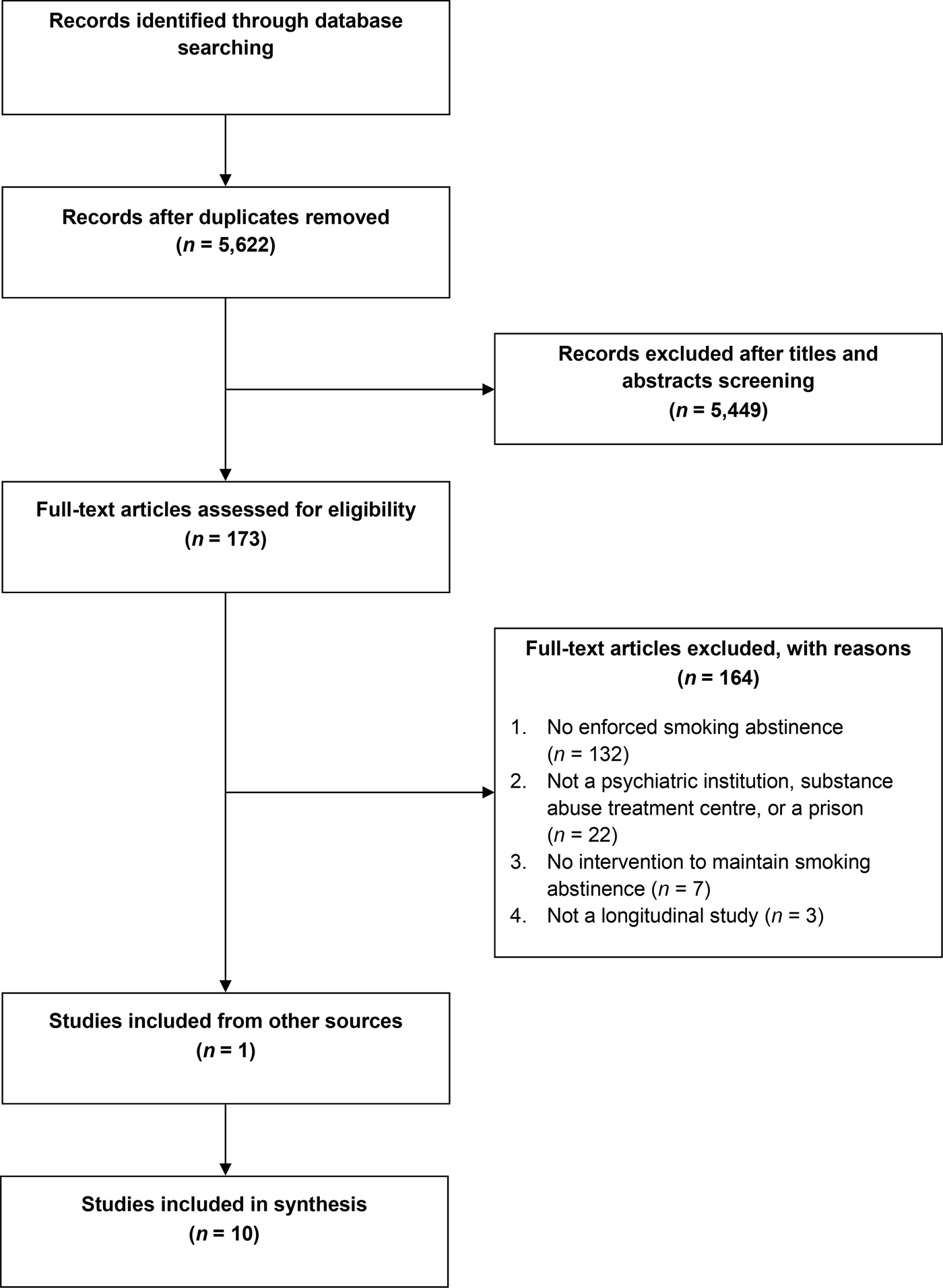
The search identified 8417 records; 10 studies with a total N = 1302 were included in the review (Fig. 1). Eight studies had been selected by both initial reviewers; κ was 0.71.
Study selection.

Five studies (Gariti et al. Reference Gariti, Alterman, Mulvaney, Mechanic, Dhopesh, Yu, Chychula and Sacks2002; Clarke et al. Reference Clarke, Stein, Martin, Martin, Parker, Lopes, McGovern, Simon, Roberts, Friedman and Bock2013; Prochaska et al. Reference Prochaska, Hall, Delucchi and Hall2014; Stockings et al. Reference Stockings, Bowman, Baker, Terry, Clancy, Wye, Knight, Moore, Adams, Colyvas and Wiggers2014b ; Hickman et al. Reference Hickman, Delucchi and Prochaska2015) were trials (intervention n = 416, control n = 415), five (Jonas & Eagle, Reference Jonas and Eagle1991; Joseph, Reference Joseph1993; Prochaska et al. Reference Prochaska, Fletcher, Hall and Hall2006; Strong et al. Reference Strong, Uebelacker, Schonbrun, Durst, Saritelli, Fokas, Abrantes, Brown, Miller and Apodaca2012; Stuyt, Reference Stuyt2015) were observational cohort studies (n = 471). One study was conducted in Australia (Stockings et al. Reference Stockings, Bowman, Baker, Terry, Clancy, Wye, Knight, Moore, Adams, Colyvas and Wiggers2014b ), all others in the US. One trial was conducted in a prison (Clarke et al. Reference Clarke, Stein, Martin, Martin, Parker, Lopes, McGovern, Simon, Roberts, Friedman and Bock2013), one trial and one cohort study in substance use treatment settings (Joseph, Reference Joseph1993; Gariti et al. Reference Gariti, Alterman, Mulvaney, Mechanic, Dhopesh, Yu, Chychula and Sacks2002), two trials and three cohort studies in mental health treatment settings (Jonas & Eagle, Reference Jonas and Eagle1991; Prochaska et al. Reference Prochaska, Fletcher, Hall and Hall2006; Strong et al. Reference Strong, Uebelacker, Schonbrun, Durst, Saritelli, Fokas, Abrantes, Brown, Miller and Apodaca2012; Prochaska et al. Reference Prochaska, Hall, Delucchi and Hall2014; Hickman et al. Reference Hickman, Delucchi and Prochaska2015) and one trial and one cohort study in mixed substance use and mental health settings (Stockings et al. Reference Stockings, Bowman, Baker, Terry, Clancy, Wye, Knight, Moore, Adams, Colyvas and Wiggers2014b ; Stuyt, Reference Stuyt2015).
All institutions were described as having complete smoke-free policies and the average length of stay in the smoke-free environment differed considerably; it was 1.5 years in the prison setting (Clarke et al. Reference Clarke, Stein, Martin, Martin, Parker, Lopes, McGovern, Simon, Roberts, Friedman and Bock2013), while all other studies measured the stay in days and the next longest was 90 days (Stuyt, Reference Stuyt2015). Follow-up periods ranged from 3 months (Clarke et al. Reference Clarke, Stein, Martin, Martin, Parker, Lopes, McGovern, Simon, Roberts, Friedman and Bock2013) to 18 months (Prochaska et al. Reference Prochaska, Hall, Delucchi and Hall2014) (online Supplementary Table S1). All randomised trials (Gariti et al. Reference Gariti, Alterman, Mulvaney, Mechanic, Dhopesh, Yu, Chychula and Sacks2002; Clarke et al. Reference Clarke, Stein, Martin, Martin, Parker, Lopes, McGovern, Simon, Roberts, Friedman and Bock2013; Prochaska et al. Reference Prochaska, Hall, Delucchi and Hall2014; Stockings et al. Reference Stockings, Bowman, Baker, Terry, Clancy, Wye, Knight, Moore, Adams, Colyvas and Wiggers2014b ; Hickman et al. Reference Hickman, Delucchi and Prochaska2015) and two of the observational cohort studies (Prochaska et al. Reference Prochaska, Fletcher, Hall and Hall2006; Strong et al. Reference Strong, Uebelacker, Schonbrun, Durst, Saritelli, Fokas, Abrantes, Brown, Miller and Apodaca2012) used biochemically verified measures of 7-day point-prevalence smoking abstinence; the other three used self-reported abstinence (Jonas & Eagle, Reference Jonas and Eagle1991; Joseph, Reference Joseph1993; Stuyt, Reference Stuyt2015); only one trial reported continuous as well as point-prevalence abstinence (Stockings et al. Reference Stockings, Bowman, Baker, Terry, Clancy, Wye, Knight, Moore, Adams, Colyvas and Wiggers2014b ).
Reporting of effects of smoking cessation treatment or continued abstinence from smoking on mental health or substance use varied considerably across studies (online Supplementary Table S2). One trial found rehospitalisation to be less common in the intervention group (Prochaska et al. Reference Prochaska, Hall, Delucchi and Hall2014) and one cohort study found non-smokers to be less likely to relapse to other substances (Stuyt, Reference Stuyt2015).
Intervention characteristics
Interventions used a number of theoretical approaches, and varied in intensity, content and mode of delivery (online Supplementary Table S1). In all but one trial (Gariti et al. Reference Gariti, Alterman, Mulvaney, Mechanic, Dhopesh, Yu, Chychula and Sacks2002), inpatient interventions were delivered by researchers, not clinic staff, whereas cohort studies generally reported on interventions delivered by clinic staff (with the exception of Strong et al. Reference Strong, Uebelacker, Schonbrun, Durst, Saritelli, Fokas, Abrantes, Brown, Miller and Apodaca2012).
Post-discharge interventions were included in the five trials (Gariti et al. Reference Gariti, Alterman, Mulvaney, Mechanic, Dhopesh, Yu, Chychula and Sacks2002; Clarke et al. Reference Clarke, Stein, Martin, Martin, Parker, Lopes, McGovern, Simon, Roberts, Friedman and Bock2013; Prochaska et al. Reference Prochaska, Hall, Delucchi and Hall2014; Stockings et al. Reference Stockings, Bowman, Baker, Terry, Clancy, Wye, Knight, Moore, Adams, Colyvas and Wiggers2014b ; Hickman et al. Reference Hickman, Delucchi and Prochaska2015) and in one observational cohort study (Strong et al. Reference Strong, Uebelacker, Schonbrun, Durst, Saritelli, Fokas, Abrantes, Brown, Miller and Apodaca2012). Telephone calls were used in three studies (Strong et al. Reference Strong, Uebelacker, Schonbrun, Durst, Saritelli, Fokas, Abrantes, Brown, Miller and Apodaca2012; Clarke et al. Reference Clarke, Stein, Martin, Martin, Parker, Lopes, McGovern, Simon, Roberts, Friedman and Bock2013; Stockings et al. Reference Stockings, Bowman, Baker, Terry, Clancy, Wye, Knight, Moore, Adams, Colyvas and Wiggers2014b ), ranging from one to eight calls between 1 day and 4 months post-discharge; two studies used a computer-generated intervention 3 and 6 months post-discharge (Prochaska et al. Reference Prochaska, Hall, Delucchi and Hall2014; Hickman et al. Reference Hickman, Delucchi and Prochaska2015) and two provided an optional face-to-face appointment (Gariti et al. Reference Gariti, Alterman, Mulvaney, Mechanic, Dhopesh, Yu, Chychula and Sacks2002; Stockings et al. Reference Stockings, Bowman, Baker, Terry, Clancy, Wye, Knight, Moore, Adams, Colyvas and Wiggers2014b ) [one (Stockings et al. Reference Stockings, Bowman, Baker, Terry, Clancy, Wye, Knight, Moore, Adams, Colyvas and Wiggers2014b ) in addition to telephone support].
The trials used different control interventions that included treatment as usual (Gariti et al. Reference Gariti, Alterman, Mulvaney, Mechanic, Dhopesh, Yu, Chychula and Sacks2002; Prochaska et al. Reference Prochaska, Hall, Delucchi and Hall2014; Stockings et al. Reference Stockings, Bowman, Baker, Terry, Clancy, Wye, Knight, Moore, Adams, Colyvas and Wiggers2014b ), enhanced treatment as usual (Hickman et al. Reference Hickman, Delucchi and Prochaska2015) and a health-related intervention matched for frequency and duration but not addressing smoking cessation (Clarke et al. Reference Clarke, Stein, Martin, Martin, Parker, Lopes, McGovern, Simon, Roberts, Friedman and Bock2013).
Risk of bias
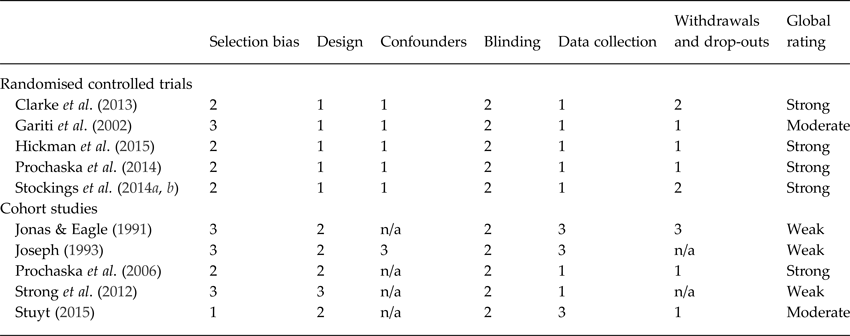
Four of the trials achieved a global rating of strong (Clarke et al. Reference Clarke, Martin, Stein, Lopes, Mello, Friedmann and Bock2011; Prochaska et al. Reference Prochaska, Hall, Delucchi and Hall2014; Stockings et al. Reference Stockings, Bowman, Baker, Terry, Clancy, Wye, Knight, Moore, Adams, Colyvas and Wiggers2014b ; Hickman et al. Reference Hickman, Delucchi and Prochaska2015); one was rated moderate due to a risk of selection bias (Gariti et al. Reference Gariti, Alterman, Mulvaney, Mechanic, Dhopesh, Yu, Chychula and Sacks2002). One observational cohort study was rated strong (Prochaska et al. Reference Prochaska, Fletcher, Hall and Hall2006) the others were moderate or weak (Table 1).
Risk of bias (study quality) assessment (Armijo-Olivo et al. Reference Armijo-Olivo, Stiles, Hagen, Biondo and Cummings 2012 )

n/a, Assessment item not applicable for a particular study design.
Note: 1 = strong, 2 = moderate, 3 = weak.
Effects of interventions
Biochemically verified smoking abstinence
Continuous abstinence was reported in only one study (Stockings et al. Reference Stockings, Bowman, Baker, Terry, Clancy, Wye, Knight, Moore, Adams, Colyvas and Wiggers2014b ) at 6 months, two participants (1.9%) in the intervention group remained abstinent compared with none in the control group. Due to this lack of data, the primary outcome was not assessed in a meta-analysis.
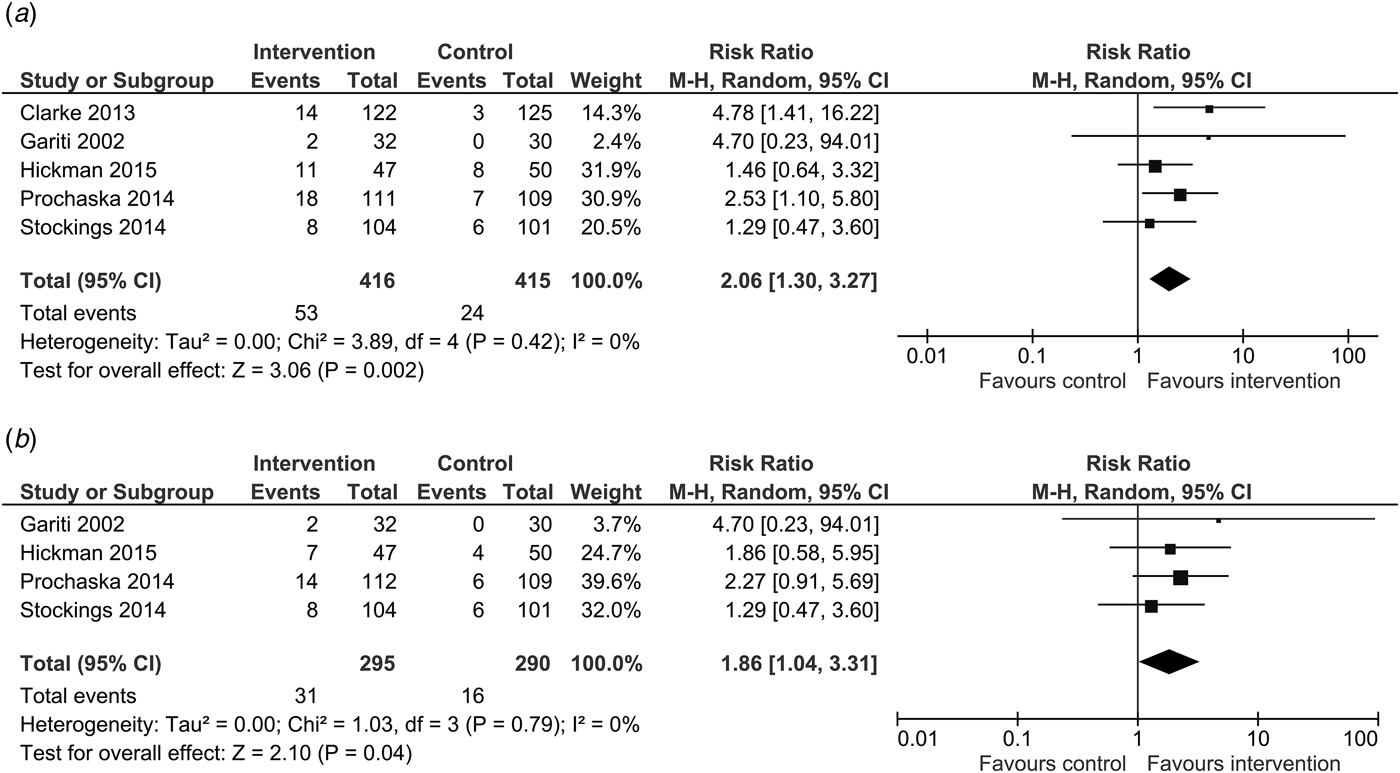
The meta-analysis of 7-day point-prevalence abstinence at longest follow-up (3 to 18 months) included all five trials and found an overall effect in favour of intervention [risk ratio (RR) = 2.06, 95% confidence interval (CI) 1.30–3.27, Fig. 2a ]. Overall, 12.7% of participants in the intervention groups achieved abstinence compared with 5.8% in the control groups.
(a) Comparison of biochemically verified point-prevalence abstinence at longest follow-up in randomised trials. Note: Length of follow-up: Clarke 3 months, Gariti 6 months, Hickman 12 months, Prochaska 18 months, Stockings 6 months. (b) Comparison of biochemically verified point-prevalence abstinence at 6 month follow-up in randomised trials. M-H, Mantel-Haenszel.

The meta-analysis of 7-day point-prevalence abstinence at 6 months follow-up excluded the single trial conducted in a prison setting (longest follow-up was 3 months). The meta-analysis also found an effect in favour of intervention (RR = 1.86, 95% CI 1.04–3.31, Fig. 2b ); 10.5% and 5.5% respectively achieved abstinence. No heterogeneity was indicated for either meta-analysis. No further subgroup analysis by setting was conducted because only one trial was set exclusively in substance use (Gariti et al. Reference Gariti, Alterman, Mulvaney, Mechanic, Dhopesh, Yu, Chychula and Sacks2002) and one trial was set in both mental health and substance use settings (Stockings et al. Reference Stockings, Bowman, Baker, Terry, Clancy, Wye, Knight, Moore, Adams, Colyvas and Wiggers2014b ).
Two observational cohort studies (Prochaska et al. Reference Prochaska, Fletcher, Hall and Hall2006; Strong et al. Reference Strong, Uebelacker, Schonbrun, Durst, Saritelli, Fokas, Abrantes, Brown, Miller and Apodaca2012) aimed to use biochemically verified 7-day point-prevalence abstinence. However, in one all patients reported smoking at the 3-month follow-up (Prochaska et al. Reference Prochaska, Fletcher, Hall and Hall2006), the other was a pilot study for intervention development and did not report results on verified abstinence (Strong et al. Reference Strong, Uebelacker, Schonbrun, Durst, Saritelli, Fokas, Abrantes, Brown, Miller and Apodaca2012).
Self-reported smoking abstinence
Four cohort studies reported self-reported abstinence without biochemical verification (Jonas & Eagle, Reference Jonas and Eagle1991; Joseph, Reference Joseph1993; Strong et al. Reference Strong, Uebelacker, Schonbrun, Durst, Saritelli, Fokas, Abrantes, Brown, Miller and Apodaca2012; Stuyt, Reference Stuyt2015). In one, four out of 39 psychiatric patients (10.3%) reported abstinence at 8 weeks post-discharge (Jonas & Eagle, Reference Jonas and Eagle1991). In another study, 8.0% of patients admitted after the introduction of the smoke-free policy reported having quit smoking compared with 3.2% of patients admitted before introduction of the policy; however, length of follow-up differed, mean follow-up was 16 months for pre-policy and 11 months for post-policy patients (Joseph, Reference Joseph1993). In a pilot with 15 participants, six participants reported a quit attempt with a median number of 62 abstinent days (range 2–110 days) (Strong et al. Reference Strong, Uebelacker, Schonbrun, Durst, Saritelli, Fokas, Abrantes, Brown, Miller and Apodaca2012). A year after completing a 90-day substance misuse programme, an increase from 14% to 27% non-smokers among 140 patients was reported (Stuyt, Reference Stuyt2015).
Other smoking outcomes – time to first cigarette
Time to first cigarette post-discharge was assessed in two trials and two cohort studies (Jonas & Eagle, Reference Jonas and Eagle1991; Gariti et al. Reference Gariti, Alterman, Mulvaney, Mechanic, Dhopesh, Yu, Chychula and Sacks2002; Prochaska et al. Reference Prochaska, Fletcher, Hall and Hall2006; Clarke et al. Reference Clarke, Stein, Martin, Martin, Parker, Lopes, McGovern, Simon, Roberts, Friedman and Bock2013). One trial and one cohort study reported that 76% of participants returned to smoking on the day of discharge (Prochaska et al. Reference Prochaska, Fletcher, Hall and Hall2006; Gariti et al. Reference Gariti, Alterman, Mulvaney, Mechanic, Dhopesh, Yu, Chychula and Sacks2002) and in another cohort study 72% of participants resumed smoking ‘immediately after discharge’ (Jonas & Eagle, Reference Jonas and Eagle1991). In the trial, 93% returned to smoking within a month with no group differences in the mean number of non-smoking days after discharge (Gariti et al. Reference Gariti, Alterman, Mulvaney, Mechanic, Dhopesh, Yu, Chychula and Sacks2002). In one cohort study, median time to first cigarette was 5 minutes and all participants returned to smoking within 36 days (Prochaska et al. Reference Prochaska, Fletcher, Hall and Hall2006), and in another, all participants who resumed smoking did so within 8 weeks post-discharge (Jonas & Eagle, Reference Jonas and Eagle1991). The other trial displayed information graphically indicating that over 70% in the control group and about 50% in the intervention group returned to smoking within 1 day; this study reported an effect of treatment in a survival model of days to first smoking lapse (hazard ratio = 1.75, p = 0.001) (Clarke et al. Reference Clarke, Stein, Martin, Martin, Parker, Lopes, McGovern, Simon, Roberts, Friedman and Bock2013).
Other smoking outcomes – change in cigarette consumption
Change in cigarette consumption post-discharge compared with the period prior to the stay in a smoke-free environment was assessed in two trials and three cohort studies (Jonas & Eagle, Reference Jonas and Eagle1991; Joseph, Reference Joseph1993; Gariti et al. Reference Gariti, Alterman, Mulvaney, Mechanic, Dhopesh, Yu, Chychula and Sacks2002; Strong et al. Reference Strong, Uebelacker, Schonbrun, Durst, Saritelli, Fokas, Abrantes, Brown, Miller and Apodaca2012; Stockings et al. Reference Stockings, Bowman, Baker, Terry, Clancy, Wye, Knight, Moore, Adams, Colyvas and Wiggers2014b ). One trial found a significant reduction for both groups for the 6 months following hospitalisation (24.6 reduced to 10.1 cigarettes per day for the intervention group and 23.8 to 9.4 cigarettes per day for the control group, F(1) = 21.07, p < 0.001), with no group differences; self-reported reduction was supported by biochemical test results (Gariti et al. Reference Gariti, Alterman, Mulvaney, Mechanic, Dhopesh, Yu, Chychula and Sacks2002). The other trial found a significant effect of the intervention for 50% reduction in cigarettes per day, with 36.5% of intervention participants having reduced their cigarette consumption by six months v. 8.9% in the control group (p < 0.0001) (Stockings et al. Reference Stockings, Bowman, Baker, Terry, Clancy, Wye, Knight, Moore, Adams, Colyvas and Wiggers2014b ). One cohort study reported a self-reported average decrease of seven cigarettes per day (95% CI −13.80 to 0.51) with a group mean of 13 cigarettes at 6-month follow-up (s.d. = 8.35, IQR: 8.2 to 16.1) (Strong et al. Reference Strong, Uebelacker, Schonbrun, Durst, Saritelli, Fokas, Abrantes, Brown, Miller and Apodaca2012). Another cohort study did not find any difference between self-reported number of cigarettes smoked per day at admission and six to 18 months post-discharge [21.6 (s.d. = 13.6) v. 21.3 (s.d. = 15.4) (Jonas & Eagle, Reference Jonas and Eagle1991)]. The third cohort study stated that around 20% of patients reported smoking less (without quantification) and no difference between patients treated before and after the introduction of a smoke-free policy (Joseph, Reference Joseph1993).
Behaviour change techniques
The number of BCTs that could be coded varied considerably between studies and was higher when manuals were available. It ranged from a single technique in published reports of two cohort studies (Jonas & Eagle, Reference Jonas and Eagle1991; Prochaska et al. Reference Prochaska, Fletcher, Hall and Hall2006) to 34 BCTs (Clarke et al. Reference Clarke, Stein, Martin, Martin, Parker, Lopes, McGovern, Simon, Roberts, Friedman and Bock2013) and 36 BCTs (Prochaska et al. Reference Prochaska, Hall, Delucchi and Hall2014; Hickman et al. Reference Hickman, Delucchi and Prochaska2015) in trial manuals (online Supplementary Table S1).
All studies delivered at least one BCT from the ‘Regulation’ cluster. This cluster includes pharmacological support, reducing negative emotions, conserving mental resources and paradoxical instructions (the latter was not delivered in any study). No study included BCTs coded to be part of the ‘Scheduled consequences’ cluster, which includes ten BCTs focused on specific reward or punishment schedules (other incentives or rewards are included in a different cluster). Two trials covered all remaining 15 clusters (Prochaska et al. Reference Prochaska, Hall, Delucchi and Hall2014; Hickman et al. Reference Hickman, Delucchi and Prochaska2015); the trial (Clarke et al. Reference Clarke, Stein, Martin, Martin, Parker, Lopes, McGovern, Simon, Roberts, Friedman and Bock2013) with the next highest number of BCTs covered 14 clusters, additionally omitting ‘Comparison of behaviour’.
The most commonly used technique was pharmacological support (n = 9). Pharmacological support in the form of nicotine replacement therapy (NRT) was used in four of the five trials (Gariti et al. Reference Gariti, Alterman, Mulvaney, Mechanic, Dhopesh, Yu, Chychula and Sacks2002; Prochaska et al. Reference Prochaska, Hall, Delucchi and Hall2014; Stockings et al. Reference Stockings, Bowman, Baker, Terry, Clancy, Wye, Knight, Moore, Adams, Colyvas and Wiggers2014b ; Hickman et al. Reference Hickman, Delucchi and Prochaska2015), mostly in the form of patches, and this was available both during and after the stay in the smoke-free institution. In four of the five observational cohort studies (Jonas & Eagle, Reference Jonas and Eagle1991; Prochaska et al. Reference Prochaska, Fletcher, Hall and Hall2006; Strong et al. Reference Strong, Uebelacker, Schonbrun, Durst, Saritelli, Fokas, Abrantes, Brown, Miller and Apodaca2012; Stuyt, Reference Stuyt2015), NRT was available only during inpatient treatment. One study mentioned availability of clonidine patches as part of treatment as usual (Joseph, Reference Joseph1993). The next most commonly used BCTs (all n = 6, online Supplementary Table S2) were problem solving (‘Goals and planning’ cluster), unspecified social support (‘Social support’ cluster) and pros and cons (‘Comparison of outcomes’ cluster).
Generally, studies delivered fewer BCTs post-discharge than during the stay, with the exception of one trial (Stockings et al. Reference Stockings, Bowman, Baker, Terry, Clancy, Wye, Knight, Moore, Adams, Colyvas and Wiggers2014b ), which delivered a more comprehensive intervention after patients had left the hospital.
In addition to the BCTs described in the interventions, a smoke-free environment in itself delivers a number of BCTs for smoking cessation such as restructuring the physical environment (BCT 12.1), restructuring the social environment (12.2), avoidance/reducing exposure to cues for the behaviour (12.3) and removing access to the reward (7.4) (Michie et al. Reference Michie, Wood, Johnston, Abraham, Francis and Hardeman2015).
Due to the small number of studies, variable study designs and inconsistent outcome measures, associations between specific BCTs and outcomes could not be assessed statistically. The two trials reporting an overall positive effect (Clarke et al. Reference Clarke, Stein, Martin, Martin, Parker, Lopes, McGovern, Simon, Roberts, Friedman and Bock2013; Prochaska et al. Reference Prochaska, Hall, Delucchi and Hall2014) differed in setting, length of stay, mode and intensity of intervention and length of follow-up, but both used over 30 BCTs during the stay. Interestingly, one did not include pharmacotherapy (Clarke et al. Reference Clarke, Stein, Martin, Martin, Parker, Lopes, McGovern, Simon, Roberts, Friedman and Bock2013), while the second did during the stay and post-discharge (Prochaska et al. Reference Prochaska, Hall, Delucchi and Hall2014). However, another trial using the same techniques as Prochaska et al. Reference Prochaska, Hall, Delucchi and Hall2014 in a smaller sample from a similar population detected no effect (Hickman et al. Reference Hickman, Delucchi and Prochaska2015).
Discussion
A systematic search found only ten small studies researching maintenance of abstinence from smoking after a period of enforced abstinence in populations with high mental health comorbidity. Outside of trial intervention groups, no or minimal support for maintaining abstinence was delivered. Relapse to smoking occurred very quickly following discharge, and the four studies that reported it found that at least 70% of participants relapsed to smoking on the day of discharge. There was some evidence that providing behavioural or pharmacological interventions was effective for improving abstinence.
Evidence on how best to maintain or increase abstinence in this setting remains limited with few trials or high-quality observational studies. The trials mostly had a low risk of bias, while the cohort studies by design were more likely to be affected by bias. In terms of outcome measures, although most used biochemical validation, few attempted to measure continuous abstinence, the strongest outcome (West et al. Reference West, Hajek, Stead and Stapleton2005). However, in this population and setting, a floor effect for continuous abstinence at follow-up would be likely. A single study evaluated an intervention in a prison setting. There was little variety in location; all but one study had been conducted in the USA. The interventions under study varied, but many evidence-based interventions have not been evaluated. For example, there is good evidence that contingency management is effective for increasing abstinence from smoking, although there is limited evidence in smokers with mental health problems (Hunt et al. Reference Hunt, Siegfried, Morley, Sitharthan and Cleary2013; Cahill et al. Reference Cahill, Hartmann-Boyce and Perera2015). Pharmacotherapies were also limited and no study tested varenicline (Cahill et al. Reference Cahill, Lindson-Hawley, Thomas, Fanshawe and Lancaster2016) cytisine (Cahill et al. Reference Cahill, Lindson-Hawley, Thomas, Fanshawe and Lancaster2016) or bupropion (Tsoi et al. Reference Tsoi, Porwal and Webster2013; van der Meer et al. Reference van der Meer, Willemsen, Smit and Cuijpers2013; Hughes et al. Reference Hughes, Stead, Hartmann-Boyce, Cahill and Lancaster2014), which have all shown effectiveness.
Limitations of the review include that policies such as smoke-free institutions may be implemented without an evaluation of the effects in the peer-reviewed literature. However, we searched Web of Science, one source of grey literature. Another limitation is due to the complexity and reliability of coding BCTs (Abraham et al. Reference Abraham, Wood, Johnston, Francis, Hardeman, Richardson and Michie2015), more experienced coders may have coded some aspects differently. However, the included analysis of BCTs for the first time provides evidence on components assessed in studies to date.
In contrast to the one previous review of the impact of smoke-free psychiatric hospitalisation on smoking (Stockings et al. Reference Stockings, Bowman, Prochaska, Baker, Clancy, Knight, Wye, Terry and Wiggers2014a ), the present review includes only longitudinal studies and includes non-psychiatric institutions with high prevalence of mental health problems. Additionally, in our review, smokers were exposed to complete smoke-free policies and received some intervention to support abstinence. The previous review findings suggested these are crucial for a stay in a smoke-free institution to have an effect on smoking (Stockings et al. Reference Stockings, Bowman, Prochaska, Baker, Clancy, Knight, Wye, Terry and Wiggers2014a ).
As in previous reports (Lorencatto et al. Reference Lorencatto, West, Stavri and Michie2013), we found some large differences between descriptions of behavioural interventions in some published reports and manuals. Most strikingly, coding from the manual instead of the publication increased the number of BCTs from four (Prochaska et al. Reference Prochaska, Hall, Delucchi and Hall2014; Hickman et al. Reference Hickman, Delucchi and Prochaska2015) to over 30 each in two cases. Due to the small number of studies and their variable study designs and outcome measures, it remains difficult to draw any clear conclusions about associations between specific techniques and effects of the intervention.
The present evidence suggests that a larger number of BCTs from a wide range of clusters is more likely to result in an effective intervention. It is worth noting that even where the same BCTs are included, delivery will differ (Lorencatto et al. Reference Lorencatto, West, Bruguera and Michie2014; Lorencatto et al. Reference Lorencatto, West, Bruguera, Brose and Michie2016; Tate et al. Reference Tate, Lytle, Sherwood, Haire-Joshu, Matheson, Moore, Loria, Pratt, Ward, Belle and Michie2016), e.g. in frequency, quality and fidelity which can impact effects, akin to medication effectiveness depending on the amount and duration of, and adherence to, treatment.
The present review focused on mental health; it is likely that interventions in other setting such as general hospitals would be transferrable to some extent. However, an existing Cochrane review covered these institutions (Rigotti et al. Reference Rigotti, Clair, Munafo and Stead2012), while excluding institutions that primarily treat mental health problems or substance abuse. That review found evidence that interventions of the highest intensity, consisting of counselling that began in the hospital and continued for more than 1 month post-discharge, increased smoking cessation post-discharge; no benefit could be detected from the large number of studies with less intense interventions. The review also found that addition of NRT conferred a benefit, while there was not enough evidence for clear conclusions on varenicline or bupropion when added to counselling (Rigotti et al. Reference Rigotti, Clair, Munafo and Stead2012). For the present review, not enough studies were available to distinguish the impact of interventions delivered during the stay and post-discharge.
Reviews evaluating the evidence for preventing relapse for smokers in the general population who have successfully quit for a short time found some evidence for the use of NRT, bupropion or varenicline (Agboola et al. Reference Agboola, McNeill, Coleman and Leonardi Bee2010) but insufficient evidence to recommend the use of any specific behavioural intervention (Agboola et al. Reference Agboola, McNeill, Coleman and Leonardi Bee2010; Hajek et al. Reference Hajek, Stead, West, Jarvis, Hartmann-Boyce and Lancaster2013), indicating the general scarcity of evidence on maintaining abstinence in any population of smokers.
Future research should evaluate interventions in more diverse countries, policy settings and institutions that enforce abstinence as e.g. evidence for prisons is particularly lacking. Research on the effectiveness of interventions such as contingency management and pharmacotherapies other than NRT would be beneficial. Improved reporting is recommended; more comprehensive descriptions of interventions, potentially using frameworks such as the BCT taxonomy (Michie et al. Reference Michie, Wood, Johnston, Abraham, Francis and Hardeman2015) would facilitate replication of studies and analysis of effectiveness of different intervention components. In addition, it would be beneficial to report clearly and comprehensively any effects of cessation treatment or cessation on mental health and substance use.
Conclusion
In populations with high rates of smoking and mental health comorbidity there is rapid and almost complete relapse to smoking after a period of enforced abstinence. Institutions implementing smoke-free policies need to also implement interventions to support sustained abstinence to help reduce inequalities in morbidity and mortality due to smoking. Interventions consisting of nicotine replacement and/or behavioural support can increase abstinence beyond discharge. However, the existing evidence base is small, tested only a narrow range of interventions and is limited by imprecise reporting of behavioural interventions. Pharmacological interventions other than NRT and additional behavioural interventions should be assessed and reported.
Supplementary material
The supplementary material for this article can be found at https://doi.org/10.1017/S0033291717002021
Acknowledgements
We thank Dr Clarke, Dr Hickman, Dr Stockings, Dr Strong and Dr Stuyt who shared additional information about their studies and the interventions with us. LB and AMcN are members of the UK Centre for Tobacco and Alcohol Studies, a UK Clinical Research Collaboration Public Health Research: Centre of Excellence. Funding from the Medical Research Council, British Heart Foundation, Cancer Research UK, Economic and Social Research Council and the National Institute for Health Research under the auspices of the UK Clinical Research Collaboration is gratefully acknowledged (MR/K023195/1). This work was supported by a Cancer Research UK (CRUK)/BUPA Foundation Cancer Prevention Fellowship (C52999/A19748).
Declaration of Interest
None.