In the second quarter of 2017 the unemployment rate in Spain was 17.22%; 15.64% for men and 19.64% for women. Although unemployment rates have started a downward trend, they are still above the pre-crisis unemployment levels of 2008. According to the latest barometer of the Centro de Investigaciones Sociológicas (CIS, 2018), 40% of the population consider unemployment to be the main problem that currently exists in Spain, with 60% placing it among the three most important problems. What are the psychological consequences of being unemployed, and to what extent does this affect self-esteem and depression symptoms of men and women differently? These are very important and relevant issues in terms of the psychological well-being of the population at risk of becoming unemployed or who are already unemployed.
Studies on the psychosocial effects of unemployment began in the 1930s (Jahoda, Lazarsfeld, & Zeisel, 1971/1933). These qualitative studies show a link between unemployment and low self-esteem, and unemployment and depression, as well as other indicators of mental health (Eisenberg & Lazarsfeld, Reference Eisenberg and Lazarsfeld1938). This link between unemployment and psychological well-being has been highlighted in recent studies showing that unemployment leads to lower self-esteem (Álvaro, Reference Álvaro1992; Feather & O’ Brien, 1986; Gurney, Reference Gurney1980; Hartley, Reference Hartley1980; Patton & Noller, Reference Patton and Noller1990; Waters & Moore, Reference Waters and Moore2002a) and an increase in symptoms of depression (Álvaro, Reference Álvaro1992; Frese & Mohr, Reference Frese and Mohr1987; Stankunas, Kalediene, Starkuviene, & Kapustinskiene, Reference Stankunas, Kalediene, Starkuviene and Kapustinskiene2006). One of the most used theories to explain the negative psychological consequences of unemployment has been Jahoda’s (Reference Jahoda1982) deprivation model, which distinguishes between the manifest function of employment (providing economic resources) and their latent functions (a temporal structure, promoting the development of an activity, facilitating the establishment of social relations, linking the person with collective goals and purposes, providing status and identity). According to Jahoda, the distress of the unemployed is not only due to the loss of income but above all to the difficulties of structuring time, inactivity, diminishing relationships with others, loss of status, a sense of worthlessness and the loss of identity, making unemployment a risk factor for mental health negatively affecting both self-esteem and depression. The psychological experiences caused by unemployment differ among the unemployed. Gender can be one of the variables that explain this variability. From the first investigations, the conclusion drawn was that unemployment had more negative effects for men than for women (Schmitt, Reference Schmitt2008). In contexts with a traditional role-sharing, work is more important for the identity of men, who also have more social pressure to work. Accordingly, when the social identity is threatened, individual self-esteem is also negatively affected (Tajfel & Turner, Reference Tajfel, Turner, Austin and Worchel1979). On the other hand, women continued to find in domestic work a way of structuring everyday time, which also contributed to cushion the psychological cost of unemployment (Jahoda, Reference Jahoda1982). The differences between men and women in their psychological response to unemployment are not so clear in current research. Findings on the possible different effects of unemployment on men and women have been inconclusive so far, with contradictory results. While some research asserts that there is no difference in the way unemployment affects mental health (Ensminger & Celentano, Reference Ensminger and Celentano1990; Jones, Reference Jones1989; Kroll & Lampert, Reference Kroll and Lampert2011; Leana & Feldman, Reference Leana and Feldman1991; Leana & Feldman, Reference Leana and Feldman1995; Leeflang, Klein-Hesselink, & Spruit, Reference Leeflang, Klein-Hesselink and Spruit1992), others highlight that this impact is greater on men (Artazcoz, Benach, Borrel, & Cortès, Reference Artazcoz, Benach, Borrell and Cortès2004; Wilson & Walker, Reference Wilson and Walker1993). Proof of the contradictory findings on this topic is offered by two meta-analysis studies. The first, by Paul and Moser (Reference Paul and Moser2009), is a meta-analysis of the existing research on the psychological effects of unemployment between 1963 and 2004, and concludes that unemployment has a more significant impact on men in terms of self-esteem and depression, among others. On the contrary, McKee-Ryan, Song, Wanberg, and Kinicki (Reference McKee-Ryan, Song, Wanberg and Kinicki2005) meta-analysis finds deeper symptoms of psychological and physical distress in unemployed women than men.
Two theories have been put forward to explain this contradiction. The first aims to explain the similarities between the psychological consequences of unemployment in men and women, and echoes the rising equality between genders; women as well as men are increasingly part of activities and duties that depend less on gender than on prior education and personal skills, which would attenuate the impact of unemployment on individuals’ symptoms of psychological distress. At the same time, the growing role women play in the working world is taking on a central part in the construction of their identity, and men alike (Lee & Owens, Reference Lee and Owens2002; Waters & Moore, Reference Waters and Moore2002b). In this way, and given that a threatened social identity can negatively affect individual self-esteem, unemployment would have negative psychological consequences for both men and women, because of their similarities in the internalization of work as a value.
The alternative explanation as to why unemployment would have less consequences for women is based on the idea that employment does not have an impact on their identity in the same way it does on men (McKee-Ryan et al., Reference McKee-Ryan, Song, Wanberg and Kinicki2005). Several studies support this theory. For Jones (Reference Jones1989), the negative impact on women would only occur when they are satisfied with, and identify themselves with their previous job, or when its loss led to economic problems, whereas in men, higher levels of depression associated with unemployment would occur without the other factors. While studying several European countries, Schmitt (Reference Schmitt2008) found that unemployment has a distinctive impact on men and women when forming a family. For men, unemployment would mean having children later because of the impossibility of providing for the family, whereas on women it would have a positive impact when having the first child. This circumstance leads to the belief that despite the greater participation of women in the work sphere, certain traditional roles associated with maternity could be enhanced with unemployment, in adopting the role of mothers, compensating in some ways for the effects of unemployment on self-esteem because it would be less threatening for women social identity. Other studies, for instance Artazcoz et al. (Reference Artazcoz, Benach, Borrell and Cortès2004), indicate that the lower impact on women’s mental health is due to the distinct family responsibilities of men and women.
Unemployment supposes a greater psychological cost for men in contexts with a traditional role distribution, where the traditional male breadwinner model predominates, and in those in which the participation of women in the labor market is low or considered secondary. On the contrary, in contexts in which the double-breadwinner model predominates, men and women experience unemployment similarly. The differences between both are associated, therefore, with differences in the economic and psychosocial need to work, which have their origin in the different assigned social roles (Strandh, Hammarström, Nilsson, Nordenmark, & Russel, Reference Strandh, Hammarström, Nilsson, Nordenmark and Russel2013).
In Spain, important advances have been made in the last decades in the reduction of gender inequalities in the labor market. In the 1970s, only one third of women between the ages of 25 and 54 remained in the labor market and the female occupation rate (29%) was much lower than that of men (96%). In 2017, around 80% of women aged between 25 and 54 were part of the active population, and more than 60% had a job (Instituto Nacional de Estadística, INE, 2017). Despite this, important features of the traditional differentiation of gender roles still persist in Spanish society. Although the double-breadwinner families have experienced a remarkable growth, currently exceeding 50%, this growth has been interrupted by the economic crisis of 2008 and they are still far from being a widespread family model, as it happens in the countries of the Northern Europe (Moreno, Reference Moreno and Torres2015). The formation of a family and, above all, the arrival of the children continues to affect the work situation of men and women differently. In the case of men, the employment rate in the age group of 25 to 49 years is more than 10 points higher when there are children (82.8%) than when there are none (72.1%), while in the case of women, the opposite occurs (63.5% versus 73.5%) (INE, 2017). Caring for the family continues to be one of the main causes of inactivity of women: 65% of inactive women indicate this as the main reason why they are not in the labor market (INE, 2017). Some recent studies show that the transition to paternity coincides with the consolidation of the professional role of men, while maternity is associated with an intensification of activities in the domestic sphere for women (Flaquer & Escobedo, Reference Flaquer and Escobedo2014). With this in mind, it is not unlikely that there are differences in gender identity construction and in the family roles that help clarify that unemployment will affect women and men differently. In the case of unemployment, a woman’s identity will be less compromised than the man’s, therefore we should observe that, among men, the differences in depression depend on their employment status, more than for women (H 1). Likewise, unemployment is linked to decreasing self-esteem in men, to the extent it is understood as a threat to their identity, but not in women (H 2). If these hypotheses had empirical confirmation, one could also expect that the consequences of unemployment on depression would be mediated by self-esteem, so that lower self-esteem would lead to higher depressive symptoms in the subsample of unemployed men, but not in the case of unemployed women (H 3). Indeed, if unemployment represents a bigger threat to self-esteem of men than of women, it should be associated with a decline in self-esteem, which, in turn, would be related with more symptoms of depression. Specifically, our hypotheses predict a moderated-mediating process insofar the relationship between unemployment and symptoms of depression should be mediated by individuals’ self-esteem, being this mediation moderated by gender.
Materials and methods
Participants
The non-probabilistic sample included 264 subjects, 128 of which were men (48%) and 136 were women (52%). The unemployed subsample was formed by those who were actively looking for a job, and randomly approached asking them to fill out a questionnaire on issues related to unemployment. The average duration of each questionnaire was 45 minutes. They were contacted in three of the nineteen existing employment offices in Madrid. These three offices were randomly selected. For the selection of the employed participants, we adopted a convenience sampling by using a snowball strategy. The condition of eligibility for this subsample was that all participants included in this category had to be employed at the time of the interview. They were contacted in the same three geographical areas where the employment offices were located. More specifically, a researcher asked them to participate in a survey in their place of residence. When the application of the questionnaire ended, the researcher asked the participant to indicate a person in their cycle of knowledge who could be contacted to participate in the study. In order to have an heterogeneous sample in terms of gender and age the snowball sampling strategy was performed by intentionally selecting six people (three men and three women) over 18 years of age who were asked to give access to contacts (linear sampling) who were working at the time.
Applying G*Power (Faul, Erdfelder, Lang, & Buchner, Reference Faul, Erdfelder, Lang and Buchner2007) to our research design, we found that our sample size provided 80% of the power to detect even a relatively medium effect size (η2p = .03). Despite this, the statistical power can be an issue in hypothesis testing involving interaction effects, which will be addressed in the results section below.
Participants were between 18 and 70 years old, with a mean age of 35.8 years (SD = 9.85). In terms of education levels, 22.7% had not completed secondary education, 38.2% had a high school diploma or professional training, and 38.2% were university graduates. In the total sample, 213 (81%) were employed and 51 (19%) were unemployed. The mean age of the employed participants (M = 36.37) was slightly higher than that of the unemployed group (M = 33.80) but this difference was not significant (t = 1.68, ns). No significant association was found between the gender of the participants and their employment status (chi-square χ2 = 1.35, ns), since in the unemployment condition the percentage of women (n = 30; 22%) was similar to men (n = 21; 16%); and also in the employment condition in which the percentage of women (n = 106, 78%) was also very similar to that of men (n = 107; 84%). Differences were observed in the educational level of both subsamples (χ2 = 6.01; p < .05); the percentage of people with primary education was higher in the sample of unemployed (27.5%) than in the sample of employed (13.6%). In the employed sample there was a higher percentage of people with secondary education (36.6% vs. 27.5%) and higher studies (49.8% vs. 45.1%) but the differences were not significant in these two groups.
Instruments
Data collection consisted of a questionnaire completed by the participants themselves. The intention was to obtain high levels of sample variability in the dependent variables of the study (depression and self-esteem) with the goal of selecting a heterogeneous sample where all social classes, age groups, and both genders could be represented, and was thus the reason why we opted for non-probabilistic sampling. Aside from the socio-demographic variables (age, gender, and education), two measures of self-esteem and depression were included.
For the operationalization of the depression variable, we used the Spanish version (Sanz & Vázquez, Reference Sanz and Vázquez2011) of Beck’s Depression Inventory (Beck, Reference Beck1967; Beck, Rush, Shaw, & Emery, Reference Beck, Rush, Shaw and Emery1983) composed of 21 items. The answer options ranged from 0 to 3. Examples of these items are: “I do not feel sad”; “I feel sad”; “I feel constantly sad and cannot stop feeling that way”; “I feel so sad or so miserable that I cannot stand it”. The higher the points awarded, the greater the symptoms of depression. This measure was validated by Sanz and Vázquez (Reference Sanz and Vázquez2011). In this current study, the alpha coefficient of internal consistency was found to be 0.89. We then averaged the scores of the participants across the items so that higher scores indicated more global symptoms of depression.
Following an adaptation of Rosenberg’s scale (1965), self-esteem was measured with 8 items (Warr & Jackson, Reference Warr and Jackson1983), four with positive assessments (and four with negative assessments). A positive item would be, for instance, “I consider myself useful to others around me”, and a negative item, “I do not have much to be proud of”. In each item, the participants chose to what extent they agreed or disagreed with the statements on how they felt (1= totally agree; 7= totally disagree). The Spanish version was validated by Alvaro (1992) in a study that confirmed the unidimensionality of this scale by means of a confirmatory factor analysis. In the current sample, the alpha coefficient of internal consistency of the scale was found to be .77. We averaged the scores of the participants across the items so that higher scores indicated a higher level of self-esteem.
Procedure
The questionnaires were self-administered, except for certain groups, depending on their socio-demographic characteristics, such as having low educational levels. For these cases a personal interview based on the same items from the questionnaire was the procedure that was followed. The average time needed for completion was 45 minutes. All participants were informed that their answers were completely anonymous and that absolute confidentiality was guaranteed in the treatment of the data. Overall response rate was 66%, with 62% for the unemployed subsample, and 70% for the employed subsample.
Although in Spain the approval by an ethics committee is not mandatory, we followed all APA guidelines for research with humans. The questionnaires were distributed individually and anonymously. Participants were instructed by the researchers to individually answer all the items.
Data Analysis
We analyzed the data using a 2 (employment situation: Employed vs. unemployed) X 2 (gender: Women vs. men) Analysis of Variance (ANOVA) between-subjects in order to test our first two predictions (H 1 and H 2). We also analyzed the results taking into account the effects of participants’ age, gender and education since these variables could be possible confounding covariates because of their association with self-esteem and depression (Alvaro, 1992). To test H 3, we conducted a set of ordinary least squares regressions according to the procedure proposed by Muller, Judd, and Yzerbyt (Reference Muller, Judd and Yzerbyt2005) to estimate the models that include moderated mediation. Before beginning such an analysis, codes were given to the different categorical variables that are part of the model (i.e., employment status: employed = –.5; unemployed = .5 and gender: women = –.5; men = .5), and self-esteem was centered around its average. Using these codified variables, we calculated the terms of interaction by multiplying the employment status by the gender (employment status*gender) and gender by self-esteem (gender*self-esteem). Additionally, we estimated the confidence intervals of the parameters using bootstrap procedures as suggested by Hayes (Reference Hayes2013). We analyzed the data in IBM SPSS (Version 21) and moderated-mediating confidence intervals were estimated with PROCESS SPSS add-on (Hayes, Reference Hayes2013). In each analysis, we used pairwise deletion for handling missing data since we have 0.70% of missing considering all measures. The data has non univariate or multivariate outliers. It should be noted that an inspection of residuals indicated that they are normally distributed.
Results
We began by analyzing the impact of unemployment and gender on depression. The results show that the main effect of gender is not significant F(1, 260) = .25, ns. On the other hand, the main effect of the employment situation is significant, since the unemployed experienced more symptoms of depression (M = .54, SD = .47) than the employed people (M = .35, SD = .37), F(1, 260) = 9.91, p < .01, η2p = .04. Nevertheless, the interaction between employment status and gender of the participants predicting depression was not significant, F(1, 260) = 1.40, ns; η2p = .01. Moreover, this pattern of results did not change when we included participant age and family income as covariates in the analysis. In fact, only education level predicted depression, in that more educated participants reported less depression (b = –.02, SE = .11, p < .05), but it did not interact with employment status or gender in predicting depression. These results indicated that the employment status and gender effects are not confounded with the three covariates analyzed.
Despite the interaction between employment status and gender not being significant, we analyzed whether unemployment affected men and women differently (Figure 1). We used the comparisons proposed by Judd, McClellan, and Culhane (Reference Judd, McClelland and Culhane1995), which encourage addressing questions that directly focus on the theoretical hypothesis proposed, by testing planned single-degree-of-freedom contrasts, rather than paying attention only to the relatively unfocused issues addressed by the omnibus, multiple-degree-of-freedom test from the traditional approach. Thus, we verified that the measure of depression, in women, is not statistically different according to their employment status, (M Unemployed = .52, SD = .48; M Employed = .40, SD = .40), F(1, 260) = 2.25, ns, whereas in the case of men, employment status does greatly affect their levels of depression, in such a way that those who are unemployed feel significantly higher symptoms of depression (M = .56, SD = .47) than those who have a job (M = .30, SD = .32), F(1, 260) = 8.21, p < .01, η2p = .03. Thus, the results obtained corroborate the first hypothesis formulated.
Averages in Depression according to Employment Status and Gender.

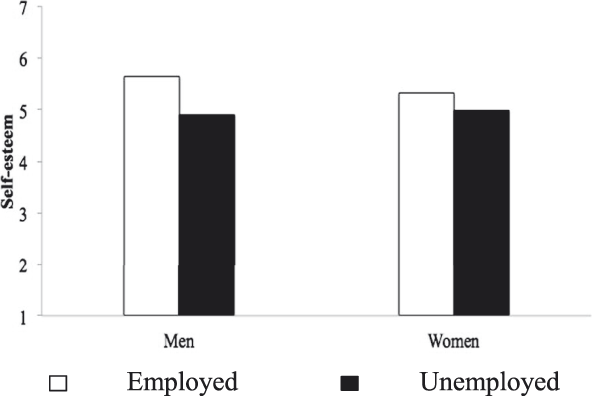
Furthermore, we analyzed the role unemployment and gender play in self-esteem through a factorial ANOVA study of the scores obtained in the measure of self-esteem. The results obtained showed a main effect of the employment situation, since the people who were unemployed expressed lower self-esteem (M = 4.95, SD = 1.39) than those currently with a job (M = 5.49, SD = 1.13), F(1, 260) = 8.38, p < .01, η2p = .03. In spite of that, a main effect of gender, and the interaction between the employment situation and gender were not significant: F(1, 260) = .50, ns; F(1, 260) = 1.62, ns, respectively. Despite the non-significance of this interaction, the decision was made to perform the comparative analysis, suggested by Judd et al., Reference Judd, McClelland and Culhane1995, between employed and unemployed for each of the genders, in order to establish if, indeed, unemployment affected the self-esteem of men and women in the same way. The results illustrated that employment status does not significantly affect women’s self-esteem, to the extent that there are no great changes in their average scores between employment (M = 5.31, SD = 1.15) or unemployment (M = 4.98, SD = 1.42), F(1, 260) = 1.93, ns. However, in the case of men, employment status does somewhat affect their self-esteem, since those unemployed present much lower self-esteem (M = 4.91, SD = 1.38) than those who are employed (M = 5.65, SD = 1.08), F(1, 260) = 6.91, p < .01, η2p = .03 (Figure 2). This data confirms our second hypothesis.
Measures of Self-Esteem according to their Employment Status and the Gender of the Participants.

Significantly, the pattern of results for self-esteem also do not change when we controlled for participant age and family income. Only education level predicted self-esteem, such that more educated participants reported more self-esteem (b = .07, SE = .06, p < .05) but it did not interact with employment status or gender effects. These results indicate that the employment status and gender effects are not confounded with the three covariates analyzed.
The role of self-esteem in the relationship between unemployment and depression
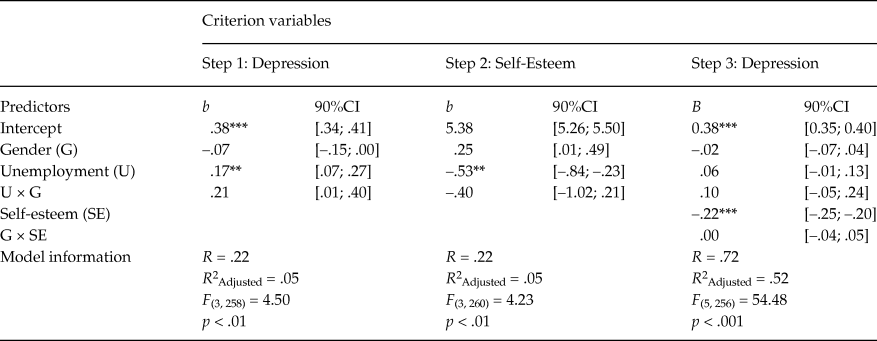
To move on, a fundamental aspect of this study was to know whether the fact that unemployment affects men’s self-esteem but not women’s was a psychological mechanism by which unemployment affects depression differently. To answer this question, one needs to analyze the possibility that self-esteem acts as a mediator variable on the consequences that unemployment has on depression. If this hypothesis is correct, then this mediation ought only occur in the case of men, not women. In this case, the mediated effect of self-esteem on depression should be moderated by the gender of the participants. To test this hypothesis, we tried three regression models to estimate a moderated mediation effect. In the first model (Table 1), employment status, gender of the participants, and interaction between employment status and gender were included as predictors of depression. Technically this model corresponds to the ANOVA previously undertaken for the analysis of symptoms of depression, and we verified the main effect of the employment situation. Because power could be an issue in detecting interaction effects (Judd et al., Reference Judd, McClelland and Culhane1995), it is important to look at the estimated confidence intervals by using bootstrap procedures (see Efron, Reference Efron1982), especially when estimating the mediating effect (see Kenny & Judd, Reference Kenny and Judd2014). We estimated the confidence intervals of the parameters through bootstrapping with 5,000 bias-corrected resamples, such as specified in the Hayes process, model 1 (Hayes, Reference Hayes2013). In this re-estimated model, we found a reliable interaction between gender and employment status because the estimated confidence interval for the interaction effects does not include zero (see Table 1). This is an important finding because it reinforces the evidence that unemployment affects men and women differently.
Parameters Estimated according to Regression Models used in the Analysis of the Role of Self-Esteem and Gender in the Relationship between Unemployment and Depression

Note: b = 90% CI = confidence intervals estimated with 5,000 bias corrected resamples after centering the predictors. Parameters and confidence intervals ware estimated with Model 1 (Step 1) and Model 59 (Steps 2 and 3) of the PROCESS for SPSS 2.16.3 (Hayes, Reference Hayes2013).
Unstandardized coefficients; ** p < .01. *** p < .001.
The second model reproduces the results of the ANOVA applied to the analysis of self-esteem, where we confirmed that unemployed people have lower self-esteem than those with employment. Finally, Model 3 added, to Model 1, self-esteem and the terms of interaction between self-esteem and gender, as predictors of symptoms of depression. As we can see, the results indicate that only self-esteem significantly predicts symptoms of depression, in such a way that the lower the participant’s self-esteem, the greater the observable symptoms of depression. It is important to note that in this model the effect of employment status is not significant, which indicates that self-esteem mediates the relationship between employment status and the symptoms of depression (Sobel = 2.84, p < .01), to the extent that unemployment is associated with a lower self-esteem, which in turn predicts stronger depressive symptoms. The reliability of the mediated effect is confirmed by using 5,000 bias-corrected resamples from bootstrapping, indirect effect = .11; 90% CI [.04, .19].
Once the link between unemployment and depression in men had been observed (see Figure 1), we expected that self-esteem’s mediating effect would depend on the participant’s gender. As we can see (Figure 3), self-esteem is a significant mediator of the impact of unemployment on depression in men (Sobel = 2.01, p < .05), in such a way that unemployment predicts self-esteem, which in turn fuels greater depressive feelings that they experience. In fact, the mediated effect is reliable with 5,000 bias-corrected resamples from bootstrapping, indirect effect = .17; 90% CI [.05, .28]. In the women’s case, the process is different, since unemployment does not have a significant impact, neither on self-esteem nor on depression. In fact, the estimated mediated effect is not reliable even when we used the bootstrap procedure, indirect effect = .06; 90% CI [–.04, .17]. This is important because it indicates that the lack of mediated effect on women is unlikely to be due to power problem analysis. These results confirm our third hypothesis about the mediating role of self-esteem on the levels of depression among unemployed men, but not for women.
Effect of Unemployment on Depression as Mediated by Self-Esteem and Moderated by the Participants’ Gender.
(Coefficients in bold represent men; coefficients in italic represent women)

Discussion
The main aim of this study was to verify whether unemployment is differently associated with men’s and women’s self-esteem and depression. Once the differential association between unemployment and psychological well-being had been established, we analyzed the relationship between self-esteem and depression as psychological processes that can contribute to better understanding the differences that were found. In this sense, the question that was asked is to what extent self-esteem can be considered a mediating factor between unemployment and depression. Specifically, we analyzed whether the fact that unemployment affects the self-esteem of men, but not of women, can be a psychological mechanism by which unemployment affects the depression of both in a different manner.
Our results confirm our prediction that self-esteem is a mediating variable because of the differential effect it has on depression. It is important to note that such mediation is itself moderated by the gender of the participants. To sum up, unemployment is associated with lower self-esteem, which predicts higher symptoms of depression, but this relationship can only be observed in men, and not in women. These results are in line with other studies in which a lower psychological impact of unemployment for women is observed. This lower impact is explained by the different family roles exercised by men and women (Artacoz et al, Reference Artazcoz, Benach, Borrell and Cortès2004; Schmitt, Reference Schmitt2008). The fact that this research has been carried out in Spain where a traditional model of gender role sharing persists can explain the results obtained in this research.
Despite there being many studies dedicated to the psychosocial consequences of unemployment, these have not focused on analyzing the psychosocial processes that underlie the differential experience of unemployment for men and women in relation to self-esteem and depression. In this sense, the main innovative aspect of this study was to simultaneously analyze the role played by unemployment on self-esteem and depression, for both genders. In fact, previous studies that bring up one of these aspects do so separately (Stankunas et al., Reference Stankunas, Kalediene, Starkuviene and Kapustinskiene2006; Waters & Moore, Reference Waters and Moore2002a), without considering the link that can exist between self-esteem and depression, and how such a link may be unequal, or at least different, between men and women.
The present work also provides new insights about the relationship between unemployment, gender and self-esteem. First, even though there is a reduction in self-esteem associated with being unemployed, which is in line with results from previous studies (Álvaro, Reference Álvaro1992; Stankunas et al., Reference Stankunas, Kalediene, Starkuviene and Kapustinskiene2006), our results go further by showing that this tendency is present both in men and in women, but only in the men’s case are the differences significant. This would indicate that it is the evaluative component of one’s image that is affected in the case of men, a fact that also corroborated results from previous studies by McKee-Ryan et al. (2015) and Schmitt (Reference Schmitt2008).
Something similar can be said about the depression variable, with the results obtained being similar to those for the self-esteem variable, indicating that associated unemployment is especially with depressive symptoms in men. The most innovative aspect of this study is that self-esteem mediates the relation between unemployment and depression, but only in the case of men. So, for men unemployment is associated with a lower self-esteem, which in turn is related to the symptoms of depression they feel. Despite the changes that occurred with the introduction of women into the working world, many roles are still mainly fulfilled by women, creating a possible alternative identity that could help explain this result. In the women’s case, unemployment, at least in this study, does not seem to affect their well-being in the same way as for men, at least in the studied dimension of depression. It is possible that those roles mainly occupied by women have impact on certain dimensions of the self, or that the differential receptiveness between men and women to alternative roles helps to explain the differences observed. In a situation such as unemployment, the differential impact may be related to the way in which the masculine and feminine gender identity are built around family roles and this might be associated with depression symptoms. In the case of women, it would be necessary to evaluate other dimensions of psychological well-being that are less linked to self-esteem, and where the impact of unemployment might be the same as found in men.
Despite the observed differences in the mediating role of self-esteem over depression in unemployed men and women, the results must be interpreted carefully. Indeed, the correlational nature of this study does not allow us to infer unequivocally the direction of the link between self-esteem and depression. Indeed, because our data were obtained from a cross-sectional design, it is also possible that depression could function as mediator of unemployment on individual self-esteem in that the more depressed individuals also show a less positive self-evaluation. However, in order to fully prove this direction, one would need longitudinal studies where the hypothesized direction is put to the test. Obviously, these results should be contrasted in future studies that include representative samples of the population. Likewise, the conclusions of this study must be confirmed in further research, taking into account other factors, age being a crucial one. It is possible that these results only apply to more advanced or intermediate ages, and not so much to younger populations among whom we would expect a similar reaction to unemployment. In addition to, other studies should compare the psychological experience of unemployment with other forms of precarious work.
If the hypothesis about the alternative roles women fulfill does indeed cause the greater preservation of their self-esteem and the lesser influence on depression, then in the case of younger persons, the social changes of the last decades - the introduction of women in the workplace - and the lesser acceptance or availability of traditional roles, would lead to the same psychological consequences of unemployment. Another important aspect that future studies should take into account is to what extent the results described in this study can be replicated in different types of unemployed couples and how this can influence mental health differently by gender. For instance, it would be interesting to know to what extent the degree of identification with traditional roles can buffer or increment the psychological consequences of unemployment for men and women.
We should also consider that, even though the results of this study show that the low levels of self-esteem are associated with depressive symptoms, more studies would be necessary to discard the alternative hypothesis that self-esteem is also another symptom of depression.
Finally, studies like this show that employment policies must be a priority insofar as they can contribute to the psychological well-being of the unemployed population. The consequences of unemployment are not only economic but also psychological, which makes necessary public support policies that minimize their negative effects