Implications
Animal fibre production is profitable in Europe within the context of small industry and niche market, and thus could contribute to improve efficiency, profitability and sustainability of livestock production in marginal agriculture lands. One of the main outcomes of this paper is to review the knowledge of the biology of fibre growth and fleece composition as well as the genetic control of fibre production in small ruminants, South American camelids and rabbits. The results that were reviewed provide guidance in managing genetic improvement programme concerning fine fibre-producing animals.
Introduction
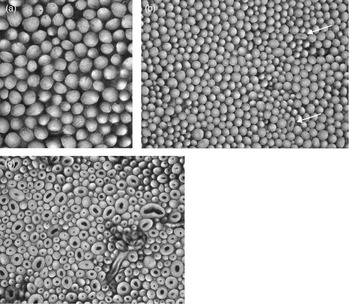
There are two main types of commercial fibre production (e.g. see Figures 1 and 2). ‘Double-coated’ (DC) species such as Angora rabbit, cashmere goat and primitive sheep have a coarse outer coat derived from primary hair follicles, and a fine inner coat produced by secondary hair follicles. ‘Single-coated’ (SC) species such as Angora goat and modern woolled sheep in which all fibres produced by both primary and secondary follicles are essentially similar in their physical characteristics (Sumner and Bigham, Reference Sumner and Bigham1993). This distinction can be extended to South American camelids. Llama, vicuna and guanaco have a double coat and alpaca predominantly a single coat (Antonini, 2010).
Cross section image of a fibre bundle from three different SC species: Merino sheep, Angora goat and alpaca. (a) Merino sheep fleece: all fibres are unmedullated. (b) Angora goat fleece: Fibres are mainly non-medullated with some medullated (←) undesirable fibres present. (c) Alpaca fleece comprises of a mixture of medullated and non-medullated fibres.

Cross section images of a fibre bundle from three DC species: cashmere goat, angora rabbit and llama. (a) Cashmere goat fleece before dehairing: primary fibres are all medullated whereas fine secondary fibres are unmedullated. (b) Cashmere goat fleece after dehairing: most of the medullated primary fibres have been removed. (c) Angora rabbit fleece: all types of fibres are medullated; medulla is made of only one hair canal in downs, two and three or more in intermediate and primaries fibres, respectively. (d) llama fleece: most of the fibres are medullated except some very fine down fibres.

In Europe, few farm enterprises are devoted to animal fibre production. The profitability of animal fibre production will depend on prices in world markets, the existence of niche markets, high levels of fibre production and low production cost. At present, cost/price structures and European fibre-producing enterprises are no longer profitable except when producers have created niche markets to obtain a premium price of the farm output. These niche markets concern production of mohair and cashmere by goats, Angora by Angora rabbits and fine or coloured wool by sheep. With regard to the sheep industry, these niche markets for wool are very small and wool production is generally not profitable and may indeed be undesirable compared with meat or milk production. However, in sheep, interests in fleece composition and structure, of relevance to protective properties against heat loss, are emerging. This is because of geographical relocation of sheep in the meat industry from intensive agricultural areas to less favourable lands and environmental conditions that include permanent exposure outdoors and the harsh environment of mountains areas (Jacquin et al., Reference Jacquin, Allain, Bouix, Foulquie, Autran and Bibe2002). Within these contexts, genetic studies and comprehensive breeding programmes either for fine fibre production or with the aim of adapting the coat to provide better environmental protection have been developed for Angora goats, Angora rabbits and sheep in European countries such as Denmark, France, Italy and the United Kingdom under international collaborations.
This paper reviews biology of fibre production in small ruminants, rabbits and South American camelids and considers studies concerning (i) genetic control and improvement of fibre production in Angora goats and Angora rabbits, SC and DC species, respectively, and (ii) studies on quantitative trait loci (QTL) and major gene detection in small ruminants and rabbits for fibre and fleece characteristics. We will consider the genetic control of traits relating to both the quantity and quality of the fibre produced and the composition of the coat. The principles will be illustrated with results from our own research and breeding programmes as well as those from elsewhere in the world.
Biology of fibre production in small ruminants, Angora rabbit and South American camelids
Variations of coat composition and structure
In general, there are two main types of hair in the coat of mammals, long and coarse overhairs of the outer coat which provide mechanical protection, and short and fine underhairs of the inner coat which provides the thermal protection (Figures 1 and 2). The overhairs are produced by primary hair follicles usually organized in trio groups (Carter, Reference Carter1943). The underhairs are produced by secondary follicles appearing within the trio groups.
There are two types of secondaries. The epidermal follicles originate from the primitive foetal epidermis as primaries and associated secondaries until the first sign of epidermal keratinization. As the keratinized epidermis is not able to produce more new follicles, the subsequent secondaries are formed by branching from existing secondary follicles (Hardy and Lyne, Reference Hardy and Lyne1956). These ‘derived’ follicles with their original epidermal follicle constitute a compound hair follicle (Rougeot et al., Reference Rougeot, Thebault and Allain1984b). The hairs of derived follicles pass through the epidermis in the common hair canal developed by the generating epidermal secondary follicle. In ‘DC species’ the number of active derived follicles could vary according to season and provides additional downs in the winter coat.
However, there are variations in coat composition and structure between mammals and specially those, which have been selected for fibre or fur production. The type of fleece varies from a typical double coat to a single coat in which all fibres are essentially similar in their physical characteristics. In most species bred for commercial fibre production, including sheep, goats, rabbit and South American camelids, the difference in pelage between DC and SC breeds represents the effect of selective breeding to produce a long fine fleece which has involved changes in the growth characteristics of the hair fibres.
Fibre growth pattern
In the typical double-type coat, such as Angora rabbit, cashmere goat and South American camelids like llama, guanaco and vicuna, hairs are replaced periodically with variable synchronisation. The pattern of growth of individual follicles can be divided in three main phases, anagen (active fibre growth), catagen (follicle regression) and telogen (resting phase; Chase, Reference Chase1954). Shedding of the previously grown fibre tends to occur about the onset of anagen so that at least one hair is generally always present in a follicle. The duration of anagen is constant, whereas the duration of telogen can be modified by photoperiodic manipulations, hormones, traumatism and plucking. Hence, a hair may be anchored in the skin by its club root for several weeks without growing. The pattern of hair growth is different in Angora rabbit, cashmere goat and moulting sheep, but changes in the coat are mainly controlled by seasonal variations in daylength (Allain et al., Reference Allain, Thebault, Rougeot and Martinet1994).
In the Angora rabbit, the different types of hair grow for 12 to 20 weeks and without any manipulations, moults can be observed in the spring and the autumn. However, in commercial farming, Angora wool is harvested at regular interval by defleecing (using a depilatory treatment in the form of leucaena in the diet) in the French system or by shearing for German and Chinese breeds. According to the season and whatever the harvest method, variations of fibre population are observed. For example, in spring, a proportion of derived hair follicles regresses to the hair germ stage or disappears without replacing their downs. They are only re-activated in the autumn, so that hair density is 20% to 30% higher in winter than in summer (Rougeot and Thebault, Reference Rougeot and Thebault1983).
In goats and sheep, the pattern of fibre growth ranges from a visible moult in the spring with a lesser moult in the autumn in DC breeds such as Soay sheep and cashmere-producing goats, to apparent continuous growth in SC breeds such as Merino sheep and Angora goat.
In DC breeds, primaries are replaced as they are shedding in spring and summer maintaining a covering over the animal, while replacement of secondaries may not occur for 1 to 3 months after shedding. The seasonal pattern of down production in Soay sheep (Ryder, Reference Ryder1978) and cashmere goats (McDonald et al., Reference McDonald, Hoey and Hopkins1987) begins around the summer solstice and ceases near the winter solstice although some subsidiary cycles have been observed during spring in cashmere goats (Nixon et al., Reference Nixon, Gurnsey, Betteridge, Mitchell and Welch1991). At the end of the growth cycle down length is quite similar or longer than guard hair. Thus in DC breeds, pattern of hair growth is controlled by day length (Rougeot, Reference Rougeot1961; Rougeot et al., Reference Rougeot, Allain and Martinet1984a; Teh et al., Reference Teh, Jia and Ogden1992), and hair density as measured by secondary/primary follicle ratio is low in summer and high in winter (McDonald et al., Reference McDonald, Hoey and Hopkins1987; Ryder, Reference Ryder1973).
In SC breeds, such as Angora goat or modern Merino sheep, fibres grow apparently in a continuous pattern. However, most of the breeds exhibit seasonal cycle of fibre growth with a rate maximising in summer and at a minimum in winter. The amplitude is less pronounced in modern Merino sheep than in Angora goats and most other sheep breeds (Margolena, Reference Margolena1974; Ryder, Reference Ryder1978). The seasonal cycle in fibre growth is associated with concomitant changes in fibre length, growth rate, mean fibre diameter and mean fibre volume (Woods and Orwin, Reference Woods and Orwin1988). This seasonal cycle of fibre growth, and occasional fleece shedding, in modern SC breeds, therefore appears to be a vestige of the moulting cycle of primitive and DC breeds (Ryder, Reference Ryder1978).
Fibre structure and quality
In sheep and goats, desirable fibres are all non-medullated as it occurs in Merino and modern woolled-sheep producing apparel wool (Figure 1a). In other sheep breeds producing carpet wool, such as the Texel, medullated fibres are less, or not undesirable. In mohair-producing Angora goats, some medullated fibres can be found within the fleece (Figure 1b) and so fibre quality is graded according to the presence of medullated kemp or other medullated (med) fibres. In cashmere-producing goats, two different hair types are recognised. These are the fine undercoat comprising unmedullated fibres and the outer coat composed of coarse medullated fibres (Figure 2a). The fleeces of cashmere-producing goats must be dehaired (Figure 2b) to obtain the valued homogeneous cashmere fibre. This could be achieved partly at fleece harvest by combing by hand in traditional producing areas or later in fibre processing by machine dehairing.
In Angora rabbits producing Angora wool, all fibre types of the double coat (Figure 2c) are desirable fibres. The content of coarse bristles determines the end use of Angora wool.
In SC or DC South American camelids (Frank et al., Reference Frank, Hick, Pesarini, Hick, Capelli and Ahumada2001a and Reference Frank, Hick, Gauna, Lamas, Renieri and Antonini2006), the fleece is made of both medullated and unmedullated fibres (Figures 1c and 2d). Primary fibres are all medullated, whereas secondaries are of both types (Antonini et al., Reference Antonini, Gonzales and Valbonesi2004).
Genetic determinism of fibre growth pattern, coat composition and structure in small ruminants and rabbit
The genetic basis of hair growth pattern and coat composition varies between species. In small ruminants, these characters are additive and due to several genes. In rabbits, several autosomal recessive genes determine characteristics of fibre growth, coat composition and structure. The Angora trait determines the duration of fibre growth and hair length (Rougeot and Thebault, 1984). The Rex character suppresses development of coarse fibres (Fraser, Reference Fraser1953), the satin character modifies the structure of the medulla within the fibre (Robinson, Reference Robinson1953) and the furless and hairless phenotypes are because of partial or complete suppression of down fibre production, respectively (Boucher et al., Reference Boucher, Thebault, Plassiart, Vrillon and Rochambeau1996).
Genetic control of fibre production in Angora goat, Angora rabbit and alpaca
For consideration of the genetic control of traits describing fleece quality and quantity, we will draw primarily on our findings in the French Angora goat, the French Angora rabbit and the Peruvian alpaca population, respectively.
For the Angora goat, the data derives from the French breeding programme of Angora goats. It is based on an open nucleus of about 5000 animals, including 1500 breeding does from 50 farms, an on-farm performance recording system and a national genetic database with breeding value evaluation on a national basis (Allain and Roguet, Reference Allain and Roguet2003). All animals of the open nucleus are registered with pedigrees recorded and performance data collected for reproduction and mohair yield. Greasy fleece weight was checked at 6-month intervals from birth. All bucks and does of 15 to 18 months of age are checked for fleece characteristics and fibre measurements. Mean fibre diameter with fibre diameter distribution and medullation content were determined from a fleece sample taken from mid-side in a textile laboratory according to the Optical Fiber Diameter Analyser (OFDA) method. Other fleece characteristics (kemp score and staple length on shoulder) are judged or determined at farm by a scoring expert (Allain and Roguet, Reference Allain and Roguet2003).
For the Angora rabbit, the data were obtained from the Angora experimental farm of Institut National de la Recherche Agronomique (INRA) at Le Magneraud, France within the context of an eight-cohort divergent selection experiment for total fleece weight. Genetic parameters and direct response to selection on fleece weight were studied as well as correlated response in Angora fleece characteristics such as fibre dimensions of each kind of fibre composing the fleece, fleece composition and hair follicle population. Animal management conditions, selection procedure and fleece measurements were described by Allain et al. (Reference Allain, Rochambeau, Thebault and Vrillon1999) and Rafat et al. (Reference Rafat, Allain, Thébault and Rochambeau2007a, Reference Rafat, Rochambeau, Brims, Thebault, Deretz, Bonnet and Allain2007b and Reference Rafat, Rochambeau, Thébault, David, Deretz, Bonnet, Pena-Arnaud and Allain2008).
For alpaca, the data derives from PROMEGE (selection programme of the alpaca population in the Callyoma province, Toccra, Peru), a genetic selection trial, which is being carried out in the alpaca population of the Callyoma province in Peru (PROMEGE, genetic improvement programme) under a tri-partite cooperation programme (Centro de Estudios y Promoción del Desarrollo (DESCO) from Perou; Department of Environmental Science, University of Camerino, and the Italian National Agency for New Technologies, Energy and the Environment (ENEA) from Italy; and the SUPPRAD project of the Universidad Católica de Córdoba, Argentina), (Renieri et al., Reference Renieri, Pacheco, Valbonesi, Frank and Antonini2007) from Argentina. It is based on an open nucleus selection scheme of 15 multipaiers (approximately 850 animals) and more than 75 breeders (campesinas families; approximately 6000 animals). The programme shows potential for the involvement of 18 000 animals (approximately 500 campesinas families) (Gonzales Paredes and Renieri, Reference Gonzales Paredes and Renieri1998; Renieri et al., Reference Renieri, Pacheco, Valbonesi, Frank and Antonini2007). The following characters are taken into account as objectives for genetic selection: type of fleece (Suri or Huacaya), colour of fleece (non-albino full white; uniformly coloured fleece: black, brown, light fawn or wild; or multi-coloured fleece with irregular spotting), quantity of fibre produced, fibre diameter and coefficient of variation (CV) of fibre diameter. Selection criteria were direct observation of colour and type of fleece at birth, the weight of fibre produced at the first shearing at the age of 1 year (Antonini et al., Reference Antonini, Gonzales and Valbonesi2004), the mean fibre diameter and CV of fibre diameter determined from a fleece sample taken from the mid-right side of the animal at first shearing.
Genetic control of fleece characteristics in alpaca
In alpaca, a differentiation is made between two types of fleece, Huacaya and Suri (Calle Escobar, Reference Calle Escobar1984; Novoa and Wilson, Reference Novoa and Wilson1992; Frank et al., Reference Frank, Renieri, Hick, Gauna and Vila Melo2001b and Reference Frank, Hick, Gauna, Lamas, Renieri and Antonini2006). Huacaya is more common and is characterised by compact, soft and highly crimped fibres, with blunt-tipped locks and is very similar to those of Merino sheep. Suri on the other hand, has straight, less crimped fibres with ‘cork-screw’ shaped locks, very similar to those of Angora goats although with less lustre. Huacaya represents 90% of alpaca fleece processed in Peru (Hoffman and Fowler, Reference Hoffman and Fowler1995). Differences between fleece types in terms of cell scale frequency, follicular density and secondary to primary follicular ratio were earlier described (Antonini et al., Reference Antonini, Gonzales, Frank, Hick, Pierdominici, Catalano and Castrignano2001 and Reference Antonini, Gonzales and Valbonesi2004; Antonini, 2010).
The genetic background of Huacaya and Suri is still not clearly defined; as segregation analyses carried out in the past do not show concordant data. Suri is reported to be inherited as a single recessive gene (Calle Escobar, Reference Calle Escobar1984), a single dominant gene (Velasco, Reference Velasco1980), a single dominant gene or a haplotype (Ponzoni et al., Reference Ponzoni, Hubbard, Kenyon, Tuckwell, McGregor, Howse, Carmichael and Judson1997; Baychelier, Reference Baychelier2000 and Reference Baychelier2002).
Renieri et al. (Reference Renieri, Valbonesi, La Manna, Antonini and Lauvergne2008b) analysed 588 (291 females and 297 males) offspring from Suri ram × Suri dam from 62 paternal half sibling families, and 2126 (1009 females and 1117 males) offspring from Huacaya ram × Huacaya dam from 177 paternal half sibling families. The following results were obtained:
– Suri is inherited as a single dominant gene. The observed offspring frequencies in segregating families fit with a single gene dominant segregation hypothesis;
– Suri is a new dominant mutation in Huacaya lines. Among the 2126 offspring by Huacaya ram × Huacaya dam, 2123 were Huacaya and three Suri, born from three different families. Therefore, the hypothesis of misclassification of heterozygous individuals showing an incomplete penetrance must be rejected. Only the hypothesis of a new dominant mutation on some germinal lines of Huacaya animals can be accepted. The mutation rate of this apparently new dominant mutation can be estimated as 3/2126 = 0.0014.
Genetic parameters of fibre production traits in Angora goat, Angora rabbit and alpaca
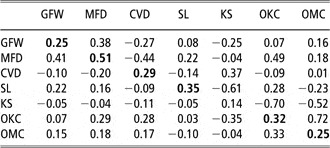
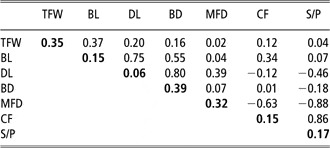
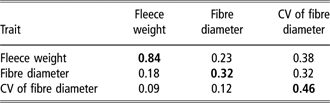
Estimates of genetic parameters influencing responses to selection for production and fleece characteristics of Angora goat, Angora rabbit and alpaca, using a BLUP animal model have been published in recent years (Allain et al., Reference Allain, Rochambeau, Thebault and Vrillon1999; Allain and Roguet, Reference Allain and Roguet2003 and Reference Allain and Roguet2006; Rafat et al., Reference Rafat, Allain, Thébault and Rochambeau2007a and Reference Rafat, Rochambeau, Thébault, David, Deretz, Bonnet, Pena-Arnaud and Allain2008; Renieri et al., Reference Renieri, Pacheco, Valbonesi, Frank and Antonini2007). The range of heritability estimates, genetic and phenotypic correlations for fleece weight and fleece characteristics for Angora goat, Angora rabbit and alpaca are given in Tables 1, 2 and 3, respectively.
Estimates of heritability (bold on diagonal), phenotypic correlations (below diagonal) and genetic correlations (above diagonal) for greasy fleece weight, and some important fleece characteristics in French Angora goats (Allain and Roguet, Reference Allain and Roguet2003 and Reference Allain and Roguet2006, unpublished data)

GFW = greasy fleece weight; MFD = mean fibre diameter; CVD = CV of fibre diameter; SL = staple length; KS = kemp score; OKC = OFDA kemp content; OMC = OFDA med fibre content.
Estimates of heritability (bold on diagonal) and genetic correlations (above diagonal) for total fleece weight and fleece characteristics in French Angora rabbits (Rafat et al., Reference Rafat, Allain, Thébault and Rochambeau2007a and Reference Rafat, Rochambeau, Thébault, David, Deretz, Bonnet, Pena-Arnaud and Allain2008)

TFW = total fleece weight; BL = bristle length; DL = down length; BD = bristle diameter; MFD = mean fibre diameter; CF = comfort factor; S/P = secondary/primary follicle ratio.
Heritability (bold on diagonal), genetic correlation (above the diagonal) and phenotypical correlation (below the diagonal) of the weight of the fleece, of the diameter and the coefficient of variation of the diameter of fibre in alpaca (Renieri et al., Reference Renieri, Pacheco, Valbonesi, Frank and Antonini2007)

CV = coefficient of variation.
There are some differences in heritability estimates of fleece weight and fleece characteristics between alpaca, Angora goat and Angora rabbit.
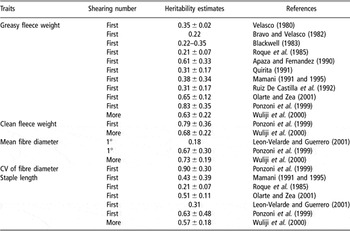
In alpaca, a very high heritability estimate of fleece weight (0.85) was observed. Other studies show a large variability of heritability estimates of fibre production traits in alpaca from 0.21 to 0.83 (Table 4). In the different studies shown above, the type of fleece which is determined by a single dominant gene (Renieri et al., Reference Renieri, Valbonesi, La Manna, Antonini and Lauvergne2008b) was not included as a genetic factor in statistical analysis models. This could have introduced a bias, which could explain such large variations in heritability estimates.
Estimated heritability of fleece characters in alpacas according to cited authors

CV = coefficient of variation.
In Angora rabbit, a higher heritability estimate of fleece weight was observed, whereas heritability estimates of fibre dimensions (length and diameter) were lower than in Angora goat (Allain and Roguet, Reference Allain and Roguet2006; Rafat et al., Reference Rafat, Rochambeau, Thébault, David, Deretz, Bonnet, Pena-Arnaud and Allain2008).
Selection for increased fleece weight in Angora goat is expected to result an increase in fibre diameter and fibre length due to low-to-moderate genetic correlations between fleece weight and fibre dimensions. Similar observations were reported in sheep, Angora goats and cashmere goats and alpaca (Sumner and Bigham, Reference Sumner and Bigham1993; Taddeo et al., Reference Taddeo, Allain, Mueller, Rochambeau and Manfredi1998; Renieri et al., Reference Renieri, Pacheco, Valbonesi, Frank and Antonini2007). In Angora rabbit, selection for increased total fleece weight was efficient (Rafat et al., Reference Rafat, Allain, Thébault and Rochambeau2007a) and resulted in an increase of fibre length without apparent contribution from fibre diameter. High genetic correlations were observed between certain parameters for fibre dimensions similar to those described in cashmere goats (Zhou et al., Reference Zhou, Allain, Li, Zhang and Yu2002; Bai et al., Reference Bai, Zhang, Li, Dao and Jia2006).
The secondary to primary follicle (S/P) ratio, describes a valuable property of the hair follicle population that is important for fibre production. There are large differences in fibre diameter between primary and secondary fibres of the Angora rabbit. A useful indirect estimation of S/P ratio, based on the high genetic correlation observed between S/P ratio and comfort factor (Rafat et al., Reference Rafat, Rochambeau, Thébault, David, Deretz, Bonnet, Pena-Arnaud and Allain2008), may be determined by measurement of comfort factor (content of fibres having a diameter higher than 30 μm) through OFDA measurement of mean fibre diameter. Similarly in cashmere goats, another DC species, the yield of cashmere down as fibres produced by secondary hair follicles and thus S/P ratio, is determined through OFDA methodology (Herrmann and Wortmann, Reference Herrmann and Wortmann1997). Unfortunately, in Angora goat and by extension in SC species where primary and secondary fibres are near similar in diameter, S/P ratio can be only determined by using long and cost expensive methodology of quantitative histological treatment (Antonini, 2010). In sheep, genetic correlation between S/P ratio and mean fibre diameter is moderate to high indicating that selection for improving fibre diameter is efficient to improve S/P ratio.
Many aspects of the genetic basis of fibre production are analogous between Angora goats and Angora rabbits and alpaca. We have demonstrated that in these three species, there are many traits controlling both fibre quality and fibre quantity, and that these traits tend to be moderately to strongly inherited with differences between species. Rapid genetic progress in any traits is possible and indeed has been achieved. However, there are differences in breeding programmes between the DC Angora rabbit and the SC species Angora goat and alpaca. In Angora rabbit, improvement of fibre production can be achieved through selection for easily measured total fleece weight that has general beneficial effects on fleece quality (Rafat et al., Reference Rafat, Allain, Thébault and Rochambeau2007a and Reference Rafat, Rochambeau, Thébault, David, Deretz, Bonnet, Pena-Arnaud and Allain2008). In Angora goat and alpaca, is a greater challenge to develop selection criteria that simultaneously meet the many factors affecting the actual income received by the farmer for the product, due to antagonistic relations between some of the traits defining quality and quantity. Achieving this goal requires a multi-trait selection index approach similar to that applied to the Merino or other modern-woolled sheep, which are also SC species.
QTL and major genes affecting fibre growth in small ruminants and rabbits
A number of genes having major effects on skin and fleece traits were identified by their extreme effects on phenotype and following verification using classical crossing strategies. These genes with Mendelian inheritance have been identified for important traits influencing pigmentation, wool quality and keratin proteins in wool sheep. Gene mapping studies have identified some chromosomal regions associated with variations in wool quality and production traits.
Sponenberg (Reference Sponenberg1997) has reviewed the existing knowledge on the genetics of skin fibre color and hair texture in sheep. One of the most important loci influencing pigmentation pattern is the agouti locus, which encodes the agouti signalling protein (ASIP) product and associated with production of pheomelanin. It was located on sheep chromosome 13. The existence of two agouti loci has been suggested (Smit et al., Reference Smit, Shay, Beever, Notter and Cockett2002), and recently, it was shown that a gene duplication affecting expression of the ovine ASIP gene is responsible for white and black sheep (Norris and Whan, Reference Norris and Whan2008) and consistently segregate with the dominant white coat colour in Merino sheep defined by a single gene segregation (Renieri et al., Reference Renieri, Valbonesi, La Manna, Antonini and Asparrin2008a). Other genes (Mitf, Scf and c-kit) seem also likely to be involved in genetic background and regulation of white colour in merino sheep (Siva et al., Reference Siva, La Terza, Pediconi and Renieri2008). There is also evidence of a significant association between coat colour and tyrosinase-related protein 1 (TYRP1) gene maps to chromosome 2 in Soay sheep (Beraldi et al., Reference Beraldi, McRae, Gratten, Slate, Visscher and Pemberton2006) and it has been shown that a single nucleotide substitution in TYRP1 regulates the recessive light-fleece colour in feral Soay St Kilda sheep (Gratten et al., Reference Gratten, Beraldi, Lowder, McRae, Visscher, Pemberton and Slate2007). Except for the Extension locus located on chromosome 14 (Vage et al., Reference Vage, Fleet, Ponz, Olsen, Monteagudo, Tejedor, Arruga, Gagliardi, Postiglioni, Nattrass and Klungland2003), other loci affecting colour patterns in sheep have yet to be identified. Further details on the biology of pigment production have been provided by Galbraith (Reference Galbraith2010).
Several wool-keratin genes, which are often clustered in families, have been cloned in the last decades. Separated clusters of the two keratin intermediate-filament genes and five of the keratin-associated protein genes have been discovered and mapped in sheep to chromosomes 11 and 3 and chromosomes 1, 11 and 21, respectively (Hediger et al., Reference Hediger, Ansari and Stranziger1991; Mclaren et al., Reference McLaren, Rogers, Davies, Maddox and Montgomery1997).
Concerning genes determining hair texture, Finocchiaro et al. (Reference Finocchiaro, Portolano, Damiani, Caroli, Budelli, Bolla and Pagnacco2003) have reported that the hairless gene is involved in congenital hypotrichosis and have identified three mutations within an exon of this gene responsible for this phenotype. However, to our knowledge, no genes regulating hair texture have yet been mapped.
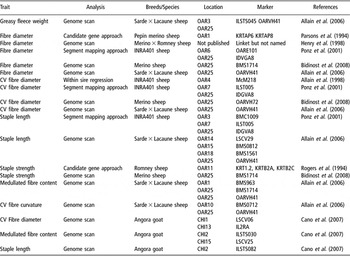
In the recent years, several experimental designs aiming to identify genomic regions in sheep and Angora goats that are associated with phenotypic differences on fibre production and fleece characteristics have been created. Most of these studies have collected data on a range of different traits, including wool and fleece characteristics to optimise the range of phenotypic information collected on each animal in such costly experimental designs. Putative QTL influencing wool production and fibre characteristics from these experiments are listed in Table 3. Other putative QTL have also been identified in sheep, but because of confidentiality agreements have not been publicly reported (Purvis and Franklin, Reference Purvis and Franklin2005).
In rabbit, few genomic data associated to coat phenotype are available although two genes modifying fibre length and fibre colour have been recently identified and mapped. The Angora recessive mutation which causes the production of abnormal long hair is tightly associated with fgf5 loci (Hebert et al., Reference Hebert, Rosenquist, Götz and Martin1994; Mulsant et al., Reference Mulsant, Rochambeau and Thebault2004) and mapped on chromosome 15 (Chantry-Darmon et al., Reference Chantry-Darmon, Urien, Rochambeau, Allain, Pena, Hayes, Grohs, Cribiu, Deretz-Picoulet, Larzul, Save, Neau, Chardon and Rogel-Gaillard2006). The ‘rex’ trait, another autosomal recessive mutation that refers to rabbits having essentially down hair amazingly soft to touching was recently fine mapped on chromosome 14 (Chantry-Darmon et al., Reference Chantry-Darmon, Urien, Rochambeau, Allain, Pena, Hayes, Grohs, Cribiu, Deretz-Picoulet, Larzul, Save, Neau, Chardon and Rogel-Gaillard2006; Diribarne et al., Reference Diribarne, Mata, Vaiman, Deretz, Auvinet, Cribiu, Allain and Guérin2009). Mutation of the tyrosinase gene that is responsible for the albino phenotype has been mapped on chromosome 1 (Chantry-Darmon et al., Reference Chantry-Darmon, Urien, Rochambeau, Allain, Pena, Hayes, Grohs, Cribiu, Deretz-Picoulet, Larzul, Save, Neau, Chardon and Rogel-Gaillard2006).
Several putative QTL’s and major genes affecting fibre production and fleece characteristics were recently found in sheep, goat and rabbit (Table 5; Chantry-Darmon et al., Reference Chantry-Darmon, Urien, Rochambeau, Allain, Pena, Hayes, Grohs, Cribiu, Deretz-Picoulet, Larzul, Save, Neau, Chardon and Rogel-Gaillard2006). The knowledge of the whole genome sequence of sheep and rabbit that will be available in the near future and the use of high-density SNP chip will allow fine mapping and dissection of the genetic basis of many production traits including fibre and fleece characteristics.
Quantitative trait loci for wool production and fleece characteristics from linkage association studies in sheep and goat

CV = coefficient of variation.
Conclusions
This paper has reviewed our knowledge of the genetic control of fine fibre-producing animals. We have demonstrated that there are many traits controlling both fibre quantity and fibre quality and that these traits tend to be moderately to strongly inherited. Rapid genetic progress in any individual traits is possible and indeed can be achieved. However, selection criteria that simultaneously meet the many factors affecting the income received by farmers differ between species. In DC species, selection for one single trait, the easy measurable total fleece weight has general beneficial effects on fleece quality. However, because of the antagonistic relations between qualitative and quantitative traits, achieving this goal requires a multi-trait selection index approach.
Today several genetic improvement programme concerning Angora goat, Angora rabbit and Merino wool are being conducted in Europe within the context of small industry and niche market and additionally under collaborative studies with Latin America and China. Moreover, several putative QTLs and major genes affecting fibre production have been found in sheep, goat, South American camelids and rabbits.
In the near future, because of rapid progress of molecular genetics research new genomic tools will be soon available. Their use, and particularly high-density SNP chip will allow the undertaking of fine mapping studies and dissection of many traits including fibre and fleece characteristics. It will thus contribute to improve efficiency, profitability and sustainability of fine fibre-producing animals and strengthen competitiveness of livestock production.