Introduction
Real-time ultrasound imaging for emergency care was introduced during the late 1970s,Reference Cohen and Moore1 and has become a key medical diagnostic tool. The World Health Organization encourages expansion of ultrasonography as a diagnostic modality with a focus on orienting uses toward local health problems,2 and the American College of Emergency Physicians lists use of ultrasound in remote environments as an indication within the scope of emergency physicians.3
Several factors contribute to interest in ultrasound use. Real-time imaging permits quick acquisition of anatomical information, leading to rapid clinical decisions. Scanning often is performed by clinicians directly involved in patient care, guiding therapy as a point-of-care modality. Ultrasound technology is inexpensive, making it accessible in a variety of healthcare economies, and recent advances have made ultrasound devices extremely portable. Unique environments in which ultrasound is being used include prehospital emergency medical service care,Reference Lapostolle, Petrovic and Lenoir4 high altitude,Reference Otto, Hamilton and Levine5, Reference Wilson, Levett and Dhillon6 military combat,Reference McNeil, McManus and Mehta7 refugee camps,Reference Adler, Mgalula and Price8 and the International Space Station.Reference Nelson, Melnick and Li9 Included among these applications is the use of ultrasound in disaster relief.
On January 12, 2010, a 7.0 magnitude earthquake struck Haiti, with the epicenter focused 15 miles from the capital city of Port-au-Prince. This event resulted in >222,000 deaths and an estimated 300,000 injuries.10 The University of New Mexico (Albuquerque, New Mexico, USA) Disaster Medical Assistance Team (NM DMAT-1) was deployed to Haiti on February 8, 2010 to participate in ongoing relief efforts as members of an International Medical Surgical Response Team (IMSuRT). Among the diagnostic imaging equipment available to this team was a handheld portable ultrasound device. This study describes the evaluation of a portable handheld ultrasound machine in point-of-care triage and diagnosis in a resource-poor setting following the Haiti earthquake.
Methods
This study was a retrospective, observational analysis of ultrasound images obtained for 50 patients who voluntarily presented to the Gheskio clinic in Port-au-Prince for evaluation and treatment from February 8 to February 20, 2010. Ultrasonography was performed for complaints or symptoms indicative of illnesses that could potentially be triaged or diagnosed by ultrasound, such as internal bleeding, pregnancy, shock, and cardiac dysfunction. The decision to use ultrasound was that of the treating clinician. After imaging, patients were further triaged, underwent further diagnostic testing, or were treated.
Images were obtained using a Signos handheld ultrasound machine (Signostics, Palo Alto, California, USA), on loan for trial use during this disaster response effort. None of the investigators have any conflicts of interest with Signostics, and the machine was returned to the company after use. Ultrasound was performed solely by the principal investigator (DJM), a Registered Diagnostic Medical Sonographer-eligible emergency physician sonographer with approximately eight hours of experience with the device prior to deployment. Scans were requested at the discretion of other physicians on the team. This ultrasound device permits the user to obtain static two-dimensional images by sweeping the probe in a linear plane; continuous two-dimensional imaging cannot be obtained with this device. Adjunct materials necessary for operation of the device, including ultrasound gel, were transported in with the team. A 3.5 MHz and a 7.0 MHz removable probe were used. Scans were repeated using a SonoSite 180 machine in an existing disaster cache (SonoSite, Bothell, Washington, USA) to confirm readings; for pulmonary or cardiac images, a portable X-ray machine occasionally was available. Because images could not be obtained retrospectively, no comparisons between the handheld ultrasound machines were made.
After completion of deployment, available demographic and clinical information relating to each study patient was obtained, and ultrasound images reviewed. Data were entered into a Microsoft Excel spreadsheet (Version 11.2, Microsoft Corporation, Redmond, Washington, USA), and included age, gender, clinical history, indication for ultrasonography, images obtained, image interpretation, image limitations, results (negative, positive, or equivocal study), clinical diagnosis, change in clinical management (yes or no), and specific changes made to clinical management (e.g., patient transferred, antibiotics given). This approach was used to identify whether clinical management was influenced by the use of ultrasound. The physician conducting ultrasound (DJM) was able to query the physician who ordered the scan to determine if the scan influenced patient disposition. The percentage of ultrasound studies that changed management and the percentage of positive studies were calculated, and values categorized and described in terms of percentages.
This retrospective study did not have patient identifiers, and was given a waiver of consent from the University of New Mexico Human Research Review Committee (HRRC 10-457).
Results
A total of 51 ultrasound scans on 50 patients were evaluated during a 12-day period using the Signos handheld portable ultrasound. Twenty-three patients were female and 27 male, and patients were 10-60 years of age.
Indications for which ultrasound was used included: hypotension (5 exams); trauma (7 exams); pregnancy (11 exams); non-traumatic abdominal pain (14 exams); deep venous thrombosis (1 exam); pulmonary embolus (1 exam); procedural and musculoskeletal (5 total: 1 for fracture evaluation, 1 for assisting the diagnosis of a tendinopathy, 3 for foreign body or abscess drainage); and shortness of breath/chest pain (6 exams). Of the pregnancy evaluations, 7 were evaluations to rule out ectopic pregnancy and 4 were used to diagnose pregnancy when urine pregnancy tests were no longer available. Evaluation of non-traumatic abdominal pain included a focus on the gallbladder (7 exams), liver (1 exam), appendix (2 exams), and kidneys/genitor-urinary system (non-pregnant pelvic pain) (4 exams).
A total of 15 different ultrasonographic views were attempted, with the number resulting in clinically applicable information per total number attempted as follows:
• inferior vena cava (2/4);
• lung (7/7);
• right upper quadrant (15/15);
• liver (1/1);
• left upper quadrant (4/5);
• aorta (0/1);
• renal (2/2);
• bladder (3/3);
• transabdominal (10/12);
• cardiac parasternal long axis (1/3);
• cardiac subxyphoid (2/4);
• cardiac parasternal short axis (2/4);
• soft tissue (3/4);
• testes (1/1);
• femoral vein (0/1).
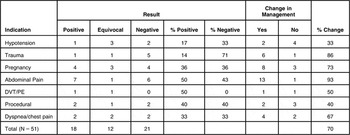
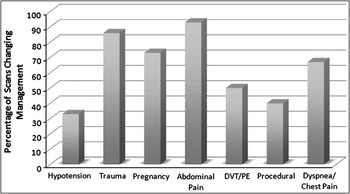
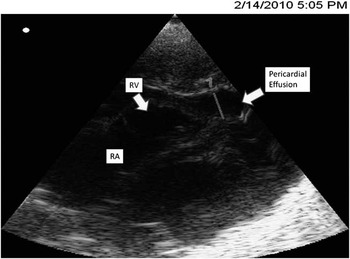
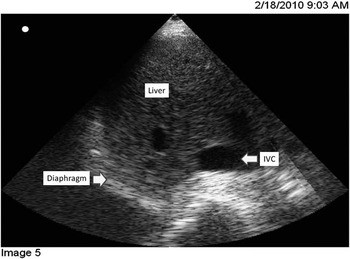
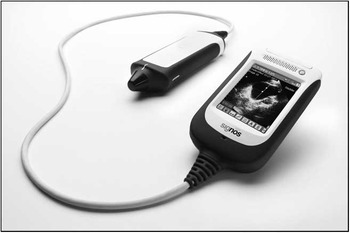
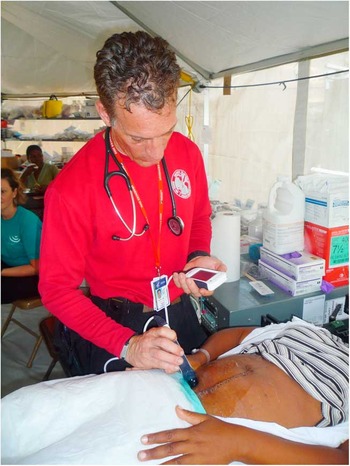
Positive, negative, or equivocal scans as well as clinical decision-making based on scan results (percent change in management) are summarized in Table 1 and Figure 1. Sample images of a pericardial effusion and the liver, diaphragm and inferior vena cava can be seen in Figures 2 and 3. Figures 4 and 5 depict the ultrasound unit used during the study.
Results versus change in management

Percentage of scans that changed management, according to complaint

Pericardial effusion image with the Signos portable handheld ultrasound

Right upper quadrant view with inferior vena cava and hemidiaphragm in undifferentiated hypotensive exam

The Signos portable handheld ultrasound device

(color online) The author (DJM) using the handheld ultrasound device during the Haiti deployment

Of ultrasounds performed, 35% were interpreted as positive, 41% were negative, and 24% yielded equivocal or indeterminate results. Of the 51 studies conducted, the clinical decision based on those studies was known for 49. Ultrasound influenced management decisions in 70% of scans. Table 1 shows, by indication, the number of positive, negative, and equivocal studies, as well as the number of studies that influenced patient management. Patient management decisions included:
• referral to a surgeon (5 cases);
• observe rather than refer to a surgeon (8 cases);
• refer to higher level of care (4 cases);
• not refer to a higher level of care (11 cases);
• initiate antibiotics (4 cases);
• change medications (2 cases);
• perform a procedure (1 case);
• not perform a procedure (2 cases);
• change patient location to include isolation (1 case).
Thirty-two patients were discharged or referred for follow-up as a result of the ultrasound findings.
There were limitations that inhibited clinical interpretations of the images. These included artifact (3 views); poor windows through which to view underlying structures (1 case); failure to identify the anatomic part of interest (1 case, the appendix); and inability to visualize the motion of the lung (3 cases), heart valves (1 case), cardiac blood flow (1 case), cardiac walls (1 case), fetal heart (1 case), and vein during compressibility (1 case). As a result, 12 of these examinations (cardiac, lung images, and the venous study for DVT), including two for undifferentiated hypotension, were not clinically helpful.
Discussion
The utility of ultrasound in disaster responses has been investigated for several decades. After the 1988 earthquake in Armenia, care was limited by the availability of only one CT scanner, and ultrasound played a significant role in both triage and treatment decisions for 400 patients.Reference Sarkisian, Khondkarian and Amirbekian11 Similarly, ultrasound was used to evaluate renal flow after crush injuries following an earthquake in northern Turkey in 1999.Reference Keven, Ates and Yagmurlu12 More recently, a study of hand-carried ultrasound following mass-casualty mudslides in Guatemala showed that ultrasound demonstrated emergent disease in 12% of cases and excluded disease in 42%.Reference Dean, Ku and Zeserson13 While these studies provide a basis for describing the utility of ultrasound in disaster response, they do not detail the exact use or limitations of the technology in disaster scenarios. Furthermore, there is no mention of the use of ultrasound in procedural applications or for endemic diseases associated with parasites.
Currently, two reports of the use of ultrasound in the aftermath of the Haiti disaster are found in the literature. One describes, in narrative form, the events surrounding the earthquake during an outreach mission by an obstetric and gynecology team unexpectedly in Haiti during the earthquake while training local physicians on ultrasound use for maternal and fetal health.Reference Abuhamad14 The other is a correspondence from members of a trauma team that describes the use of a SonoSite Micromaxx machine during disaster relief efforts beyond the Focused Assessment with Sonography for Trauma (FAST) exam, including cardiac function assessment and evaluation of post-operative infections.Reference Shah, Dalal and Smith15 However, quantitative data or qualitative analysis regarding the use of ultrasound during the disaster is lacking at this time.
In this study, the use of a Signos portable handheld ultrasound machine during a 12-day disaster relief effort for the 2010 Haiti earthquake was found to aid and change patient management decisions in 70% of cases, with nearly half of those decisions based on positive results (pathology was identified) and one-third based on negative results (lack of pathology supporting a specific differential diagnosis).
An important use of ultrasound identified in this study is patient triage. Two-thirds of the clinical decisions made based on portable ultrasound findings resulted in a referral decision to a higher level of care and almost half resulted in a period of observation rather than referral. Although not addressed specifically by this study, this suggests that one of the best uses of ultrasound during disaster relief is to improve patient triage and resource management, a crucial component of maximizing care for the masses when infrastructure is lost.
Portable ultrasound was used for a wide variety of indications, with certain indications yielding more applicable results than others. Surprisingly, ultrasonographic findings influenced the diagnosis and treatment of non-traumatic abdominal pain, with over 90% of scans resulting in some change in patient management. Although there is a wide range of disease processes that can result in abdominal pain, it appears that the ability to rule in or out a small number of possibilities can change patient care. Evaluation of pregnancy, both to help rule out ectopic pregnancy and to identify pregnancy when no other testing was available, was high-yield. This may be partly due to the fact that ultrasound for pregnancy is often a dichotomous exam, i.e., it involves either seeing one particular finding (an intrauterine pregnancy) or not, and determining if pelvic free fluid exists.
During a disaster event, local disease processes persist, and best clinical care includes diagnosis and treatment based on geographical disease prevalence. Infectious disease processes such as Echinococcus granulosus, schistosomiasis, leishmaniasis, and various flukes and helminths are known to have certain ultrasonographic findings, and are more prevalent in countries such as Haiti.Reference Richter, Hatz and Haussinger16, Reference de Cassio Saito and de Barros17 In the Lugufu refugee camp in Tanzania, for example, a significant portion of ultrasounds performed during a two-year period identified tropical infectious diseases as the etiology of complaints.Reference Adler, Mgalula and Price8 In this study, the two parasitic findings on ultrasound were consistent with filariasis and an amoebic liver abscess. Two patients with pleural effusions also had historical and clinical findings suggestive of tuberculosis. Therefore, additional training to identify region-specific diseases would likely augment use of portable ultrasound during disaster relief in developing countries.
Among the limitations of the Signos portable handheld machine for use during disaster relief was the inability to obtain dynamic moving images. Evaluation of motion and flow is critical for cardiac imaging, and assessing pleural lung sliding is necessary for the evaluation of a potential pneumothorax. Hence, the efficacy of this device in evaluation of complaints such as shortness of breath or hypotension was limited. The costs of larger or more expensive machines must be weighed against the benefits derived from dynamic imaging within a particular setting.
Limitations
There are several limitations to this study. First, with a retrospective qualitative study, there is the possibility of a selection bias in those patients who underwent portable ultrasound imaging. The physician ultrasonographer was not blinded to the clinical condition of patients, and could have influenced the requesting physician to make a patient management decision based on the image. Furthermore, the deployment timing may have influenced the findings. Had the team been deployed within days of the disaster, there would have been more traumatic-related studies undertaken as opposed to non-traumatic complaints (such as abdominal pain and pregnancies). Second, limited demographic information was obtained, and the specific characteristics of the population to whom this study applies cannot be identified. The patient population came from shelters surrounding the Gheskio clinic, and presenting problems may have differed from other areas staffed by hospitals or areas where other aid organizations were based. Moreover, comparisons cannot be made to identify what characteristics of the patient or the presenting problem would affect the ability of portable ultrasound to provide information that would change clinical management. Third, confirmatory studies were not consistently available to make comparisons between the Signos machine, Sonosite 180 machine, and portable x-ray. Finally, follow-up of all but two of the patients was not conducted, and therefore this study does not provide insight into the efficacy of portable ultrasound in improving ultimate patient outcome.
These limitations highlight the need for further investigation of portable ultrasound in disaster situations. With a larger sample size, a quantitative assessment would be useful. Areas for future research include investigating what patient populations or disaster scenarios may benefit most from portable ultrasound use, which patient characteristics may affect the ability to make management decisions using ultrasound, the comparative advantages and disadvantages of different types of portable ultrasound machines, and whether portable ultrasound is a cost-effective imaging modality within disaster medicine. Investigation of the utility of ultrasound in procedures and care of certain parasitic infections is also needed.
Conclusion
This study of 51 ultrasound scans performed using a Signos handheld portable ultrasound machine during the Haiti disaster relief effort in 2010 demonstrated that portable ultrasound was useful in evaluation of seven different clinical indications, with imaging of non-traumatic abdominal pain and pregnancy-related symptoms having the highest yield for clinically applicable information. Nearly two-thirds of the clinically relevant ultrasounds were used in the triage and disposition of patients, rather than for specific diagnosis or treatment. Ultrasound is useful for procedural applications and for aiding in the diagnosis of parasitic diseases. These findings suggest that portable ultrasound can be a helpful tool for patient triage during disaster relief, allowing for preserving valuable resources. An ultrasound machine with dynamic capabilities was needed for evaluation of undifferentiated hypotension, cardiac, and lung examinations. Further investigation into the outcomes of decisions based on ultrasound and cost-effectiveness in disaster situations is necessary.
Abbreviations
- none
Supplementary material
To view supplementary material for this article, please visit http://dx.doi.org/10.1017/S1049023X12000611.