


Introduction
The family Notocotylidae was established by Lühe (Reference Lühe and Brauer1909) for pronocephaloids lacking a head-collar and possessing blindly ending caeca passing between the symmetrical testes, which are located near the posterior end of the body and separated by the ovary (Barton and Blair, Reference Barton, Blair, Jones, Bray and Gibson2005). Members of this family are found in the digestive tract, commonly the caeca of aquatic birds and to lesser extent mammals, particularly rodents (Barton and Blair, Reference Barton, Blair, Jones, Bray and Gibson2005). A common feature of this family is the presence of papillae or ridges on the ventral surface (except in Paramonostomum Lühe, 1909, Ogmocotyle Skrjabin and Schulz, 1933, some species of Hippocrepis Travassos, 1922 and possibly Notocotyloides Dollfus, 1966) (Barton and Blair, Reference Barton, Blair, Jones, Bray and Gibson2005). The genus Paramonostomum has about 53 species, which inhabit freshwater, brackish waters, marine and terrestrial environments (Birmani et al., Reference Birmani, Dharejo and Khan2020) and have a worldwide distribution. Despite the great number of described species, 1 molecular sequence is available, Paramonostomum anatis Garkavi, Reference Garkavi1965.
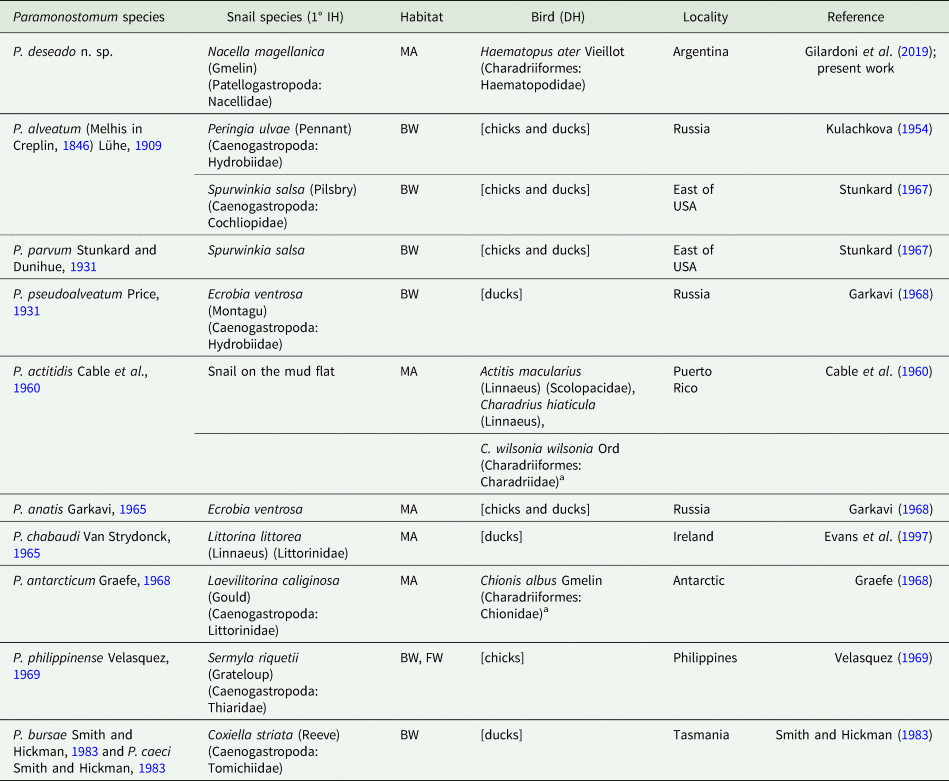
Recently, the use of molecular tools has increased the knowledge of trematodes biology, including their life cycles (Blasco-Costa et al., Reference Blasco-Costa, Cutmore, Miller and Nolan2016). Nevertheless, combining morphological and molecular approaches to study species of the family Notocotylidae Lühe, 1909 is quite uncommon (Boyce et al., Reference Boyce, Hide, Craig, Harris, Reynolds, Pickles and Rogan2012; Assis et al., Reference Assis, Lopez-Hernández, Pulido-Murillo, Melo and Pinto2019; Capasso et al., Reference Capasso, Servián, Tkach and Diaz2020; Gonchar and Galaktionov, Reference Gonchar and Galaktionov2020). Till date, DNA sequences were available for only 5 out of 21 species of notocotylids reported from vertebrate hosts in South America (Fernandes et al., Reference Fernandes, Justo, Cárdenas and Cohen2015; Capasso et al., Reference Capasso, Servián, Tkach and Diaz2020; Diaz et al., Reference Diaz, Gilardoni, Lorenti and Cremonte2020), namely Hippocrepis hippocrepis (Diesing, 1850) from Brazil (Cox1 and 28S genes), Ogmogaster antarctica Johnston, 1931 (18S and 28S genes), Notocotylus primulus Diaz et al., Reference Diaz, Gilardoni, Lorenti and Cremonte2020 from Argentina (5.8S-ITS2-28S sequence), N. chionis Baylis, 1928 and Notocotylus sp. from Argentina (ITS1-5.8S-ITS2-28S sequences) (Gilardoni et al., Reference Gilardoni, Di Giorgio, Bagnato and Cremonte2019). At present, there are life-cycle data for 10 species of Paramonostomum; in some of them, the natural definitive host is still unknown, and in others it is only proposed, but have been demonstrated neither experimentally nor by molecular tools (Table 1). They use aquatic snails belonging to multiple genera and families, mostly from freshwater environments. Cercariae leave the snail and metacercariae encyst on hard surfaces such as the gastropod shell or other submerged surfaces (Table 1). The definitive hosts are mainly Anseriformes, birds of other orders, and sometimes mammals (Barton and Blair, Reference Barton, Blair, Jones, Bray and Gibson2005; Birmani et al., Reference Birmani, Dharejo, Naz, Khan and Shaikh2013; Thebo et al., Reference Thebo, Naz, Dharejo, Siyal and Birmani2019).
Data of the life cycles of species of Paramonostomum Lühe, 1909; indicating their hosts, localities and references

BR, brackish water; DH, definitive host; FW, freshwater; IH, intermediate host; MA, marine.
a Life cycle proposed, not experimentally either by molecular tools demonstrated.
The experimental definitive hosts are indicated in brackets.
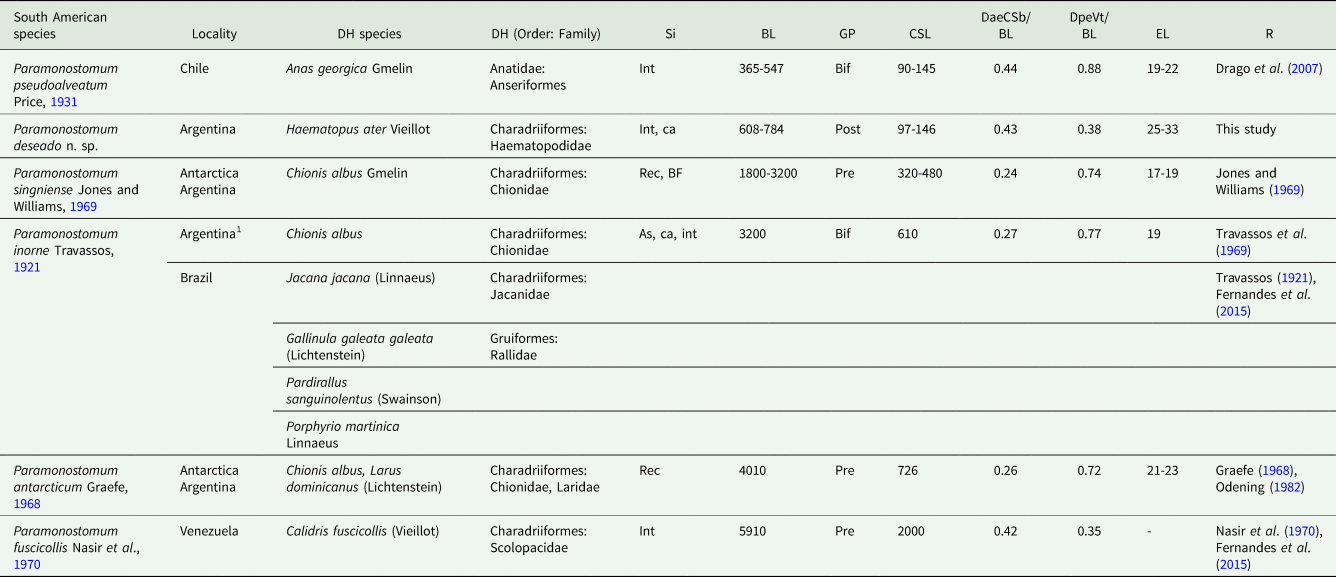
In South America there are 5 species of Paramonostomum: Paramonostomum inorne Travassos, Reference Travassos1921 parasitizing in Chionis albus Gmelin from Patagonia Argentina and other 3 species of birds from Brazil (Travassos et al., Reference Travassos, Freitas and Kohn1969); P. fuscicollis Nasir, Diaz and Guevara, 1970 parasitizing in Calidris fuscicollis (Vieillot) from Venezuela (Nasir et al., Reference Nasir, Díaz and Guevara1970), P. pseudoalveatum Price, Reference Price1931 parasitizing in Anas georgica Gmelin from Chile (Drago et al., Reference Drago, Lunaschi, Hinojosa-Sáez and González-Acuña2007) and 2 species from Antarctica Argentina: P. antarcticum Graefe, Reference Graefe1968 parasitizing in C. albus and Larus dominicanus (Lichtenstein) (Graefe, Reference Graefe1968; Odening, Reference Odening1982) and P. singniense Jones and Williams, Reference Jones and Williams1969 parasitizing in C. albus (Jones and Williams, Reference Jones and Williams1969).
The South American Black Oystercatcher Haematopus ater Vieillot (Charadriiformes: Haematopodidae) has an exceptionally wide latitudinal distribution, being resident on the western coast of South America from 7°S in Peru along the southern Pacific coast to the Magellanic islands and Cape Horn. It is also resident on the Patagonian coast from Tierra del Fuego (Argentina) and Staten Island to about 43°S (Woods, Reference Woods2014). They feed mainly on mussels and limpets on rocky coasts and secondarily consume echinoderms, crustaceans, polychaetes and fish (Povedano, Reference Povedano2016). Three digenean parasites were recently recorded parasitizing H. ater from Puerto Deseado, Argentina; 2 gymnophallids and 1 notocotylid Paramonostomum sp. (Gilardoni et al., in press). Gilardoni et al. (Reference Gilardoni, Di Giorgio, Bagnato and Cremonte2019) described the larval stages (redia, cercaria and metacercaria) of an unknown notocotylid species parasitizing the gonad and digestive gland of the limpet Nacella magellanica (Gmelin) (Gastropoda: Nacellidae); they carried out molecular studies (GenBank accession number: KF656705, ITS1) (Gilardoni et al., Reference Gilardoni, Di Giorgio, Bagnato and Cremonte2019). The aim of this work was to describe Paramonostomum deseado n. sp., based on adults from the caeca and intestine of H. ater, and we contribute to elucidate its life cycle on the Patagonian coast (Santa Cruz province), southwestern Atlantic Ocean. We provide morphological, molecular and phylogenetic data, also extending understanding of the taxonomy of the genus.
Materials and methods
Study area and sample collection
Two South American Black Oystercatchers H. ater were collected from Península Foca (47°45′S, 65°55′W), in the rocky littoral near the mouth of the estuary of Deseado River, Puerto Deseado, Santa Cruz province, Argentina, in May 2016. Birds were captured with an airsoft gun under permits provided by the Wildlife Secretary of the Santa Cruz province (Resolution Number 861/08); then they were euthanized with carbon dioxide. The shorebirds were immediately eviscerated and examined for helminths. Digeneans were isolated from the caeca and intestine. The specimens were studied alive, fixed with 4% formalin, preserved in 70% ethanol, and stained with Gömori's trichrome, hydrochloric carmine or Mayer's haematoxylin, dehydrated through ethanol series, cleared with methyl salicylate, mounted in Canada balsam, and studied under the light microscope. Drawings were made with the aid of a camera lucida of Leica DM500 (Leica, Wetzler, Germany) and photographs were taken with a Leica ICC50W camera with software connected to the microscope. The measurements are given in micrometres (μm) as range, followed by mean in parentheses. Ten gravid specimens were preserved in 96% ethanol and frozen for molecular analysis. Prevalence and intensity of infection were calculated according to Bush et al. (Reference Bush, Lafferty, Lotz and Shostak1997). Specimens of N. magellanica, which is known to act as the first intermediate host (Bagnato et al., Reference Bagnato, Gilardoni, Di Giorgio and Cremonte2015; Gilardoni et al., Reference Gilardoni, Di Giorgio, Bagnato and Cremonte2019), were sampled between February and April 2017 at different localities along the Patagonian coast encompassing most of the distribution area in the Southwestern Atlantic Ocean, from the north of Patagonia (42°05′S, 63°54′W) to the south extreme of South America (54°80′S, 68°29′W) (see Fig. 1 in Gilardoni et al., Reference Gilardoni, Di Giorgio, Bagnato, Pina, Rodrigues and Cremonte2020). Limpet specimens from each locality were collected with a spatula during the lowest tides, dissected under a stereomicroscope and rediae with cercariae/metacercariae of the notocotylid species were identified under an optic microscope. Prevalence per site was calculated (n~200 per site).
The species described in this study were compared with the 50 species of the genus, from the original descriptions and/or data in other works that could be obtained. Descriptions of 4 species from Egypt and some Asian localities could not be obtained (P. microstomum panjabensis Gupta, 1964; P. kashmiriense Fotedar and Khan, 1977; P. aegyptiacum Khadifa and El-Naffar, 1978; and an Indian species by Matta and Ahluwalia, 1977, for which neither the species name nor the original work could be found). Therefore, these 4 species were not incorporated in the comparisons. For the calculations of the ratio between the distance of the anterior end to cirrus-sac base (DaeCSb) and body length (BL) or the ratio between the distance of posterior end to the vitellaria tip (DpeVt) and BL, were taken from the original drawings. Type material (holotype and paratypes) and vouchers were deposited in the Parasitological Collection (CNP-Par) of the Instituto de Biología de Organismos Marinos (IBIOMAR), CCT CONICET-CENPAT, Puerto Madryn, Chubut province, Argentina.
DNA extraction, amplification and sequencing
Sequences were generated from DNA extracted from 1 adult using the GenEluteTM Mammalian Genomic DNA Miniprep Kit (Sigma, St. Louis, Missouri) according to the manufacturer's instructions. The ITS1, ITS2 and 28S regions of the rRNA for the adult were amplified by PCR. The PCRs were performed in a total volume of 50 μl containing 10 × buffer (200 mm Tris-HCl pH 8.4, 500 mm KCl), 0.2 mm of each dNTP, 1.5 mm MgCl2, 0.4 μ m of each primer and 1 U of platinum Taq polymerase. Two microlitres of genomic DNA was used as template. The ITS1 regions were amplified using as forward primer 18S-ITS1: 5′-CCGTCGCTACTACCGATTGAA-3′ situated 141 bp from the 3′ end of the conserved region of the ssrRNA, and as reverse primer 5.8S-ITS1: 5′-CGCAATGTGCGTTCAAGATGTC-3′, located 95 bp from the 5′ end of the 5.8S gene. The ITS2 regions were amplified using as forward primer 5.8S-ITS2: 5′-GCTCGTGTGTCGATGAAGAG-3′, situated 114 bp from the 3′ end of the 5.8S gene, and as reverse primer 28S-ITS2: 5′-AGGCTTCGGTGCTGGGCT-3′, located 34 bp from the 5′ end of the conserved region of the lsrRNA. The 28S regions were amplified using as forward primer 28S-28S: 5′-GTGAATACCCGCTGAACTTAAGC-3′, situated 16 bp from the 3′ end of the conserved region of the lsrRNA, and as reverse primer 28S-28S: 5′-TCTCCTTGGTCCGTGTTTCAA-3′, located 868 bp from the 5′ end of the conserved region of the lsrRNA. The cycling conditions included an initial denaturation at 94°C for 5 min followed by 40 cycles of 30 s at 94°C, 30 s at 54°C (annealing) for ITS1, 56°C for ITS2 and 52°C for 28S and 2 min at 72°C with a final extension step of 10 min at 72°C. Amplified PCR products were electrophoretically separated in a 1% (w/v) agarose gel stained with gel green. Negative controls for the PCR were always run to control for contamination. Relevant bands were sent for purifying and sequencing (MacroGen, Korea). All sequences have been deposited in GenBank. The other available 28S sequences of the specimens of family Notocotylidae from GenBank were taken to compare with the species here described (Table 1 from Capasso et al., Reference Capasso, Servián, Tkach and Diaz2020) and Catatropis onobae Gonchar and Galaktionov, Reference Gonchar and Galaktionov2021 (Gonchar and Galaktionov, Reference Gonchar and Galaktionov2021).
Sequence alignments and phylogenetic analysis
The concatenated alignments were performed using MAFFT software (MAFFT software, available at http://www.ebi.ac.uk/Tools/msa/mafft/) and MEGA X (Kumar et al., Reference Kumar, Stecher, Li, Knyaz and Tamura2018). Phylogenetic and molecular evolutionary analysis was conducted on the aligned nucleotide sequences of 28S and were inferred by both maximum-likelihood (ML) method using MEGA X and by Bayesian inference (BI) using MrBayes program (v3.2.6, available at http://www.phylogeny.fr/one_task.cgi?task_type=mrbayes, Huelsenbeck and Ronquist, Reference Huelsenbeck and Ronquist2001; Dereeper et al., Reference Dereeper, Guignon, Blanc, Audic, Buffet, Chevenet, Dufayard, Guindon, Lefort, Lescot, Claverie and Gascuel2008, Reference Dereeper, Audic, Claverie and Blanc2010). For the ML tree, the percentage of trees in which the associated taxa clustered together is shown next to the branches. Initial trees for the heuristic search were obtained automatically by applying Neighbor-Joining and BioNJ algorithms to a matrix of pairwise distances estimated using the maximum composite likelihood (MCL) approach, and then selecting the topology with superior log-likelihood value. A discrete gamma distribution was used to model evolutionary rate differences among sites. There were a total of 887 positions in the final dataset. Evolutionary analyses were conducted in MEGA X. For the BI, to determine the evolution model that gave the best fit to our dataset, the program jModeltest 2.1.1 (Darriba et al., Reference Darriba, Taboada, Doallo and Posada2012) was employed, with model selection based on the Akaike information criterion (AIC). Results indicated that the general time reversible model with an estimate of gamma-distributed among-site rate variation (GTR + G) was the most appropriate. The number of substitution types was fixed to 6. The 4 × 4 model was used for substitution, while rates variation across sites was fixed to ‘gamma’. Four Markov Chain Monte Carlo (MCMC) chains were run for 10 000 generations, sampling every 10 generations, with the first 250 sampled trees discarded as ‘burn-in’. Finally, a 50% majority rule consensus tree was constructed.
Results
Notocotylidae Lühe, 1909
Paramonostomum Lühe, 1909
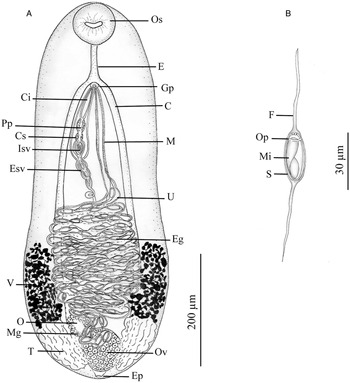
Paramonostomum deseado n. sp. (Fig. 1A–B)
Drawings of Paramonostomum deseado n. sp. (Digenea: Notocotylidae) from the South American Black Oystercatcher from Puerto Deseado, Santa Cruz province, Argentina. (A) Whole specimen, ventral view; (B) Egg detail. C: caeca, Ci: cirrus, Cs: cirrus-sac, E: esophagus, Eg: eggs, Ep: excretory pore, Esv: external seminal vesicle, F: filament, Gp: genital pore, Isv: internal seminal vesicle, M: metraterm, Mi: miracidium, Mg: Mehlis's gland, O: Öotype, Op: operculum, Os: oral sucker, Ov: ovary, Pp: pars prostatica, S: shell, T: testes, U: uterus, V: vitellaria.

Description
Based on 18 stained whole-mounted specimens: Body elongated, attenuated anteriorly, rounded posteriorly, 683 (608–784) long by 243 (212–279) maximum wide; tegument with tiny spines. Head-collar, ventral papillae and ridges absent. Oral sucker subterminal, 73 (67–88) long by 76 (71–83) wide. Pharynx absent. Oesophagus 66 (34–90) long. Caeca long, simple, terminating at the posterior margin of testes level, without uniting (Fig. 1A). Ratio of body length to oral sucker length 1: 9 (8–11). Ventral sucker absent. Testes 2, feebly lobed, symmetrical, extracaecal, at the posterior extremity; right testis 99 (74–119) long by 61 (51–75) wide; left testis 100 (66–131) long by 58 (41–76) wide. External seminal vesicle well-developed, occupying space between posterior ends of cirrus-sac to the anterior part of the uterus (Fig. 1A). Cirrus-sac median, straight, occupying from intestinal bifurcation to some distance from the anterior part of the uterus, 128 (97–146) long by 30 (25–37) wide, enclosing saccular seminal vesicle, 25 (14–49) long by 18 (13–23) wide, prostatic complex and unspined cirrus. Genital pore median, immediately postbifurcal (Fig. 1A). Ratio between distance from anterior end to the base of cirrus-sac/body length = 0.43. Ovary slightly lobed (in vivo, but in fixed specimens seems rounded with smooth edges), intercaecal, intertesticular, 73 (63–94) long by 63 (51–72) wide. Uterine seminal receptacle not seen. Öotype surrounded by Mehlis' gland median, pre-ovarian. Uterus coils transverse between the anterior edge of Mehlis' gland and external seminal vesicle in intercaecal fields, 17 (14–19) uterine loops, 3–4 previtelline; the ratio between the distance from the posterior end to vitellaria tip/body length = 0.38. Metraterm well-developed, parallel to cirrus-sac (Fig. 1A). Vitellarium in 2 rows of follicles in the posterior third of body lateral to caeca, extending from about third uterine loop to the anterior edge of the testes; left band of vitelline follicles 142 (107–179) long; right band of vitelline follicles 133 (92–163) long. Eggs with long filament at each pole, embryonated, operculate (Fig. 1B), 30 (25–33) long by 13 (12–15) wide. Polar filaments 48 (32–57) long. Excretory pore subterminal, excretory vesicle not seen.
Taxonomic summary
Type host: South American Black Oystercatcher H. ater Vieillot (Charadriiformes: Haematopodidae).
Type locality: Península Foca (47°45′S, 65°55′W), Puerto Deseado, Santa Cruz province, Argentina.
Site of infection: Mainly caeca, also intestine.
Prevalence and intensity: 100% (2/2); 11–1000.
Deposited specimens: CNP-Par 199 (holotype), CNP-Par 200 (paratypes), CNP-Par 168 and CNP-Par 201 (vouchers).
GenBank accession numbers: MK713356 (adult), KF656705.1 (metacercariae from redia).
ZooBank access: LSID: urn:lsid:zoobank.org:pub:FC00061F-2EC4-41DC-82A2-4823DF5013DD
Etymology: The specific epithet ‘deseado’ refers to the Patagonian city where the parasite was found: Puerto Deseado, Santa Cruz province, Argentina.
Remarks
Paramonostomum deseado n. sp. was compared with 50 of the 54 described species of the genus. The family Notocotylidae, including the genus Paramonostomum needs an exhaustive taxonomic review with morphological and molecular data. Within the genus, there is a wide variety of shapes and sizes and we grouped the species following these characters (Harwood, Reference Harwood1939; McDonald, Reference McDonald1981). We separate the species into 4 groups according to shape and from smallest to largest size (see Supplementary Table S1). ‘Oval group’: specimens with an oval, rounded shape, similar to the type species. The size range varies between 250 and 2400 μm; they are the smallest (see Supplementary Table S1). ‘Pyriform group’: pear-shaped specimens, narrower anteriorly and wider posteriorly. The size range varies between 322 and 2480 μm (see Supplementary Table S1). ‘Elongate group’: specimens with an elongated shape, approximately the body width is maintained from the oral sucker to the posterior end, although in some cases, from the posterior end of the cirrus-sac towards the oral sucker they are slightly narrower. The size range varies between 597 and 5760 μm (see Supplementary Table S1). ‘Overlong group’: specimens with a well-elongated shape, much more elongated than the previous shape, approximately the body width is maintained. The size range varies between 1348 and 6900 μm; they are the largest (see Supplementary Table S1). According to this classification, P. deseado n. sp. would belong to the ‘Elongate group’ with a size range between 608 and 784 μm. The species that are near to this range (597–1130 μm) are: P. caeci Smith and Hickman, Reference Smith and Hickman1983 from Australia, P. actitidis Cable et al., Reference Cable, Connor and Balling1960 from Caribbean and P. alveoelongatum Filimonova, 1971 from Russia (Cable et al., Reference Cable, Connor and Balling1960; Smith and Hickman, Reference Smith and Hickman1983; Filimonova, Reference Filimonova1985). They differ in the genital pore position, P. deseado n. sp. and P. actitidis share postbifurcal position, P. caeci has a prebifurcal position, and P. alveoelongatum a bifurcal position (see Supplementary Table S1). Therefore, the new species would resemble P. actitidis in the shape, the body length, the location of the genital pore and the ratio of the extension of the cirrus-sac and the vitellarium regarding the body length (Cable et al., Reference Cable, Connor and Balling1960). And both species share the same order Charadriiformes and the marine habitat on the Atlantic Ocean (although Caribbean birds also occupy other habitats, such as fresh- and brackish waters). They differ by the length of the cirrus-sac, which is shorter in the new species (97–146 vs 280–430 μm in P. actitidis), and the size of the eggs, which is larger in the new species (25–33 vs 18–20 μm in P. actitidis). Comparing P. deseado n. sp. with the 6 South American species, P. pseudoalveatum (Chile) would belong to the ‘Oval group’, at the other extreme P. fuscicollis (Venezuela) to ‘Overlong group’ and P. deseado n. sp., P. signiense (Antarctica), P. inorne (Brazil, Patagonia) and P. antarticum (Antarctica) would belong to ‘Elongate group’ (Graefe, Reference Graefe1968; Jones and Williams, Reference Jones and Williams1969; Travassos et al., Reference Travassos, Freitas and Kohn1969; Drago et al., Reference Drago, Lunaschi, Hinojosa-Sáez and González-Acuña2007; Fernandes et al., Reference Fernandes, Justo, Cárdenas and Cohen2015) (see Supplementary Table S1). Comparing these 4 species, we can mainly observe the differences in body length, the new species is distinguished by the smallest size among them, less than 1800 μm (608–784 μm), while the other 3 species vary between 1800 and 4010 μm (see Table 2 and Supplementary Table S1).
Comparison of South American Paramonostomum species

As, air sacs; BL, body length; ca, caeca; BF, bursa of Fabricius; CSL, cirrus-sac length; DaeCSb/BL, ratio distance from anterior end to cirrus-sac base/ body length; DH, definitive host; DpeVt/BL, ratio distance from the posterior end to vitellaria tip/ body length; EL, egg length; GP, genital pore; Int, intestine; L, length; R, references; rec, rectum.
aSpecies found in a marked Chionis albus Gmelin in Patagonia, see Travassos et al. (Reference Travassos, Freitas and Kohn1969).
Measurements are given in micrometres.
Contribution to the life cycle
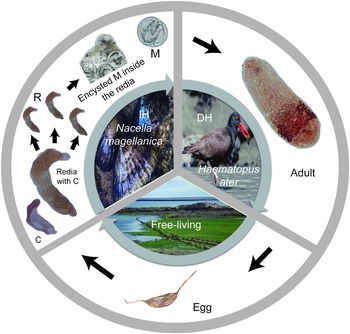
ITS1 sequences of P. deseado n. sp. adults from H. ater and metacercariae from inside rediae from N. magellanica (KF656705.1) were identical (Figure 2). Rediae contained monostome cercariae without eye-spots and with a small and rounded tail and spherical and well-developed encysted metacercariae.
Life cycle of Paramonostomum deseado n. sp. (Digenea: Notocotylidae) in the South American Black Oystercatcher from Puerto Deseado, Santa Cruz province, Argentina. C: cercaria, DH: definitive host, IH: intermediate host, M: metacercaria, R: rediae. Photo of the South American Black Oystercatcher taken by Darío Podestá.

From the 9 sampled sites in this study (Fig. 1 in Gilardoni et al., Reference Gilardoni, Di Giorgio, Bagnato, Pina, Rodrigues and Cremonte2020), P. deseado n. sp. in N. magellanica (first and second intermediate host) was present on 2 sites, (1) San Julian Port, a beach about 400 km from Puerto Deseado, with a prevalence of 1.80% (n = 167), and (2) Ensenada Bay, Ushuaia, Tierra del Fuego province, a beach located in the Beagle Channel, the most southern site, with a prevalence of 0.50% (n = 199).
Molecular and phylogenetic analysis
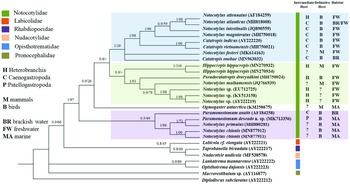
The PCR amplification of the rRNA from the adult of P. deseado n. sp. gave a product of 2389 bp comprising 109 bp of the final sequence of 18S, 832 bp of complete ITS1, 162 bp of complete 5.8S sequence, 282 bp of complete ITS2 and 1004 bp of partial 28S sequence (Fig. 3). The 28S tree topologies resulting from the ML and BI analysis were identical with BI producing higher branch support (Fig. 3). In general, all members of the family Notocotylidae included in our analysis formed a monophyletic group; however, the genus Notocotylus Diesing, 1839 which is the richest, formed a polyphyletic group. The isolates obtained in this study appeared on the tree closely related to the Argentinian species Notocotylus primulus from Lophoneta specularioides (King) and N. chionis from C. albus. These species grouped with P. anatis from Ukraine and, constitute a well-supported clade by ML and BI. Two other well-supported clades by BI were distinguished on the tree; one of them included species of Notocotylus and Catatropis Odhner, 1905 genera and another included species of Notocotylus, Hippocrepis and Pseudocatatropis Kanev and Vassilev, 1986 genera.
Phylogenetic relationships between Paramonostomum deseado n. sp. and other taxa of the superfamily Pronocephaloidea, as inferred from sequences of partial 28S rRNA (887 bp) analysed by ML and BI methods. Nodal support is indicated above internodes as BI/ML; ML values indicated by a dash disagree with BI with a very low nodal support. Sequence of Diplodiscus subclavatus (GenBank Acc. N°: AY222212) was included as an outgroup.

Discussion
Our results extend the richness of the genus Paramonostomum to 54 nominal species; this comprises the first description of a notocotylid digenean from H. ater and the second report of a species of this genus in Argentina. This is the first record of a South American notocotylid life cycle with natural intermediate and definitive hosts (not experimental), that was morphologically and molecularly corroborated. Further, it is the first reported notocotylid species having an abbreviated life cycle where the cercaria encysting inside the redia. Comparing morphologically to the species of the genus Paramonostomum, 50 of the 53 nominal species at present were considered. We propose 4 groups: ‘Oval’, ‘Pyriform’, ‘Elongate’ and ‘Overlong’ considering the body shape. The species were approximately reclassified (grouped) in the basis of shape and size following Harwood (Reference Kulachkova1939) and McDonald (Reference McDonald1981), the latter author published the last taxonomic key of this genus; the key included information collected from papers from 1846 to 1981; however, he considered 16 of the 33 species known and, he also assessed the body shape as the first classificatory character. Since then, isolated descriptions have been published mostly from Asia (India and Pakistan); however, to date, there is no complete review of the genus. This review would be essential to clarify the status of the genus including their molecular characterization. Currently, there are only available sequences of 2 species from 54 of the genus in the GenBank, and 16 (28S) and 5 (ITS1) rRNA available sequences of notocotylid species (Sasaki et al., Reference Sasaki, Kobayashi, Yoshino, Asakawa and Nakao2021; Gonchar and Galaktionov, Reference Gonchar and Galaktionov2022).
As far as is known, in the life cycles of the rest of the species of the genus and in the majority of notocotylids, the cercariae emerge from the snail and encyst on hard surfaces such as operculum, shell or in the substratum (Kulachkova, Reference Kulachkova1954; Cable et al., Reference Cable, Connor and Balling1960; Stunkard, Reference Stunkard1967; Garkavi, Reference Garkavi1968; Graefe, Reference Graefe1968; Velasquez, Reference Velasquez1969; Smith and Hickman, Reference Smith and Hickman1983; Evans et al., Reference Evans, Irwin and Fitzpatrick1997). Studies of the life cycles of some notocotylid species that recorded the same snail as first and second intermediate hosts but it is not detailed where the metacercariae were found, e.g., Pseudocatatropis joyeuxi Kanev and Vassilev, 1986 encystment occurs ‘in the very body of the mollusc’ (Joyeux, Reference Joyeux1922) or ‘inside the first intermediate host’ (Odening, Reference Odening1966), Ps. dvoryadkini Izrailskaia, Besprozvannykh, Tatonova, Nguyen and Ngo, Reference Izrailskaia, Besprozvannykh, Tatonova, Nguyen and Ngo2019 is described that ‘which do not leave the intermediate host and are encysted there’ (Izrailskaia et al., Reference Izrailskaia, Besprozvannykh, Tatonova, Nguyen and Ngo2019). Gilardoni et al. (Reference Gilardoni, Di Giorgio, Bagnato and Cremonte2019) described the larval stages, rediae with cercariae and metacercariae of a notocotylid from N. magellanica from Puerto Deseado. In the present work, we have corroborated by molecular tools that this larval stage corresponds to the adult of P. deseado n. sp. The internal encystment of metacercariae inside the rediae was corroborated in different sampling sites along the Patagonian coast. The transmission seems to be little affected because many notocotylid species use the same snail as the first and second intermediate host (encysting outside the redia) (Kulachkova, Reference Kulachkova1954; Cable et al., Reference Cable, Connor and Balling1960; Dollfus, Reference Dollfus1966; Stunkard, Reference Stunkard1967; Garkavi, Reference Garkavi1968; Graefe, Reference Graefe1968; Velasquez, Reference Velasquez1969; Winterbourn, Reference Winterbourn1973; Smith and Hickman, Reference Smith and Hickman1983; Evans et al., Reference Evans, Irwin and Fitzpatrick1997; Hechinger, Reference Hechinger2012). However, the internal encystment (inside the redia) could result in energy optimization for the parasite, especially if the oystercatcher feeds on a limpet that strongly sticks to the substrate and has a hard shell.
Ten species (larval stages) of the genus Paramonostomum were previously recorded inhabiting marine and brackish habitats (Table 1), P. alveatum (Melhis in Creplin, Reference Creplin1846) Lühe, Reference Lühe and Brauer1909; P. parvum Stunkard and Dunihue, Reference Stunkard and Dunihue1931; P. pseudoalveatum Price, Reference Price1931; P. actitidis; P. anatis; P. chabaudi Van Strydonck, Reference Van Strydonck1965; P. antarcticum; P. philippinense Velasquez, Reference Velasquez1969; P. bursae Smith and Hickman, Reference Smith and Hickman1983 and P. caeci (Kulachkova, Reference Kulachkova1954; Cable et al., Reference Cable, Connor and Balling1960; Stunkard, Reference Stunkard1967; Garkavi, Reference Garkavi1968; Graefe, Reference Graefe1968; Velasquez, Reference Velasquez1969; Smith and Hickman, Reference Smith and Hickman1983; Evans et al., Reference Evans, Irwin and Fitzpatrick1997). None of these species has abbreviated life cycles, i.e., cercariae encyst within the redia. Graefe (Reference Graefe1968) recorded rediae with cercariae of P. antarticum parasitizing the snail Laevilitorina caliginosa (Gould); however, he did not provide convincing information about the metacercariae, only 1 cyst was found in the fixed material of the snail (Graefe, Reference Graefe1968). Abbreviated life cycles could be explained by the environmental instability, where the digeneans can adapt their transmission strategies in temporally unstable environments (Holton, Reference Holton1984). The scarce availability of a determinate host, such as migratory birds or hosts with fluctuations in their abundances (Holton, Reference Holton1984) and, the extreme environmental conditions in high latitudes, could affect the transmission of a free-living stage by low temperatures (Skirnisson and Galaktionov, Reference Skirnisson and Galaktionov2002). In the particular case of P. deseado n. sp., the availability of hosts would not be a problem because both black oystercatcher and limpet are abundant species and present all year on the Patagonian coast (Aranzamendi et al., Reference Aranzamendi, Bastida and Gardenal2011; Woods, Reference Woods2014). The rocky intertidal shore with low slopes and a great tidal range where the life cycle of P. deseado n. sp. occurs could be considered an unstable environment due to the desiccation during low tides, the temperature fluctuations, high temperatures in summer (January is 28°C), and low temperatures in winter (July is −2°C), mean annual temperature reaches 9.8°C (http://www.patrimonionatural.com/HTML/provincias/santacruz/riadeseado/clima.asp). Even though the temperature fluctuations are not extreme (freezing and defrosting) as occur in higher latitudes, these could affect cercarial emergence so that cercariae encysting inside rediae could be a benefit.
Phylogenetic analysis placed P. deseado n. sp. in the same clade as P. anatis (the only 2 species of the genus sequenced) and it is grouped with species of Notocotylus recorded in Argentina; in fact, the most closely related species, N. primulus was recorded in the same study area (Diaz et al., Reference Diaz, Gilardoni, Lorenti and Cremonte2020). The genus Notocotylus appeared as a polyphyletic group. Notocotylus and Paramonostomum are similar in their diagnosis based on morphology, despite great differences such as the absence of ventral tegumental papillae in Paramonostomum. These morphological differences are not reflected in the molecular separation of notocotylid clades. The phylogenetic results show the importance of other factors to delimitate species (which do not agree with morphological distinction), specifically hosts involved in life cycles and type of habitat. On our tree (Fig. 3), 2 well-supported clades united species with molluscan hosts mainly of subclass Caenogastropoda and subclass Heterobranchia. Recent works recorded this separation regarding molluscan intermediate host (Assis et al., Reference Assis, Lopez-Hernández, Pulido-Murillo, Melo and Pinto2019; Gonchar et al., Reference Gonchar, Jouet, Skírnisson, Krupenko and Galaktionov2019; Capasso et al., Reference Capasso, Servián, Tkach and Diaz2020; Gonchar and Galaktionov, Reference Gonchar and Galaktionov2021). Further, both clades include mainly freshwater species with the exception of 2 species from brackish habitats. There is 1 species Ogmogaster antarctica Johnston, 1931, whose intermediate host is unknown and its definite host is a whale (Fraija-Fernández et al., Reference Fraija-Fernández, Olson, Crespo, Raga, Aznar and Fernández2015), is not included in any clade. A third clade includes marine and brackish species, and that uses birds as definitive hosts. This clade includes the new species, P. anatis from Ukraine and 2 species of the genus Notocotylus recorded in Argentina. In this case, the separation based on the intermediate host is not clear, because only the intermediate hosts for the 2 Paramonostomum species are known; P. deseado n. sp. uses a snail of the order Patellogastropoda and P. anatis uses a snail of order Caenogastropoda (Fig. 3).
This family lacks strong diagnostic characters to define genera; in turn, it is extremely necessary to carry out molecular studies of a major number of species considering the ecology of the hosts and type of habitat. Indeed, the family needs a dramatic new classification. The phylogenetic position of many notocotylid species is not resolved, but the elucidations of its life cycles with the addition of molecular genetic data are the correct way. Finally, our results contribute to resolving the notocotylid phylogeny probably directed by a combination of factors such as the type of habitat, and the intermediate and definitive hosts.
Supplementary material
The supplementary material for this article can be found at https://doi.org/10.1017/S0031182022001159.
Acknowledgements
The authors thank Cristian Ituarte and Eliana Lorenti for their help in field and laboratory work; Alejandro Travaini for his help in the field sampling; Darío Podestá for the Black oystercatcher photo; Nadir Ali Birmani, Vasyl Tkach, Kirill V. Galaktionov and Yoraslav Syrota for providing some literature and, especially Y. Syrota and V. Tkach for help in translating some parts of it from Russian. They also thank Néstor Cazzaniga for his help with clarifications of zoological nomenclature. The authors are grateful to the 3 anonymous reviewers who helped to improve the paper. Field works were conducted with the permission of the Wildlife Secretary of Santa Cruz Province (N° Resolution 861/08).
Author's contributions
EB wrote the manuscript. CG and FC conceived and designed research and analysed host samples. EB and FC determined the parasites morphologically. CG performed molecular analysis and CG and JJL performed the phylogenetic analysis. All authors read and approved the paper.
Financial support
The study was supported by Proyectos de Investigación Plurianuales (PIP)- Consejo Nacional de Investigaciones Científicas y Técnicas (CONICET) (FC, N° 11220200102767CO); and by the Agencia Nacional de Promoción Científica y Tecnológica- Proyecto de Investigación Científica y Tecnológica (CG, PICT N° 2019-00837; FC, PICT N° 2020-2120). CG and FC are members of CONICET.
Conflicts of interest
The authors declare there are no conflicts of interest.
Ethical standards
Not applicable.