

1. Introduction
The expositions and proposals contained in other articles in the special issue have focused primarily on advanced, industrial economies. Thereby, they imply a concept of social protection systems such as are to be understood in a country such as the United Kingdom. This article breaks from this approach, and it does so in four ways. First, it is concerned with societal ageing in a country that, despite its aspirations to do so in the near future, has not yet achieved high-income status, even if its economy has been growing rapidly in the past few decades. Second, it is concerned with societal ageing in a country where the population is ageing far faster than has been the case in most Western industrialised countries, even if it has not yet reached their current levels of age dependency. Third, it is concerned with a country where systems of social protection as organised and directed by the state are very much less developed than in the mainly Western developed economies, and one where responsibility for the provision both of income and care lies predominantly with the family. Fourth, although the country is classified as a ‘democracy’, its politics are not like those of most of the Western industrialised countries. Its system displays populist traits and these, in turn, influence how, and which, decisions are made. The interest, thus, becomes not merely an examination of the ‘economics of’, but also one of the ‘political economy of’ ageing.
Although the case of Malaysia brings out contrasts, it remains the case that similarities with countries like the United Kingdom can be observed. Indeed, the opportunities for policy-learning might flow in both directions.
The remainder of this article covers five parts. Section 2 lays out the economic and demographic development of Malaysia and sets the context for the development of policy. Section 3 describes the two components of social protection most relevant to population ageing—respectively, the system providing for income for those who are in retirement and the system for providing care for the frail elderly. Section 4 lays out recent policy developments under each of those headings, while section 5 sketches the manner in which populist politics have shaped these developments. The penultimate section considers the scope for learning by policymakers both in Malaysia and outside. Finally, section 6 concludes the article.
2. The economic and social development context
Malaysia gained its independence from the United Kingdom in 1957. Initially, under the name of the Federation of Malaya, the country included Singapore until the latter opted for full independence in 1965. The country is ethnically highly diverse, but the Bumiputera make up some 70 percent of the total population, and the Malays, as a component of that group, about 57 percent, with the remainder of the group being made up of other indigenous people. Chinese make up nearly 23 percent and Indians just under seven percent of those living in the country. The country is also religiously diverse. The official religion of Malaysia is Muslim, and its adherents represent just under two-thirds of the total population.Footnote 1 Buddhists make up nearly one-fifth, Christians just under one-tenth and Hindus rather over 6 percent. There are some obvious overlaps between ethnicity and religion—with ethnic Malays being predominantly Muslim, ethnic Chinese being Buddhist or Christian and ethnic Indians being Hindus.
The population of Malaysia has increased from around 7 mn at the time of independence to nearly 35 mn today. It is projected to rise to 42 mn by 2040. Life expectancy, which was only about 53 at the time of independence, is now over 77 (Table 1).Footnote 2 The economy of Malaysia also grew dramatically over the post-independence years. Real per capita GDP was only about $1,300 at the time of independence; it is about $13,000 today. Malaysia, which is currently classified by the World Bank as ‘upper middle-income status’, aspires to reach ‘high-income’ status by or before the year 2030.Footnote 3
Comparisons of life expectancy and healthy life expectancy at 60 (years)

Table 1. Long description
The table is organized into seven columns. The first column lists the metrics, while the subsequent columns are grouped by country (Malaysia, U K, and Germany), each subdivided into Male and Female.
* Life expectancy at 60 (years):
- Malaysia: Male 17.35, Female 19.47.
- U K: Male 21.97, Female 24.41.
- Germany: Male 21.35, Female 24.87.
* Healthy life expectancy at 60 (years):
- Malaysia: Male 13.31, Female 14.46.
- U K: Male 16.9, Female 18.17.
- Germany: Male 16.38, Female 18.26.
Source: W H O.
Malaysia has a ‘welfare state’ but, relative to that of most developed western economies, it is underdeveloped. Those who have studied it have usually tried to categorise it in the terms laid out by, mainly, ‘western’ analysts, although they have usually sought to apply concepts developed by the latter when they have been evaluating East Asian varieties of welfare provision (Sumarto, Reference Sumarto2020; Han, Reference Han2023; Jaafar, Reference Jaafar2025). There is broad agreement that the welfare state in Malaysia has involved governments embedding more formal social programmes into already long-standing informal welfare networks. The result is a hybrid system that balances market solutions with selected, targeted policies to address more Malaysian-specific inequalities and problems (WB, 2026). A form of pension provision for formal sector workers predates independence. What is more, such workers now receive certain employment-related benefits including cover for industrial injury and unemployment. Over the last quarter of a century, a large number of measures to assist lower income groups have been put in place. These include both the provision of healthcare and a plethora of cash payments for those with no alternative incomes at all. Nevertheless, reliance on the family, both for income support and for the provision of assistance to the frail elderly, remains a critical component of the system. Expenditure on welfare as a share of GDP remains much lower than in most developed Western countries (OECD, 2025).
Malaysia’s population is ageing, and it is ageing fast. Fertility rates in Malaysia, which stood at around 6.5 at the time of independence, are now only 1.5 and, so, well below the 2.1 replacement rate. The proportion of the population aged 65 years and above is still below that of most Western European countries, but it is catching up. A useful comparison is with Germany—recognised as one of Europe’s ‘aged’ societies—where it took 70 years from 1950 for the share of the population 65 and older to rise from 9 to 22 percent. By contrast, Malaysia has yet to achieve the 9 percent level—in 2025, it was only about 8 percent—but it is projected to reach 22 percent within 25 years.
The government is cognisant of the ageing problem.Footnote 4 It has issued a series of ‘ageing strategies’, the first of which was published in 1995 and the second in 2011.Footnote 5 In the context of the COVID pandemic, but also against a background of considerable internal political turmoil that involved changes of government and a succession of prime ministers, no further overarching documents were issued until 2025. The new document was entitled the Senior Citizens Action Plan or PTWE. It was complemented by a National Ageing Blueprint (NAB)—guiding the steps needed to address the challenges ageing presented.Footnote 6 The principles of the NAB were reiterated in the 13th Malaysia Plan—the latest of the five development plans issued by the government since independence—that was issued in the same year.Footnote 7
3. Social protection in Malaysia
The NAB and the 13th Malaysia Plan made special reference to two areas towards which policy would have to be directed. These were ensuring the provision of adequate retirement incomes and the building up of a system of care for the frail elderly.
Pension provision in Malaysia is limited. The principal form of retirement saving in Malaysia is via the Employees Provident Fund (EPF), which covers employees in the private sector. The EPF was introduced before Malaysia’s independence—in 1951, under the auspices of the British colonial regime. It differs from many other funded pension schemes in that, as well as providing for resources at retirement, a proportion of contributions go into a separate account from which they can be accessed to meet certain defined needs. These include educational purposes, house building/purchases, meeting medical costs and financing participation in the Haj (WB, 2018). Hence, its name is ‘provident fund’.Footnote 8
A separate, but much smaller scheme covers employees in the public sector. This does provide pensions in the form of annuities.Footnote 9 It is non-contributory and is financed out of general government revenue.
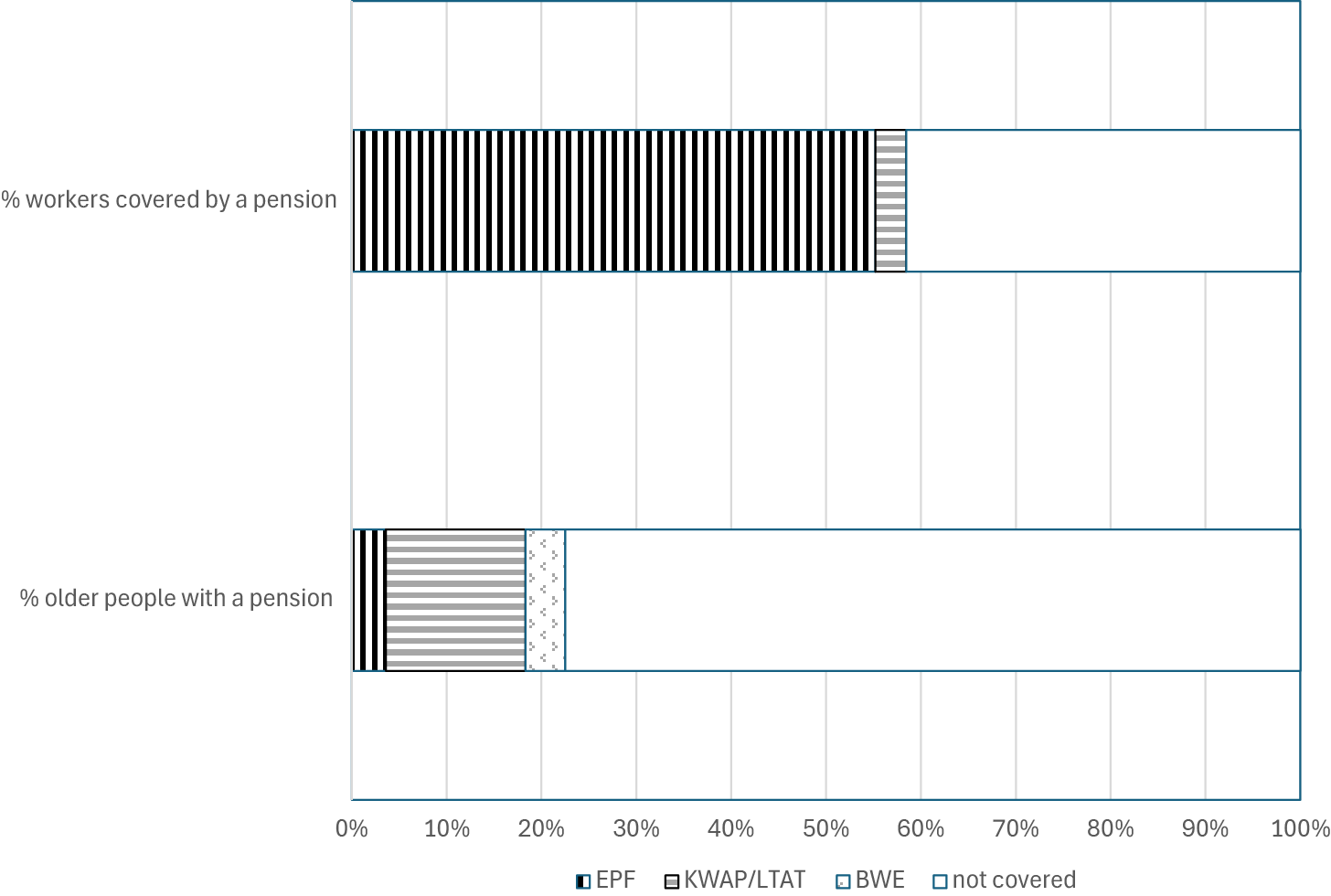
The EPF is open to those who have a contract of employment, and thus it excludes the self-employed and those deemed to be ‘contract workers’. Until recently, it also excluded those who are not Malay nationals. Professionals, such as doctors and lawyers, are outside its scope, so are most people working in the agricultural sector. Small businesses that are made up of family workers are largely outside its scope. Moreover, many employers of small businesses will often offer their workers a slightly higher payment than they would to those who declare themselves to be contract workers for tax purposes—thereby reducing the taxes they have to pay. According to most estimates, coverage of the EPF is probably not more than about 40 percent of the non-public sector workforce. Total coverage of all provisions is well below 60 percent of all people working (Chart 1).
Pension coverage in Malaysia. EPF: Employees Provident Fund. KWAP/LAT: the Public Sector Pension Scheme and the Armed Forces Pension Scheme or Lembaga Tabung Angkatan Tentera (LTAT). BWE: Bantuan Warga Emas is a targeted, non-contributory social pension for people aged over 60 years. Source: EPF and other providers, own calculations. Workers refer to all at work, whether in the formal or informal sector

Chart 1. Long description
The chart features a horizontal x-axis measuring percentage from 0 to 100 percent in increments of 20.
Top bar: percentage workers covered by a pension.
- E P F (vertical stripes) covers approximately 55 percent.
- K W A P forward slash L T A T (horizontal stripes) covers a small sliver of about 3 percent.
- B W E (dotted pattern) is not visible in this bar.
- Not covered (solid white) accounts for the remaining 42 percent.
Bottom bar: percentage older people with a pension.
- E P F (vertical stripes) covers approximately 3 percent.
- K W A P forward slash L T A T (horizontal stripes) covers approximately 15 percent.
- B W E (dotted pattern) covers approximately 5 percent.
- Not covered (solid white) accounts for the remaining 77 percent.
The EPF is financed by contributions from both the employer and the employee at a rate of 11 and 13 percent, respectively. Contributions are exempt from tax. The system guarantees a nominal yield of 2.5 percent, although it is unclear that this guarantee has ever been called upon.
The EPF does not provide a pension but a lump sum that is paid out on reaching the age of 60. Working beyond 60 is comparatively rare in Malaysia. It stood at only 36 percent, compared with 67 percent in Germany—and this held even for men—54 percent against 71 percent. Moreover, many of those working in old age are in the informal sector, either in agriculture or in services and often in family-owned businesses (Senadjki and Mansor, Reference Senadjki and Mansorn.d.).
What is more, the amounts saved via the EPF by those currently reaching retirement age are small. Even if that money were to be drawn down in stages, it would last but 4–5 years (Casey and Mustafa, Reference Casey and Mustafa2024). Actions taken during the COVID pandemic mean that the amount available at retirement is likely to have been reduced yet further. The government permitted contributors to make special drawdowns from their pension accounts, regardless of their age. Effectively, the EPF functioned as a substitute for the sort of short-time working or supplementary income support schemes to be found in many of the advanced economies of the West (Casey and Mayhew, Reference Casey and Mayhew2023). Four rounds of withdrawals were permitted, resulting in the assets in the EPF funds being diminished by about 15 percent of their value at the start of 2020. Concerns about the implications of the programmes on future well-being in old age were the principal reasons why, despite calls by some for further rounds of withdrawal, a stop was put to the policy in March 2022 (Casey and Mustafa, Reference Casey and Mustafa2024).
Once EPF savings have been exhausted, older people are reliant on the support provided by their families, especially their adult children. In extremis, and in the absence of sufficient income, older people must rely on means-tested allocations from the government—mainly from the central government under its Elderly Assistance (Bantuan Warga Emas or BWE) programme, sometimes with supplements from state governments. The sums involved are small—under BWE, they are MR 600 (or about £110) per month.Footnote 10
For the old who are unable to care for themselves—because of physical or cognitive impairments—responsibility lies almost entirely with ‘the family.’ The central government, and to a much more limited extent some of the state governments, finance assistance for the frail elderly (Table 2), but the extent of the provision these make is small.
Government programmes for the frail elderly in Malaysia

Table 2. Long description
The table consists of three columns: Types of coverage, Public facilities and programmes, and Nature of assistance.
1. Cash and in-kind benefits:
- Respite care: Services to caregivers or guardians to place the elderly temporarily in an institution due to job demands or other reasons.
- Transportation services: Facilities for elderly people living alone, with 9 centres located in individual states.
2. Institutional care:
- Residential homes: 10 units in Peninsular Malaysia and 5 in East Malaysia.
- Homes for the chronically ill: 2 units.
3. Domiciliary care:
- Elderly Activity Centres: 190 day-care centres across the country.
- Respite care: Refers to the description above.
- Transportation services: Refers to the description above.
- Home help programme: Grants of R M 400 (approximately 100 dollars) per month to volunteers who visit and perform small tasks of assistance.
Source: Hamdy and Yusuf, Reference Hamdy and Yusuf2018; Department of Social Welfare publications; own research.
It is difficult to measure how much public expenditure is directed towards aged-care services. A study by the World Bank in 2020 found that the budgets of the central government and of state governments were insufficiently transparent as to allow a proper assessment to be made, but the amount was small—perhaps only 0.1 percent of GDP (WB, 2020). Comparable figures for Germany, with its long-term care insurance programmes, were of the order of 2.0 percent.Footnote 11 What is more, the limited public financing that existed was heavily skewed towards institutional care rather than home- or community-based care (WB, 2020).
There are care homes and organisations run by for-profit and not-for-profit organisations providing domiciliary services. There are also a large number of for-profit care homes, and these do not need to be registered.Footnote 12 Private for-profit institutions tend to cater for the better-off segments of the frail elderly population. Not-for-profit institutions must cover their costs and so also rely on resident fees, but they also benefit from grants from dedicated charities.
It is likely that most of the costs of care services, whether institutional or domiciliary, are covered by family members rather than by the elderly individuals themselves. Some of these costs might take the form of pay not for formal care providers but for ‘domestic servants’. In many cases, the latter are ‘foreign’ workers—often from Indonesia or the Philippines. Most of these are not recorded as formal employees at all. On some estimates, there might be as many as 400,000—although these will be providing child as well as elder care (DWFED, n.d.).
Current provision for retirement income and care of the frail elderly is not sustainable. ‘High-income’ status is associated with being modern, and ‘being modern’ was the objective of repeated ‘Vision’ programmes issued by its governments (Aziz, Reference Aziz2021; Nga et al., Reference Nga, Wei, Kesumo and Leong2025). However, modernisation of a country is normally accompanied by reference not only to physical infrastructure but also to substantial changes in social infrastructure and behavioural patterns. Modernisation means that many people of working age are moving from the countryside to the large towns and major cities. They no longer live close to their older relatives. Multi-generational households are in retreat. Filial obligations are weakened.
With respect to provision for retirement, the 13th Malaysia Plan does make reference to the retirement age. It suggests that it might be lifted—although to what age and when is not specified. It also suggests that more should be done to facilitate the retention of older employees in the workforce. Last, it suggests that the EPF be reformed to separate contributions into a retirement savings account and a pension account. The latter would be intended to provide an annuity rather than a lump-sum payment (Ministry of Economy, 2025).
On the other hand, what is not addressed is the issue of informality in employment and, so, the way in which the size of the uncovered private sector population has not diminished as fast as modernization might imply. Employing workers on a self-employed basis remains a problem in many SMEs. What is more, a new ‘gig economy’ encompasses not merely self-employed delivery workers but also professionals in sectors such as IT who work on a contract-by-contract basis. Admittedly, self-employed private sector workers can contribute voluntarily to the EPF, but only a fraction of them do so. Initiatives increasing the rate the government contributes to voluntary contributions and mandating participation by the growing number of ‘e-’ and ‘p-hailing’ riders (respectively, taxi and parcel delivery) might have had some impact on take-up, but it is too early to judge their success (Ghorpade et al., Reference Ghorpade, Rahman and Jasmin2024; SWRC, 2024).Footnote 13
With respect to long-term care, the 13th Malaysia Plan speaks of the need to establish a more up-to-date ‘ecosystem’ with a focus on service quality, the expansion of vocational training for care workers and an absolute expansion in the size of formal provision. It even mooted exploring a long-term care insurance system. The care economy is seen as a new source of overall economic growth, and the government foresees an increasing role being given to SME entrants into the sector. On the other hand, the extent of expected demand for care services is not quantified, although that demand can be expected to grow at a rate considerably faster than the older population itself. Malaysia, like many other countries, already has and is going to face an increasing ‘care gap’.Footnote 14
Even if all else is held constant, demand for informal carers will grow over the coming decades. Yet at the same time, the growth plans the government has are predicated on an increase in participation of women in the labour market and, more especially, in the formal labour market where productivity is higher. Equally, the size of the formal care workforce will have to grow rapidly, and the need for formal services will be exacerbated by the growth of urbanisation, changing living arrangements and the changing preferences of women.
The mitigating factor is that increasing family wealth might facilitate the ability of adult children to substitute informal provision with financial transfers to their parents to assist them with paying for formal services. Of course, were retirement income provision to be substantially improved, the scope for self-payment would, of itself, be enhanced.
4. The political economy dimension of ageing in Malaysia
Despite the attention given to national development plans, which have been published every five years since independence, Malaysia’s economy scarcely displays dirigiste tendencies. The plans, as much as anything else, now serve as programmes indicating efforts the government is undertaking to achieve not only economic growth but also growth that is socially (and, more recently, environmentally) sustainable and that helps to achieve an equitable distribution of income and opportunities. Moreover, using widely accepted measures Malaysia scored relatively highly on most indices of economic freedom.Footnote 15 The development plans stress how important international trade is and they encourage foreign investment.Footnote 16
However, Malaysian policies with respect to population ageing have peculiarly Malaysian characteristics. They are subject to two forces which are themselves intertwined—namely, populism and patriarchalism. These have their own roots in the ethnic orientation of the country and the role of religion within that. Documents such as the Malaysia plan are replete with the term raykat and with improving the latter’s well-being. Raykat means the people. It implies the Malay people or, more inclusively, the indigenous people—the Bumiputera. Economic and social policy has for decades been directed towards improving this group’s economic and social standing, and it has permitted their prioritisation over and above other ethnic groups (Lee, Reference Lee2022). On top of that, politics is dominated by Malay parties. These espouse ‘consociationalism’, whereby ‘communal interests are resolved in the framework of a grand coalition’. Other groups seek alliances with these parties and shelter behind them, but they are not prominent in their own right.Footnote 17
The consociationalism of Malay politics has to be associated with ‘populism’, even if the way that term has been utilised to describe European, North American and Latin American countries is perhaps less appropriate for Malaysia. In Malaysia, what might be deemed ‘populist’ policies elsewhere might rather be described as ‘vote-wooing’ and ‘broad-based’ (Weiss, Reference Weiss2020). It is certainly the case that the long-dominant coalitions that had ruled Malaysia since independence, and the coalitions that succeeded them in recent years, presented themselves as seeking to deliver benefits to the poorer elements of society.
The programme of withdrawal from the EPF, which was similar to programmes found in countries such as Chile, Peru and Kosovo, earned the epithet ‘populist’ from economic commentators—even from some within the country itself (MIER, 2022). However, one Malaysian political scientist who used the term populist also employed specific designators and characterised leading political actors as being, respectively, ‘authoritarian’, ‘Islamist’, ‘economic’, ‘soft’, and ‘classic’ populists. Prime Minister Mahathir bin Mohamad, who held power from 1981 to 2003 and from 2018 to 2020, was classified as ‘authoritarian’. Prime Minister Ibrahim Anwar, who took power in 2022, was deemed to be ‘soft’. One reason for this is that he ‘pushed the government to allow rapid, hassle-free withdrawals from retirement savings’ during the COVID period (Shukri, Reference Shukri2024).
Alongside soft populism, which might have determined how a pension programme was utilised as a substitute for other income-support measures, another form of populism has determined the shaping of the provision of long-term care. That form of populism can best be described as ‘conservative-Islamist’. Although the constitution establishes a right to freedom of religion (Article 11), Islam is also established as the state religion of the country (Article 3). What is more, ethnic Malays—the Bumiputera—are legally defined as Muslim (Article 160). Dominant political parties have long sought to appeal to the conservative sympathies they can identify among Malay-Muslims. None of the parties has sought to establish a theocracy—something that would probably be impossible in a multi-religious, multi-ethnic society—but under many governments they have sought to reflect, and even give effect to, conservative Islamic principles whilst operating within the parameters of Malaysia’s existing constitutional framework (Saat and Alatas, Reference Saat and Alatas2023). The principles in question are patriarchal.Footnote 18 Not that such principles are exclusive to conservative Islam. They characterise social policy in many other societies and are typified, inter alia, in what is often called ‘catholic social policy’ (Deacon, Reference Deacon and Jones1993; Martin, Reference Martin and Rhodes1997).
Successive Malaysia Plans might well have encouraged women’s employment, sought to promote their rising to decision-making roles, encouraged childcare facilities and facilitated flexible working. By the time of the 12th Plan of 2020–2025, attention was even directed to paternity leave.
Conservative Islam, and so patriarchalism, has downplayed the role of women within the economy and subordinated them to their role in the home. Even by 2025, Malaysia was still ranking 108th out of 147 countries in the WEF Global Gender Gap Report.Footnote 19 Patriarchal values help explain how female labour force participation is low, how it is disproportionately engaged in the informal economy, how it is particularly low for older women and how a high proportion of women not economically active at all give ‘caring needs’ as their reason for being outside the labour market (Salleh and Mansor, Reference Salleh and Mansor2022).
5. Policy learning
Despite many differences between Malaysia and the United Kingdom, there is scope for learning from the experiences of both. Again, attention will be devoted to the issues of retirement incomes and care for the elderly.
With respect to retirement incomes, the United Kingdom has a much higher rate of pension coverage than does Malaysia. However, its pension system still leaves some groups outside any coverage at all. Here, one can point to those whose earnings are too low to make them contributors to the public pension, those who opt out of supplementary provision via auto-enrolment, and those who are not even covered because they are self-employed.
The last category has been an issue of special concern in both countries. In the United Kingdom, such workers can join pension schemes, including the plans serving employees who are auto-enrolled. However, few do so. Indeed, the number of self-employed people who contribute to any form of pension at all has been falling in the United Kingdom (Cribb et al., Reference Cribb, Emmerson, O’Brien and Sturrock2024a). Proposals for ‘nudging’ the self-employed into retirement savings plans in ways similar to those that apply to employed workers have been proposed (Gibson and Gollings, Reference Gibson and Gollings2025). Malaysia has tried offering financial incentives to encourage participation among those outside its EPF scheme. This approach appears likely to be costly, and its impact is by no means clear.
The problem is not merely whether people save at all but also how much they save. In the same way that there have been concerns in Malaysia about what EPF will deliver, questions are also raised about the amount that many people participating in the United Kingdom’s auto-enrolment schemes will actually receive. This has led to calls for contribution rates to be increased. Such proposals have, in turn, prompted the response that this might discourage voluntary participation, and this, in turn, has even led some to call for supplementary pension participation to be made mandatory (HoC, 2021; Cribb et al., Reference Cribb, Emmerson, Johnson, O’Brien and Sturrock2024b).Footnote 20 Malaysia already has mandation. There, the problem is that this obligation can be avoided by arrangements that allow employees to be treated as if they were self-employed.
Suggesting, as some have, that Malaysia might rethink its pension system and move to a pay-as-you-go rather than a funded system of individual accounts is barely realistic and contrary to what is now the direction of travel for pension systems almost world-wide.Footnote 21 Nevertheless, the question of how the funds that support future retirement income should be invested is highly pertinent in both countries. In Malaysia, employees can opt for a standard or a sharia-based plan, but they have no choices beyond that. The EPF has an almost half-and-half mix of equity and fixed income investments. The latter consists largely of government bonds.Footnote 22 As in the United Kingdom, there have been calls for redirecting more investment towards infrastructure, which currently accounts for some seven percent of the EPF portfolio, with an emphasis on domestic projects.Footnote 23 In addition, there have also been calls for a greater investment in Malaysian equities, which comprise about 40 percent of all equity holdings.Footnote 24
The EPF is supposed to be independent from the government. So, too, are pension schemes in the United Kingdom. Yet the UK government has insisted on retaining the right to mandate pension schemes to increase their share of domestic investing, and it has placed particular pressure to do so on local government schemes. This has raised objections that schemes might, thereby, be in breach of their fiduciary duty to scheme members—the investments might not be in the latter’s best interests in achieving the most favourable returns.Footnote 25 In Malaysia, some have pointed out that returns on foreign equity investments are higher than those on domestic equity investments.Footnote 26 Last, investments in infrastructure, which both governments wish to emphasise, usually involve investments in unlisted assets. Assessing the worth of such investments for valuation purposes is fraught with difficulties. They are not marked ‘to a market’; they are marked ‘to models’ and this process is not frequent (Lietz, Reference Lietz2025; Clayton, Reference Clayton2026).
With respect to care of the frail elderly, the United Kingdom places more emphasis on public provision than does Malaysia. Most of the support that such people receive is via local authority finance—it is an obligation of the latter to make such provision and spending on the elderly accounts for some 20 percent of English local authority budgets, with spending on other adults requiring care services an approximately equal amount.Footnote 27 How the obligation is fulfilled varies across local authorities—they are able to make their own determination of ‘need’ (SCIE, 2026). What is more, access to supported services is means-tested. Pressure on local government expenditure means a decline in the proportion of ‘eligible’ older people receiving public support and greater pressure being put upon family members.
Expenditure constraints are not new. In this context, in 2013 a UK health minister, Jeremy Hunt, had spoken of how he was ‘struck by the reverence and respect for older people in Asian culture’ and how ‘[i]f we are to tackle the challenge of an ageing society, we must learn from this—and restore and reinvigorate the social contract between generations. And uncomfortable though it is to say it, it will only start with changes in the way we personally treat our own parents and grandparents.’Footnote 28 Here, the suggestion is that a fully developed economy might learn from an emerging market economy—in other words, a reverse of a more conventional process and what might be called ‘technology transfer in reverse’ (Casey, Reference Casey2007).Footnote 29 Insofar as the United Kingdom, or rather England, were to follow Malaysia’s Asian way of doing things, it would encounter the same problems as are being found in Malaysia—families are less and less able to contribute in-kind care except at greater costs to themselves.
As well as relying on the family, Malaysia has made use of migrant workers to help fill the ‘care gap’. So, too, has the United Kingdom. Malaysian immigration laws require people applying to hire domestic workers to show that they have a need to do so. The United Kingdom relied, initially, on being able to draw in workers from the less prosperous areas of the European Union, who were willing to take low-wage jobs. Post-Brexit, the United Kingdom relied on special provisions that meant that, because the care sector was experiencing severe labour shortages, exemptions were made from the requirement set for hiring abroad. Care jobs were not sufficiently skilled, and not sufficiently paid, to meet the criteria set, so special derogations were made for them (HoC Library, 2023).
Malaysia has announced its intention to place less reliance on immigration and to put more emphasis on filling jobs from the existing population.Footnote 30 Organisations representing older people’s interests have also called for the need to provide better training for care staff as a means to reduce dependency on using foreign workers in the sector.Footnote 31 Such calls have been mirrored in the United Kingdom, where it is argued that the removal of dispensations on the hiring of foreign care workers that was made in July 2025 would mean that employers would be obliged to pursue a ‘domestic first’ policy in recruitment.Footnote 32
Not only has the number of foreign workers been a cause of concern, but in both countries it is also recognised that these workers are sometimes exploited by those who are using them. The exploiters might be individual employers but also the agencies through which the relevant employees are recruited. Domestic recruitment might be a way of alleviating some of the worst excesses. However, policymakers in Malaysia and in the United Kingdom must also realise that achieving improved conditions for care workers requires that their status in the labour force be enhanced substantially. These jobs are lowly paid, and the working conditions attached to them are hardly attractive relative to the rewards that are offered. This is acknowledged by those who are close to the industry. It is much less recognised by governments that not only seek to regulate the sector but also finance it (Manning, Reference Manning2025).Footnote 33
Malaysia has entertained the idea of developing a long-term care insurance (LTCI) system. Here, there are lessons from other countries that can be learnt. Germany offers one of the better well-known examples of an LTCI. Malaysia’s closer neighbours, Japan and South Korea, also have such schemes (Campbell et al., Reference Campbell, Ikegami and Kwon2007). None of these schemes are, per se, a panacea. Contributions must be collected. This is relatively easy in a country where there is a high degree of formality in employment—in Germany, premia are collected as a supplement to mandatory sickness insurance. Malaysia has no such system—health care is tax-financed.Footnote 34 Moreover, decisions must be made about which services are covered. Cost pressures affect these. Japan has tightened eligibility since its LTCI scheme was first introduced. Germany has extended it in so far as it now recognises dementia as a condition it will support, but premia have also had to be increased. Entitlements from the German LTCI are according to degree of need, but the level of benefit received has not kept pace with prices. Moreover, not all costs are covered. The ‘hotel costs’ of care homes are outside the scope of Germany’s LTCI. The latter pays for care services but not for accommodation and meals. Care home residents in Germany must finance these themselves, and they need the resources to do so. In extremis, the relevant local government can demand payments from family members (Campbell et al., Reference Campbell, Ikegami and Kwon2007; Geyer et al., Reference Geyer, Börsch-Supan, Haan and Perdrix2023).
The German LTCI permits those needing domiciliary care either to purchase services from a recognised provider or to take cash that can be used to compensate family members for what they do. The Japanese system is novel in so far as it pays only for externally purchased provision. The intention was to try to relieve family members, and especially female family members, from the obligations of tasks that were traditionally expected of them (Campbell et al., Reference Campbell, Ikegami and Kwon2007; Fu et al., Reference Fu, Iizuka and Noguchi2023). It is to be questioned whether the patriarchal attitudes to aged-care provision in Malaysia would allow any publicly instituted service to follow the sort of steps taken in Japan.
6. Summary and conclusions
The intention of this article has been to provide a comparison of aspects of the political economy of ageing that have been addressed in the UK with those in what is prima facie a very different state and society—Malaysia. However, the paper has also found that not all aspects are as different as might have been assumed. Many of the challenges faced are similar. This is of interest from an analytical and academic perspective, but it also means that there is scope for learning among policymakers—in the two countries and also more widely.
This article shows that both Malaysia and the United Kingdom have challenges with pension coverage, even if these are greater in Malaysia than in the United Kingdom. Lack of coverage relates primarily to workers who are deemed ‘self-employed’. Malaysia provides some examples of how these people might be encouraged to join pension plans.
This article also shows that pension adequacy is a challenge. Given that under Pension Freedoms, UK savers can take out their entitlements before reaching statutory pension age, they are not in an altogether different situation to retirement savers in Malaysia. What is more, as in Malaysia, the sums that many UK savers are likely to accrue have been criticised for being too low. One important difference is that older people in the United Kingdom, as long as they have been working, are also eligible for a state pension. Even if this state pension is not high, it provides a superior backstop than that which exists for older people in Malaysia. Whether the Malaysian government has seriously considered a contributory, pay-as-you-go pension like that in the United Kingdom is unclear. There are fiscal costs to such a solution, and there is no indication that these have ever been substantially analysed. This means that, whatever way forward Malaysia takes, a funded scheme, based upon individual accounts, is likely to form the basis of any retirement benefits system.
Such a system is the one on which successive UK governments have also placed increasing reliance. Funding, in turn, raises the question of how monies should be invested. In both countries, governments have sought to direct investments in favour of some kind of ‘national good’. Whether this is always in the interests of retirement savers is an open question.
The paper shows that, like the United Kingdom, Malaysia faces a ‘gap’ with respect to the provision of care for the frail elderly and that this ‘gap’ is going to loom larger. That gap arises because of societal ageing, and particularly because the ‘oldest old’—those who are most likely to experience physical and cognitive decline—constitute the fastest growing share of the elderly. At the same time, women, who have been the traditional deliverers of care to the frail elderly, are becoming less and less willing or able to take on the role expected of them. Economic incentives to work outside the home, attitudinal changes and geographic considerations have produced this state of affairs. It is unlikely that such developments can or should be reversed. Calling for greater reliance on ‘Asian values’ rings hollow when even the ‘Asians’ are rejecting them. This means that more care delivery will have to come from the formal sector and, so, via care work that is paid.
Both Malaysia and the United Kingdom have sought to mitigate costs by paying care workers low rates and by relying on importing ‘foreigners’. Yet this approach has reached its limits. It is doubtful whether ‘exploited’ care workers deliver care of the quality that is sought. It is also questionable how far societies will be willing to tolerate the existence of an underclass of workers who deliver vital services yet enjoy limited economic and social rights—implying the acceptance of less of ‘Asian’ than of ‘Gulf values’.Footnote 35
Critical to understanding the political economy of ageing, and therefore pertinent to a study of both Malaysia and the United Kingdom, are the costs of ageing societies. At the start of the 2000s, organisations such as the OECD and the EU commenced work on the costs of societal ageing.Footnote 36 Here, the costs being projected were purely the fiscal ones. Using the approach taken by such work, public expenditure would be reduced if costs could be shifted from the state to individuals and/or families. This meant favouring funded rather than state pensions and especially funded pensions based upon individual accounts. It also meant favouring the introduction or extension of payments for health services. Last, it meant favouring provision of care services for the frail elderly that were provided by family rather than services that were financed by the state and local government. The downsides of such an approach went unrecognised simply because they were beyond the framework upon which such work was directed.
What is needed is a more comprehensive recognition of what the costs of societal ageing are (Tang et al., Reference Tang, Li, Hu and Xiong2022; HoL, 2025).Footnote 37 Addressing this question requires recognition of who is to bear these costs once they are identified. Distributional issues cannot be avoided. The question of the extent to which older people themselves might become a new ‘problem group’ arises. Following the introduction of post-war welfare states, many western societies congratulated themselves on how older people had been moved away from being a major constituent of the group of the ‘poor’.Footnote 38 Yet it is also recognised that this state of affairs has become threatened as the share of the old, and especially the share of the very old, in the population has risen (Warner, Reference Warner2022).
Resolution of the challenges that societal ageing poses requires an economic approach, but it also requires a political approach. What is important is that all the different dimensions of ageing are considered. Academics can, and should, contribute to the debate. Policymakers need to be informed, but so, too, does the wider public. It is incumbent on those undertaking analysis to present their findings in a way that these can be communicated to, and so understood by, as wide an audience as possible.