


Introduction
Bipolar disorder is a serious mental illness that disrupts individuals’ mood, behaviors and thoughts. It affects from 2–4% of the population (Merikangas et al., Reference Merikangas, Akiskal, Angst, Greenberg, Hirschfeld and Petukhova2007), if not more (Akiskal et al., Reference Akiskal, Bourgeois, Angst, Post, Möller and Hirschfeld2000). The disorder is among the leading causes of disability worldwide (Murray and Lopez, Reference Murray and Lopez1996) and is associated with significant social and occupational disruption as well as increased risk of suicide (Coryell et al., Reference Coryell, Scheftner, Keller, Endicott, Maser and Klerman1993; Isometsa, Henriksson, Aro and Lonngvist, Reference Isometsa, Henriksson, Aro and Lönngvist1994). These costs underscore the need to better understand and treat the disorder.
Much research has focused on the biology and psychopharmacology of bipolar disorder (e.g. Grunze et al., Reference Grunze, Vieta, Goodwin, Bowden, Licht and Möller2013), but psychosocial aspects are important to understanding the etiology and maintenance of the disorder as well (e.g. Alloy, Reilly-Harrington, Fresco and Flannery-Schroeder, Reference Alloy, Reilly-Harrington, Fresco, Flannery-Schroeder, Alloy and Riskind2005). Attention to these has led to better clinical outcomes, with the largest treatment study of bipolar disorder to date showing that psychological interventions produce significantly better outcomes for bipolar depression compared to pharmacological interventions alone (Miklowitz et al., Reference Miklowitz, Otto, Frank, Reilly-Harrington, Kogan and Sachs2007).
Effectiveness of psychotherapy for recurrent cases (Lam, Reference Lam2006; Scott et al., Reference Scott, Paykel, Morriss, Bentall, Kinderman and Johnson2006; Szentagotai and David, Reference Szentagotai and David2010) or for treating manic symptoms, however, remains a topic of debate (Miklowitz, Reference Miklowitz2008; Scott, Reference Scott2006). One reason for the mixed findings is that treatment approaches for bipolar disorder were largely informed by research into bipolar depression, with less known during their development about cognitive risk factors associated with mania. As a result, empirically-supported psychotherapies for the disorder often focus on cognitive risk factors related to depression, or focus on behavioral strategies for the prevention of mania (Basco and Rush, Reference Basco and Rush2005; Driessen and Hollon, Reference Driessen and Hollon2010; Johnson and Fingerhut, Reference Johnson and Fingerhut2004; Johnson and Leahy, Reference Johnson and Leahy2004; Lam, Jones and Hayward, Reference Lam, Jones and Hayward1999, Reference Lam, Jones and Hayward2012; Newman, Leahy, Beck, Reilly-Harrington and Gyulai, Reference Newman, Leahy, Beck, Reilly-Harrington and Gyulai2002).
Only more recently has there been a concerted effort to identify cognitions tied specifically to mania. Several measures assessing cognitions unique to bipolar disorder have been developed (e.g. Eisner, Johnson and Carver, Reference Eisner, Johnson and Carver2008; Johnson and Carver, Reference Johnson and Carver2006). Two recent broad, theoretical approaches to this issue that have produced measures with empirical support across studies with patients or those at risk for the disorder include Beck's cognitive model of psychopathology (Reference Beck1976) adapted for bipolar disorder (Beck, Colis, Steer, Madrak and Goldberg, Reference Beck, Colis, Steer, Madrak and Goldberg2006; Newman et al., Reference Newman, Leahy, Beck, Reilly-Harrington and Gyulai2002) and Mansell's (Reference Mansell, Morrison, Reid, Lowens and Tai2007) integrative cognitive model for understanding mood disorder symptoms.
Briefly, Beck (Reference Beck1976) proposed that individuals with depression are characterized by maladaptive underlying cognitive structures, including thoughts and beliefs that influence the manner in which they process information and that put them at risk for depression. The model has been adapted for bipolar disorder (Beck et al., Reference Beck, Colis, Steer, Madrak and Goldberg2006; Newman et al., Reference Newman, Leahy, Beck, Reilly-Harrington and Gyulai2002) and posits that mania involves its own set of dysfunctional cognitions different from those that characterize depression; these cognitions are overly positive beliefs about the self, one's energy level, one's relationships, and beliefs about the importance of pleasure and excitement. Beck et al. (Reference Beck, Colis, Steer, Madrak and Goldberg2006) created the Cognition Checklist for Mania–Revised (CCL-M-R; Beck et al., Reference Beck, Colis, Steer, Madrak and Goldberg2006) to capture these unique cognitions. The measure assesses inflated beliefs that occur during mania across four domains (i.e. beliefs about the self, about relationships, about high-risk, excitement-seeking behaviors, and about pursuit of activities). In one study, the measure was able to discriminate patients whose most recent episode was manic from those with mixed or depressive episodes (Beck et al., Reference Beck, Colis, Steer, Madrak and Goldberg2006). A second study found that scores on CCL-M-R related to beliefs about the self as well as about high-risk, excitement seeking behaviors were correlated with a measure of risk for developing bipolar disorder (Fulford, Tuchman and Johnson, Reference Fulford, Tuchman and Johnson2009).
In contrast, Mansell's (Reference Mansell, Morrison, Reid, Lowens and Tai2007) integrative cognitive model outlines distinct, self-reinforcing cycles that can lead to depression or mania. These cycles begin with fluctuations in internal states (e.g. a sense of activation, a thought, or an emotion) that are appraised in an extreme, conflicting positive or negative way. The appraisals focus on mood states and their potential consequences and are more likely to provoke behaviors (i.e. “ascent” or “descent” behaviors), affect and cognitions that exacerbate the mood and increase symptoms of mania or depression. The appraisals often come at the expense of processing more context specific information that would serve to de-escalate the prevailing mood.
Central to Mansell's (Reference Mansell, Morrison, Reid, Lowens and Tai2007) model are dysfunctional cognitive appraisals about mood states and their consequences. Mansell (Reference Mansell2006) and colleagues (Mansell and Jones, Reference Mansell and Jones2006; Mansell, Rigby, Tai and Lowe, Reference Mansell, Rigby, Tai and Lowe2008; Dodd, Mansell, Sadhnani, Morrison and Tai, Reference Dodd, Mansell, Sadhnani, Morrison and Tai2010; Dodd, Mansell, Bentall and Tai, Reference Dodd, Mansell, Morrison and Tai2011) developed the Hypomanic Attitudes and Positive Predictions Inventory (HAPPI) to assess the presence of these extreme and sometimes conflicting appraisals of internal states. For example, the increasing activation to avoid failure subscale reflects beliefs that a person should remain active, otherwise they risk failure. Other subscales reflect cognitions that are extreme and that are purported to be unique to bipolar disorder. In support of the model, studies have found that responses on HAPPI items assessing positive and negative appraisals of activated mood states discriminated individuals with bipolar disorder from those with no disorder as well as those with major depressive disorder (MDD; Alatiq, Crane, Williams and Goodwin, Reference Alatiq, Crane, Williams and Goodwin2010; Kelly et al., Reference Kelly, Mansell, Wood, Altiq, Dodd and Searson2011). Moreover, the measure predicted bipolar-relevant mood states and hypomania-relevant behaviors over a 4-day period, even after controlling for behavioral activation/inhibition, current mood symptoms, and hypomanic personality (Dodd, Mansell, Bentall et al., Reference Dodd, Mansell, Morrison and Tai2011). The HAPPI also predicted clinical outcomes across 4 weeks among individuals with a confirmed diagnosis of bipolar disorder (Dodd, Mansell, Morrison and Tai, Reference Dodd, Mansell, Bentall and Tai2011).
Despite promising preliminary evidence that the CCL-M-R and the HAPPI are measuring sets of cognitions and appraisals unique to bipolar disorder, more work remains to confirm their relevance. Studies on these measures are few and have often not been independently confirmed. Moreover, prospective studies to predict onset of bipolar episodes are lacking. Finally, the extent to which these cognitions are mere symptomatic expressions of the disorder, as opposed to part of the disorder's diathesis, remains unclear, although prospective studies of the HAPPI (Dodd, Mansell, Morrison et al., Reference Dodd, Mansell, Morrison and Tai2011) suggest the latter.
One piece of evidence that would bolster the notion that these cognitions are part of the disorder's diathesis would be to find them present among the offspring of those with bipolar disorder. Given that offspring are at increased risk of developing a disorder, particularly bipolar disorder (Birmaher et al., Reference Birmaher, Axelson, Monk, Kalas, Goldstein and Hickey2009; Chang, Steiner and Setter, Reference Chang, Steiner and Ketter2003), such cognitions may represent one potential mechanism that confers risk. To date, we are aware of no study that has considered whether offspring more often endorse these dysfunctional cognitions compared to others.
The aim of the present study therefore was to determine whether dysfunctional cognitive styles associated with bipolar disorder, specifically those related to Beck's (Reference Beck1976) and Beck et al.’s, Reference Beck, Colis, Steer, Madrak and Goldberg2006) cognitive model as well as Mansell's (Reference Mansell, Morrison, Reid, Lowens and Tai2007) integrative cognitive model, would be present among the young adult offspring of individuals affected by bipolar disorder, even after controlling for whether or not the offspring themselves had developed a mood disorder.
To provide evidence that these cognitions were specific to bipolar disorder, the comparison groups included offspring of unaffected parents as well as offspring of parents with MDD. The study also included a measure of an alternative set of cognitions observed in both unipolar and bipolar depression (i.e. Ruminative Response Scale; Nolen-Hoeksema and Morrow Reference Nolen-Hoeksema and Morrow1991; Treynor, Gonzalez and Nolen-Hoeksema, Reference Treynor, Gonzalez and Nolen-Hoeksema2003). Although rumination has been implicated in bipolar disorder (e.g. Gruber, Eidelman, Johnson, Smith and Harvey, Reference Gruber, Eidelman, Johnson, Smith and Harvey2011), we included it in the present study as a point of comparison and to demonstrate the relative specificity of the bipolar-specific measures. Hypotheses were that the adult offspring of those with bipolar disorder would endorse significantly more dysfunctional cognitions on the bipolar-specific measures than the comparison groups, even after controlling for their own history of a bipolar or depressive disorder.
Method
Participants
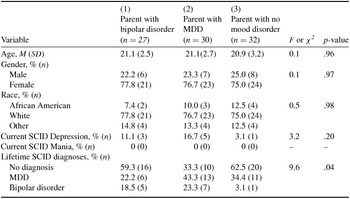
Participants (N = 89) were predominantly female (76%) students from a large public university in the United States and were recruited on the basis of whether or not they had a biological parent with a bipolar or depressive disorder that had raised them (see Table 1 for demographics). They belonged to one of three groups matched on age, race and gender: having a parent with bipolar disorder (n = 27), having a parent with MDD but not bipolar disorder (n = 30), or having parents with no mood disorder (n = 32). Participants initially self-identified themselves as having or not having a parent with a mood disorder. However, a well-validated semi-structured interview (see FHRDC measure below) of the offspring was then used to determine whether the parent exhibited symptoms consistent with bipolar disorder, MDD, or neither. Several cases that had been originally recruited were excluded from the final sample of 89 because there was evidence of a possible mood disorder in the parent (e.g. treatment), yet not sufficient evidence from the semi-structured interview to convincingly make or rule-out a diagnosis. The university's Institutional Review Board approved the study and all participants provided written, informed consent.
Demographics of the offspring by parent diagnosis group (N = 89)

Procedures
Participants met individually with Doctoral or Masters-level clinical or counseling students and were interviewed using semi-structured interviews to determine the presence or absence of a family history of bipolar disorder or MDD, as well as to determine whether the participant themselves met criteria for a current or lifetime bipolar or depressive disorder. All written interview ratings were reviewed by a senior clinical psychologist with extensive expertise in the administration of semi-structured clinical interviews; diagnostic disagreements were discussed, with final diagnosis based on consensus. A random sample of the interviews were audiotaped and independently rated by the senior psychologist to establish inter-rater reliability with the rater's original diagnosis. After completion of the interviews, participants completed self-report measures described below.
Interview measures
Family History Research Diagnostic Criteria (FHRDC)
Initial identification of parent diagnostic status was through self-report of the offspring. However, given high rates of misdiagnosis (Ruggero, Carlson, Brommet and Kotov, Reference Ruggero, Carlson, Brommet and Kotov2010), semi-structured screening with the FHRDC (Endicott, Andreasen and Spitzer, Reference Endicott, Andreasen and Spitzer1978) was carried out to corroborate that the reported symptomology of the parent was consistent with bipolar disorder, MDD, or neither. The interview asks participants about cardinal psychiatric symptoms among their immediate family members, as well as their treatment history; for the present study, interview questions were limited to symptoms of bipolar disorder and MDD. Diagnoses of family members based on FHRDC of patients shows good congruence with diagnoses based on interviews of the family members themselves (Andreasen, Endicott, Spitzer and Winokur, Reference Andreasen, Endicott, Spitzer and Winokur1977). A random sample of audiotaped interviews (n = 13) were reviewed by the senior clinical psychologist; there was high inter-rater agreement between the interviewer's initial diagnosis (prior to review with the senior psychologist) and the senior psychologist's initial diagnosis for both family member MDD (κ = 1.0) and family member bipolar disorder (κ = .83).
Structured Clinical Interview for DSM-IV (SCID)
Participants were given the mood modules of the SCID (First, Spitzer, Gibbon and Williams, Reference First, Spitzer, Gibbon and Williams1997) to screen for the presence of current or lifetime mood disorders among the offspring. The SCID is a widely used semi-structured clinical interview that corresponds with the DSM–IV diagnostic criteria for Axis I disorders and is regarded as the gold standard for establishing psychiatric diagnoses. Interviews were performed and reviewed similarly to the FHRDC. Agreement between the interviewer's initial diagnosis (prior to discussion of consensus diagnosis) and the senior psychologist's initial diagnosis on the presence of bipolar disorder and MDD was high (κ = .81 and .83, respectively).
Measures of cognitive style
Cognition Checklist for Mania–Revised (CCL-M-R)
The CCL-M-R is 29-item questionnaire that measures cognitions and beliefs specific to mania. The measure inquires about beliefs a person has when they feel activated, excited or manic. Items are divided among 4 subscales: 1) the Myself subscale reflects beliefs the person has about themselves when they are activated (e.g. “I have a special mission”); 2) the Relationships subscale involves beliefs about interpersonal relationship when activated (e.g. “Everybody loves me”); 3) the Pleasure/excitement subscale reflects beliefs related to the pursuit of pleasurable/exciting activities (e.g. “Life is dull without excitements”); and 4) the Activity subscale reflects beliefs about goal pursuit (e.g. “I have new goals”). The measure has shown internal consistency and validity with other measures of bipolar disorder (Beck et al., Reference Beck, Colis, Steer, Madrak and Goldberg2006; Fulford et al., Reference Fulford, Tuchman and Johnson2009). In the present study, the internal consistencies of the total scores (α = .94) and the subscales (α's from .76 to .91) were adequate.
Hypomanic Attitudes and Positive Predictions Inventory (HAPPI)
The HAPPI (Mansell, Reference Mansell2006; Mansell et al., Reference Mansell, Rigby, Tai and Lowe2008; Dodd et al., Reference Dodd, Mansell, Sadhnani, Morrison and Tai2010; Dodd, Mansell, Morrison et al., Reference Dodd, Mansell, Morrison and Tai2011) is a 61-item measure meant to assess beliefs about mood states and their anticipated consequences. The present study used the latest expanded version of the HAPPI based on Dodd and colleagues (Reference Dodd, Mansell, Morrison and Tai2011) factor analysis of the instrument.
Items on the measure revolve around six subscales that reflect different cognitions relevant to bipolar disorder, particularly cognitions relevant to activated or hypomanic states. These subscales and their themes include: 1) Grandiose Appraisal of Ideation items reflect overly positive self and interpersonal cognitions (e.g. “When I get an idea, it always turns out to be the best solution”); 2) the Success Activation and Triumph Over Fear items reflect overly positive beliefs about the self during activated states (e.g. “When I feel more active, I realize that I am a very important person”); 3) Increasing Activation to Avoid Failure items are related to beliefs about needing to remain activated in order to avoid failure (e.g. “Unless I am active all the time, I will end up a failure.”); 4) the Social Self-Criticism items reflect beliefs that others perceive the respondent as negative during activated states (“When I am more active than usual, other people dislike me”); 5) the Loss of Control items revolve around the theme of not being able to regulate thoughts, moods and behavior when activated (e.g. “When my mood drives upward there is nothing I can do about it”); and 6) the Regaining Autonomy items focus on beliefs related to perceived attempts from others to control them (e.g. “If I let other people do things at their own pace, I will not get what I want”). For all subscales, respondents indicate the extent to which they believe each item by making a mark on a visual analog scale running from 0 (“I don't believe this at all”) to 100 (“I believe this completely”).
The HAPPI has been shown to have high reliability and converges with others measures of bipolar disorder (Dodd, Mansell, Morrison et al., Reference Dodd, Mansell, Bentall and Tai2011). It has also been shown to distinguish individuals with bipolar disorder from both healthy controls as well as individuals with MDD (Mansell, Reference Mansell2006; Alatiq et al., Reference Alatiq, Crane, Williams and Goodwin2010; Seal, Mansell and Mannion, Reference Seal, Mansell and Mannion2008). In the present study, internal consistencies of the total score (α = .97) as well as subscales (α's from .83 to .90) were adequate.
Ruminative Response Scale (RRS-10 item version)
The RRS (Nolen-Hoeksema and Morrow Reference Nolen-Hoeksema and Morrow1991) was originally a 22-item measure assessing participants’ tendency to ruminate and was associated with risk of depression. Due to content overlap of many of the original items with depressive symptoms, a 10-item rumination scale was proposed by Treynor and colleagues (Reference Treynor, Gonzalez and Nolen-Hoeksema2003) that is less contaminated by symptoms. The 10-item version of the RRS is made up of two subfactors: Reflection (e.g. “Analyze recent events to try to understand why you are depressed”) and Brooding (e.g. “Think about a recent situation wishing it had gone better”). The Reflection and Brooding subscales have been found to have adequate reliability and can distinguish depressed from non-depressed individuals (Treynor et al., Reference Treynor, Gonzalez and Nolen-Hoeksema2003). In the present study, internal consistencies of the 10-item total subscale (α = .87) as well as Reflection and Brooding subscales (α = .82 and .87, respectively) were adequate.
Results
Demographic and clinical characteristics for the three groups according to parent diagnosis are reported in Table 1 and show groups were successfully matched on gender, race and age. Individuals with parents with MDD or bipolar disorder had significantly higher rates of a lifetime mood disorder relative to the control group. Prior to testing hypotheses, data for the primary variables (i.e. subscale scores and diagnoses) were screened for errors, missing data and normality. Data conformed to expected values and very little data were missing (i.e. < 1%). Visual inspection suggested primary variables were distributed normally.
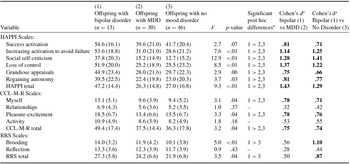
Prior to exploring the role of parent diagnostic status on cognitions, initial analyses first focused on whether offspring diagnosis of a lifetime mood disorder was associated with dysfunctional cognitions. Table 2 shows results on the cognitive outcomes by diagnostic status of the offspring. Offspring with a bipolar diagnosis compared to the other two groups endorsed significantly more dysfunctional cognitions on all of the HAPPI subscales, the CCL-M-R Myself, Pleasure-Excitement subscales and the CCL-M-R total score. Notably, scores obtained by individuals with bipolar disorder were significantly different not only from those of individuals with no mood disorder, but also from those of individuals with MDD. Participants with bipolar disorder also endorsed more items on the RRS Brooding and total subscales compared to those with no mood disorder, but not compared to those with MDD. Also of note, effects were large: mean Cohen's d comparing the bipolar versus no disorder groups was 1.04 for the HAPPI subscales and .63 for the CCL-M-R subscales; mean Cohen's d for the bipolar versus MDD groups was 1.08 for the HAPPI subscales and .64 for the CCL-M-R subscales. The offspring with bipolar disorder also endorsed more dysfunctional cognitions on the Relationship and Activity CCL-M-R subscales and the RRS reflection subscale, but these differences were not significant.
Dysfunctional cognitions by offspring diagnostic group (N = 89)

Notes: HAPPI = Hypomanic Attitudes and Positive Predictions Inventory; CCL-M-R = Cognition Checklist for Mania – Revised; RRS = Ruminative Response Scale (RRS)
a Significant Cohen's d at p < .05 are in bold. Significance based on least significant difference (LSD) post hoc t-tests.
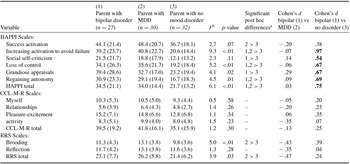
Next, the role of parent diagnostic status (i.e. bipolar disorder, MDD, no mood disorder in parents) on cognitions among offspring was assessed. Table 3 reports results from the analyses, prior to controlling for a mood diagnosis in the offspring. The offspring of a parent with bipolar disorder had significantly more dysfunctional cognitions as reflected on all of the HAPPI subscales, with the exception of Success Activation, compared to the offspring of a parent with no mood disorder. Moreover, the mean effect across the HAPPI subscales was in the moderate to large range (i.e. Cohen's d = .67). The bipolar parent group did not significantly differ from the MDD parent group on the HAPPI scales. Grandiose Appraisals came closest to distinguishing the bipolar offspring from the MDD offspring, but these differences were not significant.
Dysfunctional cognitions by parent diagnostic group (N = 89)

Notes: HAPPI = Hypomanic Attitudes and Positive Predictions Inventory; CCL-M-R = Cognition Checklist for Mania – Revised; RRS = Ruminative Response Scale, 10-item version.
a Significant Cohen's d at p < .05 are in bold. Significance based on least significant difference (LSD) post hoc t-tests.
bWith the exception of the HAPPI Social Self-Criticism subscale, all significant effects continued to be significant after controlling for the presence of a mood disorder in the offspring.
The CCL-M-R and RRS subscales, however, did not differ among the offspring groups. Nevertheless, the differences were uniformly in the direction of more dysfunctional cognitions among offspring of a parent with bipolar disorder compared to offspring of a parent with no mood disorder, but the effects were less clearly in one direction or another for the bipolar versus MDD groups. Offspring of those with MDD versus no disorder endorsed significantly more items on the RRS Brooding and Total subscales.
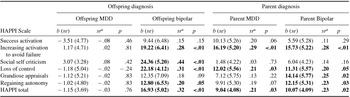
Given that offspring of those with a mood disorder were significantly more likely to have a mood disorder themselves, analyses for significant effects reported in Table 3 were repeated, but this time controlling for offspring diagnosis. A regression was carried out on HAPPI subscales predicted by offspring diagnoses (offspring MDD and offspring bipolar disorder, dummy coded) in the first block, and parent diagnosis (parent MDD and parent bipolar disorder, dummy coded) in the second block. Results are reported in Table 4.
Final regression coefficient and semipartial correlation results predicting HAPPI subscale scores based on parent diagnosis, after controlling for offspring diagnoses

Notes: Results are based on seven separate regressions. Note that the semipartial (sr) and the p-value associated with it represent the unique effect of diagnosis, after controlling for the other diagnoses. In other words, the parent bipolar sr reflects the effect of having a parent with bipolar disorder, controlling for offspring diagnosis as well as the parent diagnosis of MDD.
aSemipartial correlation.
The effect of having a parent with bipolar disorder (i.e. see semipartial correlation coefficients in Table 4) continued to have a significant effect on four of the six HAPPI subscales (i.e. Increasing Activation to Avoid Failure, Loss of Control, Grandiose Appraisals, and Regaining Autonomy), as well as the total HAPPI score, even after controlling for whether or not the offspring had been affected by a bipolar or depressive disorder. After controlling for offspring diagnosis, parent MDD only continued to be relevant for two of the HAPPI subscales (i.e., Increasing Activation to Avoid Failure and Loss of Control) as well as the total HAPPI score. Grandiose appraisals and regaining autonomy subscales most differentiated offspring of parents with bipolar disorder from offspring of parents with MDD.
Discussion
The present study breaks new ground by finding that the dysfunctional beliefs associated with an integrative cognitive model of bipolar disorder (Mansell, Reference Mansell2007) persist in the adult offspring of individuals with the disorder, even after controlling for the presence of a mood disorder in the offspring themselves. Extreme appraisals regarding internal mood states most distinguished offspring of those with bipolar disorder from others. The study also confirms that once offspring are affected by a mood disorder, they endorse significantly more dysfunctional cognitions related to both Mansell's (Reference Mansell, Morrison, Reid, Lowens and Tai2007) model as well as Beck et al.'s (Reference Beck, Colis, Steer, Madrak and Goldberg2006) model of bipolar disorder.
Detecting extreme appraisal of mood states in offspring of those with both bipolar disorder and MDD, independent of their own diagnosis, has two key implications. First, these cognitions may represent a potential mechanism by which offspring are placed at increased risk for a mood disorder themselves. Consistent with Mansell's (Reference Mansell, Morrison, Reid, Lowens and Tai2007) model, extreme, conflicting appraisals have the potential to initiate a cycle that can exacerbate mood symptoms. The present study could not trace the origin of these appraisals – whether they were learned from their parents, developed in response to observing their parents mood episodes, or developed entirely based on participants’ own experiences with mood states. Their presence early in adulthood, however, suggests they may constitute an observable pathway that confers risk. Second, the explicit nature of these appraisals makes them promising targets for psychotherapeutic intervention as well as prevention. Of course, neither of these implications can be confirmed without careful longitudinal research, but the present results provide strong support to pursue such studies.
With this background in mind, the nature of these appraisals is worth considering in more detail. There were two types of appraisals seen in offspring of those with bipolar or MDD, and two that were unique to the offspring of those with bipolar disorder. The first two, those not unique to bipolar disorder, involved beliefs about the need to become more activated to avoid failure (e.g. “Unless I am active all the time, I will end up a failure”) and beliefs about mood states being outside of their control (e.g. “My high moods are outside my own control”).
Appraisals related to activation to avoid failure in the HAPPI cover diverse content but are thought to prompt “ascent” behaviors that, at the extreme, could lead to mania. It is telling that scores on this scale, which were elevated in both mood offspring groups, were also elevated in offspring who themselves developed bipolar disorder, but not those who developed MDD. This pattern may be in line with depression avoidance theory, in which mania is thought to represent an attempt to avoid or defend against depression (Neale, Reference Neale, Oltman and Maher1988). It may be the case that such appraisals develop when an individual has a parent with MDD or bipolar disorder, but that they confer risk only for the development of manic episodes and a bipolar diagnosis.
The second type of appraisal observed in offspring of parents with both MDD and BD, as well as offspring who themselves have bipolar disorder, was related to loss of control of mood states. Such appraisals may in part reflect an acknowledgement in vulnerable individuals of heightened mood states. But they also have potentially important treatment implications: appraising that mood states are not possible to control may decrease the likelihood that these individuals will seek needed services or may reduce expectancies about the efficacy of therapy. Addressing these appraisals early in treatment may be an important strategy for clinicians attempting to engage clients with respect to the importance and efficacy of therapy for controlling mood episodes.
Two other types of cognition on the HAPPI were entirely unique to the offspring of those with bipolar disorder and thus may represent bipolar-specific cognitions. The first involved grandiose beliefs about the individuals’ ideas and the pursuit of goals. These included items such as “When I get an idea, it always turns out to be the best solution” and “When I feel I'm right, I must keep generating lots more ideas and solutions”. Such appraisals may reflect grandiosity-related symptoms of the disorder. They may also, however, be related to a more general vulnerability related to achievement striving or excessively ambitious goal-setting (Johnson and Carver, Reference Johnson and Carver2006; Johnson, Reference Johnson2005; Johnson, Ruggero and Carver, Reference Johnson, Ruggero and Carver2005; Johnson, Eisner and Carver, Reference Johnson, Eisner and Carver2009). In other words, grandiose appraisals may feed into this achievement-striving vulnerability and prompt ascent (i.e. activating) behaviors (Mansell, Reference Mansell2007; Mansell, Morrison, Reid, Lowens and Tai, Reference Mansell, Morrison, Reid, Lowens and Tai2007) that can lead to or exacerbate manic symptoms.
The final set of appraisals, also specific to offspring of those with bipolar disorder, related to autonomy and included items such as “When I try hard to get what I want, other people try to stop me”. Items from this scale convey a belief that it is important for the individual to assert autonomy over his or her behavior, even in the face of criticism from others. Such appraisals may lead vulnerable individuals to discount warnings from family or friends regarding increased activation or its consequences.
Taken together, these four sets of cognition are compelling in that they are found in offspring even independent of their own diagnosis of a mood disorder. Hence, they represent more than simply cognitive “scars” from previous mood episodes. It is important to acknowledge that other appraisals and cognitions were also observed as part of the cognitive profile related to bipolar disorder, but were apparent only once offspring had a diagnosis. Specifically, all of the HAPPI subscales differentiated offspring with a bipolar disorder diagnosis from others, including those with an MDD diagnosis. The CCL-M-R subscales to a lesser extent also differentiated the groups once they were affected, consistent with previous work using this measure (Beck et al., Reference Beck, Colis, Steer, Madrak and Goldberg2006).
One subscale of the HAPPI (i.e. Social Self-Criticism) was strongly associated with a bipolar disorder diagnosis, but was not associated with the parent diagnosis. Such a pattern may indicate that certain appraisals, specifically those related to how others perceive activated mood states, may have less to do with risk for the disorder and more to do with an acknowledgement of the consequences of manic states.
Four study limitations must be acknowledged. First, sample sizes were small, so only moderate to large effects could be detected. Although a limitation, this also makes the present findings more striking: effects from dysfunctional cognitions were not subtle, but represented clear familial markers of bipolar disorder. Moreover, although the present study was the first to look at offspring, these types of cognitions have now been observed in people with a vulnerability to bipolar disorder across repeated samples (e.g. Alatiq et al., Reference Alatiq, Crane, Williams and Goodwin2010; Kelly et al., Reference Kelly, Mansell, Wood, Altiq, Dodd and Searson2011; Mansell and Jones, Reference Mansell and Jones2006; Seal et al., Reference Seal, Mansell and Mannion2008) and also by independent teams of researchers. The replicability of these effects therefore makes it unlikely that the present study was detecting spurious findings.
Second, we did not screen for other disorders, such as borderline personality disorder. Given that borderline personality disorder is often comorbid with bipolar disorder (Paris, Gunderson and Weinberg, Reference Paris, Gunderson and Weinberg2007), as well as arguments that the two may be related (e.g. Deltito et al., Reference Deltito, Martin, Riefkohl, Austria, Kissilenko and Corless2001), it is important for future to work to explore whether cognitions associated with bipolar disorder are different from those associated with not only MDD but also other disorders, especially personality disorders.
Third, data regarding the parent diagnosis were obtained through the offspring. Special effort was made to remove ambiguous cases prior to analyses, so there is increased likelihood that those parents deemed to have bipolar disorder did indeed have the disorder. However, this procedure also meant that the parent cases that remained were likely to represent the most prototypic forms of bipolar disorder, or its most severe forms (i.e. ones that could easily be identified according to offspring reporting of symptoms). It is possible that offspring whose parents had the clearest presentations of bipolar disorder witnessed more severe mood symptoms and their consequences, which may have influenced their beliefs surrounding mood states. Therefore, it is unclear the extent to which these cognitions would be present in the offspring of individuals with less prototypic or severe forms of bipolar disorder.
Finally, data were cross-sectional. In this regard, the present study represents only a first step in showing the role that these cognitions may play as a potential diathesis for the disorder; longitudinal work is necessary to confirm their importance. Two future directions would be most intriguing: the first would be to assess how early in development these cognitive styles begin to appear in offspring. The second would be to collect longitudinal data to determine the extent to which they can predict the onset of mood episodes not only among those already affected by bipolar disorder (Dodd et al., Reference Dodd, Mansell, Bentall and Tai2011) but among those who are not yet affected but at risk.
Despite these limitations, the present study provides a window into the types of cognitions that may put individuals at risk for bipolar disorder, and specifically points to the importance of individuals’ beliefs surrounding internal mood states. Future work, particularly longitudinal studies, is needed to clarify whether these cognitions independently confer vulnerability to mania and depression, or if they interact with other factors to predict mood episodes. Finally, to the degree cognitions discussed here place offspring at risk of developing their own mood disorder, they may represent critical points of contact for cognitive interventions.



Comments
No Comments have been published for this article.