The Elizabethan poor law statutes of 1597 and 1601 created a national system of poor relief for England and Wales based on the parish as an administrative unit, which lasted for over two centuries until the Poor Law Amendment Act of 1834. With money raised from rates, parishes were expected to provide for those members of the community who were deserving of need: chiefly the old, sick, and very young, though those who were unemployed might also be provided with work.Footnote 1 After initially hesitant beginnings in some areas, the ‘old poor law’, as it came to be known, expanded in size and scope, particularly after the mid-eighteenth century under the impact of social and demographic change. Provision became more widespread; workhouses were built in some districts while allowance systems developed in parts of the rural south and east.Footnote 2 Nationally, net expenditure on poor relief rose from an estimated £500,000 in 1700 to almost £7,000,000 at its peak in 1819.Footnote 3
Such a welfare system, possibly unique in the European context, has occupied a prominent place in the historiography of English poverty, and there has been a strong emphasis on parish-based relief as the main source of support for those in need.Footnote 4 Many early studies focused on the poor law and its recipients, with a recurrent tendency to interpret wider changes, such as the growth of rural poverty in the English south and east at the end of the eighteenth century, in terms of poor relief expenditure and changes in policy.Footnote 5 Much of the English work on life-cycle poverty, where conditions such as old age or large families have been seen as a cause of hardship, has also focused on the poor law; changes in individuals' circumstances being viewed through relief applications.Footnote 6 More recent research on pauper letters and the laws of settlement has similarly emphasized the importance of the poor law as a negotiating tool and even as an influence on migration.Footnote 7
This emphasis on the centrality of the English poor law contrasts, to some extent, with continental research where historians have constructed a rather different depiction of poverty and welfare. Here, there has been a greater stress on alternative means of support for the poor; with work, kin, self-help, begging, and even crime all seen as potential parts of what has been termed the ‘economy of makeshifts’.Footnote 8 In the field of institutional provision, prompted by the relative weakness, or even absence, in some areas of state-sponsored relief, European historians have placed a strong emphasis on charity, arguing that it was the main source of external support in many urban areas.Footnote 9 English historians have not ignored the study of charity as a means of welfare; as illustrated, for example, by W. K. Jordan's extensive research on endowed provision for the sixteenth and seventeenth centuries.Footnote 10 Generally, however, there has been a tendency to focus more on the institutional and administrative aspects of charity.Footnote 11 Discussion of its welfare role has seen its resources as increasingly inadequate when coping with the demands of social and economic change, and falling behind state provision in relative terms.Footnote 12
More recently, this paradigm and the traditional primacy of poor relief have come under scrutiny. English historians have started to investigate the economy of makeshifts in more detail, and it is now argued that alternative welfare options such as kin, credit, or common rights were more significant than previously supposed, by acting as a supplement, or even alternative, to parochial support.Footnote 13 Research has shown that poor relief provision was fairly restricted in the north and west of England, where alternative strategies were evidently used by necessity.Footnote 14 Finally, in terms of reappraising the significance of charity itself, there has been a renewed emphasis on the welfare role played by the newer voluntary societies of the eighteenth and nineteenth centuries; particularly, the support afforded to the poor by subscriber-funded hospitals and dispensaries.Footnote 15 Other scholars have stressed the continued survival of older endowed provision well into the nineteenth century. In some parts of northern England, for example, endowments formed around 20 per cent of total welfare expenditure even by 1816.Footnote 16
In an English context, this work has led to increasing recognition that charity may have played a greater role in supporting the poor than previously supposed. Most studies have hitherto been predominately rural, with a focus on country parishes and small market towns. It has been suggested, however, that larger urban areas may have had an even richer array of charitable resources in some cases. In an influential article, Joanna Innes coined the phrase ‘the mixed economy of welfare’ to describe the combination of charitable and statutory relief available to the urban poor during the seventeenth and eighteenth centuries.Footnote 17 While some important research has been conducted on charity and poor relief in urban areas during the early modern period, rather less attention has been paid towards the latter part of the old poor law and the period following 1800.Footnote 18 Medium-sized provincial towns in particular have received little scrutiny, at a time when poor relief expenditure was at its highest and other forms of support were presumably less prevalent.Footnote 19 Yet traditional charitable resources may have remained significant in some towns and the period also witnessed the growth and expansion of newer forms of welfare provision, particularly subscription-based charity.Footnote 20 This article examines the role played by these different relief mechanisms by focusing on one medium-sized urban centre with particularly good archival sources, Oxford, in the last three to four decades of the old poor law. The main focus will be on external means of assistance, primarily poor relief and charity. It investigates whether the poor law was the main means of support in this period, as the data on relief expenditure suggests, or if a more mixed economy of welfare may have been present.
I
At the beginning of the nineteenth century, Oxford was still heavily influenced by the University; the city's service-based economy was largely dependent on its custom and it continued to retain its own courts and police force.Footnote 21 Yet Oxford was also the commercial and administrative centre for a wider region, being the county capital and possessing assize courts and a market. Moreover, Oxford also had a long-established corporation, first receiving its royal charter in 1155.Footnote 22 The city thus had several features in common with other county towns, such as Lincoln or Gloucester, which also possessed sizeable service sectors and acted as marketing and administrative centres.Footnote 23 After a rather somnolescent eighteenth century, Oxford experienced something of an economic revival after 1800, partly predicated by the University's expansion, but also by more general improvements in trade and communications. Retail and commercial activity increased, and the city's population almost doubled from 11,694 inhabitants in 1801 to 20,649 by 1831.Footnote 24
Not everyone shared in this prosperity, however, since much of the manual workforce was casualized and many were prone to unemployment in University vacations.Footnote 25 Around a third of all householders were recorded as not paying rates in the 1830s, which is a potential indicator of poverty.Footnote 26 Begging was a recurring problem, partly because of the presence of so many wealthy University members, and it has been estimated that, in one Oxford parish, between 30 and 40 per cent of householders in the early nineteenth century were in receipt of either poor relief or charity.Footnote 27 The city was not immune from periodic economic slumps experienced in this period, such as the depression that followed the ending of the Napoleonic Wars in 1814 and a similar downturn in 1830–1.Footnote 28 While overt discontent was rare, there was rioting in 1795 and 1800 after bread prices rose sharply; in 1802 ‘a ball of combustible materials’ was ignited in front of the mayor's house by someone aggrieved by a removal order.Footnote 29
Oxford was not therefore immune to poverty in the early nineteenth century. As in other towns and cities, the poor law had long been an important source of assistance.Footnote 30 From the end of the sixteenth century, each parish in Oxford had levied a rate to support those in need. With the exception of a few attempts to form parish workhouses, outdoor relief was initially dispensed via a mixture of pensions and casual relief in cash and in kind. After 1772, all of the Oxford parishes, with the exception of St Giles's, St Clement's, and the small parish of St John's, combined together by an act of parliament to form the United Parishes. A workhouse was built, containing accommodation for over 200 paupers, with the intention that all relief would be granted within its walls, though in practice the dispensing of outdoor relief continued. St John's, St Giles's, and St Clement's continued solely to dispense outdoor relief until the end of the old poor law in 1834.Footnote 31
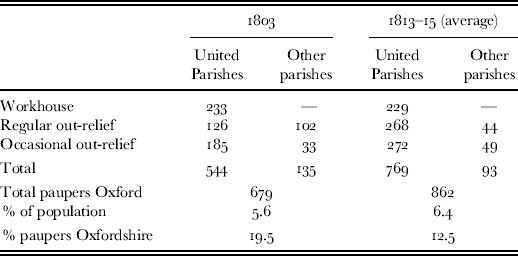
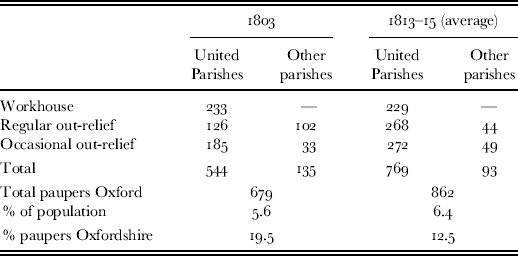
The manuscript records of the United Parishes have not survived, but information on the numbers of people receiving poor relief and the types of support available in Oxford can be obtained from the parliamentary reports of 1803 and 1813–15, which list every parish in England and Wales.Footnote 32 These pose certain methodological issues, since only the 1803 report notes the number of children relieved, and it is unclear whether the reports counted those receiving poor relief at a single point in time or as a cumulative total for the year in question.Footnote 33 Conclusions, therefore, must be treated with caution, but can still be used for comparative purposes.
Table 1 gives the types and proportions of poor relief recipients in Oxford, together with the percentage of paupers for Oxfordshire as a whole. The majority of paupers received either regular or occasional outdoor relief, in approximately equal numbers. As mentioned, St Giles's and St Clement's had no indoor provision, and even in the United Parishes the inmates of the workhouse always formed a minority. The number of outdoor paupers in the United Parishes also increased between 1803 and 1813–15. Indeed, by 1832 it was estimated that there were a total of 980 families receiving outdoor relief, compared to 247 individuals then resident in the workhouse.Footnote 34 To some extent, this increase in the number of outdoor paupers can be explained by population growth in Oxford and possibly higher levels of poverty. The Oxford workhouse also had a finite capacity, however, of around 250 inmates, and with no new construction occurring until later in the nineteenth century, by necessity any increase in the pauper host would have had to be accommodated elsewhere.Footnote 35 The overall level of pauperism in Oxford was also low compared to rural areas, the percentage of people receiving poor relief in Oxford being less than the equivalent figure for Oxfordshire for both 1803 and 1813–15. There were, however, an additional 707 ‘persons relieved, not being parishioners’ recorded in the 1803 survey, who may have been in receipt of out-relief from other parishes, of whom some could have been vagrants or itinerants. Assuming that all were resident in Oxford, the proportion of paupers could therefore be as high as 11 per cent, which is still less than the equivalent proportion for Oxfordshire including non-parishioners (22 per cent). Overall, the evidence suggests an urban–rural divide in levels of pauperism that has been rarely studied by other historians.Footnote 36
Numbers receiving poor relief in Oxford, 1803 and 1813–15
Sources: Abstract of returns, 1803-4; Abstract of answers and returns, 1818; Census 1801; Census 1811. County percentages are from Eastwood, Governing rural England, p. 144.
Turning to the sex and age composition of those receiving relief, there were differences between indoor and outdoor paupers. The inmates of the Oxford workhouse were typically female (single women or widows), or life-cycle poor, such as the elderly or very young. When Sir Frederic Morton Eden compiled his survey of the poor in 1794 he noted that the 167 paupers then present in the Oxford workhouse were ‘children, women and old men’, and similar groups of people were still present in the early 1830s when the poor law commission visited, though the presence of a few able-bodied men was also mentioned.Footnote 37 Among those receiving outdoor relief there was a greater proportion of adult males and families with children. Analysis of the overseers' accounts of St Giles's and St Clement's shows that men formed about 40 per cent of relief recipients between 1800 and 1830 and married couples a similar figure. The proportion of younger paupers also increased slightly over the same period, particularly those aged twenty to thirty-nine. Nevertheless, the majority of paupers in the two parishes continued to come from the traditional life-cycle poor, with pension lists in particular dominated by widows, children, and the elderly even by 1830.Footnote 38 Younger families were present, but evidently not on the same scale as in the rural south and east, where structural and economic change meant that pauperism was often experienced more widely across communities.Footnote 39
The life-cycle nature of much of the pauperism in Oxford did not, however, necessarily translate into a more generous welfare regime. In monetary terms, the inmates of the Oxford workhouse were reasonably well provided for. In 1834, the poor law commissioners calculated that expenditure on indoor paupers averaged £10 5s 5½d, adding that it was ‘a much greater sum than would keep them out of the workhouse’.Footnote 40 Discipline was generally relaxed, paupers were allowed out during the day, and there was little segregation of the sexes apart from at mealtimes. Married couples were also allowed to sleep together. Able-bodied inmates were, however, expected to work; although sack-making had been discontinued by the 1830s, men and boys were contracted to sweep streets while women and girls cleaned, washed clothes, and cared for the sick. The food offered by the workhouse was admittedly basic; in 1794, for example, bread, cheese, and broth formed the mainstay of most meals, though meat was offered twice a week.Footnote 41 Nevertheless, this fare was not necessarily worse than that available to the poor outside: the 1834 commission stated that ‘the inhabitants of the workhouse are better fed than they could expect to be at their own homes’.Footnote 42
The paupers in Oxford on outdoor relief received pensions and casual assistance, in cash or in kind. Although, as seen, there were roughly equal numbers of people receiving occasional or regular relief, more money was dispensed on regular pensions. In 1830, for example, pensions accounted for 72 per cent of net poor relief expenditure in St Clement's, and 61 per cent in St Giles's.Footnote 43 Less information is known about the United Parishes, but if outdoor paupers noted as appearing ‘on the masters list’ in later surviving accounts are taken to be in receipt of regular relief, the proportion was 62 per cent in 1826–7 and 71 per cent in 1833–4.Footnote 44 The significance of pensions in the Oxford context again differs from what is known about poor law provision in rural areas, where there was a greater tendency to move towards casual relief by the early nineteenth century, which might reflect the continuing survival of life-cycle provision in the city and a greater emphasis on long-term assistance.Footnote 45
Nevertheless, casual relief was still given to large numbers of people, through parish overseers in St Giles's and St Clement's and at weekly courts and via individual guardians in the United Parishes. St Clement's and St Giles's dispensed the majority of casual relief in cash, as opposed to payments in kind.Footnote 46 Surviving accounts of the United Parishes show a similar reliance on cash payments, though by 1833, guardians were also giving cheese, bread, and bacon directly to some paupers in an attempt to stop supposed ‘dram drinkers and frequenters of beer shops’ wasting relief.Footnote 47 Most cash relief was given directly in small sums of money, though people might also have their rent paid for. Relief given in kind took a wider variety of forms. The accounts of St Giles's and St Clement's show paupers receiving clothes, shoes, bed-linen, coal, wine (when ill), and work tools such as shovels, while funerals were provided for the dead. Particularly important was medical assistance. St Giles's and St Clement's paid for doctors, medicines, and midwives, while the United Parishes employed its own surgeon at the Oxford workhouse. St Giles's and St Clement's also subscribed to the Radcliffe Infirmary where severe cases of illness could be sent. Workhouse inmates were refused admission to the Infirmary, however, on account of a supposed fear of infection.Footnote 48 Poor law authorities in the city also paid for the accommodation and treatment of lunatics in asylums; in 1827, for example, two lunatic paupers from the United Parishes were housed in an asylum in Bethnal Green, London.Footnote 49
Outdoor relief thus had the potential to offer a wide range of assistance to the poor. It was rarely, however, a fully comprehensive system. The amount of money or other aid granted varied, and might fall below what people needed to support themselves. Assessing the relative generosity of outdoor provision is difficult. Historians have tried to compare the value of relief payments with wages, but given that overseers' accounts rarely mention family size, this is problematic if the number of dependants is unknown.Footnote 50 The visiting book of the St Giles's Benevolent Society, one of the subscription charities in the city concerned with assisting the poor, contains details of poor relief payments paid to some recipients and, crucially, the size of their families, enabling a rough assessment to be made.Footnote 51 Between 1823 and 1835, some sixty-two different individuals were recorded as being in receipt of poor relief, twenty-five single people and thirty-seven married couples or widows with children. Single people received an average of 3s per week, with payments varying between 6s and 1s 6d. Married couples and widows received rather more, 4s 6d per week on average, with the lowest payment 1s 6d and the highest payment 10s. Apart from the most generous payments, these were less than the comparable earnings of a typical labourer, who would have earned between 10s and 12s per week.Footnote 52 The numbers involved in this analysis are small. Some paupers might receive additional relief in kind or assistance with their rent. Nevertheless, apart from a few individuals, such payments alone would rarely have met people's full needs, necessitating other means of support.
Poor relief in Oxford was thus limited in its relative generosity, and as with the previous evidence regarding levels of pauperism, there seems to be a contrast with rural areas.Footnote 53 While poor law expenditure in the city rose over the course of the eighteenth and early nineteenth centuries, peaking at £8,603 in 1818, levels of spending were proportionally lower than in rural parts of Oxfordshire.Footnote 54 In 1803, average expenditure per head for the Oxford parishes combined was 7s while in the whole of Oxfordshire it was 16s. Similarly, in 1831 an average of 6s. per head was spent in Oxford, compared with 17s. in the county.Footnote 55 It must also be stressed that the poor law was often selective: only people possessing a settlement in Oxford were legally entitled to support, though some migrants may have been able to receive out-relief from their original parishes.Footnote 56 Even the settled poor were not automatically guaranteed assistance, since differing notions of ‘worthiness’, eligibility, or simply a shortage of funds meant that applicants were sometimes turned down. In 1833, for instance, Harry Robinson, an unemployed man, applied and was rejected by the Oxford Board of Guardians, who ‘did not consider him a proper person to be relieved’. Robinson, angry, attacked some of the Board members and was given six months' hard labour.Footnote 57
Oxford therefore appears to have had a different poor law regime from rural parts of southern and eastern England. One cause could be differing levels of prosperity between town and country for, despite occasional downturns, Oxford's economy in the early nineteenth century was still expanding, while many rural areas were suffering from structural changes and agrarian depression.Footnote 58 Relief policies in the city may also have been less generous than elsewhere. As seen, pension payments were not particularly high and provision sometimes discriminatory. Select vestries were also introduced in St Giles's and St Clement's after the Sturges-Bourne Acts of 1818 and 1819 with further controls on relief-giving.Footnote 59 Economics and sentiment doubtless exerted some influence on relief policies within the city. There was, however, another potential reason for the relative parsimony of poor relief: the existence of a large body of charitable provision that acted as a supplement, or even an alternative, to the poor law. Relatively little research has been done on the contribution of charity to welfare spending in the early nineteenth century, especially in urban areas.Footnote 60 It is argued here that charity formed an important component of the welfare mix in Oxford; indeed with the growth of the newer voluntary societies, it increased in significance, in contrast to rural parts of the south and east.Footnote 61
II
The oldest charities in Oxford were the endowments, the earliest of which dated back to the sixteenth century: gifts of land, houses, or money, usually bequeathed in wills, which produced a regular income. Endowments were used to give loans to freemen, finance doles of bread or money, establish almshouses, provide clothing, and apprentice children. Most endowed charities were administered by the corporation of Oxford or individual parishes acting as trustees. Direct University involvement was rare, apart from three almshouses administered by different colleges.Footnote 62 The Charity Commissioners' report of 1822, which lists all the charities present in Oxford at the time, gives a total of eighty-three different endowments that directly assisted the poor.Footnote 63 Inevitably, there were significant variations in provision, the most generous benefactions being found among the almshouses. Five almshouses existed in Oxford at the time of the 1822 report, in which free accommodation was provided in three, together with a pension. The six inhabitants of Tawney's almshouse received £20 a year each, the eight inmates of Parsons's almshouse £30 a year, and the eight female inmates of Stone's hospital £20 10s a year; sums that, combined with free board, would probably have been sufficient by themselves to maintain inmates.Footnote 64 The other two almshouses, Christ Church and St Bartholomew's, mostly had non-resident members, and paid much smaller annual pensions of £6 and £2 4s respectively.Footnote 65
A further thirty endowed charities dispensed annual sums worth £1 or more. The most generous was Taylor's charity of St Peter le Bailey parish which gave £10 each to twelve poor men and women over the age of sixty. Most paid out £5 or less, however, such as Wall's charity which gave £4 each to fourteen poor widows and six poor men, or Poole's charity which gave £1 each to fourteen poor widows.Footnote 66 The remainder of the endowed charities gave out much smaller amounts, typically a few shillings. St Giles's parish, for example, had six endowments operating in the early nineteenth century, dispensing between 4s and 12s on average.Footnote 67 With a few exceptions, such as the almshouses, endowed charities could thus only offer limited financial support to the poor. Most doles would not have matched the poor relief pensions then available in Oxford, which were, as seen, rarely generous. Endowments might also be restricted to certain groups, such as widows and the elderly, and not available to all. Even when there were no specific access criteria, disbursements could simply be constrained by notions of respectability or even personal acquaintance.Footnote 68 Nevertheless, significant numbers of people still benefited from these charities. In the early 1820s there were 54 almsmen and women residing in Oxford, together with another 156 individuals known to have received £1 or more each year from the thirty charities mentioned above: in total 210 persons, excluding dependants. Some of the less valuable endowments were also given to large numbers of individuals. In 1831, for example, the Eynsham charity in St Giles's parish, whose doles averaged 3s per head, relieved a total of 116 different people.Footnote 69 Overall, the income from endowed charity in 1822 amounted to £1,900, which equated to one third of poor relief expenditure for the same year.Footnote 70
Taken as a whole, endowed charity thus made a useful contribution to the provision of welfare in Oxford. It has been argued by Martin Gorsky that its relative importance declined in this period, as poor relief expenditure increased and subscription charities became more popular.Footnote 71 New benefactions were, however, still being made in Oxford during the late eighteenth and early nineteenth centuries, some with substantial incomes. Taylor's charity, worth £182 per year, was set up around 1780; Tawney's and Parson's almshouses, with a combined income of £360 per year, were founded in 1800 and 1816 respectively.Footnote 72 These additions may have helped to maintain endowed charity's overall share of expenditure, even as poor relief spending rose. Using the 1822 report, Alannah Tomkins estimated that endowment income in Oxford was around one third of poor relief expenditure in 1776, suggesting little overall change, but she did not state whether this allowed for any changes in inflation.Footnote 73 The precise trend is difficult to ascertain, but endowed charity remained an important source of welfare in Oxford during the 1820s, assisting substantial numbers of people.
Endowed charity was not the only form of charitable activity operating in Oxford. Since the beginning of the eighteenth century, an alternative form of provision had started to emerge: the subscription charity financed by annual contributions and donations.Footnote 74 In Oxford, two main groups of these charities emerged. Medical charities focused on treating the sick poor by establishing infirmaries and dispensaries. So-called ‘benevolent’ societies concerned themselves with relieving those in distress, concentrating on both the sick and able-bodied poor. The earliest medical charity was the Radcliffe Infirmary, which opened in 1770 and admitted sick poor who were recommended by subscribers.Footnote 75 Thereafter, the number of patients treated at the Infirmary steadily rose, from 500 patients a year in the 1770s to almost 1,000 a year by the 1820s. Its average annual expenditure in the latter decade was around £2,700, which was higher than the amount then spent on endowed charity.Footnote 76 The provision offered by the Infirmary was not universal, however, and some people were excluded, such as children under seven, pregnant women, and those suffering from infectious diseases.Footnote 77 Moreover, only a minority of those treated in the Infirmary were actually from Oxford. Many rural parishes subscribed to provide for their sick poor: out of 1,015 admissions between January 1812 and May 1813, when evidence survives to make a comparison, just 288 came from the city itself.Footnote 78 The only parishes in Oxford to subscribe were St Giles's and St Clement's while, as mentioned, workhouse inmates were denied entry.
Two other medical charities did, however, focus largely on Oxford residents. In 1807, The Oxford Medical Dispensary and Lying-in Charity was established, which treated only people living in the city.Footnote 79 Also organized on the subscription principle, the charity paid for an apothecary who treated patients on his premises or in their own homes. A total of 462 patients were treated in 1814 (when the first accounts survive) together with 100 patients in midwifery.Footnote 80 By 1830, numbers had increased to 748 out-patients, together with another 167 patients in midwifery, and the dispensary was employing its own surgeon.Footnote 81 A second midwifery charity, the Lying-in Charity in Oxford for Poor Married Women, was founded in 1812 and over 100 pregnant women were being assisted by 1822.Footnote 82 With just under 1,000 patients in the 1820s, the Oxford Medical Dispensary and the smaller lying-in charity were treating almost as many people as the Radcliffe Infirmary, though their total expenditure, at around £330 per annum, was much smaller, reflecting the lower level of provision offered.
Overall, medical charities evidently seem to have made an important contribution to treating the sick poor in Oxford, often complementing the provision offered by the poor law. Subscription charities that concentrated on directly assisting the poor exerted a more mixed impact. Founded in 1814, the Oxford Society for the Relief of Distressed Travellers (re-established in 1827 as the Oxford Anti-Mendicity Society) aimed at reducing the amount of begging and vagrancy in the city. ‘Travellers’ were given food and shelter for the night or financial assistance with their onward journey in an attempt to deter them from begging.Footnote 83 Large numbers of supposed vagrants and beggars were given help in this fashion. Between 1816 and 1817, during the depression following the end of the Napoleonic Wars, a total of 5,160 ‘travelling poor’ were relieved; numbers declined in the more prosperous 1820s and in 1828 only 1,943 applicants required assistance.Footnote 84 The Anti-Mendicity Society was not, however, that generously funded, with net expenditure peaking at £271 in 1817, while begging was never totally eliminated from Oxford.Footnote 85
In 1823, the Oxford Benevolent Society and the separate St Giles's Benevolent Society were founded with the specific object of relieving the ‘sick and distressed poor’. Both societies donated coals, clothes, food, and drink to people affected by sickness and poverty.Footnote 86 Much relief given was aimed at those with short-term needs; indeed the Oxford Benevolent Society's rules stipulated that people could only be relieved for a maximum of three months.Footnote 87 In terms of absolute numbers, the two charitable societies made a significant contribution. In 1831, for example, the Oxford Benevolent Society dealt with 382 cases of distress and the St Giles's Benevolent Society with forty. Their total expenditure for the same year was, however, only about £400, which was low in comparison with poor relief, and invariably entailed restrictions on the amount of support offered.Footnote 88 Evidence from the St Giles's Benevolent Society shows that relief was only given in kind and in small quantities. Typically, people received two to three pounds of meat together with one or two loaves of bread dispensed at fortnightly intervals. Such small-scale assistance may have been sufficient in some cases of need, including people who suffered a minor illness, or wives or children who fell sick. When the wife of John Lambert, a cabinet-maker, fell ill in 1832, for example, the family (which included one child) was given a total of twelve pounds of meat over a two-month period.Footnote 89 Presumably with Lambert still working, no more assistance was deemed to be necessary. In more severe cases of distress, as when the main earner in the family fell ill, the relief offered by the society was less adequate. When Robert Hazell, married with ten children, became ill with typhus between May and June 1832, he was only given a total of six pounds of meat and seven loaves of bread.Footnote 90
The two benevolent societies were not the only subscription-based charities in Oxford concerned with relieving the poor. Clothing and coal funds are known to have existed from at least the mid-1820s onwards. A ‘Clothing Fund’ was recorded in 1827 that had helped 600 poor persons to ‘purchase clothes at an easier rate’; another 300 people were employed in ‘making up the articles’.Footnote 91 In the same year a ‘Fund for supplying Coals to Poor Depositors’ stated that it had sold coal at reduced prices to 430 poor families.Footnote 92 It is not certain whether such charities existed continuously since no accounts survive for Oxford and little research has been conducted in other urban areas. They may possibly have been more active in periods of hardship, such as bad weather or economic depression.Footnote 93
Economic and other crises were in themselves an occasion for specific charitable activity. Temporary subscription charities were established to help the poor cope with the effects of bad weather, high food prices, or unemployment. Assistance was generally given for a few weeks or months until the particular crisis had passed.Footnote 94 Such charities had existed in Oxford since at least the late eighteenth century.Footnote 95 If anything, their use appears to have increased from the 1790s, with thirteen known instances of emergency subscriptions being set up between 1795 and 1832.Footnote 96 Traditionally, the relief offered was in the form of subsidized bread or other necessaries, such as coal or clothing. During the harsh winter and poor harvests of 1795, for example, it was reported that £691 was raised to supply bread at reduced prices to ‘the Industrious Poor’ in the city.Footnote 97 In 1800, when bad harvests re-occurred, £2,490 was raised to subsidize prices and a soup kitchen set up ‘to prevent too great a Consumption of Bread’.Footnote 98 Later, perhaps in response to increasing unemployment, make-work schemes became more common. In December 1819, when ‘many of the Industrious Poor were out of employ’, £1,335 was raised to put men to work repairing roads and making new footpaths; over 260 men were employed for several weeks.Footnote 99 Similarly, in early 1832 around 250 persons were engaged to dig a culvert in the city centre.Footnote 100
Large numbers of people were assisted by these charities. In the severe winter of early 1795, it was reported that 4,200 people received bread at reduced prices.Footnote 101 Another subscription in 1811 gave tickets to just over 6,000 people to purchase cheap bread, which represented almost half the population of Oxford at the time.Footnote 102 Make-work schemes directly assisted fewer individuals; as seen, the maximum number thus assisted rarely exceeded 250, though this figure does not include dependants. Support offered by these emergency charities was possibly less effective. People fortunate enough to be put on a ‘make-work’ scheme could expect the most generous assistance. Weekly wages for men engaged in public works in the early 1830s ranged between 6s and 10s.Footnote 103 As seen, 10s a week was equivalent to that earned by a labourer in Oxford; even 6s might have helped to keep people afloat until circumstances improved. In contrast, the provision of subsidized foodstuffs such as bread was less generous. In 1809, for instance, a married couple with two children were given tickets to purchase three quartern loaves a week at 6d each (compared with the current market price of 12d).Footnote 104 Using figures obtained by Sir Frederick Morton Eden for the late eighteenth century, a family of the same size would have needed between nine and ten quartern loaves per week.Footnote 105 Nevertheless, this still represents a weekly subsidy of 1s.6d, and if the period of distress was only temporary, such relief might have averted further hardship.
As well as endowed and subscription charity, one other form of assistance deserves brief consideration: informal charity, acts of generosity by particular individuals or organizations that were not part of more organized relief schemes. Due to its irregular nature, much informal charity has gone unrecorded, but recent research has shown that it was a common occurrence in some communities.Footnote 106 The available evidence for Oxford suggests a similar pattern. Some acts of generosity were connected with periods of hardship such as inclement weather. In the harsh winter of early 1830, for example, James Morrell, a wealthy local solicitor, gave ‘coals and wood, and soup twice a week’ to the poor in St Clement's for several weeks.Footnote 107 People might also leave sums of money to the poor in their wills.Footnote 108 In 1825, for example, Elizabeth Smith (who owned Headington Hill Hall just outside St Clement's parish) bequeathed £20 to be distributed in bread or coals to the local poor.Footnote 109 Money would also be given to beggars or those known to be in difficulties, with members of the University or clergy often playing an important role.Footnote 110 As curate of St Clement's church in the 1820s, John Henry Newman helped parishioners who were sick or facing hardship: giving 10s ‘sacrament money’ to a woman whose husband had deserted her, 5s for a man to bury his child, and a prescription for ‘her boy's ringworm’ to another parishioner.Footnote 111
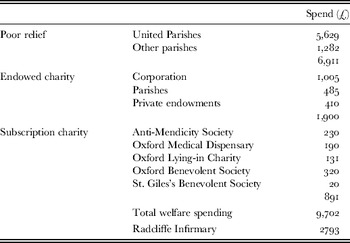
The importance of charity to the poor of Oxford, whether endowed, subscription, or informal, must not be over-emphasized. The expenditure of individual subscription charities always fell below that of the poor law. Similarly, endowed charity expenditure, at just under £2,000 per annum in the 1820s, was only one third of poor relief spending in the city. Yet collectively, charitable provision made an important contribution to overall welfare spending. Table 2 gives the average annual expenditure for poor relief and the regular endowed and subscription charities in Oxford during the 1820s, when the evidence from the 1822 Charity Commissioners' report allows for a comparison. Both poor relief and charitable spending are net amounts, excluding legal and administrative costs. The expenditure of the Radcliffe Infirmary has been accounted for separately; as seen, many of its patients came from outside Oxford.
Average Poor Relief and Regular Charity Expenditure in Oxford, 1820–9

Note: Accounts of the Oxford Benevolent Society and St Giles's Benevolent Society only start in 1823.
Sources: poor relief: Select committee on poor-rate returns, 1822; Account of the money expended, 1825; Account of the money expended, 1830–31; Account of the money expended, 1835. Endowed charity: 6th report charities; 32nd report charities; Curthoys, ‘“To perfect the college …”’. Subscription charity: Bodl., MS Top. Oxon. d.252, e.213; MS Eng. Misc. c.153; G.A. Oxon. b.113, c.38, c.47–8, 8o 487; OHA, RI 1 a2, 1820–9.
Table 2 shows that the poor law always accounted for the largest amount of welfare spending in Oxford during the 1820s, with average expenditure of just under £7,000 per annum. Nevertheless, endowed and subscription charity produced some £2,800 per annum, amounting to 40 per cent of poor law expenditure. Moreover, this figure does not include any contribution from the Radcliffe Infirmary. If we assume (from admissions data) that about a quarter of the expenditure of the Radcliffe Infirmary was on Oxford residents, the total share of charity relative to poor law expenditure may have approached 50 per cent. This is also without making additional allowance for informal charity in the form of bequests or casual alms, or the emergency subscriptions that occurred in crisis years, when it would not be inappropriate to estimate that charitable expenditure in Oxford exceeded the amount available from poor relief.
III
The combination of extensive charity provision and the poor law gave Oxford a wide-ranging relief system. Medical assistance was available from both the poor law and subscription charities; long-term support for certain groups like the elderly could be obtained from the poor law with some contribution from endowed charity; those in short-term difficulties could similarly turn to poor relief or the newer benevolent societies that were being established. Emergency subscriptions helped large numbers of people during periods of crisis, though the assistance given was generally limited. The system was not one of equal partners; the poor law always accounted for the largest share of relief spending and inherent checks and balances meant that assistance was not necessarily generous, or universally available. The amounts given by different bodies were rarely sufficient in themselves and access restrictions, notably settlement with the poor law but also the rules of many charities, often limited the availability of relief. Space prohibits a detailed analysis of the response of the poor to this, but they would probably have had to combine different types of formal relief and use other, more informal, mechanisms; such as assistance from kin or credit.Footnote 112 On balance, however, the relief system in Oxford was wide-ranging and different from that of rural areas in the south and east where low wage levels, increasing unemployment, and the loss of customary perquisites forced increasing numbers of families to seek assistance from the late eighteenth century onwards. With only limited charitable resources, there was accordingly a greater reliance on the poor law, with proportionally more people receiving poor relief in rural than in urban areas and the level of provision more generous.Footnote 113
The presence of the University, with its pool of wealthy people and concerned clergy, could have meant that Oxford had a greater scope for charitable largesse than other towns. Oxford was not alone, however, in possessing such a varied relief system. The city of Lincoln, for example, had charitable endowments for the poor worth £1,141 per year in the early 1830s; just under half of poor relief spending which averaged £2,550 per year in the same period.Footnote 114 Lincoln had its own voluntary hospital and a dispensary; emergency charities were also formed during crisis periods.Footnote 115 A similar picture was seen in Worcester; which had a voluntary hospital and several subscription charities, while endowed charity produced £1,611 per year in the 1820s, accounting for 42 per cent of poor relief expenditure.Footnote 116 Not every corporate town had such extensive provision. The town of Banbury, incorporated in 1554, possessed endowments worth just £107 a year in 1824, together with subscription charities that produced £200 annually; poor relief expenditure in the same period averaged £3,205 per year.Footnote 117 Newer, industrializing towns might have even fewer charitable resources. The metal-working town of West Bromwich, for example, only possessed endowed charity worth £13 10s per year in the 1820s, which was a fraction of the £2,000 per year it spent on poor relief.Footnote 118
With such variance in provision, more research is needed into the support given to the poor in other corporate towns and the newer, industrializing centres before an accurate typology of urban welfare for this period can be constructed. Nevertheless, the evidence from Oxford suggests that, in some towns at least, a rather different system from that seen in other areas was being established, incorporating significant amounts of charity as well as rate-based relief. This has implications for the study of poverty in other urban areas in this period, extending beyond corporate and cathedral towns. If rate-based provision was only one part of a collection of coping strategies in urban areas, including charity and other parts of the economy of makeshifts, we need to look anew at the definition and measurement of poverty in towns and cities during this period. The co-existence of charity alongside the relatively low numbers on poor relief in Oxford suggests a sizeable amount of background poverty amongst those people who were not captured by the poor law.Footnote 119 Attitudes towards the provision of welfare may also require re-examination. Charity might be useful to the poor, but it may also have suited wealthier people by keeping down poor relief expenditure, providing a further motive for its continued viability.Footnote 120 Indeed, it might be the case that, in some areas, the availability of charity and other resources was instrumental in setting the amount of poor relief that was granted. Conversely, the poor themselves may have adopted different coping strategies in urban areas with rich charitable resources. Some towns (or even individual parishes) might have been particularly attractive to migrants, especially those without a local settlement and therefore restricted access to poor relief.Footnote 121 These issues require further study and analysis before firm conclusions can be reached, but they suggest a different picture of urban poverty from that often assumed. To provide an empirical foundation for future research, we thus need a systematic and critical investigation into the philanthropy and experiential charity found in other English towns and cities, alongside a more nuanced appreciation of the role of poor relief.