Nomenclature
-
 ${C_L}$
-
coefficient of lift for aircraft
-
${C_D}$
-
coefficient of drag for aircraft
-
${C_m}$
-
coefficient of pitching moment for aircraft
-
${C_P}$
-
coefficient of power for propeller
-
${C_Q}$
-
coefficient of torque for propeller
-
${C_T}$
-
coefficient of thrust for propeller
-
${\bf{D}}$
-
drag acting along
${x_s}$
-axis of stability frame (
$N$
) -
${\boldsymbol{E}}$
-
identity matrix
-
${{\boldsymbol{F}}_{al}}$
-
aerodynamic force along aircraft body-fixed longitudinal axis (
$N$
) -
${{\boldsymbol{F}}_T}$
-
total thrust, acting along
${x_b}$
-axis of body frame (
$N$
) -
${{\boldsymbol{F}}_t}$
-
sum of all the forces acting on the aircraft (
$N$
) -
$I$
-
inertia tensor of the aircraft
-
$J$
-
advance ratio of the propeller
-
${{\boldsymbol{K}}_P}$
-
gain of proportional component of PID controller
-
${{\boldsymbol{K}}_I}$
-
gain of integral component of PID controller
-
${{\boldsymbol{K}}_D}$
-
gain of derivative component of PID controller
-
${\boldsymbol{L}}$
-
lift, acting along
${z_s}$
-axis of stability axis (
$N$
) -
${\mathscr{m}}$
-
pitching moment of the aircraft, about
${y_b}$
-axis of body axis (
$Nm$
) -
${{\boldsymbol{M}}_{al}}\;$
-
aerodynamic moment about aircraft body-fixed longitudinal axis (
$Nm$
) -
${{\boldsymbol{M}}_T}$
-
moment due to thrust differential, about
${y_b}$
-axis of body frame (
$Nm$
) -
${{\boldsymbol{M}}_t}$
-
sum of all the moments acting on the aircraft (
$Nm$
) -
$P$
-
power required by the propeller (
$Watt$
) -
$Q$
-
torque generated by the propeller (
$Nm$
) -
${\boldsymbol{R}}_S^B$
-
rotation matrix for transformation from stability frame to body frame
-
${\boldsymbol{R}}_I^B$
-
rotation matrix for transformation from inertial frame to body frame
-
${{\boldsymbol{R}}_e}$
-
rotation matrix of attitude error
-
${{\boldsymbol{R}}_{{e_{jk}}}}$
-
elements of attitude error rotation matrix, where
$j$
and
$k = 1,2,3$
-
${{\boldsymbol{R}}_\nu }$
-
matrix representing attitude of the aircraft after rotation of
${\theta _{tilt}}$
-
${{\boldsymbol{R}}_{cmd}}$
-
rotation matrix of commanded attitude of the aircraft
-
${{\boldsymbol{R}}_{cur}}$
-
rotation matrix of current attitude of the aircraft
-
$S$
-
wing span area of the aircraft (
${m^2}$
) -
$V$
-
translational velocity of the aircraft (
$m/s$
) -
${\bf{Y}}$
-
side force, acting along
${y_s}$
-axis of stability frame (
$N$
) -
$c$
-
cosine of angle
-
$d$
-
diameter of the propeller (
$m$
) -
$g$
-
gravitational acceleration in inertial frame (
$m/{s^2}$
) -
${h_{cmd}}$
-
commanded altitude of the aircraft (
$m$
) -
${h_{cur}}$
-
current altitude of the aircraft (
$m$
) -
${h_e}$
-
altitude error (
$m$
) -
$k$
-
ratio of thrust coefficient to torque coefficient of the propeller
-
$l$
-
normal distance of each rotor from cg location of the aircraft (
$m$
) -
$m$
-
mass of aircraft (
$kg$
) -
$p$
-
aircraft roll rate w.r.t. inertial frame, expressed in body frame (
$rad/s$
) -
$q$
-
aircraft pitch rate w.r.t. inertial frame, expressed in body frame (
$rad/s$
) -
$r$
-
aircraft yaw rate w.r.t. inertial frame, expressed in body frame (
$rad/s$
) -
$s$
-
sine of angle
-
$u$
-
velocity component along x-axis of body frame (
$m/s$
) -
$v$
-
velocity component along y-axis of body frame (
$m/s$
) -
$w$
-
velocity component along z-axis of body frame (
$m/s$
) -
${x_b}$
,
${y_b}$
,
${z_b}$
-
$x$
,
$y$
and
$z$
axis of body-fixed coordinate system, respectively
-
${x_i}$
,
${y_i}$
,
${z_i}$
-
$x$
,
$y$
and
$z$
axis of inertial coordinate system, respectively
-
${x_s}$
,
${y_s}$
,
${z_s}$
-
$x$
,
$y$
and
$z$
axis of stability coordinate system, respectively
-
$\alpha \;$
-
angle-of-attack (
$rad$
) -
$\beta $
-
sideslip angle (
$rad$
) -
${\delta _{{t_{pitch}}}}$
-
required differential thrust to control rotation of pitch axis (
$N$
) -
$\theta $
-
pitch angle of the aircraft (
$rad$
) -
${\theta _Y}$
-
angle representing the rotation of Y-axis (
$rad$
) -
${\theta _e}$
-
Euler angle representing attitude error in pitch (
$rad$
) -
${\theta _{tilt}}$
-
angle representing the tilt error of aircraft attitude (
$rad$
) -
$\nu $
-
rotation axis vector with elements
${\nu _x}$
,
${\nu _y}$
and
${\nu _z}$
-
$\rho $
-
density of air (
$kg/{m^3}$
) -
$\sigma $
-
rotational velocity of the propeller (
$rev/s$
) -
$\phi $
-
roll angle of aircraft (
$rad$
) -
$\psi $
-
yaw angle of aircraft (
$rad$
) -
$\omega $
-
rotational velocity of aircraft (
$rad/s$
) -
$\bar c$
-
mean aerodynamic chord length of wing (
$m$
)


1.0 Introduction
Fixed-wing and rotorcraft are two well-understood unmanned aerial vehicle (UAV) designs that have dominated the electric-powered UAV platforms for the last two decades. Both types have certain advantages but also exhibit inherent limitations. Fixed-wing UAVs provide better performance with regards to cruise speed, endurance, flight range and payload carrying capacity. However, the requirement of a paved runway for launch and recovery of fixed-wing UAVs significantly limits their operational flexibility [Reference Tielin, Chuanguang, Wenbiao, Zihan, Qinling and Xiaoou1]. It is getting increasingly costly and difficult to maintain paved runways for the operation of fixed-wing UAVs, especially in urban settings, whereas rotorcraft can execute vertical takeoff and landing from any location, providing enhanced operational flexibility. But the low flying speeds and less endurance of rotorcraft are the most obvious limitations of such systems [Reference Ali and Montenegro2]. To combine the advantages of both fixed-wing and rotorcraft UAVs and to overcome their shortcomings, the concept of the vertical takeoff and landing (VTOL) hybrid UAVs was introduced [Reference Ducard and Allenspach3].
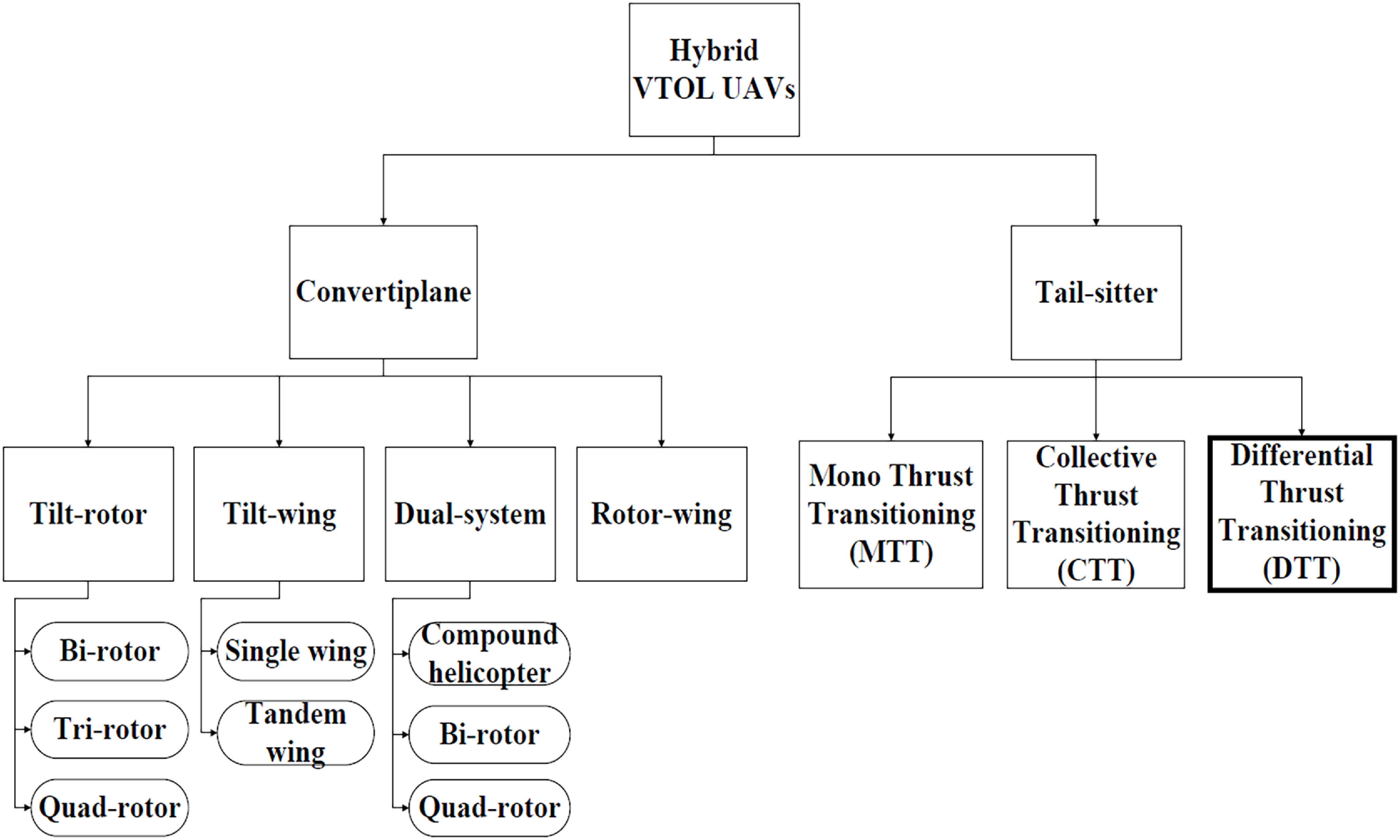
VTOL hybrid UAVs operate over a wide flight envelope, ranging from stationary hover to high-speed cruise. These features make VTOL hybrid UAVs an attractive choice for numerous commercial and military applications. In a quest to fully exploit the benefits of this emerging UAV design, many academic and industrial research programmes have been devoted to the design and development of VTOL hybrid UAVs [Reference Byun, Song, Song and Kang4, Reference Das, Páscoa, Trancossi and Dumas5]. Various design configurations of VTOL hybrid UAVs have been developed so far [Reference Darvishpoor, Roshanian, Raissi and Hassanalian6–Reference Rehan, Akram, Shahzad, Shams and Ali8]. Based on platform design configurations, VTOL hybrid UAVs are categorised into two broad types, convertiplanes and tail-sitters, as shown in Fig.1. Convertiplanes maintain their airframe orientation throughout the flight, and conversion between vertical and horizontal flight modes is achieved by transition mechanisms such as tilt-rotor, tilt-wing, dual-system and rotor-wing. On the other hand, tail-sitter aircraft exhibit flight modes transition by 90
 ${{\rm{\;}}^ \circ }$
shift in the pitch angle of the entire airframe. Differential thrust transitioning, collective thrust transitioning and mono thrust transitioning mechanisms can be employed to achieve transition for tail-sitter hybrid UAVs (refer to Fig. 1).
Categorisation of VTOL hybrid UAVs based on platform design configurations.

Among the convertiplanes, tilt-rotor [Reference Ozdemir, Aktas, Vuruskan, Dereli, Tarhan, Demirbag, Erdem, Kalaycioglu, Ozkol and Inalhan9–Reference Byun, Song, Kim, Jeong, Song and Kang13] and tilt-wing [Reference Cetinsoy, Hancer, Oner, Sirimoglu and Unel14–Reference Muraoka, Okada and Kubo18] designs require additional components to perform tilting operation. These additional components add to the takeoff gross weight of aircraft and also pose manufacturing complexities. For dual-system designs [Reference Heredia, Duran and Ollero19], the dead weight of the actuators, meant for VTOL operation, significantly affects the cruise flight performance of aircraft. Hence, dual-system design is not an optimal solution, as cruise mode generally contributes to 90% of the mission profile for VTOL hybrid UAVs. The development of rotor-wing designs [Reference Jenkins, Landis and Miller20, Reference Low, Win, Shaiful, Tan, Soh and Foong21] is still in its infancy, and only two designs have been presented so far. Rotor-wings exhibit complex mechanics and aerodynamics, unsteady transition and instabilities due to the use of a single rotor. Among the tail-sitter VTOL hybrid UAVs, mono thrust transitioning configurations [Reference Cord22, Reference Jung and Shim23] exhibit simple design with no extra actuators but experience unstable vertical flight due to the use of a single rotor. These have less endurance, low payload capacity and are difficult to control. Collective thrust transitioning UAVs [Reference Stone, Anderson, Hutchison, Tsai, Gibbens and Wong24] require the coupled actuation of rotors and control surfaces to achieve the transition; these are unstable during vertical flight and require sophisticated control systems for transition manoeuvre. Differential thrust transitioning designs [Reference Ferrell, Smith, Stark and Chen25, Reference Hochstenbach, Notteboom, Theys and De Schutter26] are the simplest way to achieve a VTOL manoeuvre as these do not require any extra actuators for transition. These are stable in vertical flight, fly at high cruise speed, provide enhanced area coverage and extended flight time. These vehicles also exhibit high payload carrying capacity and offer good controllability and stability, if the transition is automatically controlled.
Due to high non-linearity and rapidly changing flight dynamics, transition manoeuvre is the most difficult phase of flight for VTOL hybrid UAVs [Reference Sanchez-Rivera, Lozano and Arias-Montano27, Reference Wang, Ke, Lai, Gong, Tan and Chen28]. The mentioned benefits of differential thrust transitioning design configuration can be fully exploited only if an efficient transition controller is designed for the vehicle’s flight dynamics model to achieve a smooth transition between the flight modes. The problem faced by most of the previous designs is the loss of altitude during transition. As a result, aircraft can get into a stall and tumbled motion, lose track of commanded attitude, become unstable and even crash [Reference Ducard and Allenspach3].
1.1 Review of previous studies and identification of research gaps
Various researchers have worked on the differential thrust transitioning VTOL hybrid UAVs. Sinha et al. [Reference Sinha, Esden-Tempski, Forrette, Gibboney and Horn29] presented a ‘Quadshot’ design that utilised four actuators and two control surfaces to control the aircraft in all phases of flight. A highly manoeuvrable vehicle was designed and full envelope flight control was presented. In principle, for a differential thrust transitioning vehicle, four actuators can provide full envelope control for all flight modes [Reference Oosedo, Abiko, Konno, Koizumi, Furui and Uchiyama30], so the use of control surfaces for transition manoeuvre introduced design and manufacturing complexities, besides additional weight penalty. The authors presented a flight controller for hover, forward and acrobatic modes. Different control algorithms were implemented for control of each flight mode, making the control system complex. Only preliminary aerodynamic analysis was performed, at low angles of attack, by use of empirical engineering design tools. Quaternion-based feedback control and Euler angle formulation were used. The singularity in the control system at pitch angles of
 $ \pm {90^ \circ }$
was avoided by keeping the pitch angles at small values. However, for robust control of a differential thrust transitioning tail-sitter vehicle, the control system should be capable of controlling the vehicle at pitch angles ranging from
 ${0^ \circ }$
to
 ${90^ \circ }$
. Reverse transition from cruise to hover flight mode was not discussed in the study. Oosedo et al. [Reference Oosedo, Abiko, Konno, Koizumi, Furui and Uchiyama30, Reference Oosedo, Abiko, Konno and Uchiyama31] developed cross-type and asterisk-type quadrotor differential thrust transitioning VTOL hybrid UAVs, without any control surfaces. They have designed a flight control system for all phases of flight and presented optimal transition strategies for forward transition. However, no discussion on the reverse transition from horizontal cruise to vertical flight was presented in their study [Reference Oosedo, Abiko, Konno and Uchiyama31]. Moreover, hover flight simulations were not conducted in the study. Theys et al. [Reference Theys, De Vos and De Schutter32] proposed a generalised quaternion-based feedback velocity controller for differential thrust transitioning VTOL hybrid UAVs. They used aerodynamic coefficients of NACA0012 aerofoil to model the flight dynamics of the aircraft, which led to error in the modeling and degraded the performance of the controller. Lyu et al. [Reference Lyu, Gu, Wang, Li, Shen and Zhang33, Reference Lyu, Gu, Zhou, Li, Shen and Zhang34] presented the design and control system of a quadrotor tail-sitter VTOL hybrid UAV. Wing aerodynamics and propulsion dynamics were included in the flight dynamics model and a full envelope flight controller was presented. However, they used quaternion-based feedback control for attitude tracking with the Euler angle-based six DOF (degrees of freedom) model. This led to the mathematical singularity at pitch angles of
 $ \pm {90^ \circ }$
. To avoid singularity, the use of ZXY Euler angles instead of conventionally used ZYX Euler angles was proposed. Hence the designed control system could not be implemented easily by using built-in MATLAB tools such as ‘Aerospace Blockset’, whereas customised six DOF block would be required to solve the aircraft dynamics. Hover control was not discussed in their study. Moreover, quaternion-based feedback control cannot track the attitude commands, when attitude error is large because quaternion expresses the attitude by a three-dimensional unit vector
 ${\boldsymbol{r}}$
and its rotation angle
 $\zeta $
, as follows:
 \begin{align}\begin{array}{*{20}{l}}{\boldsymbol{q} = \left[ {\begin{array}{*{20}{l}}{\cos\left( {\dfrac{\zeta }{2}} \right)}\\[10pt]{{\boldsymbol{r}}\sin\left( {\dfrac{\zeta }{2}} \right)}\end{array}} \right] = {{\left[ {\begin{array}{*{20}{l}}{{q_0}}\quad{{q_1}}\quad{{q_2}}\quad{{q_3}}\end{array}} \right]}^T}}\end{array}\end{align}
In general, the following three quaternions are defined for controlling the attitude of a UAV:
 ${\boldsymbol{q}_r}$
that shows the desired reference attitude,
 ${\boldsymbol{q}_c}$
that shows the current attitude and
 ${\boldsymbol{q}_e}$
that shows the error or deviation between
 ${\boldsymbol{q}_r}$
and
 ${\boldsymbol{q}_c}$
. The
 ${\boldsymbol{q}_e}$
is shown as follows by using
 ${\boldsymbol{q}_c}$
and
 ${\boldsymbol{q}_r}$
[Reference Matsumoto, Kita, Suzuki, Oosedo, Go, Hoshino, Konno and Uchiyama35]:
 \begin{align}{{\boldsymbol{q}_e} = \left[ {\begin{array}{c@{\quad}c@{\quad}c@{\quad}c}{{q_{r0}}} & {{q_{r1}}} & {{q_{r2}}} & {{q_{r3}}}\\{ - {q_{r1}}} & {{q_{r0}}} & {{q_{r3}}} & { - {q_{r2}}}\\{ - {q_{r2}}} & { - {q_{r3}}} & {{q_{r0}}} & {{q_{r1}}}\\{ - {q_{r3}}} & {{q_{r2}}} & { - {q_{r1}}} & {{q_{r0}}}{}\end{array}} \right]{\boldsymbol{q}_c}}\end{align}
where
 ${\boldsymbol{q}_r}$
=
 ${[ {\begin{array}{*{20}{l}}{{q_{r0}}}\quad{{q_{r1}}}\quad{{q_{r2}}}\quad{{q_{r3}}}\end{array}} ]^T}$
. The vector part of
 ${\boldsymbol{q}_e}$
(
 ${q_{e1}},{q_{e2}},{q_{e3}}$
) calculated by Equation (2) shows error about each axis in the body coordinates. Quaternion feedback works well when attitude errors are not very large. However, when the attitude error is large, the quaternion feedback control may fail to stabilise the UAV. For example, let
 $( {\begin{array}{*{20}{l}}\alpha\quad \beta\quad \gamma \end{array}} )$
=
 $(\begin{array}{*{20}{l}}0\quad{90}\quad{0{)^ \circ }}\end{array}$
be a reference attitude and let
 $( {\begin{array}{*{20}{l}}\alpha\quad \beta\quad \gamma \end{array}} )$
=
 $(\begin{array}{*{20}{l}}{180}\quad{80}\quad{0{)^ \circ }}\end{array}$
be the current attitude, where
 $\alpha $
,
 $\beta $
and
 $\gamma $
are ZYX Euler angles (yaw, pitch and roll, respectively). In this case, the error quaternion is calculated as
 ${[\begin{array}{*{20}{l}}0\quad{ - 0.57}\quad 0\quad{ - 0.34}\end{array}]^T}$
. This error quaternion drives no error around the Y-axis of the aircraft body coordinates. Therefore, the pitch error (error around Y-axis) is not compensated at the beginning of the quaternion feedback control. This is the reason that in the present work, tilt-angle-based control techniques have been employed for attitude control, instead of quaternion-based attitude control techniques. Hochstenbach et al. [Reference Hochstenbach, Notteboom, Theys and De Schutter26] presented a differential thrust transitioning VTOL hybrid UAV named ‘Vertikul’. A smooth transition between the flight modes was achieved with the developed control laws. A quaternion-based attitude controller was employed to avoid gimbal locking of Euler angles, but the quaternion representation is less intuitive, which makes its implementation difficult. Wing aerodynamic effects were not included in the study.
1.2 Novelty of research
In the previous work by authors [Reference Rehan, Akram, Shahzad, Shams and Ali8], recent developments and a comparison of various design configurations in the field of VTOL hybrid UAVs were presented. The advantages and limitations of each design configuration were studied and a platform selection problem was formulated. The key design attributes such as range, endurance, payload capacity, cruise speed, stability, autonomy, dead weight in cruise mode and ease of fabrication were selected in a fuzzy-based environment. The differential thrust transitioning hybrid VTOL platform was selected using the multi-attribute decision-making technique. In continuation, the present work addresses the above-mentioned research gaps of the previous studies and is focused on the formulation, implementation and verification of a stable transition controller for the originally designed tail-sitter VTOL hybrid UAV. Key contributions of current research are as follows:
-
• A novel design of transition controller is presented, which comprises attitude-tracking and altitude-hold controllers.
-
• High-fidelity aerodynamic analysis is performed over the full flight envelope that is used to develop the flight dynamics model of the vehicle. Motor dynamics and propeller effects are also included in the dynamic model.
-
• The controller design is integrated with aircraft dynamics, and implemented in MATLAB/Simulink environment.
-
• Developed control laws are verified by real-time flight simulations.
-
• Trajectory visualisation techniques are employed to analyse the response of the aircraft to transition controller inputs.
-
• For a differential thrust transitioning VTOL hybrid UAV, controlled flight is simulated for all flight modes, i.e. horizontal cruise, transition, hover and reverse transition.
-
• The presented flight control system is singularity-free for pitch angles ranging from
${{0}^ \circ }$
to
${{90}^ \circ }$
. -
• Instead of commonly used quaternion feedback control, tilt-angle-based feedback control is used to calculate attitude errors.
-
• The algorithm of the developed control system is simple and can be implemented easily by using the built-in ‘Aerospace Blockset’ of MATLAB/Simulink.
-
• A single control system is used to control all modes of flight; no switching between the flight controllers is required to control individual flight modes, unlike previously designed controllers.


The specifications of the designed aircraft, its flight modes and coordinate systems used for dynamic modeling are expressed in section 2. Section 3 presents the flight dynamics model of the aircraft, comprising rigid body equations of motion. Section 4 provides details of the motor and propeller dynamics. Airframe aerodynamic analysis is given in section 5. Transition control system design is illustrated in section 6. Validation of controller by flight simulations, for all modes of flight, is provided in section 7. Details of prototype fabrication and experimental validation are provided in sections 8 and 9, respectively. Finally, conclusions are given in Section 10.
2.0 Design of aircraft
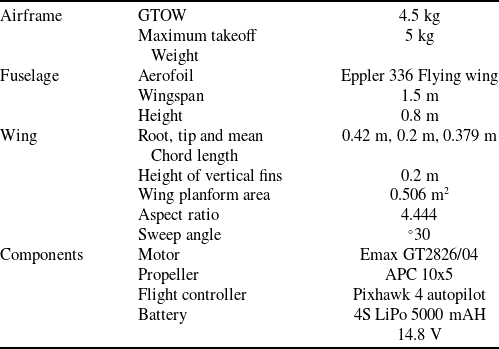
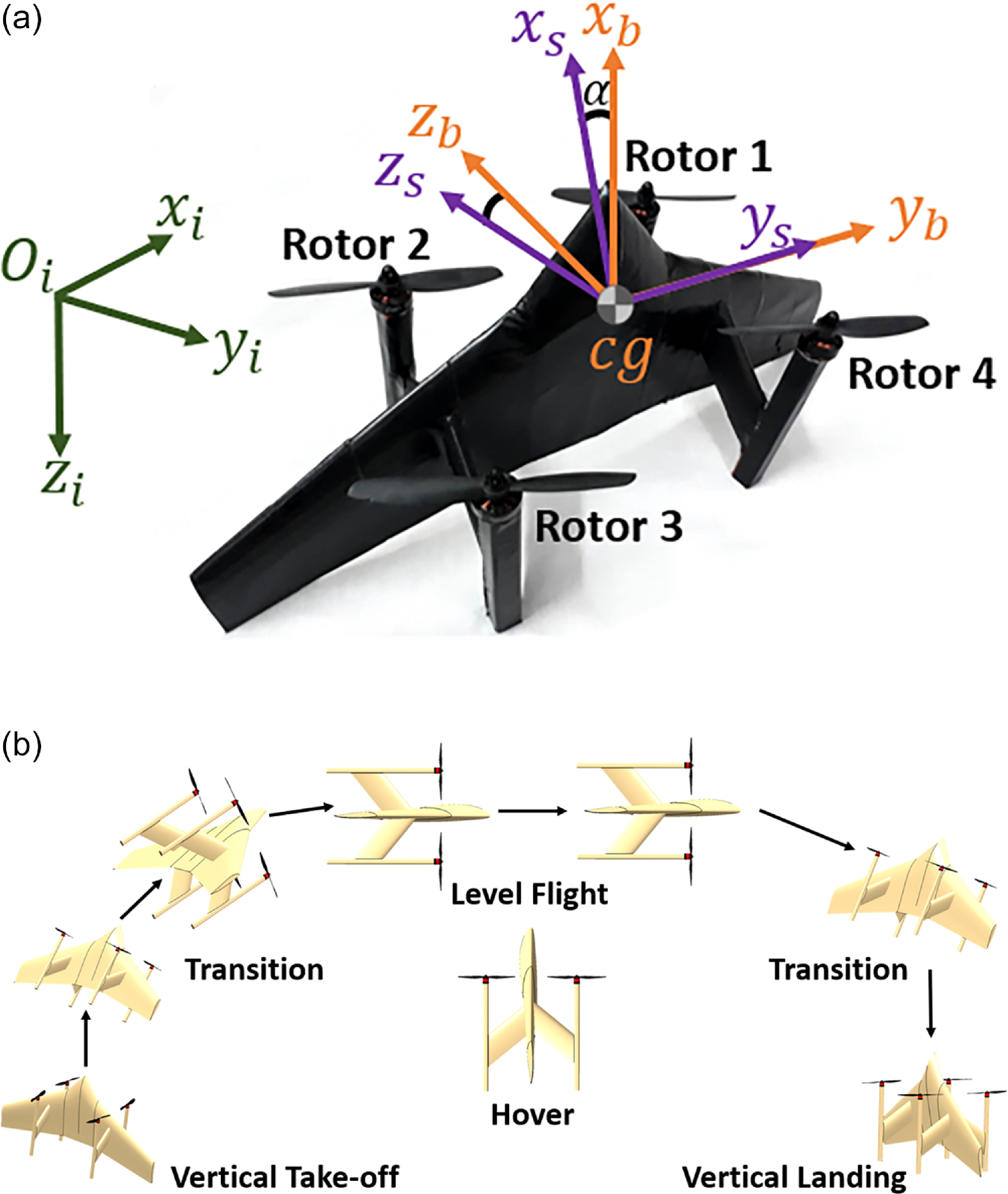
The designed aerial vehicle is shown in Fig. 2. The design comprises quadrotor combined with a flying wing. It is intended to fly over a wide envelope from stationary hover to high-speed cruise while executing a variety of flight modes as shown in Fig. 2(b). Aircraft achieves transition between the flight modes by application of thrust differential between the rotors installed above and below the vehicle’s horizontal plane. Rotor numbering is shown in Fig. 2(a).
The design specifications of the aircraft are mentioned in Table 1. A systematic aircraft design methodology, given by Ref. [Reference Gundlach and Gundlach36], is followed during the conceptual and preliminary design phases. A vehicle design is optimised for maximum range by maximising the minimum drag objective function. The electrical bay and payload compartment are housed inside the fuselage and the vehicle is designed to carry the payload of 1/2 kg. Four propulsion units comprising motors and propellers are installed at the edge of four struts. Other ends of these struts serve as landing legs. Each strut is attached to the vertical fin. Component matching techniques are applied for the selection of motor and propeller to attain the static thrust to weight ratio of more than 1.2. Axis systems used in the modeling section are illustrated in Fig. 2(a). Body axis (orange), stability axis (purple) and inertial axis (green) are shown. In the body-fixed coordinate system the positive directions of
 ${x_b}$
,
 ${y_b}$
and
 ${z_b}$
are shown in Fig. 2(a). The stability coordinate system is rotated about the
 $y$
-axis of the body-fixed frame by an angle
 $ - \alpha $
to make the longitudinal velocity vector parallel to the
 $x$
-axis of the stability frame. Origin of the body and the stability frames lie at
 $cg$
(centre of gravity) location of the aircraft (refer to Fig. 2(a)). Origin of the inertial frame is represented as
 ${O_i}$
in Fig. 2(a). In the inertial frame
 ${x_i}$
,
 ${y_i}$
and
 ${z_i}$
point towards North, East and Down, respectively. Initially inertial and body frames coincide with each other and as the aircraft starts to move, the respective forces and moments are transformed from inertial and stability frames to the body-fixed frame to determine the dynamic response of the vehicle.
Design specifications of VTOL hybrid UAV

Design of VTOL hybrid UAV. (a) Body, stability and inertial coordinate systems. (b) Operational flight modes of the aircraft.

3.0 Mathematical model of aircraft dynamics
Rigid body equations of motion of the aircraft are derived in the body-fixed frame to model the six DOF translational and rotational dynamics for all flight modes. Newton-Euler equations of motion (refer to Equations (3) and (4)) illustrate that the sum of all the forces acting on a rigid body (
 ${F_t}$
) is equal to the product of its mass (
 $m$
) and linear acceleration (
 ${\dot {\rm {v}}}$
). Whereas, the sum of all the moments acting on a rigid body (
 ${{\textbf{M}}_t}$
) is equal to the product of its inertia (
 $I$
) and angular acceleration (
 $\dot \omega $
).
 \begin{align} m{\dot{\bf{v}}} & = {{\textbf{F}}_t} \end{align}
 \begin{align} I\dot \omega + \omega \times \left( {I\omega } \right) & = {{\textbf{M}}_t} \end{align}
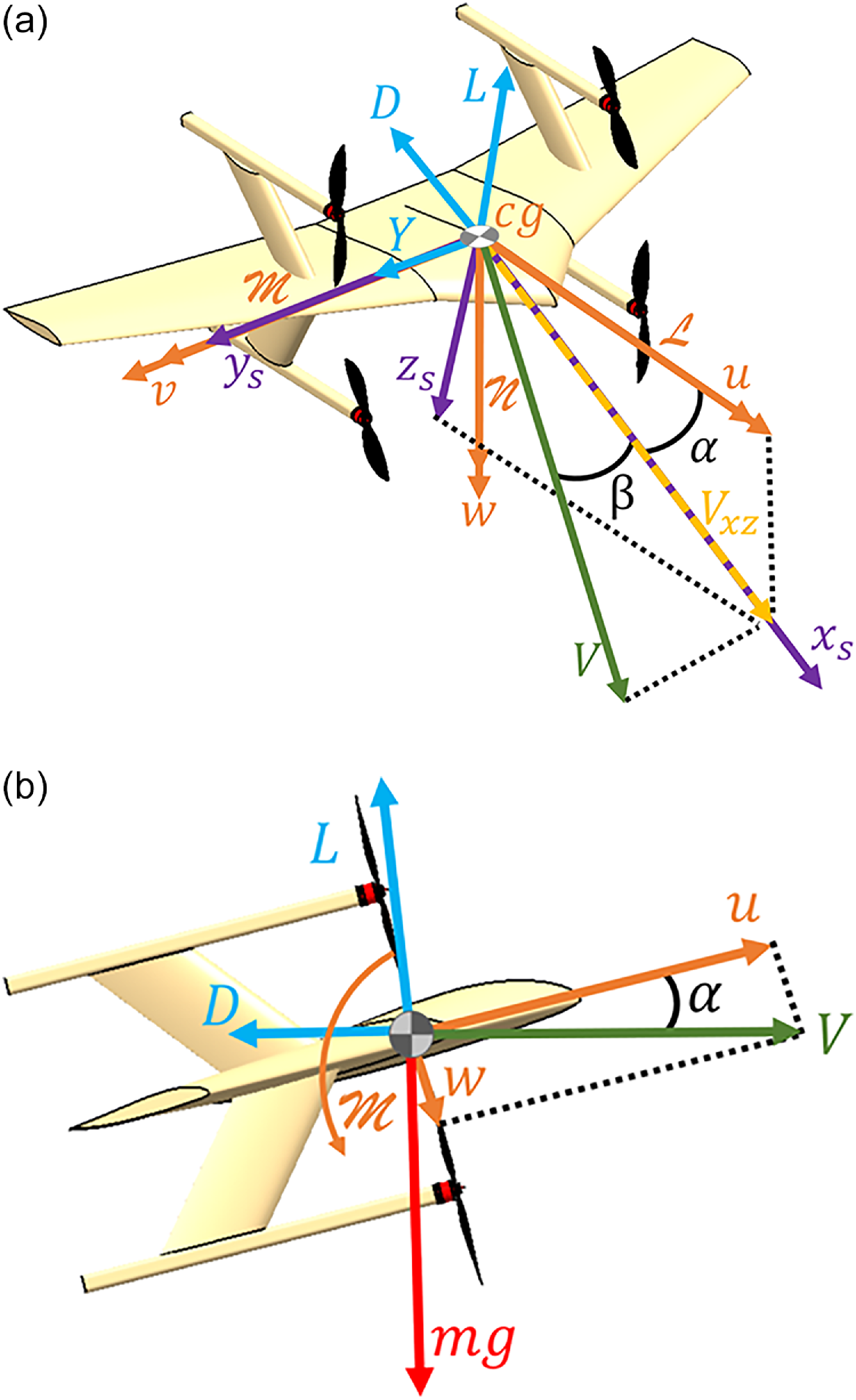
To formulate the mathematical model of aircraft dynamics based on the Newton-Euler approach, all the aerodynamic forces and moments experienced by the aircraft during a flight are demonstrated in Fig. 3 that provides a three-dimensional illustration of lift, drag, side-force, rolling moment, pitching moment and yawing moment acting along longitudinal, lateral and vertical directions in the body-fixed and stability coordinate systems. Velocity vector (
 ${\bf{V}}$
) and its
 $x$
,
 $y$
and
 $z$
components (
 $u$
,
 $v$
and
 $w$
) are also shown in the Fig. 3(a); velocity can be calculated from its components as mentioned in Equation (5). The angle-of-attack (
 $\alpha $
) and sideslip angle (
 $\beta $
) are defined, which can be obtained from the ratio of velocity and its components (refer to Equation (5)). Lift (
 $L$
), drag (
 $D$
), weight (
 $mg$
) and pitching moment (
 ${\mathscr{M}}$
) acting along the longitudinal plane of the aircraft are shown in Fig. 3(b). As the transition occurs in the longitudinal plane, adequate representation of all the forces and moments for longitudinal flight dynamics modeling is of primary concern for a detailed explanation of transition phenomenon.
 \begin{align}\begin{array}{*{20}{l}}{}{{\boldsymbol{V}} = {{[ {\begin{array}{*{20}{l}}{u,}\,{v,}\,w\end{array}} ]}^T}{\rm{\;\;\;\;}}V = \left\| {\boldsymbol{V}} \right\|}\\[4pt]{\alpha = {\rm{ta}}{{\rm{n}}^{ - 1}}\left( {\dfrac{w}{u}} \right){\rm{\;\;\;\;}}\beta = {\rm{si}}{{\rm{n}}^{ - 1}}\left( {\dfrac{v}{V}} \right)}\end{array}\end{align}
Aerodynamic forces and moments acting on the aircraft. (a) Lift, drag, side force, rolling moment, pitching moment and yawing moment. (b) Lift, drag, weight and pitching moment acting along the longitudinal plane.

Six DOF mathematical representation of translational and rotational dynamics of VTOL hybrid UAV is given as Equations (6) and (7).
Translational equations of motion
 \begin{align}\left[ {\begin{array}{*{20}{l}}m\quad 0\quad 0\\0\quad m\quad 0\\0\quad 0\quad m\end{array}} \right]\left[ {\begin{array}{*{20}{l}}{\dot u}\\{\dot v}\\{\dot w}\end{array}} \right] & = - \left[ {\begin{array}{*{20}{l}}m\quad 0\quad 0\\0\quad m\quad 0\\0\quad 0\quad m\end{array}} \right]\left( {\left[ {\begin{array}{*{20}{l}}p\\q\\r\end{array}} \right] \times \left[ {\begin{array}{*{20}{l}}u\\v\\w\end{array}} \right]} \right) + \left[ {\begin{array}{*{20}{l}}{ - c\alpha } & \quad 0 & \quad{s\alpha }\\0 & \quad 1 & \quad 0\\{ - s\alpha } & \quad 0 & \quad { - c\alpha }\end{array}} \right]\left[ {\begin{array}{*{20}{l}}{\bf{D}}\\0\\{\textbf{L}}\end{array}} \right]\nonumber\\ & \quad + \left[ {\begin{array}{*{20}{l}}1 & \quad 0 & \quad 0\\0 & \quad{c\phi } & \quad{s\phi }\\0 & \quad { - s\phi } & \quad {c\phi }\end{array}} \right]\left[ {\begin{array}{*{20}{l}}{c\theta } & \quad 0 & \quad { - s\theta }\\0 & \quad 1 & \quad 0\\{s\theta } & \quad 0 & \quad {c\theta }\end{array}} \right]\left[ {\begin{array}{*{20}{l}}{c\psi } & \quad {s\psi } & \quad 0\\{ - s\psi } & \quad {c\psi } & \quad 0\\0 & \quad 0 & \quad 1\end{array}} \right]\left[ {\begin{array}{*{20}{l}}0\\0\\{mg}\end{array}} \right] + \left[ {\begin{array}{*{20}{l}}{{{\textbf{F}}_T}}\\0\\0\end{array}} \right]\end{align}
Equation (6) corresponds to Newton’s second law (refer to Equation (3)) and represents the translation of the aircraft in body-fixed frame. The left-hand side of Equation (6) is the product of the mass and linear acceleration of the aircraft. Similarly, the right-hand side represents the summation of all the forces acting in the body-fixed coordinate system. These forces include thrust, drag, lift and weight. The first term on the right-hand side shows the Coriolis terms that arise due to the rotation of the body-fixed frame with respect to the inertial frame. The second term on the right-hand side depicts the lift and drag forces acting in the stability frame, where rotation matrix has been used to transform the aerodynamic forces from stability frame to body-fixed frame. Aerodynamic forces acting along the lateral plane (
 ${y_b}$
-axis) are not considered during mathematical modeling of transition manoeuvre, as the transition occurs only in the longitudinal plane, hence the side fore is considered to be zero. The third term represents the weight of the aircraft acting vertically downward along
 ${z_i}$
-axis in the inertial frame, as shown in Fig. 3(b). ‘ZYX’ rotation matrix is multiplied with the weight matrix to transform the weight from inertial frame to body-fixed axis system. Lastly, the total thrust produced by four propulsion units, acting along the body-fixed
 ${x_b}$
-axis, forms the fourth term on the right-hand side of Equation (6).
Rotational equations of motion
 \begin{align}{\left[ {\begin{array}{c@{\quad}c@{\quad}c}{{I_{xx}}} & { - {I_{xy}}} & { - {I_{xz}}}\\[6pt]{ - {I_{xy}}} & {{I_{yy}}} & { - {I_{yz}}}\\[6pt]{ - {I_{xz}}} & { - {I_{yz}}} & {{I_{zz}}}\end{array}} \right]\left[ {\begin{array}{c}{\dot p}\\[6pt]{\dot q}\\[6pt]{\dot r}\end{array}} \right]} = { - \left( {\left[ {\begin{array}{*{20}{c}}p\\[6pt]q\\[6pt]r\end{array}} \right] \times \left[ {\begin{array}{c@{\quad}c@{\quad}c}{{I_{xx}}} & { - {I_{xy}}} & { - {I_{xz}}}\\[6pt]{ - {I_{xy}}} & {{I_{yy}}} & { - {I_{yz}}}\\[6pt]{ - {I_{xz}}} & { - {I_{yz}}} & {{I_{zz}}}\end{array}} \right]\left[ {\begin{array}{c}p\\[6pt]q\\[6pt]r\end{array}} \right]} \right) + \left[ {\begin{array}{c}0\\[6pt]\mathscr{M}\\[6pt]0\end{array}} \right] + \left[ {\begin{array}{c}0\\[6pt]{{{\textbf{M}}_T}}\\[6pt]0\end{array}} \right]}\end{align}
Equation (7) is based on the Euler formulation of rigid body motion (refer to Equation (4)), which represents the rotational dynamics of an aircraft about the three-axis of the body-fixed frame. The left-hand side of Equation (7) shows the product of the inertia tensor of the aircraft with angular accelerations about the body-fixed axis system. The right-hand side involves the sum of all the moments acting on the aircraft in the longitudinal plane. As we are modeling the transition flight dynamics, which occurs only in the longitudinal plane, pitching moments acting about the lateral axis of aircraft are modeled, whereas, rolling moment and yawing moment acting about the longitudinal and vertical axis of the aircraft, respectively, are not considered. The first term on the right-hand side of Equation (7) represents the Coriolis terms, arising due to the rotation of the body-fixed frame with respect to the inertial frame. The second term presents the aerodynamic moment acting in the body-fixed frame; effects of the pitching moment acting on the aircraft due to airframe aerodynamics are introduced into the dynamic model by this term. The last term on the right-hand side of Equation (7) captures the moment generated about the lateral axis of the aircraft due to the differential of thrust between the rotors installed above and below the aircraft’s horizontal plane.
The total axial force is determined by adding the components of lift, drag, weight and thrust acting along the axial direction (
 ${x_b}$
-axis) of the aircraft. The total vertical force is determined by adding the components of lift, drag and weight acting along the vertical direction (
 ${z_b}$
-axis) of the aircraft. Total pitching moment is determined by adding the effects of the pitching moment due to airframe aerodynamics (
 $M$
) and pitching moment due to the application of thrust differential between the rotors (
 ${M_T}$
). These values of total axial force, total vertical force and total pitching moment are fed to 6DOF equations of motion block of the ‘Aerospace Blockset’ built-in to MATLAB/Simulink, to solve the translational and rotational flight dynamics of the aircraft, given by Equations (6) and (7), respectively.
4.0 Propulsion dynamics
According to Ref. [Reference Brandt and Selig37], the performance parameters of a propeller, i.e. thrust (
 $T$
), torque (
 $Q$
) and power (
 $P$
), can be determined from the relation given by Equations (8), (9) and (10). In these relations, the density of air (
 $\rho $
), rotational velocity (
 $\sigma $
) of a propeller and propeller diameter (
 $d$
) are the known variables. Whereas, coefficient of thrust (
 ${C_T}$
), coefficient of torque (
 ${C_Q}$
) and coefficient of power (
 ${C_P}$
) need to be calculated as a function of advance ratio (
 $J$
) and rotational velocity of the propeller. The advance ratio of a propeller is a non-dimensional parameter that is given as a ratio of forward velocity (
 $V$
) to the product of propeller rotation speed and its diameter, as shown in Equation (11). If the coefficient of torque is known, then the coefficient of power can be determined by using the relation given as Equation (12).
 \begin{align} T & = \rho {\sigma ^2}{d^4}{C_T}\left( {J,\sigma } \right) \end{align}
 \begin{align}Q & = \rho {\sigma ^2}{d^5}{C_Q}\left( {J,\sigma } \right) \end{align}
 \begin{align} P & = 2\pi \sigma Q = \rho {\sigma ^3}{d^5}{C_P}\left( {J,\sigma } \right) \end{align}
 \begin{align}J & = \frac{V}{{\sigma d}} \end{align}
 \begin{align}{C_P}\left( {J,\sigma } \right) & = {C_Q}\left( {J,\sigma } \right)2\pi \end{align}
Motor and propeller matching for propeller selection.

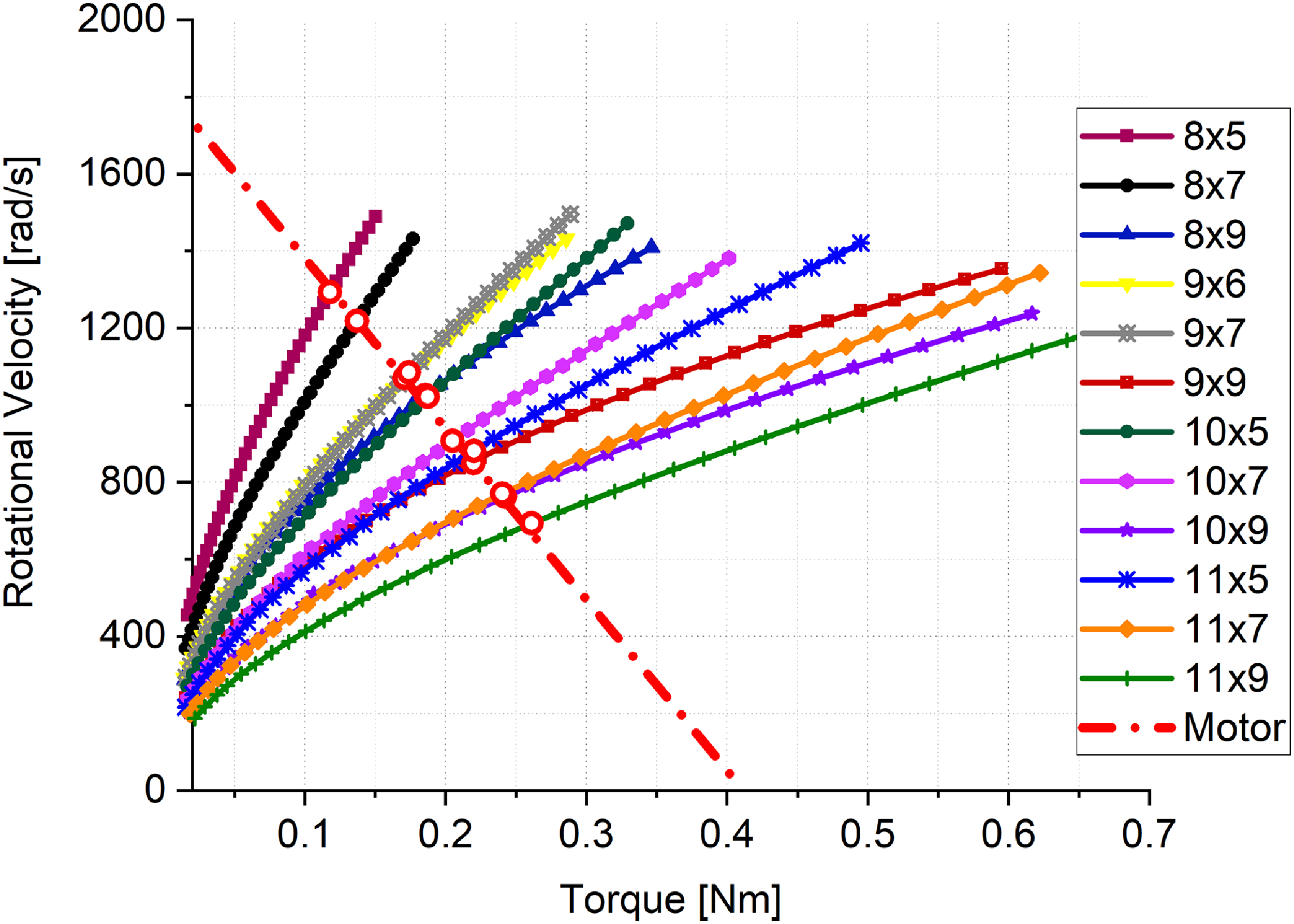
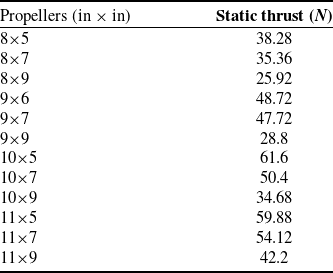
The performance characteristic curves of a motor and 12 candidate propellers are shown in Fig. 4. At a particular value of rotational velocity of a motor, the torque produced by the motor is matched with the torque required by propeller. The propeller will operate at the same rotational velocity as that of a motor because no gearbox is involved. Red circles in the graph show the point of intersection of the motor and propeller curves. At each of these points, thrust is calculated by using Equation (8), to determine the maximum static thrust produced by the motor and propeller combination. The total static thrust produced by four propulsion units, at 100 % throttle setting, with the 12 considered propellers is given in Table 2. The criteria for selection of propeller is to achieve the thrust to weight ratio
 $\left( {\frac{T}{W}} \right)$
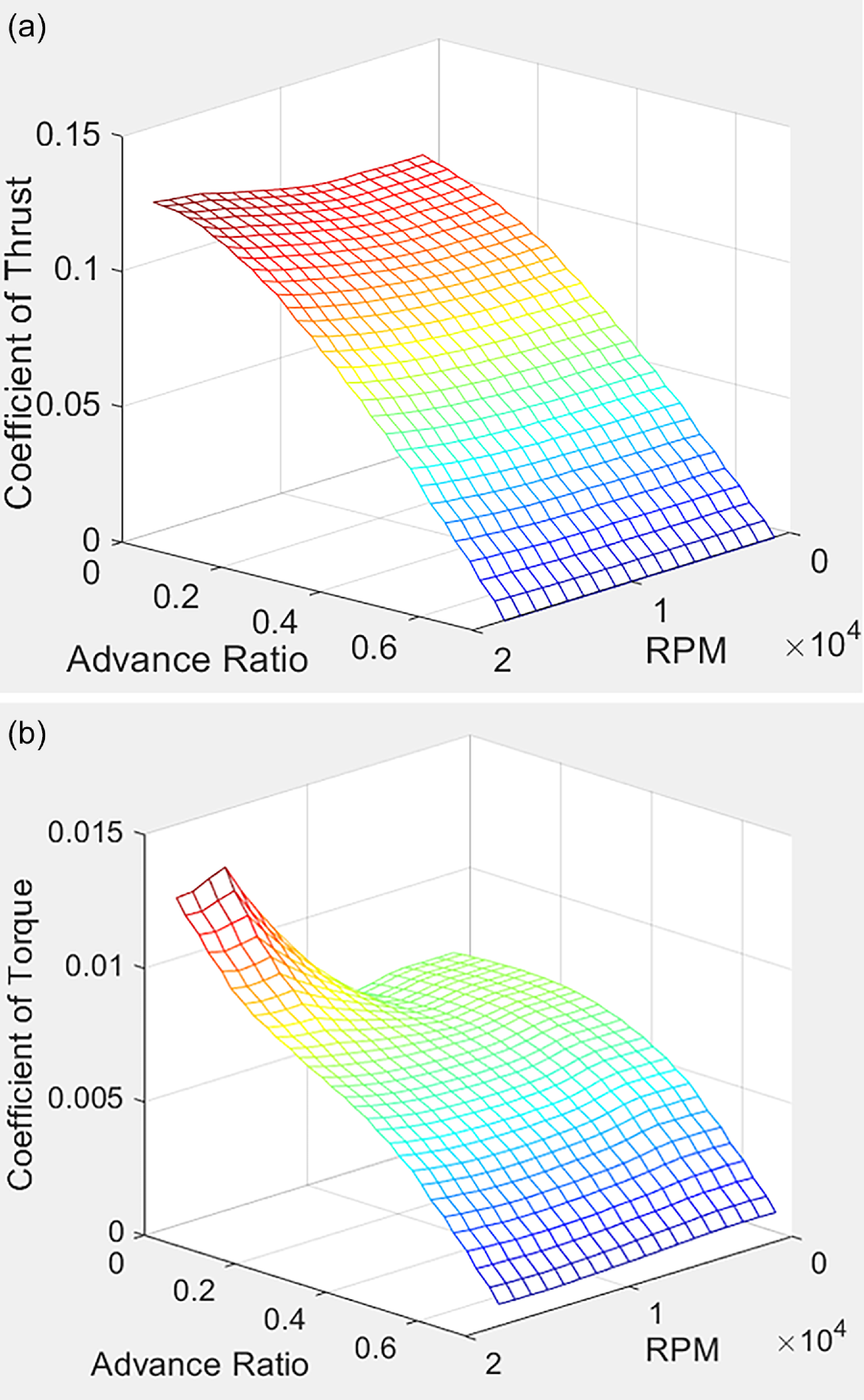
of greater than 1.2 for VTOL operation. APC 10 × 5 propeller is selected for the propulsion system, as it fulfills the selection criteria and provides maximum static thrust with the selected motor (Emax GT2826/04). For the selected propeller (APC 10 × 5), the coefficient of thrust and coefficient of torque are plotted against the advance ratio and propeller rotational velocity (RPM) in Fig. 5a and b, respectively. Data for plotting the performance characteristic curves of the propeller is extracted from the wind tunnel testing data presented by Ref. [Reference Brandt and Selig37]. These curves are introduced in the Simulink model of the vehicle in the form of lookup tables. For the input values of forward velocity and air density, the advance ratio is calculated at each instance, for the known diameter of the propeller. From the input values of advance ratio and propeller RPM, the coefficient of torque and coefficient of thrust are determined. These coefficients are used to calculate the total thrust and torque produced by propulsion units at each instance of time. Once the thrust of all rotors is known, the pitching moment produced due to the thrust differential is determined by multiplying the thrust of the upper and the lower rotors with the moment arm (
 $l$
).
Propeller selection

Performance characteristics of selected propeller (APC
 $10 \times 5$
). (a) Coefficient of thrust as a function of advance ratio and RPM. (b) Coefficient of torque as a function of advance ratio and RPM.

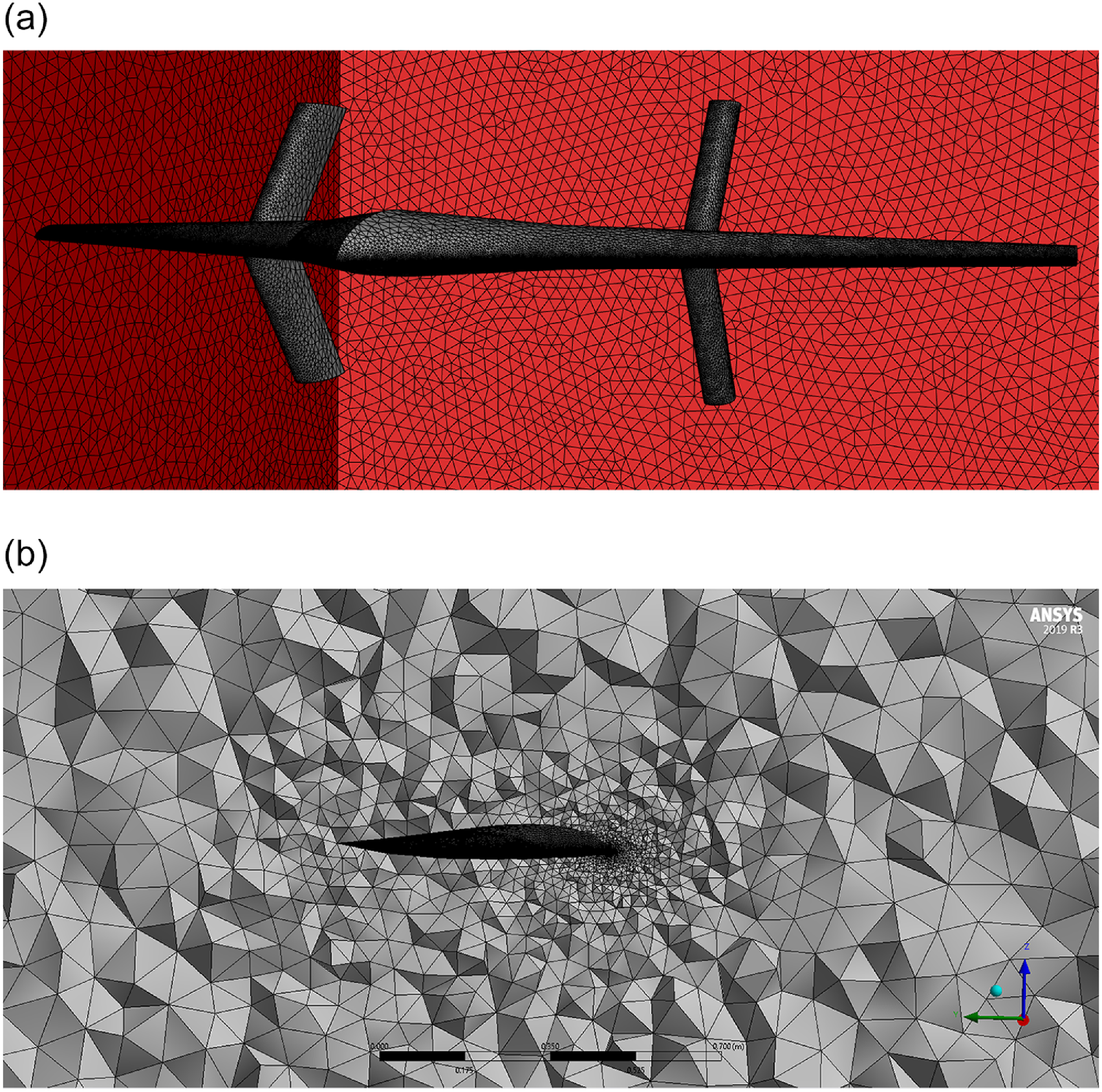
Aerodynamic analysis of designed VTOL hybrid UAV. (a) Meshing of the aircraft body and domain for analysis in ANSYS Fluent. (b) Fine mesh near the aircraft surface for aerodynamic analysis.

5.0 Airframe aerodynamics
To obtain high-fidelity data of airframe aerodynamics, and to determine the aerodynamic forces (
 ${F_{al}}$
) and moments (
 ${M_{al}}$
) acting on the aircraft in the longitudinal plane, multiple computational fluid dynamics (CFD) analysis techniques have been applied. Initially, the vortex lattice method (VLM) was applied using XFLR5 to estimate airframe aerodynamic characteristics at low angles of attack. XFLR5 is an empirical engineering design tool, which provides good baseline aerodynamic data of the aircraft. However, integrity of results of XFLR5 may be compromised for high angles of attack, because at high angles of attack, lift is overpredicted and drag is underpredicted by XFLR5, as body effects are not included in VLM analysis [Reference Waldrop, He, Hedrick and Rader38]. During the operation of VTOL hybrid UAV pitch angle varies from
 ${0^ \circ }$
to
 ${{90}^ \circ }$
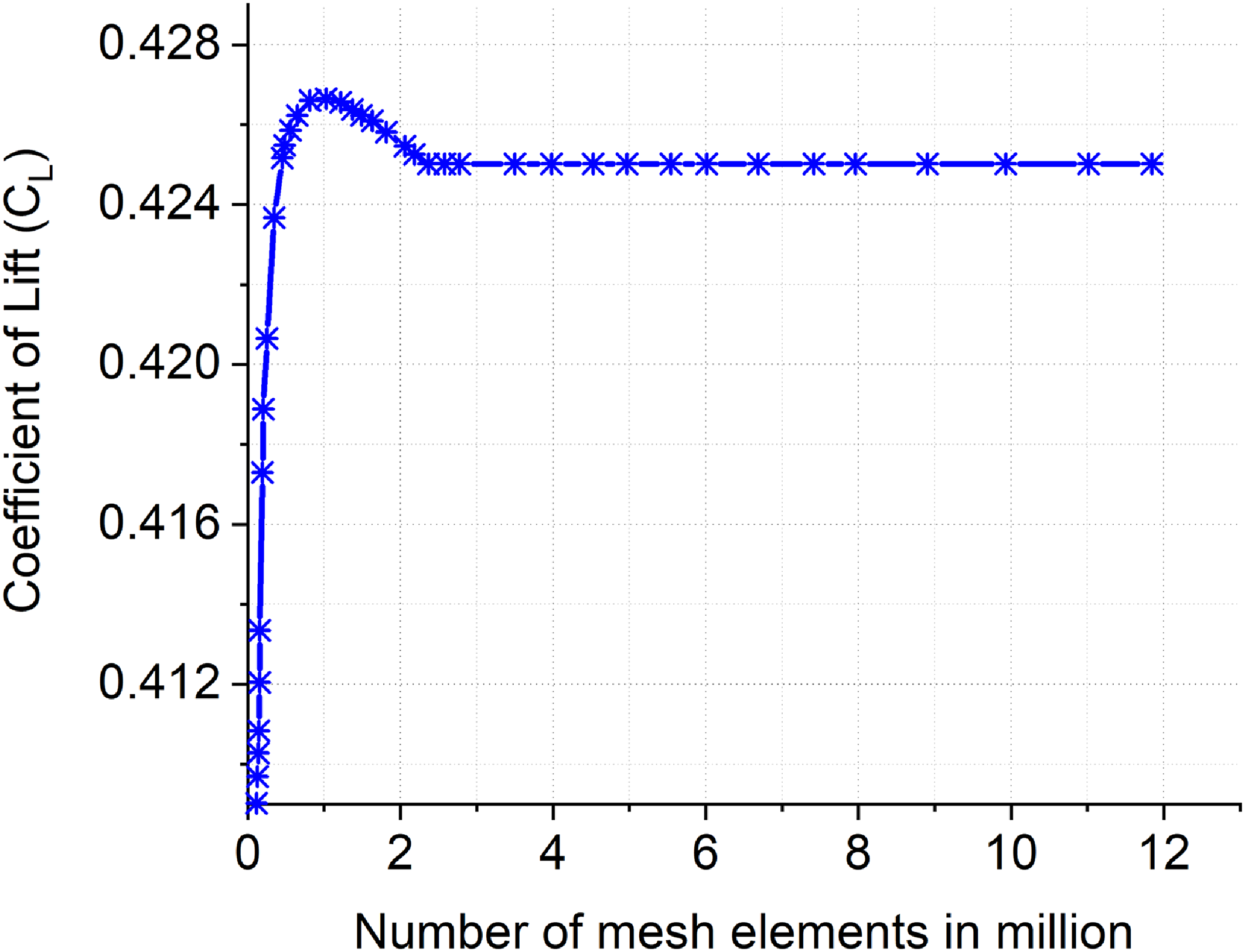
, as the vehicle executes highly dynamic maneuvers over a wide flight envelope. Therefore, to capture the aerodynamics of the aircraft in all flight modes, a high-fidelity aerodynamic analysis was performed over the full flight envelope by solving Reynolds-averaged Navier–Stokes (RANS) equations, using ANSYS Fluent. ANSYS Fluent is a well-established and reliable CFD analysis tool for estimation of aerodynamic coefficients of the aircraft [Reference Lao and Wong39, Reference Pepelea, Cojocaru, Toader and Niculescu40]. A fine mesh is realised at and near the surface of the aircraft (refer to Fig. 6). Farther away from the aircraft surface towards the boundaries of the domain, the mesh is kept coarse. This allows to adequately capture the flow dynamics near the surface of the aircraft and saves the computational power while solving the rest of the domain. The grid independence test is performed to ensure that the results of computational analysis are independent of mesh size (refer to Fig. 7). A test is performed by calculating the coefficient of lift at cruise velocity of 33
 $m/s$
and
 ${{6}^{\circ} }$
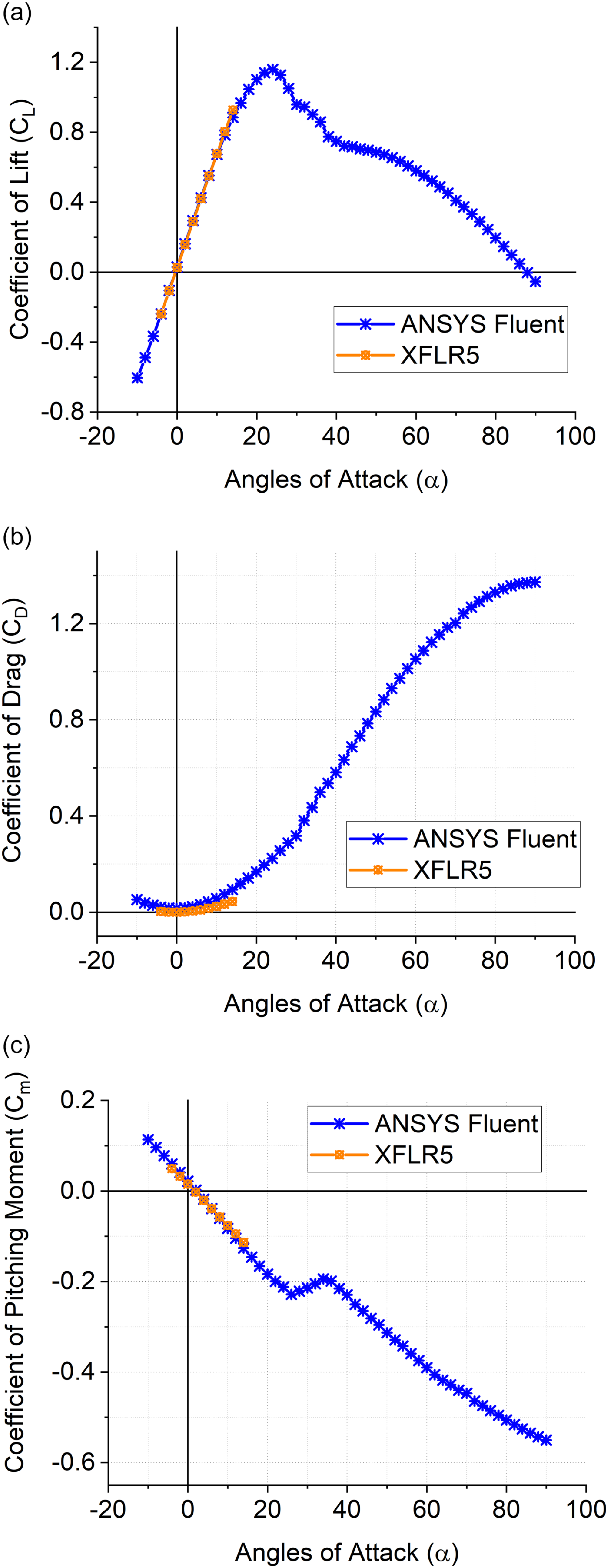
angle-of-attack, with mesh size variation from 0.1 m to 12 m number of mesh elements. It was revealed that for the grid, with the number of mesh elements greater than 2.3 m, the results of CFD become independent of mesh size, hence for our analysis, grid with 2.8 m number of mesh elements is utilised. Longitudinal aerodynamic coefficients are calculated for the wide flight envelope, from −12
 ${^ \circ }$
to +90
 ${^ \circ }$
range of
 $\alpha $
, as shown in Fig. 8. At lower values of
 $\alpha $
(−10
 ${^ \circ }$
to +15
 ${^ \circ }$
), the ANSYS results correspond very closely with those calculated from the XFLR5. However, at the higher values of
 $\alpha $
, XFLR5 overpredicted the lift and underpredicted the drag, as mentioned in the literature [Reference Waldrop, He, Hedrick and Rader38], hence a more reliable prediction of aerodynamic coefficients is achieved by using ANSYS Fluent.
 \begin{align} {{\boldsymbol{F}}_{al}} & = \left[ {\begin{array}{*{20}{l}}{ - {\cos}\left( \alpha \right)} & \quad 0 & \quad {\sin\left( \alpha \right)}\\0 & \quad 1 & \quad 0\\{ - \sin\left( \alpha \right)} & \quad 0 & \quad { - \cos\left( \alpha \right)}\end{array}} \right]\left[ {\begin{array}{*{20}{l}}{\bf{D}}\\0\\{\boldsymbol{L}}\end{array}} \right] \end{align}
 \begin{align}{{\textbf{M}}_{al}} & = {\left[ {\begin{array}{*{20}{l}}0 & \quad {\mathscr{M}} & \quad 0\end{array}} \right]^T} \end{align}
 \begin{align} {\textbf{L}} & = {1 \over 2}{C_L}\left( \alpha \right)\rho {V^2}S \nonumber\\ {\bf{D}} & = {1 \over 2}{C_D}\left( \alpha \right)\rho {V^2}S \nonumber\\ {\mathscr{M}} & = {1 \over 2}{C_m}\left( \alpha \right)\rho {V^2}S\bar c \end{align}
Grid independence test: Values of coefficient of lift calculated at cruise velocity of 33 m/s and
 ${6^ \circ }$
angle-of-attack, with variation in grid size.

Variation of aerodynamic coefficients with angles of attack. (a) Coefficient of lift vs angles of attack. (b) Coefficient of drag vs angles of attack. (c) Coefficient of pitching moment vs angles of attack.

For transition flight dynamics modeling, the longitudinal aerodynamic force and longitudinal aerodynamic moment are given by Equations (13) and (14), respectively. In these equations, unknown parameters are lift, drag and pitching moment. These unknowns can be determined by using Equation (15). In the dynamic model of the vehicle, the coefficient of lift, coefficient of drag and coefficient of pitching moment are calculated against the values of angles of attack from the graphs shown in Fig. 8. These graphs are introduced in the Simulink model of the aircraft in the form of lookup tables. In Equation (15), air density, velocity of the aircraft, wing planform area and mean aerodynamic chord length are the known variables. From Equation (15) the aerodynamic forces and moments can be determined at each time instant.
6.0 Transition control system design
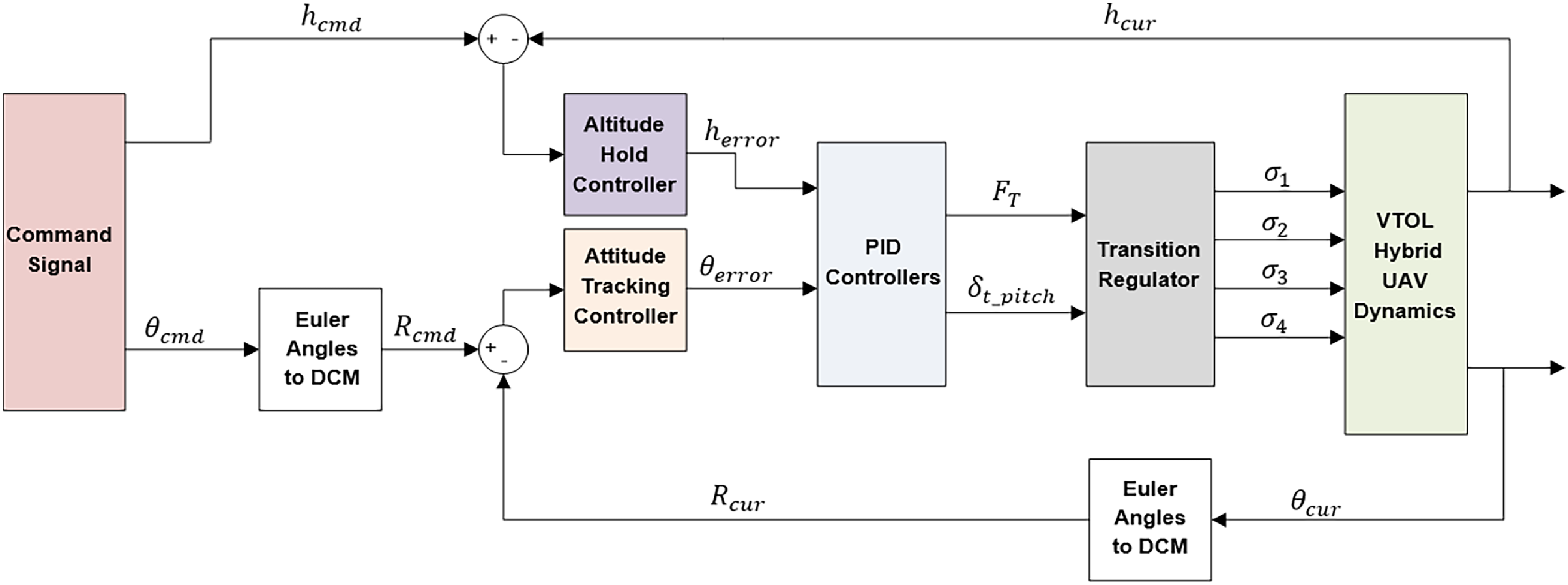
Dynamic response of the designed VTOL hybrid UAV is largely dependent on the combined effect of the propulsion dynamics and airframe aerodynamics. During the transition manoeuvre the aerodynamic coefficients change rapidly and UAV is required to be controlled through the input of actuators, which are four motors controlling the differential thrust of the propellers in the case of the designed vehicle. The manoeuvres are executed by the application of differential thrust; however it is challenging to maintain the commanded attitude and altitude simultaneously, during the transition phase. To control the smooth transition between the flight modes, a novel transition control system was formulated and implemented in MATLAB/Simulink environment. A block diagram of the transition control system design is presented in Fig. 9. The transition control system is further divided into the attitude-tracking controller, altitude-hold controller and transition regulator. An attitude-tracking controller is designed to track the commanded attitude of the aircraft to accomplish a smooth transition. The altitude-hold controller holds the aircraft’s altitude during the transition. The transition regulator takes the inputs from the attitude-tracking and altitude-hold controllers and regulates the rotational velocity of each rotor, to control the attitude and altitude of the aircraft in all flight modes. The ‘Command Signal’ block contains the predefined flight plan, providing the control system with commanded pitch (
 ${\theta _{cmd}}$
) and the commanded altitude (
 ${h_{cmd}}$
). The commanded pitch values are converted into a rotation matrix, defining the commanded attitude of the aircraft (
 ${{\boldsymbol{R}}_{cmd}}$
). Similarly, the current pitch (
 ${\theta _{cur}}$
) values of the aircraft are transformed into a rotation matrix, defining the current attitude (
 ${{\boldsymbol{R}}_{cur}}$
) of the aircraft. Commanded and current attitude rotation matrices serve as inputs to the ‘Attitude-Tracking Controller’ block. This block calculates the attitude errors in the form of pitch error (
 ${\theta _e}$
). These error signals are sent to the ‘PID Controllers’ block, which in turn calculates the required differential thrusts
 ${\delta _{{t_{pitch}}}}$
to control the rotation about the lateral axis of the aircraft for realising the transition manoeuvre. Commanded altitude (
 ${h_{cmd}}$
) and current altitude (
 ${h_{cur}}$
) signals are sent to the ‘Altitude-Hold Controller’ block, which calculates the altitude error (
 ${h_e}$
). Altitude errors are directed to the ‘PID Controllers’ block, which determines the required total thrust (
 ${F_T}$
) to control the altitude of the aircraft.
Architecture of transition control system.

The required total thrust and required differential thrust are sent to the ‘Transition Regulator’ block. This block calculates the required rotational velocity of each rotor, to control the attitude and altitude of the aircraft, for a smooth transition between the flight modes. These values of rotational velocity are sent to the ‘VTOL Hybrid UAV Dynamics’ block, where the complete dynamic model of the aircraft is implemented. This block comprises airframe aerodynamics, propulsion dynamics, gravitational effects, atmospheric model and the entire system to calculate total axial force, total vertical force and total pitching moment. These forces and moments act as inputs for the ‘6DOF Equations of Motion’ block to solve translational and rotational dynamics of the aircraft. The feedback signals are generated by the ‘VTOL Hybrid UAV Dynamics’ block and sent back to the control system, to close the loop.
6.1 Attitude-tracking controller
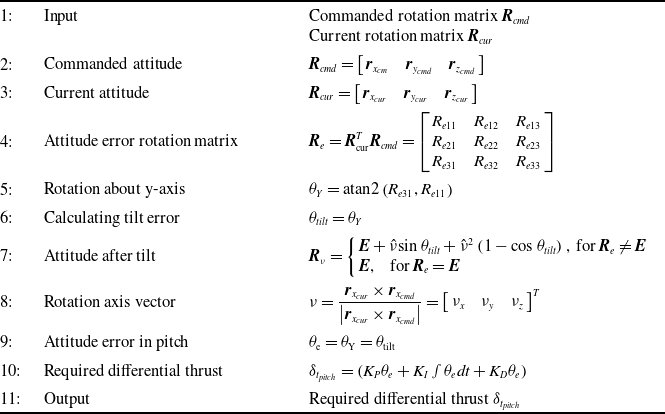
The algorithm running in the ‘Attitude-Tracking Controller’ block is presented in Table 3. This algorithm is based on the ‘resolved tilt-twist angle control’ technique, originally presented by Ref. [Reference Matsumoto, Kita, Suzuki, Oosedo, Go, Hoshino, Konno and Uchiyama35] for hover control of the tail-sitter UAV. Their design was based on the conventional aircraft with tractor configuration. For attitude control, they utilised conventional control surfaces (ailerons, elevators and rudder) and presented attitude control only for hover flight mode. We have modified and implemented the ‘tilt-angle-based control’ for attitude control of a VTOL hybrid UAV, to achieve smooth transition between the cruise and hover flight modes. For the first time this technique is applied for a differential thrust transitioning hybrid VTOL UAV, without any control surfaces where the attitude control actuation is provided by the use of differential thrust of four propulsion units. Additionally, full envelope attitude control was achieved for all flight modes including, cruise, transition, hover and reverse transition.
Attitude-tracking control algorithm

The rotation matrices representing the commanded (
 ${{\boldsymbol{R}}_{cmd}}$
) and current (
 ${{\boldsymbol{R}}_{cur}}$
) attitudes are the 3×3 matrices, each with the three column vectors,
 ${r_x}$
,
 ${r_y}$
and
 ${r_z}$
. A 3×3 rotation matrix of attitude error (
 ${R_e}$
) is determined from
 ${R_{cmd}}$
and
 ${R_{cur}}$
as shown in the S No 4 of Table 3. By using the elements of first column of
 ${{\boldsymbol{R}}_e}$
matrix, the required rotation of the aircraft about
 $y$
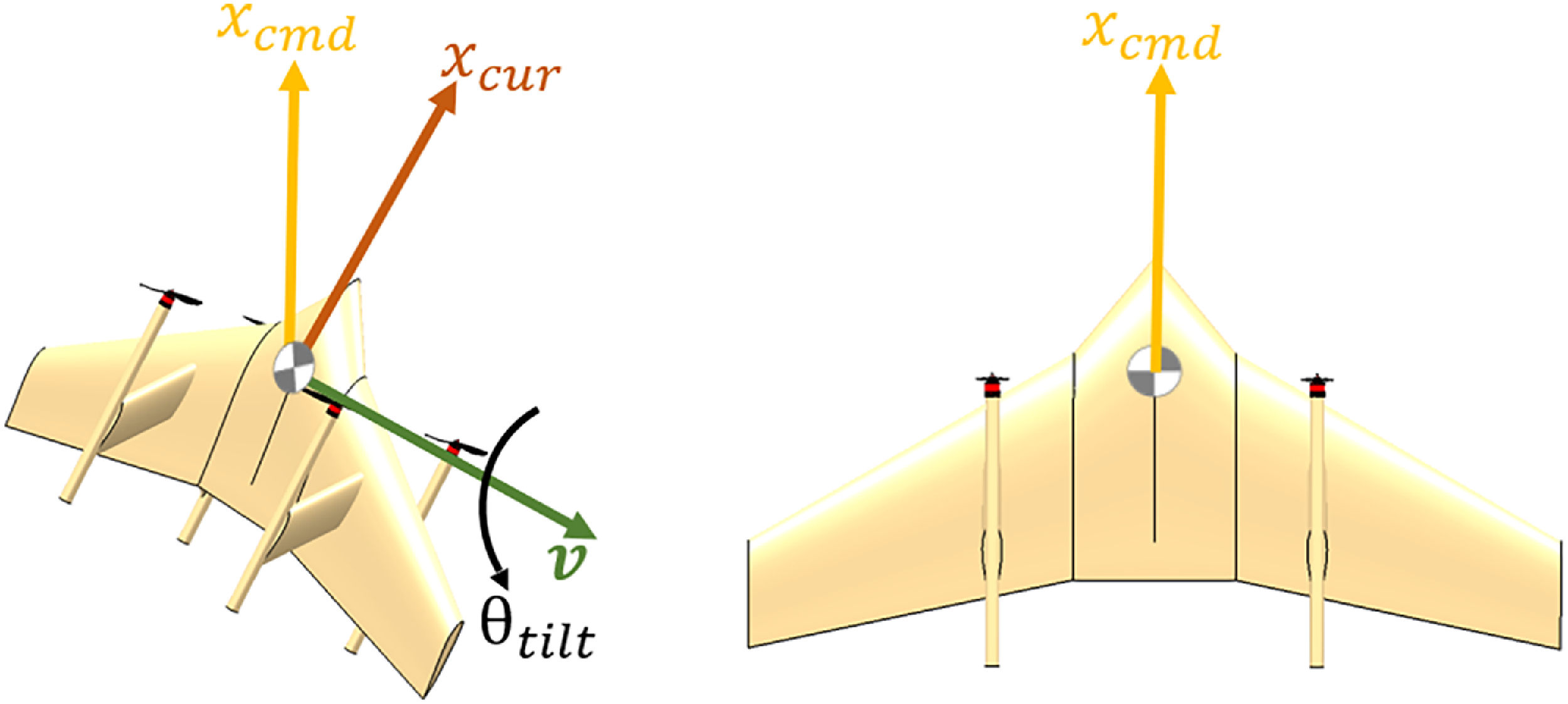
-axis is determined to calculate the tilt error between the commanded and current attitudes (refer to Fig. 10). Attitude of the aircraft after rotation of
 ${\theta _{tilt}}$
is given by matrix
 ${R_\nu }$
. Rotation axis vector (
 $\nu $
) is a vector pointing in the direction of the axis of
 ${\theta _{tilt}}$
rotation (refer to Fig. 10). Rotation axis vector (
 $\nu $
) is calculated by normalised cross product of the column vectors of the commanded and current attitude rotation matrices. Attitude after tilt (
 ${R_\nu }$
) is calculated from the rotation axis vector (
 $\nu $
) and tilt angle (
 ${\theta _{tilt}}$
), as shown in S No 7 of Table 3. Here hat operator (^) is used to transform the rotation axis vector (
 $\nu $
) into a skew symmetric matrix.
 \begin{align}{\hat \nu = }{\left[ {\begin{array}{c@{\quad}c@{\quad}c}0 & { - {\nu _z}} & {{\nu _y}}\\[3pt]{{\nu _z}} & 0 & { - {\nu _x}}\\[3pt]{ - {\nu _y}} & {{\nu _x}} & 0\end{array}} \right]}\end{align}
The attitude error in pitch (
 ${\theta _e}$
) is calculated in the body-fixed coordinate system (refer to step 9 of Table 3). These attitude errors are sent to the ‘PID Controllers’ block, which calculates the required differential thrust to compensate for attitude errors about each axis of the body-fixed coordinate system. Expressions to obtain required differential thrust for pitch control is given in S No 10 of Table 3. Outputs of the attitude-tracking control algorithm goes to the ‘Transition Regulator’ block.
6.2 Altitude-hold controller
The control algorithm implemented in the ‘Altitude-Hold Controller’ block is presented in Table 4. It is based on application of Newton’s second law of motion (Equation (3)), to determine the translational dynamics of aircraft, when it is transitioning between the flight modes. Given in S No 2 of Table 4 is the derived expression to capture the transition flight dynamics. In this equation, linear acceleration of the aircraft along the vertical direction is given as
 $\ddot h$
, where
 $h$
represents the aircraft altitude in the inertial coordinate system. Vertical acceleration
 $\ddot h$
is transformed from the inertial frame to body-fixed frame by using rotation matrix
 $\boldsymbol{R}_I^B$
, and finally multiplied with mass to give the mass to give the product of mass and acceleration. The left-hand side of expression deals with the summation of all the forces acting on the aircraft during the transition. These forces include longitudinal aerodynamic forces (
 ${F_{al}}$
), total thrust (
 ${F_T}$
) and weight (
 $mg$
) of the aircraft. Longitudinal aerodynamic forces are transformed from stability frame to body-fixed frame by using rotation matrix
 ${\boldsymbol{R}}_S^B$
. The weight of the aircraft, acting in the inertial frame, is transformed into the body-fixed frame by using rotation matrix
 $\boldsymbol{R}_I^B$
. The altitude error (
 ${h_e}$
) is calculated from direct comparison of commanded (
 ${h_{cmd}}$
) and current (
 ${h_{cur}}$
) altitudes. Altitude error is sent to the ‘PID Controllers’ block. The controlled output of the ‘PID Controllers’ block, aircraft weight and longitudinal aerodynamic forces are embedded into the expression given in S No 4 of Table 4. This expression is used to determine the required total thrust (
 ${F_T}$
) for altitude control of aircraft. The output of the ‘Altitude-Hold Controller’ block is sent to the ‘Transition Regulator’ block.
Altitude-hold control algorithm

Conceptual illustration of tilt-angle-based control.

Transition regulator algorithm

6.3 Transition regulator
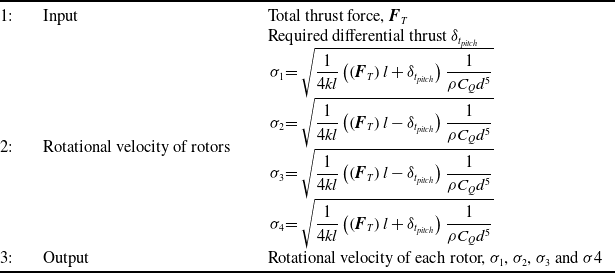
The transition regulator takes the inputs of total thrust (
 ${{\boldsymbol{F}}_T}$
) from the altitude-hold controller and the required differential thrust (
 ${\delta _{{t_{pitch}}}}$
) from the attitude-tracking controller. The transition regulator processes these signals to regulate the rotational velocity (
 $\sigma $
) of each rotor, to produce the required total thrust and required differential thrust from the propulsion units. In this way, adequate control actuation is provided for all the flight modes, by use of only four actuators. Within the transition regulator, the rotational velocity of each rotor is calculated by using the expressions given in step 2 of Table 5. These rotational velocity signals (
 ${\sigma _1}$
,
 ${\sigma _2}$
,
 ${\sigma _3}$
and
 ${\sigma _4}$
) are sent to the ‘VTOL Hybrid UAV Dynamics’ block to control the attitude and altitude of the aircraft for all the flight modes.
7.0 Controller verification by flight simulations
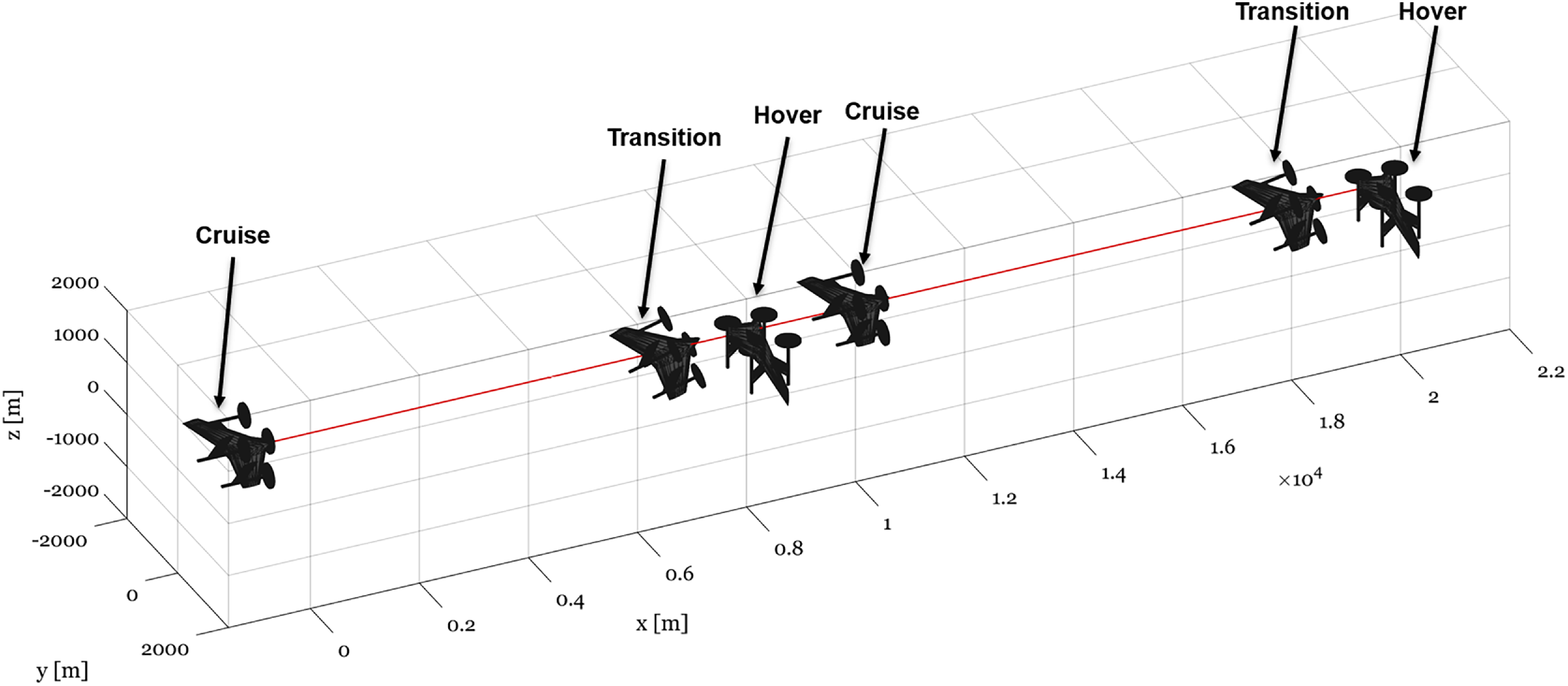
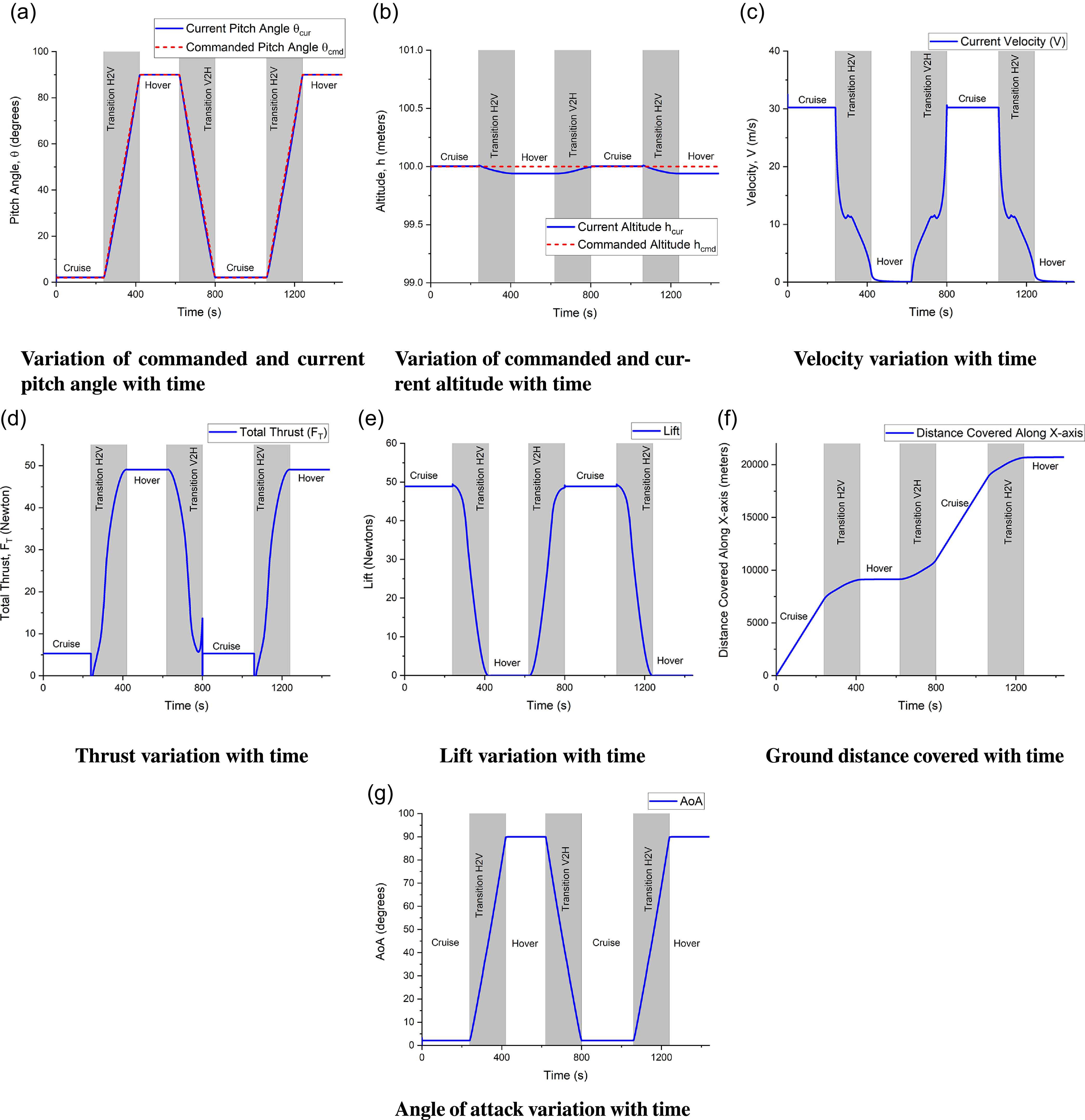
Real-time flight simulations are performed in MATLAB/Simulink environment to verify the ability of the designed transition control system to track the attitude and altitude commands, for all the flight modes of a VTOL hybrid UAV. The simulation visualisation techniques are implemented to provide a more intuitive way of analysing the aircraft dynamics. Visualisation of the flight simulations is presented in Fig. 11, whereas variation of flight parameters during the simulations is shown in Fig. 12.
Visualisation of flight simulations of VTOL hybrid UAV. All the flight modes were simulated including hover, forward transition, horizontal cruise and reverse transition.

Variation of flight parameters during simulation of different flight modes of a VTOL hybrid UAV.

7.1 Hover flight
After transition from horizontal to vertical flight mode (H2V), aircraft exhibits a stationary hover flight (refer to Figs 11 and 12). It can be seen in Fig 12(a) that during hover mode, the current pitch angle of the aircraft (
 ${\theta _{cur}}$
) adequately tracked the commanded pitch angle (
 ${\theta _{cmd}}$
) of 90
 ${^ \circ }$
. Figure 12(b) shows that during hover mode the commanded altitude (
 ${h_{cmd}}$
) of 100
 $m$
was adequately tracked by the current altitude (
 ${h_{cur}}$
) of the aircraft. Aircraft velocity variations with time given in Fig. 12(c) show that aircraft’s velocity was zero
 $m/s$
during the hover flight. During hover mode, the weight of aircraft is balanced by the thrust generated by the propulsion units, hence the thrust requirement during hover flight was around 50
 $N$
, same is shown in Fig. 12(d). Aircraft executed a stationary hovering flight without covering horizontal distance with respect to ground, as displayed in Fig. 12(f).
7.2 Forward transition
For a VTOL hybrid UAV the flight mode transition from vertical-hover to horizontal-cruise mode (V2H), also called as ‘forward transition’, is shown in Figs 11 and 12. During the forward transition, the commanded pitch angle of the aircraft (
 ${\theta _{cmd}}$
) varied from 90
 ${^ \circ }$
to 0
 ${^ \circ }$
. It can be seen in Fig. 12(a) that the current pitch angle of the aircraft (
 ${\theta _{cur}}$
) efficiently tracked the commanded pitch angle (
 ${\theta _{cmd}}$
), providing adequate attitude control. To achieve transition at a constant altitude, the commanded altitude of the aircraft (
 ${h_{cmd}}$
) is set at 100
 $m$
. During forward transition, the current altitude of the aircraft (
 ${h_{cur}}$
) tracked the commanded altitude (
 ${h_{cd}}$
) efficiently (within the error bounds of
 $ \pm $
0.2 meters), as shown in Fig. 12(b). This error in tracking is attributed to higher lift generated by the wings at high angles of attack during the transition, but as the transition progressed, the altitude-hold controller compensated for the altitude errors and adequately tracked the commanded altitude. The velocity of aircraft increased from 0
 $m/s$
during hover to the cruise velocity of 30
 $m/s$
, as shown in Fig. 12(c). The thrust requirement significantly decreased from 50
 $N$
, during hover flight to 5.3
 $N$
, during cruise flight (refer to Fig. 12(f)). During the forward transition, the aircraft started to cover the horizontal distance with respect to the inertial frame (refer to Fig. 12(f)). The smooth forward transition is achieved without any loss of altitude, and the attitude was also tracked efficiently by the transition control system.
7.3 Horizontal cruise flight
After transitioning from vertical to horizontal flight mode (V2H) the aircraft continued to fly in horizontal cruise flight. Visualisation of cruise flight simulation is provided in Figs 11 and 12. The commanded pitch angle of the aircraft (
 ${\theta _{cmd}}$
) is set at 2
 ${{\rm{\;}}^ \circ }$
during cruise flight; the current pitch angle of the aircraft (
 ${\theta _{cur}}$
) efficiently tracked the commanded attitude (refer to Fig. 12(a)). Aircraft maintained the commanded altitude (
 ${h_{cmd}}$
) of 100
 $m$
during cruise flight. Aircraft exhibited high-speed cruise at velocity of 30
 $m/s$
(refer to Fig. 12(c)) and covered considerable horizontal distance (refer to Fig. 12(f)). The thrust requirement of 5.3
 $N$
during cruise flight is very less in comparison to the thrust requirement of 50
 $N$
during hover mode (refer to Fig. 12(d). This reduction in the requirement of thrust during cruise flight is due to the fact that for a VTOL hybrid UAV, the lift generated by the wings balances the weight of the aircraft and thrust is required only to counter the aerodynamic drag. During the cruise flight, the lift of around 50
 $N$
was generated by the aircraft’s wings (refer to Fig. 12(e)), whereas for a conventional rotorcraft the weight is always balanced with the thrust produced by the rotors. Hence, an energy-efficient flight can be realised by the designed hybrid VTOL UAV.
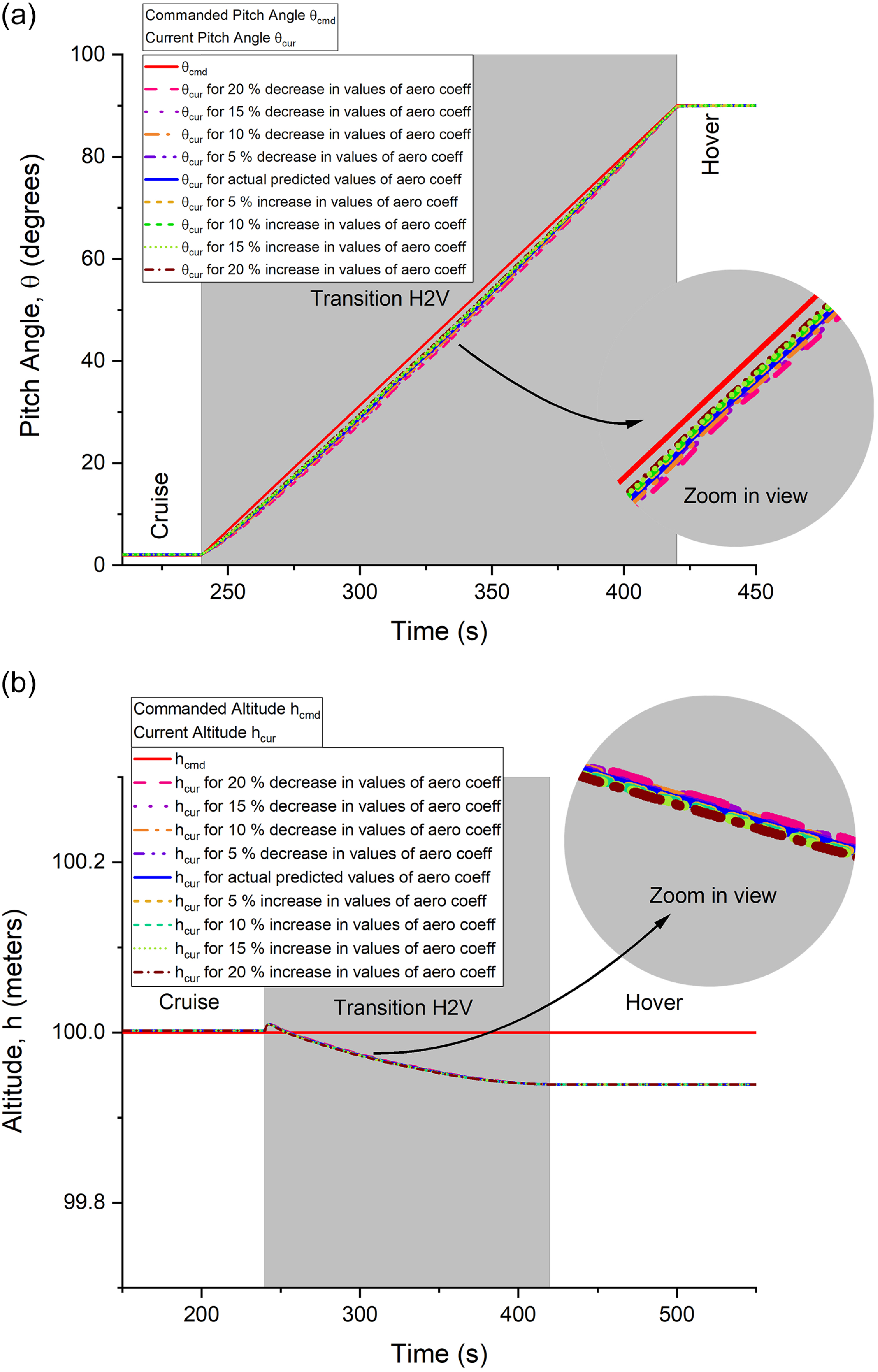
Effect of modeling error due to uncertainty in prediction of aerodynamic coefficients on the performance of designed control laws during transition manoeuvre. (a) Evaluation of attitude-tracking controller. (b) Evaluation of altitude-hold controller.

7.4 Reverse transition
After the cruise flight, the reverse transition manoeuvre, from horizontal-cruise to vertical-hover (H2V) was simulated for the aircraft. Reverse transition can be visualised in Figs 11 and 12. The commanded pitch angle (
 ${\theta _{cmd}}$
) variation from 0
 ${{\rm{\;}}^ \circ }$
to 90
 ${{\rm{\;}}^ \circ }$
is efficiently tracked by the current pitch angle of the aircraft, providing adequate attitude control (refer to Fig. 12(a)). During the reverse transition, the commanded altitude (
 ${h_{cmd}}$
) is adequately tracked by the altitude controller within the error bounds of
 $ \pm $
0.2 meters. Again, the reason for a small error in altitude tracking during reverse transition is attributed to generation of a higher lift at high angles of attack. However, the altitude controller compensated for the altitude errors to hold the aircraft altitude at commanded values during the reverse transition. The horizontal velocity of the aircraft varied from 30
 $m/s$
to 0
 $m/s$
during the reverse transition and thrust requirement increased from 5.3
 $N$
to 50
 $N$
(refer to Fig. 12(d)), whereas lift generated by the aircraft’s wings decreased from 50
 $N$
during cruise to 0
 $N$
during hover, and wings become ineffective during the hover flight mode (refer to Fig. 12(e)).
7.5 Effect of modeling errors on controller performance
The performance of designed control laws (attitude-tracking controller, altitude-hold controller and transition regulator) has been evaluated in the MATLAB/Simulink environment for all the flight modes of the designed hybrid VTOL UAV. The hybrid VTOL UAV dynamic model was based on the rigid body equations of motion (presented in section 3), propulsion dynamics (presented in section 4) and the airframe aerodynamics (presented in section 5). Any uncertainty in the values of the design parameters, while deriving the hybrid VTOL UAV dynamic model, would introduce ‘modeling errors’ in the system. For example, the accuracy of the mathematical model based on the 6DOF equations of motion would be limited by the accuracy of the assumptions of rigid body, accuracy of measured mass properties, and accuracy of the forces and moments acting on the vehicle [Reference Oberkampf, DeLand, Rutherford, Diegert and Alvin41].
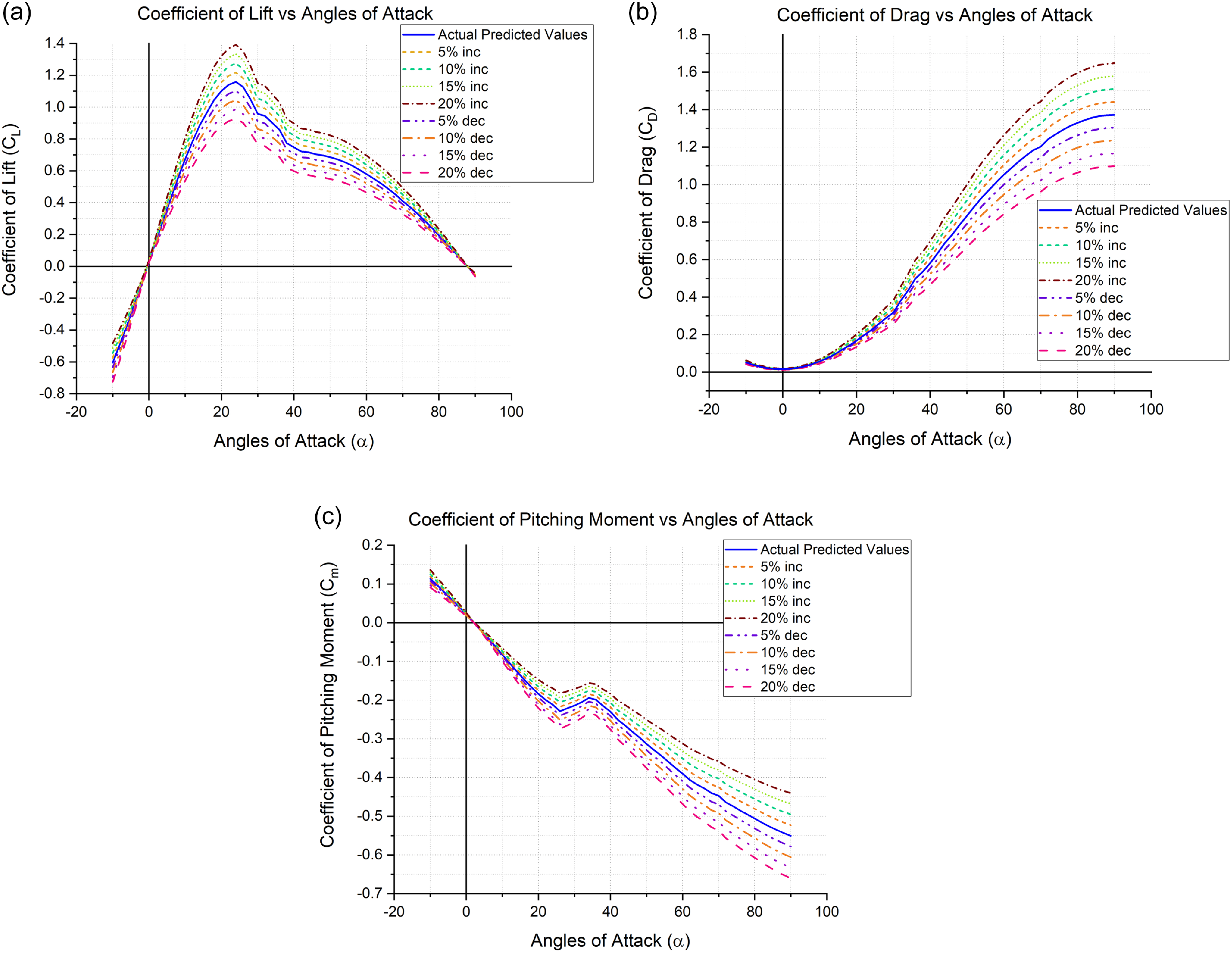
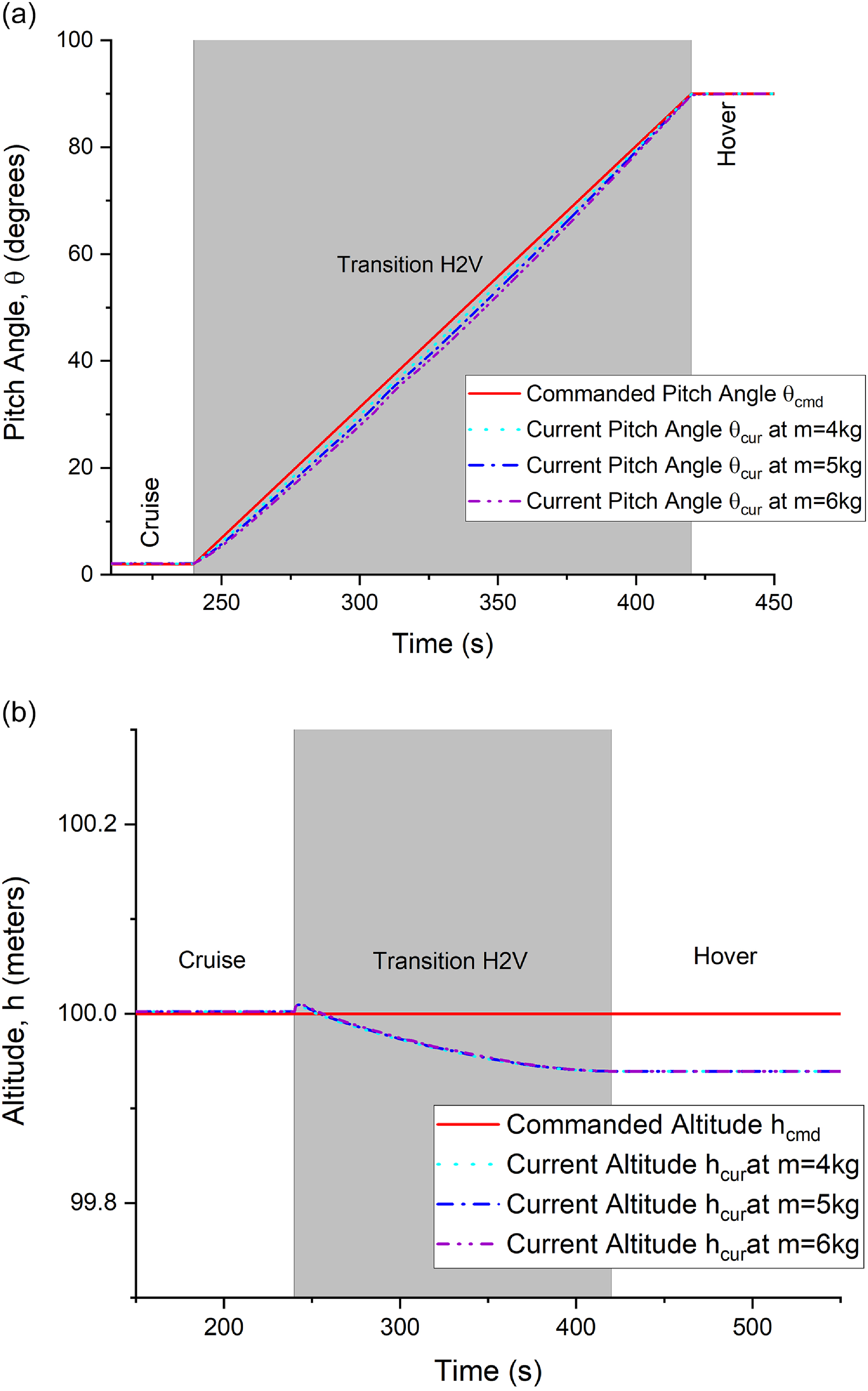
Aerodynamic forces and moments used in the dynamic model of the vehicle are calculated by using aerodynamic coefficients obtained from aerodynamic analysis (presented in section 5). The effects of modeling errors due to uncertainty in the prediction of aerodynamic coefficients on the performance of designed control laws have been carefully investigated (refer to Fig. 13). Performance of the controller was evaluated for eight different cases, corresponding to 5%, 10%, 15% and 20% over-prediction and under-prediction in the values of aerodynamic coefficients, in comparison to actual predicted values. Refer to Fig. 14 for an illustration of uncertainty in the values of aerodynamic coefficients. It was observed that performance of the attitude-tracking controller and the altitude-hold controller is slightly affected by the modeling errors introduced due to uncertainty in the values of aerodynamic coefficients. Performance of the attitude tracking controller progressively showed slight degradation for increasingly lower values of aerodynamic coefficients, as shown in Fig. 13(a). whereas the performance of the altitude-hold controller progressively showed slight degradation for increasingly higher values of aerodynamic coefficients, as shown in Fig. 13(b). However, it is evident from Fig. 13 that designed control laws can provide adequate control of the vehicle during the transition manoeuvre for up to
 $ \pm $
20% difference in the predicted values of aerodynamic coefficients. The effect of modeling errors due to uncertainty in the prediction of the mass of the UAV on the performance of designed control laws have also been evaluated, as shown in Fig. 15. It was observed that the performance of the attitude-tracking controller is slightly vulnerable to modeling errors due to uncertainties in the estimation of mass of the UAV. During the transition manoeuvre, the performance of the attitude-tracking controller progressively showed slight degradation for increment in the values of mass, as shown in Fig. 15(a); however the performance of the altitude-hold controller remained unaffected due to mass variations, as shown in Fig. 15(b). Hence it is concluded that modeling errors due to uncertainty in estimation of design parameters for hybrid VTOL UAV dynamic model can have a potential impact on the performance of control laws. In the current design, PID-based controllers have been employed, whereas the implementation of robust control techniques would be explored in future for design improvements, to compensate for the modeling errors.
Illustration of uncertainty in the prediction of aerodynamic coefficients for varying angles of attack, in comparison to actual predicted values. (a) Coefficient of lift vs angles of attack. (b) Coefficient of drag vs angles of attack. (c) Coefficient of pitching moment vs angles of attack.

Effect of modeling error due to uncertainty in UAV mass estimation on the performance of designed control laws during transition manoeuvre. (a) Evaluation of attitude-tracking controller. (b) Evaluation of altitude-hold controller.

8.0 Prototype fabrication
The fabrication has been divided into a few major steps. The first step is the procurement of off-the-shelf carbon fibre rods for the frame. Based on our design requirements, carbon fibre rods with 14 mm outer diameter and 13 mm inner diameter rods are selected. The second step is the manufacturing of joints and motor mounts. The next step is the manufacturing of airframe skin using foam. The fourth and final step is assembling of the airframe and installation of electric, avionics, and propulsion systems. Polylactic acid (PLA) is selected for the manufacturing of frame joints based on a multi-attribute decision-making technique. 3D printer is used for manufacturing these joints and computer-aided design (CAD) models are modeled using CATIA V5 software. Hexacomb structure with 100% infill density is selected because the joints are a critical and load-bearing part and lower infill densities are not giving any significant weight advantage. The generated CAD models are then converted to G codes and printed using a 3D printer. Airframe joints and motor mounts are manufactured using additive manufacturing.
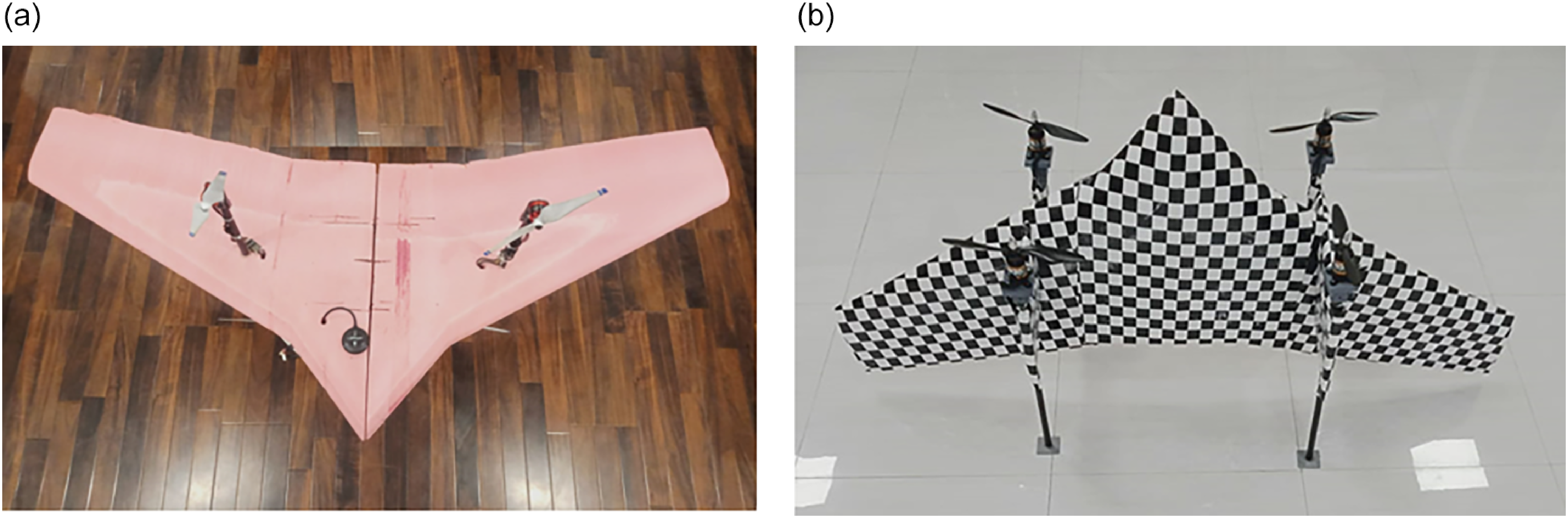
The prepared computer-aided manufacturing (CAM) in CATIA V5 software is fed to the computer numerical control (CNC) milling machine. The CNC milling machine ball tools with 25mm for rough cut and 5 mm diameter are used for finish cut. Expanded polystyrene (EPS) foam sheet is placed on the bed and a rough cut is given. After two rough cuts, a finish cut is given. After manufacturing skin, joints and motor mounts, the next step is to assemble the airframe. Firstly, the frame is assembled by connecting off-the-shelf carbon fibre rods using 3D-printed joints. M3 × 25 slotted head screws are used for connections. The frame is placed inside the foam skin using hot wire cutting, manual handwork and sanding processes. After manufacturing skin, joints and motor mounts, the next step is to assemble the airframe. Firstly, the frame is assembled by connecting off-the-shelf carbon fibre rods using two 3D-printed joints. The frame is then placed inside the foam skin using manual handwork and sanding processes. Aluminum-made motor mounts are connected to the carbon fibre rods using screws. After assembling the airframe, installing avionics, electric and propulsion systems, the prototype is covered with covering film. The film is pasted using hot iron and blower. Figure 16(a) and (b) show the complete prototype. Experimental validation of design is then performed on manufactured prototype.
Complete prototype.

9.0 Experimental validation
The experimental validation is divided into three main steps: calibration, ground tests, and flight tests. The calibration of all onboard sensors, navigation and communication systems is performed. Ground testing is done to ensure the functionality of onboard avionics, electrical and propulsion systems. The thorough physical inspection of airframe is also a part of ground tests. At the end, hover flight has been achieved.
9.1 Takeoff and landing
The aircraft is set up on a launch pad, which provides a stable platform for takeoff and landing. The aircraft is then connected to a ground control station, which provides power, control and monitoring of the flight. The test pilot then takes control of the aircraft and performs the takeoff and landing manoeuvres. The takeoff and landing process of tail-sitter UAVs can be challenging due to the unique design and flight characteristics of these aircraft. As such, special care must be taken to ensure a safe and successful takeoff and landing. The main considerations for takeoff and landing of tail-sitter UAVs include:
-
• Stability of the aircraft: During takeoff and landing, the aircraft must be stable and controllable.
-
• Control authority of the aircraft: The ability of the aircraft to be controlled during takeoff and landing is essential for a successful mission. The aircraft must have sufficient control authority in order to maintain stability.
-
• Power requirements: The power requirements of the aircraft must be taken into consideration when designing the takeoff and landing process. The aircraft must have sufficient power to take off, manoeuvre and land safely.
The aircraft takes off from a 2 m × 2 m launch pad and successfully reaches designated height. Several takeoff and landing tests illustrated that the manufactured prototype is capable enough to take off and land while maintaining stability and control authority. The power available is sufficient to take off, which indicates that the designed propulsion system suffices the power requirements of the aircraft.
9.2 Hover flight
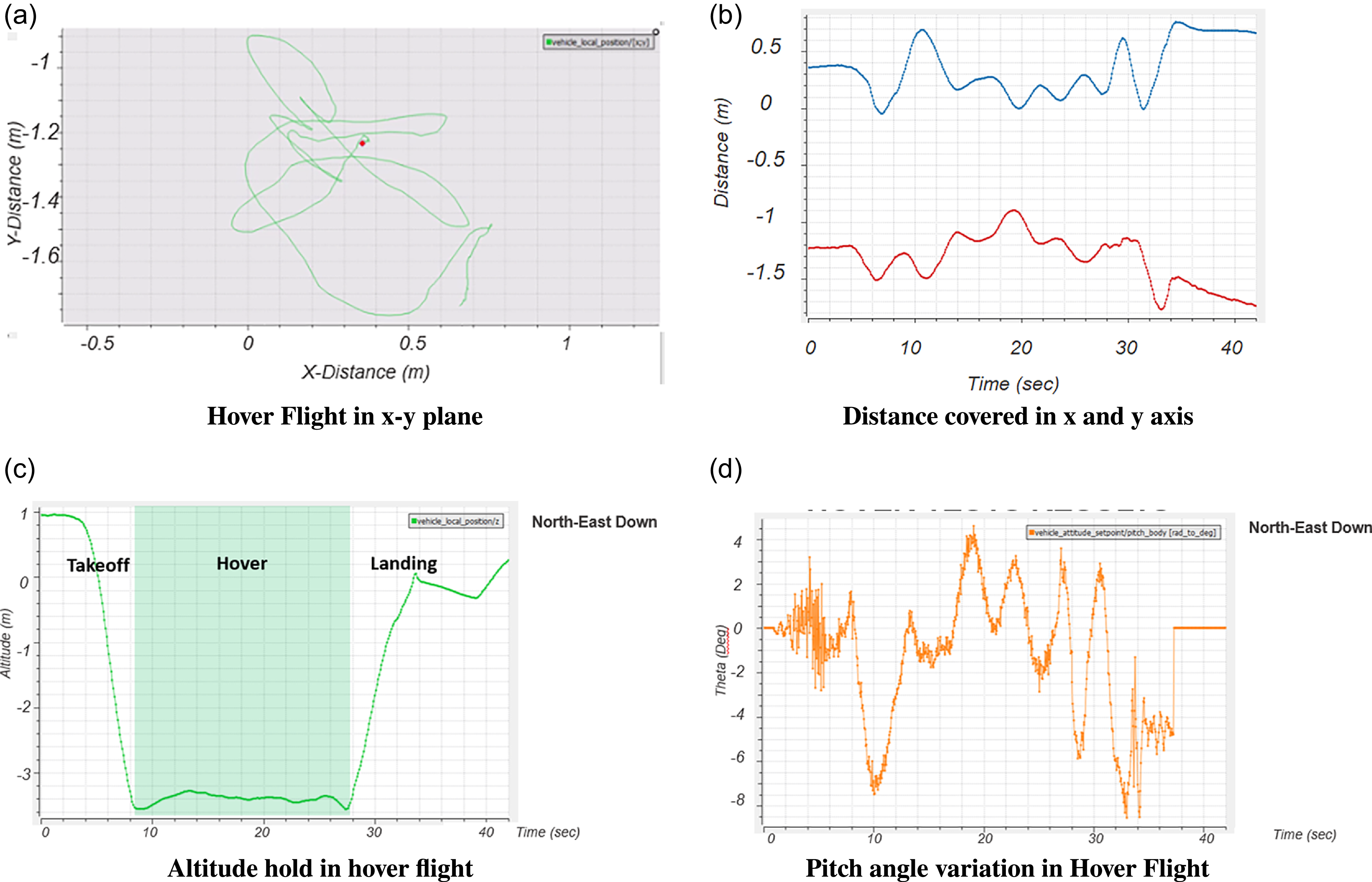
After clearing ground tests and pre-flight checks, the hover flight mission of the hybrid VTOL UAV is flown. The aircraft takes off and starts to hover at 0.9 m. The log is recorded in Pixhawk PX4 flight controller and the log is downloaded using QGroundControl open-source software. Figure 17(a) illustrates that the aircraft hovers within 1
 ${{\rm{m}}^2}$
area. Figure 17(b) illustrates that the UAV maintained the position up to 0.5 m in y-axis and 1.0 m in x-axis. Figure 17(c) describes that the UAV took off up to 4 m height and maintained its altitude within 0.4 m. Figure 17(d) depicts the pitch angle variation during the hover flight. The pitch angle was tracked efficiently by the controller. The results of hover flight show:
-
• The developed platform achieves stable takeoff, hover and landing.
-
• The UAV hovers within 0.8 m × 0.8 m area approximately.
-
• Maximum altitude error (between desired and achieved) of 0.3 m approximately is observed during hover, which is reduced to 0.2 m approximately with time.
-
• The UAV landed approximately 0.5 m away from takeoff point.
Experimental validation of hover flight.

10. Conclusion
The future of unmanned flight is anticipated to be shaped by VTOL hybrid vehicles. This is an emerging technology with enormous potential. Among the VTOL hybrid UAVs, differential thrust transitioning configuration is the simplest way to achieve VTOL manoeuvre; however, a common challenge faced by such vehicles is loss of attitude tracking and altitude hold during the transition, as a result of which vehicle can get into a stall and tumbled motion and eventually crash. This problem has been addressed in the present research. A VTOL hybrid UAV is presented, which is capable of performing multiple flight modes operations, ranging from still hovering to high-speed cruise. Six degrees of freedom translational and rotational equations of motion were derived to model the vehicle dynamics. High-fidelity aerodynamic analysis was performed over the full flight envelope to capture the airframe aerodynamics. Motor dynamics and propeller effects were included in the flight dynamics model. A novel transition control system was designed to provide attitude-tracking and altitude-hold control for all modes of flight. A transition control system was integrated with the flight dynamics model of the vehicle and implemented in MATLAB/Simulink environment for real-time simulation and control of the vehicle’s dynamics. Simulation visualization techniques were employed to provide a more intuitive way of analyzing the dynamic response of the aircraft. Effects of modeling errors on the performance of designed control laws have also been evaluated. Full envelope flight control was achieved for a VTOL hybrid UAV for all the flight modes including horizontal cruise, forward transition, hover and reverse transition. The prototype was manufactured and stable takeoff, hover and landing manoeuvres were performed. Maximum altitude loss during hover was 0.3m approx. Authors are currently working on full flight envelope flight control validation through flight tests; however, certain limitations of the designed control laws can be improved in the future research. For instance, transition regulator (control allocation) does not consider the actuator limits (position and rate) and dynamics, which might result in instability due to limited control authority when the transition regulator is demanded more than the limits of the actuators. Similarly, the calculation of transition time and limiting the transition time to minimum through a robust actuator control merits further research.