Over the past decade, state agencies throughout Brazil have launched initiatives that aim to defend children's rights to their father's name. These initiatives take the form of discrete programs in different states, all of which seek to identify children who lack a paternal last name—an estimated 10–25 percent of all Brazilian childrenFootnote 1 —in hopes of finding their fathers and encouraging or obligating them to legally recognize their paternity and inscribe their names on the children's birth registries. Project staff also sometimes formalize child support arrangements, although this is not the primary objective. Instead, Responsible Paternity projects (as most of them are known) seek to free children from the social stigma of illegitimate birth, thus protecting their constitutional right to equality and human dignity.
This seems a radical departure from a long history of legislation and policy regarding illegitimacy and paternity. From the colonial period until 1988, Brazilian law restricted the ability of illegitimate children to lay claim to their father's name and to the patrimonial rights that came with that name. Through most of the twentieth century, legitimacy figured prominently in Brazilian civil and even constitutional law as the legal foundation of the patriarchal family. As a result of the Catholic Church's unflagging campaign against divorce, each of four successive Constitutions—those of 1934, 1937, 1945, and 1967—proclaimed that the legitimate family, “constituted by indissoluble marriage,” would receive “special state protection.”Footnote 2 The distinction between legitimate and illegitimate families and children also had significant practical effects in civil law. Marriage restricted a woman's civil rights and subordinated her to her husband while protecting her and her children's rights to the family property and providing access to a variety of state benefits and assistance programs.Footnote 3 By denying these privileges to members of families that were not headed by a legally married couple, the law perpetuated both the social prejudice and the financial disadvantage suffered by out-of-wedlock children, and, usually, their mothers.
A–C: Logos for Responsible Paternity programs. Source: A: “Projeto Paternidade Responsável,” Asociação dos Registradores de Pessoas Naturais do Estado de São Paulo (ARPEN), http://www.arpensp.org.br/principal/index.cfm?tipo_layout=ABC&pagina_id=360. B: “Triagem do projeto ‘Paternidade Responsável’ começa amanhã, 4, no Estado de Roraima” October 3, 2007, http://www.arpensp.org.br/principal/index.cfm?tipo_layout=SISTEMA&url=noticia_mostrar.cfm&id=6030. C: “Diretrizes do Planejamento Estratégico 2005,” Ministério Público do Estado da Bahia, Centro de Apoio Operacional Às Promotorias de Justiça Cíveis e Fundações, http://www.mp.ba.gov.br/pga/diretrizes/2005/caocif.asp.

Despite Brazil's adherence to a civil law tradition with its meticulous codification and restrictions on the scope of judicial interpretation, the inequality of legitimate and illegitimate children was gradually mitigated over the twentieth century in the family courts, where judges broadened the circumstances in which they could demand recognition and child support. Labor and social security regulations and jurisprudenceFootnote 4 dating back to the 1930s also extended some family benefits to “concubines” (as common-law wives were known) and their children. It took a new constitution, however, to eliminate the inequality altogether.
Promulgated amid heightened expectations of social change after the “New Republic” replaced Brazil's twenty-one-year military dictatorship in 1985, the 1988 Constitution radically expanded the concepts of democracy and citizenship by subordinating both to the principle of the universal right to human dignity.Footnote 5 As under previous constitutions, the family continued to enjoy special protection. But the 1988 charter proclaimed the equality of all families and the right of all children to equal recognition, support, and nurturance by their parents, thus rendering the concept of illegitimacy obsolete.Footnote 6
Recent state initiatives to promote “responsible paternity” provide a striking illustration of the conceptual implications and practical effects of the changes—many of which were the result of feminist intervention—in the legal definition of the family after 1988. Yet new laws that guarantee children's rights to their father's name, and the activism of public officials in defense of these rights, have deep precedents in Brazil's social and legal history. History also plays a role in limiting the feminist potential and social benefits of Responsible Paternity projects.
To illuminate the historical precedents for both the transformation of family law and the limitations of this transformation, I begin this article with a review of juridical debate over legitimacy laws since the colonial period, along with the deeper legal questions that have animated this debate ever since: Is family law motivated by the need to defend honor and patrimony, or equality and dignity? Should the law play a prescriptive moralizing role or reflect popular norms and social practices? Can the judiciary override the legislature when laws fail to support fundamental principles? Should the courts consider legal documentation, biology, or affection as the bond that generates “family rights”?
When the families that appeared in courtrooms led judges to answer these questions in ways not supported by statutory laws, trial verdicts reached beyond the statutes. By the beginning of the twenty-first century, family law jurisprudence had incorporated a body of concepts and terms, such as “possession of status,” “de facto partnership,” “socio-affective filiation,” and “homo-affective union,” which permitted some courts to adapt to new family forms, even as statutory law and more traditionally minded judges refused to recognize them.
This review of historical debates and jurisprudence will set the stage for analysis of the political and legislative processes that inspired the transformation of family law beginning in 1988. In turn, this analysis will illuminate the philosophical and political underpinnings of the burgeoning state programs that aim to promote “responsible paternity.” Finally, I will describe the activities of the Responsible Paternity project in Salvador, the capital of the Northeastern state of Bahia, which I had the opportunity to observe in 2006. This case study will offer some insight into how traditionalist definitions of the family can undermine the efforts of an activist state to protect the human dignity and equal rights of all the nation's children.
Historical Debates over Legitimacy Laws
Controversy among officials and in popular opinion about legitimacy laws has been a constant feature of Brazilian history since at least the eighteenth century, whereas the high prevalence of out-of-wedlock births has been constant from the time the Portuguese first set foot on Brazilian soil. The ways the state has responded to this social reality, however, has varied considerably.
The laws that the Portuguese brought to Brazil in the sixteenth century, organized into a compilation known as the Manueline Ordinances (updated in 1603 as the Philippine Ordinances), were derived from a Roman law tradition significantly modified by medieval Catholic canons. Under Roman law and social mores, children born to their father's concubine did not receive the same rights to paternal succession as his marital offspring, but they were not necessarily stigmatized, as their parents' concubinage was a legal and acceptable, if often temporary, relationship. The medieval church struggled to persuade its followers that any extramarital relationship was sinful and that the status of all nonmarital children was therefore shameful.Footnote 7 These efforts were redoubled after the Council of Trent (1545–1563).Footnote 8 Yet royal and ecclesiastical authorities throughout the Catholic empires recognized that many people in their realms formed unions without the blessing of the marriage sacrament, and this was especially true in the New World. In Brazil, according to historian Linda Lewin, where ecclesiastical and social impediments converged with other factors to produce extremely low marriage rates, “at least one-third of all births by independence [1822] occurred outside legitimate marriage.”Footnote 9
Following canon law, the Philippine Ordinances distinguished three basic categories of moral condition by birth: legitimate, natural (the child of parents who could have married), and spurious (adulterous, incestuous, or sacrilegious—the child of a parent who had taken religious vows of chastity).Footnote 10 Natural children of plebeians enjoyed the same family entitlements as legitimate children. If their father “recognized” his paternity, whether in writing or by his customary behavior (that is, by acting as a father), a natural child had the right to live in his house or otherwise receive sustenance from him and inherit his fortune, social condition, rank, and family name.Footnote 11 Natural children inherited the same benefits from their mother, whose recognition was presumed if it was known that she had borne and raised them. In cases of doubt, or if either parent neglected or refused to recognize a natural child, the child could gain such recognition by filing suit in the royal courts, which accepted a wide variety of evidence.Footnote 12 Social and legal mechanisms for ascribing filial status worked much in the same way that they ascribed honor: if a child was publically reputed to be someone's son or daughter, or if a parent showed affection or concern for the child's upbringing, then s/he was the son or daughter.Footnote 13
Portuguese laws were not as benevolent toward nobles' natural children, or toward spurious children of any caste. As the “fruit of a crime,” such children enjoyed no family entitlement and could not sue for recognition.Footnote 14 Yet the moral stigma and material deprivation of illegitimacy could be lifted even for these infamous children. A parent could “legitimize” the child through an affidavit or testamentary declaration of the blood tie, which sufficed for the purposes of conferring the family name, insignia, and other heritable honors. With such a document in hand, the child could appeal to the Crown for “solemn legitimization,” a costly procedure, but one which could entitle him or her to inherit from the family patrimony, generally on the condition that any legitimate heirs did not object.Footnote 15
This is not to say that illegitimacy carried slight weight in colonial Brazil. In fact, despite its flexibility, Portuguese law clearly expressed the principle that legitimacy, or at least paternal recognition and a father's name, were essential elements of personal honor and public standing. Numerous studies of popular culture and moral norms in colonial Brazil have confirmed that the valorization of patriarchal notions of honor, and their roots in family values such as marriage, legitimacy, and a paternal last name, were common throughout Brazilian society, but that people commonly maneuvered around the birth requirements of honor.Footnote 16 Condition of birth was a crucial element of one's moral and social standing, but conceptually, if not always in practice, this condition was mutable.Footnote 17
Legal categories of illegitimacy hardened in the mid-nineteenth century, under the independent Brazilian Empire (1822–1889). This might seem surprising, as liberal ideals remained ascendant after Brazil cut ties with Portugal. As Lewin shows, this liberalizing impulse was not entirely new, but followed the work of an earlier generation of reformist jurists in the late eighteenth century. Pushing this agenda forward, liberals who gained prominence in the imperial legislature in the 1820s and 1830s sought to minimize birthright as the legitimate foundation of law and authority, establishing the legal equality of all citizens and balancing the emperor's power with a parliamentary regime and an autonomous judiciary.Footnote 18 Many advocated for equal rights for illegitimate children, and during an initial period of liberal ascendance, it seemed that the traditional recognition of informal family ties would expand.
The idealism of the early empire gave way to a conservative backlash by mid-century, fueled by the dramatic influx of African slaves, a rise in the population of free people of color, a variety of popular revolts, and the specter of the eventual abolition of slavery. The latter was especially relevant, as Lewin has noted, because whereas slaves did not possess succession rights, free and freed natural children could potentially sue their fathers for recognition, then share his patrimony equally with any legitimate siblings.Footnote 19 Meanwhile, popular access to local justices of the peace, who now received petitions for legitimation, multiplied manyfold the number of demands for investigation of paternity. Legislators responded by dramatically limiting the rights of out-of-wedlock children. Most significantly, an 1847 law stripped all natural children of their historical right to demand paternal recognition through the courts. At the same time, legitimization became increasingly difficult to obtain and its effects were progressively limited in practice, rendering it all but meaningless by the end of the nineteenth century.Footnote 20
A lawsuit over legitimization that reached the Federal Supreme Court in 1891, two years after the Empire had been replaced by the First Republic (1889–1930) provides evidence of the enduring effects of both hardened legitimacy laws and the persistence of more flexible popular attitudes. The case involved the daughter of a priest whose father had recognized her and given her his name in an official writ, so that she could “enjoy all the rights and prerogatives that belong to legitimate offspring, and that she [would] be able, upon his death, to succeed him in the possession of his property.” During the colonial period, this sacrilegious daughter might have hoped for legitimization through royal favor. Although nineteenth-century legislation had effectively shut down such exceptions, the young woman's legitimization and inheritance rights were nonetheless recognized by local courts in two separate trials (in 1883 and 1889). These decisions were struck down on appeal, and the priest's daughter subsequently stopped using the surname name that her father had given her as a child.Footnote 21
The initial acceptance of this woman's claim by the lower courts suggests that many people assumed that if her father had recognized her, she was his daughter, regardless of her sacrilegious “condition.” Judicial officials and even her opponents treated her with the respect due a decent young woman of relatively high social standing and a paternal last name. If the competing heirs had not hired good lawyers to contest her claim, she might well have received the patrimony that she believed was her due.Footnote 22
The jurisprudence cited in this case, developed over the previous half century, had solidified secular legal concepts to replace the canons that had guided colonial law. Nineteenth-century jurists reasoned that the family, naturally patriarchal, was moralized and civilized through the institution of marriage. By protecting the family from “invasion” by illegitimate children, conceived of as outsiders (estranhos, literally, “strangers”Footnote 23), the state preserved the natural social order while promoting the moral values of modern civilization. By the end of the nineteenth century, family law, conceived as a discrete subcategory of civil law for the first time, defined a set of exclusive rights that aimed to ensure fulfillment of the specific responsibilities of each family member as well as the just and orderly transfer of patrimony. Paternal recognition of natural children could permit them to enjoy, exceptionally, specific benefits such as child support or inheritance. It could not legitimate them or endow them with “family rights.”
After the abolition of slavery in 1888 and the creation of a democratic republic the following year, many hoped the liberal principles of equality and universal rights would finally guide civil law. Among the decrees the new regime promulgated during its inaugural year was the law that established civil marriage, which eliminated “sacrilegious” as a type of civil status.Footnote 24 The first draft of the republican civil code, completed in 1902 by Clovis Bevilaqua, a jurist who happened to be the son of a priest, went further, establishing equal rights for “all human beings” and specifying that legitimate and illegitimate children shared the same family rights.Footnote 25
Debates over family rights, however, occupied a sizeable portion of the thirteen-year-long congressional review of the civil code. During the review, legislators radically altered Bevilaqua's draft, beginning with its first chapter, where they replaced the term “human beings” with “men.”Footnote 26 This move allowed them to exclude women and children from full equality. Bevilaqua bitterly complained that the legislature went on to introduce discriminatory provisions, making the code that was promulgated in 1917 “less liberal than the Philippine Ordinances” in its treatment of legitimacy.Footnote 27 Among its concerns was the continued protection of the patrimony and honor of legitimate families at the expense of illegitimate children. Subsequent legislation, reiterating the provisions of the Imperial civil registry law of 1888, prohibited registrars from writing either parent's name on a child's birth registry, “or any other information regarding filiation,” if this would “result in scandal.” The same law specified that birth registries must indicate the child's status as legitimate, illegitimate, or abandoned.Footnote 28
The code itself protected legitimate families from scandal by stipulating that adulterous or incestuous children could not be recognized under any circumstance, which excluded them from inheritance rights.Footnote 29 Legislators protected the honor of women who might have been victims of seduction or rape early in life by barring investigations of maternity that would “attribute illegitimate children to a married woman or incestuous children to a single woman.”Footnote 30 Illegitimate children could be legitimated if their parents married, but this was possible for adulterous children only if their parent's previous marriage was extinguished through annulment or death. A 1942 modification allowed adulterous children to be recognized by parents who had legally separated from their spouses. Otherwise, spurious children remained “strangers to the family” until 1988.Footnote 31
The 1916 code followed historical custom and law regarding natural children, permitting either parent to recognize them voluntarily.Footnote 32 In cases of denial, these children could sue their mother for maternal recognition, as long as she remained unmarried.Footnote 33 The right to sue for paternal recognition, however, remained controversial. Debates over whether to maintain the 1847 ban on legal investigations into paternity ended in compromise: a child could sue only if the father had lived in “concubinage” with their mother or had abducted or “had sexual relations” with her at the time of conception.Footnote 34 All three conditions were left undefined by legislators. In early analyses of the civil code, jurists largely concurred that by “sexual relations,” legislators must have meant to imply criminal sexual relations, that is, rape or deflowering of a minor. In contrast, the meaning of “concubinage” generated considerable uncertainty.
Over time, this uncertainty was resolved as a result of suits and petitions brought to the courts, as verdicts came to mirror the popular sentiment that children deserved material and moral support from their father, regardless of his relationship with the mother. In order to hold fathers responsible, judges were obliged to stretch the meaning of “concubinage,” initially presumed to involve cohabitation or economic support. By the 1970s, jurisprudence had established that for the purpose of establishing paternity, concubinage meant simply an exclusive (on the part of the woman) sexual relationship at the time of conception, and the onus of proof often fell upon the man if he claimed she had had other sexual partners.
In cases involving children beyond infancy, judges, much like legal officials of earlier centuries, tended to rely less on proof of the nature of the parents' relationship and more on evidence of the father's customary behavior toward the child. If the alleged father had acted as such—visiting the child, providing material or emotional support, showing affection and concern with the child's upbringing or education—then the court tended to decide that he was the father. This evidence often took the form of witness testimony, and judges sometimes applied the concept of “possession of status.”Footnote 35 If “everyone in [the town] knew that João was the son of Miguel Archanjo,” or if “the headmaster always showed special affection for Pedro, and everyone at the school assumed he was Pedro's father,” judges were likely to accept the argument that the child possessed filial status, and they therefore granted filial rights.Footnote 36 The reasoning was that this status was evidence of a biological relationship, but in practice, the courts reinforced the social and emotional meaning of paternity. Biological evidence such as physical likeness or blood type compatibility, which was frequently inconclusive, was seldom a decisive factor.Footnote 37
It was not only as a result of paternity suits that the courts were obliged to redefine “concubinage” and validate family ties that were not based on legitimate marriage. Beginning in the 1920s, women who had “lived maritally” (that is, as partners in consensual unions) with working men filed petitions for family benefits such as compensation for accidents suffered by their companions. These petitions multiplied in the 1930s and 1940s, when the state dramatically expanded potential benefits, including pensions, worker's compensation, and bonuses, for families of certain categories of workers. Recognizing that consensual partnerships were a common feature of working-class family life, progressive jurists assigned to the new labor courts and other civil courts drew upon the concept of “social fact.” The concept, which can be traced to Roman law, is commonly used in many modern legal cultures to mean any non-legalized relationship (relationships are either “juridical facts” or “social facts”). In extending rights to twentieth-century “concubines,” Brazilian jurists narrowed the concept, using it to refer to existing extralegal relationships that society recognized as valid, and that engendered an obligation to judge. In the absence of a legal definition or regulations, judges could adjudicate issues relating to concubinage “by analogy” to marriage. If a woman could demonstrate that she was an “honest concubine” (that is, if she was faithful to her companion and otherwise fit judges' notions of a wife, which might include motherhood and domesticity), her relationship could be treated as though it were a legal family entity, entitling her to certain state benefits.Footnote 38
It was more difficult for women to make claims against a former consensual partner or his heirs in family court, for example for purposes of division of property after a breakup or death. Instead, consensual relationships, called “de facto partnerships” (sociedades de fato, as opposed to sociedades de direito, or legal partnerships), were treated as commercial partnerships. Because property was commonly registered in the man's name, women were often reduced to suing for “indemnification” by their partner or his estate, receiving an amount meant to compensate them for domestic services rendered. The lack of clear legal guidelines in such cases resulted in mountains of litigation, leading the Supreme Court to rule, in 1964, that once a de facto partnership was established between concubinos (“concubines,” used for men and women), a legal separation was possible, including division of property accumulated through joint effort.Footnote 39 This legal validation of such partnerships facilitated access to the courts, which began to soften their stigmatizing language and shift focus away from the women's “honesty.” By the 1980s, when procedures were in place for adjudicating issues arising within these relationships, lawyers and judges often referred to “companions” rather than “concubines” and “de facto partnership” rather than “concubinage.” These changes were not consistent, however, and because the “rights of the concubine” continued to lie in the realm of judicial interpretation, they were not guaranteed.
******************
The jurisprudential transformation of concubinage illustrates the continuing relevance of centuries of debates over what makes a family and what rights family membership brings. From the moment the Portuguese introduced European religious and legal traditions to Brazil (and earlier, in Europe), the tension between restrictive and punitive legitimacy laws and more expansive and tolerant social norms has sparked public debate and private legal battles. Brazil's liberal tradition, dating in its modern form to the late eighteenth century, left a legacy of principles and concepts that twentieth-century courts could employ as they sought to accommodate changing social formations and values and to extend rights to the consistently large population that fell outside of legally constituted families. Conservative reaction against change has left an equally powerful legacy. Appeals to “traditional values” have, at key political junctures, pushed family law to retain its punitive and restrictive function, protecting the interests of only a portion of the family relationships that exist in Brazilian society. Both legacies survived into the twenty-first century.
Eliminating “Discrimination of any Kind”: Human Dignity and Family Law under the 1988 Constitution
Legal precedents that expanded family rights in the decades that followed the passage of the 1916 civil code were incorporated into the Constitution of 1988. Unmarried couples' relationships became legal partnerships, with the term “stable union” replacing “concubinage” or “de facto union.”Footnote 40 The Constitution defined such unions as family entities and granted them “the special protection of the State,” alongside and equal to legally married couples and “communities formed by either parent and his/her descendents.”Footnote 41 The Constitution also guaranteed “equal rights and designations” for all children, prohibiting “discrimination of any kind relating to filiation.”Footnote 42
The 1990 Statute of the Child and Adolescent went further still, declaring that a child's right to know and be officially recognized by his or her parents is an “essential individual right” (direito personalíssimo).Footnote 43 A 1992 law mandated proactive measures to guarantee this right, requiring civil registrars to remit a certificate of a birth registry to the courts for judicial investigation if it did not include the father's name. The same law prohibited registrars from making reference on the birth certificate to the civil status of a person's parents or the condition of a person's birth.Footnote 44
These new laws had historical precedents not only in jurisprudence regarding concubinage, but also in the evolution of international conceptions of statehood, citizenship, and individual rights as based in the principle of human dignity. In the 1970s and early 1980s, appeals to universal principles of justice and rights served to unite an otherwise diverse array of grassroots social movements that struggled against Brazil's military dictatorship, which came to an end in 1985. Many representatives of these movements, including working-class women and feminists, participated in the convention that produced the Constitution. These and other activists succeeded in expanding the meaning of Brazilian citizenship to include a broad range of individual, social, and economic rights that are encapsulated under the overriding principle of human dignity. The Constitution therefore demanded activism on the part of the state to guarantee the social and economic conditions that support human dignity, and specifically to “eradicate poverty and marginalization and reduce social and regional inequalities.”Footnote 45
As is true in the laws of many Latin American states that emerged from authoritarian rule in the 1980s and 1990s, references to language and concepts derived from international treaties and especially human rights conventions were purposeful and explicit in the text of the Brazilian Constitution and subsequent legislation. For example, constitutional and other laws regarding the right to a legal personality, including knowledge of one's parents, reference the language of the 1948 United Nations Universal Declaration of Human Rights, which establishes the universal right to legal recognition as a person, as well as the 1989 Convention on the Rights of the Child, which specifies that this basic right is predicated on the newborn's registration by the state and guarantees the child's right to “his or her identity,” including nationality, name, and the right to know and be cared for by his or her parents.Footnote 46
Biology or Affection? Interpreting Constitutional Definitions of Family Ties and Paternal Responsibility in the Courts
Both the Brazilian provisions and the international covenants that protect children's rights to recognition and care by their parents base these rights, in the first instance, on biological relationships. This represents advancement, in the eyes of most legislators and jurists, over previous laws that defined family as bonded by legal ties of marriage, thus excluding out-of-wedlock children. With the advent of DNA testing—which under a 2001 law in Brazil is to be provided free of charge in cases of contested paternity to those who cannot afford itFootnote 47—biological ties have become even more salient.
At the same time, a significant trend in international law moves away from privileging biology, favoring instead the notion of the “socio-affective family.” Contributing to this trend, leading Brazilian jurists argue that the central purpose of modern family law is to guarantee every citizen a nurturing environment of mutuality and human dignity, necessary for the development of each individual's legal personality and therefore his or her capacity to possess and fully exercise rights. The family that receives state protection is therefore not necessarily constituted by a formal legal contract or even biological relationships, but by love and affection.Footnote 48
The 1988 Constitution recognized affective ties by establishing equality between biologically conceived and adopted children and between married couples and those in stable unions, defined subsequently as those joined “in a public and lasting relationship … established with the objective of constituting a family.”Footnote 49 In 2006, a law that established domestic violence as a specific criminal offense (the Maria da Penha law, passed as a result of a successful complaint against Brazil at the Inter-American Commission on Human Rights) placed even greater emphasis on volition and emotional attachment by defining the family as “the community formed by individuals who are or consider themselves to be related […] regardless of the family members' sexual orientation.”Footnote 50
Although the Maria da Penha law was the first to reference sexual orientation, judges had begun to apply the principles that underlie the concept of the “socio-affective family” to same-sex couples over the previous decade, creating a more specific nomenclature, “homo-affective union.” Through a process that was similar in many ways to the judicial recognition of heterosexual consensual unions some 50 years earlier, the Federal Supreme Court validated this trend on May 5, 2011. In a unanimous binding decision, the Court required the state to recognize homo-affective unions as family entities, extending to same-sex unions “the same rights and duties as stable unions [between a man and a woman].” Because stable unions are equivalent to marriage as per the 1988 Constitution, this decision grants Brazilian same-sex couples access to the same family rights as heterosexual couples.Footnote 51
This victory for same-sex families became possible in large part because since the period of re-democratization in the late 1970s and early 1980s, Brazilian gay and lesbian rights activists have successfully tied their claims to broader struggles for human rights, and their arguments were adopted by lawyers who represented gay clients in civil courts.Footnote 52 However, although since the mid-1990s the executive branch has lent at least nominal support to gay rights, LGBT activists and their allies have been unsuccessful in efforts to persuade legislators to rescind discriminatory laws. The Constitution, the 1996 “stable union law,” and the Civil Code of 2002 all specify that legally recognized stable unions are composed of a man and a woman.Footnote 53 Legislative attempts to amend the Constitution, pass a same-sex civil union law, or include same-sex couples among those who can jointly adopt children, have all failed.Footnote 54
The momentum toward equality came instead through individual lawsuits and petitions. Since the 1980s, as the injustices faced by members of same-sex unions were publicized by gay rights groups and the mass media, more and more same-sex couples approached the courts. In response, a vanguard within the judiciary in a few key states, led by Rio Grande do Sul, accepted the argument that the failure to grant equal rights to families formed by same-sex couples violated fundamental principles of equality and human dignity, and this argument became dominant in national juridical scholarship by the beginning of the new century.Footnote 55 Jurisprudence eventually followed suit, although unevenly. Faced with the absence of legal guidelines, judges ruled according to social customs (arguing that same-sex relationships were customary and broadly recognized in contemporary society) and by analogy, with stable union, rather than marriage, as the analogous legal relationship.Footnote 56 As with “concubinage” before 1988, same-sex couples' relationships were recognized in civil courts around the country as de facto partnerships based on their existence as a “social fact,” and same-sex companions won some of the rights formerly reserved for heterosexual couples, such as inheritance, legal separation, and state and federal social security benefits.Footnote 57
Yet despite the more or less steady accumulation of judicial victories, there were holdouts among the highest courts of appeals of several states, including Rio de Janeiro, where in 2008 the governor, frustrated by his inability to offer equal benefits to LGBT state employees, filed the suit that resulted in the Supreme Court's 2011 recognition of same-sex stable unions.Footnote 58 Prior to that decision, same-sex partners—again like “concubines” before 1988—often encountered barriers when they attempted to exercise “family rights” or gain access to the family courts. As a result, most couples preferred to avoid asking family courts to validate their relationships, instead seeking alternative solutions. Adoption of children, the most controversial of the family rights under debate, provides a good example. Adoption by qualified single adults, irrespective of sexual orientation, has been validated by Brazilian jurisprudence since the 1990s, although individual family court judges could still obstruct individual cases.Footnote 59 Until very recently, however, most family courts rejected adoptions by same-sex couples.Footnote 60 Unwilling to take this risk, most same-sex partners adopted as single parents, leaving the child with no legal bond to the second parent.
The principle of the affective family is considered cutting edge—and in its application to the families of same-sex couples, it is indeed novel. Yet this principle also has a deep history in Brazilian legal and social practice, as evidenced by the historical prevalence of consensual unions and their recognition by the courts. As we have seen, bonds of affection played a prominent role in lawsuits seeking to establish paternity from the colonial period through the twentieth century. Although the assumption in these cases was that paternal affection was evidence of an underlying biological relationship, the practical effect was to emphasize social roles and emotional ties. Popular ideas about affective family ties have inspired the longstanding and widespread informal adoption of children, especially among poor families, who commonly take in children whose parents cannot care for them, temporarily or permanently. Increasing reliance on DNA testing over the past few decades moved the courts away from this emphasis, but, more recently, the concept of the socio-affective family has shifted focus back.
One form of adoption is so common in Brazil that it is known among jurists as “Brazilian-style adoption.”Footnote 61 This consists of a fraudulent registration of a child as one's biological child. Sometimes this is done at birth, when the child's mother, or her obstetrician, wishes to offer the child for adoption by a specific person or couple without undergoing the complex bureaucracy of legal adoption. Anecdotal evidence suggests that many gay or lesbian individuals who wish to adopt have resorted to the “Brazilian-style” method. Very frequently, “Brazilian-style adoption” comes later in the child's life, when a new male partner of a child's biological mother files a legal affidavit of paternal recognition at a civil registry office and then presents it to the public notary's office with a petition for “rectification” of the child's birth certificate, thus “giving the child a name,” with the intention of raising the child as his own.Footnote 62
Since the advent of DNA testing, however, many fathers by “Brazilian-style adoption” have made use of this evidence to rescind their paternity when they break up with the child's mother, an act otherwise expressly prohibited by law. This situation has brought the debate over whether biological or socio-affective relationships are the basis for paternal responsibility to countless local courtrooms. According to a 2004 study in the south of Brazil by anthropologist Claudia Fonseca, in cases in which DNA testing showed the absence of a biological relationship, local courts routinely ruled in favor of fathers who claimed that they had been deceived when they recognized paternity and added their names to their supposed children's birth registries.Footnote 63 Each case was thereby resolved by another “rectification” of the “error” on the child's birth certificate to remove the father's name. A 2001 bill authored by a conservative Catholic senator would have facilitated this process by allowing fathers who recognized paternity before DNA testing was available, whether voluntarily or by court order, to rescind paternity on the basis of DNA evidence.Footnote 64 The bill did not pass, leaving the issue to be decided by the courts. Although the bulk of legal scholarship has favored applying the notion of the affective family to paternity cases since the 1990s, the highest federal court of appeals (Superior Court of Justice—STJ) has wavered on the issue, warning that in cases involving affective family ties, “the judge must decide by looking deeply and carefully at the particularities of each case.”Footnote 65
Responsible Paternity as Social Policy
Legal deliberations regarding what constitutes a family and why the state should protect it provoke passionate debate, in which political and, more importantly, religious affiliations tend to play a central role. This is most evident in congress. Legislators affiliated with progressive and secular political movements tend to support arguments in favor of extending rights to a more diverse array of families, grounded in the notion of affective bonds. On the opposing side are legislators affiliated with more conservative religious movements, particularly the powerful “bancada evangélica” (“evangelical bloc”), a multi-partisan group of mostly Pentecostal politicians who work together to preserve a “traditional,” biologically-based, heteronormative family form.
In contrast, controversy regarding the meaning of family seems to be absent from “Responsible Paternity” projects that have been implemented over the past decade by public ministries (Ministérios Públicos, or public ministries, with federal and state branches, are similar to the Office of the Attorney General in the United States but have broader responsibilities to protect citizens' rights) and other state institutions, although these projects share a tendency to privilege biological ties and heteronormative conceptions of family. These projects emerged under the centrist government of Fernando Henrique Cardoso (1995–2003) and have flourished as the government shifted leftward under the Worker's Party government of president Luis Inácio Lula da Silva (2003–2011). They form part of a range of state initiatives that aim to make public institutions, and particularly the legal system, more accessible to the poor communities that make up the majority of Brazil's population, in fulfillment of the explicit goal of empowering all Brazilians to exercise their full rights of citizenship.
Probably the best example, and one that is linked to Responsible Paternity programs, is the campaign coordinated by the federal Human Rights Secretariat and supported by UNICEF, which seeks to register and provide a birth certificate to every Brazilian child. Although similar nationwide campaigns to lower the chronically high numbers of undocumented Brazilians have been launched repeatedly since the 1930s, the current campaign boasts unprecedented governmental support and success, bringing the rate of “under-registration” (sub-registro) down from 27 percent in 1998 to 9 percent in 2009.Footnote 66
In its publicity for the civil registration campaign, the Human Rights Secretariat spells out the relationship between possession of state documents and citizenship rights: “The birth certificate is the first step toward full exercise of citizenship,” the campaign's website proclaims. “Without it, boys and girls are deprived of their most fundamental rights, [left] without access to social programs. Adults cannot obtain their state identity or social security cards or other documents.” These documents are necessary for the full exercise of citizenship because they contain information that establishes one's legal “personalidade” (personhood or identity): name and surname/s, date and place of birth, gender, and “filiation” (parents' names). Under the above-cited law that guarantees the right to “recognition of filiation,” each citizen is entitled to the inscription of both parents' names on these documents. The lack of a paternal surname renders one's legal personhood, and hence one's citizenship rights, incomplete.Footnote 67
In response to new children's rights legislation, various programs to facilitate paternal recognition were launched in the 1990s, many by state-level public ministries. In the early stages, the programs relied on the initiative of the family members involved. They later became more proactive through collaboration with local and state-level departments of education. The first such collaboration, spearheaded by the Federal District's Public Ministry and Department of Education in 2002, was called Pai Legal or “Legal Father” (a play on words, as it also translates as “Cool Dad”).Footnote 68 The Department of Education identifies children in public elementary schools whose registration does not include a father's name—which indicates that the space for the father's name is blank on the child's birth certificate and civil identity card, documents required for school enrollment. The Public Ministry then contacts the children's mothers, in hopes of obtaining information about the fathers, whom they summon to meet with program personnel. The Federal District's model was adopted by a number of public ministries and other organs around the country, and it forms the basis of the plans by the Conselho Nacional de Justiça (CNJ, the federal council that oversees judicial administration) to create a nationwide Responsible Paternity project, in collaboration with the federal Ministry of Education's research institute.Footnote 69
Federal District “Legal Father” staff meet with families in public school. Source: “Pai Legal nas Escolas: projeto garante direito de registro paterno à criança,” Ministério Público do Distrito Federal, April 9, 2008, http://www.mpdft.gov.br/portal/index.php?option=com_content&task=view&id=189&Itemid=1

In Search of Responsible Paternity in Bahia
In Bahia, proactive efforts by the state Public Ministry to promote recognition of paternity began in 2005, when the Ministry began collaborating with the municipal Department of Education in the capital city, Salvador.Footnote 70 The Bahian project takes its name from the Constitution, which refers to “the principles of human dignity and responsible paternity” in chapters that guarantee that the family will receive “the special protection of the state.”Footnote 71 The project is therefore called “In Search of Responsible Paternity,” or for short, “Responsible Paternity.”
I visited the project office in August 2006, meeting first with José Ferreira de Souza Filho, director of the Public Ministry's operational support office, which had created the Responsible Paternity project. Souza Filho explained that the Public Ministry's social programs are grounded in the 1988 Constitution, which greatly expanded the functions of the ministry by making it responsible for the defense of “collective interests,” including citizenship and human rights. “The Public Ministry defends the dignity of the human person,” the director told me, “a right guaranteed by Article 1…. No child's identity can be left unknown.” Although the 1992 law requires civil registry offices to notify the courts when a child's birth certificate does not indicate the father's name, he said, “they don't.” The high number of children registered without their father's names—8,000 between the ages of 6 and 14 already identified in the capital city of Salvador and an expected 50,000 more in the rest of the state—was critical because “it affects the right to personality,” that is, the right to legal subjectivity, or personhood. However, the director explained, poor Bahians showed little concern for their children's legal personhood. “There is a lot of ignorance, and a very difficult reality. More than 70 percent of the population [lives in extreme poverty]. They don't care about citizenship as something of value for their children. They are more interested in … child support.”
I interrupted him to ask, “but don't you help mothers get child support?” I had assumed that was the point of the project. “Yes,” he answered, “during the act of recognizing the child, and after a conversation, we talk about child support. We say that if he is not able, he is not obligated. But if he can, he should support the child.”Footnote 72
Souza Filho, who in addition to running this branch of the attorney general's office, taught law at Bahia's Catholic University, had provided a coherent summary of the principles that guide contemporary legal notions of paternity. His remarks were consistent with the information that this and other state projects post to the Public Ministry or other state agency websites, and with the project's “consciousness raising” work.
An educational pamphlet that describes the Responsible Paternity program illustrates how the ministry envisions its consciousness raising. The pamphlet features a comic-strip scenario, titled “Pedrinho is going to have a father!” In the first panel, Pedrinho asks his mother who his father is. The mother replies, “son, it is Miguel, but he has not assumed paternity.” Pedrinho is delighted (“Miguel is my father? How great!!! I like him!”), but his mother, with an air of resignation, subdues his enthusiasm. “Yes, son, but let it go. Who knows, maybe someday we'll resolve this situation.” Sometime later, Pedrinho brings home from school a letter from the Public Ministry, summoning his mother to a meeting. When the mother comes home from the meeting, she is elated. Hugging her son, she tells him that the ministry's social worker had explained “important things” and that the public prosecutor was going to call in his father “to resolve our problem.” An overjoyed Pedrinho exclaims, “Great!!! I really want to have a father. I want to go on outings, go to soccer matches, do a bunch of things with him.” In the next scene, Miguel, sitting with the mother across from the prosecutor, acknowledges that he is Pedrinho's father, and that he had not registered his son because “I didn't get around to it.” Now ready to “do things right,” Miguel formally recognizes paternity of Pedrinho, agrees to provide child support, and “is now a part of Pedrinho's life.” The final scene shows a smiling Miguel embracing Pedrinho, with a caption summarizing the outcome: “Thanks to the Public Ministry, through its Responsible Paternity program, the right to a father's name was secured, and Pedrinho's life will surely be easier than before.”Footnote 73
Several aspects of this idealized scenario accurately represent real interactions between Responsible Paternity Program staff and its clientele. “Mother's meetings” such as the one Pedrinho's mother attended, generally led by a social worker in the school auditorium, lay the groundwork by informing mothers of their children's right to know their father and the program's strategy for guaranteeing that right. At one such meeting, which I observed at a downtown public elementary school in 2006, a social worker began by informing the audience, composed of about fifty mothers, assorted small children, and a few grandparents, that every child needs a family.
It doesn't have to be a traditional family, mom, dad, and kids living together … but the child is going to ask, “mommy, who is my father?” … It is a child's right. The child has this right and we are going to defend this right. … Here in Salvador, we have 9,000 children without their father's name. We are going to find those fathers, put their names on the certificate, whether they like it or not, and whether you like it or not. We are going to every school. … This is a huge problem. … Why is this important? There are many mothers who don't want to go after the father. ‘I have raised him up until now, I don't need him,’ [they say]. But you don't have the right not to find the father. Your children have the right to choose to have, or not to have, a relationship with their father. You do not own your children's feelings. I understand and respect each of your motives, but we can't let more time pass because the one who suffers the consequences is your child. The ones who are suffering most in this country are the children. We can't let this go on.Footnote 74
These statements provide accurate information about children's legal rights and the district attorney's responsibility to defend them. Many of the women present seemed to appreciate the service provided by the Responsible Paternity project. Some looked forward to help with previously unsuccessful efforts to obtain child support. A few asked, “what if he refuses to come?”
“The police will come after them. You get us the name and address.”
“But he says he's not the father”
“We'll arrange a DNA test.”Footnote 75
According to the program's published statistics, over half of the women who attended a mother's meeting in 2006 returned with the “alleged father” for a subsequent session in which the social worker and public prosecutor heard each case individually. Eighty-four percent of these men declared their paternity on the spot, and prosecutors drew up the appropriate documents and directed the parents to the next step: rectification of the child's birth registry at the appropriate notary office.Footnote 76 In a few cases I observed, the prosecutor even helped the couple decide how to rename the child, as each parent could potentially contribute one or more surnames. “What do you think sounds better: Maria Jaqueline de Oliveira Santos Silva, or just Maria Jaqueline de Oliveira Silva? How about [laughing] Maria Jaqueline de Oliveira Ferreira Santos Silva?” “Can we change her first name?”Footnote 77 In a few cases, these were families living under the same roof. In many others, the mother reported that the father had provided support “when he could,” and had always been meaning to register the child, but just hadn't gotten around to it. Many parents seemed embarrassed about not having taken care of this matter years earlier. “Don't worry,” I heard a prosecutor say to a few couples during these meetings, “there is no need to feel guilty! None of this old-fashioned guilt. The important thing is that you are here to resolve your child's problem. The important thing is that your child has a problem and you are doing the right thing.”Footnote 78
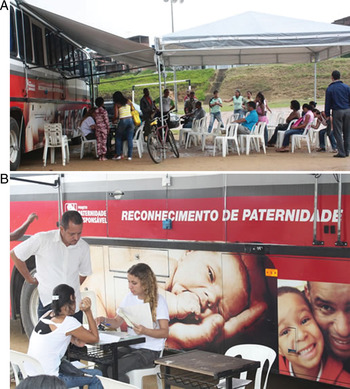
The Bahian Responsible Paternity campaign expanded from Salvador to the entire state in 2008, with the inauguration of a new center devoted exclusively to the program (NUPAR—Núcleo para Fomentar Paternidade Responsável).Footnote 79 In addition to creating publicity and supporting the efforts of local Ministry offices around the state, NUPAR dispatched busloads of campaign personnel, armed with plastic tables, tarps, documents, stamps, and DNA testing kits, to poor suburbs and other remote areas through the reinstituted “Public Ministry Goes to the Streets” program. An agreement to collaborate with the state-level Department of Education and other agencies permitted more effective identification of children registered without their father's name, in numbers even higher than expected.Footnote 80
A and B. Ministério Público Goes to the Streets bus. Source: MPEB, “Relatório de Atividades 2008,” 54–59 and “Relatório de Atividades 2009,” 66–69, http://www.mp.ba.gov.br/pga/publicacoes.asp.

According to the Public Ministry's annual reports, the significant number of paternal recognitions secured by the Responsible Paternity program—24,768 between 2005 and 2009Footnote 81—constitutes a form of “symbolic capital,” concrete evidence that the ministry is fulfilling its mission to promote “a new social order” that is “more humane, just, and egalitarian.” In fact, Responsible Paternity is possibly the Bahian Public Ministry's most successful civil rights program. Annual reports on the program characterize the lack of paternal recognition as “one of Brazil's greatest social problems, affecting approximately 30 percent of Brazilian children.” Confronting this problem, according to the reports, provides the ministry a means of defending children's civil rights while battling sexism and poverty. “Not recognizing paternity is an antidemocratic, sexist practice, which contributes to obstructing the effective exercise of citizenship,” according to reports for 2006 and 2008, and, moreover, “paternal recognition is often accompanied by child support agreements, which are very important for attenuating the hunger of many children who are initially rejected by their fathers.”Footnote 82
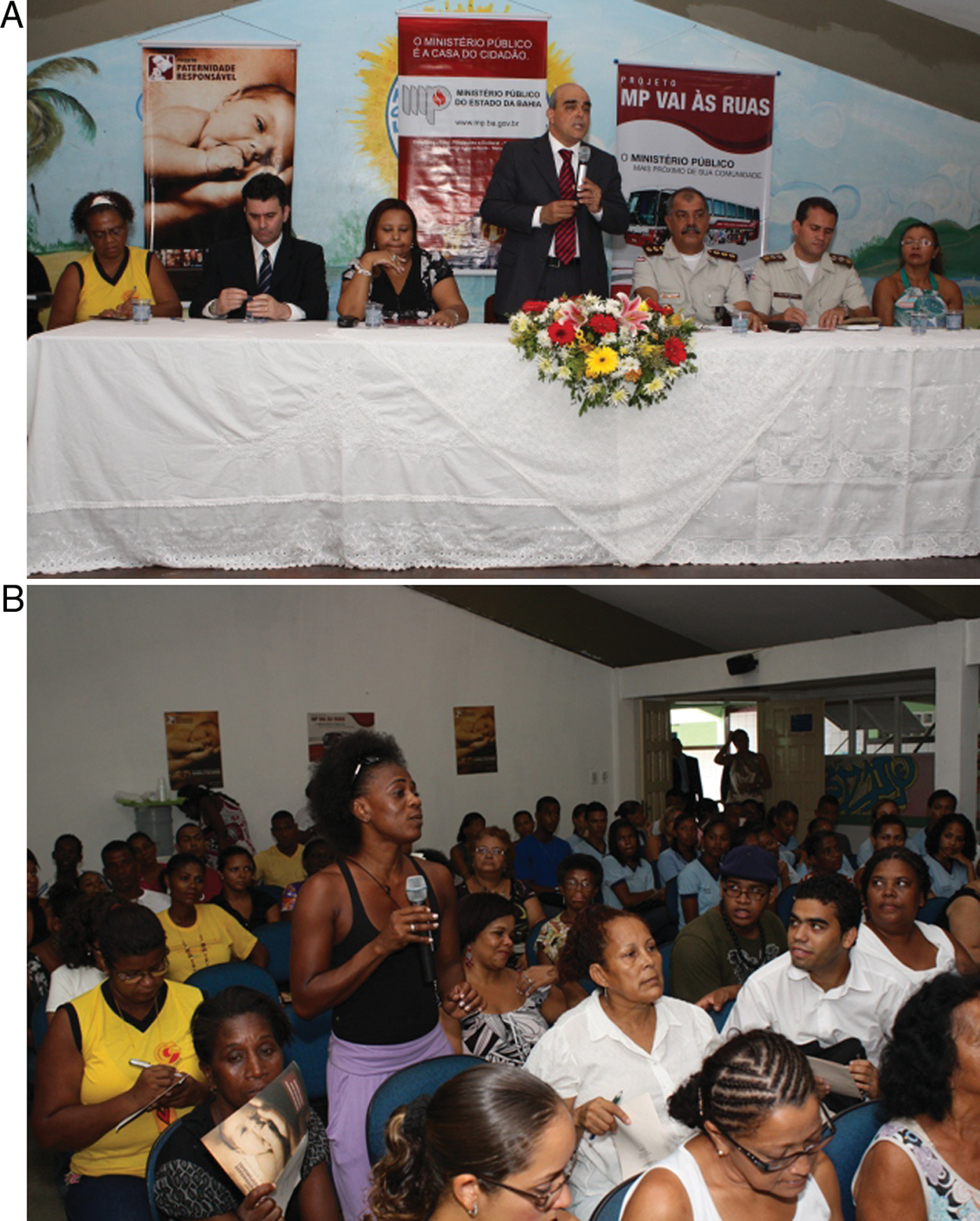
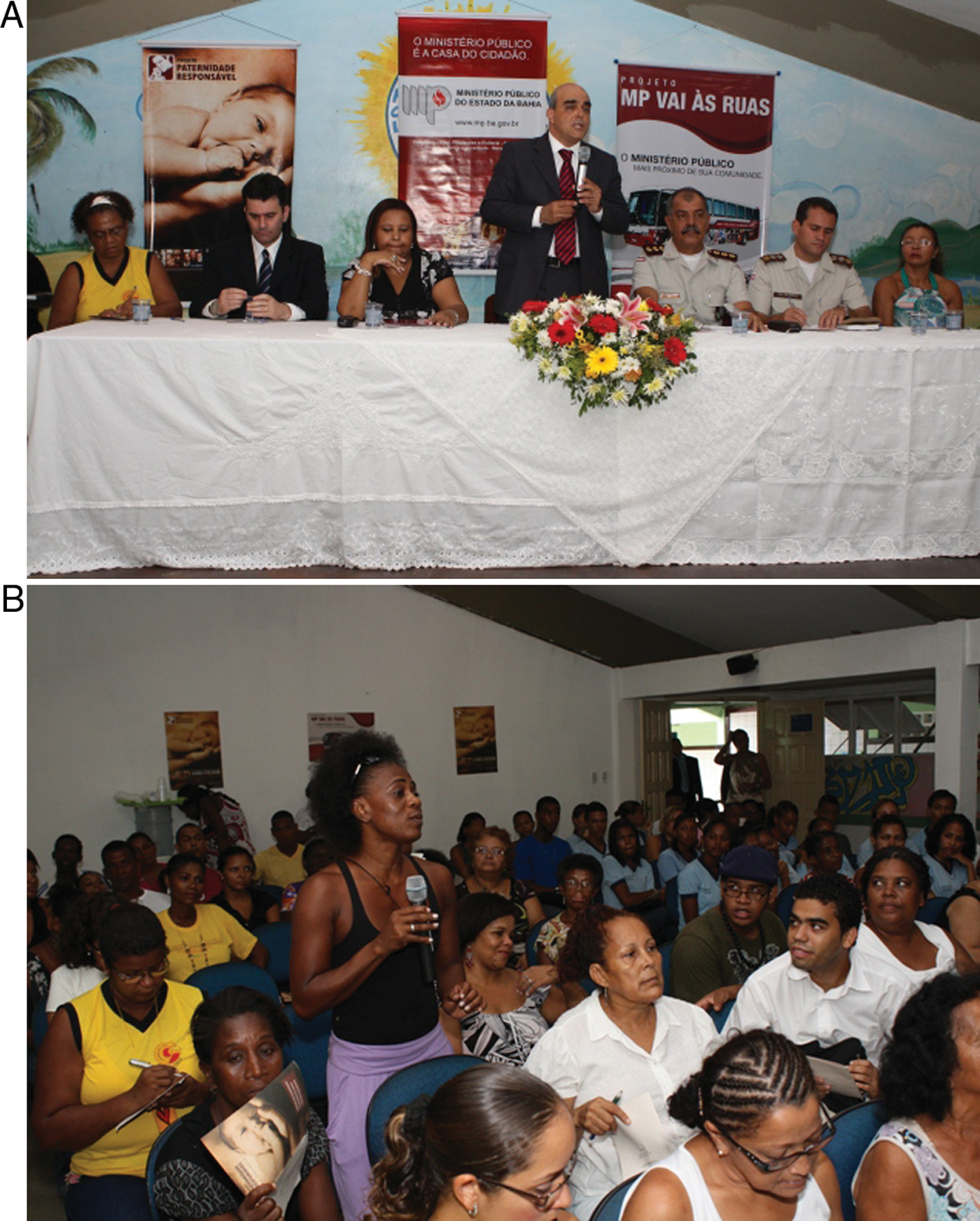
This emphasis on the importance and success of the Responsible Paternity program might be explained by the fact that most of the civil rights issues faced by Bahia's poor communities are much more difficult for the Public Ministry to solve. This was evident during a recent meeting between the state attorney general (Procurador da Justiça) and the director of NUPAR with residents of Alagados, one of Salvador's poorest neighborhoods, in preparation for a visit by the “MP Goes to the Streets” buses. While the residents demanded solutions to the problems of “precarious housing, difficult access to Justice, ‘barbaric’ police actions, and inadequate provision of educational services,” the Attorney General explained that although ministry officials would hear all complaints, the itinerant service was designed to address access to civil services, primarily those provided by Responsible Paternity. After the NUPAR director explained the importance of these services, community representatives politely expressed their appreciation of the ministry's efforts, but insisted on the need to resolve what they considered more pressing problems.Footnote 83 The Ministry's 2009 report on the itinerant service confirmed that the vast majority—3,380 of 4,105 clients over the previous year—had sought help with issues unrelated to paternal recognition.Footnote 84
Moreover, not everyone contacted by the Responsible Paternity program appreciated the ministry's efforts. Approximately 20–30 percent of the “alleged fathers” doubted or flatly denied their paternity, leading the ministry to offer DNA testing. Although the law mandates that DNA testing be provided free of cost in such cases, funds were insufficient, so the couples involved—or more often, the mothers—paid for it.Footnote 85 If they could not, or if the father refused to undergo testing, the ministry would file a civil lawsuit—usually a lengthy and costly process for all parties. Even in the cases of fathers who “spontaneously recognized” their children, material benefits for the child were not always guaranteed, at least not immediately. According to Ministry reports, few of these fathers agreed to formalize child support arrangements—only 5 percent in 2007 and 13 percent in 2009, the years for which these data are available.Footnote 86
A and B. Ministério Público community meeting in Alagados. Source: Maiama Cardoso, “Carências do bairro de Alagados são apresentadas ao MP,” Ministério Público do Estado da Bahia, March 4, 2010, http://www.mp.ba.gov.br/visualizar.asp?cont=2136.
It is not only “alleged fathers” who resisted state efforts to oblige them to recognize their paternity. Some mothers, including, for example, one who sobbed uncontrollably at the meeting I observed when her turn came to talk to the social worker, seemed fearful or resentful of the state's intrusion into their family life. According to a report on the project in an online journal, mothers' complaints that they had been obligated to contact the fathers are common. The report quoted a few: “If it were up to me, things would stay as they are. It doesn't make any difference whatsoever. If the father wasn't there when his son was registered, when he was born, why this now?” “Children are born and we raise them. And that's that. I came only because the school told me to. I don't want to have anything more to do with that guy.”Footnote 87
DNA sample collected from child for proof of paternity exam. Source: Aline D'Eça, “Assinatura de convênio entre MP e GACC otimizará investigação de paternidade,” Ministério Público do Estado da Bahia, August 15, 2006, http://www.mp.ba.gov.br/noticias/2006/ago_15_duas.asp.

The journalist cites these comments as evidence of these uneducated mothers' failure to perceive the legal, psychological, and even social harm done by their failure to pursue paternal recognition for their children. The analysis is compatible with the speech by the social worker quoted previously, who at the end of her talk cited homosexuality and drug addiction as two of the problems Bahia faces because of “irregularities in the family.” Similar ideas can be found in a report by the same journalist on the psychological effect of not having a father's name. The journalist interviewed several experts who agreed on children's need for paternal recognition. “For the child, it is humiliating to show a document that does not have the father's name,” according to the head of a family services NGO (echoing an explanation that I had heard many times while talking to Responsible Paternity staff). Rather than suggesting the need to alter the social prejudice that produces this humiliation, the reporter emphasized the harm done by single mothers who did not pursue their children's fathers, and the importance of the Bahian Responsible Paternity program.Footnote 88
Although these analyses are those of individuals rather than official discourse, they highlight the ways the state's focus on the significance of a father's name can unintentionally reinforce stereotypes regarding gender roles and parenthood. Moreover, these stereotypes are present in some of the program's publicity, such as the “Pedrinho is going to have a father!” pamphlet mentioned previously. By publicizing the notion that a child who lacks a father's name suffers a violation of human dignity and citizenship rights, and by insisting that this “lack” necessarily causes psychological harm to the child and constitutes a major social problem, Responsible Paternity program staff inadvertently reinforce the social stigma that out-of-wedlock children, and their mothers, have historically faced in patriarchal societies.
Another unintended outcome of the state's emphasis on every child's need for and right to paternal recognition and a paternal name is the intimidation felt by mothers who prefer not to contact their children's father. According to the literature published by state Responsible Paternity programs and statements by the Bahian project's staff, the program avoids coercive and punitive strategies, stressing instead the goal of “facilitating voluntary and spontaneous recognition [of paternity].” This seems to contribute to the staff's evident pride in the program. Staff members feel that unlike many efforts to reduce Brazil's inequality and defend civil rights, their work has had a tangible positive effect. The prosecutors who worked with Responsible Paternity in Bahia in 2005 and 2006 emphasized their commitment to helping single mothers, not punishing them.Footnote 89 And although the social worker I quoted told mothers who resisted that they did not have the right to hide information about the child's father (which, again, accurately describes the law), and explained that the lack of this information would harm the child psychologically, she told me privately that nothing would happen to those who did not return with the requested information. “We don't force anyone. We try to make them aware of the benefit for their child, but [referring to the desolate mother at the meeting] if she still doesn't want to contact the father at our next meeting, I'll just let it go.”Footnote 90
The program's preference for persuasion over coercion is consistent with current laws. The 1992 law that inspired the creation of Responsible Paternity programs states that when a registrar remits a birth certificate to the court because the father's name is missing, the judge “shall, if possible, hear the mother regarding the child's paternity.” The law does not obligate the mother to name the father, or even to appear.Footnote 91 A 2007 senate bill aimed to change this.Footnote 92 Authored by Senator Marcelo Crivella, one of the most prominent members of the evangelical bloc, the bill called for an obligatory judicial interrogation of the mother regarding the father's identity, followed by the summons of the alleged father, who must either declare paternity or submit to a DNA test—refusal of which would be considered definitive proof of paternity (the latter stipulation has now been preempted by a 2009 law).Footnote 93 Crivella justified his bill by citing a thesis by a feminist sociologist on the impoverishment of single mothers and impunity of fathers who abandon them, and by arguing that the right of the child to paternal recognition overrode the mother's right to privacy.Footnote 94
Despite the precepts and discourses that emphasize the mother's legal and moral obligation to name the biological father, in practice Responsible Paternity staff sometimes validate the variety of family arrangements based on the socio-affective ties that are so common in working-class neighborhoods. Grandparents, godparents, or others who have informally adopted children are encouraged to formalize their guardianship and apply for state aid; mothers who have formed stable unions with a man who acts as the child's father are asked whether he would be willing to legalize his paternity. The online journal article cited previously provides an example, quoting a mother who sought the latter solution. “I want to legalize this situation,” the woman explained. “The boy is already sixteen years old. He calls my companion his father. It isn't worth finding out where his biological father is, he was violent and drank too much. I don't want someone like that in my house and not even once in awhile. They told me that on my son's birth certificate, he can have my husband's name as his father. It's like an adoption. […] The father is the one who raises the child. That's what I believe.”Footnote 95
Conclusion
After the 1988 Constitution incorporated expansive conceptions of citizenship, new state initiatives—Responsible Paternity is one of them—were undertaken with the explicit goal of reducing inequality and empowering poor Brazilians to exercise their expanded citizenship rights. Laws and state programs that seek to force fathers to take responsibility for their children have also been inspired by feminist concerns regarding the unequal burden imposed on single mothers. All of this certainly represents a welcome departure from a history of patriarchal family law, on the one hand, and, on the other, from a history of costly legal procedures and remote institutions that made it difficult for many Brazilians to acquire the legal benefits of a legitimate family.Footnote 96
Considering the history of paternal responsibility in Brazilian law over the past two centuries, however, reveals that post-1988 changes in family law and policies are a less radical rupture with the past then they seem at first glance. New laws and policies such as Responsible Paternity form part of a long process of legal and social change, brought about in part through courtroom struggles and juridical debate over what kinds of family relationships generate rights and merit state protection. On one side were unmarried mothers and their children, represented by jurists and politicians who developed moral arguments and legal concepts that supported their claims. Between the 1920s and 1988, their efforts resulted in the creation of jurisprudence that incorporated a degree of flexibility into the narrow conferral of family rights in positive law, paving the way for the Constitution to expand the definition of family. In opposition to this trend, conservative jurists and politicians have attacked what they consider to be judicial activism in favor of broadened family rights, while reiterating the need to preserve a “traditional” family structure in the interest of social order and the moral or psychological health of the nation's children.
Debates over the definition of family did not end with the 1988 Constitution's proclamation of equal family rights for all children, but resurfaced in controversies over issues such as mandatory DNA testing, “Brazilian-style adoption,” and families formed by “socio-affective” or “homoafective” bonds. Although Responsible Paternity programs have not generated political controversy, they incorporate the competing conceptions of family that have animated legal debates over at least the past century. Envisioned as part of the state's broader commitment to the defense of children's human rights, these programs answer feminist demands for greater gender equality in parenting, providing welcome assistance to the children of single mothers who want recognition and support from the biological fathers. In some instances, the programs also support the modern concept of social-affective family ties by providing legal support for extended or non-biological family arrangements.
Reponsible Paternity programs deviate from their progressive, feminist-inspired objectives when they apply a top-down, standardized solution to a variety of family situations, a practice that can place undue pressure on mothers to name the father, without individualized consideration of whether a mother's refusal might be in the best interest of the child. This standardized prescription is one logical outcome of the program's legal and ideological grounding, coupled with Brazil's strong tradition of state paternalism. By focusing primarily on biological paternity, assuming that a child's psychological health and social standing depend upon a paternal recognition, and insisting that the lack of paternal recognition is always a problem warranting state intervention, Responsible Paternity programs reify paternity in ways that recall patriarchal discourses of family honor. Therefore, it seems that the centuries-old notion that the inscription of a biological father's name on an official document is an essential element of personal honor and public standing has survived state efforts to eradicate the social stigma and humiliation of illegitimate birth.