Nomenclature
- APU
-
auxiliary power unit
- DT
-
digital twin
- FCOM
-
flight crew operations manual
- IST
-
individual systems thinking
- MDO
-
multidisciplinary design optimisation
- ROS
-
robot operating system
- UAV
-
unmanned aerial vehicle
- VTOL
-
vertical take-off and landing
1.0 Introduction
As a holistic methodological paradigm, systems thinking is instrumental in comprehending the dynamic behaviours of complex systems and in addressing the design and optimisation challenges posed by the growing interconnectivity of multidisciplinary components [Reference Amissah, Gannon and Monat4]. Systems thinking, which is used to understand the components of a system, their interrelationships and feedback behaviours, is used in many different disciplines and industries such as healthcare, sustainability, defense, project management, education and the service sector [Reference Arnold and Wade6, Reference Behl and Ferreira10].
A system is a structure that produces a certain response to external influences because of the interaction of its constituent subsystems and/or components with each other. From an engineering point of view, the functional performance of the system means the realisation of the external environment interaction at the desired level. Therefore, the ability of the system to give the desired response depends on the correct configuration of its constituent components. Since the components and subsystems that make up the system are numerous and from different fields, understanding and analysing the system and designing the interactions between its components involves complexity and requires a systematic approach. The performance of the system, which consists of very different disciplinary components, especially air vehicles, from combustion science to aerodynamics, from structural to electronic control, it is known that a new approach is needed to determine during design, unlike the cumulative design approach that has come to the present day [Reference Grose28].
Aircraft design, as an engineering activity, is a process carried out by integrating the subsystems that will form the aircraft. The classical aircraft engineering discipline has been an activity focused on the design processes of subsystems. For example, wing design and landing gear designs were carried out as discrete processes. It is obvious that when integrated as a system, they have functional reciprocal effects. However, in the design process, these effects have been abstract or hypothetical until today [Reference Torenbeek53].
In the literature on systems thinking, different researchers have addressed the definition, scope and application areas of the concept from various perspectives. Gharajedaghi, in his study in 1999, examined systems thinking under four headings based on the historical development of design approaches and practical experience. Using five fundamental principles and an iterative design scheme, he addressed challenges such as interdependence, chaos and choice [Reference Gharajedaghi26]. Buchanan [Reference Buchanan12] addressed the uncertainties in the system definition and explained the system under appropriate conditions, subcomponents, related sets and order headings [Reference Buchanan12]. Cavana and Maani [Reference Cavana and Maani15] have linked systems thinking and dynamics to four levels of thinking and a five-stage modeling methodology [Reference Cavana and Maani15]. Behl and Ferreira analysed the relationships between elements by focusing on individual systems thinking (IST), while Eren Şenaras and Sezen explained the system through causal loop diagrams based on five fundamental elements [Reference Behl and Ferreira10, Reference Eren Şenaras and Sezen24].
In studies conducted in the field of education, Verhoeff et al. [Reference Verhoeff, Knippels, Gilissen and Boersma56] and Plate and Monroe [Reference Plate and Monroe45] have shown that systems thinking provides a cognitive tool and a measurable structure for students to understand complexity [Reference Plate and Monroe45, Reference Verhoeff, Knippels, Gilissen and Boersma56]. Similarly, Oskarsson et al. [Reference Oskarsson, Huge-Brodin and Hallström42] emphasised that systems thinking is a competency that exists in engineering education but is not sufficiently conveyed [Reference Oskarsson, Huge-Brodin and Hallström42]. Kapsali [Reference Kapsali31] argues that failures in innovation projects can be overcome through systems thinking, while Yildiz [Reference Yildiz62] and Dugan et al. [Reference Dugan, Mosyjowski, Daly and Lattuca21] highlight the importance of systems thinking in understanding the contextual aspects of new technologies and systems in engineering [Reference Dugan, Mosyjowski, Daly and Lattuca21, Reference Kapsali31, Reference Yildiz62]. Additionally, systems thinking is applied in various fields such as risk management [Reference McIlroy, Banks and Parnell36], and the training of expert engineers [Reference Armstrong and Wade5].
1.1 What is a ‘system’?
The system should be analysed not only as a collection of components, but also as a whole, with the way the components come together, their interactions and their cooperation [Reference Sillitto, Dori, Griego, Jackson, Krob, Godfrey and McKinney50]. Systems offer more than just the sum of their components put together, because interactions and cooperation allow the whole system to produce results that are greater or different than the sum of its components. There are many definitions of systems in literature. In this section, system definitions made by researchers are analysed.
Systems theory is generally based on the idea that elements are not considered in isolation but in relation to each other and that the parts that make up the system come together to become more than the system [Reference Morin37, Reference Von Bertalanffy57]. It is stated that feedback mechanisms contribute to regulating the behaviour of systems and adapting to changing environmental conditions. These feedback mechanisms enable systems to achieve their goals and help maintain the system’s stability [Reference Wiener59]. This dynamism helps to organise and structure systems [Reference Umpleby54]. To summarise Niklas Luhmann’s definition, systems can be defined as a set of autonomous and self-sustaining structures [Reference Mattheis35].
In line with the definitions, the schematic diagram of the system is shown in Fig. 1. In the literature, all researchers agree that the orderly combination of system elements forms systems and emphasises the importance of the interaction between these elements. Also, a common denominator is the idea that systems are organised for a specific purpose and are in mutual relationship with their environment. In addition to these substances, the ability of systems to adapt to environmental changes is another important point highlighted by several researchers. Based on this, when each of the components of a system is exposed to external influences, it may react subjectively to them. As a result of these reactions, its interaction with other components may also be affected. This aspect also means that we need to consider that the system definition involves regular change and will accommodate time-dependent attributes.
System-schematic diagram.

Feedback mechanisms are essential in ensuring that the system achieves its purpose and maintains stability. Systems are entities that interact with their environment and maintain continuity within themselves while preserving their autonomy [Reference Oliveira, Muÿlder, Pinheiro, Cardoso and Rosa Martins41]. This framework provides a basic definition to help understand and analyse systems in applications across different disciplines.
Basic concepts of systems thinking

2.0 Systems Thinking
The term ‘systems thinking’ refers to thinking about the system – the ability to visualise all the components that make up the system and their interrelationships in the human imagination. In this study, systems thinking should be understood as a verb in meaning, that is, the reflection of the system in the human mind in all its aspects.
Systems thinking is especially valuable for addressing complex and interconnected problems with inadequate independent solutions. This approach encourages interdisciplinary collaboration and contributes to a better understanding of complexity, predicting the future behaviour of systems, and identifying problems at the design stage, often using tools such as mathematical models, simulations or graphical representations.
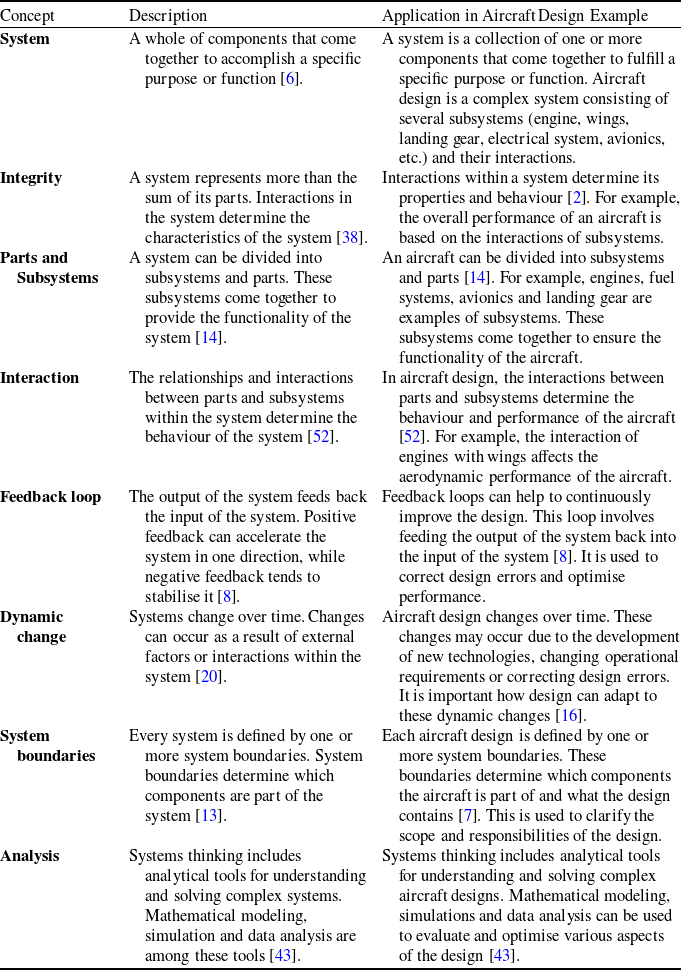
The basic principles of systems thinking include integrity, interaction, feedback and dynamic change. These principles occupy an essential position in understanding and solving complex systems. The basic systems thinking concepts are explained in more detail in Table 1. The basic concepts for systems thinking are system, integrity, parts and subsystems, interaction, feedback loop, dynamic change, causality, system boundaries and analysis. These concepts represent important principles used to understand and manage complex systems. In addition, these concepts are expressed in short and customised definitions for the aviation field. Thus, it aims to provide a better understanding of the terms used in the definition of systems thinking for aircraft design and a better understanding of the definition.
Systems thinking offers a focused approach to finding the root causes of problems and therefore enhances the ability to better understand, analyse and solve complex problems across different disciplines and application areas. In business, systems thinking plays a critical role in many application areas, such as strategic planning, systems optimisation in engineering, policy development and setting sustainability goals. This approach increases the ability to develop long-term and sustainable solutions by focusing not on visible symptoms but on the root causes of problems [Reference Arnold and Wade6]. Moreover, the ability to understand all components of the system and evaluate their interactions helps to effectively solve recurrent problems and prevent the occurrence of similar problems in the future. Systems thinking is therefore recognised as a vital tool in many fields, increasing our ability to understand the complexity in the modern world, make effective decisions and address the root causes of problems [Reference Yener61].
The processes of a project from idea to product are shown in Fig. 2. Historically, the focus has been on design and manufacturing processes in product development projects. Basically, the steps of designing, completing tests, manufacturing and launching to the market have been followed. The introduction of the thinking method has allowed this perception to develop in a positive direction. Before the design, it was seen that the part of the creation and development of the idea in the human mind was important for the success of the project output, and the systems started to be considered as processes given in Fig. 2.
System lifecycle in the view of systems thinking.

2.1 System design tools
Systems thinking is the concept of handling all the subsystems of a defined system at once. The tools that have been used for engineering are the subsystems mainly dealing with only parameters or any aspects. Such as, computational fluid dynamics (CFD) provides insight into flow or aerodynamic aspects. On the other hand, systems thinking needs further tools that could help to see all interactions of all subsystems in all physical aspects. Such as, aerodynamic flow will cause thermal changes, which at the end may cause contraction/expansion of all the structures, which can lead to cyclic interactions.
2.2 Failures due to ignoring systems thinking
To understand how critical systems thinking is in every aspect of daily life, a look at historical events can be quite illuminating. This study looked at the potential consequences of neglecting or not sufficiently implementing systems thinking, focusing on the serious events that occur in different time periods. Historically, many tragic events, from the BP Deepwater Horizon Oil Spill to the Space Shuttle Challenger Disaster and the Hindenburg Disaster, have been associated with a lack or neglect of systems thought. These events highlight the importance of systems thinking and show how vital a more holistic approach is to prevent similar disasters in the future.
-
Case 1: BP Deepwater Horizon Oil Spill: BP’s Deepwater Horizon oil platform exploded, and the platform sank. As a result, one of the largest oil spills in history occurred in the Gulf of Mexico [Reference Borunda11].
Analysis: The neglect of systems thinking in this case can be considered as ignoring technical problems and inadequacy of safety measures on the platform and not considering the whole system holistically. The root causes behind the explosion and leakage on the platform are attributed to many parameters, not just a single component. By applying systems thinking, how each factor interacts with each other could have been modeled and understood in advance, and measures could have been taken to prevent such an accident [Reference Makocha, Ete and Saini34].
-
Case 2: Space Shuttle Challenger Disaster: A leak in the shuttle’s fuel tank during the launch of NASA’s Challenger space shuttle caused an explosion at the end of the Earth’s return phase, killing seven astronauts [22].
Analysis: The main reason behind the Challenger disaster is that weaknesses in the structural design of the shuttle and warnings about the O-ring seals becoming dysfunctional at low temperatures were not considered. As shown in Fig. 3, the failure to fully understand the interactions between the different parts and the lack of a holistic approach to the problem can be seen as one of the reasons for the disaster [22].
-
Case 3: Hindenburg Airship Disaster: The Hindenburg airship, which ran from Germany to New Jersey, was burned as it landed at the airport in Lakehurst, New Jersey. The reason for this tragic event was the use of hydrogen gas in an airship with inadequate safety measures [23].
Analysis: The Hindenburg airship disaster was caused by the use of hydrogen gas in an airship with inadequate safety measures. The design of the airship and the choice of fuel are preferred without being based on a method of systems thinking that fully assesses the hazards. Safer fuel options and better safety measures were ignored or not adequately investigated [23].
The causal-loop of the Challenger disaster (AI is partly used to form the diagram).

The examples listed show that neglecting systems thinking or not applying it sufficiently can lead to serious consequences. The importance of systems thinking can be observed through historical events and experiences as well as the examples given.
3.0 Systems Thinking in Aircraft Design
Aircraft design is a complex process where interdisciplinary engineering skills and safety requirements come together. Each aircraft system includes several subsystems and components, each of which has a major impact on the overall performance, safety and cost of the aircraft. The aircraft design involves complexity as it requires the integration of different subsystems [Reference Sadraey47]. Components such as engines, wings, landing gear, cockpit, fuel systems and electrical systems must be assembled and work in harmony. When designing and optimising these components, various engineering disciplines are utilised. At the start of the project, the overall system characteristics (e.g. aircraft performance values) are transferred as input to the design of the subsystems, and each functional subsystem is designed in an independent team. Except for the evaluation of critical interfaces, the interoperability of subsystem designs can usually only be verified during the integration phase. The literature recommends that the integration of the project to reach the targets and the quality of the output be carried out as early as possible in the project [Reference Wiseman, Scoggins, Michelli, Janet and Walker60]. Since correcting errors discovered during the integration phase requires revisiting the system design, which is costly, it is vital to identify the possible integration problems at an earlier phase. The design process requires a thorough analysis to assess the impact of the components on each other in compliance with change management [Reference Dişlitaş, Yıldız and Kale-Halasz19].
The necessity for aircraft design to meet certification requirements has made it more viable to strictly adhere to the use of techniques that are primarily known in design to date [Reference Yildiz62]. This is the most important factor for aircraft manufacturers to stay away from new technologies and innovative applications in competitive environments. For example, the decision of Boeing to use lithium batteries in the APU electrical system in 2013 ended with a fire [Reference Vutetakis58], due to the mistakes caused by the user interface and user training of the 737-Max aircraft, which is implemented by innovative engines, the company suffered a large financial loss [Reference Sgobba49]. Both the certification requirements and the economic comfort brought by the reuse of technical know-how constitute the basis of the conservative approach of manufacturers to new technologies.
Employing systems thinking in aircraft design helps comprehension of the interactions of components and sub-systems throughout the lifecycle, which are possibly subjects of different disciplines. By integrating components into a whole, it provides the opportunity to see the effects of components on system performance [Reference Dişlitaş, Yıldız and Kale-Halasz19]. For example, elements such as engine performance, wing design and fuel system have critical impacts on the overall efficiency of an aircraft. Systems thinking is a strategy that helps to effectively manage the complexity of aircraft design and to take a more systematic and data-driven approach to the design process [Reference Sevaldson48]. This approach involves analysing how each component interacts with each other and how these bidirectional interactions are reflected in the aircraft’s performance.
An aircraft design project in which the systems thinking approach is successfully applied results in a more reliable, efficient and optimised product. This approach could enable the use of innovative technologies outside existing applications in the aviation industry and significantly improve existing aircraft design approaches. Systems thinking contributes to the successful completion of complex projects such as aircraft design and, as a result, allows for faster delivery of an innovative and competitive product on the market. Therefore, systems thinking should be considered an essential element of modern aircraft design [Reference Sterman51].
3.1 Evolution of aircraft design
Initially, aircraft design relied on trial-and-error methodologies to demonstrate the feasibility of flight. For the flight to take place, the plane had to be lightweight, and a wooden structure was used for this purpose. After adopting the metal body structure, aerodynamic-based calculations began to be used to build the aircraft. Thus, engineering methods were incorporated into the design phases of the technically focused design process. The need for long-range and high-altitude became evident with the emphasis on operations. The 1973 oil crisis prompted a transition to a cost-centric strategy aimed at the civilian market, emphasising fulfilling customer needs. Subsequently, technical advances heightened the demand for rapid competition. Consequently, the production of a rapid product has emerged as a critical criterion in the aircraft design process for civil aviation. The design process transitioned to a digital environment through digitalisation, utilising computer-aided design systems for aircraft modeling. This expedited the evaluation of designs, enhanced efficiency and performance, and facilitated optimisation. Nowadays, systems across several disciplines are integrated as a cohesive unit, with an emphasis on the functionality of the system.
The assessment of the focus of engineering studies can be summarised by year as follows:
-
Material oriented (1900–1945)
-
Technically oriented (1945–1960)
-
Operation oriented (1960–1975)
-
Maintenance and cost oriented (1975–1985)
-
Digitalisation (1985–2000)
-
Integrated function-oriented (2000-)
3.2 Early design efforts
In the early stages of large passenger aircraft design and production, companies have a design organisation focused on competency groups. In this organisation, the design team makes its design and transfers it to the production unit. There is a structure where the production team transfers the aircraft to the sales/marketing unit.
In the conventional functional-oriented system approach method, the aircraft design process is organised vertically as shown in Fig. 4. These processes are independent; only the results are carried to the next stage.
Process-oriented system approach [Reference Grose28].

Safety requirements and certification are considered a fundamental element of aircraft design. Aircraft must comply with high safety and certification standards. This means ensuring the aircraft can fly safely, handle emergencies and ensure all passengers are safe. Security is always a priority throughout the design process [Reference Zipay, Modlin and Larsen63].
3.3 Function-oriented design
In a study conducted by Boeing in 1994 [Reference Grose28], aircraft development processes were analysed, and a more customer-oriented structure was envisaged in which integration activities started at an earlier stage. Basically, the structure is based on the simultaneous focus of the integration process and the structural production of the aircraft. The proposed system-oriented design approach structure is illustrated in Fig. 5. Interestingly, although a function-oriented structure was envisaged for the systems-oriented approach in the same report, the approach proposed in Fig. 5 is still being used by two companies producing large-scale civil passenger aircraft. This approach is based on the flow of information rather than the flow of tasks between units. It is important to note that at the time this second approach entered new and intensive use of computing technologies in the years it was put forward, it is necessary to take into account the use of software on airplanes, as well as the use of software products in design processes [Reference Raj46].
Function-oriented system approach [Reference Grose28].

Detection of possible problems in unit and functionality-oriented design approaches, production and/or integration stages is not possible at the preliminary design stage. In this approach, problems usually arise during the detailed design phase, and this period may even extend until the production line and customer feedback. This leads to costs arising from change management during the detailed design phase, as well as a lack of customer satisfaction.
In both above-mentioned approaches, it has been observed that the team performing the preliminary design does not have data on the production process, it is not possible to access the production cost parameters, there is a need to go back to the design stage during production, and high production costs are encountered. This includes the possibility of unnoticed problems until the customer returns, both the negative impact of the production-sales channel and the cost and calendar pressure on the whole process of returning to the detailed design, especially in the civilian aircraft market, it should be expected to be high. Returns and revisions, in addition to negatively affecting the project cost, cause time pressure on the project team and often the failure to provide the committed values to the customer. For example, during the preliminary design phase of the A400M aircraft, the 32-ton payload target committed to customer countries could not be met due to the functional focus of the design [Reference López Díez and Asenjo Tornell33].
When evaluating design approaches, aircraft performance, as well as another important issue for companies, is that costs are kept under control at every phase of the project. For the reasons mentioned above, the fact that unforeseen changes of requirements may arise in the project is an important obstacle in predicting project costs. It should also be considered that customers need an approach or tool to obtain data on project duration, cost of ownership and product reliability during the early design phases.
3.4 Digitalisation and integrated function-oriented design
Almost all of the literature dealing with the functional design approach emphasises system optimisation [Reference Grose28, Reference Raj46, Reference Wiseman, Scoggins, Michelli, Janet and Walker60]. In particular, with the increase in computing possibilities, multidisciplinary design optimisation (MDO) application techniques have been developed and have become the most important activity of aircraft engineering [Reference Alonso, LeGresley and Pereyra3, Reference Fioriti, Boggero, Corpino, Prakasha, Ciampa and Nagel25]. With the development of the idea of systems thinking, it was understood that system design is not only optimisation, but it was also concluded that the system should be developed integrally. Systems thinking is the preferred effective method for modeling systems, identifying parameters, complex factors, elements and their relationships, as well as providing an analytical understanding of systems. Systems thinking not only optimises problems and the connections between them, but also creates a system that can integrate new knowledge and strategies [Reference Claeys and Minati17]. Digitalisation provides uncertainty reduction and decision support in aircraft design efforts [Reference Longueville, Jézégou, Bénard and Gourinat32].
System optimisation refers to the strategic approach used to improve the performance of a system and minimise inefficiencies. In the light of this research, optimisation can be redefined as resizing or realignment of related components (system elements) to maximise environmental coherency and performance. This discipline aims to provide improvements in critical areas such as repeatability, reliability, consistency and accuracy by using available resources in the most effective and efficient way [Reference Dincer, Rosen and Ahmadi18]. In addition to minimising costs, system optimisation offers an approach that focuses on long-term goals. This approach gives you the opportunity to build systems that are reliable, long-term and have low maintenance requirements. With the ability to adapt to technological changes and needs, system optimisation also represents a continuous improvement process. In this way, systems and organisations can adapt faster to changing conditions and gain competitive advantage [Reference Dincer, Rosen and Ahmadi18].
Figure 6 shows an example of an interface where functional tests can be performed during the design phase of an aircraft.
Modelling and simulation interface.

3.5 Application examples
The applications of the systems thinking approach and the gains brought by these applications are examined. In a design effort, as the design progresses, knowledge about the final system increases but the flexibility in the design reduces. The systems thinking helps to increase knowledge well before the detailed design to give enough room to have innovative design flexibility at the earlier stages of the project. This can be achieved by using systems thinking tools, which gives the ability to see systems performances before system integration phase [Reference Verhagen, Bermell-Garcia, Van Dijk and Curran55]. Some examples related to these advantages are summarised as follows.
In one of the research projects, the authors suggest combining traditional methods with the systems thinking of digital twin (DT) technology to save time and cost problems to the complexity experienced in the aircraft design process. For this purpose, a cargo plane was created with an example of a simulation that included climbing, cruising and landing missions. The data obtained in the flight simulation performed at a maximum of 18,000 feet were compatible with FCOM data. Thus, it has been shown that the necessary tests and changes can be followed in the digital environment without the need for physical prototype [Reference Nacak, Yildiz and Zöldy40].
In order to model and dynamically simulate an individual combat quadrotor unmanned aerial vehicle (UAV), the UAV was designed using the digital twin-based ROS (robot operating system) and Gazebo simulator. A large database was created, including historical flight data, real-time sensor data of the physical system, system data and simulation data obtained with the digital twin. Using connectors, these data obtained from the physical and twin models were integrated with the control system containing the system objectives and the system was simulated. The physical system and the digital twin were analysed interactively, and an experimental setup was set up to compare the results. As a result, it was concluded that the digital twin method is consistent in basic flight missions but needs to be improved as it is more stable than the physical system [Reference Ji, Hao, Gao and Lu30].
In another study, a battlefield and an aircraft were modeled for use in combat training using the digital twin method. The study includes the creation of a 3D model of the battlefield, processing of environmental conditions, development of a data flow system, aircraft modeling and examination of different scenarios. 3D reconstruction programmes such as simultaneous mapping were used for modeling. The fighter jet was studied in two modes: driving mode, where flight data information is used directly, and correction mode, which processes real flight data into the system as correction, and it was observed that it could be a good training tool for pilots [Reference Hu, Zhang and Ma29].
The digital twin method is used to analyse large systems involving different disciplines as well as specific components. For example, Paternina-Verona et al. modeled the filling procedure of a pipeline with an irregular profile using the numerical twin method. CFD analysis of the model was performed to investigate the air oscillation dynamics, and the results agreed with the simultaneous experimental data. Thus, it is observed that it increases the efficiency and safety of the systems compared to standard modeling methods [Reference Paternina-Verona, Coronado-Hernández, Pérez-Sánchez and Ramos44].
In another study, it was used in the controller design and simulation studies of a four-engine VTOL aircraft. Pitch, roll, yaw and thrust control movements are used to determine the block parameters. The input voltage of the engine is changed, and the angular position of the load is adjusted, and it keeps track of the actual position information, allowing it to reach the targeted position. It has been seen that the system control algorithm can be improved while still in the sub-system design. It is concluded that it will be possible to direct the UAV to the desired position without the need for GPS or internet connection [Reference Gökçe, Yıldız, Kale-Halasz and Zöldy27].
Since multiphysics modeling functionally allows the evaluation of functional performance during the design phase, it is seen that it will provide significant time and cost savings by allowing the trial and error and integration process on the prototype to be included in the design phase [Reference Nacak39].
3.6 Disadvantages of systems thinking in aircraft design
The systems thinking approach has many advantages, as well as some disadvantages and restrictions in its development and implementation.
-
• The necessity to analyse components from different fields (aerodynamics, avionics, propulsion, etc.) within a unified framework may result in complexity. Furthermore, this collaboration across disciplines requires experts to understand the entire system, which can lead to the need for highly trained experts. To prevent this situation, an infrastructure can be created through experimental learning from simple to complex systems and standardisation of systems thought approach and results can be ensured. Thus, an appropriate training and orientation can be provided for the new experts [Reference Beasley9].
-
• There may not be enough time to model complex systems and analyse them under different conditions and/or may not be able to respond quickly during a real-time operation [Reference Adamenko, Kunnen, Pluhnau, Loibl and Nagarajah1]. For this, predefined decision scenarios can be implemented, or it can be programmed to prioritise emergency alerts when processing decision mechanisms.
-
• In organisations, especially successful companies, there can be a resistance to change. Instead of completely replacing existing applications, a gradual change process may need to be undertaken as an addition to systems engineering.
Despite the disadvantages mentioned, a functional simulation system can be developed that will provide many advantages in design processes with the development of data processing, interdisciplinary information and collaboration management and modeling process.
4.0 Conclusion
Systems thinking is the process of reviving systems consisting of many components in the human mind. Systems thinking is seen as a critical thinking method for understanding, analysing and solving complex problems that are native to the aircraft design process. This method provides a framework for understanding and visualising the interactions and relationships between the components that make up a system. Systems thinking is particularly valuable for understanding the nature of systems with interconnected and complex components, where point solutions are insufficient. This method encourages interdisciplinary collaboration and contributes to better understanding and managing complexity using tools such as mathematical models, simulations or graphical representations. Systems thinking focuses on understanding how the components of a system interact with each other, rather than considering them in isolation during the aircraft design process. This aims to better understand the functioning of the system and achieve more effective results. Historically, neglect or insufficient application of systems thinking has led to disasters and had serious consequences. As seen in events such as the BP Deepwater Horizon oil spill, Space Shuttle Challenger disaster and the Hindenburg airship disaster, the lack of systems thinking can hinder the modeling of chain effects and the identification of relationships, and thus the cause and effect of complex events. Therefore, the possibility of identifying potential risks and problems at the design stage can be solved. Systems thinking provides a more comprehensive perspective, considering all components and interactions, and can help take preventive measures. Systems thinking is essential to preventing future disasters and finding more sustainable solutions.
Systems thinking plays a vital role in aircraft design. Aircraft are complex systems and operate through the interaction of many components. Systems thinking brings a holistic approach to the aircraft design process. This approach is critical to improve the performance, safety and efficiency of the aircraft. Systems thinking can be used at every stage of aircraft design, from aerodynamics to material selection, from engine design to safety protocols.
This research finding points out that using systems thinking is useful in integrating the corporate knowledgebase and corporate identity to the design, and flexibility to perform optimisation earlier in the design phase. It can be also concluded that the systems thinking approach can make it easier to incorporate new technologies in the new product design.
In the creation and development of complex systems, such as aircraft design, systems thinking is indispensable to achieve successful and more innovative results. In order to address future challenges and develop more sustainable solutions, the use of systems thinking should be included in the educational processes of professionals in engineering, science and other disciplines, and the ability of the individual to focus on the whole before the constituent elements will be a critical skill that will pave the way for progress in these fields and enable the introduction of innovative ideas.
Acknowledgements
This research is supported by TÜBİTAK under project No: 5240035 and Erciyes University Scientific Research Projects (BAP) under project No: 14127.
The authors used an artificial intelligence–based language model to improve the grammar and clarity of the manuscript. The authors reviewed and verified all generated content for accuracy and appropriateness.