Introduction
The mazaedium, a distinctive structure in which loose masses of ascospores accumulate in a layer covering the surface of the ascomata to be passively disseminated, was for a long time seen as the characteristic synapomorphy for the order Caliciales which was conceived as a natural or monophyletic group (e.g. Zahlbruckner Reference Zahlbruckner1926). For a long time in the premolecular era, classifications continued to regard the calicioid lichenized and non-lichenized fungi as a natural group included within a single order Caliciales (e.g. Poelt Reference Poelt1973), a view already questioned by Nannfeldt (Reference Nannfeldt1932) and later by Henssen & Jahns (Reference Henssen and Jahns1973). After analyzing morphological, chemical and ultrastructural traits with statistical and cladistic methods, Tibell (Reference Tibell1984) suggested that this group was a highly polyphyletic assemblage of taxa which had evolved mazaedia and passive spore dispersal independently several times. Later, molecular phylogenetic studies have supported this view and shown that mazaediate fungi are spread over different classes within the Ascomycota (Prieto et al. Reference Prieto, Baloch, Tehler and Wedin2013; Prieto & Wedin Reference Prieto and Wedin2016). For instance, Nadvornikia (Harris Reference Harris1990; Tibell Reference Tibell1996; Lumbsch et al. Reference Lumbsch, Mangold, Lücking, Garciá and Martín2004) and Schistophoron (Tehler et al. Reference Tehler, Baloch, Tibell and Wedin2009) were demonstrated to belong to Graphidaceae in the Ostropomycetes (Prieto et al. Reference Prieto, Baloch, Tehler and Wedin2013; Rivas Plata et al. Reference Rivas Plata, Parnmen, Staiger, Mangold, Frisch, Weerakoon, Hernández, Cáceres, Kalb and Sipman2013), Pyrgillus was placed within Pyrenulales in the Eurotiomycetes by Lumbsch et al. (Reference Lumbsch, Mangold, Lücking, Garciá and Martín2004), and Tylophoron belongs to the Arthoniomycetes, as shown by Lumbsch et al. (Reference Lumbsch, Lücking and Tibell2009).
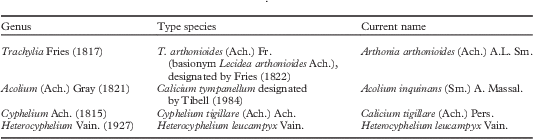
Historically, the name and systematic placement of Heterocyphelium leucampyx has undergone considerable changes (see Table 1). The species was first described from Cuba in Trachylia (Tuckerman Reference Tuckerman1862), a genus introduced by Fries & Sandberg (Reference Fries and Sandberg1817) to accommodate species characterized by circular, convex, rough and immarginate apothecia with spores ‘spread in the margin’. The type species, T. arthonioides (Ach.) Fr. (basionym Lecidea arthonioides Ach.), was designated by Fries (Reference Fries1822) and later transferred to Arthonia as A. arthonioides (Ach.) A. L. Sm. (Smith Reference Smith1911). Tuckerman (1888) transferred T. leucampyx to Acolium (Ach.) Gray, a genus in the Caliciales characterized by a crustose, flat, expanded, adnate, uniform thallus and apothecia that are cup-like, nearly sessile, cartilaginous and composed of a compact powdery mass forming a naked centre, the upper part flat or nearly globular (Gray Reference Gray1821). However, the name Acolium had been used first by Acharius (Reference Acharius1808) to create a subdivision of Calicium including three species (i.e. Calicium turbinatum, C. stigonellum and C. timpanellum), characterized by subsessile ascomata. Acolium has recently been resurrected to accommodate two species characterized notably by a dark excipulum that is strongly thickened at the base and by ornamented spores (Prieto & Wedin Reference Prieto and Wedin2016). Before that, Zahlbruckner (Reference Zahlbruckner1903) had transferred Acolium leucampyx to Cyphelium, another genus of Caliciales, and subsequently Vainio (Reference Vainio1927) proposed the new genus Heterocyphelium in his treatment of the family Coniocarpeae, to accommodate species resembling Cyphelium but with 2-septate ascospores. Vainio did not, however, place the newly described genus within the Coniocarpeae or any other family. In the meantime, several other species have been considered conspecific with Heterocyphelium leucampyx. For example, Tibell (Reference Tibell1996) synonymized Tylophoron eckfeldtii, described by Müller (Reference Müller1894) from Mexico, under H. leucampyx. Tylophorum triloculare, described by Müller from Australia (1893), was also added to the synonymy of H. leucampyx (Tibell Reference Tibell1987), considerably expanding the distribution range for the species. It is unclear in this respect whether Müller (Reference Müller1893) intended to describe a new genus different from Tylophoron (Nylander Reference Nylander1862), whether he deliberately changed the ending of the name, or whether he just produced an orthographic error. Again, in his monograph of the Caliciales, Tibell (Reference Tibell1996) did not assign Heterocyphelium to any family. Therefore, the position of H. leucampyx has remained unresolved and it has not been included in any molecular phylogenetic study until now. Since Eriksson (Reference Eriksson1999) and until most recently Lumbsch & Huhndorf (Reference Lumbsch and Huhndorf2010), the genus has been listed under Ascomycota as incertae sedis in the Outline of Ascomycota.
List of genera where Heterocyphelium leucampyx was successively placed together with their type species and current names

In 2010, JLC collected material of Heterocyphelium leucampyx during fieldwork in Costa Rica which was sequenced by the third author (EG) and, based on blast results, preliminarily placed in Arthoniales without an assigned family. Comparison with DNA sequence data obtained from a second specimen collected by the first author (DVDB) in Uganda in 2014 confirmed this result. The present study, therefore, aims to resolve the precise systematic position of Heterocyphelium within Arthoniales using additional molecular data in a phylogenetic framework.
Material and Methods
Morphological study
Macroscopic characters of the material were studied and measured using an Olympus SZ61 stereomicroscope and a Leica MS5 dissecting microscope. Macroscopic photographs were taken using a Keyence VHX-5000 digital microscope. Hand-cut preparations of ascomata were mounted in water or a solution of 5% potassium hydroxide, and for ascus structure in Lugol’s iodine solution (1% I2) without (I) or with KOH pretreatment (K/I) and studied using an Olympus CHR-TR45, an Olympus BX51 and a Zeiss Axioskop 2 compound microscope. For all measurements, the minimum and maximum values are given, all values rounded to the nearest multiple of 0·5 mm or 0·5 µm, followed by the number of measurements (n). Measurements refer to dimensions in water. Microscopic photographs were prepared using an Olympus BX51 microscope fitted with an Olympus UC 30 camera. Voucher specimens are deposited in the herbarium of the Botanic Garden Meise (BR), the Field Museum of Natural History (F), and the Instituto Nacional de Biodiversidad (INB).
Molecular techniques
Well-preserved and freshly collected specimens lacking any visible symptoms of fungal infection were used for DNA isolation. Hand-cut sections of the ascigerous areas of specimen ‘Van den Broeck 6326’ from Uganda were used for direct PCR as described in Ertz et al. (Reference Ertz, Tehler, Irestedt, Frisch, Thor and van den Boom2015). The lichen material was washed with a 1% KOH solution and then rinsed with water to remove remnants of pigments. The material was placed directly in microtubes with 0·2 ml of H2O. Amplification reactions were prepared for a 50 µl final volume containing 5 µl 10×DreamTaq Buffer (Thermo Fisher Scientific, Waltham, MA), 1·25 µl of each of the 20 µM primers, 5 µl of 2·5 mg ml−1 bovine serum albumin (Thermo Fisher Scientific, Waltham, MA), 4 µl of 2·5 mM each dNTPs (Thermo Fisher Scientific, Waltham, MA), 1·25 U DreamTaq DNA polymerase (Thermo Fisher Scientific, Waltham, MA) and the small fragments of lichen material. Specimen ‘Chaves 1758’ from Costa Rica was prepared for extraction by carefully selecting portions of the hymenia beneath the mazaedia; extraction and PCR followed the protocol specified by Gaya et al. (Reference Gaya, Högnabba, Holguin, Molnar, Fernández-Brime, Stenroos, Arup, Søchting, van den Boom and Lücking2012). A targeted fragment of c. 0·8 kb of the mtSSU rDNA was amplified from both specimens using primers mrSSU1 and mrSSU3R (Zoller et al. Reference Zoller, Scheidegger and Sperise1999), and a fragment of c. 1 kb of the RPB2 protein-coding gene was amplified from the Ugandan material using primers fRPB2-7cF and fRPB2-11aR (Liu et al. Reference Liu, Whelen and Hall1999). After examination by gel electrophoresis, the material from Uganda was purified and sequenced by Macrogen® using the same amplification primers. For the Costa Rican material, PCR products were purified using ExoSAP-IT (USB Corporation, Cleveland, OH). Sequencing was carried out in 10 µl reactions using: 1 µl primer, 1 µl purified PCR product, 0·75 µl Big Dye (Big Dye Terminator Cycle sequencing kit, ABI PRISM version 3.1; Perkin–Elmer, Applied Biosystems, Foster City, CA), 3·25 µl Big Dye buffer, and 4 µl double-distilled water. Automated reaction clean up and visualization was performed at the Duke Genome Sequencing & Analysis Core Facility of the Institute for Genome Sciences and Policies, as described in Gaya et al. (Reference Gaya, Högnabba, Holguin, Molnar, Fernández-Brime, Stenroos, Arup, Søchting, van den Boom and Lücking2012). Sequence fragments were subjected to BLAST searches for a first verification of their identities. They were assembled and edited with Geneious Pro 5.1.7 (Kearse et al. Reference Kearse, Moir, Wilson, Stones-Havas, Cheung, Sturrock, Buxton, Cooper, Markowitz and Duran2012).
Taxon selection and phylogenetic analyses
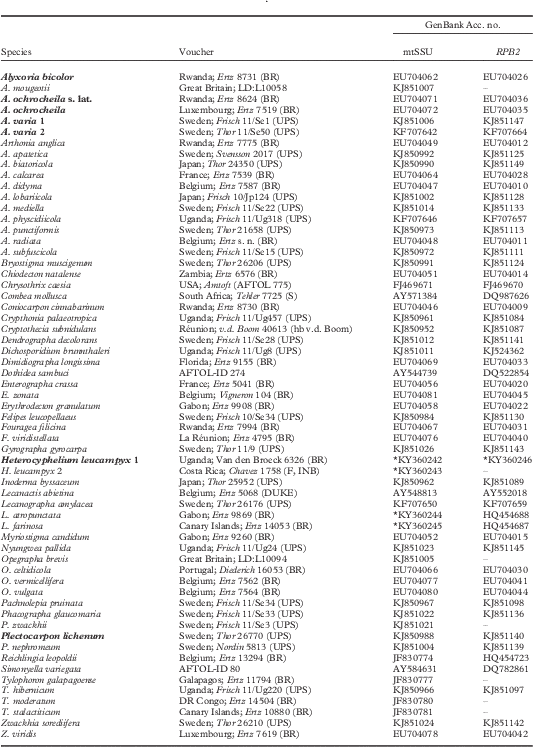
Five new sequences were obtained for this study and 110 additional sequences were retrieved from GenBank (Table 2). Two different taxon sets were used for the phylogenetic analyses: a set of 61 OTUs consisting of taxa representing all major clades currently accepted in the Arthoniales (Frisch et al. Reference Frisch, Thor, Ertz and Grube2014) and for which at least the mtSSU was available, and a subset of seven specimens focusing on Heterocyphelium and its closest relatives with complete data (Table 2). For the first data set Dothidea sambuci was chosen as outgroup species and for the second data set, Plectocarpon lichenum. For the two data sets, the sequences were aligned using MAFFT v6.814b (Katoh et al. Reference Katoh, Misawa, Kuma and Miyata2002) within Geneious Pro 5.1.7 and corrected for errors manually using Mesquite 3.04 (Maddison & Maddison Reference Maddison and Maddison2015). Ambiguously aligned regions following Lutzoni et al. (Reference Lutzoni, Wagner, Reeb and Zoller2000) and introns were delimited manually and excluded from subsequent analyses. All new sequences were deposited in GenBank (Table 2) and the alignment data were deposited in TreeBASE (Accession number S20530).
Specimens and their GenBank Accession numbers. Newly generated sequences are indicated by an asterisk; dash denotes missing data. Species in bold were used for the subset

To examine topological incongruence among data sets, Bayesian and maximum likelihood (ML) analyses were carried out on each of the single-locus data sets. We used MrBayes v.3.2.6 (Huelsenbeck & Ronquist Reference Huelsenbeck and Ronquist2001; Ronquist & Huelsenbeck Reference Ronquist and Huelsenbeck2003), with the same settings described below for the 61 sample data set, and RAxML v.7.2.7 (Stamatakis Reference Stamatakis2006) with 1000 replicates of ML bootstrapping (ML-BS) and the GTRGAMMA model. In both cases, analyses were run on the CIPRES web portal (Miller et al. Reference Miller, Pfeiffer and Schwartz2010). All topological bipartitions were compared for the two loci. A conflict was assumed to be significant if two different relationships (one being monophyletic and the other being non-monophyletic) for the same set of taxa were both supported with PP values ≥95% and/or bootstrap values ≥70% (Mason-Gamer & Kellogg Reference Mason-Gamer and Kellogg1996). Based on this criterion, no conflict was detected and therefore the mtSSU and RPB2 data sets were concatenated.
Phylogenetic relationships and confidence were inferred on the combined data sets also using Bayes and maximum likelihood (ML) as optimization criteria. In both analyses, alignments were divided into four partitions (mtSSU, RPB2/1st, RPB2/2nd and RPB2/3rd positions). For the Bayesian analyses, best-fit evolutionary models for each partition were estimated using the Akaike Information Criterion (AIC) as implemented in jModelTest 2 (Darriba et al. Reference Darriba, Taboada, Doallo and Posada2012). For the data sets of 61 samples, the GTR+I+G model was selected for the mtSSU data set as well as for the RPB2/1st and RPB2/2nd codon positions, while the TVM+I+G model was selected for the RPB2/3rd position. For the subset of seven samples, the GTR+I+G model was selected for the mtSSU data set while the TIM2+G model was selected for the RPB2/1st, TIM3+G for the RPB2/2nd and the TPM3uf+I+G for the RPB2/3rd codon positions. Two parallel Bayesian MCMCMC runs were performed, each using four independent chains and 120 million generations for the 61 sample data set and 40 million generations for the 7 sample data set, sampling trees every 1000th generation in both cases. Tracer v.1.6.0 (Rambaut et al. Reference Rambaut, Suchard, Xie and Drummond2013) was used to ensure that stationarity was reached by plotting the log-likelihood values of the sample points against generation time. Convergence between runs was also verified using the PSRF (Potential Scale Reduction Factor), where values were all equal to 1·000 or 1·001. A tree was generated from 180 002 post-burn-in trees out of 240 002 sampled for the 61 sample data set and from 60 002 post-burn-in trees out of 80 002 trees sampled for the seven sample subset for the two pairs of MCMCMC runs using the sumt option in MrBayes. Posterior probabilities (PP) were determined by calculating a majority-rule consensus tree. For the ML analyses, RAxML was used to estimate the most likely tree with 1000 replicates and a GTRGAMMA model of molecular evolution. Bootstrap proportions (ML-BS) were obtained from 1000 replicates of ML bootstrapping conducted with the same settings and program. Internodes with bootstrap proportions ≥70% and Bayesian posterior probabilities ≥95% were considered strongly supported. Internodes with a bootstrap value ≥70% and a posterior probability <0·95 were also interpreted as well supported (Alfaro et al. Reference Alfaro, Zoller and Lutzoni2003; Lutzoni et al. Reference Lutzoni, Kauff, Cox, McLaughlin, Celio, Dentinger, Padamsee, Hibbett, James and Baloch2004).
The combined two-loci data set of 61 samples consisted of 1347 unambiguously aligned sites, 525 for mtSSU and 822 for RPB2. The combined two-loci data subset of 7 samples consisted of 1666 unambiguously aligned sites, 790 for mtSSU and 876 for RPB2. Phylogenetic trees were visualized using FigTree v1.3.1 (Rambaut Reference Rambaut2012). Since RPB2 has been shown to produce aberrant topologies due to saturation of the third codon position (see Discussion below), we tested this potential effect by reanalysing the 61 sample data set with the third codon position excluded and using the same settings as above. In addition, we also used the smaller taxon set including only the close relatives of Heterocyphelium leucampyx (7 sample data set) to test the effect of exclusion of ambiguous regions in broad versus narrow alignments (Fig. 3).
Results
Taxonomy
Heterocyphelium leucampyx (Tuck.) Vain.
Acta Soc. Fauna Flora Fenn. 57: 16 (1927). Basionym: Trachylia leucampyx Tuck., Proceedings Am. Acad. Arts Sci. 5: 390 (1862).—Acolium leucampyx (Tuck.) Tuck., Syn. N. Amer. Lich. (Boston) 2: 162 (1888).—Cyphelium leucampyx (Tuck.) Zahlbr., in Engler & Prantl, Nat. Pflanzenfam., Teil I (Leipzig) 1*: 84 (1903); type: Cuba, Monte Verde, Wright s. n. (FH-Tuckerman!—holotype; FH, K, PC!, S!, UPS!—isotypes; Müller, Lich. Cub. 21).
Tylophorum triloculare Müll. Arg., Hedwigia 32: 122 (1893); type: Australia, Queensland, ad cortices vetustos prope Brisbane, Bailey 1533 (G!—holotype).
Tylophoron eckfeldtii Müll. Arg., Herb. Boissier 2: 89 (1894); type: Mexico, Jalisco, Eckfeldt s. n. (G!—holotype, with spore drawings and annotations).
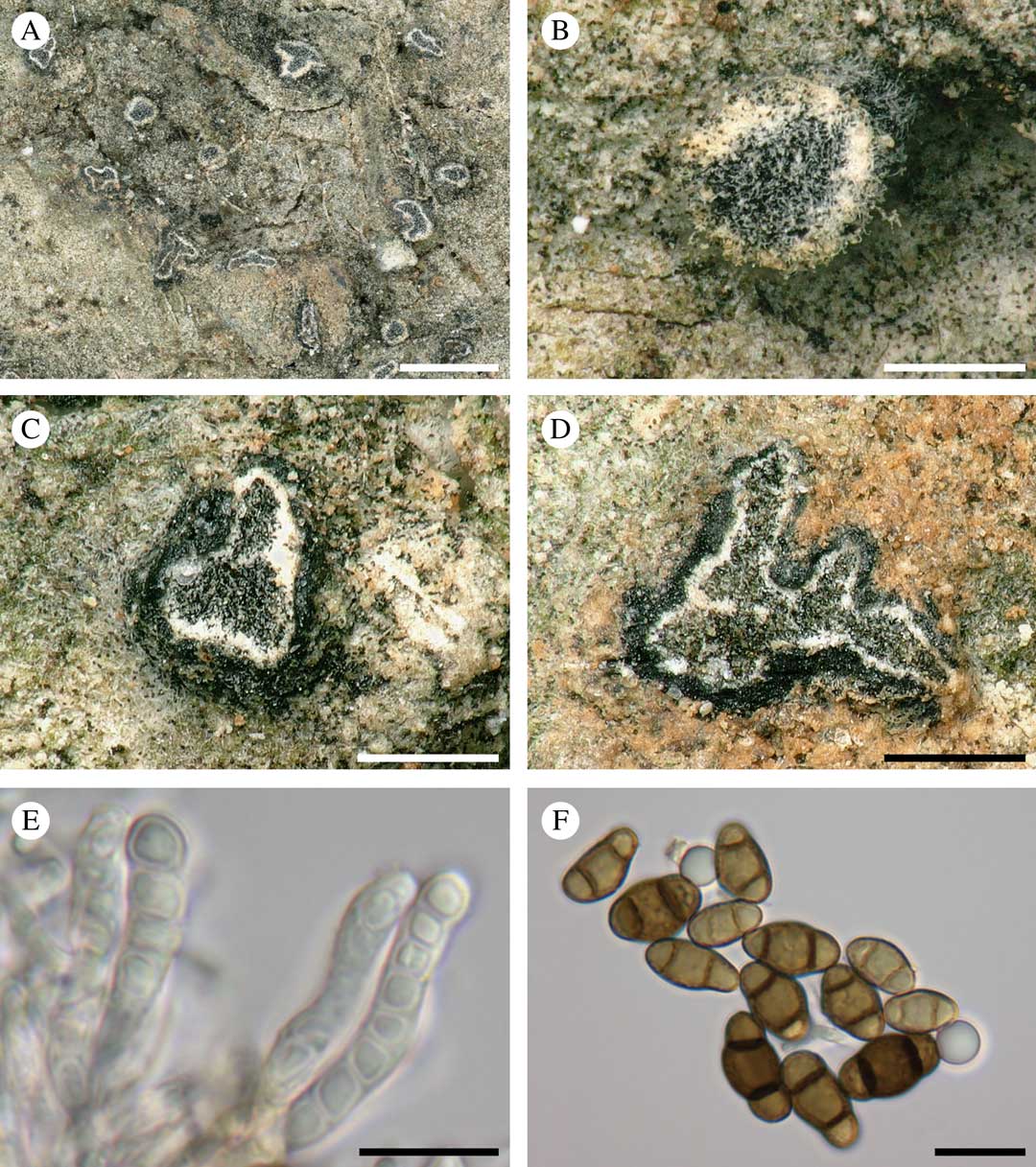
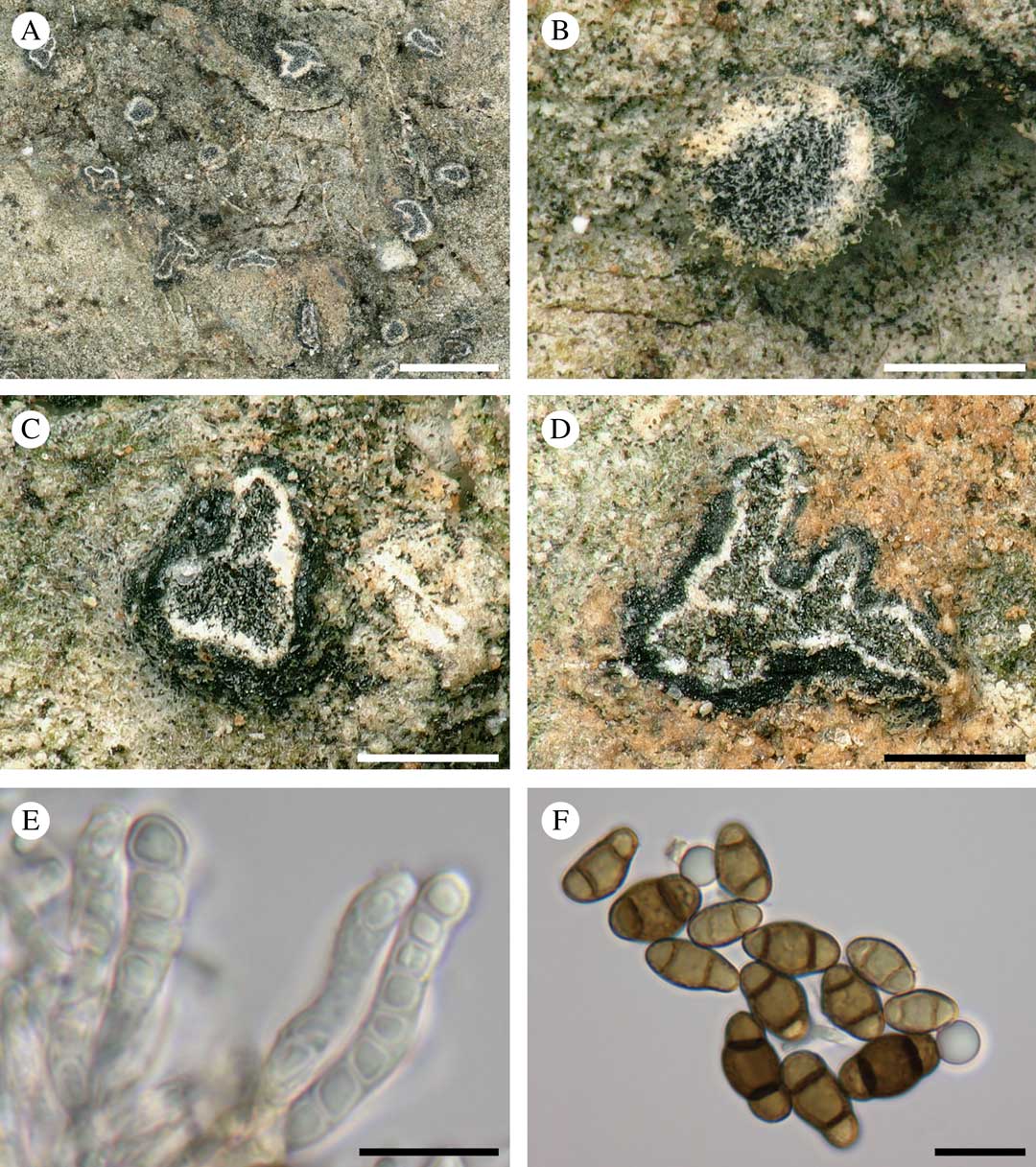
Heterocyphelium leucampyx, showing the variability of the ascomata and the ascospores. A, thallus with ascomata; B, rounded ascoma with byssoid margin; C, elongate ascoma with black margin; D, lobed ascoma with black margin; E, asci with hyaline, young, unicellular ascospores; F, brown, mature, 2-septate ascospores. Scales: A=1 mm; B–D=0·25 mm; E & F=10 µm. In colour online.
Thallus corticolous, crustose, not endophloeodic, ecorticate, greenish grey to white, farinose, partly cracked and/or byssoid, hydrophobic. Prothallus visible as a black line when in contact with other lichens. Photobiont often inconspicuous, but according to Tibell (Reference Tibell1996) it is Trentepohlia.
Ascomata first immersed in the thallus, becoming prominent to sessile, very variable in outline, rounded to lobate or lirellate, with or without a thalline, more or less byssoid margin, not or slightly constricted at the base, 0·10–0·35×0·16–0·55 mm (n=10), hydrophobic. Mazaedium well developed, black, bordered by a white rim. Excipulum black, composed of brown, branched and anastomosing hyphae 2–3 µm thick. Hamathecium hyaline, composed of branched and anastomosing hyphae 1·5–2·0 µm thick, the apices not or very slightly swollen, without a dark cap, visible as a white rim between the mazaedium and the excipulum, I+ red, KI+ patchily pale blue, inspersed with rounded to angular, hyaline to orange crystals 0·5–2·5×1·0–3·0 µm, completely dissolving in K. Asci cylindrical, often curved, 23–26×3·5–4·5 µm (n=4), with a single functional wall layer (prototunicate), disintegrating at an early stage, I−, KI−, without a K/I+ blue ring-like structure, wall 0·5–0·7 µm. Ascospores 2-septate, or rarely with 3–4 septa, 10·5–15·0×4·5–7·0 µm (n=20), hyaline, becoming dark brown, straight to slightly curved, young globose to ellipsoid or obovoid, uniseriately arranged in the asci, hyaline, without septa and round to angular, 8 per ascus, olivaceous in K. Mature spores distinctly constricted at septa and having a median cell much larger than the apical ones, without ornamentation, I−, KI−, a gelatinous sheet not observed, wall thick, dark brown. Septation of the spores starts with one extramedian septum.
Conidiomata not observed.
Chemistry (Costa Rican material tested with TLC). No secondary substances detected by TLC; thallus and ascomata K−, C−, KC−, P−.
Distribution and ecology. Heterocyphelium leucampyx grows on the bark of trees in tropical forests at 120–1200 m elevation. It is widespread in the tropics and known from the Neotropics (Bolivia, Brazil, Costa Rica, Cuba, Florida, Galapagos, Guatemala, Mexico, Venezuela) as well as tropical Africa (Ivory Coast, Uganda) and the eastern Palaeotropics (Australia, Bonin Islands, China, India, Thailand) (Tibell Reference Tibell1987, Reference Tibell1996, Reference Tibell2001; Harris Reference Harris1990; Elix & McCarthy Reference Elix and McCarthy1998; Aptroot & Sparrius Reference Aptroot and Sparrius2013; Balaji & Hariharan Reference Balaji and Hariharan2013; Bungartz et al. Reference Bungartz, Yánez and Nugra2013; Flakus et al. Reference Flakus, Sipman, Bach, Flakus, Knudsen, Ahti, Schiefelbein, Palice, Jabłońska and Oset2013).
Additional specimens examined. China: Yunnan: Xishuangbanna, 2 km from Menglun, Green Stone Park, 21°54'37''N, 101°16'51''E, UTM: 47QQE356246, 600 m, on tree trunk, 2002, Aptroot 57326 (BR).—Costa Rica: Guanacaste: Quebrada Azul, Tilarán (Arenal Conservation Area), 10°31'N, 84°59'W, 700–800 m, 2003, Chaves 1758 (F, INB).—India: Tamil Nadu: Salem District, Kolli Hills, 1000 m, 1994, G. N. Harharan & M. S. S. Mohan s. n. (BR).—Uganda: Wakiso District: Entebbe, Kisubi, Ziika Forest, 00°07'18·6''N, 032°31'34·4''E, 1141 m, on unidentified tree species, 2014, Van den Broeck 6326 (BR).
Phylogenetic analysis
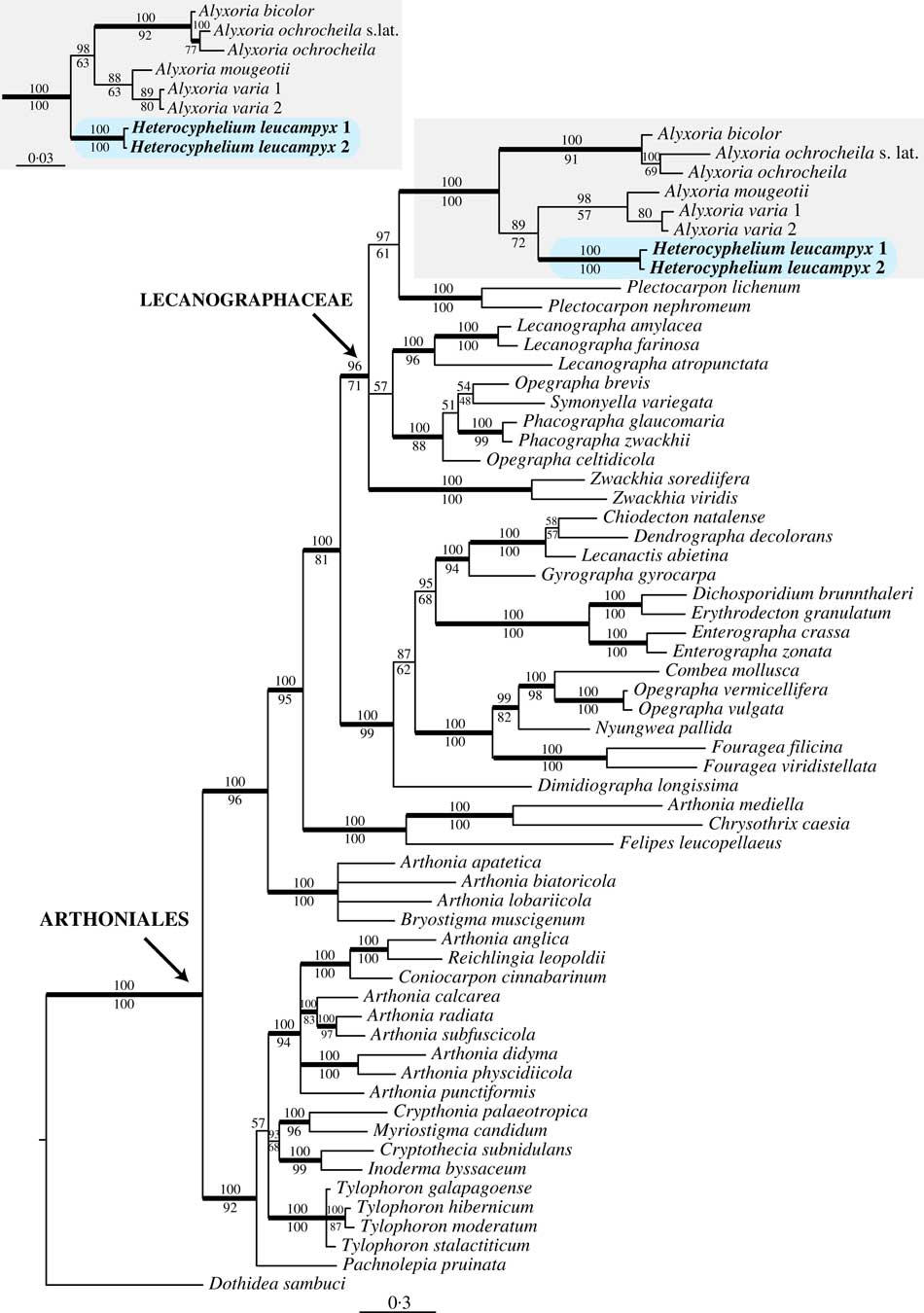
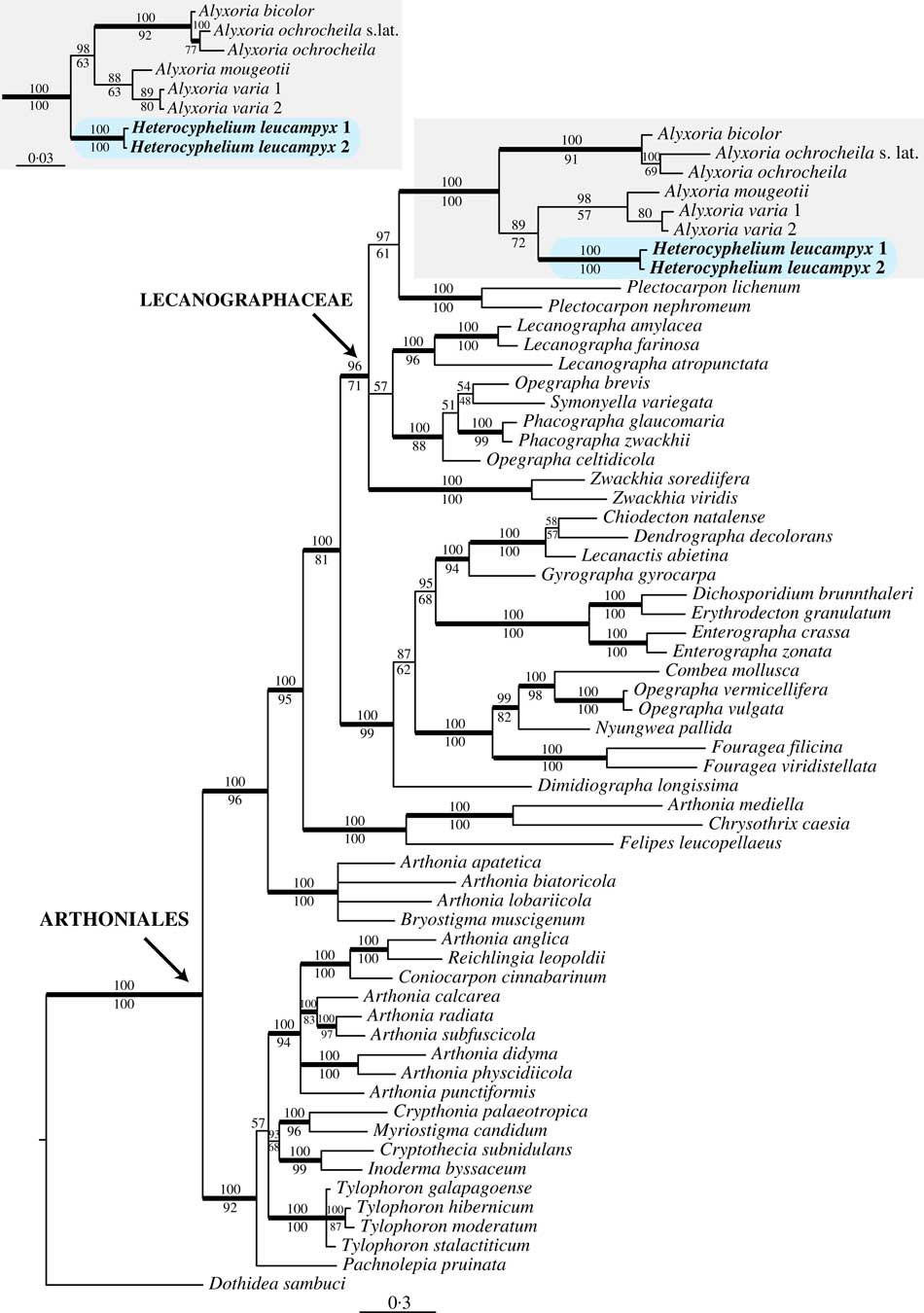
The Bayesian tree obtained in the combined 2-locus analyses of 61 OTUs including the third codon position of RPB2 is shown in Fig. 2. The clade on the left upper corner shows the different topology obtained from the same data set, but excluding the third position for the RPB2 (Fig. 2). In both cases, statistical support from posterior probabilities and ML bootstrap replicates is indicated. Branches strongly supported by both analyses are highlighted with thicker lines. The topology obtained from the reduced data set is depicted in Fig. 3.
Phylogenetic relationships among Arthoniales based on a data set of 61 samples of mtSSU and RPB2 sequences resulting from a Bayesian analysis. Dothidea sambuci was chosen as outgroup. Posterior probabilities ≥95 are shown above internal branches and maximum likelihood bootstrap values ≥70 obtained from a RAxML analysis are shown below internal branches. Internal branches, considered strongly supported by both analyses, are represented by thicker lines. Heterocyphelium leucampyx is in bold. The clade on the left upper corner shows the different topology obtained from the same data set of mtSSU and RPB2 sequences but excluding the third position for the RPB2.
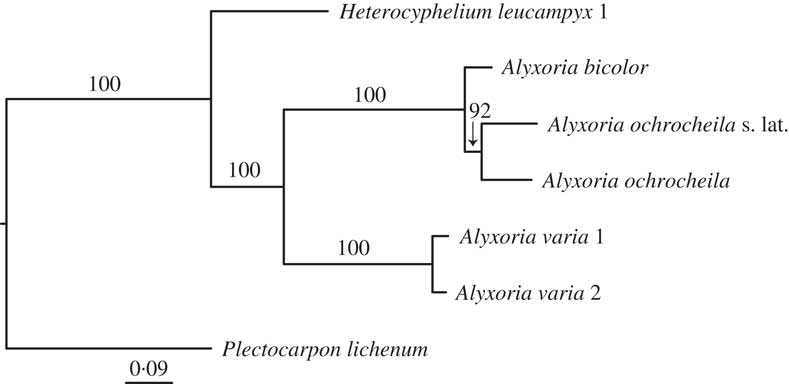
Phylogenetic relationships based on a subset of seven samples of mtSSU and RPB2 sequences of Lecanographaceae resulting from a Bayesian analysis. Plectocarpon lichenum was chosen as outgroup. Posterior probabilities (PP) are shown above internal branches. Internal branches with PP ≥95% are considered strongly supported.
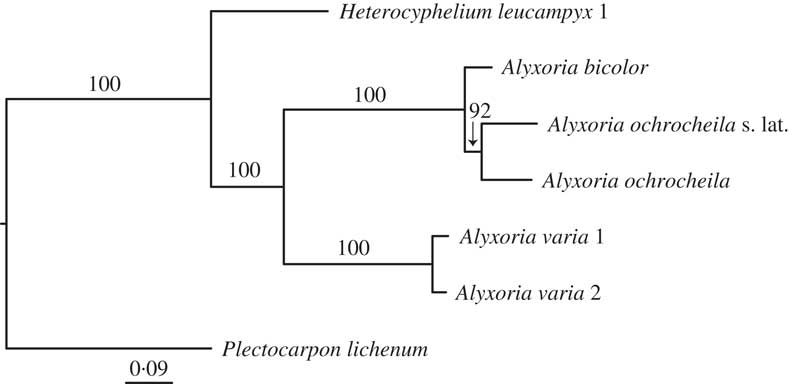
In the 2-locus tree of 61 OTUs based on 115 sequences, Heterocyphelium leucampyx is placed in the order Arthoniales in the family Lecanographaceae, nested within the genus Alyxoria with strong support (Fig. 2). In the analysis based on the combined 2-loci data set including only the first and second positions for the RPB2, Heterocyphelium is recovered as sister to Alyxoria with strong support (Fig. 2). In order to investigate whether Heterocyphelium is sister to Alyxoria or should be included in that genus, despite its strongly deviating morphology, we analyzed a subset of the original alignment including only Heterocyphelium and Alyxoria, with Plectocarpon lichenum as outgroup, since the three genera form a strongly supported monophyletic clade in both analyses of the larger data set. The analysis of the reduced set resulted in substantially more unambiguously aligned sites (1666 in the subset vs. 1347 in the complete data set) and in a strongly supported placement of Heterocyphelium as sister to Alyxoria (Fig. 3).
The backbone topology in our analysis differs somewhat from the topology presented in earlier studies, particularly Frisch et al. (Reference Frisch, Thor, Ertz and Grube2014). In that study, the Bryostigma clade was significantly recovered as sister to Arthoniaceae, while in the present manuscript this clade is strongly supported as sister to the other families of Arthoniales (i.e. Chrysotrichaceae, Lecanographaceae, Opegraphaceae, Roccellaceae and Roccellographaceae). In the 2014 study, Roccellographaceae appears sister only to Roccellaceae, whereas in the present manuscript Roccellographaceae is sister to both Opegraphaceae and Roccellaceae, but these conflicts lack support in both studies. The placement of Dimidiographa longissima is also not significantly supported in either of the two studies. These differences could be explained by the inclusion of a third locus (nuLSU) in Frisch et al. (Reference Frisch, Thor, Ertz and Grube2014) and by partially different taxon sampling. However, while the relative position of families and family-level clades varied between the two studies, all families are likewise monophyletic and supported in both studies, including Lecanographaceae, and hence these differences do not affect the strongly supported placement of our target taxon, Heterocyphelium, within that family.
Discussion
On the basis of morphology, Heterocyphelium leucampyx had initially been placed in the order Arthoniales (family Arthoniaceae, genus Trachylia), before it was included in the collective order Caliciales (successively within the genera Acolium and Cyphelium). After establishing a separate genus (Heterocyphelium) for this species, it remained tentatively in Caliciales but was eventually considered a genus incertae sedis within the Ascomycota, without a determined class, order or family (Eriksson Reference Eriksson1999; Lumbsch & Huhndorf Reference Lumbsch and Huhndorf2010). Our molecular analyses provide clear evidence that the species belongs in the Arthoniales, where it was already listed by Jaklitsch et al. (Reference Jaklitsch, Baral, Lücking, Lumbsch and Frey2016) in anticipation of the present study. However, unlike the only other mazaediate genus for which sequences are available in this order, Tylophoron (Lumbsch et al. Reference Lumbsch, Lücking and Tibell2009), H. leucampyx does not belong to the family Arthoniaceae but to the Lecanographaceae (Fig. 2). The latter is a recently described family that includes taxa characterized by a crustose, ecorticate thallus, a trentepohlioid photobiont, ascomata that are lirelliform to rounded, without a thalline margin, a well-developed dark brown excipulum, cylindrical to clavate, bitunicate asci, and hyaline, fusiform, distoseptate ascospores with a microcephalic ontogeny and a gelatinous sheath (Ertz & Tehler Reference Ertz and Tehler2011; Frisch et al. Reference Frisch, Thor, Ertz and Grube2014). The morphology of H. leucampyx deviates from all other Lecanographaceae by the mazaediate ascomata, asci with a single functional wall layer (prototunicate), disintegrating at an early stage, and dark brown ascospores lacking a gelatinous sheet.
In our combined analysis (Fig. 2), Heterocyphelium leucampyx appears clustered within the genus Alyxoria, suggesting that Heterocyphelium could be considered as a synonym of the latter. The genus Alyxoria was recently reinstated for a group of species previously placed in Opegrapha s. lat. characterized by an ascus of the ‘Varia type’ and ascomata having an exposed, usually pruinose disc (Ertz & Tehler Reference Ertz and Tehler2011). Although the ontogeny of the ascospores starting with one extramedian septum leading to a larger central cell in mature spores is unusual in Heterocyphelium, this seems also to be the case for some species of Alyxoria, where ascospores might have a larger central cell (e.g. A. varia). This morphological trait could potentially explain the close relationship of both genera and needs further examination. On the other hand, Heterocyphelium differs from Alyxoria in the distinctly mazaediate ascomata. So far, only one case is known where a single genus includes mazaediate and non-mazaediate forms. This is the genus Nadvornikia, where recently two non-mazaediate species were added (Medeiros et al. Reference Medeiros, Kraichak, Lücking, Mangold and Lumbsch2017). Hence, including Heterocyphelium within Alyxoria would not be entirely out of the ordinary. However, when reanalyzing the data without the third codon position of the RPB2 gene, Heterocyphelium was recovered as sister to the Alyxoria clade with significant support (Fig. 2). This sister relationship was again recovered with significant evidence in the analyses of the reduced data set including only Alyxoria and Heterocyphelium, with Plectocarpon as outgroup (Fig. 3), independently of whether the third codon position of the RPB2 gene was removed or not. This phenomenon is due to homoplasy in the DNA data and the fact that alignments may include an imbalance between protein- and non-coding genes. Protein-coding genes are well alignable even between distantly related taxa and hence no columns are usually excluded due to potential alignment ambiguity, even if the third codon position tends to be saturated and might cause problems, as has been reported for RPB2 (Reeb et al. Reference Reeb, Lutzoni and Roux2004; Hansen et al. Reference Hansen, LoBuglio and Pfister2005; Dávalos & Perkins Reference Dávalos and Perkins2008; Breinholt & Kawahara Reference Breinholt and Kawahara2013). In contrast, non-protein-coding genes result in alignment ambiguity, especially for saturated regions with a large proportion of indels which are then excluded. As a result, data sets combining both types of genes tend to produce aberrant topologies. This effect is nicely shown here: whereas the largest data set resolves Heterocyphelium as nested within Alyxoria, removing the third codon position of the RPB2 (which is equivalent to the exclusion of ambiguously aligned columns in the non-coding mtSSU) places Heterocyphelium as sister to Alyxoria. This topology was then confirmed when analyzing a reduced taxon set that allowed the retention of over 300 additional columns in the mtSSU gene, which in the largest taxon set had to be excluded. We conclude that the complete set of nucleotide sites in both markers supports Heterocyphelium being sister to Alyxoria; however, this effect can only be obtained when looking at a sufficiently small clade of closely related taxa that allows most alignment columns to be retained. With a broader taxon set, columns that contain phylogenetic signal for the correct placement of Heterocyphelium in the mtSSU gene needed to be excluded due to alignment ambiguity, whereas the likely saturated third codon position of the RPB2 partition remains to be included, leading to an aberrant topology.
The strategy employed here to examine the precise topology of a terminal clade by greatly reducing the data set to the smallest clade of interest, allowing the inclusion of much more data, is therefore recommended when terminals in relatively large-scale analyses lack resolution power and exhibit unexpected topologies.
Based on these phylogenetic results, we maintain Heterocyphelium as a genus distinct from Alyxoria, in accordance with the main morphological traits such as the production of mazaediate ascomata in Heterocyphelium. The strongly deviating morphology in Heterocyphelium compared to all other members of the family Lecanographaceae might be another example of the apparently strong selection pressure on passive ascospore dispersal in certain lineages, a phenomenon also observed in other families such as Arthoniaceae, Caliciaceae, Graphidaceae, and Pyrenulaceae (Wedin et al. Reference Wedin, Döring, Nordin and Tibell2000; Lumbsch et al. Reference Lumbsch, Mangold, Lücking, Garciá and Martín2004, Reference Lumbsch, Lücking and Tibell2009; Tehler et al. Reference Tehler, Baloch, Tibell and Wedin2009). Mazaedia or similar structures occur in many distantly related ascomycete lineages, and structurally different types of fruiting bodies can develop a mazaedium, for example stalked, immersed, or sessile apothecia, as well as perithecium-like, lirellate and stroma-like ascomata (Prieto et al. Reference Prieto, Baloch, Tehler and Wedin2013). This suggests some positive evolutionary constraint on this type of fruiting body (Prieto et al. Reference Prieto, Baloch, Tehler and Wedin2013) which is, however, not yet well understood (Lumbsch et al. Reference Lumbsch, Mangold, Lücking, Garciá and Martín2004). A remarkably similar phenomenon can be found in gasteroid fungi in the Basidiomycota (Krüger et al. Reference Krüger, Binder, Fischer and Kreisel2001; Binder & Bresinsky Reference Binder and Bresinsky2002; Matheny et al. Reference Matheny, Curtis, Hofstetter, Aime, Moncalvo, Ge, Yang, Slot, Ammirati and Baroni2006; Wilson et al. Reference Wilson, Binder and Hibbett2011). Three other genera currently placed in the Arthoniales develop mazaediate ascomata: Sporostigma, Tylophorella and Tylophoron. However, we cannot draw further conclusions about those genera since molecular data are available only for the Tylophoron. Lumbsch et al. (Reference Lumbsch, Lücking and Tibell2009) placed Tylophoron Nyl. ex Stiz., previously thought to be related to pyrenocarpous lichens, in the Arthoniaceae, a placement that has since been confirmed and refined (Ertz et al. Reference Ertz, Bungartz, Diederich and Tibell2011; Frisch et al. Reference Frisch, Thor, Ertz and Grube2014). The genus is morphologically similar to Heterocyphelium leucampyx in having sessile, well-delimited ascomata, a well-developed mazaedium, evanescent, cylindrical asci and transversally septate, dark brown ascospores. Heterocyphelium leucampyx differs in lacking secondary substances and ascospores that are predominately 2-septate with an enlarged median cell. Sporostigma is a monospecific genus containing the species S. melaspora (Tuck.) Grube. It was tentatively placed in the Arthoniaceae on the basis of ascomatal characters, in particular the lack of an exciple, the branched and anastomosing paraphysoids, as well as the shape of young asci (Grube Reference Grube2001). Tylophorella (Müll. Arg.) Egea & Tibell is another monospecific mazaediate genus containing one species, T. pyrenocarpoides (Tibell Reference Tibell1996; synonym: Tylophorella polyspora Vain.). Based on morphological grounds, Tylophorella would be likely to belong to the Arthoniomycetes (Tibell Reference Tibell1984; Grube Reference Grube2001); it differs from the other species discussed here by having oblong, initially multiseptate to submuriform, eventually disintegrating ascospores resembling those of Opegraphaceae and Lecanographaceae rather than Arthoniaceae.
Two other mazaediate tropical genera associated with Trentepohlia and traditionally included in Caliciales were also not assigned to any family by Tibell (Reference Tibell1984, Reference Tibell1996): Allophoron and Schistophoron. Using molecular data, Schistophoron Stirt. has recently been placed in the subclass Ostropomycetidae, family Graphidaceae (Tehler et al. Reference Tehler, Baloch, Tibell and Wedin2009; Lücking et al. Reference Lücking, Tehler, Bungartz, Rivas Plata and Lumbsch2013; Prieto et al. Reference Prieto, Baloch, Tehler and Wedin2013; Rivas Plata et al. Reference Rivas Plata, Parnmen, Staiger, Mangold, Frisch, Weerakoon, Hernández, Cáceres, Kalb and Sipman2013). The type species, S. tenue, differs from Heterocyphelium leucampyx by the strongly sessile ascomata closely resembling those of the genus Carbacanthographis, the mazaedium forming a thin, dark slit and by the distinct chemistry (norstictic and stictic acids). Moreover, in Schistophoron tenue the asci are obclavate with biseriately arranged and, in part, overlapping ascospores. Schistophoron as currently delimited is heterogeneous; whereas S. indicum Kr. P. Singh & Swarnal. is closely related to the type species, both S. variabile Tibell and S. aurantiacum Aptroot & Sipman strongly deviate in morphology and chemistry and seem akin to Arthoniales. Finally, Allophoron, with the single species A. farinosum Nádv., is characterized by submuriform dark brown ascospores with 2–5 transverse and 0–4 longitudinal septa, and the absence of secondary substances. It shares the presence of sclerotinized hyphae in the hamathecium with Heterocyphelium leucampyx, which is easily distinguished from Allophoron by its 2-septate ascospores. Based on anatomical similarities with Heterocyphelium (Tibell Reference Tibell1996), we hypothesize again that Allophoron might most likely also be a member of Arthoniales. Therefore, Arthoniales could become the order with the highest number of mazaediate lineages, with two independent lineages (Heterocyphelium, Tylophoron) confirmed with molecular data to date and up to four potential additional lineages remaining to be tested (i.e. Allophoron, Schistophoron p.p., Sporostigma, Tylophorella). Unfortunately, these taxa are comparatively rare and more difficult to obtain for sequencing.
Permission to perform fieldwork in Uganda was granted by the Uganda Wildlife Authority and the Uganda National Council for Science and Technology. Support was generously provided by Julius Lejju, Professor of Botany at the Mbarara University of Science & Technology in Uganda and by Olivia Wanyana Maganyi, Collection Manager at the herbarium of the Makarere University in Uganda. Fieldwork in Costa Rica was supported by two grants from the National Science Foundation: TICOLICHEN (DEB 0206125 to The Field Museum; PI Robert Lücking) and Neotropical Epiphytic Microlichens – An Innovative Inventory of a Highly Diverse yet Little Known Group of Symbiotic Organisms (DEB 715660 to The Field Museum; PI R. Lücking), with logistical assistance from the National Institute of Biodiversity (INBio), including processing of collection permits. The authors are indebted to Cyrille Gerstmans, Gabriela Sroka and Wim Baert for technical assistance.