Introduction
Paediatric cardiac surgery encompasses operative management of CHD in children, as well as acquired conditions such as rheumatic heart disease and infective endocarditis. Reference Triedman and Newburger1 In conflict and disaster zones, the need for paediatric cardiac surgery remains constant, but access to timely diagnosis and surgery is severely disrupted. Reference Trudeau and Rothstein2 Infants with critical duct-dependent lesions often die before reaching specialist care and are therefore underreported, while older children present later with advanced and more complex pathology. Reference Mat Bah, Sapian and Alias3 The overall burden of disease is further heightened by a rising prevalence of acquired cardiac conditions, e.g., rheumatic heart disease resurges where primary prevention and antibiotics are disrupted. Reference Liang, Yu, Lu, Zheng and Yang4 Infective endocarditis and tuberculous or bacterial pericarditis increase in overcrowded and low-resource settings. Reference Feng, Liu and Li5 Conflict-related trauma may also cause cardiac injuries in older children and adolescents, adding to the caseload. Reference Kaptein, Talving and Konstantinidis6
A major barrier to providing quality CHD surgical care is the shortage and maldistribution of the congenital surgical workforce, Reference Francis, Peng and Corno7 who represent the standard of care for these operations. During conflicts, trained personnel may be displaced, hospitals repurposed for trauma care, and supply chains for specialist equipment interrupted, significantly inflating the cost of surgery. A single missing component, such as an unavailable oxygenator or pacing box, can render entire programmes non-functional. Reference Deshpande8 While the challenges of congenital cardiac surgery in low-resource settings are well described, far less attention has been paid to how war and natural disasters acutely destabilise even partially functioning systems, converting chronic system fragility into sudden collapse. Therefore, this narrative review aims to explore existing evidence of models used in conflict and disaster settings, outcomes and barriers to providing congenital cardiac surgery, and how conflict and disaster settings uniquely compound pre-existing structural challenges in CHD care delivery.
Methods
Search design
This study was conducted as a narrative review of the literature exploring the provision of paediatric and congenital cardiac surgery in conflict and disaster settings. Given the limited and heterogeneous nature of published data in this field, a systematic review or quantitative meta-analysis was not feasible. The objective was therefore to summarise available evidence thematically and identify recurring operational patterns, barriers, and models of care.
Search strategy
A structured literature search was conducted using PubMed/MEDLINE and Google Scholar to identify studies relating to paediatric and congenital cardiac surgery in conflict-affected and disaster settings between January 2000 and December 2025. Search terms included “congenital heart disease,” “paediatric cardiac surgery,” “humanitarian surgery,” “cardiac missions,” “armed conflict,” “war,” and “natural disasters.” Eligible sources included review articles, original research studies, case series, programme reports, and descriptive accounts of service delivery.
Eligibility criteria
Studies were included if they described paediatric or congenital cardiac surgical care delivered in the context of armed conflict, political instability, natural disasters, humanitarian crises, or severely disrupted health systems. Publications addressing congenital cardiac surgery in low-resource settings without a defined conflict or disaster context were excluded unless they contained operational insights directly relevant to crisis settings. Additional relevant publications were identified through manual review of reference lists.
Titles and abstracts retrieved from the structured search were reviewed independently by three authors (VM, JF, RR) for relevance to the review objective. Given the broad narrative scope of the study, source selection prioritised publications containing operational, clinical, or systems-level insights into paediatric cardiac surgery delivered during armed conflict, humanitarian crises, and/or natural disasters. Approximately 36 publications were identified as directly relevant and were included for thematic synthesis. Where disagreements arose regarding relevance or inclusion, these were resolved through discussion among the review team until consensus was reached.
Given the limited volume of directly relevant studies and the absence of comparable datasets, formal screening frameworks and quality appraisal tools were not applied. Instead, the selected literature was summarised thematically, with emphasis on recurrent operational challenges, models of care, and perioperative considerations. This approach was chosen to provide a structured overview of a field where evidence remains sparse, inconsistent, and largely descriptive.
Infrastructure and resource limitations
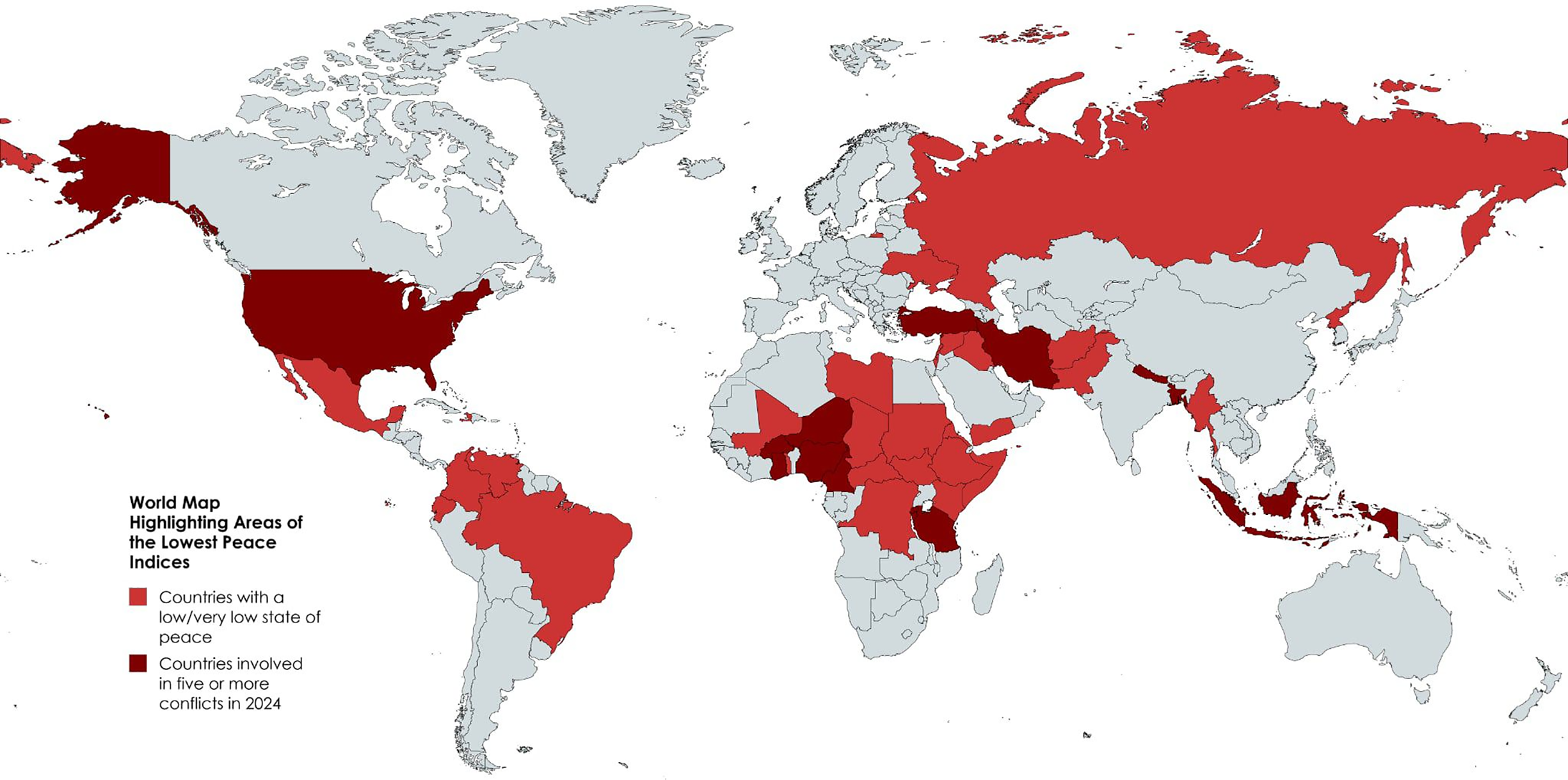
Whilst resource limitations are a persistent challenge across many regions of the world, natural disasters and conflicts acutely disrupt infrastructure and access to vital resources. The 2025 Global Peace Index reports 59 active state-based conflicts, the highest number since the end of the Second World War, and global peacefulness has dropped to its lowest level since the index began. 9 This decline reflects increasing geopolitical tensions, greater militarisation, and a rise in internationalised conflicts, with 78 countries involved in fighting beyond their own borders. Figure 1 highlights the global distribution of countries with the lowest peace indices and multiple active conflicts in 2024—this figure reflects national involvement in conflict, either domestic and/or international, and does not represent the degree of domestic healthcare system disruption. Importantly, international involvement in conflict does not necessarily equate to disruption of the domestic healthcare system. For example, countries such as the United States may be engaged in multiple international conflicts while maintaining stable and highly resourced paediatric cardiac services. Contrastingly, regions such as Palestine face direct, severe consequences on healthcare delivery due to active conflict inside their own borders. As such, the impact of conflict on paediatric cardiac surgery is highly heterogeneous and is driven more by domestic instability than by conflict involvement alone. Importantly, these events differ from chronic low-resource settings by causing an abrupt transition from functional systems to acute instability.
Global distribution of countries with the lowest peace indices and multiple active conflicts in 2024.

Figure 1. Long description
The map shows global distribution of peace indices, with countries marked in red indicating low or very low states of peace. Countries involved in five or more conflicts in 2024 are highlighted in a darker shade. Key regions include parts of Africa, the Middle East, and South Asia, with notable countries such as those in the Democratic Republic of the Congo, Syria, and Afghanistan. The map provides a visual representation of global conflict zones and areas with significant peace challenges.
During conflict, many hospitals become unable to function, leaving populations without access to essential care. In Sudan, for instance, nearly two-thirds of healthcare centres are non-operational due to destruction, occupation, or severe shortages of medicines. Reference Badri and Dawood10 Similarly, an estimated 94% of hospitals in the Gaza Strip have been damaged, 11 leading to total or near-total collapse of healthcare systems in such crisis settings.
However, conflict zones are not the sole cause of hospital destruction and resource depletion. A comprehensive analysis of hospital disasters from 1976 to 2023 demonstrated a marked rise in both the frequency and severity of catastrophic events, including fires, earthquakes, and other natural disasters. Reference Mani, Khorram-manesh, Alotaibi and Goniewicz12 The destruction sustained by hospitals severely limits healthcare delivery, as complex interventions such as cardiac surgery cannot be performed without a stable, functional hospital environment. This disruption affects the distribution of medical equipment and medicines, including sterile consumables and blood products. A notable example is the case of a 12-year-old girl in Kyiv who required prolonged extracorporeal membrane oxygenation. Reference Rusnak, Condello and Dohtiar13 Her survival depended on access to specialist equipment; however, conflict-related shortages of oxygenators and heparin ultimately led to fatal complications. Reference Rusnak, Condello and Dohtiar13 This case illustrates how, even when healthcare personnel and facilities remain functional, the disruption of supply chains can render cardiac surgery impossible.
Mortality due to lack of surgical access is significant but poorly quantified. Reference Francis, George and Stoica14 For children with CHD, survival without intervention may be measured in weeks in the most severe cases, where the risk increases with each month of delay as patients develop pulmonary hypertension, recurrent infections, or malnutrition, potentially rendering them inoperable or at substantially higher surgical risk. Reference Yun15,Reference Golovenko, Lazorhyshynets, Prokopovych, Truba, DiSessa and Novick16 Conceptually, this can be described as an operability attrition over time—progressive delays in access result in a growing number of patients whose conditions advance beyond the window of operability. Another factor is the survival penalty of distance—in many regions, especially those in conflicts and disaster zones, many children die before reaching the few centres capable of surgery due to lack of stabilisation, safe transport, or referral pathways.
Programme experience from conflict-affected regions further illustrates how these dynamics unfold in practice. In Ukraine, sustained international collaboration before and during periods of instability enabled a congenital cardiac centre to maintain operative services through repeated site visits, structured team training, and protocol standardisation; however, the continuation of surgery remained critically dependent on uninterrupted access to consumables and perfusion equipment. Reference Polivenok, Gilbert and Danton17 When supply chains were disrupted, there were abrupt reductions in surgical activity. During the periods of escalation, international teams in Ukraine reported the need to adapt equipment usage, limit case selection to patients with realistic perioperative support, and maintain flexible referral pathways when transport corridors were uncertain. 18 These examples reinforce that operability attrition is not merely theoretical—in conflict settings, each delay in referral, interruption in consumables, or loss of trained personnel compounds the risk that a potentially correctable defect will progress beyond safe surgical intervention.
Human resource challenges
The deliberate targeting of healthcare professionals in conflict zones is becoming increasingly common, exacerbating the already critical shortage of medical personnel. In Sudan, for example, aid has been weaponised, with access deliberately restricted to certain demographics perceived as opposition supporters. Reference Reeves19 Governments have used bureaucratic means such as denying visas, withholding travel permits, and limiting entry to affected regions to obstruct humanitarian assistance. Reference Tronc, Grace and Nahikian20 Beyond administrative barriers, many healthcare workers face direct violence, abduction, and even death. In 2024, the Safeguarding Health in Conflict Coalition documented over 3,600 attacks on health care—an increase of 15% from the previous year—including kidnappings, arrests, and killings of medical staff. 21 This figure represents the highest number of assaults on healthcare ever recorded in a single conflict, with Gaza and the West Bank bearing the heaviest toll.
Staff shortages are a major challenge in crisis situations, Reference Harrell, Selvaraj and Edgar22 creating a self-perpetuating cycle in which dwindling workforce numbers make it impossible to meet the growing demand for care. As workloads intensify, exhaustion and attrition among remaining staff further erode service delivery. In cardiac surgery, these shortages are particularly devastating due to the reliance on highly specialised personnel, including perfusionists, anaesthetists, intensive care nurses, and surgeons. Any further disruption from conflict or natural disaster risks collapsing this fragile balance entirely, leaving countless children without access to life-saving surgical care.
Most crucially, the demand for surgical interventions often surges during conflicts and natural disasters, diverting already limited resources away from chronic and elective conditions toward acute, life-saving procedures. In Haiti, for instance, congenital defects accounted for over 20% of the surgical burden before the 2010 earthquake. However, immediately after the earthquake, resources were redirected almost entirely to trauma and burn care, resulting in a sharp decline in non-traumatic surgical interventions. Reference Hughes, Nash and Alkire23 Such reallocation can have lasting consequences, as it may take months or even years for a country’s surgical capacity to return to pre-crisis levels, leaving many patients with untreated conditions and widening existing care gaps. In conflict settings, this problem is magnified, whereby paediatric and congenital cardiac programmes are often suspended, and some never resume, resulting in generational setbacks. Yemen exemplifies this, where ongoing conflict and blockades have restricted the entry of essential medical supplies and personnel, effectively halting cardiac surgery services altogether. Reference Vervoort and Cardarelli24
Models of care
Delivering paediatric cardiac surgery in war and disaster zones requires flexible models that respond to disrupted infrastructure and a lack of specialised workforce. Existing structural models of care delivery in conflict and disaster settings include humanitarian missions, long-term capacity-building partnerships, and mobile or field-based surgical platforms. In addition to these structural approaches, enabling mechanisms such as telemedicine increasingly support triage, decision-making, and continuity of care.
In conflict and disaster settings, humanitarian surgical missions are often the first way by which paediatric cardiac services are restored. Short-term deployments typically involve specialist teams travelling for limited periods to operate within partially functioning or recently damaged hospitals. Reference Fenton, Novick, Entwistle, Moffatt-Bruce and Sade25 In these contexts, missions must contend with disrupted infrastructure, limited intensive care capacity, insecure supply chains, and uncertain follow-up pathways. While such interventions can provide life-saving treatment for selected patients, their impact is limited by the volatility of the environment and the difficulty of ensuring continuity of care once teams withdraw.
Longer-term partnerships and repeat deployments during protracted crises may offer greater stability. Reference Fenton, Castillo, Claro and Novick26 In settings where conflict persists or recovery is prolonged, programmes that combine service delivery with structured local training are better positioned to rebuild capacity and mitigate workforce losses. Organisations such as Healing Little Hearts and Global Cardiac Alliance have increasingly incorporated structured training programmes into their work. Reference Novick, Molloy and Bowtell27 However, even these models remain vulnerable to renewed instability, displacement of trained staff, and interruption of essential supplies. The most effective programmes are those that adapt their mission model into a hub-and-spoke system, where care is provided locally, when possible, but more complex cases are transferred to regional centres once stability allows.
Mobile surgical units and field hospitals have been deployed in some humanitarian crises, mainly to deliver trauma and general surgery. Reference Mugisha, Uwishema, Noureddine, Ghanem, Manoel and Shariff28 Adapting these for paediatric cardiac surgery is challenging given the need for cardiopulmonary bypass, cardiac-specific anaesthesia, and post-operative intensive care. However, there are very limited reported examples of mobile cardiac support systems, including transportable perfusion and extracorporeal support units, that have been successfully deployed outside traditional cardiac centres. Reference Gariboldi, Grisoli and Tarmiz29 More recently, German NGO “kinderherzen” developed and transported a semi-mobile paediatric cardiac unit to Burundi in 2025. 30 As described in the programme reports, this kit-based facility comprises operating theatres, an ICU, essential equipment and supplies to support congenital heart operations delivered outside permanent hospital infrastructure.
These are resource-heavy and often require strong backing from governments or large non-governmental organisations. Their advantage lies in reaching populations that cannot travel due to insecurity, but the risks include limited ability to provide follow-up and the difficulty of managing post-operative complications once the unit has left. In these settings, innovation often arises from clinicians adapting existing multi-purpose perfusion and ventilation systems and simplifying them for safe use, rather than from the development of bespoke equipment designed specifically for conflict environments. A hybrid approach whereby stabilising children in mobile units before transfer to permanent centres may be more feasible.
Telemedicine and remote decision-making represent a more contemporary supportive model with growing relevance, although current evidence is largely derived from small studies and programme-based experience. Reference Wu, Kunte and Rajkumar31 In unstable settings where specialists cannot be physically present, video links and cloud-based platforms now allow remote echocardiography review, surgical planning, and multidisciplinary team discussions. This has been reported to reduce inappropriate transfers, help prioritise which children need urgent intervention, and provide mentoring for local clinicians. Remote decision-making is particularly useful when cross-border evacuation is needed, Reference Parveen, Amjad and Rauf32 as it allows the receiving centre to assess operability before travel. Several non-governmental organisations and academic groups are piloting telemedicine platforms dedicated to paediatric cardiac care, but challenges remain in ensuring connectivity, maintaining patient confidentiality, and integrating remote advice into local workflows. Reference Lustig33
An important and often contentious question in the prioritisation of congenital cardiac surgery in conflict and disaster settings is whether programmes should focus predominantly on lesions that require a single definitive intervention, such as atrial and ventricular septal defects, tetralogy of Fallot, or coarctation of the aorta, rather than complex CHD requiring staged repairs and lifelong structured follow-up. From a utilitarian perspective, prioritising conditions with a high probability of survival after one operation may maximise the number of children benefiting from scarce operative time, blood products, intensive care beds, and humanitarian funding. However, an equity-based framework challenges this approach, as it risks systematically excluding children with the most severe disease burden purely because their physiology requires longitudinal care that unstable systems cannot reliably support. The feasibility of follow-up further complicates decision-making. Where medical records, anticoagulation monitoring, and reintervention pathways cannot be guaranteed, programmes may be reluctant to undertake staged palliation that could leave children stranded between operations. This creates a difficult ethical tension between utility, fairness, and non-maleficence. In humanitarian conflict settings, these tensions are magnified, highlighting the need for explicit triage frameworks rather than ad hoc lesion selection.
Overall, short-term missions save lives but risk perpetuating dependency during acute crises, long-term partnerships build capacity but are vulnerable to political and security instability, mobile units provide reach but face technical and logistical limits, and telemedicine offers new opportunities but relies on digital infrastructure that may not exist in conflict zones.
Perioperative challenges
The perioperative pathway, including preoperative stabilisation, intraoperative safety, and post-operative intensive care, depends on resources that are often absent in disrupted systems. Reference Patel, Tolppa and Biccard34 The challenges are not only logistical but structural, affecting outcomes and long-term survival.
Pre-and post-operative critical care is the most immediate limitation. In high-income countries, the average length of stay in paediatric cardiac intensive care is 3–10 days, with nurse-to-patient ratios of 1:1 and access to advanced monitoring. Reference Hart, Tanel and Kipps35 In conflict zones, intensive care beds may be diverted to trauma patients, ventilators are limited, and staff trained in paediatric critical care may be absent. Reference Olatunji, Kokori and Aderinto36 This mismatch means children are either operated on without adequate perioperative stabilisation or denied surgery altogether. One innovative approach trialled in some conflict-disrupted centres is the use of “step-down” critical care models—deploying non-invasive monitoring and simplified ventilator protocols under remote mentorship, allowing limited capacity to stretch further. Reference Rausen, Nahass and Halpern37
Infection control is a hidden but major risk in these settings. Reference Jenkins, Castañeda and Cherian38 Disrupted water supply, shortages of sterile consumables, and overcrowded wards increase the risk of surgical site and bloodstream infections. Reference Yiek, Coenen and Nillesen39 While infection rates after paediatric cardiac surgery in high-income countries are typically 2–5%, in disrupted systems, reports suggest rates may exceed 20–30%. Reference Sen, Morrow and Balachandran40 Without reliable laboratory cultures, broad-spectrum antibiotic use becomes the norm, fuelling antibiotic resistance. Pragmatic solutions may include point-of-care bacterial identification kits, single-use negative-pressure wound dressings to reduce infection risk, and embedding infection-control specialists into humanitarian surgical teams to train local staff in simple but high-yield interventions (hand hygiene, antibiotic stewardship, and sterile field maintenance). Even in such scenarios, the lack of low-cost humidifiers within ventilator circuits and adherence to simple ventilator-associated pneumonia prevention protocols substantially contribute to the disproportionately high rates of post-operative infection following paediatric cardiac surgery.
Additionally, paediatric cardiac surgery in high-income countries consumes substantial blood resources. Studies report average utilisation of 20–175 mL/kg of packed red blood cells peri-operatively, with most children often receiving platelets and plasma. Reference Iyengar, Scipione and Sheth41 For a 5–10 kg infant, this equates to one to two units of red cells plus additional components. In conflict zones, blood banks are often fragmented, testing for transfusion-transmissible infections may be unreliable, and cold chain storage is disrupted. Reference Custer, Zou and Glynn42 Shortages of medications such as prostaglandin E1 for duct-dependent lesions, inotropes, and anticoagulants further reduce survival chances. One potential adaptation is the use of autotransfusion systems or microplegia protocols to reduce donor blood requirements, combined with regional blood-sharing networks coordinated by humanitarian agencies. Reference Zimmermann, Zhu and Ogami43
Follow-up and continuity of care are chronic challenges. Successful paediatric surgery requires structured follow-up for wound care, anticoagulation management, and staged interventions. In conflict settings, families are often displaced, medical records lost, and referral pathways disrupted. Loss to follow-up leads to preventable mortality from complications such as shunt thrombosis, arrhythmias, or prosthetic valve failure. One pragmatic solution is the use of digital patient passports where low-cost, portable devices or mobile-based platforms containing operative and medication details are accessible across borders. Non-governmental organisations and some global health groups have piloted these systems, which may be particularly valuable for children requiring staged interventions. Reference Towett, Snead and Marczika44
Addressing these challenges requires targeted adaptations, including simplified critical care protocols, pragmatic infection-control measures, blood conservation strategies, and mechanisms to maintain follow-up across displacement. Without supporting perioperative systems during crises, isolated surgical interventions are unlikely to translate into sustained survival benefit. For example, in Libya’s post-conflict setting, an international team was able to deliver complex paediatric heart surgery within a partially functioning hospital despite insecurity, damaged infrastructure, and fragile supply chains. This example demonstrates that sustaining paediatric cardiac surgery in war zones depends on protecting core perioperative systems, without which operability attrition and preventable mortality escalate. Reference Campbell45
Lessons learned and emerging strategies
Published data and programme experience suggest that paediatric cardiac surgery can be delivered safely under highly limited circumstances, but success depends on adaptability and longer-term planning rather than isolated missions. Teams have reported modifying bypass circuits to work with limited consumables, using adult-sized equipment for paediatric patients, and developing simplified anaesthesia and monitoring protocols when technology is unavailable. However, improvisation must balance safety. The lesson is not to lower standards indiscriminately but to identify which elements of care are truly non-negotiable (sterility, perfusion safety, reliable blood cross-matching) and which can be adapted without major outcome compromise.
In conflict and disaster settings, programmes that combine direct surgical intervention with structured local training are more likely to sustain services beyond the immediate crisis. Mentoring surgeons, perfusionists, and intensive care nurses during periods of instability helps preserve core perioperative capacity, allowing services to resume more rapidly when acute disruptions subside. Reference Polivenok, Gilbert and Danton17,Reference Vervoort, Guetter and Munyaneza46
Current frameworks for humanitarian health response prioritise trauma, infectious disease, and maternal-child health. Cardiac surgery, though less visible, carries a high mortality burden when neglected. A more comprehensive framework would define congenital and paediatric cardiac care as part of the essential non-communicable disease response. This could include establishing referral networks linking mobile stabilisation units with regional surgical hubs, pre-positioning critical medications, and creating registries to track operable patients through displacement. Embedding paediatric cardiac representatives into national disaster-response committees and global humanitarian planning bodies would ensure these children are not systematically overlooked.
Improving access to paediatric cardiac surgery in war and disaster zones requires coordinated action beyond isolated clinical efforts. Practical priorities include sustained investment in local training, formalised surgical and referral networks, protection of the specialist workforce, and inclusion of CHD services within humanitarian response and national emergency preparedness plans. International partners should prioritise long-term capacity building over short-term case delivery, while policymakers must recognise paediatric cardiac care as an essential, not elective, service during crises.
Whilst there have been no summaries examining paediatric cardiac surgery in conflict and disaster settings, this review is limited by the small volume and heterogeneity of available data. Much of the published literature consists of case reports, programme descriptions, and narrative reports rather than quantitative studies. Publication bias is likely, as unsuccessful or interrupted initiatives are less frequently reported. In addition, data from active conflict zones are often incomplete or inaccessible, restricting the ability to directly compare delivery models. These findings should therefore be interpreted as a structured summary of available evidence.
Conclusion
Across war and disaster settings, three consistent patterns emerge from available literature and programme experiences. First, paediatric cardiac surgery is uniquely vulnerable to disruption because it depends on tightly coordinated teams, functioning intensive care, perfusion services, and uninterrupted supply chains. When any one component fails, operative capacity collapses. Second, reports indicate that evacuation and short-term missions can provide temporary relief but cannot substitute for protected local teams, maintained infrastructure, and functioning referral pathways. Third, observational programme data suggest that centres that recover most effectively are those with pre-existing regional partnerships, protected supply reserves, and formal inclusion of cardiac services in national emergency planning. Integrating paediatric cardiac surgery into humanitarian response frameworks, strengthening regional referral networks, and prioritising workforce protection and training are critical steps toward ensuring continuity of care when systems collapse.
Acknowledgements
None.
Financial support
This research received no funding.
Competing interests
None.