Implications
Increasing consumer concerns on ethically produced products and the welfare impacts of routine husbandry procedures commonly used on-farm are placing many farm practices under scrutiny. It is possible that the quality of early handling may have positive effects on the responses to routine husbandry procedures that animals experience, reducing the welfare impact of such procedures. No evidence for such an effect was found in the present study. The differences between calves’ responses to humans as a result of the handling treatments, reported elsewhere, were probably not sufficient to override the pain and/or stress associated with ear-tagging and disbudding.
Introduction
Human–animal interactions are a common occurrence in most farming systems, and the frequency and quality of these interactions have implications for animal welfare. Negative interactions and fear of humans have been shown to reduce productivity and welfare and increase handling times and risks of injury to animals and stockpeople (Hemsworth, Reference Hemsworth2003; Waiblinger et al., Reference Waiblinger, Boivin, Pedersen, Tosi, Janczak, Visser and Jones2006). Positive handling can improve the ease of handling and reduce fear responses in cattle (Boissy and Bouissou, Reference Boissy and Bouissou1988; Boivin et al., Reference Boivin, Le Neindre, Chupin, Garel and Trillat1992b). Some animals discriminate between humans based on previous positive and negative experiences (de Passillé et al., Reference de Passillé, Rushen, Ladewig and Petherick1996; Munksgaard et al., Reference Munksgaard, De Passillé, Rushen, Thodberg and Jensen1997; Boivin et al., Reference Boivin, Garel, Mante and Le Neindre1998b).
Most of the research that has investigated different types of handling has centred around reducing fear responses to humans and the effects of handling quality on productivity; this has been comprehensively reviewed (Hemsworth, Reference Hemsworth2003; Waiblinger et al., Reference Waiblinger, Boivin, Pedersen, Tosi, Janczak, Visser and Jones2006). Less attention has been devoted to examining the effects that handling has on animals’ ability to cope with routine husbandry procedures commonly used on farm (e.g. dehorning and castration). These procedures are performed on farms for various reasons, mostly to improve animal health, welfare and performance, as well as the safety of stock people. Many of these procedures are stressful and painful for the animal, which can result in a general fear towards humans. Reducing stress during such procedures has the potential to improve animal welfare. It is possible that the welfare impact of routine husbandry practices could be partly offset by positive early handling.
The few studies that have investigated the effects of handling on responses to routine husbandry procedures have shown varied results. One study reported that lambs handled positively showed a smaller increase in the time spent lying abnormally after docking than did lambs that had no handling (Reference Guesgen, Beausoleil and StewartGuesgenet al., in press). Waiblinger et al. (Reference Waiblinger, Menke, Korff and Bucher2004) investigated the effects of previous gentle handling on responses of dairy cows during rectal palpation and found that heart rate (HR) and restlessness were reduced in the presence of a familiar handler comforting the animal during the procedure. Lensink et al. (Reference Lensink, Raussi, Boivin, Pyykkönen and Veissier2001) showed that calves that had experienced previous additional handling (including patting) had lower HRs and were easier to load onto a truck for transportation than those that had received minimal handling. Conversely, positive handling of foals in the first 2 days of life did not affect their responses to the pain of freeze branding (Søndergaard and Jago, Reference Søndergaard and Jago2010). The contrasting results could be due to the type, amount and frequency of the handling and the severity of the husbandry procedure. Therefore, there is a need for information on the interaction between previous handling and responses to husbandry procedures.
This study was undertaken as part of a larger study examining how positive or negative human interactions during calf rearing influence responses towards humans and indicators of positive emotions (see Schütz et al., Reference Schütz, Hawke, Waas, McLeay, Bokkers, van Reenen, Webster and Stewart2011). The aim of the present study, using the same animals, was to investigate the effects of early handling on the responses of calves to two common on-farm procedures: ear-tagging and disbudding. Ear-tagging is a routine procedure performed for identifying animals. Disbudding is also a routine procedure carried out on young dairy calves to prevent horn growth, typically between the ages of 2 to 6 weeks; there is a large body of evidence showing that this procedure is painful (Stafford and Mellor, Reference Stafford and Mellor2005) and pain relief is recommended for this procedure in many countries. Administration of a local anaesthetic before disbudding markedly reduces, but does not completely eliminate, the behavioural and physiological responses of calves indicative of pain (Stafford and Mellor, Reference Stafford and Mellor2005; Stewart et al., Reference Stewart, Stafford, Dowling, Schaefer and Webster2008). Cortisol concentration, HR, respiration rate (RR) and changes in behaviours indicative of pain, which have been shown previously to increase in response to disbudding (Stafford and Mellor, Reference Stafford and Mellor2005; Heinrich et al., Reference Heinrich, Duffield, Lissemore, Squires and Millman2009; Stewart et al., Reference Stewart, Stookey, Stafford, Tucker, Rogers, Dowling, Verkerk, Schaefer and Webster2009), were measured in the present study. We predicted that calves handled positively in early life would respond less to ear-tagging and disbudding than those handled previously in a negative manner and that overall the responses would be greater to disbudding than to ear-tagging.
Material and methods
The experimental protocol was approved by the Ruakura and University of Waikato Animal Ethics Committees, Hamilton, New Zealand.
Forty Holstein–Friesian heifers, between 2 and 5 days of age, were brought to the research farm (AgResearch, Tokanui, New Zealand) for indoor rearing and were randomly allocated to either a positive or a negative handling treatment. Calves were housed in indoor pens (3.5 × 4.8 m) in groups of five (eight groups in total, four for each handling treatment) with thick straw bedding, fed 2 l of Ancalf™ calf milk replacer (Fonterra Ltd, Auckland, New Zealand) twice daily (0830 and 1430 h) and provided with water and concentrates (Seales Ltd, Morrinsville, New Zealand) ad libitum. All pens were in close proximity and the calves had auditory but no visual contact with each other. From 4 days to 5 weeks of age, calves were handled in either a positive (e.g. gentle soft voices, slow movements, patting) or negative (e.g. rough voices, rapid movements, pushing) manner (n = 20 calves/treatment). Handling was carried out twice daily (5 min per group) 5 days per week after feeding in the morning and before feeding in the afternoon, and once per day during weekends (5 min per group after feeding in the morning). Handling procedures and management of the calves have been described previously in more detail (Schütz et al., Reference Schütz, Hawke, Waas, McLeay, Bokkers, van Reenen, Webster and Stewart2011).
At 5 weeks of age, calves were exposed to two types of routine husbandry procedures on different days (with one recovery day between procedures) while they were held in a calf restraint with a head catch (Cattlemaster, Te Pari Products, Oamaru, New Zealand) to which they were preexposed once for 15 min 2 days before testing. On each test day, two groups of five calves (one positive and one negative group) were brought into the test area following the morning handling. In the test area, calves were held in their groups in pens (5.1 m × 2.3 m) with straw bedding and access to concentrates and water, and one animal was tested at a time, with the test order balanced between groups. During testing, the calves were restrained facing away from calves in the holding pens so that they could maintain auditory but limited visual contact.
On the first test day, calves were restrained in the head catch for 10 min (baseline) and then ear-tagged using an ear tag applicator (Allflex® Universal, Chevillot, France) as per normal farm practice (in the middle of their left ear between the two main cartilage ridges) and restrained for a further 10 min post procedure (recovery). Two days after ear-tagging, calves were disbudded as part of normal farm practice. During this procedure, calves were restrained and immediately administered a local anaesthetic injection (6 ml of 2% lignocaine hydrochloride: lopaine, Ethical Agents Ltd, Auckland, New Zealand) into the corneal notch around each horn bud. After a 5 min period to allow the anaesthetic to take effect, both horn buds were removed (average time 98 s) using a standard gas-powered cautery iron (ABER LPG debudder, Shoof International Ltd, Cambridge, New Zealand). Calves were restrained for a further 5 min post procedure. HR, RR and behaviour (see below) were recorded in the time periods before and after ear-tagging and disbudding. In addition, cortisol concentrations were measured before and after disbudding (see below). Calves were returned to their home pens once all animals were tested.
HR
During ear-tagging and disbudding, HR (bpm) was recorded using Polar HR monitors (S810i™, Polar Electro Oy, Helsinki, Finland). The day before ear-tagging, calves were clipped down the left side of the body to allow maximum contact for the electrodes. Before testing, an ultrasound transmission gel was applied to the clipped site at each electrode contact point to increase conductivity. The electrodes and transmitter were built into an elastic strap, supplied with the Polar HR monitors, which was fastened firmly around the calf's thorax immediately behind the forelimbs with the HR monitor attached. The stored data were downloaded via a USB interface to a computer for analysis. Data were later extracted using Polar software (Polar Precision Performance Software; Version 5.0, Polar Electro Oy, Helsinki, Finland).
RR
During ear-tagging and disbudding, RR was calculated by counting the number of rises of the flank for 15 s, which were then converted to breaths/min. Recordings were taken in the holding pen before calves were moved to the restraint (baseline) and ∼2 min after the calf had been restrained.
Behaviour
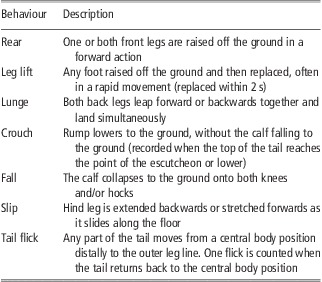
Three video cameras (DCR-TRV355E, Sony, Tokyo, Japan), one at the rear, one directly above and the other at the front of the calf, were used to record activity during testing. All occurrences of the behaviours described in Table 1 were recorded continuously over the sampling period for each animal during both procedures (ear-tagging and disbudding) by video analysis, as described in Stewart et al. (Reference Stewart, Stafford, Dowling, Schaefer and Webster2008).
Description of each behaviour recorded continuously before and after ear-tagging and disbudding procedures

Cortisol concentrations
Blood samples (10 ml) were taken for measurement of plasma cortisol concentrations by jugular venipuncture using vacuum tubes at −20, 20 and 40 min relative to disbudding (time 0) while being held by a person in the holding pen for ∼1 min. Blood samples were collected in tubes containing lithium heparin anticoagulant (Becton, Dickinson and Company, Plymouth, United Kingdom) and placed immediately on ice and centrifuged for 10 min at >2500 rpm. Plasma was separated and stored at −20°C until assayed. Cortisol was measured using a double-antibody radioimmunoassay as described previously (Fisher et al., Reference Fisher, Verkerk, Morrow and Matthews2002). The interassay coefficient of variation values for plasma pools measuring 70.5, 28.7 and 6.9 nmol/l were 3.6%, 8.8% and 13%, respectively.
Statistical analysis
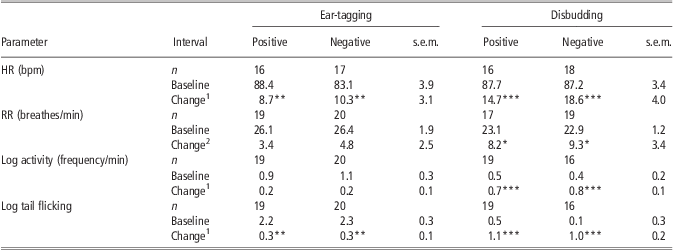
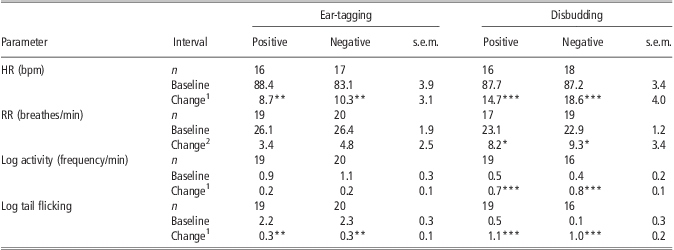
Counts of behavioural events were normalised to a frequency per minute. All occurrences of each of the behaviours recorded, except tail flicking, were combined together as a single measure of activity (frequency per minute), and a natural log-transformation was used to normalise the data before analysis. A restricted maximum likelihood analysis revealed that there were no effects of group or order. Therefore, a one-way ANOVA was used to detect treatment differences, and Student's t-test was used to compare changes from baseline for HR, RR and behaviour. Behavioural and HR responses 5 min post procedure were compared with the responses 5 min before ear-tagging or disbudding; in the case of disbudding, the preprocedural period included the time for the local anaesthetic to take effect. For RR, post-procedural responses were compared with the recordings taken in the home pen. A repeated-measures ANOVA was used to compare cortisol concentrations at all sampling periods (−20, 20 and 40 min relative to disbudding) and changes from baseline. One calf in the positive treatment group was excluded because of ill health, and two calves (one from each treatment group) were naturally polled (did not grow horn buds) and were therefore excluded from disbudding. Owing to equipment failure, some data were unavailable for analysis (see Table 2 for a summary of the final numbers included in each analysis).
Mean HR, RR, activity and tail flicks (±s.e.m.), during the baseline, the change from baseline and the number of animals included in the analysis for positively and negatively handled calves
HR = heart rate; RR = respiration rate.
Descriptive statistics are based on treatment means (±s.e.m.). Means and s.e.m. for activity and tail flicking are log transformed. No treatment differences were found overall (P ⩾ 0.493).
Statistical significances for the change from baseline, using a Student's t-test, are presented as *P < 0.05, **P < 0.01 and ***P < 0.001.
15 min pre v. 5 min post procedure.
22 min post procedure compared with recordings in the home pen.
Results
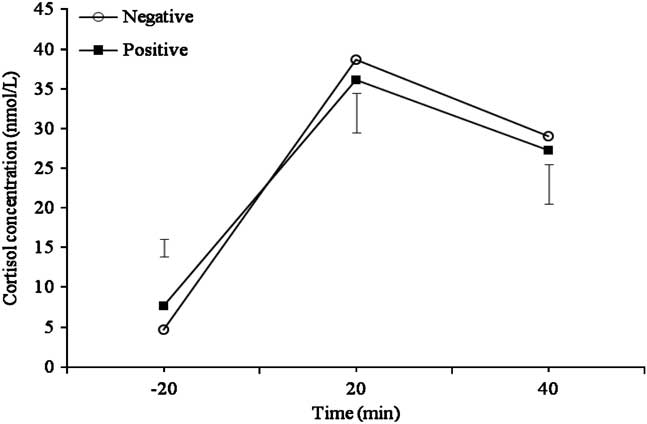
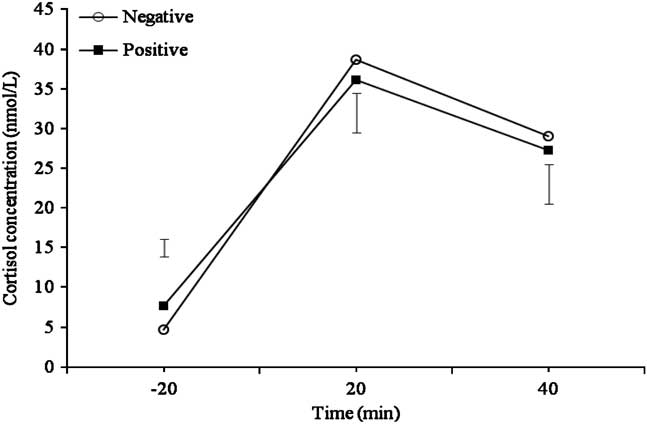
There were no significant treatment differences between positively and negatively handled calves with respect to HR, RR or behaviour in response to any procedure (P ⩾ 0.493); however, changes occurred across procedural phases in both treatment groups (Table 2). Following disbudding, there was an increase in HR (P < 0.001), activity (P < 0.001), tail flicking (P < 0.001) and RR (P < 0.05), relative to baseline levels. HR also increased after ear-tagging (P < 0.01). There were no treatment differences in cortisol concentration at −20, 20 or 40 min in relation to the time of disbudding (Figure 1). Cortisol was higher (P < 0.001) than baseline levels (−20 min) at 20 and 40 min post disbudding for both treatment groups.
Average cortisol concentrations (nmol/l) and standard error of the difference for negative (n = 19) and positive (n = 18) treatment groups at −20, 20 and 40 min relative to the time of disbudding.
Discussion
The results from this study do not support our hypothesis that positively handled 5-week-old calves would respond less to routine husbandry procedures compared with negatively handled calves. The lack of differences between treatments in terms of physiological and behavioural responses to the routine husbandry procedures is inconsistent with most previous findings. For example, Waiblinger et al. (Reference Waiblinger, Menke, Korff and Bucher2004) found that positively handled cows had lower HRs, kicked less and were less restless during rectal palpation. Lensink et al. (Reference Lensink, Raussi, Boivin, Pyykkönen and Veissier2001) found an effect of the quantity of handling in calves in response to loading onto a truck for transportation. The calves that had additional previous human contact were easier to load and had lower HRs than those that had minimal contact. Inconsistencies between studies may be due to the type of husbandry procedure, the perceived severity of the procedure, the quantity of handling or other factors.
Factors such as age and previous experience with humans could influence the nature of the response. At a young age, calves are highly dependent on humans and exposed to intensive routine contact with humans (e.g. during feeding and cleaning). It is possible that if the negatively handled calves had minimal/less human contact or were already weaned and managed at pasture, the treatment may have had a greater effect due to the lack of daily human contact and association of humans with food. Indeed, Jago et al. (Reference Jago, Krohn and Matthews1999) reported that feeding had a greater influence on responses of calves towards humans compared with handling. However, the findings from studies in which the handling treatments were associated with provision of food have been inconsistent. It has been shown that food is perceived as being more rewarding compared with handling alone (Boivin et al., Reference Boivin, Neindre and Chupin1992a; de Passillé et al., Reference de Passillé, Rushen, Ladewig and Petherick1996; Jago et al., Reference Jago, Krohn and Matthews1999). Hemsworth et al. (Reference Hemsworth, Price and Borgwardt1996) found that handling alone did not increase the approach behaviour of cattle, whereas Boissy and Bouissou (Reference Boissy and Bouissou1988) found regular handling without feeding reduced avoidance behaviour and improved handling ability in calves.
Location of the testing area compared with the handling area in the present study may be another factor influencing responses, as the calves were moved from their home pens to a different area for testing. Responses of calves to humans can be dependent on whether the testing is undertaken in their home pen or at an unfamiliar location (de Passillé et al. Reference de Passillé, Rushen, Ladewig and Petherick1996). Genetic selection may also affect responses to humans, as dairy cows have been selected over many years for low level of fear of humans and have been shown to have a shorter flight distance compared with beef breeds (Murphey et al., Reference Murphey, Duarte and Penedo1980). It is also possible that the calves did not perceive the tactile contact in the positive treatment as ‘positive’. For example, some studies found that tactile contact with humans was not necessarily rewarding for animals (Boivin et al., Reference Boivin, Garel, Durier and Le Neindre1998a; Jago et al., Reference Jago, Krohn and Matthews1999; Pajor et al., Reference Pajor, Rushen and de Passille2000), which highlights the danger in assuming that particular interactions are positive from the animal's perspective. However, the possible explanations discussed so far are unlikely in the present study, as calves that received positive handling were more willing to voluntarily approach a handler and showed less avoidance behaviour towards the handler and an unfamiliar person (Schütz et al., Reference Schütz, Hawke, Waas, McLeay, Bokkers, van Reenen, Webster and Stewart2011), indicating that the type of handling did alter their response to humans.
It is possible that the effects of the treatments were concealed because of the stress caused by the procedures, especially in the case of disbudding. Pain due to disbudding has been well documented (Stafford and Mellor, Reference Stafford and Mellor2005). Although a local anaesthetic was used in the present study, it is possible that the corneal nerve block was not sufficient in eliminating all of the pain associated with disbudding as reflected by the responses. This can be practically difficult to achieve; incomplete or partial effectiveness of analgesia can result from incorrect placement of the local anaesthetic due to operator variability and individual differences in the neural topography of the horn bud area. However, to completely alleviate the pain caused by disbudding, it is necessary to use a combination of a local anaesthetic and a non-steroidal anti-inflammatory agent (Faulkner and Weary, Reference Faulkner and Weary2000; Stafford and Mellor, Reference Stafford and Mellor2005; Heinrich et al., Reference Heinrich, Duffield, Lissemore, Squires and Millman2009; Stewart et al., Reference Stewart, Stookey, Stafford, Tucker, Rogers, Dowling, Verkerk, Schaefer and Webster2009).
To our knowledge, no studies to date have investigated the effects of early handling of calves on responses to painful procedures. Reference Guesgen, Beausoleil and StewartGuesgenet al. (in press) reported a smaller increase in the time spent lying in abnormal postures after tail docking of handled lambs v. unhandled lambs; however, there were no effects of handling on other behaviours indicative of pain, such as restlessness, kicking and rolling. Tosi and Hemsworth (Reference Tosi and Hemsworth2002) found that lambs that received negative handling for 2 min per day from 2 weeks of age had higher maximum HR within 20 s after tail docking, at 7 weeks of age, compared with positively handled lambs; however, the average HR response over 3 min post treatment and behaviour did not differ between treatments. It was also reported elsewhere (Hemsworth, Reference Hemsworth2003) that in the same study salivary cortisol concentrations were lower in positively handled lambs after tail docking; however, little information is available regarding the methodology and detailed results of this study to compare with the present study.
An increase in RR, typically associated with an increase in HR, occurred following disbudding. Heinrich et al. (Reference Heinrich, Duffield, Lissemore, Squires and Millman2009) also reported similar increases in RR following disbudding of calves with a local anaesthetic. The HR response in the present study was similar to the levels reported in other studies (Schwartzkopf-Genswein et al., Reference Schwartzkopf-Genswein, Booth-McLean, McAllister and Mears2005; Stewart et al., Reference Stewart, Stafford, Dowling, Schaefer and Webster2008; Heinrich et al., Reference Heinrich, Duffield, Lissemore, Squires and Millman2009; Stewart et al., Reference Stewart, Stookey, Stafford, Tucker, Rogers, Dowling, Verkerk, Schaefer and Webster200) and was lower than the increase found in calves disbudded without pain relief. There are no previous studies to compare the responses to ear-tagging; however, owing to the shorter duration and relatively little tissue damage, it is likely that ear-tagging is less painful than disbudding and this is supported by the greater behavioural and physiological response to disbudding than ear-tagging in the present study. The cortisol concentrations following disbudding were consistent with previous findings (Stafford and Mellor, Reference Stafford and Mellor2005). The increase in activity after disbudding most likely reflects a pain response and attempts by the calf to escape. Activities such as rearing, falling down and slipping occur in response to pain (Graf and Senn, Reference Graf and Senn1999; Grøndahl-Nielsen et al., Reference Grøndahl-Nielsen, Simonsen, Damkjer Lund and Hesselholt1999). Although the frequency of tail flicking did not differ between handling treatments, there was a greater increase in frequency following disbudding than after ear-tagging, suggesting that it may indicate the degree of pain.
It is possible that the lack of treatment differences found in these behavioural and physiological responses may be because the effects of handling on the calves’ response to humans were overridden by the degree of stress and/or pain from the procedures. Although this might be expected with disbudding, the lack of a difference following ear-tagging, which produced much smaller physiological responses, suggests that this might not be the only explanation. The calves from the present study were retested for their responses to humans at 3 months of age, this time including 20 control animals of the same breed and age that had received routine on-farm rearing (or minimal handling) in the same facility. Interestingly, the controls showed more avoidance behaviour and had greater flight distances compared with calves that had received positive and negative handling (Schütz et al., Reference Schütz, Hawke, Waas, McLeay, Bokkers, van Reenen, Webster and Stewart2011). It was suggested that the controls may have had greater fear responses because of the lack of habituation to human contact. Further research to understand the effects of quality v. quantity of handling is warranted.
Conclusion
There was no effect of two different types of handling on the responses to ear-tagging and disbudding in 5-week-old calves in the present study. The most likely explanation for these results is that the differences between calves’ responses to humans as a result of handling treatments (identified in separate study) were not sufficient to override the pain and/or stress associated with ear-tagging or disbudding. It is possible that the quality of early handling may have positive effects on responses to less stressful routine procedures that animals are exposed to on-farm and assist in reducing the impact of such procedures. Therefore, further research is required to understand the welfare impact and interaction between previous handling and responses to husbandry procedures, taking into account some of the factors discussed here, such as age and previous experience with humans, and possibly assessing the effects of the quantity of handling as well as the quality.
Acknowledgements
The authors thank AgResearch staff Suzanne Dowling, Frankie Huddart, Andrea Rogers and Gemma Worth, as well as Waikato University students Stephanie Delaney, Jane Johnson and Michelle Hawke, for their valuable technical assistance. They are also very grateful to the AgResearch farm staff, particularly Ken Jones and Claire Walpole. This project was funded by the Foundation of Research, Science and Technology (Wellington, New Zealand) and Dairy NZ (Hamilton, New Zealand).