Introduction
Parasites often are unevenly distributed across hosts, i.e. few host individuals tend to be highly infested by a given parasite while several other individuals show absence or low levels of infestation (Shaw and Dobson, Reference Shaw and Dobson1995; Poulin, Reference Poulin and Poulin2007). Different causes have been proposed to explain the aggregated distribution of parasites across host individuals (Morrill and Forbes, Reference Morrill and Forbes2012; Poulin, Reference Poulin2013). If different hosts are nearly equally susceptible to be parasitized and exhibit similar ability for removing parasites, then aggregation can arise from differential exposure to the parasites (Poulin, Reference Poulin and Poulin2007). For instance, it can occur either when only few definitive host individuals prey on intermediate hosts that are highly infested by parasites, or when few hosts use places containing high densities of parasite infective stages (Boag et al., Reference Boag, Lello, Fenton, Tompkins and Hudson2001; Hansen et al., Reference Hansen, Jeltsch, Tackmann, Staubach and Thulke2004; Warburton and Vonhof, Reference Warburton and Vonhof2018). Alternatively, variable susceptibility to acquire or variable ability to remove parasites can additionally contribute to aggregate parasites across hosts (Boag et al., Reference Boag, Lello, Fenton, Tompkins and Hudson2001; Poulin, Reference Poulin and Poulin2007; Morrill and Forbes, Reference Morrill and Forbes2012). Therefore, addressing factors that potentially affect the exposure of hosts to parasites is central to understand the distribution of parasites in the host populations.
Bat flies (Streblidae) comprise ectoparasites exclusively found on bats, showing high specificity at the host species level (Dick and Patterson, Reference Dick, Patterson, Morand, Krasnov and Poulin2006). The knowledge on South American bat flies is mainly restricted to species list and quantitative host parasite associations (Graciolli et al., Reference Graciolli, Zortéa and Carvalho2010; Lourenço et al., Reference Lourenço, Patrício, Pinheiro, Dias and Famadas2014; Bezerra and Bocchiglieri, Reference Bezerra and Bocchiglieri2018). Some studies, however, have showed that infestation by bat flies depends upon the characteristics of the bats' day roosts (ter Hofstede and Fenton, Reference ter Hofstede and Fenton2005; Patterson et al., Reference Patterson, Dick and Dittmar2007). Nonetheless, the potential effects of the roosting environment on bat flies are still poorly understood (Dick and Dittmar, Reference Dick, Dittmar, Klimpel and Mehlhorn2014). The larvae develop inside their mothers, which need to leave the host's body for expelling the pre-pupae and attaching them to the wall of the bats' shelters. The pupae must be located on parts of the wall close to bats or bat passages to facilitate host finding by the emerging adults (Overal, Reference Overal1980; Dittmar et al., Reference Dittmar, Dick, Patterson, Whiting and Gruwell2009). Small day roosts limit the space used by the bats and the size of bat colonies, leading to an aggregation of the pre-pupae in the roosts that potentially increases the effectiveness of emerging adult flies to find a host, thus promoting high infestation of these bat individuals.
The Pantanal is a huge sedimentary floodplain bordered by Cerrado plateaus in the central South American savanna (Nunes da Cunha and Junk, Reference Nunes da Cunha, Junk, Junk, Nunes da Cunha and Wantzen2010; Pott et al., Reference Pott, Oliveira, Damasceno-Junior and Silva2011). The plateaus present rocky formations with caves and crevices that provide bat shelters (Mercante et al., Reference Mercante, Rodrigues and Ross2011), which are absent in the floodplain. Artibeus planirostris is the most abundant fruit-eating bat in both regions (Fischer et al., Reference Fischer, Silveira, Munin, Camargo, Santos, Pereira, Fischer and Eriksson2018). It uses a variety of roost types, including tree hollows, canopies, and rocky shelters (personal observations; see also Garbino and Tavares, Reference Garbino and Tavares2018). Megistopoda aranea and Aspidoptera phyllostomatis flies are the most conspicuous ectoparasites associated with A. planirostris in the region (Eriksson et al., Reference Eriksson, Graciolli and Fischer2011; Barbier and Graciolli, Reference Barbier and Graciolli2016). Therefore, the wide occurrence of A. planirostris bats in the Pantanal floodplain and Cerrado plateaus represents an opportunity to evaluate the effects of environments with different shelter types on the level of bat fly aggregation. Here, we asked whether the aggregation of bat fly species among A. planirostris individuals differs between the Pantanal and Cerrado populations. We hypothesized that bat fly species will present higher aggregation in the Pantanal than in Cerrado, as only small and ephemeral tree hollows are available as shelters for A. planirostris in the former, whereas it can additionally use perennial and large shelters, such as caves and rock crevices, in the Cerrado plateaus.
Materials and methods
Study region
We studied bat–bat fly interactions throughout the Miranda and Negro basins, which originate in the Cerrado plateaus and drain to the Pantanal floodplain in Mato Grosso do Sul state, south-western Brazil. Climate is type Aw of Köppen, with the rainy season from October to April and the dry season from May to September (Kottek et al., Reference Kottek, Grieser, Beck, Rudolf and Rubel2006). The mean annual temperature varies from 23 to 26 °C, and annual precipitation from 1168 to 1477 mm (Hijmans et al., Reference Hijmans, Cameron, Parra, Jones and Jarvis2005). Typical savannic landscapes, composed of sparse shrubs or trees on grasslands, interspaced with semideciduous forest patches in more humid or riparian sites, predominate in both environments, Pantanal and Cerrado (Pott et al., Reference Pott, Oliveira, Damasceno-Junior and Silva2011; Silva and Carlini, Reference Silva and Carlini2015; Silveira et al., Reference Silveira, Tomas, Fischer and Bordignon2018).
Data collection
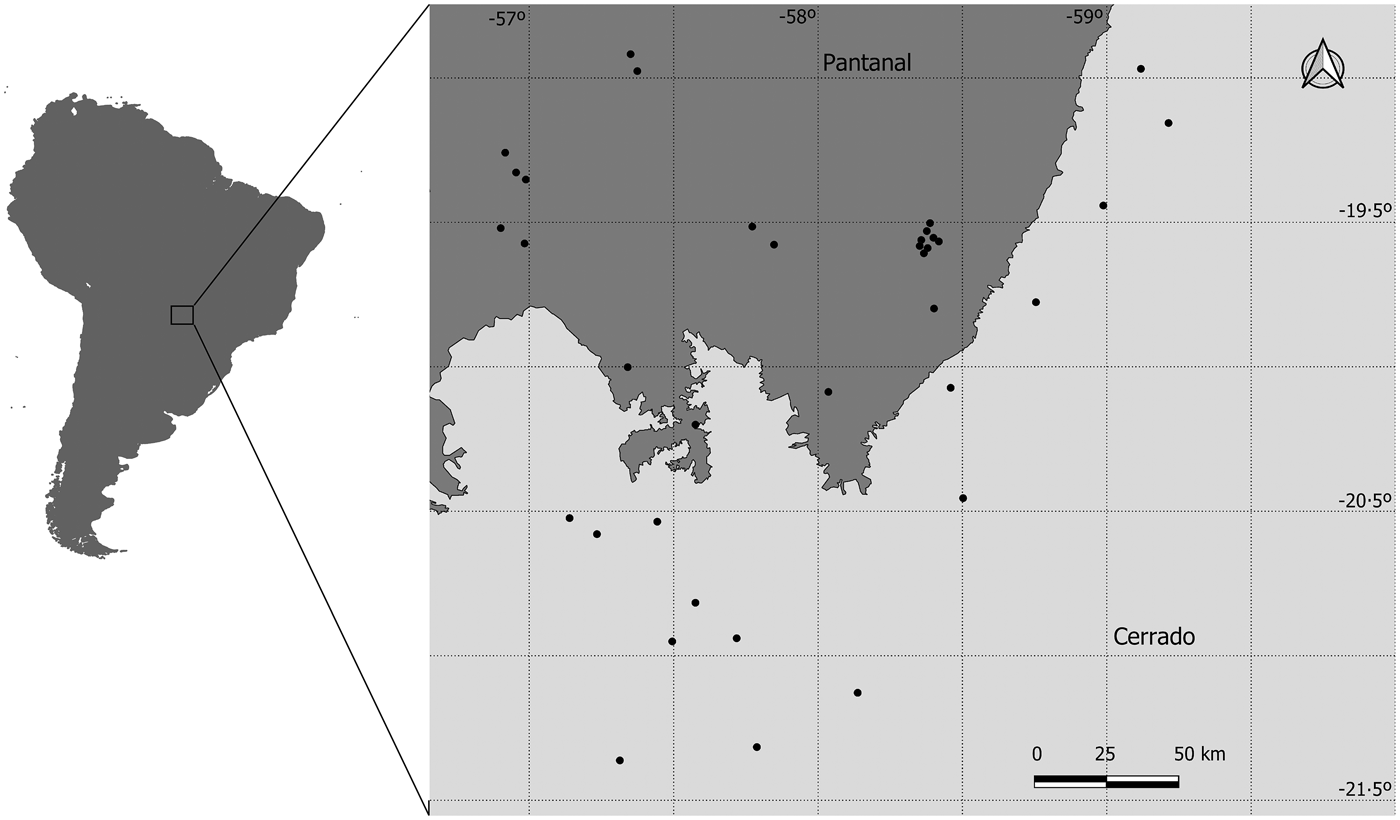
We mistnetted bats in 21 sites in the floodplain and 15 sites in the plateaus (Fig. 1) between 2002 and 2017. All sites were sampled at least one night in the dry and one night in the wet season. Each night, six to ten 12 × 2.6 m mistnets were kept open during 6 h after sunset. In all sites, at least 30 individuals of A. planirostris were captured. We considered all captured individuals regardless of age, sex or reproductive stage because effects of these traits on bat flies is unclear (Bertola et al., Reference Bertola, Aires, Favorito, Graciolli, Amaku and Pinto-Da-Rocha2005; Patrício et al., Reference Patrício, Lourenço, de Freitas and Famadas2016), and because we did not find significant differences in the proportion of the host age, sex or reproductive stage between regions. We inspected every captured A. planirostris individuals for ectoparasites, collected the streblids manually or with tweezers, and stored them in microtubes containing 1.5 mL of 70 or 99% alcohol. Bats were then released at the site of capture, except some individuals collected as vouchers and included in the zoological collection of the Universidade Federal de Mato Grosso do Sul (ZUFMS). Collected streblids were identified in the laboratory based on Wenzel (Reference Wenzel1976) and Guerrero (Reference Guerrero1995), following the taxonomic classification by Dick and Graciolli (Reference Dick and Graciolli2018); they were also included in the ZUFMS collection.
Study sites (black dots) in the Pantanal floodplain (dark grey) and the Cerrado plateaus (light grey), Mato Grosso do Sul, Brazil.

Data analyses
We calculated the Poulin index of discrepancy (D) to describe the bat fly aggregations, which measures the deviation of a parasite distribution from a theoretically even distribution among host individuals; D ranges from zero to one, indicating no aggregation to highly aggregated distribution (Poulin, Reference Poulin1993, Reference Poulin and Poulin2007). Different measures of parasite aggregation have similar interpretation and they roughly predict each other (Reiczigel et al., Reference Reiczigel, Marozzi, Fábián and Rózsa2019). We choose the index D because it is easy to understand and compute (Poulin, Reference Poulin and Poulin2007), and appropriate to the statistics available in the Quantitative Parasitology software (QPweb) (Reiczigel et al., Reference Reiczigel, Marozzi, Fábián and Rózsa2019), used here for all data analyses. To test for significance of differences of D between the Pantanal and Cerrado, we used a bootstrap approach with 3000 randomizations and accepted significant differences if the 97.5% confidence intervals did not overlap (Reiczigel et al., Reference Reiczigel, Marozzi, Fábián and Rózsa2019).
Results
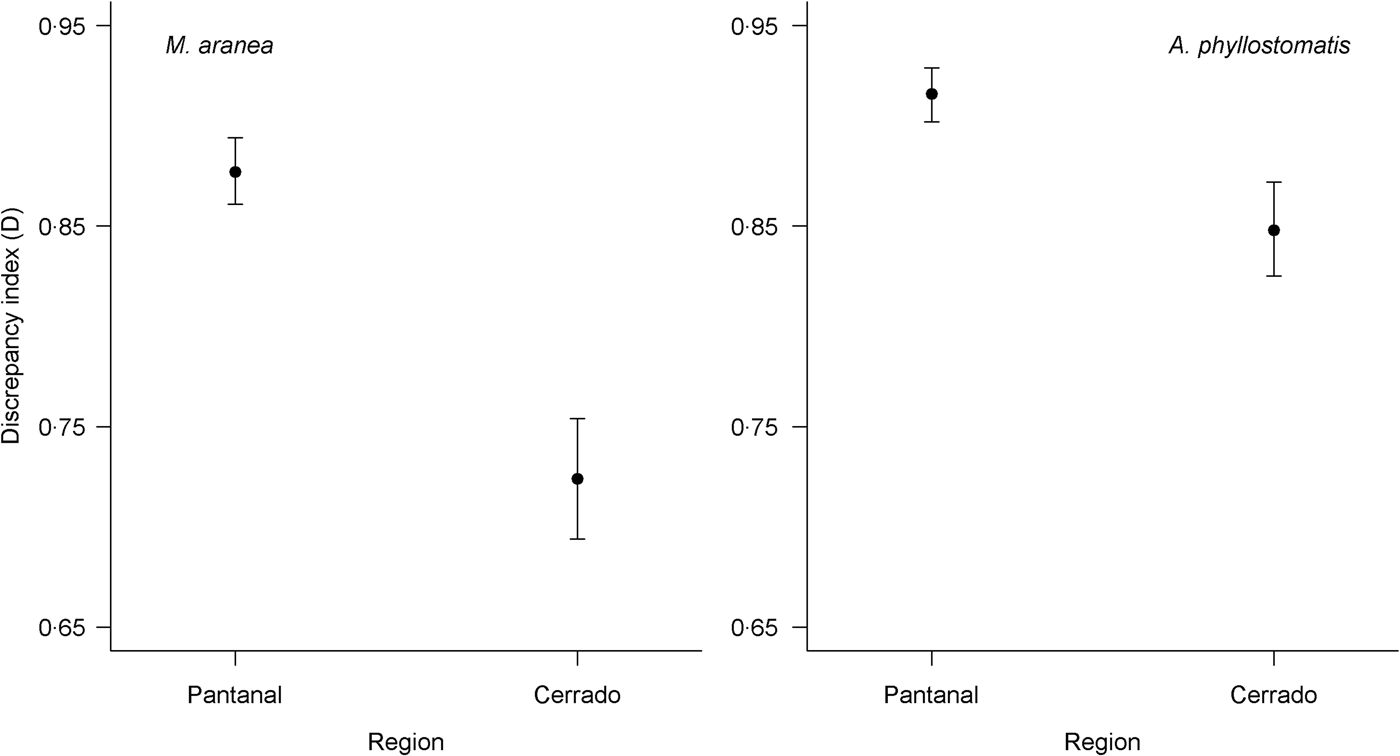
We sampled 1784 streblid flies from 2497 individuals of A. planirostris, consisting of 1698 bats from Pantanal and 799 bats from Cerrado. All bat populations in the 36 sites presented bat flies. Megistopoda aranea was almost two times more abundant than A. phyllostomatis, with 1117 (494 in Pantanal and 623 in Cerrado) and 667 (327 in Pantanal and 340 in Cerrado) sampled bat flies, respectively. Megistopoda aranea and A. phyllostomatis showed aggregated distributions in both regions, but their aggregations were higher (P < 0.05) in the Pantanal than in Cerrado, and A. phyllostomatis showed higher overall aggregation compared to M. aranea (Fig. 2). The prevalence of M. aranea was 17.3% (s.d. = 10.4%) and 40.8% (s.d. = 9.1%) in the Pantanal and Cerrado, respectively. The prevalence of A. phyllostomatis was 13.2% (s.d. = 8.4%) in the Pantanal and 20.7% (s.d. = 8.7%) in the Cerrado.
Poulin index of discrepancy (D) measuring the aggregation of distributions of Megistopoda aranea and Aspidoptera phyllostomatis bat flies among Artibeus planirostris host individuals in the Pantanal floodplain and the Cerrado plateaus, Mato Grosso do Sul, Brazil. Error bars are the 97.5% confidence Intervals (P < 0.05).

Discussion
Our results indicate that aggregation of both species of bat flies across A. planirostris individuals is higher in the Pantanal floodplain than in the Cerrado plateaus. This outcome supports our initial hypothesis, based on the consideration of regional differences of roost types used by this bat species. Two main reasons for parasite aggregation across host individuals are the exposure and susceptibly of the hosts to parasite infections (Poulin, Reference Poulin and Poulin2007). Some studies have showed that juvenile or pregnant female bats are more prone to acquire higher infections by bat flies (Rui and Graciolli, Reference Rui and Graciolli2005; Esbérard et al., Reference Esbérard, Astúa, Geise, Costa and Pereira2012). Nonetheless, this increased susceptibility has been not found for A. planirostris juveniles or pregnant females (Patrício et al., Reference Patrício, Lourenço, de Freitas and Famadas2016). We raised that small and ephemeral tree hollows available for A. planirostris in the Pantanal could favour an increased aggregation of parasites across host individuals if compared with large and perennial rocky shelters available in the plateaus (Sallun-Filho et al., Reference Sallun-Filho, Karmann and Lobo2010). Small tree hollows could improve the success of newly emerged flies seeking out a bat host, because the small internal area of this roost type forces bat individuals to pass close to, or perch on, wall parts where bat fly pupae have been previously deposited. In contrast, large caves and rock fissures allow bats to use variable entrance routes and perching places inside the roost, potentially increasing the uncertainty of encounters of emerging flies with a bat host; actually, bats could actively change their perching location to escape from high infestation (Lewis, Reference Lewis1995).
Differences between Cerrado and Pantanal with regard to numbers and durability of the available roosting places could also affect bat fly aggregation across host individuals. Tree hollows are ephemeral but largely available in the floodplain, which contrasts to rocky shelters in the surrounding plateaus that are perennial but relatively rare. Therefore, A. planirostris populations tend to split up into several small groups inhabiting different tree hollows in the floodplain, whereas rocky shelters can concentrate bat individuals into few and large groups in the plateaus (Díaz and Linares García, Reference Díaz and Linares García2012; Breviglieri and Uieda, Reference Breviglieri and Uieda2014; Cordero-Schmidt et al., Reference Cordero-Schmidt, Medeiros-Guimarães, Vargas-Mena, Carvalho, Ferreira, Rodriguez-Herrera and Venticinque2016). Low durability of bats' roosting places can reduce bat fly prevalence (Patterson et al., Reference Patterson, Dick and Dittmar2007), as we found for M. aranea and A. phyllostomatis in the Pantanal. Thus, few bat groups in tree hollows would be infested and all individuals in these groups would be consistently parasitized due to the confined space in which they roost. If so, bat fly aggregation should be high because only a small fraction of host individuals is continuously infested. On the other hand, large bat groups sharing perennial rocky shelters in the Cerrado plateaus could favour a high prevalence and low aggregation of bat flies among hosts.
The prevalence of M. aranea was higher than that of A. phyllostomatis in both regions, Pantanal and Cerrado, a pattern already reported (Eriksson et al., Reference Eriksson, Graciolli and Fischer2011; Barbier and Graciolli, Reference Barbier and Graciolli2016; Dornelles et al., Reference Dornelles, Graciolli, Odon and Bordignon2017). Although they occupy different portions of the host body, competition has been evidenced between these bat fly species (Hiller et al., Reference Hiller, Honner, Page and Tschapka2018, but see Presley, Reference Presley2011). The highest prevalence of M. aranea in both of our studied regions indicates that M. aranea is a more successful competitor than A. phyllostomatis. Different patterns of pupae deposition could be another cause of differences in prevalence between these fly species on Artibeus hosts (Pilosof et al., Reference Pilosof, Dick, Korine, Patterson and Krasnov2012; Hiller et al., Reference Hiller, Honner, Page and Tschapka2018). We suggest that A. phyllostomatis pupae are deposited in more exposed areas of the bat roosts and thus subjected to external climatic conditions, decreasing the survival rate of pupae and consequently decreasing the availability of individuals to infect bats.
The availability of caves and rock crevices in the Cerrado and the absence of such roosting places in the Pantanal provide a potential explanation for differences of bat fly aggregation patterns on A. planirostris individuals. However, further studies on roost types and numbers of bats per roost are required to support that. Although A. planirostris uses a variety of roost types (Garbino and Tavares, Reference Garbino and Tavares2018), there are no data on the use of roost sites in our study Cerrado plateaus. It is usually assumed that differences in bat fly abundance result from the type or condition of host's roosts (ter Hofstede and Fenton, Reference ter Hofstede and Fenton2005; Patterson et al., Reference Patterson, Dick and Dittmar2007; Pilosof et al., Reference Pilosof, Dick, Korine, Patterson and Krasnov2012; Bolívar-Cimé et al., Reference Bolívar-Cimé, Cuxim-Koyoc, Reyes-Novelo, Morales-Malacara, Laborde and Flores-Peredo2018; Hiller et al., Reference Hiller, Honner, Page and Tschapka2018). Such explanation makes sense since the bat fly pupal stage is decoupled from the bats, nevertheless the literature on pupae deposition is scarce (Overal, Reference Overal1980; Fritz, Reference Fritz1983; Dittmar et al., Reference Dittmar, Dick, Patterson, Whiting and Gruwell2009). Further studies on the patterns of pupal deposition in different roosts, as well as on the biotic and abiotic factors affecting pupae are important to understanding the distribution of bat flies across bat host individuals.
Author ORCIDs
Erich Fischer, 0000-0001-8722-9876; Alan Eriksson, 0000-0003-1857-7935.
Acknowledgements
We are grateful to Robert Poulin, Fátima Jorge and two anonymous referees for valuable suggestions and to Driele Soares for help with data summarization.
Financial support
This study was financed in part by the Coordenação de Aperfeiçoamento de Pessoal de Nível Superior – Brasil (CAPES) – Finance Code 001, grant to AE (88881.187634/2018-01) and MS, and research grant from Conselho Nacional de Desenvolvimento Científico e Tecnológico (CNPq) to EF (307016/2015-3), to GG (306216/2018-3), to GC (473996/2010-3) and to EGMV (128291/2017-6).
Conflict of interest
None.
Ethical standards
Bat captures were conducted under legal authorization of Brazilian Ministry of the Environment MMA/ ICMBio permit numbers, 10303-1 and 41652-1.