Introduction
A notable feature of recent public administration is the increasing opportunities for citizens to have more direct input into the public bureaucracy, as stated by Peters and Pierre in their 2003 ‘Handbook of public administration’, emphasising that this includes a role for civil society as a source of ideas, legitimation and feedback for government (Peters and Pierre, Reference Peters, Pierre, Pierre and Peters2003: 3). Forms of participatory or collaborative governance supplement conventional representative democracy and bring a democratic element to public administration (Fung and Wright, Reference Fung and Wright2001). In health and social care, in the UK and the Scandinavian countries among others, various initiatives to involve the public, patients or clients aim to improve welfare services and make them more responsive to users (Alm Andreassen, Reference Alm Andreassen2009a; Barnes et al., Reference Barnes, Newman and Sullivan2007; Dent and Pahor, Reference Dent and Pahor2015; Eriksson and Jacobson, Reference Eriksson, Jacobson, Gubrium, Alm Andreassen and Koren Solvang2016; Fotaki, Reference Fotaki2011; Newman et al., Reference Newman, Barnes, Sullivan and Knops2004; Tritter and McCallum, Reference Tritter and McCallum2006; Tritter, Reference Tritter2009; Van De Bovenkamp et al., Reference Van De Bovenkamp, Trappenburg and Grit2010; Vrangbaek, Reference Vrangbaek2015). As a result, a variety of models of citizen involvement flourish, each with their subsequent organisational forms, formation of the role of the citizens involved and demands as to their representativeness, performance and competence.
Models of citizen involvement in health and social care address citizens in different capacities. The publics or populations to be involved are differently constituted (Baggott and Jones, Reference Baggott and Jones2014; Barnes et al., Reference Barnes, Newman, Knops and Sullivan2003; Barnes et al., Reference Barnes, Newman and Sullivan2007; Harrison and Mort, Reference Harrison and Mort1998; Needham, Reference Needham2008; Pestoff, Reference Pestoff2009). Citizens can be conceived of, for instance, as lay people, as service users, patients or clients, as members of voluntary organisations, as community residents, as consumers of public goods, or as co-producers and, more recently, even as service workers or peer providers. Each term implies a substantially different kind of relationship between those who provide and those who ‘receive’ services (McLaughlin, Reference McLaughlin2009; Wistow and Barnes, Reference Wistow and Barnes1993).
Citizens can be involved in issues concerning planning, decision-making and evaluation of service provision through consultations, standing forums or advisory bodies, which offer citizens opportunities for involvement as political participants and via collective forms of organising (Beresford, Reference Beresford2002; Fotaki, Reference Fotaki2011; Pollitt, Reference Pollitt, Flösser and Otto1998; Tritter, Reference Tritter2009; Wistow and Barnes, Reference Wistow and Barnes1993). Furthermore, citizens can be involved as co-producers, partners or collaborators in a mix of activities in which both public service agents and citizens, with reciprocal strengths, contribute to the provision of public services (Bovaird et al., Reference Bovaird, Van Ryzin, Loeffler and Parrado2015; Brandsen and Pestoff, Reference Brandsen and Pestoff2006; Fotaki, Reference Fotaki2011; Needham, Reference Needham2008; Pestoff, Reference Pestoff2009). Contributions could include public participation in policy-making, consultative user councils, or participation in service delivery, each requiring different roles for the citizens or service users.
Citizens can be involved as individuals or as collective actors (Barnes, Reference Barnes1999; Bovaird et al., Reference Bovaird, Van Ryzin, Loeffler and Parrado2015; Tritter, Reference Tritter2009). They can be involved as designated persons perceived as having sought-after experience or perspectives. Citizens can also be involved as members or spokespersons of user groups or organisations, which, for their part, as interest groups or social movements, are claiming the rights to self-determination and a say in governmental decisions that affect their living conditions (Alm Andreassen, Reference Alm Andreassen2008; Bovaird et al., Reference Bovaird, Van Ryzin, Loeffler and Parrado2015; Brandsen and Pestoff, Reference Brandsen and Pestoff2006; Fotaki, Reference Fotaki2011; Halvorsen, Reference Halvorsen, Goul Andersen, Guillemard, Jensen and Pfau-Effinger2005; McLean, Reference McLean, Scheid and Brown2010; Needham, Reference Needham2008; Pestoff, Reference Pestoff2009; Rose and Lucas, Reference Rose, Lucas, Knapp, McDaid, Mossialos and Thornicroft2007; Shakespeare, Reference Shakespeare1993; Wistow and Barnes, Reference Wistow and Barnes1993).
Unsurprisingly, confusion, disagreement and tension between divergent ideas of citizen involvement are common among participants in involvement processes (Barnes et al., Reference Barnes, Newman, Knops and Sullivan2003; Barnes et al., Reference Barnes, Knops, Newman and Sullivan2004; Coleman et al., Reference Coleman, Checkland and Harrison2009; Martin, Reference Martin2008a; Martin, Reference Martin2008b).
Researchers argue that, despite a substantial body of academic literature, clarity is still lacking. Bochel et al. (2008) argue that there remains a major lack of clarity regarding many aspects of the involvement of citizens or users, and conditions for achieving ‘real’ participation and involvement that actually has an influence on public services are still to be identified. Dent and Pahor conclude that the whole arena of patient involvement within health care is riven with problems of meaning, definition and purpose (Dent and Pahor, Reference Dent and Pahor2015: 549).
Conceptual frameworks for categorization of different types of involvement exist. A much-used distinction is the dichotomy between ‘choice’ and ‘voice’ as mechanisms of expressing citizens’ agendas or interests, i.e. between market mechanisms versus mechanisms of democracy (Aberbach and Christensen, Reference Aberbach and Christensen2005; Callaghan and Wistow, Reference Callaghan and Wistow2006; Clarke et al., Reference Clarke, Newman and Westmarland2008; Fotaki, Reference Fotaki2011; Greener, Reference Greener2008; McLaughlin, Reference McLaughlin2009; Wistow and Barnes, Reference Wistow and Barnes1993). An extended taxonomy used by some distinguishes between three different approaches summarized as ‘choice’, ‘voice’ and ‘co-production’, reflecting respectively a ‘consumerist’, ‘deliberative’ and ‘participative’ concept of involvement (Dent and Pahor, Reference Dent and Pahor2015; Fotaki, Reference Fotaki2011; Vrangbaek, Reference Vrangbaek2015). Here, co-production differs from voice and choice in that the latter two are external to service production.
For some, the concept of co-production consists of individual as well as collective co-production, and includes co-production in various forms, such as co-commissioning, co-design and co-delivery (Bovaird et al., Reference Bovaird, Van Ryzin, Loeffler and Parrado2015). For others, co-production refers to voluntary efforts by individual citizens, while co-governance refers to arrangements in which the third sector participates in planning and delivery of public services (Brandsen and Pestoff, Reference Brandsen and Pestoff2006).
While such frameworks and distinctions are valuable in differentiating between different policy approaches and even to some degree indicate organisational designs of involvement, they are still too broad to guide analysis of how policy is interpreted and operationalized in actual involvement processes. Further specification of the purpose, organisational form, criteria and processes of selection of the citizens involved and of the role of participants is desirable. This is because it could clarify theoretically illuminating similarities and differences, as well as provide insight into the means through which involvement might (or might not) influence service provision. The need for further specification is the motivation for this analysis.
Approach, aim and analysis
The approach is to reflect on citizen involvement through the concept of institutional logics and the understanding that different models of citizen involvement draw on different institutional logics. Institutional logics are understood here as supraorganisational patterns of activity through which humans conduct their material life in time and space, and symbolic systems through which they categorize that activity and infuse it with meaning (Friedland and Alford, Reference Friedland, Alford, Powell and DiMaggio1991: 232).
The institutional logics perspective
In their seminal article on institutional logics, ‘Bringing Society Back In’, Friedland and Alford (Reference Friedland, Alford, Powell and DiMaggio1991), identified the central institutions of modern western societies to be: capitalist markets, the bureaucratic state, democracy, the nuclear family and the Christian religion. They emphasised that each of these most important institutional orders has a central logic, a set of material practices and symbolic constructions which constitute its organising principles.
Institutional logics shape individual preferences and organisational interests as well as the repertoire of behaviours by which these may be attained. Institutional logics provide agents with socially constructed systems of classifications that constitute categories of social actors, organisational forms and organisational agendas (Thornton and Ocasio, Reference Thornton, Ocasio, Greenwood, Oliver, Suddaby and Sahlin2008). The existence of institutionalized elements of organisational structure enables social actors to organise along prescribed lines and makes organisations easier to create (Meyer and Rowan, Reference Meyer and Rowan1977).
Institutional logics are not permanent and static but historically and contextually conditioned: a) they are symbolically grounded, organisationally structured, politically defended, and technically and materially constrained and hence have specific historical limits; b) they are basic features and available to organisations and individuals to elaborate; c) the existence of multiple and potentially contradictory logics for individuals and organisations to draw on opens up spaces for confrontation and challenging of established practices and symbols (Friedland and Alford, Reference Friedland, Alford, Powell and DiMaggio1991).
Because society is constituted through multiple institutional logics, the major institutions are interdependent and yet also contradictory. Some of the most important struggles between groups, organisations and classes are over the appropriate relationships between institutions, the particular institutional logic by which different activities should be regulated, and which categories of persons they apply to (op. cit.).
The concept of hybridity illuminates how many organisations and organisational fields are permeated with several different and even contradictory institutional logics. Different logics may compete and eventually lead to the suppression of one logic and the dominance of another, or they may coexist in the form of stalemate, tension or equilibrium, and give organisations a hybrid character (Battilana and Lee, Reference Battilana and Lee2014; Reay and Hinings, Reference Reay and Hinings2009; Seo and Creed, Reference Seo and Creed2002; Van Gestel and Hillebrand, Reference Van Gestel and Hillebrand2011). Social enterprises can combine organisational forms from the logics of both business and charity. Likewise, organisational structures may be developed to allow the logics of medical professionalism and business-like health care to co-exist in collaborative, rather than only in conflicting, ways.
The argument in this article is that the concept of institutional logic can be applied fruitfully to enhance the understanding of not only whole organisations or organisational fields, but even of the various models that organisations utilize to organise their relationships to the environment (such as citizens and civil society). Applied to citizen involvement in health and social care, an institutional logic perspective points to the frameworks available to policy-makers and participants. When policies of citizen involvement are enacted, they have to be operationalized. Operationalizing involvement policies means giving citizen involvement organisational form, purpose and tasks, and linking it to the organisational structures and processes of health and social care organisations. Institutional logics offer templates that explicitly or implicitly guide operationalization of involvement policies. Institutional logics provide the cultural materials through which organisational forms are constructed. They provide prescriptions for involvement practices: for organisational forms; for tasks, assignments or entitlements given to positions, posts or bodies through which involvement is enacted and also for the perception of the relevant citizens involved, and the competencies requested of them. Because different institutional logics are available to draw on when involvement is operationalized, models of involvement could be embedded in different logics that may co-exist or compete, and thus models could become hybrids containing elements from more than one model.
Aim
The aim is to explicate key dimensions in the construction of citizen involvement through a presentation of some significant models in health and social care and the institutional logics on which these rest, and thereby to demonstrate significant differences in how involvement is operationalised.
The models are presented as ideal types, i.e. deliberate simplifications have been made in order to afford comparative analysis. Within an institutional logic approach, ideal types is a method of interpretive analysis for understanding the meaning with which actors invest their actions (Thornton and Ocasio, Reference Thornton, Ocasio, Greenwood, Oliver, Suddaby and Sahlin2008). As a theoretical tool to facilitate intelligible comparisons, ideal types are particularly suited to the aim of understanding variation in models of citizen involvement.
Analysis
The analysis is a synthesis of existing studies not unlike a process of inductively building theories from case studies (Eisenhardt, Reference Eisenhardt1989; Eisenhardt and Graebner, Reference Eisenhardt and Graebner2007), although the synthesis here is built on existing studies rather than new empirical research. In such theory building, selecting cases is based on theoretical sampling. Cases are selected because they are particularly illuminating; for example, because they could be examples of polar types likely to extend the emergent theory. Analysis means both within-case analysis (with existing studies already performed by others) and searching for cross-case patterns to identify categories or dimensions, and then looking for within-group similarities coupled with intergroup differences. Shaping of theoretical constructs (hypotheses, concepts, ideas) is a two-part process of a) refining the definition of the construct (here, the distinguishing dimensions of citizen involvement) and b) building evidence which measures the construct in each case (here, investigating whether the dimensions could be identified in all cases).
Due to the existing plethora of forms of citizen involvement, it would be impossible to cover the full variety within the space of one article. Instead, three contrasting models of involvement have been purposely selected to emphasise variation. The selection is based on the author's empirical research from Norway and a literature search to inform the analyses through findings from other studies, and thereby to compare and contrast forms of involvement from different national contexts. The analysis draws on reported studies from other European countries, mainly the UK. The UK is appropriate because it offers a rich collection of research material due to decades of various involvement policies.
Three contrasting models of citizen involvement
The models presented here include a dominant organisational form of citizen involvement in Norwegian health and welfare services (advisory bodies of service users) and a model more prevalent in the UK (panels of the general public). These are both embedded mainly in a logic of democracy. In addition, a quite different model of involvement is included, a model in which citizens with experience as service users are engaged as workers in health and social care. The institutional embedding of this model is not immediately recognizable, but rather has to be explored.
Involvement of spokespersons from user organisations
The prevailing model of citizen involvement in health and social care in Norway is in the form of consultation through standing advisory bodies, termed ‘user councils’. In the regional health authorities, hospitals and in the labour and welfare administration, user councils are entitled to be involved in discussions in relation to the planning, provision and evaluation of services (Alm Andreassen, Reference Alm Andreassen2008). Often the councils are supplemented with ad-hoc forms of consultative forums involving larger numbers of service users in relation to specific matters on the decision-makers’ agenda.
The citizens involved are the ‘users’, those directly affected by service provision, through associations who organise and speak for citizens with long-term and complex conditions – people with chronic illnesses, disabilities or mental health problems, substance addicts, the elderly, and the economically disadvantaged. The organisations nominate their spokespersons, and public services can select council participants with the aim of achieving a representative cross-section of user groups. Involvement is grounded in a tradition of democracy where citizens elect those who are to speak for them – who, for their part, act on behalf of and are held accountable to their constituencies.
Besides intimate acquaintance with the situation of the relevant user group, important competencies expected of the participants include doing a proper job as spokespersons (Alm Andreassen et al., Reference Alm Andreassen, Breit and Legard2014). The organisations provide training programmes through which the participants are taught what it means to be ‘representatives’.
While organisations of health and social care users exist in many European countries, and many of them state that influencing policy is an important task, there are variations between countries as regards the extent to which the organisations are engaged in policy processes (Anker and Halvorsen, Reference Anker, Halvorsen, Hvinden and Johansson2007; Baggott and Jones, Reference Baggott and Jones2014; Opedal et al., Reference Opedal, Rommetvedt and Vrangbæk2012; Van De Bovenkamp et al., Reference Van De Bovenkamp, Trappenburg and Grit2010). The strong position of groups with long-term and complex conditions in Norwegian involvement policy could be understood in the light of active campaigning by disability organisations and their federation, in which organisations of persons with chronic illnesses and mental health problems are incorporated (Alm Andreassen, Reference Alm Andreassen2008).
This model of citizen involvement bears the hallmark of the logic of democracy, which can be explained by its embedding in the Nordic model of the state–civil society relationship, with the following key features (Alapuro and Stenius, Reference Alapuro and Stenius2010; Salamon, Reference Salamon2004; Wijkström and Zimmer, Reference Wijkström and Zimmer2011):
-
• a vibrant civil society with a large number of voluntary organisations, with a high volume of membership, active participation, donations and voluntary work;
-
• an expressive-dominant civil society sector where the organisations are not primarily service providers but vehicles for the expression of political, social and cultural interests and mechanisms of interest mediation from private lives to public policy;
-
• widespread support of democratic governance and representation, underpinned by requirements for receiving public funding, and developed organisational models with internal democratic structures and boards elected by the members;
-
• a particularly close relationship between state and civil society in the form of integrated participation or participatory corporatism, through which various societal interests have been involved in policy-making based on experiential knowledge of the issues under consideration; and
-
• a transformation of traditional participatory corporatism, as features of ‘deliberative neo-corporatism’ involving networks, partnerships and deliberative forums are replacing centralised and hierarchical forms of representation (Enjolras, Reference Enjolras, Bozzini and Enjolras2012).
The advisory bodies and ad-hoc forums of service user involvement offer public spaces where a range of civil society organisations are brought in, including small and marginalized minorities, and where an abundance of interests, identities, voices and experiences can be expressed and debated. Such advisory bodies are placed in an in-between position, of being part of the decision-making processes of the public sector service organisations and partly autonomous bodies composed of members of voluntary organisations of civil society (Alm Andreassen, Reference Alm Andreassen, Waldahl and Enjolras2009b). This in-between position gives the councils a hybrid nature. User councils become both carriers of interests (as in the Nordic model of the state–civil society relationship) and, at the same time, providers of knowledge intended to be utilised by those in charge of health service deliverables, as the councils have to answer to managerial agendas.
Involvement of generalised publics of lay people
The Norwegian model of service users as the relevant citizens to be involved, and their role as representatives of those directly concerned, differs from models in other European countries where it is considered that the relevant citizens to be involved are the ‘public’. In health technology assessment, for instance, while those directly affected by a given health condition or technology are involved, such as individual patients and service users and their representatives (e.g. a disabled people's group or the Cancer Society), these publics are supplemented with publics deemed to represent a societal or lay perspective (Gauvin et al., Reference Gauvin, Abelson, Giacomini, Eyles and Lavis2010).
Forms of involvement where invited or self-selected individuals represent the public, understood as ordinary, true, or ‘unhyphenated’ citizens, have been more prominent in the UK, for instance in citizen juries or the Citizens Council of the National Institute of Clinical Excellence, as a way of keeping government and public services in touch with public values (Davies et al., Reference Davies, Barnett and Wetherell2006; Harrison and Mort, Reference Harrison and Mort1998; Martin, Reference Martin2008a).
The citizens involved are selected to represent the community as a whole, rather than to represent the interests of particular user groups (the ‘hyphenated’ citizens). Involvement procedures are guided by some conception of the ‘general public’. The citizens may be self-selected through open invitations or advertisements, or they may be systematically but randomly selected from the electoral registers, for example, then matched to fit a community profile and balanced to take account of characteristics such as gender, ethnicity, socio-economic status or age. The citizens involved are to reflect the community from which they are drawn.
These ordinary citizens are invited to serve only for a limited period of time to avoid professionalization of citizens. The aim is to ensure that the involved citizens are ‘new’ to the issues, and to prevent them from becoming too familiar with the services. The citizens are to be ‘genuine’ members of the public (Davies et al., Reference Davies, Barnett and Wetherell2006; Harrison and Mort, Reference Harrison and Mort1998).
There are hybrid aspects connected with this model of involvement, too, as the request for ordinariness is modified in that the citizens involved are expected to be knowledgeable about health care and able to devote a substantial amount of time to participation (Learmonth et al., Reference Learmonth, Martin and Warwick2009). The perception of the citizen is someone who knows and makes known his or her constituency, by being typical of the local population but also making efforts to better understand its views (Martin, Reference Martin2008a).
This hybridity in requirements for citizens to qualify leads to ambiguity: they have to be ‘ordinary’ to represent the community effectively, but, if they are ordinary, they cannot effectively represent the community. If they have knowledge, experience of providing or using services, and an understanding of the health needs of the community, and are capable of giving considered and informed opinions, the citizens are no longer ordinary but, rather, professional.
Such models, where ordinary citizens and members of the general public are involved, must be placed within a version of the logic of democracy which is different from the Nordic model of the state–civil society relationship. The mediating position of civil society organisations, which is so prominent in citizen involvement in Norway, is here replaced with a model that seems to operate with a direct link between the citizens and the state. A service-dominant civil society sector (Salamon, Reference Salamon2004), with a higher share of paid staff, might be part of the explanation: civil society organisations are themselves service providers.
Involvement of users as co-workers
User-employment is a model of citizen involvement in which citizens are involved as co-workers, co-carers, or co-researchers. The model appears to have spread from the US, and is found in Australia, New Zealand, the Netherlands, Canada, the UK and, more recently, also in Scandinavian countries.
Various terms are applied, such as ‘consumer-providers’, ‘consumer employees’, ‘lived experience workers’, ‘consumer consultants’, ‘peer counsellors’, ‘peer support workers’ and ‘peer-providers’. Personal experience as service users and having health conditions, mental health problems, disability or social problems is the important qualification in this model, too, but the form of involvement differs from consultative models in that service users are engaged by service-providing organisations, sometimes as voluntary workers, but most often in paid jobs.
As many of the terms indicate, peer employees are people with lived experience who are employed to support others who face similar challenges (Repper and Carter, Reference Repper and Carter2011). They are hired into designated positions with the task of performing peer-delivered interventions (Walker and Bryant, Reference Walker and Bryant2013). Consumer providers in mental health care, for instance, are those with serious mental illness who are further along in recovery and can draw upon their experience to provide services to others with similar mental health problems (Chinman et al., Reference Chinman, Young, Hassell and Davidson2006). User-employees work not only with peer support in health services but also in posts where the task is explicitly to communicate user perspectives to service providers or researchers, or to organise user involvement (Austin and Johannessen, Reference Austin and Johannessen2015).
An example from Norway is a collaborative research and development programme in social services where service users were employed on several occasions in part-time positions as project workers, as co-workers, co-researchers and, in some cases, as project managers (Austin and Johannessen, Reference Austin and Johannessen2015). Involvement of users as co-workers, instead of via consultative bodies, was founded on an idea of rebalancing the power relationship, acknowledging users as subjects rather than objects of research or professional help, and creating equality by ‘doing the same things’ (Eide, Reference Eide2015). Some of the citizens involved were associated with user groups or organisations. Nonetheless, most often they were not considered spokespersons of user organisations; rather, they were selected individuals personifying a ‘generalized service user’ (Alm Andreassen, Reference Alm Andreassen2015; Gjernes and Bliksvær, Reference Gjernes and Bliksvær2011).
Involvement through user-employment is not only a means of enhancing the responsiveness, quality and effectiveness of health and social care services through a source of service user perspectives, or a democratic right of citizens to influence services of great importance to their living conditions. In several cases, an equally important objective is the impact of involvement on the involved citizens themselves – their personal development, recovery and vocational rehabilitation. Thereby involvement as user-employment attains aspects of hybridity.
In the social service research and development programme much weight was placed on strengthening the citizens involved, on relieving them of feelings of guilt and shame produced by their status as social welfare recipients, and on building their self-confidence (Natland and Celik, Reference Natland and Celik2015). More formally, education to convert user experience into a professional qualification is organised as vocational rehabilitation. In the UK, for instance, a User Employment Programme in a mental health trust was established in 1995, as a ‘supported employment’ project aimed at helping people who have had mental health problems to gain and maintain employment within mental health services (Perkins et al., Reference Perkins, Rinaldi and Hardisty2010). A similar programme was tried out in Denmark from 2000 until 2007, founded on an ‘Individual Placement and Support’ programme for health and social care professionals at risk of being excluded from the labour market due to mental illness (Andersen, Reference Andersen2010). In Norway in 2006, a one-year education programme, undertaken by a vocational rehabilitation enterprise, was designed to educate ‘workers with user experience’ from a target group of individuals with mental health problems (Biong et al., Reference Biong, Fugletveit and Lofthus2012).
The ideal-type organisational form of user-employment is a job; the citizens involved are not spokespersons of user organisations from which they are elected, or members of the general public selected to represent ordinary citizens. Rather, they are employees or co-workers, hired by the services in which they work. Representativeness is of minor importance and, if made relevant, it is conceptualised more as typicality. Their qualifications become more important than their representativeness – the fact that they have knowledge and skills that are of use to the employers, i.e. the health and social care organisations. User-employment means establishing the experiential knowledge of service users as a qualification for paid work; in many cases as a sufficient qualification, in others as an essential supplement to a professional education. User-employment involves an employment process where meritocratic criteria for the best suited are taken into consideration.
In addition, citizen involvement through user-employment sometimes achieves a hybrid character. With its element of social policy, user-employment is not only a form of employment in which one important outcome is better services, but also a measure of vocational rehabilitation in which another important outcome is the recovery of the user-employees.
Discussion
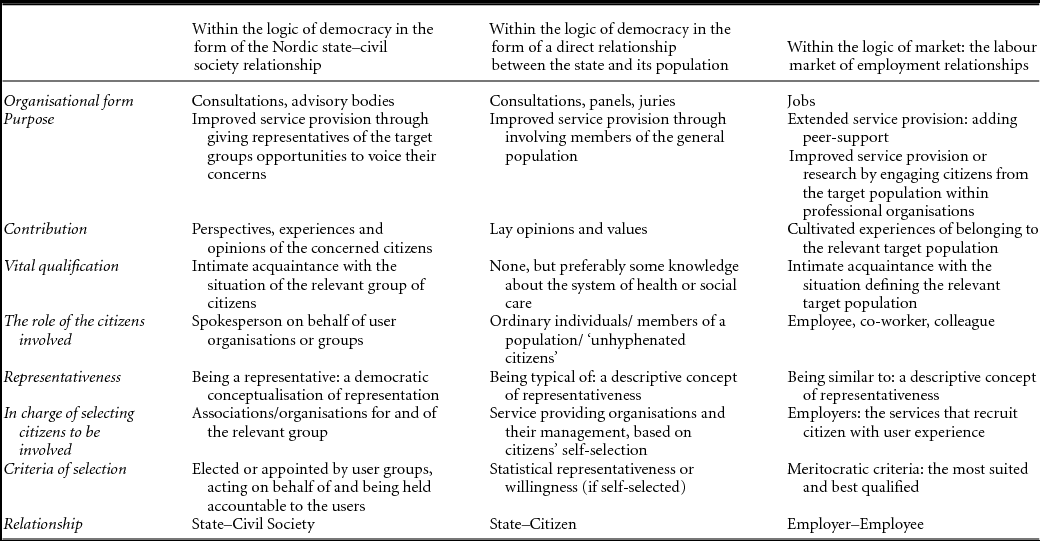
In terms of ideal types, the differences between the aforesaid models of involvement can be outlined as in the table below.
Each of the models of involvement, outlined in terms of ideal types in the table, are more complex as they all embody features of hybridity. Nonetheless, they show that models of citizen involvement can differ in important respects:
-
• Citizens can be involved by the use of advisory bodies – councils, panels, juries – in which they, together with other citizens, are consulted about issues concerning service provision, or they can be employed as workers in professional organisations where they, together with professional staff, are producers.
-
• Those involved can be considered ordinary citizens, representing a lay perspective, typically lacking both professional expertise and direct experience of the relevant health conditions or services, or they can be citizens directly concerned, having personal experience of the relevant health conditions and use of service, and deemed to hold experiential knowledge useful to the services who involve them.
-
• Citizens can be involved as individuals, bringing with them their personal opinions, values, judgements or experiences, or as collectives, as groups, associations or organisations assumed to carry the experience of the many and act as spokespersons for their constituencies.
-
• They can be members and spokespersons of voluntary associations or employees embodying a generalised user.
-
• They can be self-selected, responding to an open invitation or job advertisement or they can be selected by health authorities or service-providing organisations based on a random selection to provide a statistically representative sample of the target population. They can be nominated or elected by the groups, communities or constituencies they are meant to represent, or they can be recruited and hired by service providing work organisations into employment positions.
-
• Their representativeness can be based on a statistical or descriptive concept of representativeness, of being similar to or typical of the populations to be represented, or on a democratic or political concept of representation, of being a delegate or a spokesperson speaking on behalf of and being accountable to their constituency.
The first two models in the table are embedded within the institutional logic of democracy. Even with their common character of a consultative model, their remarkable differences make it clear that, in practice, models of citizen involvement (similar to models of democracy or of management reforms) achieve their specific character in interplay with national traditions or regimes (Christensen and Lægreid, Reference Christensen and Lægreid2001; Lijphart, Reference Lijphart2012; Pollitt and Bouckaert, Reference Pollitt and Bouckaert2004).
The third model, where users are co-workers, is not so easy to situate institutionally. At first glance it seemingly resembles a form of co-production. There are a variety of definitions and meanings of co-production (Needham, Reference Needham2008; Pestoff, Reference Pestoff2009), but the underlying idea of co-production underscores the work performed and its contribution in the process of service delivery (Bovaird et al., Reference Bovaird, Van Ryzin, Loeffler and Parrado2015; Brandsen and Pestoff, Reference Brandsen and Pestoff2006; Thomas, Reference Thomas2013). An important question concerns when co-production ceases to be co-contributing and turns into ordinary production.
The involvement of individuals with user experience as co-workers emphasises the work performed by citizens and the contribution of users in the process of service delivery. The collaboration between academics, service staff and service users in the programme for improved social services shares common features with co-production in the form of collective dialogues about the co-produced nature of service delivery (Needham, Reference Needham2008). However, organising involvement as user-employment represents a transformation of citizen involvement from co-production of third-sector voluntary organisations and voluntary work, into employment and paid work. A different contract is introduced – the employment contract. According to the International Labour Organization, an employment relationship is defined by the key criteria of one individual being subordinate to, or dependent on, another and is further characterised as a contractual relationship where the worker provides services to the benefit of another in exchange for receipt of regular, periodic payment (ILO, 2013).
In contrast, when citizens are involved as volunteers or members of voluntary organisations, even if they are remunerated for their participation, the relationship is one of voluntariness. This means, in accordance with an internationally recognised definition of civil society (Salamon, Reference Salamon2004; Salamon, Reference Salamon2010), that the involved actors are institutionally separate from government; self-governing and fundamentally in control of their own affairs, and that participation is contingent on an individual's choice or consent, rather than being legally required, or otherwise compulsory.
The introduction of user involvement as user-employment appears to denote a shift in the institutional embedding of citizen involvement in health and social care. It seems reasonable to place user-employment within the logic of the market, although not the customer market of service-providing organisations, but rather the labour market of service workers.
The employment relationship is not important in itself because employment relationships exist also in civil society and in user organisations. The logic of the labour market is also present in civil society organisations and, for that matter, also in organisations sustaining the system of democratic governance. Similarly, the logic of democracy is present in the labour market as rights to freedom of association and collective bargaining. Rather, in relation to service user involvement, the important issue is that user-employment constructs the relationship between the carriers of the voice of the users and the service-providing organisations as an employment relationship. The relationship is no longer between the state (organisations providing services on its behalf) and a citizen, or member of an organisation of civil society, but is recast as a relationship between an employer and an employee.
The model of user-employment is particularly in need of further examination. On one hand, the model may be welcomed by users who view employment and ordinary payment as recognition of the worth of users’ contributions, and as the equalising of users’ experiential knowledge with the expert knowledge of professionals. Additionally, the model offers continuity in the presence of user perspectives that consultative forms do not provide. On the other hand, its relationship of subordination may affect users’ opportunities to voice critical opinions or those which conflict with the service providers. While the state-civil society/citizen relationship in principle envisages the involved users as self-governing, the employment relationship places the involved users under the control of their employer. Within the logic of democracy, protest and opposition are legitimate actions. In an employment relationship, the independent voice of the citizen is replaced with a voice that is in principle controlled by the employer. The shift in institutional embeddedness therefore implies a move away from democratic accountability and publicness towards private employer control.
Citizen involvement in health and social care within different institutional logics

Conclusion
The starting point of this analysis was the variety of models of citizen involvement in health and social care and the consequent confusion this variation causes – to citizens involved and even to researchers looking for clarity. The argument here is that this variety is not purely arbitrary but is, to some degree, explicable in the light of the institutional embedding of these models. The concept of institutional logics sheds light on key distinctions between different models of citizen involvement. It helps in recognising the frames of reference of socially acceptable categories of actors, organisational forms and agendas available to agents who are operationalising policies of involvement into organisational forms, tasks, roles, representativeness and criteria for the selection of those involved. Thereby, confusion and struggle in relation to the proper institutional framing of citizen involvement can be understood.
The complexities surrounding citizen involvement in health and social care are, of course, even greater than has been demonstrated through the three models explored here. Nonetheless, clarifying the dimensions in which models of citizen involvement differ could provide a framework for analysis of models other than the ones explored here.
In addition, as studies have shown that different models of citizen involvement could affect service provision differently (Michels, Reference Michels2011; Veronesi and Keasey, Reference Veronesi and Keasey2013), further exploration of the explanatory factors behind such differences is needed. Awareness of distinguishing dimensions in the models of involvement might enable more nuanced investigations of the dynamics in operation, which might affect the functioning of involvement processes, and of the mechanisms of change that might be at work and might have an impact on service provision. These dimensions of the models, however, remain to be developed.
Acknowledgements
This article is based on extant research and no external funding. I want to thank the editors and two anonymous reviewers who offered very helpful suggestion for the improvement of the article.