Introduction
The most recent trend toward economic liberalization and globalization has paralleled an unprecedented period of democratization throughout the world (e.g. O'Donnell and Schmitter, Reference O'Donnell and Schmitter1986; Kim, Reference Kim2000; Hagopian and Mainwaring, Reference Hagopian and Mainwaring2005). It is, therefore, theoretically and substantively important to know whether or not political democracy has influenced societal responses to globalization. One perspective that has become front page material in recent years evokes an image of a ‘backlash’ against globalization. Protestors of all stripes and creeds in several regions of the world have ignited a wave of popular resistance against the economic threats associated with globalization policies (Almeida, Reference Almeida2009; Gentile and Tarrow, Reference Gentile and Tarrow2009). Reminiscent of the ‘IMF riots’ (Walton and Seddon, Reference Walton and Seddon1994) that gripped Latin America during the 1980s, mass-civic revolts in the region have rolled back unpopular economic liberalization policies, even forced embattled pro-market presidents to leave office early. Weeks of protest in South Korea have toppled cabinets and pressed executives to make major economic policy reversals. Globalization thus appears to have revitalized extra-parliamentary politics.Footnote 1
This popularized ‘backlash’ picture, however, is at odds with the conventional wisdom that associates exposure to worldwide competition with material insecurities and other destabilizing changes for popular subjects. As nations aggressively compete with each other to attract footloose capital, globalization forces are thought to homogenize policies and other economic institutions. This convergence has propelled a ‘race to the bottom’ in labor standards, which in turn, has severely weakened and fragmented popular subjects. Concomitantly, exposure to worldwide competition has allegedly resulted in a ‘powerless’ postglobalization state with constrained capacities particularly in the areas of monetary and fiscal policies, and as such, the existing literature has argued that the state no longer represents a worthy target of popular mobilization. Thus, the impersonal forces of economic globalization produce political apathy, and ultimately discourage extra-parliamentary politics.
Given the contradictions between widely publicized protest events and existing theory, this paper re-examines the domestic consequences of globalization around the world, and cross-regionally compares East Asia with Latin America. Based on the ‘backlash’ narrative, it appears that political democracy has played an important role in influencing societal responses to market changes, creating a favorable environment to help contest or modify economic liberalization policies. In contrast, the ‘race to the bottom’ perspective suggest that the forces of economic liberalization are unyielding and continue forward, while political democracy has not aided to revitalize popular subjects. The implication here is that democracy remains in form only, making little difference to the popular subjects affected by globalization. Thus, the central questions are: Does globalization in the presence of democracy depoliticize popular subjects, as the conventional ‘race to the bottom’ perspective holds, or do they repoliticize extra-parliamentary protest activity, as the ‘backlash’ perspective suggests?
The paper advances the current debate in two ways. First, to the best of our knowledge, and despite the widespread consensus that globalization shapes domestic politics, the existing literature has not systematically examined how democracy influences the relationship between globalization and extra-parliamentary protest activity. In this light, the paper provides a global and cross-regional test of the competing perspectives where existing research has remained primarily at the case study level. Although recent case studies appear to support the repoliticization perspective, others provide evidence of depoliticization, raising questions about whether either perspective is generalizable beyond a few specific cases. While we applaud the insights of these case studies, and highlight their contribution to the literature on the political consequences of economic reform, the general pattern of collective responses to economic liberalization remains unknown. Second, by emphasizing the importance of democracy as an intervenient variable affecting the relationship between globalization and extra-parliamentary protest activity, the paper shifts attention toward the salience of political conditions in an area of research that has traditionally dwelt on the structural influence of economic factors. Until recently, globalization, in fact, was thought to prefigure ‘the end of politics’, eclipsing national governments and their sovereignty. Along these lines, since the incidence of democratization varies cross-regionally, placing Latin America ahead of East Asia, the consequential role of democracy in mediating the social consequences of globalization ought to be varied as well.
Utilizing cross-sectional time-series data in a global sample for the 1970–2006 period, the empirical results reveal distinct patterns of protest activity across East Asia and Latin America, setting Latin America apart from East Asian and global trends. Ironically, the depoliticization perspective – which was originally formulated to explain Latin America, is more fitting to understand East Asia's experience with globalization. The results for Latin America, in contrast, provide confirming evidence for the repoliticization perspective by showing that protest activity increases in response to globalization in the presence of democracy. These findings remain robust across a number of control variables, and different measures of democracy and estimation techniques. A close reading of several case studies from East Asia and Latin America further corroborates the statistical evidence.
The consequences of globalization: depoliticization vs. repoliticization
The relationship between economic policies, political democracy, and extra-parliamentary politics has been the subject of inquiry by several well-known Latin American scholars (e.g. O'Donnell, Reference O'Donnell1973; Collier, Reference Collier1979). O'Donnell (Reference O'Donnell1973) argued that economic crises resulting from the exhaustion of import substitution industrialization policies, and the economic reforms pursued to resolve them, ushered in an explosion of popular mobilization and class conflict that made bureaucratic authoritarianism an attractive option for powerful segments of society. According to this classic literature then, the primary threat to democracy was the hypermobilization of collective actors in response to economic reform. Other work pointed out that democracies, with their emphasis on elections and political rights, enhanced the disruptive capacity of social forces (Huntington, Reference Huntington1968). In many ways, the revival of protest in the region mirrors the popular conflicts of this classic literature, yet the preoccupation with stability and order that characterized those studies has been relaxed. As Cleary (Reference Cleary2006: 41) puts it, ‘protest politics, including strikes, demonstrations, and roadblocks … are seen as a legitimate form of civil disobedience within a democratic system, rather than a direct challenge to the system itself’. In keeping with Cleary's observation, the 2009 Latinobarómetro survey reported that on average 92% of Latin American respondents viewed street mobilizations as a normal part of a democracy, a 29 percentage point increase from the 63% response recorded in 2008 (Latinobarómetro, 2009).Footnote 2
The recent literature on the societal consequences of economic liberalization advances two competing views on the linkage between economic reforms, democracy, and protest. Depoliticization scholars emphasize the disorganizing effects of economic liberalization on popular subjects, and do not expect democracy to revitalize collective action. Recently, however, this conventional wisdom has been challenged on a number of grounds by several studies documenting the revival of extra-parliamentary politics, particularly in the Latin America region as well as other countries in the world. These repoliticization studies seek to explain how in some cases collective actors adapt to economic liberalization, and how in other cases new actors and new forms of collective activity have emerged in response to globalization.Footnote 3
The depoliticization perspective
The literature arguing that the primary effect of globalization is depoliticization expects a ‘generalized pattern of decline in mobilization’ (Kurtz, Reference Kurtz2004: 289) as economic liberalization moves forward. This literature emphasizes the consequences of chronic economic crises, and their often far-reaching and swift pro-market resolution, such as increased poverty and inequality, higher levels of unemployment, and lower standards of living (e.g. Agüero and Stark, Reference Agüero and Stark1998; Oxhorn and Ducantenzeiler, Reference Oxhorn and Ducantenzeiler1998; Kurtz, Reference Kurtz2004; Holzner, Reference Holzner2007; Oxhorn, Reference Oxhorn2009). These economic conditions are said to hurt the collective capacity of popular subjects and produce, among other things, anomie, disorder, and societal disorganization (e.g. Zermeño, Reference Zermeño1990). As Oxhorn (Reference Oxhorn2009: 223) writes, the economic insecurities produced by market policies ‘generate political apathy as people's efforts are devoted to participating in the market, and they have less time to become politically active’. In turn, these outcomes jeopardize the organizational bases of representative institutions and organizations, especially political parties and labor unions (Roberts, Reference Roberts2002; Roberts and Portes, Reference Roberts and Portes2006). As Roberts (Reference Roberts2002: 26–27) puts it, ‘Labor unions remain as political actors, but their organic ties to party and state institutions have loosened, their access to the policy making arena has narrowed, and their ability to speak for a plurality of popular interests has diminished’.
A related set of arguments focuses less on the decline of civil society's mobilizing capacity, shifting attention to the ability of the post-globalization state to meet social needs after economic liberalization. Owing to the powerful external constraints imposed by the institutionalization of economic reforms, some studies have argued that the post-globalization state significantly thwarts the ability of policymakers to improve the social dislocations related to economic liberalization policies. Hence, social actors have little motivation to collectively organize given that the stripped-down, post-economic liberalization state no longer represents a worthy target of social mobilization. As Kurtz (Reference Kurtz2004: 271) notes, ‘[t]he freeing of markets has withdrawn the government from many of its adjudicatory functions in the economy, thereby simultaneously removing a host of critical, zero-sum conflicts from the political arena itself’.
The repoliticization perspective
In contrast to the depoliticization view, and drawing upon an established literature in contentious politics, the repoliticization perspective argues that grievances – as those generated by globalization – create a strong will for collective activity, while democracy creates a favorable environment or opportunity for collective responses. First, numerous studies have shown that grievances motivate societal actors to engage in collective action (e.g. Booth, Reference Booth1991; Muller et al., Reference Muller, Dietz and Finkel1991; Auvinen, Reference Auvinen1997; Gurr and Moore, Reference Gurr and Moore1997; Dudley and Miller, Reference Dudley and Miller1998; Finkel and Muller, Reference Finkel and Muller1998; Ellingsen, Reference Ellingsen2000; Pappas, Reference Pappas2008). Moreover, other scholars of contentious politics have long cited ‘the strategic framing of injustice and grievances,’ as ‘templates for collective action’ that can be used to mobilize diverse actors for a common cause (Zald, Reference Zald1996: 261). The repoliticization perspective posits that economic liberalization has provided a strong strategic framing opportunity for the resolution of collective action problems across a diverse range of social actors, which in turn has made sustained popular mobilization possible. As Roberts (Reference Roberts2008: 330) recently notes, ‘market reform left unmet social needs or heightened economic insecurities that provided a basis for the collective articulation of political grievances’. Economic liberalization thus produced a ‘master frame’ (Roberts, Reference Roberts2008: 341) for the repoliticization of popular subjects.
Second, as several scholars have argued, the presence of democracy enhances the opportunity for extra-parliamentary protest activity. Compared to autocracies, democracies foster collective mobilization by relaxing repression (Francisco, Reference Francisco2009), encouraging associational life, and opening channels of popular participation (Johnston and Almeida, Reference Johnston and Almeida2006). In this sense, democracies shape societal responses to grievances by creating ‘political opportunity structures’ that facilitate or hinder collective mobilization (Tarrow, Reference Tarrow1998), and by and large, democratic settings ‘guarantee a more open political opportunity structure than their opposites’ (Tilly and Tarrow, Reference Tilly and Tarrow2006: 66). Other literature portrays democracies as ‘movement societies’ (Meyer and Tarrow, Reference Meyer and Tarrow1998), where political protest is accepted and even encouraged as a ‘normal part of politics’ (Goldstone, Reference Goldstone2004: 348). In autocracies, however, where political and civil rights are restricted, collective mobilizations tend to be the exception rather than the rule, as protests in these settings are ‘likely to invite quick (and often violent) repression’ (Cook, Reference Cook1996: 40).Footnote 4
In sum, both perspectives agree that economic liberalization imposes severe material hardships on popular sectors – such as lower wages, employment insecurity, higher prices, cuts in social programs, regressive land reform, among other examples. However, following the literature on contentious politics, we expect these economic-based threats associated with economic liberalization to mobilize collective political actors, especially when the opportunity for mobilization is high, as in the context of democracy. By fueling widespread discontent and other dislocations, the repoliticization perspective posits that economic liberalization policies have helped to solve the collective action problems associated with large-scale mobilizations, prompting large pockets of previously un-mobilized citizens to take to the streets. Having outlined two contending theoretical perspectives on social responses to trends toward economic liberalization and globalization, the next section draws upon recent case study evidence to illustrate the plausibility of these theoretical arguments.
The Latin American experience
Three broad patterns of popular resistance to economic liberalization can be discerned across the Latin American region. First, despite the sweeping predictions of the depoliticization perspective, traditional class-based actors have continued to mobilize against economic reform policies. Second, new forms of contention involving both actors and types of protests have emerged to challenge economic liberalization policies. Finally, economic liberalization has provoked a number of geographically territorialized protests that have had significant political consequences at the national level. Collectively, these responses speak of the changing nature of anti-government mobilizations against economic liberalization in the context of democracy.
Recent case studies indicate that traditional class-based actors have continued to mobilize in the aftermath of economic liberalization, despite being the hardest hit by market reforms. The bulk of these studies have centered on Argentina, where labor-mobilizing forces remain strong. Etchemendy and Collier (Reference Etchemendy and Collier2007: 364) document a resurgence in labor organizing that has allowed unions to go on the ‘the offensive’, using strikes to re-regulate labor markets. Garay (Reference Garay2007: 302) argues that unemployed and informal workers have been at the forefront of Argentina's recent wave of protest, citing the emergence of massive nationwide federations of unemployed workers that have ‘produced fundamental effects on public policy, popular-sector interest intermediation, and partisan politics’. Murillo and Ronconi (Reference Murillo and Ronconi2004) show that Argentine teachers’ unions increasingly used strikes to improve public sector working conditions after the implementation of structural reforms in 1989, sometimes producing spillover effects in other sectors. ‘Indeed, a teachers’ strike caused by unpaid salaries started the so-called ‘Santiagazo’ of 1993, which became the first urban riot of Argentina in the 1990s (Murillo and Ronconi, Reference Murillo and Ronconi2004: 78).
Other case studies have drawn attention to the paradoxical effect of economic liberalization to simultaneously debilitate certain types of popular resistance while activating others, viewing the demise of traditional popular organizations as a ‘precondition for the emergence of more productive forms of politicization’ (Peruzzotti, Reference Peruzzotti2001: 141). Van Cott (Reference Van Cott2003) and Yashar (Reference Yashar2007) argue that both economic liberalization and democratization created openings on the left side of the political spectrum, enabling indigenous actors and new forms of contention to emerge on the national political landscape. In Ecuador, for example, indigenous mobilizations led by the Confederación de Nacionalidades Indígenas del Ecuador (CONAIE, Confederation of Indigenous Nationalities of Ecuador) have been successful in extracting concessions from multinational oil companies and reversing agrarian reform policies. By blocking highways and seizing government buildings, indigenous resistance forced three popularly elected presidents to resign from office early, and helped to redraft a new constitution that included an indigenous understanding of citizenship.Footnote 5 As in Ecuador, the rise of indigenous movements and parties highlights how economic liberalization in the context of democracy presents powerful mobilizing grievances that have contributed to the emergence of new actors and types of protest in Latin America.
Finally, a number of recent case studies have shown that societal responses to economic liberalization – while geographically territorialized – can sometimes have explosive national repercussions. Starting with the ‘IMF riots’ (Walton and Seddon, Reference Walton and Seddon1994) that gripped the region during the 1980s, there have been several major protest events that have drawn international media attention, and have had important political ramifications. In the popular revolt known as the Sacudón or Caracazo in 1989 in Caracas, Venezuela, for instance, market reforms provoked violent urban rioting followed by a heavy handed use of military force that killed 400 or more civilians (López-Maya, Reference López-Maya2003). Similarly, the food riots in Santiago del Estero (the so-called Santiagazo mentioned earlier) in Argentina, where the buildings that housed the three branches of the provincial government were set on fire, were perhaps a preview of the cacerolazos (demonstrations), road blockades, and other acts of collective resistance that have surfaced in the country over the last few years. In Bolivia, both the ‘water war’ of Cochabamba in 2000 and the ‘gas war’ of La Paz in 2003 rejected the country's economic liberalization model and its exclusionary governing practices (Kohl and Farthing, Reference Kohl and Farthing2006). Other examples include the anti-privatization revolt in Arequipa, Peru, in mid-2002, which derailed the government's privatization program and forced the then president Alejandro Toledo to reshuffle his cabinet (Arce, Reference Arce2008).
The existence of large-scale popular mobilizations is perhaps the strongest evidence against the view that economic liberalization has had a depoliticizing effect on societal actors, as these events have joined together numerous civil society groups, including indigenous peoples, students, women's organizations, workers, neighborhood associations, religious groups, and sectors of the middle class. Together, these events highlight the extent to which collective actors in Latin America are both inclined and capable of mounting a sustained resistance to economic reforms. They also go to show that political democracy has provided a favorable environment to modify or oppose economic liberalization policies as all of these events took place in the context of democracy.
These popular conflicts involving economic policy, political democracy, and extra-parliamentary politics seen in Latin America may not, however, be as widespread or common in other regions. In East Asia, for instance, the growing prosperity and economic stewardship advanced by a number of well-known autocracies, as well as the role of Confucian values in promoting respect for authority and other community-oriented characteristics that advocate order and consensus continue to be seen as roadblocks to further democratization in the region (e.g. Shin, Reference Shin1999). Thus the economic-based threats linked to economic liberalization and globalization may not necessarily produce the types of mass-based mobilizations and disturbances seen in several countries around the world, even while democratization continues to progress. Ultimately, research ought to subject these conjectures to empirical testing.
The East Asian experience
Two forces have influenced societal responses to economic liberalization across the East Asian region. First, the financial crisis of 1997–98 was a transformational event that placed the region at the epicenter of a full-fledged process of economic liberalization and globalization. With the sole exception of Taiwan, virtually all the East Asian countries were hit by the financial crisis, and four countries undertook restructuring programs mandated by the IMF. The negative socio-economic dislocations of the crisis have been well-documented (e.g. Pempel, Reference Pempel1999; Haggard, Reference Haggard2000). However, despite the material and welfare hardships on the majority of populations as the result of comprehensive economic liberalization reform policies, it is difficult to detect any systematic, region-wide pattern of extra-parliamentary protest activity. Second and closely tied to the first point, democratization in the region has been a comparatively gradual movement as nearly half of the countries in East Asia have yet to undergo democratic regime change. Understandably, popular resistance to globalization has been mixed and can be observed mostly in democratizing nations like South Korea and the Philippines, while explicit social movements are hardly found under authoritarian regimes in Malaysia, Indonesia, and other Southeast Asian countries.
Resembling the Latin American pattern, and consistent with the country's history of mobilization during its transition to democracy, South Korea has experienced important mobilizations against economic liberalization. The country is characterized by vibrant social movements combined with powerful civil society organizations and militant labor unions, such as the Citizens’ Coalition for Economic Justice, the People's Solidarity for Participatory Democracy, and the Korean Confederation of Trade Unions (Kim, Reference Kim2003; Lee, Reference Lee2007). The militancy of South Korean civil society played a key role during the country's transition to democracy in 1987, and it has remained actively involved in the politics of economic reform. The climax of South Korea's social movement occurred in the summer of 2008 when ‘the country's largest anti-government protest in 20 years’ broke out in central Seoul (Choe, Reference Choe2008). Initially, the protest was fueled by the decision of the government of Lee Myung Bak (2008-present) to re-open the country's markets to US beef imports, which were banned in 2003 following the discovery of mad cow disease in the United States. Subsequently, the demonstrations widened, evolving into a more general disapproval of various aspects of the Lee government, such as its pledge to support the interests of the chaebol (the family-owned business conglomerates) and other reform policies in the areas of privatization, free trade, and labor flexibility. The protest began in early May 2008, at first with a few hundred people. Then several thousands of South Koreans flooded the streets nightly, holding candlelights in paper cups. By the middle of June, more than half million citizens participated daily in the vigils. In the end, the mobilizations forced President Lee, whose approval rating plummeted to 17%, to make a public apology and replace nine of his cabinet members (Kang, Reference Kang2008: 261). The Lee government also reversed its decision to allow US beef imports.
In Southeast Asia, with the exception of the brief turbulent moments during the financial crisis of 1997–98 (e.g. the street riots that toppled the seemingly impregnable Suharto's regime in Indonesia), on-going large-scale protests against economic liberalization have been mostly sporadic. Extra-parliamentary protest activity is probably the strongest in the Philippines, following its strong tradition of social movements, evidenced by the famous People Power in 1986 and People Power II in 2001. Grassroots non-governmental organizations, such as the Stop the New Round Coalition, have consistently organized anti-globalization protests (Nem Singh, Reference Nem Singh2008), and farmers led by the militant Kilusang Magbubukid ng Pilipinas (Peasant Movement of the Philippines) frequently took the streets to resist against market-oriented land reforms (Artner, Reference Artner2004). In Thailand, some protest activities have occurred although not as frequently and visibly as in the Philippines, as illustrated by the anti-government protest in Bangkok in 2000. The protest marked the end of decade-long struggles by many villagers in resisting the World Bank-sponsored construction of dams in the Ubon province in Northeast Thailand (Hewison, Reference Hewison2000; Glassman, Reference Glassman2001).
Surveying various social movements of Southeast Asian countries, Loh (Reference Loh2004) concludes that with the exception of the Philippines and Thailand, most countries in this region, including Malaysia and Indonesia, simply lack strong collective activities that could propel sustained extra-parliamentary movements against globalization. Artner (Reference Artner2004: 244) echoes this conclusion by suggesting that ‘the Philippines have the liveliest movement’, but other ‘anti-globalization or globalization-critical movements are not equally developed in Southeast Asian countries’. These conclusions defy any meaningful generalization about the consequences of globalization in this region.
In sharp contrast to the contentious South Korean society, and the intermittent mobilizations seen primarily in the Philippines and Thailand in Southeast Asia, Japan epitomizes the apathy and near absence of extra-parliamentary politics that depoliticization scholars have attributed to the economic forces of globalization, even in democracy. This is most puzzling given the prolonged economic recession known as the ‘lost decade’, and the collapse of the so-called ‘developmental state’ – outcomes that were tied to the overall economic transformation of the early 1990s in response to the pressures brought to bear by globalization. The breakdown of the traditional life-employment system and the rise in market-related social risks (Schoppa, Reference Schoppa2006; Estevez-Abe, Reference Estevez-Abe2008), among other things, are two examples of the dislocations resulting from these economic changes. Yet, despite these grievances, Japanese society has been passive and unable to generate any type of collective protest. In the words of country specialist Ian Buruma (Reference Buruma2009: 35), in Japan simply ‘there is no effect of repoliticization, and there are no big demonstrations, at least not yet, nothing except an anxious waiting for worse to come’. In fact, several scholars examining the country's political economy ask why Japanese society is not reacting. Employing Hirschman's exit-voice framework, Schoppa (Reference Schoppa2006) attributes the absence of countervailing voice in Japan primarily to the depoliticization effect of economic globalization. Globalization increases various exit options for firms and civil society, which ‘saps the strength for reform movements’ (italic is original, Schoppa, Reference Schoppa2006: 21). In a similar vein, Curtis (Reference Curtis1999) argues that in the country there is a widespread phenomenon of atomization in the light of people's political action, caught in what the author describes as the ‘politics of complacency’: ‘precisely at a time when Japan needed change, most people are satisfied with their present circumstances and adverse to taking risks’ (Curtis, Reference Curtis1999: 28).
It is also worth noting that Japan's current absence of social mobilization was not the case during the 1960s and the early 1970s, a time before widespread economic liberalization and globalization – when there were intense, bitter, and sometimes violent ideological conflicts led by Sohyo, then the powerful trade unions, Nokyo, the farmers’ association, many progressive interest groups and socialist forces (Curtis, Reference Curtis1999: 43–44). Contrasting this earlier period, Pekkanen (Reference Pekkanen2006) describes the fragmentation of civil society during the current globalization era. Although 75% of the Japanese population belongs to some groups of civil society, which is indeed the highest level in the world, civil society organizations have a low degree of professionalism and little interest in large-scale extra-parliamentary protest activity. Hence, Pekkanen (Reference Pekkanen2006: 8) characterizes Japanese civil society as ‘members without advocates’. In short, democratic Japan represents a clear-cut case of depoliticization and atomization.
As presented in the theoretical section, democracy serves as an intervenient variable that affects the relationship between economic globalization and extra-parliamentary protest activities. Autocracies, in turn, provide fewer opportunities for contention, resulting in less tolerance for protests and greater levels of state repression. Yet, the case of China presents contradictory implications, because both repoliticization and depoliticization appear to be taking place simultaneously. The usual counterfactual question addressed by China observers reflects these conflicting forces: whether the widespread grievances associated with globalization would have been more explicitly and rapidly materialized into large-scale collective action had China been a democracy. The recent studies on China have provided competing answers to this question. Some scholars suggest that Chinese society would have been explosive under political democracy, pointing out the increasing number of protests by workers and peasants in the countryside due to the fast growing inequality between urban and rural areas (e.g. Lee, Reference Lee2007; Perry and Goldman, Reference Perry and Goldman2007; O'Brien, Reference O'Brien2008). The mobilizations of pensioners in China's northeastern provinces are another example (Hurst and O'Brien, Reference Hurst and O'Brien2002; Frazier, Reference Frazier2004). Other scholars argue that economic liberalization has brought the spirit of market competition into society, depoliticized potential progressive forces, and turned them into ‘complicit capitalists’ who have little interest in political change or in organizing collective political activities; the implication is that more political democracy combined with the current rate of economic globalization would entail greater depoliticization (e.g. Gallagher, Reference Gallagher2007; Tsai, Reference Tsai2007).
Overall, while the case study literature documenting the societal consequences of globalization has made important contributions, the broader pattern of collective responses to economic liberalization remains unclear, particularly in East Asia. Thus, the need for systematic research assessing the consequences of globalization in the context of democracy is paramount. The next section provides a cross-national test of the depoliticization and repoliticization hypotheses.
Data and methods
The dependent variable, Protest, is the number of riots and anti-government demonstrations that captures both non-peaceful and peaceful extra-parliamentary protest activities, respectively. The data is taken from Banks’ (Reference Banks2005) Cross-National Time-Series Data Archive.Footnote 6 As Protest is a rare event-count variable, we use the negative binomial model to deal with the problem of overdispersion underlying the data.Footnote 7 To account for country-specific traits and to correct for a possible serial correlation, we employ the fixed-effect model with a lagged dependent variable, so that the fixed-effect negative binomial model is estimated by conditional maximum likelihood (Cameron and Trivedi, Reference Cameron and Trivedi1998; Hilbe, Reference Hilbe2008). The basic estimation model can be written as:

where exp(δi) is the country-specific fixed effect drawn from a gamma distribution, country is indexed by i, and year by t. Central to the paper is to estimate the effects of economic globalization on the level of extra-parliamentary protest activity conditional upon political democracy. The interaction term, Globalization × Democracy, captures this conditional effect of Globalization, and Democracy is considered as an intervenient variable that affects the relationship between economic globalization and protests. In other words, the conditional effect of Globalization is: ∂E(Protest|x)/∂Globalization = (β 2 + β 4Democracy)F(·)′, where F(·) denotes E(Protest|x). If the depoliticization thesis is correct, the conditional effect is expected to be either zero or negative: (β 2 + β 4Democracy)F(·)′ ⩽0. In turn, the repoliticization perspective posits that the conditional effect is positive: (β 2 + β 4Democracy)F(·)′ >0.
The sample includes the period from 1970 to 2006 for which the necessary data are available. We first estimate this model for a pooled-global sample of 141 countries to see a general trend throughout the world. In addition, following the discussions in the preceding sections, we focus on the subsamples of East Asia and Latin America, arguably the two regions in the world where dual transitions to economic and political liberalization have been in full force since the early 1970s.Footnote 8 We pay special attention to the differences across these subsamples as these allow for an explicit comparison between East Asia and Latin America.
The main covariates of interest are Globalization and Democracy. We use the 2007 KOF index of economic globalization to measure Globalization. The KOF index, constructed by Dreher, Gaston and Martens (2008), is probably the most comprehensive measure of diverse aspects of economic globalization going back to 1970, and covers a large number of countries. Unlike usual measures of economic globalization, the KOF index is innovative in that it is a composite measure of both de facto and de jure features of economic globalization, capturing the overall development of economic globalization. De facto sub-indices include trade openness, foreign direct investment, portfolio investment, and payments to foreign nationals, and the de jure category contains capital account restrictions, mean tariff rate, taxes on international trade, and hidden import barriers (Dreher et al., Reference Dreher, Gaston and Martens2008: 29–50). The values of this variable in the sample fall between 8.68 and 96.60 with the mean of 46.08. The higher value of Globalization indicates greater levels of globalization.
Following Przeworski et al. (Reference Przeworski, Alvarez, Cheibub and Limongi2000), we use a dichotomous variable of Democracy, coded 1 for democracies and 0 for dictatorships.Footnote 9 This variable is taken from Przeworski et al.'s updated ACLP Political and Economic Database (hereafter ACLP). Yet, dichotomous measures of regime type, such as this one, are not free from criticism, and there have been considerable debates comparing the merits of dichotomous with graded measures of political regime (e.g. Collier and Adcock, Reference Collier and Adcock1999; Munck and Verkuilen, Reference Munck and Verkuilen2002; Epstein et al., Reference Epstein, Bates, Goldstone, Kristensen and O'Halloran2006). To check the robustness of our results based on the ACLP dichotomous variable, we also use a graded measure of political regime taken from Polity IV, Regime (Marshall and Jaggers, Reference Marshall and Jaggers2009). As recently suggested by Acemoglu and Robinson (Reference Acemoglu and Robinson2006: 51), we normalize Polity scores (−10 to 10) to lie between 0 and 1, where 0 means full autocracy, and 1 denotes full democracy. The correlation between Democracy and Regime is 0.8, thus these political regime measures are very similar.
We also estimate the models by including three essential control variables: Income, Growth, and Log(Population). One can generally expect that as people get richer, they tend to be politically risk-averse, de-radicalized, and eschew explicit conflicts (Przeworski, Reference Przeworski2005). To control for this income effect, we include Income measured by real GDP per capita in 2000 constant price (chain series) from Penn World Table Version 6.2 (PWT6.2; Heston et al., Reference Heston, Summers and Aten2006). Growth, the annual growth rate of real GDP in constant price, is also included to control for the possible relationship between overall economic performance and protest activity. It is taken from the World Bank (2008). Both Income and Growth are lagged 1 year to properly capture their realized economic effects. Finally, we include Log(Population), the log of total population, from the World Bank (2008) to control for the possibility that larger countries may experience higher levels of extra-parliamentary protest activity compared to smaller countries.
Empirical results
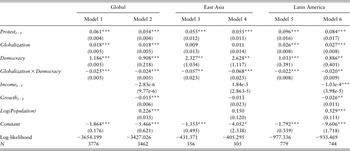
We present five sets of results. First, the estimates of the fixed-effect negative binomial models are provided (Table 1). Although estimated coefficients reveal the directions of association between the dependent and independent variables with some degree of uncertainty, it is difficult to interpret directly the coefficients from the negative binomial models because the effect of each estimated coefficient depends on the values of other independent variables and of the coefficients attached to those variables, as with other non-linear models (see Cameron and Trivedi, Reference Cameron and Trivedi1998; Brambor et al., Reference Brambor, Clark and Golder2006; Hilbe, Reference Hilbe2008). To overcome these pitfalls, we perform a statistical simulation (see McCloskey and Ziliak, Reference McCloskey and Ziliak1996). Following King et al. (Reference King, Tomz and Wittenberg2000)'s simulation method, we present the second set of results based on the statistical simulation (Table 2). Second, we report the estimates based on the alternative regime variable of Polity IV (Table 3) and its simulated results to demonstrate the robustness of our findings (Table 4). Finally, since it is plausible to suggest that dictatorships are more likely to tolerate peaceful vis-à-vis non-peaceful confrontations, we disaggregate our summed dependent variable Protest to check the robustness of our main results (Table 5).Footnote 10
Estimates of the fixed-effect negative binomial models by region

*P < 0.10, **P < 0.05, ***P < 0.01.
Note: Standard errors in parentheses.
Estimated effects of globalization and regime type on protest by region

Notes: Entries are the estimated event counts of Protest, calculated using Clarify 2.1. The level of globalization is measured by the one standard deviation (s) around its mean (μ) in the sample; low = μ−s, mean = μ, and high = μ + s. Standard errors are in the parentheses.
Estimates of the fixed-effect negative binomial models by region: alternative measure of political regime (Polity IV)

*P < 0.10, **P < 0.05, *** P< 0.01.
Note: Standard errors in parentheses.
Estimated effects of globalization and regime type on protest by region: alternative measure of political regime (Polity IV)

Notes: Entries are the estimated event counts of Protest, calculated using Clarify 2.1. AUTO denotes autocracy, PART partial democracy, and DEMO full democracy. The level of globalization is measured by the one standard deviation (s) around its mean (μ) in the sample; low = μ−s, mean = μ, and high = μ + s. Standard errors are in the parentheses.
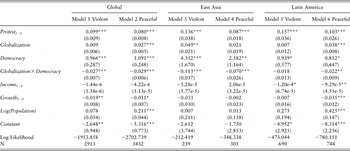
Estimates of the fixed-effect negative binomial models by region: disaggregated dependent variables – violent and peaceful protests

*P < 0.10, **P < 0.05, ***P < 0.01.
Notes: Standard errors in parentheses.
Table 1 presents the estimates of the fixed-effect negative binomial models (Models 1 and 2 estimate the pooled global sample, Models 3 and 4 East Asia, and Models 5 and 6 Latin America) for the period from 1970 to 2002.Footnote 11 Recall that the estimated effect of Globalization depends on the value of Democracy: (β 2+β 4Democracy)F(·)′. Since Democracy is a dichotomous variable coded 1 for democracy and 0 for dictatorship, the results in Model 1 for the global sample suggest that the average conditional effect of economic globalization is negative in democracy (−0.007F(·)′<0). This finding suggests that globalization entails depoliticization under democracy. Model 2 includes control variables of per capita income, growth, and population. Even after controlling for the economic and demographic factors, however, the conditional effect of economic globalization on extra-parliamentary political activities remains intact. Defying then the ‘backlash’ narrative, this global pattern confirms the depoliticization perspective.
We now split the sample into East Asia and Latin America where dual transitions of democratization and globalization have been most visible since the 1970s. The results of Model 3 for East Asia approximate the depoliticization trend of the global sample (Models 1 and 2). The conditional effect of economic globalization in Model 3 is negative (−0.048F(·)′<0). As the estimates of Model 4 indicate, including economic and demographic control variables does not change this depoliticization trend. Interestingly, the coefficients of the control variables are not statistically significant at the conventional level, implying that extra-parliamentary protest activities in East Asia are not driven by the economic and demographic factors.
In stark contrast to the global and East Asian trends, economic globalization in Latin America increases the level of extra-parliamentary protest activity under democracy, as indicated by the positive conditional effect of Globalization in Model 5 (0.004F(·)′ > 0). The results remain unchanged even in the presence of the statistically significant effects of Income, Growth, and Log(Population), as shown in Model 6. From the coefficients of the control variables, we can infer that unlike East Asia, economic and demographic factors also shape the level of protest activity in Latin America. While this finding points to the validity of the repoliticization perspective in Latin America (see Roberts, Reference Roberts2008), the estimated effect of globalization in Latin America appears to be greater under dictatorship than under democracy. As discussed above, however, one should be cautious about making direct inferences from the results in Table 1 because the average marginal effects of Globalization also depend on F(·)′, that is, the values and coefficients of other covariates.
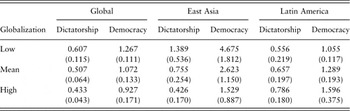
To give more substantive interpretations around the quantities of interest, we now provide the combined effect of globalization and political regime using a statistical simulation. Based on King et al. (Reference King, Tomz and Wittenberg2000), Table 2 presents the predicted event counts of Protest with statistical uncertainty using Model 1 (Global), Model 3 (East Asia), and Model 4 (Latin America).Footnote 12 The predicted event counts of Protest are computed for three different levels of Globalization (low, mean and high) and two types of political regime (democracy and dictatorship).Footnote 13 The levels of Globalization are measured by one standard deviation centered around the mean.Footnote 14 All the estimates are statistically significant at the conventional level. First, the predicted event counts of Protest across the samples for any level of globalization (low, mean and high) clearly demonstrate the strong statistical regularity that there is a higher level of riots and anti-government demonstrations under democracy than under dictatorship. That political regime matters for protest is not surprising because democratic institutions, again, create a favorable environment or opportunity for collective responses (e.g. McAdam et al., Reference McAdam, Tarrow and Tilly2001; Goldstone, Reference Goldstone2004). A more interesting issue to the paper's central purpose is to see if democracy plays a modifying role in shaping the domestic consequences of globalization – a role that up to now has rarely been systematically tested. In the global sample, the level of protests tends to be diminished as globalization deepens for both types of political regime; the predicted event count decreases from 0.607 at the low level of globalization to 0.433 at the high level of globalization in authoritarian regimes, and from 1.267 to 0.927, respectively, in democratic regimes. Although the degree of the decrease is small, we can detect that the global depoliticization tendency is in force. Globalization has affected extra-parliamentary politics despite the presence of democracy.
East Asia follows this global pattern of globalization-based depoliticization in a more explicit fashion. Compared with the global trend, political regimes in East Asia make the most difference in terms of the level of protests. For example, there are 3.286 more protests under democracy than under dictatorship at the low level of globalization. However, this distinctive regime effect is overwhelmed by the depoliticizing forces of economic globalization. The overall extent of decrease in the predicted event counts of protest is more dramatic than the global trajectory. The estimated number of protest drops radically from 1.389 at the low level of globalization to 0.426 at the high level of globalization under dictatorship, and from 4.675 to 1.529, respectively, under democracy.
By contrast, the predicted number of protests in Latin America increases from 1.055 at the low level of globalization to 1.596 at the high level of globalization under democratic institutions. As such, our results reveal that Latin America has taken an opposite direction, following the theorized repoliticization thesis. As economic globalization deepens, people in Latin American societies become more politically active, and under the favorable democratic environment, they are more likely to take to the streets against the economic threats tied to globalization. Interestingly, the overall estimated number of riots and demonstrations is higher in East Asia than in Latin America, but the protest activities in East Asia are decapitated precipitately by the expansion of globalization. In turn, the joint effects of globalization and democracy in Latin America strengthen the number of extra-parliamentary political activities.
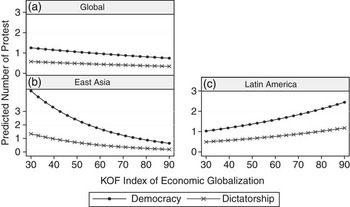
To visualize these differences among the global trend, East Asia and Latin America in Figure 1, we show the varying magnitudes of the effects of economic globalization by political regimes, using the same models as in Table 2. To show the different effects of the varying degrees of globalization, 20 predicted event counts of Protest are computed, setting Globalization at 20 different levels from 30 (low) to 90 (high). Consistent with the previous results, the graphs visibly demonstrate that independent of the level of globalization, democratic regimes in general entail more extra-parliamentary protest activities than authoritarian regimes. As the declining slopes from the graphs in Panel A and B show, however depoliticization takes place to some extent in the global sample but most evidently in East Asia. Moreover, the gap between the democracy and dictatorship lines in East Asia becomes narrower as the level of globalization rises, indicating diminishing regime effects as globalization deepens. The figure in Latin America is almost a mirror image of East Asia, illustrated by the rising slope in Panel C. Contrary to East Asia, the gap between the democracy and dictatorship lines becomes wider at higher levels of globalization than at lower levels. These contrasting pictures confirm our expectations: in Latin America, democratic institutions enable society to politically mobilize in response to the deepening of economic liberalization, while in East Asia globalization depoliticizes society even in the context of democracy.
Estimated effects of globalization and regime type on protest by region

Robustness checks
As discussed above, the ACLP dichotomous measure of regime type is not free from criticism, and one may wonder if these findings are statistical artifacts, solely driven by the choice of this regime variable. To demonstrate the robustness of the results, we conduct an additional estimation using our basic model specification of equation (1) with the alternative graded measure of regime based on Polity scores (Marshall and Jaggers, Reference Marshall and Jaggers2009). Fortunately, in this data set Polity IV covers a longer time-series from 1970 to 2006 compared to the updated version of ACLP, which includes the years from 1970 to 2002. Therefore, the robustness check takes in more observations, and ultimately provides greater confidence in the statistical inferences from Tables 1 and 2.
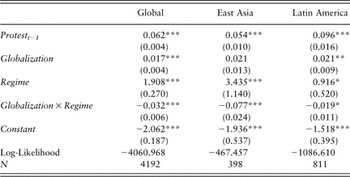
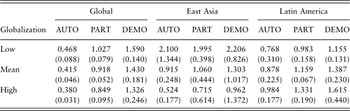
Table 3 reports the estimates for the three samples. With more observations and the alternative measure of political regime, the results remain qualitatively unchanged. The average estimated effects of Globalization on extra-parliamentary political activities are negative under full democracy (Regime equals 1) both in the global and East Asian samples, while its average estimated effect in Latin America is, again, positive in the presence of full democracy. As Regime is measured as a gradation from 0 to 1, a statistical simulation is also necessary to calculate more accurately the conditional effects of globalization. To perform this statistical simulation, we recode the Polity scores following Epstein et al. (Reference Epstein, Bates, Goldstone, Kristensen and O'Halloran2006)'s ‘trichotomous’ measure of political regimes. We re-categorize Regime into autocracy, partial democracy, and full democracy, and in the simulation, we set these regime categories at their average values.Footnote 15 Table 4 presents the predicted event counts of Protest by three levels of globalization and three regime type categories. The results, again, demonstrate that our core findings remain robust: depoliticization is detected in the global sample, far-reaching depoliticization is uncovered in East Asia, but strong repoliticization is revealed for Latin America.
A second concern was the stability of our results across each type of extra-parliamentary political activity summed into our dependent variable Protest. Table 5 presents the estimates for non-peaceful and peaceful extra-parliamentary protest activities for the three samples separately using the ACLP measure of regime type. In five of the six models, the interaction term Globalization × Democracy is statistically significant, and these estimates are consistent with the ones reported in Tables 1 and 3. Specifically, the average estimated effects of Globalization on non-peaceful and peaceful extra-parliamentary protest activities are negative under full democracies both in the Global and East Asian sample, while the average conditional effect of Globalization on peaceful extra-parliamentary protest activities is positive in the presence of full democracy in the Latin American sample. The only exception is the results for non-peaceful extra-parliamentary protest activities in the Latin American sample, which are not statistically significant at the conventional level, implying that neither depoliticization nor repoliticization in response to globalization can be inferred. Overall, the substantive conclusions of this article were not altered by differentiating non-peaceful and peaceful extra-parliamentary protest activities. Table 5 thus confirms our original findings and decision to use the summed dependent variable.Footnote 16
Conclusion
The dual transition toward economic liberalization and democracy has puzzled scholars for several decades as research has sought to understand how these complex phenomena complement or contradict each other. The depoliticization perspective views the combination of free markets and democracy as incompatible with each other, arguing that the forces of economic liberalization are inexorable and thus continue to move forward at the expense of robust democracy. The repoliticization perspective, in contrast, underlines the importance of democracy in creating a favorable environment or opportunity to address the economic-based threats caused by economic liberalization and globalization (Almeida, Reference Almeida2009). Thus, extra-parliamentary protest activity increases in response to globalization in democratic contexts. Exhausting available data, the empirical results reveal distinct trends of protest activity cross-regionally: depoliticization in East Asia, but repoliticization in Latin America. South Korea's experience with globalization, however, is much closer to Latin America – where incidentally the bulk of evidence advocating depoliticization originally accumulated. The repoliticization effects of globalization suggest that popular subjects in South Korea and across Latin America are not passive, atomized recipients of painful economic changes, but rather, are actively engaged in resisting or modifying the policies that affect their lives.
Not long ago, Tarrow (Reference Tarrow2002: 23) aptly noted that ‘terms like globalization and resistance open up topics for investigation … but they do not help us to grasp the mechanisms and processes involved in contentious interaction’. This paper has shown that democracy influences the relationship between globalization and extra-parliamentary protest activity – a relationship that up to now has remained systematically untested. Having established the varying cross-regional influence of democracy, future research should explore the meso-level political institutions that associate democratic political regimes with extra-parliamentary protest, as well as compensatory institutions typical of democracies that could dampen protest activity. In this area of research, Rudra (Reference Rudra2002) has recently shown that globalization has diminished social spending, particularly in countries where the structural power of labor is weak. However, since the welfare paths of countries vary cross-regionally – generally with greater entitlements in East Asia compared to Latin America (e.g. Haggard and Kaufman, Reference Haggard and Kaufman2008), the compensation capacity of states in East Asia is likely to be larger. This would suggest that people in East Asia exposed to globalization-related social risks are likely to be relatively well compensated, and less prone to engage in extra-parliamentary protest activity, compared to Latin American counterparts. Thus, it is possible that different welfare regimes may entail different levels of protest activity.
Future research should also explore how the recent surge in protest has affected the quality of democracy in these regions. Clearly, popular resistance to economic liberalization has been politically destabilizing in some contexts, but at the same time, it has produced a number of unexpected positive political developments in others. This future research should disaggregate the central variables used in this analysis to develop a more nuanced understanding of the specific elements of economic liberalization and democracy that are driving protest activity. It could be that certain aspects of economic liberalization, such as trade openness, are particularly repoliticizing (e.g. Munck, Reference Munck2007). Similarly, with regards to democracy, perhaps the quality of party representation is the crucial factor that structures the level of societal conflict (e.g. Arce, Reference Arce2010). Understandably, our paper has only begun to scratch the surface of these larger sets of theoretical and empirical questions regarding the consequences of globalization amid democratization.