Archaeologists have long been concerned with the relationship between craft production and political and institutional structures (Wailes Reference Wailes and Bernard1996). Economic differentiation and political complexity are often seen as inextricably intertwined and are widely perceived as the defining characteristics of early states and empires. Craft products can perform a number of functions in political economies: as exchange goods, as sources of wealth, as tools that produce the material infrastructure of complex societies, and as prestige goods or symbols of power and status. The relations between craft producers and institutions tend to be both multiple and multidimensional, with varying degrees of autonomy and interdependence, and much production can occur outside the control of the state (Sinopoli Reference Sinopoli2003). This paper explores some dynamic levels of interaction between the production of copper and copper-based goods and the centralized power of the Tarascan empire of Late Postclassic period Mesoamerica. Archaeological evidence and documentary sources provide a picture of organizational patterns in the pre-Hispanic Tarascan copper industry.
THE TARASCAN EMPIRE
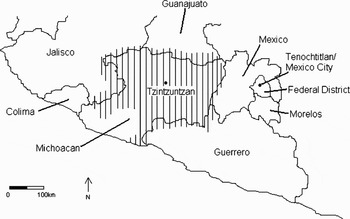
Empires can be defined as large, multiethnic states ruled from a single center (Sinopoli Reference Sinopoli1994, Reference Sinopoli2003). By definition, empires incorporate cultural and economic diversity. In the sphere of production, such diversity is manifested in scale and organization and the nature and degree of integration of different productive areas into an imperial order (Sinopoli and Morrison Reference Sinopoli and Morrison1995). In the early sixteenth century, much of western Mexico was under the rule of the Purepecha empire. People of the empire called themselves Irechequa and were later known to the Europeans as the Tarascan kingdom of Michoacan. The maximal extent of this political unit was roughly equivalent to the modern Mexican state of Michoacan, but it also included parts of Guanajuato, Queretaro, Jalisco, and possibly Guerrero and the state of Mexico (Gorenstein and Pollard Reference Gorenstein and Pollard1983; Pollard Reference Pollard1993; Warren Reference Warren1985). Between a.d. 1450 and 1520, the Tarascan state controlled a territory that extended beyond the Lerma River to the north and as far as the Balsas in the south (Figure 1). The core of the Tarascan empire was located in the Lake Patzcuaro Basin, covering an area of 929 km2 (Pollard Reference Pollard1993).
Approximate extent of the Tarascan empire during the Late Postclassic period, represented by the vertical lines (from Haskell Reference Haskell2003:Figure 2-1, adapted from Pollard Reference Pollard1993:5).

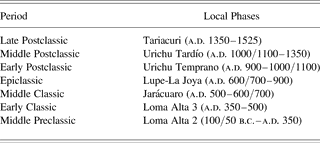
Using the number and distribution of settlements of the Late Postclassic period (a.d. 1350–1520) (see Table 1 for established chronology for the Patzcuaro Basin), Pollard (Reference Pollard1993:79) estimated the total population of the Patzcuaro Basin to have been between 60,750 and 105,000 with a mean estimated population of 80,000. At that time, more than 36% of the population lived in the primary center, Tzintzuntzan, and more than 80% lived in communities with more than 1,000 people. Thus, the Patzcuaro Basin was characterized by highly urbanized populations distributed in a variety of functionally differentiated communities. Tzintzuntzan encompassed slightly more than 6 km2. The city shows no overall plan, yet some individual structures and sectors can be interpreted as religious/political zones. Its growth as an urban center appears to have been initiated by political, not economic, factors (Pollard Reference Pollard1993).
Established chronology for the Patzcuaro Basin (Pollard Reference Pollard2005:9).

The Tarascan empire emerged when Tzintzuntzan gained control over five other polities in the Patzcuaro Basin as a result of intense competition between local elites for access to basic resources (Gorenstein and Pollard Reference Gorenstein and Pollard1983; Pollard Reference Pollard1993). According to colonial documents, between a.d. 1250 and 1350, an elite lineage known as the uacusecha (eagles) solidified the political control of Tzintzuntzan over the Patzcuaro Basin (Gorenstein and Pollard Reference Gorenstein and Pollard1983; Pollard Reference Pollard1993, Reference Pollard1997). Three additional administrative centers were created, resulting in a highly centralized and hierarchically organized administrative system under the rule of Tzintzuntzan. These administrative centers, however, were patronized by resident, non-royal elites (Gorenstein and Pollard Reference Gorenstein and Pollard1983; Pollard Reference Pollard1993). Political control was held and maintained by a hereditary dynasty with a vast and complex system of tribute (Pollard Reference Pollard1993).
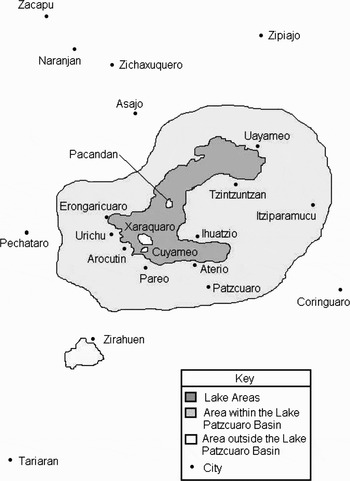
Gorenstein and Pollard (Reference Gorenstein and Pollard1983) applied a model of site stratification to basin settlement patterns and interpreted the upper-rank cities as corresponding to administrative units. They place Tzintzuntzan in two different ranks: in rank 1 as the administrative center for the territory, and the only settlement in rank 2 as the administrative center for the basin. The next administrative level used by the Tarascans is identified as the settlements governed by lords, or señores. Such señores were members of the rank 2 social class and had administrative responsibilities for the population of their own settlements and for the populations of dependent settlements. Rank 3 settlements were Eronguariquaro, Pechataro, Urichu, Pareo, Pacandan-Xaracuaro, Itziparamucu, Uyameo, and Patzcuaro (Figure 2). Seven of these eight settlements are considered to be of the same rank, with the exception of Patzcuaro, which played what appears to have been a representative role at conclaves for territorial representatives (Gorenstein and Pollard Reference Gorenstein and Pollard1983:69).
The Lake Patzcuaro Basin and vicinity (not to scale; from Haskell Reference Haskell2003:Figure 6-1).

According to the Relación de Michoacán (Alcalá Reference Alcalá2000 [1541]; Pollard Reference Pollard1993:123), in Tzinztzuntzan the cazonci (the paramount ruler of the Tarascan state) held court, administered justice, and received emissaries from within and outside his territory. The court included members of the Tarascan nobility in a series of hierarchically organized offices. Below the court was a large bureaucracy composed of members of the nobility and commoners. The village leaders represented the link between the Tarascan dynasty and the commoners, stressing that authority came from the central government and not from the local nobility. This flow of authority was supported by the basic system of land and resource ownership. All land titles and use rights within the Tarascan domain came from the king. This included agricultural lands, fishing rights, mineral resources, and hunting territories within the Patzcuaro Basin itself. In contrast with the Aztecs, Tarascan leaders as well as agricultural workers could be granted land in private ownership. There were also communal lands that were cultivated for the ruler and communal lands cultivated for the lower leaders and for the temples (Beltrán Reference Beltrán and Carrasco1986:46; Carrasco Reference Carrasco and Carrasco1986:68; García Alcaráz Reference García Alcaráz, Carrasco and Broda1976:222; Van Zantwijk Reference Van Zantwijk1967:41).
The organization of occupational groups was extremely important in Tarascan society. The Tarascan wards were endogamous, and occupations were hereditary, descending from father to son. So an occupational group was at the same time one lineage or combination of lineages, and the members of one occupational group lived in the same ward. The heads of the occupational groups may have been ward chiefs at the same time, which may account for the fact that ward chiefs are not mentioned separately. The Relación de Michoacán (Alcalá Reference Alcalá2000 [1541]; Van Zantwijk Reference Van Zantwijk1967:42–48) gives the following list of heads of occupational groups at the court of the Cazonci:
Kwahta-uri or Wekskuti, head of the house and temple builders.
Kakari, head of the kakacha, the masons.
Kwanikoti, head of the kwanikocha, the hunters and makers of bows and arrows.
Kuru-hapindi, head of the bird-hunters.
Waruri, head of the fishermen.
Tarama, head of the anglers.
Ehpuspati or kwapuakuri, head of the honey collectors and beekeepers.
Atari, head of the makers of pulque.
Kutusuri, head of the tanners (kutsucha).
Uskwarekuri, head of the feather-mosaic workers (uskwarekucha).
Pukurikwari, head of the foresters and gamekeepers (pukurikwacha).
Kwiringuri, head of the drum-makers.
Tekari, head of the carpenters (tekacha).
Cherenguekwa-uri, head of the makers of cotton war shirts.
Icharuta-wandari, head of the boat-builders.
Xurihkakaheri or Tzinahpeti, head of the healers of curers.
Urani-atari, head of the painters of cups.
Xunicha, deputy head of the painters.
Hukatsikwa-uri, head of the makers of vessels of food.
Tsitsikikanakwa-uri,, head of the weavers of flower chains.
Mayapeti, head of the merchants (mayapecha), particularly traders in gold, feathers and precious stones.
Kwatas-uri, head of the makers of trunks and tule-weavers.
Akawekwa-uri, head of the sandal makers.
Kwinguingata-uri or tayakata punitati, head of the smiths.
Tsinahpu-uri, head of the makers of obsidian knives.
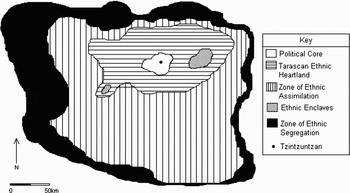
The Relación de Michoacán (Alcalá Reference Alcalá2000 [1541]) refers to earlier ethnic heterogeneity in central Michoacan. At the time of the Spanish contact, however, there was no indication of political and ethnic borders within the state (Pollard Reference Pollard1993:128). As the imperial territory enlarged, the economic and political success of the Protohistoric period Tarascans required that increasingly distinct communities be integrated (Figure 3). In this way they ensured the economic exploitation of populations and resources and protected the integrity of the states' frontiers. This integration was designed to serve the interests of the political core, the Lake Patzcuaro Basin, and it particularly had to serve the interests of the sociopolitical elite residing in Tzintzuntzan (Pollard Reference Pollard1993).
Areas of ethnic assimilation and segregation in the Tarascan empire (from Haskell Reference Haskell2003:Figure 2-2, following Pollard Reference Pollard, Brumfiel and Fox1994:84).

Pollard (Reference Pollard1993) believes that two processes, assimilation and segregation, were part of deliberate administrative policy during the state's development period. She identifies a zone of active assimilation as the place of origin of many resources basic to elite identification, including tropical fruit, cacao, cotton, copal, jaguar skins, tropical feathers, gold, silver, copper, and tin. This zone was absorbed into the expanding state only after a.d. 1440 and became increasingly important to the maintenance of Tarascan elite society. Population density in the assimilation zone was low, so revolts and insurrection were unlikely in this region. However, the core elite assured the loyalty of the groups in this region by applying a policy of gradual incorporation into the mainstream of the Tarascan social system and by the adoption of Tarascan ethnic identity.
In contrast, along the military borders, loyalty to the Tarascan elite was assured in exchange for the security provided by the state military structure (Pollard Reference Pollard1993). Administrators were sent from the political core to interact with the local population and ensure this loyalty. Nevertheless, the populations were regarded as subject allies rather than as subjects, and tribute included war captives and slaves. This ethnic strategy differed from that of the Aztecs. There was not an ethnic Aztec heartland but a zone of culturally similar populations inhabiting the Basin of Mexico, often sharing individual communities for their mutual benefit (Gorenstein Reference Gorenstein1985).
Within the Tarascan cultural system, goods and services flowed through several institutions that are divisible into two classes: (1) local and regional markets; and (2) government-controlled agencies. According to the definition provided by Hirth (Reference Hirth1998:454), market exchanges involve balanced and actively negotiated terms occurring in contexts that range from highly centralized to isolated. Tarascan government agencies controlled the tribute network, official long-distance trade, agricultural lands, forest lands, mines, and official gift exchange (Pollard Reference Pollard1987, Reference Pollard1993). Through these channels, goods and services flowed in and out of the Lake Patzcuaro Basin, incorporating it into regional and territorial economic networks. There is, however, no evidence that markets were controlled or regulated by the government (Pollard Reference Pollard1993). The exchange strategy in the Tarascan territory seems to correspond to a basically decentralized market system and therefore is characterized by an unequal distribution of resources throughout the society.
The Tarascan tribute network was vast, centralized, and hierarchically organized. It was fundamentally a political institution, with the bulk of goods passing through various levels from various regions of the territory and ultimately to the capital at Tzintzuntzan. In Tzintzuntzan, the goods were placed in central storehouses and distributed within the basin to the royal family, the administrative bureaucracy, the religious functionaries of the government temples, to foreign emissaries in the form of gifts, and to the local population in emergencies (Gorenstein and Pollard Reference Gorenstein and Pollard1983). In the initial period of war against the Aztecs, the stores were also used to supply the army (Gorenstein Reference Gorenstein1985). To the extent that these goods were consumed by the basin's population, they represented a significant portion of the local economy.
There is an important difference between goods used by the commoners and those used by the elite in the Tarascan territory. Commoners obtained goods through subsistence activities or local markets, while the elite obtained them primarily through state-controlled means, especially state lands (Pollard Reference Pollard1993). Apparently, local tribute was a main source of household services and some manufactured goods for the elite. This means that basin settlements with immediate access to valued resources such as prime agricultural land, marshland, and fishing zones could exchange local surpluses for non-local items in the marketplace. However, according to colonial sources (e.g., Relación de Michoacán), the local elite and possibly their retainers (such as artisans and other specialists) participated only minimally in such market exchange, obtaining similar products by outright ownership of production or by tribute (Pollard Reference Pollard1993:120).
According to D'Altroy and Earle (Reference D'Altroy and Earle1985), explaining the evolution of complex societies requires an understanding of how resources are mobilized to support the activities of new institutions. In ancient states, creating systems of taxation was basic to institutional development and maintenance. The Tarascan empire illustrates how the political economy underlies institutional expansion. Institutions of domination and integration formed the basis of the empire and created mechanisms to exert and legitimize force over a territory that had been composed of separate polities, economies, and ethnic identities. Support of these new imperial institutions necessitated the development of an elaborate political economy.
METAL AND THE POLITICAL ECONOMY OF THE TARASCAN STATE
Archaeological and ethnohistorical evidence indicate that during the Late Postclassic period (a.d. 1350–1520) the Tarascan empire was the primary center for metallurgy and metalworking in Mesoamerica. Such technology was largely based on copper and its alloys. Although some utilitarian implements were made, most Tarascan metal objects were considered sacred, to be used for adornment in religious ceremonies and to enhance the social and political status of the elites (Hosler Reference Hosler1988a, Reference Hosler1994; Pollard Reference Pollard1987, Reference Pollard1993), thus becoming an integral part of the political economy of the state.
The presence of craft producers with a considerable degree of specialization in the production of metal goods can be assumed from the relatively restricted spatial distribution of such products, the specific social and political context of their production and distribution, and the technological complexity of the industry behind their manufacture. Scattered references to these craft specialists in documentary sources support this assumption. For the purposes of this paper, political economy is defined broadly as the relations between political structures and systems and the economic realms of production, consumption, and exchange (Stein Reference Stein, Feinman and Price2001:359). The concept of specialized craft production is understood here as the investment of labor by (more or less) skilled workers in the production of goods that in turn are consumed by non-producers (Sinopoli Reference Sinopoli2003:1).
Pollard (Reference Pollard1987, Reference Pollard1993, Reference Pollard1997) has suggested that in the process of defining Tarascan elite culture, the central dynasty encouraged the development of metal as a distinctly Tarascan product. The rapid expansion of the Tarascan state between a.d. 1350 and 1450 provided a direct means of increasing the emerging elite's access to metal goods, primarily in the form of conquest booty and tribute. Metal adornments used as insignias of social status and public ritual became even more associated with political control (Pollard Reference Pollard1987). It is important to keep in mind, however, that, although on a minor scale, copper implements such as hoes and axes were also being manufactured. This point is discussed further later in this paper.
As part of a larger centralization of political and economic power by the royal dynasty, mining and metallurgy appears to some extent to have become a state industry by the sixteenth century. Pollard (Reference Pollard1987) points out that the most active zone of cultural assimilation of non-Tarascans to Tarascan ethnicity in the empire was the central Balsas region which, coincidentally, was also an area where major mining operations were being carried out. She proposes that by the sixteenth century, metal goods and the control of access to metal was no longer a reflection of individual social or ritual power. Instead, it was a reflection of royal and state political power. Hence, metal products were not just luxury goods used by the elite but basic material expressions of political ideology essential to the maintenance of the prevailing social and political order.
Patterns of Distribution and Consumption
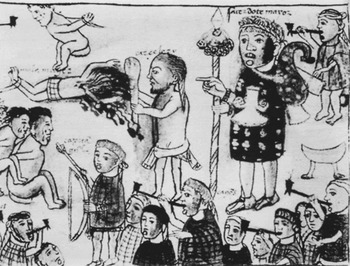
The use of fine metal goods within Tarascan territory appears to have been restricted to the social and political elite. Implements used for subsistence activities, such as hoes and axes, were produced, but not in quantity, and may even have been traded through local market networks within the Balsas Basin (Barrett Reference Barrett1987; Pollard Reference Pollard1987; Warren Reference Warren1968). Other copper tools, including needles, awls, punches, and fishhooks, appear to have been widely distributed, but their procurement and use was probably limited to craft or occupational specialists (Hosler Reference Hosler1994; Pollard Reference Pollard1987). Presumably, all other metal goods were limited to the central dynasty and the nobility (Figure 4). Excavations at Tzintzuntzan (Grinberg Reference Grinberg1989; Pollard Reference Pollard1987; Rubín de la Borbolla Reference Rubín de la Borbolla1944), Urichu (Hosler and Macfarlane Reference Hosler and Macfarlane1996; Pollard Reference Pollard, Williams and Weigand1995) and Huandacareo (Macías Goytia Reference Angelina1990), among other sites, have produced large numbers of metal objects from elite burials. This information is consistent with accounts in the Relación de Michoacán (Alcalá Reference Alcalá2000 [1541]), probably one of the best known ethnohistorical sources on the Tarascans, which also refer to the existence of treasuries located at Tzintzuntzan and at six other centers in the Lake Patzcuaro Basin. The metal stored in these treasuries was exclusively for use in state religious ceremonies and under the custody of a head treasurer and other noblemen (Alcalá Reference Alcalá2000 [1541]; Pollard Reference Pollard1987).
Scene from the Chronicles of Michoacán (Craine and Reindorp Reference Craine and Reindorp1970:Plate 19). The main figure, a Tarascan priest, is wearing a metal tweezer.

The state government, according to Pollard (Reference Pollard1987, Reference Pollard1993), acquired finished metal goods and/or smelted ingots through different mechanisms, including: (1) as gifts presented by foreign visitors and regional elite to the king; (2) from government long-distance merchants at the border of the empire's territory; (3) as tribute paid to regional elites who in turn contributed part (or all) of the received goods to state storehouses in Tzintzuntzan; and (4) through the direct movement of copper ingots from state-controlled mines to the state storehouses. While the consumption of finished metal goods was highly concentrated within a limited social and spatial territory, the production of metal from ore was dispersed throughout the Tarascan territory (Hosler Reference Hosler1994; Pollard Reference Pollard1982, Reference Pollard1987). Ethnohistorical evidence suggests that production took place at a number of locations within the domain of the Tarascan empire (Pollard Reference Pollard1987).
THE SYSTEM OF PRODUCTION OF METAL GOODS
Preindustrial metallurgy is often discussed as if it were a single technological process. The successful transformation of metalliferous ore into finished metal objects, however, involves many individual stages. Numerous choices have to be made throughout the production sequence. Moreover, a specific body of knowledge and skills is required that includes the procurement of minerals from which to extract metal (extractive metallurgy); the identification and use of alloys; the working of metal through some mechanical method (hot or cold hammering) or by fusion and molding (foundry); and the application of solder, polishing, and other finishing techniques (Grinberg Reference Grinberg1990, Reference Grinberg and Cervantes1996, Reference Grinberg2004). Such knowledge implies an efficient use of what Forbes (Reference Forbes1950:24) has called “the four essential elements of metallurgy”: (1) the mining of ores; (2) fuel and fire making; (3) the production of blast air by draught; and (4) the necessary tools, furnaces, and crucibles.
Several important questions arise from the facts above. How many different categories of producers participated in the manufacture of metal items in the Tarascan empire? What was the degree of specialization of these producers in their particular craft? What was the level of involvement of the central power of the state and the elites in each of the stages of production of this craft? Although current data for mining and extractive metallurgy in Mesoamerica are sparse and unclear, important aspects of the metallurgical chaîne opératoire (Leroi-Gourhan Reference Leroi-Gourhan1963) for Tarascan copper production, including ore deposit exploitation and mining, smelting, and final processing, can be inferred from a combination of ethnohistorical, archaeological, and geological data.
Ore Deposits and Mining
Western Mexican metallurgy and metalworking, especially among the Tarascans and their neighbors, was based mainly on copper and its alloys (Hosler Reference Hosler1994; Pollard Reference Pollard1987). Most minerals that Tarascan metal smiths processed are abundant within the territory of the empire, including copper oxides and sulfides; native copper is also present. Artifactual evidence suggests that some, or perhaps most, of these sources of copper were being exploited by about a.d. 650 (see Hosler Reference Hosler1994). Pre-Hispanic copper exploitation, however, reached its height during what Pollard (Reference Pollard1982, Reference Pollard1987, Reference Pollard1993, Reference Pollard1997; Gorenstein and Pollard Reference Gorenstein and Pollard1983) has called the Protohistoric period (a.d. 1450–1530) in the Tarascan domain. In the sixteenth century, the Tarascan language used the term tiyamu charapeti haracuquaro to refer specifically to copper mines (tiyamu charapeti meaning copper, or “red metal”; see Warren Reference Warren1991). Unfortunately, apart from linguistic facts and discrete references to several mines in Spanish colonial documents (Grinberg Reference Grinberg, Dahlgren and Arechavaleta1995; Hosler Reference Hosler1994; Pollard Reference Pollard1987; Roskamp Reference Roskamp and Hernández2001; Warren Reference Warren1968), little is known about copper mining in the Tarascan territory or in Mesoamerica in general.
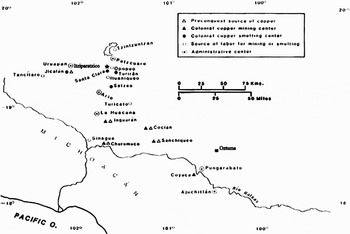
Hosler and Macfarlane (Reference Hosler and Macfarlane1996) carried out lead-isotope studies of copper ores from several deposits in western Mexico, Oaxaca, and Veracruz, as well as of a representative sample of copper artifacts recovered from excavations at a number of Protohistoric sites in western Mexico and other areas in Mesoamerica. Among these sites was Urichu, one of the eight administrative centers of the Tarascan state. The results of these scientific analyses indicate that specific mining zones, Inguaran and Bastan (near La Huacana) in Michoacan (Figure 5), and the regions of Ayutla and Autlan in Jalisco, provided copper metal for Urichu and a number of other sites in western Mexico and beyond. The Relación de Michoacán and other colonial documents make extensive reference to Inguaran and Bastan and report copper mines in neighboring districts such as Sinagua, Guayameo, Tacambaro, and Turicato. The exact means of access to and procurement of the ore-bearing resources, however, remain to be defined.
Mining centers in the central Balsas Basin (adapted from Barrett Reference Barrett1987:Map 2).

Apparently, the bulk of the metal that moved into the Patzcuaro Basin came in the form of tribute, which was delivered with regularity (Paredes Martínez Reference Paredes Martínez and Paredes Martínez1984; Pollard Reference Pollard1982, Reference Pollard1987). The primary supplier of copper was the central Balsas Basin, in the southern portion of the Tarascan territory, the region in which the mining zones of La Huacana, Turicato, and Sinagua are located. Paredes Martínez (Reference Paredes Martínez and Paredes Martínez1984) and Pollard (Reference Pollard1987) have suggested that during the last century of the Tarascan empire, the state took a more direct control of the copper resources of this particular region than simple tribute. This idea is largely based on accounts in Legajo 1204 of the Archivo General de Indias, an important (Warren Reference Warren1968), an important sixteenth-century (1533) manuscript dealing with copper mines in Michoacan, which suggests that the cazonci sent workers to extract copper from the mines of La Huacana to meet his needs (Pollard Reference Pollard1987:748; Warren Reference Warren1968:47, 48). Some mines, however, continued to be exploited through the tribute system (Pollard Reference Pollard1987). Pollard (Reference Pollard1982, Reference Pollard1987) has pointed out, however, that the schedule for payments of copper either every 40 days or on demand substantially exceeds that of any other tributary item for the central authority.
Legajo 1204 indicates that mining activities and smelting operations often took place at separate locations within the central Balsas Basin. While mining centers were concentrated at Churumuco, Sinagua, Cutzian, and La Huacana, among others, smelting operations were carried out at La Huacana, Cutzian, and Huetamo-Cutzio (Pollard Reference Pollard1987; Warren Reference Warren1968). At the Cutzian mine alone, there had been up to 50 miners and 40 others, some of whom were moving the dirt and minerals out of the mines and some of whom were processing the ore (Warren Reference Warren1968:49). Accounts in Legajo 1204 also declare that the metalworkers from La Huacana region owned and cultivated the fields at the foot of the hill where the copper veins were mined. This suggests that mining and metallurgy (at least at this particular location) represented part-time activities, undertaken mostly during the slack period in the agricultural season. The great climatic variation between the rainy and dry seasons in the region supports this assumption. During the rainy season, the mines were probably flooded, while during the dry season, agricultural production must have fallen dramatically due the region's extreme aridity. The miners/smelters most likely alternated between metalworking and farming according to the seasons as well as to royal demands (Grinberg Reference Grinberg and Cervantes1996:433).
After grinding the mineral and mixing it with ground charcoal, the metalworkers used blowpipes to smelt it into an ingot one hand long, one hand wide, and two fingers high (Grinberg Reference Grinberg and Cervantes1996:433; Pollard Reference Pollard1987:748; Warren Reference Warren1968:37). According to calculations by Grinberg (Reference Grinberg and Cervantes1996:433), 20 smiths together produced one carga (load) of copper per day and one montón (charge) per month. One carga, therefore, comprised 20 ingots and probably weighed about 90 kg. A montón was the production achieved in 20 days, the length of a Mesoamerican month, which amounted to 400 ingots, weighing about 1,800 kg. These figures, however, seem high and may require reevaluation.
Smelting
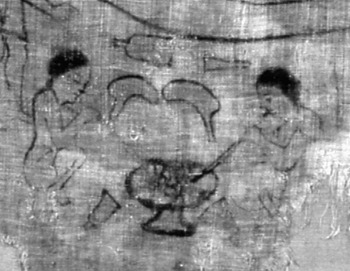
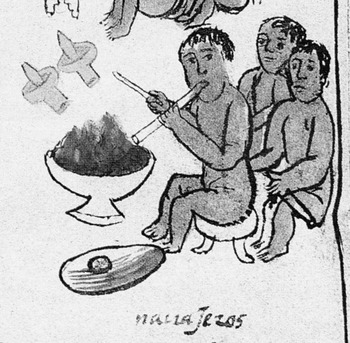
Although ethnohistorical sources provide some information on Tarascan extractive metallurgy, the technological processes that native metalworkers used for the extraction of copper from their ore and the organization of the craft itself remain poorly understood. Probably the most famous ethnohistorical source regarding pre-Hispanic mining and metallurgy is the Lienzo de Jicalan or Lienzo de Jucutacato, a pictographic document that dates from the second half of the sixteenth century (Grinberg Reference Grinberg, Dahlgren and Arechavaleta1995; Roskamp Reference Roskamp and Hernández2001). The document was produced and used as proof of the rights that the indigenous authorities of Jicalan claimed over several mineral deposits, copper sources, and soil-based colorants in the tierra caliente (hot lands) of Michoacan. This document illustrates metalworkers crouching in front of a brazier, heating metal by blowing through pipes (Figure 6). Similar representations are shown in the Relación de Michoacán (Figure 7) (Alcalá Reference Alcalá2000 [1541]:Plate XI) and in central Mexican documents such as the Florentine Codex (Sahagún Reference Sahagún, Anderson and Dibble1950–1982 [1590]) and the Codex Mendoza (Berdan and Anawalt Reference Berdan and Anawalt1992). These illustrations, I believe, may represent melting of metal ingots for final processing rather than smelting of ores.
Mesoamerican crucible and blowpipes (from the Lienzo de Jicalan, in Roskamp Reference Roskamp and Feder-Nadoff2004:Figure 6).

Mesoamerican crucible and blowpipe, from the Relación de Michoacán (Alcalá Reference Alcalá2000 [1541]:Plate XIX).

According to early Spanish accounts, the actual extractive operations were carried out by heating small quantities in shallow earthen pits lined with a mixture of clay and ash and intensifying the heat by blowing through cane tubes (Barrett Reference Barrett1987:15). Similar descriptions appear in the Relación de Michoacán (Alcalá Reference Alcalá2000 [1541]:Plate XXIX) and other documents, including Legajo 1204 (Warren Reference Warren1968:46, 48). Documentary sources also point out that, with this method, it was necessary to heat two or three times to produce metal of useful quality. I infer that part of this process actually may have involved roasting the ore to remove impurities before smelting. When Spaniards took over the local copper industry of Michoacan in 1533, natives were employed as both miners and smelters and for decades continued to use the metallurgical techniques that they knew. The only significant technological change introduced by the Spanish occurred sometime after 1599, when blowpipes were replaced by animal-skin bellows (see Barrett Reference Barrett1987). Artisans from Santa Clara del Cobre, a modern Tarascan municipality in Michoacan, maintain traditional techniques for working copper to this day. Essentially, the method employed by these contemporary craftsmen is based on the use of the cendrada, a hole in the ground lined with oak ashes that functions as a mold to produce a tejo (a disk-like copper ingot) that is then hammered into finished shapes. Information provided by written sources, along with the factual presence of smelting waste products (known as slag) on the surface of archaeological areas near Santa Clara, suggests that the ongoing production of copper has its roots in pre-Hispanic traditions (Horcasitas de Barros Reference Horcasitas de Barros1981; Maldonado Reference Maldonado2002).
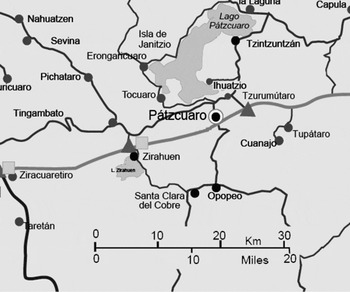
Santa Clara del Cobre is located approximately 19 km south of Patzcuaro and 29 km from Tzintzuntzan (Figure 8). The community was officially founded when a curacy (which also included the neighboring town of Opopeo) was instituted in 1577, although it had started as a congregation settlement 20 years earlier (Paredes Martínez Reference Paredes Martínez and Michele2004). Presumably because of its strategic location in the pine-oak uplands, where forests would provide an ample supply of charcoal (and there would be enough charcoal makers), in 1604 Santa Clara del Cobre was chosen to establish the royal copper smelter under the administration of Spanish officials. The community of Santa Clara would become the most important smelting center in the New Spain, despite its location in the region of La Huacana, about 125 km away from the mines that supplied the ore (Barrett Reference Barrett1987; Paredes Martínez Reference Paredes Martínez and Michele2004). Documentary sources are not clear as to whether metalworkers in Santa Clara were local or had been congregated from the mining region. A particular account referring to the difficulties that the Spanish had in obtaining enough workers (due to the dramatic decline in native population during the sixteenth century) states that in 1604, the viceroy granted the right to use smelters from Opopeo to a copper administrator because “they were the only ones left who knew this type of work” (Archivo General de la Nación, Reales Cédulas Duplicadas, in Barrett Reference Barrett1987:23). This strongly suggests the existence of metalworkers in the area prior to the Spanish arrival. It also provides another reason for Spaniards to locate their smelting operations there.
Santa Clara del Cobre-Opopeo (based on Universidad Michoacan de San Nicolás de Hidalgo Road Map 2003).

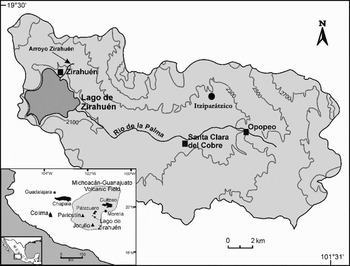
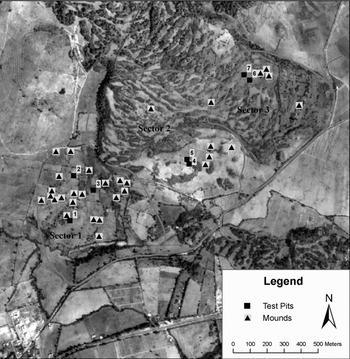
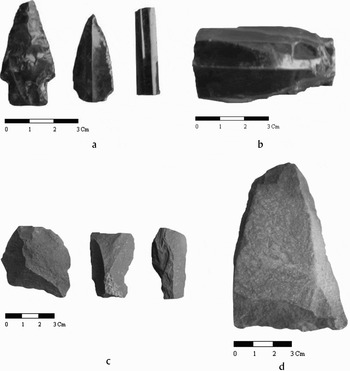
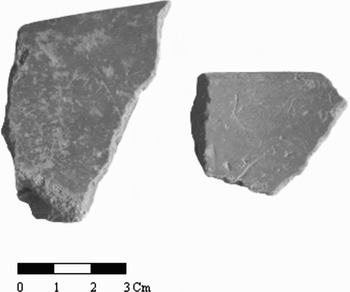
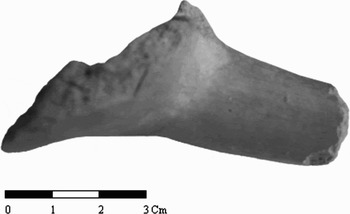
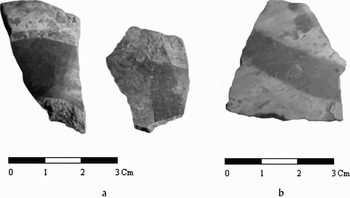
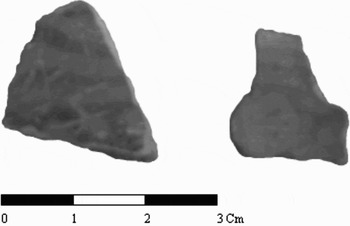
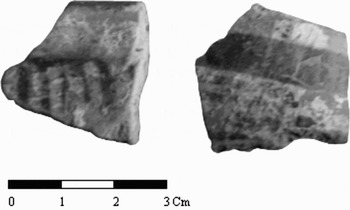
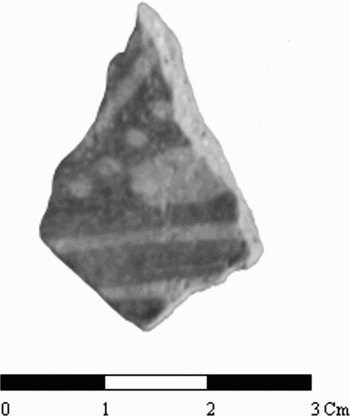
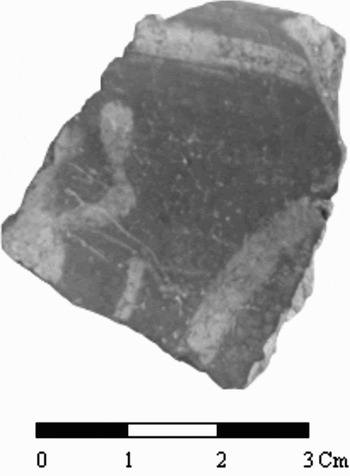
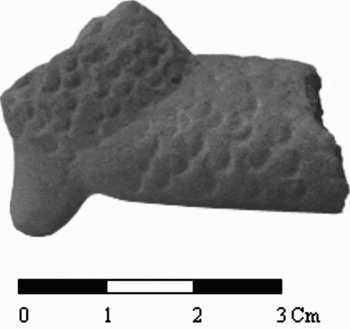
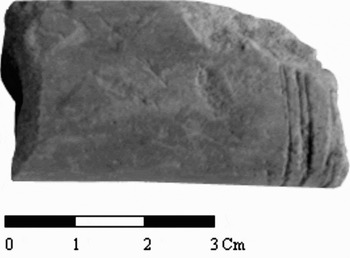
Recent archaeological investigations at the archaeological zone of Itziparatzico, located in the Zirahuen Basin, near Santa Clara del Cobre and Opopeo (see Figure 9), have documented new evidence for studying aspects of pre-Contact extractive metallurgy of copper in the Tarascan domain. Surface survey identified and mapped three major sectors of the site (Figure 10) (Maldonado Reference Maldonado2003). While artifactual evidence is present at varying densities throughout the research area, slag concentrations were located almost exclusively at one particular sector (Sector 1 in Figure 10). Other materials include moderate amounts of lithics (Figure 11a–d) and potsherds (Figures 12–18), as well as a set of stylistically diverse Tarascan pipes (Figures 19–20). Pollard (personal communication 2003, 2006) has positively identified these pipes and several polychrome ceramic fragments as Late Postclassic period in date. The combination of ceramic pipe fragments, Tarascan polychrome ceramics, and prismatic blade fragments (probably from Ucareo), indicates presence of Tarascan elite at this location (Pollard and Cahue Reference Pollard and Cahue1999; Pollard et al. Reference Pollard, Amy Hirshman, Glascock, Williams and Weigand2001). A second sector (Sector 2) of Itziparatzico consists basically of terraces, both occupational and agricultural, and presents the highest densities of potsherds and lithics on the surface. The third sector investigated (Sector 3) contains numerous mounds, as well as lithic and ceramic materials on the surface (Figure 10). The nature and the density of the archaeological artifacts seem to indicate that the area experienced its most significant occupation during the Late Postclassic period, and it may involve more than one site.
Location of Itziparatzico within the Zirahuen Basin and the state of Michoacan (modified from Davies et al. Reference Davies, Metcalfe, MacKenzie, Newton, Endfield and Farmer2004:Figure 1).

Three main sectors of the Itziparatzico area (map by P. van Rossum 2006).

Lithics from Itzparatzico: (a) gray-black obsidian arrowhead, modified flake, and prismatic blade; (b) gray-black obsidian core; (c) basalt tools; (d) basalt axe.

Polished red slip ware from Itziparatzico.

Red-slipped stirrup spouted vessel fragment.

(a) red-and-white-on-cream rim and body fragment; (b) red-and-white-on-cream body fragment.

Red ware with negative resist decoration.

Decorated red-and-black-on-white pottery.

Decorated black-on-white pottery.

Decorated white-on-red pottery.

Zoomorphic pipe fragment.

Pipe fragment showing incised decoration.

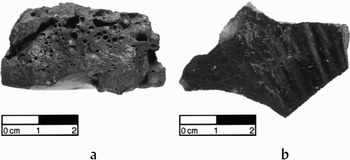
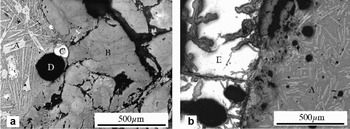
Archaeological test excavations conducted at Itziparatzico produced large amounts of slag. Unfortunately, no identifiable metalworking structures (furnaces, hearths, or pits) were found during the investigation. The absence of metallurgical materials other than slag (e.g., crucible fragments, mold fragments, stock metal, metal prills, failed castings, partly manufactured objects, and spillages) around Itziparatzico seemed to indicate that only primary copper production had been carried out at the site. Primary production involves the actual smelting or extraction of metal from its ore by heating. Secondary production, or smithing, implies the working or forging of metals into artifacts (Bachmann Reference Bachmann1982). Samples of the collected slag (Figures 21a–b) have been analyzed for microstructure and composition using light microscopy, scanning electron microscopy and energy dispersive spectrometry (SEM/EDS) and X-ray fluorescence (XRF). The analyses of slag samples corroborate that the production activities carried out at Itziparatzico involved primary smelting. The identification of un-reacted ore, together with prills of copper sulfide and copper (Figure 22), unambiguously characterize this material as copper slag. The mineral ore processed was a sulfidic ore, chalcopyrite (CuFeS2). The dominance of fayalite and the presence of copper prills indicate a high smelting temperature, of about 1,100 °C and reducing conditions (Maldonado et al. Reference Maldonado, Rehren, Howell, Vandiver, Mass and Murray2005).
(a) Lumpy slag fragment from Itziparatzico; (b) platy slag fragment from Itziparatzico.

Low magnification images of a typical slag sample from Itziparatzico. (a) Region of slag that contains a fayalitic solidification structure (at A), together with a polycrystalline aggregate of un-reacted quartz grains (at B). A duplex copper/copper sulfide prill (C) is seen in association with a gas bubble (D); (b) regions of the slag that contain fayalitic slag (A), together with an un-reacted aggregate of chalcopyrite (E).

The evidence found at Itziparatzico raises important questions about the chronological context and development of the primary production of copper at the site. The technology employed in the process involved an efficient, highly reducing smelting environment, which would be difficult to achieve using lung-powered blowpipes (Rehder Reference Rehder1994). If the smelting activities at Itziparatzico involved the use of bellows, we may well be dealing with a relatively early post-Contact production area that greatly overlapped with pre-Hispanic traditions, as indicated by the ceramic and lithic evidence. Alternatively, if the operations at the site were Late Postclassic period in date, this would indicate that Tarascan metalworkers had developed a copper-smelting method that involved some form of natural draft. The exposed position to prevailing strong winds in this area (especially during the dry season) have led me to consider that natural, wind-aided processing may have taken place at the site. Such a presumption, however, will have to be verified by further archaeological investigations and experimentation. The use of wind power for smelting has been identified at a number of sites in the Old World (Craddock Reference Craddock2001) and has been suggested for pre-Hispanic northern Peru (Shimada et al. Reference Shimada, Epstein and Craig1983). In either case, copper ore (chalcopyrite) was brought to Itziparatzico for smelting, and copper ingots were then transported elsewhere for their final processing (Maldonado et al. Reference Maldonado, Rehren, Howell, Vandiver, Mass and Murray2005). The mineralogy of chalcopyrite is consistent with the sulfidic ore bodies that make the mining district of La Huacana (Carranza et al. Reference Carranza, López, Pérez and Yáñez1995).
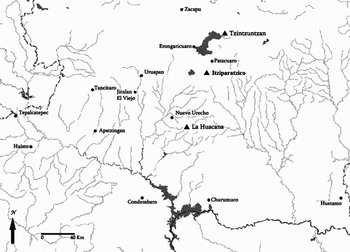
Considering the apparent involvement of the Tarascan state in the extraction of ore, it is possible that the smelting operations were also under some degree of supervision. As the demand for copper by the central dynasty increased, one might suggest a model in which the Tarascans established a production and distribution system to obtain metal from different locations and divided the industry into small components that could be easily managed: mining, transportation of copper (and probably tin) ores from different locations, smelting, alloying, finishing by casting and forging. The new system may have started with the smelting of ores away from the mines at sites such as Itziparatzico, which had access to high-quality charcoal (made of oak wood, which has a far more efficient combustion than fuel made from scrub trees around the mines) for smelting and was located strategically on the route connecting the central Balsas region and the Patzcuaro Basin (Figure 23). The geographic situation of the site is also important because of the potential use of the strong winds, which would provide a constant draft of air for highly efficient smelting. Ore had to be carried some 125 km, which would also imply an increase in efficiency of the transport system to cope with high transportation costs. According to accounts in the Relación de Michoacán and Legajo 1204, processed ingots were transported for final manufacture on the backs of tlamemes (the Nahuatl term for human carriers), each load consisting of 20–30 ingots (Warren Reference Warren1968:47, 49), which weighed 32–72 kg (Pollard Reference Pollard1987:748). Based on information found in Legajo 1204, Pollard (Reference Pollard1987:750) has estimated that the major smelting centers of La Huacana and Cutzian were a two-day' journey from Tzintzuntzan. These figures make the transport of ore to a relatively intermediate point such as Itziparatzico seem plausible.
Location of Itziparatzico and other mining and smelting localities within the Tarascan territory (modified from Roskamp et al. Reference Roskamp, Mario Retiz and Cárdenas2003:Figure 4).

Itziparatzico does not represent an isolated occurrence. Large deposits of slag in (presumably) pre-Hispanic contexts have been recorded at Jicalan El Viejo, a Late Postclassic/Early Colonial-period site that occupied a strategic position on the frontier between the tierra caliente, to the south, and the Sierra Tarasca, to the north (Figure 23) (Roskamp et al. Reference Roskamp, Mario Retiz and Cárdenas2003). Slag samples from Jicalan were subjected to the same analyses as the samples from Itziparatzico, producing similar results; evidence of smelting technology that used sulfidic ores and very efficient furnaces. Incidentally, the site is also located in an area where wind-powered pyrometallurgy seems feasible (Roskamp, personal communication Reference Roskamp and Feder-Nadoff2004, 2006). The organization of the production and the complexity implied in the task of smelting sulfidic ores seem to have involved full-time craft specialists. Conversely, if consistent with mining activities (and the wind regime), the smelting operations may have been seasonal. Evidence for the presence of specialized Tarascan smelters is found in testimony in Legajo 1204, which, in reference to copper smelters in La Huacana region in 1533, states
- que los indios comunmente no lo saben soplar ni hacer [el cobre] sino son los que son maestros que en cada pueblo donde hay minas hay doce o quince fundidores que lo saben sacar [Warren Reference Warren1968:37].
that the indians do not commonly know how to heat up or make [the copper] but only the ones who are masters [know]; in every town where there are mines there are twelve or fifteen smelters who know how to obtain it.
Final Processing
The types of metal artifacts and the manufacturing methods and materials (pure metals and alloys) that Tarascan metalworkers employed in their fabrication have been relatively well documented (e.g., Grinberg Reference Grinberg1990, Reference Grinberg and Cervantes1996, Reference Grinberg2004; Hosler Reference Hosler1988a, Reference Hosler1988b, Reference Hosler and Maddin1988c, Reference Hosler1994; Pendergast Reference Pendergast1962; Rubín de la Borbolla Reference Rubín de la Borbolla1944). Copper was alloyed with tin and/or arsenic to produce bronzes or mixed with various concentrations of silver, gold, or both to fashion bells, ornamental tweezers, rings, and body ornaments. Although bronzes were also used to manufacture tools such as axes, hoes, and needles, the main focus of Tarascan metallurgy was on sumptuary objects that reflected fundamental religious and political agendas. Metals were directly associated with particular deities and the cazonci, as the human representative on earth of the patron god Curicaueri, also shared this association (Hosler Reference Hosler1994; Pollard Reference Pollard1987). Given these facts, it is not surprising that the greater part of the metal items produced in the Tarascan territory were concentrated in the royal palace and associated quarters of the social and political elite in Tzintzuntzan, as well as in royal treasuries of the Lake Patzcuaro Basin. Outside the core of the empire, metal objects were found in relatively small quantities in elite contexts and, to a limited extent, as implements for basic production (Pollard Reference Pollard1987).
The Relación de Michoacán refers to a kind of guild system in the crafts in the Tarascan core, each craft being under the authority and supervision of a subject of the cazonci (Alcalá Reference Alcalá2000 [1541]:171–178; Warren Reference Warren1985:20–21). While the presence of guilds is questionable (since no evidence of their existence has been reported anywhere else in Mesoamerica), artisans who were in some way attached to the palace in Tzintzuntzan appear to have produced a wide range of goods for the royal household, including objects of gold, silver, and copper. Although it is not clear whether these were royal retainers or individuals paying tribute in specialized activities (Gorenstein and Pollard Reference Gorenstein and Pollard1983:103; Pollard Reference Pollard1982:259), the evidence, points toward a category closer to the former. Attached specialization (following Brumfiel and Earle Reference Brumfiel, Earle, Brumfiel and Earle1987; Costin Reference Costin and Schiffer1991) has been conceptualized as one end of a continuum (opposing independent specialization) in the relationships of producers to sociopolitical institutions and/or patrons, in which institutions or elites directly regulate some aspects of craft production, including control over raw materials, access to finished products, and producers themselves, among others. In this case, the concept applies because the raw materials (metal ingots) were owned by the state; the distribution of metal goods was socially and spatially restricted; and the specialists in the craft worked under supervision. Given that the manufacture of metal objects was also taking place outside the capital, it is likely that analogous contexts of attached craft production existed in elite compounds in the administrative centers of the Patzcuaro Basin.
The storage of ingots brought from the smelting sites ensured a stable supply of raw material for metalworking, which also may have facilitated production of metal goods as the primary economic task in which the craftsmen were engaged—that is, full-time specialization (Costin Reference Costin and Schiffer1991). Although references regarding the principles for recruiting these specialists are not currently known, it is well known that in Aztec society masters of trades taught their profession to their sons from childhood (Berdan and Anawalt Reference Berdan and Anawalt1992:145). It is possible that the system in the Tarascan state in the Late Postclassic period was similar to that of central Mexico at the time. Nahuatl speakers also used two different terms to distinguish between “gold casters” and “copper finishers” (Sahagún Reference Sahagún, Anderson and Dibble1950–1982 [1590]: Vol. 10, Part 11, Chapter 7, Figures 33–34). The Diccionario grande de la lengua de Michoacán (Warren Reference Warren1991) makes a clear distinction between the terms metal melting (tiyamu ytsieranstani) and metal casting (yurehpanstani tiyamu), which may indicate a comparable subdivision within the metal craft. However, this separation of terms could have served simply to describe different stages of manufacture. While we do not know the nature and size of the production units, both the patterns of distribution and the context of production suggest small workshops, probably within the elite households themselves. Given the apparent spatial circumscription of metalworking, the complete process of production of an artifact, including melting, alloying, and casting or forging, may have been in the hands of the same individual or individuals.
DISCUSSION
The diverse arenas of copper production in the Tarascan empire present very different pictures in terms of the forms and degrees of craft specialization and elite involvement and control. Here, as in other contexts of production and consumption of specialist craft products, individuals and groups are linked in intricate webs of interdependence and interaction. Tarascan copper production involved social groups of various sizes, including procurers or producers of raw material (who may include other specialists, such as miners, charcoal producers, and smelters who provided ores and smelted materials to forgers or casters) and people involved in various stages of production and distribution. Producers also interacted with those who acquired and used their products (i.e., elite patrons). The Tarascan multidimensional production model presented above, while fragmentary and requiring further data collection and study, clearly reflects the complexity of this dynamic system for a single craft. Its main organizational characteristic was the division of an industry into small segments that could be easily controlled, including mining, smelting, and final processing (and probably a range of subdivisions within these). With no single segment performing all of the needed manufacturing steps, centralized control was more easily established and maintained. Control, however, seems to have been exercised in a variety of ways, with varying effects and consequences.
The distinction between attached and independent specialization understood as a continuum of variability (as formulated by Costin Reference Costin and Schiffer1991) can be used to explore the nature of the relationships among the different categories of producers within the copper industry and the Tarascan state. In this context, this scheme is perceived as particular relationships of production, with specific duration, rather than as fixed and exclusive relations of production (Sinopoli Reference Sinopoli2003:32–33; Smith Reference Smith2004:83; Stein Reference Stein and Wailes1996:25–26). Attached specialists are generally viewed as being dependent on and bound to institutions, while independent specialist exercise greater choice over their activities and labor. However, considerable variability can lie within each of these relations. According to Costin (Reference Costin and Schiffer1991), attached specialization can include: (1) intensified household production, in which kin-based units produce in excess of their needs to satisfy institutional demands; (2) dispersed corvée production, in which a portion of producers' production activities in local settings is reallocated to the state; (3) individual retainer production, where individual skilled artisans are recruited to produce for elite patrons or state institutions; (4) nucleated corvée production, in which part-time labor is recruited by the state to work in administered settings or facilities; and (5) retainer workshop production, or large-scale, spatially segregated workshops with full-time artisans.
Copper production in the Tarascan empire appears, for at least a period of time, to have encompassed different forms of variation in the units of production. Mining in the Tarascan territory was controlled mainly through the tribute system, although it also involved some direct exploitation of the Tzintzuntzan elite. These varying state procurement strategies may have resulted in units of production that roughly corresponded to at least two of the categories suggested by Costin. One of these productive types is dispersed corvée production (e.g., labor in mines and smelters to produce tribute for the state); the other is nucleated corvée production (e.g., workers sent to state mines). Smelting operations are the least known and most problematic aspect of Tarascan copper production. It is likely that the degree of control from the state varied on the basis of region in a way similar to that in mining. The presence of elite items at a production site (Itziparatzico), however, may imply a sort of individual retainer production (e.g., individual skilled artisans recruited to produce for elite patrons or state institutions) taking place in particular locations. Finally, artifact manufacture is consistent with forms of retainer production in which metalworkers produced valued goods for the elite and the palace in supervised units. In the Tarascan state, control from the elites and the central power was aimed mainly at limiting access to both raw materials and finished products. By extension, the craft producers themselves may have been under their control. While the mechanisms of such control remain unknown, institutional representatives may have imposed it directly and forcefully. Or control over craft production may have been more subtle and indirect, involving inducements and rewards rather than coercion (Sinopoli and Morrison Reference Sinopoli and Morrison1995). It seems clear, however, that some mining and smelting of copper and goods manufacturing were also taking place outside the main system of the state and its centralized control, possibly in household contexts, as indicated by the evidence of tools and items of daily use.
Although this study focuses on a specific craft, it cannot not isolate it completely from the larger imperial system. The above discussion illustrates some of the political, social, economic, and geographic variables that influenced the production of copper in the Tarascan state. The kinds of social and economic relations that developed among producers and between producers and consumers seem to have varied considerably throughout the empire (and probably across time). The nature of these relations and the reasons for their patterning are important questions for study that can allow us to consider both specific cases and broader cross-cultural patterns.
RESUMEN
Un interés constante de la arqueología ha sido la relación entre la producción artesanal y las estructuras políticas e institucionales. La diversificación económica y la complejidad política con frecuencia son vistas como inextricablemente interrelacionadas, y en general se perciben como las características que definen a los estados e imperios tempranos. Los productos artesanales pueden desempeñar una serie de funciones en las economías políticas: como bienes de intercambio, como fuentes de riqueza, como herramientas para producir la infraestructura material de las sociedades complejas y como símbolos de poder, prestigio y estatus. Las relaciones entre los productores de estos bienes y las instituciones tienden a ser múltiples y multidimensionales, con grados variables de autonomía e interdependencia, e aspectos importantes de la producción pueden ocurrir fuera del control del estado.
En Mesoamérica, varias cuestiones surgen del hecho de que los objetos de metal parecen haber ejercido la función de bienes de prestigio en la economía del Estado tarasco de Michoacan en el posclásico tardío. Entre las más sobresalientes se destaca la cuestión de la manera en que estos bienes de prestigio se producían y eran controlados por un poder central. El presente trabajo combina datos arqueológicos y etnohistóricos y los utiliza para explorar algunos de los niveles dinámicos de interacción entre la producción de cobre y de bienes a base de cobre y el poder centralizado del imperio tarasco del postclásico tardío en Mesoamérica. El objetivo principal es proponer un modelo de producción de cobre entre los Tarascos que ayude a comprender la naturaleza de la metalurgia prehispánica, así como el papel de ésta en el aparato del Estado tarasco o purepecha. Este trabajo permitirá vislumbrar también la dinámica entre la tecnología y la sociedad prehispánica y el funcionamiento de la economía política de la antigua Mesoamérica.
ACKNOWLEDGEMENTS
The ideas presented in this paper resulted from research supported by the Foundation for the Advancement of Mesoamerican Studies, Inc. (FAMSI), the Marie Curie Early Stage Research Training Programme (contract no. MEST-CT-2004-514509), and Pennsylvania State University. I acknowledge and thank all those who contributed to this publication—particularly Kenneth Hirth and David Webster for their expert and constructive reviews of the manuscript. Greatly appreciated also are comments and suggestions provided by Susan Evans, Thilo Rehren, Hans Roskamp, and Jay Silverstein.