INTRODUCTION
Numerous studies have been interested in the empirical question about whether sociolinguistic variation is acquired by children from adult speech or is “the product of the later acquisition of superposed dialects beyond the critical period” (Labov, Reference Labov2013, p. 247). A number of studies have shown that children's style shifting is mediated by their parents' linguistic behavior with them according to gender and age (e.g. Foulkes, Docherty & Watt, Reference Foulkes, Docherty and Watt2005; Smith, Durham & Fortune, Reference Smith, Durham and Fortune2007). Smith, Durham, and Richards (Reference Smith, Durham and Richards2013) show that the correlation of the caregivers' input frequency with children's output frequency depends on the variable and on the age cohort. However, despite the difference in the rate of use between children and caregivers, the children show similar patterns of use, i.e. similar patterns of the application of linguistic constraints. While the acquisition of variation has been indicated as an integral part of the general acquisition process (Foulkes et al., Reference Foulkes, Docherty and Watt2005; Roberts, Reference Roberts and Ball2005), the difference in the acquisition of variation requires further investigation, i.e. looking at what leads to different degrees of variation. In other words, what is the motor of the acquisition (Chevrot & Foulkes, Reference Chevrot and Foulkes2013) of sociolinguistic variation and what is the relationship between the linguistic environment and input from family, peers, and the community, and the acquisition of sociolinguistic variation? The motor of acquisition (Chevrot & Foulkes, Reference Chevrot and Foulkes2013, p. 253) could be related to social issues such as identity and norms or to statistical learning of linguistic patterns in their environment, i.e. replication of the frequency of certain variation or variants. In addition, what acquired social knowledge helps in the acquisition of sociolinguistic variation and what kind of social knowledge is retrieved when processing or acquiring variation? In other words, both social and cognitive factors should be investigated in relation to language variation as both could be involved in the acquisition of sociolinguistic variation (Chevrot & Foulkes, Reference Chevrot and Foulkes2013). In addition, Labov (Reference Labov2013, p. 249) suggests that “the larger pattern of variation in the speech community – ‘the orderly heterogeneity’… is not learned at all” and raises the question as to how much of this larger pattern is learned and at what age. This study attempts to address some of these questions and issues.
Habib (Reference Habib2011a, to appear) found that children and adolescents in the village of Oyoun Al-Wadi in Syria exhibit different usages of the variable (q); they show different percentages of use of the rural variant [q] (boys 39% vs. girls 8%) and its counterpart urban variant [ʔ]. The observed differences are gender- and age-related. There is a great difference between boys' and girls' use of these forms. Boys use the rural form more than girls. Preadolescent boys increase their use of the rural form tremendously and continue increasing their use of this form with age. However, an important question arises from this study regarding whether the proportions observed in the children's and adolescents' and boys' and girls' speech reflect the proportions that exist in their environment or the proportions of men and women in this environment. To answer this question, the study compares the use of the variable (q) in the speech of twenty-two parents from the village of Oyoun Al-Wadi in Syria to that of their twenty-one children. It also sets forward the following hypotheses: (1) Children's age plays a role in whether or not they follow the general linguistic patterns of their community and replicate their parents' frequencies. (2) Boys deviate from their primary caregiver's (i.e. mother's) pattern and approximate the general pattern of men in the community with age. (3) Girls retain their primary caregiver's pattern and approximate the general pattern of women in the community.
The community in this study is highly heterogeneous as mothers come from various backgrounds and mostly use the urban form [ʔ] except for some local women who may use the rural [q] categorically or vary between the two forms based on their social interactions and educational backgrounds. The challenge is to discover how variation is acquired and why it is acquired in a certain way in the middle of the existence of different varieties, norms, and ideologies in this heterogeneous community. In many communities, the primary caregiver is considered the first influential person on a child's speech (Labov, Reference Labov2010, p. 8; Smith et al., Reference Smith, Durham and Richards2013). In a community like Oyoun Al-Wadi, it is possible that the child is influenced by more than one source, not only the primary caregiver, because of the familial and social atmosphere of the village, where grandmothers, grandfathers, mothers- and fathers-in-law, relatives, cousins, uncles, and aunts are sometimes, if not most of the time, involved in the upbringing and care of the child, or, at least, are constantly around the child.
Oyoun Al-Wadi
Oyoun Al-Wadi is a small village strategically located within an hour's drive from three major urban centers in Syria: Hims, Hamah, and Tartus. It is administratively in Hims county, and many of its people have migrated to study, work, or/and live in Hims and Damascus. Being located in a mountainous area that enjoys cooler summers than most other areas in Syria, it attracts tourists from urban centers. The increase of tourism in the area led to the development of roads, transportation, and infrastructure, and hence an increase in contact with urban features (see Habib, Reference Habib2011a, Reference Habib2014, for detailed description of this village and the cultural and social changes of the village that make it an interesting location for investigating variation in contact).
In the variety of Oyoun Al-Wadi, the variable (q) is realized as either the rural form [q] or the urban form [ʔ]. The realization of the two variants [q] and [ʔ] is not linguistically or lexically conditioned (Habib, Reference Habib2010a, Reference Habib2011b); both sounds could occur in the same linguistic environments and in the same word interchangeably, e.g. [qa:l] and [ʔa:l] ‘he said’; [wiqeʕ] and [wiʔeʕ] ‘he fell’; and [ħaqq] and [ħaʔʔ] ‘right (N)’. The sound [q] is local to the village and [ʔ] is the supralocal form that is used in all surrounding urban centers in Syria, such as Damascus, Hims, Aleppo, Hama, Lattakia, Tartus, etc. The local form [q] is used in a small number of scattered villages and by some ethnic groups, such as the Alawites and Druzes in Syria. It is also the main form used by men in the village. However, the supralocal form [ʔ] has been slowly replacing the local form due to numerous factors: exogenous marriages and increased contact with urban features through internal migration, obtaining college education in urban centers, and ease of commuting between urban and rural areas in the past 25–30 years (Habib, Reference Habib2011a, Reference Habib2014).
Background
The age at which variation is acquired has been subject to debate. According to Labov's (Reference Labov, Shuy, Davis and Hogan1964) developmental model, children initially learn from their parents the basic grammatical rules and lexicon of their language. Children aged five to twelve learn the vernacular from their peer groups. In early adolescence (ages 14–15), children start understanding the social values of certain variants, and only in late adolescence do children start modifying their speech according to the social context. This developmental model does not take into consideration the existence of more than one vernacular in one's community, including more than one peer group vernacular (Nardy, Chevrot & Barbu, Reference Nardy, Chevrot and Barbu2013). It also does not consider the possibility of the existence of both the linguistic knowledge acquired from parents in stage 1 along with what is acquired from peers and the community. In fact, many studies indicated that children as young as three or four years acquire sociolinguistic variation (Foulkes et al., Reference Foulkes, Docherty and Watt2005; Roberts, Reference Roberts and Ball2005; Chevrot & Foulkes, Reference Chevrot and Foulkes2013) and are capable of adjusting their linguistic behavior to social situations (Patterson, Reference Patterson1992; Roberts, Reference Roberts1994, Reference Roberts1997; Díaz-Campos, Reference Díaz-Campos and Eddington2005; Smith et al., Reference Smith, Durham and Fortune2007). Even children as early as two years old modify their speech including switching between languages or between varieties within the same language according to the situation (e.g. Montanari, Reference Montanari2009) or the culture or identity they identify with, which sometimes leads to differences among siblings within the same family (Wolfram, Carter & Moriello, Reference Wolfram, Carter and Moriello2004). Furthermore, preschool children aged four to seven can be sensitive to the social meanings of variants (Andersen, Brizuela, DuPuy & Gonnerman, Reference Andersen, Brizuela, DuPuy and Gonnerman1999) and those aged three to five can associate linguistic information and/or variation with social groups or categories (Hirschfeld & Gelman, Reference Hirschfeld and Gelman1997). However, what happens when there are two or more competing forms that are associated with different social meanings and different appropriateness norms?
In the middle of this debate about when variation is acquired by children, a couple of questions arise. The first question is related to whether social or linguistic constraints are acquired first. Labov (Reference Labov1989) suggested that social constraints are acquired first, while Roberts (Reference Roberts1994), like others (e.g. Tagliamonte & Molfenter, Reference Tagliamonte and Molfenter2007; K. Miller, Reference Miller2013; Smith et al., Reference Smith, Durham and Richards2013), suggested otherwise. One piece of evidence in Smith et al. (Reference Smith, Durham and Richards2013) regarding the hoose (i.e. the [ʌʉ] of house is produced as [u:]) variable suggested the latter, i.e. linguistic constraints are acquired first. Smith et al. (2007) argued that the acquisition of sociolinguistic variation depends on the variable and on the caregivers' awareness of this variation and transmitting this knowledge to children. In the hoose variable, caregivers recognize which lexical items are more appropriate with the diphthong in formal contexts and which are not and transmit this knowledge to their children. This social recognition is absent regarding the use of -s in third person plural contexts, a feature found in Buckie and other varieties of Scots where the -s inflection can appear in third person plural full NP contexts but not with pronominal they, which are linguistic constraints acquired by children as they replicate their caregivers' rates of use of this form in the various linguistic environments. Hence, the social constraints associated with the -s variable, e.g. -s should be avoided in formal contexts with third person plural full NPs, are not transmitted to children or acquired by them. Nonetheless, Smith et al. (Reference Smith, Durham and Richards2013) concluded that children acquire the highly complex patterns of variation, both linguistic and sociolinguistic, as early as three years old. The second question is related to how and why children orient their linguistic behavior to the norm of the general community (Labov, Reference Labov2010, Reference Labov2012) or other norms later on in life after having initially acquired certain variant forms from child-directed speech (Kerswill & Williams, Reference Kerswill and Williams2000; Ghimenton, Chevrot & Billiez, Reference Ghimenton, Chevrot and Billiez2013), which may differ from the general community norms.
Whether the gender of the child plays a role in acquiring variation has also been subject to debate. According to Hill and Flom (Reference Hill and Flom2007), children as young as 18–24 months learn gender stereotypes, categories, and social roles. Fischer's (Reference Fischer1958) first sociolinguistic study of the use of the English variable -ing by three- to ten-year-old children showed that girls use more standard forms than boys. Similarly, Romaine (Reference Romaine1984) found differences between boys and girls at ages six, eight, and ten. This linguistic gender differentiation is sometimes ascribed to the differential mother's input towards boys and girls (Foulkes et al., Reference Foulkes, Docherty and Watt2005). Some studies showed lack of linguistic gender differences between boys and girls in their early stages of development, at three or four years old (e.g. Roberts, Reference Roberts1994; Smith et al., Reference Smith, Durham and Fortune2007), indicating that linguistic gender differences develop later in life as boys and girls become more aware of gender differentiation and different social roles in society. In other words, children, both boys and girls, first acquire their mothers' forms (Docherty, Foulkes, Tillotson & Watt, Reference Docherty, Foulkes, Tillotson, Watt, Goldstein, Whalen and Best2006), and later on start realizing the different social roles ascribed to them and act accordingly. In Patterson (Reference Patterson1992), for example, four-year-old children associated sociolinguistic variants with different forms of interactions within the family. However, they only applied this knowledge later on in their development as markers of their social identity. In addition, peer group pressure could lead to linguistic gender differences (Kerswill, Reference Kerswill1996). The different results of previous studies make it hard to confirm whether gender differences occur in the early stages or later stages (i.e. in preadolescence or adolescence) of children's linguistic development. In Habib (Reference Habib2011a, to appear), the children of Oyoun Al-Wadi mostly fall into the second category in which boys and girls show no gender differences before age eight; boys use 3% and girls 6% of [q] at ages six to eight, while boys use 38% and girls 6% at ages nine to eleven, and the percentage gap increases between boys and girls in the older age groups (66% vs. 10% respectively at ages 12–14 and 44% vs. 8% respectively at ages 15–18). After age eight, they develop different linguistic behavior based on societal and linguistic appropriateness norms and different gender roles.
When examining variation in children's language, the issue of linguistic evaluation also arises. Some studies show that girls' linguistic evaluations are closer to those of adults than boys' evaluations are, and thus boys are less aware of the social values of adults than girls (Macaulay, Reference Macaulay1977). Hence, girls tend to use the standard forms more than boys, and usually speakers, mainly males, do not admit to the hidden covert values of the non-prestige forms they use to display loyalty towards their social group (Trudgill, Reference Trudgill, Thorne and Henley1975). On the other hand, in Habib (Reference Habib2011a, 2014, to appear), boys express these covert values openly despite their simultaneous knowledge of the prestige of the urban forms, raising the question of whether children produce speech in the way they evaluate it. Although Barbu, Nardy, Chevrot, and Juhel (Reference Barbu, Nardy, Chevrot and Juhel2013, p. 405) indicate that there is a link between children's production and evaluation of variants at an early stage (e.g. in French, 6–7 and 10–12 years old; Chevrot, Beaud & Varga, Reference Chevrot, Beaud and Varga2000) of their linguistic development, they believe that “the awareness of prestige norms socially shared by speakers of a given community does not seem to be the driving force of children's acquisitions, as these appear merely related to the characteristics of the children's input and to their familiarity with linguistic varieties”. Nevertheless, is the input or frequency always the driving force behind the children's acquisition of variation, as has been considered in many studies (Chevrot et al., Reference Chevrot, Beaud and Varga2000; Tomasello, Reference Tomasello2003; Smith et al., Reference Smith, Durham and Fortune2007; Barbu et al., Reference Barbu, Nardy, Chevrot and Juhel2013; Ghimenton et al., Reference Ghimenton, Chevrot and Billiez2013; Smith et al., Reference Smith, Durham and Richards2013)? The input of mothers may change with the age of the child towards more non-standard forms as in Smith et al. (Reference Smith, Durham and Fortune2007), and may lead to higher acquisition of non-standard forms with age. However, what happens when higher acquisition of the local forms occurs among children despite the mothers' constant use of the supralocal forms throughout their children's development, as in Habib (Reference Habib2011a, 2014, to appear)?
METHODOLOGY
Participants
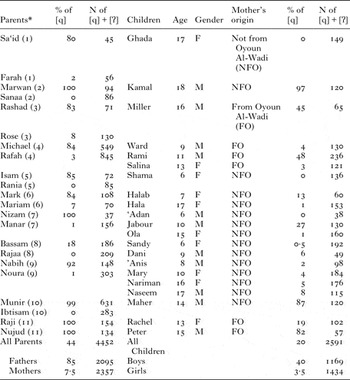
The participants of the study are twenty-two parents and their children. The parents constitute eleven married couples, i.e. eleven husbands and eleven wives. Their ages range from twenty-nine to fifty-seven. The children are eleven boys and ten girls. Their ages range from six to eighteen. The children and their data are taken from a larger study that included fifty children aged six to eighteen (Habib, Reference Habib2011a, Reference Habib2014, to appear). These twenty-one children are selected to compare their speech to that of their parents. The number of children included in the study for each married couple ranges from one child to four children (see Table 1). Table 1 shows the distribution of the twenty-one children according to age, gender, and mother's origin. It also presents individual, gendered, and general counts and percentages of the variants to observe the patterns of use of these variants and compare their use between parents and their children. Age is treated as a continuous variable in the quantitative analysis.
Distribution of [q] and [ʔ] in the speech of parents and their children

note: *Couples are numbered from (1) to (11). The first name of each couple is the father; the second name is the mother. Each couple is paired with their children.
Both parents and children were recorded in naturalistic settings. Other family members or friends were present during the unstructured interviews to add more spontaneity to the data (see Habib, Reference Habib2014, for detailed information about how the data were collected). Because of the nature of the interviews, the data are mostly from mixed conversations among family members with the researcher. Within the same recording, both parents, or both parents and a child, may be speaking. After transcription, the data of each participant are tabulated separately. Although the conversations were spontaneous, the researcher asked parents occasionally about how they liked their children to speak and whether they ever attempted to change the way their children spoke. Such questions were intended to see how the community evaluated male and female speech and certain sounds. Although there was no reference to specific sounds in the questions, parents and children volunteered information about (q), a salient and stereotypical variable in Syria and other Arab countries (e.g. Abd-el-Jawad, Reference Abd-el-Jawad1986; Abu-Haidar, Reference Abu-Haidar1987; Haeri, Reference Haeri1997; Daher, Reference Daher, Benmamoun, Eid and McCarthy1998; Amara, Reference Amara2005; C. Miller, Reference Miller2005; Habib, Reference Habib2010a, Reference Habib2010b, Reference Habib2010c, Reference Habib2011a, Reference Habib2011b; Al-Wer & Herin, Reference Al-Wer and Herin2011). It is worth noting that such questions did not affect the way all speakers were speaking, and no accommodation among speakers was observed. Speakers spoke normally and consistently at all times, regardless of the interlocutor and his/her gender or age.
Data and statistical procedures
Table 1 gives detailed distribution of the variants [q] and [ʔ] in the speech of the eleven married couples and their children. The counts and percentages of these two variants in the speech of each child are compared to those in the speech of their parents. Table 1 shows that all husbands use much higher percentages of [q] than their wives with the exception of couple 11, as both the husband and the wife are local and use [q] categorically. Some men show some influence of the urban form [ʔ] in their speech as fathers' percentages of [q] range from 80% to 100%, with the exception of Bassam (the man of couple 8).Footnote 1 He is the only father who has lower percentages of [q] than other men in the dataset (only 18%), possibly due to living in Damascus in his childhood until the fifth grade, i.e. age ten to eleven. The women of the first ten couples show categorical or almost categorical use of [ʔ], including Rose and Rafah (the women of couples 3 and 4, respectively) who are local. This could be due to the fact that Rose lived most of her life in urban centers from the second grade, i.e. age seven to eight, until about ten years prior to the recording in spring 2010. That is, she spent almost thirty years of her life in urban centers. On the other hand, Rafah lived most of her life in the village, but her recent constant contact with urban people through her husband's restaurant business seems to have encouraged her to use the superlocal form (Habib, Reference Habib, Mallinson, Childs and Van Herk2013, p. 30§). That is why Rose and Rafah are unlike the local mother, Nujud (the woman of couple 11), who uses [q] categorically. Hence, there is a great linguistic difference between the one uninfluenced local woman, Nujud, and other women, including the two other local women who exhibit major urban influence in their speech.
Table 1 also shows that most children use very high percentages of [ʔ] (73–100%) with the exception of some boys, Miller (55%), Rami (52%), Peter (18%), Maher (13%), and Kamal (3%), whose ages are sixteen, eleven, fifteen, fourteen, and eighteen, respectively. The only 73% is also observed in the speech of the boy Jabour, who is ten years old. Other boys aged eight to nine show 94–98% usage of [ʔ] with 'Anis the youngest (8 years old) at 98% and Ward and Dani the oldest (9 years old) at 96% and 94%, respectively. The only six-year-old boy, ‘Adan, shows 100% use of [ʔ], similar to girls his age, Shama and Sandy. All girls have categorical or almost categorical use of [ʔ]. Even Rachel, both of whose parents are local and show categorical usage of [q], shows 81% usage of [ʔ]. Table 1 also shows discrepancy between siblings within the same family, particularly brothers and sisters (cf. Trudgill, Reference Trudgill1986, pp. 28–31; Starks & Bayard, Reference Starks and Bayard2002). Rami shows much higher use of [q] than his sister Salina and his younger brother Ward. The same is true of Jabour and his sister Ola and his younger brother ‘Adan, and of Peter and his sister Rachel. Halab is the only young girl (7 years old) who shows slightly more use of [q] (13%); she even uses [q] more than her older sister. This could be due to the fact that she mainly plays with her male cousins who are close to her age, although slightly older, and live next door.
In the quantitative analyses that include binary regression tests and visual distribution of variants in the speech of children, only gender and the origin of the mothers of the children in this study are considered for parents' use of the variants. This is because the study seeks to see if the difference between fathers and mothers is significant, and if the origin of the mother is significant, given that all the fathers are from Oyoun Al-Wadi, whereas only three of the mothers are from Oyoun Al-Wadi – Rose, Rafah, and Nujud – and eight are not. In the children's quantitative analyses, gender and continuous age are considered, because mother's origin does not reflect a major linguistic difference between children whose mother is local and those whose mother is not local, and because the study seeks to discover if there are differences between boys and girls and the different ages. Then, individual comparisons between children and their parents are implemented through presenting comparisons of percentages as well as paired-samples t-tests that include correlation tests that are performed between individual parents and each of their children.
ANALYSIS
Table 1 shows that parents use [q] 24% more than children. It also shows that there is complete polarization between fathers and mothers in the use of [q] and [ʔ]. Mothers rarely use [q], and fathers use [q] 77·5% more than mothers. Hence, [q] is mainly used by fathers. As for children, boys use [q] 36·5% more than girls. The boys' higher use of [q] indicates deviation from the mothers' low use of [q] (32·5% more), and an attempt to approximate the fathers' use of [q], although they remain lower users of [q] than their fathers (45% lower). Hence, the boys seem to comply with the general pattern in the community. That is, they seem to use more [q] to approximate the linguistic patterns of other men in the community. However, they retain higher percentages of [ʔ] as a sign of their initial acquisition of their mothers' form. They continue to use [ʔ] 20% more than [q]. In contrast, girls show a closer linguistic pattern to their mothers. They maintain very high usage of [ʔ]. They even use [ʔ] 4% more than their mothers. This also indicates that girls comply with the general pattern in the community; they use more [ʔ] to approximate and even exceed the linguistic patterns of other women in the community.
Parents' binary regression tests results
Only gender and origin are taken into consideration in the parents' binary regression tests because of the assumed difference between men and women and those who are or are not from Oyoun Al-Wadi. In the main effects regression test, only gender emerged as statistically significant regarding the use of [q] and [ʔ] (see Table 2). The coefficient (B) and its exponential (Exp(B)) (p = ·000; B = 3·495; Exp(B) = 32·959) show that men use [q] much more than women, and the odds that men would use [q] are 33 times more than the odds that women would use it. Although the interaction between gender and Origin emerged as statistically significant, the significance is only in the case of the interaction Men*FO (p = ·028), which is meaningless since all men are from Oyoun Al-Wadi and most of them use very high percentages of [q]. In other words, there is no interaction between Women*FO or Women*NFO (p = ·319).
Main effects and interaction of gender and origin in parents' use of the variable (q)

note: *p-values are significant at the ·05 level.
Distribution of (q) in children's speech
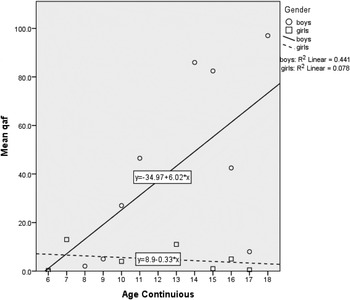
Table 1 has shown that most children, both boys and girls, use urban forms more than rural forms; girls rarely use [q] and almost categorically use [ʔ]; and boys use [q] much more than girls. Figure 1 presents a scatterplot of the distribution of the variant [q] in the speech of the twenty-one children according to gender and age as a continuous variable, giving a very clear visual comparison between girls' and boys' linguistic behaviors. Both boys and girls show categorical use of [ʔ] at ages six to eight. However, beyond these ages boys increase their use of [q]. The lines clearly indicate that boys show linear increase in the use of [q] with age, while girls maintain a categorical use of [ʔ] with age.
Distribution of [q] in the twenty-one children's speech by gender and age as a continuous variable.

Children's regression tests results
In the children's regression test, both gender and age as a continuous variable emerged as statistically significant (see Table 3). The interaction between gender and age also emerged as statistically significant. This significance is specific to the following interactions Boys*Ages ten, eleven, fourteen, fifteen, sixteen, and eighteen (p-values are respectively ·022, ·006, ·000, ·001, ·008 & ·000). There is no interaction between Boys*Ages six, eight, nine, and seventeen (the respective p-values are: no result, ·458, ·217 & ·128). The boy Naseem, whose age is seventeen, is an exceptional boy who uses fewer [q] (8%) than boys of similar age. There is also no interaction between Girls*All Ages (i.e. 6, 7, 10, 13, 15, 16 & 17) (the respective p-values are: ·977, ·075, ·251, ·086, ·823, ·190 & no result). The results of the interaction test confirms that only older boys (particularly age 10 and above) show a major shift towards the use of the rural form [q], and that younger boys and girls maintain categorical or almost categorical use of [ʔ]. Figure 1 shows a slight shift in eight- to nine-year-old boys, but this shift did not emerge as statistically significant.
Main effects and interactions of gender and age (continuous) in children's and adolescents' use of the variable (q)

note: *p-values are significant at the ·05 level.
Pair comparisons of each child with his/her mother and father
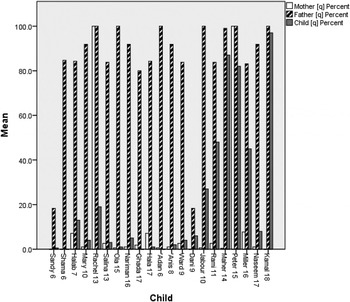
Children's percentages are paired with those of their mothers and fathers to see if their use of [q] matches that of their immediate surrounding environment or one of their parents. In Figure 2, ‘Adan to Kamal are the boys and Sandy to Hala are the girls. The age of each child is given next to his/her name. Boys and girls are ordered from left to right from youngest to oldest.
Comparison of the percentages of [q] between individual children and their mothers and fathers.

Figure 2 shows the distribution of [q] in the speech of each individual child and his/her mother and father. It is clear that boys and girls show inter- and intra-speaker variation. Boys use much more [q] than girls and their mothers, whereas girls show a more similar behavior to their mothers. Boys aged six to eight show similar behavior to their mothers, but at age nine they show slightly more usage of [q] than their mothers, and later on in life the difference between the boys and their mothers increases and becomes major in adolescence. We do not observe such a major difference between mothers and their daughters, with the exception of Rachel who seems to sound more like other girls in the village rather than sounding rural like her mother. Fathers use much more [q] than their wives, their daughters, and their boys, particularly boys aged six to eight, and preadolescent boys. Adolescent boys seem to approach their fathers' usage. Only the parents of Rachel and her brother Peter are equally categorical users of [q], as both of them are local. Only Bassam, the father of Sandy and Dani who are a sister and a brother, shows much lower use than other fathers for the reason mentioned above. This indicates that he still carries some urban influence in his speech despite reports that he mainly uses [q] with his family, friends, and other people in the village. In the interview, he may have tried to sound more urbane with me for a couple of reasons: (i) wanting to sound softer and gentler with a woman, and (ii) trying to show a degree of similarity to my speech, knowing that I lived most of my life in Hims and thus am familiar with urban dialects. In addition, according to him, his restaurant business requires him to sound more urbane with customers, most of which are urban tourists. Figure 2 also shows that younger boys use fewer [q] than older boys; the use of [q] increases with age. ‘Adan, the youngest among boys, has 0% usage of [q]. The use of [q] starts increasing at age nine, as seen in the speech of Dani and Ward. Naseem is the only older boy who shows slightly lower use of [q], although reportedly he uses mainly [q] with his male friends in the village. In contrast, the girls in general show much lower use of [q] than boys and fathers, and they remain categorical or near-categorical users of [ʔ]. Rachel shows slightly more usage of [q], due to the fact that both her parents are local, but compared to her brother, Peter, she uses much lower rates of [q], which indicates that she, as a girl, deviates from her local caregivers as well as the speech of her immediate environment. Halab also seems to be another exception, for the reason mentioned above.
Testing for correlations and significant difference
To see if the distributions and differences observed in Figure 2 are significant, the study applies paired-samples t-tests (see Table 4). These tests examine if children use the same rates or frequencies of the variants in their community or immediate environment, i.e. if their speech correlates with that of their parents or differs from it, and whether the difference is significant. Since it has been established that boys use more [q] than girls, just as men use more [q] than women, it is essential to test for correlations between fathers and boys and between mothers and girls. In addition, it is essential to test for correlation between mothers and boys, as boys show an intermediate usage between fathers and mothers. The paired-samples t-tests reveal the following (see Table 4).
Paired-samples t-tests and correlations between fathers and boys, and mothers and girls and boys

First, there is no correlation between the speech of fathers and boys (r = ·363, p = ·272), and the difference between the fathers and boys is statistically significant (t = 4·547, df = 10, p = ·001). Fathers use more [q] than boys; the mean difference is 49·6182.
Second, there is no correlation between the speech of mothers and boys (r = ·401, p = ·222), and the difference between the mothers and boys is statistically significant (t = –2·345, df = 10, p = ·041). Mothers use fewer [q] than boys; the mean difference is –26·3182.
Third, there is a strong, positive correlation between the speech of mothers and girls (r = ·817, p = ·004), and the difference between the mothers and girls is statistically insignificant (t = 0·907, df = 9, p = ·388). Mothers use [q] slightly more than girls; the mean difference is 7·4700. This could be due to one woman, Nujud, who is from Oyoun Al-Wadi and uses [q] almost categorically (see Table 1 and Figure 2).
DISCUSSION AND CONCLUSION
The data indicate that there is a change in progress towards the urban form led by females in the community. All women except one use more [ʔ] than men. The presence of [ʔ] in the speech of most men also indicates that this supralocal sound has started penetrating their speech. Girls are advancing this change in progress as they show higher usage of [ʔ] than their mothers, even those who have local mothers. However, boys, who initially sound like young girls, seem to be advancing this urban change shift towards higher usage of the rural form [q] after age eight (Habib, Reference Habib2011a) as their social network widens beyond the home. This shift and the difference between the boys' behavior and that of their mothers, fathers, and girls cannot be interpreted merely by acquisition of the input they encounter in their environment. While the girls' behavior abides more with their primary caregivers' form, boys deviate tremendously from this form. The similarity between the boys' proportions and the proportions of their parents combined (Table 1) also cannot be interpreted as acquisition of the community's proportions of use of the variants because we do not see a similar behavior among girls. This shift also cannot be interpreted by the theory that females are usually one generation in advance of males during a change in progress (Tagliamonte & D'Arcy, Reference Tagliamonte and D'Arcy2009; Labov, Reference Labov2010), because of the significant disparity observed between boys and their mothers. Although Tagliamonte and D'Arcy (Reference Tagliamonte and D'Arcy2009, p. 64) indicate that “[g]ender asymmetry develops early in the progression of a change”, and that “the underlying cause is that once a change becomes associated with women, men either retreat from or resist the incoming form”, this is applicable when both men and women are going in the same direction of the occurring change in progress but the difference between them is in the rate of change. “During this period, men are often a full generation behind, displaying levels similar to women of the previous generational cohort” (Tagliamonte & D'Arcy, Reference Tagliamonte and D'Arcy2009, pp. 63–64). In other words, boys should exhibit similar proportions to their caregivers during a change in progress. In this study, mothers use [ʔ] 32·5% more than their boys. In addition, the split between boys and girls is not observed in the youngest ages, six to eight, i.e. this generational difference does not exist early on.
One argument is that all children of six to eight years old are categorical users of [ʔ] because their mothers are categorical users of [ʔ], i.e. this is the input they are learning from. However, variation exists in their environment, given the great linguistic difference between fathers and mothers (Tables 1 & 2) and the absence of influence of some local mothers who are categorical users of [q] on their daughters. Hence, the lack of split in the youngest ages of six to eight is better argued as being the result of regularization, i.e. using one form predominantly without learning the variation that exists in one's environment (Hudson-Kam & Newport, Reference Hudson-Kam and Newport2005, 2009), supporting evidence from cognitive and psycholinguistic experimental work on child and adult (statistical) learning of free variations in artificial languages that children aged five to seven years old may regularize (Hudson-Kam & Newport, Reference Hudson-Kam and Newport2005, 2009). However, Wonnacott (Reference Wonnacott2011) found more replication of variation and less regularization in five- to seven-year-old children when there were fewer constraints on working memory. Because these studies focused on the learning of artificial languages in a controlled setting, greater overgeneralization is expected because learners have less experience with these languages than with a natural language (Wonnacott, Reference Wonnacott2011, p. 12§). In natural speech, and within the realm of social influences, children's behavior may differ greatly. Labov (Reference Labov2007) specifically indicated that children are the transmitters of linguistic change because of their ability to replicate the language of their parents and then modify it slightly, resulting in continuous change. While the data of the younger children support Hudson-Kam and Newport's (Reference Hudson-Kam and Newport2005, Reference Hudson Kam and Newport2009) findings, the presence of more variation in the speech of older children, particularly boys, highlights the influence of social-psychological factors such as, locality, masculinity, femininity, gender roles, and linguistic norms within the community.
One possible explanation of the boys' increased use of [q] is that, as they grow older, they interact more with their own gender, and thus that form becomes relatively more frequent in their input. However, this cannot be a complete account. First, much of their input will come from their peers – as opposed to adult males – who will initially have almost categorical usage of [ʔ] like themselves. Second, there is compelling evidence that [q] becomes associated with masculinity and local identity (Habib, Reference Habib2011a). In the recordings, older boys are heard to ridicule each other when using the urban form. Some of them mention the importance of sounding like the original people of their village, to identify as distinct members from Oyoun Al-Wadi who sound different from males from other villages or areas including cities. Choosing not to use [q] seems to depict a boy among his peers as a ‘sissy’ and/or betrayer of his own people and village. This indicates a role for socialization and social constraints in this linguistic switch. In other words, the switch is a social and gender process that is realized and achieved with older age. The association of [q] with masculinity and locality boosts males' ego in the village, leading boys to a higher use of [q] with age as they become more aware of the significance of this sound to their masculine and local identity. Consequently, instead of participating with girls in advancing the supralocal change, boys retreat from this change and reverse the change in the direction of the local form, leading to a major split between boys and girls in the older ages (Habib, Reference Habib2011a). On the other hand, the feminine and urbane social meanings of [ʔ] encourage girls to continue advancing the supralocal change and using [ʔ] categorically.
Moreover, the emergence of gender as statistically significant for both parents and children in the binary logistic regression tests provides a further explanation of this linguistic split. This indicates that children have acquired the general pattern of variation in their speech community, i.e. boys, like men, use more [q] than girls, although the boys and girls do not show complete polarization like their parents (Table 1), and the children's proportions do not exactly match those of their parents (Smith et al., Reference Smith, Durham and Richards2013). In addition, the boys' proportions are much lower than their fathers' and higher than their mothers', and their higher use of [q] is observed only at ages nine to eighteen, indicating that this general pattern of variation is acquired later in the child's life, unlike the findings of some studies such as Hill and Flom (Reference Hill and Flom2007) and Smith et al. (Reference Smith, Durham and Richards2013), in which the general pattern of variation is acquired as early as two or three years old. This finding accords with studies that have shown a lack of linguistic gender differences between boys and girls in their early stages of development (e.g. Patterson, Reference Patterson1992; Roberts, Reference Roberts1994; Docherty, Foulkes, Tillotson & Watt, Reference Docherty, Foulkes, Tillotson, Watt, Goldstein, Whalen and Best2006; Smith et al., Reference Smith, Durham and Fortune2007), indicating that linguistic gender differences develop later in life as boys and girls become more aware and accepting of societal and linguistic appropriateness norms and different gender roles. This is not surprising, as older boys start spending more time outside the home with same-sex friends, playing soccer, billiards, going to internet cafes, etc. Boys, in general, have more social liberties than girls, such as staying out late at night and going for long walks to neighboring villages. In addition, boys pressure each other to sound more local and masculine, and girls are encouraged by family members and friends to sound more feminine, sophisticated, and urbane (Habib, Reference Habib2011a, Reference Habib2014). Some girls may have similar liberties, but generally girls are more restricted in their movement and tend to spend more time at home with their mothers, as they are also expected to help with the house chores more than boys. Through these different social roles and behaviors, it is normal for girls and boys to develop different linguistic trends and attitudes towards language (Martin and Fabes, Reference Martin and Fabes2001).
The quantitative analysis showed correlation only between mothers and girls in the use of [q] and [ʔ], and no correlation between fathers and boys and mothers and boys. The similar categorical or almost categorical linguistic usage of [ʔ] of girls and boys in the youngest ages of six to eight, and the lack of correlation between mothers and boys and fathers and boys, indicate that children do not acquire variation from a very young age and do not replicate the frequencies in their parents' input (Smith et al., Reference Smith, Durham and Richards2013). Furthermore, statistically significant differences between fathers and boys and mothers and boys emerged, indicating that boys are in a somewhat intermediate state, where they are shifting away from their maternal [ʔ] to their paternal [q]. Their percentages are not close to either one; they use [q] 32·5% more than mothers and 45% less than fathers. These discrepancies in percentages between boys and their fathers, boys and their mothers, and some girls and their mothers, indicate that children initially acquire their caregivers' form and then shift towards the community's gendered linguistic norms. Boys shift towards the male linguistic norm, [q], and girls maintain or shift towards the supralocal norm of their mothers or other women in the community, as in the case of Rachel, who still shows maternal influence at age thirteen, as she is the highest user of [q] among girls (19%). In other words, this girl shows a major shift away from her maternal categorical use of [q] and sounds more like other girls and women in the village. These are very important findings because previous research showed that children start shifting and reorganizing their vernacular away from their caregivers after age four, more specifically in the period between four and eight years old (Kerswill, Reference Kerswill1996; Tagliamonte & D'Arcy, Reference Tagliamonte and D'Arcy2009). In this study, vernacular shift and reorganization start at age eight and become significant at age ten and older. This is clear in the boys' linguistic behavior because of their obvious shift towards the rural form after age eight. It is not as clear in the girls' behavior because of their continued categorical use of [ʔ]. It is possible that children become aware of the gendered linguistic differences prior to age eight, but it is at this age that linguistic differences between boys and girls emerge. The emergence of these linguistic differences indicates that they have started accepting the gendered linguistic differences in their community, the social meanings associated with each form, and the importance of certain forms for projecting gendered and spatial identities (Habib, Reference Habib2011a, Reference Habib2014). This acceptance leads to using more rural forms by boys and retention of urban forms by girls. Thus, the variation observed in the later stages of these children's lives is not a by-product of the early stages of acquisition (Foulkes et al., Reference Foulkes, Docherty and Watt2005; Roberts, Reference Roberts and Ball2005). Rather, it is driven by social-psychological factors and “later acquisition of superposed dialects” (Labov, Reference Labov2013, p. 247).
This study also shows that when most mothers are not local, one may encounter a different result to what is predicted by Smith et al. (2013, p. 320): “the local variants will come to dominate caregiver/child interaction in the home environment as the child gets older: the caregiver's, and hence, children's rates of use will reach the same level as the general community norms i.e. used categorically.” In this study, caregivers clearly do not adopt the local form and maintain the use of the supralocal form with their children. Likewise, girls rarely adopt the local form, advancing the majority females' supralocal form in the community. Only boys increase their use of the local form after age eight, without necessarily reaching categorical use.
Based on the above findings, the hypotheses set forward can be weighed as follows. Hypothesis (1), ‘Children's age plays a role in whether or not they follow the general linguistic patterns of their community and replicate their parents' frequencies', holds as younger children replicate only the mother's linguistic pattern. As they grow older, children replicate the general gendered linguistic pattern in the community. However, they do not replicate the parents' frequencies, particularly boys. Hypothesis (2), ‘Boys deviate from their primary caregiver's (i.e. mother's) pattern and approximate the general pattern of men in the community with age’, holds as older boys show much higher percentages of [q] than their mothers, although their approximation of the general pattern of men in the community is not perfect. Hypothesis (3), ‘Girls retain their primary caregiver's pattern and approximate the general pattern of women in the community’, holds as girls of all ages show very high percentages of [ʔ], like their mothers.
In conclusion, in this study variation is not acquired in the early stages of a child's development. It is acquired later, as is evident in the use of more gendered linguistic forms as the children grow older, become exposed to more language outside the home and to peer influence that seems to overcome parental influence (Kerswill, Reference Kerswill1996), and start ascertaining their gender roles and societal norms. In this sense, the motor of acquisition (Chevrot & Foulkes, Reference Chevrot and Foulkes2013, p. 253), or the driving force of acquisition, is gendered identity and social norms and pressures, not statistical learning of frequencies in their environment (Chevrot et al., Reference Chevrot, Beaud and Varga2000; Tomasello, Reference Tomasello2003; Smith et al., Reference Smith, Durham and Fortune2007; Barbu et al., Reference Barbu, Nardy, Chevrot and Juhel2013; Ghimenton et al., Reference Ghimenton, Chevrot and Billiez2013; Smith et al., Reference Smith, Durham and Richards2013). In brief, children acquire the larger and general pattern of variation in the speech community but do not acquire the specifics of these patterns (cf. Labov, Reference Labov2013, p. 249), i.e. they do not replicate the exact frequencies of each gender (Table 1). Hence, in this study, children seem to understand, evaluate, accept, and ascertain social norms and values and modify their speech at an age that strikes a compromise between Labov's (Reference Labov, Shuy, Davis and Hogan1964) developmental model, in which early adolescence (ages 14–15) is considered the age at which children start understanding the social values of certain variants and modifying their speech accordingly, and other studies that indicate that children can modify their speech from as early as three or four years old according to the social and cultural situation (Patterson, Reference Patterson1992; Roberts, Reference Roberts1994, Reference Roberts1997; Hirschfeld & Gelman, Reference Hirschfeld and Gelman1997; Andersen et al., Reference Andersen, Brizuela, DuPuy and Gonnerman1999; Wolfram et al., Reference Wolfram, Carter and Moriello2004; Díaz-Campos, Reference Díaz-Campos and Eddington2005; Smith et al., Reference Smith, Durham and Fortune2007; Khattab, Reference Khattab2013). However, examining more variables is required to test if different variables are acquired differently and at different stages in a child's life (Smith et al., Reference Smith, Durham and Richards2013). In addition, examining the influence of other social factors, such as social networks, television, and residential area, and children's social attitudes and evaluations of variables on the acquisition of variation would increase our understanding of children's linguistic development. While the data and findings of this study are limited to this specific small rural community and may not be generalized to other communities, especially Western communities, they contribute greatly to the debate about the age when variation is acquired and other socio-psychological factors that lead to different degrees of acquisition of variation. They also draw attention to the possibility that the acquisition of variation may differ from one community to another.