Intravenous unfractionated heparin is the standard therapy in children with complex congenital heart disease (CHD) with the need of anti-coagulation during hospital admission.Reference Girod, Hurwitz and Caldwell1–Reference Glatz, Keashen and Chang6 Advantages of intravenous unfractionated heparin include a tight control of the level of anti-coagulation, the fast offset after termination, and the possibility to antagonise by administration of protamine.Reference Van de Werf7,Reference Andrew, Michelson, Bovill, Leaker and Massicotte8 However, constant venous access is needed for intravenous unfractionated heparin treatment, and this is deemed sometimes difficult in the population of complex CHD children requiring prolonged hospital stays and multiple interventions during early life. Furthermore, age- dependent unpredictable pharmacokineticsReference Newall, Johnston, Ignjatovic and Monagle9 require frequent therapeutic laboratory monitoring.Reference Dix, Andrew and Marzinotto10–Reference Hirsh, Warkentin, Raschke, Granger, Ohman and Dalen13 Frequent phlebotomies cause additional stress to chronically ill pediatric patients and might induce iatrogenic anemia. Furthermore, long-term need for intravenous access may cause local complications, such as extravasation of intravenous fluids, necrosis, or infection.
Low-molecular-weight heparinsReference Prandoni, Lensing and Buller14 administered by a subcutaneous indwelling catheter device might be an effective alternative to intravenous unfractionated heparin therapy. Subcutaneous low-molecular-weight heparin injection has shown favourable bioavailabilityReference Aslam, Sundberg, Sabri, Cooke and Lakier12,Reference Belcaro, Nicolaides and Cesarone15,Reference Fareed, Hoppensteadt and Walenga16 as well as equivalent efficacy and safety in numerous indications.Reference Sutor, Chan and Massicotte17–Reference Hull, Raskob and Brant19 Main advantages of low-molecular-weight heparin include minimal monitoring due to favourable pharmacokinetics,Reference Massicotte, Adams, Marzinotto, Brooker and Andrew20 ease of administration (subcutaneously), especially in children with challenging venous access, and a more predictable anti-coagulation response over unfractionated heparin.Reference Dix, Andrew and Marzinotto10 A longer plasma half-life and the lack for antagonist agents are of disadvantage in case of rapid need for surgical intervention or bleeding complications.Reference Hepponstall, Chan and Monagle21 Given the differences in clearance and interaction with the developmentally immature system of the young patientsReference Andrew, Michelson, Bovill, Leaker and Massicotte8,Reference Massicotte, Adams, Marzinotto, Brooker and Andrew20,Reference Hepponstall, Chan and Monagle21 and reduced levels of anti-thrombin III levels in pre-term born and newborn infants,Reference Michaels, Gurian, Hegyi and Drachtman22 dosing needs to be adjusted in children according to age and weight.Reference Massicotte, Adams, Marzinotto, Brooker and Andrew20,Reference Moffett, Lee-Kim and Galati23,Reference Bauman, Belletrutti and Bajzar24
For monitoring the dose level and to adjust the therapy, plasma anti-factor Xa activity is the most frequently used assay to measure the biologic activity of low-molecular-weight heparins.Reference Aslam, Sundberg, Sabri, Cooke and Lakier12,Reference Ho, Wu, Hamilton, Dix and Wadsworth25
The aim of this retrospective observational case control study was to compare the efficacy and safety of subcutaneous low-molecular-weight heparin with intravenous unfractionated heparin in a heterogeneous complex CHD patient population.
Material and methods
Study design
Comparison of clinical data from inpatients meeting inclusion criteria and being prospectively enrolled to receive subcutaneous low-molecular-weight heparin with clinical data obtained by medical chart review from an age- and gender-matched historical group of inpatients with similar underlying disease etiology and treatment indication receiving intravenous unfractionated heparin.
Patient population
Between 2016 and 2018, 31 patients with the need of anti-coagulation admitted in the pediatric cardiology inpatient unit of a tertiary care university were consecutively prospectively enrolled to receive subcutaneous low-molecular-weight heparin as anti-coagulation regimen. Inclusion criteria of enrollment were admission to the inpatient pediatric cardiology unit, any kind of underlying structural heart disease, age between 0 and 18 years, and the need for invasive anti-coagulation. Exclusion criteria were any contraindication for low-molecular-weight heparins, presence of mechanical valves, or no denial of informed consent from parents. In order to match a patient group to the patients receiving subcutaneous low-molecular-weight heparin, medical charts were retrospectively reviewed from 44 patients with structural heart disease aged between 0 and 18 years who were admitted to the hospital between June and December 2015 and had received intravenous unfractionated heparin anti-coagulation.
The study was conducted in accordance with the Declaration of Helsinki (revision 2008) and the Good Clinical Practice guidelines. The study protocol was approved by the local ethical board (project number 428/15) of the Technical University Munich.
Data collection
Demographic, clinical data and laboratory data related to the anti-coagulation regimen were recorded. Number of phlebotomies necessary to perform anti-coagulation monitoring and the number of placements of indwelling catheters (intravenous access in intravenous unfractionated heparin group and subcutaneous access in subcutaneous low-molecular-weight heparin group) were extracted from medical charts. Complications related to anti-coagulation, such as general thromboembolic events or bleeding, and complications related to the subcutaneous catheter placement, such as irritation, infection, pain, or hematoma, were documented.
Assessment of pain
To objectify physical stress surrounding intravenous or subcutaneous catheter placement, vital signs (oxygen saturation, heart rate, respiratory rate, systolic and diastolic blood pressure) were measured shortly before and 5, 10, and 30 minutes after the respective procedure in a subset of patients.
The visual analog pain scale (VAS)Reference Hanas26 was used to assess psychological stress on patients surrounding placement of intravenous or subcutaneous catheters (Supplemental Fig. S1). The assessment was answered by the patients or the parents, if the children were not able to answer the questions by themselves. Additionally, parents were asked after discharge hospital about their all over experience of the subcutaneous low-molecular-weight heparin in comparison to intravenous unfractionated heparin anti-coagulation practice and the influence on the child’s stress level.
Indwelling device for low-molecular-weight heparin administration
In the subcutaneous low-molecular-weight heparin group, BD Saf-T-IntimaTM (Beckton, Dickson and Company, New Jersey, USA) catheter was used. The BD Saf-T-IntimaTM is a subcutaneous catheter of a butterfly type and siliconised steel needle with a rubber stopper at the end of the tubing,Reference Hanas and Ludvigsson27 inserted into the patient’s subcutaneous tissue. The catheter was replaced once weekly unless a complication, such as bleeding, hematoma, or infection, occurred. The complete system was flushed with sodium chloride 0.9% solution after each application of low-molecular-weight heparin in order to make sure that the medication was applied completely. Examinations of the injection site were undertaken by nurses and doctors of pediatric cardiology unit before and after every injection.
Dosages
Strict dosing and monitoring protocols were used in both groups (Supplemental Table S1, Table S2 and Table S3).
Efficacy of anti-coagulation was assessed by measuring the activated partial thromboplastin time in the intravenous unfractionated heparin group.Reference Van de Werf7 Therapeutic range was determined between 55 and 85 seconds. Initial dosing of heparin for therapeutic anti-coagulation was 10,000 IE per body surface area per day. Maintenance dosage was based on adjustments depending on activated partial thromboplastin time levels in order to reach therapeutic rangeReference Andrew, Marzinotto and Massicotte3 (Supplemental Table S3).
Dosages of low-molecular-weight heparin were calculated according to body weight and age (Supplemental Table S1). Measurement of the anti-factor Xa level was performed 4 hours after the second low-molecular-weight heparin application.Reference Van de Werf7 Yield of the therapeutic anti-factor Xa range was 0.5–1.0 U/ml. The low-molecular-weight heparin dosage for the following application was adapted based on anti-factor Xa level measured (Supplemental Table S2). Once therapeutic anti-factor Xa level was achieved, control of the anti-factor Xa level was performed once weekly.Reference Glatz, Keashen and Chang6 Dose adjustments and repeat laboratory controls were then performed accordingly.Reference Massicotte, Adams, Marzinotto, Brooker and Andrew20,Reference Michaels, Gurian, Hegyi and Drachtman22,Reference Ho, Wu, Hamilton, Dix and Wadsworth25,Reference Streif, Goebel, Chan and Massicotte28
Statistics
Data were presented as median, maximum, minimum or mean, and standard deviation according to distribution. Mann–Whitney U test and t-test were used according to data distribution to compare parameters between the two groups. To assess the distribution of variances, the Kolmogorov–Smirnoff test was applied. Fisher’s test or Pearson Chi-square was used for comparison of categorical variables. The significance level of p-value was set at less than 0.05. Data were analysed on IBM SPSS Version 22.
Results
Patient population
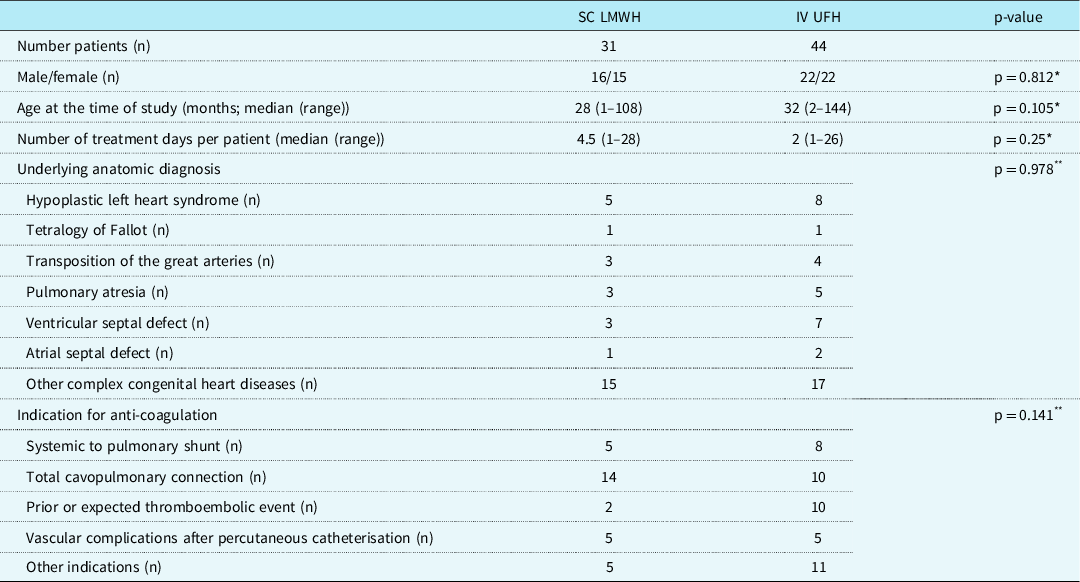
Information was collected on a total of 31 patients who received subcutaneous low-molecular-weight heparin and was compared with 44 patients who received intravenous unfractionated heparin as anti-coagulation regimen during hospital admission. Patients’ characteristics are depicted in Table 1. The diagnosis included hypoplastic left heart syndrome and other complex congenital heart diseases in most of the patients. Indications for anti-coagulation were mostly total cavopulmonary connection, systemic-to-pulmonary shunt, and prior or expected thromboembolic event, without differences between groups. There were no significant differences between groups concerning gender, age at study, and the total number of days with invasive anti-coagulation needed per patient.
Patient characteristics

IV UFH: intravenous unfractionated heparin; SC LMWH: subcutaneous low-molecular-weight heparin; n: number of patients; SD: standard deviation
* Mann–Whitney–Wilcoxon test
** Chi-squared test
Efficacy of anti-coagulation
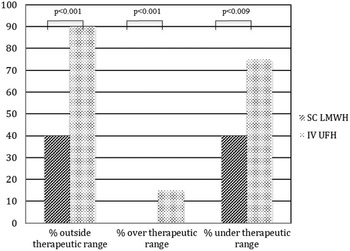
Therapeutic range of medication was better achieved in the low-molecular-weight heparin group (anti-factor Xa levels) in comparison to the intravenous unfractionated group (activated partial thromboplastin time) (Fig 1). Most levels were below therapeutic range before dosing adjustments in both groups (Fig 1).
Percentage of therapeutic range values on drug monitoring. Anti-Xa levels between 0.5 and 1.0 U/ml were considered within therapeutic range for patients receiving subcutaneous low-molecular-weight heparin; an activated partial thromboplastin time (PTT) between 55 and 85 seconds was considered within therapeutic range for patients receiving intravenous unfractionated heparin; the percentage of laboratory test with values outside the therapeutic range was significantly less in the subcutaneous low-molecular-weight heparin group compared with the intravenous unfractionated heparin group; striped bars: subcutaneous low-molecular-weight heparin; dotted bars: intravenous unfractionated heparin; p-value from Fisher’s exact test. SC LMWH: subcutaneous low-molecular-weight heparin group; IV UFH: intravenous unfractionated heparin group.

In the low-molecular-weight heparin group, no anti-factor Xa levels were above therapeutic range. In comparison to that, 15% of activated partial thromboplastin time measurements in the unfractionated heparin group were above therapeutic levels requiring dose adjustments.
Safety of anti-coagulation
There were no severe complications, such as general thromboembolic or bleeding event, in both groups. Minor hematoma after subcutaneous catheter placement was seen in 16%, and local infections were seen in 3% of subcutaneous low-molecular-weight heparin patients.
Procedural physical stress
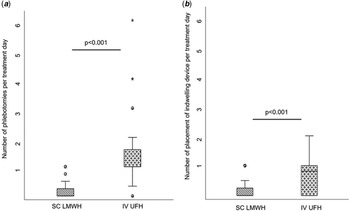
The number of placements of indwelling device per treatment day (intravenous catheter in intravenous unfractionated heparin group and subcutaneous catheter in subcutaneous low-molecular-weight heparin group) and the number of phlebotomies needed for monitoring of anti-coagulation effectiveness (activated partial thromboplastin time level in intravenous unfractionated heparin group and anti-factor Xa level in subcutaneous low-molecular-weight heparin group) were significantly lower in the subcutaneous low-molecular-weight heparin compared with the intravenous unfractionated heparin group (Fig 2).
Number of of needle punctures. The number of placement of indwelling catheters per treatment day and the number of phlebotomies per treatment day were significantly lower in the subcutaneous low-molecular-weight heparin group compared with the intravenous unfractionated heparin group; p-values from Mann–Whitney–Wilcoxon test; SC LMWH: subcutaneous low-molecular-weight heparin group; IV UFH: intravenous unfractionated heparin group.

Placement of indwelling device caused similar changes in vital signs (increase in respiratory and heart rate, decrease in oxygen saturation, increase in arterial blood pressure) in both the intravenous and the subcutaneous catheter group (Supplemental Table S4). Also, pain reported on the visual analog pain scale by parents or patients was similar between groups (Supplemental Table S4).
Perceived stress
Parents of children receiving subcutaneous low-molecular-weight heparin were interviewed after hospital discharge regarding the perceived physical and psychological stress of their children related to anti-coagulation during their hospital stay. Parents’ answers revealed that 84.2% were satisfied with the procedure of receiving the subcutaneous catheter and would prefer this anti-coagulation regimen over administration of intravenous heparin in case invasive anti-coagulation was required again for their children (Table 2). In total, 89.4% of parents would recommend the administration of low-molecular-weight heparin by a subcutaneous catheter for invasive anti-coagulation to others (Table 2).
Parents’ satisfaction

Discussion
The primary goal of this case–control study was to demonstrate that administration of low-molecular-weight heparin via a subcutaneous catheter was not inferior for efficacy and safety and caused less physical stress compared with the historical practice of unfractionated heparin infusions in children with complex CHD.
The current study shows that anti-coagulation administered by subcutaneous low-molecular-weight heparin was more efficient compared with administration of intravenous unfractionated heparin, as shown by a significantly higher percentage of anti-factor Xa levels compared with activated partial thromboplastin time levels measured within therapeutic range during the respective treatment period. This is in line with the results of a large investigation in 1672 pediatric patients with congenital heart disease undergoing cardiac catheterisation. In this patient cohort, the authors report that only 19% of all activated partial thromboplastin time levels, but 57% of all anti-factor Xa levels obtained, were within therapeutic range at first check.Reference Glatz, Keashen and Chang6 Most activated partial thromboplastin time levels were subtherapeutic in the current study. This finding is also reported by others in a study population of 68 children treated with intravenous unfractionated heparin for thrombotic disease.Reference Andrew, Marzinotto and Massicotte3 The need for frequent control of activated partial thromboplastin time levels due to pharmacokinetic factors has been reported.Reference Glatz, Keashen and Chang6,Reference Young29,Reference Young, Male and van Ommen30 Studies report on challenges in achieving target ranges in unfractionated heparin therapy in infants and children because of age-dependent mechanism of action of unfractionated heparin and limitations of unfractionated heparin-monitoring assays.Reference Van de Werf7,Reference Newall, Johnston, Ignjatovic and Monagle9 In contrast, there is a large body of evidence that therapeutic levels were reached faster and less monitoring was necessary in patients receiving low-molecular-weight heparin for anti-coagulation.Reference Prandoni, Lensing and Buller14,Reference Michaels, Gurian, Hegyi and Drachtman22,Reference Massicotte, Julian and Gent31–Reference van Den Belt, Prins and Lensing36 In order to achieve optimal therapeutic levels, dosing of low-molecular-weight heparin needs to be adjusted to age and weight of children since dosing guidelines for adult patients cannot be transferred to children.Reference Andrew, Marzinotto and Massicotte3,Reference Andrew, Michelson, Bovill, Leaker and Massicotte8,Reference Sutor, Chan and Massicotte17,Reference Massicotte, Adams, Marzinotto, Brooker and Andrew20
There were no serious complications including stroke, thrombotic events, or significant bleeding requiring intervention or causing permanent disability in the current study. None of the subcutaneous low-molecular-weight heparin patients showed an anti-factor Xa level above the therapeutic range. Similar low rates of thromboticReference Glatz, Keashen and Chang6,Reference Massicotte, Adams, Marzinotto, Brooker and Andrew20,Reference Bontadelli, Moeller and Schmugge37 or bleedingReference Ohuchi, Yasuda and Miyazaki4,Reference Kindo, Gerelli and Hoang Minh38,Reference Thom, Hanslik and Male39 complications are reported in other studies investigating the use of low-molecular-weight heparin in the children for different indications.Reference Hirsh, Siragusa, Cosmi and Ginsberg18,Reference Kakkar, Boeckl and Boneu33,Reference Hinsley, Evans-Langhorst and Porter40–Reference Nohe, Flemmer, Rumler, Praun and Auberger42
Superiority in efficacy, safety, and costs of low-molecular-weight heparin therapy compared with continuous-infusion unfractionated heparin for initiation of anti-coagulation after mechanical prosthetic valve implantation has been shown in adults.Reference Fanikos, Tsilimingras, Kucher, Rosen, Hieblinger and Goldhaber43
Injection pain and anxiety pose additional physical and psychological stress on complex CHD children requiring numerous hospitalisations and interventions during early life and childhood. Complex CHD patients therefore benefit from minimising the need for frequent needle punctures. The current study shows that individual pain received (as reflected by the crying symbol on the visual analog scaleReference Hanas26) and the changes of vital signs around intervention were similar during placement of subcutaneous catheter and gaining intravenous access. However, the total number of placement of indwelling catheters and that of phlebotomies were significantly lower in the subcutaneous low-molecular-weight heparin group compared with the intravenous unfractionated heparin group, therefore reducing stress in this group. On follow-up questionnaire, most parents therefore reported on preferring subcutaneous low-molecular-weight heparin administration if anti-coagulation was needed again for their children.
The use of indwelling subcutaneous catheters has been reported in other pediatric indications, such as in administration of insulin therapy in diabetic childrenReference Hanas26,Reference Hanas and Ludvigsson27,Reference Hanas, Adolfsson and Elfvin-Akesson44–Reference Adolfsson, Ziegler and Hanas46 or pain controlReference Allvin, Rawal and Saros47,Reference Rouss, Gerber, Albisetti, Hug and Bernet48 and administration of granulocyte stimulating factorReference Dyer, Collins, Baghurst, Saxon and Meachan49 in oncology patients. One study reports on the administration of low-molecular-weight heparin by subcutaneous catheter in pregnant womanReference Anderson, Ginsberg, Brill-Edwards, Demers, Burrows and Hirsh50 and another in children with thrombotic diseases.Reference Massicotte, Adams, Marzinotto, Brooker and Andrew20 Those studies consistently report a reduction of needle punctures, pain, and anxiety by the use of subcutaneous catheters for drug administration.Reference Hanas, Adolfsson and Elfvin-Akesson44–Reference Adolfsson, Ziegler and Hanas46,Reference Marquez, Pino and Zuniga51 Additionally, a 30% reduction of costs was emphasised in one pediatric study given decreased laboratory monitoring, blood sampling times, intravenous starts, and nursing time in low-molecular-weight heparin compared with unfractionated heparin patients.Reference Massicotte, Adams, Marzinotto, Brooker and Andrew20
The current data are the first to support those findings on complex CHD children requiring invasive anti-coagulation. The rates of local skin irritation or swelling at injection site of the subcutaneous catheter were low in the current study group and comparable with the rate described by others.Reference Belcaro, Nicolaides and Cesarone15,Reference Hanas26,Reference Hanas and Ludvigsson27,Reference Marquez, Pino and Zuniga51,Reference Planes, Vochelle and Mazas52
The limitations of this case–control study include a small patient population in a setting of a low frequency of serious complications, which limits statistical power of this observation. Limitations also occur because of retrospective data collection, and data present a single centre experience which may not be extrapolated to other institutions, respectively. Additionally, the metric measure of a telephone interview after patients’ discharge is susceptible to recall bias, and parents’ answers should be interpreted accordingly.
In conclusion, application of low-molecular-weight heparin via subcutaneous catheter seems to be a safe and efficacious anti-coagulation regimen in complex CHD patients and might reduce physical and psychological stress in this children.
Acknowledgements
We thank the patients and their families for their participation in this study.
Financial support
This research received no specific grant from any funding agency, commercial or not-for-profit sectors.
Conflicts of interest
None.
Ethical standards
The authors assert that all procedures contributing to this work comply with the ethical standards of the relevant national guidelines on human experimentation (Good Clinical Practice guidelines) and with the Helsinki Declaration of 1975, as revised in 2008, and have been approved by the institutional committees of the Technical University Munich, Germany (project number 428/15).
Supplementary material
To view supplementary material for this article, please visit https://doi.org/10.1017/S1047951121000317