Composer Lou Harrison published an article in a journal from Bombay, India, about Arnold Schoenberg on the occasion of his former teacher's hundredth birthday.Footnote 1 Harrison wrote:
How distant he seems—Arnold Schoenberg in Vienna—and the concerns of a corrupt and disintegrating Europe. Still, how very close he seems, too, (at the privacy of our pianos) in his insistence on musical awareness, in his good humor (for he was good humored, and his liquor bills were high), and in his stubborn confidence in the strength and the importance of intimate musicality.Footnote 2
This essay addresses the unlikely but profound synergy between Lou Harrison and Arnold Schoenberg. Despite a strong personal rapport and a mutual interest in visual art, as individuals they held strongly antithetical beliefs about the nature of musical composition. Schoenberg, the idealistic Austrian American, maintained that composition (whether tonal, atonal, or twelve-tone) was the presentation of a “musical idea”—beyond time and space, perhaps even metaphysical in nature.Footnote 3 Harrison, the matter-of-fact American, saw composition as the process of systematically gathering and assembling resources and techniques, both traditional and exotic.
After studying with Henry Cowell and Schoenberg in the late 1930s and early 1940s, Harrison displayed a fascination with diverse compositional systems and methods that led him to compose twelve-tone works that incorporated vastly disparate tools, both serial and nonserial. By the early 1950s, shortly after completing a twelve-tone opera in Schoenberg's memory, he definitively rejected the compositional aims of the East Coast, total-serialist movement and found his own voice by using tuning systems based on just intonation and the principle of pitch centricity instead. Several decades later all vestiges of twelve-tone technique had long since disappeared from Harrison's music, yet analogous serial techniques reappeared in his paintings.
Despite his ultimate move away from serialism, Harrison's deep respect for and devotion to Schoenberg as a composer, an artist and craftsman, a teacher, and a friend never changed.
Schoenberg's “Idea”/Harrison's “Puttering”
Harrison first encountered Schoenberg's music as a high school student while studying contemporary scores in San Francisco's Public Library—and the teenager was enthralled: “During my own adolescence, I went thru a period, perhaps several periods, during which I could barely study or listen to any music other than Schoenberg's.”Footnote 4 Soon afterward, in the fall of 1935, he began studying composition with Schoenberg's supporter Henry Cowell, and then collaborated in performance and composition with his good friend and Schoenberg's notoriously difficult student John Cage.Footnote 5 After moving to Los Angeles in 1942, Harrison began attending Schoenberg's composition class at the University of California and composed the Suite for Piano (1943), inspired by Schoenberg's Suite für Klavier, op. 25.
As individuals, Schoenberg and Harrison had obvious personal affinity. Both were painters, bookbinders, and general craftsmen—Harrison built percussion instruments; Schoenberg designed furniture, musical typewriters, playing cards, and chess pieces.Footnote 6 Even after Harrison moved from Los Angeles to New York in 1943, the two remained in intermittent contact. Harrison kept Schoenberg up to date concerning his compositional activities, and, in response to Harrison's seventieth birthday greeting, Schoenberg sent him a copy of the Birthday Canons for Carl Engel.Footnote 7 In a letter dated 17 May 1945 to composer Roy Harris, Schoenberg proclaimed his friend Harrison one of the most gifted young composers in the United States.Footnote 8 In spite of their personal empathy, the two composers maintained their opposing beliefs about the essence and nature of musical composition.
Schoenberg was thoroughly opposed to working out musical materials for their own sake. He claimed that an a priori Idea—metaphysical in nature and inexpressible in words—guided any valid act of composition. For Schoenberg, the Idea of a work was a “prophetic message,” an expression of Truth bestowed from a divine source,Footnote 9 that “cannot be imitated, nor can it be taught.”Footnote 10 He wrote:
I see the work as a whole first. . . . Then I compose the details. In working them out, I always lose something. This cannot be avoided. There is always some loss when we materialize. But there is a compensating gain in vitality. We all have technical difficulties, which arise not from inability to handle the material, but from some inherent quality in the idea. And it is this idea, this first thought, that must dictate the structure and texture of the work.Footnote 11
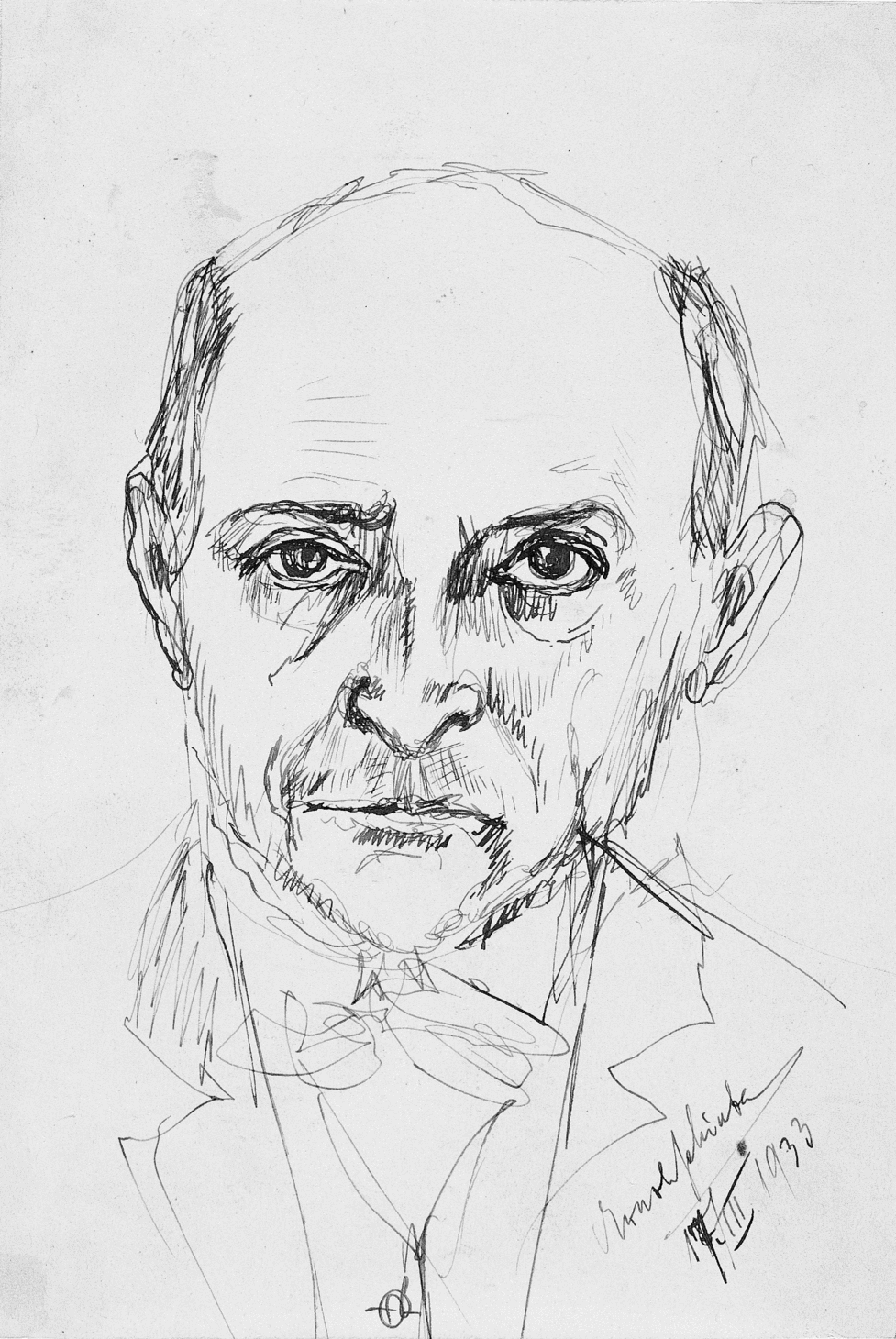
Schoenberg's pedagogy and theoretical writings were largely focused on the presentation of the metaphysical Idea as a concrete, musical form. He always asserted that such musical presentation was dialectical in nature, beginning with a statement of materials, their immediate contradiction that led to an intensification, and finally to a synthesis.Footnote 12 And, indeed, Schoenberg's fascination with the Hegelian model even permeated his paintings. For example, Figure 1, Schoenberg's 1933 self-portrait memorializing his decision to leave Nazi Germany, is clearly divided in two. The left side of the portrait shows embittered disappointment and crestfallen introspection, whereas the right reveals a remarkably intense anger and a determination to strike back—a theme and its antithesis, synthesized emotionally in the mind of the viewer and thus conveying the Idea of the artwork.
Arnold Schoenberg, Self-portrait (1933). Reprinted by permission of Lawrence Schoenberg, Belmont Music Publishers.

Harrison held absolutely no stock in the metaphysical beliefs of Austro-German Idealism; any aspect of Romanticism was anathema to him. Harrison explained: “I compose because it's fun—because I want to do that, or an idea has occurred to me. . . . Well, will that work? And then I start thinking it out, and before you know it, I'm writing something. I'm an American putterer from that point of view.”Footnote 13 Robert Hughes, Harrison's student, adds: “Lou seldom starts out with a gut, sensual idea. Rather, he begins with the scaffolding, which is usually some kind of logically rational preconceived formula that turns loose, as he manipulates the materials into wonderfully sensuous, forward-flowing music.”Footnote 14
An interest in the rational manipulation of materials is the germ of Harrison's seminal text Music Primer.Footnote 15 The book is a catalog of various ways in which Harrison “puttered” throughout his career, using Western techniques derived from Charles Seeger, Cowell, Cage, Joseph Yasser, and Schoenberg. Harrison spontaneously combined their different methods; in Cage's words, he was always “brushing information with information.”Footnote 16
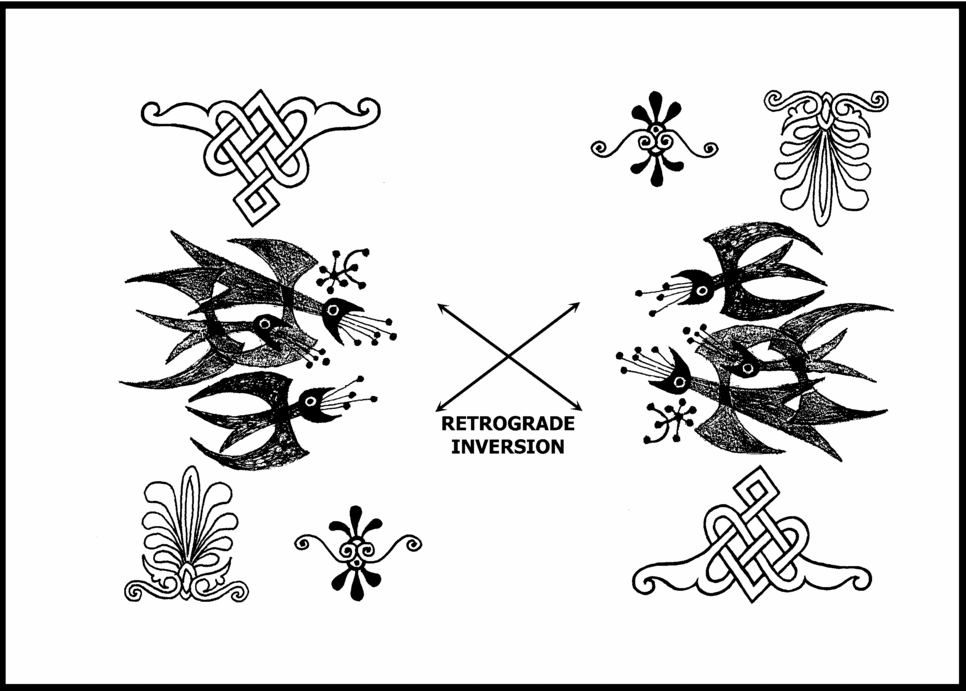
Harrison's “putterings” encompassed visual art and music alike. In addition to being a composer, performer, and conductor, he was also a painter and calligrapher. After the mid-1980s, when his interest in writing twelve-tone music was, for a variety of reasons, at an end, permutational structures associated with Schoenberg's serial music began to reappear in Harrison's paintings. For example, Figure 2, from his collection of poems Joys and Perplexities, shows three sparrows sacred to the goddess of love, Aphrodite.Footnote 17 If viewed upside down, the entire image inverts and forms retrogrades, like a row.Footnote 18 Thus Harrison's work epitomizes his unbridled joy in, and fascination with, rational acts of artistic creation.
Lou Harrison, “The Sparrows of Aphrodite” (ca. 1990). Reprinted by permission of Charles Hanson, the Lou Harrison Estate.

Schoenberg, Seeger, and Cowell
Many of Harrison's compositional beliefs developed during his study with Henry Cowell—“I remember him everywhere.”Footnote 19 For Harrison, Cage, and their musical circle, Cowell was “a builder of morale . . ., a human being who . . . contributed more than any other one person to uniting the more radical composers of America in the belief that there was a future for them.”Footnote 20 In turn, Cowell understood Schoenberg as a kindred ultra-modernist composer,Footnote 21 one who did not “fall into the conventional attitude of objecting to the intellect in music.”Footnote 22 Thus, more than anyone else, Henry Cowell indelibly branded Schoenberg's music and techniques on Harrison's compositional psyche.Footnote 23
Cowell's own teacher, the musicologist and occasional composer Charles Seeger, introduced the sixteen-year-old Cowell to Schoenberg's Drei Klavierstücke, op. 11, and Cowell replicated its use of piano harmonics in Dynamic Motion (1916), a piece that he performed during his 1923 European tour.Footnote 24 Back in New York, in the late 1920s, Cowell met Adolph Weiss, one of Schoenberg's earliest American pupils.Footnote 25 A zealous Schoenbergian, Weiss had studied privately with the Austrian composer at his home in Mödling in 1925 and was the first American to join his composition seminar at the Prussian Academy of the Arts in Berlin from 1925 to 1927.Footnote 26 In 1931, when Cowell was studying on a grant in Berlin, Weiss arranged a meeting for him with Schoenberg at the Berlin Tennis Club.Footnote 27 Cowell then began to play tennis with Schoenberg and attend his composition seminar at the Prussian Academy, the main topic of which was the tracing of symbiotic relations between Schoenberg's First Quartet, op. 7, and Mozart's String Quartet in F major, K. 590.Footnote 28
Cowell's writings reveal that Schoenberg showed a polite curiosity in his work at that time: “I played Dynamic Motion for him yesterday, and although I do not think that he got a great deal out of it, he said it was interesting.”Footnote 29 Despite his reservations about this work and later compositions, Schoenberg always seemed to respect Cowell and regard him as a friend. Schoenberg wrote: “Of course there are differences between him and me, differences of approach, style, and even of opinion. But most importantly, he always has an aim. That, in essence, is all you can ask of a composer. It places him on my side.”Footnote 30
The nature of Cowell's admiration for Schoenberg, however, was musically and psychologically complex. In 1933 Cowell wrote his most extended prose work on Schoenberg, the highly flattering commentary, “Who Is the World's Greatest Composer?”Footnote 31 Despite the seemingly straightforward nature of its title, a careful reading shows that the European Schoenberg was only “a [italics mine] mostly likely candidate for the post”—the American Charles Ives is subtly mentioned as the other. Cowell wrote that Schoenberg “was the first to inaugurate, in Europe at any rate, the complete change of materials harmonically and melodically which have [sic] become recognized as the ‘modern’ style. Practically every living composer makes use of the type of new materials, which were first brought into use by Schoenberg in Europe and by Ives in America.” Some years later Cowell, a champion of music in the Americas, would hold his friend Carl Ruggles's Men and Mountains in higher regard than Schoenberg's Pierrot lunaire.Footnote 32
As a composer, Cowell was especially skeptical of Schoenberg's serial methods,Footnote 33 although he did use twelve-tone themes in the first movement of his Symphony no. 6, written in 1951–52. Cowell's use of such themes may have been a private tribute to Schoenberg, who had died in 1951.Footnote 34 Cowell's reservations about serialism did not prevent him from encouraging his student Harrison to uncover the well-known, notational errors in the published score of Schoenberg's Wind Quintet, op. 26.Footnote 35
Harrison was energized by this detailed study of Schoenberg's music. As he explained in a late interview with Ives scholar Vivian Perlis:
Schoenberg was a very great influence on me, too—in some ways more of an influence [than Ives], because in addition to the expressive powers in Mr. Ives and the sense of freedom, there is a need for method. It is to me that friction of the polarity between the free and the controlled that is very stimulating. You have to have both. Naturally, Schoenberg in a completely chromatic event represents the more fundamental control. Let's face it, Mr. Ives's methods are personal, and they are for the solution of particular artistic problems, whereas Mr. Schoenberg's solutions of a generally chaotic tonal situation were in the grand manner, for all species. And it was this sense of order that I needed from Schoenberg. I love systems and methods.Footnote 36
Harrison's major study with Cowell, however, did not focus on serialism per se but on other technical subjects that in turn would strongly affect Harrison's approach to composition with rows: “Henry Cowell set . . . a way of thinking that I've never entirely gotten rid of. I still think in terms of very small germ motives flowing out.”Footnote 37 For Harrison, melodies are generated from pitch cells or “melodicles,” as he termed them.Footnote 38 He explains: “Cowell would give me three- and four-note melodicles. Then I would learn to construct music out of that—a given form or simply a melody by connecting them either with one another or at a given interval. I learned how to make larger melodies out of very small mosaic units.”Footnote 39
Cowell's pedagogical methods of generating and varying melodies from pitch cells finds detailed expression in his 338-page, still unpublished treatise “The Nature of Melody,” written during his incarceration in San Quentin State Prison.Footnote 40 Part theoretical treatise and part practical manual, the book contains five sections—the first on the value of teaching melody before harmony, the second on melody as speech, the third on the generation of exotic scales, and the fourth on the motive as the generator of melody. The final section contains exercises that impart practical knowledge based on Cowell's notions of melodic composition.
Throughout “The Nature of Melody” Cowell generates themes from what he understood as the smallest melodic unit. Sometimes Cowell (and later Harrison) terms the unit a neume, after Seeger.Footnote 41 However, more often than not, Cowell describes music's smallest melodic unit as a motive, after Schoenberg.Footnote 42 He explains:
The primary concept of the neume is that the melodic unit is not a single tone but a succession of tones, which may be sung (or are natural to sing) in one breath. A neume, therefore, is to a group of horizontal, or successive tones what harmony is to a group of vertical or simultaneous tones: namely, organization into a unit. . . . The neume is still the basis of melody; but in modern use, there is usually “thematic” development of the melodic germ; and when this takes place, the germ is called a motive instead of a neume. The term neume originally applied more to vocal music, while the term motive applies especially to an instrumental form.Footnote 43
Ultimately Cowell's approach to melodic generation centered on the concept of motivic transformation. His treatise outlines detailed ways to subject the motive or smallest pitch cell to intervallic, rhythmic, timbral, and dynamic variation. Above all, it addresses four basic transformations of the motive that Seeger termed conversions. For Seeger,
Each neume-form, it must be understood, may undergo . . . conversion without changing its fundamental logical identity. This holds true for all six functions [i.e., pitch, tempo, proportion, rhythm, dynamic, timbre] . . . but the device is chiefly of use in connection with pitch. For all functions, however, the pattern is as follows:
1) Any neume
2) Its Contrary
3) Its Retrograde (“Crab”)
4) Its Contrary Retrograde (Contrary “Crab”) or, what is the same thing, its Retrograde Contrary.Footnote 44
Thus Seeger's and Cowell's ideas of motivic transformation overlap with Schoenberg's notion of row permutation. Cowell further discusses Schoenberg's methods of motivic transformation associated with “developing variation,” including omission, augmentation and diminution, embellishment, and various kinds of interpolation—procedures also considered by Seeger.Footnote 45 However, unlike both Seeger and Cowell, Schoenberg never emphasized dynamics or timbre in his major discussions of motivic variation, nor did his pedagogical methods focus on nontonal procedures.
Seeger's and Cowell's teachings included their well-known techniques of “dissonation” that would inform a student about the characteristic techniques of their post-tonal language: the use of primary and secondary permutations of pitch cells, registrally disjunct melodic intervals, dynamics associated with specific pitch structures, secundal and quintal counterpoint, exact sequence of rhythm and pitch leading to extended tonality, scrutiny of the potential “continuation” of phrases using nontonal materials, use of cross-rhythms analogous to pitch ratios of the overtone series, and use of exotic scales.Footnote 46 These techniques powerfully impacted Harrison's earliest twelve-tone compositions as well.Footnote 47
An Early Twelve-Tone Work by Harrison
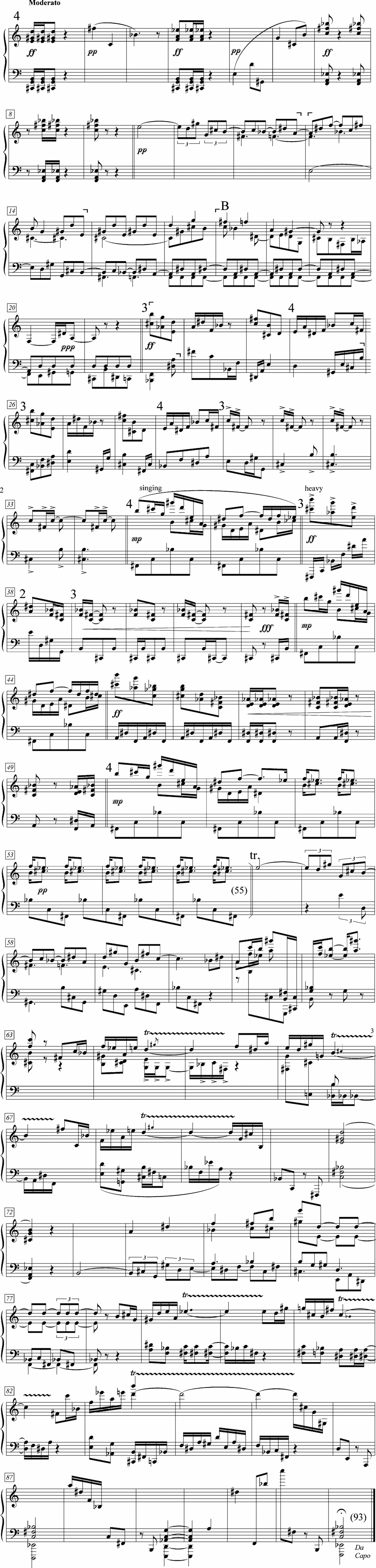
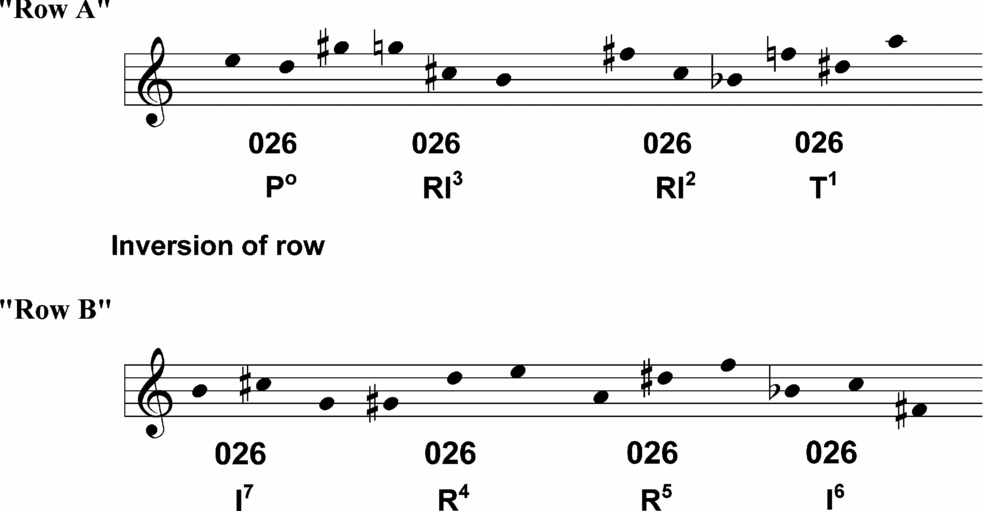
Harrison understood the twelve-tone row as “one large ‘melodicle,’” parsed, on another level, into local “melodicles,” rearranged in different intervallic orders that reflect and unify the whole.Footnote 48 For example, the two rows employed in an early, incomplete, and untitled twelve-tone piano piece (1937) consist of permuted, three-pitch “melodicles” (in contemporary theory, 026 trichords; see Examples 1 and 2).Footnote 49
Score of an untitled piano piece by Lou Harrison (1937). Printed by permission of Charles Hanson, the Lou Harrison Estate.

Harrison, untitled piano piece: Relationships to the first trichord of “Row A.”

In “Row A” (the main row, designated as such by Harrison), the first and fourth trichords are related by transposition, and both the first and second, and first and third, by retrograde inversion. The trichords of Harrison's “Row B” relate to the first trichord of “Row A” by inversion and retrograde. In layout, the repeated and permuted trichords resemble one of Webern's “derived sets.”Footnote 50
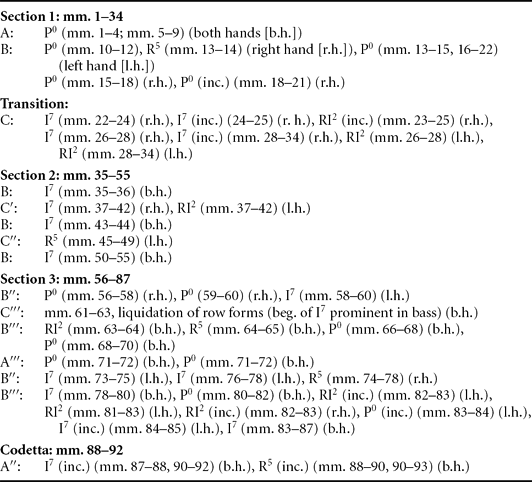
Rows A and B generate the idiosyncratic form of the work (see Table 1). Double bar lines reveal discrete units, often indicated by metric shifts (e.g., from duple to triple and vice versa) or new technical treatments of the row (e.g., canon in Unit 2, new partitioning in Unit 3; compare Example 1). The notion of writing in such sections reflects Harrison's (and Cowell's) experience with dance music.Footnote 51 In particular, the procedure relates to Cowell's notion of an “elastic form”—a work constructed in “block-units” that could be extended through improvisation during dance accompaniment.Footnote 52
The Form of the Untitled Piano Piece (1937)

Harrison most likely generated each section of this twelve-tone piano work while improvising for dance classes at Mills College. As he explained in an unpublished interview:
They [the dancers] would go on for a half an hour. I could develop thematics. I remember at Mills once, I spent a whole day improvising classes on “We want Cantor” (C′–A–D′–G). . . . It's an old thing from the '30s. . . . “Cantor” was a comedian . . . and this was the call for him. . . . So I just spent a whole day at Mills improvising all the classes on that subject—inversions, retrogrades, retrograde inversions, different harmonic effects, polyphonies, and so on. It was always interesting. There was always a way of doing it.Footnote 53
In the first three block-units of his piano piece, Harrison presents materials in twelve-tone rows that also explore Seeger's and Cowell's techniques of “dissonation” (compare Example 1, mm. 1–34). For example, the linear, pianissimo “melodicles” at mm. 2 and 5 contain many leaps of more than an octave. Harrison is consistent in his choice of dynamic levels for given textures—forte for chords (mm. 1, 4) and piano for linear “melodicles” (mm. 2–3, 5–6). The repetition of dynamic patterns vivifies the chromatic completion of the rows themselves. By contrast, in the second unit of the form (mm. 10–21), the lyrical, pianissimo canon at the octave favors quintal and secundal simultaneities on downbeats, recalling Seeger's rules of “dissonant counterpoint” (see Example 1).Footnote 54 Unit 3 (mm. 22–34) introduces a triple versus duple division of the beat (e.g., mm. 22–24 versus m. 25); for Cowell and Harrison, a 4:3 rhythmic ratio could be read as referring to the pitch relation of the fourth (from the overtone series). Thus, such rhythmic shifts reflect the interval of transposition between the work's primary sets, “Row B” (begins on B) and “Row A” (begins on E).Footnote 55
In discussing the effects of “dissonation” on the emotional landscapes of modern music, Seeger wrote:
Most modern composition seems to restrict itself to a comparatively narrow variety of moods. In avoiding romantic sentiments, there has been little left except excitement, which is not an emotion or sentiment but rather a concomitant of emotion or sentiment. . . . In its abhorrence of the pretty, the sentimental, the self-pitying revelry, the exuberant optimism and subjectivism of romantic ardor, modern music has run almost entirely to the grotesque, the unsentimental, the merely exciting, and the almost inevitable pessimism of pure objectivity.Footnote 56
The structural juxtapositions of Harrison's opening phrases epitomize Seeger's view. Moments of quiet lyricism are starkly contrasted with angry, harsh chords. Thus each unit of sound communicates its own sensual, intellectual—and distinctly un-Romantic—wisdom.
Harrison amplifies these expressive dichotomies in the work's second section (beginning in m. 35). He repeatedly returns to a “singing,”Footnote 57 freely canonic, two-measure phrase (mm. 35–36, 43–44, 50–55) that he contrasts with reworkings of the materials of Unit 3 (beginning in m. 22; see Example 1). These angry, “heavy”Footnote 58 sonorities interrupt the literal repetition of the “singing” phrases (mm. 43–44, 50–55). Harrison's schema of interruption and return can be viewed as giving artistic life to Seeger's and Cowell's advice; composition students should be inspired to compose numerous “continuants” to the same nontonal materials. Seeger explains:
To emphasize the flow, progress, and continuity in the individual line, the plan of the continuant is recommended. This is based on the assumption that every initial motive, measure, or phrase contains within it certain definite implications regarding movement and rest in what may follow. . . . One of the best disciplines in the art of composition is the writing of a large number of continuants to the same given beginning. . . . In making continuants, it is necessary to have a definite idea and feeling of what must follow as well as what can follow, with its mood, momentum (broken or sustained), the type of flow (step-wise or skip-wise), symmetry and asymmetry, etc.Footnote 59
Unsurprisingly Schoenberg used exactly the same method for teaching aspects of continuity in tonal composition. For example, in teaching the model composition of traditional phrase structures such as the period, he stressed the writing of multiple consequents to the same antecedent.Footnote 60 Schoenberg further understood compositional continuity as predicated on the careful construction of any work's initial thematic and harmonic materials—and his teaching focused on this notion. As he explained, “When Webern came to me . . . I told him he had to start all over from the beginning, and for six months we did nothing but study the structure of themes.”Footnote 61
The final portion of Harrison's piece (m. 56) commences with an obvious thematic return to the lyrical canon of Unit 2 (compare m. 10 in Example 1), presenting a set entirely absent from Section 2, “Row A” (P0). An ensuing series of sequences (mm. 63–69) develop both rows “A” and “B” in a texture strikingly reminiscent of configurations in Schoenberg's op. 11, no. 2: trills extending above melodies disjunct in register.Footnote 62 Subsequently Harrison returns to a variation of Unit 1 but with a completely different musical spirit: dark harmonies confined to the low register replace the opening's vibrant, broadly spaced chords. In the codetta disjunct melodies (e.g., A–D sharp–F–B flat–C–F sharp, mm. 88–89 and 91–92) become one with the final sonority—the first sense of resolution in the work, although one ironically using incomplete forms of the row.
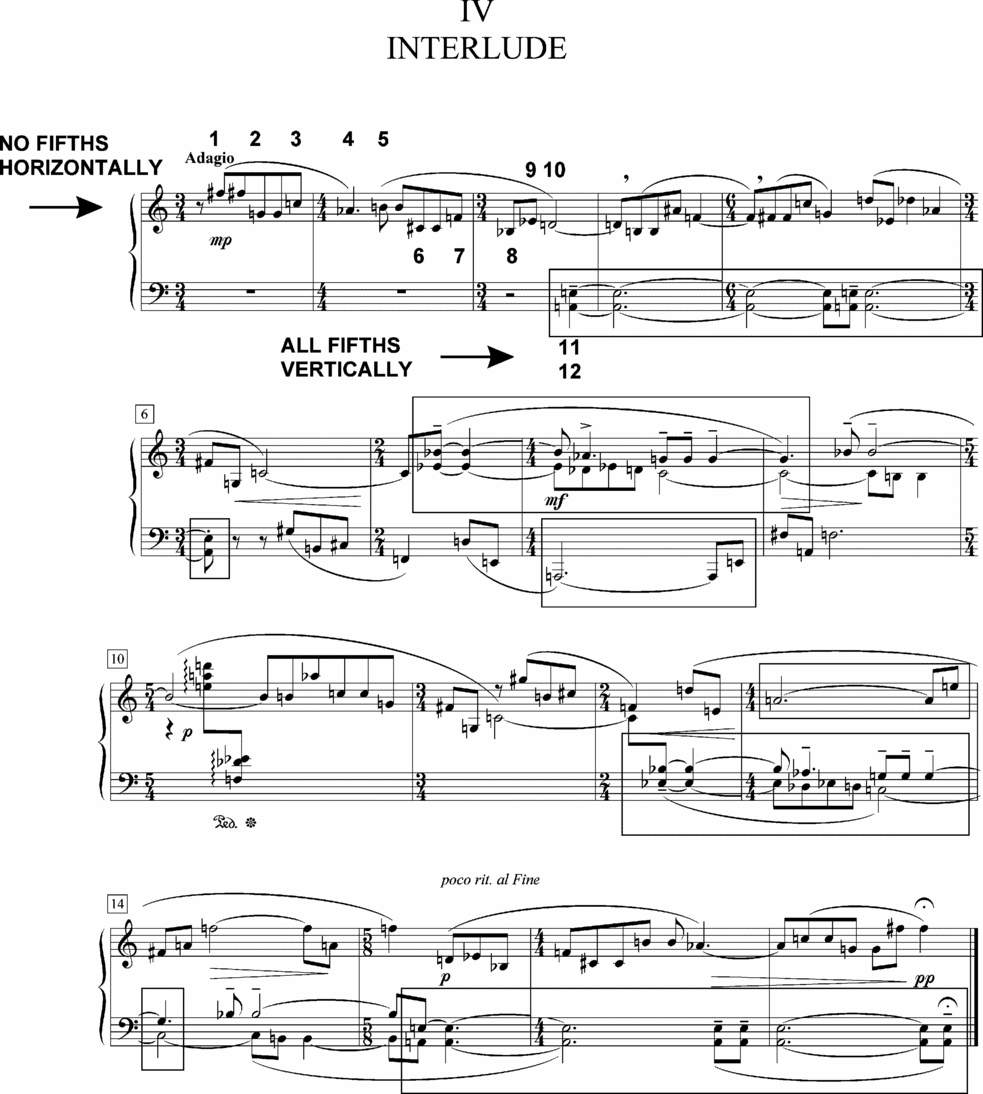
It is telling that Harrison would circle back to the work's initial materials and end in a spirit of resolve. This compositional choice reveals a deep-seated interest in, and attachment to, pitch centricity, if not tonality. A decade later, when Harrison composed the “Interlude” of the twelve-tone Suite for Piano (1943), he conceived an underlying framework based on tonal procedures. Here the fifth is used only as a vertical interval; and the chordal drone on A–E appears in the opening and closing bass parts, thus functioning by analogy as a pitch center (see Example 3).Footnote 63 As we will see, such intuitive tendencies toward tonality would lead to Harrison's skepticism about the twelve-tone method and would ultimately help convince him to reject it.
Pitch centricity in the “Interlude” from Harrison's Suite for Piano (1943). Copyright 1964 by C. F. Peters Corp. International Copyright Secured. Reprinted by permission.

John Cage and the Suite for Piano (1943)
Lou Harrison first met Schoenberg at a concert reception on 7 March 1935 in San Francisco—a singularly tense occasion. Cowell had invited Schoenberg to conduct the performances of Pierrot lunaire and the Kammersymphonie No. 1 under the auspices of the New Music Society.Footnote 64 Gerald Strang described the concert preparations as strenuous:
I remember sitting through every single rehearsal, being amazed at Schoenberg's tremendous concern with every little detail. This kind of rehearsal, which was not unusual in Europe, was something that we simply had never seen: the idea that every grade of dynamic had to be worked out and every attack, every phrasing in every instrument, whether it was conspicuous or not, was the subject of endless attention and care.Footnote 65
The program was changed at the last minute. Only seven of the twenty-one songs of Pierrot were performed, whereas the Kammersymphonie was played twice. Moreover, because of a player's tardiness, the performance started thirty minutes later than scheduled.
The San Francisco critic Alfred Frankenstein remembered that after the concert, Schoenberg “was in a terrible mood. . . . I took him back to the hotel, and he was fit to be tied.”Footnote 66 He was virtually silent during the reception after the concert at the home of Olive Cowell, Henry's stepmother. In her words, “Schoenberg was a very proper person and said nothing at the reception even though the concert was not very professionally conducted.”Footnote 67
Yet none of these circumstances affected Harrison's impression of Schoenberg's music. He wrote:
It was quite some time [before the concert began], forty or forty-five minutes, because one of the important players was late. He had been playing in the opera next door at the opera house, and he had to come through a subterranean tunnel to get to the chamber music stage. In the meantime, Henry [Cowell] had to jolly the audience along, as he put it. I've never forgotten that—he gave a kind of history of Schoenberg—very informative. And then the great event occurred, and it was really a marvelous concert. That was my first hearing of parts of Pierrot lunaire and certainly of the Chamber Symphony. It was very exciting indeed.Footnote 68
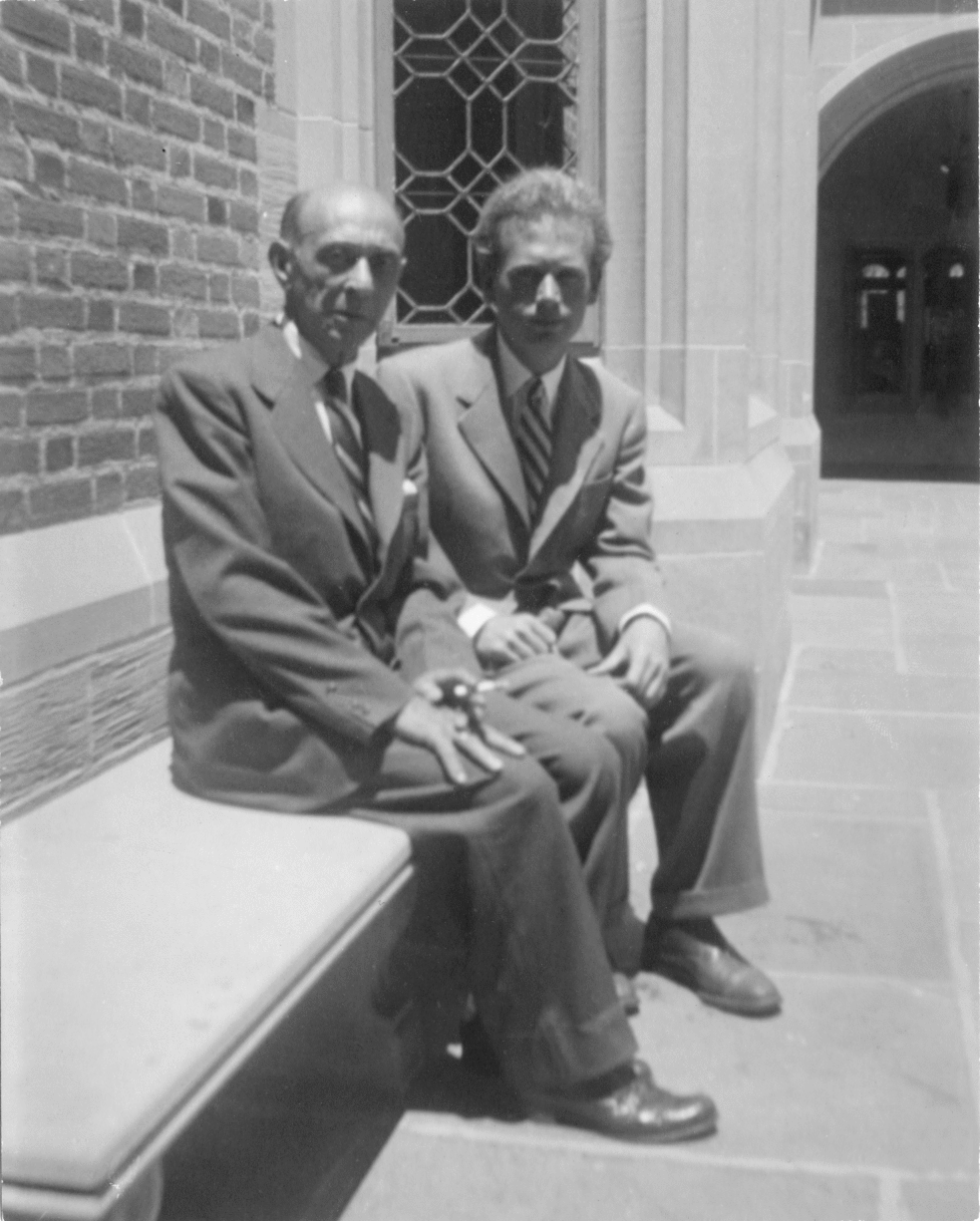
In 1942 Harrison moved to Los Angeles hoping to study with Schoenberg.Footnote 69 He made contact with the composer through a mutual friend, photographer Harold Halma, Schoenberg's composition student (Fig. 3).Footnote 70 Harrison explained to the pianist Neil Rutman:
I gathered up my courage and applied to his then assistant, Harold Halma, who took me directly to Schoenberg in his study. He had evidently been in deep concentration and must have been startled, for he physically twitched during the introduction. I was relieved, though, to be accepted as a student.
He was a marvelous man—very small and [he] had a rather bad complexion, sort of dark, and he smoked too much. His hands were all bronzed from it. He was a lovely and delicate man . . ., very nervous when airplanes flew over UCLA. . . . He would almost dart under the piano. He once hushed us, too, in order to hear a bird outside.Footnote 71
Schoenberg and Harold Halma at UCLA (ca. 1942). Reprinted by permission of Lawrence Schoenberg, Belmont Music Publishers.

In the spring of 1943 Harrison began visiting Schoenberg's course, titled “Music 261: Seminar: Special Studies for Composers” in the UCLA class list. Harrison's remembrances of the class per se are few; he notes that they analyzed Beethoven symphonies and one of Schoenberg's string quartets.Footnote 72 During class time Harrison had the occasion to show Schoenberg his early works; he provided the following information in numerous interviews: “I was told that [Schoenberg] refused to examine any work in ‘12-tone technique.’ Firstly, then, I took my Saraband and also my Prelude for Grand Piano and played those for him. He said, with obvious pleasure, ‘This is music I understand,’ and turning, asked my fellow seminarians, ‘Why do you not bring to me such music?’”Footnote 73
During his study with Schoenberg, Harrison was teaching LabanotationFootnote 74 at UCLA and was also an accompanist at Lester Horton's dance studio, a leading company of its day. One of the dance instructors, Melissa Blake, took a personal interest in Harrison. She was a friend of the critic Peter Yates and his wife, pianist Frances Mullen, who together ran the contemporary music series “Evenings on the Roof.” Blake introduced Yates and Mullen to Harrison. Yates recalled:
[At the Horton Studio, Harrison] improvised the accompaniments for the dance exercises while he read a book propped on the piano. And then between classes, he would continue reading the book while he would improvise fugues at the piano. This fascinated [Melissa], so she quickly got acquainted and brought him over to meet us. . . . [He] was particularly anxious to hear the Suite for Piano, Op. 25, by Schoenberg. And Frances played that for him. She had performed it several times for our concerts. He was so gratified that he then went away and in about three and a half weeks came back with his own piano suite, which is quite as substantial as the Schoenberg.Footnote 75
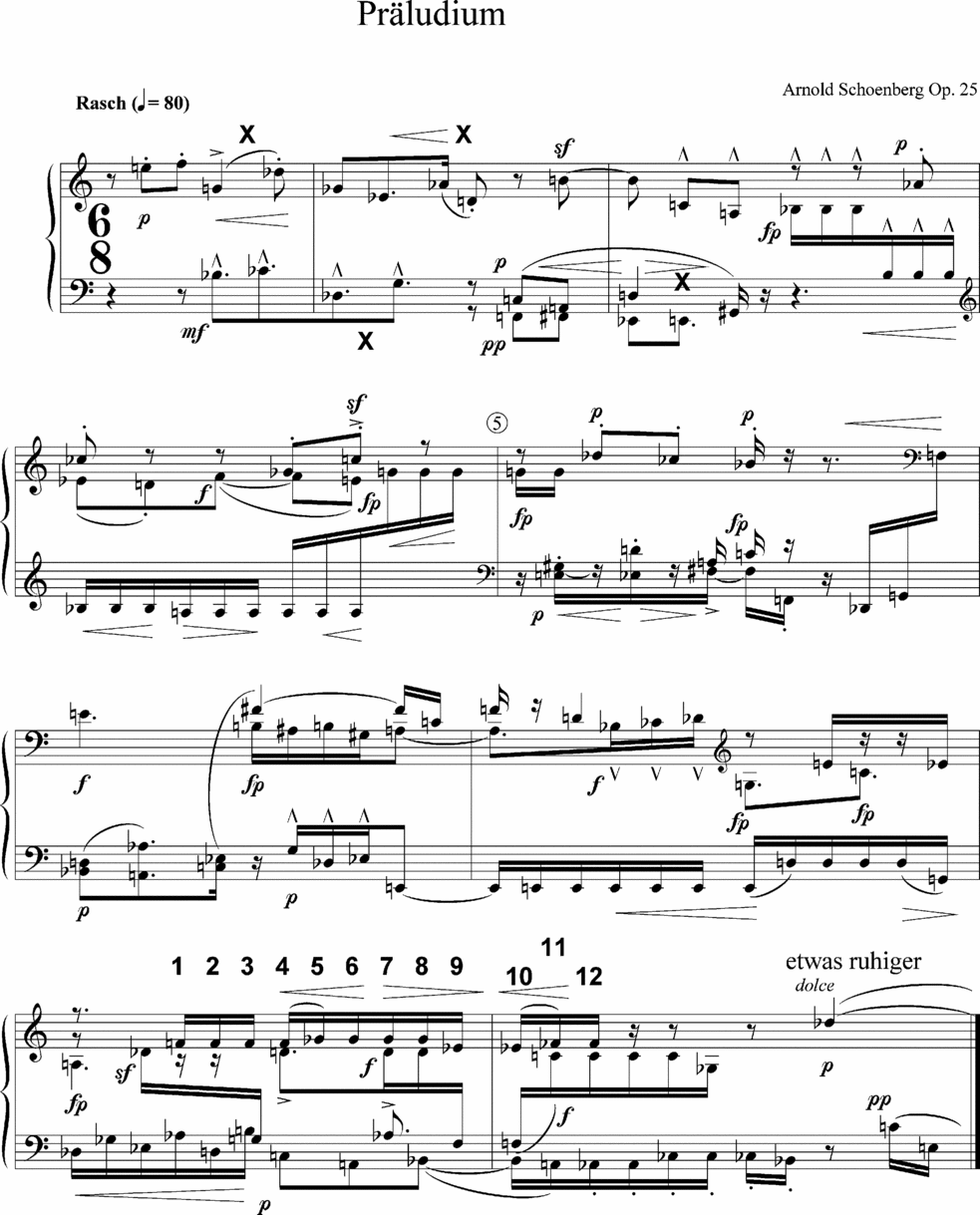
Harrison's Suite for Piano consists of four main movements and an interlude (compare Example 3) built on a row containing all intervals but the tritone—the very interval that is a constant presence in Schoenberg's op. 25 (see “X's” on the score in Example 4A). Perhaps in creating this complementary relationship, Harrison was paying a subtle compliment to Schoenberg.
Attacks of twelve in Schoenberg's “Prelude,” Suite für Klavier, op. 25. Copyright 1952 by Belmont Music Publishers. All Rights Reserved. Reprinted by permission.

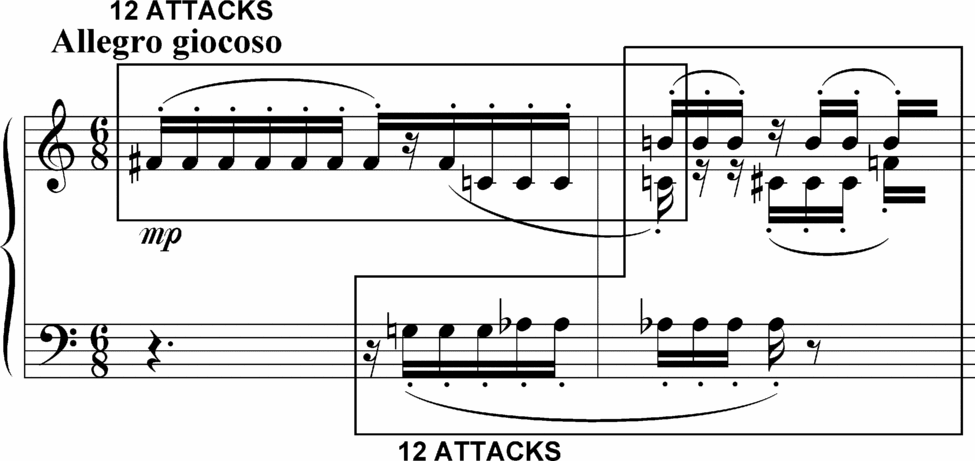
Since writing his earliest twelve-tone works in the mid-1930s, Harrison had become extensively involved in music for percussion and dance, and his ear for the number and nature of attack patterns was keen. He invented a technique termed “ictus control,” in which he kept consistent the number of attacks within a given temporal unit regardless of their metric position.Footnote 76 In listening to Schoenberg's op. 25, he was obviously attracted to the opening repeated-note figure in the Prelude—and especially to that figure when it contained twelve attacks (mm. 8–9; see Example 4A). Harrison begins his Suite's Rondo with seven attacks (plus a rest) in the alto line followed by five attacks (plus a rest) in the tenor—twelve attacks in all (see Example 4B). The bass part enters with nine attacks (plus a rest) followed by the soprano's three attacks (after a sixteenth-note rest), again totaling twelve attacks. The Rondo's continued sixteenth-note repetitions reminded Harrison of a “laughing game, the whole thing! Giocoso!”Footnote 77
Attacks of twelve in Harrison's “Rondo,” Suite for Piano. Copyright 1964 by C. F. Peters Corp. International Copyright Secured. Reprinted by permission.

Harrison composed three of the main movements of the Suite—the Prelude (I), Aria (II), and Rondo (V)—quite quickly.Footnote 78 By contrast, he chose a schema for the third that proved a challenge—a “Conductus.” Like Seeger and Cowell, Harrison held that early-music genres needed revival in contemporary form. Seeger wrote, “In the twelfth and thirteenth centuries and again around 1600, adventurous experiments resulted in dissonant practice that was left high and dry by the succeeding generations.”Footnote 79 Despite Seeger's, Cowell's, and Harrison's fascination with medieval music, their precise musical knowledge of it remained questionable. For example, the conductus is generally considered a through-composed composition in simple note-against-note texture without a cantus firmus. By contrast, Harrison's “Conductus” presents a row in long notes moving against others presented in smaller values. In principle, this layout suggests the scaffolding of a medieval motet instead: the rhythmic extension of a cantus firmus moving against lines of smaller values. Thus, if Harrison had a model in mind for his movement, it was not a strictly historical one.Footnote 80
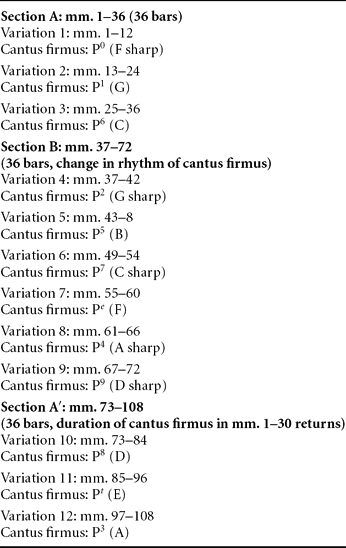
In his idiosyncratic “Conductus,” Harrison aimed to present all twelve transpositions of the row's prime form in the continuing format of a cantus firmus. The order of their entrance and level of their transposition would correspond to the order of pitches in the row (i.e., a statement of the cantus on F sharp followed by one on G, then C, and so on). In turn, each successive transposition would articulate the beginning of one of the work's twelve variations (compare Table 2). Miller and Lieberman describe listening to the movement as follows:
The long-note cantus firmus is a twelve-tone row . . . that stands out as a supportive underpinning to dense flurries of sixteenth-notes in the surrounding voices. . . . The twelve notes of the structural melody are first articulated in the left hand at approximately two-second intervals. . . . In the middle of the piece, the cantus firmus doubles in speed and migrates to the bass and soprano, then moves between these outer parts. As a result, it becomes increasingly prominent as the glue that binds the movement together. For the concluding sections, it reverts to whole notes in the tenor. [The piece thus becomes] a virtuosic tour-de-force.Footnote 81
The Form of Lou Harrison's “Conductus,” Suite for Piano.

During its creation the “Conductus,” bursting with row forms, grew to such length and complexity that Harrison felt, “I was composing myself into a corner.” At that point his immediate solution was to take it to Schoenberg for comment. Throughout his life he recounted this meeting:
I played the Prelude. There was rather a long moment of silence, and then he asked me thoughtfully, “Is it 12-tone?” I simply said, “Yes.” He reached out for the page, saying, “It is good! It is good!” . . . He asked me to continue, and I played Movement II. Again, “It is good! It is good!” He seemed fascinated by the very wide, soft spacing in mm. 4–8. By the time I had played to the point of my blockage in Movement III, he plunged directly in, already aware of my structure, and with splendid illuminating instructions, permanently disposed of, for me, not only that particular difficulty but also any of the kind I might ever encounter. Only a few years ago I wrote a sentence in a paper for the East-West Music Encounter in Tokyo, which suggests something of what I felt he was telling me about: . . . that deft, light musicality which to us (as musicians) is the happiest conjunction of our intellect and senses.Footnote 82
In another version of the story, Harrison added: “I somehow let him know that I was bogging down, and he really said, ‘Thin out! Less. Thin. Thinner. Less and only the essentials.’”Footnote 83
The composer/scholar Heidi Von Gunden contends that Harrison played the “Conductus” to bar 36 in the published score—perhaps the composer himself told her that this moment was “the point of blockage.” At this measure the row is doubled in speed (from whole notes to half notes) and begins to migrate among various parts.Footnote 84 Von Gunden interprets these rhythmic and textural changes as Harrison's compositional reaction to Schoenberg's advice: “Thin out.” However, Von Gunden never considers Harrison's overall method of both simplifying and tightening the work's large-scale form. Here we shall see that Harrison's own interpretation of John Cage's square-root form comes to the fore.
In the five years before studying with Schoenberg, Harrison had composed numerous works for percussion, many of which contain serial procedures. For example, the Fifth Simfony (1939), the third movement of Labyrinth #3 called “Seed” (1941), and the Fugue for Percussion (1942) articulate their form through the retrogrades, inversions, and retrograde inversions of large sections and local rhythmic “melodicles” and their permutations. In particular, the Fugue weds these techniques to Cowell's derivations of cross-rhythms from the overtone series.Footnote 85 In addition, these and other works further tend to reflect Harrison's intense involvement with the ideas and music of his friend John Cage. In Double Music (1941), composed with Harrison, Cage made use of an organizational principle found in several of his percussion works from the time, his so-called square-root form—a type of structure in which, he says, “the whole [has] as many parts as each unit has small parts, and these, large and small, in the same proportion.”Footnote 86 Harrison considered this notion “a useful, fascinating way of forming a piece,”Footnote 87 and as we shall later see, he would use it in the “Conductus.”
While Harrison was composing the Suite (1943), Cage himself was concerned with the number of attacks within small, structural divisions—a concept related to and most likely derived from Harrison's notion of “ictus control.”Footnote 88 James Pritchard writes:
There are two short pieces written in 1943 (after Cage had moved to New York) which use a different means for controlling rhythmic patterns—what he has called “a method for controlling the number of attacks within the small structural division.” What this means is that rather than creating phrases of music by stringing motives along one after the other, here he used a system that controlled the number of notes to be struck in each phrase unit. The patterns and rhythms were then composed freely to provide the proper number of attacks. This is first seen in the second movement of the suite Amores (1943), a trio for tom-toms and rattle.Footnote 89
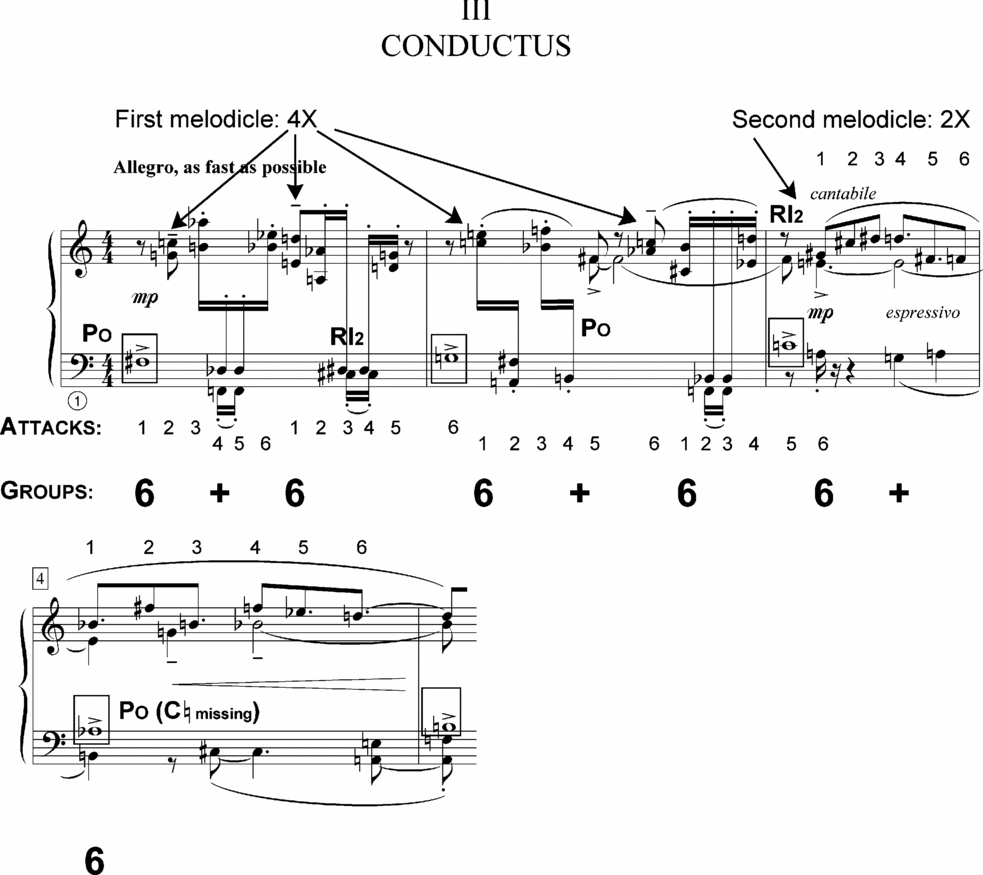
Harrison seems to have returned to the opening phrase of the “Conductus” and studied its attack patterns in an attempt to solve his compositional problems (see Example 5). The pitches of the row/cantus firmus fall on the attack of every twelfth note, whereas rhythmic “melodicles” (consisting of an eighth and four sixteenth notes [mm. 1–2]) and a lyrical melody (consisting of six eighth notes [mm. 3–4]) enter on every sixth sixteenth note. A row change accompanies the entrance of the lyrical melody (mm. 3–4) at the point of the twenty-fourth attack in the work. In addition, there are four instances of one rhythmic “melodicle” (i.e., the eighth note plus four sixteenth notes) and two of the second (i.e., six dotted eighth notes)—together adding up to six.
Attacks of six in Harrison's “Conductus,” Suite for Piano. Copyright 1964 by C. F. Peters Corp. International Copyright Secured. Reprinted by permission.

On a structural level Harrison chose to divide the “Conductus” into units of thirty-six measures—the square root of thirty-six is six times six (see Table 2). Harrison articulates the second unit of thirty-six by shifting the rhythmic value of the cantus firmus to half notes; and he repeats the rhythmic values of mm. 1–30 to articulate the work's final section in mm. 72–108. The technique of the “square-root form” was certainly fresh in Harrison's mind and ear—he had just finished working with Cage on Double Music, a work extensively employing the method. Thus, the “Conductus” becomes one of the first American twelve-tone works to use macro- and micro-configurations of rhythm and pitch in generating a large-scale form.Footnote 90
Frances Mullen performed the premiere of the Suite at a “Roof” concert on 8 May 1944 and repeated it at her final “Roof” recital on 2 November 1953.Footnote 91 Her friend, the Hungarian pianist Andor Foldes, played the work in New York on a program of the I.S.C.M. Forum in 1945,Footnote 92 and in 1995 the American pianist Michael Boriskin recorded it commercially for the first time.Footnote 93
Schoenbergiana
Shortly after finishing the Suite, in the early summer of 1943, Harrison decided to accompany Lester Horton and his dance company on their move to New York. Harrison frequently told the following anecdote about Schoenberg's reaction to his departure: “I went to say good-bye to Schoenberg. On Schoenberg's desk were two piles—one pile was Bach scores, one was Mozart. As a parting gift, Schoenberg told me to ‘study only Mozart.’ I had the feeling that I had gotten my diploma in counterpoint.”Footnote 94
From New York, Harrison wrote to Schoenberg about his compositional activities:
In music I have continued to compose almost constantly and fatuously [sic] feel that I am improving. I have written a great number of things this year and am trying to get readings so that I can tell more about them than the silent working-over can give me. I have more or less tried to expand my range, or rather it seems to be expanding itself. I really feel that since my serious conversion to the principles of your row technique, I have for the first time really been able to feel on speaking terms with larger forms. The result has been a small Symphony and a first quartet. Since May, I have been at work on a second quartet. I find that I love writing for the four strings. When it is done, I shall take the liberty of dedicating it to you.Footnote 95
Less than two weeks after writing this letter, Harrison decided to abandon the Second String Quartet that had been intended to celebrate Schoenberg's seventieth birthday.Footnote 96 However, in 1961, when his composition student Robert Hughes requested a piece for his wind sextet, Harrison returned to the unfinished work. With the help of Hughes, a virtuoso bassoonist and conductor, Harrison reinvented the piece for woodwinds. In the process he reduced the work from four to three movements, which he also reordered. Finally, he dedicated this new version to Schoenberg's memory and titled it Schoenbergiana.Footnote 97
In 1944, just before Harrison abandoned the quartet, the New York music scene was buzzing in anticipation of the premiere of Schoenberg's Ode to Napoleon Bonaparte for reciter, string quartet, and piano, op. 41, a work famous for its political overtones (the tyrant Napoleon of Byron's poem is equated with Adolf Hitler). Two months before its scheduled performance, the New York Times critic Noel Straus pointed out that, in the Ode, Schoenberg used the twelve-tone row in ways that were Janus-faced—intermixing nontonal and triadic sounds. He wrote:
The score is definitely in the twelve-tone technic, but often becomes homophonic in texture. Space forbids detailed account of this provocative score. But just a few words may be said concerning its use of the triad. That the triads in the “Ode” stem from the interval of the third at the start of the introduction, and that it was chosen because it outlined the same interval in the motive used at the word “victory” in the text, is evident. Triads form a most vital element in the music, moreover, since they are used in their purest form for several measures at the climactic moment in the final stanza, starting with the words, “Yes, one,” etc., where Washington is lauded as the ideal conqueror, and they obviously symbolize him and his type of victory.Footnote 98
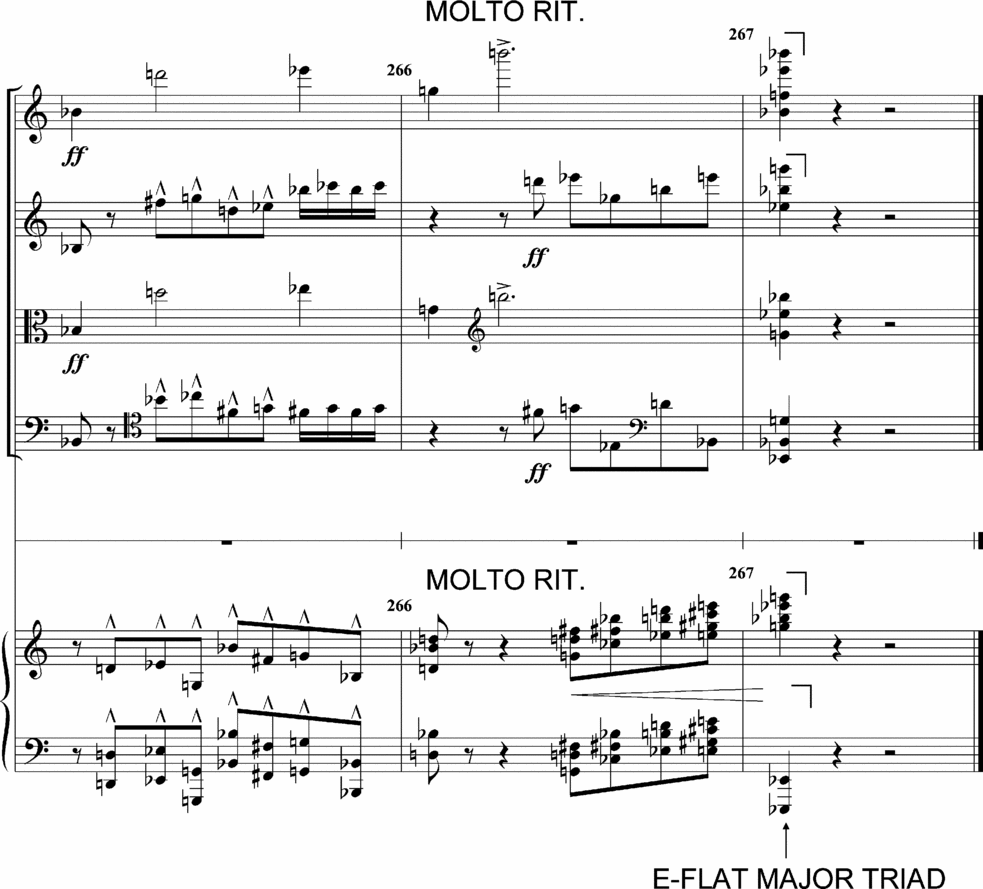
The idea of Schoenberg using tonal materials in a twelve-tone work could have inspired (or in other cases, validated) composers' instincts to combine tonal and serial materials in a single work. Indeed, the Ode ends on an E-flat major triad, an homage to Beethoven's “Eroica” (see Example 6A).Footnote 99 In his own review of the premiere, Harrison indicates a strong interest in this cadence. He wrote, “Kurt List. . . referred to the sound of the final section as an ‘exalted glow.’ This ending is a marvelous contrivance; at once tender and impersonal, it is a berceuse for a national hero.”Footnote 100 Indeed, this ending could well have influenced Harrison's quartet.
The final cadence of Schoenberg's Ode to Napoleon, op. 41. Copyright 1952 by Belmont Music Publishers. All Rights Reserved. Reprinted by permission.

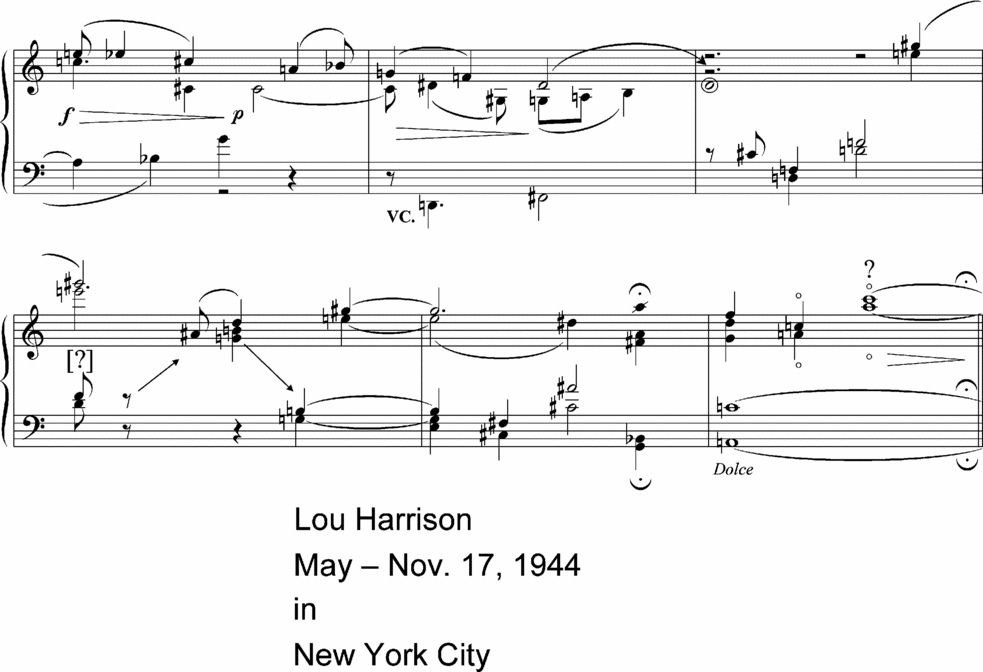
The second movement of Harrison's Second String Quartet (like the second movement of Schoenberg's Third String Quartet, op. 30) consists of a nontonal theme and variations, although Harrison articulated a broad plan of departure and return alluding to tonality. Even his choice of tempi for the movement articulates such a pattern (from poco adagio to allegro vivo and back to subito largo, amoroso). In addition, he continually “puttered” with the thirds of the row—configurations that flirt with tonal sounds. The overall effect of the variations is one of intense agitation. Crucially the movement ends on a remarkable minor third—one so rich in harmonics that it sounds like an A-minor triad (Example 6B). Harrison placed a question mark above it. Was it too tonal? Were the harmonics too bold in sound? Or, on another level, could its own sad “glow” not sufficiently capture Harrison's own feelings, perhaps about the world at war? Nothing is clear from the manuscript. There is no question, however, that the effect of this triadic ending is analogous to that of Schoenberg's Ode—a lone triad crying out to be heard after prolonged stretches of dissonance.Footnote 101 (A live recording of this movement made in May 1963 by Hughes and his ensemble, the California Wind Quintet, can be heard on the JSAM web site at www.journals.cambridge.org/sam2009001.)
The final cadence of Harrison's Second String Quartet. By permission of Charles Hanson, the Lou Harrison Estate.

Harrison's technical and expressive interest in successfully combining “Janus-faced” materials into a twelve-tone framework would persist through the early 1950s, when he experimented in his Symphony on G (begun 1947, completed 1964) and the opera Rapunzel (1952) by drawing on the quasi-tonal/serial resources of Schoenberg's student Alban Berg.Footnote 102 Rapunzel, Harrison's first major work composed after Schoenberg's death, could be viewed as his private tribute to Schoenberg's memory; it is the last of Harrison's fully twelve-tone works.Footnote 103
Aftermath
By the 1950s and 1960s Harrison's attitude toward the twelve-tone method was altered by a new issue, entirely unrelated to Schoenberg and the Second Viennese School. As a contemporary composer of modal and tonal music, Harrison became a target of the hostile judgments of total serialists on the East Coast; Harrison came to associate their sense of absolute, compositional control with inhumanity:Footnote 104 12-tonalism often represented for him the depersonalization of Western society. He would use it with specifications for equal temperament in protest pieces such as ‘Hatred of the Filthy Bomb’ movement of Pacifika Rondo (1963), which ends with a terrifying scream by the conductor [Robert Hughes on the first recording].”Footnote 105
Yet his personal hatred of total serialism did not deter Harrison from resurrecting the Second String Quartet/String Orchestra piece for Robert Hughes's woodwind group in 1961. His decision reflects not only his dissociation of East Coast serialism from the Second Viennese School but also his cherished remembrances of being Schoenberg's favored pupil—and now he could have the joyous opportunity of collaborating with his own student. Hughes was an ideal personal and professional partner, who alone had a “magic gift” to speak at any time with Harrison about music.Footnote 106 Hughes and Harrison worked closely not only on the formal problems in Schoenbergiana but also on balancing the wind orchestration among its movements and adjusting its tempi and articulations. Hughes's California Wind Quintet gave the work's premiere (with the Siciliana as a first movement) at the Sticky Wicket, a cafe in Aptos, California, in April 1962.Footnote 107
Harrison's travels to Japan, Korea, and China in the 1960s increased his strong interest in non-Western tunings. By that time he had also discovered the music of Harry Partch, whose work in 43-tone tuning he considered the “logical extension of Schoenberg's twelve-tone system” because of the strictness and profundity of its method.Footnote 108 As a result, he turned to writing in just intonation and a variety of tonal or modal languages. Miller and Lieberman point out that “Harrison later compared serialism to a squirrel's cage: round and round the series of twelve fixed notes. He found the door out of the cage by admitting more than twelve possible subdivisions of the octave into his tonal palette.”Footnote 109 Thus Harrison came to write, “How distant he seems, Arnold Schoenberg in Vienna.”
Yet Harrison's personal affection and unquestioned respect for Schoenberg's achievement remained unchanged. In 1974, on the centenary of Schoenberg's birth, while busy composing the Sonata in Ishartum and the Suite for Violin and American Gamelan, he wrote: “What I liked about the music was its intense self-contained musicality. For it seemed to me that those small mobile melodies, so swiftly and adroitly developed, imitated, inverted, retrograded, collapsed into chords, augmented, ornamented, contracted, or otherwise treated, did create a closed garden of purely musical interest, purely musical existence.Footnote 110
In his sole surviving letter to Schoenberg (1944), Harrison had written:
No person has given me as much confidence in myself, and I have had much need since then, in the face of fads and fashions, of just that intense and real belief in the importance of honesty towards oneself and honesty towards the arts which I profess that you seemed to give me. Be assured of my continuous devotion, both to you personally and to the music, which you have so wonderfully given to us all.Footnote 111