Introduction
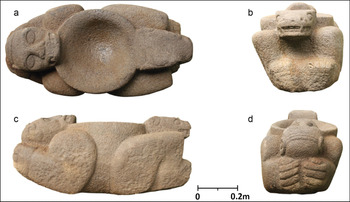
The people of lower Central America have long been connected to Mesoamerica, the culture area that encompasses the southern half of Mexico, all of Belize and Guatemala, along with adjacent areas of Honduras and El Salvador. Lower Central America comprises all territory south of this to Panama's southern border. Migrations of Nahua-speakers (i.e. the language of the Aztec) south along the Pacific Coast from the Soconusco region in Chiapas, Mexico, to the Guanacaste region of Costa Rica attest to direct connections in the final 500 years of the pre-Hispanic era (Carmack & Salgado Reference Carmack and Salgado2006; MacCafferty et al. Reference MacCafferty, Amador, Salgado, Dennet, Nichols and Pool2012). The recent discovery of a sculpture (Figure 1) from Las Mercedes in the Limón Province of Costa Rica adds to the evidence for these connections with Mesoamerica, dating back as far as AD 1000. The sculpture resembles a chacmool, a distinctive sculptural form best known from the Mesoamerican political centres of Chichen Itza and Tula in Mexico (Miller Reference Miller1985). A similar sculpture—also from Las Mercedes and long housed at the American Museum of Natural History (Mason Reference Mason1945)—along with six previously unpublished examples from the National Museum of Costa Rica, demonstrate that chacmool-like sculptures were more common in Costa Rica than previously suspected. As the only Costa Rican example from a secure, excavated context, the newly discovered sculpture from Las Mercedes allows us to date—for the first time—the inter-regional cultural ties to AD 1000–1200 (Vázquez & Rosenswig Reference Vázquez and Rosenswig2016). Such long-distance connections situate Costa Rica in a Pan-American world system that stretches over 4000km north to the U.S. Southwest, and was centred on an expansionary military cult in Mesoamerica at the end of the Classic period (AD 800–1000) (see Ringle et al. Reference Ringle, Gallareta Negron and Bey1998).
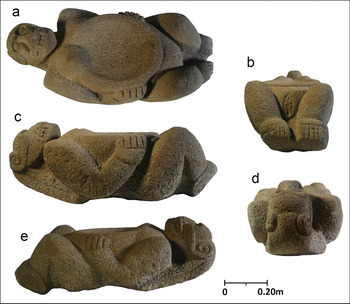
New chacmool excavated in 2012 from Las Mercedes, Costa Rica (L289 LM-1 art. 180) (photograph by J.C. Calleja).

Pan-American context
Long-distance connections between Mesoamerica and the U.S. Southwest have been dated back to the beginning of the first millennium AD. The use of chocolate pots—which combine the Mesoamerican cylinder form with Southwest decorative styles—dates to between AD 1000 and 1125 (Crown & Hurst Reference Crown and Hurst2009), and feathers of the neotropical scarlet macaw are documented in Chaco Canyon at AD 900–1150 (Watson et al. Reference Watson, Plog, Culleton, Gilman, LeBlanc, Whiteley, Claramunt and Kennett2015). Distinctively shaped chocolate-drinking pots and brightly coloured feathers both represent material remains of behaviours employed by ancient U.S. Southwest elites to demonstrate ties with their Mesoamerican counterparts. With no ‘functional’ motivation for transporting bird feathers over long distances, or for copying ceramic container forms that are awkward to use, we look to political and ritual factors to explain the adoption of these Mesoamerican practices over such long distances.
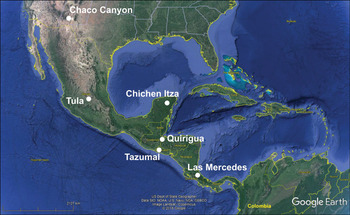
Together, the evidence from the U.S. Southwest and lower Central America reflects the adoption of Mesoamerican cultural beliefs. The extent of this process, in turn, provides us with a glimpse of a Pan-American world stretching over approximately 4300km (see Figure 2) and dating back more than 1000 years. At this time, Mesoamerican elites propagated a new religion (Ringle et al. Reference Ringle, Gallareta Negron and Bey1998) that employed warrior imagery and the use of exotic goods. This new ideology could have been the engine that propelled the establishment by Mesoamerican elites of long-distance connections to both north and south. Lower Central America had gold and the U.S. Southwest had turquoise; these novel raw materials were first used in Mesoamerica after AD 1000. While the search for new and exotic goods could have motivated Mesoamerican elites, why were these distant peoples interested in participating? Anthropological archaeologists have long proposed that local elites strategically borrow the foreign beliefs and associated practices of more complex neighbours for local purposes (e.g. Flannery Reference Flannery and Benson1968; Rathje Reference Rathje1971). The foreign nature of exotic practices connects elites to a wider world of goods and knowledge that may enhance their prestige at home. Such connections can be social, economic and political, as well as ideological (e.g. Kristiansen & Larsson Reference Kristiansen and Larsson2005; Rosenswig Reference Rosenswig2007, Reference Rosenswig and Hodos2017).
Map of the USA to Colombia, showing sites mentioned in the text (map courtesy of the U.S. Department of State Geographer; Data SIO, NOAA, U.S. Navy, NGA, GEBCO; Image Landsat/Copernicus; and Google Earth © Google 2018).

Long-distance connections were important to the local chiefdoms of lower Central America when the Spanish arrived in the sixteenth century. Knowledge of the mythological realm, along with the political skills of oration and leadership, was used to garner political advantage between the Cuna chiefs of Panama (Helms Reference Helms1979, Reference Helms1993). Political power was established and maintained by sending elite Cuna youths to Colombia to acquire arcane knowledge—a commodity exploited for political ends once they returned home (Helms Reference Helms1988: 118–19). Cuna elites travelled to northern Colombia to be schooled in religion, medicine, history and leadership skills. Travelling to distant lands to acquire arcane knowledge and returning with exotic prestige goods was a significant source of social capital. While all village chiefs learned a distinctive language, those with regional influence were better versed in matters of lore and ritual. Knowledge was compared at political occasions and served the same function as any other scarce goods (Helms Reference Helms1979: 128). We suggest that the sixteenth-century structure of knowledge acquisition from Colombia provides a reasonable parallel for the ‘borrowing’ of the chacmool sculptural form (and associated beliefs and rituals) from Mesoamerica 500 years earlier.
Although often inspired by distant exchange partners, foreign practices are rarely adopted without modification, but instead are adapted to make them salient within the cultures in which local prestige and power are sought (Rosenswig Reference Rosenswig2010: 13–46). When such ritual and political practices employ material accoutrements or furniture, they become accessible to archaeologists who study cultures in the absence of written texts. We argue that the Costa Rican sculptures we describe in this article represent ritual furniture employed by local chiefs to demonstrate their worldliness, enhance their prestige and bolster their political power by enacting Mesoamerican-inspired rituals. These chacmool-like sculptures were not adopted outright, but were adapted using lower Central American norms by the local elites who commissioned them.
Mesoamerican chacmools
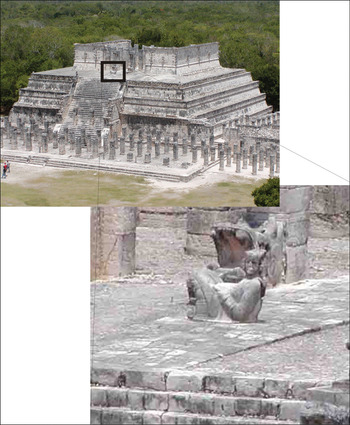
‘Chacmool’ means red or great jaguar paw in Yucatec Maya. Coined by the nineteenth-century explorer Agustus Le Plongeon (Miller Reference Miller1985: 7), it has unfortunately become the standard term used to refer to a distinctive subset of sculptures depicting reclining figures in Mesoamerican art. All Mesoamerican chacmool sculptures with known provenance come from prominent locations at important political centres, such as Chichen Itza (Figure 3). Mesoamerican chacmools comprise single, reclining male figures with their backs and knees raised and heads rotated 90° to face an audience. The elbows are planted on the ground, with hands raised to the chest, supporting a disc or dish that could hold offerings. Miller (Reference Miller1985: 8) notes that “This recumbent position represents the antithesis of aggression: it is helpless and almost defenceless, humble and acquiescent”. Chacmools therefore may have been part of a long-standing tradition in Maya public art of depicting humbly dressed rulers engaged in sacrifices, such as blood-letting (Miller Reference Miller1985: 9). The body position of chacmools is reminiscent of earlier public art, such as on a sarcophagus lid at the Late Classic period (AD 600–800) Maya centre of Palenque. This lid depicts the ruler Pakal, with his head and knees drawn up as he dies and is reborn as the maize god (Miller & Samayoa Reference Miller and Samayoa1998). The function of chacmool sculptures is the subject of speculation, and interpretations of the disc or dish on their chests range from being a mirror, to a receptacle for hearts, or as a location for food offerings (see Miller Reference Miller1985). Regardless of the specific meaning, the general form is distinctive, unusual and therefore easily identified. Furthermore, the location of these sculptures in prominent locations at political centres indicates their importance in the public realm and, as with all publicly displayed monuments, would have served political or religious purposes.
Example of a chacmool in context at Chichen Itza, Mexico (photographs by R.M. Rosenswig).
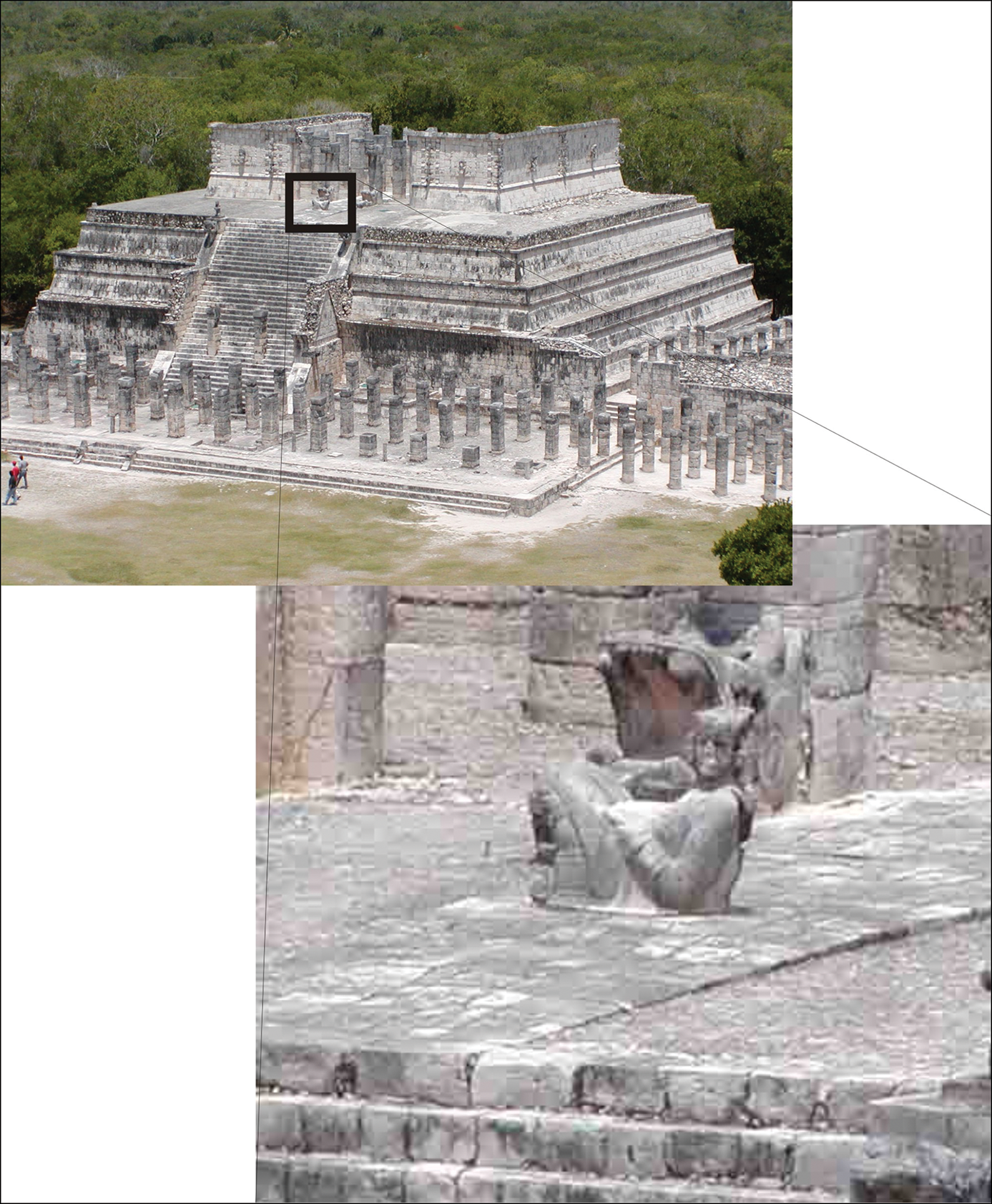
Chacmool sculptures are best known from the archaeological sites of Tula in the central Mexican state of Hidalgo and Chichen Itza in the state of Yucatan (see Figure 2). Twelve examples are documented at the former site, and 18 at the latter (Miller Reference Miller1985; López Austin & López Luján Reference López Austin and López Luján2001; Maldonado Cárdenas & Miller Reference Maldonado Cárdenas and Miller2017). Multiple chacmools, however, are also known from the Mexican states of Tlaxcala and Michoacan. Furthermore, an example was excavated at the Central American Maya site of Quirigua in Guatemala, near the Honduran border, and two others excavated at Tazumal in western El Salvador (Sharer Reference Sharer1974: 172–73, Reference Sharer, Case and Rice1985: 250)—at the southern edge of the Mesoamerican culture area. The earliest examples date from the Terminal Classic period (AD 800–1000) at Tula and Chichen Itza. Two chacmools excavated from the Aztec capital of Tenochtitlan date to the final centuries before the arrival of the Spanish (Miller & Samayoa Reference Miller and Samayoa1998: 67–69), demonstrating the use of this sculptural form for over 500 years—and the contemporaneity of use of chacmools in Mesoamerica and lower Central America. Despite the lack of consensus around the precise interpretation of the iconography, scholars agree that these distinctive sculptures were intended to depict widely recognised personages and events. The eight Costa Rican sculptures described here were a reinterpretation of this distinctive Mesoamerican sculptural form. As with the chocolate pots and scarlet macaw feathers documented in the U.S. Southwest, these Costa Rican chacmools represent the material remains of ritual behaviour that, by AD 1000, extended over very long distances.
Las Mercedes
The site of Las Mercedes has a 150-year history of exploration, with formal excavations first undertaken at the site's core in the late nineteenth century (Hartman Reference Hartman1901; Skinner Reference Skinner and Lothrop1926). Prior to this, Minor Keith, one of the founders of the United Fruit Company, had promoted the removal of thousands of stone sculptures, as well as ceramic, stone and gold artefacts from Las Mercedes, and their shipment to New York (Mason Reference Mason1945). Hartman (Reference Hartman1901) documented a 6m-high central mound, as well as 1.5m-high by 4m-wide stone walls measuring hundreds of metres in length. Two life-sized stone sculptures—possibly depicting officials wearing conical-shaped hats—were recovered from the central mound's north-west side and transported by Hartman to the National Museum of Copenhagen, where they still reside.
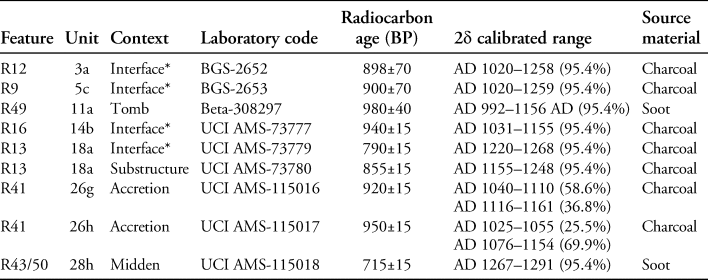
Our recent work at the site has uncovered new architectural features, and contextualises the setting in which the chacmool was erected at the centre of Las Mercedes (Vázquez et al. Reference Vázquez, Latimer and Rosenswig2012, Reference Vázquez, Rosenswig, Buyantuev, Marx, Vargas and Brenes2018; Vázquez & Rosenswig Reference Vázquez and Rosenswig2016). Two stone-paved causeways, measuring 7m in width and 1.4 and 1.3km in length, were documented entering the site's centre from the north-west and south-east, respectively. Another recent discovery is a semi-circular, stone-enclosed water tank built immediately to the south-east of the central mound and in front of where the life-sized stone sculptures had been set (Vázquez & Rosenswig Reference Vázquez and Rosenswig2016). The overall orientation of Las Mercedes aligns with the local topography along the edge of the piedmont below the Turrialba volcano. The railway and modern highway run parallel to the causeways and the overall site alignment. At least eight elite residential mounds are documented at Las Mercedes, each measuring 2m in height and up to 30m in diameter. Each elite residence has a proportionately large elevated porch (Vázquez et al. Reference Vázquez, Rosenswig, Buyantuev, Marx, Vargas and Brenes2018). Six of these elite mounds were tested and the area beneath each was burned before construction began. This burning left a distinctive charcoal layer at all the tested mounds; these layers date to AD 1000–1200 (Table 1; Vázquez & Rosenswig Reference Vázquez and Rosenswig2016).
Las Mercedes AMS radiocarbon dates (from Vázquez & Rosenswig Reference Vázquez and Rosenswig2016: tab. 4). Dates calibrated in OxCal 4.3.2 using the IntCal 13 atmospheric curve (Bronk Ramsey Reference Bronk Ramsey1995, Reference Bronk Ramsey2019; Reimer et al. Reference Reimer2013).

* Interface between base soil/construction fill.
Las Mercedes was the paramount centre of a regional chiefdom. Ten smaller, secondary centres are also known, with elite residential mounds defining the core of each (Vázquez et al. Reference Vázquez, Latimer and Rosenswig2012; Vázquez & Rosenswig Reference Vázquez and Rosenswig2016). A large secondary centre is located at each edge of the chiefdom: La Iberia to the south-east and Anita Grande at the north-west. At both of these sites, burning events undertaken before the construction of elite platform mounds have also been dated to AD 1000–1200 (Vázquez et al. Reference Vázquez, Latimer and Rosenswig2012, Reference Vázquez, Rosenswig, Buyantuev, Marx, Vargas and Brenes2018). Hence, by the beginning of the first millennium AD, a regional chiefdom was established, operating in a similar way to that documented farther south in Panama (Helms Reference Helms1979). The establishment of Las Mercedes as the paramount centre of a regionally integrated chiefdom was the political context in which chacmool sculptures and associated practices were adopted.
Las Mercedes chacmools
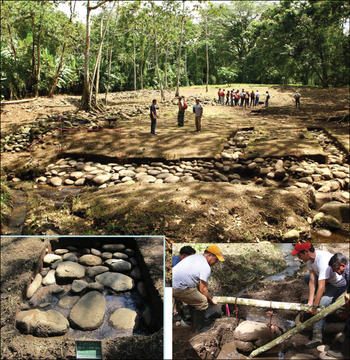
The new chacmool was excavated at Las Mercedes in 2012 (Vázquez & Rosenswig Reference Vázquez and Rosenswig2016; Figure 1; Figure S1 in the online supplementary material (OSM)), located upside-down at the edge of a stream that defines the north-west side of the site's core (Figure 4). Many more sculptures littered the site's centre, but these were removed long ago (see Mason Reference Mason1945). The newly discovered chacmool was in a prominent location: 5m from a causeway leading into the site, in the middle of an open, stone-lined plaza behind (i.e. to the south-east of) the central mound. This paved plaza is defined on three sides by stone enclosures and measures 650m2. We interpret this carefully constructed plaza at the heart of the site's centre as the location where tribute payments would have been deposited by visiting dignitaries to honour the paramount chief of Las Mercedes.
Photographs of the plaza at Las Mercedes (photographs by R.M. Rosenswig).

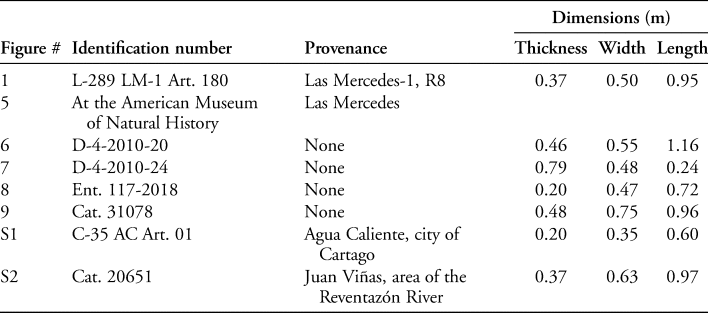
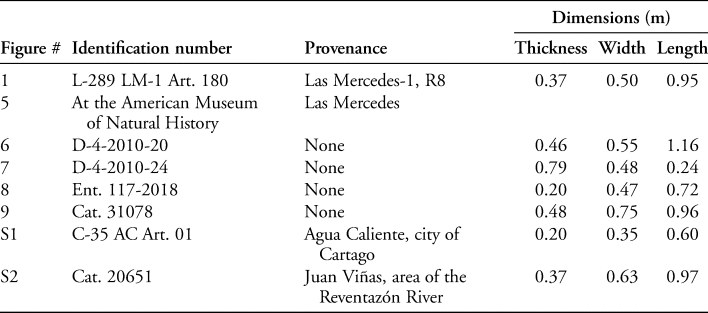
The newly discovered sculpture depicts a reclining individual with knees raised and arms extended behind the head (Figure 1 & Table 2). The face is monkey-like, with a band over the top of the head suggestive of a mask. The eyes are large, void and almond-shaped. The nose is broad and the open mouth exhibits large canines. A jaguar head, which appears to be phallic when viewed from the sides or top, emerges from between the knees (Figure 1a & 1c). When viewed from the foot end (Figure 1b), however, the sculpture's legs and feet resemble the front limbs of a jaguar, with its head raised above the front paws. From this angle, the human knees become the jaguar's shoulders. The image could resemble a snake when viewed from this angle (Figure 1b), but large mandibular canines (and the depiction of ears) make this interpretation unlikely. A deep receptacle is located on the individual's stomach, extends under the chin and is contained between the arms and upper thighs; the jaguar-head phallus defines the receptacle's fourth side. The arms are anatomically incorrect, as the elbows are on the ground below the shoulders, with hands behind the head (Figure 1c). As a result, the individual's armpits clasp the receptacle.
Dimensions of eight known Costa Rican chacmools.
The chacmool at the American Museum of Natural History
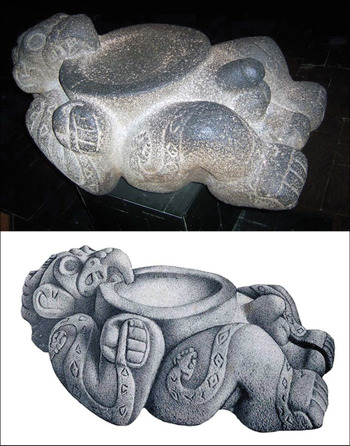
The chacmool at the American Museum of Natural History (Figure 5 & Table 2) was taken from an unknown context at Las Mercedes and was brought to the USA by Minor Keith in the nineteenth century (Mason Reference Mason1945). It shares many common features with the sculpture excavated in 2012. The head and knees are bent and the feet and toes are depicted, as are the penis and testicles. This individual has a hooked beak, pointed teeth and head feathers, although it is depicted with human ears. As with the 2012 discovery, we interpret this as a human figure wearing a mask, rather than a mythological hybrid creature. Furthermore, the receptacle on the sculpture at the American Museum of Natural History is also held under the chin. The arm position is more consistent with Mesoamerican chacmools (Miller Reference Miller1985), as the elbows rest on the ground and the hands support the receptacle, rather than being placed behind the head, as in the 2012 example. A distinctive characteristic of the American Museum of Natural History sculpture is that it depicts four snakes in low relief, one on each arm and on each leg. While these snakes could represent tattoos, both examples on the individual's arms have their tails held in the figure's hands, and the snakes on the legs have their tails pinned under his feet. The snakes have a diamond pattern on their bodies and their heads are triangular—characteristics shared by many venomous species. The receptacle held by the American Museum of Natural History sculpture is very shallow and is consistent with those Mesoamerican chacmools that are interpreted as holding mirrors (Miller Reference Miller1985).
Photograph and drawing of the Costa Rican chacmool; housed at the American Museum of Natural History (photograph by R. Vázquez Leiva and drawing after Mason Reference Mason1945: pl. 35c).

Chacmools in the National Museum of Costa Rica
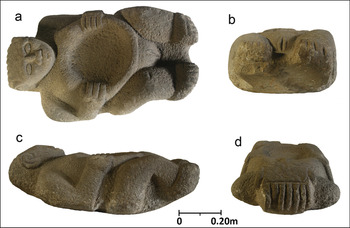
The National Museum of Costa Rica houses six stone sculptures depicting reclining individuals holding dishes or discs on their stomachs (Table 2). As none of these sculptures have provenance, we cautiously interpret them together with the two examples from Las Mercedes as Costa Rican interpretations of the Mesoamerican chacmool. One individual depicts a female wearing a monkey-like mask (Figures 6 & S2–6). Unlike both known chacmools from Las Mercedes, this individual's ears are not human-like. Instead, they are curly (see Figure S5) and resemble those on the jaguar-head phallus of the newly excavated sculpture from Las Mercedes (Figure 1c). These curly ears connect to the individual's eyebrows. A vulva depicted between the raised knees clearly reveals the sex of this chacmool. A shallow dish is supported by hands with outstretched fingers, along with clearly depicted breasts. This sculpture wears bracelets and her hair is depicted in a mullet style: cut over the ears and long down the back. Mullets are frequently depicted on sculptures of standing warriors who brandish an axe in an upraised hand (Snarskis Reference Snarskis1998: 28–30). The individual's pose is stiff, with elbows firmly planted on the ground and the face looking straight upwards.
Photograph of Costa Rican chacmool with mask and curly ears; housed at the National Museum of Costa Rica (chacmool cat. 31956) (photograph by N. Ríos).

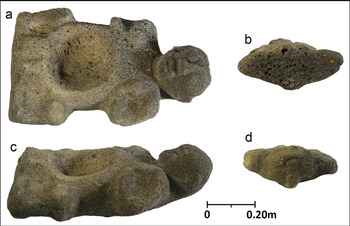
Another chacmool-like sculpture in the National Museum of Costa Rica has a half-circle-shaped face (not wearing a mask), with almond-shaped eyes, a wide nose and human ears (Figures 7 & S7–8). This Costa Rican chacmool-like sculpture resembles those from Mesoamerica more than any of the others. A clearly depicted vulva makes the sex of this individual unambiguous. The sculpture's knees are raised, her elbows are on the ground and the hands clasp a deep dish, with fingers curving into the receptacle. The back is curved so that the sculpture could easily have been rocked back and forth, suggesting that rather than be fixed in a prominent location, this sculpture may have been interacted with and moved.
Photograph of a well-preserved female Costa Rican chacmool with no mask; housed at the National Museum of Costa Rica (chacmool cat. 31957) (photograph by N. Ríos).

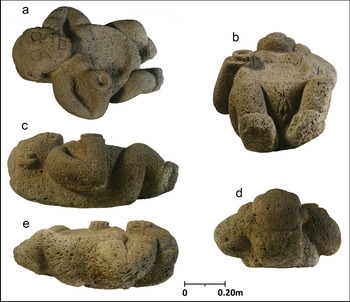
Three other female chacmool-like sculptures are housed at the National Museum of Costa Rica (Figures 8 & S9–21). Each of these sculptures has a human face and ears, as well as a vulva. Unlike the example presented in Figure 7, these three sculptures each lack detail on their legs. Two have no legs extending beyond their vulvae (Figures 8 & S9–S11 & S21), and the third has short stumps (~0.15m long) with no feet or knees (Figures S12–13). The example presented in Figure 8 is depicted holding her breasts. Female sculptures depicted with thin arms ending in poorly defined hands and holding their breasts are very common in the Costa Rican stone sculpture tradition (e.g. Mason Reference Mason1945: 36–38; Snarskis Reference Snarskis1998: 33 & 37). The two female chacmools included in the OSM (Figures S12 & S21) have a squared, rather than round, receptacle. They also both have rounded backs (Figures S14 & S20) so that they can potentially be rocked (Figure S8).
Photograph of an eroded female Costa Rican chacmool holding her breasts; housed at the National Museum of Costa Rica (ent. 117–2018) (photograph by N. Ríos).

The eighth known Costa Rican chacmool wears a monkey mask with round, void eyes, prominent canines and human ears featuring round earspools (Figures 9 & S22–24). This individual has a vulva and holds a small, shallow receptacle in her right hand. The left arm is raised up, with the left hand resting on the individual's cheek. The right elbow is on the ground and the chacmool dish is held by the right hand, on the back of which is a small, round receptacle. One of the chacmools from Chichen Itza also holds a very similar small receptacle in its right hand (Maldonado Cárdenas & Miller Reference Maldonado Cárdenas and Miller2017: fig. 7). The hands and feet of the Costa Rican chacmools are crude, although the fingers and toes are all clearly indicated. As with most of the Costa Rican female chacmool-like sculptures, the back of this individual is also rounded.
Photograph of masked Costa Rican chacmool with one hand on its cheek; housed at the National Museum of Costa Rica (chacmool cat. 31078) (photograph by N.Ríos).

Discussion
As a group, the eight Costa Rican chacmools share attributes with those known from Mesoamerica. First, they all depict individuals on their backs, with raised knees and heads. They are therefore all in the same vulnerable position. The vulnerability of this pose is remarkable, given that the majority of lower Central American sculptures from this time depict warriors in threatening poses (Snarskis Reference Snarskis1998; Ibarra Rojas Reference Ibarra Rojas2012). These chacmools are therefore foreign to the majority of the local sculptural traditions. Second, most Costa Rican chacmools cradle a disc or dish on their chests and stomachs. These are generally held by the individual's hands, although our excavated example from Las Mercedes is an exception. We propose that these formal characteristics and the unusual subject matter are sufficient for us to interpret these Costa Rican sculptures as local versions of the Mesoamerican chacmool form. The newly discovered Costa Rican chacmool from Las Mercedes is the only one so far documented beyond Mesoamerica through controlled archaeological investigation. It was recovered from a prominent location at the central site of a paramount chiefdom built shortly after AD 1000 (Vázquez & Rosenswig Reference Vázquez and Rosenswig2016). The dating of the elite platform mounds at Las Mercedes to immediately after AD 1000 links these lower Central American sculptures to the Mesoamerican prototype that began between AD 800 and 1000 (Miller Reference Miller1985). Mesoamerican chacmools were employed in public contexts up to 200 years earlier than those from Costa Rica, and were therefore the likely source of inspiration.
The Costa Rican chacmools also share characteristics with each other that are different to those in Mesoamerica. The similarities of the eight currently known Costa Rican examples establish them as a geographically distinct sculptural assemblage. The first and most obvious characteristic that distinguishes the Costa Rican examples is that none of their heads is rotated to the side. Instead, the heads all face straight upwards. We propose that this distinctive feature could be due to a difference in the context of their use. Rather than being observed from a distance, the people witnessing ceremonies conducted with these chacmools were probably gathered close by, and could view them from above and on all sides. This hypothesis is consistent with our interpretation that chacmools with rounded backs could have been rocked. Lower Central American chacmools may therefore have been interacted with in a much more intimate manner than their Mesoamerican counterparts.
The second distinctive characteristic of the Costa Rican chacmool assemblage is that the primary sexual traits of male and female individuals are clearly represented. Due to the small and mostly unprovenanced sample, however, we do not want to over-interpret this characteristic. Regardless, sex in the Costa Rican chacmools is depicted purposefully and differently from those known from Mesoamerica. We propose that these differences represent the integration of Mesoamerican ideas into a well-established lower Central American belief system—expressed in a large corpus of stone sculptures—in order to support the local status claims of elite individuals. Chacmool sculptural imagery and related rituals and beliefs reflected the possession of knowledge from distant lands by ancient Costa Rican chiefs.
Lower Central America has a long tradition of carved stone sculptures depicting violence and its aftermath (Ibarra Rojas Reference Ibarra Rojas2012). This includes the depiction of rulers with raised knives and wearing severed trophy heads on their belt (Snarskis Reference Snarskis1998). Other common forms include depictions of just the severed heads with closed eyes (Hoopes Reference Hoopes, Chacon and Dye2007). The eight Costa Rican chacmool sculptures described here are recognisably linked to Mesoamerica in terms of their form. As with the Chacoan chocolate pots, however, this ritual furniture was reimagined in terms of local imagery within established practices of stone carving.
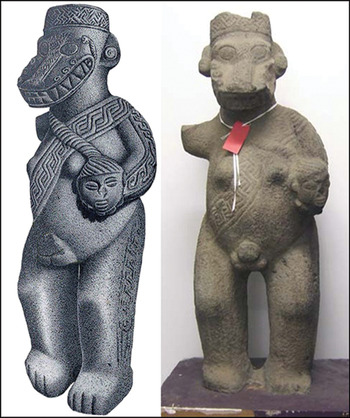
A salient example of the larger Costa Rican sculptural tradition from Las Mercedes is a standing individual wearing a crocodilian mask, with human ears featuring round ear spools akin to those exhibited by the Costa Rican chacmool shown in Figure 9 (see Figure S24) (Figure 10). Currently held in the Keith collection at the Brooklyn Museum in New York, this individual has a trophy head held in his left hand with the head's long, twisted hair over his right shoulder. The figure has a penis (now partially broken) and feet and toes depicted in the same stylised manner as some of the Costa Rican chacmool sculptures. Furthermore, a woven motif depicted up his arms and legs is reminiscent of the engraved snake imagery visible on the chacmool in the American Museum of Natural History (see Figure 5). In addition, this same woven motif is found on the sash worn over the standing figure's left shoulder, around his hat, between his eyes and down the snout of his mask. This woven mat motif is well attested in Mesoamerica from the Late Classic period (AD 600–800) onward, and is associated with royalty (Sparry Reference Sparry1976).
Standing individual with trophy head and mask; housed at the Brooklyn Museum (photograph by R. Vázquez Leiva).

During the Terminal Classic period (AD 800–1000), a state cult is believed to have emerged at Chichen Itza that emphasised militarism and the long-distance trade of elite goods (Ringle et al. Reference Ringle, Gallareta Negron and Bey1998). The associated political ideology was soon adopted by other Mesoamerican elites, such as those in the Mexican states of Hidlago, Tlaxcala and Michoacan. Within Mesoamerica, this new ideology provided an impetus to expand beyond traditional borders and seek out new peoples and new civilisations (Ringle et al. Reference Ringle, Gallareta Negron and Bey1998). The overland distance from Chichen Itza to Tula is approximately 1500km, and around 2100km from Chichen Itza to Las Mercedes. It is only 630km from Tazumal in western El Salvador (the southernmost location of a known Mesoamerican-style chacmool) to Las Mercedes. These distances are comparable to the 1800km from Chaco Canyon to the Gulf Coast, where the closest populations of scarlet macaws are found (Watson et al. Reference Watson, Plog, Culleton, Gilman, LeBlanc, Whiteley, Claramunt and Kennett2015). Thousands of kilometres were traversed during the early first millennium AD, linking peoples from the U.S. Southwest to Mesoamerica, as well as Costa Rica in the central Caribbean region of lower Central America.
Soon after AD 1000, peoples to both the north and the south of Mesoamerica were interacting with it in novel ways, as inhabitants of both the U.S. Southwest and lower Central America possessed raw materials desirable to Mesoamerican elites. The U.S. Southwest had turquoise and lower Central America had a thriving tradition of gold smithing (Quilter & Hoopes Reference Quilter and Hoopes2003). Chichen Itza's cenote famously contains gold objects, amongst many other riches. A chacmool once stood at the entrance to the road leading from the Cenote to the site's centre (Ringle Reference Ringle2004: 190), thus associating this sculptural form with the depositional context of lower Central American gold. As there are no known gold sources in Mesoamerica, its acquisition probably motivated Mesoamerican elites to establish exchange networks with distant peoples to the south. Reciprocally, the use of novel chacmool sculptures and associated rituals at Las Mercedes would have bolstered local chiefly power through the display of esoteric knowledge and rituals. Connections with Mesoamerican societies were desirable for lower Central American chiefs due to the acquisition of exotic knowledge and beliefs. As such, the Costa Rican chacmool sculptures were stone furniture connected to rituals performed in prominent public locations at political centres, such as Las Mercedes.
Conclusion
The knowledge of foreign beliefs and customs acquired through long-distance travel imbued those who partook in such endeavours with prestige when they returned home (e.g. Rosenswig Reference Rosenswig2010: 13–46). The eight Costa Rican chacmools reported in this article represent the material remains of such travel and the import of novel ideas. Did the chiefs of Las Mercedes actually travel to the city of Chichen Itza? Probably. The distance is barely more than that between Mexican cities of Chichen Itza and Tula. Alternatively, the Costa Rican chiefs could have travelled the 630km to Tazumal in El Salvador, or to a yet undiscovered site with chacmools in the intervening area. Regardless, somewhere to the south of the Mesoamerican culture area, chacmool imagery was reinterpreted using the aesthetics of a long-standing lower Central American sculptural tradition. The dichotomies of sex were introduced to recast the Mesoamerican sculptural trope of an asexual individual as both male and female versions of the chacmool, with each sex still depicted in the characteristic prone position, with raised head and knees supporting a disc or dish. Furthermore, rather than stiffly looking sideways, the Costa Rican interpretations look straight upwards, so they could be viewed by the people who were directly interacting with them. Although we will never know the specific beliefs or precise rituals associated with Costa Rican chacmools, the formal similarities and dating of the newly excavated Las Mercedes example indicates that exotic ideas were adapted from distant Mesoamerica. Moreover, the adoption of the Mesoamerican chacmool form and the adaptation to lower Central American sculptural norms was almost certainly undertaken soon after AD 1000 to enhance the prestige of local chiefs. Mesoamerican-inspired ritual practices are also known from the U.S. Southwest (e.g. Crown & Hurst Reference Crown and Hurst2009; Watson et al. Reference Watson, Plog, Culleton, Gilman, LeBlanc, Whiteley, Claramunt and Kennett2015) at the beginning of the first millennium AD, after a new expansionary religion developed in Mesoamerica (see Ringle et al. Reference Ringle, Gallareta Negron and Bey1998). The discovery and dating of the Las Mercedes chacmool (see Figure 1) to AD 1000–1200 situates the rituals undertaken at this paramount chiefly centre in Costa Rica within the larger Pan-American world of rulers and shared public ceremonies.
Acknowledgements
Our thanks to all of the participants of four undergraduate field schools at Las Mercedes in 2005, 2009, 2012 and 2017. Excavations were undertaken with permits graciously issued by the Comisión Arqueológica Nacional. Permission to work at Las Mercedes was provided by EARTH University, and Dennis Blanton was instrumental in excavations of the new Costa Rican chacmool. Access to all of the sculptures was provided and supervised by the Departamento de Protección del Patrimonio Cultural, National Museum of Costa Rica. We also acknowledge the helpful comments of the peer reviewers.
Funding statement
We acknowledge the financial support of the University at Albany's Department of Anthropology and the Study Abroad office, as well as the support of the National Museum of Costa Rica's Departamento de Antropología e Historia.
Supplementary material
To view supplementary material for this article, please visit https://doi.org/10.15184/aqy.2020.227